R E S E A R C H
Open Access
An improved EZBC algorithm based on block bit
length
Renlong Wang
1, Shuangchen Ruan
1*, Chengxiang Liu
1, Wenda Wang
2and Li Zhang
3Abstract
Embedded ZeroBlock Coding and context modeling (EZBC) algorithm has high compression performance. However, it consumes large amounts of memory space because an Amplitude Quadtree of wavelet coefficients and other two link lists would be built during the encoding process. This is one of the big challenges for EZBC to be used in real time or hardware applications. An improved EZBC algorithm based on bit length of coefficients was brought forward in this article. It uses Bit Length Quadtree to complete the coding process and output the context for Arithmetic Coder. It can achieve the same compression performance as EZBC and save more than 75% memory space required in the encoding process. As Bit Length Quadtree can quickly locate the wavelet
coefficients and judge their significance, the improved algorithm can dramatically accelerate the encoding speed. These improvements are also beneficial for hardware.
PACS: 42.30.Va, 42.30.Wb
Keywords:block bit-length, zeroblock, EZBC, Quadtree, DWT
1. Introduction
At present, the typical embedded wavelet-based image coding methods includes Embedded Zerotree Wavelet coder (EZW) [1] proposed by Shapiro, Set Partitioned in Hierachical Tree (SPIHT) [2] proposed by Said etc., Set Partition Embedded block algorithm (SPECK) [3] pro-posed by Asad Islam, Embedded Block Coding with Optimal Truncation (EBCOT) [4] used in JPEG2000 [5], and Embedded ZeroBlock Coding and context modeling (EZBC) [6] proposed by Shih-Ta Hsiang etc.
Among these algorithms, EZW and SPIHT were based on the local characteristic in spatial-frequency domain of wavelet transform. They utilized the similarity of wavelet coefficients of the same spatial location in differ-ent subbands. SPECK was based on the characteristic that the energy concentrated in low-frequency subband and the insignificant coefficients mainly concentrated in high-frequency subbands after wavelet transform, it uti-lized the correlation of insignificant coefficients in the same subband. EBCOT used the correlation of wavelet coefficients in the same subband to build the high
efficiency context and adopted the Arithmetic Coder. EZBC utilized the correlation of coefficients in the same sub-band and coefficients in different subbands at the same time and adopted a simple and efficient quadtree coding structure and context-based bitplane encoding method [6,7], so it can achieve higher compression per-formance than SPIHT and EBCOT. EZBC algorithm is widely used in digital image compression and scalable video coding.
However, during the encoding process EZBC built an Amplitude Quadtree Qk[l](i, j) and two link lists: the insignificant nodes link list LINand the significant pix-els link list LSP. Both Amplitude Quadtree Qk[l](i, j) and the link lists consumed a large amounts of memory space and this was one of the big challenges for the EZBC to be used in real time or hardware applications. As it has a large amount of operations of link lists such as adding and deleting nodes during encoding, this made its coding efficiency decline greatly when good image quality is required. The algorithm proposed in reference [8] presented the significance state-table of Quadtree coefficients to record the significance state change of all the QuadTree corresponding coefficients in the coding of Quadtree bitplane, which removed the LIN and LSP. Some memory was saved but Qk[l](i, j)
* Correspondence: [email protected]
1
Shenzhen Key Laboratory of Laser Engineering, College of Electronic Science and Technology, Shenzhen University, Shenzhen, 518060, China Full list of author information is available at the end of the article
was still adopted in the algorithm. Instead of making any radical change, it increased the complexity of the algorithm on the contrary.
In order to overcome these disadvantages, an improved EZBC algorithm, Bit Length EZBC (BL-EZBC) based on bit length of coefficients, was put forward in this article. It used Bit Length Quadtree instead of Amplitude Quadtree of wavelet coefficients and other two link lists, so it can save more than 75% memory space required in the encoding process. As Bit Length Quadtree can quickly locate the wavelet coefficients, judge their significance, and avoid a large amount opera-tions of link lists used in EZBC, this algorithm can accelerate the encoding speed effectively. The test results indicates that this algorithm achieves the same signal to noise ratio as EZBC and gains much higher encoding speed, saves 75% memory usage than EZBC.
2. Bit Length Quadtree
The bitplane coding process in BL-EZBC begins with establishment of the Bit Length Quadtree representa-tions for the individual subbands. The bit length here refers to the significant bit length of the absolute value of quantized wavelet coefficient. The value of the Bit Length Quadtree nodeBk[l](i, j) at position (i, j), quad-tree levelland subbandkis defined by
Bk[l](i,j) = ⎧ ⎪ ⎪ ⎪ ⎪ ⎪ ⎪ ⎪ ⎪ ⎪ ⎪ ⎪ ⎪ ⎪ ⎪ ⎪ ⎪ ⎨ ⎪ ⎪ ⎪ ⎪ ⎪ ⎪ ⎪ ⎪ ⎪ ⎪ ⎪ ⎪ ⎪ ⎪ ⎪ ⎪ ⎩
0, l≡0,ck(i,j)<1
1 +log2(ck(i,j))
l≡0, ck(i,j)≥1
max ⎧ ⎪ ⎪ ⎪ ⎨ ⎪ ⎪ ⎪ ⎩
Bk[l−1](2i, 2j) Bk[l−1](2i+ 1, 2j) Bk[l−1](2i, 2j+ 1)
Bk[l−1](2i+ 1, 2j+ 1) ⎫ ⎪ ⎪ ⎪ ⎬ ⎪ ⎪ ⎪ ⎭
l>0
(1)
whereCk(i, j) is the quantized subband coefficient at position (i, j). |x| indicates the absolute value ofx; x indicates the rounding operation on x. For example, if x=3.8, then x ≡ 3 where “ = “ means assignment and“≡”indicates the equality test.
Below is an example forBk[l](i, j).
IfCk(i, j) = (± 9), then Bk[0](i, j) = 4. That is, the sig-nificant bit length of ± 9 is equal to 4.
Each bottom quadtree node is assigned to the bit length of the subband coefficient at the same position. The quadtree node at the next level is then set to the maximum of the four corresponding nodes at the cur-rent level, as illustrated in Figure 1a. The top quadtree node is just equal to the maximal bit length of all sub-band coefficients. Similar to the conventional bitplane coders, we progressively encode subband coefficients from the MSB toward the LSB. In the Bit Length
Quadtree, a node is significant if the value of the node Bk[l](i, j) is great than the index of the bitplane. A sig-nificant pixel (coefficient) is located by the testing and splitting operation recursively performed on the signifi-cant nodes up to the pixel (bottom) level of a quadtree, as shown in Figure 1b.
Instead of using Amplitude QuadtreeQk[l](i, j) and two link lists in EZBC, the bit length of the Quadtree in BL-EZBC is built up with the bit length of the absolute value of the subband coefficients. It corresponds to the index of the bitplane. It means that Bit Length Quadtree can quickly locate the wavelet coefficients and judge their sig-nificance. Thus, it can accelerate the encoding speed effectively. And the lists of insignificant nodesLINand significant nodesLSPrequired in EZBC are not necessary in BL-EZBC. What iss more, the usual bit length of wave-let coefficients is 16. That is, each node of Amplitude QuadtreeQk[l](i, j) uses 16 bit length memory. However, in BL-EZBC, each node of the Bit Length QuadtreeBk[l] (i, j) uses 4 bit length memory. For 4 bit length, the max value it can represent is 15. It means that the corre-sponding max absolute value of wavelet coefficients is 215 - 1 = 32767. Generally, the absolute value of the wavelet coefficients is less than 32767. That is, 4 bit length of each node of Bit Length Quadtree can represent the bit length of wavelet coefficients. This saves a large amount of memory space required in the coding process.
3. The coding process of BL-EZBC First, define parameters below,
•Ck (i, j): the quantized wavelet coefficient of sub-bandkat position (i, j).
6LJQLFDQW1RGH 4XDGWUHH OHYHO 6LJQLFDQW1RGH ,QVLJQLFDQW1RGH &RGHVWUHP
(a)4XDGWUHH%XLOGXS (E)4XDGWUHH6SOLWWLQJ 4XDGWUHH
OHYHO
4XDGWUHH OHYHO 3L[HOOHYHO
• Bk[l](i, j): Bit Length QuadtreeBrepresentation for the bit length of coefficients from the same subband with node of Bk[l](i, j) corresponding to a quadtree node at position (i, j), Subandk, and levell. Its value is defined by (1).
• Dk: depth of the quadtree of the subbandk. • Dmax: the maximum quadtree depth among all subbands.
• K: total number of subbands.
• Xk: Horizontal offset of the subbandkreferring to the original image, left-to-right as a positive direction.
• Yk: Vertical offset of the subbandkreferring to the original image, top-to-down as a positive direction.
• CodeBL(k, l): Function for coding the insignificant node of level lin Bit Length Quadtree of subbandk. Its parent node should be signficant in the last bit-plane if it exists.
• CodeDescendant(k, l, i, j): function for processing all the descendent nodes of Bk [l](i, j) after it just tested significant against the current threshold.
• CodeLSP(k): function for refinement of the coeffi-cients of subband k.
The coding process,
Initialization,n= max(k) {Bk[Dk−1](0, 0)};
Coding the highest bitplane, for k= 0:K-1,Code BL(k, Dk-1); n–;
Coding the remaining bitplanes.
for(;n> 0;n–){ for l= 0:Dmax-1
for k= 0:K-1,Code BL(k, l); for k= 0:K-1,Code LSP(k);
}
Below are the functions in pseudocode, CodeBL(k, l)
{
•if(l<Dk- 1)
* for all (i, j) in quadtree level l+1, subbandk. That is, all the nodes in levell+1 of Bit Length Quadtree of subbandk
⋆if(Bk[l+1](i, j) >n),CodeDescendant (k, l+1, i, j);
•else if(l≡Dk- 1)
*if(Bk[l](0, 0) <n), output 0; *else if(Bk[l](0, 0)≡n){
output 1; ⋆if(l≡0)
-output the sign of Ck(0+Xk, 0+Yk);
⋆else
- CodeDescendant(k, l, 0, 0); }
}
CodeDescendant(k, l, i, j) {
•for (x, y)Î{(2i, 2j), (2i, 2j+1), (2i+1, 2j), (2i+1, 2j +1)}. That is, the four child nodes in levell-1 that mapping to the node (i, j) in levell, subband k
*if(Bk[l-1](x, y) <n), output 0; *else if(Bk[l-1](x, y)≡n){
output 1; ⋆if(l≡1)
-output the sign of Ck(x+Xk,y+Yk); ⋆else
-CodeDescendant(k, l-1,x, y); }
}
CodeLSP(k)
{
•for all (i, j) in quadtree level 0, subbandk. That is, all the nodes in level 0 of Bit Length Quadtree of subbandk, scanning first in row then column.
*if(Bk[0](i, j) >n),outputthe value of| Ck(I+Xk,j+ Yk) | in bitplanen.
}
4. Experimental results and analysis
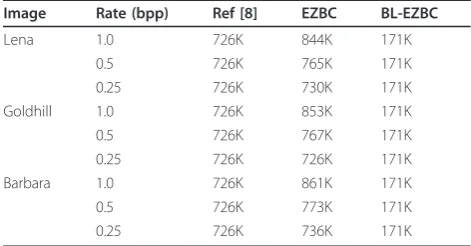
The improved algorithm BL-EZBC and the original EZBC were verified and compared in Pentium(R) D CPU 2.80 GHz computer with 512 × 512 × 8 bits Stan-dard grayscale images of Lena, Goldhill and Barbara. 9/7 Wavelet filters boundary symmetrical extension was used. The context model was the same as which used in EZBC algorithm, the algorithm data in reference [8] were quoted here. Table 1 listed out the PSNR compari-son. Table 2 shows the memory usage comparison dur-ing coddur-ing. Table 3 shows the coddur-ing time comparison with different thresholds of BL-EZBC and EZBC.
complexity of the hardware. Although linked lists LIN andLSPwere removed from the algorithm in reference [8], Amplitude Quadtree Qk[l](i, j) and significance state-table of Quadtree coefficients were still adopted, which also occupied a lot of memory and increased the algorithm complexity. Bit Length Quadtree was pre-sented to replace the Amplitude Quadtree in the improved algorithm, which was used to complete the coding process and construct the context, so the mem-ory usage was greatly reduced during the coding. As shown in Table 2, by using the improved algorithm BL-EZBC, more than 75% memory was saved compared to the original EZBC algorithm. Therefore, the memory usage was significantly reduced.
As EZBC used a large amount of operations of link lists such as adding and deleting nodes during encod-ing, this made its coding efficiency decline greatly when good image quality was required. Instead of using Amplitude QuadtreeQk[l](i, j) and two link lists in EZBC, the bit length of the Quadtree in BL-EZBC is built up with the bit length of the absolute value of the subband coefficients. It corresponds to the index of the bitplane. It means that Bit Length Quadtree can quickly locate the wavelet coefficients, judge their sig-nificance. Thus, it can accelerate the encoding speed effectively. As shown in Table 3, if the threshold less than 32, the coding time of BL-EZBC was significantly less than EZBC. If the threshold is great than or equal
to 32, the coding time of BL-EZBC was less than EZBC too. However, it was not so obvious. A larger threshold means less bitplanes would be scanned, the size of link lists was smaller, and the operations of link lists were also fewer. As the larger threshold means the worse image quality, in most situations in order to achieve better image quality the threshold was not so large. When good image quality was required, the cod-ing speed of BL-EZBC is significantly faster than EZBC.
5. Conclusion
An improved algorithm BL-EZBC based on EZBC was proposed in this article. A new model Bit Length Quad-tree was used to complete the coding process and con-struct the context. It can achieve the same compression performance as EZBC but the memory usage was greatly reduced during the coding process. Bit Length Quadtree can quickly locate the wavelet coefficients, judge their significance, and avoid a large amount operations of link lists used in EZBC. Thus, it can accelerate the encoding speed effectively. These improvements are also beneficial for the hardware.
Abbreviations
EBCOT: Embedded Block Coding with Optimal Truncation; EZBC: Embedded ZeroBlock Coding and context modeling; EZW: Embedded Zerotree Wavelet coder; SPECK: Set Partition Embedded block algorithm; SPIHT: Set Partitioned in Hierachical Tree.
Acknowledgements
This work was supported in part by the Shenzhen Double Hundred Person Project and the Shenzhen University Dr start-up fund research (000201) of China.
Author details
1Shenzhen Key Laboratory of Laser Engineering, College of Electronic
Science and Technology, Shenzhen University, Shenzhen, 518060, China
2
College of Automation, Harbin Engineering University, Harbin, 15001, China
3College of Information Engineering, Shenzhen University, Shenzhen, 518060,
China
Competing interests
The authors declare that they have no competing interests. Table 1 PSNR(dB) comparison.
Image Rate (bpp) Ref [8] EZBC BL-EZBC
Lena 1.0 40.58 40.63 40.63
0.5 37.44 37.49 37.49
0.25 34.32 34.41 34.42
Goldhill 1.0 36.78 36.93 36.93
0.5 33.37 33.45 33.45
0.25 30.71 30.77 30.76
Barbara 1.0 37.17 37.35 37.37
0.5 32.08 32.27 32.28
0.25 28.20 28.37 28.39
Table 2 Memory usage comparison (Bytes).
Image Rate (bpp) Ref [8] EZBC BL-EZBC
Lena 1.0 726K 844K 171K
0.5 726K 765K 171K
0.25 726K 730K 171K
Goldhill 1.0 726K 853K 171K
0.5 726K 767K 171K
0.25 726K 726K 171K
Barbara 1.0 726K 861K 171K
0.5 726K 773K 171K
0.25 726K 736K 171K
Table 3 Coding time comparison with different threshold with BL-EZBC and EZBC (ms).
Threshold 1 2 4 8 16 32 64
Lena
BL-EZBC 156 109 63 47 31 20 15
EZBC 406 312 187 93 46 31 20
Goldhill
BL-EZBC 172 125 94 62 46 26 16
EZBC 453 375 265 156 78 32 21
Barbara
BL-EZBC 171 125 93 78 47 31 20
Received: 9 March 2011 Accepted: 10 October 2011 Published: 10 October 2011
References
1. JM Shapiro, Embedded image coding using zerotrees of wavelet coefficients. IEEE Trans Signal Process.41(12), 3445–3462 (1993). doi:10.1109/78.258085
2. A Said, WA Pearlman, A new, fast, and efficient image codec based on set partitioning in hierarchical trees. IEEE Trans Circuits Syst Video Technol.6(3), 243–250 (1996). doi:10.1109/76.499834
3. A Islam, WA Pearlman, An embedded and efficient low-complexity hierarchical image coder, inVisual Communication and Image Processing‘99, vol. 3653. (San Jose, California, SPIE, 1999), pp. 294–305
4. D Taubman, High performance scalable image compression with EBCOT. IEEE Trans Image Process.9(7), 1158–1170 (2000). doi:10.1109/83.847830 5. M Rabbani, R Joshi, An overview of the JPEG2000 still image compression
standard. Signal Process Image Commun.17(1), 3–48 (2002). doi:10.1016/ S0923-5965(01)00024-8
6. S-T Hsiang,Highly Scalable Subband/Wavelet Image and Video Coding, (Rensselaer Polytechnic Institute, New York, 2002)
7. ST Hsiang, JW Woods, Embedded image coding using zeroblocks of subband/wavelet coefficients and context modeling, inIEEE ISCAS2000, (IEEE, Geneva, Switzerland, 2000), pp. 662–665
8. W Du, J Sun, M Sima, Improved EZBC algorithm with low complexity. IEICE Electron Express.1(15), 447–452 (2004). doi:10.1587/elex.1.447
doi:10.1186/1687-6180-2011-84
Cite this article as:Wanget al.:An improved EZBC algorithm based on
block bit length.EURASIP Journal on Advances in Signal Processing2011 2011:84.
Submit your manuscript to a
journal and benefi t from:
7Convenient online submission 7Rigorous peer review
7Immediate publication on acceptance 7Open access: articles freely available online 7High visibility within the fi eld
7Retaining the copyright to your article