An Empirical Test of a Postulate of a Mediating
Process between Mind Processes
Raimo J Laasonen
Project Researcher
Vihti
Finland
2
Abstract
The objective of the research was to verify a
postulate of a theory of mind processes. The
postulate stated that the mediating process of the
mind processes comprises of diffusion, absorption,
and assimilation through bursts of information. The
data were obtained from videotaped sessions. The
number of subjects was 78. Reliability of
observation was assessed with the help of the
coefficients of determination and alienation in
comparison with the randomized variables. The proper
analysis device was conditional probability.
Patterns occurred that enabled to indicate that
diffusion, absorption, and assimilation are real
processes between other mind processes; such as the
initial form, the mental shape, the mindy, and the
configuration. Thus the postulate has a high
probability of verification that makes it needless to
patch the wholes of the preliminary theory,
logically. The next phase is to find out the
associations of the entire preliminary construction
or the 8 processes with adult data.
Key words: diffusion, absorption, assimilation,
An Empirical Test of a Postulate of a Mediating
Process between Mind Processes
The objective of the research is to verify a
postulate of a mediating process between mind
processes. The postulate was a necessary one because
of obtaining sensible reasoning for a preliminary
theory of the mind processes (Laasonen, 1996,
Unpublished). The postulate differentiates between
two states of the mind processes, elasticity and
plasticity. Elasticity by definition is resilient
and plasticity irreversible into the former state.
Interaction between the mind processes is
possible in the state of plasticity and storing of
the mind processes occurs in the state of active
rest or elasticity. Information exchange takes place
between the mind processes through 1) bursts, 2)
diffusion, 3) absorption, and 4) assimilation.
A burst is a quick way of mediating information
between the processes. Diffusion means for example,
activation of processes spreads out to other
processes. Absorption purposes receiving information
and not sending it between the processes.
Assimilation means; the processes have freedom to
transform with each other in the state of plasticity,
4
processes have proved to be fertile in dealing
with the occurrences of the mind. The croupier
process that comprises of separator, sorter, and
collector of environmental information or form bound
meanings. The croupier process is the control unit
regulating other processes. The mental shape that
characterizes as a vague process with its most
prominent feature. The mindy(ies) that is an
organized process. The configuration is a stabilized
mindy with resistance to change. The configuration
includes both experiental content and organization.
However, four processes are not enough because
nothing produces anything. So in this research it
was necessary to define an initial form as a hazy
process. Thus mind constructs the initial form when
information about an event is scarce or null in
between the ears.
Functionally, the postulate states that
interaction between the croupier process, the mental
shape, the mindy, and the configuration takes place
through diffusion, absorption, and assimilation where
the bursts function as messages of meanings.
Transformations between the processes occur in
plastic states. Thereafter the processes transfer in
the research is interaction of five processes:
the croupier process, the initial form, the mental
shape, the mindy, and the configuration.
Method
Data were obtained from a TV-program Clock Play.
The number of subjects was 78 adults. The program is
a contest where three persons try to answer the
questions of the leader in preciseness of a century,
a decade, a year. In the final lap, the winners can
try to have four right answers that brings to the
persons money. After the second lap, one of the
competitors drops out. After the third lap the
winners remain. Every right answer produces one
score. The competitors use joystick to guide the
cursor in 3 by 3 table where the time intervals
localize in squares. I think, it is better to have
data from professionals than, you know, to have one
of those home-videos where nothing is stable. So the
entire process dealing with encyclopedic information
has four subprocesses and the number of the
competitors lessens after second and third laps in
the sequence of 78, 52, and 26 subjects.
To record the observations of the responses of
the subjects an observation form was constructed. It
included the competitors in the columns with right,
6
The number of guesses was so small that its
column of the data matrix was deleted. There were
‘no answers’, too. The right and wrong answers
remained and they formed the basis of the frequency
matrix that was used in the statistical analysis.
Two response categories were in use but four
processes were under scrutiny. Thus interpolation
and arrangement of the processes were necessary. The
mind processes were arranged in descending order of
content and organization; the configuration, the
mindy, the mental shape, and the initial form. So
there remained two points for interpolation.
Interpolation was done in the following manner: the
absolute difference between the right and wrong
frequencies were calculated and divided by 2. The
obtained value was added to the configuration
frequency. The measure produced the mindy frequency
for a subject. The same procedure was repeated with
the mindy frequency that resulted in the mental shape
frequency. Subtraction was used when the frequency
of the right answers was greater than of the wrong
answers. The measure guaranteed the scale to be in
right direction. The total score of the entire
process indicated the function of the croupier
process.
each subprocess. The values were converted into
statistical probabilities. Thereafter, the
conditional probabilities were calculated between the
processes. Other processes functioned as the
conditions for each other process. So all the
combinations of the conditional probabilities
included in the analysis.
Reliability of Observation
The frequencies of the right, wrong, and answers
were added in each subprocess and the values were
added over the rows. Thus the mind processes
obtained the sum scores in four subprocesses.
To check randomness of observation the
corresponding seeded randomized frequencies were
calculated using the same ranges as with the
empirical variables. After that, correlations were
calculated with the randomized variables. The
correlations proved to be: the configuration, 0,067;
the mindy, 0,022; the mental shape, -0,002; and the
initial form, -0.057.
The about zero correlations do not solve the
problem of reliability because the correlations are
with the randomized variables. That is why it was
necessary to construct a coefficient of reliability
of observation. The starting point of the
8
was the equation r2 + k2 = 1. The calculation
of r2 out produces the coefficient of determination
and the calculation of k results in the coefficient
of alienation. The quotient 1 -(k2/r2) indicates
reliability because increase of ‘common variance’
decreases alienation that increases deviation from
randomness. In this case other variables were the
randomized ones. That is why the inverse quotient is
to be used to asses the coefficients of reliability.
The one before the quotient shows perfect
reliability. Slight formalization gives the equation
rii = 1 - (r2/k2) for reliability in this case. Results
The coefficients of reliability are verifiable
in Table 1.
_________________________
Insert Table 1 about here
_________________________
One thing, at least, is perceivable from Table 1
that observation does not include randomness in
considerable amounts, although subjectivity includes
Table 1
Coefficients of Reliability of Observation
Coefficient
Variable name
Configuration .99
Mindy 1.00
Mental shape 1.00
10
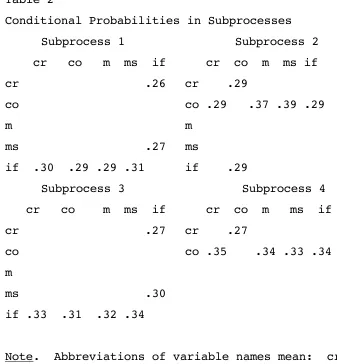
The calculation of the combinations of the
conditional probabilities resulted in the values
presented in Table 2 for the subprocesses.
_________________________
Insert Table 2 about here
_________________________
There is certain similarity between the first
and third subprocesses. The same concerns the
subprocesses 2 and 4.
Discussion
Time involves the net of the conditional
probabilities. So the net indicates the pattern of
functions between the processes in time order. In
addition, the verification of diffusion, absorption,
and assimilation needs rules of inference. In this
case, diffusion verifies from the operators that
occur in the net of the subprocesses. Absorption is
verifiable from one-way implications. Assimilation
verifies from two-way implications or sometimes
called biconditions. The main operator is the mind
that keeps going the processes.
In the first subprocess the mind produces the
initial shape that diffuses its activity to the
Table 2
Conditional Probabilities in Subprocesses
Subprocess 1 Subprocess 2
cr co m ms if cr co m ms if
cr .26 cr .29
co co .29 .37 .39 .29
m m
ms .27 ms
if .30 .29 .29 .31 if .29
Subprocess 3 Subprocess 4
cr co m ms if cr co m ms if
cr .27 cr .27
co co .35 .34 .33 .34
m
ms .30
if .33 .31 .32 .34
Note. Abbreviations of variable names mean: cr
= croupier process; co = configuration; m =
mindy; ms = mental shape; if = initial form.
12
the configuration. The subprocess
differentiates between the active part and the
passive one. The active part comprises of the
processes of the initial form, the mental shape, and
the croupier process. The passive part includes the
mindy and the configuration.
The mindy and the configuration absorb the
activity of the initial shape while the initial form
ignites the mental shape and the croupier process to
transfer into the plastic state.
In detail from Table 2, the initial form
assimilates the mental shape and next it assimilates
the croupier process. The mental shape transmutes
the initial form and communicates the changes to the
croupier process. Before that, the mental shape
produces the transmuted initial form for further
modification of the croupier process. The croupier
process organizes content and form of the transformed
initial form. Transmutation continues until the end
of the first subprocess.
In the second subprocess in Table 2, the mind
activates the configuration that spreads out its
activity to the initial form, the mental shape, the
mindy, and the croupier process. In the same way as
active and passive part. The active part is in
the state of plasticity. The passive elastic part
comprises of the mindy and the mental shape. The
configuration assimilates the initial shape and the
croupier process, simultaneously. The configuration
transmutes the initial form and the transmuted
initial form assimilates the configuration. The
croupier process modifies the transformed
configuration at the same time with the assimilation
of the initial form. The sequence continues to the
end of the second section.
The third subprocess is a replication of the
first one with the exception. The mind processes are
somewhat quicker than in the first subprocess. The
speed of the sequence is higher.
In the fourth subprocess the mind activates the
configuration in the same way as in the second
subprocess. On the contrary, the 4th subprocess is
not a replication of the second one. The mindy and
the mental shape again form the passive part of the
subprocess. They are in the state of active rest.
The activation of the configuration diffuses to the
initial shape, the mindy, the mental shape, and the
croupier process. The activation absorbs into the
14
Evidently, the construction of the initial form
is not needful in the mind processes. In place
thereof, the configuration assimilates the croupier
process that transmutes the configuration until the
end of the last section.
The entire process shows that diffusion,
absorption, and assimilation are real mind processes.
It is possible with them to explain the connections
prevailing between other mind processes. So the
postulate expressed in ‘One Preliminary Theory of
Mind Processes’ (Laasonen, 1996, Unpublished) has a
very high probability of verification. Furthermore,
there is no need to patch the holes of the
preliminary theory, logically. That what is needed
is more empirical knowledge about the mind processes
with the initial forms and other variables of the
research. It is likely that the next task is to try
References
Laasonen, R. J. (1996). One preliminary theory