Volume 2007, Article ID 89264,10pages doi:10.1155/2007/89264
Research Article
Efficient Algorithm and Architecture of Critical-Band
Transform for Low-Power Speech Applications
Chao Wang1, 2and Woon-Seng Gan2
1Center for Signal Processing, School of Electrical and Electronic Engineering, Nanyang Technological University,
Nanyang Avenue, Singapore 639798
2Digital Signal Processing Lab, School of Electrical and Electronic Engineering, Nanyang Technological University,
Nanyang Avenue, Singapore 639798
Received 15 December 2005; Revised 8 December 2006; Accepted 18 January 2007
Recommended by Hugo Van Hamme
An efficient algorithm and its corresponding VLSI architecture for the critical-band transform (CBT) are developed to approximate the critical-band filtering of the human ear. The CBT consists of a constant-bandwidth transform in the lower frequency range and a Brown constant-Qtransform (CQT) in the higher frequency range. The corresponding VLSI architecture is proposed to achieve significant power efficiency by reducing the computational complexity, using pipeline and parallel processing, and applying the supply voltage scaling technique. A 21-band Bark scale CBT processor with a sampling rate of 16 kHz is designed and simulated. Simulation results verify its suitability for performing short-time spectral analysis on speech. It has a better fitting on the human ear critical-band analysis, significantly fewer computations, and therefore is more energy-efficient than other methods. With a 0.35μm CMOS technology, it calculates a 160-point speech in 4.99 milliseconds at 234 kHz. The power dissipation is 15.6μW at 1.1 V. It achieves 82.1% power reduction as compared to a benchmark 256-point FFT processor.
Copyright © 2007 C. Wang and W.-S. Gan. This is an open access article distributed under the Creative Commons Attribution License, which permits unrestricted use, distribution, and reproduction in any medium, provided the original work is properly cited.
1. INTRODUCTION
Spectral analysis is one of the most fundamental operations in the field of acoustic and speech signal processing. It trans-forms the time-domain acoustic signal into a frequency-domain spectrum. Some traditional methods, such as fast Fourier transform (FFT), short-time Fourier transform, and filterbank (a group of bandpass filters), have been widely used in academia and industry. These methods usually have a constant frequency resolution. However, psychoacoustical studies show that the human ear performs spectral analy-sis on the acoustic signal in the form of a filterbank with nonuniform critical bandwidths [1]. For wide-band speech with a bandwidth of 8 kHz, there are 21 critical bands for the Bark scale described by Zwicker [2] and 24 bands for the Mel scale [3]. An interesting finding is that, the bandwidths of the critical bands with center frequencies below a certain frequency are approximately constant. The bandwidths are around 100 Hz below 500 Hz in the Bark scale and below 1 kHz in the Mel scale. Above 500 Hz in the Bark scale or 1 kHz in the Mel scale, the bandwidths increase as the center
frequencies increase, while theQfactors of these bandpass filters are approximately constant. Motivated by the human auditory perception model, many methods have been devel-oped to approximate the critical-band analysis. These meth-ods provide advantages over other traditional ways in speech applications, especially in the fields of speech recognition, speech coding, and speech enhancement.
speech recognition [6]. One of the CQT methods [7] uses constant-Qfilters to approximate the critical-band filtering in the high frequency range. In the lower frequency range, the constant-bandwidth coefficients are obtained by sum-ming the constant-Qfilters coefficients within each constant-bandwidth band in question. The CQT method in [8] em-ploys the chirpz-transform to approximate the critical-band filtering in the higher frequency range. It uses the FFT to compute the constant-bandwidth coefficients in the lower frequency range. The above methods give a close approxi-mation to the critical-band scale but they are computation-ally expensive and involve complex hardware architectures. A new approach based on the fast orthogonal WPT (OWPT) was proposed for the applications of speech coding, speech enhancement, and speech recognition [9,10]. This method uses a tree structure to decompose the input speech signal into the approximated critical bands. However, the disad-vantages are the high hardware complexity, and inaccurate approximation to the critical-band scale.
Recently, low-power VLSI speech systems, such as speech recognizers and speech codecs, have many promising ap-plications in large volume battery powered portable prod-ucts, such as personal digital assistants, communicators and smart toys. The front-end spectral analysis in speech appli-cations, such as the FFT, filterbank and critical-band analysis methods, is both computation intensive and memory inten-sive, which may consume significant power [11]. The existing CBT methods are not suitable for low-power VLSI realiza-tion because of the high computarealiza-tion complexity and high hardware complexity. Therefore, there is a need to design an efficient spectral analyzer for low-power speech systems.
In this study, we develop an efficient critical-band trans-form algorithm and an architecture for approximating the critical-band filtering of the human ear [12]. The novel CBT scheme has a smaller on-chip memory requirement than the other methods. It also needs fewer computations and less memory access. The proposed VLSI architecture uses a paral-lel and pipeline structure to increase the throughput. There-fore, a lower supply voltage and a slower clock frequency can be used to achieve significant power reduction.
The remainder of the paper is divided into five sections.
Section 2 describes the critical-band transform algorithm.
Section 3presents the short-time spectral analysis of two typ-ical speech phonemes by a 21-band Bark scale CBT. The VLSI architecture and circuit design are presented inSection 4. We evaluate the efficiency of the architecture by designing and simulating the 21-band CBT processor [13], and comparing it against a benchmark 256-point FFT processor we designed. InSection 5, circuit simulation results are reported and dis-cussed. Finally, conclusions are given inSection 6.
2. THE PROPOSED ALGORITHM OF THE CRITICAL-BAND TRANSFORM
Based on the observation of the critical-band scale de-picted in Section 1, a novel critical-band transform algo-rithm is proposed to approximate the critical-band filtering of the human ear. It consists of two transforms: a
constant-Q transform (CQT) in the higher frequency range and a constant-bandwidth transform (CBWT) in the lower fre-quency range. In this study, the Bark scale is approximated.
The Brown CQT algorithm [14] is employed in the pro-posed CBT. The results in this study show that the Brown CQT with low Qvalues is a suitable algorithm for speech signal processing. The Brown CQT is also more efficient than the other constant-Qanalysis methods. From the dis-crete short-time Fourier transform, Brown derived an effi -cient constant-Qtransform with a constant ratio of center frequency to frequency resolution (Q). It is known that the resolutionΔf of the DFT is equal to the sampling rate di-vided by the window size (the number of samples analyzed in the time domain). In order to achieve a constant Q, the window size in the Brown CQT varies inversely with fre-quency. The frequency resolution decreases while the center frequency increases. By choosing a suitableQvalue, Brown CQT can achieve a close fitting to the critical bandwidths in the higher frequency range.
The CBWT in the proposed CBT is implemented by us-ing the Brown CQT with a constant window length. The CBWT is formally expressed as
Xkcw=N1 c
Nc−1
n=0
w[n]x[n]
×exp
−j2πQkcw n
Nc
, kcw=1, 2,. . .,ncw. (1) The window sizeNcin the CBWT is constant, while the win-dow size varies for different bands in the original Brown CQT. However, theQvalue,Qkcw in the Brown
implemen-tation of the CBWT is not constant. TheQkcwis different for
ncwconstant bandwidths of the CBWT.
In the CBWT, the window size is equal to the sampling rateSRdivided by the frequency resolution of 100 Hz,
Nc=ΔSRf
c =
SR
fkcw
Qkcw=const. (2)
In accordance with the Brown CQT, the CBWT is normalized by dividing it byNc. The center frequency fkcw of thekcwth spectral component varies linearly withkcw, and is given as
fkcw= fminc+Δfckcw−1, (3)
where fminc is the minimum center frequency in the lower
frequency range. The center frequency in the Brown CQT is exponential inkcq.
As both the CQT and CBWT in the CBT can be expressed in the Brown CQT form, the proposed CBT is expressed as follows:
Xkcb=
⎧ ⎪ ⎨ ⎪ ⎩
Xkcw, kcb=kcw=1, 2, 3,. . .,ncw;
Xkcq, kcb=kcq=ncw+ 1,. . .,ncw+ncq,
Table1: Comparison of the parameters in CBWT and CQT.
CBT CBWT CQT
Range Low frequency range of CBT High frequency range of CBT
Frequency fminc+ (kcw−1)ΔfcLinear inkcw (21/s)[kcq−(ncw+1)]fminqexponential inkcq
Window size Nc(constant) N[kcq]=SR×Qcq/ fkcq(variable) Bandwidth SR/Nc(constant) fkcq/Qcq(variable) Ratio of frequency
to bandwidth Qkcw(variable) Qcq(constant)
frequency range can be rearranged into one equation as
Xkcb=N1k
cb
N[kcb]−1
n=0
wkcb,nx[n]
×exp
−j2πQkcb n
Nkcb
,
kcb=1, 2,. . .,ncw+ncq,
(5)
where X[kcb] is the kcbth spectral component of the CBT. Here, x[n] is the discrete-time input speech signal and
w[kcb,n] is a window function for each critical band. The length of each window isN[kcb].
The fixed bandwidth in the low frequency range and constant-Qbandwidths in the higher frequency range are de-fined as
Δfkcb=
⎧ ⎪ ⎪ ⎪ ⎪ ⎪ ⎨ ⎪ ⎪ ⎪ ⎪ ⎪ ⎩
Δfc=100, kcb=1, 2,. . .,ncw;
21/s[kcb−(ncw+1)]
×Δfminq,
kcb=ncw+ 1,. . .,ncw+ncq,
(6) wheresis the number of constant-Qbands per octave. The
kcbth center frequency is expressed as
fkcb=
⎧ ⎪ ⎪ ⎪ ⎪ ⎪ ⎪ ⎪ ⎪ ⎪ ⎨ ⎪ ⎪ ⎪ ⎪ ⎪ ⎪ ⎪ ⎪ ⎪ ⎩
fminc+Δfc
kcb−1=50+100×kcb−1, kcb=1, 2,. . .,ncw;
21/s[kcb−(ncw+1)]
×fminq,
kcb=ncw+1,. . .,ncw+ncq.
(7) Note that 50 Hz is chosen to be the center frequency of the lowest critical band. fminqandΔfminqare the minimum
cen-ter frequency and bandwidth in the higher frequency range, respectively.
TheQfactor of the CBT,Qkcb, is therefore described by
Qkcb= fkcb
Δfkcb
= ⎧ ⎪ ⎪ ⎪ ⎨ ⎪ ⎪ ⎪ ⎩
fkcb
100, kcb=1, 2,. . .,ncw;
Qcq=21/s1−1, kcb=ncw+ 1,. . .,ncw+ncq.
(8)
In order to reduce spectral leakage, a Hamming window is chosen as the window function w[kcb,n]. The length of each window for each critical band is determined by
Nkcb=ΔSRf
kcb = ⎧ ⎪ ⎪ ⎪ ⎪ ⎪ ⎪ ⎪ ⎪ ⎪ ⎨ ⎪ ⎪ ⎪ ⎪ ⎪ ⎪ ⎪ ⎪ ⎪ ⎩
Nc= ΔSRf c
= SR
100, kcb=1, 2,. . .,ncw;
SR
fkcb
Qkcb, kcb=ncw+ 1,. . .,ncw+ncq.
(9) A comparison between the various parameters used in the CBWT and CQT is given in Table 1. By combining the Hamming windoww[kcb,n] and the exponential part into kern[kcb,n], we can compute the critical-band spectrum by only multiplications and accumulations directly from the in-put speech data and the precalculated coefficients in (10):
Xkcb=
N[kcb]−1
n=0
x[n]
wkcb,n Nkcb exp
−j2πQkcb n
Nkcb
=
N[kcb]−1
n=0
x[n] kernkcb,n, kcb=1, 2,. . .,ncb.
(10) In this paper, a 21-band Bark scale CBT with 5 constant-bandwidth bands (100 Hz), and 16 constant-Qbands (Q =
5.6) is constructed at a sampling rate of 16 kHz. The parame-ter values are chosen so that the 21-band CBT closely approx-imates the Bark scale. For the Mel scale, there are 10 constant-bandwidth bands, and 14 constant-Qbands withQ=6.9.
3. SHORT-TIME CRITICAL-BAND ANALYSIS ON SPEECH
102 103 104
Center frequency (Hz) 0
200 400 600 800 1000 1200 1400
Filt
er
band
w
idth
(Hz)
Munich critical band WPT
CBT
Figure1: Degree of approximation to Munich Bark critical bands.
The 21-band CBT algorithm has been programmed and simulated in Matlab 6.5. A typical utterance “ka” [8] is used in our testing. The syllable “ka” consists of two 600-ms wave-forms for “k” and “a,” respectively. The 1200-ms speech spo-ken by a male talker was recorded in a small room and pro-cessed by CoolEdit Pro 2.0 at a sampling rate of 16 kHz. The 21-band CBT uses 1/2-overlap processing on the 160-point segments of the speech. The CBT spectra of the two speech waveforms are shown in Figures2(a)and2(b), respectively. The corresponding FFT spectra are given in Figures3(a)and
3(b), respectively. These plots show the short-time spectral magnitude on thez-axis against the frequency in a log scale on the x-axis. The labels on the y-axis correspond to the speech duration in seconds.
In the first 600 milliseconds in Figure 2(a), the initial burst of energy of the plosive “k” has a concentration of en-ergy in the region near 2 kHz. The enen-ergy peak at the very low frequency range is also observed in the FFT spectra as shown inFigure 3(a). It is commonly observed in spectro-gram analysis of the speech signal. A clear formant struc-ture for the vowel “a” can be observed fromFigure 2(b), with the first and second formant frequencies around 650 Hz and 1100 Hz, respectively. The third formant around 2500 Hz can also be seen. These formant frequencies are the typical fea-tures of the vowel “a” [15]. The short-time spectra as shown in Figure 2for the CBT follow closely those obtained by a 256-point FFT as shown inFigure 3. The proposed CBT is not invertible as the Brown CQT is not invertible [14]. How-ever, it is adequate to show the typical spectral features of the phonemes. In some speech applications, the pitch is ignor-able and the higher frequency information is less significant [16]. But the critical-band analysis based on the Bark scale or Mel scale can still capture the phonetically important charac-teristics of speech. It may work effectively and well in speech recognition [3,4].
Based on the above analysis and discussion, the proposed 21-band CBT performs spectral analysis of speech satisfacto-rily. It can be used as an auditory spectral analyzer in speech applications.
4. THE VLSI ARCHITECTURE OF THE CRITICAL-BAND TRANSFORM
In this section, an efficient VLSI architecture is proposed for the critical-band transform. By applying the symmetry prop-erty of the CBT coefficients, the number of multiplications is reduced by about 50%. The derived data path can easily be pipelined and parallelized. It is very suitable for an ASIC im-plementation.
4.1. The VLSI architecture of
the critical-band transform
It is observed that there is a symmetry property of the CBT coefficient kern in (10). The coefficient consists of a real part (the cosine function) and an imaginary part (the sine tion). Applying the symmetry property of the cosine func-tion and antisymmetry property of the sine funcfunc-tion, the CBT can be rearranged as
Xkcb
=
N[kcb]−1
n=0
x[n]coskcb,n+j∗sinkcb,n
= ⎧ ⎪ ⎪ ⎪ ⎪ ⎪ ⎪ ⎪ ⎪ ⎪ ⎪ ⎪ ⎪ ⎪ ⎪ ⎪ ⎪ ⎪ ⎪ ⎨ ⎪ ⎪ ⎪ ⎪ ⎪ ⎪ ⎪ ⎪ ⎪ ⎪ ⎪ ⎪ ⎪ ⎪ ⎪ ⎪ ⎪ ⎪ ⎩
M[kcb]
n=1
x[n]+x[N−n]cos+j∗x[n]−x[N−n]sin
+x[0] + 0kern[0], Nkcbis odd,
M[kcb]−1
n=1
x[n]+x[N−n]cos+j∗x[n]−x[N−n]sin
+x[0] + 0kern[0] +x[M] + 0kern[M],
Nkcb] is even,
(11) where
Mkcb=
⎧ ⎪ ⎪ ⎪ ⎪ ⎨ ⎪ ⎪ ⎪ ⎪ ⎩
Nkcb−1
2 , N
kcbis odd,
Nkcb
2 , N
kcbis even.
(12)
102
103
x Frequency
(Hz) 0
1 2 3 4 5 6 7 8
×10−2 z
M
ag
nitude
0 0.1 0.20.3
0.40.5 0.6
y
Tim e (s)
(a)
102
103
x
Fre quency (H
z)
0 1 2 3 4
×10−2 z
M
ag
nitude
0 0.1
0.2 0.3
0.4 0.5
0.6
y
Tim e (s)
(b)
Figure2: (a) CBT analysis of the first 600 ms of “ka”; (b) CBT analysis of the second 600 ms of “ka.”
102
103
x Frequency (Hz)
0 5 10 15 z
M
ag
nitude
0 0.1
0.2 0.3
0.4 0.5
0.6
y
Tim e(s
)
(a)
102
103
x Frequency
(Hz) 0
5 10 15 z
M
ag
nitude
0 0.1
0.2 0.3
0.4 0.5
0.6
y
Tim e(s
)
(b)
Figure3: (a) FFT analysis of the first 600 ms of “ka”; (b) FFT analysis of the second 600 ms of “ka.”
memory access. The data flow of the CBT is derived from (11). As depicted inFigure 4, the CBT spectral magnitude for each critical band is obtained after all the accumulations over a window of input speech samples complete. We denote the addition (or subtraction) and multiplication-accumulation (MAC) process of a pair of data elements as one butterfly op-eration.
The proposed VLSI architecture of the critical-band transform processor consists of a pipelined data path, a con-troller, a coefficient ROM, a data input RAM, a data output RAM, and an address generator. In this study, the I/O data and coefficients are expressed in the 16-bit two’s complement fixed-point format. The operation of the processor is parti-tioned into data I/O process (I/O mode) and CBT computa-tion process (CBT mode).
From the CBT data flow depicted inFigure 4, we pro-pose a two-multiplier and four-adder pipelined data path as shown in Figure 5. The data are processed in two parallel
x[n]
+ cos
+
Real[X]=cbr
x[m]
−
sin
+
Image[X]=cbi
Figure4: Data flow graph of the CBT algorithm.
Table2: Pipeline table of CBT data path.
RAM read First 2 adds Two mults. Second 2 adds —
x[n]
x[n] + 0 x[n]−0 read kern
x[n]×cos
x[n]×sin 2 accumulations —
— RAM read First 2 adds Two mults. Second 2 adds
— x[n],x[m]
x[n]−x[m] x[n]+x[m] read kern
(x[n]−x[m])×kern
(x[n]+x[m])×kern 2 accumulations
Table3: Last butterfly operation in the pipeline.
RAM read First 2 adds Two mults. Second 2 adds RAM write
x[n],x[m]
x[n]+x[m] x[n]−x[m] read kern
(x[n]−x[m])×kern
(x[n]+x[m])×kern 2 accumulations cbr, cbi (a) When window sizeN[kcb] is odd
RAM read First 2 adds Two mults. Second 2 adds RAM write
x[n]
x[n] + 0 x[n]−0 read kern
x[n]×cos
x[n]×sin 2 accumulations cbr, cbi (b) When window sizeN[kcb] is even
x[n]
R
+ cos
R
R
∗ R
R
+ R
Real[X]=cbr
x[m]
R
−
sin
R
R ∗
R
R
+ R
Image[X]=cbi
c1, rst1 c2 c3, rst3 cw
Figure5: Proposed pipelined CBT data path.
stage, the first pair of 16-bit wide adders processes two data elements from the input RAM. The two multipliers compute 16-bit×16-bit multiplications and produce 32-bit results for each multiplier in the second stage. In the last stage, the sec-ond pair of 32-bit wide adders performs the accumulations. The final results are truncated into 16-bits and written to the output RAM, when a CBT spectrum computation is com-pleted.
As described in (11), for a particular CBT spectrum, there are (N[kcb]−1)/2+1 butterfly operations whenN[kcb] is odd, orN[kcb]/2+1 butterflies when even. The pipeline processing
of the butterfly operations is described inTable 2. In the first butterfly operation for each critical band, only one data ele-ment is read from the input RAM and fed into one of the first pair of pipeline registers. At the same time, the other register is reset to zero as described in (11). As shown inTable 3, the CBT data path has two working modes, that is, even mode and odd mode. This is because the last butterfly operation might be different for individual critical bands. For the odd window length, a pair of data elements is read from the in-put RAM as usual but only one data element is read when the window size is even. It takes the data path (N[kcb]−1)/2 + 4 cycles to compute a CBT spectrum (including access of the I/O memories) whenN[kcb] is odd, andN[kcb]/2 + 4 cycles whenN[kcb] is even.
band, including the number of the butterfly operations, par-ity of the window size, and the offset values for calculating the correct addresses in the CBT mode. This information has been prestored in the critical-band generator when a particu-lar CBT is determined. The address generation unit generates addresses for the coefficient ROM in CBT mode and for the I/O RAMs in both CBT and I/O modes.
For comparison, we also design a 256-point radix-2 DIT (decimation-in-time) in-place FFT processor based on a single-butterfly architecture, as a benchmark against the pro-posed CBT processor. The benchmark FFT processor consists of a controller, a coefficient ROM, a data RAM, an address generation unit, and a pipelined butterfly unit with only two multipliers and three adders. The I/O data and coefficients are also represented in the 16-bit two’s complement fixed-point format.
The implementation of the butterfly unit is very crucial in the design of a single-butterfly FFT processor. In the litera-ture, there are mainly three methods using different numbers of multipliers and adders to implement the radix-2 DIT but-terfly unit. The radix-2 DIT butbut-terfly is described by
C=A+W×B,
D=A−W×B, (13)
whereWis the twiddle factor. In (13),AandBare the two in-puts, whileCandDare the two outputs. All the variables are complex numbers. By replacing the complex variables with real variables, a fully parallel butterfly structure with four multipliers and six adders in [18] was derived to achieve the highest throughput. The four-multiplier and six-adder but-terfly unit computes one butbut-terfly operation every cycle. To reduce the hardware cost, a one-multiplier and two-adder butterfly unit in [19] was proposed to compute one butterfly operation every four cycles by multiplexing just one multi-plier and two adders. By considering both performance and cost, the two-multiplier and four-adder implementation pro-vides the best trade offas claimed in [20]. The throughput is two cycles for one butterfly operation, while the control is much simpler.
In the benchmark 256-point FFT processor, we design a two-multiplier and three-adder radix-2 DIT butterfly unit derived from the rewritten butterfly equation (14)
X=BR×WR−BI×WI, CR=AR+X, DR=AR−X,
Y=BI×WR+BR×WI, CI=AI+Y, DI=AI−Y.
(14)
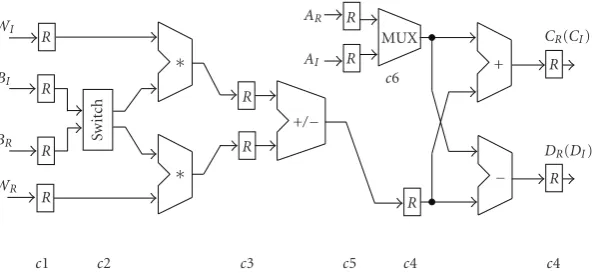
In (14), the subscripts “R” and “I” are used to denote the real part and imaginary part of the complex variables, re-spectively. For simplicity, the j prefix associated with the imaginary part is omitted. From (14), a rescheduled SFG for the radix-2 butterfly is derived as shown inFigure 6. Based on the SFG, we propose a two-multiplier and three-adder pipelined butterfly unit as depicted inFigure 7. Compared
WI
BI(BR)
AR(AI)
+
CR(CI)
−
+
X(Y)
WR
BR(BI) AR(AI)
−
+
DR(DI)
Figure6: Rescheduled data flow graph for the radix-2 butterfly.
with the two-multiplier and four-adder scheme, it can still achieve a throughput of two cycles with a latency of four cy-cles, while it has less hardware cost by reducing the num-ber of adders from four to three. It is a good solution with a good trade-offfor low-cost speech applications. The pro-posed two-multiplier and three-adder butterfly unit is em-ployed to compute the butterfly operations recursively in the benchmark FFT processor.
In high-performance applications, such as image, video, and radar signal processing, the pipeline architecture [21] and the parallel architecture [22] using multiple butterfly units are widely used to compute the high-speed long-sized FFT. All these architectures including the single-butterfly methods provide users flexibility to make a trade offbetween hardware cost and performance, by choosing different num-bers of butterfly units to achieve a different throughput for a particular application. However, our study focuses low-cost speech applications. The multiple-butterfly pipeline and par-allel architectures are not necessary and too expensive as the performance requirement of speech applications is not high. For example, the array FFT processor designed in [22] uses four butterfly units to compute the FFT. Each butterfly unit consists of two multipliers and four adders. So the hardware cost required by the butterfly units in the array processor is four times that of the single-butterfly architecture. Given the segments of 256-point speech samples at a sampling rate of 16 kHz, the single-butterfly FFT architecture can easily meet the real-time processing requirement. Because of low cost re-quirements, we chose the single-butterfly architecture to de-sign the benchmark 256-point FFT processor.
4.2. Computation complexity and memory access
Since most of the operations in DSP algorithms involve mul-tiplications and accumulation, the multiplication and ad-dition operations are commonly used to measure the effi -ciency of DSP algorithms. In this section, the numbers of multiplications and additions are used to evaluate the power-efficiency of the proposed CBT algorithm and architecture.
WI R
BI R
BR
R
WR R
Sw
it
ch
∗
∗ R
R
+/− AR
AI
R
R
MUX
R
+ R
CR(CI)
− R
DR(DI)
c1 c2 c3 c5
c6
c4 c4
Figure7: Proposed pipelined radix-2 butterfly unit.
Table4: Comparison of on-chip memory access.
Auditory spectral analyzer RAM access Total memory access Input write R/W during computation Output read
256-point in-place FFT processor 256 8192 (512×2×8) 512 8960 21-band CBT processor 160 1808 (1766 + 42) 42 2010
and the coefficients are complex. The 21-band CBT involves 1766 real multiplications and 3466 real additions. Both the numbers of real multiplications and real additions in the 256-point FFT are 4096. The OWPT method, using 10-order Daubechies filters, consumes 9216 real multiplications and 3800 real additions in a frame of 64 samples [9]. The number of multiplications in the CBT is 56.9% less than in the FFT, while the saving in the real additions is 15.4%. The reduction as compared to the OWPT is more significant. Recently, the lifting technique is widely used in wavelet transforms to re-duce the computation complexity by up to 50% [23]. If the lifting technique is used in the WPT method, the computa-tion is still larger than in the CBT.
In most typical DSP algorithms, frequent memory access is another important contribution to the total power dissi-pation. Therefore, the memory access of the proposed CBT processor is also compared with that of the 256-point FFT processor in this section. For the proposed 21-band CBT pro-cessor, the on-chip memory consists of a 1766-word×16-bit ROM, a 160-word×16-bit RAM, and a 42-word×16-bit output RAM. The point FFT processor requires a 256-word × 16-bit coefficient ROM and a 512-word ×16-bit RAM. The comparison on RAM access is given inTable 4. The CBT requires a total of 2010 read/write RAM accesses. This is in contrast to the 8960 accesses required for a 256-point in-place FFT. The 21-band CBT results in a reduction of 77.6% in memory accesses as compared to the FFT.
5. CIRCUITS SIMULATION RESULTS AND ANALYSIS
The proposed 21-band Bark scale CBT processor and the benchmark 256-point FFT processor are designed by using
VHDL. The CBT processor takes 1167 cycles to compute a 21-band CBT. The FFT processor computes a 256-point FFT in 2572 cycles.
Both the CBT processor and the FFT processor are sim-ulated at RTL by using Mentor Graphics Modelsim. They have been synthesized into gate level by the Synopsys design compiler with the AMS 0.35μm CMOS standard cell library. The estimated areas of the two processors are 2.69 mm2and
9.02 mm2, respectively. The estimated maximum clock
fre-quencies are 83.3 MHz and 100 MHz, respectively. In order to estimate the power dissipation, the two processors are sim-ulated at transistor level by Synopsys Nanosim. Simulation at transistor level shows that the CBT processor can still work at a maximum clock frequency of 13 MHz, when the sup-ply voltage is scaled down to 1.1 V. It can achieve real-time processing at 234 kHz.Table 5 lists the percentage dissipa-tion for the different functional units at 234 kHz and 1.1 V.
Table 6shows the estimated power dissipation at 1.1 V when the clock frequency is 234 kHz and 1 MHz, respectively. The CBT processor operates at 50% overlap on 160-point data segments at a sampling rate of 16 kHz.
Table 5shows that the multiplications and RAM memory accesses consume the largest portion of the total power dis-sipation, which is 52.1% and 17.6%, respectively. It is shown inTable 6that the CBT processor can achieve about 95.3% power saving at 234 kHz by scaling the supply voltage from 3.3 V to 1.1 V.
Table5: Power dissipation percentage for different functional units in the CBT processor.
Functional units Address generator Controller I/O RAM ROM Data path (multiplications) Percentage of the total
power dissipation 4.6% 2.8% 17.6% 2.9% 71.3% (52.1%)
Table6: CBT processor power dissipation simulation results under 1.1 V and 3.3 V.
Supply voltage (V) 3.3 1.1 Clock frequency (MHz) 0.234 0.234 Average power (μW/MHz) 1413.6 66.7
6. CONCLUSIONS
An efficient algorithm and its VLSI architecture for the critical-band transform have been proposed for speech ap-plications. Comparative studies were conducted to show that the proposed 21-band Bark scale CBT is better than the OWPT and FFT methods in terms of the closeness in approx-imation to human ear critical-band filtering, computational complexity, and memory access. Simulation results verified its suitability for performing short-time spectral analysis on speech. Circuits design and simulation of the CBT proces-sor and a benchmark 256-point FFT procesproces-sor verified the power efficiency of the proposed architecture. The proposed CBT algorithm and its architecture are very suited for low-power speech applications.
REFERENCES
[1] H. Fletcher, “Auditory patterns,”Reviews of Modern Physics, vol. 12, no. 1, pp. 47–65, 1940.
[2] E. Zwicker, “Subdivision of the audible frequency range into critical bands (frequenzgruppen),”The Journal of the Acousti-cal Society of America, vol. 33, no. 2, p. 248, 1961.
[3] J. W. Picone, “Signal modeling techniques in speech recogni-tion,”Proceedings of the IEEE, vol. 81, no. 9, pp. 1215–1247, 1993.
[4] B. A. Dautrich, L. R. Rabiner, and T. B. Martin, “On the effects of varying filter bank parameters on isolated word recogni-tion,”IEEE Transactions on Acoustics, Speech, and Signal Pro-cessing, vol. 31, no. 4, pp. 793–807, 1983.
[5] P. Noll, “Digital audio coding for visual communications,”
Proceedings of the IEEE, vol. 83, no. 6, pp. 925–943, 1995. [6] S. B. Davis and P. Mermelstein, “Comparison of
paramet-ric representations for monosyllabic word recognition in con-tinuously spoken sentences,”IEEE Transactions on Acoustics, Speech, and Signal Processing, vol. 28, no. 4, pp. 357–366, 1980. [7] T. L. Petersen and S. F. Boll, “Critical band analysis-synthesis,”
IEEE Transactions on Acoustics, Speech, and Signal Processing, vol. 31, no. 3, pp. 656–663, 1983.
[8] J. M. Kates, “An auditory spectral analysis model using the chirp z-transform,”IEEE Transactions on Acoustics, Speech, and Signal Processing, vol. 31, no. 1, pp. 148–156, 1983.
[9] B. Carnero and A. Drygajlo, “Perceptual speech coding and enhancement using frame-synchronized fast wavelet packet transform algorithms,”IEEE Transactions on Signal Processing, vol. 47, no. 6, pp. 1622–1635, 1999.
[10] O. Farooq and S. Datta, “Mel filter-like admissible wavelet packet structure for speech recognition,”IEEE Signal Process-ing Letters, vol. 8, no. 7, pp. 196–198, 2001.
[11] A. P. Chandrakasan, S. Sheng, and R. W. Brodersen, “Low power techniques for portable real-time DSP applications,” in
Proceedings of the 5th International Conference on VLSI Design, pp. 203–208, Bangalore, India, January 1992.
[12] C. Wang and Y.-C. Tong, “An improved critical-band trans-form processor for speech applications,” inProceedings of IEEE International Symposium on Circuits and Systems (ISCAS ’04), vol. 3, pp. 461–464, Vancouver, BC, Canada, May 2004. [13] C. Wang, Y.-C. Tong, and Y. Shao, “VLSI design and analysis
of a critical-band transform processor for speech recognition,” inProceedings of IEEE International SOC Conference, pp. 365– 368, Santa Clara, Calif, USA, September 2004.
[14] J. C. Brown, “Calculation of a constant Q spectral transform,”
Journal of the Acoustical Society of America, vol. 89, no. 1, pp. 425–434, 1991.
[15] L. Rabiner and B. Juang,Fundamentals of Speech Recognition, Prentice-Hall, Englewood Cliffs, NJ, USA, 1993.
[16] J. N. Holmes and W. J. Holmes,Speech Synthesis and Recogni-tion, Taylor & Francis, New York, NY, USA, 2nd edition, 2001. [17] A. P. Chandrakasan, S. Sheng, and R. W. Brodersen, “Low-power CMOS digital design,”IEEE Journal of Solid-State Cir-cuits, vol. 27, no. 4, pp. 473–484, 1992.
[18] B. M. Bass, “A low-power, high-performance, 1024-points FFT processor,”IEEE Journal of Solid-State Circuits, vol. 34, no. 3, pp. 380–387, 1999.
[19] E. Cetin, R. C. S. Morling, and I. Kale, “An integrated 256-point complex FFT processor for real-time spectrum analy-sis and measurement,” inProceedings of IEEE Instrumentation and Measurement Technology Conference, vol. 1, pp. 96–101, Ottawa, ON, Canada, May 1997.
[20] P. A. Ruetz and M. M. Cai, “A real time FFT chip set: architec-tural issues,” inProceedings of the 10th International Conference on Pattern Recognition, vol. 2, pp. 385–388, Atlantic City, NJ, USA, June 1990.
[21] E. Bidet, D. Castelain, C. Joanblanq, and P. Senn, “A fast single-chip implementation of 8192 complex point FFT,”IEEE Jour-nal of Solid-State Circuits, vol. 30, no. 3, pp. 300–305, 1995. [22] Z. Liu, Y. Song, T. Ikenaga, and S. Goto, “A VLSI array
pro-cessing oriented fast Fourier transform algorithm and hard-ware implementation,”IEICE Transactions on Fundamentals of Electronics, Communications and Computer Sciences, vol. 88, no. 12, pp. 3523–3530, 2005.
Chao Wangreceived his B.Eng. degree in electronics engineering from the Depart-ment of Electronics Science and Technol-ogy, Huazhong University of Science and Technology, Wuhan, China, in 2000. Cur-rently, he is a Ph.D. Candidate in the School of Electrical and Electronic Engineering, Nanyang Technological University (NTU), Singapore. He is also with the Center for Signal Processing, NTU as a Research
Engi-neer. His research interests include digital IC design, VLSI architec-tures for digital signal processing, low-power design, and embed-ded signal processing.
Woon-Seng Gan received his B.Eng. (1st class hons) and Ph.D. degrees, both in elec-trical and electronic engineering from the University of Strathclyde, UK, in 1989 and 1993, respectively. He joined the School of Electrical and Electronic Engineering, Nanyang Technological University, Singa-pore, as a Lecturer and Senior Lecturer in 1993 and 1998, respectively. In 1999, he was promoted to an Associate Professor. He