Appendix A: ODD Protocol
The model description follows the ODD (Overview, Design concepts, and Details) protocol for describing IBMs (Grimm et al., 2010).
Purpose
The purpose of the model is to simulate Aporrectodea caliginosa population dynamics under varying environmental conditions representative of those encountered in the field. As food density is rarely limiting for this species we investigate how food quality alters individual life cycle processes in the laboratory and population level endpoints in the field. Soil water conditions are also essential for realistically predicting the exposure of populations to environmental change in the soil profile.
Entities, state variables and scales
This IBM comprises a number of individual A. caliginosa and a model landscape consisting of two-dimensional 0.01 m2 patches, representing a vertical soil profile. Individuals are
characterized by life cycle stage (cocoon, juvenile or adult), mass and energy reserves, and landscape patches by food density, food quality, soil temperature, soil water content. The model proceeds in discrete daily time-steps. Metabolic calculations are in units of energy per unit time (kJ/day).
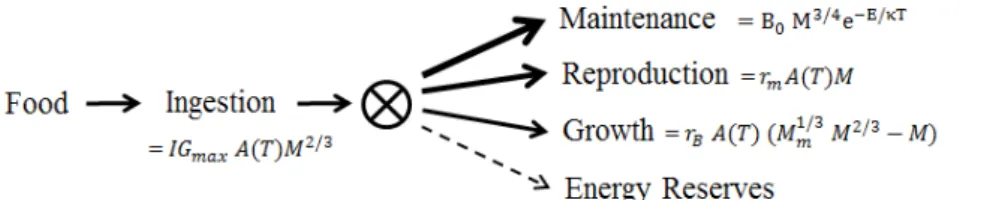
Fig. A.1. Structure of the energy budget model for adults, with the thickness of solid arrows indicating priorities for allocation of energy obtained from food. Reproduction has priority over growth in sexually mature
individuals. Energy remaining after allocation enters the energy reserves. Equations show maximum daily allocation rates which depend on mass, M in grams, temperature, T in kelvin, and parameters as defined in Table 1. A(T) is the Arrhenius function of temperature, A
(T)=e −E
κ
(
1 T−1
Tref
)
, where κ is the Boltzmann’s constant(8.62 × 10⁻⁵ eV K-1).
Process overview and scheduling
Each individual in the IBM has its own energy budget. The energy budget model includes algorithms for how energy uptake and expenditure direct life cycle processes based on fundamental principles of physiological ecology (Johnston et al., 2014; Sibly et al., 2013). Individuals assimilate energy from ingested food (Ingestion and Energy Uptake) and expend available energy on maintenance (Maintenance), growth (Growth) and reproduction
Juveniles and adult move across the landscape according to a trade-off between food
availability and soil water conditions (Movement), assimilating a fixed proportion of energy from ingested food that fuels life cycle processes and survival. Feeding by individuals
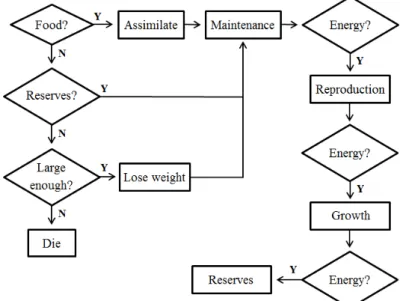
depletes landscape patches and the food density changes accordingly. Cocoons cannot feed or move but pay maintenance costs from energy reserves until they are fully developed at the end of the temperature-dependent incubation period, when they hatch as juveniles (Sousa et al., 2010). Juveniles transform to adults once they reach a body mass threshold for sexual maturity (Ma, 1984; Springett and Gray, 1992). When food is not available, energy reserves are used to cover maintenance costs. Once the energy reserves are depleted to a critical level individuals catabolise energy from tissue to meet maintenance demands. In the field soil water and soil texture variations are used to calculate soil water potentials (-kPa), which constrain individual growth and reproduction (Soil Water Potential). If the soil water potential drops to a critical level under dry conditions, juveniles and adults enter a resting phase in which their metabolic rate is reduced (Aestivation). Fig. A.2 gives an overview of processes occurring at the adult stage in each time-step under different feeding conditions.
Fig. 2. Partial energy flow diagram of A. caliginosa adults, showing the processes (rectangles) each individual goes through per time step, with diamonds indicating decision points. Energy reserves are used to pay
maintenance costs when food is unavailable and individuals die if weight loss under starvation continues.
Design concepts
Basic Principles. Key processes in the model determine how energy consumption and
expenditure direct life cycle processes in response to environmental conditions. Individual energy budgets follow fundamental principles of physiological ecology (Sibly and Calow, 1986) and scale with body mass and temperature according to known allometric laws (Sibly et al., 2013).
Emergence. Variation in food availability between patches arises from the feeding of individuals in the landscape. Population dynamics emerge from differential energy allocation amongst individuals which is affected by food density, food quality, soil temperature, soil water conditions.
Observation. Population density and biomass, stage class structure (cocoon, juvenile, adult) and individual body masses and cocoon production rates were recorded.
Initialization
Simulations were initialised with individuals randomly distributed in the landscape. Landscape size and earthworm numbers, life cycle stages and body masses followed the experiments being replicated.
Input Data
External weather data from Rothamsted Research is used to simulate the conditions of a field trial experiment, , including daily soil temperature measurements at 10, 20 and 30 cm under grass and soil water contents, estimated from potential soil moisture deficit (mm) values.
2.1.7. Submodels
Species-specific parameters were derived from the literature for A. caliginosa as shown in Table A.1. Details of parameter calculations are available in Appendix 2 of the
supplementary material. The following sections describe the energy budget model, outlined in the above sections and in Fig. A.1, in terms of metabolic organisation at the individual level.
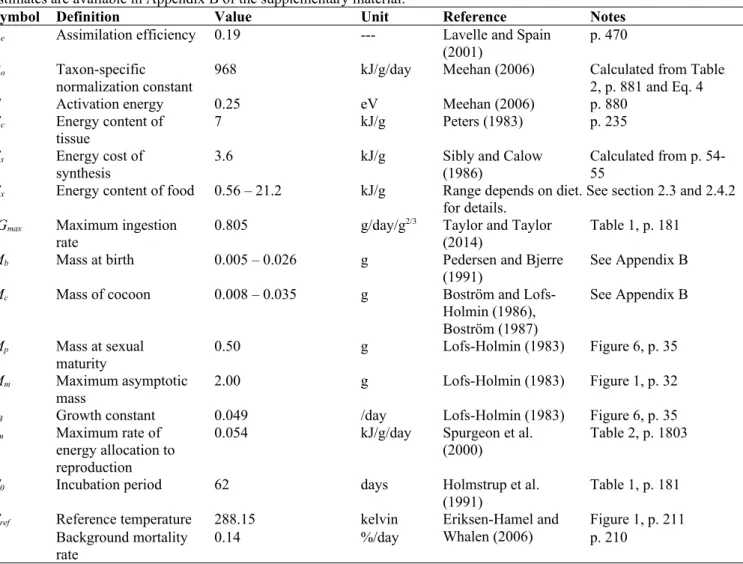
Table A.1. Default parameter values of the A. caliginosa energy budget model with sources. Further details of the parameter estimates are available in Appendix B of the supplementary material.
Symbol Definition Value Unit Reference Notes
Ae Assimilation efficiency 0.19 --- Lavelle and Spain
(2001)
p. 470 Bo Taxon-specific
normalization constant 968 kJ/g/day Meehan (2006) Calculated from Table 2, p. 881 and Eq. 4
E Activation energy 0.25 eV Meehan (2006) p. 880
Ec Energy content of
tissue 7 kJ/g Peters (1983) p. 235
Es Energy cost of
synthesis 3.6 kJ/g Sibly and Calow (1986) Calculated from p. 54-55 Ex Energy content of food 0.56 – 21.2 kJ/g Range depends on diet. See section 2.3 and 2.4.2
for details. IGmax Maximum ingestion
rate 0.805 g/day/g
2/3 Taylor and Taylor
(2014) Table 1, p. 181 Mb Mass at birth 0.005 – 0.026 g Pedersen and Bjerre
(1991) See Appendix B
Mc Mass of cocoon 0.008 – 0.035 g Boström and
Lofs-Holmin (1986), Boström (1987)
See Appendix B Mp Mass at sexual
maturity
0.50 g Lofs-Holmin (1983) Figure 6, p. 35
Mm Maximum asymptotic
mass 2.00 g Lofs-Holmin (1983) Figure 1, p. 32
rB Growth constant 0.049 /day Lofs-Holmin (1983) Figure 6, p. 35
rm Maximum rate of
energy allocation to reproduction
0.054 kJ/g/day Spurgeon et al.
(2000) Table 2, p. 1803
T0 Incubation period 62 days Holmstrup et al.
(1991) Table 1, p. 181 Tref Reference temperature 288.15 kelvin Eriksen-Hamel and
Whalen (2006)
Figure 1, p. 211 Background mortality
Maintenance
The basal metabolic rate (B) is the level of metabolism below which an organism cannot survive (Fry, 1971), and is used here as a measure of maintenance costs. Costs of movement, small in earthworms, are here included in maintenance. B (kJ/day) is known to scale with body mass (M) as a power law and temperature (T), measured in grams and kelvins respectively, according to the equation:
B=B0M
3/4e−E/kTB
=B0M
3/4e−E/kT Eq. A.1
where Bo is a taxon-specific normalization constant, M3/4is the scaling with body mass, e-E/κT
is the exponential Arrhenius function, E is the activation energy, κ is the Boltzmann’s constant (8.62 x 10⁻⁵ eV K-1) (Table A.1) (Peters, 1983, Gillooly et al., 2001, Brown and
Sibly, 2012). In what follows it is sometimes convenient to consider effects of temperature relative to a reference temperature, Tref. The effect of temperature is then given by e
−E κ
(
1 T−
1 Tref
)
e −E κ
(
1 T− 1 Tref)
.Ingestion and energy uptake
Ingestion rate is proportional to the surface area (M2/3) of an individual as the search rate
depends on the food gathering apparatus (Kooijman and Metz, 1984) and to temperature, giving:
Ingestion rate = ¿IG
maxe −E κ
(
1 T− 1 Tref)
M2/3 Eq. A.2
where IGmax is the maximum ingestion rate recorded of a 1 g individualunder optimal feeding
conditions (g/day/g2/3) (Table A.1). Ingestion rate is measured in g/day and this is converted
into kJ/day depending on the energy content of the food (Ex). After ingestion, food is
processed by the digestive system and a proportion, assimilation efficiency, becomes available for allocation to the various functions shown in Fig. A.1. The value of the
assimilation efficiency (Ae) (Table A.1) depends on diet but not body mass (Hendriks, 1999).
Growth
After expenditure to maintenance and, at the adult stage, to reproduction, individuals allocate remaining energy to somatic growth. The maximum growth rate of an individual under optimal conditions is assumed to follow the von Bertalanffy (1957) growth equation:
M=Mm¿ ¿ Eq. A.3
where Mb and Mm denote mass at birth and maximum mass respectively and rB is the
Bertalanffy growth constant, obtained by fitting Eq. A.3 to data recording the increase in individual biomass over time under optimal conditions. The maximum growth rate per time-step (M, change in mass per unit time) is obtained from:
∆ M=rBe −E
κ
(
1 T−1 Tref
)
(Sibly et al., 2013). The energy costs of growth are determined from the new mass calculated from Eq. A.4 and the energy costs of production (Ec + Es)(Ec+Es) (Table A.1). Eq. A.4
shows how the maximum rate at which resources can be allocated to growth changes as an individual increases in mass. If insufficient energy is available to support maximal growth, growth rate is reduced accordingly.
Reproduction
Reproduction is assumed to take priority over growth in adults, because in the absence of a sexual partner, earthworms grow larger (Neuhauser et al., 1980). Energy allocated to reproduction by adults goes directly to the production of an egg until oviposition inside a cocoon (note this is a slight simplification since earthwormscan insert more than one egg into a cocoon). The maximum reproduction rate (R, change in energy available for reproduction per unit time) increases linearly with adult mass (Mulder et al., 2007):
∆ R=rme −E
κ
(
1 T−1 Tref
)
M Eq. A.5
where rm is the maximum rate of energy allocation to reproduction per unit of adult mass (kJ/ g/day). The energy cost of producing a hatchling depends on the mass of cocoon (Mc ): Mc (Ec
+ Es) and the hatchling’s energy reserve content is initially Mc Ec, which is utilized for maintenance during the incubation period.
Energy reserves and starvation
If any assimilated energy remains after expenditure on relevant life processes (Fig. A.1) it is stored in an individual’s energy reserves. Energy is stored as glycogen (Byzova, 1977), costing Es = 3.6 kJ to store 1g with an energy content of Ec = 7 kJ (Sibly and Calow, 1986, Peters, 1983). When energy is not available from ingested material, maintenance costs are taken from energy reserves, allowing individuals to survive for some time under starvation (Sousa et al., 2010, Gunadi et al., 2002). Furthermore, as evidence supports the assumption that reproduction continues even when food is limiting (Reinecke and Viljoen, 1990), the energy reserves are assumed to be utilized for reproduction above a threshold of 50% of an individual’s maximum energy reserves, taken as M/2 (Ec) (e.g. Peters, 1983). If food
limitation continues and the energy reserves decline below 50% of an individual’s maximum energy reserves, individuals are considered to be in a state of starvation. Under these
conditions tissue is catabolised to cover maintenance costs, resulting in net weight loss (Gunadi and Edwards, 2003); individuals die if their mass falls to that at birth (Mb) following
Reinecke and Viljoen (1990).
Soil water potential
Soil moisture is a major driver of earthworm population dynamics and distribution in the field (Lee, 1985). Holmstrup (2001) found decreasing soil water potentials to have a negative effect on individual A. caliginosa life cycle traits, as shown in Fig. A.3. Here we suppose soil water potential (ψ) reduces the ingestion rate parameter (IGmax) as:
IGmax(ψ)=(IGmax)ekψ Eq. A.6
where IGmaxis the parameter value at a soil water potential of -2 kPa (Table A.1) and k takes the value 0.040. This results in less energy being available for allocation to growth or
Fig. A.3. The effects of soil water potential (< -2 kPa) on growth and reproduction. Data (points) from Holmstrup (2001) together with result of our model simulations (lines) for reproduction (dashed) and growth (solid).
Aestivation
Holmstrup (2001) reported aestivation in A. caliginosa to be induced at soil water potentials in the range -19 to -29 kPa at a constant temperature of 15 °C, whilst Doube and Styan (1996) found the closely related species A. trapezoides to avoid soil water potentials below -25 kPa. Here, we assumed a soil water potential of -25 kPa triggers aestivation, independent of temperature (e.g. Laverack, 1963; Edwards and Bohlen, 1996). As facultative diapause is a condition that may terminate as soon as soil conditions become favourable (Lee 1985), we assumed a soil water potential of -20 kPa prompts the re-emergence of individuals from aestivation and that growth and reproduction then resume. During the aestivation phase individuals utilize energy reserves to pay the energetic costs of maintenance. Bayley et al. (2010) found oxygen consumption and carbon dioxide release of A. caliginosa to vary at different stages of aestivation. Here, we assume a proportional exponential decline in the maintenance parameter B0during aestivation, for a maximum duration of 60 days, as in Fig.
A.4.
Fig. A.4. Decline in maintenance rates of A. caliginosa with time aestivating as indicated by oxygen
Movement
Major factors determining the movement of A. caliginosa in natural soil environments are soil water content and food quality. Understanding how these factors interact is essential in modelling representative field populations. As A. caliginosa is sensitive to decreasing soil water potentials, the movement of individuals along the soil profile is primarily driven by soil water gradients when surface conditions are dry (Gerard, 1967). Thus, we assume that under a sub-optimal soil water potential of -10 kPa individual movement is driven by the
availability of higher soil water potentials in neighbouring patches in the model landscape (Fig. A.5). Burrowing activity of A. caliginosa in the top 10 cm of the soil profile is believed to reflect the presence of a higher organic matter content (McKenzie and Dexter, 1993; Jégou et al., 1998). The closely related species A.tuberculata has also been observed to exhibit random movement until food is encountered, thereafter burrowing in the area of the food source (Cook and Linden, 1996). Thus, if soil water conditions are non-limiting (> -10 kPa) individuals preferentially move to patches of greater food quality, represented by the
parameter EX (Fig. A.5).
Fig. A.5. Conceptual model of A. caliginosa movement in the ABM. ψ represents soil water potential and Ex the
energy content of food. Diamonds indicate decision points and rectangles are processes per time-step.
References
Bayley, M., Overgaard, J., Høj, A.S., Malmendal, A., Nielsen, N.C., Holmstrup, M., Wang, T., 2010. Metabolic changes during estivation in the common earthworm Aporrectodea caliginosa. Physiol. Biochem. Zool. 83, 541-550.
Brown, J. H., Gillooly, J. F., Allen, A. P., Savage, V. M., West, G. B., 2004. Toward a metabolic theory of ecology. Ecology 85, 1771-1789.
Brown, J.H., Sibly, R.M., 2012. The metabolic theory of ecology and its central equation, in: Sibly, R.M., Brown, J.H., Kodric-Brown, A. (Eds.), Metabolic Ecology: A Scaling
Approach. Wiley-Blackwell, Oxford, pp. 21-33.
Cook, S.M.F., Linden, D.R., 1996. Effect of feed type and placement on earthworm (Aporrectodea tuberculata) burrowing and soil turnover. Biol. Fert. Soils 21, 201-206. Doube, B., Styan, C., 1996. The response of Aporrectodea rosea and Aporrectodea
trapezoides (Oligochaeta: Lumbricidae) to moisture gradients in three soil types in the laboratory. Biol. Fert. Soils 23, 166-172.
Dominguez, J., Velandro, A., Aira, M., Monroy, F., 2003. Uniparental reproduction of
Eisenia fetida and E. andrei (Oligochaeta: Lumbricidae): evidence of self-insemination. Pedobiologia 47, 530-534.
Edwards, C.A., Bohlen, P.J., 1996. Biology and ecology of earthworms, third ed. Chapman and Hall, London.
Eriksen-Hamel, N.S., Whalen, J.K., 2006. Growth rates of Aporrectodea caliginosa
(Oligochaetae: Lumbricidae) as influenced by soil temperature and moisture in disturbed and undisturbed soil columns. Pedobiologia 50, 207-215.
Fry, F.E.J., 1971. The effect of environmental factors on the physiology of fish, in: Hoar, W.S., Randall, D.J. (Eds.), Physiology of Fishes 1. Academic Press, London and New York, pp. 1-98.
Gillooly, J.F., Brown, J.H., West, G.B., Savage, V.M., Charnov, E.L., 2001. Effects of size and temperature on metabolic rate. Science 293, 2248-2251.
Grimm, V., Berger, U., DeAngelis, D.L., Polhill, J.G., Giske, J., Railsback, S.F., 2010. The ODD protocol: A review and first update. Ecol. Model. 221, 2760-2768.
Gunadi, B., Blount, C., Edwards, C.A., 2002. The growth and fecundity of Eisenia fetida
(Savigny) in cattle solids pre-composted for different periods. Pedobiologia 46, 15-23. Hendriks, A. J., 1999. Allometric scaling of rate, age and density parameters in ecological
models. Oikos 86, 293-310.
Holmstrup, M., Østergaard, I.K., Nielsen, A., Hansen, B., 1991. The relationship between temperature and cocoon incubation time for some Lumbricid earthworm species. Pedobiologia 35, 179-184.
Holmstrup, M., 2001. Sensitivity of life history parameters in the earthworm Aporrectodea caliginosa to small changes in soil water potential. Soil Biol. Biochem. 33, 1217-1223. Jégou, D., Cluzeau, D., Wolf, H.J., Gandon, Y., Tréhen, P., 1998. Assessment of the burrow
systems of Lumbricus terrestris, Aporrectodea giardia, and Aporrectodea caliginosa using X-ray computed tomography. Biol. Fert. Soils 26, 116-121.
Johnston, A.S.A., Hodson, M.E., Thorbek, P., Alvarez, T., Sibly, R.M.,in press. An energy budget agent-based model of earthworm populations and its application to study the effect of pesticides. Ecol. Model. http://dx.doi.org/10.1016/j.ecolmodel.2013.09.012.
Kooijman, S.A.L.M., Metz, J.A.J., 1984. On the dynamics of chemically stressed populations: The deduction of population consequences from effects on individuals. Ecotox. Environ. Safe. 8, 254-274.
Lavelle, P., Spain, A.V., 2001. Soil Ecology. Kulwer Academic Publishers, The Netherlands. Laverack, M.S., 1963. The physiology of earthworms. Pergamon Press, London.
Lofs-Holmin, A., 1983. Reproduction and growth of common arable land and pasture species of earthworms (Lumbricidae) in laboratory cultures. Swedish J. Agr. Res. 13, 31–37. Loustau., D, 1984. Morphologie et fonctionnement biodynamique de quelques humus
hydromophes de l’est de la France, thèse de 3e cycle, Université Nancy I. ( In: Lavelle, P.,
Spain, A.V. (Eds.), Soil Ecology, 2001, Kulwer Academic Publishers, The Netherlands) Table 1.8, p. 37.
McKenzie, B.M., Dexter, A.R., 1993. Size and orientation of burrows made by the earthworms Aporrectodea rosea and A. caliginosa. Geoderma 56, 233–241.
Meehan, T.D., 2006. Mass and temperature dependence of metabolic rate in litter and soil invertebrates. Physiol. Biochem. Zool. 79, 878-884.
Mulder, C., Baerselman, R., Posthuma, L., 2007. Empirical maximum lifespan of earthworms is twice that of mice. Age 29, 229-231.
Neuhauser, E.F., Hartenstein, R. & Kaplan, D.L., 1980. Growth of the earthworm Eisenia foetida in relation to population density and food rationing. Oikos 35, 93-98.
Pedersen, M.B., Bjerre, A., 1991. The relationship between mass of newly hatched individuals and cocoon mass in lumbricid earthworms. Pedobiologia 35, 35-39.
Peters, R.H., 1983. The ecological implications of body size. Cambridge University Press, Cambridge.
Reinecke, A.J., Viljoen, S.A., 1990. The influence of feeding patterns on growth and
reproduction of the vermicomposting earthworm Eisenia fetida (Oligochaeta). Biol. Fert. Soils 10, 184-187.
Sibly, R.M., Calow, P., 1986. Physiological Ecology of Animals. Blackwell Scientific Publications, Oxford.
Sibly, R.M., Grimm, V., Martin, B.T., Johnston, A.S.A., Kułakowska, K., Topping, C.J., Calow, P., Nabe-Nielsen, J., Thorbek, P., DeAngelis, D.L., 2013. Representing the
acquisition and use of energy by individuals in agent-based models of animal populations. Methods Ecol. Evol. 4, 151-161.
Sousa, T., Domingos, T., Poggiale, J.C., Kooijman, S.A.L.M., 2010. Dynamic energy budget theory restores coherence in biology. Philos. T. Roy. Soc. B 365, 3413-3428.
Springett, J.A., Gray, R.A.J., 1992. Effect of repeated low doses of biocides on the
earthworm Aporrectodea caliginosa in laboratory culture. Soil Biol. Biochem. 24, 1739-1744.
Spurgeon, D.J. Svendsen, C., Rimmer, V.R., Hopkin, S.P., Weeks, J.M., 2000. Relative sensitivity of life-cycle and biomarker responses in four earthworm species exposed to zinc. Environ. Toxicol. Chem. 19, 1800-1808.
Taylor, A.R., Taylor, A.F.S., 2014. Assessing daily egestion rates in earthworms: using fungal spores as a natural soil marker to estimate gut transit time. Biol. Fert. Soils 50, 179-183.