ANIMAL FEED SCIENCE AND TECHNOLOGY
ELSJNIER Animal Feed Science Technology 67 (1997) 97-l 14
Indigenous knowledge of the feeding value of tree
fodder
B. Thapa a, D.H. Walker by*, F.L. Sinclair ’
a Pakhribas Agricultural Centre, BAPSO, P.O. Box 106, Lainchur, Lazimpat, Kathmandu, Nepal b CSIRO Division of Tropical Crops and Pastures, Davies Lab., Private Mail Bag, P.O., Aitkenvale, Qld.
4814, Australia
’ School of Agricultural and Forest Sciences, University of Wales, Bangor, LL.57 2UW, UK Accepted 29 January 1997
Abstract
Tree fodder plays a central role in the farming systems of the mid-hills of Nepal. With declining forest resources farmers increasingly rely on establishing on-farm tree fodder resources. An inventory of fodder species grown and a detailed investigation of farmers’ knowledge of the (comparative) fodder quality of different species revealed a complex set of criteria for comparing the 90 species cultivated. Fodder quality was determined by: the ability of fodder to satisfy appetite; the effects of fodder on milk and ghee (butter fat content) production including the effects of fodder on milk odour; the ability of fodder to improve animal growth rate (body weight gain); the effects of fodder on animal health; the comparative preference of different livestock for different fodder; the palatability of fodder. Attributes known to influence fodder quality were: leaf texture, leaf maturity, leaf bitterness, fodder toxicity, season and the management regimes applied to the fodder tree. 0 1997 Elsevier Science B.V.
Keywords: Tree fodder; Indigenous knowledge; Nepal
1. Introduction
The dominant farming system in the mid-hills of Nepal comprises three closely integrated components: crop production, animal husbandry and tree husbandry. Live- stock are an integral component, providing draught power for crop production, manure for maintaining cropland fertility, farm income and protein for household nutrition
* Corresponding author. Tel.: + 77.538580; fax: + 77-538650; e-mail: [email protected]
0377-8401/97/$17.00 0 1997 Elsevier Science B.V. All rights reserved. PII SO377-8401(96)01129-7
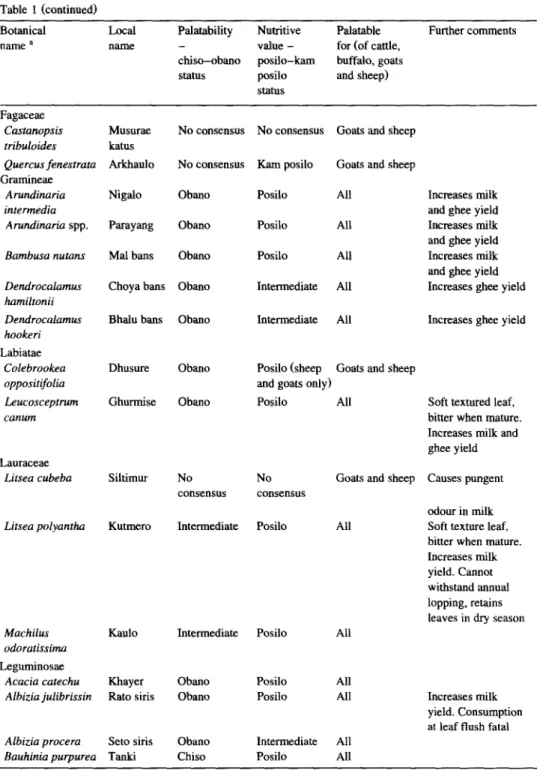
98 B. Thapa et al. /Animal Feed Science Technology 67 (1997) 97-114 Table 1
Trees, shrubs and bamboos cultivated for fodder on farms and their key characteristics
Botanical Local Palatability Nutritive Palatable Further comments
name ’ name - value - for (of cattle,
chiso-obano posilo-kam buffalo, goats status posilo and sheep)
status
Actinidiaceae
Saurauia nepautensis Gogun chiso Kam posilo All Coarse leaf, cannot withstand annual lopping, retains leaves in dry season
Sati bayer Intermediate Posilo (sheep Goats and sheep
Bhakimlo Bhayalo
Khirra
Intermediate No consensus
and goats only) Kam posilo Kam posilo
Goats and sheep Goats and sheep Anacardiaceae Rhus paruiflora Rhus semialata Rhus succedanea Apocynaceae Wrightia antidysenterica Araliaceae Brassaiopsis spp. Betulaceae Alnus nepalensis Bignoniaceae Oroxylum indicum Stereospermum personatum Burseraceae Garuga pinnata Caprifoliaceae Leycesteria formosa Combretaceae Terminalia bellirica Terminalia chebula Terminalia tomentosa Dipterocarpaceae Shorea robusta Elaegnaceae Elaeagnus latiyolia Ericaceae Lyonia oualifolia
No consensus Kam posilo
Chuletro chiso Utis No consensus Tatola Padoti Intermediate Intermediate Dabdabe Intermediate Patpatae No consensus Barro Harro Saj Intermediate Intermediate Sal No consensus Guyelo No consensus
Angerii No consensus Kam posilo
Goats and sheep
Intermediate
Kam posilo
No consensus Intermediate
All
Goats and sheep
All All Intermediate All No consensus Intermediate Intermediate Kam posilo
Goats and sheep
All All All Intermediate Kam posilo All
Goats and sheep
Goats and sheep Consumption at leaf flush fatal Euphorbiaceae
Bn’delia retusa Gayo Intermediate All Decreases milk
yield. Consumption at leaf flush fatal Goats and sheep
Macaranga pustulata Fagaceae Castanopsis indica Maleto Dhalne katus No consensus No consensus Kam posilo
B. Thapa et al. / Animal Feed Science Technology 67 (1997) 97-114 99 Table 1 (continued) Botanical name a Local name
Palatability Nutritive Palatable Further comments - value - for (of cattle,
chiso-obano posilo-kam buffalo, goats status posilo and sheep)
status Fagaceae Castunopsis Musurae tribuloides katus Quercusfenestratu Arkhaulo No consensus No consensus Gramineae Arundinaria intermedia Arundinariu spp. Bambusa nutans Dendrocalumus hamiltonii Dendrocalamus haokeri Labiatae Colebrookea oppositifolia Leucosceptrum canum Lauraceae Litsea cubeba Litsea polyantha Nigalo Obano Parayang Obano
Ma1 bans Obano
Choya bans Obano
Bhalu bans Obano
Dhusure Obano
Ghurmise Obano
Siltimur No
consensus
Kutmero Intermediate
No consensus Goats and sheep
Kam posilo Goats and sheep
Posh0 All
Posilo All
Posilo All
Intermediate All
Intermediate All
Posilo (sheep Goats and sheep and goats only)
Posilo All
No
consensus
Goats and sheep
Posilo All
Muchilus Kaulo Intermediate Posilo All
odoratissima Leguminosae
Acacia catechu Khayer Obano Posilo All
Albizia julibrissin Rato siris Obano Posilo All
Increases milk and ghee yield Increases milk and ghee yield Increases milk and ghee yield Increases ghee yield
Increases ghee yield
Soft textured leaf, bitter when mature. Increases milk and ghee yield
Causes pungent
odour in milk Soft texture leaf, bitter when mature. Increases milk yield. Cannot withstand annual lopping, retains leaves in dry season
Increases milk yield. Consumption at leaf flush fatal Albizia procera Set0 siris
Bauhinia purpurea Tanki
Obano Chiso
Intermediate All Posilo All
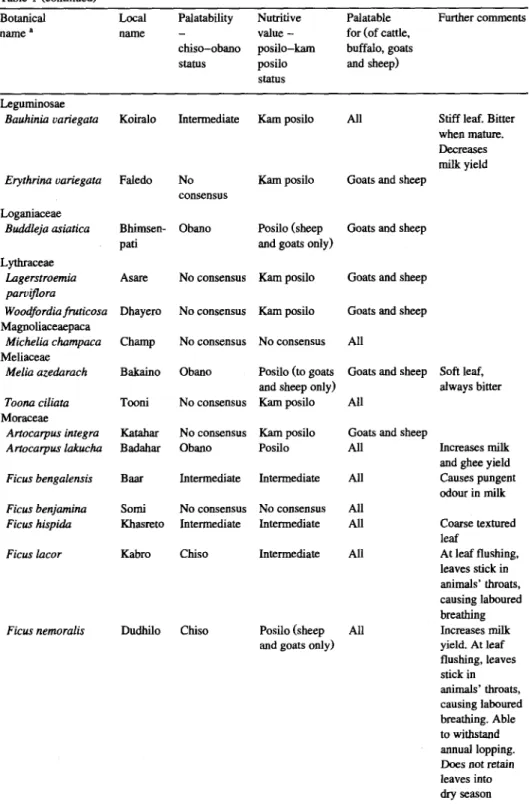
100 B. Thapa et al./Animal Feed Science Technology 67 (1997) 97-114 Table 1 (continued)
Botanical name a
Local Palatability Nutritive
name - value -
chiso-obano posilo-kam
status posilo
StatuS
Palatable for (of cattle, buffalo, goats and sheep) Further comments Leguminosae Bauhinin variegata Etythritaa variegata Loganiaceae Buddleja asiatica Lythraceae. Logerstroemia parviflora Woodfordiafncticosa Magnoliaceaepaca Michelia chumpaca Meliaceae Melia azedarach Toona ciliata Moraceae Artocarpus integra Artocarpus lakuchu Ficus bengalensis Ficus benjamina Ficus hispida Ficus lacer
Koiralo Intermediate Kam posilo All
Paledo No consensus
Kam posilo Goats and sheep
Bhimsen- Obano pati
Posilo (sheep Goats and sheep and goats only)
Asare No consensus Kam posilo Goats and sheep Dhayero No consensus Kam posilo Goats and sheep Champ No consensus No consensus All
Bakaino Obano Posilo (to goats Goats and sheep and sheep only)
Tooni No consensus Kam posilo All
Katahar No consensus Kam posilo Goats and sheep
Badahar Obano Posh0 All
Baiir Intermediate Intermediate All SOIIli No consensus No consensus All Khasreto Intermediate Intermediate All
Kabro chiso Intermediate All
Ficus nemoralis Dudhilo chiso Posilo (sheep All and goats only)
Stiff leaf. Bitter when mature. Decreases milk yield Soft leaf, always bitter Increases milk and ghee yield Causes pungent odour in milk Coarse textured leaf At leaf flushing, leaves stick in animals’ throats, causing laboured breathing Increases milk yield. At leaf flushing, leaves stick in animals’ throats, causing laboured breathing. Able to withstand annual lopping. Does not retain leaves into dry season
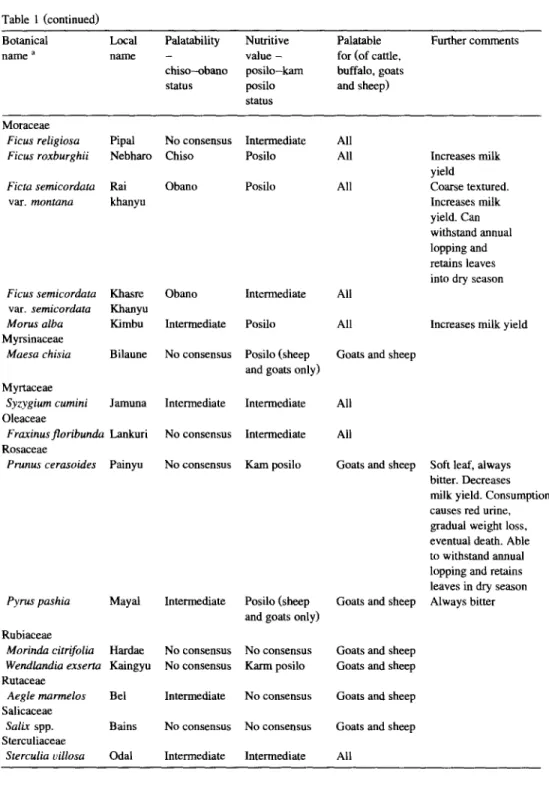
B. Thapa et al./Animal Feed Science Technology 67 (1997) 97-114 101 Table 1 (continued)
Botanical name a
Local Palatability Nutritive Palatable Further comments name - value - for (of cattle,
chiso-obano posilo-kam buffalo, goats status posilo and sheep)
status
Moraceae
Ficus religiosa Pipal Ficus roxburghii Nebharo Ficta semicordata Rai
var. montana khanyu
Ficus semicordata Khasre var. semicordata Khanyu
Morus alba Kimbu
Myrsinaceae
Maesa chisia Bilaune Myrtaceae
Syzygium cumini Jamuna Oleaceae
Fraxinusfloribunda Lankuri Rosaceae
Prunus cerasoides Painyu
Pyrus pashia May al
Rubiaceae
Morinaiz cittifolia Hardae
Wendlandia exserta Kaingyu Rutaceae
Aegle marmelos Bel Salicaceae
Salix spp. Bains Sterculiaceae
Sterculia uillosa Odal
No consensus Chiso Obano Obano Intermediate No consensus Intermediate Intermediate No consensus Intermediate
No consensus Kam posilo
Intermediate No consensus No consensus Intermediate No consensus Intermediate Intermediate Posilo Posilo All All All Intermediate All Posilo All
Posilo (sheep Goats and sheep and goats only)
All
All
Goats and sheep
Posilo (sheep Goats and sheep and goats only)
No consensus Karm posilo
No consensus
No consensus
Intermediate
Goats and sheep Goats and sheep
Goats and sheep
Goats and sheep
All Increases milk yield Coarse textured. Increases milk yield. Can withstand annual lopping and retains leaves into dry season
Increases milk yield
Soft leaf, always bitter. Decreases milk yield. Consumption causes red urine, gradual weight loss, eventual death. Able to withstand annual lopping and retains leaves in dry season Always bitter
102 B. Thapa et al. /Animal Feed Science Technology 67 (I 997) 97-114 Table 1 (continued) Botanical name a Local name
Palatability Nutritive Palatable Further comments value - for (of cattle,
chiso-obano posilo-kam buffalo, goats
status posilo and sheep)
status Theaceae
Eurya acuminata Schima wallichii
No consensus Kam posilo No consensus Kam posilo
Goats and sheep Goats and sheep Chilaune
Shyal- fusro
All
Khari Intermediate Posilo All
Karam Intermediate Intermediate All
Tusate Kamle Gidari Intermediate Intermediate Intermediate All Posilo All Posilo All
Simall Posilo (sheep
and goats only)
Goats and sheep
Hadchur Intermediate All
Hallaudae No consensus Kam posilo Chamlayo Sigoure Sindurae Tilke Malledo Darimpate Pipire Dtldhae hihara Babis Silange Char chare lahara Archal Intermediate Intermediate No consensus Intermediate No consensus Karn posilo Intermediate Posilo No consensus No consensus Intermediate Kam posilo Inte.tmediate Intermediate Intermediate Posilo Fed to goats and sheep All All
Goats and sheep All
Goats and sheep Goats and sheep Goats and sheep All
No consensus Kam posilo Goats and sheep No consensus No consensus All
Intermediate Posilo All
No consensus Kam posilo Goats and sheep
Stiff leaf, unpalatable when mature Soft textured leaf, bitter when mature. Can withstand annual lopping and retains leaves into dry Season Increases milk yield Tiliaceae Grewia oppositifolia Celtis australis Hotoptelea integrifolia Utticaceae Debregeasia salicifolia Pilea wightii Verbenaceae
Premna spp. Causes pungent
odour in milk Soft textured leaf, always bitter Verbenaceae Vite.x negundo Viscum artkulatum ?
Increases milk yield
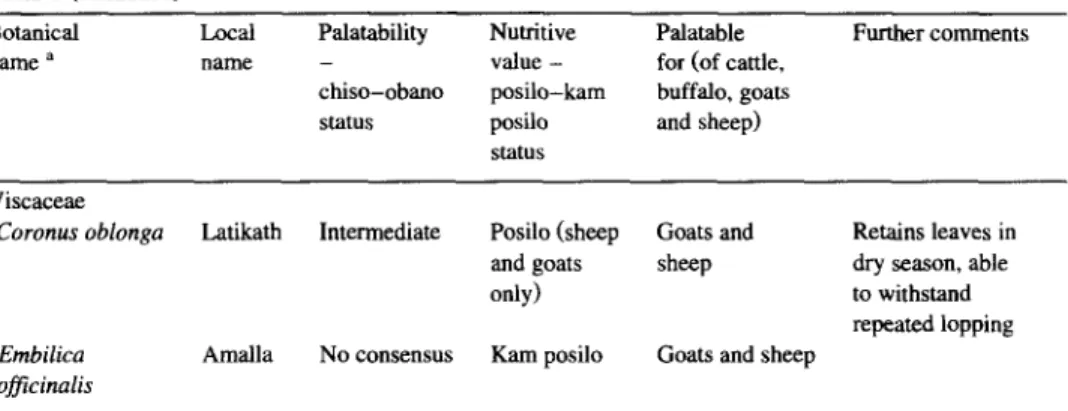
B. Thapa et al./Animal Feed Science Technology 67 (1997) 97-114 103 Table 1 (continued) Botanical name a Local name
Palatability Nutritive Palatable Further comments _ value - for (of cattle,
chiso-obano posilo-kam buffalo, goats status posilo and sheep)
status
Viscaceae
Coronus oblonga Latikath Intermediate Posilo (sheep Goats and Retains leaves in and goats sheep dry season, able
only) to withstand
repeated lopping Embilica Amalla No consensus Kam posilo Goats and sheep
officinalis
a Family names are given in normal type
(Hopkins, 1985; T 1 h u ac an, 1985; Shrestha and Sherchand, 1988). Decreases in animal numbers leads to a reduction in the quantity of manure and draught power. This in turn results in a decline in agricultural productivity and a loss of farm income, with severe consequences for human nutrition. Because tree fodder is a primary constituent of animal feed in Nepal, farmers depend on tree resources to maintain livestock numbers. Tree fodder is particularly important in providing a store of green and nutritious feed for livestock during the dry season when other feeds are in limited supply - more than 75% of the tree fodder that is fed to livestock is used during the period from November to June (Panday, 1982).
Tree fodder is collected and fed to animals in stalls. Farmers collect tree fodder from two sources: private farmland and public forestland. Fragmentation of land holdings coupled with the declining productivity of public forestland motivate farmers to cultivate more trees on their private farmland (Carter and Gilmour, 1989; Gilmour and Nurse,
1991; Robinson, 1992; Subba, 1992). These trees and shrubs are usually grown in strips along the edges of the bari land (upper slope non-irrigated cultivated land) terraces which constitute about 80% of the cultivated land (Carter and Gilmour, 1989). While the trees cultivated are predominantly the result of natural regeneration, the seedlings retained are carefully selected, principally for fodder value and location and are often relocated within the farm. A severely constrained land resource means that all the trees on farmland are retained deliberately.
In Parbat district, in the western mid-hills of Nepal, 56 species were identified as being cultivated on private farmland and used for fodder by a hill farming community (Rusten and Gold, 1991). Similarly, Upton (1990) reported some 70 species of trees and shrubs being used for fodder by a hill farming community south-east of the Kathmandu valley, in the central mid-hills. Thapa (1995) found some 129 species cultivated on-farm, 90 of which played a role as a fodder source (Table 1).
Given the precarious nature of the livelihoods of communities in the mid-hills of Nepal, the critical role of tree fodders within the farming systems and the potential impact of on-farm tree fodder cultivation on crop production (Thapa et al., 1995), it seems reasonable to hypothesise that this extreme diversity of on-farm tree fodder
104 B. Thapa et al./Animal Feed Science Technology 67 (1997) 97-114
resources is not arbitrary but reflects a sophisticated understanding of the comparative value of tree fodder resources. The research reported here aimed to explore the extent and nature of such understanding.
2. Methods
The Agroforestry Knowledge Toolkits (AKTl and AKT2) and associated methodol- ogy (Walker et al., 1995) support the creation and use of coherent and accessible knowledge bases, synthesising information elicited from farmers and development professionals. The AKT-based systems’ approach was applied to investigate the farmers’ knowledge about the comparative value of tree fodder resources. The study community was defined by the administrative boundary of Solma Village Development Committee comprising 3500 people in a collection of hamlets spread over an altitudinal range of 500 m to 2000 m in eastern Nepal. Sixty farmers, selected randomly from the heads of households in the study community, were interviewed using a questionnaire. A detailed tree inventory was undertaken on 30 of these farms. Trees were classified in relation to the Nepali term rukh, which embraces some species that might be considered to be shrubs as well as bamboos. This was followed by the iterative creation and refinement of a knowledge base through semi-structured interviews with 40 purposively selected key informants, each interviewed on average four times, for about 1 h on each occasion. The purposive sample was stratified in terms of gender, altitude and ethnic&y. Knowledge base creation took approximately 2 h for every hour of interview material. It was undertaken on an iterative basis. Knowledge was entered into the knowledge base on the computer immediately after the first interview and the growing knowledge base was both modified and completed after each subsequent interview. Assessment of the content of the growing knowledge base itself provided the direction for further interviewing. A questionnaire survey was then used to test the representativeness of the content of the knowledge base against the knowledge of 50 randomly selected farmers from the community who had not previously been interviewed. For further details of the methodology applied see Walker et al. (1995) and Thapa et al. (1995).
3. Results
A total of 6350 trees representing 90 locally described species (of which 76 were unequivocally identified - Table 1) were found on the 30 farms on which an inventory of species was made.
Early in the research, it became apparent that the variety and abundance of tree species grown on farmland were primarily determined by a balance between fodder needs and quality on the one hand and the impact of tree husbandry on crop production on the other. The former is discussed in this paper.
Local classifications of fodder value (Section 3.1) integrated a range of perceived effects on livestock, particularly on milk production and animal health (Section 3.2). Effects were believed to vary with the livestock in question (Section 3.3). The classifications provided an operational basis for decision-making in feeding stock. However, it was possible to demonstrate that a more fundamental understanding also
B. Thapa et al./Animal Feed Science Technology 67 (1997) 97-114 105 existed. In particular, intra-species variation in terms of fodder quality was recognised and variable management of sub-species was practised (Section 3.4). Variable identifica- tion and management was achieved through recognition of a range of tree attributes believed to influence fodder palatability and nutritive value (Section 3.5). The relation- ship between this detailed information and the operational classifications demonstrates a sophisticated knowledge system in relation to fodder value. Finally, from a farming systems perspective, the nutritive value and palatability of different tree fodders were balanced by considerations of availability (Section 3.6) and impact on crop production (see Thapa et al., 1995).
3.1. Local classification of fodder value
The comparative quality of fodder from different species was a function of nutritive value, palatability and availability. Two local classifications (posilo/kam posilo and chiso/obano) were used to categorise nutritive value and palatability. The most literal translation of the terms posilo and kam posilo are nutritious (high nutritive value) and less nutritious (low nutritive value), respectively. Farmers’ knowledge of fodder quality was based on an understanding of posilo and kam posilo attributes of fodder, their variability between tree species and their implications for the productivity of animals fed on these fodders. Feeding livestock posilo fodders was considered to increase milk and ghee (butter fat) yield, cause body weight gains and improve vigour and health. Posilo fodders were generally considered to be highly palatable and to satisfy appetite but this was dependent to some extent on the livestock to which they were fed. By contrast kam posilo fodders were not associated with good animal performance and, if used as a sole fodder, were said to cause weight loss, declining milk and ghee yield and a general deterioration. Of the 90 fodder tree species recorded in the inventory, 28 were considered as posilo, 25 as kam posilo and 25 as intermediate between posilo and kam posilo with no clear consensus on the latter (Table 1). Similar classifications have been noted in Salija in the western mid-hills of Nepal (Rusten, 1989) and in Dolakha district in the central mid-hills of Nepal (Robinson, 1990). The categorisation of fodder into posilo and kam posilo types is complicated by the fact that what is considered kam posilo fodder to one class of animal may be considered as posilo fodder when fed to another type of animal, and fodder palatability similarly depends upon the type of animal that is fed (Section 3.3).
Solma farmers also classified tree fodder as chiso or obano. The term obano literally means ‘dry and warm’ and chiso ‘cold and wet’. According to Solma farmers, obano fodders (for example, Leucosceptrum canum and all species of bamboo) tended to be eaten voraciously by animals, often causing constipation if fed in excess, while chiso fodders (for example, Ficus nemoralis and Ficus roxburghii) were reported to be less palatable, often causing diarrhoea when fed during cold months particularly during the months of Poush and Magh (mid-December to mid-February). The definition of chiso and obano fodder given by Solma farmers is similar to that acquired by Rusten (1989) in Salija in the western mid-hills of Nepal. Obano fodders tend to be highly palatable to animals during cold months; lead to the production of dry and firm dung; cause constipation if fed in excessive amounts; satisfy appetite and generally improve animal health and contribute to milk and ghee production. By contrast, chiso fodders are not
106 B. Thnpa et al. /Animal Feed Science Technology 67 (1997) 97-114
very palatable during cold months; cause diarrhoea (watery dung) if fed as a sole fodder during cold months; do not satisfy appetite and cause a decrease in milk and ghee production if fed as a sole fodder during cold months. Of the 90 fodder species recorded in the inventory, only a few species were classified as predominantly obano (15 species) and even fewer predominantly chiso (six species). The high proportion of species classified as intermediate (34 species) or for which there was no consensus (36 species) may reflect the seasonal variation that farmers recognised in this property, making it difficult to classify a species as falling discretely into either a chiso or obano category. Farmers, in fact, said that as leaves matured they typically became less chiso and more obano. Chiso fodder tree species were generally considered to produce chiso fodder from mid-December to mid-February and their fodder was said to be kam posilo, less palatable to animals, to cause diarrhoea and to reduce milk and ghee production if fed during this time of the year, but from mid-February onwards their fodder was said to become gradually obano as the leaves matured so that many of them (Buuhiniu
purpurea, Ficus nenwralis and Ficus roxburghii) were considered posilo for the rest of
the year.
There is clearly some correspondence between obano and posilo attributes of fodder. Of the 15 species classified as obano, 11 were posilo and four intermediate. None were kam posilo. The six species classified as chiso, however, were not predominantly kam posilo (three posilo, two intermediate and one kam posilo). The chiso-obano classifica- tion has a fundamentally seasonal basis and emphasises intake of fodder and the passage of digesta whereas the posilo-kam posilo classification is predominantly related to nutritive value. The adverse effects of chiso fodder were restricted to colder months of the year and only occurred when fed as a sole fodder. The common practice reported was to feed a mixture of chiso and obano fodder to obtain a desirable mixture. Panday (1982) noted farmers reporting Ficus roxburghii fodder causing a decrease in milk yield in the Dolakha area. Similarly, Shrestha and Pakhrin (1989) reported a decrease in milk yield of 0.2 kg day-’ when Ficus roxburghii fodder was fed ad lib. to lactating buffaloes. However, these authors make no mention of whether a decrease in milk yield was caused by chiso attributes associated with Ficus roxburghii fodder.
3.2. Underlying perceptions of the efsects of different fodders
The local classifications in the previous section generalise a more complex under- standing of fodder value. For example, the choice of fodder fed to livestock was partially determined by the products desired from livestock. A number of fodder-s were known to promote milk production while others were known to decrease milk produc- tion. For milk promoting fodders, further distinctions were made between fodders that promoted an increase in milk yield per se and those that caused an increase in ghee content of the milk. For example, Buuhinia purpurea and Ficus nenwralis fodders were said to increase milk production. However, the milk of animals fed with these two fodders was said to be thin corresponding with a low ghee content. By contrast,
Bambusa nutans and Arundinaria spp. fodders were known to produce thick milk and,
therefore, a high ghee content. Fodders that promote high milk production as well as a high ghee content were particularly prized including Artocurpus lakoocha, Litsea
B. Thapa et al. /Animal Feed Science Technology 67 (1997197-l I4 107 considered to cause animals to produce milk with a pungent odour and were, therefore, not fed to lactating animals (though they may promote milk and ghee production or both).
Farmers also showed a considerable knowledge about the deleterious effects of fodders on animal health. A number of fodders were known to be toxic to animals. Detailed species-specific knowledge included: the extent of deleterious effects, variabil- ity of effects according to season and different stages of leaf development and the mechanisms by which these effects could be minimised, either by avoiding feeding particular fodders at particular times or by post-harvest treatments. In most cases it was the paulo leaves (young leaves at flushing stage) which were said to cause toxic effects on animals. Three species (Albizia julibrissin, Bridelia retusa and Lyonia ovalifolia) were known to be highly toxic to animals at the paulo stage and, if fed, the conse- quences could be fatal. Symptoms included laboured breathing (dyspnoea), frothing at the mouth, bloat and convulsions. Foliage was, therefore, avoided at leaf flush. It is likely that these tree leaves contain cyanogenic glycosides, producing hydrogen cyanide through reaction in the digestive tract with hydrolysing enzymes (as described by Maslin et al., 1987 in Acacia spp.). Hydrogen cyanide can lead to the immediate death of animals (Paterson, 1993). Preliminary laboratory analyses of fodder toxicity at Pakhribas Agricultural Centre has indicated that these three species do contain high levels of cyanogenic substrates which may be reduced to acceptable levels by boiling leaves before feeding to animals. Certain fodder leaves, notably the leaves of Ecus nemoralis and Ficus Zacor, were said to stick in animals throats, a condition locally known as gala lagne. No serious consequences were generally expected but the condition could be fatal at times if immediate action was not taken. Generally, farmer practice in such cases was to remove the leaves manually from the animal’s throat. These species were known by farmers to produce a sticky milky latex which was said to cause the leaves to become stuck. The latex content of leaves was said to decrease with increased leaf maturity and, therefore, deleterious effects occurred only if paulo leaves were fed to animals. Post-harvest treatments, for example wilting of paulo leaves for about 12 h before feeding to animals, was thought to eliminate the effect and this was widely practised by farmers. Feeding Prunus cerasoides fodder to cattle was said to cause red urine disease known locally as lahue mute, which would lead to loss of body weight and ultimately death. Certain fodders, for example all species of bamboos and Arundinaria spp., were considered to have positive effects on animals, particularly young calves. Feeding these fodders to young calves was said to decrease gastro-intestinal worms.
3.3. Differences according to livestock category
Farmers in the study area recognised that certain fodders were eaten preferentially by goats and sheep but not by cattle and buffaloes. Similarly, certain fodders were considered as posilo to goats and sheep while the same fodders were known to be kam posilo to cattle and buffaloes. On the basis of this understanding, farmers often classified tree fodders as goat-sheep fodder and cattle-buffalo fodder. Of the 90 species recorded in the inventory, 38 were considered to be primarily goat-sheep fodder, while 52 were considered to be suitable as cattle-buffalo fodder. Further analysis of the 28 species listed as posilo fodder (Table 1) in relation to animal type revealed that 19 species were
108 B. Thapa et al. /Animal Feed Science Technology 67 (1997) 97-114
considered as posilo fodder to all classes of animal while nine were considered as kam posilo and less palatable to cattle and buffaloes but posilo and palatable to goats and sheep (Table 1).
Farmers could not provide an explanation for why certain fodders were posilo to certain classes of animal and kam posilo to others and why certain classes of animal eat certain fodders preferentially when others did not. Paterson (1993) suggested that cattle generally showed a marked preference for fodder with soft leaves rather than tough leaves and that this characteristic was shared to some extent by sheep but probably not by goats. However, Paterson (1993) further states that such a preference is only important when animals are presented with a choice. Since all fodders considered as posilo and palatable to cattle and buffalo are also considered as posilo and palatable to goats and sheep, it may be that the distinctions made by farmers between cattle-buffalo fodder and goat-sheep fodder were based on the value of different classes of farm animals. For example, farmers may view cattle and buffalo as more important farm animals than sheep and goats and, therefore, cattle and buffalo may have been fed with posilo fodders and goats and sheep fed with kam posilo fodders so that each category of animal may have become accustomed to a particular type of fodder.
3.4. Intra-species variation in tree fodders
A number of fodder tree species which are identified as single taxonomic units by botanists and foresters were said by farmers to occur as different varieties with differences in fodder quality and to require different silvicultural management. At least seven species of tree fodder were recognised by farmers as occurring in two or more distinct varieties, Differences were not only in physical appearance but also related to tree productivity and fodder value. The qualitative analytical tools used by farmers in distinguishing these varietal differences were based on leaf shape, leaf size, leaf texture, time of leaf shedding and the implications of these attributes for fodder palatability, productivity and management options, nutritive value (posilo or kam posilo status) and chiso-obano status. The varietal differences and characteristics of three fodder tree species recognised unanimously by informants to display it&a-species variation are summarised in Table 2(a) and those recognised less consistently are listed in Table 2(b). Some authors have reported the existence of varietal differences in certain fodder tree species in other parts of Nepal (Upton and Robinson, 1988; Dutt, 1993). Fodder improvement work based on intra-species variation has not received attention because forestry researchers active in Nepal have not been aware of intra-species variability. One varietal distinction used by farmers (khanyu subspecies kbasre khanyu and rai khanyu) has been accepted by the scientific community in recent years in that khasre khanyu has been classified as Ficus semicordata var. semicordata and rai khanyu, Ficus semicor- data var. montana (Amatya, 1989).
3.5. Tree attributes influencing fodder palatability and nutritive value
Fodder palatability in relation to type of animal has already been discussed (Section 3.3). In this section, tree attributes recognised by farmers as influencing fodder palatability and nutritive value are examined: leaf texture, leaf maturity and leaf
Table 2
B. Thupa et al. /Animal Feed Science Technology 67 (1997) 97-l 14 109
(a) Varietal differences and characteristics of three fodder tree species recognised unanimously by informants. (b) Fodder tree species recognised by some informants as occurring in two or more varieties
(a)
Ficus nemoralis (Dudhilo) Variety 1: sano pate dudhilo
Variety 2: thulo pate dudhilo
Bauhinia purpureu (Tanki) Variety 1: buthure tanki
Variety 2: labare tanki
Ficus roxburghii (Nebharo) Variety 1: sano pate nebharo
Variety 2: thulo pate nebharo
(b)
Ficus lacer (Kabro)
Ficus semicordala (Khanyu) Saurauiu nepuulensis (Gogun) Buuhiniu variegatu (Koiralo)
Leaf size small, leaf shape elongated with pointed tips; sheds leaves early in the dry season (winter shedder); rapid growth of regrowth shoots after lopping; lopping frequency more than one time per year (can be lopped at least two to three times per year and so produce a large quantity of fodder); only posilo to and eaten preferentially by goats and sheep; more chiso than the variety thulo pate dudhilo; produces more sticky milky latex than thulo pate dudhilo and hence causes leaves to stick in animals’ throats more than thulo pate dudhilo
Leaf size big, leaf shape round with flat tips; sheds leaves late in the dry season (spring shedder); slow growth of regrowth shoots after lopping; lopping frequency one time per year (can be lopped only one time per year for fodder, therefore, produces a smaller quantity of fodder than sano pate dudhilo); posilo and eaten preferentially by all classes of animal; more obano or less cbiso than sano pate dudhilo; produces less sticky milky latex than sano pate dudhilo and hence less of a problem in respect of leaves sticking in animals’ throats
Leaf size big; leaf shape round (large leafed); leaf texture stiff; leaves bitter in taste; leaf inclination angle - horizontal; more kam posilo than Mare tanki; more chiso than lahare tanki
Leaf size small; leaf shape elongated; leaf texture soft; leaves not bitter in taste; leaf inclination angle - drooping (sticking down); posilo and eaten preferentially by all classes of animal: more obano or less chiso than buthure tanki
Leaf size small, leaf shape round with flat tips; leaf texture soft; posilo and eaten preferentially by all classes of animal; more obano or less chiso than thulo pate nebharo; sheds leaves late in the dry season (spring shedders) Leaf size big, leaf shape round with pointed tips; leaf texture coarse; more kam posilo than sano pate nebharo; more chiso than sano pate nebharo; sheds leaves early in the dry season (winter shedders)
Varietal differences recognised by 52% of informants. Kalo kabro, seto kabro, rato kabro and Mare kabro with latter being exclusively preferred over others as quality fodder
Varietal differences recognised by 42% of informants. Rai khanyu and khasre khanyu with former being considered as quality fodder Varietal differences recognised by 27% of informants. Seto gogun and rato gogun with former being considered as quality fodder
Varietal differences recognised by 17% of informants. Seto koiralo and kalo koiralo (phenological differences only, no differences recognised in terms of fodder quality)
bitterness. Generally, fodders that were palatable were also considered to be of high nutritive value. However, these two terms were quite different and fodders that were palatable were not always of high nutritive value. For example, Litsea monopetala
110 B. Thapa et al./Animal Feed Science Technology 67 (1997) 97-114
fodder was considered to be of high nutritive value but of low palatability, while Brideliu retusa fodder was considered to be palatable but of low nutritive value. Farmers described leaf texture as soft, coarse and stiff. Fodders with soft leaves were said to be more palatable and nutritious than coarse and stiff leaves. Generally, leaves were said to become coarser and stiffer with an increase in leaf maturity and, therefore, fodders became less palatable as well as less nutritious as they matured. Leaf maturity was described in terms of ripeness. Three categories of ripeness were recognised: unripe (immature>, ripe (mature) and over-ripe (senescing). Ripe leaves were considered to be very palatable and nutritious, while over-ripe leaves were considered not very palatable and of low nutritive value with unripe leaves intermediate. Unripe leaves were generally described as reddish in colour and shiny. They were also sometimes considered to be bitter. Over-ripe leaves were generally said to be yellowish in colour and bitter. Ripe leaves were generally said to be dark green in colour and less shiny than unripe leaves and were considered the most appropriate for lopping and feeding to animals. Leaf bitterness was said to make fodder less palatable and to decrease nutritive value. Leaf bitterness was also said to cause a decrease in the voluntary intake of fodder by animals. Generally, leaf bitterness was said to increase with an increase in leaf maturity. However, certain tree fodder leaves such as Melia azedarach, Prunus cerasoides, Vitex negundo and Pyrus pashiu were said to be extremely bitter irrespective of leaf maturity and were considered only palatable to goats and sheep.
Many features of woody plants ranging from purely physical (for example, thorns, spines and leaf coarseness) to chemical (for example, offensive odour, tannin content and alkaloid content) have been reported in the literature as influencing palatability and nutritive value of a particular fodder. A recent review (Paterson, 1993) suggests that the presence of tannins, because of their astringency, and alkaloids, because of their bitter taste, can reduce nutritive value and fodder palatability considerably. D’Mello (1992) reports that the tolerance to tannins and alkaloids varies between animal species with goats being most tolerant followed by sheep and cattle. D’Mello (1992) also reported that, unlike cattle, goat and sheep saliva contains proline-rich protein which can act as a defence against tannins explaining why goats and sheep may be able to eat more tannin or alkaloid-rich fodder than cattle.
3.6. Fodder productivity and availability
The previous sections have considered a range of tree attributes influencing the quality of fodder and the knowledge held by farmers about the way these attributes affect fodder quality. While this knowledge system appears to be crucial in making decisions about when, what and how much fodder to cut, other factors were also important in determining the value of fodder to the farmers. The most important were seasonal availability and the ability of fodder trees to withstand multiple lopping, which, in turn, influenced when fodder from trees was available.
Certain fodder tree species shed leaves early in the winter while others retained leaves late into the spring. Some fodder tree species could be lopped more than one time per year while others only once. Farmers often preferred those fodder species which could withstand multiple lopping within a year and those that retained leaves late into the dry season so that more fodder could be supplied at critical times of the year. The
B. Thupa et al. /Animal Feed Science Technology 67 Cl 9971 97-l 14 111 need to supply fodder throughout the dry season meant that trees producing fodder of high nutritive value were not always preferred because the choice of trees to cultivate on a farm was dictated as much by the necessity to supply fodder at different times of the year as by the desire to maximise nutritive value at any particular time in the season. Many of the tree species that retained leaves late into the dry season and were able to withstand multiple lopping were also kam posilo in terms of their fodder quality but were nevertheless cultivated on farmland.
The inventory data reflect the trade-offs between productivity, availability and nutritive value in that, of the total of 6350 fodder trees recorded, 56.6% produced kam posilo fodder, 7.1% fodder of intermediate status and only 36.3% posilo fodder. The situation was further complicated by the fact that fodder was not the only tree product required by farmers. With a declining supply of tree products from public forestland (common property resources) and farmers having to rely increasingly on their own farmland to meet their tree product needs they often expressed a preference to grow fodder tree species that supplied multiple products (for example fodder, fuelwood and timber), so that the fodder quality of a tree species was balanced against its other attributes. This may be particularly true for farmers with small land holdings whose pressing concern may be to meet these basic tree product needs, whereas larger farmers, who are less constrained by land area, may have more opportunity to make full use of knowledge about fodder quality and so improve the plane of nutrition of their animals. In summary, it appears that farmers know fodder quality very well. However, the quality of fodder fed to their animals may be moderated by constraints imposed by the product mix required from trees on small land holdings and the need to supply fodder throughout the dry season.
4. Discussion
The research reported here demonstrated that the farmers interviewed had a compara- tively sophisticated set of criteria for assessing fodder quality. Furthermore, it should be noted that the fodders fed to livestock (which are predominantly stall fed) were frequently supplied in carefully managed mixtures. The research reported here relates to the quality of fodder from individual species but has not explicitly addressed their role within mixtures and merits further attention.
As the major purpose for which farmers grew trees was to produce fodder, fodder value can be expected to be an important factor in selection requirements. However, growing trees on, or adjacent to, crop land has an impact on crop yield. So, comparative tree-crop interactions were also highly significant in managing tree-fodder resources (Thapa et al., 1995). Consideration of selection criteria in tree breeding programmes based on farmers’ knowledge can be envisaged as resulting in explicit selection of species and genotypes that may be compatible with requirements for incorporation of trees into local farming systems. However, it is clear that selection requirements for fodder trees that will be optimal for growing on crop terrace risers and meet the needs of farmers are complex. This is further complicated by the fact that not all the tree species cultivated possess a desirable combination of attributes. In particular, highly productive
112 B. Thapa et al./Animal Feed Science Technology 67 (1997) 97-114
and nutritious fodder species may be likely to have a greater impact on crop yield than less desirable species. This problem provides opportunities for further research for selecting desirable genotypes either by altering management actions or through selection and breeding.
The lack of scientific knowledge about the vast majority of fodder tree species used by farmers is another problem. In Solma alone, 90 species were used as fodder in some form by farmers. Present scientific knowledge of these species is too sparse to support promotion at farm level and many of the species are unfamiliar to researchers and development professionals. The inability on the part of the professional foresters working in the district to name more than a few species reinforces this point. Given the dearth of information, it may be sensible in the short term to select a limited number of species considered by farmers to have desirable attributes for detailed investigation. As scientific understanding about these species progresses, more species could be evaluated for their suitability and promotion for growing on crop terrace risers.
No knowledge system can be complete, and farmers’ knowledge, like modem science, has weaknesses and imperfections and some complementarity between farmers’ and scientists’ knowledge is apparent. The present research revealed that farmers may often be faced with a series of trade-offs between their various needs and the resources available to them. This clearly suggests potential for improvement in the system through future research.
Scientists both in Nepal (Subba et al., 1992; Panday and Osti, 1993) and elsewhere (M. Gill and P. Thome, personal communication, 1994) 1 have been actively trying to ascertain fodder quality through repeatable methods of chemical analysis. However, results from these studies are far from conclusive and often contradictory between different laboratories (Mahato and Subba, 1988; Paterson, 19931, in some cases vindicat- ing farmers’ preferences and in others finding no chemical explanations for them (Subba et al., 1992). A review of available literature clearly suggests the need for more rigorous work before farmers’ preferences and nutritional values of tree fodder can be evaluated reliably using chemical means.
Researchers have rarely considered local understanding of the factors influencing fodder quality in their assessment of it. The failure of researchers to recognise tree attributes considered important by farmers in influencing fodder quality means that much research on the nutritional value of tree fodder in Nepal has been based on standard nutritive value assessment methods, notably ‘proximate analysis’ and more recently a broader range of methods in which digestibility and crude protein, crude fibre, lignin, cellulose and tannin content are often considered as important indicators of fodder quality. While these indicators may be important in determining fodder quality, many studies carried out based on these indicators have produced widely differing results for the same species (Subba and Tamang, 1990). This may be because nutritive and anti-nutritive factors often vary with species, sub-species (varieties), season and leaf maturity as suggested in the present study. This may partly explain why so many
I Dr Margaret Gill and Dr Peter Thome are livestock specialists at the Natural Resources Institute, Chatham, UK.
B. Thapa et al. /Animal Feed Science Technology 67 (1997) 97- 114 113 attempts to ascertain fodder quality through chemical analysis have failed to draw conclusions of practical utility.
A clear indication from this study is that if farmers’ preferences and nutritional values of tree fodder are to be evaluated reliably using chemical means, the indicators of fodder quality currently being used in the assessment of nutritive value of tree fodder are inadequate. In this context, consideration of farmers’ knowledge, particularly the tree attributes that they recognise as influencing fodder quality, could lead to the develop- ment of more suitable sampling strategies and methods for assessing nutritive value than currently being used. Research to investigate whether methods can distinguish tree fodder on the basis of quality defined according to farmer criteria might, therefore, constitute the first stage in attempting to unify chemical analysis with farmers’ knowl- edge.
The present research has shown that the majority of the characteristics of tree fodder that were used by farmers as indicators of fodder quality were based on physical attributes of the trees that were easily observed by farmers. In some cases, the link between these characteristics and their impact on fodder quality as defined by farmers could be easily inferred (for example, coarse leaves and fodder palatability), while others could not (for example, leaf bitterness and milk and/or ghee production). This suggests a high degree of empiricism in farmers’ knowledge and that indicators of tree fodder quality that they use may not be capable of differentiating new types of tree fodder or how to use existing types in different ways. There may, therefore, be scope for nutritive value assessment methods to contribute when farmers need to generate information on new types of tree fodder or the use of existing types under different conditions.
On the basis of these considerations, it is suggested that future research on tree fodder quality might most appropriately be directed to investigate: the extent to which indicators currently used by farmers are able to meet their needs for information on tree fodder quality; the extent to which the nutritive value assessment methods can differenti- ate tree fodder quality defined according to farmers’ criteria and the extent to which nutritive value assessment methods can supplement farmers’ indicators of fodder quality in an improved system of fodder quality evaluation.
References
Amatya, SM., 1989. Ficus semicordara Buch.Ham.ex Sm. and Its Taxonomy. Forest Research Division Publication No. l/89, Department of Forestry and Plant Research, Kathmandu, Nepal.
Carter, AS. and Gilmour, D.A., 1989. Increase in tree cover on private farmland in central Nepal. Mt. Res. Dev., 9(4): 381-391.
D’Mello, J.P.F., 1992. Chemical constraints to the use of tropical legumes in animal nutrition. Anim. Feed Sci. Technol., 38: 237-261.
Dutt, P., 1993. Fodder: Development of a Fodder Seedling Supply Strategy for the Koshi Hills. Koshi Hill Development Programme, Dhankuta, Nepal.
Gilmour, D.A. and Nurse, M.C., 1991. Farmers initiatives in increasing tree cover in central Nepal. Paper presented at an international workshop on socio-economic aspects of tree growing by farmers, 1 l-14 March 1991, Institute of Rural Management, Anand, India.
114 B. Thapa et al./Animal Feed Science Technology 67 (1997) 97-114
Mahato, S.N. and Subba, D.B., 1988. Nutritional evaluation of fodder at Pakhribas Agricultural Centre, Dhankuta. In: P.J. Robinson (Editor), Proceedings of the Second Meeting of the Working Group on Fodder Trees, Forest Fodder and Leaf Litter. FRIC Occasional Paper No. 2/88, Forest Research and Information Centre, Kathmandu, Nepal, pp. 20-22.
Maslin, B.R., Conn, E.E. and Dunn, J.E., 1987. Cyanogenic Australian species of Acacia: a preliminary account of their toxicity potential. In: J.W. Tumbull (Editor), Proceedings of the Workshop on Australian Acacias in Developing Countries. ACIAR Proceedings No. 16, Canberra, Australia, pp. 107-l 11. Panday, K.K., 1982. Fodder Trees and Tree Fodder of Nepal. Sahayogi Prakashan, Kathmandu, Nepal. Panday, S.B. and Osti, N.P., 1993. Chemical composition of six fodder tree species. In: P. Mathema (Editor),
Proceedings of the Regional Seminar on Fodder Trees, Forest Fodder and Leaf Litter. FRD Occasional Paper No. l/93, Forest Research Division, Kathmandu, Nepal, pp. 4-11.
Paterson, R.T., 1993. Use of Trees by Livestock: Anti-Nutritive Factors. Natural Resources Institute, Chatham, UK.
Robinson, P.J., 1990. Some results of the Dolakha private tree survey. In: SM. Amatya and M.S. Philip (Editors), Proceedings of the Third Meeting of the Working Group on Fodder Trees, Forest Fodder and Leaf Litter. FRIC Occasional Paper No. 2/90, Forest Research and Information Centre, Kathmandu, Nepal, pp. 34-41.
Robinson, P.J., 1992. Indigenous knowledge in agroforestry systems in Nepal. Paper presented at the workshop on indigenous management of agriculture and natural resources, 8-9 June 1992, Kathmandu, Nepal.
Rusten, E.P., 1989. An investigation of an indigenous knowledge system and management of tree fodder resources in the middle hills of western Nepal. Ph.D. Thesis, Michigan State University, USA.
Rusten, E.P. and Gold, M.A., 1991. Understanding an indigenous knowledge system for tree fodder via a multi-method on-farm research approach. Agrofor. Syst., 15: 139-165.
Shrestha, N.P. and Pakhrin, B., 1989. Effect of different tree fodders on milk production in buffaloes. PAC Technical Paper No. 117, Pakhribas Agricultural Centre, Dhankuta, Nepal.
Shrestha, N.P. and Sherchand, L., 1988. Role of livestock in Nepalese farming system. Paper presented at VI World Conference of Animal Production, 27 June-l July 1988, Helsinki, Finland.
Subba, K.J., 1992. A Comparative Study of Land Use Changes in Dhankuta District Between 1978-1990. Koshi Hills Development Programme, Dhankuta, Nepal.
Subba, D.B. and Tamang, P.M., 1990. Seasonal variation in the chemical composition of the leaves of Ficus species of fodder trees. In: S.M. Amatya and M.S. Philip (Editors), Proceedings of the Third Meeting of the Working Group on Fodder Trees, Forest Fodder and Leaf Litter. FRIC Occasional Paper No. 2/90, Forest Research and Information Centre, Kathmandu, Nepal, pp. 20-24.
Subba, D.B., Tamang, B.B. and Tamang, P.M., 1992. Availability of protein from high altitude tree fodders during the dry season in the eastern hills of Nepal. Vet. Rev., 7(2): 55-57.
Thapa, B., 1995. Farmers’ ecological knowledge about the management and use of farmland tree fodder resources in the mid-hills of eastern Nepal. Ph.D. thesis, School of Agricultural and Forest Sciences, University of Wales, Bangor.
Thapa, B., Sinclair, F.L. and Walker, D.H., 1995. Incorporation of indigenous knowledge and perspectives in agroforestry development. 2: Case study on the impact of explicit representation of farmers’ knowledge. Agrofor. Syst., 30: 249-261.
Tulachan, P.M., 1985. Socioeconomic characteristics of livestock raising in Nepal. Natural Resource Management Research Paper No. 1, HMG(N)-USAID-GTZ-IDRC-Ford-Winrock Project, Kathmandu, Nepal.
Upton, P.L.J., 1990. Effect of aspect, altitude and season on the use of fodder tree species in south Lalitpur district. Banko Janakari, 2(3): 243-260.
Upton, P.L.J. and Robinson, P.J., 1988. Fodder tree survey of south Lalitpur. In: P.J. Robinson (Editor), Proceedings of the Second Meeting of the Working Group on Fodder Trees, Forest Fodder and Leaf Litter. FRIC Occasional Paper No. 2/88, Kathmandu, Nepal, pp. 34-36.
Walker, D.H., Sinclair, F.L. and Kendon, G., 1995. A knowledge based systems approach to agroforestry research and extension. AI Appl., 9(3): 61-72.