Accelerating Multi-Pattern Matching on
Compressed HTTP Traffic
Anat Bremler-Barr,
Member, IEEE,
and Yaron Koral
Abstract—Current security tools, using ‘signature-based’ de-tection, do not handle compressed traffic, whose market-share is constantly increasing. This paper focus on compressed HTTP traffic. HTTP uses GZIP compression and requires some kind of decompression phase before performing a string-matching.
We present a novel algorithm, Aho-Corasick-based algorithm for Compressed HTTP (ACCH), that takes advantage of informa-tion gathered by the decompression phase in order to accelerate the commonly used Aho-Corasick pattern matching algorithm. By analyzing real HTTP traffic and real web application firewall signatures, we show that up to 84%of the data can be skipped in its scan. Surprisingly, we show that it is faster to perform pattern matching on the compressed data, with the penalty of decompression, than on regular traffic. As far as we know, we are the first paper that analyzes the problem of ‘on-the-fly’ multi-pattern matching on compressed HTTP traffic and suggest a solution.
Index Terms—Compressed HTTP, Computer security, Intru-sion detection, Pattern matching
I. INTRODUCTION
S
ECURITY tools, such as Network Intrusion Detection System (NIDS) or Web Application Firewall (WAF) usessignature-based detection techniques to identify malicious activities. Today, the performance of the security tools is dominated by the speed of the underlying string-matching algorithms that detect these signatures [1].
HTTP compression, also known as content encoding, is a publicly-available method to compress textual content trans-ferred from web servers to browsers. Most popular sites and applications such as Yahoo!, Google, MSN, YouTube and Facebook use HTTP compression; as of 2007, over27%of the Fortune 1000 companies web sites used HTTP compression and the trend is increasing [2]. Moreover, this standard method of delivering compressed content is built into HTTP 1.1, and thus supported by most modern browsers. On average, content encoding saves around 75% of transmitted text files (HTML, CSS, and JavaScript) [3].
Multi-pattern matching on compressed traffic requires two time-consuming phases, namely traffic decompression and
pattern matching. Therefore, most current security tools either ignore scanning compressed traffic, which may be the cause of security holes or disable the option for compressed traffic by re-writing the ‘client-to’ HTTP header to indicates that A. Bremler-Barr is with the Efi Arazi School of Computer Science, The Interdisciplinary Center, Herzlia, Israel (email: [email protected])
Y. Koral is with the Blavatnik School of Computer Sciences Tel-Aviv University, Israel (email:[email protected]).
Manuscript received March 23, 2010; revised April 18, 2011.
This work was supported by the European Research Council under the European Union’s Seventh Framework Programme (FP7/2007-2013)/ERC Grant agreement no 259085.
compression is not supported by the client’s browser thus de-creasing the overall performance and bandwidth. Few security tools handle HTTP compressed traffic by decompressing the entire page on the proxy and performing signature scan on the decompressed page before forwarding it to the client. That option is not applicable for security tools that operate at a high speed or when introducing additional delay is not an option.
In this paper we present a novel algorithm, Aho-Corasick-based algorithm on Compressed HTTP (ACCH). ACCH de-compresses the traffic and then uses the data from the decom-pression phase to accelerate the pattern matching. Specifically, GZIP compression algorithm works by eliminating repetitions of strings using back-references (pointers) to the repeated strings. Our key insight is to store information produced by the pattern matching algorithm for the already scanned decompressed traffic, and in the case of a pointer, use this information to understand if it contains a match or one can safelyskip scanning bytes within it. We show that ACCH can skip up to84% of the data and boost the performance of the multi-pattern matching algorithm by up to 74%.
Preliminary abstract of this paper was published in the proceedings of IEEE INFOCOM 2009.
II. BACKGROUND
GZIP algorithm: GZIP [4] is the most commonly used algorithm for compressing HTTP 1.1 traffic. It is based on the DEFLATE [5] algorithm that first compresses the text using LZ77 algorithm [6] and then compresses the output using Huffman coding [7].
LZ77 Compression - LZ77 technique compresses a string which has already appeared in the past (specifically, in a sliding window of the last 32KB of decompressed data) by encoding it with a pair (distance, length), where distance is a number in [1,32 768] that indicates the distance in bytes to the repeated string, and length is a number in [3,258] that indicates the length of the string in bytes. For example, the string: ‘abcdefabcd’, can be compressed to: ‘abcdef(6,4)’, where (6,4) implies one should return6bytes and copy4bytes from that point. Fig. 1 shows example of ‘Yahoo!’ home page after compression (Stage I - LZ77).
Note that decompression has moderate time consumption, since it reads and copies sequential data blocks, hence relying on spatial locality requiring only few memory references.
Huffman Coding -The Huffman method works on character-by-character basis, transforming each 8-bit character to a variable-sizecodeword; the more frequent the character is, the shorter its corresponding codeword. The codewords are coded such no codeword is a prefix of another so the end of each
(a) (b)
Fig. 1. Example of the LZ77 compression on the beginning of the Yahoo home page (a) Original (b) After the LZ77 compression
codeword can be easily determined.Dictionariesare provided to facilitate the translation of binary codewords to bytes.
In the DEFLATE format, Huffman codes both ASCII char-acters (a.k.a. literals) and pointers into codewords using two dictionaries, one for the literals and pointer lengths and the other for the pointer distances. Huffman may use either fixed or dynamic dictionaries. The use of dynamic dictionaries gains better compression ratio. The Huffman dictionaries for the two alphabets appear in the block immediately after the header bits and before the actual compressed data.
A common implementation of Huffman decoding (cf. zlib [8]) uses two levels of lookup tables. The first level stores all codewords of length less than 9 bits in a table of 29 entries
that represents all possible inputs; each entry holds the symbol value and its actual length. If a symbol exceeds9bits, there is an additional reference to a second lookup table. Thus, on most of the cases, decoding a symbol requires only one memory reference, while for the less frequent symbols it requires two. Multi-pattern matching:Pattern-matching has been a topic of intensive research resulting in several approaches; the two fundamental approaches are based on Aho-Corasick (AC) [9] and the Boyer-Moore [10] algorithms. In this paper, we illustrate our technique using the AC algorithm.
The basic AC algorithm constructs a Deterministic Finite Automaton (DFA) for detecting all occurrences of given pat-terns by processing the input in a single pass. The input is inspected symbol by symbol (usually each symbol is a byte), such that each symbol results in a state transition. Thus, AC algorithm has deterministic performance, which does not depend on the input, and therefore is not vulnerable to various attacks, making it very attractive to NIDS systems.
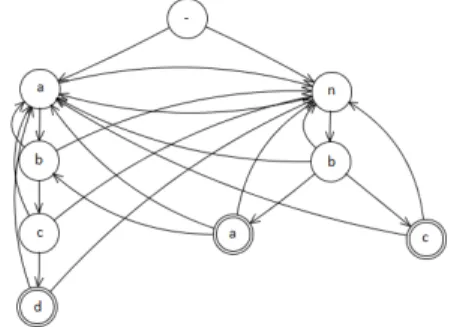
Fig. 2 depicts the DFA for the patterns set: ‘abcd’, ‘nba’, ‘nbc’. The resulting automaton has9 states (corresponding to the nodes of the graph). Each arrow indicates a DFA transition made by a single byte scan. The label of the destination state indicates the scanned byte. If there is no adequate destination state for the scanned byte, the next state is set to root. For readability, transitions to root were omitted.
Note that this common encoding requires a large matrix of size |Σ| · |S| where Σ is the set of ASCII symbols and
S in the number of states) with one entry per DFA edge. In the typical case, the number of edges, and thus the number of entries, is256|S|. For example, Snort patterns [11] used in the experimental results section, require16.2MB for1202patterns that translate into16 649 states. There are many compression algorithms for the DFA (for example [12]–[16]) but most of them are based on hardware solutions.
At the bottom line, DFAs require significant amount of
Fig. 2. Aho Corasick DFA for patterns: ‘abcd’, ‘nba’, ‘nbc’.
memory, therefore they are usually maintained in main mem-ory and characterized by random rather than consecutive accesses to memory.
III. THE CHALLENGES IN PERFORMING MULTI-PATTERN MATCHING ON COMPRESSEDHTTPTRAFFIC This section provides an overview of the obstacles in performing multi-pattern matching on compressed HTTP traf-fic. Note that dealing with web traffic is significantly more challenging than its offline counterpart, since the compression method cannot be chosen or modified. Second, pattern match-ing should be performed ‘on-the-fly’.
We note that there is no apparent “easy” way to perform multi-pattern matching over compressed traffic without de-compressing the data in some way. This is mainly because
LZ77is anadaptivecompression; namely, the text represented by each symbol is determined dynamically by the data. As a result, the same substring is encoded differently depending on its location within the text. Thus, decoding the pattern is futile. For example the pattern ‘abcd’ can be expressed in the com-pressed data byabc∗j(j+ 3,3)dfor all possiblej <32 765. On the other hand, Huffman encoding, is non-adaptive within a given text and the same symbol will always be encoded to the same bit sequence. However, the combination of the two algorithms is adaptive.
The na¨ıve way of performing multi-pattern matching on the traffic in real time, is by the following steps (see Algorithm 1): 1) Remove the HTTP header and store the Huffman dic-tionary of the specific session in memory. Note that different HTTP sessions would have different Huffman dictionaries.
2) Decode the Huffman mapping of each symbol to the original byte or pointer representation using the specific Huffman dictionary table.
0% 5% 10% 15% 20% 25% Pr ec en ta ge
GZIP Pointer Distance Distribution (bytes)
0% 2% 4% 6% 8% 10% 12% 14% 16% 18% 20% Pr ec en ta ge
GZIP Pointer Length Districution (bytes)
(a) (b)
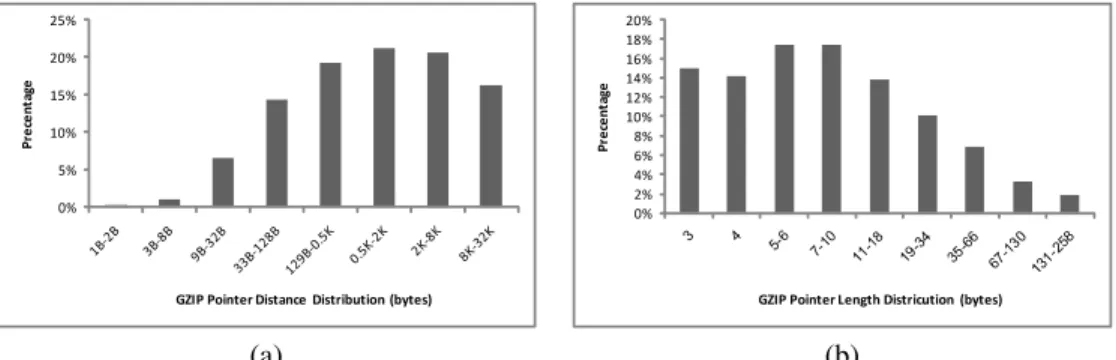
Fig. 3. Distribution of the following pointer characteristics on the real life data set of Section VII (a) distance of a pointer (b) length of a pointer.
Algorithm 1 Na¨ıve: Decompression with Aho-Corasick
T rf - the input, compressed traffic (after Huffman decompression).
SlideW in0...32KB - LZ77 sliding window, contains last 32KB of
decompressed data.
SlideW inj - Represents thejth entry prior to current position.
DF A(state, byte)- performs single DFA transition and returns the next state.startStateDF Ais the initial DFA state.
M atch(state) - stores information about the matched pattern if
stateis a “match state”, otherwise it is NULL.
1: nextState= function scanAC(currentState,byte)
2: nextState= DFA(currentState,byte)
3: ifM atch(nextState)̸=NULLthen
4: act according toM atch(nextState)
5: end if
6: returnnextState
7: procedure GZIPDecompressPlusAC(T rf1. . . T rfn) 8: state=startStateDF A
9: fori=1 to ndo
10: if T rfi is pointer (dist,len) then 11: forj= 0 tolen-1do
12: state= scanAC(state,SlideW indist−j) 13: end for
14: SlideW in0...len−1 =SlideW indist...dist−len−1 15: else
16: state=scanAC(state, T rfi) 17: SlideW in0 =T rfi
18: end if
19: end for
4) Perform multi-pattern matching on the decompressed traffic.
The challenges of the multi-pattern matching algorithm on compressed traffic are both from the spaceandtimeaspects: Space - One of the problems of decompression is its memory requirement; the straight forward approach requires32KB slid-ing window for each HTTP session. Note that this requirement is difficult to avoid, since the back-reference pointer can refer to any point within the sliding window and the pointers may be recursive unlimitedly (i.e., pointer may point to area with a pointer). Fig. 3(a) shows that indeed the distribution of pointers on real-life data set (see Section VII for details on the data set) is spread across the entire window. On the other hand, pattern matching of non-compressed traffic requires storing only one or two packets (to handle cross-packet data), where the maximum size of TCP packet is 1.5KB. Hence, dealing with compressed traffic poses a higher memory requirement
by a factor of10. Thus, mid-range firewall, that handles 30K concurrent sessions, requires 1GB memory while a high-end firewall with 300K concurrent sessions requires 10GB. This memory requirement has implication on not only the price and feasibility of the architecture but also on the capability to perform caching. The space requirement is not in the focus of this paper. Still, recent work by Afek et al. [17] has shown techniques that circumvent that problem and drastically reduce the space requirement by over80%, with only a slight increase in time. It has also shown a method to combine that technique with ACCH that achieves improvements of almost 80% in space and above40% in the time requirement for the overall DPI processing of compressed web traffic.
Time - Recall that pattern matching is a dominant factor in the performance of security tools [1], while performing decompression further increases the overall time penalty. Therefore, security tools tend to ignore compressed traffic. This work focus on reducing the time requirement by using the information gathered by compression phase.
We note that pattern matching with the AC algorithm requires significantly more time than decompression, since decompression is based on consecutive memory reading from the sliding window hence, has low read-per-byte cost. On the other hand, the AC algorithm employs a very large DFA that is accessed with random memory reads, that typically does not fit in cache thus requiring main memory accesses.
Appendix A introduces a model that compares the time requirements of the decompression and the AC algorithm. Experiments on real data show that decompression takes only a negligible3.5%of the time it takes to run the AC algorithm. For that reason, we focus onimproving AC performance. We show that we can reduce the AC time by skipping more than 70% of the DFA scans and hence reduce the total time requirement for handling pattern matching in compressed traffic by more than 60%.
IV. RELATEDWORK
The problem of pattern matching on compressed data has re-ceived attention in the context of the Lempel-Ziv compression family [18]–[21]. However, the LZW/LZ78 are more attractive and simple for pattern matching than LZ77. HTTP uses LZ77 compression, which has simpler decompression algorithm, but performing pattern matching on it is a more complex task that requires some kind of decompression (see Section II). Hence
all the above works are not applicable to our case. Klein and Shapira [22] suggest modification to the LZ77 compression algorithm to make the task of the matching easier in files. However, the suggestion is not implemented in today’s HTTP. [23], [24] are the only papers we are aware of that deal with pattern matching over LZ77. However, in those papers the algorithms are for single pattern and require two passes over the compressed text (file), which is not applicable for network domains that requires ‘on-the-fly’ processing.
One outcome of this paper is the surprising conclusion that pattern matching on compressed HTTP traffic, with the overhead of decompression, is faster than pattern matching on regular traffic. We note that other works with the context of pattern matching in compressed data such as [25]–[27] has shown a similar conclusion, stating that compressing a file once and then performing pattern matching on the compressed file accelerates the scanning process.
V. AHO-CORASICK BASED ALGORITHM FOR COMPRESSEDHTTP (ACCH)
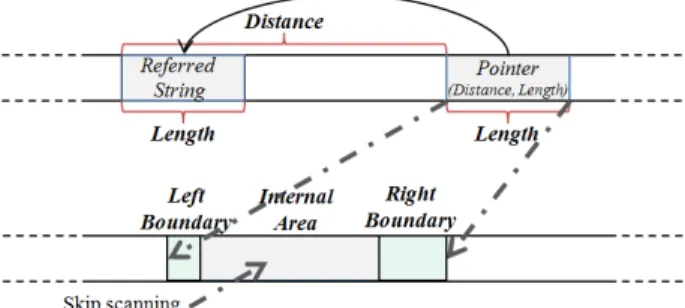
In this section, we present our Aho-Corasick based algo-rithm for Compressed HTTP (ACCH)(detailed pseudo code in Algorithm 2). The algorithm performs multi-pattern matching over compressed input and provides the exact location of all occurrences of any pattern from the given pattern-set within the uncompressed form of the input data stream. As recalled, HTTP uses GZIP that compresses data with pointers to past occurrences of strings. ACCH operates on the uncompressed data after decompression but uses the information about the pointer structure within the compressed data. We start with some definitions. Let string be a sequence of consecutive bytes within the uncompressed data. Recall that pointer is a recurrence of a string within the uncompressed data rep-resented by a pair (distance, length). Let the string that the pointer points to be denoted as referred string. Hence
distance indicates the number of bytes between the referred string start to thepointer start within the uncompressed data and length indicates the number of bytes of the referred string in the uncompressed data which are equal to the number of bytes in the uncompressed data represented by the pointer (see Figure 4). Therefore if the referred string
starts at position k within the uncompressed data then the following byte sequences, representing the referred string
and pointer respectively, are equal: {bk, . . . , bk+length−1} =
{bk+distance, . . . , bk+distance+length−1}.
The algorithm operates the same as the basic AC algorithm as long as the input data contains literals (Lines 49-53), and updates a status vector that would be explained on the sequel. The basic observation is that if the referred string does not completely contain matched patterns then the pointer also contains none. Following this observation implies that the algorithm may skip scanning bytes in the uncompressed data where the pointeroccurs. Hence, the algorithm handles three special cases where the first two refer to examining whether the pointer is part of a pattern and the third refers to the case where a match occurred within the referred string. In the first case, the pattern starts prior to the pointer and only
Fig. 4. Illustration ofpointerand itsreferred stringwith theleft boundary
andright boundaryscan areas.
Fig. 5. ACCH run forCDepth=2 using the DFA from Fig. 2. Gray rectangles indicatepointerand itsreferred string. Light green rectangles indicate bytes which the algorithm scan. Question marks indicate that the corresponding bytes were skipped therefore their depth is unknown to the algorithm. its suffix is in the pointer. In the second case the pointer
contains a pattern prefix and its remaining bytes occur after (see Example 1 in Fig. 5). In order to detect those patterns we need to scan few bytes within thepointer starting and ending points denoted by pointer left boundary and right boundary
scan areas respectively (as in Fig. 4). If no matches occurred within the referred string the algorithm skips the remaining bytes between thepointerboundaries denoted byinternal area. Note thatleft boundary,right boundary andinternal areaare properties determined by the ACCH algorithm as opposed to the pointer and itsreferred string. In the third case a pattern ends within the referred string. The algorithm has to figure out whether the whole pattern is contained within thereferred string or only its suffix (see Example 2 in Fig. 5). We now describe how the algorithm handles these three cases:
Left Boundary (first case):In this case the algorithm deter-mines whether a pattern ends within thepointerleft boundary. We use the statedepthparameter (namely, the number of edges on the shortest simple path from the state and the DFA root). Thedepthof a state has a property that it indicates the longest prefix of any pattern within the pattern-set [28] at the current scan location. Hence, the algorithm should continue scanning the pointer bytes (in the uncompressed data) as long as the number of bytes scanned within the pointer is smaller than the current DFA state’sdepth (Lines 12–18). Note that if the current statedepth, priorpointerarea is0, the algorithm moves directly to the internal area case without scanning a single byte (as shown in Examples2 and3 in Figure 5).
Algorithm 2 Compressed HTTP based Aho-Corasick
Definitions are as in algorithm 1, with the following additions:
byteInf o- is a record that contains a pair of variables:b- byte value;status- byte status.
SlideW in- A cyclic array where each entry is of typebyteInf o.
SlideW inj - Represents thejth entry prior to current position.
Depth(state)- a function that returns the depth of the state in the DFA.
CDepth- the constant parameter of ACCH algorithm.
1: (status,nextState) = function scanAC(state,byte)
2: nextState= DFA(state,byte)
3: ifM atch(nextState)̸=N U LLthen
4: act according toM atch(nextState)
5: status= Match
6: else
7: ifDepth(nextState)≥CDepththen status= Check
8: elsestatus= Uncheck
9: end if
10: end if
11: return (status,nextState)
12: (nextP os, nextState) = function scanLeft(state, curP trInf o)
13: curP os=0
14: while(Depth(state)> curP os)and(curP os < len) do
15: (status,state) = scanAC(state,SlideW indist−curP os.b)
16: curP trInf o[curP os].status=status
17: curP os++
18: end while
19: return (curP os,state)
20: (nextP os, nextState) = function scanSegment(state,start, end,curP trInf o)
21: Find the maximalunchkP os,start≤unchkP os≤endsuchSlideW indist−unchkP os.status=U ncheck
22: If no suchunchkP osexistsunchckP os=start ◃Continue from last scanned byte without skip
23: if start <(unchkP os−CDepth+ 2) then ◃Skip and update window
24: curP trInf o[start . . .(unchkP os−CDepth+ 2)].status=SlideW indist−start...(dist−(unchkP os−CDepth+2)).status 25: state=startStateDF A
26: forcurP os=(unchkP os−CDepth+ 2)to(unchkP os)do ◃Scan bytes and copy status fromSlideW in
27: (state,status)=scanAC(state,SlideW indist−curP os.b) 28: curP trInf o[curP os].status=SlideW indist−curP os.status
29: end for
30: end if
31: forcurP os=unchkP os+ 1toenddo ◃Internal or Right Boundary scan
32: (state,status) = scanAC(state,SlideW indist−curP os.b)
33: curP trInf o[curP os].status=status
34: end for
35: return (curP os+1,state)
36: procedure ACCH(T rf1. . . T rfn) 37: fori=1 to ndo
38: ifT rfiis pointer (dist,len) then
39: curP trInf o[0. . . len−1].b=SlideW indist...dist−len.b
◃ curP trInf o- an array ofbyteInf oentries, used to maintain pointer status information during pointer scan
40: (state,curP os) = scanLeft(state,curP trInf o)
41: whilecurP os < lendo ◃CheckM atches within internal area
42: Find the minimalmatchP os,curP os≤matchP os < lensuchSlideW indist−matchP os.status= Match
43: ifno suchmatchP osexistthen ◃Case of Right Boundary Segment
44: curP os=scanSegment(state, curP os,len-1,curP trInf o)
45: elsecurP os=scanSegment(state,curP os,matchP os,curP trInf o) ◃ Case of Match Segment
46: end if
47: end while
48: slideW inlen−1...0 =curP trInf o[0. . . len−1]
49: else ◃ T rfiis not a pointer, performing simple byte scan 50: SlideW in0.b=T rfi
51: (state,status)=scanAC(state, SlideW indist−i.b) 52: SlideW in0.status=status
53: end if
Right Boundary (second case): In this case the algorithm determines whether a pattern starts within the pointer suffix. As opposed to the left boundary case, we do not have a current DFA state since the bytes prior to the pointer’s right boundary were skipped. One may suggest that the DFA state can be maintained from prior scans of the referred string. That would require maintaining all previous scan states. Those states are determined by DFA scans. But since ACCH skips scanning bytes, it has no way of determining those bytes exact state. Another option is to use the depth property as mentioned in the left boundary case. Since the depth of a state expresses the longest prefix of any pattern within the pattern-set, it indicates the maximal number of bytes that need to be scanned within pointer right boundary in order to detect a prefix. Still, maintaining the exact depth is also complicated due to the presence of skipped bytes. Therefore we use an approximation to thedepthparameter which is easy to maintain and also requires less space. The approximation indicates whether the depth of the corresponding byte is below some constant CDepth, a parameter of our algorithm. In such a case this byte is marked with a status ofUncheck; otherwise the byte is marked Check. Marking a byte with a status is done by storing a bit for each byte within the sliding window. In the case where a byte was scanned, the status is obtained according to the depth of the state the DFA reached. The case where a byte was skipped is discussed in the sequel.
Having the above status information, the algorithm locates the last occurrence of an Uncheck status position within the referred string. Let unchkPos be the corresponding po-sition within the pointer. In order to determine safely the
right boundary area, the scan is resumed from unchkPos−
CDepth+ 2bytes priorpointer end and the DFA state is set tostart state(see Function scanSegment Lines 20–35).
Note that a byte with anUncheckstatus provides a location to restart scanning from. Hence every byte withUncheckstatus raises the chance for skipping more bytes. As noted in [12], [13] and shown in our experimental results section, most of the time the DFA uses states of low depth, hence in most cases the status would be Uncheck, therefore we might skip scanning most of the bytes.
The challenging task is to maintain a correct status for the skipped bytes. This is done by simply copying the status information from the corresponding bytes within the referred string. Since we finished handling theleft boundarycase, we are certain that if the skipped bytes would have been scanned, their depths would not have been higher than the depths of the corresponding bytes within thereferred string. Hence, copying statuses might over estimate the depth of a byte thus assigning it aCheckstatus rather than anUncheck(but not vice-versa) in the case of skipped bytes. Still, a mistake in that direction does not cause misdetection. It only causes skipping less bytes.
Internal area (third case): (Lines 41–47) Up to this point we assumed that no match occurred within thereferred string. Information about previous matches is crucial for the algorithm in order to determine whether the previously matched pattern was referred to entirely by thepointeror only its suffix. First we introduce a third status (along with Uncheck and Check) called Match. This status is stored using additional bit for
each byte within the sliding window. A byte with a Match
status means that a pattern (or more) ends at its location. Let
matchPosbe the position within the pointer, corresponding to the position of the M atch status within the referred string. Using the status information, we could detect whether an entire pattern was referred to by thepointer, by scanning few bytes prior the matchPos in the same manner as in the case of the right boundary. We locate unchkPos, the lastUncheck
status prior the byte with theMatchstatus, and start scanning
unchkPos−CDepth+ 2 bytes prior to matchPos. Function
scanSegment is also used for this case (Lines 20–35). In the next theorem we prove the correctness of the algo-rithm. LetP be a finite set of patterns, T rf the compressed traffic andU the decompressed traffic.
Theorem 1: ACCHdetects all patterns inP in the decom-pressed traffic form of T rf.
Sketch of Proof: The full detailed proof is given in Appendix B. The proof relies on the validity of AC algorithm. Therefore, we perform pattern matching on the compressed traffic twice, once with the na¨ıve algorithm (decompression + AC that scans all bytes), denoted as the Na¨ıve algorithm, and another time withACCH. The two algorithms use the same DFA, the only difference is thatACCH skips scanning some of the bytes. In Lemma 4 in the appendix, which is the heart of the proof, we compare for every byte in the decompressed traffic the state and status, that each of the algorithms reached. We show that the three invariants claim holds: 1) If a byte has the status ofCheck in the Na¨ıve algorithm then it will also have the statusCheckin theACCH algorithm. Note that the opposite direction does not hold. 2) Iff a byte has a M atch
status in the Na¨ıve algorithm, it will also have M atch status in the ACCH algorithm. Note, that this is iff, i.e., the two directions hold. From this claim we can conclude thatACCH
detects all the patterns that Na¨ıve detects and theorem follows. 3) Both algorithms,ACCHand Na¨ıve reach exactly the same DFA state after scanning of any single byte or after scanning a decompressed pointer entirely. This is not true within a pointer, sinceACCHmay skip scanning some of the bytes. The proof relies heavily on the characteristics of AC DFA. Based on Claim 2 from Lemma 4 we show the validity of Theorem 1.
VI. ACCH OPTIMIZATIONS
In this section we present two techniques that exploit the characteristics of ACCH further to achieve even better performance. ACCH algorithm rescans at least CDepth−1 bytes at every right boundary or a byte marked as Match. This implies that when the data contains many “matches”, ACCH performance deteriorates dramatically. Optimization I fits for data with many “matches”. It eliminates the need for rescanning prior to Match marks. Optimization II refers to another aspect of ACCH. Note that the algorithm uses only three statuses out of four possible, using2bits. Optimization II uses a fourth status to achieve better performance.
A. Optimization I - Eliminate Byte Scans Within Internal Area
Optimization I (described by Algorithm 3) focus on the in-ternal area(third case). We use a hash table denoted asMatch
Algorithm 3 ACCH - Optimization I
absP osition- Absolute position from the beginning of data. After line 38:absP osition+=len
After line 49:absP osition++
M atchT able - A hash table, where each entry represents a Match. The key is the MatchabsP ositionand the value is a list of patterns that where located at that position.
FunctionscanAC- a new line is added after line 4:
add patterns inM atch(state)toM atchT able(absP osition)
ProcedureACCH- instead of the while loop, lines (41-47): handleInternalMatches(state,curP os,len-1)
scanSegment(state,curP os,len-1)
Function scanSegment should ignore Matches found by scanAC
since all matches within pointer are located by functions scanLeft
and handleInternalMatches.
1: function handleInternalMatches(start, end)
2: forcurP os=startto (end)do
3: ifSlideW indist−curP os.status= Matchthen 4: ifM atchT able(curP os) contains patterns shorter or equal tocurP osthen
5: add those patterns toM atchT able(absP osition)
6: curP trInf o[curP os].status= Match
7: elsecurP trInf o[curP os].status= Check
8: end if
9: else
10: curP trInf o[curP os].status
=SlideW indist−curP os.status
11: end if
12: end for
Table. WheneverscanACreaches a “match state”, all patterns that were found by that state are stored in the M atchT able. The position of the byte within the uncompressed data is used as a key to that entry in the hash table.
Algorithm 3 changes theinternal areacase (see Lines 1–12) such as for each Match found within the referred string, the list of its related patterns in M atchT able is extracted. Each pattern in that list with length not longer than the index of the “match status” within the pointer, was referred-to entirely by the pointer and therefore is contained within it. All those patterns are added to theM atchT ableand the status is marked as Match(see Lines 5–6).
The case where all patterns are longer than the index of
Match indicates that only the suffix of them was referred by the pointer, therefore no match occurs at that position within
pointer. The status of that position is safely set toChecksince it cannot be maintained from the referred bytes (Line 7), and an error in that direction does not harm algorithm correctness (as discussed in Section V). All status bits of skipped bytes within internal area other than Match, are copied from the
referred string (Line 10).
This optimization gains significant speed improvement as shown in the experimental results section. The downside is the additional data structure M atchT able that has to be maintained.
B. Optimization II - The CDepth Parameter
ACCH, as described in Algorithm 2, uses three possible sta-tus types for each byte:Check,U ncheck andM atch. Those types are maintained within the sliding window using two bits. Since two bits represent four different values, additional status can be represented by those bits without using extra space.
Algorithm 4 uses an additional status in order to maintain a more precise estimation about the depth of each byte in the sliding window. We define two constant parameters:CDepth1 andCDepth2 instead of one, whereCDepth1< CDepth2. Status of bytes other thanM atchis determined in the follow-ing way: if depth is smaller thanCDepth1 then the status is
U ncheck1. If depth is smaller than CDepth2 but not from
CDepth1 then the status is U ncheck2. Otherwise the status isCheck.
Algorithm 4 ACCH - Optimization II
CDepth1,CDepth2- Instead of one constant parameterCDepth, we maintain two, whereCDepth1< CDepth2
FunctionscanAC- line 8 changes to lines:
else ifDepth(state)≤CDepth1thenstatus =U ncheck1 elsestatus =U ncheck2
FunctionscanSegment- line 21: instead of searching for maximal
U ncheck, it searches for maximalU ncheck1orU ncheck2
Function scanSegment - lines 23-30: CDepth parameter changes toCDepth1orCDepth2depending on whether the state found on line 21 isU ncheck1orU ncheck2respectively
CDepthparameter determines two factors that influence the number of bytes scanned by the ACCH algorithm: constant part, where scanSegment scans CDepth−1 bytes prior to unchkP os; variable part, where scanSegment scans all bytes fromunchkP osto the end of the segment. Hence, there is a tradeoff choosing differentCDepthvalues, between using a higher value of CDepth which leads to more U nchecks (which in turn lowers the variable part) or lower value of
CDepththat minimizes the constantpart.
By using two constant depth estimators instead of one, the algorithm gains the advantages of both factors (see ex-perimental results in Section VII). The algorithm sets as much U ncheck1 andU ncheck2 status types as it would set
U ncheckwhenCDepthfrom Algorithm 2 equalsCDepth2. And scanSegment scans the same amount of bytes as it would have if CDepthfrom Algorithm 2 would be equal to
CDepth1. Status is maintained as in Algorithm 2, by either copying the status from thereferred stringor determining the status withscanAC according to state depth.
VII. EXPERIMENTALRESULTS
In this section, we evaluate the performance benefit of ACCH algorithm and find the optimal CDepth, a key pa-rameter of our algorithm, using real life traffic.
A. Data Set
We use two data sets, one of the traffic and the other of the patterns. For the traffic, we use two data sources: traffic
0 0.1 0.2 0.3 0.4 0.5 0.6 0.7 0.8 0.9 1 1 2 3 4 S c a n n ed C h a r a c ter R a ti o ( R s ) CDepth Snort Reduced Set ModSecurity 0 0.1 0.2 0.3 0.4 0.5 0.6 0.7 0.8 0.9 1 1.1 Plain 0 1 2 3 4 N o r m a li z e d E x ec u ti o n T im e CDepth Snort Reduced Set ModSecurity (a) (b) 0 0.1 0.2 0.3 0.4 0.5 0.6 0.7 0.8 0.9 1 1 2 3 4 S c a n n ed C h a r a c te r R a ti o ( R s ) CDepth ACCH OPT I OPT II 0 0.1 0.2 0.3 0.4 0.5 0.6 0.7 0.8 0.9 1 1 2 3 4 N o r m a li z e d E x e c u ti o n T im e CDepth ACCH OPT I OPT II (c) (d)
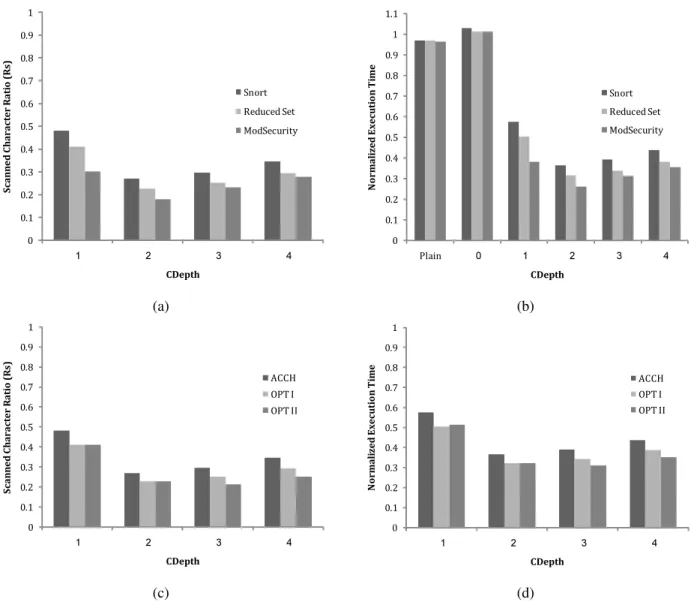
Fig. 6. (a) Scanned character ratio as function ofCDepthfor ModSecurity, Snort and the Reduced Snort data-set. (b) Performance benefit as oppose to the Scanned character ratio (Rs) as function ofCDepthcompared to the na¨ıve algorithm (decompression + AC that scans all bytes) performance. “Plain” column, refers performance of running Aho-Corasick on the uncompressed data. (c) Scanned character ratio as function ofCDepthfor Snort pattern set compared among ACCH with optimizations. (d) Performance benefit as function ofCDepthfor Snort pattern set compared among ACCH with optimizations.
Corp. FW Alexa
Num. of HTML pages 23 698 14 078
Uncompressed size 910MB 808MB Compressed size 181MB 160MB
Pr - Ratio of bytes represented by
pointers
0.94 0.921 Pl- Average pointer length 17.8 16.7
TABLE I
PARAMETERS OF BOTH DATA-SETS.
that was captured by a corporate firewall for 15 minutes and a list of the most popular web pages taken from Alexa web site [29], that maintains web traffic metrics and top sites lists. Table I shows the characteristics of both traces. No significant difference was found between the results over those two data sets, therefore we refer to the Alexa data-set parameters.
We use two signature data sets: one of ModSecurity [30], an open source web application firewall, and the other of Snort [11], an open source network intrusion prevention and
detection system.
In ModSecurity we chose a signature group that applies to HTTP-response (since only the response is compressed). Patterns are normalized such as they do not contain regular expressions.1 Total number of patterns is124.
The Snort data set contains rules which in turn may contain either exact strings or regular expressions. Since this work is restricted to exact string matching techniques and it does not cover regular expression matching, we constructed the signa-ture set from the exact strings only. The extracted signasigna-ture set contains more than 8K patterns. Most of them are in a binary mode that is not relevant to textual HTML content. Therefore we removed the binary patterns and were left with a subset of1202textual patterns. We note that Snort patterns are not meant to be applied on an HTTP-response, hence are less applicable in the domain problem of compressed HTTP traffic. However, we decided to use this signature set since
most pattern-matching papers refer to it therefore is good for evaluating the effect of the number of patterns and number of matches on our algorithm performance compared to other work in the area. We also note that Snort patterns occur significantly more within the traffic, mainly since Snort has patterns like “st”, “id=” or “ver”. The data set contains 655 occurrences of ModSecurity patterns and over 14M of Snort patterns.
B. ACCH performance
In this subsection, we compare the performance benefit using the ACCH algorithm. We define Rs as the scanned
character ratio. Rs is a dominant factor for performance
improvement for ACCH over na¨ıve algorithm as shown later. Fig. 6(a) summarizes Rs as a function of CDepth, for
Snort and ModSecurity patterns. CDepth = 2 shows best performance for both pattern sets. Rs for Snort patterns is
0.27 and for ModSecurity is0.181. The tradeoff of choosing different values for CDepth, as discussed in Section VI-B, can be shown in the graph.
Snort patterns result in a significant amount of matches within the traffic (near 2% of the total number of bytes are marked with M atch) resulting in more Match Segments, which in turn cause a significantly higher Rs. In order to
check the influence of the amount of matches on Rs we
synthesized a reduced Snort pattern-set by removing 88 of the most frequent patterns. The data contains234 448patterns from the reduced pattern-set (instead of 14M). As can be seen from 6(a), removing only 88 patterns had a significant effect on the Rs value (Rs = 0.23 forCDepth= 2). Thus, match
ratio has stronger influence on Rs value than the number of
patterns.
Fig. 6(b) shows the correlation between Rs and the
per-formance benefit compared to the perper-formance of running the na¨ıve algorithm (i.e. decompression + AC). We use Intel Core 2 Duo 2GHZ with 2GB RAM as a platform. The “Plain” column shows the performance ratio of running AC on plain uncompressed data. ACCH with CDepth = 0 marks all statuses as Check, therefore no scan-skips takes place. It also shows a slight overhead in implementing the algorithm as compared to the na¨ıve algorithm, which is between 4%-8%. It can be explained by the additional memory used for the status bits in the sliding window, which in turn result in more memory references. For CDepth= 2, ACCH running over ModSecurity achieved 74% performance improvement and ACCH running over Snort achieved 64%.
The surprising outcome is that the algorithm operates faster on compressed data than on uncompressed, as shown by comparing the “Plain” column in Fig. 6(b) to other columns withCDepth > 0.
C. ACCH Optimizations
Fig. 6(c) shows the impact on Rs for both optimizations
compared to ACCH in Algorithm 2 for the Snort pattern set. For Optimization II we used several combinations of
CDepth1 andCDepth2 values. Fig. 6(c) shows four com-binations where CDepth2 = CDepth1 + 1. The values of
Description Snort ModSecurity
Al Average byte number scanned
on theleft boundary
1.077 0.684 Ar Average byte number scanned
on theright boundary
1.61 1.159 Am Average byte number scanned
onMatch Segment
2.55 4.824 Mr Ratio of bytes withM atch
sta-tus out of all bytes
0.017 7.73×10⁻⁷ TABLE II
PARAMETERS ANALYZED USING REAL-LIFE DATA FORSNORT AND
MODSECURITY. PARAMETERS MEASURED WHILE EXECUTINGACCH
WITHCDepthOF VALUE2.
the x-axis refer toCDepth2. In the first columnCDepth1 = CDepth2 = 1. For Optimization I, CDepth = 2is optimal withRs =0.229and for Optimization IICDepth1 = 2 and CDepth2 = 3 is optimal with Rs = 0.215 as compared to Rs=0.27for ACCH in Algorithm 2.
ForModSecurity pattern set, CDepth= 2 is optimal for Optimization I and for Optimization II the optimal parameters are CDepth1 = 1 and CDepth2 = 2. In Optimization I,
Rs = 0.181 and in Optimization II, Rs = 0.163. Note that
Optimization I had no observable effect on the value of Rs
since the ratio of matches out of total bytes is negligible. Optimization I uses the Match Table data structure that infers space overhead using Snort pattern set of around2KB per open session. For ModSecurity the space overhead is negligible due to low number of pattern matches within data.
D. Experimental Results Analysis
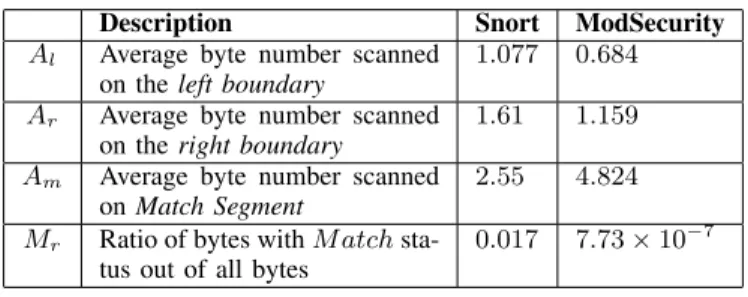
In this subsection we give intuition for the results described at the above subsections. We calculate a lower bound for the
Rsvalue of the given data set.Rsis described by the following
formula,2 using parameters described in Table II: (1−Pr) +Pr×((Al+Ar)/Pl) +Pr×Mr×Am
Lower bound of Rs is reached when the following
condi-tions occur: there are no matches at all, whereMr=Am= 0,
therefore the third expression becomes zero; minimal value of
Alis zero and the minimal value ofArisCDepth- 1. Using
the optimalCDepthof value 2 we get a ratio of0.135which is alower boundfor Rs on this data set.
Optimization I skips byte scanning withinMatch Segments which is represented by Am. Table II shows that in Snort,
Optimization I may improve Rs by at most 4.34% which
explains the improvements gained for Snort. In ModSecurity Optimization I do not help due to insignificant Mr.
Another observation from Table II shows that bothAl and Ar are lower at ModSecurity as compared to Snort. That is
because Snort has got much more patterns than ModSecurity. Therefore its DFA represents much more prefixes and it is more likely that transitions would lead to depths with higher value. Hence, there are more bytes with Check status and 2First expression represents uncompressed bytes which are always scanned. Second expression represents bytes which are scanned from pointers left and right boundaries. Last expression represents bytes which are scanned onMatch Segments.
Fig. 7. Relation between theRsparameter and thePras measured for each input HTML page.
more bytes need to be scanned at pointer left and right boundaries.
We note that HTTP traces are usually characterized with high compression ratio. As explained earlier, the skip ratioRs
is strongly related with Pr, the ratio of bytes represented by
pointers. Fig. 7 demonstrates the Rs / Pr ratio as measured
for each input file separately and shows a linear relationship between those parameters.
E. Using Space Efficient DFA Data Structures
Earlier we claimed that the DFA implementation is orthog-onal to ACCH, hence it may be combined with recent state of the art works enjoying their improvements while gaining the additional performance boost achieved by skipping scans with ACCH. In this subsection we support our claim by combining ACCH with some other DFA implementations as stated below. Up to this point we based the pattern matching engine on the second representation suggested by Aho-Corasick that uses two-dimensional array. This is one of the implementations used by Snort. The first representation proposed by Aho-Corasick indicates explicitly only transitions to the next level of the DFA where for the rest of the possible input bytes it uses a default failure pointer. This representation allows compact implementation of the data structure with the cost of 2ntransitions for an input of length n.
Recently, a significant effort was made to compact the size of the DFA. Few focused on enhanced hashing schemes such as [31], [32] or another work that suggested BitSplit automata [33]. The above works are aimed at a hardware solution.
In order to experiment ACCH with a more compact DFA implementation we used three different configurations imple-mented by Snort, namely: Banded, Sparse and Sparse-Banded respectively, for the default failure-transition representation. The ideas of those implementations are mentioned also in recent work by Tuck et al. [15] and Becchi et al. [34]. Table III concludes the normalized throughput of ACCH (with optimizations) as compared to what achieved by the basic, two-dimensional array DFA implementation.
We note that the main focus of recent works is around more efficient space representation, mostly in order to allow
Memory Plain ACCH
Two-Dimensional Array 74.49MB 1 0.3
Sparse 1.79MB 0.99 0.29
Banded 2.02MB 0.97 0.28
Sparse-Banded 1.89MB 0.98 0.28
TABLE III
NORMALIZED THROUGHPUT OFACCH (WITH OPTIMIZATIONS)AS COMPARED TO THE TWO-DIMENSIONAL ARRAYDFAIMPLEMENTATION
USINGSNORT PATTERN-SET.
hardware architecture. Still in software implementations the impact of those works is less significant in the time aspect mostly since the space compression is achieved usually by the cost of extra memory references. In addition, Table III shows that the significant performance boost is gained by applying ACCH to either one of the given implementations.
VIII. CONCLUSION
At the heart of almost every modern security tool is a pattern matching algorithm. HTTP compression becomes very common in today web traffic. Most security tools ignore this traffic and leave security holes or bypass the parameters of the connection therefore harm the performance and bandwidth of both client and server. Our algorithm eliminates up to84%of data scan based on information stored in the compressed data. Surprisingly, it is faster to do pattern matching on compressed data, with the penalty of decompression, than doing pattern matching on uncompressed traffic. Note that ACCH is not intrusive for the AC algorithm, therefore all the methods that improve AC DFA [12]–[16] are orthogonal to ACCH and are applicable. As far as we know we are the first paper, that analyzes the problem of ‘on-the-fly’ multi-pattern matching algorithm on compressed HTTP traffic, and suggest a solution.
ACKNOWLEDGMENT
The authors would like to thank Dr. D. Movshovitz, former VP security Technologies at F5 Networks and I. Ristic, VP of Security Research of Breach Security and the creator of ModSecurity, for helpful suggestions.
REFERENCES
[1] M. Fisk and G. Varghese, “An analysis of fast string matching applied to content-based forwarding and intrusion detection,” Techical Report CS2001-0670 (updated version), 2002.
[2] Port80. [Online]. Available:
http://www.port80software.com/surveys/top1000compression
[3] Website optimization, llc. [Online]. Available: http://www.websiteoptimization.com
[4] P. Deutsch, “Gzip file format specification,” May 1996, RFC 1952. [Online]. Available: http://www.ietf.org/rfc/rfc1952.txt
[5] ——, “Deflate compressed data format specification,” May 1996,RFC
1951. [Online]. Available: http://www.ietf.org/rfc/rfc1951.txt
[6] J. Ziv and A. Lempel, “A universal algorithm for sequential data compression,” IEEE Trans. Inf. Theory, vol. 23, no. 3, pp. 337–343, May 1977.
[7] D. Huffman, “A method for the construction of minimum-redundancy codes,”Proceedings of IRE, 1952.
[8] Zlib. [Online]. Available: http://www.zlib.net
[9] A. Aho and M. Corasick, “Efficient string matching: an aid to biblio-graphic search,”Commun. Ass. Comput. Mach., vol. 18, pp. 333–340, June 1975.
[10] R. Boyer and J. Moore, “A fast string searching algorithm,” Comm. ACM, vol. 20, no. 10, pp. 762–772, Oct. 1977.
[11] (2008, July) Snort. [Online]. Available: http://www.snort.org
[12] T. Song, W. Zhang, D. Wang, and Y. Xue, “A memory efficient multiple pattern matching architecture for network security,” inINFOCOM 2008, April 2008, pp. 166 – 170.
[13] J. van Lunteren, “High-performance pattern-matching for intrusion de-tection,” inINFOCOM 2006. IEEE, April 2006, pp. 1–13.
[14] V. Dimopoulos, I. Papaefstathiou, and D. Pnevmatikatos, “A memory-efficient reconfigurable aho-corasick fsm implementation for intrusion detection systems,” in Embedded Computer Systems: Architectures, Modeling and Simulation. IC-SAMOS, July 2007, pp. 186–193. [15] N. Tuck, T. Sherwood, B. Calder, and G. Varghese, “Deterministic
memoryefficient string matching algorithms for intrusion detection,” in
INFOCOM 2004, 2004.
[16] M. Alicherry, M. Muthuprasanna, and V. Kumar, “High speed pattern matching for network ids/ips,” inICNP, 2006, pp. 187–196.
[17] Y. Afek, A. Bremler-Barr, and Y. Koral, “Efficient processing of multi-connection compressed web traffic,” in NETWORKING 2011, Part I, LNCS, 2011.
[18] A. Amir, G. Benson, and M. Farach, “Let sleeping files lie: Pattern matching in z-compressed files,” inProc. of the 5th Symp. on Discrete Algorithms, January 1994.
[19] T. Kida, M. Takeda, A. Shinohara, and S. Arikawa, “Shift-and approach to pattern matching in lzw compressed text,” in10th Annual Symposium on Combinatorial Pattern Matching (CPM 99), 1999.
[20] G. Navarro and M. Raffinot, “A general practical approach to pattern matching over ziv-lempel compressed text,” in10th Annual Symposium on Combinatorial Pattern Matching (CPM 99), 1999.
[21] G. Navarro and J. Tarhio,Boyer-Moore String Matching over Ziv-Lempel Compressed Text, ser. Lecture Notes in Computer Science. Springer Berlin Heidelberg, 2000, vol. 1848, ch. 16, pp. 166–180.
[22] S. Klein and D. Shapira, “A new compression method for compressed matching,” inDCC 2000, March 2000, pp. 400–409.
[23] M. Farach and M. Thorup, “String matching in lempel-ziv compressed strings,” in27th annual ACM symposium on the theory of computing, 1995, pp. 703–712.
[24] L. Gasieniec, M. Karpinski, W. Plandowski, and W. Rytter, “Efficient algorithms for lempel-ziv encoding (extended abstract),” inIn Proc. 4th Scandinavian Workshop on Algorithm Theory. SpringerVerlag, 1996, pp. 392–403.
[25] U. Manber, “A text compression scheme that allows fast searching directly in the compressed file,” ACM Trans Inf Syst, vol. 15, no. 2, pp. 124–136, Apr. 1997.
[26] M. Takeda, Y. Shibata, T. Matsumoto, T. Kida, A. Shinohara, S. Fuka-machi, T. Shinohara, and S. Arikawa, “Speeding up string pattern matching by text compression. the dawn of a new era.”Transactions of Information Processing Society of Japan, vol. 42, no. 3, pp. 370– 384, mar 2001.
[27] N. Ziviani, E. S. de Moura, G. Navarro, and R. Baeza-Yates, “Com-pression: A key for next-generation text retrieval systems,”Computer, vol. 33, no. 11, pp. 37–44, 2000.
[28] T. Cormen, C. Leiserson, R. Rivest, and C. Stein, Introduction To Algorithms. New York: The MIT Press and McGraw-Hill Book Company, 2001.
[29] (2009, July) Alexa. [Online]. Available: http://www.alexa.com [30] (2008, July) Modsecurity. [Online]. Available:
http://www.modsecurity.org
[31] N. Sertac Artan and H. Chao, “Tribica: Trie bitmap content analyzer for high-speed network intrusion detection,” inINFOCOM 2007. 26th IEEE International Conference on Computer Communications. IEEE, May 2007, pp. 125 –133.
[32] S. Kumar, J. Turner, P. Crowley, and M. Mitzenmacher, “Hexa: Compact data structures for faster packet processing,” inNetwork Protocols, 2007. ICNP 2007. IEEE International Conference on, 2007, pp. 246 –255. [33] L. Tan and T. Sherwood, “A high throughput string matching
architecture for intrusion detection and prevention,” inProceedings of the 32nd annual international symposium on Computer Architecture, ser. ISCA ’05. Washington, DC, USA: IEEE Computer Society, 2005, pp. 112–122. [Online]. Available: http://dx.doi.org/10.1109/ISCA.2005.5 [34] M. Becchi and P. Crowley, “An improved algorithm to accelerate regular
expression evaluation,” inProceedings of the 3rd ACM/IEEE Symposium on Architecture for networking and communications systems, ser. ANCS ’07. New York, NY, USA: ACM, 2007, pp. 145–154. [Online]. Available: http://doi.acm.org/10.1145/1323548.1323573
Description Value
Pr Average ratio of bytes represented by pointers 0.921
Pl Average pointer size in bytes 16.7
Ph Average ratio of times that Huffman symbol
was longer than 9 bits
0.03
TABLE IV
PARAMETERS ANALYZED USING REAL-LIFE DATA AS DESCRIBED IN SECTIONVII.
APPENDIXA
DECOMPRESSION VERSUSPATTERNMATCHINGTIME REQUIREMENT
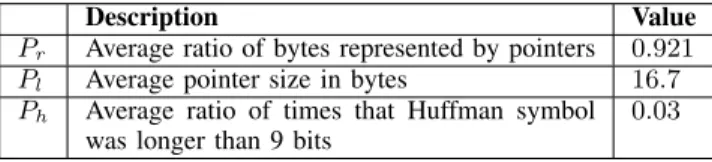
In this section we introduce a simple model that helps us compare the time requirement of the decompression with the time requirement of the AC algorithm. A key influence on the time is the ability to perform fast memory references to the limited memory of the cache as opposed to the slower main memory. We assume in our model, that we can choose that some of the data structures will be in cache.3
LetM be the cost of one memory reference,C the cost of one cache reference,Pl the average length of a pointer in the
compressed traffic andPr the fraction of bytes represented by
pointers in the compressed traffic. Let B be the cache block size which is typically 32 Bytes in SDRAM memory (i.e., each memory lookup loads the cache with32Bytes from the surrounding area of the memory address). We show thatBhas a dramatic influence on the performance of the decompression algorithm since the pointers refer to consecutive addresses in memory.
We start by analyzing the AC algorithm. At the common representation of AC DFA (described at Section II) each state has also a match pointer that points to a matched pattern list in the case it is a “match state” (a.k.a. “output state” [9]) or NULL otherwise. For each byte the AC algorithm performs two memory references, one for next state extraction and the other to check whether a match was found.4If the DFA is not in cache memory due to its large size (for example 73MB for 6.6K Snort patterns in 2009), the memory cost for each byte is around2M. Otherwise, if the DFA fits into the cache, due to a small number of patterns or the usage of DFA compression techniques [12]–[16] the memory cost is around2C.
We now analyze the GZIP algorithm. GZIP maintains two data structures per HTTP session for the decompression phase: a small one for the Huffman dictionaries (less than 700 bytes, which is small enough and therefore assumed to be in cache) and a larger one for the 32KB sliding window. Note that common Huffman decoding implementation (as implemented by the ”zlib” software library [8]) uses at most two memory lookups per symbol (most of the symbols require only one memory lookup while longer symbols require two memory lookups) as described in Section II. Table IV shows some parameters calculated by using real-life data.
3Using hardware solutions or by special assembly commands that give recommendation to the loader.
4If there is more than one matching pattern for a state then more memory accesses are required, but for simplicity this case is ignored. Note that each state (a row) is much bigger than the general block size, since usually each state holds data about transitions for each of the256possible inputs.
Cache Memory AC 2C 2M
GZIP decompression ∼2C ∼3C
TABLE V
SUMMARY OF THE ANALYSIS OF TIME COMPLEXITY OFACANDGZIP
DECOMPRESSION WHERECIS CACHE LOOKUP TIME ANDMIS MAIN MEMORY LOOKUP TIME
The number of memory lookups per byte decode at the Huffman stage can be calculated using the following formula5:
Pr ×(Ph+ 2) /Pl + (1−Pr) ×(Ph+ 1)
Using parameters from table IV and assuming Huffman dictionary is in the cache, the overhead of Huffman decoding is 0.19C which is negligible.
We now analyze the LZ77 decompression part. For a small number of concurrent sessions where all of the 32KB sliding windows fits into cache, the cost per byte which is not a pointer is 1C reference for updating the sliding window. A byte represented by a pointer requires 2C for both reading and writing to the sliding window. Since most of the data is represented by pointers we approximate the total overhead caused by LZ77 decoding as 2C. However, if the number of concurrent sessions is high, then in the case of a pointer, we first need to bring the blocks to the cache. The average number of cached blocks retrieved per pointer, denoted by BP, isBP =⌈(Pl/B)⌉+ (PlmodB)/B.
In order to understand the cost per byte we need to divide the result by the average pointer length. Hence we need total
Pr∗(BP/Pl∗M+ 2C) + (1−Pr)∗2C time. Since today
the factor between the main memory lookup to cache lookup of M/C is usually between10−20 andB is 32Bytes, the
Pr∗BP/Pl can be bounded by 0.08M which is around1C.
Hence the fact that number of concurrent sessions is high has a minor impact on the decompression time, because each pointer refers to consecutive bytes. Since most of the compressed file is represented by pointers (i.e Pr = 0.921), memory access
time is dominated by the pointer analysis part, hence it is around3C.
Table V summarizes the findings. One outcome of this analysis is the observation that when the DFA is in the cache, the GZIP decompression has an equivalent time requirement as the AC algorithm itself. In the case where the DFA is in main memory, the GZIP decompression takes only 7.5% of the time of the AC (assuming M/C∼20).6
APPENDIXB
CORRECTNESS OFACCHALGORITHM
In this section we prove Theorem 1 (i.e. that ACCH detects all patterns within given text as AC would), the correctness of ACCH algorithm. The proof relies heavily on the following characteristics of AC DFA: The state of the DFA after reading as input a series of bytes is correlated to the longest prefix of 5The left part refers to pointer symbols and the right part refers to literals. Decoding a pointer requires access to two different tables in order to extract both length and distance parameters while decoding a literal requires access to only one table. In case of a symbol which is decoded by more than 9 bits, Phis added to resemble the overhead of accessing another table.
6Experiments on real data with small number of concurrent sessions showed a lower ratio of 3.5%.
any pattern which is a suffix of the input (see Lemma 2). An important outcome of this lemma, is that if the depth of state
s in the DFA is equal tok then only the last k bytes of the decompressed traffic are relevant to the state (see Corollary 3). Formally, let U1. . . Uj be the decompressed bytes of the
input traffic after scanning j bytes, and let P be a set of patterns,Pi a pattern such asPi ∈P wherePi=Pi1. . . Pin. Letsbe the state of AC DFA after scanning all bytes up toUj.
Lemma 2: For anyPi∈P, the length of the longest prefix
of any pattern inP which is a suffix of U1. . . Uj is equal to depth(s).
Proof:See [28].
Let the depth of a state after scanning byteUj bek. Then,
Corollary 3: The state of AC DFA after scanningU1. . . Uj
is equal to the state as if the input traffic to AC DFA is
Uj−k+1. . . Uj.
The following Lemma 4, is the heart of Theorem 1 proof.7 Lemma 4 compares between ACCH (Algorithm 2) to the Na¨ıve algorithm (Algorithm 1) that does decompression and AC on all data. Let T rf = T rf1. . . T rfN be the input,
the compressed traffic (after Huffman decompression) and let
Uj1. . . Ujn be the decompressed string ofT rfj. IfT rfj is a byte thenn= 1. LetUji be a byte in the decompressed traffic - we defineACCH statusUji (andN aive statusUji) to be
the status ofUji according toACCH algorithm (andN aive respectively) after scanning all input bytes before it. Similarly, we defineACCH stateUji (N aive stateUji) to be the state
we reach at the AC DFA.
Lemma 4: For every T rfm, where m ≤ N the following
three claims hold:
1) For every Umi (mi < mn), if N aive statusUmi =
Check thenACCH statusUmi =Check.
2) For every Umi (mi < mn), Iff N aive statusUmi =
M atch then ACCH statusUmi =M atch (Note, the
two directions of the statement hold).
3) N aive stateUmn = ACCH stateUmn, i.e., the DFA state after scanning them compressed input (pointer or a byte) is correlated between both algorithms.
Proof: The proof is by induction. For m = 1, T rf1
is the first byte (cannot be a pointer) in the traffic which decompresses toU11. Thus the induction assumption follows, since the two algorithms have started from the same start state and had the same input.
For the induction step we assume the claim holds up to
m−1, we prove form.
In the case T rfm is a byte (and not a pointer), all three
claims hold, since after scanningT rfm−1the two algorithms
are correlated at the same state (from Claim 3) and receive the same input, hence will reach the same state and will have the same status.
The delict case is when T rfm is a pointer. We go over
by induction on the decompressed form of the pointer i.e., onUm1. . . Umn. For readability letP t1. . . P tlen be equal to
Um1. . . Umn, wherelen=mn. We will prove the claims on 7Note that we use Lemma 4 for all three versions ofACCH. Therefore in each sectionACCHrefers to the version for which we prove correctness.