POUR L'OBTENTION DU GRADE DE DOCTEUR ÈS SCIENCES
acceptée sur proposition du jury: Prof. C. Dehollain, présidente du jury
Dr M. Mattavelli, directeur de thèse Prof. J. Castrillon, rapporteur
Dr L. Morel, rapporteur Prof. A. Burg, rapporteur
Programs for Multi-core Platforms
THÈSE N
O7607 (2017)
ÉCOLE POLYTECHNIQUE FÉDÉRALE DE LAUSANNE
PRÉSENTÉE LE 17 MARS 2017À LA FACULTÉ DES SCIENCES ET TECHNIQUES DE L'INGÉNIEUR GROUPE SCI STI MM
PROGRAMME DOCTORAL EN GÉNIE ÉLECTRIQUE
Suisse
PAR
(Psalm 126:5)
To my husband Mirosław for reminding me about the things that really matter . . .
The work described in this dissertation would not have been accomplished without the pre-cious support of many people. I would like to express my sense of gratitude to some of them in particular.
I would like to thank Dr. MER Marco Mattavelli for his constant supervision of my work. The relationship between a student and a supervisor includes some elements of a lead, guidance, advice, help and criticism. It is the constructive criticism that I especially appreciate and that I will take with me for future challenges.
I deeply appreciate the collaboration with Prof. Nicolas Zufferey from University of Geneva. I am thankful for all the discussions and common publications providing valuable contributions to my thesis. For such smaller or bigger contributions, I would like to thank everyone I had a pleasure to collaborate with.
I would like to thank all past and current members of SCI-STI-MM lab. Especially, I would like to thank my colleagues from the former ELG 138 office: Dr. Junaid Ahmad, Dr. Endri Bezati and Dr. Simone Casale Brunet. I appreciate your time, patience and understanding.
I am thankful to my family and friends supporting me during these intensive years of work. Thank you for believing in me, even in my own moments of doubt.
Finally, I would like to thank the Swiss National Science Foundation for founding my research.
The limitations of clock frequency and power dissipation of deep sub-micron CMOS tech-nology have led to the development of massively parallel computing platforms. They consist of dozens or hundreds of processing units and offer a high degree of parallelism. Taking advantage of that parallelism and transforming it into high program performances requires the usage of appropriate parallel programming models and paradigms. Currently, a common practice is to develop parallel applications using methods evolving directly from sequential programming models. However, they lack the abstractions to properly express the concurrency of the processes. An alternative approach is to implement dataflow applications, where the algorithms are described in terms of streams and operators thus their parallelism is directly exposed. Since algorithms are described in an abstract way, they can be easily ported to different types of platforms. Several dataflow models of computation (MoC s) have been for-malized so far. They differ in terms of their expressiveness (ability to handle dynamic behavior) and complexity of analysis. So far, most of the research efforts have focused on the simpler cases of static dataflowMoC s, where many analyses are possible at compile-time and several optimization problems are greatly simplified. At the same time, for the most expressive and the most difficult to analyze dynamic dataflow (DDF), there is still a dearth of tools supporting a systematic and automated analysis minimizing the programming efforts of the designer. The objective of this Thesis is to provide a complete framework to analyze, evaluate and refactorDDF applications expressed using theRV C−C ALlanguage. The methodology relies on a systematic design space exploration (DSE) examining different design alternatives in order to optimize the chosen objective function while satisfying the constraints. The research contributions start from a rigorousDSEproblem formulation. This provides a basis for the definition of a complete and novel analysis methodology enabling systematic performance improvements ofDDF applications. Different stages of the methodology include exploration heuristics, performance estimation and identification of refactoring directions. All of the stages are implemented as appropriate software tools. The contributions are substantiated by several experiments performed with complex dynamic applications on different types of physical platforms.
Key words: dynamic dataflow, design space exploration, performance estimation, variable space search, heterogeneous platforms, RVC-CAL
Les limitations de la technologie CMOS sous-micron profonde en termes de fréquence d’hor-loge et de dissipation de puissance ont conduit au développement de plates-formes de calcul massivement parallèle. Elles se composent de dizaines voire de centaines d’unités de traite-ment et offrent un haut degré de parallélisme. Tirer parti de ce parallélisme et le convertir en performances élevées nécessite l’utilisation de modèles et de paradigmes de program-mation parallèle appropriés. Actuellement, une pratique courante consiste à développer des applications parallèles en utilisant des méthodes dérivant directement de modèles de program-mation séquentielle. Cependant, celles-ci manquent d’abstractions permettant d’exprimer correctement la concurrence des processus. Une autre approche consiste à implémenter des applications dites de flux de données, dans lesquelles les algorithmes sont décrits en termes de flux et d’opérateurs, leur parallélisme étant ainsi directement exposé. Puisque les algorithmes sont décrits de façon abstraite, ils peuvent être facilement portés vers différents types de plates-formes. À ce jour, plusieurs modèles de calcul de flux de données ont été formalisés. Ils diffèrent en termes d’expressivité (capacité à gérer le comportement dynamique) et de complexité de l’analyse. Jusqu’à présent, la plupart des efforts de recherche se sont concentrés sur les cas de modèles statiques, plus simples, dans lesquels de nombreuses analyses sont possibles à la compilation et plusieurs problèmes d’optimisation sont grandement simplifiés. Or, pour les flux de données dynamiques, qui sont plus expressifs et plus difficiles à analyser, il existe toujours une pénurie d’outils supportant une analyse systématique et automatisée minimisant les efforts de programmation du développeur. L’objectif de cette thèse est de fournir un cadre complet pour analyser, évaluer et refactoriser les applications de flux de données dynamiques exprimées dans le langage RVC-CAL. La méthodologie s’appuie sur une exploration systématique de l’espace de design, examinant différentes alternatives de design, afin d’optimiser la fonction objectif choisie tout en satisfaisant les contraintes. Les contribu-tions à la recherche partent d’une formulation rigoureuse des problèmes d’exploration de design. Celle-ci fournit une base pour la définition d’une méthodologie d’analyse complète et novatrice permettant d’améliorer systématiquement les performances des applications dynamiques. Les étapes de la méthodologie incluent l’application d’heuristiques d’explora-tion, l’estimation des performances et l’identification de directions de refactorisation. Toutes les étapes sont implémentées sous forme d’outils logiciel appropriés. Les contributions sont étayées par plusieurs expériences réalisées avec des applications dynamiques complexes sur
différents types de plates-formes physiques.
Mots clefs : flux de données dynamiques, exploration de l’espace de design, estimation des performances, espaces variables de recherche, plates-formes hétérogènes, RVC-CAL
Acknowledgements . . . i Abstract (English/Français) . . . ii List of figures . . . xi List of tables . . . xv Abbreviations . . . xix 1 Introduction . . . 1
1.1 Parallel systems development . . . 1
1.2 Motivations and problem statement . . . 3
1.2.1 Design exploration . . . 4 1.2.2 Dataflow programming . . . 6 1.2.3 Problem statement . . . 8 1.3 Research contributions . . . 9 1.4 Thesis organization . . . 10 2 Dataflow programming . . . 13 2.1 Dataflow programs . . . 13
2.1.1 Kahn process network . . . 14
2.1.2 Dataflow process network . . . 15
2.1.3 Actor transition systems . . . 16
2.1.4 Dataflow programs comparison . . . 17
2.1.5 Dataflow concurrency . . . 18
2.2 Dataflow classes . . . 18
2.2.1 Static dataflow programs . . . 19
2.2.2 Cyclo-static dataflow programs . . . 21
2.2.3 Dynamic extensions to static dataflow programs . . . 22
2.2.4 Dynamic dataflow programs . . . 25
2.3 CAL Actor Language . . . 25
2.3.1 CAL program . . . 26
2.3.2 CAL syntax . . . 28
2.3.3 Example . . . 32
2.3.4 Code generation . . . 34
2.4 Summary and conclusions . . . 36
3 State-of-the-art of dataflow-oriented analysis frameworks . . . 39
3.1 Frameworks . . . 39
3.2 Features . . . 41
3.3 Exploration heuristics . . . 41
3.4 RVC-CAL frameworks . . . 48
3.5 Design flow for dataflow programs . . . 50
3.6 Contributions to the state-of-the-art . . . 51
3.7 Summary and conclusions . . . 51
4 Program execution modeling . . . 55
4.1 Execution Trace Graph . . . 55
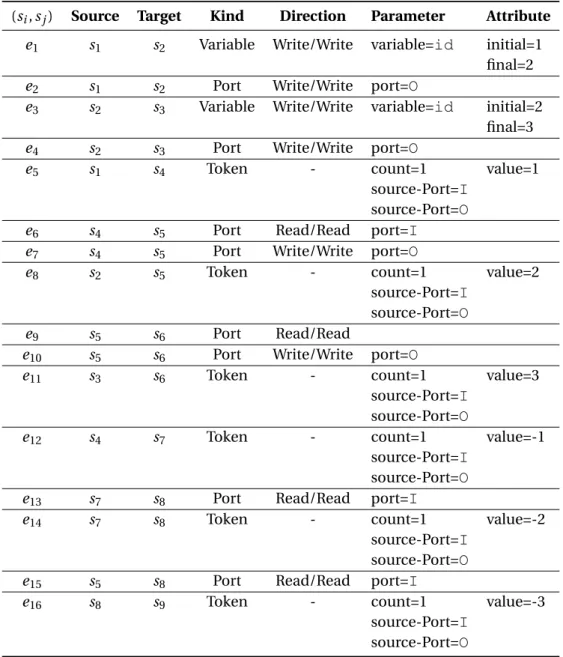
4.1.1 Firings . . . 56 4.1.2 Dependencies . . . 56 4.1.3 Example . . . 60 4.2 Properties . . . 61 4.2.1 Topological order . . . 63 4.2.2 Configuration-related dependencies . . . 63
4.2.3 Capturing the dynamic behavior . . . 65
4.2.4 Potential parallelism . . . 67
4.3 Conclusions . . . 68
5 Architecture modeling . . . 69
5.1 Abstract-to-timed translation . . . 69
5.2 Transport Triggered Architecture . . . 71
5.3 Intel 86x64 . . . 73 5.3.1 Processing weights . . . 74 5.3.2 Scheduling weights . . . 76 5.3.3 Communication weights . . . 77 5.4 Profiling accuracy . . . 79 5.5 Conclusions . . . 79
6 Design space exploration problem . . . 81
6.1 Related work . . . 81
6.2 Underlying optimization problems . . . 83
6.2.1 Partitioning . . . 83 6.2.2 Scheduling . . . 84 6.2.3 Buffer dimensioning . . . 84 6.3 Target platforms . . . 85 6.3.1 Homogeneous platforms . . . 85 6.3.2 Heterogeneous platforms . . . 85
6.5 Problem instance sizes . . . 89
6.6 Conclusions . . . 91
7 Exploration of multiple multidimensional design spaces . . . 93
7.1 Related work . . . 93
7.1.1 Design space exploration variants . . . 93
7.1.2 Bottlenecks in design space exploration . . . 95
7.1.3 Variable space . . . 96
7.2 Multidimensional design space definition . . . 97
7.3 Space-to-space transition . . . 98
7.4 Design space quality . . . 99
7.5 Design space complexity . . . 99
7.6 Optimization scenarios . . . 101
7.7 Variable Space Search . . . 102
7.8 Conclusions . . . 103
8 Heuristics for design space exploration . . . 105
8.1 Partitioning . . . 106
8.1.1 Related work . . . 107
8.1.2 Greedy constructive procedures . . . 108
8.1.3 Descent local search procedures . . . 111
8.1.4 Tabu search . . . 113
8.1.5 Advanced tabu search . . . 115
8.1.6 Tabu search with iterative communication cost profiling . . . 115
8.2 Buffer dimensioning . . . 116
8.2.1 Related work . . . 117
8.2.2 Notion of partitioning and scheduling configurations . . . 118
8.2.3 Minimal and maximal buffer size estimation . . . 119
8.2.4 Bottom-up optimization procedures . . . 120
8.2.5 Top-down optimization procedure . . . 121
8.3 Scheduling . . . 122
8.3.1 Related work . . . 124
8.3.2 Intra-actor and intra-partition scheduling policies . . . 125
8.3.3 Scheduling cost . . . 127
8.4 Conclusions . . . 129
9 Performance estimation . . . 131
9.1 Related work . . . 131
9.2 Trace processor tool . . . 134
9.2.1 Atomic models . . . 135
9.2.2 Atomic models interaction . . . 136
9.3 Critical path analysis . . . 140 9.3.1 Algorithm . . . 140 9.4 Impact analysis . . . 141 9.5 Conclusions . . . 141 10 Experimental results . . . 147 10.1 Experimental set-up . . . 147 10.1.1 JPEG decoder . . . 149 10.1.2 MPEG4-SP decoder . . . 149 10.1.3 HEVC decoder . . . 150 10.1.4 Target platforms . . . 150
10.2 Partitioning: experiments on Transport Triggered Architecture . . . 152
10.2.1 Methodology of experiments . . . 153
10.2.2 Parameters tuning . . . 154
10.2.3 Greedy and descent local search procedures . . . 154
10.2.4 Tabu search . . . 155
10.2.5 Discussion . . . 159
10.3 Partitioning: experiments on Intel 86x64 platforms . . . 160
10.3.1 Methodology of experiments . . . 160
10.3.2 Heuristics comparison . . . 161
10.3.3 Discussion . . . 162
10.4 Buffer dimensioning . . . 162
10.4.1 Bottom-up: throughput optimization with constrained resources . . . . 163
10.4.2 Top-down: resources minimization with constrained throughput . . . . 163
10.4.3 Multidimensional vs single-dimension exploration . . . 165
10.4.4 Discussion . . . 165 10.5 Scheduling . . . 169 10.5.1 Performance potential . . . 169 10.5.2 Scheduling cost . . . 172 10.5.3 Discussion . . . 173 10.6 Performance estimation . . . 173
10.6.1 Estimation accuracy on TTA platform . . . 173
10.6.2 Estimation accuracy on Intel 86x64 platforms . . . 175
10.6.3 Estimation accuracy across different platforms . . . 177
10.6.4 Discussion . . . 179
10.7 Variable Space Search . . . 180
10.7.1 Design spaces . . . 180
10.7.2 Critical path and impact analysis . . . 183
10.7.3 Solutions in multiple spaces . . . 188
10.8 Conclusions . . . 197
11 Conclusions . . . 199
11.1 Achievements of the Thesis . . . 200
11.2 Work extensions . . . 203
11.2.1 Improvements . . . 203
11.2.2 Open problems . . . 205
Bibliography . . . 226
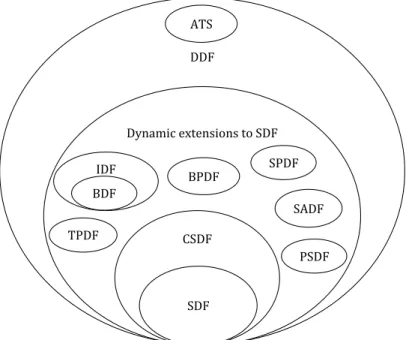
2.1 DataflowMoC sclasses. . . 18
2.2 A dataflow graph with two actors,aiandaj, connected through the bufferbn. pi,ndefines the number of tokens produced onbnduring each firing ofai.cj,n defines the number of tokens consumed frombnduring each firing ofaj. . . 19
2.3 Example of a dataflow graph. . . 20
2.4 C ALnetwork and actors structure. . . 26
2.5 Action execution model . . . 28
2.6 Basic dataflow program. . . 32
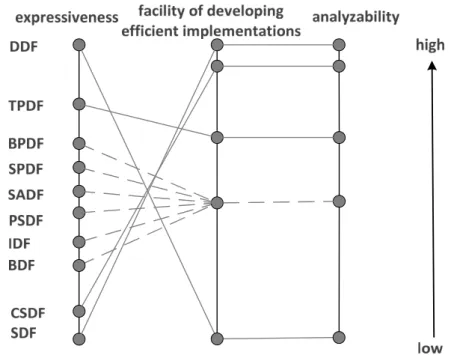
2.7 DataflowMoC scomparison. . . 37
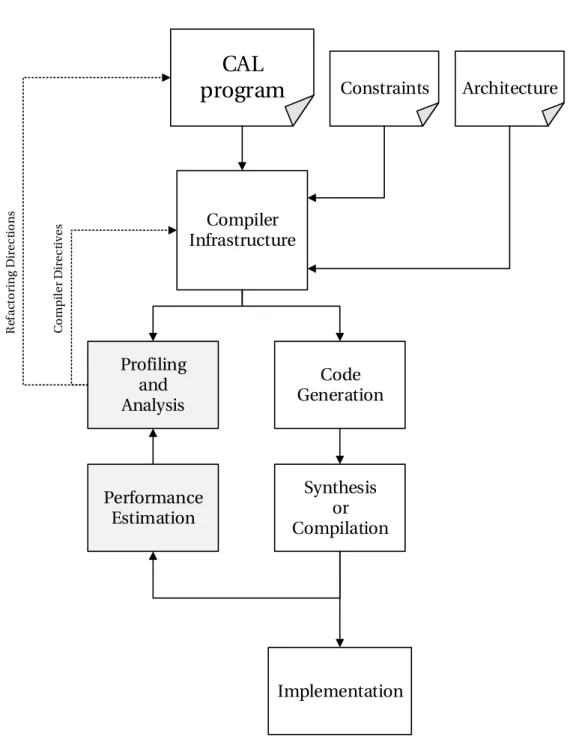
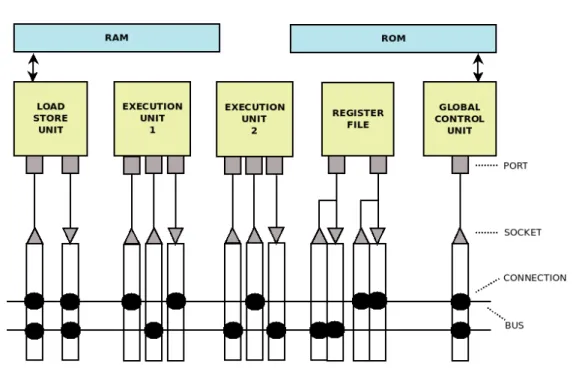
3.1 Heterogeneous system development design flow forC ALdataflow programs. 52 4.1 Example: Gantt chart. . . 60
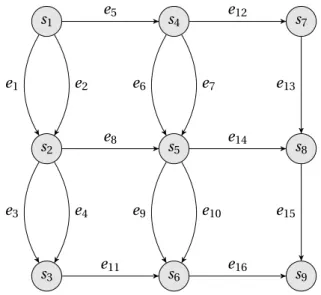
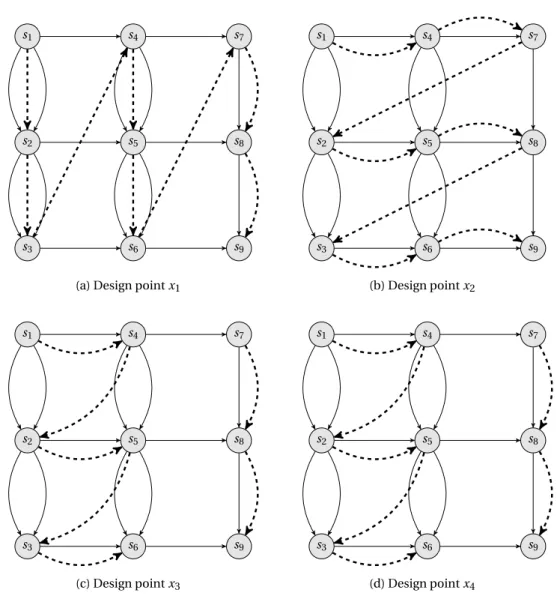
4.2 E T Gobtained after the execution of theC ALprogram from Section 2.3.3. The set of firingsS(dependenciesD) is summarized in Table 2.3 ( 4.2), respectively. 61 4.3 E T G s of theC AL network depicted in Fig. 2.6. Dashed lines represent ad-ditional edges that model a particular partitioning, scheduling and buffer dimensioning configuration, as defined in different variants in Table 4.3. . . . 66
5.1 System development design flow: profiling. . . 70
5.2 Transport Triggered Architecture model. . . 72
5.3 T T Atime-stamp placement: pseudocode. . . 73
5.4 Intel processing weights clock-cycles measurement: pseudocode. . . 75
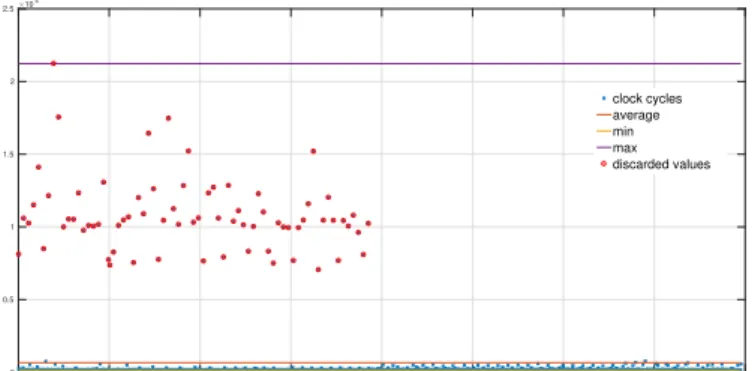
5.5 T T Aprofiling data of a single action: collected timing data of 1600 firings. . . 76
5.6 Intel profiling data of a single action: collected timing data of 1600 firings. . . 76
5.7 Intel scheduling weights clock-cycles measurement: pseudocode. . . 80
6.1 The partitioning, scheduling and buffer dimensioning subproblems. . . 83
6.2 Homogeneous platform. . . 86
6.4 Dataflow program representations. . . 90
7.1 DSEexample: MPEG4-SP decoder on Intel i7-3770. . . 101
8.1 System development design flow: design space exploration. . . 106
8.2 Simple network with the assigned partitioning, scheduling and buffer dimen-sioning configurations. . . 119
8.3 Gantt charts for the execution of the network from Fig. 8.2 for the two buffer size configurations. . . 119
8.4 Scheduling policy - illustration. . . 126
8.5 Sample partition with the actors to be considered by the scheduler. . . 128
9.1 System development design flow: performance estimation. . . 132
9.2 Schematic illustration of the system components and connections. . . 135
9.3 Atomic actor model: state transition. . . 143
9.4 Atomic actor partition model: state transition. . . 144
9.5 Components interaction and exchanged signals. . . 144
9.6 Communication procedure between an actor and a buffer. . . 145
9.7 System development design flow: bottleneck and impact analysis. . . 146
10.1 Extended system development design flow forC ALdataflow programs. . . 148
10.2 JPEG decoder: dataflow network. . . 149
10.3 Dataflow networks. . . 151
10.4 Partitioning heuristics -T T A- experimental workflow. . . 153
10.5 Partitioning heuristics - Intel - experimental workflow. . . 160
10.6 Bottom-up buffer dimensioning heuristic (MPEG4-SP Parallel decoder). . . . 164
10.7 Bottom-up buffer dimensioning heuristic (HEVC decoder, 7 cores). . . 165
10.8 Top-down buffer dimensioning heuristic. . . 166
10.9 M DSvs designB-subspace vs infinite buffer. . . 167
10.10 T T Aplatform execution. . . 171
10.11 Performance estimation validation - experimental workflow. . . 174
10.12 T T Aclock-cycles comparison. . . 174
10.13 JPEG, machine M2 (discrepancy as % value). . . 176
10.14 MPEG-4 SP decoder estimation results (discrepancy as % value). . . 176
10.15 Estimation accuracy: different platforms. . . 178
10.16 Design spaceD0. . . 188 10.17 Design spaceD1. . . 189 10.18 Design spaceD2. . . 189 10.19 Design spaceD3. . . 189 10.20 Design spaceD4. . . 190 10.21 Design spaceD11. . . 190
10.22 Design spaceD12. . . 190
10.23 Throughput improvement summary (1). . . 192
10.24 Throughput improvement summary (2). . . 193
10.25 Throughput and resources in different design spaces: summary (1). . . 194
2.1 K P N,DP NandAT Sprograms: comparison. . . 17
2.2 CAL lexical tokens. . . 29
2.3 Firings of theC ALprogram described in Section 2.3.3. . . 34
3.1 Analysis frameworks: features summary, part 1. . . 42
3.2 Analysis frameworks: features summary, part 2. . . 43
3.3 Analysis frameworks: features summary, part 3. . . 44
4.1 Dependencies: types, directions, parameters and additional attributes. . . 59
4.2 Dependencies setDof the execution trace graph depicted in Figure 4.2. . . . 62
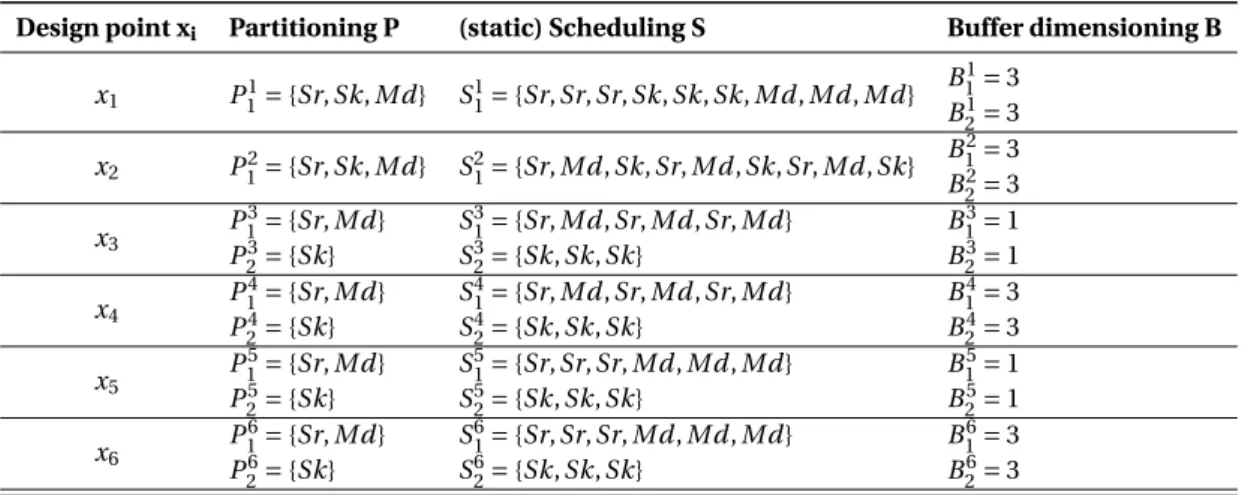
4.3 Summary of the design points considered for the program network in Figure 2.6. The actors: Source, Medium and Sink are denoted with Sr, Md, Sk, respectively. 64 4.4 Firings sequence of theC ALactorSeparator(defined in Listing 2.2), when two input sequences are available in its input portI:I1={1, 2,−3,−4} and I2={−5,−6, 0,−7}, respectively. . . 65
5.1 Statistical information obtained for a single action on theT T Aand Intel plat-forms. . . 75
5.2 Sample communication cost data. . . 78
8.1 W Bpartitioning algorithm: sample flow. . . 108
8.2 B Ppartitioning algorithm: AW andAPW settings. . . 110
8.3 B Ppartitioning algorithm: AC Psettings. . . 110
8.4 B Ppartitioning algorithm: sample flow. . . 110
8.5 Conditions numbers updates. . . 128
10.1 Configurations of Intel platforms. . . 152
10.2 Speed-up: Greedy constructive procedures. . . 155
10.3 DLSSpeed-up: balanced start. . . 155
10.4 DLSSpeed-up: random start. . . 155
10.5 Speed-up:N(B)with balanced start. . . 156
10.7 Speed-up:N(I)with balanced start. . . 157
10.8 Speed-up:N(I)with random start. . . 157
10.9 Speed-up:N(C F)with balanced start. . . 157
10.10 Speed-up:N(C F)with random start. . . 157
10.11 Speed-up:N(R)with balanced start. . . 157
10.12 Speed-up:N(R)with random start. . . 157
10.13 P T SandJ T Sspeed-up: balanced start. . . 158
10.14 P T SandJ T Sspeed-up: random start. . . 158
10.15 Improvement summary. . . 158
10.16 Averaged time of the final improvement. . . 160
10.17 Platform execution speed-up: SOA approach. . . 161
10.18 Platform execution speed-up:B P with additional optimization procedures. . 161
10.19 Platform execution speed-up: tabu search with an iterative re-profiling proce-dure. . . 161
10.20 MPEG4-SP Parallel: performance differences [FPS]. . . 163
10.21 HEVC: performance differences [FPS]. . . 163
10.22 Estimated speed-ups: balanced partitioning configurations. . . 169
10.23 Estimated speed-ups: random partitioning configurations. . . 170
10.24 Execution timesNnP. . . 172
10.25 Execution timesRR. . . 172
10.26 Conditions checked. . . 172
10.27 Conditions failed. . . 172
10.28 Execution time change vs the initial configuration (4 units). . . 175
10.29 Execution time change vs the initial configuration (5 units). . . 175
10.30 MPEG-4 SP Serial: estimation with the communication cost, discrepancy. . . 177
10.31 HEVC: summary of the considered design spaces. . . 181
10.32 HEVC: summary of the improvement achieved in various design spaces. . . . 182
10.33 Design spaceD0. . . 184 10.34 Design spaceD1. . . 184 10.35 Design spaceD2. . . 184 10.36 Design spaceD3. . . 185 10.37 Design spaceD4. . . 185 10.38 Design spaceD5. . . 185 10.39 Design spaceD6. . . 186 10.40 Design spaceD7. . . 186 10.41 Design spaceD8. . . 186 10.42 Design spaceD9. . . 187 10.43 Design spaceD10. . . 187 10.44 Design spaceD11. . . 187
AAA/M Algorithm Architecture Adequation Matching Methodology
ACP Average Common Predecessors
APO Average Partitioning Occupancy
APW Average Preceding Workload
AST Abstract Syntax Tree
ATS Actor Transition Systems
BDF Boolean Dataflow
BP Balanced Pipeline
BPDF Boolean Parametric Dataflow
CAL Cal Actor Language
CFDLS Communication Frequency Descent Local Search
CFG Control Flow Graph
CNnP Critical Non-Preemptive
COW Critical Outgoings Workload
CP Critical Path
CSDF Cyclo-Static Dataflow
DAG Directed Acyclic Graph
DDF Dynamic Dataflow
DLS Descent Local Search
DSE Design Space Exploration
ECO Earliest Critical Outgoings
EET Estimated Execution Time
EMF Eclipse Modeling Framework
ETG Execution Trace Graph
FCFS First-Come First-Served
FNL Functional unit Network Language
FSM Finite State Machine
HW Hardware
IANnP Intra-Actor Non-Preemptive
IAP Intra-Actor Preemptive
IASP Intra-Actor Scheduling Policy
IDF Integer Dataflow
IDLS Idle Descent Local Search
IPSP Intra-Partition Scheduling Policy
IR Intermediate Representation
JTS Joint Tabu Search
KPN Kahn Process Network
LTS Labeled Transition Systems
LUB Lowest Upper Bound
MCDF Mode-controlled Dataflow
MCDM Multi-Criteria Decision Making
MDE Model Driven Engineering
MMPN Multiprocessor Mappings of Process Networks
MoC Model of Computation
MOEA Multi-Objective Evolutionary Algorithms
MPSoC Multiprocessor System-on-chip
NnP Non-Preemptive
NnP/P Non-Preemptive / Preemptive swapped
NUMA Non Uniform Memory Access
ORCC Open RVC-CAL Compiler
PAPS Periodic Admissible Parallel Schedule
PASS Periodic Admissible Sequential Schedule
PCP Partial Critical Path
PE Performance Estimation
PiMM Parameterized and Interfaced dataflow Meta-Model
PSDF Parametrized Synchronous Dataflow
PTS Probabilistic Tabu Search
RR Round Robin
RTL Register Transfer Language
SADF Scenario-Aware Dataflow
SDF Synchronous Dataflow
SDO Standard Deviation of Occupancy
SoC System on Chip
SPDF Schedulable Parametric Dataflow
SPEO Strength Pareto Evolutionary Algorithm
SW Software
TP Trace Processor
TPDF Transaction Parametrized Dataflow
TS Tabu Search
VLIW Very Long Instruction Word
VSS Variable Space Search
WB Workload Balance
XDF XML Data Format
Due to the broad availability of many- and multi-core platforms, there is an increasing interest in developing applications taking advantage of the offered parallelism. Given the scale of the massively parallel platforms consisting of dozens or hundreds of processing units, different programming languages have been developed and compete in order to ensure scalability, productivity and reusability, and to meet design and performance constraints. One of the paradigms to be used in conjunction with such parallel platforms is dataflow programming. Dataflow programs respond to the increasing demands of designing highly parallel applica-tions expressed at a high level of abstraction. Multiple complex applicaapplica-tions (i.e., in the field of media and signal processing) display dynamic behavior that does not fit into the static restrictions. Such applications can be expressed using a dynamic dataflow subclass. In order to make the development process of such dynamic applications maximally efficient, this research work aims at providing a complete methodology for design space exploration, analysis and refactoring of dynamic dataflow applications. It relies on the modeling of a dynamic program and an architecture that enables the portability of a design to different parallel platforms. Furthermore, it allows a systematic exploration of different design alternatives so that mul-tiple objective functions and/or design constraints can be satisfied. Finally, it identifies the refactoring directions efficiently guiding the designer during the entire development process.
1.1 Parallel systems development
Since its very first release in the 1970s, a single processor has been constantly sped-up by various means, such as an increase of the clock frequency, exploitation of the instruction-level parallelism [1] and also an increase of the cache and pipeline size. However, the process of accelerating a single core is constrained as a consequence of the clock frequency and the power dissipation limitations of deep sub-micron CMOS technology. Coming close to the practical limits of a single core started an alternative path of manufacturing processing
platforms consisting of multiple cores. Such multi-core platforms, currently ubiquitous, have opened a new chapter in the field of efficient application design and brought both, interesting opportunities and significant challenges.
An obvious advantage of the emerging many- and multi-core platforms is the level of paral-lelism related to the number of available processing units. For instance, theEpiphanyfrom Adapteva [2] consists of 64 cores and the MPPA-256 chip from Kalray [3] of 256 cores. Among the challenges related to the usage of many- and multi-core platforms, one problem can be referred to as thememory wall. It is related to the gap between the speed of processors and the speed of memory accesses enforcing a higher memory bandwidth along with an increase of the number of cores. Another problem is the interconnections between the processors which are constantly increasing in number. Furthermore, the more cores are used, the more it is questioned if they are used efficiently so that the power consumption is commensurate with the actual usage. Finally, with an increased number of cores, the synchronization of memory accesses is getting more and more challenging. Some of these issues have been tackled at the level of platform design. A good example is the creation of a hierarchical memory architecture providing different bandwidths and speeds of access for the cores depending on their rela-tive location. This kind of architecture is currently used in several embedded platforms, for instance in the, mentioned earlier, Kalray’s MPPA-256.
The emerging field of many- and multi-core platforms introduces a requirement of defining programming methods capable of handling a massively parallel execution while minimizing the additional programming effort of the designers. In the case of single core platforms, the focus of the application developers is on writing a correct program, whereas the compiler gen-erates the code. Without appropriate support on many/multi-core platforms, the developers often have to perform additional work assisting the compilation process in order to make the generated code efficient. This work can include a decomposition of the application into tasks, deciding where and when these tasks should be executed or even hand-tuning the code in order to gain performance by exploiting some specific hardware features. Performing these tasks explicitly for a given platform decreases the potential reusability of the code, introduces some low-level issues, such as synchronization, data locality management and race conditions, and prevents porting the code to other platforms.
In this context, an arising question is if the challenges, such as decomposition of an application into parallel running tasks, design of the synchronization and communication mechanisms and exploitation of the available parallelism can be taken care of by the abstractions provided by the programming paradigm. Traditional programming languages (i.e., C, C++, Java) do not reflect the inherently parallel nature of the applications and the underlying many/multi-core architectures. They have been designed for single-core systems with unified memories and rely on a sequential control flow, procedures and recursion lacking a high-level abstraction to
capture and express the parallelism. In order to adapt them for many/multi-core architectures with distributed memories, several partial solutions have been invented. They are based on extensions added to the sequential languages [4] by means of macros, annotations and message passing libraries (i.e., PVM [5], MPI [6], OpenMP [7]). However, common drawbacks of the approaches based on threads, that is, sequential processes sharing the memory, are: non-determinism, susceptibility to hidden bugs and error-prone modifications. Furthermore, using thread-based methods causes difficulties fully exploiting the application parallelism and maintaining portability, since such implementations do not scale automatically. Instead, any difference in the structure of the target platform requires modifications directly on the algorithmic side of the program [8]. The implementations built with threads are also not analyzable and consist of several non-analyzable components, such as pointers.
1.2 Motivations and problem statement
It can be stated that parallel implementations evolving from sequential techniques have an important disadvantage in the connection between the behavioral description of a program and the target architecture. Not only does it make a program difficult to maintain when the structure of the target platform changes (i.e., additional cores are added), but also it becomes a critical problem when the considered platform is heterogeneous, that is, it consists of both, hardware and software components. A common practice is to makea priorian assignment of different parts of the design to different architectural components. Such an approach prevents an efficient exploration of the design alternatives and requires a complete rewriting of entire parts of the design if the assumed assignment does not satisfy the design constraints. Hence, the main requirements for a flexible design of parallel applications can be summarized as follows:
• Design abstraction: already at the early stages of development, the designer must decide about the level of abstraction which should be used. Due to the diverse nature of the platforms, different levels of abstractions are possible, depending on the required amount of details and the constraints. In any case, behavioral descriptions should be able to seamlessly express both: sequential and parallel computation paradigms;
• Modularity: if a design is modular, the functionality of the system is split into com-ponents that communicate with each other and hence divide the functionality of the overall application. The design abstraction should support modularity as a data and task parallelism;
• Composability: if a software system is composable, it is formed of several independent and recombinant components. These components can be assembled in various combi-nations to satisfy specific design requirements. The design abstraction used to describe
a system should operate on such composable components;
• Reusability: the design abstraction and the modularity of a program should enable reusing the components among different designs. In this way target-dependent ab-stractions are avoided and different systems can be described using a set of common components.
1.2.1 Design exploration
Given a semantically correct sequential program, the opportunities for its exploration are very limited, because the only possibility is to identify some independent portions of the code and change their order of execution so that the unnecessary memory copies are reduced. In contrast, in the case of parallel applications running on many/multi-core platforms, there are plenty of possible configurations to be applied, such as: decomposition of an application into tasks, assigning the tasks to the processing units (statically or dynamically) and defining their execution order. Each of these configurations can lead to different metrics on the performance, power consumption, resource utilizationet c.
Design space exploration (DSE) can be described as a process of exploration and evaluation of different design alternatives, also referred to as design configurations or design points. These alternatives are applied as some settings to the design and are not related to the modifications of the algorithmic parts. The objective of the exploration is to find such a configuration (or a set of configurations) that satisfies the given constraints and optimizes the value(s) of the objective function(s).
An exploration of the design is especially important in the early stages of system development. Finding high-quality design alternatives has two important implications. First, it allows an evaluation of the design in terms of compliance with the specified constraints and objective functions. Second, if supported by an identification of some directions, it can point to the currently infeasible or not achievable design points which may become achievable, when the necessary modifications are applied to the design. Considering some large and complex designs in the context of massively parallel platforms, performing a manual exploration is inefficient and error-prone, due to a huge number of different alternatives. Hence, different state-of-the-artDSEmethodologies make use of some common functionalities, such as:
• Prototyping: a design is validated and tested before the final implementation using a generated set of prototypes. In this case, the cost and the time required for the final im-plementation is reduced and the impact of the design decisions in the imim-plementation process can be highlighted;
constraints. If these are not satisfied, the design requires modification;
• System integration: it requires a working assembly and a configuration of the compo-nents.DSEshould result in a set of feasible assembly configurations.
Performing these tasks requires providing a formal method supported with an appropriate computer-aided framework which can accomplish different stages of the exploration with regards to the specification requirements in a systematic way. Although many structuredDSE
methodologies exist, they are characterized by a common practice of designing application-specific architectures at a detailed level, which can limit the number of design points to be explored. In consequence, it limits the freedom of defining trade-offs between the per-formance, resource utilization and programmability. In contrast, providing ageneral DSE
methodology should take into consideration the following components:
• Application and architecture models: both components should be represented accord-ing to some rules. First, the models should be formal, so that the analysis and exploration can be performed in an automated way. Second, in order to keep the methodology retar-getable, the two models should be independent. Finally, they must allow to capture and express the necessary constraints and objective functions;
• Exploration techniques: since for the large design spaces a manual or random explo-ration is highly inefficient, the methodology should provide a set of automated tech-niques for discovering potential high-quality design points. Due to the large number of points, these techniques should allow navigation between different design points and narrow the space to the promising regions. It is also important to ensure that the exploration can be performed in a reasonable time;
• Refactoring directions: if the design points established during the exploration do not meet the requirements (i.e., do not satisfy the constraints), the designer should be provided with a set of refactoring directions indicating possible improvements that can be applied to the design in order to resolve the factors leading to an unsatisfactory quality of the design. These factors are often referred to asdesignorperformance bottlenecks. When identified during the exploration, they prevent theDSEmethodology from being a
black boxto the designer. Instead, one is made aware of the narrowing factors occurring in the design and the opportunities for resolving them;
• Performance estimation: it is used to directly evaluate different design points without requiring execution of the program on a physical platform. In consequence, no partial implementations of the design are necessary in the process of exploration. It is important to ensure that the performance estimation is accurate enough to correctly evaluate all design alternatives.
1.2.2 Dataflow programming
The dataflow programming paradigm, which can be expressed by different models of com-putation (MoC s), is an alternative solution to programming methods evolving directly from sequential approaches, when program implementations on many- and multi-core systems, or, in particular, heterogeneous parallel platforms are considered. Dataflow programs, in general, are composed of, possibly hierarchical, networks of communicating computational kernels, calledactors. Actors are connected by directed, lossless, order-preserving point-to-point com-munication channels, calledbuffers. Hence, the flow of data between the actors is explicit, because they are not allowed to exchange data differently than by exchanging atomic data packets, calledtokens. The internal parallelism of an application, related to the actors, is directly exposed, since they are not allowed to share state. In consequence, the decisions about assigning dataflow actors to different software or hardware components can be freely made. The strengths of dataflow programs can be briefly summarized as: parallelism scalability, modularity, composability and portability.
Parallelism scalability
Scalability of a computer application has two common meanings. First, it is an ability to function well when its size or volume changes. This change can be related to both, the system itself and the context (i.e., the platform the system is operating on). Second, it is not only the ability to function well in the rescaled situation, but eventually to take an advantage from it and improve the performance. Scalability of a dataflow program corresponds to these two meanings, because the explicit concurrency of actors leads to a parallel composition mechanism. For instance, when the parallelism of a target platform increases, a dataflow program can be always mapped to the available processing units yielding a correct behavior. Furthermore, its performance can improve along with the increase of the platform parallelism, up to the maximal potential parallelism expressed in a dataflow design.
Modularity
Dataflow actors are encapsulated, so that they do not share state or variables. In consequence, it is ensured that changing one actor does not impact others and a high potential parallelism of actors is provided. The functionality of a program can be separated into independent, interchangeable modules (actors), such that each of them contains everything necessary to process a given aspect of the desired functionality. Different modules are reusable between different designs.
Composability
Modularity of dataflow actors leads to defining programs as composable systems formed of independent components that can be freely assembled to provide a required functionality. Unlike for the case of thread-based implementations, when different parts of a program (components) are assembled, the occurrence of races is eliminated and no synchronization mechanisms need to be developed. Furthermore, different configurations can be applied to a program design, depending on the considered platform. For instance, dataflow actors can be assigned to the available processing units always yielding a correct behavior of the overall design, without introducing any unpredictable behavior.
Portability
Portability of dataflow programs implies that different components are not only reusable between different designs, but also between different target platforms. For instance, the same program network can be executed on platforms with different levels of parallelism (i.e., different numbers of processing units), only by specifying the assignment of actors to the available processing units. Furthermore, having a single representation of a program it is possible to generate and reuse the code on different targets, including software (SW) and hardware (HW) elements.
Properties
Dataflow programs can be expressed using different classes bringing different complexity when it comes to their analysis. For the subclass ofstaticdataflow programs, it is possible to perform the analysis at compile-time. This leads to establishing a static schedule, exact bounds on the buffer sizes, exact prediction of throughput and latencyet c. This class can be, however, insufficient when complex designs, such as signal processing applications, need to be expressed. An extreme opposite is the subclass ofdynamicdataflow programs. They allow changing rates of token production/consumption and a data-dependent behavior. This expressiveness and flexibility comes, however, at the cost of more difficult analyzability which is not possible at compile-time.
DataflowMoC spossess several valuable properties which perfectly respond to the described requirements for a flexible system design. Transmitting these attractive features into efficient implementations on the emerging many- and multi-core systems requires, however, dealing with several challenges. Thecomposabilityproperty implies that the program components can work in several configurations. These configurations result in different qualities of the implementation in terms of, for instance, performance. The open decisions for the designer, when porting an abstract description of a dataflow program onto a target platform, include
the following:
• Partitioning: it specifies the assignment of dataflow components to the processing units. Depending on the platform, different numbers of processing units can be available, but the number of dataflow components often exceeds this number. The other commonly used terms forpartitioningarebindingandmappingin the space domain;
• Scheduling: if multiple dataflow components are partitioned to one processing unit, they are, in general, not allowed to be executed in parallel. Hence, for each processing unit a specific order of execution must be established. The termschedulingis sometimes also referred to assequencing andmappingin the temporal domain. Depending on the considered dataflowMoCand the internal nature of the components, there might exist a static execution order. Otherwise, the order must be established dynamically at run-time;
• Buffer dimensioning: although according to general specifications dataflow compo-nents communicate over infinite buffers, when executed on a real platform each buffer must be assigned a finite size. Depending on the consideredMoC, these sizes might be necessary only to guarantee an execution without deadlocks or can influence the achievable throughput.
These design decisions can be made in various combinations corresponding to the design points in theDSEprocedure. Each point can lead to different metrics related to data through-put, energy consumption, memory utilization, latency, and so on. These metrics can be directly taken as specifications of the constraints and/or objective functions to optimize [9].
1.2.3 Problem statement
Dataflow programs possess the features necessary for a flexible design of parallel applications running on various many/multi-core platforms. The performances of the implementations depend on several configurations, including partitioning, scheduling and buffer dimensioning, which result from the design space exploration process. Hence, the problem considered in this dissertation can be stated as follows.
Thesis:Transferring the features of dataflow programs into efficient implementations satisfying the design constraints and optimizing the values of the objective functions is subject to locating high-quality configurations in the available design space and identifying refactoring directions revealing new promising regions in the space.
1. A rigorous design space exploration problem formulation for heterogeneous platforms;
2. A set of heuristics making the exploration process effective and efficient;
3. A high-accuracy performance estimation tool driving the exploration process;
4. A methodology of analysis and optimization of dataflow programs according to various constraints and objective functions.
1.3 Research contributions
This dissertation addresses the problem of design space exploration of dynamic dataflow applications and provides a systematic analysis methodology consisting of multiple stages. It follows the discussed generalDSEapproach overcoming the architecture dependency of the commonly used approaches. Hence, it can be applied to different types of many-, multi-core and heterogeneous platforms without any intervention in the methodology and allows a flexibility of choice in terms of the objective function and/or design constraints. Furthermore, it considers the most expressive, but also the most difficult to analyze, dynamic dataflow programs with all their implications. Nevertheless, the less expressive dataflowMoC sare still encompassed. The main contributions can be summarized as:
1. Design space exploration problem formulation[10]: the considered problem, consist-ing of partitionconsist-ing, schedulconsist-ing and buffer dimensionconsist-ing for dynamic dataflow programs executed on homo- and heterogeneous platforms is thoroughly described and discussed at a level of detail not considered in the literature so far. The problem is formalized in terms of decision variables, objective functions and constraints. As the problem formulation is analyzed and exploited, the possible design optimization objectives are also identified;
2. Variable Space Search methodology: following the novel problem formulation, the concepts of design points and design spaces are introduced and expressed so that the multidimensionality of the problem is properly captured. Next, employing the concept of design space exploration, identification of program bottlenecks and determining the refactoring directions, a complete methodology of analysis and improvement of dataflow applications is defined. The methodology relies on the concept of Variable Space Search introduced originally for the graph coloring problem. It can be used in different scenarios, without limiting the choices of trade-offs between the performance and resource utilization;
3. Definition of a dynamic dataflow program execution model for DSE[11, 12, 13, 14]: using the available tools for collecting the profiling information of an execution, the
appropriate notion of time is retrieved and processed in order to be injected into an abstract model of a dynamic execution expressed as an execution trace. In this way, a real execution on a target platform is modeled. The timing information is kept separately from the abstract execution, hence a single model can be exploited for different types of architectures ensuring portability;
4. Design space exploration heuristics: various heuristic approaches corresponding to the introduced design space exploration problem formulation are proposed. Each of the heuristics relies on a generic model of dynamic execution expressed as a graph, which is being post-processed;
• Partitioning[13, 15, 16, 17, 18]: the algorithms include greedy heuristics, descent local search methods and tabu search with different types of neighborhoods and advanced variants;
• Buffer dimensioning[19]: the algorithms represent two approaches: bottom-up and top-down which can be applied in different optimization scenarios. Neverthe-less, in both cases the main objective is to enable finding a trade-off between the performance and resource utilization;
• Scheduling[20, 21]: several dynamic scheduling policies aiming at establishing the most efficient order of execution inside each processing unit are defined and analyzed with regards to performance potential and scheduling cost. A figure of merit for the cost of the scheduling policy is also introduced.
5. Performance estimation[12, 19, 22, 23]: a highly accurate performance estimation
SW tool is provided. It enables the analysis of the design points on different types of platforms. The analysis includes the estimation of the execution time expressed in clock-cycles and extraction of metrics which are used by the design space exploration heuristics. Similar to the proposedDSEheuristics, it relies on a graph-based representa-tion of a dynamic execurepresenta-tion. The same representarepresenta-tion, when supplied with appropriate timing information, is used for different types of platforms. An algorithm for perform-ing an analysis of the bottlenecks of the program is also implemented on top of the performance estimation module.
1.4 Thesis organization
Chapter 2is an overview of the main concepts related to dataflow programming. Different paradigms and classes including static, cyclo-static, dynamic extensions of static and, finally, dynamic programs are compared and discussed. Furthermore, an introduction toC AL lan-guage is provided along with a set of examples. Finally, the process of code generation and
theRV C−C ALcompiler are explained.Chapter 3comprises the state-of-the-art of dataflow-oriented analysis frameworks. Different frameworks are compared and discussed with regards to the supported models of computation, objectives, features and availableDSEheuristics. A special emphasis is placed on the frameworks intended for applications expressed using
RV C−C AL. After presenting an overview of the related works, a dataflow design flow is intro-duced and discussed.Chapter 4describes the concept of an execution trace graph used as an abstract model of a dynamic execution. The formal definition and properties are described using simple examples. The emphasis is on the genericness of the model when referred to different configurations (design points) and the opportunities of employing the model in the design space exploration process. The challenges related to the modeling of the dynamic behavior of the actors are also discussed. Chapter 5focuses on the requirements related to obtaining accurate timing information for an execution trace graph. Consequently, the profiling methodologies to generate appropriate weights (related to processing, scheduling and communication) are discussed for two types of target platforms: Transport Triggered Architecture and Intel 86x64. Following different properties of these platforms, the profil-ing challenges are discussed in conjunction with the procedures necessary for each type of architecture. Chapter 6presents the design space exploration problem formulation re-garding partitioning, scheduling and buffer dimensioning. The formulation is preceded by an overview of the formulations commonly used in the field of parallel programming and multi-core systems. The general formulation is then referred to two cases of target platforms: homogeneous and heterogeneous architectures which introduce more precise specifications and/or additional constraints. Towards the end of the Chapter, the problem instance sizes are also illustrated.Chapter 7handles the concept of design space exploration performed in different spaces, which was originally proposed for the graph coloring problem. The related work discusses also different possible formulations and objectives of exploration, as well as the importance of bottleneck identification. Then, the concepts of design points and design spaces are introduced using an appropriate notation and capturing the multidimensionality of the problem. An example demonstrates the complexity of the considered design spaces. Finally, the Variable Space Search algorithm is defined with regards to different possible optimization criteria. Chapter 8defines various heuristics to be used during the exploration in order to find high-quality solutions for each of the considered subproblems (partitioning, scheduling, buffer dimensioning). Regarding each subproblem, an overview of related work is provided and several heuristics of different complexity are introduced. For the case of scheduling it is discussed how this subproblem differs from the others and a figure of merit to express the cost of a scheduling policy is introduced.Chapter 9describes the software tool for performance estimation. The related work considers different general approaches to performance estima-tion and the achievable level of accuracy reported in the literature. Then, the construcestima-tion of the tool is thoroughly described and a list of the tracked execution properties is provided. An algorithm for calculating the critical path and performing the impact analysis leading to
the identification of bottlenecks, which is built on top of the tool, is also presented.Chapter 10reports the experimental results performed with regards to different components of this research work. They include: the verification of partitioning heuristics on Transport Triggered Architecture and Intel 86x64, the experiments with buffer dimensioning and scheduling, the analysis of accuracy for the performance estimation tool and the validation of the proposed Variable Space Search methodology using the recent dataflow implementation of the HEVC decoder. Chapter 11concludes the dissertation, summarizes the accomplished task and briefly discusses further improvements and open problems identified during the realization of this research work.
Dataflow programming was first introduced in 1974. In principle, it is a paradigm where the programs are expressed as directed graphs of streams and operators. Such programs are currently in use in multiple fields, such as: signal and video processing, telecommunications, health care, transportation, retail, science, security, emergency response and finance. Under a general term "dataflow programming", various models of computation (MoC s) have been developed independently by some research communities. The two most commonly used classes are: Synchronous Dataflow (SDF) and Cyclo-Static Dataflow (C SDF), introduced in 1987 and 1995, respectively. Since these classes do not allow expressing dynamic applications, several extensions capable of handling some dynamic behavior have been defined. Expressing fully dynamic applications is possible using Dynamic Dataflow (DDF). This Chapter is an overview of dataflow programming, including the definition of a dataflow program, different
MoC sand classes, which are examined in terms of their properties related to the expressive-ness and analyzability. Next, the Cal Actor Language (C AL) is discussed, regarding the syntax, semantics and differentMoC sthat it can represent.
2.1 Dataflow programs
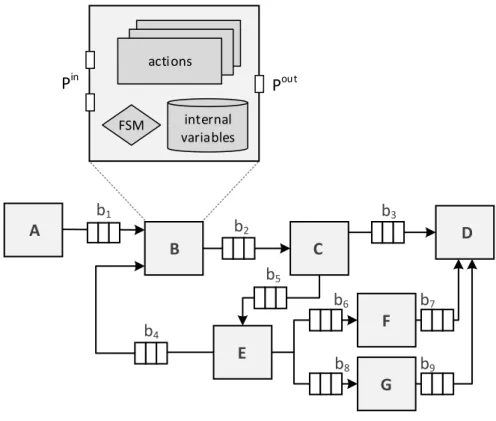
A dataflow program is defined as a directed graph where the vertices are operators, called actors, and the edges are streams. In general, stream graphs might be cyclic, but some systems only support acyclic graphs. Dataflow programs implement streams as FIFO (first-in, first-out) queues, called buffers, with sometimes limited capacity. Conceptually, streams are infinite sequences of atomic data items, called tokens, and each actor consumes data items from incoming streams and produces data items on outgoing streams. A token is the atomic unit of communication in a dataflow program. One of the main properties of dataflow programs is their data-driven semantic, because it is the availability of tokens that enables an actor. One of the principal strengths of dataflow programs is that they do not impose unnecessary
sequencing constraints between the actors, hence the implemented algorithms are not over-specified. Instead, only a partial order is specified and the sequencing constraints are imposed only by data dependence. Since the actors can run concurrently, dataflow programs inherently expose the application parallelism [24, 25].
An overview of different dataflowMoC sincludes: the Kahn process networks (K P N) [26] that represent the underpinning representation for dataflow graphs, the closely related toK P N
Dataflow process networks (DP N) [27] and the Actor transition system [28] that extendsDP N
with the notion of atomic steps, priorities and actor internal variables.
2.1.1 Kahn process network
AK P N is a network of processes that can communicate only through unidirectional and unbounded buffers. Each buffer carries a possibly infinite sequence of tokens. Using the notation formalized in [27], each sequence of tokens is denoted asX=[x1,x2,x3, . . .]. A token
is considered to be an atomic data object written (produced) and read (consumed) exactly once. The process of writing to the buffers is non-blocking, hence it always succeeds immediately. Reading from the buffers is blocking in the sense that if a process attempts to read a token from a buffer and the data is not available, it stalls (waits) until the buffer has sufficient tokens to satisfy the consumer. It is not possible to test the presence of input tokens in advance.
Kahn process
LetSpdenote a set of p-tuples of sequences as inX=©X1,X2, . . . ,Xpª∈Sp. A Kahn process is then defined as a mapping from a set of input sequences to a set of output sequences such as:
F:Sp→Sq (2.1)
TheK P NprocessF has an event semantic instead of state semantics as in some other do-mains such as continuous time. Moreover, the only technical restriction is thatFmust be a continuous mapping function.
Monotonicity and continuity
Considering a prefix ordering of sequences, the sequenceXprecedes the sequenceY (written
XvY) ifXis a prefix of (is equal to)Y . For example, ifX=[x1,x2] andY =[y1,y2,y3] then
XvY and it is common to say thatXapproximatesY , since it provides partial information aboutY. An empty sequence, denoted as⊥is a prefix of any other sequence. An increasing chain (possibly infinite) of sequences is defined asχ={X0,X1, . . .} whereX1vX2v. . .. Such
The least upper bound (LU B)tχis an upper bound such that for any other upper boundY, tχvY. TheLU Bmay be an infinite sequence.
Given a functional processFand an increasing chain of sets of sequencesχ, as defined in Equa-tion 2.1,Fmapsχinto another set of sequences that may or may not be an increasing chain. Lettχdenote theLU Bof the increasing chainχ. ThenFis said to be Scott-continuous [29] if for all such chainsχ,tF(χ) exists and:
F(tχ)= tF(χ) (2.2)
Networks of Scott-continuous processes have a more intuitive property called monotonicity. This property can be thought of as a form of causality that does not invoke time, so thatfuture inputconcerns onlyfuture output. A processFis said to be monotonic if:
XvY ⇒F(X)vF(Y) (2.3)
A continuous process is monotonic. However, a monotonic process may be noncontinuous A key consequence of this property is that a process can be computed iteratively [30]. This means that given a prefix of the final input sequences, it may be possible to compute a part of the output sequences. In other words, a monotonic process is non-strict: its inputs need not be complete before it can begin computation. In addition, a continuous process will not wait forever before producing an output (it will not wait for the completion of an infinite input sequence). Networks of monotonic processes are determinate.
2.1.2 Dataflow process network
Dataflow process networks (DP N s) are formally a special case ofK P N s, where the computa-tional blocks are called actors. Analogous to aK P N process, actors can communicate only through unidirectional and unbounded buffers which can carry possibly infinite sequences of tokens and writing to the buffers is non-blocking. In contrast, reading from buffers is non-blocking in the sense that an actor can first test for the presence of input tokens. If there are not enough input tokens, then the read returns immediately and the actor does not need to be stalled. This property introduces non-determinism, without forcing the actors to be non-deterministic.
Actor with firings
DP N networks are a special case ofK P Nnetworks where each process consists of repeated firings of an actor [31]. An actor firing can be defined as an indivisible (atomic) quantum of
computation. The firings can be described as functions, and their invocation is controlled by a set of firing rules. Sequences of firings define a continuous Kahn process as the least-fixed-point of an appropriately constructed functional mapping, henceDP N can be formally established as a special case ofK P N[32].
An actor withminputs andnoutputs is defined as a tuple (f,R), where:
• f :Sm→Snis a function called the firing function;
• R⊆Smis a set of finite sequences called the firing rules;
• f(ri) is finite for allri∈R.
• no two distinctrirj∈Rare joinable, in the sense that they do not have aLU B.
The Kahn processF, as defined previously, based on the actor (f,R) has to be interpreted as the least-fixed-point function of the functionalφ: (Sm→Sn)→(Sn→Sm) defined such as:
(φ(F))(s)=
f(r)⊕F(s0) if there exists∈Rsuch thats=r⊕s0andsvs0
⊥ otherwise (2.4)
where⊕represents the concatenation operator and (Sm→Sn) is the set of functional map-pings ofSmtoSn. It is possible to demonstrate thatφis, both, a continuous and monotonic function. In contrast, the firing functionf does not need to be continuous, or even monotonic. It merely needs to be a function, and its value must be finite for each of the firing rules [32].
2.1.3 Actor transition systems
The Actor transition system (AT S) [28] describes actors in terms of labeled transition systems (LT S). The AT S extends the notion of an actor with firings by introducing the notions of atomic step, internal state, and priority. In anAT S, a step makes a transition from one state to another. An actor maintains and updates its internal variables: these are not sequences of tokens, but simple internal values that cannot be shared among actors. Hence, the state of an actor depends on the value (state) of its internal variables, and not just on the sequence of tokens it has received. Moreover, the notion of priority allows actors to ascertain and react to the absence of tokens. Hence, actors become more versatile and appropriate to expressDDF
programs. On the other hand, they become harder to analyze as undesired non-determinism can be introduced to a dataflow application.
LetΣdenote a non-empty actor state space,u the space of tokens that can be exchanged between actors andUna finite and partially-ordered sequence ofntokens overu. Ann-to-m
• σ0∈Σis the actor initial state;
• τ⊂Σ×Un×Um×Σdefines the transition relation; • Â⊂τ×τdefines a strict partial order overτ.
Any (σ,s,s0,σ0)∈τis called a transition, whereσ∈Σis its source state,s∈Snits input tuple, σ0∈Σits destination state ands0∈Um its output tuple. It must be noted that
Âis a non-reflexive, anti-symmetric, transitive and partial-order relation onτ, also called its priority relation. An equivalent and more compact notation for the transition (σ,s,s0,σ0) isσ−−−→s→s0 σ0. As for anyLT S, in theAT Seach transition can be labeled and referred to as anactionλsuch as:
λ:σ−−−→s→s0 σ0 (2.5)
In summary, a step makes a transition from one state to another, each transition can be labeled as an action and the execution of a step is defined as a firing, in which tokens may be consumed and produced, and the internal variables may be updated.
2.1.4 Dataflow programs comparison
The most important properties of different dataflow programs discussed in the previous Sections are summarized in Table 2.1. In general, a transition fromK P N, throughDP N, up toAT Scan be identified.DP N is a special case ofK P N, where the presence of input tokens can be tested and considered when invoking a firing function. Furthermore, the program execution is described as a set of repetitive firings of actors. AT Sgoes further by introducing the notion of an atomic step and making its execution dependent also on the priorities and values of internal variables.
Property KPN DPN ATS
reading from input FIFOs blocking non-blocking non-blocking
writing to output FIFOs non-blocking non-blocking non-blocking
computational blocks processes actors actors
priorities no no yes
internal state variables no no yes
program execution input/output
sequence mapping
repetitive actor fir-ings
atomic steps (fir-ings)
firing function invocation control - input tokens input tokens, state
variables, priorities
2.1.5 Dataflow concurrency
The emergence of massively parallel architectures, along with the difficulties to program these architectures, makes the dataflow paradigm a more appealing alternative to an imperative paradigm [33, 34, 35, 36, 37, 38, 39]. The main advantages of this paradigm are related to the ability of expressing concurrency without complex synchronization mechanisms. This is made possible by the internal representation of the program as a network of processing blocks that only communicate through communication channels. In fact, blocks are independent and do not produce any side-effects. This removes the potential concurrency issues that could arise when the programmer is asked to manually manage the synchronization between parallel computations [40, 8]. Moreover, this paradigm explicitly exposes all the natural parallelism of a program [33, 40].
2.2 Dataflow classes
Since the representation of a dataflow program does not over-constrain the order of operations, a scheduler of the program has the freedom it needs to adequately exploit the available parallelism in order to maximize the re-use or simply reduce the limited hardware resources available on the target platform. Figure 2.1 illustrates some of the dataflowMoC sclasses. The respective actor behavior that can be represented for each of them is discussed in this Section.
DDF Dynamic extensions to SDF CSDF SDF IDF BDF PSDF SADF SPDF BPDF TPDF ATS