An optimal feedback model to prevent manipulation
behaviour in consensus under social network group
decision making
Jian Wu,
Senior M ember, IEEE
, Mingshuo Cao, Francisco Chiclana, and Yucheng Dong,
Enrique Herrera-Viedma.
Senior M ember, IEEE
Abstract—A novel framework to prevent manipulation be-haviour in consensus reaching process under social network group decision making is proposed, which is based on a the-oretically sound optimal feedback model. The manipulation behaviour classification is twofold: (1) ‘individual manipulation’ where each expert manipulates his/her own behaviour to achieve higher importance degree (weight); and (2) ‘group manipulation’ where a group of experts force inconsistent experts to adopt specific recommendation advices obtained via the use of fixed feedback parameter. To counteract ‘individual manipulation’, a behavioural weights assignment method modelling sequential attitude ranging from ‘dictatorship’ to ‘democracy’ is developed, and then a reasonable policy for group minimum adjustment cost is established to assign appropriate weights to experts. To prevent ‘group manipulation’, an optimal feedback model with objective function the individual adjustments cost and constraints related to the threshold of group consensus is investigated. This approach allows the inconsistent experts to balance group consensus and adjustment cost, which enhances their willingness to adopt the recommendation advices and consequently the group reaching consensus on the decision making problem at hand. A numerical example is presented to illustrate and verify the proposed optimal feedback model.
Index Terms—Consensus, social network, group decision mak-ing, feedback process, manipulation behaviour, adjustment cost.
I. INTRODUCTION
A
Group decision making (GDM) framework involves sev-eral experts who provide individual preference relations, via the pairwise comparison of a finite set of alternativesX= {x1, x2, ..., xn}, which are subsequently aggregated/fused intoa group preference relation from which a consensual ranking of the alternatives is derived (consensual solution) [1]. Re-cently, a large number of research articles on GDM from the
Jian Wu and Mingshuo Cao are with the School of Economics and Management, Shanghai Maritime University, Shanghai 201306, China ([email protected]; [email protected]).
Francisco Chiclana is with the Institute of Artificial Intelligence (IAI), Fac-ulty of Computing, Engineering and Media, De Montfort University, Leicester, UK ([email protected]) and with the Andalusian Research Institute on Data Science and Computational Intelligence (DaSCI), University of Granada, Spain. (Co-corresponding author)
Yucheng Dong is with with the Business School, Sichuan University, Chengdu 610065, China (e-mail:[email protected]).
Enrique Herrera-Viedma is the Andalusian Research Institute on Data Science and Computational Intelligence (DaSCI), University of Granada, Spain ([email protected]) and with the Department of Electrical and Computer Engineering, Faculty of Engineering, King Abdulaziz University, Jeddah, Saudi Arabia. (Co-corresponding author)
decision makers’ psychology and behavior perspective have been published, with prospect theory being one of the most widely used theories [2], [3]. One challenge in GDM is how to address inconsistency in group preference relations [4], [5], i.e. it is desirable that the group of experts implement a consistency based process to obtain the acceptable solution by a suitable aggregation procedure [6]–[8]. In traditional group decision making approaches, such as Delphi, consists of a number of rounds of group interaction in which the opinions provided by each expert are collected by the group coordinator, who feedbacks the group experts on how to modify their opinions to increase group consensus degree in next round of group interaction, until an acceptable level of group consensus (the threshold of group consensus) is reached. In these traditional group decision making processes, all experts are treated equally, and experts with consensus levels below the threshold of group consensus (inconsistent experts) are not paid special attention, nor they are specifically informed/aware of the change of preferences cost they can afford to reach the acceptable consensus. In order to overcome these mentioned issues, consensus feedback mechanisms that aim to effectively reduce or eliminate inconsistency have been proposed by specifically implementing the generation of recommendations, on how to change/modify opinions with the associated cost of doing so, to support the inconsistent experts on increasing their respective consensus degrees [9].
Generally, a feedback process contains two main parts: (1) recommendation mechanism; and (2) implementation mechanism. Usually, in the recommendation mechanism ad-vices are generated after fusing the individual opinions to derive a group one using an aggregation function. This is done by associating weights to experts, possibly different to represent different importances, which are implemented in the specific aggregation process to be applied. One assumption of traditional GDM models is that experts’ weights are provided without taking into consideration any other information related to the group of experts [10]–[14]. Other approaches are possi-ble though, as the one proposed by Zhang et al. [15] in which decision makers’ importance weights are determined using different criteria based on the experts’ corresponding consis-tency degrees. Recently, the concept of social networking has been regarded as a useful resource to study/analyse the rela-tionship and behaviour among group [14], [16]–[19]. Indeed, trust relationship analysis approaches have been regarded as a reliable method to assign experts’ weights in social network
GDM (SN-GDM) due to the usage of the structure analysis of existent connections between the considered experts [20]– [23]. However, this is a ‘somehow’ static weights assignation methodology because it is only based on the connection quality without taking into account the behaviour of individual experts or of the group itself [24]–[27]. In other words, the relationship between weight and manipulation behavior is not possible to be explored by the existing approaches, which obviously impedes as well quantifying how the cost involved in adjusting/changing opinions to achieve consensus is affected by this type of behaviour. Therefore, a research is necessary to study the behaviour among a group of experts in consensus reaching process and its relationship with the adjustment cost involved in reaching consensus.
The first issue addressed in this article refers to the study of the manipulation behavior of individual experts in the recommendation mechanism of a feedback model, which is referred to as ‘individual manipulation’. Self-esteem of indi-vidual experts [28], [29] may push them to change behavior with the aim of achieving a greater benefit, which may be linked to achieve greater importance degree (weight) in group decision making, meaning more respect from peers in the group. On one hand, in a conservative group decision making environment a particular expert may be assigned with an importance degree that amounts to a significant proportion of the total sum of importance degrees for the whole group, which can be regarded as ‘dictatorship’ when the full impor-tance degree is given to one decision maker. On the other hand, in an open environment each expert in the group may be considered equally important, which means ‘democracy’. Obviously, ‘dictatorship’ and ‘democracy’ states will have associated different adjustment costs to reach the threshold of group consensus. In any case, ‘dictatorship’ and ‘democracy’ are the two extreme cases of group behaviour, i.e. there exists intermediate states of behaviour in group consensus reaching process [30]. Thus, the first aim of this article will be the development of a behavioural weights assignment method to describe the different intermediate states of behaviour between ‘dictatorship’ and ‘democracy’ in group consensus reaching process. The proposed complete group behaviour weights assignment method will be described in terms of different attitude parameters. The prevention of individual manipulation behaviour in consensus reaching process is advocated in this article with the reasonable policy of selecting the attitude parameter with minimum adjustment cost for the group to reach consensus (group aim).
The second issue this article deals is the study of the manipulation behavior in the adoption mechanism of the feedback model, which is referred to as ‘group manipulation’. In the traditional feedback process [31]–[33], for consensus to be reached quickly the inconsistent expert(s) is(are) forced by the group to adopt recommendation advices, which are de-rived using a fixed feedback parameter, without contemplating whether the inconsistent expert(s) will like them, i.e. without presenting their corresponding adjustment cost associated to the implementation of the recommendation advices. In other words, the inconsistent expert(s) may incur in an unaffordable, and possibly unnecessary, cost in order to reach the threshold
of group consensus. However, group consensus (group aim) is not the only driver of the inconsistent expert(s). Maintain-ing their independence (individual aim), i.e. modifyMaintain-ing their original opinion as little as possible, is also a main aspiration of individual experts [34]–[37]. Therefore, the dictation of the feedback parameter by the group and its subsequent adverse affect on the adjustment cost faced by individual inconsistent experts, in order to reach the threshold of group consensus, are drawbacks associated with traditional feedback processes that require being addressed. To hinder group manipulation behaviour in consensus reaching process, this articles develops an optimal feedback model with the aim that inconsistent experts exactly reach the group consensus boundary with minimum opinions adjusting cost.
Thus, the proposed methodology to reach group consensus will allow the inconsistent expert(s) to find their equilibrium point between their individual aim (minimum cost) and group aim (reaching consensus) by preventing both individual and group manipulations by considering their behaviour in the consensus reaching process.
The rest of this article is organised as follows: Section II proposes a novel approach to ‘individual manipulation’ analysis in the weights assignment mechanism under a social network environment with distributed linguistic trust function (DLTF) information. A reasonable policy is established to assign experts’ weights by considering the adjustment cost variable. Section III focuses on the study of ‘group manipula-tion’ in the feedback process, and develops an optimization feedback model to determine the feedback parameter for reaching consensus boundary. In Section V, the framework of a consensus reaching process that prevents manipulation behaviour is proposed, which is illustrated and validated with a numerical example in Section VI. A comparison analysis between the consensus model proposed herein and traditional ones in Section VII. Lastly, Section VIII concludes the paper.
II. SOCIAL NETWORK FRAMEWORK WITH DISTRIBUTED LINGUISTIC TRUST FUNCTIONS
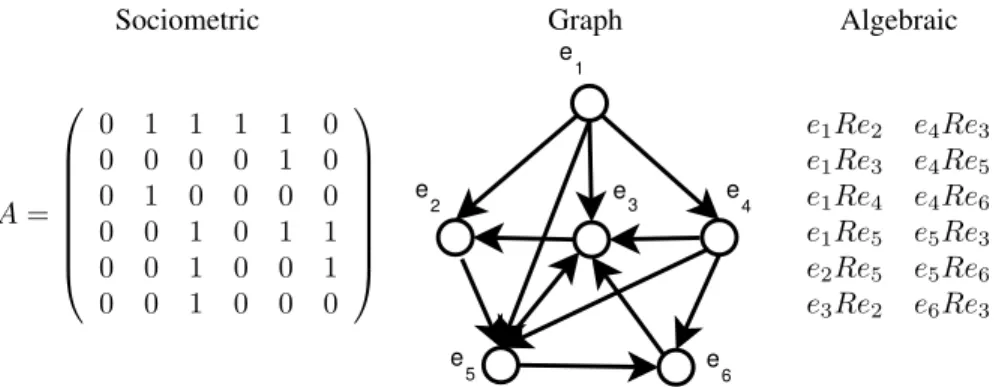
Social network analysis (SNA) is regarded a powerful method to investigate human social trust relation [38]. There are three key elements in SNA (set of nodes, nodes relation, nodes attributes) and three possible representation schemes (sociometric, graphic, algebraic), which are shown in Table I.
The sociomatrix shown in Table I is a binary relation or crisp relation for the existence and/or lack of ‘trust’ scenar-ios. However, realistic SN trust relationship representation is more complex, with humans trust in their relationship being described, more often than not, with words such as ‘high’, ‘middle’ or ‘low’, which underlines the uncertain nature of the concept of trust [39]. In this context, Wu et. al [40] proposed the following definition of distributed linguistic trust function (DLTF):
Definition 1. Suppose thatΩ ={Ωi|i= 1, ..., π}is a linguis-tic term set. A distributed linguislinguis-tic trust function (DLTF) on
Sociometric Graph Algebraic A= 0 1 1 1 1 0 0 0 0 0 1 0 0 1 0 0 0 0 0 0 1 0 1 1 0 0 1 0 0 1 0 0 1 0 0 0 e 1 e 2 e3 e4 e 5 e6 e1Re2 e4Re3 e1Re3 e4Re5 e1Re4 e4Re6 e1Re5 e5Re3 e2Re5 e5Re6 e3Re2 e6Re3
TABLE I: Different representation schemes in SNA
Ωis expressed as follows: Θ = ( (Ωα, ϕα) (ϕα>0 ∀α)∧ π X α=1 ϕα= 1 )
The set {α1, . . . , απ}is the distribution assessment ofΩ. To rank DLTFs, Wu et. al [40] defined the following ordinal based expectation and uncertainty degrees of a DLTFΘ:
• Expectation degree: E(Θ) = π P α=1 αϕα; • Uncertainty degree:U(Θ) = π1 π P α=1 (αϕα−E(Θ)); Given any two DLTFs,Θ1 andΘ2:
Θ1≺Θ2 m E Θ1 < E Θ2 ∨ E Θ1 =E Θ2 ∧U Θ1 > U Θ2 (1)
In the following, some definitions of the OWA operator based aggregation of DLTFs in group decision making and the distance between DLTFs are provided as needed later in the paper to define agreement between a group of experts and its individual expert members.
Definition 2 (Distributed trust OWA (DTOWA) operator).
The distributed trust OWA (DTOWA) operator with weighting vector ω= (ω1, ..., ωn), subject to the conditions ωj>0 and
n P j=1 ωj= 1, applied to a set of DLTFs Θ1, ...,Θn is DTOWAω Θ1, ...,Θn ={(Ωα, ϕα|α= 1, ..., π)} (2) whereϕα= n P j=1 wjϕ σ(j)
α andσis the permutation{1, . . . , n}
verifying Θσ(i)≥Θσ(i+1) ∀i.
Definition 3(Distance between DLTFs). The distance between DLTFs Θ1 and Θ2is d Θ1,Θ2 =Θ1−Θ2 = 1 π π X α=1 ϕ1α−ϕ2α (3)
III. INDIVIDUAL MANIPULATION ANALYSIS IN GROUP DECISION MAKING WEIGHTS ASSIGNMENT
Trust relationship in social network has been used as a reliable resource to compute experts’ importance and as a derivative their weights in aggregation individual preferences into collective one. However, in general, trust relationship
measurement based static approaches are used to compute experts’ weights. In reality, apart from trust, group behaviour may affect the weights assignment mechanism, i.e. experts may be willing to manipulate for their own benefit. Ma-nipulation behaviour has been reported in multiple attribute decision making in [41]–[43]. However, as far as we know, the manipulation behaviour in GDM has not be reported so far. Therefore, this section includes the proposal of a manipulation model for assigning experts’ weights by aggregating trust relationship in social network, from which to obtain trust in-degree centrality values, with Yager’s linguistic quantifier based OWA operator [44]. To do that, we first introduce some DLTF based definition related to social network.
Definition 4. Let E = {e1, ..., ek} be a set of experts in a social network. A DLT sociomatrix (DLTS) SL on E is a
network relation onE×E that associates a duple (em, en)
with a DLTF, Θmn ={(Ωα, ϕα)|α= 1, ..., π}, representing the trust degree from expertemto expert en, i.e.
µSL(em, en) = Θmn. (4)
In SNA, the importance level of nodes in a directed graph is determined by the in-degree of centrality. In our research framework this is translated in the following trust in-degree centrality index, which measures the average expert’s trust relationship from their peers in the social network. In general, the higher the trust in-degree centrality of an expert, the higher the importance associated to her/him.
Definition 5 (Trust In-degree Centrality). LetG= (E, L, ω)
be a directed graph,E={e1, ..., ek}be the set of nodes and
L={l1, ..., lq} be the set of directed edges between pairs of nodes with associated DLTFs as per a DLTSSL= (Θmn)k×k.
The trust in-degree centrality (TDC) index of nodes is com-puted as follows: T DC(en) = 1 k k X m=1 Θmn (5)
In order to model the manipulation behaviour in the process of GDM, Yager’s OWA operator [44] is used to assign weights. In decision making process, the majority concept can be ap-propriately modelled via the linguistic quantifier concept [45], [46], which is modelled as a regular increasing monotonic (RIM) function Q: [0,1] →[0,1]with boundary conditions
Q(0) = 0 and Q(1) = 1. In general, the weights of a linguistic guided OWA operator (φQ) are obtained as follows:
ωh=Q h k −Q h−1 k , h= 1,2, ..., k (6) Interestingly, Yager [44] modelled the majority concept with the RIM quantifier
Q(r) =rη(η>0) (7) The following two properties of this type of RIM quantifier were proved in [47]:
• For η ∈ [0,1], Q is concave. When ranking experts by importance, the concavity of Q means that the weight increases with the rank of the experts at the time. Indeed, denoting h = 1, then it is the position given to the most important experts;h= 2 means the position to the second most important experts, etc.; denoting rh= hk, it is obvious that rh= rh−1+2rh+1 and the concavity of Q implies that ∀h:Q(rh) =Q r h−1+rh+1 2 > Q(rh−1)+Q(rh+1) 2 m ωh>ωh+1 (8)
• Forη6= 0,Qis strictly monotonic, which means that all weight values are positive and all users will contribute to the final aggregated value. Indeed, for any r6= 0and
η6= 0, it is dQ
dr(r) =ηr
η−1>0. Hence:
η6= 0⇒ωh>0∀h (9) Additionally, the following result shows the monotonicity relationship between the weights and the RIM quantifier Q
as functions of the parameter η.
Proposition 1 (Strict monotonicity property). Let Q(r) =
rη, η ∈ [0,1]; then ω
1 is strictly decreasing while
ωh(h= 2, ..., k) are strictly increasing with respect to the
parameter η.
Proof. From expression (6), we have: • ω1 = r
η
1. In general exponential function ax is strictly
decreasing with respect toxwhena∈(0,1). Hence,ω1
is strictly decreasing with respect to the parameterη. • h >1 :ωh=rηh−rhη−1. The derivative ofωhwith respect
toηisdωh dη (η) =r η hlnrh−r η h−1lnrh−1. Bothx a(a >0) and lnx(x >0) are strictly increasing functions, hence
rh > rh−1 implies r η h > r η h−1 and lnrh > lnrh−1. Therefore, it is rηhlnrh> rhη−1lnrh−1 and ddωηh(η)>0
∀η, which proves that ωh (h > 1) is strictly increasing with respect to the parameter η.
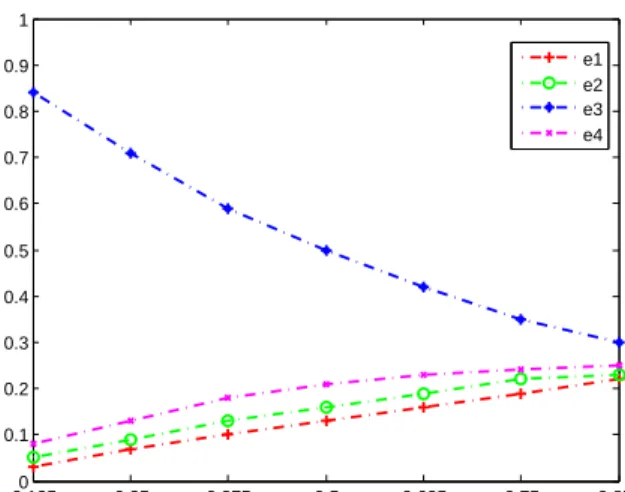
The result of Proposition 1 regarding the depen-dence of the importance degrees of experts on the at-titude parameter η is visualized in Fig 1 for values of
η ∈ {0.125,0.25,0.375,0.5,0.625,0.75,0.875}. The extreme 0.1250 0.25 0.375 0.5 0.625 0.75 0.875 0.1 0.2 0.3 0.4 0.5 0.6 0.7 0.8 0.9 1 η weight e1 e2 e3 e4
Fig. 1: Effect of ‘individual manipulation’ for weights assign-ment in GDM
cases ofη = 0 andη = 1 are discussed below in relation to the orness of the RIM quantifier (7):
orness(Q) = Z 1
0
rηdr= 1
η+ 1. (10)
The parameter η can be regarded as an attitude parameter. Indeed, if the valueη= 0is used in (7), thenω={1,0, . . . ,0} and all the importance will be allocated/assigned to the expert with highest TDC value, i.e. (orness(Q) = 1, the OWA guided byQ becomes the t-conormmaximum operator. This case represents an authoritarian decision making model. If
η = 1, then ω = {1/k, ...,1/k} and, irrespective of their TDC values, each expert will be allocated the same importance value, i.e.orness(Q) = 1/2, the OWA guided byQbecomes the average operator. This case represents an egalitarian decision making model.
The aggregation of experts’ DLT decision matrices using the RIM quantifier guided OWA operator is as follows:
Definition 6. LetnΘh= thijr
×s;h= 1,2, ..., k o
be a col-lection of DLT decision matrices given by a set of experts E ={e1, ..., ek}, nodes of a directed graph G = (E, L, ω), representing their assessments on a set of ralternatives with respect to a set ofscriteria. Their collective decision matrix aggregated by trust relationship isΘ = (tij)r×swith element
tij= k X h=1 ωh·t σ(h) ij = k X h=1 h k η − h−1 k η ·tσij(h) (11)
whereη ∈[0,1]; andσ is the permutation of {1, ..., n} such thatT DC eσ(h)
>T DC eσ(h+1)
(∀h).
In realistic cases, individual experts may aim to achieve more respect from the group of piers via its own self esteem value. Therefore, individual experts may be tempted to manip-ulate the value ofη with the aim to achieve a higher weight (importance degree). For example, the highest trusted experte3
in Fig 1 may selectη= 0to obtain the highest possible weight of ω3 = 1 to become the person who decides for the group
(dictatorship). On the other hand, expert e1, who is trusted
lowest by the group peers, may choose the value η = 1 to get his/her maximum potential weights of 1/4, which would lead to an egalitarian or democratic decision model where everyone contributes equally, although it could be the result of a strategic manipulation choice. Anyhow, there is a need to investigate a reasonable method to determine the appropriate value ofηto benefit of group, and as a consequence, it is able to prevent individual expert’s manipulation. The above study and analysis shows as well that the attitude parameter η will determine the network structure of the group of experts, and in consequence, it will affect the adjustment cost of reaching the threshold of group consensus, which is later illustrated in Table II. Therefore, it is also worth investigating the relationship between the attitude parameter η and the adjustment cost.
IV. DLTFS CONSENSUS BASED INDEXES AND VISUAL IDENTIFICATION OF INCONSISTENT ELEMENTS
DLTFs based indexes are defined for consensus degree. Then, a process is provided for the identification of incon-sistent experts by three consecutive steps and their alterna-tives and elements with consensus degree below the required threshold of group consensus.
A. Consensus degrees
The distance between DLTFs is used to measure how similar an expert’s opinions are to the group experts’ collective opinion. The agreement or consensus of an expert can be measured at three hierarchical levels:
Definition 7 (Consensus degree on the elements). “The consensus degree between expert eh and the group on the
alternativexi under criterion cj element,(xi, cj), is”
CEijh = 1−d thij, tij = 1− thij−tij = 1− 1 π π X α=1 (ϕα) h ij−(ϕα)ij (12)
Definition 8(Consensus degree on the alternative level). “The consensus degree between expert eh and the group on the
alternativexi is” CEih= 1 s s X j=1 CEijh (13)
Definition 9(Consensus Degree on the DLT decision matrix).
“The consensus degree between expert eh and the group on
the decision matrix is” CEh= 1 r r X i=1 CEIh= 1 rs r X i=1 s X j=1 CEijh (14) Definition 3 implies CEh ij, CEih, CEh ∈ [0,1]. Con-sensus, as it is well known, is defined as the full and unanimous agreement of all the experts regarding all the feasible alternatives. However, it is inconvenient because it only allows differentiating between two states: the existence and absence of consensus. Also, the chances for reaching such a full agreement are rather low. Therefore, a threshold value
of group consensus (γ) might be agreed before hand. The following restriction can therefore be imposed to the group consensus threshold:γ <1. Additionally, the decision-making output may be acceptable only when there is agreement among at least half of the experts (simple majority). Thus, the following additional restriction is imposed to the consensus threshold:γ >0.5. Obviously, the stronger the acceptance of decision-making output, the higher the percentage of experts in agreement. In passing legislation, legislative bodies may require unanimous majority or qualified majorities such as 2/3 or 3/5 of votes [48]. For example, qualified majority is the most widely used voting method in the European Council, with a special ‘reinforced qualified majority’ in some cases requiring as one of its two conditions that at least 72% of Council members vote in favor [49]. In any case, a threshold value higher than 0.5 is to be considered in practice to achieve a qualified majority and it assures that the group of experts are satisfied by the solution to implement. In this paper, we will assume a threshold value of group consensus is 0.8.
B. Inconsistent elements identification
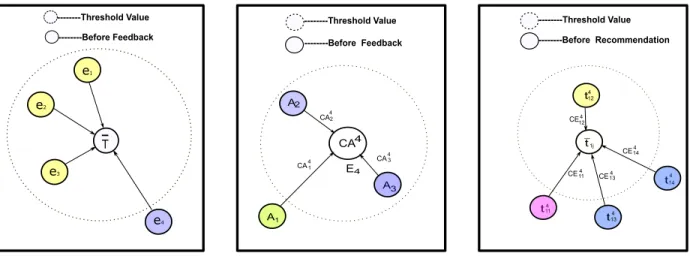
The set of elements (alternative, decision matrix) with consensus degree below the group consensus threshold value (γ) are identified with the following three consecutive steps process, which is later visualised (see Fig. 3) and presented to experts in the group during the feedback process.
Definition 10. Inconsistent elements identification process: Step 1. Experts with low consensus index:
EXP CH=h|CEh< γ . Step 2. Alternatives with low consensus index:
ALT =(h, i)|h∈EXP CH ∧ CEih< γ . Step 3. Elements with low consensus index:
AP S=
(h, i, j)|(h, i)∈ALT ∧ CEijh < γ .
V. GROUP MANIPULATION IN THE FEEDBACK MECHANISM
Aa aforementioned, the essence of ‘group manipulation’ is that the group of experts forces the inconsistent expert(s) to adopt the recommendation advices to reach consensus quickly. This implies that the inconsistent expert(s) will face higher adjustment cost than necessary while, at the same time, have their independence lessened. To prevent group manipulation, in conjunction with the visual representation of inconsistent elements, this article develops an optimal feedback model to balance group consensus (group aim) and individual indepen-dence (individual aim).
A. Behaviour based feedback mechanism
The feedback mechanism recommends inconsistent experts to change the assessments of their previously identifiedAP S
elements to improve their consensus degree as per the below rule:
“Change your element(i, j)assessmentth
ij torthij.”
rthij = (1−δh)·thij+δh·tij; ∀(h, i, j)∈AP S (15)
The above recommended advice is highly related to the original assessment, the group assessment and the feedback parameter δh ∈ [0,1]. In the traditional feedback model, the feedback parameter δh may be set as high as necessary by the group to speed up the consensus reaching process, which can be considered as a manipulation in favour of the group (group manipulation) and against the inconsistent expert who, as argued above, will have their their independence lessened in addition to a higher adjustment cost than necessary. A detailed analysis of these two issues is provided in the following subsections.
B. Consensus analysis of group manipulation
The relationship between the consensus index CEg and the feedback parameter δg, when the inconsistent expert eg adopts the feedback recommended value for element (xi, cj), is derived below.
Firstly, the new collective assessment value for element (xi, cj)will be: rtij=ωg·rthij+ k P h=1,h6=g ωh·thij =ωg·rtijg −ωg·tgij+tij.
Secondly, the new consensus indexCEg will become:
CEg= 1 rs r X i=1 s X j=1 1− rt g ij−rtij = 1− 1 rs r X i=1 s X j=1 rt g ij−rtij = 1− 1 rs r X i=1 s X j=1 rt g ij− tij+ωg·rtgij−ωg·tgij = 1− 1 rs r X i=1 s X j=1 (1−δg(1−ωg))· tgij−tij = 1−(1−δg(1−ωg)) 1 rs r X i=1 s X j=1 t g ij−tij =δg(1−ωg) 1 rs r X i=1 s X j=1 t g ij−tij +CEg
Thirdly, considering that δg, ωg, CEg ∈ [0,1], the above expression means that CEg >CEg. Furthermore, the larger the value of δg, the larger the value of CEg. Hence, the following result has been proved:
Proposition 2. Assuming that there is only one inconsistent experteg, who changes his/her assessment for element(xi, cj)
fromtgij tortgij = (1−δg)·t g
ij+δg·tij, then the new expert
consensus index CEg=δg(1−ωg) 1 rs r X i=1 s X j=1 t g ij−tij +CEg (16)
is greater than his/her original consensus degree and mono-tonically increases with feedback parameterδg∈(0,1].
The case of one inconsistent expert changing his/her assess-ments on more than one element can be considered as a series of sequential steps of one assessment change. In each step of this sequence the new consensus of the inconsistent expert will be greater than that in the previous step, with the increase in consensus being proportional to the feedback parameter
δg ∈ (0,1] used in the feedback process. Equally, the case with more than one inconsistent experts can be considered as a series of sequential steps of one inconsistent expert changing assessments. Based on this, the group of experts may be willing to manipulate the consensus process by forcing the inconsistent experts to adopt recommendation advices by using a high feedback parameter value. This type of ‘group manipulation’ is hindered with the below cost analysis and the subsequent proposed optional feedback adjustment cost model.
C. Cost analysis of group manipulation
Let us assume that #EXP CH = l(≤ k). Following the implementation of the feedback recommendation advices, their new decision matrices will be
RΘp rtp ij |p= 1, ..., l : rtpij = ( (1−δp)·t p ij+δp·tij if (p, i, j)∈AP S; tpij otherwise.
The rest of experts’ decision matrices are unchanged
RΘu= Θu= tuij, u=l+ 1, ..., k
Experts in this later group have no adjustment cost, while in-consistent experts’ adjustments cost after the feedback process do as per the following:
Definition 11. The adjustment cost of inconsistent expert ep
after implementing the feedback advice is:
f(Θp, RΘp) =ωp|RΘp−Θp|, p= 1, ..., l (17)
The total cost of adjustment after the consensus feedback process is T C = X p∈EXP CH ωp|RΘp−Θp|= X (p,i,j)∈AP S ωp|RΘp−Θp| (18) where|RΘp−Θp|= P (p,i,j)∈AP S rt p ij−t p ij .
The total cost of adjustment is the result of the combination of the individual adjustment costs and aggregation function. A reasonable policy in the described consensus process is to reach a balance between consensus (group aim) and adjust-ment cost (individual aim).
The total cost of adjustment can be rewritten as follow:
T C = X p∈EXP CH ωp|RΘp−Θp| = X (p,i,j)∈AP S ωp t p ij− (1−δp)t p ij+δptij = X (p,i,j)∈AP S δp·ωp t p ij−tij (19)
Hence, the following result is obtained:
Proposition 3. The total cost of adjustment monotonically increases with respect to the feedback parameter δp∈(0,1].
The higher the parameter value δp set by the group, the higher the total cost of adjustment the inconsistent experts will afford. In practice case, the inconsistent experts are aiming to minimize their cost of adjustment while contributing to their consensus reaching the threshold of group consensus [33], [50]–[52]. This in turn implies that the total cost of adjustment of inconsistent experts should be minimised while threshold of group consensus is reached. This is the focus of the next section.
D. Optimal feedback model to prevent group manipulation
Group manipulation will be hindered by determine theηmin value associated to the minimum adjustment cost of the below optimization model: Min l P p=1 ωp|RΘp−Θp| s.t. 1 rs RΘp−RΘ = 1−γ, p= 1, . . . , l; 1 rs RΘu−RΘ = 1−γ, u=l+ 1, ..., k; RΘ =DTOWAQ RΘ1, ..., RΘk ; ωh= (h/k) η −((h−1)/k)η; 0≤γ≤1; 0< η <1. (20)
The objective function of Model (20) is to minimize the total cost of adjustment subject to the each expert’ consensus degree on their decision matrices reaching the group consensus threshold. Using expression (19), the proposed optimization model can be rewritten as follow:
Min P (p,i,j)∈AP S δp·ωp t p ij−tij s.t. 1 rs RΘp−RΘ = 1−γ, p= 1, . . . , l; 1 rs RΘu−RΘ = 1−γ, u=l+ 1, ..., k; RΘ =DTOWAQ RΘ1, ..., RΘk; ωh= (h/k) η −((h−1)/k)η; 0≤γ≤1; 0< η <1. (21)
Model (21) solution will determine the boundary feed-back parameter value δmin to reach the threshold of group consensus γ with minimum total cost of adjustment for the inconsistent experts.
The adoption of the feedback mechanism advices by incon-sistent experts will affect the group collective decision matrix. The similarity of the group collective decision matrices before (Θ) and after (RΘ) the implementation of the feedback process is computed by applying expression (14):
sim Θ, RΘ = 1− 1 rs Θ−RΘ (22)
For experts who do not change assessments in the feedback process (the consistent ones),u /∈EXP CH, their consensus degree on their DLT decision matrices before the feedback process were equal or greater than the threshold of group consensus, i.e. CEu = 1− 1 rs Θu−Θ > γ. After the feedback process, solving model (21), it will also be the case
that these experts will shave a consensus degree on their DLT decision matrices after the feedback process equal or greater than the threshold of group consensus, i.e. RCEu = 1− 1
rs
RΘu−RΘ
>γ. It is then clear that
CEu−RCEu
≤1−γ.
Thus the closer the threshold of group consensus is to 1, the closer will be CEu and RCEu and consequently the more similar will be Θ, andRΘ.
E. Consensus Reaching Algorithm with manipulation be-haviour prevention
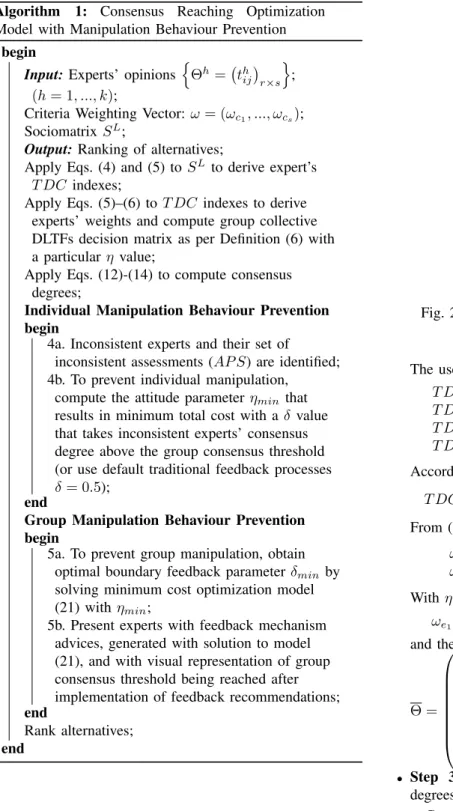
Algorithm 1 provides a formal description of the proposed optimal feedback process model to prevent manipulation be-haviour in a SN consensus reaching process.
VI. NUMERICAL EXAMPLE
Travel social App provides information on attractions, trans-portation and prices to tourists. In addition, users can find friends or acquaintances with similar travel plans or interests. The App may recommend users to travel with others users with matching travel plans regarding places and dates of travelling. Four users{e1, e2, e3, e4}from the same association planning
a group travel consider three alternative destinations: ‘Bali Island’ (x1); ‘Maldives Island’ (x2); and ‘Phuket Island’ (x3).
These are to be assessed using ‘attractions’ (c1); ‘price’ (c2);
‘location’ (c3); and ‘food’ (c4) as criteria with weighting
vectorω= (0.30,0.20,0.15,0.35)T.
• Step 1. The users’ DLTFs decision matrices based on the linguistic terms set Ω = {Ω1=low; Ω2=middle; Ω3=high}are:
Θ1= C1 C2 C3 C4 A1 (Ω1,0.6) (Ω2,0.3) (Ω3,0.1) (Ω1,0.6) (Ω2,0.0) (Ω3,0.4) (Ω1,0.2) (Ω2,0.5) (Ω3,0.3) (Ω1,0.0) (Ω2,0.4) (Ω3,0.6) A2 (Ω1,0.1) (Ω2,0.2) (Ω3,0.7) (Ω1,0.0) (Ω2,0.4) (Ω3,0.6) (Ω1,0.2) (Ω2,0.3) (Ω3,0.5) (Ω1,0.1) (Ω2,0.5) (Ω3,0.4) A3 (Ω1,0.0) (Ω2,0.3) (Ω3,0.7) (Ω1,0.2) (Ω2,0.7) (Ω3,0.1) (Ω1,0.0) (Ω2,0.5) (Ω3,0.5) (Ω1,0.4) (Ω2,0.5) (Ω3,0.1) Θ2= C1 C2 C3 C4 A1 (Ω1,0.2) (Ω2,0.4) (Ω3,0.4) (Ω1,0.0) (Ω2,0.7) (Ω3,0.3) (Ω1,0.5) (Ω2,0.0) (Ω3,0.5) (Ω1,0.1) (Ω2,0.5) (Ω3,0.4) A2 (Ω1,0.0) (Ω2,0.6) (Ω3,0.4) (Ω1,0.2) (Ω2,0.0) (Ω3,0.8) (Ω1,0.3) (Ω2,0.2) (Ω3,0.5) (Ω1,0.2) (Ω2,0.2) (Ω3,0.6) A3 (Ω1,0.2) (Ω2,0.2) (Ω3,0.6) (Ω1,0.5) (Ω2,0.3) (Ω3,0.2) (Ω1,0.2) (Ω2,0.4) (Ω3,0.4) (Ω1,0.4) (Ω2,0.0) (Ω3,0.6) Θ3= C1 C2 C3 C4 A1 (Ω1,0.0) (Ω2,0.8) (Ω3,0.2) (Ω1,0.3) (Ω2,0.4) (Ω3,0.3) (Ω1,0.2) (Ω2,0.0) (Ω3,0.8) (Ω1,0.3) (Ω2,0.7) (Ω3,0.0) A2 (Ω1,0.1) (Ω2,0.1) (Ω3,0.8) (Ω1,0.2) (Ω2,0.4) (Ω3,0.4) (Ω1,0.3) (Ω2,0.7) (Ω3,0.0) (Ω1,0.0) (Ω2,0.5) (Ω3,0.5) A3 (Ω1,0.2) (Ω2,0.8) (Ω3,0.0) (Ω1,0.3) (Ω2,0.6) (Ω3,0.1) (Ω1,0.1) (Ω2,0.9) (Ω3,0.0) (Ω1,0.0) (Ω2,0.6) (Ω3,0.4) Θ4= C1 C2 C3 C4 A1 (Ω1,0.1) (Ω2,0.0) (Ω3,0.9) (Ω1,0.3) (Ω2,0.6) (Ω3,0.1) (Ω1,0.0) (Ω2,0.8) (Ω3,0.2) (Ω1,0.7) (Ω2,0.3) (Ω3,0.0) A2 (Ω1,0.2) (Ω2,0.3) (Ω3,0.5) (Ω1,0.3) (Ω2,0.6) (Ω3,0.1) (Ω1,0.2) (Ω2,0.0) (Ω3,0.8) (Ω1,0.1) (Ω2,0.2) (Ω3,0.7) A3 (Ω1,0.4) (Ω2,0.6) (Ω3,0.0) (Ω1,0.2) (Ω2,0.4) (Ω3,0.4) (Ω1,0.6) (Ω2,0.0) (Ω3,0.4) (Ω1,0.0) (Ω2,0.5) (Ω3,0.5)
Algorithm 1: Consensus Reaching Optimization Model with Manipulation Behaviour Prevention
begin
Input: Experts’ opinionsnΘh= thij
r×s o
; (h= 1, ..., k);
Criteria Weighting Vector: ω= (ωc1, ..., ωcs);
Sociomatrix SL;
Output: Ranking of alternatives;
1 Apply Eqs. (4) and (5) toSL to derive expert’s T DC indexes;
2 Apply Eqs. (5)–(6) to T DC indexes to derive experts’ weights and compute group collective DLTFs decision matrix as per Definition (6) with a particularη value;
3 Apply Eqs. (12)-(14) to compute consensus
degrees;
4 Individual Manipulation Behaviour Prevention
begin
4a. Inconsistent experts and their set of
inconsistent assessments (AP S) are identified; 4b. To prevent individual manipulation,
compute the attitude parameterηmin that results in minimum total cost with aδ value that takes inconsistent experts’ consensus degree above the group consensus threshold (or use default traditional feedback processes
δ= 0.5);
end
5 Group Manipulation Behaviour Prevention
begin
5a. To prevent group manipulation, obtain optimal boundary feedback parameterδmin by solving minimum cost optimization model (21) withηmin;
5b. Present experts with feedback mechanism advices, generated with solution to model (21), and with visual representation of group consensus threshold being reached after implementation of feedback recommendations;
end
6 Rank alternatives;
end
• Step 2. The users’ trust relationship network of Fig. 2 has the following DLTS:
SL= − Ω1,0.8 Ω2,0.2 Ω3,0.0 Ω1,0.0 Ω2,0.4 Ω3,0.6 Ω1,0.2 Ω2,0.7 Ω3,0.1 Ω1,0.6 Ω2,0.3 Ω3,0.1 − Ω1,0.2 Ω2,0.0 Ω3,0.8 − Ω1,0.4 Ω2,0.3 Ω3,0.3 Ω1,0.0 Ω2,0.7 Ω3,0.3 − Ω1,0.2 Ω2,0.8 Ω3,0.0 − Ω1,0.1 Ω2,0.9 Ω3,0.0 Ω1,0.2 Ω2,0.5 Ω3,0.3 −
Distributed Trust Network
E
1E
2E
3E
4Fig. 2: Tourists social trust relationship network
The users’ TDC indexes are:
T DC(e1) ={(Ω1,0.5),(Ω2,0.3),(Ω3,0.2)};
T DC(e2) ={(Ω1,0.3),(Ω2,0.6),(Ω3,0.1)};
T DC(e3) ={(Ω1,0.13),(Ω2,0.3),(Ω3,0.57)};
T DC(e4) ={(Ω1,0.2),(Ω2,0.75),(Ω3,0.05)}.
According to (1), the following ordering is obtained :
T DC(e3)> T DC(e4)> T DC(e2)> T DC(e1).
From (5)–(6), the tourists’ importance degree are:
ω1= 1−(3/4)η; ω2= (3/4)η−(2/4)η;
ω3= (1/4)η; ω4= (2/4)η−(1/4)η.
Withη= 6/8, we get
ωe1 = 0.19; ωe2= 0.22;ωe3 = 0.35;ωe4 = 0.24.
and the group decision matrix Θis:
Θ = C1 C2 C3 C4 A1 (Ω1,0.19) (Ω2,0.43) (Ω3,0.39) (Ω1,0.29) (Ω2,0.44) (Ω3,0.27) (Ω1,0.22) (Ω2,0.29) (Ω3,0.49) (Ω1,0.30) (Ω2,0.50) (Ω3,0.20) A2 (Ω1,0.10) (Ω2,0.28) (Ω3,0.62) (Ω1,0.19) (Ω2,0.36) (Ω3,0.45) (Ω1,0.26) (Ω2,0.35) (Ω3,0.39) (Ω1,0.09) (Ω2,0.36) (Ω3,0.55) A3 (Ω1,0.21) (Ω2,0.52) (Ω3,0.27) (Ω1,0.30) (Ω2,0.51) (Ω3,0.19) (Ω1,0.22) (Ω2,0.50) (Ω3,0.28) (Ω1,0.16) (Ω2,0.43) (Ω3,0.41)
• Step 3. Apply Eqs. (12)-(14) to compute consensus degrees:
– Consensus degrees on the elements.
CE1 ij = 0.72 0.71 0.86 0.73 0.95 0.87 0.93 0.90 0.71 0.87 0.85 0.79 CEij2= 0.98 0.81 0.81 0.87 0.79 0.76 0.90 0.89 0.77 0.86 0.92 0.71 CE3 ij = 0.75 0.97 0.79 0.87 0.88 0.97 0.74 0.91 0.82 0.94 0.73 0.89 CE4 ij = 0.66 0.88 0.66 0.73 0.72 0.77 0.73 0.89 0.83 0.86 0.76 0.89
– Consensus degrees on the alternatives. CE1 i = (0.76,0.91,0.81); CE2 i = (0.87,0.84,0.82); CE3 i = (0.85,0.87,0.85); CE4 i = (0.74,0.83,0.81);
– Level 3. Consensus degree on the decision matrix.
CE1= 0.82; CE2= 0.84;
CE3= 0.86;CE4= 0.79.
Based on a threshold of group consensus of γ = 0.8, the inconsistent expert (e4), correspondingAP S
assess-ments, and visualizations as per Fig. 3 are presented to experts:
AP S={(4,1,1),(4,1,3),(4,1,4)}.
In this example, e4 is identified as the only
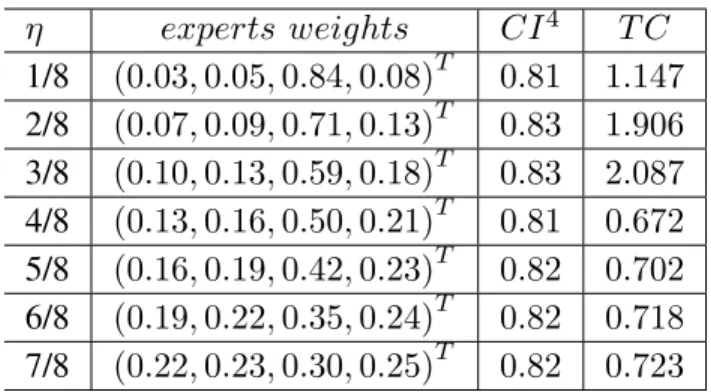
inconsis-tent expert. Therefore, the feedback mechanism is acti-vated.As aforementioned, each user has their own motiva-tions to manipulate weights via the attitude parameter to obtain their desired ranking of alternatives, which can be overcome by determining the optimal attitude parameter. • Step 4. To identify ‘individual manipulation’, Table II and its graphical visualization in Fig. 4 with attitude parameter ηi ranging from 1/8 to 7/8 are obtained with
δ= 0.5. Theindividual manipulationof ηi is prevented by selecting the value with minimum adjustment cost. In this case the minimum T C = 0.672 is achieved when
ηmin = 0.5. However, this value ηmin also results in a new consensus degree for expert of CI4 = 0.81,
which is above the threshold of group consensus and therefore there is room for e4 to reduce the adjustment
cost with the computation ofδmin, solution to model (21), to satisfy group consensus and maintain independence simultaneously.
TABLE II: Consensus degrees with individual manipulation of
η and corresponding TC values usingδ= 0.5
η
experts weights
CI
4T C
1/8
(0
.
03
,
0
.
05
,
0
.
84
,
0
.
08)
T0
.
81
1
.
147
2/8
(0
.
07
,
0
.
09
,
0
.
71
,
0
.
13)
T0
.
83
1
.
906
3/8
(0
.
10
,
0
.
13
,
0
.
59
,
0
.
18)
T0
.
83
2
.
087
4/8
(0
.
13
,
0
.
16
,
0
.
50
,
0
.
21)
T0
.
81
0
.
672
5/8
(0
.
16
,
0
.
19
,
0
.
42
,
0
.
23)
T0
.
82
0
.
702
6/8
(0
.
19
,
0
.
22
,
0
.
35
,
0
.
24)
T0
.
82
0
.
718
7/8
(0
.
22
,
0
.
23
,
0
.
30
,
0
.
25)
T0
.
82
0
.
723
• Step 5.To avoid ‘group manipulation’, the minimum cost optimization model (21) with optimal attitude parameter
ηmin= 0.5 becomes model (23):
Min P (p,i,j)∈AP S δp·ωp t p ij−t p ij s.t. 1 12 RΘp−RΘ = 0.2, p= 4 1 12 RΘu−RΘ = 0.2, u= 1,2,3 RT =DT OW AQ RΘ1, ..., RΘ4 ωh= (i/4) ηmin−((i−1)/4)ηmin, η min= 0.5 (23)
The solution of this model results in δmin = 0.2 and the total costs of the feedback process adjustment for different values of η are compared with previous ones withδ= 0.5used in traditional feedback processes. This is also illustrated in Fig. 5. Obviously, the minimum total cost is achieved in both cases whenηmin = 0.5, although the total cost is always lower forδmin = 0.20no mater which η value is implemented. The inconsistent expert will modify his/her assessment less with(ηmin, δmin) = (0.5,0.2) than with any other duple (ηmin, δ)(Fig. 6a), which helps to maintain individual independence and minimize the total cost of adjustment, while at the same time achieving the group aim of reaching consensus (Fig. 6b).
TABLE III: Total cost analysis by preventing group manipu-lation ofδ
η 1/8 2/8 3/8 4/8 5/8 6/8 7/8
T Cδmin=0.2 0.876 0.984 1.024 0.269 0.285 0.295 0.295
T Cδ=0.5 1.147 0.906 2.087 0.672 0.702 0.718 0.723
• Step 6.Implementing the boundary feedback parameter, the recommendations for usere4 are:
– Change your assessment for alternativex1 under
cri-terionC1 with
{(Ω1,0.11),(Ω2,0.10),(Ω3,0.79)}.
– Change your assessment for alternativex1 under
cri-terionC3 with
{(Ω1,0.04),(Ω2,0.69),(Ω3,0.27)}.
– Change your assessment for alternativex1 under
cri-terionC4 with
{(Ω1,0.62),(Ω2,0.35),(Ω3,0.03)}.
Using the criteria weighting vector: ω = (0.30,0.20,0.15,0.35)T, the collective assessments of the three alternatives are:
r1={(Ω1,0.23),(Ω2,0.47),(Ω3,0.30)};
r2={(Ω1,0.13),(Ω2,0.36),(Ω3,0.52)};
r3={(Ω1,0.20),(Ω2,0.53),(Ω3,0.27)}.
Their corresponding expectation degrees are:
E(r1) = 2.06, E(r2) = 2.34, E(r3) = 2.07.
Hence, ‘Maldives Island’ becomes the travel destination of consensus.
The example clearly illustrates that the proposed optimal model allows the group to find the optimal feedback parameter to reach the group consensus threshold with minimum adjust-ment cost for the inconsistent experts. These two goals (group consensus with minimum changes for individuals) are indeed the goals of all members working together in a group decision making to bring benefit to the whole group while maintaining the independence of their members as much as possible. Thus, the proposed methodology facilitates the acceptance of the feedback process advices by individual members, which is key for any group to reach consensus.
T ---Before Feedback ---Threshold Value e2 e1 e3 e4
(a) Consensus degrees on the decision matrix
CA CA4 CA4 2 3 ---Threshold Value ---Before Feedback 4 E4 CA41 A A1 A2 3
(b) Consensus degrees on the alternatives for experte4 ---Threshold Value ---Before Recommendation CE 11 4 CE CE t t1j -13 t4 4 114 413 4 12 t 12 t14 4 CE144
(c) Consensus degrees on the elements of alterna-tiveA1for experte4
Fig. 3: Visual representation of consensus indexes at three different levels before feedback process
0.125 0.25 0.375 0.5 0.625 0.75 0.875 0.6 0.8 1 1.2 1.4 1.6 1.8 2 2.2 η cost δ=0.5
Fig. 4: Total cost analysis, with δ = 0.5, by individual manipulation ofη
VII. COMPARISON ANDDISCUSSION
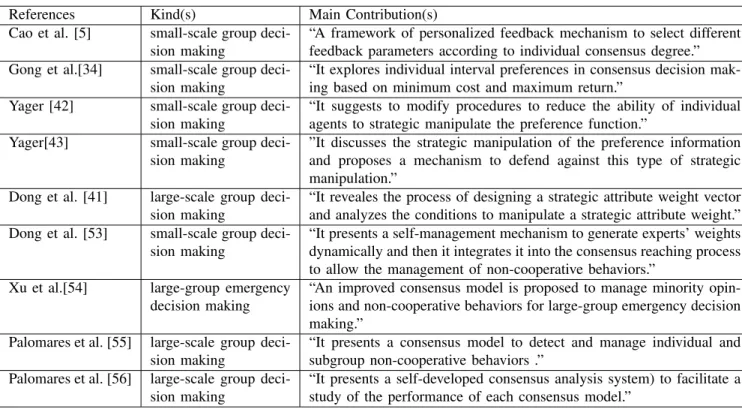
This section summarises the main contribution of manipu-lation behaviour in GDM reported in the literatures, which are listed in Table IV, with the aim to highlight their differences with the contribution of the proposed method.
Gong et al. [34] explored the consensus evolution path based on the economic interpretation, but it did not men-tion the psychological behavior of decision makers. Although Cao et al. [5] developed a personalized consensus feedback mechanism to stop the ‘group manipulation’, they ignored the problem of ‘individual manipulation’. On the one hand, Yager and Dong et al. [41]–[43] focused on the properties of aggregation operators to investigate the problem of strategic manipulation, which both methodologies aim to prevent ma-nipulation behaviors by modifying the traditional paradigm. In [41], Dong et al. applied their improved method to the large-scale group decision making framework. On the other
0.125 0.25 0.375 0.5 0.625 0.75 0.875 0.2 0.4 0.6 0.8 1 1.2 1.4 1.6 1.8 2 2.2 η cost δ=0.5 δ=0.2
Fig. 5: Total cost analysis by preventing group manipulation of δ
hand, some novel consensus reaching process models were proposed for managing non-cooperative behaviors to avoid strategic manipulation behaviors [27], [53]–[55], with the corresponding larger-scale decision making framework were studied in [27], [54], [55]. Fuzzy clustering approach was used in large-scale group decision making by Palomares et al.[55], while Palomares et al. and Labella et al. [56], [57] had pioneered a framework system of consensus analysis by integrating different consensus reaching process models, which they called AFRYCA. We conclude that none of the reported manipulation behaviour models in GDM deal with the individ-ual and group behaviour manipulations at the same time, which is per a novel and useful contribution in developing consensus reaching processes in practice, as it was emphasized above that the solution model proposed will facilitate the acceptance and posterior willing implementation of the feedback process advices by individual members.
R
---Major Threshold R1 R4 R3 R2 Group manipulation δi More cost(a) Group manipulation of parameterδ
R
---Major Threshold R1 R4 R3 R2Boundary feedback parameter
δmin=0.2
Minimum cost
(b) Boundary feedback parameterδmin preventing
group manipulation
Fig. 6: Comparison of feedback process with group manipulation of parameterδiand with optimal parameterδminpreventing group manipulation
VIII. CONCLUSION
This paper investigates an optimal feedback model to simultaneously prevent the individual and group behaviour manipulations in consensus in a social network group decision making framework. Compared with other consensus models proposed in the literature, the main novelties of the proposed model are:
(i) It studies the individual manipulation in the feedback process recommendation mechanism. The weights as-signment mechanism can be manipulated by individual experts to get a greater influence. However, reaching consensus with this kind of individual manipulation may increase the total adjustment cost for the group. To pre-vent individual manipulation, a policy based on minimiz-ing the group adjustment cost is proposed to derive the (optimal) weights for each expert. This is achieved with the implementation of a behavioural weights assignment method, which conveniently describes the different atti-tude stages from ‘dictatorship’ to ‘democracy’, together with a sensitivity analysis of the adjustment cost to determine the optimal attitude parameter leading to the minimum group adjustment cost.
(ii) It explores the group manipulation in the process leading to the recommendations to feedback to inconsistent ex-perts. To arrive at group consensus quickly, traditional consensus reaching processes are built under the as-sumption that inconsistent experts are ‘forced’ by the group to implement the recommendation advices with a fixed feedback parameter. This approach implies, more frequent than not, that the inconsistent experts will have to afford a higher adjustment cost than necessary as this leads to the consensus degree of inconsistent experts to jump from below to above the group consensus threshold, when reaching this threshold is sufficient. In
other word, this type of group manipulation reduces the inconsistent experts’ independence. To hinder this group manipulation behaviour in consensus reaching process, an optimization feedback model is proposed to obtain the optimal feedback parameter for the inconsistent experts consensus degrees reach the group consensus threshold while their cost of adjustment of changing original assessments is minimized. Therefore, the inconsistent experts can find a realistic and admissible equilibrium point between consensus (group aim) and independence (individual aim).
Behavioural manipulation plays an important role in group consensus. This behavioural manipulation utilizes trust rela-tionship as a resource to assign weights to experts. There may be no direct trust relationship between some experts in social network [58], in which trust propagation methodologies could be considered in future as tools to build indirect trust relationship by the trusted third party in order to tackle behavioural manipulations. Additionally, the proposed method will be further developed to be applied in the large-scale group decision making framework.
ACKNOWLEDGEMENTS
This work was supported by National Natural Science Foundation of China (NSFC) (No.71971135,71571166) and FEDER funds provided in the National Spanish project TIN2016-75850-R.
REFERENCES
[1] E. Herrera-Viedma, F. J. Cabrerizo, J. Kacprzyk, and W. Pedrycz, “A review of soft consensus models in a fuzzy environment,”Information Fusion, vol. 17, pp. 4–13, 2014.
[2] X. L. Tian, Z. S. Xu, and H. Fujita, “Sequential funding the venture project or not? A prospect consensus process with probabilistic hesitant fuzzy preference information,”Knowledge-Based Systems, vol. 161, pp. 172–184, 2018.
TABLE IV: Comparisons of the proposed consensus method and the existing methods References Kind(s) Main Contribution(s)
Cao et al. [5] small-scale group deci-sion making
“A framework of personalized feedback mechanism to select different feedback parameters according to individual consensus degree.” Gong et al.[34] small-scale group
deci-sion making
“It explores individual interval preferences in consensus decision mak-ing based on minimum cost and maximum return.”
Yager [42] small-scale group deci-sion making
“It suggests to modify procedures to reduce the ability of individual agents to strategic manipulate the preference function.”
Yager[43] small-scale group deci-sion making
”It discusses the strategic manipulation of the preference information and proposes a mechanism to defend against this type of strategic manipulation.”
Dong et al. [41] large-scale group deci-sion making
“It reveales the process of designing a strategic attribute weight vector and analyzes the conditions to manipulate a strategic attribute weight.” Dong et al. [53] small-scale group
deci-sion making
“It presents a self-management mechanism to generate experts’ weights dynamically and then it integrates it into the consensus reaching process to allow the management of non-cooperative behaviors.”
Xu et al.[54] large-group emergency decision making
“An improved consensus model is proposed to manage minority opin-ions and non-cooperative behaviors for large-group emergency decision making.”
Palomares et al. [55] large-scale group deci-sion making
“It presents a consensus model to detect and manage individual and subgroup non-cooperative behaviors .”
Palomares et al. [56] large-scale group deci-sion making
“It presents a self-developed consensus analysis system) to facilitate a study of the performance of each consensus model.”
[3] R. X. Nie and J. Q. Wang, “Prospect theory-based consistency recovery strategies with multiplicative probabilistic linguistic preference relations in managing group decision making,”Arabian Journal for Science and Engineering, vol. 45, pp. 2113–2130, 2020.
[4] Z. B. Wu and J. P. Xu, “Managing consistency and consensus in group decision making with hesitant fuzzy linguistic preference relations,”
Omega, vol. 65, pp. 28–40, 2016.
[5] M. S. Cao, J. Wu, F. Chiclana, R. Ure˜na, and E. Herrera-Viedma, “A personalized consensus feedback mechanism based on maximum harmony degree,”IEEE Transactions on Systems, Man, and Cybernetics: Systems, 2020, DOI:10.1109/TSMC.2019.2960052.
[6] H. J. Zhang, Y. C. Dong, F. Chiclana, and S. Yu, “Consensus efficiency in group decision making: A comprehensive comparative study and its optimal design,”European Journal of Operational Research, vol. 275, no. 2, pp. 580–598, 2019.
[7] Z. B. Wu, S. Huang, and J. P. Xu, “Multi-stage optimization models for individual consistency and group consensus with preference relations,”
European Journal of Operational Research, vol. 275, no. 1, pp. 182–194, 2019.
[8] H. H. Zhang, G. Kou, and Y. Peng, “Soft consensus cost models for group decision making and economic interpretations,”European Journal of Operational Research, vol. 277, no. 3, pp. 964–980, 2019. [9] J. Wu, F. Chiclana, H. Fujita, and E. Herrera-Viedma, “A visual
interaction consensus model for social network group decision making with trust propagation,”Knowledge-Based Systems, vol. 122, pp. 39–50, 2017.
[10] J. Casc´on, T. Gonz´alez-Arteaga, and R. de Andr´es Calle, “Reaching social consensus family budgets: The Spanish case,”Omega, vol. 86, pp. 28–41, 2019.
[11] S. P. Wan and D. F. Li, “Fuzzy LINMAP approach to heterogeneous MADM considering comparisons of alternatives with hesitation de-grees,”Omega, vol. 41, no. 6, pp. 925–940, 2013.
[12] Y. Liu, Z. P. Fan, T. H. You, and W. Y. Zhang, “Large group decision-making (LGDM) with the participators from multiple subgroups of stakeholders: A method considering both the collective evaluation and the fairness of the alternative,”Computers & Industrial Engineering, vol. 122, pp. 262–272, 2018.
[13] J. F. Pang and J. Y. Liang, “Evaluation of the results of multi-attribute group decision-making with linguistic information,” Omega, vol. 40, no. 3, pp. 294–301, 2012.
[14] C. T. Bergstrom and J. B. Bak-Coleman, “Information gerrymandering in social networks skews collective decision-making,” NATURE, vol. 573, pp. 40–41, 2019.
[15] X. Y. Zhang, H. Y. Zhang, and J. Q. Wang, “Discussing incomplete 2-tuple fuzzy linguistic preference relations in multi-granular linguistic MCGDM with unknown weight information,”Soft Computing, vol. 23, no. 6, pp. 2015–2032, 2019.
[16] Y. C. Dong, Z. G. Ding, L. Mart´ınez, and F. Herrera, “Managing con-sensus based on leadership in opinion dynamics,”Information Sciences, vol. 397, pp. 187–205, 2017.
[17] Y. C. Dong, Q. B. Zha, H. J. Zhang, G. Kou, H. Fujita, F. Chiclana, and E. Herrera-Viedma, “Consensus reaching in social network group decision making: Research paradigms and challenges,” Knowledge-Based Systems, vol. 162, pp. 3–13, 2018.
[18] N. Capuano, F. Chiclana, E. Herrera-Viedma, H. Fujita, and V. Loia, “Fuzzy group decision making for influence-aware recommendations,”
Computers in Human Behavior, vol. 101, pp. 371–379, 2019. [19] N. Capuano, F. Chiclana, H. Fujita, E. Herrera-Viedma, and V. Loia,
“Fuzzy group decision making with incomplete information guided by social influence,”IEEE Transactions on Fuzzy Systems, vol. 26, no. 3, pp. 1704–1718, 2017.
[20] J. Wu, F. Chiclana, and E. Herrera-Viedma, “Trust based consensus model for social network in an incomplete linguistic information con-text,”Applied Soft Computing, vol. 35, pp. 827–839, 2015.
[21] X. Liu, Y. J. Xu, R. Montes, and F. Herrera, “Social network group decision making: Managing self-confidence-based consensus model with the dynamic importance degree of experts and trust-based feedback mechanism,”Information Sciences, vol. 505, pp. 215–232, 2019. [22] Z. P. Tian, R. X. Nie, and J. Q. Wang, “Social network
analysis-based consensus-supporting framework for large-scale group decision-making with incomplete interval type-2 fuzzy information,”Information Sciences, vol. 502, pp. 446–471, 2019.
[23] R. Ure˜na, G. Kou, Y. C. Dong, F. Chiclana, and E. Herrera-Viedma, “A review on trust propagation and opinion dynamics in social networks and group decision making frameworks,”Information Sciences, vol. 478, pp. 461–475, 2019.
[24] T. Wu, X. W. Liu, J. D. Qin, and F. Herrera, “Consensus evolution networks: A consensus reaching tool for managing consensus thresholds in group decision making,”Information Fusion, vol. 52, pp. 375–388, 2019.
[25] B. S. Liu, Q. Zhou, R. X. Ding, I. Palomares, and F. Herrera, “Large-scale group decision making model based on social network analysis: Trust relationship-based conflict detection and elimination,” European Journal of Operational Research, vol. 275, no. 2, pp. 737–754, 2019. [26] J. Wu, X. Li, F. Chiclana, and R. R. Yager, “An attitudinal trust
decision making,”IEEE Transactions on Fuzzy Systems, vol. 27, no. 11, pp. 2163–2175, 2019.
[27] Y. C. Dong, S. H. Zhao, H. J. Zhang, F. Chiclana, and E. Herrera-Viedma, “A self-management mechanism for noncooperative behaviors in large-scale group consensus reaching processes,”IEEE Transactions on Fuzzy Systems, vol. 26, no. 6, pp. 3276–3288, 2018.
[28] H. B. Yan, T. J. Ma, and V. N. Huynh, “On qualitative multi-attribute group decision making and its consensus measure: A probability based perspective,”Omega, vol. 70, pp. 94–117, 2017.
[29] X. Liu, Y. J. Xu, and F. Herrera, “Consensus model for large-scale group decision making based on fuzzy preference relation with self-confidence: Detecting and managing overconfidence behaviors,”Information Fusion, vol. 52, pp. 245–256, 2019.
[30] J. Wu, Q. Sun, H. Fujita, and F. Chiclana, “An attitudinal consensus degree to control the feedback mechanism in group decision making with different adjustment cost,” Knowledge-Based Systems, vol. 164, pp. 265–273, 2019.
[31] Z. W. Gong, N. Zhang, K. W. Li, L. Mart´ınez, and W. Zhao, “Consensus decision models for preferential voting with abstentions,”Computers & Industrial Engineering, vol. 115, pp. 670–682, 2018.
[32] Z. Z. Ma, J. J. Zhu, K. Ponnambalam, and S. T. Zhang, “A clustering method for large-scale group decision-making with multi-stage hesitant fuzzy linguistic terms,”Information Fusion, vol. 50, pp. 231–250, 2019. [33] T. Wu, K. Zhang, X. W. Liu, and C. Y. Cao, “A two-stage social trust network partition model for large-scale group decision-making problems,”Knowledge-Based Systems, vol. 163, pp. 632–643, 2019. [34] Z. W. Gong, X. X. Xu, H. H. Zhang, U. A. Ozturk, E. Herrera-Viedma,
and C. Xu, “The consensus models with interval preference opinions and their economic interpretation,”Omega, vol. 55, pp. 81–90, 2015. [35] ´A. Labella, H. B. Liu, R. M. Rodr´ıguez, and L. Mart´ınez, “A cost
consen-sus metric for consenconsen-sus reaching processes based on a comprehensive minimum cost model,”European Journal of Operational Research, vol. 281, no. 2, pp. 316–331, 2020.
[36] X. Tan, Z. W. Gong, F. Chiclana, and N. Zhang, “Consensus modeling with cost chance constraint under uncertainty opinions,”Applied Soft Computing, vol. 67, pp. 721–727, 2018.
[37] J. Wu, Y. J. Liu, and C. Y. Liang, “A consensus-and harmony-based feedback mechanism for multiple attribute group decision making with correlated intuitionistic fuzzy sets,”International Transactions in Oper-ational Research, vol. 22, no. 6, pp. 1033–1054, 2015.
[38] S. Wasserman, K. Faust et al.,Social network analysis: Methods and applications. Cambridge university press, 1994, vol. 8.
[39] B. Z. Sun and W. M. Ma, “An approach to consensus measurement of linguistic preference relations in multi-attribute group decision making and application,”Omega, vol. 51, pp. 83–92, 2015.
[40] J. Wu, L. F. Dai, F. Chiclana, H. Fujita, and E. Herrera-Viedma, “A minimum adjustment cost feedback mechanism based consensus model for group decision making under social network with distributed linguistic trust,”Information Fusion, vol. 41, pp. 232–242, 2018. [41] Y. C. Dong, Y. T. Liu, H. M. Liang, F. Chiclana, and E. Herrera-Viedma,
“Strategic weight manipulation in multiple attribute decision making,”
Omega, vol. 75, pp. 154–164, 2018.
[42] R. R. Yager, “Penalizing strategic preference manipulation in multi-agent decision making,”IEEE Transactions on Fuzzy Systems, vol. 9, no. 3, pp. 393–403, 2001.
[43] R. R. Yager, “Defending against strategic manipulation in uninorm-based multi-agent decision making,”European Journal of Operational Research, vol. 141, no. 1, pp. 217–232, 2002.
[44] R. R. Yager, “On ordered weighted averaging aggregation operators in multicriteria decision making,”IEEE Transactions on systems, Man, and Cybernetics, vol. 18, no. 1, pp. 183–190, 1988.
[45] R. R. Yager, “Quantifier guided aggregation using OWA operators,”
International Journal of Intelligent Systems, vol. 11, no. 1, pp. 49–73, 1996.
[46] R. R. Yager and D. P. Filev, “Induced ordered weighted averaging operators,”IEEE Transactions on Systems, Man, and Cybernetics, Part B (Cybernetics), vol. 29, no. 2, pp. 141–150, 1999.
[47] F. Chiclana, E. Herrera-Viedma, F. Herrera, and S. Alonso, “Some induced ordered weighted averaging operators and their use for solving group decision-making problems based on fuzzy preference relations,”
European Journal of Operational Research, vol. 182, no. 1, pp. 383–399, 2007.
[48] P. P´erez-Asurmendi and F. Chiclana, “Linguistic majorities with differ-ence in support,”Applied Soft Computing, vol. 18, pp. 196 – 208, 2014. [49] “Qualified majority – consilium,”
https://www.consilium.europa.eu/en/council-eu/voting-system/qualified-majority/, accessed: 2020-03-01.
[50] Y. C. Dong, Y. F. Xu, H. Y. Li, and B. Feng, “The OWA-based consensus operator under linguistic representation models using position indexes,”
European Journal of Operational Research, vol. 203, no. 2, pp. 455–463, 2010.
[51] P. Wu, J. M. Zhu, L. G. Zhou, and H. Y. Chen, “Local feedback mech-anism based on consistency-derived for consensus building in group decision making with hesitant fuzzy linguistic preference relations,”
Computers & Industrial Engineering, vol. 137, p. 106001, 2019. [52] S. P. Wan, F. Wang, and J. Y. Dong, “A group decision-making method
considering both the group consensus and multiplicative consistency of interval-valued intuitionistic fuzzy preference relations,”Information Sciences, vol. 466, pp. 109–128, 2018.
[53] Y. C. Dong, H. J. Zhang, and E. Herrera-Viedma, “Integrating experts’ weights generated dynamically into the consensus reaching process and its applications in managing non-cooperative behaviors,”Decision Support Systems, vol. 84, pp. 1–15, 2016.
[54] X. H. Xu, Z. J. Du, and X. H. Chen, “Consensus model for multi-criteria large-group emergency decision making considering non-cooperative behaviors and minority opinions,” Decision Support Systems, vol. 79, pp. 150–160, 2015.
[55] I. Palomares, L. Martinez, and F. Herrera, “A consensus model to detect and manage noncooperative behaviors in large-scale group decision making,”IEEE Transactions on Fuzzy Systems, vol. 22, no. 3, pp. 516– 530, 2013.
[56] I. Palomares, F. J. Estrella, L. Mart´ınez, and F. Herrera, “Consensus under a fuzzy context: Taxonomy, analysis framework AFRYCA and experimental case of study,”Information Fusion, vol. 20, pp. 252–271, 2014.
[57] ´A. Labella and L. Mart´ınez, “AFRYCA 3.0: An improved framework for consensus analysis in group decision making,” in International Conference on Intelligent Decision Technologies. Springer, 2018, pp. 76–86.
[58] J. Wu, J. L. Chang, Q. W. Cao, and C. Y. Liang, “A trust propagation and collaborative filtering based method for incomplete information in social network group decision making with type-2 linguistic trust,”Computers & Industrial Engineering, vol. 127, pp. 853–864, 2019.
Jian Wu (SM’16) received the B.Sc. and Ph.D. degrees in Management Science and Engineering from Hefei University of Technology, Hefei, China, in 2000 and 2008, respectively. He is a Distinguished Professor with the School of Economics and Man-agement, Shanghai Maritime University, Shanghai, China. From October 2012 to October 2013, he was an Academic Research Visitor with the Centre for Computational Intelligence, De Montfort University, Leicester, U.K. He has 60+ papers published in leading journals such IEEE Transactions on Fuzzy Systems, IEEE Transactions on Systems, Man, and Cybernetics:Systems, Information Fusion, Information Sciences, Knowledge-Based Systems, Expert Systems with Applications, Applied Soft Computing. Thirteen papers have been classed as Highly Cited Papers by the Essential Science Indicators, four of them are HOT paper. One of his research papers was awarded the prestigious Emerald Citations of Excellence for 2017. His research interests include group decision making, social network, fuzzy preference modeling, and information fusion.
Prof. Wu is an Area Editor of the Journal of Computers & Industrial Engineering, Associate Editor of the Journal of Intelligent and Fuzzy Systems and a Guest Editor of Applied Soft Computing.
Mingshuo Cao received the BSc in Accounting from Shanghai Maritime University, China, in 2018. He is currently enrolled in a Ph.D. degree at Shang-hai Maritime University. His research interest is mainly in group decision making.
Francisco Chiclanareceived the BSc and PhD in Mathematics from the University of Granada, Spain, in 1989 and 2000, respectively.
He is a Professor of Computational Intelligence and Decision Making with the School of Computer Science and Informatics, Faculty of Computing, Engineering and Media, De Montfort University, Leicester, U.K. He is an Associate Editor and a Guest Editor for several ISI indexed journals. He has organized and chaired special sessions/workshops in many major international conferences in research areas as fuzzy preference modeling, decision support systems, consensus, recommender systems, social networks, rationality/consistency, aggregation. He is currently a Highly Cited Researcher in Computer Sciences (according to Essential Science Indicators by Clarivate Analytics).
Yucheng Dong received the B.S. and M.S. de-grees in mathematics from Chongqing University, Chongqing, China, in 2002 and 2004, respectively, and the Ph.D. degree in management from Xian Jiaotong University, Xian, China, in 2008.
He is currently a Professor with the Business School, Sichuan University, Chengdu, China. He has authored or coauthored more than 100 international journal papers in Decision Support Systems, the European Journal of Operational Research, the IEEE Transactions on Big Data, the IEEE Transactions on Cybernetics, the IEEE Transactions on Fuzzy Systems, the IEEE Transactions on System, Man, and Cybernetics, and Omega. His current research interests include consensus process, computing with words, opinion dynamics, and social network decision-making.
Dr. Dong is an Editorial Board Member of Information Fusion, an Area Editor of Computers & Industrial Engineering, and an Associate Editor of Group Decision and Negotiation and the IEEE Transactions on System, Man, and Cybernetics: Systems.
Enrique Herrera-Viedma received the M.Sc. and Ph.D degrees in computer science from the Univer-sity of Granada, Granada, Spain, in 1993 and 1996, respectively.
He is a Professor of computer science and the Vice-President for Research and Knowledge Trans-fer with University of Granada,Granada, Spain. His h-index is 68 with more than 17 000 citations received in Web of Science and 85 in Google Scholar with more than 29000 cites received. He has been identified as one of the worlds most influential researchers by the Shanghai Center and Thomson Reuters/Clarivate Analytics in both computer science and engineering in the years 2014,2015,2016,2017 and 2018. His current research interests include group decision making, con-sensus models, linguistic modeling, aggregation of information, information retrieval,bibliometric, digital libraries, web quality evaluation, recommender systems, and social media. Dr. Herrera-Viedma is currently Vice-President for Publications in IEEE SMC Society and an Associate Editor in several journals such as IEEE Transactions on Fuzzy Systems, IEEE Transactions on Systems, Man and Cybernetics: Systems, Information Sciences, Applied Soft Computing, Soft Computing, Fuzzy Optimization and Decision Making, and Knowledge-Based Systems.