The Net Neutrality Debate
Analysis of economic implications of netneutrality on internet service providers, content providers and internet users
Jørgen Møinichen
Industrial Economics and Technology Management Supervisor: Alexei A. Gaivoronski, IØT Co-supervisor: Gorm Grønnevet, Telenor Anna D'Annunzio, Telenor
Department of Industrial Economics and Technology Management Submission date: July 2014
Abstract
This thesis studies the economic implications of a transition from a neutral to a non-neutral network. A mathematical model with an end to end ecosystem is developed, which includes a backbone internet service provider that provides connectivity for the content providers. The model also includes internet users that pay an access internet service provider for connectivity to interact with the content providers, advertisers that pay the content providers, and access internet service providers that charge the internet users for their connectivity. In the non-neutral regime, the content providers can pay the access internet service provider to access specialized services, a priority lane. The model is solved in a non-cooperative two stage game, and where the backbone and access internet service providers maximize their individual profits. Our analysis shows that the non-neutral unregulated regime always improves social welfare, investment and innovation levels, and lowers the congestion levels. We also show that the backbone internet service provider is always better off in the non-neutral regime, and therefore reduce the benefit of the other players. The result for the other players is generally positive in favor of a non-neutral regime, but much more ambiguous, especially for the access internet service providers. We also show that moderate regulation can increase social welfare. However, even moderate regulation might severely impair individual players, and too much regulation may also impair the non-neutral regime so that the overall social welfare is worse than in the neutral regime.
Sammendrag: Oppgaven studerer de økonomiske konsekvensene ved en overgang fra et nøytralt til et ikke-nøytralt nettverk. Vi utvikler en matematisk modell med et ende-til-ende økosystem, som inkluderer en bakgrunnsleverandør som gir innholdsleverandører tilgang til Internett. Modellen inkluderer også internettbrukere som betaler internettleverandører for tilgang til Internett og dermed innholdsleverandørene, annonsører som betaler innholdsleverandørene, og internettleverandører som får betalt av internettbrukerne. I det ikke-nøytrale regimet kan innholdsleverandørene betale internettleverandørene for å få tilgang til spesialiserte tjenester, en prioritetstilkobling. Modellen løser et ikke-samarbeids to-stegs spill, hvor bakgrunnsleverandøren og internettleverandørene maksimerer sine respektive overskudd. Analysen viser at det ikke-nøytrale og uregulerte regimet alltid forbedrer det sosialøkonomiske overskuddet, investerings- og innovasjonsnivåene, og gir lavere kødannelser i nettverket. Vi viser også at bakgrunnsleverandøren alltid profiterer på det ikke-nøytrale regimet, og derfor reduserer de potensielle fordelene av regimet for de andre aktørene. Overgangen er likevel generelt sett positiv for de andre aktørene, men resultatet er mye mer tvetydig. Dette gjelder særlig for internettleverandørene. Vi viser også at moderat regulering av nettverket kan øke det sosialøkonomiske overskuddet. Men, selv moderat regulering kan gå kraftig utover individuelle aktører, og for mye regulering kan også redusere det sosialøkonomiske overskuddet i et ikke-nøytralt regime slik at overskuddet blir mindre enn i det nøytrale regimet.
ii
Acknowledgements
I would like to express my special thanks of gratitude to Alexei A. Gaivoronski for excellent supervision and support throughout the process of writing this thesis.
A special thanks to the Telenor research team, led by Per J. Nesse, for supporting this thesis and earlier research on the field by NTNU. Other members of the team were Dennis Becker, Anna D’Annuncio and Magnus Gran-Jansen.
I would also like to thank my business partner, Ole Jansen Holtet, for giving me time and support to complete my thesis during the last months of hard work.
My father endured reading through the first draft, for which I am very grateful. Thanks again to all who helped me!
A Note to the Reader
A pre study was done on end to end differentiated services, pricing and segmentation of a quality of service enabled network, during the fall of 2013. The pre study focused on segmentation and pricing of differentiated services towards the IUs. While the results proved to be interesting, the work done in this thesis is completely different from that in the pre study. None of the work in the pre study has therefore been carried over to this thesis. Readers interested in the results from the pre study are encouraged to contact the author directly.
This thesis is written by a single student, and the only external aid was provided through meetings with the supervisor and the Telenor research team.
The Author
Name: Education: Field of study: E-mail: Tel: Address: Jørgen MøinichenNorwegian University of Science and Technology, Industrial Economics Finance, economics and optimization [email protected]
+47 986 75 359 Ole Vigs gate 8 B 0357 Oslo
Table of Contents
Abstract ... i
Acknowledgements ... ii
A Note to the Reader ... ii
Table of Contents ... iii
List of Figures and Tables ... v
1 Introduction ... 1
1.1 Definitions and Conceptual Clarifications ... 4
1.2 Introduction to the Net Neutrality Debate... 7
1.3 Presentation of the Problem Statement ... 11
1.4 Justification of the Chosen Problem Statement ... 11
2 Survey of Previous Research ... 13
2.1 Literature on Net Neutrality ... 13
2.1.1 Tabular Overview of Previous Research on the NN Debate ... 13
2.1.2 Summaries on Articles Covering the NN Debate ... 16
2.2 Literature on Two-sided Markets ... 26
2.2.1 Summaries on Articles Covering Two-sided Markets ... 26
3 Relevant Theory ... 30
3.1 Economics and Game Theory ... 30
3.1.1 Microeconomics ... 30
3.1.2 Nash Equilibrium, and Subgame Perfect Nash Equilibriums and Backward Induction ... 31
3.1.3 Cournot and Bertrand Conditions of Competition ... 32
3.1.4 Tragedy of the Commons ... 33
3.2 Optimization ... 33
3.2.1 Non-linear Optimization and Convex Analysis ... 33
3.2.2 M/M/1 Queuing Theory ... 34
3.3 Two-sided Markets ... 36
3.3.1 Mathematical Model of Competitive Bottlenecks ... 37
4 Mathematical Models from Previous Research ... 41
4.1 Congestion Sensitive Model by Krämer and Wiewiorra ... 41
4.3 Investments and Competition model by Njorge et al. ... 47
4.4 Congestion Sensitive Model by Economides and Hermalin [5] ... 50
4.5 Strengths and Weaknesses of the Mathematical Models from Previous Research ... 54
5 Mathematical Models, Numerical Experiments and Discussion ... 58
5.1 The Net Neutrality Debate Ecosystem ... 58
5.2 The General Mathematical Model ... 61
5.3 Simplified Mathematical Model that Allows Analytical Treatment ... 74
5.4 Solutions to the Simplified Mathematical Model ... 78
5.5 Discussion of the Analytical Results ... 85
5.5.1 NN Equilibrium Properties, a Discussion of Proposition 2 and Proposition 3 ... 86
5.5.2 NNN Equilibrium Properties, a Discussion of Proposition 5 and Proposition 6 ... 88
5.5.3 Net Neutrality vs. Non-Net Neutrality, a General Discussion Comparing the Two Regimes... 89
5.6 Numerical Experiments ... 98
5.6.1 Implementation ... 99
5.6.2 Description of Scenarios ... 99
5.6.3 Presentation and Discussion of the Results ... 102
5.6.4 General Discussion on NNN vs. NN ... 119
5.6.5 General Discussion on Regulation ... 121
5.7 Strengths and Weaknesses Compared to Previous Research ... 122
6 Recommendations to the Enterprise, Evaluations and Conclusion ... 123
6.1 Recommendations to the Enterprise Based on the Analysis and Evaluation of the Results ... 123
6.2 Evaluation of the Results Compared to the Problem Statement ... 126
6.3 Conclusion ... 126
6.4 Recommendations for Future Research ... 128
7 References ... 129
8 Appendix ... 133
8.1 Proofs ... 133
8.2 Analytical Solutions ... 136
8.2.2 Analytic Model NNN Regime ... 147
8.2.3 Analytical Results Modifications in the Reduced Simplified Model ... 161
8.2.4 Second Order Conditions Reduced Simplified Model ... 166
8.3 Additional Numerical Results ... 177
List of Figures and Tables
FIGURE 1:GRAPH BY THE WALL STREET JOURNAL ILLUSTRATING THE LARGE SHARE OF DATA FLOW TO INTERNET USERS FROM NETFLIX AND YOUTUBE [18]. ... 8FIGURE 2:FCC(TOP) AND THE EUROPEAN (EU)COMMISSION ... 10
FIGURE 3:THE OPERATING SYSTEM MICROSOFT WINDOWS CHARGES CONSUMERS AND SUBSIDIZES DEVELOPERS WITH FREE DEVELOPER TOOLS [27]... 29
FIGURE 4:CREDIT CARDS ARE USUALLY FREE TO USE FOR THE CUSTOMERS, BUT THE SHOPS PAY FOR THE CREDIT CARD’S SERVICES [28] ... 29
FIGURE 5:SHOPPING MALLS USUALLY ALLOW CUSTOMERS TO ENTER FOR FREE, AND THE RETAILERS PAY A SUM TO THE SHOPPING MALL [27] ... 29
FIGURE 6:VIDEO GAME CONSOLES SUBSIDIZES CONSUMERS AND CHARGES THE DEVELOPERS [27] ... 29
FIGURE 7:ILLUSTRATION OF A GAME AND ITS SUBGAMES, WHICH ARE MARKED BY RED CIRCLES.AS SEEN BY THE FIGURE, A SUBGAME CAN CONTAIN SEVERAL SUBGAMES OF ITS OWN [34]. ... 32
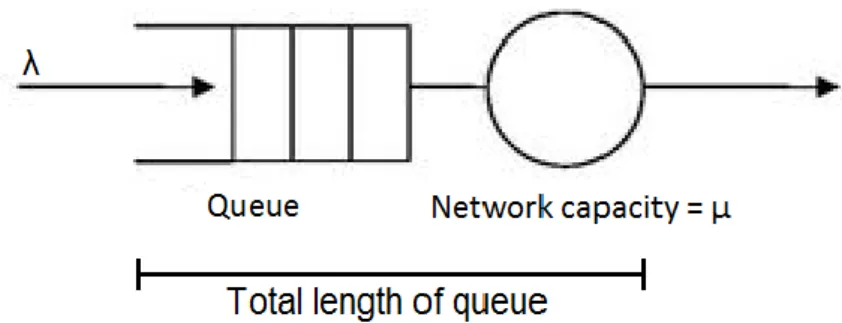
FIGURE 8: SCHEMATIC REPRESENTATION OF THE M/M/1 QUEUE WITH CAPACITY Μ AND AVERAGE ARRIVALS PER TIME UNIT Μ ... 35
FIGURE 9:REPRESENTATION OF THE STATE TRANSITION DIAGRAM OF AN M/M/1 QUEUE ... 35
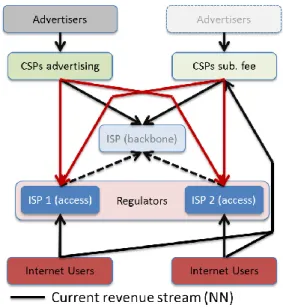
FIGURE 10:THE ECOSYSTEM OF THE NN DEBATE ... 58
FIGURE 11:FROM TOP LEFT:EXAMPLE OF IUS, ACCESS ISP(TELENOR) AND CPS ... 59
FIGURE 12:INVESTMENTS IN NETWORK CAPACITY IS ALWAYS HIGHER IN THE NNN REGIME ... 97
FIGURE 13:THE VOLUME OF CONTENT FROM THE CPS IS ALWAYS HIGHER IN THE NNN REGIME ... 97
FIGURE 14:THE AVERAGE CONGESTION IS ALWAYS LOWER IN THE NNN REGIME ... 97
FIGURE 15:THE BACKBONE ISP ALWAYS PREFERS THE NNN REGIME ... 97
FIGURE 16:SOCIAL WELFARE IS ALWAYS HIGHER IN THE NNN REGIME ... 97
FIGURE 17:SOME REGULATION CAN INCREASE SOCIAL WELFARE, BUT RISK HURTING THE IUS,CPS OR ACCESS ISPS ... 97
FIGURE 18:NORMALIZED RESULTS FROM BASE SCENARIO, COMPARING NNN AGAINST THE BASIC VALUES OF NN ... 103
FIGURE 19:NORMALIZED VALUES OF INVESTMENTS AND INNOVATION IN THE ATTRACTIVENESS OF ONLINE ADVERTISING SCENARIO ... 104
FIGURE 20:NORMALIZED VALUES OF PRICE AND CONGESTION IN THE ATTRACTIVENESS OF ONLINE ADVERTISING SCENARIO ... 104
FIGURE 21:NORMALIZED VALUES OF PROFITS AND WELFARE IN THE ATTRACTIVENESS OF ONLINE ADVERTISING SCENARIO ... 104
FIGURE 22:THE ATTRACTIVENESS OF ONLINE ADVERTISING IS IMPORTANT FOR THE INDIVIDUAL PLAYERS’ BENEFIT OF THE NNN REGIME. ... 105 FIGURE 23:NORMALIZED VALUES OF INVESTMENTS AND INNOVATION IN THE
INTERACTIVE AND LIVE SERVICES SCENARIO ... 106 FIGURE 24:NORMALIZED VALUES OF PRICE AND CONGESTION IN THE INTERACTIVE AND
LIVE SERVICES SCENARIO ... 106 FIGURE 25:NORMALIZED VALUES OF PROFITS AND WELFARE IN THE INTERACTIVE AND
LIVE SERVICES SCENARIO ... 106 FIGURE 26:THE LEVEL OF INTERACTIVE AND LIVE SERVICES, LIKE SKYPE, REDUCE THE
RELATIVE BENEFIT OF THE NNN REGIME.HOWEVER, AS PROPOSED THE NNN REGIME CAN CONTRIBUTE TO MAINTAIN THE OVERALL INVESTMENT LEVELS ... 107 FIGURE 27:NORMALIZED VALUES OF PROFITS AND WELFARE IN THE OPERATIONAL
PERFORMANCE OF THE ACCESS ISPS SCENARIO ... 108 FIGURE 28:NORMALIZED VALUES OF INVESTMENTS AND INNOVATION IN THE
OPERATIONAL PERFORMANCE OF THE BACKBONE ISP SCENARIO ... 108 FIGURE 29:NORMALIZED VALUES OF PROFITS AND WELFARE IN THE OPERATIONAL
PERFORMANCE OF THE BACKBONE ISP SCENARIO ... 108 FIGURE 30:THE VARIABLE COSTS OF THE BACKBONE ISP AFFECTS THE WHOLE
ECOSYSTEM. ... 109 FIGURE 31:NORMALIZED VALUES OF INVESTMENTS AND INNOVATION IN THE
EFFECTIVENESS OF BUILDING INFRASTRUCTURE SCENARIO... 110 FIGURE 32:NORMALIZED VALUES OF PRICE AND CONGESTION IN THE EFFECTIVENESS OF BUILDING INFRASTRUCTURE SCENARIO ... 110 FIGURE 33:NORMALIZED VALUES OF PROFITS AND WELFARE IN THE EFFECTIVENESS OF
BUILDING INFRASTRUCTURE SCENARIO.THE SECONDARY AXIS IS FOR THE IUS RELATIVE EFFECT. ... 110 FIGURE 34:FIBER OPTIC CABLES HAVE REVOLUTIONIZED THE TELECOMMUNICATION
INDUSTRY AND THE WAY WE TRANSFER INFORMATION, PROVIDING BETTER AND MORE EFFICIENT NETWORK INFRASTRUCTURE. ... 111 FIGURE 35:NORMALIZED VALUES OF INVESTMENTS AND INNOVATION IN THE IUS
DEPENDENCE ON ONLINE SERVICES SCENARIO ... 112 FIGURE 36:NORMALIZED VALUES OF PRICE AND CONGESTION IN THE IUS DEPENDENCE
ON ONLINE SERVICES SCENARIO ... 112 FIGURE 37:NORMALIZED VALUES OF PROFITS AND WELFARE IN THE IUS DEPENDENCE
ON ONLINE SERVICES SCENARIO ... 112 FIGURE 38:INTERNET IS RAPIDLY BECOMING A MORE IMPORTANT PART OF OUR LIVES,
AND WE CARRY IT WITH US ALMOST EVERYWHERE WITH OUR PHONES. ... 113 FIGURE 39:NORMALIZED VALUES OF INVESTMENTS AND INNOVATION IN THE BACKBONE ISPS MARKET POWER SCENARIO ... 114 FIGURE 40:NORMALIZED VALUES OF PRICE AND CONGESTION IN THE BACKBONE ISPS
MARKET POWER SCENARIO ... 114 FIGURE 41:NORMALIZED VALUES OF PROFITS AND WELFARE IN THE BACKBONE ISPS
MARKET POWER SCENARIO ... 114 FIGURE 42:NORMALIZED VALUES OF PROFITS AND WELFARE IN THE REGULATED
FIGURE 43:NORMALIZED VALUES OF PROFITS AND WELFARE IN THE REGULATED NETWORK – HIGH IU UTILITY ON CPS AND QOS SCENARIO ... 117 FIGURE 44:NORMALIZED VALUES OF PROFITS AND WELFARE IN THE REGULATED
NETWORK– LOW IU UTILITY ON CPS AND QOS SCENARIO ... 117 FIGURE 45:NORMALIZED VALUES OF PROFITS AND WELFARE IN THE REGULATED
NETWORK– LOW R/Λ SCENARIO ... 118 FIGURE 46:NORMALIZED VALUES OF PROFITS AND WELFARE IN THE REGULATED
NETWORK– HIGH R/Λ SCENARIO ... 118 FIGURE 47:SHARE OF IAS AND WDIA/WD IN THE ATTRACTIVENESS OF ONLINE
ADVERTISING SCENARIO’S NNN REGIME ... 177 FIGURE 48:AVERAGE MARGIN OF CPS IN THE ATTRACTIVENESS OF ONLINE
ADVERTISING SCENARIO.ONE SHOULD CONSIDER THIS AS MARGIN PER VOLUME OF CONTENT AND NOT PER CSP. ... 177 FIGURE 49:NORMALIZED VALUES OF INVESTMENTS AND INNOVATION IN THE
OPERATIONAL PERFORMANCE OF THE ACCESS ISPS SCENARIO ... 178 FIGURE 50:NORMALIZED VALUES OF PRICE AND CONGESTION IN THE OPERATIONAL
PERFORMANCE OF THE ACCESS ISPS SCENARIO ... 178 FIGURE 51:NORMALIZED VALUES OF PRICE AND CONGESTION IN THE OPERATIONAL
PERFORMANCE OF THE BACKBONE ISP SCENARIO ... 178 FIGURE 52:NORMALIZED VALUES OF INVESTMENTS AND INNOVATION IN THE
REGULATED NETWORK – BASIC SCENARIO ... 179 FIGURE 53:NORMALIZED VALUES OF PRICE AND CONGESTION IN THE REGULATED
NETWORK – BASIC SCENARIO ... 179 FIGURE 54:NORMALIZED VALUES OF INVESTMENTS AND INNOVATION IN THE
REGULATED NETWORK – HIGH IU UTILITY ON CPS AND QOS SCENARIO ... 180 FIGURE 55:NORMALIZED VALUES OF PRICE AND CONGESTION IN THE REGULATED
NETWORK – HIGH IU UTILITY ON CPS AND QOS SCENARIO ... 180 FIGURE 56:NORMALIZED VALUES OF INVESTMENTS AND INNOVATION IN THE
REGULATED NETWORK– LOW IU UTILITY ON CPS AND QOS SCENARIO ... 181 FIGURE 57:NORMALIZED VALUES OF PRICE AND CONGESTION IN THE REGULATED
NETWORK– LOW IU UTILITY ON CPS AND QOS SCENARIO ... 181 FIGURE 58:NORMALIZED VALUES OF INVESTMENTS AND INNOVATION IN THE
REGULATED NETWORK– LOW R/Λ SCENARIO ... 182 FIGURE 59:NORMALIZED VALUES OF PRICE AND CONGESTION IN THE REGULATED
NETWORK– LOW R/Λ SCENARIO ... 182 FIGURE 60:NORMALIZED VALUES OF INVESTMENTS AND INNOVATION IN THE
REGULATED NETWORK– HIGH R/Λ SCENARIO ... 183 FIGURE 61:NORMALIZED VALUES OF PRICE AND CONGESTION IN THE REGULATED
TABLE 1:DEFINITIONS AND CONCEPTUAL CLARIFICATIONS 6 TABLE 2:FEATURES OF THE MATHEMATICAL MODELS PRESENTED IN THE PREVIOUS
RESEARCH, COMPARED TO THE FEATURES OF THE MODEL IN THIS THESIS.THIS THESIS IS THE ONLY PAPER WITH YES IN ALL OF THE COLUMNS. 14 TABLE 3:SUMMARY OF RESULTS ON PROFITS, CONSUMER SURPLUS AND SOCIAL
WELFARE FROM THE TRANSITION TO A NON-NEUTRAL FROM A NEUTRAL REGIME IN THE PREVIOUS RESEARCH, COMPARED TO THE RESULTS PROVIDED BY THIS THESIS.
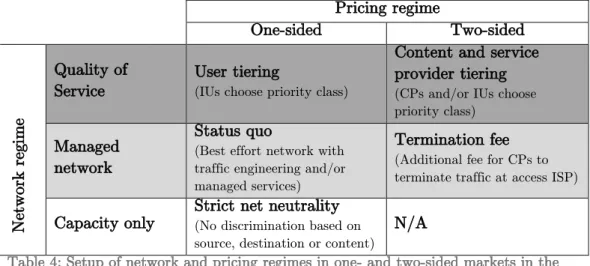
15 TABLE 4:SETUP OF NETWORK AND PRICING REGIMES IN ONE- AND TWO-SIDED MARKETS
IN THE NN DEBATE 24
TABLE 5:INDEXES, PARAMETERS AND VARIABLES OF THE MATHEMATICAL MODEL OF
COMPETITIVE BOTTLENECKS [19] 38
TABLE 6:INDEXES, PARAMETERS AND VARIABLES OF THE MATHEMATICAL MODEL BY
KRÄMER AND WIEWIORRA [2] 42
TABLE 7:INDEXES, PARAMETERS AND VARIABLES OF THE MATHEMATICAL MODEL BY
BOURREAU ET AL.[3] 44
TABLE 8:INDEXES, PARAMETERS AND VARIABLES OF THE MATHEMATICAL MODEL BY
NJORGE ET AL.[4] 48
TABLE 9:INDEXES, PARAMETERS AND VARIABLES OF THE MATHEMATICAL MODEL BY
ECONOMIDES AND HERMALIN [5] 51
TABLE 10:SUMMARY OF STRENGTHS AND WEAKNESSES OF THE MATHEMATICAL MODELS
FROM PREVIOUS RESEARCH 56
TABLE 11:THE GENERAL DECISION PROCEDURE AND TIMING OF THE NN DEBATE
ECOSYSTEM 60
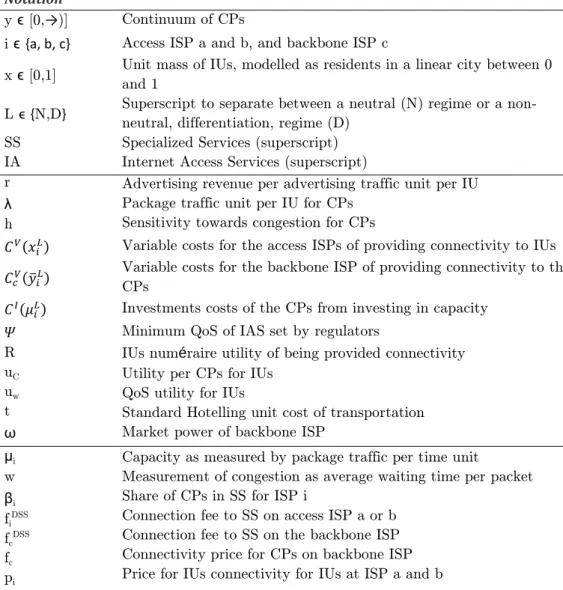
TABLE 12:INDEXES, PARAMETERS AND VARIABLES OF THE MATHEMATICAL MODEL
FROM THIS THESIS 62
TABLE 13:INDEXES, PARAMETERS AND VARIABLES OF THE SIMPLIFIED MATHEMATICAL
MODEL 74
TABLE 14:TIMING AND DECISIONS IN THE NN AND NNN REGIME.DECISIONS UNDER THE SAME NUMBER ARE TAKEN SIMULTANEOUSLY, AND THE PLAYERS HAVE THE SAME
INFORMATION. 75
TABLE 15:VALUES CHANGED TO PERFORM SENSITIVITY ANALYSIS OF THE EFFECTS
FROM REGULATION THE NNN REGIME 101
TABLE 16:THE NORMALIZATION PROCESS IN THE NUMERICAL EXPERIMENTS TO COMPARE THE RESULTS OF THE NNN REGIME TO THE NN REGIME.SEE TABLE 17 FOR A DESCRIPTION OF THEIR REPRESENTATION IN THE SCENARIO ANALYSIS’
GRAPHS AND DIAGRAMS 102
TABLE 17:PARAMETER SETTING IN THE BASE SCENARIO, AND EXPLANATION OF THE VARIABLE NAMES IN THE SCENARIO ANALYSIS REPRESENTING THE RELATIVE
CHANGE 103
TABLE 18:SUMMARY OF PROFITS, CONSUMER SURPLUS AND SOCIAL WELFARE FROM THE NUMERICAL EXPERIMENTS.SEE SECTION 5.3 PAGE 74 FOR AN EXPLANATION OF THE
1
Introduction
The Internet is rapidly evolving, with services demanding ever higher levels of network capacities. This has led to the exploration of alternative ways the access internet service providers can monetize on their position as gatekeepers, in order to finance the high levels of investments. In general what is being explored is the transition from a neutral network to a non-neutral network where the internet service providers can differentiate and prioritize content, and much research has been done to analyze the effects of such a transition [1] [2] [3] [4] [5] [6] [7] [8] [9] [10] [11] [12] [13]. Among these, [1] and [2] are closest to our work. In this context, and throughout the thesis, a neutral network is a network where the internet service providers are not allowed to differentiate content in the network or favor one content provider over another, and the access internet service providers can only charge the internet users once and not the content providers for sending information over the broad band lines to end users. The internet service providers are also not allowed to block internet traffic based on its source, ownership or destination. A non-neutral network is a network where the internet service providers are allowed to differentiate content in the network, and as such prioritize content from one content provider over another. The prioritized lane is called specialized services, and the best effort lane is called internet access services. The internet service providers may also charge both the internet users and the content providers for sending information over the broad band lines to end users. However, the internet service providers are not allowed to block internet traffic.
The articles, [1] - [13], are part in what is referred to as the net neutrality debate. Net neutrality is widely and intensely debated among law and policy makers, as well as the key actors in the ecosystem that are affected by a possible transition to a non-neutral network. The policy makers are afraid that a non-non-neutral network will threaten the open internet, and impair the traffic that is not being paid for by the content providers. The neutral regime proponents, mostly the content providers, are afraid that a departure from a neutral regime will stifle innovation. The proponents of a non-neutral network, mostly the internet service providers, claim that a non-neutral regime will stimulate innovation by expanding the network infrastructure, help to cope with the increase in internet traffic and that it will secure necessary revenues to maintain and improve networks without charging extra fees on the end-users.
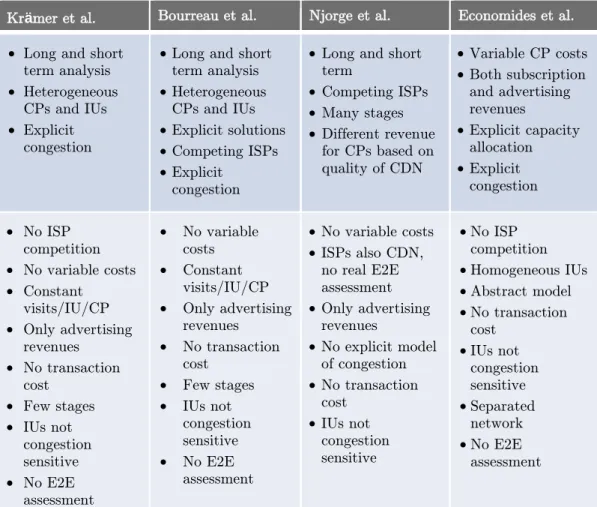
Much important research has been developed in the later years, and especially the late research by Krämer et al. [1], Bourreau et al. [2], Njorge et al. [3] and Economides and Hermalin [4] provide interesting results and thorough insights to many of the possible effects of this transition. Krämer et al. provides a model with heterogeneous content providers, investments from both internet service providers and content providers and multi-homing content providers. Bourreau et al. have further developed a model based on a similar setting to include heterogeneous internet users and
competing access internet service providers, providing more crisp and realistic results. They also do a comprehensive analysis on the effect of endogenous regime choice, sabotage and different size of the content providers. While Krämer is more ambiguous towards the non-neutral regime, and shows that the access internet service providers always benefits from a transition, Bourreau et al. are more positive, and show that because of the competition between the access internet service providers they are not certain at all to benefit from a non-neutral regime. Njorge et al. use a different setting from Bourreau et al., however, with the same overall features. They obtain a crisp set of results through a six stage game, and the results mostly agrees with what was found by Bourreau et al. Economides and Hermalin does include heterogeneous content providers and internet users, and investments by the content providers and access internet service providers. However, they do not consider competing access internet service providers and multi-homing content providers. Their results are generally not in favor of a non-neutral regime.
The previous research is largely based on a closed ecosystem, where the content providers have to connect to the same internet service providers as the internet users, or the content provider’s connectivity is not included. In reality, the content providers have to connect to the internet, which is modelled in this thesis through a backbone internet service provider. The content providers are dependent on sufficient quality of service from the backbone internet service provider. We assume, because of the much lower costs of backbone network expansion, that the backbone internet service provider delivers sufficient quality of service. We have extended on the work done by Krämer et al. and Bourreau et al. to include the backbone internet service provider, and also include the other features of Bourreau et al., which includes competing internet service providers, investments by the internet service providers and the content providers as measured by innovation, multi-homing content providers and heterogeneous content providers and internet users. The new features in our model are the following
A backbone internet service provider that provides connectivity to the content providers, and endogenously sets the connectivity price to maximize its own profits
The opportunity to simulate a weaker market power of the backbone internet service provider
A regulation scheme on the internet access lane, that forces the access internet service providers to invest in more capacity to obtain sufficient quality of service on their internet access lanes
In addition to confirming propositions of Bourreau et al. in an ecosystem that includes a backbone internet service provider, we also provide new propositions based on the analysis and assumptions of our model
If the M/M/1 queue assumptions hold, splitting a network into two separate networks can increase the average congestion levels by a factor of two
A backbone internet service provider always prefers a non-neutral regime, provided he has sufficient quality of service to deliver sufficient quality of service to the specialized service lanes in the non-neutral regime
The backbone ISP reduce the benefit of the non-neutral regime for the other actors
Too much regulation of the internet access services’ quality of service may reduce the overall social welfare
We perform a numerical experiment where we compare the two regimes, and analyze which regime is favorable over the other in overall social welfare and for the individual actors. Some highlights of our findings are
The attractiveness of advertising relative to the traffic needed to generate revenues is arguably the most important factor when considering the effects of a neutral versus a non-neutral network because with high and low ratio values the winners and losers of a non-neutral regime is opposite to one another
Regulating the internet access services lane can reduce the overall social welfare, and significantly reduce the benefit of the internet users when they are dependent on the content providers and high quality of service This thesis consists of eight parts. Part 1 provides an overview of important definitions and clarifications, an introduction to the net neutrality debate and a description of the problem. Part 2 follows up with a comprehensive survey of previous research on the net neutrality debate and two-sided markets. Part 3 describes the most relevant theory used in this thesis. Part 4 presents mathematical models from four of the latest and most comprehensive papers on the net neutrality debate, and discusses the strengths and weaknesses of the presented models. Part 5 is the core section of this thesis, and contains a presentation of the mathematical models developed and modified for this thesis, solutions to the analytical model, an analytic discussion of the results, and a scenario based numerical experiment with a thorough discussion that compares a neutral and a non-neutral network based on the scenarios in the numerical experiments. Part 6 evaluates the results, and provides a conclusion as well as recommendations for future research. Part 7 contains a full list of references and part 8 contains the appendix, which provides proofs, a thorough derivation of the analytical results and some complimentary numerical results that were used in the analytical discussion in part 5.6.4.
1.1
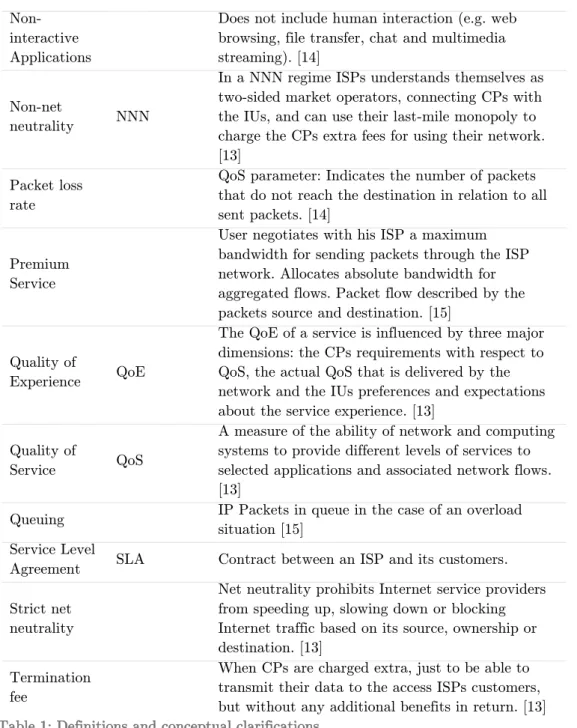
Definitions and Conceptual Clarifications
The following section shows common expressions and their abbreviations that are frequently used in the net neutrality debate, together with an explanation. Where there is no abbreviation the full expression is used throughout the thesis. However, for most of the thesis the abbreviation will be used when possible.
Expression Abbreviation Explanation Assured
forwarding AF
Assurance of delivery of packet as long as the traffic does not exceed some subscribed rate. [14] Bandwidth QoS parameter: Describes the capacity of a link or
end-to-end path. Measured in bits per second. [14] Best Effort BE
Packet forwarding is performed with the best effort, but without guaranteeing bandwidth, delay bounds etc. [14]
Bits per
second bps
Bandwidth rate describing how much information can be transferred in the network per second. [14]
Content distribution networks
CDN
Networks paid by the big CPs to improve the quality of experience in a BE Internet. They achieve this by building additional infrastructure that bypasses congested routes on the public Internet and by caching frequency downloaded content closer to respective customer class networks. [13]
Content
provider CP
Actor or player in the NN ecosystem that provides content to the IUs through a platform provided by the ISPs. [13]
Delay QoS parameter: Average delays that packets experience over a specific connection. [14] Delay
variation
QoS parameter: Difference between the bounds of minimum and maximum delay. [14]
Differentiated
services DiffServ/DS
Approach to provide QoS support in large scale networks while avoiding the scalability problems in the IntServ concept. Does this by reducing the flows to a small number of aggregated flows, and admission control and policing are no longer the responsibility of core routers. [14]
Elastic Applications
Application able to adapt to changing QoS parameters and does not fail in that case. Also called Best Effort Applications (e.g. e-mail). [14] End-to-end E2E In the context of this thesis end-to-end refers to the
principle of treating information from one end of the value chain to the other. Should not be
confused with the end-to-end principle of networks.
Inelastic applications
Need strict QoS guarantees. Real-time applications by nature are mostly inelastic, but might have some abilities to adapt to certain QoS parameter changes (e.g. video conferring with changing bandwidth). [14]
Integrated
Services IntServ
Architecture designed to overcome the inability of the Internet to provide guaranteed end-to-end QoS. It is based on the reservation of network and system resources on application parameters. Five parameters (token rate, bucket size, peak rate and minimum and maximum packet sizes) make up an IntServ Traffic Specification. [14]
Interactive Applications
Include human interaction. Typically a human interacts remotely with another end system and expects quick reaction to the performed action (e.g. online gaming). [14]
Internet
Protocol IP
Principal communications protocol in the Internet Protocol suite for relaying datagrams across network boundaries. [15]
Internet Protocol packets
IP packets Data information to be sent in the network. [15] Internet
Protocol services
IP services Services provided by data sent through the network. [15]
Internet Service Provider
ISP
Providing access to the Internet for IUs (end-users), and may be viewed as a two-sided market platform under the NNN regime.
Internet user IU Internet users, or end-users, are connected to the network by their local access provider (ISP). [13]
Net
neutrality NN
Net neutrality means that broadband service providers charge consumers only once for internet access, do not favor one content provider over another, and do not charge content providers for sending information over broadband lines to end users. [13]
Network
Non-interactive Applications
Does not include human interaction (e.g. web browsing, file transfer, chat and multimedia streaming). [14]
Non-net
neutrality NNN
In a NNN regime ISPs understands themselves as two-sided market operators, connecting CPs with the IUs, and can use their last-mile monopoly to charge the CPs extra fees for using their network. [13]
Packet loss rate
QoS parameter: Indicates the number of packets that do not reach the destination in relation to all sent packets. [14]
Premium Service
User negotiates with his ISP a maximum bandwidth for sending packets through the ISP network. Allocates absolute bandwidth for aggregated flows. Packet flow described by the packets source and destination. [15]
Quality of
Experience QoE
The QoE of a service is influenced by three major dimensions: the CPs requirements with respect to QoS, the actual QoS that is delivered by the network and the IUs preferences and expectations about the service experience. [13]
Quality of
Service QoS
A measure of the ability of network and computing systems to provide different levels of services to selected applications and associated network flows. [13]
Queuing IP Packets in queue in the case of an overload situation [15]
Service Level
Agreement SLA Contract between an ISP and its customers. Strict net
neutrality
Net neutrality prohibits Internet service providers from speeding up, slowing down or blocking Internet traffic based on its source, ownership or destination. [13]
Termination fee
When CPs are charged extra, just to be able to transmit their data to the access ISPs customers, but without any additional benefits in return. [13] Table 1: Definitions and conceptual clarifications
1.2
Introduction to the Net Neutrality Debate
The internet is rapidly developing into an essential platform to reach information, entertainment and communication, and the role of network infrastructure owners has shifted to an essential gatekeeper position in the information society. This has leaded both politicians and the public to be concerned about how ISPs are going to monetize access and usage of the networks in the future [13]. Much research has been done to analyze the consequences of different regimes the ISPs monetize on their position as gatekeepers [1] [2] [3] [4] [5] [6] [7] [8] [9] [10] [11] [12] [13]. These articles are part of what is referred to as the net neutrality debate. The debate is currently active in both the EU and the USA [16].
The phrase net neutrality was first coined by Columbia Law Professor Tim Wu in 2003 [7]. The term is used to signify the concept that the Internet is merely a carrier of online content that does not distinguish one website from another. The central idea inherent in this concept is that a «maximally useful public information network aspires to treat all content, sites and platforms equally» [7]. There are several definitions of net neutrality. Two definitions of net neutrality can be read below:
“Net neutrality usually means that broadband service providers charge consumers only once for Internet access, do not favor one content provider over another, and do not charge content providers for sending information over broadband lines to end users.” [13]
“NN usually means that broad-band service providers charge consumers only once for Internet access, do not favor one content provider over another, and do not charge content providers for sending information over broadband lines to end users.” [7]
There is also a strict definition of net neutrality:
“Net neutrality prohibits Internet service providers from speeding up, slowing down or blocking Internet traffic based on its source, ownership or destination” [13]
The first two definitions refer to that ISPs cannot differentiate among IUs or CPs, and that CPs should be free to send their content to IUs without being charged by the ISPs. The strict net neutrality has much of the same message. However, it also includes blocking of content, which is forced upon the ISPs in some foreign countries. Also the strict definition prohibits ISPs from charging access fees on CPs to reach their end-users.
The techniques necessary to differentiate and manage internet traffic are already implemented in the networks. However, what started the debate was that ISPs have implicitly and overtly signaled that they intend to use these techniques to generate extra revenues. The debate was particularly stimulated in 2005 when the CEO of ATT at the time, Ed Whitacre, stated: “Now what content providers would like to do is use my pipes free, but I ain’t going to let them do that because we have spent this capital
and we have to have a return on it”. Similar statements have been released by major European network operators since then [13].
To understand the reasoning behind the ISPs statements, one has to look at the ISPs as platforms in a two-sided market, which they might be considered economically [18] [19] [20]. The ISPs provide access to the Internet for IUs, who through their connection with the ISP can interact with several CPs. We could say that there are two types of CPs, inelastic and elastic applications. Where elastic applications can adapt to changing QoS, e.g. e-mail,
inelastic applications need strict QoS guarantees to deliver sufficient QoE [13] [14]. These inelastic applications usually consume a disproportionate amount of internet traffic. E.g. Netflix amount for nearly 30% of Internet traffic at peak hours [21] (new estimates provide an even higher number [17]). Netflix provides video on demand through online streaming. Their huge demand for traffic is of course not only generated by their services per se, but also by their vast amount of IUs. Thus, an ISP has to provide sufficient access to good enough QoS to the IUs in order for all their users to be satisfied with both the service of the ISP and the experience from using Netflix. If not, they might lose subscribers themselves, or at least many of their customers will not be satisfied. However, with the one-sided pricing most ISPs use today, they cannot charge Netflix explicitly to bear the investment costs that is required to provide a sufficient QoS so that the IUs can enjoy their services. This leads us to the three main arguments of the proponents of NNN:
First, the prioritization of bandwidth stimulates innovation because the ISPs can use the money paid for preferential treatment of Internet traffic to pay for the building of network infrastructure that would increase broadband access to more consumers. [16]
Second, video sharing websites, such as YouTube (www.youtube.com), Vimeo (www.vimeo.com), and Vevo (www.vevo.com), take up a lot of bandwidth. According to Cisco, global Internet video traffic was 57 percent of all consumer traffic in 2012. The global Internet video traffic will be 69 percent of all consumer Internet traffic in 2017. This statistic does not include video exchanged through peer-to-peer (P2P) file Figure 1: Graph by the Wall Street Journal illustrating the large share of data flow to internet users from Netflix and YouTube [17].
sharing. Cisco states that the sum of all forms of video traffic, including P2P, will be in the range of 80 to 90 percent of global consumer traffic by 2017. In order to deal with the increased bandwidth requirements, ISPs will need to charge more high-bandwidth websites. [16]
Third, network neutrality decreases the revenues earned by the ISPs. The decreased revenues of the ISPs increase the level of the employment and decrease GDP. Moreover, the decreased revenues of ISPs prevent them from deploying and maintaining networks, and improving them over time. In order to recoup the decrease revenues, the ISPs may charge their customers increased fees. [16]
In short, the main arguments of the NNN proponents are that NNN will stimulate innovation by building our the network infrastructure, it is necessary to cope with the increase in internet traffic and that it secures necessary revenues to maintain and improving networks without charging extra fees on the end-users.
However, there are those who fears that the NNN regime would have negative effects. There are mainly six arguments used by the NN proponents:
First, network neutrality protects the right of freedom of speech. The reason is that network neutrality restricts ISPs from blocking or prioritizing content on the Internet. Countries that have not implemented the principle of network neutrality in their legislation often control or suppress the publishing or accessing of information on the Internet. For example, in China, the government uses a system that does not allow the residents of China to access certain online content. As a result, if an Internet user searches in Google or other search engines for the word “Tibetan independence,”
“democracy movements,” or other blacklisted words, he or she will be redirected to a blank page stating “page cannot be displayed.” [16]
Second, ISPs have no right to control data transmitted between end-users. According to this argument, the networks’ only function is to move data, not choose which data to move. In this context, Vinton Cerf, a co-inventor of the internet protocol (IP), stated that “the Internet was designed with no gatekeepers over new content or services.” [16]
Third, network neutrality does not allow ISPs to restrict content and/or services provided by their competitors. As known, restrictions of competition may lead to increased prices of services and/or goods. For example, in 2009, Deutsche Telekom announced plans to prohibit the use of Skype over iPhones. Such a prohibition will harm the interests of consumers who can otherwise save money on calls by using Skype. [16]
Fourth, the involvement of ISPs in determining what content or services reach consumers will stifle innovators. For instance, if Google can pay ISPs to deliver YouTube videos faster than other sources of Internet video, any startups offering better services than YouTube will have tremendous difficulties enter the online video market. [16]
Fifth, network neutrality preserves the existing Internet standards. The reason is that, at present, the Internet runs on technical standards created by variety of organizations, such as the internet engineering task force (IETF). By using the existing Internet standards, computers, services, and software created by different companies can be integrated together. Without network neutrality, the Internet will be regulated by ISPs under standards chosen by them. [16]
Sixth, network neutrality maintains the end-to-end principle. It “allows nodes of the network to send packets to all other nodes of the network, without requiring intermediate network elements to maintain status information about the transmission”. The principle allows people using the Internet to innovate free of any central control. [16]
In short, the main arguments of the NN proponents are that it protects the freedom of speech, is in accordance with “no gatekeepers” principle, protects the interest of consumers with no blocking of content, it preserves the existing internet standards and it maintains the end-to-end principle so that people can use the Internet freely to innovate.
All three arguments posed by the NNN proponents can be tested quantitatively in a mathematical model. The third, fourth and fifth argument of the NN proponents can also be analyzed in a mathematical model. The other arguments of the NN proponents are either technical or principal and will therefore not be analyzed in this thesis.
Regulators have so far responded differently towards NN. In the USA, the Federal Communications Commission (FCC) has adopted a set of rules that should “preserve the Internet’s openness and broadband providers’ ability to manage and expand their networks”. The four core principles are: transparency, no blocking of content, no unreasonable discrimination, and reasonable network management. In Europe, no such rules have been adopted so far. The European Commission is committed to
“preserving the open and neutral character of the Internet”, it believes that the existing rules on transparency, consumer
switching and quality of service are sufficient to ensure competitive outcomes [22]. However, the EU has recently stated that the Internet could be spilt in two, internet access services (IAS) and specialized services (SS). Internet access services should be open without traffic management. On the other hand specialized services allows the operators to manage the networks how they want. The splitting point between these two networks has not yet been decided, and neither has the flexibility in managing the two networks been decided yet. This is to be decided by the European commission this year [23].
Figure 2: FCC (top)
and the European
(EU) Commission
1.3
Presentation of the Problem Statement
The regulators and policy makers have not yet set the final conditions for a potential NNN regime, where a specialized service lane can be offered to the content providers that are willing to pay for it. The other content providers are left in the internet access lane, which is similar to today’s best effort. In order to increase the knowledge of the effects of adopting the NNN regime has on key ecosystem actors, and guide the policy makers in their work on possible regulations, the following problem statement was chosen:
“What effects does leaving the NN regime in favor of the NNN regime involve for
key ecosystem actors in an E2E multi actor environment, which scenarios lead to a beneficial outcome for the key actors and overall social welfare, and how does regulating the QoS of the IAS lane in the NNN regime affect the key actors and social welfare?”
1.4
Justification of the Chosen Problem Statement
The problem description given to me by Telenor was the following: “Describe different quantitative methods for analyzing economics effects in E2E multi actor environment for a network operator (ISP), including two-sided pricing models. Furthermore design different scenarios in both network neutrality and non-neutrality settings. Finally analyze economic impact and recommend policy implications for key ecosystem actors using preferred methods.” The problem statement of this thesis aims to provide an answer to this problem description, as well as give deeper insights on the effects of regulation.
The EU has largely agreed to allow a separation of the internet into specialized services, and internet access services. However, how this should be implemented, and how flexible it should be, is still to be considered. The problem statement is to provide better insights into the questions the EU commission, FCC and other policy makers have to evaluate before deciding on final guidelines for a possible non-neutral Internet. Also, the problem statement allows for a broad analysis of the implications of a non-neutral internet, which has not yet been fully analyzed in an end to end perspective, which is included in this thesis.
The problem statement could have included a broad analysis on regulation, and look deeper into how regulators could best regulate the network in order to best utilize the benefits and avoid the possible pitfalls of a non-neutral Internet. This is a topic that could also be interesting to investigate further. However, the regulators largest concern is how the QoS of IAS is affected by the non-neutral regime, and therefore this is also chosen as the problem statement in this thesis. A broad analysis of
different regulation schemes would also complicate the mathematical model and solutions, which might reduce the quality of the general analysis.
By key actors we consider the main actors in the network ecosystem, the content providers, the backbone ISP, the access ISPs, the internet users and the regulators. The formulation could include a direct analysis of specific actors, like Telenor or Netflix. However, since the insights provided by this thesis aims to aid in a general assessment of adopting the NNN regime, no individual actors are considered. A business analysis that aims to help companies maneuver in the NNN regime to maximize their own profits would benefit from such a formulation and analysis. Single companies should not affect the regulators that have to evaluate the full picture, which is the focus of this thesis.
2
Survey of Previous Research
2.1
Literature on Net Neutrality
The following section contains a survey of previous research on the net neutrality debate. Two articles, [24] and [25], describe the framework of internet interconnections, and how regulators have to take the complexity of the Internet Interconnections into consideration when looking at different regulation policies. Twelve articles, [1] - [12], directly analyze the effects of regulation regimes for the NN debate, will be presented both in tabular form and in a short summary. Some of the findings from these articles will be used explicitly in own sections. As such, they will be presented thoroughly according to the context in which they are being used. An article providing empirical studies [22] is presented, and represents a different approach from the other research papers and the work in this thesis. Lastly, Krämer et al. [13] have written a progress report, and we summarize their most important findings.
2.1.1 Tabular Overview of Previous Research on the NN Debate
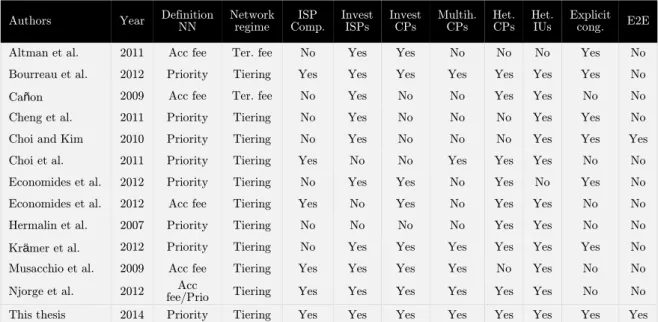
This section contains two tables; one that summarizes the framework in which the previous research has analyzed the NN debate, the other table shows the findings in these articles. Both tables were made in MS Excel using Pivot tables.
The columns of the first table include Authors states who wrote the article Year states when the article was published
Definition NN is how net neutrality is defined in the article. Some articles consider managing access is defining NN, while other articles define NN as the ability not to prioritize content by offering differentiated classes.
Network regime is how, in the NNN case, the ISP structures the network. It could be by offering tiering services, where there are lanes of different quality, or simply by allowing access to the higher quality lanes or even the network through a termination fee.
ISP Comp. is whether the model captures competition among ISPs. This is important as previous research shows competition for end users are toughened in the NNN regime [2]
Invest ISPs state whether the article consider investments in infrastructure and better quality by the ISPs or not. This is important to analyze long-term effects of regulation policies.
Invest CP states whether the article considers investments or innovations done by CPs, and is again important to analyze long-term effects of regulation.
Multih. CPs is whether end-users connect to several CPs simultaneously. Het. CPs is whetheris whether the CPs are modelled as heterogeneous or not Het. IUs is whetheris whether the IUs are modelled as heterogeneous or not Explicit cong. is whether congestion is modelled explicitly as a result of demand
for packages and investment levels
E2E is whether E2E effects are considered in the model or not
Authors Year Definition NN Network regime Comp. ISP Invest ISPs Invest CPs Multih. CPs Het. CPs Het. IUs Explicit cong. E2E
Altman et al. 2011 Acc fee Ter. fee No Yes Yes No No No Yes No Bourreau et al. 2012 Priority Tiering Yes Yes Yes Yes Yes Yes Yes No Cañon 2009 Acc fee Ter. fee No Yes No No Yes Yes No No Cheng et al. 2011 Priority Tiering No Yes No No No Yes Yes No Choi and Kim 2010 Priority Tiering No Yes No No No Yes Yes Yes Choi et al. 2011 Priority Tiering Yes No No Yes Yes Yes No No Economides et al. 2012 Priority Tiering No Yes Yes No Yes No Yes No Economides et al. 2012 Acc fee Tiering Yes No Yes No Yes Yes No No Hermalin et al. 2007 Priority Tiering No No No No Yes Yes No No Krämer et al. 2012 Priority Tiering No Yes Yes Yes Yes Yes Yes No Musacchio et al. 2009 Acc fee Tiering Yes Yes Yes Yes No Yes No No Njorge et al. 2012 fee/Prio Acc Tiering Yes Yes Yes Yes Yes Yes No No This thesis 2014 Priority Tiering Yes Yes Yes Yes Yes Yes Yes Yes
Table 2: Features of the mathematical models presented in the previous research, compared to the features of the model in this thesis. This thesis is the only paper with yes in all of the columns.
As can be seen from the overview, only two articles, with the exception of this thesis, use a relatively complete framework, namely Njorge et al. (2012) and Bourreau et al. (2012), which are also some of the newest articles. However, these articles do not consider the effects of an E2E network ecosystem. Njorge et al. does consider connectivity by a CDN, but that is from one of the same ISPs that provide connectivity for the end users, which is rarely the case in international E2E network configurations. This thesis presents the first research what takes this into consideration, in a complete framework. The second table shows a summary of the results found in the different papers. The table reflects a general interpretation of the articles results and argumentation, and does not necessarily represent any personal views the authors may have.
The columns of the second table include
NNN states whether the article in general is positive towards NNN or not. This is usually tied to the overall social welfare. It is important to notice that whether the article is generally in favor of or against NNN is usually dependent on the values of the parameters, and that there usually are values that make either regime profitable.
SW states whether social welfare benefits from NNN or not. Social welfare is in most cases measured as the profit of the ISPs, the CPs and the consumer surplus combined.
CP states whether the CP is better off with NNN or not
Backbone ISP states whether the backbone ISP is better off with NNN or not Access ISP states whether the access ISPs is better off with NNN or not IU stated whether the IUs (end-users) are better off with NNN or not
Where depending is used, the result is dependent on parameter values, and no clear answer can be given based on the general argumentation in the article. N/A states that non conclusion could be made from the analysis in the article
Authors Year NNN SW CP Backbone ISP Access ISP IU
Altman et al. 2011 Depending N/A Depending N/A Yes N/A Bourreau et al. 2012 Yes Yes Depending N/A Yes Depending Cañon 2009 No Depending Depending N/A Depending Yes
Cheng et al. 2011 Yes Yes No N/A Yes Yes
Choi and Kim 2010 Depending Depending Depending N/A Depending Depending
Choi et al. 2011 N/A Yes N/A N/A Yes Yes
Economides et al. 2012 No Depending No N/A Yes Depending Economides et al. 2012 Depending Depending Depending N/A Depending Depending
Hermalin et al. 2007 Yes Yes N/A N/A Yes Yes
Krämer et al. 2012 Depending Depending No N/A Yes Yes Musacchio et al. 2009 Depending Depending Depending N/A Depending Depending Njorge et al. 2012 Yes Yes Depending N/A Depending Yes This thesis 2014 Yes Yes Depending Yes Depending Depending
Table 3: Summary of results on profits, consumer surplus and social welfare from the transition to a non-neutral from a neutral regime in the previous research, compared to the results provided by this thesis.
The table reveals a trend that most articles are actually positive towards NNN, especially later research with more comprehensive modelling. However, most articles
also point out challenges like “tragedy of the commons” with the ISPs overcharging CPs when the maximize their own profits, ISPs sabotaging BE lanes, hard entry for new CPs or that small CPs might be pushed out of the market. Thus, for regulators, even though NNN should prove beneficial for the society, the articles reveal a need to regulate or monitor some of the business to protect fair competition.
2.1.2 Summaries on Articles Covering the NN Debate
The following section contains short summaries of the articles, their most important findings and suggestions for future research. The summaries are not meant to give a thorough understanding of the results, and any material used explicitly in this thesis will therefore be described independently of this section.
Complexity of Internet Interconnections: Technology, Incentives and Implications for Policy (Faratin, Clark, Gilmore, Bauer, Berger and Lehr) [24]
The article describes the structure and complexity of Internet interconnections. The article describes the different participants in a network system: Autonomous Systems, Prefix, Cone of Prefixes and Default Route. The article also defines tiers for the different ASes, depending on how they interact with each other. There are two ways to interact, transit (A is a customer of X) or peering (exchange of traffic). Peering is what enables ISPs to be in contact with the whole of internet without doing a transit with all networks. However, for peering to work, certain conditions must be met which is regulated by traffic volume, traffic ratio, consistent announcements, marketing considerations or other requirements. The article goes on to describe possible issues and solutions to conflicts, as well as different types of interconnection agreements. The article then describe “Settlement-Free Peering Bargaining”, in which different network providers have different willingness to peer (WTP) based on their traffic structure. The article follows up with strategies on when not to peer, and how to create incentives to peer. In general you should avoid to indirectly or directly peering with current or potential customers, and create incentives by lowering performance of the networks that does not want to peer but indirectly are dependent of your network. The article also provides strategies to remain in a current peering policy. Lastly the article provides bilateral negotiations, market failure and entry of content delivery networks. The market failure refers to the fact that there are willingness to pay for better than best effort connectivity, but with no providers able to give such an offer. This enables entry incentives for third party content distribution overlay networks. The article concludes that because of the complexity of the Internet interconnection, regulations have to be very complex in order to reflect reality. The article suggests that regulators should rather focus on the sources of bargaining power and identify anti-competitive opportunism, rather than to impose ex-ante restrictions on the range of bilateral contacts. The article encourage both the industry and the
academia to bring “best practice” or “common practice” in interconnection into the light, as this might help reduce bargaining costs, but in a more flexible way than might be achieved vie regulatory constraints. Lastly the article points out that today’s
“best effort” Internet probably have hindered the emergence of some applications because of lacking QoS, and that some sort of differentiated QoS will be necessary in the future to accommodate the requirements of different types of traffic.
The Growing Complexity of Internet Interconnection (Faratin, Clark, Bauer, Lehr, Gilmore and Berger, 2008) [25]
The article is an abbreviated version of [24]. However, some elaboration of different alternative interconnections is presented. The early internet grew on the assumption that the ISPs were homogeneous in size, and thus in costs. This makes it beneficial for the large Tier 1 ISPs to peer. However, following the recent development of the Internet with bandwidth heave content providers, the Autonomous Systems’ (AS) are now more heterogeneous. They can be divided into “eyeball” heavy networks, which provide connectivity to users, and “content” heavy networks that provide connectivity to the content providers. The “eyeball” networks connects to many users that send relatively little traffic to the “content” networks, that on the other hand send loads of traffic back to the “eyeball” networks. This makes for unfair peering, as the
“eyeball” networks have to carry much cost that they do not get compensated for directly. The “eyeball” networks thus sometimes refuse to peer with “content” network; this could be because of several reasons: Switching costs are now high for consumers, so the “eyeball” networks may perceive that they have increased bargaining power. The
“eyeball” networks believe that the natural direction of value flow is towards them. Especially since the content providers are so dependent on advertising to users to generate revenues. The last-mile networks of the broadband “eyeball” networks are more capital intensive, which makes for a cost recovery challenge.
Some alternative peering and transit is therefore discussed, paid peering and partial transit. Paid peering is also called “settlement based peering”, and is similar to
“settlement free peering” except that the traffic is no longer exchanged without payment. This is the best solution for heterogeneous ASes that want to peer. Partial transit is where a provider sells access to and/or from a subset of the Internet prefixes to another network. E.g. a network that only buy the ability to send traffic but not receive can work as a content network but not like an eyeball network.
Network Neutrality and Congestion Sensitive Content Providers: Implication for Content Variety, Broadband Investment, and Regulation (Krämer and Wiewiorra, 2012) [1]
The article answers and analyses many of the arguments in the net neutrality debate, welfare enhancement, capacity expansion, BE unable to provide necessary QoS. The article finds results that do not agree with previous research on capacity expansion. The reason is that the article also considers the effect of new CP entrants, and competition between ISPs, that force them to invest in higher capacities. The analysis also considers the effect of bad QoS, and thus capture the disutility that might be the effect from congestion with traditional BE networks. The article also analyses different strategic options for policy makers, like minimum quality standards or strategic degradation. The first may be effective but inefficient concerning investments, while the latter may decrease the overall welfare as fewer CPs enter the network. All in all, except for the capacity expansion, the article agree with much earlier research in that in general the CPs are worse off while the overall welfare in general is higher. However for very congestion sensitive CPs QoS tiring might put them better off because QoS tiring can allocate congestion to congestion insensitive CPs. The article concludes that QoS tiering is the preferred regime for ISPs, and that prohibiting this can eventually be harmful to content variety, broadband investment, and welfare.
Net Neutrality with Competing Internet Platforms (Bourreau, Kourandi and Valleti, 2013) [2]
The article studies the effect of a net neutrality regulation on capacity investment in the market for Internet access, and on innovation in the market for content. The article finds that under discrimination investments in broadband capacity and content innovation are both higher than under net neutrality, and that the total welfare increases. Also, the end users benefit from less congestion. However, the discriminatory regime is not always beneficial to the ISPs as it can intensify competition for subscribers. Though welfare-enhancing, the discriminatory regime has some undesirable effects, as the discriminatory regime hurts the small CPs more than the large ones. The article also considers sabotage by the ISPs on the CPs, and shows that it can only emerge, with adverse effects, under discrimination. Under discrimination each ISP benefits from degrading the quality of the non-priority lane in order to extract higher profits from the priority lane. This effect should be considered by policy makers, and if possible be regulated while allowing the welfare-improving discriminatory regime. This could be done my monitoring the traffic quality.
Investment in two-sided markets and the net neutrality debate (Njorge, Ozdaglar, Stier-Moses and Weintraub, 2012) [3]
The article develops a game theoretic model, where the participants make decisions in a specified order, to investigate the net neutrality debate. The article
summarizes the research done on the NN debate, and explicitly shows the limitations of the other articles that this article covers. The paper claims to be the first to analyze the NN debate in a model that simultaneously considers competition between ISPs, ISP investment decisions, CPs and consumers heterogeneity and CPs endogenous participation decisions as a proxy for content innovation. The model has a high quality platform, and a low quality platform that offer their services. The model is solved theoretically and exhaustively through numerical simulation. In general ISPs investments are larger in the non-neutral regime, because the ISPs can extract surplus from the CPs. The results in the article suggests that net neutrality regulation could possibly be an inapt policy to increase value in the Internet, because it could limit the investment incentives of network providers, which results in decreased CPs and consumer utility directly through low QoS and indirectly through bottleneck effects. The results are in general, and the article also provides tables to illustrate which actors prefer what under different circumstances. E.g. the low quality platform always prefers non-neutrality. However the high quality platform prefer (in the numerical solution) non-neutrality when the CPs are very heterogeneous, and neutrality when they are not (theoretically the high quality platform always prefer neutrality). This is because with heterogeneous CPs the platforms can use their monopoly power more effectively charging higher prices to CPs that enroll and appropriating the higher revenues that CPs earn in this regime. The results also suggest that a non-neutrality policy could potentially reduce the CPs participation and innovation. The article suggests that future research could implement transaction costs in the non-neutral regime, to let the CPs quality be determined endogenously and finally to model congestion more explicitly.
The economics of network neutrality (Economides and Hermalin, 2012) [4]
The article analyzes the private and social implications of two-sided pricing by ISPSs when the network is congested and more traffic implies greater delays. The article analyses under the assumption that the ISP can price discriminate only the CP side. The article argues that even though network neutrality might not generally be welfare maximizing, it might be welfare maximizing within second degree price discrimination, where the content providers are induced to play their part in the set. In particular, if the elasticity of content demand with respect to transmission time does not increase with households’ time sensitivity for the content, then network neutrality is welfare maximizing within the set of feasible schema. The article features a complex and abstract mathematical model, which provides some direct insights. E.g. that it is impossible to increase total welfare by excluding content, and that it could be welfare maximizing to hold back inelastic content in favor of elastic content, because the IUs will adapt to the situation. Overall the article argues in favor on NN. If that elasticity is invariant with households’ time sensitivity for the content, then network neutrality is welfare superior to all schema. (This is of course not realistic).

![Figure 7: Illustration of a game and its subgames, which are marked by red circles. As seen by the figure, a subgame can contain several subgames of its own [33]](https://thumb-us.123doks.com/thumbv2/123dok_us/10070729.2906875/44.748.196.516.190.394/figure-illustration-subgames-marked-circles-subgame-contain-subgames.webp)
![Table 5: Indexes, parameters and variables of the mathematical model of competitive bottlenecks [18]](https://thumb-us.123doks.com/thumbv2/123dok_us/10070729.2906875/50.748.61.650.104.420/table-indexes-parameters-variables-mathematical-model-competitive-bottlenecks.webp)