(REFEREED RESEARCH)
A RESEARCH ON YARN LIVELINESS TENDENCY OF
STAPLE YARNS
ŞTAPEL İPLİKLERİN İPLİK CANLILIĞI EĞİLİMLERİ ÜZERİNE BİR
ARAŞTIRMA
Pınar ÇELİK
Ege University, Textile Engineering Department e-mail: [email protected]
Hüseyin KADOĞLU
Ege University, Textile Engineering Department
ABSTRACT
Yarn snarling tendency causes several problems at the various post-spinning processes, such as winding, warping, weaving and knitting. In this study we analyzed the snarling tendency of short and long staple yarns. The yarn samples were produced with different raw material, spinning technique and yarn parameter variations. Long staple yarns from 100% wool and 100% acrylic (PAN) fibers were spun in two different nominal yarn counts with three different yarn twist factors using four different yarn spinning techniques. Short staple yarns from 100% cotton, 100% viscose, 100% polyester, 100% modal and 100% lyocell fibers were spun in two different nominal yarn counts with three different yarn twist factors using three different yarn spinning techniques. After spinning process their twist liveliness values were measured on Keisokki Kringel Factor Meter yarn liveliness test apparatus. The tests results were analyzed and evaluated in order to asses the effects of raw material, spinning technique and yarn parameters on yarn twist liveliness.
Key Words: Yarn liveliness, Staple yarn, Long staple spinning, Short staple spinning, Yarn steaming, Fabric spirality.
ÖZET
İpliğin kendi üzerine kıvrılma eğilimi bobinleme, dokuma ve örme gibi eğirme sonrası işlemlerde bir çok probleme neden olmakta-dır. Bu çalışmada uzun ve kısa ştapelli liflerden üretilmiş ipliklerin kendi üzerine kıvrılma eğilimi incelenmiştir. İplik numuneleri farklı hammadde, eğirme tekniği ve değişen iplik parametreleri ile üretilmiştir. Uzun ştapelli iplikler %100 yün ve %100 akrilik (PAN) liflerin-den iki farklı iplik numarası ve üç farklı iplik büküm katsayısı ile dört farklı iplik eğirme tekniği kullanılarak üretilmiştir. Kısa ştapelli iplikler %100 pamuk, %100 viskon, %100 polyester, %100 modal ve %100 lyocell liflerinden iki farklı iplik numarası ve üç farklı iplik büküm katsayısı ile üç farklı iplik eğirme tekniği kullanılarak üretilmiştir. İpliklerin iplik canlılığı değerleri Keisokki Kringel Factor Meter test aparatı kullanılarak ölçülmüştür. İplik canlılığına hammaddenin, eğirme tekniğinin ve iplik parametrelerinin etkisini belirle-mek için test sonuçları analiz edilmiş ve değerlendirilmiştir.
Anahtar Kelimeler: İplik canlılığı, Ştapel iplik, Uzun ştapel iplik eğirme, Kısa ştapel iplik eğirme, İplik büküm fiksajı, May dönmesi. Received: 10.10.2008 Accepted: 22.06.2008
1. INTRODUCTION
Textile fibres and yarns are subjected to torsional strains during various processes of yarn manufacturing. In staple yarns, twist is essential to hold the fibres together and to provide the required strength to the yarn structure. Especially, twisting process induces tension within yarn and its constituent fibres. Twist is one of the most important yarn features influencing the properties of yarn. It is a known fact that the yarn liveliness is related with yarn twist and strain.
Yarn twist liveliness is affected by the twist factor, yarn fineness and retractive forces, which, in turn, are determined by the torsional and bending stresses in the fibres, and torque generated during yarn twisting (1).
Yarns tend to snarl in order to relax themselves and simultaneously are
twisted in the opposite twist direction. This property is described as “liveliness”. In fancy yarn production, cut-piled carpet production and medical bandage manufacture, the effect of yarn liveliness is employed as an advantage (2). On the other hand, yarn twist liveliness causes several problems at various post-spinning processes, such as winding, warping, weaving and knitting; for example, it may generate yarn breakage at winding process. In addition, yarn twist liveliness is the main cause of the spirality in single jersey knitted fabrics (3, 4, 5, 6, 7). If a twist-lively yarn is used for knitting, the resultant loop will no longer be symmetric because of the varying induced torsional strain in the yarn (8). Generally vacuum steaming process is used for reducing the yarn snarling tendency, but it fails to eliminate the
snarling tendency completely. There is still a small amount of retained snarling tendency in the yarn after steaming process.
In terms of reducing yarn liveliness, a moderate steaming is much more effective than prolonged storage in an atmosphere of 65% r.h., 20ºC (9). The yarn twist liveliness phenomenon caused by a wide variety of factors. However, in order to narrow the scope of this study only the most important factors including raw material, yarn count, yarn twist level, spinning tech-nique and steaming operation were selected for this research.
2. EXPERIMENTAL
Short staple yarns from cotton, polyes-ter, viscose, modal and lyocell were
190
spun in two different nominal yarn counts Ne 16 (36.91 tex) and Ne 24 (24.61 tex) with three different yarn twist coefficient (αe 3.5, αe 4.1, αe 4.7)
by using three different spinning tech-niques, ring spinning (Rieter model G30), OE rotor spinning (Rieter model R40) and compact spinning (Zinser compact spinning machine). The specifications of raw materials are given in Table 1.
Table 1. Raw material specifications Raw material Fineness Fibre length 100% cotton 3,95 mic. 29,11 mm (UHML) 100% polyester 1.2 denier 38 mm 100% viscose 1.2 denier 38 mm 100% modal 1.2 denier 38 mm 100% lyocel 1.2 denier 38 mm
After the spinning process, one half of these yarns (the ring and compact yarns were in cop form and the OE yarns were in cone form) were sub-jected to steaming operation (90C, 10 min., two cycles of vacuum steaming). Subsequently, the yarn liveliness val-ues of untreated and steamed yarns were measured at standard humidity and temperature (20±2ºC and 65% Rh) by using the Kringel Factor Meter. 10 individual samples were taken from each party, and five tests were done by each sample.
Long staple yarns out of 100% wool and out of 100% acrylic (PAN) were spun in two different nominal yarn counts (Nm20 (50 tex) and Nm 32 (31.25 tex)). Each yarn count was spun at three different twist coefficient (α m 80, α m 90, α m 100) by using four
different spinning techniques, ring spinning (Zinser ring spinning ma-chine), siro-spun spinning (Zinser sirospun system), compact spinning (EliTe compact spinning) and compact siro-spun spinning (EliTwist). After the spinning process, one half of these yarns, whose yarn packages were in cop form, were subjected to steaming operation (85C, 10 min., two cycles of vacuum steaming). Subsequently, the yarn liveliness of untreated and steamed yarns was measured at standard hu-midity and temperature (20±2ºC and 65% RH) by using the Kringel Factor Meter. The yarn specifications of all yarn samples were measured. The specifications of raw materials are given in Table 2.
In this study, Keisokki Kringel Factor Meter twist liveliness test apparatus was used (Figure 1). The measuring principle can be described briefly as following steps;
Table 2. Raw material specifications Raw mate-rial Fineness Fibre length 100% wool 21 micron (for Nm32 (20 tex) yarns) 71,7 mm 100% wool 22 micron (for Nm 20 (50 tex) yarns) 70,5 mm 100% PAN 2,5 denier (for Nm32 (20 tex)yarns) 90 mm 100% PAN 3 denier (for Nm 20 (50 tex) yarns) 90 mm
I- Yarn is positioned through the pins to form a triangular path.
II- A specific amount of weight is hanged down at the end of the each coupled yarn pair.
III- The weight hanged yarn couple is let free to rotate axially until it reaches to a stable state.
IV- Thereafter, the length of twisted (axially rotated) part of the coupled yarns are measured from the scale.
Figure 1. Kringel factor meter yarn liveliness test apparatus
This numeric value which is termed as Kr value (Kringel factor) gives the quantitative measure of the yarn twist liveliness. This apparatus functions with a standard weight for all sorts of
yarn counts. However, pre-trials showed that in order to obtain more precise results weight should be varied depending on yarn linear density. A weigh of 10 mg per tex was found to be the most appropriate for our pur-pose. In addition, the yarn properties of all yarn samples were measured. An individual group of ten cops (cones for OE yarns) were tested for each yarn sample. All of the measurements were carried out under the standard atmos-pheric conditions.
The tensile properties of the yarns were evaluated by using an Uster Tensorapid 3 tensile testing machine. Unevenness tests were performed by using an Uster Tester 3. The yarn hairiness properties of the yarns were evaluated by using a Zweigle G566 yarn hairiness testing machine. Furthermore, a party (having the yarn characteristics of 100% PAN, Nm32/1, αm=90) were selected out of the yarn
samples and these selected yarns were knitted on a single system-single jersey hosiery machine. The fabric spirality behavior of the yarns was evaluated over these knitted fabric samples both before and after wash-ing. Statistical analyses were per-formed by implementing the statistical software. To determine the statistical importance of the variations, ANOVA tests were applied. To deduce whether the parameters were significant or not, p values were examined. Ergün (10) emphasized that if p value of a pa-rameter is greater than 0.05 (p>0.05), the parameter will not be important and should be ignored.
3. RESULTS AND DISCUSSION
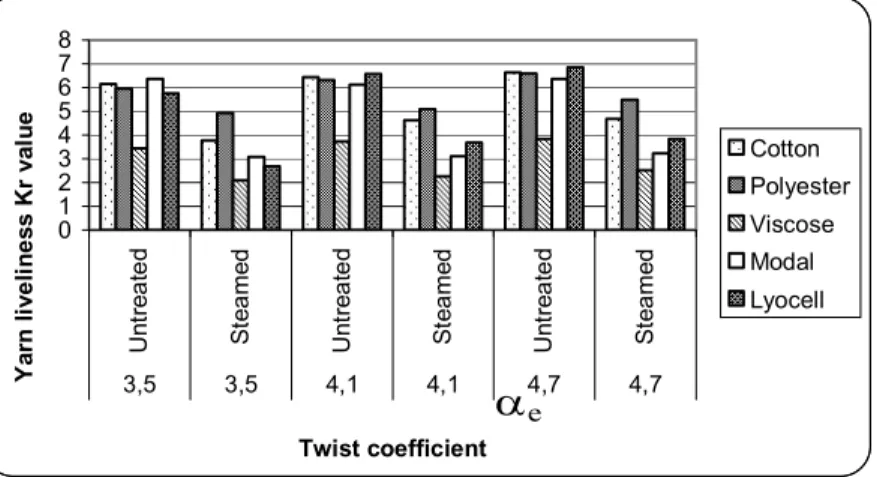
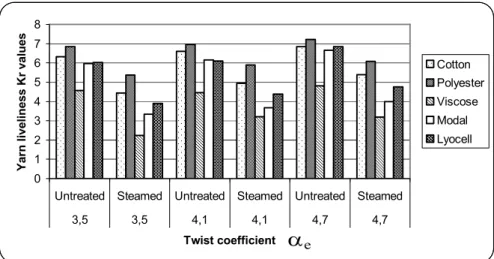
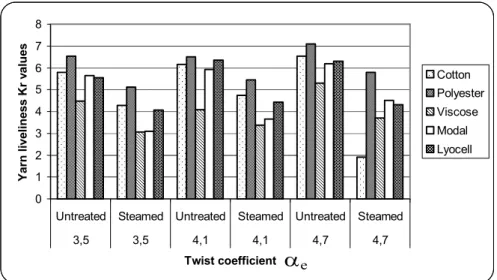
Yarn liveliness Kr (Kringel factor) values of untreated and steamed short staple yarn samples were given in Figure 2, Figure 3, Figure 4, Figure 5, Figure 6 and Figure 7.
0 1 2 3 4 5 6 7 8 U n tr e a te d S te a m e d U n tr e a te d S te a m e d U n tr e a te d S te a m e d 3,5 3,5 4,1 4,1 4,7 4,7 Twist coefficient Y a rn l iv e li n e s s K r v a lu e Cotton Polyester Viscose Modal Lyocell
e0 1 2 3 4 5 6 7 8
Untreated Steamed Untreated Steamed Untreated Steamed
3,5 3,5 4,1 4,1 4,7 4,7 Twist coefficient Y a rn l iv e li n e s s K r v a lu e Cotton Polyester Viscose Modal Lyocell
eFigure 3. Yarn liveliness values of Ne24 (24,61 tex) short staple OE rotor yarn samples
0 1 2 3 4 5 6 7 8
Untreated Steamed Untreated Steamed Untreated Steamed
3,5 3,5 4,1 4,1 4,7 4,7 Twist coefficient Y a rn l iv e li n e s s K r v a lu e s Cotton Polyester Viscose Modal Lyocell
eFigure 4. Yarn liveliness values of Ne24 (24,61 tex) short staple compact yarn samples
0 1 2 3 4 5 6 7 8
Untreated Steamed Untreated Steamed Untreated Steamed
3,5 3,5 4,1 4,1 4,7 4,7 Twist coefficient Y a rn l iv e li n e s s K r v a lu e s Cotton Polyester Viscose Modal Lyocell
e192
Yarn liveliness Kr (Kringel factor) values of untreated and steamed long staple yarn samples were given in Table 3 and Table 4.
The results of the statistical analyses for the parameters influencing the yarn liveliness properties of yarns (including the products of both the short staple spinning methods and the long staple spinning methods) were evaluated as below:
Influence of Raw Material on Yarn Liveliness
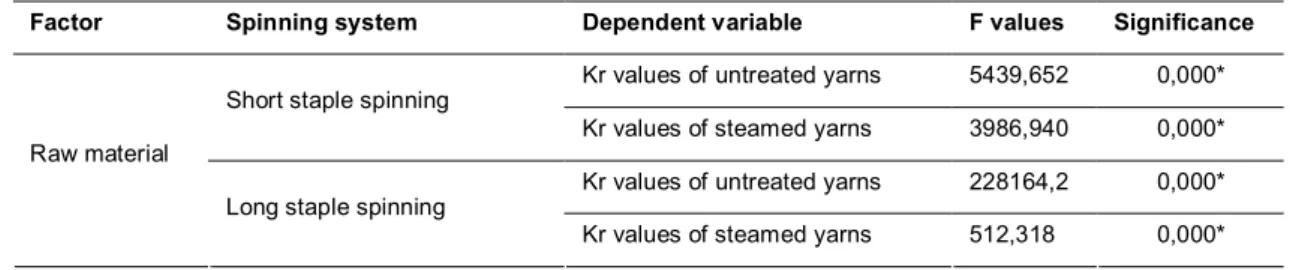
The results demonstrated that the influence of the raw material on the yarn liveliness were statistically significant for both spinning methods (the short staple spinning and the long staple spinning (Table 5).
The multiple comparison techniques for the short staple yarns revealed that the difference between cotton and lyocell yarns was statistically insignificant, whereas the differences between cotton and the other raw materials were statistically significant. The results suggest that the yarns having the viscose raw material tend to display the minimum level of yarn liveliness (Figure 8). 0 0,5 1 1,5 2 2,5 3
Untreated Steamed Untreated Steamed Untreated Steamed
3,5 3,5 4,1 4,1 4,7 4,7 Twist coefficient Ya rn l iv e li n e s s K r v a lu e s Cotton Polyester Viscose Modal Lyocell
eFigure 6. Yarn liveliness values of Ne16 (36 tex) short staple OE rotor yarn samples
0 1 2 3 4 5 6 7 8
Untreated Steamed Untreated Steamed Untreated Steamed
3,5 3,5 4,1 4,1 4,7 4,7 Twist coefficient Y a rn l iv e li n e s s K r v a lu e s Cotton Polyester Viscose Modal Lyocell
eTable 3. Yarn liveliness values of Nm32 (31,25 tex) long staple yarn samples Twist liveliness Kr values Twist coeffi-cient m 80 80 90 90 100 100 Raw material Spinning method
untreated steamed untreated steamed untreated steamed
Kr value 5,37 1,56 5,69 1,35 5,39 1,52 Ring Kr Cv% 1,77 24,77 2,55 27,10 2,39 19,57 Kr value 5,05 1,52 5,3 1,47 5,24 1,92 Siro spun Kr Cv% 2,51 38,46 1,99 35,14 1,84 12,95 Kr value 6,8 1,63 6,93 2 7,11 2,22 Compact Kr Cv% 1,39 21,65 1,81 13,33 1,40 16,28 Kr value 7,07 1,5 6,79 1,87 7,36 1,85 Wool Compact siro Kr Cv% 1,49 14,74 1,28 14,92 1,45 27,23 Kr value 6,44 2,4 6,66 2,92 6,89 2,76 Ring Kr Cv% 1,50 8,33 1,05 4,21 1,07 5,18 Kr value 6,4 3,13 6,57 3,09 6,74 3,11 Siro spun Kr Cv% 1,47 6,74 1,61 6,90 0,77 4,66 Kr value 7,53 3,27 7,53 3 7,68 3,31 Compact Kr Cv% 1,09 6,46 0,90 6,48 0,82 2,65 Kr value 7,46 3,35 7,58 3,2 7,75 3,53 PAN Compact siro Kr Cv% 0,93 7,34 1,36 6,25 0,91 5,0
Table 4. Yarn liveliness values of Nm20 (50tex) long staple yarn samples Twist liveliness Kr values Twist coeffi-cient m 80 80 90 90 100 100 Raw material Spinning method
untreated steamed untreated steamed untreated steamed
Kr value 5,34 2,19 5,76 2,71 5,76 2,59 Ring Kr Cv% 2,53 14,51 1,68 14,07 1,21 15,49 Kr value 5,06 2,27 5,16 2,7 5,55 2,72 Siro spun Kr Cv% 1,91 26,35 1,00 14,29 1,27 12,11 Kr value 6,59 1,83 6,46 2,03 6,48 2,34 Compact Kr Cv% 2,72 16,70 2,09 13,94 2,60 13,39 Kr value 7,07 2,08 7,02 2,72 7,25 2,52 Wool Compact siro Kr Cv% 1,64 14,47 1,85 9,13 1,97 6,42 Kr value 6,64 2,91 6,7 2,66 6,77 2,94 Ring Kr Cv% 1,77 5,72 1,00 15,16 1,40 7,21 Kr value 6,53 3,8 6,61 3,84 6,89 3,84 Siro spun Kr Cv% 1,03 10,08 1,12 9,60 0,82 7,18 Kr value 7,41 3,73 7,47 3,14 7,63 3,39 Compact Kr Cv% 1,00 5,06 0,65 12,31 1,24 2,18 Kr value 7,47 3,81 7,58 3,3 7,73 4,13 PAN Compact siro Kr Cv% 0,90 10,53 1,04 5,88 0,62 11,64
Table 5. Influence of raw material on yarn liveliness
Factor Spinning system Dependent variable F values Significance
Kr values of untreated yarns 5439,652 0,000* Short staple spinning
Kr values of steamed yarns 3986,940 0,000* Kr values of untreated yarns 228164,2 0,000* Raw material
Long staple spinning
194
The results of acrylic and wool yarns revealed higher yarn liveliness values for acrylic yarns. The differences of yarn liveliness values between acrylic yarns and wool yarns evolved as statistically significant for both yarn counts.
Numerous researchers mentioned about the influence of fibre’s flexural and torsional rigidity properties over yarn snarling (1) (2). Various raw materials have different specific flexural rigidity and torsional rigidity properties, thus the spun yarns out of
different raw materials have different yarn liveliness values. For example, Morton and Hearl (14) declared the typical specific flexural rigidity value for cotton fibres as 0,53 mN mm2/tex2, and for viscose fibres as 0,35 mN mm2/tex2.
Influence of Spinning Method on Yarn Liveliness
The comparison of spinning methods (short staple spinning and long staple spinning) revealed that spinning method had a statistically significant effect on yarn liveliness (Table.6). The minimum yarn liveliness values were observed in open-end yarns, whereas the maximum yarn liveliness values were observed in compact spun yarns.
The structural properties of the open-end yarns topen-end to retain lower yarn liveliness values. The fibre straps within the structure of open-end yarns restrain the release of the applied twist through the opposite direction. This is consistent with the results of previous studies of Kadoğlu (11), and Lünenschloss and Farber (12). Statistical analysis of data showed that there were significant differences in the twist liveliness values of long staple yarns produced by different spinning methods for = 0.05. The ranking for the twist liveliness values from the lowest value to highest value was siro-spun spinning, ring spinning, compact spinning and compact siro spinning respectively.
The results exposed that the compact spun yarns (both for short staple spinning and for long staple spinning methods) tend to have higher yarn liveliness values. The structure of compact spun yarns is different than the structure of ring spun yarns and compact spun yarns generally have a harder handle. For the yarns that spun with long staple spinning method, the siro-spun yarns displayed the lowest yarn liveliness values, whereas the compact siro-spun yarns displayed the highest values. Siro-spun yarns have stabile yarn construction (13).
Influence of Yarn Count on Yarn Liveliness
The influence of yarn count was recognized as statistically significant (Table 7). A fine yarn count gets more amount of twist than a coarse yarn count for the same spinning coefficient on a unit length of yarn, hence drawing forth a higher yarn liveliness value as
0 1 2 3 4 5 6 7 8
cotton PES viscose modal lyocell
Y a rn l iv e li n e s s K r v a lu e OE ring compact
Figure 8. The yarn liveliness Kr values of Ne24 (25 tex) (α e 4.1) yarns (untreated)
Table 6. Multiple comparison of spinning methods
%95 confidence interval Dependent
variable (I) method (J) method
Mean difference (I-J) significance Lower bound Upper bound compact -0.3330 .000* -0.3637 -0.3023 ring open end 3.8147 .000* 3.7839 3.8454 ring 0.3330 .000* 0.3023 0.3637 compact open end 4.1477 .000* 4.1169 4.1784 Ring -3.8147 .000* -3.8454 -3.7839 Yarn liveliness values (untreated yarns) open end compact -4.1477 .000* -4.1784 -4.1169 compact -0.6940 .000* -0.7316 -0.6564 ring open end 2.2887 .000* 2.2511 2.3263 ring 0.6940 .000* 0.6564 0.7316 compact open end 2.9827 .000* 2.9451 3.0203 ring -2.2887 .000* -2.3263 -2.2511 Yarn liveliness values (steamed yarns) open end compact -2.9827 .000* -3.0203 -2.9451 * Differences between means is significant for = 0,05.
0 1 2 3 4 5 6 7 8 wool PAN Y a rn l iv e li n e s s K r v a lu e s siro-spun ring compact compact siro
well. This is consistent with the previous studies of Milosavljevic and Tadic (16) and of Ureyen (15), these studies also similarly emphasis on the significance of the yarn count.
Influence of Yarn Twist Level on Yarn Liveliness
The results in the Table.7 pointed out that the twist level of the yarn over the yarn liveliness was statistically significant. As the twist coefficient rises, the yarn liveliness also rises. This is consistent with the other related studies (1, 8, 11, 15, 16).
Influence of Yarn Steaming on Yarn Liveliness
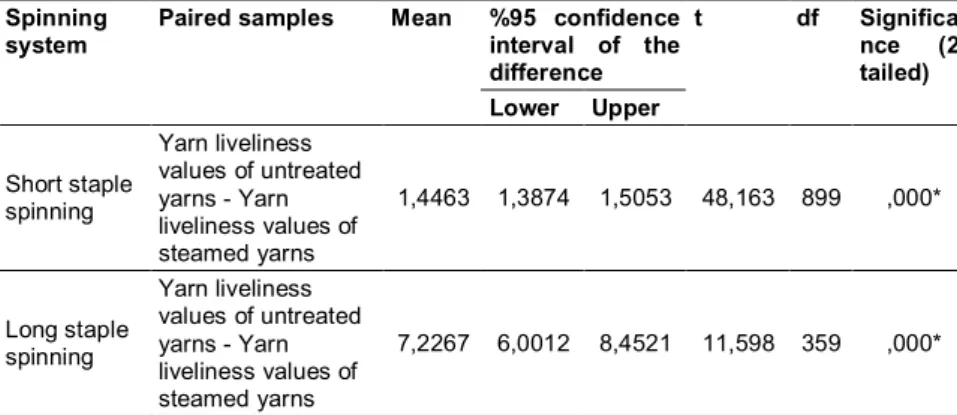
The results in Table.8 revealed that the heat setting (fixing) operation had a statistically significant influence over the yarn liveliness in consistency with the other previous studies (1, 3, 17).
Influence of the Other Physical Yarn Specifications on Yarn Liveliness
It was not observed any significant relation between the hairiness of, irregularity of and strength of yarns over the yarn liveliness characteristic.
Correlation of yarn liveliness and spirality of knitted fabric
It was detected a strong correlation between yarn liveliness characteristics and knitted fabric spirality as seen in tine results of Table.9. As the yarn liveliness value increases, the degree of knitted fabric spirality tendency also increases. The steaming operation substantially reduced the degree of knitted fabric spirality. As the twist coefficient increases, Kr yarn liveliness value also correspondingly increases, consequently increasing the severity of knitted fabric spirality, which is consistent with the results of previous studies (3, 4, 5, 7, 17).
4. CONCLUSION
Twisting process causes tension in yarn and fibers. Yarn tends to untwist itself due to the internal tension, showing property described as yarn liveliness (16). This phenomenon is regarded as a problem having detrimental effects over workability at textile processes along with quality losses.
In this study, the Kringel Factor Meter test instrument was used for measuring the yarn liveliness. The influences of raw material, spinning method, yarn count, twist coefficient and steaming operation over the yarn liveliness properties were analyzed. For this purpose samples were produced on both short staple spinning system and long staple spinning system.
The results demonstrate that the raw material, the spinning method, the yarn count, the twist coefficient and the steaming operation, each of them individually, have statistically significant influence over the yarn liveliness properties of the yarns for both short staple and also for long staple yarns. The statistical results of multiple comparison (Bonferroni) test method revealed that the minimum degree of yarn liveliness was attained for viscose yarns among the short staple ones. These results did not show any significant difference between cotton and lyocell yarns for their yarn liveliness properties. We can list that, the yarn liveliness values increases respectively in open-end spinning, ring spinning and compact spinning. The results demonstrate that the within the long staple yarns, the acrylic fibre yarns have higher yarn liveliness val-ues than wool yarns. The effect of spinning method on yarn twist liveli-ness was statistically significant. The compact siro yarns had the highest twist liveliness Kr value among the four spinning methods. They were followed by compact yarns, ring yarns and siro-spun yarns. After steaming process the compact siro yarns had the highest Kr values.
An obvious relation detected between the yarn liveliness values and knitted fabric spirality degrees within this study. In conclusion, the results of this study specifically suggest that as the yarn liveliness value Kr increases, the knitted fabric spirality degree increases as well.
Table 7. Influence of yarn count and twist level on yarn liveliness
Factor Spinning system Dependent variable F values Significance Kr values of untreated yarns 787,908 ,000* Short staple spinning
Kr values of steamed yarns 97,966 ,000* Kr values of untreated yarns 5,920 ,000* Yarn
count
Long staple spinning
Kr values of steamed yarns 1,896 ,111 Kr values of untreated yarns 1706,951 ,000* Short staple spinning
Kr values of steamed yarns 1075,442 ,000* Kr values of untreated yarns 39,023 ,000* Twist
level
Long staple spinning
Kr values of steamed yarns 1,630 0,166 * Differences between means is significant for = 0,05.
Table 8. Comparison of yarn liveliness values of steamed and untreated yarns
%95 confidence interval of the difference Spinning
system
Paired samples Mean
Lower Upper t df Significa nce (2- tailed) Short staple spinning Yarn liveliness values of untreated yarns - Yarn liveliness values of steamed yarns 1,4463 1,3874 1,5053 48,163 899 ,000* Long staple spinning Yarn liveliness values of untreated yarns - Yarn liveliness values of steamed yarns 7,2267 6,0012 8,4521 11,598 359 ,000*
* Differences between means is significant for = 0,05.
Table 9. Correlation of yarn liveliness and spirality (100%PAN, Nm32 (20 tex)) Yarn twist (T/m) Spirality of knitted fabric (before washing) Spirality of knitted fabric (after washing) Correlation (Pearson) 0,320 0,478 0,243 Yarn liveliness Kr values significance ,001** ,000** 0,011* * significant for α = 0,05. * * significant for α = 0,01.
196
REFERENCES / KAYNAKLAR
1. Primentas A., 2003, “Direct Determination of Yarn Snarliness”, Indian Journal of Fibre&Textile Research, Vol. 28, March, pp. 23-28. 2. Belov E.B., Lomov S.V., Truevtsev N.N., Bradshaw M.S., Harwood R.J., 2002, “Study of Yarn Snarling, Part I: Critical Parameters of
Snarling”, Journal of Textile Institute, Vol.93 Part I, No.4, pp. 341-365.
3. Araujo M., Smith G., 1989, “Spirality of Knitted Fabrics Part II: The Effect of Yarn Spinning Technology on Spirality”, Textile Research
Journal, Vol. 59 (6), pp. 350-356.
4. Chen Q.H., Au K.F., Yuen C.W.M., Yeung K.W., 2003, “Effects of Yarn and Knitting Parameters on the Spirality of Plain Knitted Wool Fabrics”, Textile Research Journal, ISSN: 0040-5175, Vol. 73 (5), pp. 421-426p.
5. Krishnakumar V., Dasaradan B.S., Subramaniayam V., 2004, “Effect of Fibre Quality Index on Spirality of Weft Knitted Fabrics”,
Pro-ceedings of 3rd INDO-CHECH Textile Research Conference, Liberec, Chech Republic.
6. Lau Y.M., Tao X.M., 1997, “Torque Balanced Singles Knitting Yarns Spun by Unconventionl Systems, Part II: Cotton Friction Spun DREF III Yarn”, Textile Research Journal, Vol.67, pp.815-828.
7. Primentas A., 2003, “Spirality of Weft-Knitted Fabrics: Part I-Descriptive Approach to the Effect”, Indian Journal of Fibre&Textile
Research, Vol.28, March, pp. 55-59.
8. Tao X.M., Lo W.K., Lau Y.M., 1997, “Torque Balanced Singles Knitting Yarns Spun by Unconventional Systems, Part I: Cotton Rotor Spun Yarn”, Textile Research Journal, Vol. 67(10), pp. 739-746.
9. The Wira Textile Data Book, 1982, Second Edition, Published by Wira, UK, ISBN: 0 900820 15 2, p. B125. 10. Ergün M., 1985, “SPSS for Windows”, Ocak Yayınevi, Ankara, p.107.
11. Kadoğlu H., 2000, “Pamuk Ipliklerinde Kendi Üzerine Kıvrılma Eğilimi (Iplik Canlılığı) Üzerine Bir Araştırma”, Tekstil Türkiye, Kasım, Sayı 3, pp.26-31.
12. Lünenschloss J., Farber K., 1981, “Zwirnen von Ring-und-OE-Rotorgarnen aus Baumwolle auf einer Doppeldrahtzwirnmaschine“,
Textile Praxis International, Juni, pp. 650-652 and August, pp.845-849
13. Bedez, T., Üreyen, M.E., 2007, “Sirospun Yöntemi ile Kısa Ştapelli Liflerin Eğrilmesi”, Tekstil ve Konfeksiyon, Yıl: 17, Sayı.1, pp. 31-36. 14. Morton W.E., Hearle J.W.S., 1993, “Physical Properties of Textile Fibres, The Textile Institute.
15. Ureyen M.E., 2005, “Pamuk Ring İpliklerinde İplik Canlılığı ile Lif Özellikleri ve Bazı İplik Özellikleri Arasındaki İlişkiler”, Tekstil ve
Kon-feksiyon, Yıl: 15, Sayı:1, pp. 12-18.
16. Milosavljevic S., Tadic T., 1991, “Snarling of Wool and Woolblend Yarns”, Proceedings of Gdynia Wool Federation, METLAN, p. 103-105.
17. Başer G., Çeken F., 1985, “Atkı Örme Kumaşlarda İplik ve Kumaş Parametrelerinin İlmek Eğikliğine Etkileri Üzerine Bir Araştırma”,
E.Ü.Mühendislik Fakültesi Dergisi, Seri.D, Tekstil Mühendisliği, Cilt.3, Sayı.2.
Bu araştırma, Bilim Kurulumuz tarafından incelendikten sonra, oylama ile saptanan iki hakemin görüşüne sunulmuştur. Her iki hakem yaptıkları incelemeler sonucunda araştırmanın bilimselliği ve sunumu olarak “Hakem Onaylı Araştırma” vasfıyla yayımlanabileceğine karar vermişlerdir.