Doctoral School of Management Sciences and Business Administration
Anikó Csilla Csepregi
The Knowledge Sharing and Competences of
Middle Managers
Doctoral (PhD) Dissertation - Repertory of the Theses
Supervisor: Dr. Lajos Szabó
Veszprém
2011
CONTENT
1 THE IMPORTANCE OF MIDDLE MANAGERS, THEIR KNOWLEDGE
SHARING AND THE COMPETENCES THEY FIND IMPORTANT FOR
KNOWLEDGE SHARING ... 1
2 EMPIRICAL STUDY ... 3
2.1 PURPOSE OF THE RESEARCH ... 3
2.2 THE STRUCTURE OF THE RESEARCH ... 3
2.3 RESEARCH QUESTIONS ... 4
2.4 RESEARCH MODEL ... 4
2.5 HYPOTHESES ... 5
2.6 METHOD USED TO TEST THE HYPOTHESES ... 6
2.7 THESES ... 7
3 THE SIGNIFICANCE OF THE RESEARCH RESULTS ... 11
4 FUTURE RESEARCH PLANS ... 11
5 REFERENCES ... 12
1
1 The Importance of Middle Managers, their Knowledge Sharing and the Competences they Find Important for Knowledge sharing
Nowadays knowledge is becoming an increasingly important factor of organizational competitiveness. Thus knowledge appears as an irreplaceable capital of organizations. The way knowledge is shared within the organization is essential and central not only to the success of the organization where it takes place but also among those who share it, since those who take part in the knowledge sharing process also benefit from it. If employees realize the positive and useful consequence of knowledge sharing it will also continue to facilitate the sharing of knowledge within the organization.
One of the reasons why I have found the topic of investigating middle managers interesting is that these employees can be found in the middle of their organizations. Thus they are related not only to their peers but also to the top-level and the first-level (operational level) management. Their special position within their organization also results in being a role model for the employees of their department or group, having a key position in vertical communication, being responsible for achieving business objectives by setting goals for their own department or group, giving suggestion and feedback to the top management for helping the improvement of the organization. Furthermore, middle managers play a key role in the knowledge sharing process as well. During the process of knowledge sharing these middle managers’ role has to change from control to mentor and they also have to assist others (Pommier et al. 2000). However middle managers often resist the realization of such changes. After building their careers and lives around the hierarchical pathways that exist within the organization, the appearance of a non-hierarchical work flow which does not require management behaviours concerning command-and-control may threaten them (Pommier et al. 2000). The fact regarding middle managers’ poor knowledge sharing and their resistance towards knowledge sharing should not be neglected since it may cause serious damages within the organization.
Regarding my research it is important to highlight that it focuses not only on the vertical but also on the lateral relationships of middle managers and investigates their roles and relationships in these directions. Thus the main direction of my research contains these middle managers’ downward vertical and the horizontal lateral relationships.
Knowledge sharing has been defined and measured differently in previous research. Yang and Chen (2007) have considered knowledge sharing behaviour as the degree to which knowledge is actually shared by organizational members with others. While according to Lin (2008) knowledge sharing takes place among various organizational units, and has been regarded as a knowledge exchange activity which occur for current or for future benefits. Knowledge sharing also takes place between different organizational units in the research of Matzler et al. (2008), who emphasise that during the knowledge sharing process one organizational unit’s experience, expertise, know-how etc. has an effect on other units. Finally, regarding the barriers to knowledge
2
sharing Christensen (2005), who has categorised the dimensions of barriers to knowledge sharing into several categories, has revealed that one of these categories is the structural misfit between the willingness and ability to share knowledge.
This research and their results have inspired me in developing a method by which knowledge sharing, especially middle managers’ maturity of knowledge sharing, could be defined and measured regarding my research. I developed a measure with which the maturity of the knowledge sharing of middle managers, and the managers and subordinates they are in connection with, can be determined. Thus in my research, knowledge sharing is not only investigated between different organizational units but also within one organizational unit. This shows similarities with previous knowledge sharing research although previous ones did not investigate middle managers and their knowledge sharing.
Knowledge cannot be shared efficiently without having the adequate competences. Thus it is also important to be aware of those competences that are necessary for knowledge sharing. From a large number of competences, those which are needed for knowledge sharing can be revealed with the help of middle managers, who will finally use them to share knowledge. My research uses the term competence instead of competency and adopts the definition of Gibb (1990) who emphasises the importance of attitudes, knowledge, skills and also motivation to perform certain tasks, since these characteristics are also useful for the middle managers to fulfil their task.
My competence grouping regarding the various classifications and features of competences has adapted Sonntag, Schäfer-Rauser’s (1993), Kuhl, Fuhrmann’s (1997) and Forgács et al.‘s (2002) classification of competences, since I have found these categorisations the best for revealing the competences found important for knowledge sharing. To reveal as much competences as possible concerning competences found important for knowledge sharing by middle managers I have extended these categories with an additional category as well, which is other characteristics and competences. The aim of examining methodological, social, professional, personal competences and other characteristics and competences has been to reveal those competences which are desirable for knowledge sharing according to middle managers. Furthermore these competences after being developed can foster the knowledge sharing within organizations.
Being aware of the important position of middle managers within the organization, the resistance that may appear because of knowledge sharing and the competences that are important for knowledge sharing, show the difficulties and antinomy experienced in the role of middle managers.
3
2 Empirical Study
2.1 Purpose of the Research
The purpose of this research has been to:
• reveal those components that describe middle managers’ maturity of knowledge sharing who work at medium- and large-sized enterprises in Hungary;
• reveal those competence groups and competences that middle managers, who work at medium- and large-sized enterprises in Hungary, find important for knowledge sharing;
• discover which components of individual and organizational characteristics result in differences in the elements of these middle managers’ maturity of knowledge sharing;
• discover which components of individual and organizational characteristics result in differences within the competence groups these middle managers find important for knowledge sharing.
2.2 The Structure of the Research
A questionnaire was created for the research. Regarding individual and organizational characteristics data were collected with this questionnaire. To reveal the elements of maturity of knowledge sharing and competences found important for knowledge sharing this questionnaire was also used to collecting data which was afterwards analyzed.
The empirical study is based on a quantitative research during which statistical and econometric analysis have been made on the database collected with a questionnaire. The questionnaire has been sent to the enterprises of middle managers working at medium- and large-sized enterprises in Hungary. The data collection was supported by the Department of Management, University of Pannonia between 2007 and 2010. 4000 medium- and large-sized enterprises have been selected randomly and questionnaires have been sent to these enterprises by post and via e-mail. Besides the Hungarian and the English Microsoft Office Word versions of the questionnaire, the electronic version of the Hungarian and the English questionnaire was also created by LimeSurvey (an Online Survey Tool). A Hungarian and an English homepage were established for the research thus the participants could receive information about the research. On these Homepages the electronic and the printable Microsoft Office Word versions of the questionnaires, brief information about the research, and contact information can be found.
The selected enterprises have been asked to have the questionnaire filled in by at least one of their middle managers. Between the years of 2007 and 2010 400 questionnaires have been returned by post, via e-mail and via the electronic version of the questionnaire.
4
Data analysis was needed to present the observations and to investigate the elements of the research model and the relationships between its elements. Microsoft Office Excel 2007 has been used to conduct statistical analysis on the database collected from the questionnaires. The database did not contain personal information about the middle manager who filled in the questionnaire and company information in connection with the enterprise where the middle manager worked. Thus anonymousness was guaranteed regarding the results of the analysis. In addition SPSS Statistics 17.0 has also been used to conduct econometric analysis.
2.3 Research Questions
Regarding the purpose of this research the following questions have needed to be answered:
Q1: With what kind of components can middle managers’ maturity of knowledge
sharing who work at medium-and large-sized enterprises in Hungary be described?
Q2: Which competence groups are found important for sharing knowledge by middle
managers who work at medium-and large-sized enterprises in Hungary?
Q3: How do individual and organizational characteristics influence middle managers’
maturity of knowledge sharing who work at medium-and large-sized enterprises in Hungary?
Q4: How do individual and organizational characteristics influence the competence
groups middle managers, who work at medium-and large-sized enterprises in Hungary, find important for knowledge sharing?
2.4 Research Model
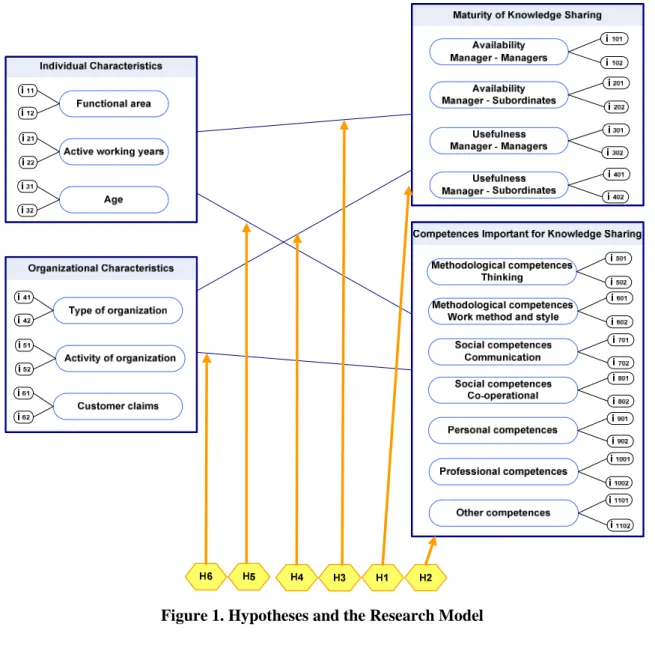
To answer these research questions a research model has been created. Figure 1 presents this research model in which each presumed element of the research, their presumed relationships and the hypotheses regarding the research can be seen.
5
Figure 1. Hypotheses and the Research Model
Six hypotheses have been determined based the research questions and research model.
2.5 Hypotheses
H1: Middle managers’ maturity of knowledge sharing who work at medium- and
large-sized enterprises in Hungary can be characterised by the availability among middle managers, the availability among the middle managers and their subordinates, the usefulness of knowledge among the middle managers, and the usefulness of knowledge among the middle managers and their subordinates.
H2: The competences found important for knowledge sharing by middle managers
who work at medium- and large-sized enterprises in Hungary can be characterised by the following competence groups: methodological competences needed for thinking, methodological competences used for work method and style, social competences connected with communication skills, social competences connected with co-operational skills, professional competences, personal competences, and other characteristics and competences.
6
H3: Difference can be found in the elements of middle managers’ maturity of
knowledge sharing who work at medium- and large-sized enterprises in Hungary on the basis of individual characteristics.
H4: Difference can be found in the elements of middle managers’ maturity of
knowledge sharing who work at medium- and large-sized enterprises in Hungary on the basis of organizational characteristics.
H5: Difference can be found within the competence groups found important for
knowledge sharing by middle managers who work at medium- and large-sized enterprises in Hungary on the basis of individual characteristics.
H6: Difference can be found within the competence groups found important for
knowledge sharing by middle managers who work at medium- and large-sized enterprises in Hungary on the basis of organizational characteristics.
2.6 Method used to Test the Hypotheses
My initial assumption regarding hypothesis 1 and hypothesis 2 was that it could be described by certain number of elements (4 concerning maturity of knowledge sharing and 7 regarding competence groups found important for knowledge sharing). Furthermore these elements could retain as much of the information (variation) of the original variables as possible. Thus I have chosen principal component analysis from the available methods, since the requirements of retaining large amount of information of the original variables by certain number of components can only be tested and proved by the usage of principal component analysis. Another reason of choosing this method is that the principal components are based upon the measured responses (DeCoster 1998). Furthermore as a result of principal component analysis the number of principal components is also less then the number of variables, since this method reduces the number of variables (Myatt, Johnson 2009).
Regarding hypothesis 3, hypothesis 4, hypothesis 5 and hypothesis 6 to reveal the differences that can be found in the elements of maturity of knowledge sharing or within the competence groups found important for knowledge sharing regarding the influencing factors I have decided to use decision tree as the first method, since with the use of individual or organizational characteristics, as influencing factors, it has been possible to reveal classes within them. After separating classes with the use of decision tree, I have compared in pairs the group means of these classes with the use of analysis of variance. This was followed by the step when the groups with the most favourable results within each class have been separated from the groups with the least favourable results. Knowing this I have combined the most and the least favourable results and based on these combinations additional subgroups have been formed. Depending on the number of these groups, I have chosen analysis of variance or post hoc test, because by comparing the group means I have aimed to reveal whether significant difference exists, based on the individual or organizational characteristics, in these classes created within the elements of middle managers’ maturity of
7
knowledge sharing or the competence groups found important for knowledge sharing by middle managers. Nominal or categorical variables can be used during these methods and as independent variables at least two independent groups can be created (Urdan 2005). Since individual and organizational characteristics match these characteristics, these methods seemed to be the best for this analysis.
2.7 Theses
After the investigation the following theses and sub-theses have been determined:
T1: Middle managers’ maturity of knowledge sharing who work at medium- and
large-sized enterprises in Hungary is characterized by the availability among middle managers, the availability among the middle managers and their subordinates, the usefulness of knowledge among middle managers, and the usefulness of knowledge among the middle managers and their subordinates.
T2: The competences found important for knowledge sharing by middle managers
who work at medium- and large-sized enterprises in Hungary are characterized by the following competence groups: methodological competences needed for thinking, methodological competences used for work method and style, social competences connected with communication skills, social competences connected with co-operational skills, professional competences, personal competences, and intercultural competences.
T3: Difference is found in the elements of middle managers’ maturity of knowledge
sharing who work at medium- and large-sized enterprises in Hungary on the basis of individual characteristics.
T3.1: Difference is found in the availability among middle managers on the basis of individual characteristics primarily by the middle manager’s functional area
and secondly by the middle manager’s active working years which are spent at the investigated organization.
T3.2: Difference is found in the availability among the middle managers and their subordinates on the basis of individual characteristics primarily by the middle
manager’s active working years which are spent at the investigated organization and secondly by the middle manager’s functional area .
T3.3: Difference is found in the usefulness of knowledge among middle managers
on the basis of individual characteristics by the middle manager’s active
working years which are spent at the investigated organization.
T3.4: Difference is found in the usefulness of knowledge among the middle managers and their subordinates on the basis of individual characteristics
primarily by the middle manager’s active working years which are spent at the investigated organization and secondly by the middle manager’s age.
8
T4: Difference is found in the elements of middle managers’ maturity of knowledge
sharing who work at medium- and large-sized enterprises in Hungary on the basis of organizational characteristics.
T4.1: Difference is found in the availability among middle managers on the basis of organizational characteristics primarily by the type of the investigated
organization and secondly by the activity of the investigated organization.
T4.2: Difference is found in the availability among the middle managers and their subordinates on the basis of organizational characteristics primarily by the
type of the investigated organization and secondly by the activity of the investigated organization.
T4.3: Difference is found in the usefulness of knowledge among middle managers
on the basis of organizational characteristics by the customer claims fulfilled by the investigated organization.
T5: Difference is found within the competence groups found important for knowledge
sharing by middle managers who work at medium- and large-sized enterprises in Hungary on the basis of individual characteristics.
T5.1: Difference is found in the methodological competences needed for thinking
on the basis of individual characteristics by the middle manager’s functional
area.
T5.2: Difference is found in the social competences connected with communication skills on the basis of individual characteristics primarily by the middle
manager’s age and secondly by the middle manager’s functional area.
T5.3: Difference is found in the intercultural competences on the basis of individual characteristics by the middle manager’s age.
T6: Difference is found within the competence groups found important for knowledge
sharing by middle managers who work at medium- and large-sized enterprises in Hungary on the basis of organizational characteristics.
T6.1: Difference is found in the methodological competences used for work method and style on the basis of organizational characteristics primarily by customer
claims fulfilled by the investigated organization, secondly by the activity of the investigated organization, and thirdly by the type of the investigated organization.
T6.2: Difference is found in the social competences connected with co-operational skills on the basis of organizational characteristics by the type of the
investigated organization.
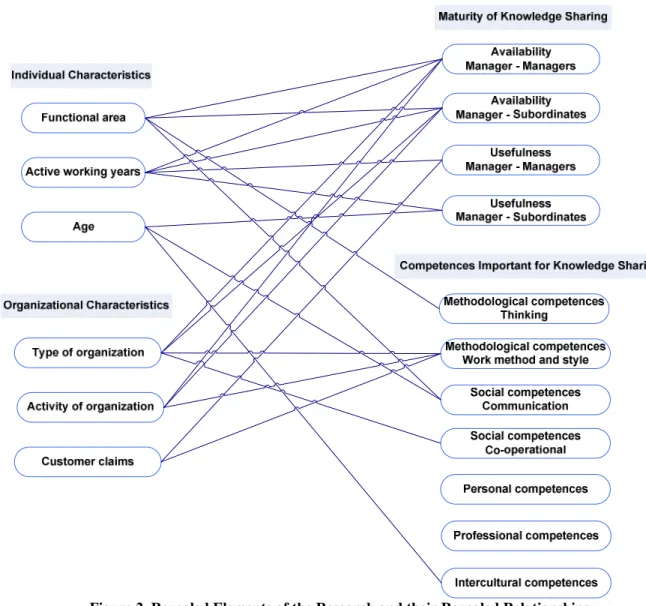
Based on the above presented theses and sub-theses the revealed elements of the research and the revealed relationships between them can be seen in Figure 2.
9
Figure 2. Revealed Elements of the Research and their Revealed Relationships
This research has revealed that middle managers’ maturity of knowledge sharing who work at medium- and large-sized enterprises in Hungary can be measured by the availability among middle managers, the availability among the middle managers and their subordinates, the usefulness of knowledge among middle managers, and the usefulness of knowledge among the middle managers and their subordinates.
The availability among middle managers contains other middle mangers’ availability towards the investigated middle managers and the investigated middle managers’ availability towards other middle mangers. The availability among the
middle managers and their subordinates component consists of the availability of
the investigated middle mangers’ subordinates towards the middle managers and the investigated middle managers’ availability towards their subordinates. The usefulness
of knowledge among middle managers comprises the usefulness of other middle
managers’ knowledge to the investigated middle managers and also the usefulness of the investigated middle managers’ knowledge to other middle managers. The
usefulness of knowledge among the middle managers and their subordinates
includes the usefulness of knowledge of the investigated middle managers’ subordinates to the investigated middle managers and usefulness of the investigated middle managers’ knowledge to their subordinates.
10
This research has also revealed that the competence groups found important for
knowledge sharing by middle managers who work at medium- and large-sized
enterprises in Hungary are methodological competences needed for thinking, methodological competences used for work method and style, social competences connected with communication skills, social competences connected with co-operational skills, professional competences, personal competences and intercultural competences.
Methodological competences needed for thinking contains competences such as
logical thinking, systematizing ability, analytical ability, and system analysis capability. Competences as awareness of organizational goals, result-orientation, and practical comprehension of tasks belong to methodological competences used for
work method and style. Social competences connected with communication skills
include the competences of ability of summarizing, easy capacity of understanding, and ability of explaining. Social competences connected with co-operational skills consist of capability of initiation, capability of maintaining relationship, objectivity, ability of feedback, and empathy. Professional competences contain working experiences gained in other special fields, experience gained by individual interests, experience at other types of organizations, and experience at organizations similar to present. Personal competences include stamina, capability of undertaking tasks, and ability of managing stress. Studies abroad, job abroad, and job in international surroundings belong to intercultural competences.
Difference has been found in all four elements of maturity of knowledge sharing of middle managers who work at medium- and large-sized enterprises in Hungary on the basis of at least one of the individual characteristics which are functional area, active working years or age.
Furthermore difference has been found in three elements of maturity of knowledge
sharing of middle managers who work at medium- and large-sized enterprises in
Hungary on the basis of at least one of the organizational characteristics which are type and activity of the investigated organizations and the customer claims fulfilled by these organizations. The three elements of maturity of knowledge sharing have been availability among middle managers, availability among the middle managers and their subordinates, and the usefulness of knowledge among middle managers.
This research has revealed a difference within three competence groups found
important for knowledge sharing by middle managers who work at medium- and
large-sized enterprises in Hungary on the basis of at least one of the individual
characteristics which are functional area, and age. The three competence groups
found important for knowledge sharing have been methodological competences needed for thinking, social competences connected with communication skills, and intercultural competences.
As a result of this research difference has been found within two competence groups
found important for knowledge sharing by middle managers who work at medium-
and large-sized enterprises in Hungary on the basis of at least one of the
organizational characteristics which are type and activity of the investigated
11
competence groups found important for knowledge sharing have been methodological competences used for work method and style and social competences connected with co-operational skills.
3 The Significance of the Research Results
The fact that no scientific research has been carried out in Hungary which measured middle managers working at medium- and large-sized enterprises concerning their knowledge sharing and the competence groups and competences they find important for knowledge sharing increases the importance of this research.
The results of this research could help not only the middle managers of medium- and large-sized enterprises in Hungary but also the top managers and the employees working under the middle manager as well. The above mentioned beneficiaries of this research will be able to:
• measure their middle managers’ maturity of knowledge sharing after which they can learn how to develop their maturity of knowledge sharing;
• determine which individual and organizational characteristics affect middle managers’ maturity of knowledge sharing;
• define which competence groups and competences are important for knowledge sharing after which they can learn which competences need to be developed to share knowledge better;
• find out which individual and organizational characteristics influence the competence groups that middle managers find important for knowledge sharing.
4 Future Research Plans
As a continuation of this research the following options could be taken into consideration:
• if this research is carried out among middle managers in a few years changes in the middle managers’ maturity of knowledge sharing and changes regarding individual and organizational characteristics could be revealed;
• if this research is carried out among middle managers in a few years changes within the competence groups middle managers find important for knowledge sharing and changes regarding individual and organizational characteristics could also be revealed;
• if managers or employees from other levels of the organization are also investigated then their maturity of knowledge sharing and those competence groups that they find important for knowledge sharing could be revealed, and their results could be compared with the recent results of middle managers;
• if this research is extended to other countries then the Hungarian results of the research could be compared with the results of other countries considering the national cultural differences as well;
• if other parts of the research questionnaire is examined in Hungary and extended to other countries as well then the results could be compared.
12
5 References
Christensen, P.H. (2005) Facilitating Knowledge Sharing: A Conceptual Framework. SMG Working Paper No. 4/2005. SMG WP 4/2005.
DeCoster, J. (1998) Overview of Factor Analysis. pp. 1-7. Retrieved 12th August 2010, 2:15 pm from http://www.stat-help.com/factor.pdf
Forgács K., Kaucsek, Gy., Simon, P. (2002) A Kompetens Munkaerı Értékelése
Pszichológiai Teszttel és Írásanalízissel. Munkaügyi Szemle. 16(9). pp.12-18.
Gibb, A. (1990) Training the Trainers of Small Business. Journal of European Industrial Training. 14(1). pp. 17-25.
Kuhl, J., Fuhrmann, A. (1997) Selbststeuerungs–Inventar: SSI (Kurzversion) Universität Osnabrück.
Lin, W.B. (2008). The Effect of Knowledge Sharing Model. Expert Systems with Applications. 34(2). pp. 1508-1521.
Matzler, K., Renzl, B., Müller, J., Herting, S., Mooradian, T.A. (2008) Personality Traits
and Knowledge Sharing. Journal of Economic Psychology. 29(3). pp. 301-313.
Myatt, G.J., Johnson, W.P. (2009) Making Sense of Data II: A Practical Guide to Data
Visualization, Advanced Data Mining Methods, and Applications. Wiley-Blackwell.
pp. 126-129.
Pommier, M., Shneier, L., Denning, S. (2000) The Springboard: How Storytelling Ignites
Action in Knowledge-Era Organizations. Boston. London: Butterworth Heinemann
Sonntag, K., Schäfer-Rauser, U. (1993) Selbsteinschatzung Berufliche Kompetenzen bei
der Evalution von Bildungsmassnahmen. Zeitschrift für Arbeits – und
Organisationspsychologie. 37(4). pp. 163-171.
Urdan, T.C. (2005) Statistics in Plain English (2nd ed.). Mahwah, NJ: Lawrence Erlbaum. pp. 81-92.
Yang, C., Chen, L.C. (2007) Can Organizational Knowledge Capabilities Affect
Knowledge Sharing Behavior? Journal of Information Science. 33(1). pp. 95-109.
6 Publications
Chapters in Books
Szabó, L., Csepregi, A. (2011) Válságkezelés – Kultúraváltás – Tudásmegosztás: Tudatosan Alakított Folyamatok? in Noszkay, E. (Ed.) Tudásból Várat…. Tudásmenedzsment Elméleti és Módszertani Megközelítésben. pp. 233-244.
Gaál, Z., Szabó, L., Obermayer-Kovács, N., Kovács, Z., Csepregi, A. (2011) Knowledge Management Profile: An Innovative Approach to Map Knowledge Management Practice. in Eardley, A., Uden, L. (Ed.) Innovative Knowledge Management: Concepts for Organizational Creativity and Collaborative Design. pp. 253-263.
Gaál, Z., Szabó, L., Kovács, Z., Obermayer-Kovács, N., Csepregi, A. (2008) Cultural Competencies of Knowledge Management. in Hawamdeh, S., Stauss, K., Barachini, F. (Ed.) Series on Innovation and Knowledge Management – Vol. 7, Knowledge Management, Competencies and Professionalism. World Scientific Publishing. 2008. pp. 323-334.
13
Journals
Szabó, L., Csepregi, A. (2011) Competences Found Important for Knowledge Sharing: Investigation of Middle Managers Working at Medium- and Large-sized Enterprises. The IUP Journal of Knowledge Management. 9(3, July), pp. 41-58
Antonova, A., Csepregi, A., Marchev Jr, A. (2011) How to Extend the ICT Used at Organizations for Transferring and Sharing Knowledge. The IUP Journal of Knowledge Management. 9(1, January), pp. 37-56.
Gaál, Z., Szabó, L., Obermayer-Kovács, N., Csepregi, A. (2010) Successful Knowledge Management and Knowledge Sharing in Hungarian Enterprises. Club of Economics in Miskolc: Theory, Methodology, Practice. 6(2, December), pp. 11-18. Szabó, L., Csepregi, A. (2009) A Gazdasági Válság Hatása a Szervezeti Kultúra Alakulására – Jó Irányba Megyünk? Harvard Business Review. 11(11), pp. 29-35. Gaál, Z., Szabó, L., Kovács, Z., Obermayer-Kovács, N., Csepregi, A. (2008) Consequence of Cultural Capital in Connection with Competitiveness. International Journal of Knowledge, Culture and Change Management. 8(10), pp.79-90.
Proceedings
Gaál, Z., Szabó, L., Csepregi, A. (2011) Individual Characteristics Influencing Competences Found Important for Knowledge Sharing by Middle Managers. in Proceedings of the 6th International Conference on Business Excellence. 14th-15th October 2011. Brasov, Romania. Vol. 1. pp. 221-224.
Gaál, Z., Szabó, L., Obermayer-Kovács, N., Csepregi, A. (2011) Middle Managers’ Maturity of Knowledge Sharing: Investigation of Middle Managers Working at Medium- and Large-sized Enterprises. in Proceedings of 12th European Conference on Knowledge Management. 1st-2nd September 2011. Passau, Germany. pp. 306-314. Antonova, A., Csepregi, A. (2011) Sharing and Transferring Knowledge – How to Increase Efficiency of Soft Techniques for KS. in Proceedings of 12th European Conference on Knowledge Management. 1st-2nd September 2011. Passau, Germany. pp. 37-44.
Gaál, Z., Szabó, L., Csepregi, A. (2010) Perspectives of Knowledge Sharing and Organizational Culture: Investigation at Hungarian Organizations. in Proceedings of the 5th International Conference on Business Excellence. 15th-16th October 2010. Brasov, Romania. pp. 195-198.
Antonova, A., Csepregi, A., Marchev Jr, A. (2010) How to Extend the ICT Used at Companies for Transferring and Sharing Knowledge. in Software, Services & Semantic Technologies. (S3T) 2nd International Conference. 11th-12th September 2010. Varna, Bulgaria. pp. 147-151.
14
Szabó, L., Kovács, Z., Csepregi, A., Antonova, A., Jenei, E. (2010) Is Knowledge Shared the Same Way? A Comparison of Three Central-Eastern European Countries' National Culture and Knowledge Sharing. in KMO 2010 - Roles and Challenges of Knowledge Management in Innovation for Services and Products. 5th International Knowledge Management in Organizations Conference. 18th-19th May 2010. Veszprém, Hungary. pp. 21-30.
Gaál, Z., Obermayer-Kovács, N., Csepregi, A., Antonova, A., Jenei, E. (2010) Clan, Adhocracy, Market, Hierarchy? Investigating Organizational Culture Types and Knowledge Sharing in Bulgaria, Hungary and Serbia. in KMO 2010 - Roles and Challenges of Knowledge Management in Innovation for Services and Products. 5th International Knowledge Management in Organizations Conference. 18th-19th May 2010. Veszprém, Hungary. pp. 52-61.
Gaál, Z., Szabó, L., Kovács, Z., Obermayer-Kovács, N., Csepregi, A. (2010) Clan, Adhocracy, Market or Hierarchy? Which is the Best for Knowledge Sharing in Hungary? in Proceedings of 2nd European Conference on Intellectual Capital. 29th-30th March 2010. Lisbon, Portugal. pp. 249-256.
Gaál, Z., Szabó, L., Kovács, Z., Obermayer-Kovács, N., Csepregi, A. (2009) Knowledge Sharing Investigation: What is the Knowledge Sharing of Managers Like? in Proceedings of 10th European Conference on Knowledge Management. 3rd-4th September 2009. Vicenza, Italy. pp. 286-293.
Gaál, Z., Szabó, L., Kovács, Z., Obermayer-Kovács, N., Csepregi, A. (2009) Knowledge Sharing Research in Hungary: Investigating the Knowledge Sharing of Hungarian Managers. in KMO 2009 – Knowledge Management and Service Science. 4th International Knowledge Management in Organizations Conference. CD. 23rd-24th June 2009. Taipei,Taiwan.
Csepregi, A. (2008) Investigating Managers in Hungary: What is Their Knowledge
Sharing Like? in Üzleti Tudományok, Fiatal Kutatók Szimpóziuma, Magyar Tudomány Ünnepe 2008. 7th November 2008. Budapest, Hungary. pp. 19-28.
Gaál, Z., Szabó, L., Kovács, Z., Obermayer-Kovács, N., Csepregi, A. (2008) Knowledge Management Profile” Maturity Model. in Proceedings of 9th European Conference on Knowledge Management. 4th-5th September 2008. Southampton, England. pp. 209-216.
Gaál, Z., Szabó, L., Kovács, Z., Obermayer-Kovács, N., Csepregi, A. (2008) The Challenge: Facilitating Powerful Knowledge Sharing. Knowledge Management in Organizations. in KMO 2008 - Challenges of Knowledge Management. Third International Knowledge Management in Organizations Conference. 24th-25th June 2008. Vaasa, Finland. pp. 399-410.
15
Csepregi, A. (2008) The Effect of Culture and Leadership on Knowledge Sharing. in
New Trends and Tendencies in Human Resource Management – East Meets West. Session 2. CD. 13th-14th June 2008. Pécs, Hungary. pp. 1-8.
Obermayer-Kovács, N., Csepregi, A. (2008) Towards Competitiveness: The Shape of Knowledge and its Influence on Knowledge Sharing. in microCAD 2008 International Scientific Conference. 20th-21st March 2008. Miskolc, Hungary. pp. 47-52.
Obermayer-Kovács, N., Csepregi, A. (2007) Perspectives of Knowledge Management: Investigations at Hungarian Organizations. in Üzleti Tudományok, Fiatal Kutatók Szimpóziuma. Magyar Tudomány Ünnepe 2007. 16th November 2007. Budapest, Hungary. pp. 27-36.
Csepregi, A. (2007) Knowledge Sharing of Middle Managers. in 6th International
Conference of Ph.D. Students. Economics I. 12th-18th August 2007. Miskolc, Hungary. pp. 103-108.
Proceedings (papers written in Hungarian)
Szabó, L., Obermayer-Kovács, N., Csepregi, A. (2009) Tudásmegosztás kihívásai a válságban - Fókuszban a Magyarországi Vezetık. in A Karbantartás Kihívásai a Válságban - Amikor a Nagyok is Táncolni Tanulnak. Nemzetközi Konferencia. 8th-9th June 2009, Veszprém, Hungary. pp. 169-182.
Szabó, L., Csepregi, A., Jenei, E. (2009) Tudásmegosztás kihívásai a válságban Magyarországon és Szerbiában. in A Karbantartás Kihívásai a Válságban - Amikor a Nagyok is Táncolni Tanulnak. Nemzetközi Konferencia. 8th-9th June 2009. Veszprém, Hungary. pp. 183-196.
Szabó, L., Obermayer-Kovács, N., Csepregi, A. (2008) Tudásmenedzsment a Karbantartásban. Tudásmegosztóak vagyunk? Fókuszban a Karbantartási Vezetık. in A Karbantartás Fókuszában: Érték – Költség – Versenyképesség. Nemzetközi Konferencia. 16th-18th June 2008. Veszprém, Hungary. pp. 131-144.
Szabó, L., Dancsecz, G., Csepregi, A. (2007) Karbantartási projektek vezetése és szervezése. in A Karbantartás Fókuszában: Minıség – Hatékonyság - Rendelkezésre állás. Nemzetközi Konferencia. 11th-13th June 2007. Veszprém, Hungary. pp. 52-72.
Csepregi, A. (2007) Tudásmenedzsment, Tudásmegosztás Közép-, és
Kelet-Európában. in Európai Integráció – Elvek és Döntések Gazdasági Fejlıdés Európában. II. Pannon Gazdaságtudomány Konferencia. 7th June 2007. Veszprém, Hungary. pp. 155-160.