Factors Potentially Affecting the Viability
and Success of Biodiversity Offsetting to
Compensate for Nightingale Habitat Loss
Report AuthorsChris M. Hewson & Robert J. Fuller
October 2012
British Trust for Ornithology
The British Trust for Ornithology, The Nunnery, Thetford, Norfolk IP24 2PU
Registered Charity No. 216652
1 CONTENTS Page No. List of Figures...3 1. INTRODUCTION...4
1.1 Aims of this Report...4
1.2 Current National Status of Nightingales...4
2. SUMMARY OF LODGE HILL POPULATION IN 2012...6
3. ECOLOGICAL AND BEHAVIOURAL REQUIREMENTS OF NIGHTINGALES IN BRITAIN...8
3.1 Climatic Envelope within Britain – Current and Future...8
3.2 Altitude and Soil Type...8
3.3 Broad Habitat Types Occupied...9
3.4 Vegetation Structure...10
3.5 Food Availability...13
3.6 Social Factors...13
4. DOES HIGH DENSITY MEAN HIGH QUALITY?...15
5. VEGETATION DYNAMICS AND CURRENT HABITAT MANAGEMENT PRACTICES...16
6. CASE STUDIES...19
6.1 Within the Core Range...19
2
Page No.
7. WHAT FACTORS NEED TO BE CONSIDERED IN CREATING NEW HABITAT?...26
7.1 Key Uncertainties...26
7.2 Major Limiting Factors Concerning Site Choice that Affect Likelihood of Success Given Above Uncertainties...27
7.3 Management Considerations...29
8. HOW MUCH LAND MIGHT BE NEEDED?...30
9. SUMMARY AND CONCLUSIONS...33
Acknowledgements...36
3
LIST OF FIGURES
Page No.
Figure 1 Cross section of typical thicket occupied by Nightingales on the eastern
edge of the Cambridgeshire / Suffolk Fens...11
Figure 2 Home ranges and song territories of three Nightingales at Paxton Pits ...12
4
1. INTRODUCTION
1.1 Aims of this Report
This report aims to provide ornithological information to facilitate a Technical Workshop on
‘Nightingale Habitat Offsetting’ relating to the proposed Lodge Hill development. Principally, it
addresses the issue of whether it is feasible to create habitat for Nightingales on a large scale in
Britain, and specifically whether this can be done close to Lodge Hill – e.g. in Kent or an adjacent part
of south‐east England. This includes a review of our current understanding of habitat selection in
the species, in terms of what constitutes suitable habitat, and the identification of the factors likely
to affect the chances of colonisation and successful Nightingale Luscinia megarhynchos population
establishment, should potentially suitable habitat be established. The amount of land needed to
accommodate the number of birds currently present at Lodge Hill, in habitat of equivalent quality, is
also considered, along with the factors that need to be considered in estimating the effect that the
development will have on Nightingale numbers at the site.
1.2 Current National Status of Nightingale
The Nightingale population in Britain has undergone severe and on‐going declines in the last 45
years. According to the BTO/RSPB/JNCC Breeding Bird Survey the species declined by 60% between
1995 & 2009, whilst the longer‐term CBC/BBS index indicates a decline of more than 90% in the last
40 years (Holt, Hewson & Fuller 2012). The latter decline is sufficiently great that had those figures
been available at the time of the last Birds of Conservation Concern assessment, the species would
have been placed on the Red list, rather than the Amber list that it currently sits on. Whilst the rate
of decline was greatest prior to 1978 (17% per annum), the species is still declining at a rate of
approximately 3% p.a.
These population declines have gone hand in hand with a range contraction towards the south‐east
of the country – thus populations in Kent, Sussex and other south‐eastern counties are becoming
more important for the national status of the species. Preliminary results from the latest BTO Atlas,
with breeding season fieldwork conducted between 2008 and 2011, show that the species is being
lost from some areas within even these core counties (Holt, Hewson & Fuller 2012).
At the national scale, population size estimates for breeding small territorial birds are likely to be
5
should be noted that the British population (which lies entirely within England) was estimated to lie
between 5600 and 9350 territorial males by the 1999 BTO National Nightingale Survey (Wilson,
Henderson & Fuller 2002). The latest National Nightingale Survey was organised by the BTO in 2012;
the data from this survey are still being collated and prepared so it is not yet possible to produce a
6 2. SUMMARY OF LODGE HILL POPULATION IN 2012
The survey undertaken in 2012 as part of the BTO National Nightingale Survey estimated 69
territorial males within the Lodge Hill site and a further 15 either in or adjacent to the Chattenden
Woods SSSI or adjoining the Lodge Hill site boundary, giving a total of 84 territorial males. Although
this represents a large apparent increase over estimates from surveys in 2009 (28 males) and 2010
(43 males), we believe this is largely due to methodological and coverage differences between
surveys. Detectability of Nightingales varies greatly with time of day and season, meaning that
survey design (including the number as well as timing of visits employed) and the subsequent
interpretation of territory clusters, are critical to the numbers estimated.
The 2009 survey by Thompson Ecology employed territory mapping (CBC) methodology to survey all
species, with 5 visits between 5 March and 15 July. Assuming that these were spread evenly at once
per month, this would give only one effective visit for surveying Nightingales (in early May), with the
two earlier ones occurring before Nightingales would be present, the June survey after the main
song period and the July survey after they had become completely unobtrusive and were preparing
for migration. Furthermore, no details of the time of day at which surveys were undertaken were
shown, which is critical given that Nightingale song output drops off sharply around two hours after
dawn, whilst survey efficiency for Nightingales will have been further reduced by the need to survey
all species. This survey can therefore only really be used as an indication that a substantial
population of Nightingales exists at Lodge Hill. The 2010 survey was carried out from outside the
Lodge Hill boundary and the results map shows clearly that many territories recorded in both 2009
and 2012 were missed in the eastern arm of the site at least. This can therefore only be considered a
partial survey.
In contrast, the 2012 survey was undertaken using methodology specifically devised to most
accurately survey the Nightingale population of Lodge Hill and was carried out by an expert surveyor
with experience of Nightingale territory mapping surveys who carried out 6 Nightingale–specific
surveys between 28 April and 3 June (including 3 in the critical period up to 13 May). It is possible
that habitat change between 2009 and 2012 may have contributed in a minor way. However, whilst
some habitats, such as coppiced woodland, could improve in suitability for Nightingales markedly
over a three year period following intensive and widespread management, it is extremely unlikely
that a site consisting of scrub and woodland such as Lodge Hill could do so to an extent to account
for approximately two‐fold and three‐fold increases in two and three years respectively, even when
7
quite strong by 2009. We therefore believe the 2012 estimate most accurately reflects the current
and, most probably, recent population at the site.
For reasons discussed below, it can reasonably be assumed that all of the birds within the Lodge Hill
site will be lost as a consequence of the development, although a small number may persist. This will
be caused by a combination of loss of habitat comprising territories, loss of habitat that is very likely
to form parts of the wider home ranges of Nightingales, reduction in quality of small fragments of
habitat remaining which are not likely to be functionally useful for Nightingales, reduction in
probable social attraction and the probable effects of disturbance and cat predation. An unknown
proportion of the birds in the Chattenden Woods SSSI may persist but due to effects of disturbance,
cat predation and reduction in social attraction, it is not clear how great this proportion is likely to be
8
3. ECOLOGICAL AND BEHAVIOURAL REQUIREMENTS OF NIGHTINGALES IN BRITAIN
3.1 Climatic Envelope within Britain – Current and Future
The Nightingale’s British range is climatically restricted (Wilson, Henderson & Fuller 2002), the
species being restricted to areas with warmer springs and lower winter evapotranspiration than
unoccupied areas. This is in keeping with the fact that the main part of the range lies to the south, in
continental Europe. During this century, the European range is predicted to extend northwards and
increase in extent by 30% in response to predicted climate change (Huntley et al. 2007). Range
extension within Britain, however, is predicted to be only modest with the core part of the range
remaining more or less stable but with gains along the eastern side of the country as far north as
southern Scotland (Huntley et al. 2007). It should be noted that the current contraction in the
British range is contrary to the expectations of how the species should be responding to on-going
changes in climate (Wilson, Henderson & Fuller 2002; Holt, Hewson & Fuller 2012) which reinforces
the view that the British population is under pressure at the present time.
3.2 Altitude and Soil Type
The Nightingale is largely restricted to low altitudes within Britain, the mean altitude of singing
males recorded in the 1999 survey being 31m above sea level and c.80% being below 60 m asl
(Wilson, Henderson & Fuller 2002). Within south‐eastern England, there is some evidence that birds
have been lost from higher altitude sites (e.g. downland sites) at a greater rate than from lower, less
well‐drained sites (Wilson, Henderson & Fuller 2002), possibly suggesting that the higher altitude
sites are sub‐optimal.
Surveys of Nightingales in Kent in 1985, 1994 and 1999 show that the population in this county has
become more associated with lower altitude land during this period (see Figs. 3 & 4 in Henderson
2002). The percentage of the Kent population occurring on land below 60 m has increased, whereas
it has decreased above this altitude. The greatest relative increase has occurred on land below 20m.
Henderson (2002) gives four possible explanations for this altitude shift. First, the higher altitudes
tend to be on chalk which has probably become drier and less suitable. Second, higher altitudes may
be cooler and less suitable (though this does not fit with the recent pattern of increasing
temperatures). Third, the shift to lower altitude could reflect a contraction into preferred habitats,
such as low‐lying damp scrub, at a time when overall populations are declining. Fourth, the shifts
9
altitude and (b) an increase in availability of low‐lying damp / wet scrub (as opposed to drier scrub)
which may be strongly preferred by Nightingales.
On average, habitats occupied within Britain tend to be wetter than elsewhere in the range with the
drier ecotypes occupied elsewhere being largely avoided (Cramp 1988), suggesting preferential
occupation of areas near to streams, ditches, ponds and other water bodies. In the Cambridgeshire
/ Suffolk / Norfolk Fens, the highest densities of Nightingales are found on humus‐rich soils,
especially earthy peats and humic sandy‐gleys along river valleys (Wilson et al. 2005) but the causes
of this correlation have not been determined although they may relate to food availability. It is also
known, though, that the drainage and irrigation systems of areas with the earthy peat soils differs
from other areas and the presence of partially water‐filled ditches along the field boundaries
occupied by the Nightingales in these areas may be significant, either directly (through providing
foraging opportunities or food resources) or indirectly (through effects on vegetation and habitat
structure). Nevertheless, it seems that Nightingales are associated with areas of damp nutrient‐rich
soils in these areas.
Some sites that are occupied by Nightingales, typically abandoned gravel and other workings, have
poorer, drier less productive soils, often initially comprised of sub‐soil, sand and gravel. These soils
may retard vegetation growth in such a way as to prolong the period of time that structures suitable
for Nightingales are present, although they may also prolong the period it takes to develop suitable
structures. It is not clear what effect these soils have on food availability but as they are usually
close to remaining water bodies, it is possible that these aquatic habitats enhance food availability in
some way.
3.3 Broad Habitat Types Occupied
The Nightingale’s ecological requirements are provided in a range of habitat types within Britain.
These include: various types of scrub, including those found on heathland and chalk downland;
coniferous, mixed and broad‐leaf woodland, including active coppice (especially with a low to
medium density of standard trees) and woodland edges, glades and rides; carr; new & young
plantations; thick hedgerows with and without trees. Cramp (1988) noted that in England the
species tends to be frequently associated with the wetter habitats that are used elsewhere in the
range, i.e. ones resembling those occupied by the Thrush Nightingale (Luscinia luscinia) of northern
10
increased recently, with higher altitude, better drained sites being abandoned as the population has
declined.
There has been a recent shift in the habitat distribution of British Nightingales, with a greater
proportion being found in scrub and relatively fewer in mixed and coniferous woodland and coppice
(although use of broad‐leaf woodland has apparently remained stable) (Wilson, Henderson & Fuller
2002). This has not simply been a result of a reduction in the availability of coppice as Fuller (1992)
and Fuller & Rothery (in press) have demonstrated the presence of much apparently suitable
coppice that is not occupied by Nightingales. It seems likely that coppiced woodland generally offers
less suitable habitat for Nightingales than some types of scrub (see below).
3.4 Vegetation Structure
In areas of England where the species is relatively abundant a broader range of vegetation structures
may characterise occupied territories than in areas on the margins of the range (Hewson, Fuller &
Day 2005). However, most Nightingale habitats in England tend to share several common features,
especially the presence of dense woody understorey vegetation, often enclosing, or in close
proximity to, bare ground which forms foraging habitat. Dense vegetation appears to be important
for singing and concealment. Nests are placed on or close to the ground, often within rank or
ruderal vegetation immediately adjacent to woody thickets.
The dependence on areas with a dense understorey has been illustrated by two studies. First, in the
East Anglian Fens, on the Cambridgeshire / Suffolk / Norfolk border, differences between
scrub/shrub patches that were occupied by Nightingales and those that were not suggested that a
dense and continuous canopy forming a shell over bare ground, but with dense low foliage at thicket
edges provided ideal conditions for the species (Wilson et al. 2005) (see Figure 1). The second study
showed that Nightingale territories were strongly centred on areas from which deer had been
excluded in Bradfield Woods, Suffolk, with the birds also spending the majority of their time in these
areas (Holt, Fuller & Dolman 2010, 2011). In mature woodland, these types of structures are usually
confined to external or internal edges and gaps, and patches of young regeneration, including
coppice. Blackthorn Prunus spinosa thicket that is regenerating via suckering at the edges can
produce ideal structures, as the advancing dense edge envelopes the open areas under the adjacent
taller scrub (Fuller, Henderson & Wilson 1999).
Locally, a somewhat different vegetation structure can be occupied. For instance, in the parts of the
11
comprises a fairly open elder Sambucus nigra dominated understorey with dense beds of nettles
Urtica dioica below and open‐canopy trees (often poplars) above. This is reminiscent of the habitat
occupied in parts of France, e.g. in the Petite Camargue Alsacienne near Basle (personal
observation). The dampness of these habitats and the presence of water is a consistent feature. This
combination of features is rather scarce in England which may explain why it appears to have been
seldom recorded as prime Nightingale habitat.
Figure 1 Cross section of typical thicket occupied by Nightingales on the eastern edge of the
Cambridgeshire / Suffolk / Norfolk Fens (from Wilson et al. 2005). Reproduced, with
permission, from Ibis.
The ‘classic’ domed vegetation structures tend to be found in vegetation at intermediate
successional stages, with younger vegetation first lacking shrub density and lacking bare ground
under the canopy, but with older vegetation becoming ‘leggy’, presenting an open structure at low
levels and lacking the concealed spaces for foraging. Sites where vegetation growth is fast may,
therefore, become suitable sooner than other sites but may quickly become unsuitable as vegetation
growth progresses.
It should be noted that because Nightingales are difficult to observe in most circumstances, their
distribution and habitat use is usually determined by plotting the song territory. Whilst these
territories tend to be centred on the vegetation structures described, it is probably normal for
individual Nightingales to use a home range encompassing a wider range of habitats whilst breeding.
Several studies (both in England and elsewhere within the range) have demonstrated the use of a
home range incorporating a wider range of habitats than the song territory (Holt, Fuller & Dolman
2010; Holt et al. in press), possibly because of mating or foraging opportunities available there.
12
areas away from their territories for foraging. A radio‐tracking study at Paxton Pits found that whilst
Nightingale territories tended to be centred on areas of scrub 3‐5m high, home ranges were much
larger and also usually included areas with mature trees and that these areas were used more than
expected based on their availability (Holt et al. in press) (Figure 2). This suggests that at the scale of
the home range, a wider‐scale habitat mosaic, including some areas without low dense vegetation
may be ideal for Nightingales, possibly including open areas at edges and in gaps as well as under
trees.
Figure 2 Home ranges (solid black lines) and song territories (dashed lines) of three
Nightingales at Paxton Pits. Habitat patches shaded as: Black – woodland; grey –
scrub; white – open habitats. Cross hatched areas are water bodies (from Holt et al.
in press). Reproduced, with permission, from Bird Study.
3.5 Food Availability
Nightingales feed mostly on invertebrates taken from the ground, especially beetles and ants (Cramp
1988). There is little direct information on factors affecting the abundance of these food sources
across the range of habitats occupied by Nightingales, although it is likely to be correlated with many
13
ground invertebrates, as well as indirectly influencing it via its effects on vegetation and also
influencing availability (the extent to which Nightingales can access the prey that is present) via its
moisture content. This may be part of the reason why, in Britain more than in other parts of its
range, the Nightingale may be associated with damp and waterside habitats.
3.6 Social Factors
Through a variety of mechanisms, it is possible that Nightingale settlement patterns within available
habitat are influenced by ‘conspecific attraction’ – i.e. the presence of other Nightingales already
occupying the area, which could act as an indicator of suitable habitat (Holt, Hewson & Fuller 2012).
Such processes are more likely to operate in migratory species, such as the Nightingale, than
resident species partly because they have a shorter period for territory establishment prior to the
onset of breeding. The often transient nature of habitats occupied by Nightingales means that
efficient methods of colonisation must have evolved and it is likely that social attraction provides
one means of maximising the efficiency of dispersal, especially if reproductive output (e.g. pairing
success of males) is higher where more birds are present. This seems likely as many European
populations of Nightingales, including in England, are known to include more males than females
with the result that up to 50% of males are not paired (Amrhein et al. 2007). It is thought that
females search for males to pair with at night, and that the nocturnal advertising song of the males
could serve as a settlement cue for other arriving males, whilst the song of multiple males could
provide a stronger stimulus for females. The importance of this process would be amplified if
females preferred to pair with males on territories close to other males in order to maximise the
chances of extra pair copulations with high quality neighbours (the ‘hidden lek’ concept, Wagner
1997).
Although the precise potential mechanisms are varied, the result of social processes operating may
be that initial stages of colonisation are more difficult and proceed more slowly, until a small
population becomes resident. At that point, the existing birds may form as a nucleus for the
settlement of further males and over time, colonisation may accelerate providing that suitable
14 4. DOES HIGH DENSITY MEAN HIGH QUALITY?
It is frequently assumed that a locally high density of a species indicates high habitat quality (i.e. high
reproductive output and / or high survival) in that location. There have been no specific studies of
relationships between density and habitat quality in the Nightingale. More generally, however, a
high density of breeding birds is usually found to correlate with habitat quality, but in habitats that
have been strongly modified by humans this relationship can be reversed (Bock and Jones 2004).
Similarly in habitat creation, ‘ecological traps’ could be created if settlement is stimulated by the
creation of settlement cues but the habitat does not contain the critical resources required, for
example in terms of food, safe nesting and foraging sites. Uncertainty over the precise determinants
of habitat quality for Nightingales means that it should not necessarily be considered desirable to
pack as many Nightingales into as small a piece of land as possible, whilst the provision of social
settlement cues should be undertaken with caution.
The Nightingale population at the Lodge Hill development site is dispersed within an area of 325 ha,
with the Chattenden Woods SSSI population dispersed within a further 133 ha, although only a
subset of the area supports Nightingale territories and it is not known what proportion of these
areas falls within the wider home ranges of breeding Nightingales. Packing the same number of
Nightingales into habitat created on a smaller area of land may not necessarily result in equivalent
numbers of Nightingales in territories of the same quality (i.e. territories which provide conditions
15
5. VEGETATION DYNAMICS AND CURRENT HABITAT MANAGEMENT PRACTICES
As noted above, the vegetation structures typically included within Nightingale territories tend to
occur at the early to middle stages of successions and as such are usually transient to some degree.
Under natural conditions, circumstances where vegetation development is slow (due to poor soils,
for instance) allow the habitat to remain at the required stages for longer and consequently a bigger
population of Nightingales may build up. Habitat management will usually be required to maintain
populations in the long‐term; exceptions are rare and may include unstable riparian vegetation that
is periodically removed or modified by floods.
Coppiced woodland is sometimes regarded as an iconic Nightingale habitat and is widely quoted as a
‘traditional’ English habitat. When coppice is occupied, the highest densities usually occur after 3‐7
full summers of re‐growth on richer soils and 5‐10 years of re‐growth on poorer soils (Fuller,
Henderson & Wilson 1999). Although there is a popular association between the species and this
habitat, we do not consider coppice to be a generally optimal habitat. The proportion of British
Nightingales found in coppice decreased from 13.6% to 8.6% between 1976 and 1999 (Wilson et al.
2002). This does not simply reflect a reduction in the availability of coppice as Fuller & Rothery (in
press) report that the species severely declined in Bradfield Woods, Suffolk, and has recently
disappeared from this site despite the maintenance of high quality coppice management there.
Similarly, Fuller (1992) found that many sites with apparently suitable coppice habitat
(compartments of 3‐8 years age in general) were not occupied, with only two of 17 such woods
containing Nightingales, albeit with apparently high densities within the coppice available at these
two locations. There are several reasons for thinking that much coppice may not represent the
highest quality habitat for Nightingales. Coppice appears to be especially vulnerable to deer
browsing which, by reducing the structural complexity of low vegetation, may reduce habitat quality
for Nightingales (Holt, Fuller & Dolman 2010, 2011). Furthermore, coppice probably does not offer
such complex spatial vegetation mosaics as some scrub. The period of habitat suitability in coppice is
often relatively short for Nightingales, being as little as five years (Fuller & Henderson 1992, Fuller &
Rothery in press) whereas it can be considerably longer in many scrub environments (Fuller 2012).
Furthermore, apparently high occupancy of coppice by Nightingales in the past may have been
evident during periods of relatively high Nightingale populations when sub‐optimal as well as
optimal habitats were more likely to be occupied.
Various types of management can create the low dense vegetation that characterises Nightingale
16
within a suitable habitat mosaic to persist within a site over long periods. Small scale mosaics can
also be formed by processes such as creating scallops within scrub, or rides within woodlands along
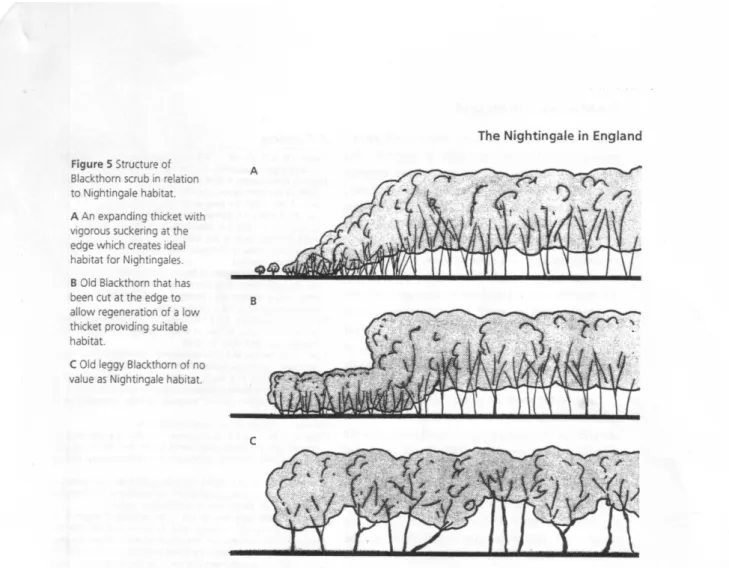
the edges of which scrub can develop. The features of suckering blackthorn scrub that can make it
such good Nightingale habitat (see section 3.4) can be reproduced via management, in particular by
cutting at the edge of the thicket to produce a low regenerating thicket there (Figure 3). Layering of
blackthorn scrub also produces suitable structures, such as at Castor Hanglands, Cambridgeshire
(Fuller, Henderson & Wilson 1999). This involves partially cutting the stems 30cm above the ground,
laying them over to a height of some 1.5m. New growth suckers rapidly, creating suitable dense
thicket habitat very quickly which deer can find difficult to penetrate.
Figure 3 Structure of blackthorn scrub in relation to Nightingale habitat (from Fuller,
Henderson & Wilson 1999). Reproduced, with permission, from British Wildlife.
Excessive deer grazing can cause a reduction in the density of understorey vegetation and therefore
in habitat quality for Nightingales (Gill & Fuller 2007). A study in Bradfield Woods demonstrated that
17
that were protected from grazing, compared to similar unprotected stands (Holt, Fuller & Dolman
2010). At the national scale, Newson et al. (2011) found a strong likelihood of a causal relationship
between local increases in roe deer numbers and declines in Nightingales. In Kent, deer numbers
have yet to increase in numbers sufficiently to be a problem for Nightingale habitat quality but they
may do in the future and so it should be remembered that deer management may be required if
18 6. CASE STUDIES
In this section we summarise several case studies of locations supporting concentrations of
nightingales to explore the historical establishment of the population and site‐specific factors that
have influenced the establishment of local populations and the apparent effects of specific
management practices. Taken together with knowledge about the critical habitat requirements
(section 3), this information is relevant to the assessment of whether habitat creation is feasible for
Nightingales and to assessing what factors need to be considered in maximising the probability that
potential habitat will be colonised and a population become established. We present these case
studies in two categories: (1) locations that lie within the core of the British range where populations
are relatively high and it is assumed that there is a greater chance that birds will be available to
colonise potential habitat (Kent, Essex and Sussex), (2) locations lying outside the range core, either
at the periphery of the core region or at the fringes of the current range, where we assume that
there will be fewer potential colonists. This information has been compiled through a mixture of
personal experience and interviews with individuals who are familiar with the locations and their
history of Nightingales. We do not claim that this is a comprehensive list of relevant and potentially
informative locations.
We are unaware of any detailed published account that explicitly describes the establishment of a
Nightingale population in relation to habitat creation and vegetation development on a formerly
unoccupied site. Indeed, we are unaware of any instance where habitat creation for Nightingales
has been attempted on any large scale. In this section we describe instances where, fortuitously,
habitat has become recently available and has been colonised by the species. We have focused on
scrub or shrubland environments because we think these offer the best opportunity for creation of
high quality Nightingale habitat. We have excluded the Cambridgeshire / Suffolk / Norfolk fen‐edge
populations because we know nothing about their history. Also, it is well known that Nightingales
colonised many areas of treefall following the severe gale that hit south‐east England in 1987
(Henderson, 1996) but this phenomenon is not considered here.
6.1 Within the Core Range
Fingringhoe Wick, Essex (50 hectares) – At this site, gravel extraction took place from the 1920s
through to 1959. In 1961 the site was taken over by Essex Wildlife Trust. At that time ‘a few’ singing
Nightingales were present, presumably in bramble Rubus fruticosus thickets which were present in
19
following year and to 26 males by 1979 and 1982. Numbers remained stable until 1993 then rose
slowly to a peak of 42 males in 1999, before falling sharply in the early years of the 21st century. This
gradual increase from the early 1960s through to the late 1970s reflects the development of scrub
on the abandoned gravel workings, suggesting that peak conditions were reached after about 20
years. Some early increases in settling Nightingales are thought to have occurred on the richer soil of
the spoil heaps, with subsequent increases due to the later maturation of scrub on the sand and
gravel dominated areas.
The reason for the increase in the late 1990s is not clear, but it appears some tree removal by ring
barking was undertaken prior to this. The pattern of increase is consistent with an episode of
management having been undertaken in the early 1990s and the subsequent decrease in the early
2000s likely reflects the scrub becoming too mature to support suitable habitat following its
cessation. Numbers have increased since 2005, due to the re‐instatement of scrub management,
with between 40 and 50 pairs being present this year. The success of this habitat management
contrasts with the limited success at Paxton Pits (see below) – this is likely a consequence of the
relative positions of these sites within the species range, with a greater pool of birds being present
at Fingringhoe to occupy habitat created whilst conspecific attraction may be relatively more
important in maintaining numbers at Paxton. We are not certain from the information we have
available whether this level of population is sustainable by rotational coppicing / scrub cutting, or
whether it is the result of a short‐term peak of habitat availability.
The scrub at the site comprises blackthorn, sallow Salix spp., hawthorn Crataegus monogyna, rose
Rosa spp. and oak Quercus spp., centred around small pits and ponds left over from the gravel
workings. Most Nightingale territories are in this, although a few are in areas with less complex
structure, including areas of nettle beds and brambles and areas dominated by gorse Ulex europaeus
– this likely reflects the broader habitat occupancy in the core of the species range in England
(Hewson, Fuller & Day 2005). Current scrub management at the site involves coppicing the scrub to
ground level, with some brash placed over the stools to protect against deer browsing and a dead
hedge being erected to provide further protection in the early years. Scrub is being cut on a 10‐15
year rotation (10 years for areas dominated by sallow, 15 years for oak). Wood (2005) suggests that
the enlarging of rabbit‐grazed glades at the site may have been beneficial for Nightingales through
providing feeding areas in the glades but it is also likely that they will have benefitted from an
20
Orlestone Forest, Kent (331 hectares) – Establishment of forestry at Orlestone Forest after the
Second World War resulted in the existing native woodland being largely replaced with Norway
Spruce Picea abies and Scots Pine Pinus sylvestris, with the native woodland surviving as fire breaks
along rides etc. The storm of October 1987 resulted in the destruction of large areas of mature
conifer trees, which were replaced by regeneration of native broadleaves (primarily birch Betula
spp., oak, hornbeam Carpinus betulus, aspen Populus tremula, willow, field maple Acer campestre
and wild service Sorbus torminalis). This increase in dense, low scrubby habitat resulted in a large
increase in the Nightingale population through the 1990s (to about 60 pairs) but this was in decline
by the end of the decade as the scrubby habitats that had been created matured.
Since 2000, 1 hectare blocks spread throughout of the forest have been ‘mulched’ to provide
continuity of habitat for Nightingales and other migratory birds such as Garden Sylvia borin and
Willow Warblers Phylloscopus trochilus. Apart from ‘mulching’, no detailed management of the
habitat is undertaken to enhance suitability for Nightingales. These blocks are embedded within a
matrix of more mature woodland and are mulched every 6‐10 years (limited by resources available
for management operations), resulting in a window of suitability for Nightingales between 2‐3 years
until 6‐8 years post‐management. This has resulted in a recovery and maintenance of the
Nightingale population from about 2003 to its current level of around 50‐55 singing males.
Mulching is a highly mechanised cutting technique used primarily because traditional coppicing is
prohibitively expensive. When used on stems of no more than about 15 cm diameter (maximum of
10 years growth), it can result in rapid regrowth of woody regeneration. If used on older stands,
however, the regrowth appears to be slower and may result in less dense regrowth of marginal or
little value for Nightingales. Additionally, the habitat is suitable for Nightingales sooner after
management when the mulching machine’s head is not allowed to touch the ground, as this retains
the stumps and roots of the woody vegetation in situ and re‐growth begins immediately. Areas
dominated by birch become suitable more quickly than those dominated by for example hornbeam,
due to the higher growth rate of birch.
This demonstrates that suitable habitat for Nightingales can be colonised very quickly within Kent. It
should be noted that as the mulched blocks are set within a matrix of more mature woodland, they
form part of a wider mosaic of habitats that may be important as Nightingales, at least in some
21
should also be noted that Orlestone Forest is very wet and contains several marshy areas and pools
which may contribute to the favourability of the site for Nightingales.
One further comment should be made on the mulching technique. It appears to work at this site as
a means of keeping existing young growth (that may even be just about suitable for Nightingales at
the time of cutting) in good condition for the species by ensuring vigorous regrowth through cutting
on a short rotation. It is by no means clear that this technique could be applied to older woodland
(e.g. 20 year coppice growth) with the expectation that it would rapidly create suitable regrowth for
Nightingales – under these circumstances it make take considerably longer for suitable conditions to
develop.
Burham, Eccles and New Hythe, Kent (‘the Medway Gap’) – The lower Medway valley has held one
of the main concentrations of Nightingales in Kent in recent decades (Henderson 1996, 2002). This
area downstream of Maidstone, sometimes known as the ‘Medway Gap’ where the river cuts
through the North Downs, is extremely complicated in terms of the habitats it offers Nightingales.
The downland and its woodland has become less populated by the species which has redistributed in
recent years into the valley (Henderson 2002). The valley contains different types of scrub habitat in
various contexts including gravel, chalk and clay pits, sewage works and other industrial land. Within
this complex of scrub and shrubland there have been major shifts in local distribution and numbers
of Nightingales with birds apparently rapidly colonising suitable vegetation as it has become
available. A detailed account is provided by Woodcock (1992) who documents that approximately
30 pairs were present in some 100 hectares of scrub (exact areas are not given but a map is
provided) on the east bank of the Medway in 1991. Particularly interesting is the rapid build up of
an extremely dense population (11 to 15 pairs in a small area of approximately 4 hectares) where
waste paper pulp was dumped in the 1960s. By 1979 a high density of Nightingales was present.
Woodcock (1992) states that the ‘most sought after territories are in willow carr, followed by
bramble and then buddleia, nearly all of which have an undergrowth of nettles’. This demonstrates
that under ideal conditions (i.e. highly suitable vegetation structures combined with a high local
Nightingale population providing colonists and social stimulation), a population can become rapidly
established. This population persisted at high density from the late 1980s until sometime in the
2000s when the vegetation lost its suitability due to natural growth, although some birds continue to
use the site (A. Henderson pers comm.).
Alton Water, Suffolk (60 hectares of scrub surrounding a 180ha reservoir). This area supports a
22
at Fingringhoe Wick, albeit in linear fringing habitat rather than a more discrete habitat block. The
reservoir was dammed in the mid‐1970s and scrub development has taken place since then,
together with growth of single‐species blocks of broad‐leafed trees (including some non‐natives such
as Norwegian maple Acer platanoides) that were planted around the time of damming. The soils of
the area are sandy and somewhat acidic, hence there are patches of gorse in addition to the mixed
species scrub and coppice currently present. There is little information immediately available about
the build‐up of Nightingales at the site (from the warden, Simon Walters), other than that some
were present 15 years ago (i.e. c.20 years after the reservoir was created) but that numbers were
smaller than they are now. The subsequent increase is attributed to the management that has been
undertaken over the last 10‐15 years, particularly the removal of larger trees (especially sycamore
Acer pseudoplatanus) from the scrub and very small‐scale coppicing, both designed to restrict the
development and area of woodland on the site.
6.2 Outside the Core Range
Paxton Pits LNR, Cambridgeshire (core area of 110ha, though we are unclear how much water is
included in this area) – This site is an area from which gravel was extracted between the 1940s and
the early 1960s. The first three territorial Nightingales were recorded in 1974 but further territorial
birds were only recorded in two further years prior to 1987. Since then breeding has been annual,
with 5‐9 birds each year up to 1992, 15 in 1993 and between 21 and 29 birds each year since. Ray
Matthews, the warden of the LNR since its establishment in 1989, says that scrub that develops on
the bare mixture of subsoil, shingle and sand remaining after gravel activities takes between 15 and
20 years to reach a stage where Nightingales could become established. This is borne out by the
time‐scale outlined above, with the first singing Nightingale present 12 years after workings ceased
and annual breeding not occurring until after 25 years. According to Ray Matthews, habitat
management at this site (comprising layering and coppicing, combined with leaving deadwood in
situ and also the erection of some rabbit and muntjac exclosures) does not appear to have had a
positive effect on Nightingale numbers, but it may have prevented the population decreasing in line
with regional declines. Specifically, management has never successfully brought Nightingales back
into areas that they had abandoned. In one instance, removal of invasive Turkey Oaks Quercus cerris
over a period of 15 years, combined with leaving the dead wood in situ, successfully led to
Nightingales expanding into a hitherto unused part of the reserve following natural regeneration of
ash Fraxinus excelsior, hawthorn, rose and bramble. In 2012 that area was inhabited by 4 singing
23
There is much apparently suitable, more or less identical habitat in the area (both very locally and
along nearby river valleys with similar histories of gravel extraction) that is not occupied by
Nightingales. Ray Matthews considers this to be evidence of the importance of conspecific attraction
in determining habitat occupancy. Conspecific attraction may be especially important at sites such as
this at the edge of the range, where the pool of birds available for colonisation is smaller, and this
process may have been responsible for maintaining the numbers at this site in the face of regional
decline. If so, this could explain the limited success of habitat management on Nightingale numbers
at this site. In this regard, it is notable that annual breeding was only established up to 25 years after
gravel extraction ceased and 13 years after the presence of the first territorial bird. It is possible that
this is due to the difficulties of establishing a breeding population in a new area at the edge of the
range without social stimuli, although it should be noted that the national, and probably the
regional, breeding population was declining throughout the establishment period.
Bainton, near Helpston, SE Lincolnshire – An area, approximately 20 hectares, of former gravel
workings filled with rubble and topped off with fly ash some 40 years ago. Scrub, consisting mainly
of hawthorn with vigorous rose and bramble, has colonised in a patchy way, creating a complex
mosaic of impenetrable vegetation interspersed with sparsely vegetated openings. The structure is
very close to that shown in Figure 1 with many scrub patches fringed by dense bramble. The rate of
woody vegetation expansion appears to be slow, probably partly a consequence of poor soils and
partly due to suppression of new growth by rabbits and deer. In recent years, the site has supported
several pairs of Nightingales (probably less than 10 territories in any one year). It is likely that
development of a suitable vegetation structure for the species at this site took more than 20 years
but it is also likely, given the ‘suppressed vegetation dynamic’ described above, that, in the absence
of any intervention, the scrub would remain in a suitable condition for many years to come.
Immediately to the north of the scrub occupied by singing nightingales, and within some 300 m of
the birds, there is an area of mixed woodland sloping down to a river. This may enhance the quality
of the site by providing additional foraging areas (see discussion in section 3.4 about the potential
value of trees to nightingales). These notes are based on a site visit in June 2011 by the authors with
Chris Hughes who operates a ringing site there.
Cotswold Water Park – This site is a huge wetland complex where 20 Nightingale territories were
located in 2012. Of these, 19 were in the western complex, scattered through an area of
approximately 1200 hectares. The highest density within this area is 5 territories in approximately 14
hectares. According to Gareth Harris (Cotswold Water Park Biodiversity Manager) the birds are
24
has recently developed on gravel workings but rather very old habitat remaining from the previous
farmland landscape, albeit having become much more mature. All territories are close to water,
either adjacent to one of the numerous gravel pits or over a ditch. The gravel workings may be
important in that (a) they have meant that some of these woody features have been preserved in
the areas between the pits and (b) that they provide proximity to water. Within the complex, Gareth
Harris believes that management has negligible effect because Nightingale numbers are limited and
they always settle in the areas that are currently most suitable, with the vast area of habitat
constantly offering suitable habitat somewhere due to natural habitat dynamics, management or
25
7. WHAT FACTORS NEED TO BE CONSIDERED IN CREATING NEW HABITAT?
7.1 Key Uncertainties
The speed at which new habitat will become suitable for Nightingales is unclear. Some of the
examples given in section 6 suggest that 15‐20 years may be required under natural regeneration,
although these times are usually at sites with soil characteristics likely to retard vegetation
development. Planting, rather than natural regeneration, may result in more rapid establishment of
suitable habitat. Even in cases where the vegetation reaches an apparently suitable stage sooner,
there is uncertainty over whether the entire requirements, including food sources, would become
sufficiently established in that time. As the development at Lodge Hill is due to commence in 2014
and continue over the next few years, the only conceivable way that offsetting habitat could be in
place relatively soon (but certainly not immediately) after the start of habitat loss (it is clearly not
possible for it to be in place in advance of the current start date) would be for management to be
instated through some form of rotational cutting at a woodland site currently unsuitable for
Nightingales. If management was carried out over winter 2012‐13 (i.e. as soon as is possible),
managed areas would, at the very earliest, begin to become suitable from 2016 (i.e. after three
complete summers re‐growth) and would not reach a peak until several years later, so even in this
instance there would be a time lag between management and the creation of suitable conditions.
The Orlestone experience with mulching (see above) would suggest that good habitat conditions for
Nightingales are most likely to develop rapidly only where existing young growth is being cut and
such sites are quite likely already to hold Nightingales. Furthermore, the conditions created – akin
to some form of coppicing – would not necessarily be as satisfactory as a scrub mosaic and require
on-going intensive management.
The degree to which social attraction plays a role in settlement decisions by Nightingales is unclear,
although this may be less important in the core of the range, as in Kent, where there is a greater
pool of potential colonisers.
The extent to which effects of existing development close to the site of habitat creation will
negatively impact on habitat quality (i.e. the probability of occupancy and breeding success of
occupants) is unknown. It is quite likely that nearby housing developments could negatively impact
Nightingales through recreational disturbance, predation by cats and by reducing the local
Nightingale population and hence social attraction, but the strength of these effects and how far
26
7.2 Major Limiting Factors Concerning Site Choice that Affect Likelihood of Success Given Above Uncertainties
The geographical location of receptor sites within the English range of Nightingales is likely to be
important. Colonisation of suitable habitat is very likely in the core of the range, as in Kent, where
the pool of potential colonisers is great, but such habitat may well not be colonised towards the
range periphery. This emphasises the importance of any habitat being created in Kent or possibly an
adjacent county such as Essex or Sussex.
On a smaller spatial scale, proximity to an existing concentration of Nightingales could be
important because of the possibility of conspecific attraction. It is not clear how important a factor
this might be within the core range, although it is likely to be very important towards the periphery.
It is also not clear over what spatial scale this process would operate. For example, are birds likely to
be influenced to settle within the same hectare or one kilometre square as existing birds or could
the number present over the adjacent landscape be important, with other factors determining the
precise settlement location?
Because the annual survival rate of Nightingales probably does not exceed 50%, the chances of
luring many of the actual birds whose habitat had been lost by the development would probably not
be high, so proximity to Lodge Hill itself would not necessarily be important, especially given that
timescales suggest that new habitat would not be ready for at least a decade, whereas the
development is projected to begin within 2‐3 years. Nonetheless, proximity to an existing
population could be beneficial though.
Whilst towards the periphery of the range, conspecific attraction may be especially important in
determining occupancy patterns and much suitable habitat remains unoccupied, in the core of the
27 Altitude: low altitude sites are preferred (section 3.2)
Soil type: soils with high moisture content may be preferred but poorer soils, such as at gravel pits,
may inhibit vegetation development and thus extend the period over which habitat remains suitable
in the absence of management (section 3.2);
Drainage: wetter habitats appear to be preferred and the presence of water bodies, such as ponds
and marshy areas, and drainage features such as streams and ditches may be beneficial
Adjacent habitats: nearby habitats harbouring predators such as cats may be highly detrimental
whilst establishment of habitat next to existing habitat that could form part of home ranges, such as
mature woodland, may be beneficial to habitat quality
Existing and past habitat features: the presence dense hedges, trees or tree patches or other woody
vegetation that takes a long time to develop may increase the speed with which good quality habitat
develops, by acting both as receptor habitat features and sources of seeds for future natural
regeneration.
If the Kent Nightingale population is to be maintained through offsetting without suffering at least a
temporary decline due to the development, it will be necessary to use sites where good quality
habitat can be brought into condition as soon as possible. This also means that, without habitat
management, these sites could become unsuitable more quickly but the availability of relatively
cheap, simple techniques for maintaining Nightingale habitat, such as the rotational mulching used
at Orlestone Forest, means that this may not be a problem. These sorts of techniques may be easier
to apply within larger sites. Larger sites may also be more likely to develop valuable mosaics and,
because they could hold more Nightingales within a single location, they could produce stronger
28
7.3 Management Considerations
Methods of vegetation and habitat development need to be carefully chosen, partly to reduce the
time it takes for an area to become ‘mature’ as Nightingale habitat and partly to maximise the
quality of the habitat and its attractiveness to Nightingales (not necessarily the same thing – see
section 4).
Numerous examples suggest that natural regeneration of scrub and woody vegetation can produce
structures that are attractive to Nightingales. At sites such as Paxton Pits, Fingringhoe Wick and
numerous other gravel pit sites, high density populations of Nightingales have resulted from such
processes. It is less clear whether high Nightingale habitats can be easily created through deliberate
and direct habitat creation, although there is some evidence that planted habitats can be colonised
by Nightingales, possibly more rapidly than sites which have become suitable through natural
regeneration. For example, at Strensham Water treatment Works, Worcestershire, Nightingales
colonised an area in which young trees had been planted to screen a plant but rapidly declined from
around 7 birds in 1998 to 2 in 2006, the last year they were recorded there – this could reflect the
rapid maturation of the habitat beyond the successional stages suitable to Nightingales but it could
also partly reflect the declines that were happening at that time in the area, which is now well
outside the species core range. There are also many reports of young conifer plantations being
occupied for some years after planting (Fuller, Henderson & Wilson 1999) which would suggest that
planting can produce Nightingale habitat. Appropriate management could prolong and even
maintain the habitat, provided a sufficiently large area was created to allow rotational management,
which may also provide a useful mosaic of habitats. Similarly, there are many examples of natural
processes producing Nightingale habitat within existing scrub and woodland, through wind throw of
mature trees creating gaps for vegetation regeneration, for instance.
Natural regeneration (combined with subsequent management) may produce the required habitat
structures, including heterogeneity on an appropriate scale, more readily than planting or seeding.
Artificial habitat creation will require that heterogeneity is built into planting or seeding regimes and
subsequent management plans in order to provide the mosaics that characterise the best
Nightingale habitat. Incorporation of numerous gaps and edges will help to provide this from an
early stage, as will inclusion of mature trees and bushes where available. This is returned to in
29 8. HOW MUCH LAND MIGHT BE NEEDED?
The Lodge Hill site is 325 hectares and Chattenden SSSI is 133 hectares. The amount of land
required for offsetting will depend on the actual reduction in the numbers Nightingales at the site
but this is difficult to predict precisely and will depend partly on whether appropriate avoidance and
mitigation measures are taken during the development. Because of these unknowns it is, however,
unrealistic to firmly predict the persistence of any Nightingales within the Lodge Hill development
itself whilst serious reductions could also occur in Chattenden Woods SSSI and neighbouring areas.
The reduction in the number of Nightingales will therefore theoretically be between 69 and 84 so we
will take a hypothetical mid‐point of 75.
The area required to contain this number of Nightingales will depend on a number of factors, in
particular the territory and home range sizes of Nightingales and, importantly, their dispersion
within any habitat created. There is minimal information available on these factors and none on how
they might vary with habitat characteristics. Song territories may be as small as 0.25 hectares but are
usually >0.5 hectares (Fuller, Henderson & Wilson 1999 and inferred from Holt et al. in press). At
Paxton Pits, home range size estimates were between 0.4 and 2.3 hectares (Holt et al. in press). The
extent of overlap in home ranges, the number of birds that can overlap and the relation between
home ranges and song territories will all influence the area of habitat required in a way that makes it
difficult to estimate a ‘Nightingale unit’ metric. The best way of estimating the areas that might be
required is probably to look at areas of habitat that contains similar numbers of Nightingales in the
types of habitats most likely to be created as offset habitat for Lodge Hill, which could lead to
estimation of a ‘Nightingale unit’ via division of the area by the number of birds. These habitats are
scrub and scrub / woodland mosaics, depending on the receptor site or sites chosen. We would
stress that even within apparently suitable habitat, birds are unevenly distributed; typically not all
apparently suitable habitat is occupied. This may be because there are insufficient potential
colonists or because there is variation in habitat suitability that is evident to Nightingales but not to
humans.
Excluding populations on small sites from which densities cannot be extrapolated to larger areas
(e.g. the area where waste paper pulp was dumped in the Medway Gap described above), the
densest Nightingale population that we are aware of is at Fingringhoe Wick, Essex, where at least 42
males were present in 2012 within the core 50 hectares of the reserve, although as this is dependent
on management it is not clear how sustainable this population level is in the medium term. To be