Effective Energy Consumption Scheduling in Smart
Homes
O. M. Longe, K. Ouahada, S. Rimer, H. Zhu, H. C. Ferreira Electrical & Electronics Engineering Science, University of Johannesburg, Johannesburg, South Africa.
[email protected], {kouahada, suvendic, hailingz
,
hcferreira}@uj.ac.zaAbstract – Monthly expenditure on electricity by most households in South Africa take beyond acceptable percentage of their income. In order to keep the household energy expenditure below the energy poverty threshold, a daily electricity optimization problem is formulated using mixed integer linear programming (MILP) method. The energy optimization scheduling was carried out by a device called the Daily Maximum Energy Scheduling (DMES) device proposed to be incorporated into smart meters of households. The DMES algorithm was tested with household data set and was shown to be capable of ensuring that households spend less than 10% of their income on electricity bill monthly. This technique therefore, would be beneficial to consumers (for better financial savings and planning), utility (for effective energy and financial savings, and energy network planning) and cleaner environments as proposed for smart grid. Also, number of households in the nation living below the energy expenditure-based poverty threshold would increase.
Key words -Smart meter; Daily Maximum Energy Scheduling (DMES); smart home appliances; low-income households; electricity consumption.
I. INTRODUCTION
The future of smart grid is proposed to be facilitated by bi-directional power, information and communications flow between utility providers and consumers. Advanced Metering Infrastructure (AMI) had recently gained attention from the industry and academia because it involves consumers’ participation in the smart grid through Demand Response (DR) and Demand Side Management (DSM). The components of AMI system include smart meters, Home Area Network (HAN), wide area communications infrastructure, Meter Data Management Systems (MDMS) and operational gateways [1]. AMI is therefore essential for effective energy management in the smart grid, alongside the Internet of Things (IoT).
Electricity bill is a recurrent monthly expenditure for households and the demand for electricity to residential consumers is generally inelastic. However, the percentage of household income spent on energy is one of the indicators of energy poverty [2]. Also, the percentage of household income spent on monthly electricity bills by most residential customers in South Africa is beyond the energy poverty threshold set by the Department of Energy, South Africa. Hence, DSM and energy management techniques can be introduced to enhance reasonable consumption of electricity as desired and government threshold for energy poverty. Therefore in this work, Daily Maximum
Energy Scheduling (DMES) technique is proposed to attempt to help households spend more reasonably on electricity bills and government to also have more households living below the energy poverty threshold.
Monthly electricity bill comes from cumulative daily consumption. Therefore, daily energy consumption by smart home appliances connected in a HAN to a smart meter is investigated in this work to ensure that electricity bills are within the limit desired according to their income class. This was carried out by setting maximum daily energy consumption limit for households through the DMES device. This work assumes existing HAN in the homes where the DMES device will be deployed.
Generally, linear programming has been a useful tool in solving many optimization problems in economics, science and engineering. In smart grid, it has been proposed useful in implementing many algorithms for DSM [3,4] and DR [5,6]; among others. Mixed Integer Linear Programming (MILP) is proposed in this work to formulate the problem for optimized daily energy consumption in smart homes.
This study has shown that incorporating the DMES device into smart meters will further enhance energy and financial planning and saving for both consumer and utility providers. The consumer would pay for electricity within their desired budget. The utility can also effectively plan for their energy networks especially the generation and distribution. Furthermore, the government would have lesser number of energy poor households in the country. Also, this work is novel to using DSM techniques to mitigate household-level energy poverty.
The rest of this work is organized as follows. Section II contains the relationship between households’ income, household electricity expenditure and energy poverty; while the use of DMES device for daily energy consumption scheduling in smart homes is presented in Section III. Results and discussions are found in Section IV and the conclusion in Section V.
II. HOUSEHOLDS INCOME AND ENERGY EXPENDITURE Electricity consumption by households is largely affected by household income and appliances owned [7], but what percentage of income is spent on electricity bill is of interest in this study. Some energy efficiency technologies are also being introduced to reduce the quantity of energy consumed by households. This includes awareness on the use of energy efficient appliances, opening of windows during summers
instead of using fan or air-conditioner, constructing energy efficient buildings etc. However, these come with a cost to customers.
Energy expenditure-based indicator of energy poverty varies from country to country, but is widely 10% - 15% threshold. The Department of Energy (DoE), South Africa, chose 10% as its threshold [8]. This implies that households that spend more than 10% of their income on energy are considered energy-poor households. The DoE through a nationwide survey found that South African households spend an average of 14% of their income on energy expenditure, but low-income households spend an average of 17% of their income on energy bills [8]. This work therefore, attempts to ensure that low-income residential consumers of electricity only pay ≤ 10% of their
income on electricity by using the DMES device. The classes of consumers considered as low income households are those in LSM1 – LSM3, according to the South African Living Standard Measurement (LSM) [9].
III. SMART HOMES DAILY CONSUMPTION SCHEDULING
A. HAN DMES System Description
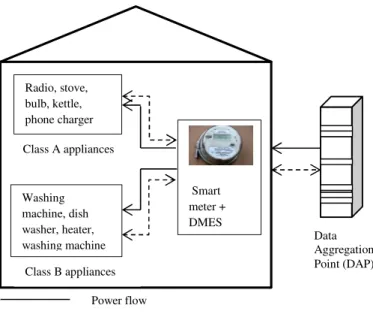
The electricity scheduling in smart homes was carried out by the proposed DMES device to be incorporated into customers’ smart meter (SMs). The DMES-SM serves as a link between the HAN and the Data Aggregation Point (DAP). The proposed system is illustrated in the Fig. 1.
Fig. 1. Illustration of a DMES-HAN
Monthly household electricity bill can be kept within a tolerable range and below energy poverty threshold by monitoring and controlling what is daily consumed in the household. Therefore, a daily maximum electricity consumption technique is proposed in this work. According to [10], low income households in South Africa consume an average of
2666.67 kWh/annum (222.23 kWh/month). The power utility in South Africa, Eskom has a tariff called Home Power Standard classification [11] where block 1 consumers are those that consume 0 to 600 kWh monthly, and block 2 consumers use more than 600 kWh monthly. This block classification is used in this work. This implies that low income households would fall into block 1 energy tariff.
A survey of fifteen low income households was carried out in this work. The average household income for low-income households is R1955 according to the South African Advertising Research Foundation (SAARF) [9]. Since a threshold on energy expenditure had been set as 10% of household income by DoE [8], R200 was chosen as the proposed budgeted energy expenditure for low income households respectively. For a scenario where all customers were connected to non-local authority rates of Eskom, average energy tariff of R1.20/kWh was chosen taking other charges and VAT into consideration [11]. Some information about the initial and DMES consumption systems are presented in Table I.
TABLE I. INFORMATION ON INITIAL AND PROPOSED DMES SYSTEMS
Description Low income
Household
Initial average monthly electricity consumption 190 kWh Initial average monthly electricity bill ≥R228 Initial average maximum daily consumption 6.33 kWh Proposed average monthly electricity bill R200 Proposed average maximum daily consumption, 5.56 kWh
B. Daily Electricity Consumption Scheduling for Smart Homes
The proposed daily energy consumption model can be described as a linear optimization problem that sets maximum daily energy consumption for each household through their smart meters according to the proposed monthly budget for electricity bill. The smart home appliances in the low-income households were categorized into class A (priority) appliances and class B (non-priority) appliances as shown in Table II.
TABLE II. LIST OF HOUSEHOLD APPLIANCES
Appliance Appliance class and ID Power (kW)
Radio A1 0.015 TV A2 0.040 Stove A3 1.500 Inside Bulbs A4 0.040 Outside bulbs A5 0.040 Kettle A6 1.000 Fan * A7 0.080 Phone charger A8 0.010 Refrigerator A9 0.250 Iron B1 1.000 Room heater* B2 2.000 DVD player B3 0.025 Laptop B4 0.050 * Seasonal appliance
The proposed electricity bill of a consumer is used to calculate how much of monthly electricity that can be purchased from the utility, and hence, a maximum daily consumption is set. Data
Aggregation Point (DAP) Power flow
Information and communications Radio, stove, bulb, kettle, phone charger Class A appliances Washing machine, dish washer, heater, washing machine Class B appliances Smart meter + DMES
Let = { , , … , } and = { , , … , } . The classification of appliances can also be effected based on customer’s preferences. Laptop was considered as a class B appliance because it is a battery-assisted appliance and shifting its demand up to an average of 3hrs would not discomfort the user. Since energy is the product of power and time , variable is included to represent the quantity of a particular appliance being used at a particular time in a household. Therefore, electrical energy consumed by an appliance in a household is expressed in (1) as:
= ∀ , > 0 ≥ 0 (1) Whereas, the total hourly energy consumed at time h by all class A and class B appliances is given by equations (2) and (3) respectively:
, = !, + #, + . . . + %, = ∑ '∈ , ∈ℍ ', (2)
*, = *!, + *#, + . . . + *+, = ∑*,∈ , ∈ℍ *,, (3)
where ' is the energy consumed by class A appliance with ID,
n ∀1 ≤ ≤ 9 and *, is the energy consumed by a class B appliance with ID, m ∀1 ≤ 0 ≤ 4at a time h for ℎ ∈ ℍ, where
ℍ = [1, 2, 3, …, 24]. However, each appliance’s period of usage within t, may also be less or greater than one hour. For instance, a kettle would boil water within a few minutes whereas, a refrigerator may be operated for 24 hours.
The energy consumption plan of a smart appliance in a household is expressed as 3 '= [ ', , ', , ',5, . . . , ', ]7
∀ 8∈ and 3*9= [ *,, , *,, , *,,5, . . . , *,, ]: ∀ ;∈ for class A and B smart appliances respectively.
A household total hourly energy consumed, at every time, h where ℎ ∈ℍ by all the smart appliances connected to the DMES device is expressed in (4):
= , + *, = ∑ '∈ , ∈ℍ ', + ∑*,∈ , ∈ℍ *,, (4)
The cumulative energy consumed in the household ∗ at a time h
is given by (5):
∗= =
', > + *,, > ? + = ', + *,, ? (5)
The consumption pattern per household for each class A appliances, according to the survey carried out, is expressed by the diagonal matrix in (6):
@ ' = A3 ', 3 ', … 3 ', B = C
', ⋯ 0
⋮ ⋱ ⋮
0 ⋯ ',
G (6) Also, for class B appliances, the consumption pattern is given as (7): @*,= A3*,, 3*,, … 3*,, B = C *,, ⋯ 0 ⋮ ⋱ ⋮ 0 ⋯ *,, G (7) Probability of usage was considered during data mining for appliances not on daily usage (iron and DVD player).
Maximum daily household energy consumption ;HIJis found by (8):
;HIJ =8L;MNO PQ RHST U8 V N ;P8V K, =W. X/Z8 (8)
Where represents the number of days in the month, ; is the proposed maximum monthly household energy consumption, which is a function of the household income, [ and flat tariff, .
The daily consumption of all appliances is expected to continue as scheduled until the time when household daily energy threshold is reached (i.e. Eh = 7\), after which switching off of class B appliances begin to further ensure that ≤
;HIJ every day. The value of 7\ is chosen such that 7\ = 0.9 ;HIJ . At time ℎK]^ ∈ ℍ when energy threshold is reached,
switching OFF of connected class B appliances in decreasing order of energy consumption sets in such that ∑*,∈ *,, ← 0 . However, if the consumer is awake, manual switching OFF of desired appliances can be also done. At 24:00 hrs, the timer resets and the same process are repeated again for the next day until month ends and = R`abc is saved in the energy logger of the DMES device. However, for households with consumptions such that < 7\, then priority plan algorithm does not sets in at all.
C. Energy Savings Decision
The energy savings decision is meant to give the consumers the ability to decide how to spend ;HIJ − . Firstly, the consumers can have their ;HIJ updated daily, ;HIJfg with the difference of ;HIJ − = h from the previous day added to the ;HIJ of the next day. Once ;HIJ is updated, 7\ is also automatically updated. Secondly, T can also be saved during hot months from first day d1 to last day dl and used during cold months by the consumer as energy paid back, ZM. The ZM is added to the ;HIJ ; and the cold months ;HIJ and 7\ are updated accordingly. Hence, the consumer can choose between optimizing the energy savings, T for the month continuously,
opt1 or for demand in cold months, opt2. All the households in this phase of the work chose opt2 that is to use energy saved T in cold months to cater for the usual high demand in cold months.
The optimization problem and algorithm are presented in the next section.
D. DMES Energy Optimization Problem and Algorithm
The linear optimization problem to minimize the total daily energy consumption per household can be formulated in (9) as follows from (1) – (8):
K min ^,Kl',^,Km,,^∈ℝ o. p. ≤ ;HIJ , ∑ '∈ ', + ∑*,∈ *,, ≤ ;HIJ ∑ '∈ ', + ∑*,∈ *,, = , ∀ℎ ∈ ℍ, g73 , + g73*, = , ∀ℎ ∈ ℍ, ', ≥ 0, *,, ≥ 0, ∀ 8∈ , ∀ ;∈
(9) Where g7 = [1,1,..,1] was introduced to obtain scalar result for the total energy consumption at every time h. The proposed algorithm is as shown in Algorithm 1.
Algorithm 1: Executed by each DMES smart meter device
input: Consumption plan, , qr. output: total s for the day.
repeat
if time s ∈ ℍthen
Solve ∑tu∈ tu,s+ ∑v ∈ v ,s= s , ∀s ∈ ℍ Update s according to the solution.
if s= qr= w. x then ∑v ∈ v ,s← w y s qs∈ ℍ but class A consumption continues end if end if until s = z{: wws}~ At s = z{: wws}~, if z{ < then
savings optimization decision sets in to determine how ~=
− z{ is used by household ifopt1 is chosen then fg = + ~ elseopt2 is chosen then
•€= ∑ • ~
g for cold months end if
end if
Timer resets and repeats same process next day until month ends and bill is generated.
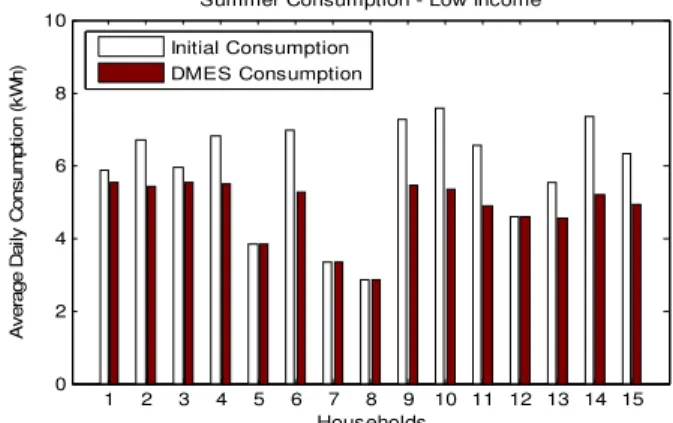
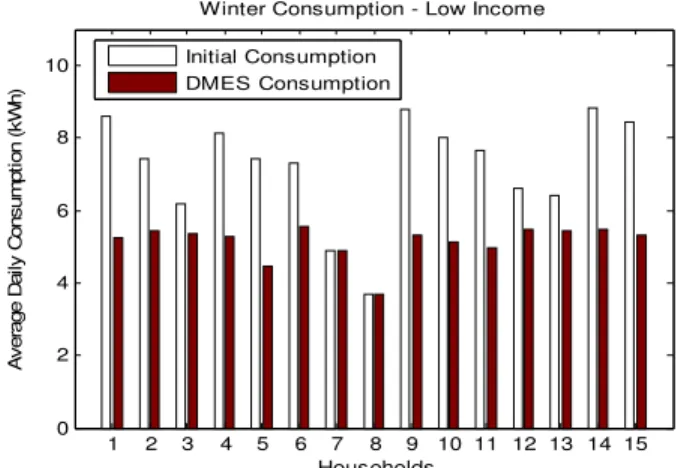
IV. RESULT OF DMES CONSUMPTION IN SMART HOMES The result of the survey on household usage of electricity was used to develop the consumption pattern for the households, and it was fed into the DMES algorithm as earlier illustrated. Only fifteen low-income households’ consumption data were each considered. The survey inquired from household on possession of household appliances, period of day appliances are used and seasonal usage of appliances. The information was used to build hourly and seasonal load profile data for all the households considered. The data generated was fed into the algorithm and the results obtained for the four seasons of the year are shown in Figs. 2 to 5.
From the annual electricity consumption obtained for all the households considered, it was discovered that only 33% of
low-income households, on average, were below the desired DoE energy expenditure threshold initially. This implies that majority of low income householders are spending more than 10% of their income on monthly energy expenditure. The average monthly energy expenditure for the fifteen households was R173.38, which is less than R200 as proposed. Nevertheless, with the DMES technique households can learn to be more energy efficient and saving to keep their consumption below the desired consumption.
Fig. 2. Result of initial and DMES consumption during summer
Fig. 3. Result of initial and DMES consumption during spring
Fig. 4. Result of initial and DMES consumption during autumn
1 2 3 4 5 6 7 8 9 10 11 12 13 14 15 0 2 4 6 8 10
Summer Consumption - Low Income
Households A v e ra g e D a ily C o n s u m p ti o n ( k W h
) Initial ConsumptionDMES Consumption
1 2 3 4 5 6 7 8 9 10 11 12 13 14 15 0 1 2 3 4 5 6 7 8 9 10
Spring Consumption - Low Income
Households A v e ra g e D a ily C o n s u m p ti o n ( k W h ) Initial Consumption DMES Consumption 1 2 3 4 5 6 7 8 9 10 11 12 13 14 15 0 1 2 3 4 5 6 7 8 9 10
Autumn Consumption - Low Income
Households A v e ra g e D a ily C o n s u m p ti o n ( k W h ) Initial Consumption DMES Consumption
Fig. 5. Result of initial and DMES consumption during winter
In order to ensure that the consumer’s energy needs is adequately taken care of, there is an energy request algorithm also incorporated into the DMES device. For instance, households at the upper bound of the low-income class (LSM3) can request for a higher ;HIJ to be able to meet its energy needs.
Also, it was shown that the DMES device can be used to maintain electricity bills at the amount the household desire and still give the households some comfort. With time, the consumers are expected to adjust better and get used to the DMES technique for monitoring their consumption. This will enhance financial and energy savings for the consumers. This could also mean energy savings, financial savings and better planning for the power utilities.
In [8] it was shown that 77% of South African households are willing to accept government initiatives towards energy saving. Also, apart from the installation of the DMES device on their smart meters, they would also need application of other DSM consumer behavioural techniques as presented in an earlier work [12] so that the comfort of the consumer is further enhanced.
Although this idea was tested for low-income households, middle and high income customers can also find it applicable to them, if desired.
V. CONCLUSION
The DMES device, through daily electricity consumption scheduling, has been shown in this work as a device that can be used to ensure that consumers do spend on electricity bills within a desired limit. Consequentially, it would help both the utility provider and the customers towards better energy savings, financial savings, planning and budgeting for a more reliable and sustainable grid. The DoE, South Africa would also be able to have more households in South Africa spend <10% of their income on monthly electricity bills. The DMES device can be incorporated into smart meters not only in South Africa, but also in other countries of the world, where smart grid is being envisioned. This can be achieved by putting the country’s energy
expenditure threshold into account, rather than
‚ ‚ƒ„… ‚† ‚ ‡ ˆƒ‚ ℎƒ‚hℎ‰Š = 0.1 used in this work for
South Africa. Peak demand reduction capabilities shall also be investigated using the DMES device to make it more robust for DSM in smart grid.
REFERENCES
[1] O.M. Longe, K. Ouahada, H.C. Ferreira and S. Rimer, “Wireless sensor networks and advanced metering infrastructure deployment in smart grid,” in Proc. 2013 IEEE/EAI Africomm, pp. 167-171.
[2] R. Schuessler, “Energy Poverty Indicators: Conceptual Issues, Part I: The Ten-Percent-Rule and Double Median/Mean Indicators,” Centre for European Economic Research, 2014.
[3] M. Fischetti, G. Sartor and A. Zanette, “A MIP-and-refine matheuristic for smart grid energy management," International Transaction in Operation Research, pp. 1-11, 2013.
[4] Z. Zhu, J. Tang, S. Lambotharan, W.H. Chin and Z. Fan, “An integer linear programming and game theory based optimization for demand-side management in smart grid”, in Proc. IEEE International Workshop on Smart Grid Communications and Networks, pp. 1205–1210, 2011. [5] P. Yi, X. Dong, A. Iwayemi, C. Zhu and Li S, “Real-time opportunistic
scheduling for residential demand response,” IEEE Transactions on Smart Grid, vol. 4, no. 1, pp. 227-234, 2013.
[6] S. Tang, Q. Huang, X.Y. Li and D. Wu, “Smoothing the energy consumption: peak demand reduction in smart grid,” in Proc. IEEE INFOCOM, pp. 1133–1141, 2013.
[7] M. Auffhammer and C.D. Wolfram, “Powering up China: income distributions and residential electricity consumption,” pp. 1–14, 2014. [8] Department of energy, South Africa, “A survey of energy-related
behaviour and perceptions in South Africa – the residential sector,” 2012. [9] South African Advertising Research Foundation (SAARF),
“Developmental indicators – poverty and inequality,” 2014. [Online]. Available: www.saarf.co.za.
[10] JUWI. “Wind energy: our driving force in the mix for power generation in South Africa,” [Online]. Available: www.juwi.co.za/wind_energy, 2013. [11] Eskom, “Tariff & charges booklet 2014/2015,” 2014. [Online]. Available:
www.eskom.co.za.
[12] O.M. Longe, S. Rimer, K. Ouahada, H.C. Ferreira, “Time programmable smart devices for peak demand reduction of smart homes in a microgrid,” in Proc. 2014 IEEE ICAST, pp. 1-6.
1 2 3 4 5 6 7 8 9 10 11 12 13 14 15 0 2 4 6 8 10
Winter Consumption - Low Income
Households A v e ra g e D a ily C o n s u m p ti o n ( k W h ) Initial Consumption DMES Consumption