CHALLENGING DESIGN PERCEPTIONS IN
IMMERSIVE VIRTUAL REALITY ENVIRONMENTS?
The potential and use of immersive virtual reality (IVR) technologies in performing design and construction activities has been widely addressed in the literature. However, research is only just beginning to emerge which examines the role of these technologies in use in ‘real-life’ practice situations, and seldom if ever addresses the way surprise and novelty impact both experience of these technologies, and of the designs they are representing. Adopting a practice based perspective to understanding the effect of immersive technologies on construction design work as used in concrete ‘real -life’ settings and as perceived by the practitioners involved, this study draws a specific focus on the concept of ‘surprise’ around using these technologies. The empirical case examined is a ‘real-life’ construction design project for a new hospital in the UK wherein a CAVE environment was used performing design review sessions during the bid preparation stage. The methodology draws on accessing participants’ view on their surprise emerging in the CAVE through reflective conversations oriented to engage the participants in retrospective reflection on their CAVE design experience. The analysis reveals that the element of surprise encountered by the participants both within making sense of the newly experienced technology, and within orienting to the design in the immersive environment played an important role in performing design review in the CAVE. The findings indicate that using CAVE as design media is not only enhancing or adding to an existing understanding of design through paper based or non-immersive digital representations, but it is also, and perhaps most significantly, challenging the participants’ understanding of the design as they experience the immersive, full scale version of it.
Keywords: [CAVE, immersive virtual reality (IVR), design practice, surprise].
INTRODUCTION
The potential and use of immersive virtual reality (IVR) technologies in performing design and construction activities has been widely addressed from a number of approaches (Kahkonen 2003, Whyte 2002). The themes addressed in this literature range from immersiveness, experience, complexity, spatial perception and cognition, problem solving, decision-making, collaboration, user engagement, to value and cost or time. Some focus on the practical implications of using IVR for construction design work and indicate the usefulness for supporting design, constructability and safety issues (e.g. Yerrapathruni et al 2003), integrating design process and product (e.g. Gopinath 2004), or for the design of sustainable buildings (e.g. Messner et al 2005). Overall, these studies suggest the potential of IVR technology as visualisation and collaboration environments to support the creation, communication, development and understanding of design through supporting and extending other design procedures (Whyte, 2002). However, most of the literature focusses on developing/ testing technology in experimental studies, or examines the practical use of immersive
technology preponderantly from quantitative perspectives based on standard metrics. Research is only just beginning to emerge which examines the role of these
technologies in use in ‘real-life’ practice situations, and seldom if ever addresses the way surprise and novelty impact both experience of these technologies, and of the designs they are representing.
Therefore this study questions: How might IVR be impacting on broader design practice? The paper addresses this question by taking a practice based approach to examine the use of IVR in a real-life construction design project through focussing on how the actors and materials bound up in the situated design process and by
accounting for the participants’ perspective on their design activities performed using the IVR. The empirical material is drawn on the early design of a new hospital project wherein design and contractor teams used a particular type of IVR, a CAVE (Cave Automatic Virtual Environment) set up in the University of Reading to demonstrate particular design requirements to the client and to perform design review meetings. The study builds on previous research which examined the use and implications of the IVR for design activities (Maftei and Harty 2012, 2015) by drawing on direct
observation and video recording of design meetings held within the CAVE. Detailed examination of naturally occurring interactions emerging in the CAVE sessions revealed the issue of surprise as distinct feature playing an important role in the design process. Building on insights of the former video study, this paper takes surprise as an unexpected phenomena emerging in the CAVE design processes and unpacks the phenomenon by reflecting on the participants’ retrospective insights on these surprises.
A glimpse of design practice in the CAVE: introducing the idea of surprise
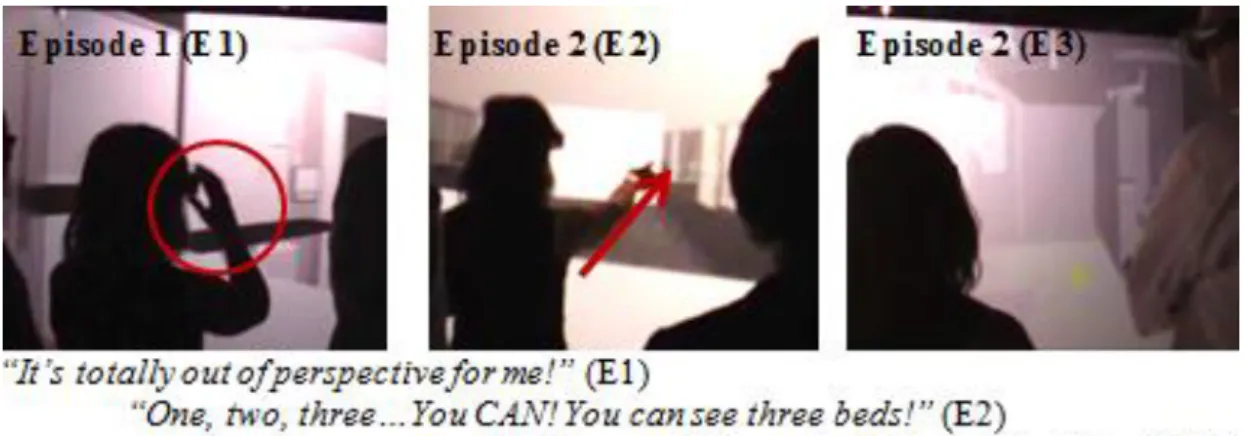
Figure 1. Instances of design practice in the CAVE (16th November 2012)
Episodes E1-E3 (Figure 1) illustrate empirical examples of design interactions occurring in the CAVE.
In episode 1, examining the hospital patient room in the virtual model, a designer expresses her difficulty in evaluating the space because of the distorted perspective: “I can’t tell anything, it’s totally out of perspective for me!”
Episode 2 illustrates the participants’ surprise and excitement around noticing that their model unexpectedly confirms compliance with the clients’ visibility requirement on the visibility towards the patients’ beds: “You CAN! You can see three beds!” (E2).
In Episode 3, the participants are reviewing the operating theatre and question their expectation around the size of the space -“This is huge!”; “But this room, is huge, but it doesn’t look big!”.
The fragments illustrate surprise around the newly encountered technological setting (E1), discovering unexpected issues about the model (E2), or noticing disconfirmation of previous design assumptions (E3) and building up new understanding to further develop their design. Taking surprise as interesting phenomenon characterising design practice performed using IVR, this study further examines literature around the aspect of surprise, and analyses the CAVE participants’ view on their surprises.
LITERATURE REVIEW
The aspect of surprise is scarcely considered in the literature on IVR for design. Some experimental studies (e.g. Rahimian et al 2014) indicate the potential of IVR to enable simulating unexpected events and to support learning by doing and stepping outside routine, enhanced decision making, creativity and understanding of construction design problems. However, this work obscures the processes whereby practitioners perceive and address the surprise and challenge of designing in immersive settings. There is, however, a well-established interest around the issue of surprise in areas including design cognition and creativity, organisational management and learning and use of technology/ information systems in organisational settings, as well as broader studies of social practices or psychology studies of social cognition, cognitive emotion and behaviour. Drawing on a broad identification of two main perspectives in this literature– 1) scientific rationality/cognitive and 2) qualitative/ experiential–, this paper next reviews how the issue of surprise is treated across these areas.
Cognitive treatments of surprise
Building on a cognitivist (information retrieving and processing) and cognitive psychology orientation, the first strand of studies treats surprise as connected to a degree of expectancy disconfirmation and as affective reaction to unexpectedness linked to ‘causal thinking’ and indicates surprise as central to sensory processing, adaptation and learning, attention and decision making (Reisenzein 2000:268). These studies aim for an abstract theorising of surprise by developing and/ or testing rational models of surprise in experimental studies in controlled laboratory situations.
Within design, surprise is mostly addressed from a cognitive perspective and it is mainly discussed in relation to its impact on aspects of design creativity and on the perception and framing of design problems. For example, some studies on design creativity (Grace and Maher 2015) consider surprise as a metacognitive (thinking about thinking) process and focus on the impact of surprise on design problems, goals, requirements formulation and relatedly on design creativity. Pointing the iterative nature of the process of problem and solution formulation and indicating the reasoning about the cause of surprise as relevant for changing design goals, this experimental work identifies taxonomies of surprise and responses to develop cognitive and
computational models of surprise (programing computers to measure surprise). Other studies on improving design methods, tools and approaches to foster creativity
(Becattini et al 2015) focus on the cognitive processes emerging in relation to the perception of surprise around a new design product by treating surprise as constituted through human interpretation rather than as effect of measuring novelty. Other studies (Chen and Lai 2014) address the impact of unexpectedness on the communication effect of design by taking an information retrieving perspective focussed on the
emotion aspects. The role of non-routine contexts is also highlighted in relation to the impact of the design experience on creativity (Rahman and Jonas 2010). These cognitive studies draw on experimental work to develop/ test rational models of surprise based on measuring novelty and unexpectedness by using standard metrics. In a different vein, Dorst and Cross (2001) develop a cognitive model of design creativity by connecting with reflective practice treatments of surprise as interruption of routine and as essential for triggering reflection in action. Stressing the role of surprise in stimulating the framing and reframing, in terms of shaping and changing the view of the problem, these studies find that creativity in design processes is linked with the designers’ identification of surprise in the ‘problem space’ which triggers their reflection, enabling the seeing of things in new ways and stimulating the process. This understanding accounts for designers’ views of the terms and relationships underlying the design activities, views based on their previous experiences and knowledge, as well as their perspectives of addressing them within a situation. Overall, the literature engaging with the issue of surprise from cognitive perspectives develop rational models and abstract theorising based on experimental studies rather than looking into the actual processes whereby individuals experience and respond to surprise and unexpectedness in practice.
Qualitative driven studies of surprise
Contrasting this generally abstracted understanding of surprise, the second strand of literature -drawn on qualitative approaches- treats surprise as situated, by turning attention to the practice as performed in everyday life, inherently realised in situated social and material interaction and stressing the connection between knowing and doing instead of focussing on the cognitive aspects. These studies build on various theoretical standpoints including practice based approaches, reflective practice, or sensemaking perspectives. These studies, across organisational management and learning, the use of technology/ information systems as change in organisations, and design practice, intersect in recognising the role of surprise as a social, generative phenomenon through triggering practitioners’ attention to and reconsideration of the underlying mechanisms of practice.
From a reflective practice perspective (Schön 1983), surprise is central in performing (design) practice by triggering reflection and action to address and engage with unique, conflicting, uncertain, puzzling situations of practice by mobilising appreciations drawn on existing repertoires through both individual and collective conversation with the materials. Surprise is discussed as triggering ‘new ways of seeing things’ and leading to ‘questioning assumptions that had been built into practice’ (Schön 1992:131,136). The practitioner’s ‘ability’ of responding to the ‘surprise’, contradictory, unfamiliar states perceived in the ‘back-talk’ of a design situation is mediated through ‘seeing’ the situation in new ways, in association with familiar elements of previous experiences, which guides the process of shaping the situation by employing action and driving further accomplishment of practice. Similarly, from a phenomenology oriented practice based approach to change in organisations, the issue of surprise as breakdown is treated as means to encounter the ‘world’ suspending, even if briefly, usual attitudes and expectations (Ciborra 2001: 28). Applying this perspective to study the use of technology in organisations, Ciborra indicates the processes of bricolage (‘make do’) and improvisation employed by practitioners to “find fixes to the plans and deal with surprises” (Ciborra 2004:20) and points out the phenomenon of drifting i.e. “deviating from planned purpose for a
variety of reasons often outside anyone’s influence” (Ciborra 2001:4). This kind of phenomenological approach indicates situations of discontinuity and disruptions related to the use of novel technologies and points out practitioners’ reconsideration of existing assumptions built into practices (Lanzara 2009). Surprise is treated as a complex of “features that defy our understanding, descriptions and planning abilities”, addressed through a range of constructive activities globally conceptualised as
‘bricolage’ i.e. encompassing “practical experiments, local readjustments and repairs, extemporaneous improvisations” employed to respond to surprises, novelties, and other puzzling phenomena interrupting/ rupturing repertoires of practice routines (Lanzara 1999:334, 135).
From a sensemaking perspective, surprise (particularly understood as interruption of routine and/or as ambiguous event) is seen as “consequential occasion for
sensemaking” (Weick 1995:105) and it is often discussed in relation to improvisation and making new sense to restore interrupted activity (e.g.Weick,1995; Sandberg and Tsoukas, 2015). Intersecting with other areas of literature, this perspective
acknowledges that interruption and recovery (Weick 2009) drive accentuation of consciousness and meaning of experiences. This approach to surprise is also
indicating the role of the repertories of previous experiences and understandings on which new sense is built in non-routine situations.
These studies also intersect in discussing surprise as triggering practitioners’ shifting from subsidiary to focal awareness around the practice elements, leading to
(re)opening (reflective) inquiry (e.g. Yanow 2015). From a sensemaking perspective, ‘jolts’, surprises and other types of disruptions trigger interpretations and “expose tacit, taken for granted assumptions” (Weick 1992:101). In various ways, these studies indicate the idea that through surprise and novel circumstances characterised by interruption of routines, ‘elements’ of practice taken for granted may begin to be questioned, sometimes through a change of focus of awareness and attention. Surprise is discussed as relating to new types of awareness- more focal forms of attention employed to address disruptions: “When routine practices are interrupted by surprises, these disturbances produce a caring, a mattering –an affective state- that focuses awareness and attention” (Yanow and Tsoukas 2009: 1351). Unexpectedness may trigger changed ways of engaging with the elements involved in a practice situation, which may shift from being ‘transparently available’ (Yanow and Tsoukas 2009) to being brought under focus of deliberate attention. Surprise may trigger changes in the degree of awareness around these constituents, focus on their properties, and
beginning of reflection on the underlying ‘mechanisms’ of practice.
In various ways, this literature highlights the relevance of surprise in performing social practices. This study draws on the second strand of literature on surprise by taking a practice based approach to examine the surprise phenomenon around the use of IVR in design work through focusing on the participants’ perspective.
METHODOLOGY
The case study is based on a real-life project for designing a new hospital in the UK. One of the requirements is that all patient accommodation is in single rooms, rather than traditional wards. Single room only accommodation is rare in the UK, and so a key issue for the client was ensuring that the rooms were of sufficient size. At the time of the research, the project was still in bid preparation stage. The project team opted to augment the traditional design and client engagement procedure with the use of an
IVR environment - a CAVE facility set up in the University of Reading. This was to be used to demonstrate to the client that the rooms were of an appropriate size. Building on insights of former research based on observation and video recording of multiple design meetings performed using the CAVE (Maftei and Harty 2012; 2015), the methodology here draws on follow up discussions with the participants involved to access their views on the surprise emerging in their CAVE design experience and the implications on the design process. The research conducted retrospective
conversations with the participants by playing back video clips of the CAVE design events and engaging them to reflect on the use of the technology and on their design review experience. The discussions were conducted individually in four sessions (30-60 minutes) with participants having various roles in the design team: visualizer (REVIT modeller), project director, lead of interior design and lead medical planner. Conducting the research followed the University's ethical procedures regarding the participants' consent and the confidentiality and data protection.
The analysis draws on the participants’ retrospective reflection on the CAVE design review experience to unpack their views on the surprise and challenge encountered in the immersive simulation of their models.
ANALYSIS
Surprise around the technology
The participants’ retrospective insights on the CAVE design experience indicated the surprise encountered in the technicalities of using the immersive environment and provoking ruptures in the routine performance of a design review:
“[..] it was exciting but it was a bit daunting as well because you, it’s something new and you’re kind of, you have an expectation. So it’s like, ooh, this space that I’ve designed, this was my layout that suddenly you walk into. But for me, […] I couldn’t, the perspective of what I was looking at was completely wrong.” (Medical Planner) Relating back to the example illustrated in Episode 1 earlier in the paper, the Medical Planner’s retrospective reflection on using the CAVE indicates the disruption caused by the technicalities of the environment: “it was exciting but it was a bit daunting” and points the source of breakdown in the distorted viewing perspective, relating to the lack of using the head trackers: “you have an expectation […] but […] the
perspective of what I was looking at was completely wrong”. As firstly encountered, the CAVE was perceived as unusual and surprising in reference to participants’ repertoires of design experiences and procedures: “it was a bit daunting because, it’s
something new and you have an expectation”. The participant’s comments indicate the misfit between the expectations drawn on previous work and repertoires of usual representations (like REVIT/ CAD models visualised on computer screens) - “this
space that I’ve designed, this was my layout”- and the CAVE version of the model as perceived from the participant’s viewing perspective: “what I was looking at was completely wrong”.
Together with noting the disruption cause by the technicalities of the CAVE as newly experienced design setting (distorted viewing perspective), the participants reflected on the use of the CAVE on a more frequent basis, suggesting familiarisation with the specific procedures of navigating and using the model:
“Let’s just assume we’ve been in the CAVE for 15 times, that newness is of […] Wow, that would be really powerful, […] it’s just you walk through a space and people offer
observations about, that’s not right or this could be better or there’s an issue here. So that would be very powerful.” (Project Director)
The participant’s comment suggests that through repeated experiences in the CAVE designers would familiarise with the technical particularities of the setting and points that a more routine way of performing design in the immersive environment would lead to diminishing the novelty. These insights indicate the eventual extinction of surprise around the technology, whilst also pointing the potential of the CAVE as design medium to better enable designers’ noticing design misfit, disconfirmed expectations and supporting discovery of new issues about the design.
Surprise around the design Visibility requirement
The participants’ comments indicated their perception of surprise around their design while they experienced it in the immersive, full scale simulation in the CAVE. For example, relating back to the instance illustrated in Episode 2 earlier in the paper, the CAVE model revealed surprise around the design conformity with the clients’
requirement on the visibility towards the patients’ beds from the nurses’ station area.
“That was out in the main corridor at the staff base that one of the big issues was observation of the bedrooms from the staff base and that [the CAVE simulation] was really good validation of our design because we could see more beds than we thought we could so that was very exciting.” (Medical Planner)
By triggering the participants’ discovery that they “could see more [beds] than [they] thought [they] could, and that was very exciting”, this is a case of surprise not as interruption, misfit or disconfirmation but instead as excitement through finding out an unexpected realisation of previous design intention, a discovery of a not strongly envisaged fit. The participants’ view on the CAVE design experience shows that surprise occurred not only as unconfirmed expectation, but also as unexpected
confirmation. This circumstance of surprise through satisfactory excitement contrasts the literature tending to discuss surprise as connected to negative feelings (Giddens 1999 in Sandberg and Tsoukas 2015:17).
Beyond driving excitement on the unexpected conformity of their design with the visibility requirement, this surprise emerged through designers’ physically immersive exploration of their design within the CAVE connected with their increased awareness of the actual use of their design, triggering reflection on the clients’ requirement and leading to reframing:
“I remember doing […] work with clinicians, saying you’ve given us this criteria which is […] to be able to see 60% of the rooms from one single point, and I said […] look, is that really necessary, because do people really stand like that? And I just walked one step one way, one step the other way and I said, if I did that I can see a lot more. So is it such a concern? And this was a way of absolutely […] demonstrating that that wasn’t such an issue, and I think they believe that.” (Project Lead) The Project Lead’s reflection on the surprise around the visibility requirement connects with the literature point on surprise as relating to an affective state, a ‘mattering’, a ‘caring’ (e.g. Yanow and Tsoukas 2009) which focusses awareness on the practice elements. In this case, the surprise connected with designers’ reflection on the client’s requirement and on the actual usability of the designed space.
Summing up, the participants’ view on the surprise experienced in the CAVE around the visibility requirement shows that in this case surprise triggered: 1) excitement through discovery of their design’s unexpected conformity with the requirement; and 2) inquiry into the requirement itself, and relatedly a ‘caring’, a ‘mattering’ about the use of their design and increased awareness of the actual usability of the space, and reconsidering the requirement together with the client.
Spatial size and relation with the equipment
Another circumstance of surprise and challenge indicated by the participants’ comments on their CAVE design experience is the misfit between their expectation and assumption on the spatiality and functionality of the operating theatre as designed through mundane procedures and the outcome perceived in the CAVE model. This example relates back to the instance illustrated in Episode 3 earlier in the paper. The participants’ view on their surprise encountered in the CAVE around the spatial size and relation with the equipment in the operating theatre indicates the breakdown as sourced in the lack of realisation of design intention - although designed of
sufficient size, the room looked overcrowded with the equipment. Discussing with the participants revealed the connection between their various roles in the project and focus of concern in the CAVE simulation and their attention on particular aspects around this surprise and distinct strategies of addressing them. For the Visualiser, the misfit consisted in the representational impact of the equipment in the operating theatre, triggering reflection on the representation and driving changes to the model:
“[…] looking at it [the operating theatre] from that perspective and […] seeing the equipment and how crowded rooms were, […] was a way of us saying […]this is going to look too cluttered for the client to understand the room. Even though this is our realistic representation of what the room will be with all the kit, it’s better if we strip some of it out so they can maybe understand the space better.” (Visualiser) For the Medical Planner, the misfit perceived in the unsatisfactory relation between the spatial size and equipment in the operating theatre triggered her attention on the actual use of the space, leading to questioning and reframing the client’s requirement:
“[…] what we were concerned about was that there was so much [equipment] in that space that it wasn’t necessarily workable despite the fact that they had asked for everything in there.” (Medical Planner)
This case resonates with what the literature discusses about surprise as trigger for questioning assumptions built into practices, by turning focal attention on the client’s requirement which shifts from being ‘transparently available’ (Yanow and Tsoukas 2009), or taken for granted by the designers to becoming ‘apparent’ and subjected to scrutiny, through a ‘caring’ about the use of the space: “[…] it’s too much stuff for you to move around. How do you even work in this space?” (Medical Planner). The participants’ comments show that the CAVE design experience challenged existing understandings and procedures by not confirming expectations of former design intentions and assumptions based on previous experience (the size of the operating theatre) or by revealing new issues about the design (unexpected discovery of their design conformity with the visibility requirement). These surprises emerging in the CAVE provoked interruption of the routine performance of the process and triggered designers’ reflection on the medium, on their understanding and on the ways of addressing these unsatisfactory issues perceived in the design. The designing process built up on such disruptive aspects, through participants’ making sense of and
addressing these surprises to accomplish their practice. The participants’ discovery of unexpected issues about their design triggered changes on the design and affected the process: “[…] to see the spaces in CAVE […] was very useful for us, and we certainly
used that experience in our thinking when we were developing later on in the process, definitely.” (Visualiser)
These findings indicate that the design surprises in the CAVE triggered new ways of making sense of the space and seeing things in new ways, which impacted on the process through informing further design decisions and the design development.
CONCLUSIONS
The analysis revealed that the element of surprise encountered by the participants both around the CAVE as newly experienced technology and around the immersive version of their design played an important role in the design process. The study indicates that using CAVE as design media is not only enhancing or adding to an existing
understanding of design through paper based or non-immersive digital representations, but it is also, and perhaps most significantly, challenging the participants’
understanding of the design as they experience the immersive, full scale version of it. The findings also showed that 1) the surprise around the CAVE as newly encountered technology is susceptible to fade out through practitioners’ familiarising with the setting through repeated experiences in the CAVE; 2) when the technology will not be a novelty anymore, surprise and unexpectedness around future designs may still be central in the process by triggering designers’ new ways of seeing and making sense of their designs with impact on the further design development. These insights enhance current understanding around and support integrating the practical consequences of using CAVEs in design activities by indicating that immersive technologies might be useful for design practice and practitioners through extending and challenging designers’ own understandings of their previous work.
REFERENCES
Becattini, N, Borgianni, Y, Cascini G et al. (2015) Surprise and design creativity: investigating the drivers of unexpectedness. " International Journal of Design Creativity and Innovation", 1-19.
Chen, Y and Lai, I (2014) The impact of relevancy and unexpectedness on the communication effect of design. "KEER2014", 11-13June 2014, Linkoping. International Conference on Kansei Engineering and Emotion Research.
Ciborra, C (2001) " From Control to Drift: The Dynamics of Corporate Information Infrastructures". Oxford: Oxford University Press.
Ciborra, C (2004) "The Labyrinths of Information: Challenging the Wisdom of Systems". Oxford: Oxford University Press.
Dorst, K and Cross, N (2001) Creativity in the design process: co-evolution of problem– solution. "Design Studies", 22, 425-437.
Gopinath, R (2004) "Immersive Virtual Facility Prototyping for Design and Construction Process Visualisation Department of Architectural Engineering", Master of Science, University of Pennsylvania.
Grace, K and Maher, M (2015) Surprise and reformulation as meta-cognitive processes in creative design. Proceedings of the Third Annual Conference on Advances in Cognitive Systems ACS-2015, Article 8.
Kahkonen, K (2003) Editorial: Virtual Reality Technology in Architecture and Construction. "Journal of Information Technology in Construction”, 8, 101- 103.
Lanzara, G (1999) Between transient constructs and persistent structures: designing systems in action. "Journal of Strategic Information Systems", 8, 331–349.
Lanzara, G (2009) Reshaping practice across media: Material mediation, medium specificity and practical knowledge in judicial work. "Organization Studies, 30, 1369-1390. Luck, R (2012) Kinds of seeing and spatial reasoning: Examining user participation at an
architectural event. "Design Studies", 33(6), 557-588.
Maftei, L and Harty, C (2012) Exploring CAVEs: Using immersive environments for design work In: Smith, S D (Ed.) "28th Annual ARCOM Conference", 3-5 September 2012, Edinburgh, UK. Association of Researchers in Construction Management, 13-22. Maftei, L and Harty, C (2015) Designing in Caves: Using Immersive Visualisations in Design
Practice. “International Journal of Architectural Research", 9(3), 53-75.
Messner, J, Riley, D and Moeck, M (2005) Virtual facility prototyping for sustainable project delivery. "Journal of Information Technology in Construction", 11, 723- 738.
Rahimian, F, Arciszewski, T and Goulding, J (2014) Successful education for AEC
professionals: case study of applying immersive game-like virtual reality interfaces. "Visualization in Engineering", 2(4).
Rahman, H and Jonas, M (2010) Creativity in Spatial Design Processes: Establishing a Non-Routine Design Approach. "ICDC 2010", 29 November - 1 December 2010, Kobe, Japan. First International Conference on Design Creativity.
Reisenzein, R (2000) The subjective experience of surprise. In: H. Bless and J. Forgas (Eds.) "The message within: The role of subjective experience in social cognition and behavior". Philadelphia, PA: Psychology Press, 262-279.
Sandberg and Tsoukas (2015) Making sense of the sensemaking perspective: Its constituents, limitations, and opportunities for further development. "Journal of Organizational Behavior", 36, S6–S32.
Schön, D (1983) "The reflective practitioner. How professionals think in action". London: Temple Smith.
Schön, D (1992) The theory of Inquiry: Dewey's Legacy to Education. "Curriculum Inquiry", 22(2), 119-139.
Yannow, D (2015) After Mastery: Insights form Practice Theorising. In: R. Garud, B. Simpson, A. Langley and H. Tsoukas (Eds.) “The Emergence of Novelty in Organizations”. Oxford press, ch.11, 272-317.
Yanow, D and Tsoukas, H (2009) What is reflection-in-action? A phenomenological account. "Journal of Management Studies", 46, 1339–1363.
Yerrapathruni, S et al. (2003) Using 4D CAD and Immersive Virtual Environments to Improve Construction Planning. "CONVR 2003", Blacksburg, VA. Conference on Construction Applications of Virtual Reality, 179-192.
Weick, K. (1992), Jolts as a synopsis of organizational studies. In: P. Frost and R. Stablein, (Eds.) "Doing Exemplary Research". Newbury Park, CA: Sage Publications, 99-104. Weick, K (1995) "Sensemaking in organisations". London: Sage Publications.
Weick, K (2009) "Making sense of the organization: The impermanent organization". Chichester, UK: Wiley.