This is a repository copy of
Tensor Rank Estimation and Completion via CP-based Nuclear
Norm
.
White Rose Research Online URL for this paper:
http://eprints.whiterose.ac.uk/120408/
Version: Accepted Version
Proceedings Paper:
Q, S., Lu, H. and Cheung, Y.M. (2017) Tensor Rank Estimation and Completion via
CP-based Nuclear Norm. In: CIKM'17: ACM Conference on Information and Knowledge
Management Proceedings. ACM Conference on Information and Knowledge Management,
06-10 Nov 2017, Pan Pacific Singapore. Association for Computing Machinery . ISBN
978-1-4503-4918-5
https://doi.org/10.1145/3132847.3132945
[email protected]
https://eprints.whiterose.ac.uk/
Reuse
Unless indicated otherwise, fulltext items are protected by copyright with all rights reserved. The copyright
exception in section 29 of the Copyright, Designs and Patents Act 1988 allows the making of a single copy
solely for the purpose of non-commercial research or private study within the limits of fair dealing. The
publisher or other rights-holder may allow further reproduction and re-use of this version - refer to the White
Rose Research Online record for this item. Where records identify the publisher as the copyright holder,
users can verify any specific terms of use on the publisher’s website.
Takedown
If you consider content in White Rose Research Online to be in breach of UK law, please notify us by
Tensor Rank Estimation and Completion via CP-based Nuclear
Norm
Qiquan Shi
Department of Computer Science, Hong Kong Baptist University
Hong Kong, China [email protected]
Haiping Lu
Department of Computer Science, University of Sheield
Sheield, U.K. [email protected]
Yiu-ming Cheung
Department of Computer Science,Hong Kong Baptist University Hong Kong, China [email protected]
ABSTRACT
Tensor completion (TC) is a challenging problem of recovering missing entries of a tensor from its partial observation. One main TC approach is based on CP/Tucker decomposition. However, this approach often requires the determination of a tensor rank a pri-ori. This rank estimation problem is diicult in practice. Several Bayesian solutions have been proposed but they often under/over-estimate the tensor rank while being quite slow. To address this problem of rank estimation with missing entries, we view theweight vectorof the orthogonal CP decomposition of a tensor to be anal-ogous to thevector of singular valuesof a matrix. Subsequently, we deine a newCP-based tensor nuclear normas theL1-norm of this weight vector. We then propose Tensor Rank Estimation based onL1-regularized orthogonal CP decomposition (TREL1) for both CP-rank and Tucker-rank. Speciically, we incorporate a regular-ization with CP-based tensor nuclear norm when minimizing the reconstruction error in TC to automatically determine the rank of an incomplete tensor. Experimental results on both synthetic and real data show that: 1) Given suicient observed entries, TREL1 can estimate the true rank (both CP-rank and Tucker-rank) of incom-plete tensors well; 2) The rank estimated by TREL1 can consistently improve recovery accuracy of decomposition-based TC methods; 3) TREL1 is not sensitive to its parameters in general and more eicient than existing rank estimation methods.
KEYWORDS
Tensor Rank Estimation; CP-based Tensor Nuclear Norm; CP De-composition; Tensor Completion
1
INTRODUCTION
Tensors are generalization of vectors (irst-order tensors) and matri-ces (second-order tensors). They are ubiquitous (e.g., multichannel EEGs, images, videos, and social networks) and attract increasing interests [16].Tensor completion, a task of recovering the missing en-tries based on partially observed enen-tries, has drawn much attention recently in many applications of machine learning [24, 28, 32, 34] and data mining [29ś31, 36].
Permission to make digital or hard copies of all or part of this work for personal or classroom use is granted without fee provided that copies are not made or distributed for proit or commercial advantage and that copies bear this notice and the full citation on the irst page. Copyrights for components of this work owned by others than ACM must be honored. Abstracting with credit is permitted. To copy otherwise, or republish, to post on servers or to redistribute to lists, requires prior speciic permission and/or a fee. Request permissions from [email protected].
CIKM’17, , November 6ś10, 2017, Singapore.
© 2017 Association for Computing Machinery. ACM ISBN ISBN 978-1-4503-4918-5/17/11. . . $15.00 https://doi.org/http://dx.doi.org/10.1145/XXXXXX.XXXXXX
One popular approach to solving tensor completion problems is tensor nuclear norm minimization, which is extended from ma-trix [5] to tensor case as a convex surrogate for rank minimization [18]. Although the nuclear norm approximation leads to good ten-sor completion performance under typical conditions [7, 11, 19], there is no theoretical guarantee that it is the tightest convex enve-lope of a tensor rank. Moreover, this approach is not eicient on large-scale tensors due to the heavy computation of singular value decomposition (SVD).
Another popular approach is based on tensor decompositions including CANDECOMP/PARAFAC (CP) [6, 12]) and Tucker de-composition [35], which is more promising for large-scale data. These two main decompositions lead to two common deinitions for tensor rank: CP-rank and Tucker-rank respectively. This ap-proach often requires a tensor rank as input. For example, aCP
decomposition with weighted optimization method (CP-WOPT) [1] and an alternating minimization algorithm for tensors with a (ixed) low-rank orthogonal CP decomposition (TenALS) [14] can obtain good completion results for data with missing values under typical conditions. However, they need to manually choose a CP-rank as input, which is quite challenging because estimating the CP-rank is NP-hard [13], especially given incomplete information. On the other hand, by enforcing orthogonality intoTuckermodel, a generalized higher-order orthogonal iteration method (gHOI) [20] is developed to eiciently solve tensor completion problem, where the Tucker-rank for their model is obtained via a heuristic Tucker-rank-increasing scheme. Furthermore, a simple Tucker decomposition-based ap-proach (Tucker-WOPT) [10] fails to recover missing data accurately if the pre-speciied rank is smaller than the true rank. Most recently, a Riemannian manifold optimization method (FRTC) [15] achieves good recovery performance on large-scale tensors, while still re-quiring a good rank value to be pre-speciied. Moreover, its time cost increases exponentially with increasing input Tucker-rank.
Some studies attempt to estimate the CP/Tucker-rank of incom-plete tensors automatically. Several Bayesian models have been proposed to automatically determine the CP-rank [3, 27, 42, 43]. For example, the CP rank of an incomplete tensor can be inferred by employing a multiplicative gamma process prior in [27], where the inference is performed by Gibbs sampler with slow convergence. Most recently, a Bayesian robust tensor factorization (BRTF) [43] employs a fully Bayesian generative model for automatic CP-rank estimation. However, BRTF often under/over-estimates the true rank of incomplete tensors and has high computational cost.
To automatically estimate the Tucker-rank, an automatic rele-vance determination (ARD) algorithm is applied for sparse Tucker decomposition (ARD-Tucker) [23]. ARD is a hierarchical Bayesian
approach widely used in many methods [26, 33, 37]. However, ARD-Tucker is not applicable to incomplete tensor data and its eiciency is quite low. Most recently, a robust Tucker-rank estimation method using Bayesian information criteria is proposed [39], while also only applicable to complete tensors.
In this paper, we view theweight vectorof the orthogonal CP decomposition of a tensor as analogous to thevector of singular val-uesof the SVD of a matrix. We then deine a simpleCP-based tensor nuclear normas theL1norm of this weight vector. Based on this new tensor norm, we proposeTensorRankEstimation based on
L1-regularized orthogonal CP decomposition, denoted asTREL1.
TREL1 can automatically determine bothCP-rank and Tucker-rank
accurately given suicient observed entries by removing the zero entries of the weight vector after optimization. We solve the opti-mization problem by block coordinate descent, where we optimize a block of variables while ixing the other blocks and update one variable while ixing the other variables in each block. In a nutshell, our contributions are fourfold:
•We propose TREL1 to automatically estimate the CP-rank of an incomplete tensor via a newly deined CP-based tensor nuclear norm.
•We automatically estimate the Tucker-rank in each mode by degenerating TREL1 to matrix case and applying it on the unfolded matrices of an incomplete tensor.
•We develop an eicient block coordinate descent algorithm for model optimization.
•We carry out extensive experiments to show that TREL1 is not sensitive to its parameters in general and more ef-icient than existing tensor rank estimation methods, and using TREL1 for rank estimation can improve the recovery accuracy of the state-of-the-art decomposition-based tensor completion methods.
This paper is organized as follows. We review preliminaries and backgrounds in Section 2. In Section 3, we deine a CP-based tensor nuclear norm and propose two tensor rank estimation methods for both CP-rank and Tucker-rank estimation. We report empirical results in Section 4, and conclude this paper in Section 5.
2
PRELIMINARIES AND BACKGROUNDS
We irst review the preliminaries and backgrounds [16, 22].
2.1
Notations and Operations
The number of dimensions of a tensor is theorderand each dimen-sion is amodeof it. A vector is denoted by a bold lower-case letter
x∈RI and a matrix is denoted by a bold capital letterX∈RI1×I2.
A higher-order (N ≥3) tensor is denoted by a calligraphic letter
X ∈RI1×···×IN. Theith entry of a vectora∈RI is denoted bya(i),
and the(i,j)th entry of a matrixX∈RI1×I2is denoted byX(i,j). The(i1,· · ·,iN)th entry of anNth-order tensorXis denoted by X(i1,· · ·,iN), wherein ∈ {1,· · ·,In} andn ∈ {1,· · ·,N}. The
Frobenius norm of a tensorXis deined by∥X ∥F =⟨X,X⟩1/2.Ω∈
RI1×···×IN is a binary index set:Ω(i
1,· · ·,iN)=1 ifX(i1,· · ·,iN)
is observed, andΩ(i1,· · ·,iN)=0 otherwise.PΩis the associated
sampling operator which acquires only the entries indexed byΩ:
(PΩ(X))(i1,· · ·,iN)= ( X(i1,· · ·,iN), if(i1,· · ·,iN)∈Ω 0, if(i1,· · ·,iN)∈Ωc , (1) whereΩcis the complement ofΩ. We havePΩ(X)+PΩc(X)=X.
Definition 1. Mode-nProduct. A mode-nproduct between a tensorX ∈RI1×···×INand a matrix/vectorU∈RIn×Jn is denoted by
Y=X ×nU⊤∈RI1×···×In−1×Jn×In+1×···×IN, with entries given by
Yi1···in−1jnin+1···iN =
P
inXi1···in−1inin+1···iNUin,jn, and we have
Y(n)=UTX(n)[22].
Definition 2. Mode-nUnfolding. Unfolding, a.k.a., matriciza-tion or lattening, is the process of reordering the elements of a tensor into matrices along each mode [16]. A mode-nunfolding matrix of a tensorX ∈RI1×···×IN is denoted asX
(n)∈RIn×Πn∗,nIn∗.
2.2
CP and Tucker Decomposition
2.2.1 Tucker Decomposition and Tucker-rank.A tensorX ∈
RI1×I2×···×IN is represented as a core tensor with factor matrices
in Tucker decomposition model [16]:
X= G×1U(1)×2U(2)· · · ×NU(N), (2) where {U(n) ∈ RIn×Rn,n
= 1,2· · ·N, andRn < In} are
fac-tor matrices with orthonormal columns andG ∈ RR1×R2×···×RN
is the core tensor with smaller dimension. TheTucker-rank of anNth-order tensor Xis anN-dimensional vector, denoted as
r =(R1,· · ·,RN), whosen-th entryRn is the rank of the
mode-nunfolded matrixX(n) ofX.Rn is themode-nrank. Figure 1
illustrates this decomposition.
Figure 1: The Tucker decomposition of a third-order tensor.
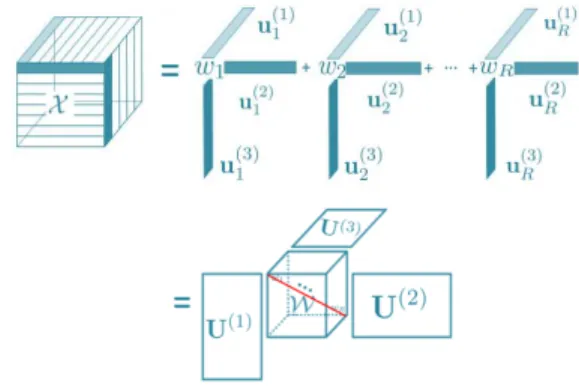
Figure 2: The CP decomposition of a third-order tensorX, where the core tensorWis a super-diagonal tensor.
2.2.2 CP Decomposition and CP-rank. CPdecomposition de-composes a tensorX ∈RI1×···×IN as the weighted summation of a
set of rank-one tensors:
X= R X r=1 wr ur(1)◦ · · · ◦ur(n)· · · ◦ur(N) =W×1U(1)×2U(2)· · · ×NU(N), (3)
where eachur(n),n = 1,· · ·,N is a unit vector with the weight absorbed into the weight vectorw =[w1,· · ·wr,· · ·wR]⊤∈RR,
and◦denotes the outer product [16]. Figure 2 shows that CP de-composition is also could be reformulated as the Tucker decom-position where the core tensorWis a super-diagonal tensor, i.e.,
W(r,· · ·,r)=wr.RisCP-rankas the minimum number of
rank-one comprank-onents.
3
PROPOSED TENSOR RANK ESTIMATION
METHODS
This section presents newTensorRankEstimation methods based onL1-regularized orthogonal CP decomposition, namely,TREL1. For simpler notations, we consider third order tensorsX ∈RI1×I2×I3
only while our methods generalize easily to higher-order tensors.
Orthogonal CP decomposition.In this paper, we consider the orthogonal CP decomposition, i.e., we enforceup(n)⊤u(n)q =0for
p,q, andu(n)
p
⊤
uq(n)=1otherwise. There are two motivations: (1) CP decompositioncan be viewed as a generalization of SVD
to tensors [8]. It seems natural to inherit the orthogonality of SVD in CP decomposition.
(2) Although orthogonality is considered unnecessary in general or even impossible in certain cases in exact CP decompo-sition [4, 9, 40], some recent studies show that imposing orthogonality in the CP model can turn non-unique tensor decomposition into a unique one with guaranteed optimality [2, 14, 17, 40].
Tensor decomposition with missing data is more challenging than that with complete data in traditional problems. Furthermore, it is important to estimate a good rank from an incomplete tensor for accurate tensor completion. Therefore, we believe incorporating orthogonality into the CP model can help us determine the rank and further recover the tensor in the context of tensor completion. Our empirical studies to be presented later will show that the or-thogonality constraint indeed gives better tensor rank estimation and completion results. Furthermore, we view theweight vectorw
of the orthogonal CP decomposition of a tensorXto be analogous to thevector of singular valuesof a matrix.
Definition 3. TheCP-based Tensor Nuclear Normof a tensor Xis deined as theL1norm of the weight vectorwof its orthogonal CP decomposition:∥X ∥CP=∥w∥1.1
In TREL1, we incorporate a regularization ofCP-based tensor nuclear normwhile minimizing the reconstruction error to obtain the estimated rank of an incomplete tensor and a low-rank recovery.
1For easy reading, we use∥w∥1instead of∥ X ∥CPbelow.
Thus, our objective function is: min X,w,{u(rn)},R λ∥w∥1+1 2∥X − R X r=1 wrur(1)◦ur(2)◦ur(3)∥F2, s.t. PΩ(X)=PΩ(T),ur(n)⊤ur(n)=1,n=1· · ·3, u(n)r ⊤uq(n) =0,q=1· · ·r−1,r=1· · ·R, (4)
whereT ∈RI1×I2×I3is the given incomplete tensor with observed
entries inΩ.w=[w1,· · ·,wr,· · ·,wR]⊤is theweight vectorand
Ris the CP-rank ofX.λis a regularization parameter.
3.1
Derivation of TREL1 by BCD
We employ the Block Coordinate Descent (BCD) (a.k.a., alternat-ing minimization[14]) method for optimization. We divide the tar-get variables intoR+1 blocks: {{w1,u1(1),u1(2),u(13)},· · ·,{wr,ur(1),
ur(2),ur(3)},· · ·,{wR,uR(1),u(R2),u(R3)},X}. We optimize a block of
vari-ables while ixing the other blocks, and update one variable while ixing the other variables in each group. After updating theR+1
blocks, we inally determine the tensor rank.
The Lagrangian function of (4) with respect to ther-th block
{wr,ur(1),ur(2),u(r3)}is: L wr,u( n) r =λ |wr|+12∥Xr−wrur(1)◦u(r2)◦ur(3)∥2F, s.t.ur(n)⊤u(n)r =1,n=1· · ·3, u(n)r ⊤uq(n)=0,q=1· · ·r−1,r=1· · ·R, (5) whereXr =X −Prq−=11wqu (1)
q ◦uq(2)◦u(q3) is the residual of the
approximation. We use Lagrange multipliers to transform (5) to include all the constraints as:
L wr,u( n) r =λ |wr|+12∥Xr−wrur(1)◦ur(2)◦ur(3)∥2F −γ(u(n)r ⊤ur(n)−1)− r−1 X q=1 µqu(n)r ⊤ uq(n), (6)
whereγand{µq}rq−=11are the Lagrange multipliers.
3.1.1 Updateur(n).The function (6) with respect tour(1)is,
Lu(1) r = 1 2∥Xr−wru (1) r ◦ur(2)◦ur(3)∥F2 −γ(ur(1)⊤u(r1)−1)− r−1 X q=1 µqur(1)uq(1), (7)
Then we set the partial derivative ofL
ur(1) with respect to
u(r1)to zero and eliminate the Lagrange multipliers, and get:
ur(1)=(Xr ×2ur(2)×3ur(3))/wr − r−1 X q=1 uq(1)⊤(Xr×2ur(2)×3ur(3))uq(1) /wr, (8)
Algorithm 1CP-rank Estimation Based onL1-Regularized
Orthog-onal CP Decomposition (TREL1CP)
1: Input:PΩ(T),Ω,λ, initial rankRˆ, maximum iterationsK, and
stopping tolerancetol.
2: Initialization:SetZ = zeros(I1,I2,I3), PΩ(X) = PΩ(T), PΩc(X)=0; Initialize{u(1) r ,ur(2),u(3)r ,wr}rRˆ=1ofXby RTPM [2]. 3: fork=1, ...,Kdo 4: X1=X; 5: forr=1, ...,Rˆdo 6: ifwr ,0then 7: Update{u(1)r ,u(2)r ,ur(3)}by (8), (9), (10) respectively. 8: Updatewrby (14). 9: end if 10: Xr =Xr−wrur(1)◦ur(2)◦ur(3). 11: end for
12: UpdateX:SetZ=X − Xrand update the missing entries by:PΩc(X)=P
Ωc(Z).
13: If∥w(k+1)−wk∥2/∥w(k+1)∥2 <tol, break; otherwise,
con-tinue. 14: end for
15: CP-rank Estimation:Only keepwr >0inwrand then obtain
the CP-rankR=length(w).
16: output:R.
and normalizeu(1)r = u
(1)
r
∥ur(1)∥2
. Note that we only update the blocks with non-zero weights. Similarly, we updateur(2)by
ur(2) =(Xr×1ur(1)×3u(3)r )/wr − r−1 X q=1 uq(2)⊤(Xr ×1ur(1)×3ur(3))u(2)q /wr, (9) and normalizeu(2)r = u (2) r ∥u(r2)∥2 , and updateur(3)by ur(3) =(Xr×1ur(1)×2u(2)r )/wr − r−1 X q=1 uq(3)⊤(Xr ×1ur(1)×2ur(2))u(3)q /wr, (10) and normalizeu(3)r = u (3) r ∥u(r3)∥2 .
3.1.2 Updatewr.The function (6) with respect towr is:
Lwr =λ|wr|+
1
2∥Xr −wru
(1)
r ◦u(2)r ◦u(3)r ∥F2. (11)
Then we set the partial derivative ∂Lwr
∂wr to zero and obtain, wr =Xr×1ur(1)×2u(2)r ×3ur(3)−
λ|wr|
∂wr
. (12)
Based on thesoft thresholdingalgorithm [25] forL1regularization,
we updatewr in (12) by:
wr =shrinkλ(⟨Xr,u(1)r ◦u(2)r ◦u(3)r ⟩), (13)
Algorithm 2Tucker-rank Estimation Based onL1-Regularized
Orthogonal CP Decomposition (TREL1Tucker)
1: Input:PΩ(T),Ω,λ, initial Tucker-rankrˆ=[ ˆR1,Rˆ2,Rˆ3],
max-imum iterationsK, and stopping tolerancetol. 2: SetPΩ(X)=PΩ(T),PΩc(X)=0.
3: fori=1, ...,3do
4: X(i)= unfold(X,i).
5: Ω(i)=ones (size(X(i))),Ω(i)(X(i) ==0)=0.
6: Tucker-rank Estimation:Compute the Tucker-rankr= [R1,R2,R3]viaRi = TREL1CP(X(i),Ω(i),λ,Rˆi,K,tol).
7: end for
8: output:r=[R1,R2,R3].
whereshrinkis the soft thresholding operator [25], and we denote
S=⟨Xr,u(1)r ◦u(2)r ◦ur(3)⟩: wr =shrinkλ(S)= S−λ (S>λ) 0 (|S| ≤λ) S+λ (S<−λ) . (14)
3.1.3 UpdateX.The objective function (4) with respect toXis,
min X 1 2∥X− R X r=1 wrur(1)◦ur(2)◦ur(3)∥2F, s.t.PΩ(X)=PΩ(T), (15)
By deriving the Karush-Kuhn-Tucker (KKT) conditions for function (15) [20], we can updateXbyX=PΩ(X)+PΩc(Z), whereZ=
PR
r=1wru (1)
r ◦ur(2)◦ur(3).
3.2
TREL1 for CP-rank Estimation
Applying TREL1 directly for CP-rank estimation, we obtain a new CP-rank estimation method, namely,TREL1CP, summarized in
Al-gorithm1. Here we specify an initial medium rank value ˆRfor eiciency though we could also automatically set it to some high rank value, e.g., min(I1,I2,I3). Besides, to obtain a good initializa-tion, we initialize the CP decomposition of an incomplete tensor using Robust Tensor Power Method (RTPM) [2] following [14]. RTPM makes TREL1CPless sensitive to parameterλthan using random initialization.
3.2.1 Estimate CP-rank.InAlgorithm1, after iteratively
updat-ing all theR+1 blocks till convergence or reaching the maximum
iterations, we inally determine the CP-rank: checking the weight vectorw, we only keep the weights greater than zero. The number of the remaining weights inwis the estimated CP-rank.
3.3
TREL1 for Tucker-rank Estimation
Since the Tucker-rankrconsists of the mode ranks of unfolded
matrices ofXalong each mode, we can compute the rank of each unfolded matrixX(i),i=1,2,3, by degenerating TREL1 to matrix
we have: min X(i),w,{u( n) r },Ri λ∥w∥1+1 2∥X(i)− Ri X r=1 wr ur(1)ur(2) ⊤ ∥2F, s.t.PΩ(X)=PΩ(T),u(n)r ⊤ur(n)=1,n=1· · ·2, u(n)r ⊤uq(n)=0,q=1· · ·r−1,r=1· · ·Ri, (16)
whereRiis the rank (i-th entry of Tucker-rank) of mode-iunfolded
matrixX(i)ofX. Here, each unfolded matrix is approximated by an orthogonal CP decomposition, which is actually the SVD of the unfolded matrix as the orthogonal CP decomposition is a general-ization of SVD from matrices to tensors.
3.3.1 Estimate Tucker-rank.We degenerate the TREL1 to matrix
case to estimate the mode ranks{Ri}i3=1of unfolded matrices along
each mode, and inally determine the Tucker-rankr=[R1,R2,R3]. We denote this TREL1 for Tucker-rank estimation asTREL1Tucker
and summarize it inAlgorithm2. Here, we use random initial-ization for weights and factors ofX(i)because RTPM is only for third-order tensors.
Remark: This mode-wise estimation inTREL1Tuckershares
the same spirit as the Tucker-based nuclear norm (i.e., sum of the nuclear-norms of all the matricizations) and many other existing Tucker-based works. However, the key diference is that our TREL1 objective is to estimate thetrueTucker-rank while Tucker-based nuclear norm is used tominimizethe Tucker-rank. As to be shown in the empirical studies (e.g., Figs. 7 and 8), a smaller rank is not necessarily better and a rank smaller than the true rank often dete-riorates the recovery performance.
3.4
Complexity Analysis
We analyze the complexity of TREL1 following [21], which mainly includes the shrinkage operator and some multiplications. At each iteration, the time complexity of performing the shrinkage op-erator in (13) isO(R(Q3
j=1Ij). This is also the time complexity
of computing{u(n)r }3n
=1and (15). The overall time complexity is
O(KR(Q3
j=1Ij).
4
EXPERIMENTAL RESULTS
We implemented TREL1 in MATLAB to evaluate the rank estimation and tensor completion/recovery performance. All experiments were performed on a PC (Intel Xeon(R) 4.0GHz, 64GB).
4.1
Experimental Setup
4.1.1 Compared Methods.We mainly consider
decomposition-based methods with two steps: (i) rank estimation, and (ii) tensor completion with the rank estimated in (i). In addition, we tested three popular baseline methods (SiLRTC, FaLRTC and HaLRTC) in [18, 19]. FaLRTC performs the best among the three, but inferior to gHOI with TREL1 on the whole. Thus, their results are not included below for more compact presentation.
(i) Rank estimation.We studyfourexisting methods:
•MGP-CP [27]: a Bayesian method for low-rank CP decom-position of incomplete tensors, which infers theCP-rank
using a multiplicative gamma process.
•BRTF[43]: a Bayesian robust tensor factorization which employs a fully Bayesian generative model for automatic
CP-rankestimation.
•ARD-Tucker[23]: an automatic relevance determination algorithm for sparseTuckerdecomposition using the gra-dient based sparse coding algorithm.
•SCORE [39]: a robustTucker-rankestimation method us-ing Bayesian information criteria for complete tensors. Among the four methods, BRTF and ARD-Tucker performed much better than MGP-CP and SCORE, respectively. Thus, we only report the comparison of TREL1 against BRTF and ARD-Tucker to save space.
(ii) Tensor completion.We studytworepresentative CP decomposition-based methods andthreerepresentative Tucker decomposition-based methods:
•CP-WOPT[1]: CP decomposition with missing data is formulated as a weighted least squares problem and solved by a gradient descent optimization approach.
•TenALS[14]: decomposing of incomplete tensors is for-mulated as a low-rankorthogonalCP decomposition prob-lem, solved by an alternating minimization algorithm.
•gHOI[20]: a generalized higher-order orthogonal iter-ation tensor completion method, based on orthogonal Tucker decomposition.
•Tucker-WOPT[10]: a nonlinear conjugate gradient method that solves Tucker decomposition with missing data in a similar way as CP-WOPT.
•FRTC[15]: a Riemannian manifold preconditioning ap-proach for tensor completion with rank constraint.
4.1.2 Synthetic Data.We generated four synthetic tensors of
size –50×50×50,100×100×100,100×100×100,200×200×200˝ with 50 70 90 110 130 150 170 190 210 230 250 Vaule of λ (50×50×50, CP-rank=5) 0 5 10 15 20 Estimated Rank MR=10% MR=20% MR=30% MR=40% MR=50% MR=60% MR=70% MR=80% MR=90%
(a) Estimated ranks:100×100×100(R=5)
50 70 90 110 130 150 170 190 210 230 250 Vaule of λ (200×200×200, CP-rank=50) 30 40 50 60 70 80 90 100 Estimated Rank MR=10% MR=20% MR=30% MR=40% MR=50% MR=60% MR=70% MR=80% MR=90% (b) Estimated ranks:200×200×200(R=50) 50 70 90 110 130 150 170 190 210 230 250 Vaule of λ (100×100×100, CP-rank=5) 10 15 20 25 30 35 40 45 50 55 60 Time(s) MR=10% MR=20% MR=30% MR=40% MR=50% MR=60% MR=70% MR=80% MR=90% (c) Time costs:100×100×100(R=5) 50 70 90 110 130 150 170 190 210 230 250 Vaule of λ (200×200×200, CP-rank=50) 0 2000 4000 6000 8000 Time(s) MR=10% MR=20% MR=30% MR=40% MR=50% MR=60% MR=70% MR=80% MR=90% (d) Time costs:200×200×200(R=50)
Figure 3: (a-b) EstimatedCP-ranksof two tensors (100×100×100withR=5and200×200×200withR=50) by TREL1CPwith
50 70 90 110 130 150 170 190 210 230 250 Vaule of λ (mode-1 of 200×200×200, rank=15) 5 10 15 20 25 Estimated Rank MR=10% MR=20% MR=30% MR=40% MR=50%
(a)Estimated ranks onmode-1:R1=15
50 70 90 110 130 150 170 190 210 230 250 Vaule of λ (mode-2 of 200×200×200, rank=18) 6 12 18 24 30 36 Estimated Rank MR=10% MR=20% MR=30% MR=40% MR=50%
(b) Estimated ranks onmode-2:R1=18
50 70 90 110 130 150 170 190 210 230 250 Vaule of λ (mode-3 of 200×200×200, rank=20) 10 20 30 40 Estimated Rank MR=10% MR=20% MR=30% MR=40% MR=50%
(c) Estimated ranks onmode-3:R3=20
50 70 90 110 130 150 170 190 210 230 250 Vaule of λ (200×200×200, rank=[15 18 20]) 0 500 1000 1500 2000 2500 Time(s) MR=10% MR=20% MR=30% MR=40% MR=50% (d) Time costs:200×200×200(r={15 18 20}) Figure 4: (a-c) EstimatedTucker-ranks in each modeof a200×200×200(r=[15,18,20])tensor by TREL1Tuckerwithλ∈[50 : 10 : 250]; (d) The corresponding time costs.
10 30 50 70 90 110 130 150 170 190 Initial Rank (100×100×100, CP-rank=5) 0 1 2 3 4 5 6 7 8 9 10 Estimated Rank λ=70 λ=100 λ=135 λ=170 λ=200 (a)100×100×100(R=5) 50 7090 110 130 150 170 190 210 230 250
Initial Rank (200×200×200, Tucker-rank= [15 18 20])
12 14 16 18 20 22 Estimated Rank λ=60(Mode-1) λ=80(Mode-1) λ=100(Mode-1) λ=120(Mode-1) λ=150(Mode-1) λ=60(Mode-2) λ=80(Mode-2) λ=100(Mode-2) λ=120(Mode-2) λ=150(Mode-2) λ=60(Mode-3) λ=80(Mode-3) λ=100(Mode-3) λ=120(Mode-3) λ=150(Mode-3) (b)200×200×200(r={15 18 20})
Figure 5: (a) EstimatedCP-ranksof the100×100×100(R=5) tensor with50%missing entries by TREL1CPgiven diferent initial ranksRˆ∈[10 : 10 : 200](b) EstimatedTucker-ranksof the200×200×200(r=[15,18,20])with50%missing entries by TREL1Tuckergiven diferent initial rankRˆ∈[50 : 10 : 250].
50 100 150 200 250 300 350 400 Iteration (100×100×100, CP-rank=5) 10-20 10-15 10-10 10-5 100 105 Weights Error MR=10% MR=20% MR=30% MR=40% MR=50% MR=60% MR=70% MR=80% MR=90% (a)100×100×100(R=5) 50 100 150 200 250 300 350 400 Iteration (200×200×200, CP-rank=50) 10-20 10-15 10-10 10-5 100 105 Weights Error MR=10% MR=20% MR=30% MR=40% MR=50% MR=60% MR=70% MR=80% MR=90% (b)200×200×200(R=50)
Figure 6: Convergence curves of TREL1CP in terms of
weights error:∥w(k
+1)−wk∥2/∥w(k+1)∥2on two tensors.
CP-ranksR={5,5,25,50}, respectively, following [43]. We also gen-erated three synthetic tensors of size –50×50×50,80×100×120,200×
200×200˝ with Tucker-ranksr={[5,5,5],[8,10,12],[15,18,20]}, respectively, following [15].
4.1.3 Real Data.We evaluate tensor rank estimation and
com-pletion onsixrealtensors: Hall sequence (144×176×300) [43], Knix medical images (256×256×24) [38] and Basketball video (144×256×40) [41] for CP-rank estimation; Amino Acid data (5×61×201) [27], Flow Injection data (12×100×89) and Ocean video (160×112×32) [19] for Tucker-rank estimation. We uniformly select10%−90%entries of each tensor at random as missing data and usełMR"to denoteMissingRatio.
4.1.4 Parameter Setings.We set the maximum iterationsK=
500,tol=1e−5for all methods and the initial rankRˆ=round(1/2×
mean(I1,I2,I3))for TREL1. We set other parameters of the
com-pared methods following guidance from the original papers. We
compare the estimated rank against the true rank to evaluate the rank estimation error. We measure tensor completion performance by Relative Square Error (RSE) [18]:∥Z − T ∥F/∥T ∥F, whereZ
is the recovered tensor given a few entries from the (ground truth)
T. We repeat each run 10 times and report the average results. We report the running time as well, in seconds. The setting ofλin TREL1 will be discussed in the following sensitivity study.
4.2
Parameter Sensitivity
4.2.1 Rank Estimation Sensitivity onλ.Figures 3 and 4 show the
rank estimation results on various synthetic tensors by TREL1 with diferentλs. As seen from Figs. 3(a) and 3(b), the rank estimation performance ofTREL1CPis stable and not sensitive to the values
ofλin most cases. Only for very high missing ratios (e.g., MR
=90%), a largeλ(e.g.,λ =110) can make theL1regularization
dominate the whole objective function (4) and result in zero rank. In addition, the time costs of TREL1CPare stable with most ofλ
values (e.g.,λ∈[70,200]), as shown in Figs. 3(c) and 3(d). Figure 4 shows thatTREL1Tuckeris not sensitive toλeither on tensors with no more than half of data missing (i.e., MR≤50%). However, for larger MRs, the rank estimation performance will de-teriorate, which is not shown in the igures for clarity. Nevertheless, this is not surprising by noting that TREL1 is formulated based on CP decomposition so it suits the CP model better than the Tucker model. Nevertheless, for small to medium MRs, TREL1 can mostly produce an accurate estimate of the Tucker-rank for a wide range ofλ. In addition, it is interesting to show that the time cost with a lagerλis lower, as shown in Fig. 4(d).
In summary, CP/Tucker rank estimation performance does not require careful tuning ofλ. The CP-rank estimation is accurate even for some challenging high MRs. Furthermore, the selection ofλis largely insensitive to data. For example, goodλvalues for synthetic tensors are good values for real tensors as well (to be shown in the following). Thus, we can ixλ=100inboth CP/Tucker-rank
estimation for both synthetic and real tensors. Note that in Tucker-rank estimation, we only need to set a singleλand there is no need to set separateλvalues for each mode. Therefore, settingλis much more user-friendly than manually setting the rank values.
4.2.2 Rank Estimation Sensitivity on Initial RankRˆ.Figures 5(a)
and 5(b) study the sensitivity of rank estimation onRˆ. We can see
the rank estimation results by TREL1 with diferent ofλvalues are not sensitive toRˆfor both CP and Tucker models. Thus, we set
ˆ
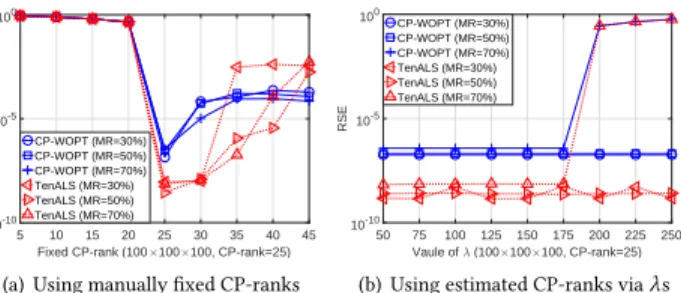
5 10 15 20 25 30 35 40 45 Fixed CP-rank (100×100×100, CP-rank=25) 10-10 10-5 100 RSE CP-WOPT (MR=30%) CP-WOPT (MR=50%) CP-WOPT (MR=70%) TenALS (MR=30%) TenALS (MR=50%) TenALS (MR=70%)
(a)Using manually ixed CP-ranks
50 75 100 125 150 175 200 225 250 Vaule of λ (100×100×100, CP-rank=25) 10-10 10-5 100 RSE CP-WOPT (MR=30%) CP-WOPT (MR=50%) CP-WOPT (MR=70%) TenALS (MR=30%) TenALS (MR=50%) TenALS (MR=70%)
(b) Using estimated CP-ranks viaλs
Figure 7: RSE of recovering a tensor (trueCP-rankR=25) via CP decomposition-based methods given (a) manually ixed ranks and (b) rank estimated via TREL1 with diferentλ.
[4 5 6] [5 7 9] [6 8 10][7 9 11 ] [8 10 12 ] [9 11 13] [10 13 15][11,14,18][12 15 18]
Fixed Tucker-rank (80×100×120, Tucker-rank=[8 10 12])
10-8 10-7 10-6 10-5 10-4 10-3 10-2 10-1 RSE gHOI (MR=30%) gHOI (MR=50%) gHOI (MR=70%) Tucker-WOPT (MR=30%) Tucker-WOPT (MR=50%) Tucker-WOPT (MR=70%) FRTC (MR=30%) FRTC (MR=50%) FRTC (MR=70%)
(a) Using manually ixed Tucker-ranks
50 75 100 125 150 175 200 225 250 Vaule of λ (80×100×120, Tucker-rank=[8 10 12]) 10-8 10-6 10-4 10-2 100 RSE gHOI (MR=30%) gHOI (MR=50%) gHOI (MR=70%) Tucker-WOPT (MR=30%) Tucker-WOPT (MR=50%) Tucker-WOPT (MR=70%) FRTC (MR=30%) FRTC (MR=50%) FRTC (MR=70%)
(b) Using estimated Tucker-ranks viaλs
Figure 8: RSE of recovering a tensor (trueTucker-rankr = [8,10,12]) via Tucker decomposition-based methods given (a) manually ixed ranks and (b) rank estimated via TREL1 with diferentλ.
4.3
Convergence Study
Since TREL1Tuckercan be viewed as performing TREL1CPmultiple times on unfolded matrices, we only study the convergence of TREL1 for CP-rank estimation in terms ofweights error:∥w(k
+1)− wk∥2/∥w(k+1)∥2. Figure 6 shows that TREL1CPconverges within 100 iterations except for a large MR (>70%), which needs more iterations to converge.
4.4
Efects of Rank Value on Completion
Performance
Here, we present studies that investigate the efects of rank estima-tion accuracy on tensor compleestima-tion performance of decomposiestima-tion- decomposition-based methods. All ive decomposition-decomposition-based tensor completion methods (i.e., CP-based CP-WOPT and TenALS, and Tucker-based gHOI, Tucker-WOPT and FRTC) listed in Sec. 4.1.1 (ii) are stud-ied. We compare tensor completion performance with two ways of rank determination: (i) setting the rank manually; (ii) settingλin TREL1 to estimate the rank. We show the results of recovering two synthetic tensors with MR={30%,50%,70%}in Figs. 7 and 8.
•As seen from Figs. 7(a) and 8(a), the completion performance (in RSE) of all ive methods is highly sensitive to the man-ually set rank value. Even a slight error in the rank value (particularly lower-than-true ranks) can lead to serious per-formance degradation. Only given the true tensor ranks, all the ive methods can achieve their best completion results in all cases. For CP-WOPT, TenALS and gHOI, setting any rank value diferent from the true rank gives much worse perfor-mance than their best results. Tucker-WOPT and FRTC can
achieve good results given a higher-than-true rank although still worse than their best results.
• In contrast, Figs. 7(b) and 8(b) show the corresponding results with TREL1 rank estimation by settingλto a limited number of values only. We can see a wide range ofλvalues lead to the best performance of all methods. Such range is particular wide for CP-based methods and narrower for Tucker-based methods, which is not surprising since TREL1 is designed based on a CP model.
This study shows the advantage of TREL1 in rank estimation, compared to manually specifying the rank. TREL1 greatly simpliies parameter tuning where a simple setting ofλfrom a wide range of feasible values works for a wide range of methods and data. This not only improves the completion performance but also reduces the time cost in parameter tuning.
4.5
Tensor Rank Estimation and Completion
Performance
Here, we report the results for MR={30%,50%,70%}in four tables. We highlight thecorrectly estimated rankinitalicandboldfonts,
smallest RSEresults inboldfonts and the second smallest RSE in underline. Here, the corresponding CP-rank estimated by TREL1CP and BRTF are denoted asTREL1-RandBRTF-Rrespectively, and the corresponding Tucker-rank estimated by TREL1Tuckerand ARD-Tucker are denoted asTREL1-randARD-rrespectively.
Further-more, the estimated tensor ranks are fed into decomposition-based tensor completion methods to compare the recovery performance.
4.5.1 CP-rank Estimation and Tensor Completion.
On synthetic tensors: As shown in the left half of Table 1,
TREL1CPcorrectly determines the true CP-ranks of the synthetic tensors in all cases, while BRTF over-estimates the ranks (it only succeeds in one case). More importantly, with TREL1-R, both CP-WOPT and TenALS achieve their best recovery results, as seen from the left half of Table 2. Moreover, TenALS outperforms CP-WOPT both given the true ranks (TREL1-R), which demonstrates the beneits of orthogonal CP decomposition for tensor completion.
On real tensors:We cannot directly evaluate the estimated
CP-ranks since we do not know the ground-truth of CP-CP-ranks for real tensors. Thus, we alternatively compare the tensor completion results afected by the estimated CP-ranks. As seen from the right half of Table 1, TREL1-Rimproves the completion performance of CP-WOPT and TenALS with around 25%than that of using BRTF-R. Moreover, with TREL1-R, TenALS still achieves better results than CP-WOPT on the whole.
4.5.2 Tucker-rank Estimation and Tensor Completion.
On synthetic tensors:As reported in the left half of Table 3,
TREL1Tucker can correctly determine the true Tucker-ranks of the synthetic tensors in all cases, while ARD-Tucker fails (over-estimates or under-(over-estimates) in these cases. Furthermore, with our estimated true ranks (TREL1-r), the Tucker decomposition-based tensor completion methods (gHOI, Tucker-WOPT and FRTC) outperform the cases of using Tucker-ranks estimated by ARD-Tucker (ARD-r) by several orders, as shown in the left half of Table
Table 1: CP-rank estimation on synthetic and real tensors with MR={30%,50%,70%}missing entries. Est.R is the estimated CP-ranks and Time in seconds.
Synthetic Synthetic Synthetic Real Real Real
Data 50×50×50 100×100×100 200×200×200 144×256×40 256×256×24 144×176×300 R=5 R=25 R=50 Hall Sequence Knix Medical Images Basketball Video MR 30% 50% 70% 30% 50% 70% 30% 50% 70% 30% 50% 70% 30% 50% 70% 30% 50% 70%
TREL1CPEst.R 5 5 5 25 25 25 50 50 50 4 3 3 5 3 2 7 7 5
Time 1.59 1.61 2.41 29.17 33.04 43.74 487.60 526.28 568.47 399.30 366.20 363.08 98.83 76.70 79.87 74.13 70.34 69.34
BRTF[43] Est.R 9 6 5 36 42 32 85 79 73 2 1 1 1 1 1 2 2 1 Time 165.57 100.35 88.47 4178.78 5901.48 3462.21 1.80E+05 1.87E+05 1.30E+05 2944.40 2239.89 2089.96 960.78 784.26 766.29 280.61 265.87 226.36
Table 2: Tensor completion results by CP-based methods given estimated CP-ranks on synthetic and real tensors with MR ={30%,50%,70%}missing entries. TREL1-Rand BRTF-Rrefer to the corresponding CP-ranks estimated by TREL1CPand BRTF.
Synthetic Synthetic Synthetic Real Real Real
Data 50×50×50 100×100×100 200×200×200 144×256×40 256×256×24 144×176×300
R=5 R=25 R=50 Hall Sequence Knix Medical Images Basketball Video
MR 30% 50% 70% 30% 50% 70% 30% 50% 70% 30% 50% 70% 30% 50% 70% 30% 50% 70%
CP-WOPT[1] RSE 1.20E-07 1.43E-07 6.12E-07 1.94E-07 3.42E-07 4.79E-07 7.27E-08 9.56E-08 1.37E-07 1.97E-012.09E-012.11E-013.45E-013.80E-01 4.22E-01 1.87E-01 1.88E-01 2.05E-01
withTREL1-RTime 6.16 3.12 1.65 1015.99 636.24 629.92 3.46E+04 1.53E+04 1.19E+04 5118.82 1779.43 1114.47 1746.97 207.79 57.33 1060.02 971.85 299.95
CP-WOPT[1] RSE 9.96E-05 3.82E-05 6.12E-07 1.94E-04 1.87E-04 6.49E-05 3.39E-04 1.86E-04 1.04E-04 2.35E-01 2.62E-01 2.62E-01 4.72E-01 4.72E-01 4.73E-01 2.49E-01 2.49E-01 3.06E-01
with BRTF-R Time 23.62 9.69 1.66 6149.26 4631.69 1725.27 1.72E+05 1.15E+05 5.33E+04 751.29 44.66 24.08 11.66 6.90 3.81 73.39 44.35 2.95
TenALS[14] RSE7.11E-09 1.65E-09 9.74E-09 1.36E-09 2.81E-09 8.26E-09 3.26E-09 5.96E-09 1.52E-09 1.97E-01 2.08E-01 2.11E-01 3.43E-01 3.80E-01 4.22E-01 1.87E-011.89E-012.04E-01
withTREL1-RTime 1.19 1.22 1.26 97.59 104.84 108.93 1493.04 1829.04 2178.05 1755.47 1454.21 1381.88 541.85 280.75 182.67 736.83 712.95 430.92
TenALS[14] RSE 1.61E-08 1.32E-089.74E-093.32E-07 1.48E-08 9.06E-04 1.13E-05 5.50E-06 9.58E-05 2.35E-01 2.62E-01 2.62E-01 4.72E-01 4.72E-01 4.73E-01 2.48E-01 2.49E-01 3.06E-01
with BRTF-R Time 24.02 14.78 1.23 2290.32 1876.08 1805.51 5.18E+04 5.49E+04 5.46E+04 1002.08 424.07 419.32 103.92 103.95 98.67 124.50 124.66 66.59
hours time costs in ive cases as its computational cost increases exponentially given over-estimated Tucker-ranks (ARD-r).
On real tensors:Unlike synthetic data with true Tucker-rank
because we constructed them via QR decomposition and can control the dimensions of its core tensor (Tucker-rank), the real tensors naturally do not have exact low Tucker-ranks. We can unfold a real tensor along each mode and then truncate its mode rank (R1,R2and
R3) to be exact low-rank. However, because the unfolded matrices
are interdependent, we can only control the low-rank in one mode exactly. Therefore, we studied the cases of truncating the unfolded matrices of a tensor into exact low-rank in one of the three modes, and report the results for the mode with the highest dimension. In this way, we can directly evaluate the estimated Tucker-rank exactly in one mode at least. As shown in the right half of Table 3, our method can correctly estimate the mode-1 rank (R1=22) of
Ocean video, the mode-2 rank (R2=7) of Flow Injection and the mode-3 rank (R3=4) of Amino Acid in all cases, while ARD-Tucker
fails to get the exact mode ranks for these real tensors. In addition,
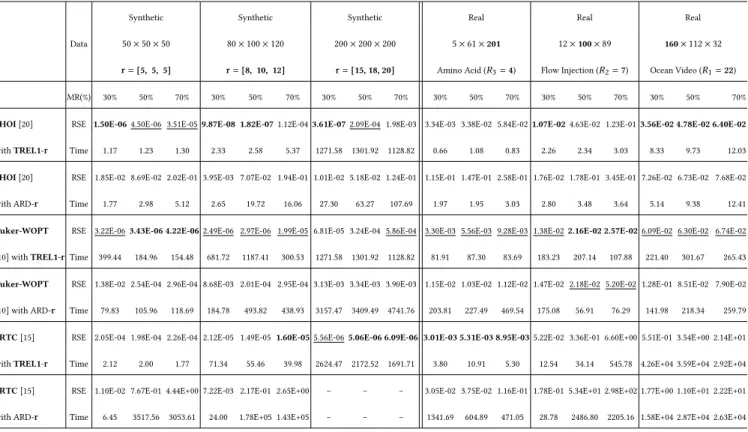
the results shown in the right half of Table 4 demonstrate that: with TREL1-r, the three Tucker decomposition-based tensor completion methods improves recovery performance than that of given ARD-r.
Nevertheless, with ARD-r, Tucker-WOPT achieves the second best recovery results in two cases because it assumes the true ranks can be over-estimated.
4.5.3 Time Cost of Rank Estimation and Tensor Completion.
Time cost of TREL1 rank estimation:As seen from Table 1:
TREL1CPis much faster than BRTF and only needs less than 1%and
18%of BRTF’s time cost on synthetic and real tensors on average respectively. Especially on the larger tensors with higher ranks, for example, TREL1CPis about 300 times faster than BRTF on average on the200×200×200tensor withR = 50. Table 3 shows that
TREL1Tuckeris about 9 times faster than ARD-Tucker on average on the synthetic and real tensors. Thus, due to the expensive time costs of the compared methods, it is not feasible to report results of the lager tensors here.
Table 3: Tucker-rank estimation results on synthetic and real tensors with MR = {30%,50%,70%} missing entries. Time in seconds. Est.R1, Est.R2and Est.R3are the estimated Tucker-ranks in mode-1, mode-2 and mode-3, respectively.
Synthetic Synthetic Synthetic Real Real Real Data 50×50×50 80×100×120 200×200×200 5×61×201 12×100×89 160×112×32
r=[5, 5, 5] r=[8, 10, 12] r=[15, 18, 20] Amino Acid (R3=4) Flow Injection (R2=7) Ocean Video (R1=22)
MR(%) 30% 50% 70% 30% 50% 70% 30% 50% 70% 30% 50% 70% 30% 50% 70% 30% 50% 70% Est.R1 5 5 5 8 8 8 15 15 15 5 5 5 11 11 11 22 22 22
L1TRETucker Est.R2 5 5 5 10 10 10 18 18 18 7 6 4 7 7 7 51 51 51
Est.R3 5 5 5 12 12 12 20 20 20 4 4 4 23 22 31 32 32 32 Time 1.86 3.10 6.87 32.14 56.87 99.73 430.95 788.72 1442.56 1.63 2.82 5.31 3.83 5.87 19.71 35.37 54.46 101.10 Est.R1 6 23 25 2 41 48 26 87 94 5 5 5 12 12 11 11 23 27 ARD-TuckerEst.R2 6 25 25 3 50 50 78 100 100 25 18 30 12 29 34 15 35 41 [23] Est.R3 6 25 25 3 50 50 87 100 100 25 17 18 20 34 34 19 32 34 Time 50.58 90.27 93.08 127.82 310.78 260.07 1021.62 1398.99 1584.68 19.23 36.27 55.35 66.93 83.17 80.16 86.44 161.09 201.89
Table 4: Tensor completion results by Tucker-based methods given estimated ranks on synthetic and real tensors with MR = {30%,50%,70%}missing entries. Time in seconds and łś" indicates that the results cost more than 50 hours. TREL1-rand ARD-rrefer to the corresponding Tucker-ranks estimated by TREL1Tuckerand ARD-Tucker.
Synthetic Synthetic Synthetic Real Real Real
Data 50×50×50 80×100×120 200×200×200 5×61×201 12×100×89 160×112×32
r=[5, 5, 5] r=[8, 10, 12] r=[15, 18, 20] Amino Acid (R3=4) Flow Injection (R2=7) Ocean Video (R1=22)
MR(%) 30% 50% 70% 30% 50% 70% 30% 50% 70% 30% 50% 70% 30% 50% 70% 30% 50% 70%
gHOI[20] RSE 1.50E-064.50E-06 3.51E-059.87E-08 1.82E-071.12E-043.61E-072.09E-04 1.98E-03 3.34E-03 3.38E-02 5.84E-021.07E-024.63E-02 1.23E-013.56E-02 4.78E-02 6.40E-02
withTREL1-r Time 1.17 1.23 1.30 2.33 2.58 5.37 1271.58 1301.92 1128.82 0.66 1.08 0.83 2.26 2.34 3.03 8.33 9.73 12.03
gHOI[20] RSE 1.85E-02 8.69E-02 2.02E-01 3.95E-03 7.07E-02 1.94E-01 1.01E-02 5.18E-02 1.24E-01 1.15E-01 1.47E-01 2.58E-01 1.76E-02 1.78E-01 3.45E-01 7.26E-02 6.73E-02 7.68E-02
with ARD-r Time 1.77 2.98 5.12 2.65 19.72 16.06 27.30 63.27 107.69 1.97 1.95 3.03 2.80 3.48 3.64 5.14 9.38 12.41
Tuker-WOPT RSE 3.22E-063.43E-06 4.22E-062.49E-06 2.97E-06 1.99E-05 6.81E-05 3.24E-04 5.86E-04 3.30E-03 5.56E-03 9.28E-03 1.38E-022.16E-02 2.57E-026.09E-02 6.30E-02 6.74E-02
[10] withTREL1-rTime 399.44 184.96 154.48 681.72 1187.41 300.53 1271.58 1301.92 1128.82 81.91 87.30 83.69 183.23 207.14 107.88 221.40 301.67 265.43
Tuker-WOPT RSE 1.38E-02 2.54E-04 2.96E-04 8.68E-03 2.01E-04 2.95E-04 3.13E-03 3.34E-03 3.90E-03 1.15E-02 1.03E-02 1.12E-02 1.47E-02 2.18E-02 5.20E-02 1.28E-01 8.51E-02 7.90E-02
[10] with ARD-r Time 79.83 105.96 118.69 184.78 493.82 438.93 3157.47 3409.49 4741.76 203.81 227.49 469.54 175.08 56.91 76.29 141.98 218.34 259.79
FRTC[15] RSE 2.05E-04 1.98E-04 2.26E-04 2.12E-05 1.49E-051.60E-055.56E-065.06E-06 6.09E-06 3.01E-03 5.31E-03 8.95E-035.22E-02 3.36E-01 6.60E+00 5.51E-01 3.54E+00 2.14E+01
withTREL1-r Time 2.12 2.00 1.77 71.34 55.46 39.98 2624.47 2172.52 1691.71 3.80 10.91 5.30 12.54 34.14 545.78 4.26E+04 3.59E+04 2.92E+04
FRTC[15] RSE 1.10E-02 7.67E-01 4.44E+00 7.22E-03 2.17E-01 2.65E+00 ś ś ś 3.05E-02 3.75E-02 1.16E-01 1.78E-01 5.34E+01 2.98E+02 1.77E+00 1.10E+01 2.22E+01
with ARD-r Time 6.45 3517.56 3053.61 24.00 1.78E+05 1.43E+05 ś ś ś 1341.69 604.89 471.05 28.78 2486.80 2205.16 1.58E+04 2.87E+04 2.63E+04
Time cost of tensor completion using TREL1:As shown in
Table 1: unlike on synthetic tensors, CP-WOPT and TenALS with TREL1-Rcost more time than those with BRTF-Ron real tensors be-cause TREL1-Rs are larger than BRTF-Rs, though leading to better accuracy. This increased time cost is inherent for the tensor com-pletion algorithms rather than TREL1. On Tucker-rank estimation, FRTC with TREL1-ris much faster than FRTC given ARD-rin most
cases, as observed in Table 4.
5
CONCLUSION
In this paper, we deined a simple CP-based tensor nuclear norm and proposed two novel tensor rank (both CP-rank and Tucker-rank) estimation methods, TREL1CPand TREL1Tucker, based on orthogonal CP decomposition. In the proposed methods, we im-pose anL1regularization on the weight vector of the orthogonal
CP decomposition, served as the CP-based tensor nuclear norm, while minimizing the reconstruction error. This leads to automatic
rank determination for incomplete tensors. As demonstrated in our experimental results, TREL1 can correctly determine the true tensor ranks (both CP-rank and Tucker-rank) of synthetic tensors, and also can estimate the rank of real tensors well given suicient observed entries. More importantly, our estimated tensor ranks consistently improved the recovery performance of decomposition-based tensor completion methods. Besides, TREL1 is not sensitive to its parameters in general and much more eicient than existing tensor rank estimation methods.
ACKNOWLEDGMENT
This work is supported by the NSFC Grant: 61672444 and 61272366, HKBU Faculty Research Grant: FRG2/16-17/051, the SZSTI Grant: JCYJ20160531194006833, the HKBU KTO grant (MPCF-004-2017/18), and Hong Kong PhD Fellowship Scheme. We thank Prof. Piyush Rai, Dr. Bamdev Mishra, and Dr. Hiroyuki KASAI for their code sharing and helpful discussion.
REFERENCES
[1] Evrim Acar, Daniel M Dunlavy, Tamara G Kolda, and Morten Mùrup. 2011. Scal-able tensor factorizations for incomplete data. Chemometrics and Intelligent Laboratory Systems106, 1 (2011), 41ś56.
[2] Animashree Anandkumar, Rong Ge, Daniel Hsu, Sham M Kakade, and Matus Telgarsky. 2014. Tensor decompositions for learning latent variable models.
Journal of Machine Learning Research15, 1 (2014), 2773ś2832.
[3] Juan Andrés Bazerque, Gonzalo Mateos, and Georgios B Giannakis. 2013. Rank regularization and Bayesian inference for tensor completion and extrapolation.
IEEE Transactions on Signal Processing61, 22 (2013), 5689ś5703.
[4] Göran Bergqvist and Erik G Larsson. 2010. The higher-order singular value decomposition: Theory and an application.IEEE Signal Processing Magazine27, 3 (2010), 151ś154.
[5] Emmanuel J Candès and Benjamin Recht. 2009. Exact matrix completion via convex optimization. Foundations of Computational Mathematics9, 6 (2009), 717ś772.
[6] J Douglas Carroll and Jih-Jie Chang. 1970. Analysis of individual diferences in multidimensional scaling via an N-way generalization of "Eckart-Young" decom-position.Psychometrika35, 3 (1970), 283ś319.
[7] Yi-Lei Chen, Chiou-Ting Hsu, and Hong-Yuan Mark Liao. 2014. Simultaneous tensor decomposition and completion using factor priors.IEEE Transactions on Pattern Analysis and Machine Intelligence36, 3 (2014), 577ś591.
[8] Wei Chu and Zoubin Ghahramani. 2009. Probabilistic models for incomplete multi-dimensional arrays. InProceedings of the 12th International Conference on Artiicial Intelligence and Statistics. Citeseer.
[9] Jean Baptiste Denis and Thierry Dhorne. 1989. Orthogonal tensor decomposition of 3-way tables. InMultiway Data Analysis. 31ś37.
[10] Marko Filipović and Ante Jukić. 2015. Tucker factorization with missing data with application to low-n-rank tensor completion.Multidimensional Systems and Signal Processing26, 3 (2015), 677ś692.
[11] Silvia Gandy, Benjamin Recht, and Isao Yamada. 2011. Tensor completion and low-n-rank tensor recovery via convex optimization.Inverse Problems27, 2 (2011), 25010ś25028.
[12] Richard A Harshman. 1970. Foundations of the PARAFAC procedure: Models and conditions for an łexplanatoryž multi-modal factor analysis.UCLA Working Papers in Phonetics(1970), 1ś84.
[13] Christopher J Hillar and Lek-Heng Lim. 2013. Most tensor problems are NP-hard.
J. ACM60, 6 (2013), 45.
[14] Prateek Jain and Sewoong Oh. 2014. Provable tensor factorization with missing data. InAdvances in Neural Information Processing Systems. 1431ś1439. [15] Hiroyuki Kasai and Bamdev Mishra. 2016. Low-rank tensor completion: a
Rie-mannian manifold preconditioning approach. InProceedings of The 33rd Interna-tional Conference on Machine Learning. 1012ś1021.
[16] Tamara G Kolda and Brett W Bader. 2009. Tensor decompositions and applications.
SIAM Rev.51, 3 (2009), 455ś500.
[17] Wim P Krijnen, Theo K Dijkstra, and Alwin Stegeman. 2008. On the non-existence of optimal solutions and the occurrence of "degeneracy" in the CAN-DECOMP/PARAFAC Model.Psychometrika73, 3 (2008), 431ś439.
[18] Ji Liu, Przemyslaw Musialski, Peter Wonka, and Jieping Ye. 2009. Tensor com-pletion for estimating missing values in visual data. InProceedings of the IEEE Conference on Computer Vision and Pattern Recognition. IEEE, 2114ś2121.
[19] Ji Liu, Przemyslaw Musialski, Peter Wonka, and Jieping Ye. 2013. Tensor comple-tion for estimating missing values in visual data.IEEE Transactions on Pattern Analysis and Machine Intelligence35, 1 (2013), 208ś220.
[20] Yuanyuan Liu, Fanhua Shang, Wei Fan, James Cheng, and Hong Cheng. 2014. Generalized higher-order orthogonal iteration for tensor decomposition and completion. InAdvances in Neural Information Processing Systems. 1763ś1771. [21] Yuanyuan Liu, Fanhua Shang, Licheng Jiao, James Cheng, and Hong Cheng. 2015.
Trace norm regularized CANDECOMP/PARAFAC decomposition with missing data.IEEE Transactions on Cybernetics45, 11 (2015), 2437ś2448.
[22] Haiping Lu, Konstantinos N Plataniotis, and Anastasios Venetsanopoulos. 2013.
Multilinear Subspace Learning: Dimensionality Reduction of Multidimensional Data. CRC press.
[23] Morten Mùrup and Lars Kai Hansen. 2009. Automatic relevance determination for multi-way models.Journal of Chemometrics23, 7-8 (2009), 352ś363. [24] Cun Mu, Bo Huang, John Wright, and Donald Goldfarb. 2014. Square Deal: Lower
Bounds and Improved Relaxations for Tensor Recovery. InProceedings of the 31st International Conference on Machine Learning. 73ś81.
[25] Stanley Osher, Yu Mao, Bin Dong, and Wotao Yin. 2011. Fast linearized Breg-man iteration for compressive sensing and sparse denoising. arXiv preprint arXiv:1104.0262(2011).
[26] Yuan Alan Qi, Thomas P Minka, Rosalind W Picard, and Zoubin Ghahramani. 2004. Predictive automatic relevance determination by expectation propagation. InProceedings of the 21st International Conference on Machine Learning. ACM, 85. [27] Piyush Rai, Yingjian Wang, Shengbo Guo, Gary Chen, David Dunson, and Lawrence Carin. 2014. Scalable Bayesian low-rank decomposition of incom-plete multiway tensors. InProceedings of the 31st International Conference on Machine Learning. 1800ś1808.
[28] Wenjie Ruan, Peipei Xu, Quan Z Sheng, Nguyen Khoi Tran, Nickolas JG Falkner, Xue Li, and Wei Emma Zhang. 2016. When Sensor Meets Tensor: Filling Missing Sensor Values Through a Tensor Approach. InProceedings of the 25th ACM Inter-national Conference on Conference on Information and Knowledge Management. ACM, 2025ś2028.
[29] Fanhua Shang, Yuanyuan Liu, James Cheng, and Hong Cheng. 2014. Robust principal component analysis with missing data. InProceedings of the 23rd ACM International Conference on Conference on Information and Knowledge Manage-ment. ACM, 1149ś1158.
[30] Qiquan Shi, Yiu-ming Cheung, and Qibin Zhao. 2017. Feature Extraction for In-complete Data via Low-rank Tucker Decomposition. InJoint European Conference on Machine Learning and Knowledge Discovery in Databases (Accepted). [31] Kijung Shin, Lee Sael, and U Kang. 2017. Fully scalable methods for distributed
tensor factorization.IEEE Transactions on Knowledge and Data Engineering29, 1 (2017), 100ś113.
[32] Marco Signoretto, Quoc Tran Dinh, Lieven De Lathauwer, and Johan AK Suykens. 2014. Learning with tensors: a framework based on convex optimization and spectral regularization.Machine Learning94, 3 (2014), 303ś351.
[33] Vincent YF Tan and Cédric Févotte. 2013. Automatic relevance determination in nonnegative matrix factorization with theβ-divergence.IEEE Transactions on Pattern Analysis and Machine Intelligence35, 7 (2013), 1592ś1605.
[34] Giorgio Tomasi and Rasmus Bro. 2005. PARAFAC and missing values. Chemo-metrics and Intelligent Laboratory Systems75, 2 (2005), 163ś180.
[35] Ledyard R Tucker. 1963. Implications of factor analysis of three-way matrices for measurement of change.Problems in Measuring Change15 (1963), 122ś137. [36] Yichen Wang, Robert Chen, Joydeep Ghosh, Joshua C Denny, Abel Kho, You Chen,
Bradley A Malin, and Jimeng Sun. Rubik: Knowledge guided tensor factorization and completion for health data analytics. InProceedings of the 21th ACM SIGKDD International Conference on Knowledge Discovery and Data Mining.
[37] David P Wipf and Srikantan S Nagarajan. 2008. A new view of automatic relevance determination. InAdvances in Neural Information Processing Systems. 1625ś1632. [38] Yuning Yang, Yunlong Feng, and Johan AK Suykens. 2016. Robust low-rank
tensor recovery with regularized redescending M-estimator.IEEE Transactions on Neural Networks and Learning Systems27, 9 (2016), 1933ś1946.
[39] Tatsuya Yokota, Namgil Lee, and Andrzej Cichocki. 2017. Robust multilinear tensor rank estimation using higher order singular value decomposition and information criteria.IEEE Transactions on Signal Processing65, 5 (2017), 1196ś 1206.
[40] Tong Zhang and Gene H Golub. 2001. Rank-one approximation to high order tensors.SIAM J. Matrix Anal. Appl.23, 2 (2001), 534ś550.
[41] Zemin Zhang, Gregory Ely, Shuchin Aeron, Ning Hao, and Misha Kilmer. 2014. Novel methods for multilinear data completion and de-noising based on tensor-SVD. InProceedings of the IEEE Conference on Computer Vision and Pattern Recog-nition. IEEE, 3842ś3849.
[42] Qibin Zhao, Liqing Zhang, and Andrzej Cichocki. 2015. Bayesian CP Factorization of Incomplete Tensors with Automatic Rank Determination.IEEE Transactions on Pattern Analysis and Machine Intelligence37, 9 (2015), 1751ś1763. [43] Qibin Zhao, Guoxu Zhou, Liqing Zhang, Andrzej Cichocki, and Shun-Ichi Amari.
2016. Bayesian robust tensor factorization for incomplete multiway data.IEEE Transactions on Neural Networks and Learning Systems27, 4 (2016), 736ś748.
![Figure 3: (a-b) Estimated CP-ranks of two tensors (100 × 100 × 100 with R = 5 and 200 × 200 × 200 with R = 50) by TREL1 CP with λ ∈ [50 : 10 : 250]; (c-d) the corresponding time costs.](https://thumb-us.123doks.com/thumbv2/123dok_us/9002526.2798042/6.918.103.442.146.249/figure-estimated-ranks-tensors-trel-corresponding-time-costs.webp)
![Figure 4: (a-c) Estimated Tucker-ranks in each mode of a 200 × 200 × 200 (r = [15, 18, 20]) tensor by TREL1 Tucker with λ ∈ [50 : 10 : 250]; (d) The corresponding time costs.](https://thumb-us.123doks.com/thumbv2/123dok_us/9002526.2798042/7.918.115.823.131.264/figure-estimated-tucker-ranks-tensor-trel-tucker-corresponding.webp)