Global nuclear fuel research during 2000 to 2017: A scientometric analysis
D. Sudarsanaa and M. Sai BababaAssistant Professor, Department of Library and Information Science, Khallikote University, Berhampur, India, Email: [email protected]
bT.V. Raman Pai Chair Professor, National Institute of Advanced Studies, Indian Institute of Science Campus, Bengaluru, India, Email: [email protected]
Received: 06 March 2019; revised & accepted: 22 August 2019
A scientometric analysis of global nuclear fuel research has been carried out for the years from 2000 to 2017 based on various scientometric indicators such as: publication output, prolific authors, collaboration networks of authors, productive institutions involved, the hot research topics and the citation pattern. A total of 7,402 bibliographic records from the Web of Science core collection database were taken as a data source and analyzed using CiteSpace and VOSviewer software. The analysis indicated that half of the publications (4166; 56%) were published in during 2011 to 2017 and the year 2017 had the highest number of publications (679; 9%) and the most significant developments in nuclear fuel research is from USA, France, South Korea and Germany. A significant contribution has been made from Korea Atomic Energy Research Institute. Keywords analysis indicated that, spent nuclear fuel, uranium, spent fuel and plutonium are commonly used.
Keywords: Nuclear fuel; Scientometrics; Global publication output; CiteSpace; VOSviwer. Introduction
Nuclear fuel is the fuel that is used in nuclear power plants to produce heat to power turbines. Heat is generated when nuclear fuel undergoes nuclear fission. Developments in the domain of nuclear fuel cycle are of paramount importance for effective utilization of the nuclear fuel and efficient operation of the nuclear reactor. This would lead to successful deployment of nuclear plants and enhanced utilization of the nuclear fuel. Research relating to nuclear fuel involves: mining, extraction, purifying, enrichment, fabrication, storage, and disposal of irradiated fuel. R&D in the domain of nuclear fuel is multidisciplinary and involves disciplines like metallurgy, nuclear engineering, chemistry, material science and physics.
Scientometrics1 can be defined as an application of quantitative techniques to scientific communication, which aims at measuring the impact of science on society; comparing the output as well as its impact at national and international levels. These include the measurement of impact articles, journals and institutes, understanding of scientific citations and mapping the research domains. A number of scientometric studies have been carried out, many of which are based on research output of specific countries 2 or institutions3. There are also several scientometric studies carried out and some amongst
them are: on nuclear power4, organic photovoltaic technology5, nuclear plant6, geographic information systems7, nuclear physics8, reproductive medicine9 and nonpoint source pollution10. It is seen from the literature survey that the scientometrics analysis of global nuclear fuel research has not been well studied. The present study reports the scientometric analysis based on nuclear fuel research output data during 2000 to 2017.
Objectives of the study
1. To study the characteristics of publication output on nuclear fuel;
2. To evaluate the productivity and connectivity of countries, institutions, authors, and journals; and 3. Identify and visualize the emerging hotspots and
the intellectual structure of nuclear fuel field. Methodology
The Web of Science (WoS) Core Collection of Clarivate Analytics was selected as source of data for this study. After pre-analysis and comparison, the following retrieval strategy was used in the WOS core collection: TS = ("nuclear fuel" OR "reactor fuel" OR "denatured fuel" OR "liquid metal fuel" OR "mixed carbide fuel" OR "mixed nitride fuel" OR "mixed oxide fuel" OR "molten salt fuel" OR "spent fuel"). Only journal articles in English language were
ANN. LIB. STU.; SEPTEMBER 2019 86
selected and book reviews, editorials, conference papers were excluded. Finally, a total of 7,402 bibliographic records were collected for the period 2000 to 2017 on 30th July 2019 and forms the basis for the current study.
CiteSpace11 and VOSviewer12-13 are the scientometric analysis tools that were employed to analyse the results of global nuclear fuel research. CiteSpace and VOSviewer are mainly used for analysing and visualising co-citation networks and co-occurrence networks. CiteSpace contains three metrics such as: Burst detection, Betweenness centrality and Heterogeneous networks, which are rigorously used for identifying the nature of a research front, labelling a specialty and detecting the emerging trends and abrupt changes in a timely manner14. Three types of scientometric indicators like co-author analysis, co-occurrence analysis and co-citation analysis were applied in the current study as offered by these software. In addition, cluster analysis was performed based on the co-citation analysis results, and citation bursts showing a surge of citations of publications were detected.
Results and discussion
Characteristics of publication outputs
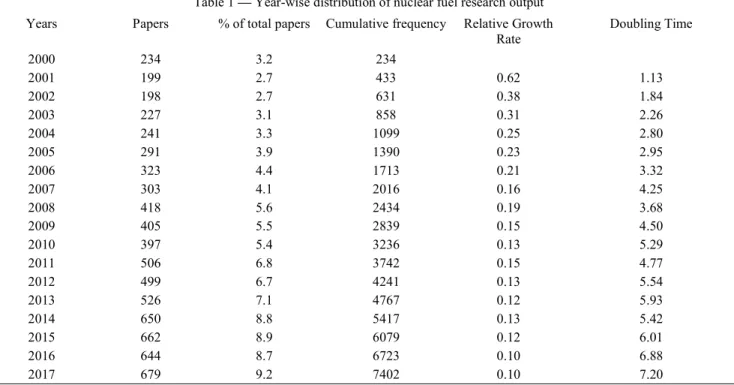
Summary of the analysis of the research output is shown in Table 1. It can be seen that half of the number of publications (4166; 56%) were published
during the period of 7 years from 2011 to 2017 and the year 2017 had the highest number of publications (679; 9%). Publication output performance was also analyzed based on scientometric parameters, namely, the relative growth rate (RGR) and doubling time (DT)15. RGR is the increase in the number of publications per unit of time and calculated using the formula RGR= (lnN2-lnN1)/(t2–t1), where N2 and N1 are the cumulative number of publications in the years t2 and t1. The parameter doubling time (DT) indicates the time required for publications to become double. And it is calculated as DT = 0.693/RGR. It is observed from the table that RGR has shown a slightly downward trend from 2011 (0.15) to 2017 (0.10). Whereas DT increased trend 1.13 to 7.20 in the same period implying that although the number of publications increased since 2000, its rate of growth slightly decreased while the corresponding doubling time increased. Figure 1 is the graphical presentation of the nuclear fuel research output and its impact.
Authors’ productivity and connectivity analysis
This section analyses the authors’ collaborative network. Figure 2 displays the visualisation of the core authors of the domain. The network contains 478 nodes, 7311 co-authorship links and 18 clusters. The network was formed by those authors who had at least 8 publications related to this domain. Each node in the Figure 2 represents an author’s productivity and the links between the authors denote the collaboration Table 1 — Year-wise distribution of nuclear fuel research output
Years Papers % of total papers Cumulative frequency Relative Growth
Rate Doubling Time
2000 234 3.2 234 2001 199 2.7 433 0.62 1.13 2002 198 2.7 631 0.38 1.84 2003 227 3.1 858 0.31 2.26 2004 241 3.3 1099 0.25 2.80 2005 291 3.9 1390 0.23 2.95 2006 323 4.4 1713 0.21 3.32 2007 303 4.1 2016 0.16 4.25 2008 418 5.6 2434 0.19 3.68 2009 405 5.5 2839 0.15 4.50 2010 397 5.4 3236 0.13 5.29 2011 506 6.8 3742 0.15 4.77 2012 499 6.7 4241 0.13 5.54 2013 526 7.1 4767 0.12 5.93 2014 650 8.8 5417 0.13 5.42 2015 662 8.9 6079 0.12 6.01 2016 644 8.7 6723 0.10 6.88 2017 679 9.2 7402 0.10 7.20
established through the co-authorship in the articles. The size of circles represents the quantum of the publications of the authors, and thickness of the line represents the frequency of collaboration amongst the authors. The colour of the circles remains the same for the authors in the same cluster having Jungseung Kim was the highly productive author with 87 articles as well as strong collaboration network with other authors with total link strength of 259. He is a Sr. Product Engineer at Dow Chemical Company, USA. Following him is Peter C. Burns (n=86), a Professor of Chemistry & Biochemistry at University of Notre Dame, France. Burns' research focuses on actinides -
specifically actinide material science, mineralogy, chemistry, geochemistry, and nanoscience. Next is Hakwon Kim, a professor of applied chemistry at Kyung Hee University, US. His area of expertise are organic synthesis, natural product chemistry, organic chemistry synthesis, chemical organic synthesis.
Table 2 provides the list of the most productive researchers in the global nuclear fuel research in terms of citations as measured by VOSviewer. Amongst 14743 authors, Peter C. Burns with 2754 citations is the most highly cited author. Following him are Rodney C. Ewing from USA, L. L. Snead from USA, Zhi-Fang Chai from Chaina and Jaewoo Kim from South Korea with a citations of 1124, 951, 865 & 855 respectively
Figure 3 illustrates the authors who have the strongest publication bursts and years in which it took place. It can be seen that Peter C. Burns (2000) from University of Notre Dame, France has the strongest burst among the top 5 authors since 2000. Hüseyin Yapıcı (2000) from Erciyes University, Turkey has the second strongest burst, which took place in the period of 2000 to 2006. Following him are Zhi-Fang Chai (2000), R Natarajan (2000) from Indira Gandhi Fig. 1 — Global nuclear fuel research output and its impact
Fig. 2 — Co-authors network visualisation
Table 2 — Highly cited authors
Citations Authors Abbreviations 2754 Peter C. Burns burns, p 1124 Rodney C. Ewing ewing, r
951 L L Snead snead, l
865 Zhi-Fang Chai chai, z
ANN. LIB. STU.; SEPTEMBER 2019 88
Centre for Atomic Research, India, and WI Ko (2000) from Korea Atomic Energy Research Institute, South Korea.
Productivity and connectivity analysis of countries
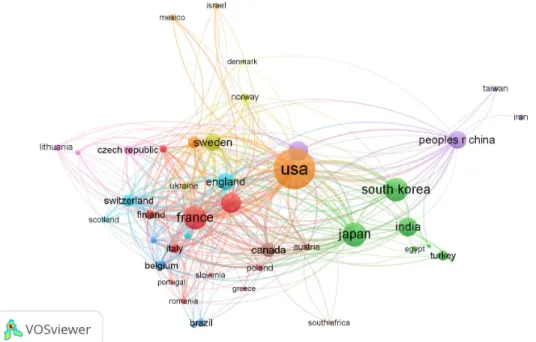
Analysis of productivity and connectivity amongst the countries (Figure 4) based on the affiliations of author’s contribution was performed by VOSviewer. A threshold value of ten was prescribed as a minimum number of research publications coming out of any given country. Out of 88 countries from where publications have come, 43 met the given threshold. Each node represents the country’s productivity and the links between the countries denote the collaborations established through the authorship in the articles. It is seen that the highly productive countries in term of publications are: USA (n =1987), Japan (n =693), France (n =675), South Korea (n =675) and Germany (n =500). Whereas, USA and Germany are having more collaboration with other countries. USA played a core role in the collaboration network and had good collaborations with other
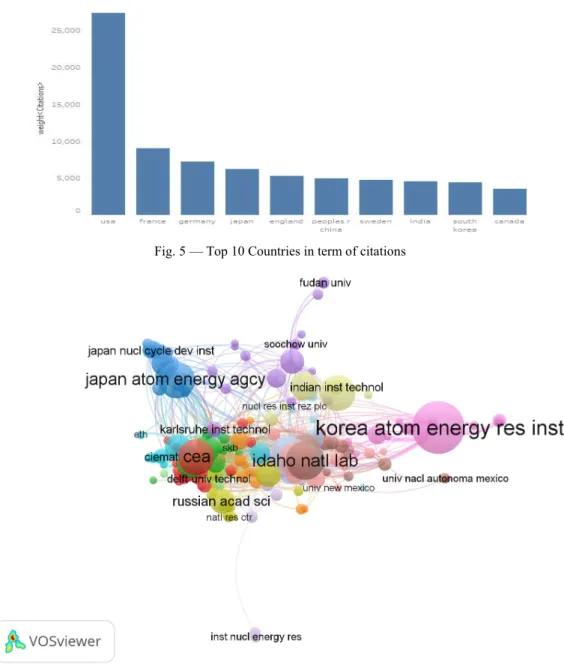
counties in general and in particular with South Korea and France. Figure 5 shows that the research publications from USA, France, and Germany are highly cited. The citations for the publications from India and South Korea are less reflecting the need for enhancing their collaboration networks.
Institutions productivity and connectivity analysis
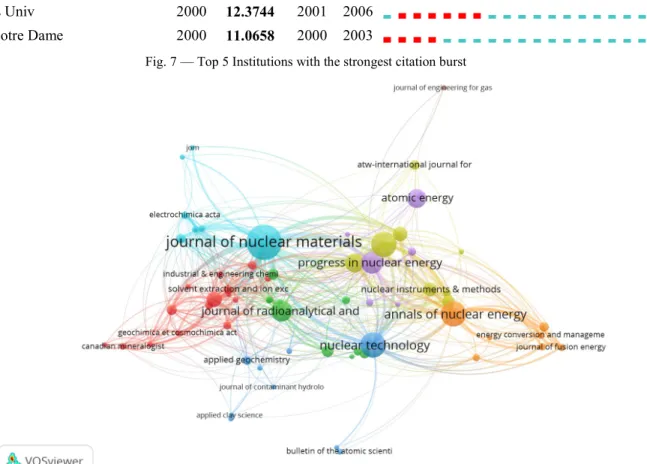
The analysis reveals that 3371 institutions around the world contributed the 7402 research papers. The visualisation of institutions is performed by selecting those institutions that has at least 15 publications. Figure 6 contains a network of institutions of 216 nodes and 1278 collaboration links. The size of the node thus indicates the publication frequency of the institutions. It can be seen that the Korea Atomic Energy Research Institute from South Korea has the highest publication frequency, which indicates that the origin of key publications in the domain is the Korea Atomic Energy Research Institute. This is followed by articles originating from Idaho National Laboratory, Japan Atomic Energy Agency, Los
Authors Year Strength Begin End 2000 - 2017
PC BURNS 2000 10.0397 2000 2003 ▃ ▃ ▃ ▃ ▂ ▂ ▂ ▂ ▂ ▂ ▂ ▂ ▂ ▂ ▂ ▂ ▂ ▂
H YAPICI 2000 9.3209 2000 2006 ▃ ▃ ▃ ▃ ▃ ▃ ▃ ▂ ▂ ▂ ▂ ▂ ▂ ▂ ▂ ▂ ▂ ▂
ZF CHAI 2000 9.2821 2014 2017 ▂ ▂ ▂ ▂ ▂ ▂ ▂ ▂ ▂ ▂ ▂ ▂ ▂ ▂ ▃ ▃ ▃ ▃
R NATARAJAN 2000 8.5105 2011 2015 ▂ ▂ ▂ ▂ ▂ ▂ ▂ ▂ ▂ ▂ ▂ ▃ ▃ ▃ ▃ ▃ ▂ ▂
WI KO 2000 8.3908 2011 2014 ▂ ▂ ▂ ▂ ▂ ▂ ▂ ▂ ▂ ▂ ▂ ▃ ▃ ▃ ▃ ▂ ▂ ▂
Fig. 3 — Top 5 co-authors associated with strongest publication bursts
Alamos National Laboratory and CEA. In terms of collaborations, Los Alamos National Laboratory and Idaho National Laboratory are having a large number of links in the network and had good number of collaborations with many of the institutes, especially with Korea Atomic Energy Research Institute and CEA.
A visual analysis of the history of the burstness of institutions identifies universities that are specifically active in the research in this domain. As shown in Figure 7, the Japan Nuclear Cycle Development Institute, Japan has the strongest publication burst among all other institutes. The Royal Institute of
Technology, Sweden has the longest period of the burst from 2001 till 2010, whereas the University of Notre Dame, USA has shortest publication burst.
Journals productivity and connectivity analysis
Research output in the domain of nuclear fuel is scattered across 910 journals. The visualisation of journal was performed by selecting those journals that have at least 15 publications. Figure 8 contains a network of journals of 64 nodes and 572 collaboration links. The size of the node thus indicates quantum of articles related to this domain published by journals. From the display, it can be seen that the Journal of Nuclear Materials has published the largest number Fig. 5 — Top 10 Countries in term of citations
ANN. LIB. STU.; SEPTEMBER 2019 90
of articles related to nuclear fuel and its Impact Factor is 2.547. The second largest number of publications is in Nuclear Engineering and Design and has an Impact Factor of 1.541. It can be inferred that these two are the core journals for nuclear fuel research. Table 3 gives details of the top 5 key journals based on citations. Journal of Nuclear Materials has the highest cited journal with 11573 citations. Nuclear
Engineering and Design, Annals of Nuclear Energy,
Nuclear Technology and Progress in Nuclear Energy are also some of the productive journals of this domain with 3172, 2567, 2318 and 2164 citations respectively.
Research hotspots and emerging trend based on keywords
A keyword is more suitable for providing a high level of description of a document16 and the analysis of keyword co-occurrences could reflect research hotspots, whereas burst words represent new research frontiers17,
Table 3 — Top 5 most productive journals in nuclear fuel research
Journal Citations
Journal of Nuclear Materials 11573 Nuclear Engineering and Design 3172
Annals of Nuclear Energy 2567
Nuclear Technology 2318
Progress in Nuclear Energy 2164 which represent words that are cited frequently in a period of time. Author assigned keywords were used for arriving at the keyword co-occurrence network as they reflect the author’s thoughts. Figure 9 displays the visualisation of the keyword co-occurrence network of this domain that was formed by selecting those keywords which occurred at least 20 times in the dataset. The network contains 89 keywords, 881 co-occurrence links and 7 clusters. As can be seen in the map, nodes such as nuclear fuel, spent nuclear fuel, uranium, spent fuel, plutonium, nuclear fuel cycle, thorium,
Institutions Year Strength Begin End 2000 - 2017
Japan Nucl Cycle Dev Inst 2000 21.0001 2000 2005 ▃ ▃ ▃ ▃ ▃ ▃ ▂ ▂ ▂ ▂ ▂ ▂ ▂ ▂ ▂ ▂ ▂ ▂
Japan Atom Energy Res Inst 2000 20.2978 2000 2005 ▃ ▃ ▃ ▃ ▃ ▃ ▂ ▂ ▂ ▂ ▂ ▂ ▂ ▂ ▂ ▂ ▂ ▂
Royal Inst Technol 2000 14.3103 2001 2010 ▂ ▃ ▃ ▃ ▃ ▃ ▃ ▃ ▃ ▃ ▃ ▂ ▂ ▂ ▂ ▂ ▂ ▂
Erciyes Univ 2000 12.3744 2001 2006 ▂ ▃ ▃ ▃ ▃ ▃ ▃ ▂ ▂ ▂ ▂ ▂ ▂ ▂ ▂ ▂ ▂ ▂
Univ Notre Dame 2000 11.0658 2000 2003 ▃ ▃ ▃ ▃ ▂ ▂ ▂ ▂ ▂ ▂ ▂ ▂ ▂ ▂ ▂ ▂ ▂ ▂
Fig. 7 — Top 5 Institutions with the strongest citation burst
reprocessing, actinides, pyroprocessing, nuclear waste have the highest frequency of occurrences and represent research hotspots in the nuclear field and the small nodes without the name reflect the less occurrence of the respective subjects.
A visual analysis of the history of the burstness of keywords identifies keywords that are specifically active in this research domain. As shown in Figure 10 (a), the keyword “90 degrees c” has the strongest citation burst and longest period of the burst from 2000 to 2007 among all other keywords. Figure 10(b) illustrates those keywords that showed strong citation bursts in the recent years.
Intellectual structure analysis
To identify the most important areas of research, we performed cluster analysis by using CiteSpace. In Figure 11, the merged network of cited references is divided into some major clusters of articles represented by unique colour years from 2000 to 2017. We have selected top 50 cited references per one-year time slice. The links between the nodes also represent the particular time slices. The largest connected component cluster (#0) had 70 members and was labelled as “lead uranyl oxide hydrate”. The most active citer to the cluster was “Uranium: Mineralogy, Geochemistry, and the Environment”. Fig. 9 — Keywords co-occurrence network
Keywords Year Strength Begin End 2000 - 2017
90 degrees c 2000 15.7583 2000 2007 ▃ ▃ ▃ ▃ ▃ ▃ ▃ ▃ ▂ ▂ ▂ ▂ ▂ ▂ ▂ ▂ ▂ ▂
mixed oxide fuel 2000 14.9032 2003 2006 ▂ ▂ ▂ ▃ ▃ ▃ ▃ ▂ ▂ ▂ ▂ ▂ ▂ ▂ ▂ ▂ ▂ ▂
radionuclide 2000 14.4978 2000 2006 ▃ ▃ ▃ ▃ ▃ ▃ ▃ ▂ ▂ ▂ ▂ ▂ ▂ ▂ ▂ ▂ ▂ ▂
rejuvenation 2000 13.7934 2002 2004 ▂ ▂ ▃ ▃ ▃ ▂ ▂ ▂ ▂ ▂ ▂ ▂ ▂ ▂ ▂ ▂ ▂ ▂
bond valence parameter 2000 11.7573 2000 2003 ▃ ▃ ▃ ▃ ▂ ▂ ▂ ▂ ▂ ▂ ▂ ▂ ▂ ▂ ▂ ▂ ▂ ▂
release 2000 11.4399 2000 2005 ▃ ▃ ▃ ▃ ▃ ▃ ▂ ▂ ▂ ▂ ▂ ▂ ▂ ▂ ▂ ▂ ▂ ▂
microstructure 2000 10.6451 2014 2017 ▂ ▂ ▂ ▂ ▂ ▂ ▂ ▂ ▂ ▂ ▂ ▂ ▂ ▂ ▃ ▃ ▃ ▃
blanket 2000 10.4837 2002 2006 ▂ ▂ ▃ ▃ ▃ ▃ ▃ ▂ ▂ ▂ ▂ ▂ ▂ ▂ ▂ ▂ ▂ ▂
nuclear fuel cycle 2000 10.4078 2010 2013 ▂ ▂ ▂ ▂ ▂ ▂ ▂ ▂ ▂ ▂ ▃ ▃ ▃ ▃ ▂ ▂ ▂ ▂
ion 2000 10.4061 2010 2013 ▂ ▂ ▂ ▂ ▂ ▂ ▂ ▂ ▂ ▂ ▃ ▃ ▃ ▃ ▂ ▂ ▂ ▂
ANN. LIB. STU.; SEPTEMBER 2019 92
The second large connected component cluster (#2) had 53 members and was labeled as “molecular dynamics study”. The most active citer to the cluster was “Multidimensional multiphysics simulation of nuclear fuel behavior”. The third largest cluster (#3) had 52 members and was labeled as “oxidative dissolution”. The most active citer to the cluster was “Fuel corrosion processes under waste disposal conditions”. The fourth largest cluster (#4) had 43 members and was labeled as “mixed oxide”. The most active citer to the cluster was “The high burn-up structure in nuclear fuel”.
Conclusion
The scientometric analysis of literature in the domain of nuclear fuel brings to light some interesting facts about research hotspots, the literature and the authors. Though there is a steady growth in the number of publications, it is not reflected in the number of citations especially after 2014. This could be due to newer research relating to nuclear fuel emerging in the recent times. USA is leading in terms of collaborative research and least seen for India.
The low score for India can be taken as a reflection of a strong indigenous program. Journal of Nuclear Materials emerged as the preferred destination for publishing research relating to nuclear fuel, reflected both in terms of number of publications and citations. The study indicates the emergence of Korea Atomic Energy Research Institute as leading research institute. Spectroscopy, molecular dynamics and simulation, emerging as active research areas, reflecting more fundamental work being carried out relating to nuclear fuel. Lack of correlation between the number of papers published to the number of citations received, reflects some unique work carried out by the researchers.
References
1 Leydesdorff L and Milojević S, Scientometrics, In
International Encyclopedia of the Social & Behavioral Sciences,2nd edn, 2015, p.322-327. doi:10.1016/B978-0-08-097086-8.85030-8.
2 Agyeman E A and Bilson A, Research focus and trends in nuclear science and technology in Ghana : a bibliometric study based on the INIS database, Library Philosophy and Practice,
1212 (2015) https://digitalcommons.unl.edu/libphilprac/1212/
Keywords Year Strength Begin End 2000 - 2017
spectroscopy 2000 10.1583 2013 2017 ▂ ▂ ▂ ▂ ▂ ▂ ▂ ▂ ▂ ▂ ▂ ▂ ▂ ▃ ▃ ▃ ▃ ▃
molecular dynamics 2000 9.8114 2013 2017 ▂ ▂ ▂ ▂ ▂ ▂ ▂ ▂ ▂ ▂ ▂ ▂ ▂ ▃ ▃ ▃ ▃ ▃
transport 2000 7.3868 2013 2017 ▂ ▂ ▂ ▂ ▂ ▂ ▂ ▂ ▂ ▂ ▂ ▂ ▂ ▃ ▃ ▃ ▃ ▃
simulation 2000 5.7457 2013 2017 ▂ ▂ ▂ ▂ ▂ ▂ ▂ ▂ ▂ ▂ ▂ ▂ ▂ ▃ ▃ ▃ ▃ ▃
Fig. 10(b) — Top 3 citation bursts keywords
3 Kademani B S, Gaderao C R, Surwase G, Sanhotra A B, Kumar A and Kumar V, Scientometric profile and publication productivity of the radiochemistry division at Bhabha Atomic Research Centre, SRELS Journal of Information Management, 44(2) (2007) 99-124.
4 Wang Q, Li R and He G, Research status of nuclear power: A review, Renewable & Sustainable Energy Reviews, 90 (2018) 90-96. doi:10.1016/j.rser.2018.03.044.
5 Xiao F, Li C, Sun J and Zhang L, Knowledge domain and emerging trends in organic photovoltaic technology : a scientometric review based on CiteSpace analysis, Frontiers in Chemistry, 5 (2017)1-12. doi:10.3389/fchem.2017.00067. 6 Almeida dos Santos A, Marinho C A, Neto JV and Filho R D
F, Desalination in nuclear plants: a bibliometric study of research activity in scientific literature indexed by SCOPUS base, International Journal of Advanced Engineering Research and Science, 6495 (12) (2017) 151-161.
7 Wei F, Grubesic T H and Bishop B W, Exploring the GIS knowledge domain using CiteSpace, Professional Geographer, 67 (3) (2015) 374-384. doi:10.1080/00330124.2014.983588. 8 Trofimenko A P, Scientometric analysis of the development of
nuclear-physics during the last 50 years, Scientometrics, 11 (3) (1987) 231-250. doi:10.1007/bf02016594.
9 Bernabò N, Greco L, Mattioli M and Barboni B, A scientometric analysis of reproductive medicine,
Scientometrics, 109 (1) (2016) 103-12. doi:10.1007/s11192-016-1969-3.
10Xiang C, Wang Y and Liu H, A scientometrics review on nonpoint source pollution research, Ecological Engineering, 99 (2017) 400-408. doi:10.1016/j.ecoleng.2016.11.028. 11Chen C, The CiteSpace Manual v1.05, College of Computing
and Informatics, (2015)102. doi:10.1007/s11192-015-1576-8. 12Van Eck N J and Waltman L, VOSviewer : a computer
program for bibliometric mapping, (2009). Available at http://hdl.handle.net/1765/14841.
13Van Eck N J and Waltman L, Software survey: VOSviewer, a computer program for bibliometric mapping, Scientometrics, 84(2)(2010) 523-538. doi:10.1007/s11192-009-0146-3. 14Chen C, CiteSpace II: Detecting and Visualizing Emerging
Trends and Transient Patterns in Scientific Literature, Journal of the American Society for Information Science and Technology, 57(3) (2006) 359-377. doi: 10.1002/asi.20317. 15Kumar R S, Publication trends in global output of spintronics :
a scientometric profile, Library Philosophy and Practice
(e-journal), (2016) 1480.
16Sudarsana D, Meenachi N. M, Venkatesh T, Gunta V, R. Gowtham and Sai Baba M, Method for automatic key concepts extraction: application to documents in the domain of nuclear reactors, The Electronic Library, 37(1)(2018)2-15. doi:10.1108/EL-01-2018-0012.
17Chen C, Dubin R and Kim M C, Emerging trends and new developments in regenerative medicine: a scientometric update (2000–2014), Expert Opinion on Biological Therapy, 14(9) (2014) 1295-1317. doi:10.1517/14712598.2014.920813.