University of Huddersfield Repository
Jimoh, Falilat A Synthesis of Automated Planning and Model Predictive Control Techniques and its Use in Solving Urban Traffic Control Problem Original Citation Jimoh, Falilat (2015) A Synthesis of Automated Planning and Model Predictive Control Techniques and its Use in Solving Urban Traffic Control Problem. Doctoral thesis, University of Huddersfield. This version is available at http://eprints.hud.ac.uk/id/eprint/30343/ The University Repository is a digital collection of the research output of the University, available on Open Access. Copyright and Moral Rights for the items on this site are retained by the individual author and/or other copyright owners. Users may access full items free of charge; copies of full text items generally can be reproduced, displayed or performed and given to third parties in any format or medium for personal research or study, educational or notforprofit purposes without prior permission or charge, provided: • The authors, title and full bibliographic details is credited in any copy; • A hyperlink and/or URL is included for the original metadata page; and • The content is not changed in any way. For more information, including our policy and submission procedure, please contact the Repository Team at: [email protected]. http://eprints.hud.ac.uk/A Synthesis of Automated Planning and Model Predictive Control
Techniques and its Use in Solving Urban Traffic Control Problem
Falilat Jimoh
School of Computing and Engineering
University of Huddersfield
A thesis submitted for the degree of
Doctor of Philosophy
I would like to dedicate this thesis to my loving husband, Abdul Wasiu Adetunji Jimoh, for his continuous trust and support during my endless
Acknowledgements
All praises are due to Almighty Allah for making it possible for me to com-plete my Ph.D. programme. I give thanks to Allah for sparing the life of my parents to witness this wonderful moment of their child. I pray Allah grant them longer life in good health and faith. I also give thanks to Almighty Allah for given me the best of spouse and healthy children. All praises are due to Allah for making it possible for my children to endure pains of liv-ing without their mother. May we all live long to appreciate the blessliv-ing of Allah upon our family.
I would like to acknowledge the contribution of my siblings and in-laws for making it possible for me to stay abroad while they take care of my love ones. My special appreciation goes to “big mummy” for her priceless sac-rifices to take care of our old parent and still keep my family together while being away. My special appreciation also goes to two jewels among my in-laws: “Ms Peju Udoinwang” and “Engr Bashir Jimoh” for their priceless sacrifice and effort during the completion stage of this Ph.D. programme despite my weak and fragile state of health.
I would like to acknowledge the help of my faculty members in my aca-demic achievement, most especially my supervisor Professor T. L. Mc-Cluskey for his fatherly support and advice during most of my health and family challenges. My special appreciation also goes to Dr Lukas Chrpha for his advice and support during this Ph.D. programme especially in his role in most of my academic publications.
My acknowledgement also goes to the research office staffs for making my Ph.D. life seamless despite all the frictions in my research profiles and documentation. My special appreciation goes to Ms Gwen Wood and Mr Chris Sentence for going out of their way to put a smile on the face of students like me during difficult times.
I would like to acknowledge the prayers, advice and support of most of our family friends: The AbdulRaman’s for always being by our side from the conception of this idea till the actualisation of the research. The Hassan’s the Abdul-Kareem’s for their continuous encouragements. The Akanni’s for their priceless duas. The Qahaar’s for their physical, emotional and spir-itual support towards making me feel comfortable home away from home. The Naheed’s for their support and always being there at my time of need. The Hamzat’s for their social upliftment in the time of depression away from home. My appreciation also goes to the rest of my family friends that have believed and contributed in this course of mine. The list is endless, but Allah knows you all. May Almighty Allah in His infinite mercy grant you the highest place in paradise.
My acknowledgement also goes to my colleagues in the office for their sin-cere advice and guidance during the difficult time of my Ph.D. programme. A special acknowledgement goes to Dr Aisha Jilani and Dr Shahin Shah for the guidance and supports they gave to me especially during the early years of my Ph.D.
My final acknowledgement goes to most of my friends for their prayers and advice before and during this Ph.D. programme. Listing their names could be as long as this thesis chapters. Almighty Allah knows you all and would reward you with the best of reward in this world and beyond.
Abstract
Most desired applications for planning and scheduling typically have the characteristics of a continuous changing world. Unfortunately, traditional classical planning does not possess this characteristic. This drawback is because most real-world situations involve quantities and numeric values, which cannot be adequately represented in classical planning. Continuous planning in domains that are represented with rich notations is still a great challenge for AI. For instance, changes occurring due to fuel consumption, continuous movement, or environmental conditions may not be adequately modelled through instantaneous or even durative actions; rather these re-quire modelling as continuously changing processes. The development of planning tools that can reason with domains involving continuous and com-plex numeric fluents would facilitate the integration of automated planning in the design and development of complex application models to solve real world problems.
Traditional urban traffic control (UTC) approaches are still not very effi-cient during unforeseen situations such as road incidents when changes in traffic are requested in a short time interval. For such anomalies, we need systems that can plan and act effectively in order to restore an unexpected road traffic situation into a normal order. In the quest to improve reasoning with continuous process within the UTC domain, we investigate the role of Model Predictive Control (MPC) approach to planning in the presence of mixed discrete and continuous state variables within a UTC problem. We
explore this control approach and show how it can be embedded into ex-isting, modern AI Planning technology. This approach preserves the many advantages of the AI Planning approach, to do with domain independence through declarative modelling, and explicit reasoning while leveraging the capability of MPC to deal with continuous processes.
We evaluate the possibility of reasoning with the knowledge of UTC struc-tures to optimise traffic flow in situations where a given road within a network of roads becomes unavailable due to unexpected situations such as road accidents. We specify how to augment the standard AI planning engine with the incorporation of MPC techniques into the central reason-ing process of a continuous domain. This approach effectively utilises the strengths of search-based and model-simulation-based methods.
We create a representation that can be used to capture declaratively, the def-initions of processes, actions, events, resources resumption and the struc-ture of the environment in a UTC scenario. This representation is founded on world states modelled by mixed discrete and continuous state variables. We create a planner with a hybrid algorithm, called UTCPLAN that com-bines both AI planning and MPC approach to reason with traffic network and control traffic signal at junctions within the network. The experimental objective of minimising the number of vehicles in a queue is implemented to validate the applicability and effectiveness of the algorithm. We present an experimental evaluation showing that our approach can provide UTC plans in a reasonable time. The result also shows that the UTCPLAN ap-proach can perform well in dealing with heavy traffic congestion problems, which might result from heavy traffic flow during rush hours.
Contents
Contents vi List of Figures xi Nomenclature xii 1 Introduction 1 1.1 Motivation . . . 1 1.2 Thesis Contribution . . . 5 1.3 Thesis Layout . . . 6 1.4 Publications . . . 82 Introduction to Automated Planning Approach 11 2.1 Planners . . . 13
2.1.1 Planners Coverage . . . 14
2.1.2 Planner Coverage Analysis . . . 17
2.2 Planner Algorithms . . . 18
2.3 Planning Modes and Capability . . . 21
2.3.1 Classical Planning . . . 21
2.3.2 Metric Planning . . . 23
2.3.3 Temporal Planning . . . 24
CONTENTS
2.4 Planning Representation and Language Semantics . . . 30
2.5 Automated Planning Applications . . . 36
2.5.1 Software Development . . . 36
2.5.2 Space System . . . 36
2.5.3 Business Management and Commerce . . . 38
2.5.4 Education Sector . . . 39
2.5.5 Game . . . 40
2.5.6 Industrial Control . . . 40
2.6 Summary . . . 42
3 Introduction to Urban Traffic Control 43 3.1 Basic Component of Urban Traffic Control System . . . 44
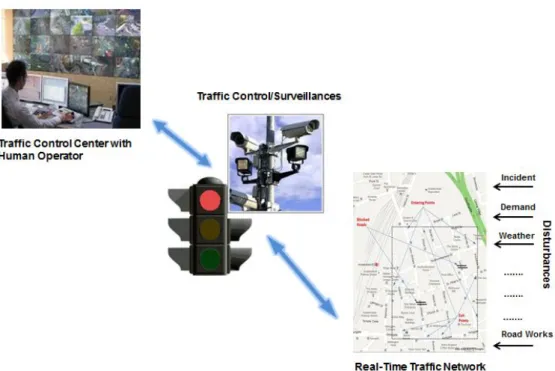
3.1.1 Road Traffic Network and Disturbances . . . 44
3.1.2 Traffic Control Strategies and Rules . . . 45
3.1.3 Traffic Operator . . . 45
3.1.4 Traffic Devices . . . 46
3.2 Urban Traffic Control Application . . . 47
3.3 Urban Traffic Control Problem . . . 49
3.4 Conclusion . . . 52
3.5 Summary . . . 52
4 Applying AI Planning in an Urban Traffic Domain 53 4.1 The Road Traffic Domain Model . . . 53
4.1.1 Resources and Constraints . . . 54
4.1.2 RTDM Specification . . . 57
4.1.3 Modeling RTDM in PDDL . . . 59
4.2 Evaluation . . . 63
4.3 Result . . . 64
CONTENTS
4.5 Conclusion . . . 65
4.6 Summary . . . 66
5 Introduction to Model Predictive Control 67 5.1 Introduction to Model Predictive Control . . . 67
5.1.1 MPC approach . . . 68
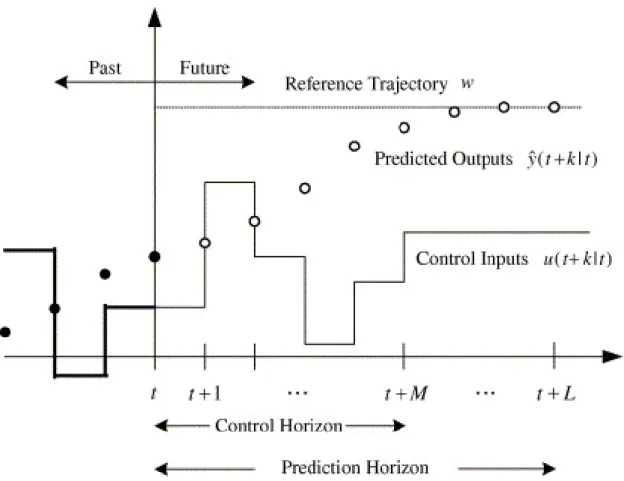
5.1.2 MPC Concepts and Terminologies . . . 69
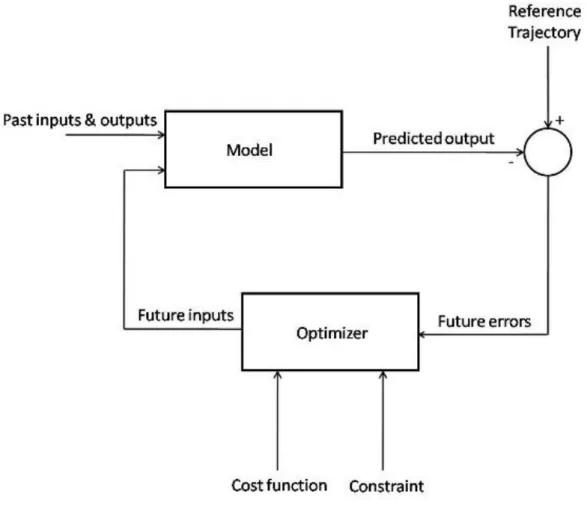
5.1.3 MPC Strategy and Structure . . . 73
5.2 Sample MPC Model Analysis . . . 76
5.2.1 Store-and-forward modeling . . . 76
5.2.2 MPC Constraints Example on UTC Model . . . 79
5.2.3 Non-negative control constraints . . . 79
5.2.4 Traffic Light Cycle Constraints . . . 80
5.2.5 Green Duration Constraints . . . 80
5.2.6 Flow Conflict Constraints . . . 80
5.2.7 Non Negative Queue Constraints . . . 80
5.2.8 Capacity Constraints . . . 81
5.2.9 The Objective Function . . . 81
5.3 Comparison between MPC and AI Planning . . . 81
5.4 Conclusion . . . 83
5.5 Summary . . . 84
6 A Self-Management System for Urban Traffic Control 85 6.1 Introduction . . . 85
6.2 The Self-Managing System Architecture . . . 87
6.2.1 Road Traffic Network and Disturbances . . . 90
6.2.2 System Description Block (SD) . . . 90
6.2.3 Sensor and Effector Block (SE) . . . 92
CONTENTS
6.2.5 MPC Solution to Challenges in PA Block . . . 96
6.2.6 Learning Block . . . 98
6.2.7 Service Level Checker (SLC) . . . 99
6.3 Challenges . . . 100
6.4 Conclusion . . . 100
6.5 Summary . . . 101
7 Design and Implementation 102 7.1 Introduction . . . 102
7.2 Planner Language Representation . . . 104
7.3 Planner Algorithm . . . 105
7.3.1 UTCPLAN Algorithm Preliminaries . . . 106
7.3.2 Top level algorithm of UTCPLAN . . . 110
7.3.3 Expand Search Node(n) . . . 112
7.3.4 Action Application . . . 112
7.3.5 Simulate Process . . . 113
7.3.6 Event Application . . . 114
7.3.7 Optimise Numeric Fluents(n, DM,℘) . . . 115
7.3.8 Update Dynamic Information(n,Nc,Np, DM) . . . 116
7.4 Planner Implementation . . . 117
7.4.1 Planner Implementation Assumptions . . . 119
7.5 Conclusion . . . 120
7.6 Summary . . . 121
8 Evaluation and Results 122 8.1 Results . . . 123
8.1.1 Evaluation Policy . . . 124
8.1.2 Evaluation Performance . . . 127
CONTENTS
8.2.1 Scaling Difficulties . . . 134
8.3 Conclusion . . . 134
8.4 Summary . . . 135
9 Conclusions and Future Work 136
9.1 Future Work . . . 138
9.2 Summary . . . 140
Appendix A: A PDDL Domain Model 141
Appendix B: PDDL Problem File for an Urban Traffic Network 143
Appendix C: Sample Plan Generated by a Domain Independent Planner 150
Appendix D: Sample plan generated by UTCPLAN 152
Appendix E : Sample UTCPLAN Domain Model 155
Appendix F: Sample UTCPLAN Problem File 172
Appendix G: Sample Thermal Problem and Solution Generated by the Planner177
Appendix H: Sample Block World Problem and Solution Generated by the
Planner 182
List of Figures
2.1 Sample Predicates and Assignment in the Tea Making Environment . . 12
2.2 Sample Action Declaration in the Tea Making Environment . . . 12
2.3 Sample Plan to Make a Cup of Tea . . . 12
2.4 Table of Planner Coverage Analysis . . . 18
2.5 A excerpt of a PDDL painting domain model showing the action to wet brushwith paint . . . 32
2.6 Painting Plan generated by lpg-td-1.0 planner for two robots painting several rooms with time and resource constraint . . . 33
3.1 Basic Component of Urban Traffic Control System . . . 45
4.1 Map showing the network entry and exit points and the blocked roads in a part of town center of Hudderfield, West Yorkshire, United Kingdom. It is used for our empirical analysis. . . 56
4.2 The PDDL encodings of thedriveplanning operator. . . 60
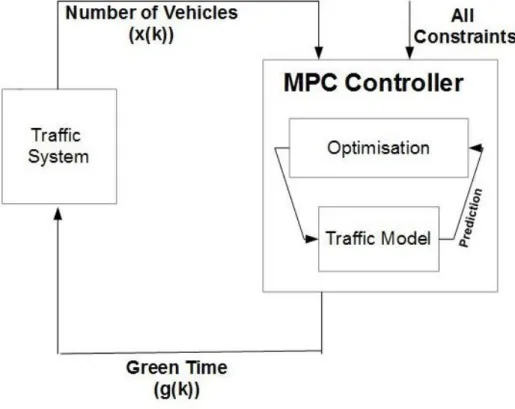
5.1 Model Predictive Control Feedback Loop . . . 74
5.2 Graph to Depict the Structure of an MPC . . . 75
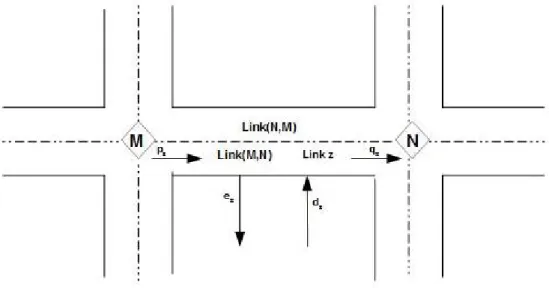
5.3 Representation of urban roads using links and junctions . . . 76
5.4 Applying MPC to UTC structure . . . 79
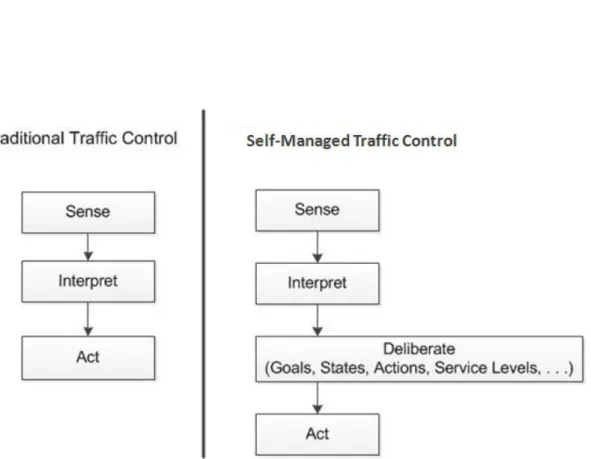
6.1 Comparison of traditional and deliberative controls in Urban Transport Systems. . . 88
LIST OF FIGURES
6.2 Diagram of a Self-Managing System Architecture . . . 89
6.3 Illustration of a well guided real-time process curve. . . 98
7.1 The Agony of a Continuous Planner . . . 103
7.2 The Planner as a Black Box . . . 104
7.3 Sample of an Action Declaration . . . 107
7.4 Sample of an Process Declaration . . . 108
7.5 Sample of an Event Declaration . . . 109
8.1 A sample plan generated by UTCPLAN . . . 125
8.2 The average planning time at different fixed signal timings compared with the controlled UTCPLAN approach with an increasing traffic queues128 8.3 The average total number of processes initiated by the planner to achieve the goal condition at different fixed signal timings compared with the controlled UTCPLAN approach with increasing traffic queues . . . 129
8.4 The average total number of action operators in the plan at different fixed signal timings compared with the controlled UTCPLAN approach with respect to increasing traffic queues . . . 131
Chapter 1
Introduction
1.1
Motivation
The field ofArtificial Intelligence Planning, or AI Planning, deals with the problem of finding a sequence or partially ordered set of actions whose execution leads from an initial state to a state in which a goal condition is satisfied. Actions in plans are ordered in such a way that executability of every action is guaranteed. Hence, it is now possible to transform the environment from an initial state into a desired state that satisfies some goal conditions. A planning problem thus involves deciding “what” actions to do, and “when” to do them. The “when” part of the problem refers to “scheduling”.
Most desired application for planning and scheduling typically have the following characteristics: a continuous changing world; multiple agents (both cooperative and ad-versarial); uncertainty of the state of the world; communication with external sources (sensors, databases, human users) to get information about the world; overlapping ac-tions; time constraints and numeric computations involving resources, probabilities, spatial relationships and geometric. Unfortunately, traditional classical planning does not possess any of these characteristics.
This drawback of classical planning is due to the fact that most real-world situations involve quantities and numeric values, which are not properly represented in classical
planning. The need to express numeric quantities of entities within a domain represen-tation led to the development of metric planning [42; 73]. Also, continuous planning in domains that are represented with rich notations has long been a great challenge for AI [35]. For instance, changes occurring due to fuel consumption, continuous move-ment, or environmental conditions may not be adequately modelled through instanta-neous or even durative actions; rather these require modelling as continuously chang-ing processes. The combination of time-dependent problems and numeric optimisation problem create a more challenging and hard task of time-dependent metric fluents.
Thus, automated planning had to move away from the restricted classical planning with the introduction of real world problems which included some non-classical plan-ning. From 2002, there has been an introduction of elementary notation of timing and resources. In 2004, inference rules and derived effects were added with a new track of planning in probabilistic domains. 2006 witness addition of soft goals, trajectory constraints, preferences, plan metrics, and expressions of constraints in temporal logic. AI Planning has evidenced a significant advancement in planning techniques in the last 10 - 15 years, which has led to the development of efficient planning systems that can input expressive models of applications. The existence of these general planning tools has motivated engineers in designing and developing complex application models that closely approximate real-world problems. These improvements enable automated planning application to cut across several disciplines with different applications ranging from space exploration, education, health care, business and commerce to entertainment industry.
Urban traffic management is an application area that we believe could benefit from the applications of AI Planning and is the motivating application for this thesis. Current urban traffic management centres (UTMCs) have systems that help to minimise delay within day to day traffic flows using controls such as self-tuning traffic light clusters. They are effective in coping with local expected changes in traffic flows, but are not
avoid poor air quality hotspots, utilising the network fully, or working adequately in the face of unplanned exceptional events such as road closures or accidents, cannot be met by Urban Traffic Management Centres on a day to day basis. For instance, UTC operators have no technological help to synthesise and coordinate collections of inter-ventions (light phase changes, message signs) to influence the build-up of traffic related flow over a region. Throughout the world urban operators, and hence road users, would benefit from tools to support the effective regional management of roads. Integrating the knowledge of control engineering into the field of AI planning and scheduling to create hybrid technology that can solve these kinds of complex planning problems of regional management could prove the foundation for a breakthrough for the transporta-tion industry.
The area of AI Planning and Scheduling (AIP & S) involves modelling a system in a knowledge-based way, with declarative data structures representing goals, states, resources, actions to mention a few, and creating tools that can reason about them logi-cally. Plans are created as output to achieve goal conditions in a future state. In this case, goals and actions can be easily changed or even generated themselves automatically (for example, a trigger on pollution monitoring data feeds could lead to the generation of goals to be fed into a planning engine that would output the appropriate plans to be car-ried out by traffic controls). As well as the flexibility of input language, a characteristic of this approach is that the human user can understand and inspect the output plan, to help validate the approach, and to promote a mixed-initiative interaction with the system operators. There are drawbacks, however, in that few if any planning engines can rea-son with models described by continuous processes, and the computational complexity of the planning problem can be prohibitive without strong heuristics.
This thesis addresses these drawbacks and proposes a planning algorithm that can reason with continuous processes using approach that are aimed at handling the com-putational complexity of the UTC planning problem.
Control Engineering, on the other hand, have developed techniques to control a continuous process by the varying of a control variable over a fixed time horizon. The motivation for this originates in areas of chemical engineering. Here the process is modelled by some approximating function, and the ”goal” is to ensure that certain of the variables of the dynamic system stay within a specified interval. A simple example is to adjust gas on a burner to ensure a pan will simmer but not boil over. The advantages of Control Engineering approaches in this area, such as embedded in the popular “Model Predictive Control” technique, is that they can work with dynamical systems described as continuously changing processes, and output controls that take into account future events. On the other hand, these approaches are not as flexible, nor as transparent, as the AIP & S approaches.
This thesis aims to transform areas of control engineering and AIP & S by for-mulating plan generation algorithms, and execution architectures, which combine the advantages of both approaches into one unified approach. The algorithms can produce readable plans to achieve goal conditions where the dynamical system model includes continuous processes. This thesis will lead to the creation of shared, flexible, generic tools to perform planning capable of being used in UTC management. It will lead to a number of specifications of sample problems that can be used to characterise the ap-plication of the technology. The planner produced is inspired and motivated by urban traffic control problem: the output technology is tested as part of the solution to UTC control for UMTCs. Our present effort is focused on using a Model Predictive Con-trol(MPC) architecture to implement a continuous planner that can generate plans that can serve as advisory to traffic officers as well as urban traffic controller(agent) in other order to optimize traffic flows in urban areas.
In this thesis, we explore the application of AI planning technology and control en-gineering to the problem of Urban Traffic Control(UTC) system. We design a generic architecture for self-management systems which is inspired by Human self-management Nervous System. Our architecture consists of several components, which is discussed
in the context of the Urban Traffic Control Domain. We investigate the feasibility of using this approach in an urban road traffic domain to generate plans, where learned or reactive behaviours fail because of unforeseen situations. We show how this is ac-complished by the creation of a declarative representation of a road network in a town centre area in the United Kingdom. The task is to navigate effectively cars through a network of connected roads during an unforeseen situation.
1.2
Thesis Contribution
This thesis describes a continuing effort to unite control engineering technique with automated planning approach towards solving controls problems in the area of urban traffic management. Our contributions are as follows, the first being the most important.
• The design, implementation and testing of a planner algorithm which can input
expressive domain descriptions, output solution plans containing continuous pro-cesses, events and actions. This work is the first AI Planner we are aware of to integrate MPC with AI search - based planning techniques.
• An investigation into the role of Model Predictive Control(MPC) architecture in
automated planning.
• The Design of a hybrid planner algorithm that is angled towards applications
exemplified by the urban road traffic management problem
• Modelling of a declarative representation of the road network of Huddersfield
town centre area of West Yorkshire in the United Kingdom. Thus, creating an-other benchmark domain for the planning community
• The design of a generic UTC architecture for self-management systems which is
• Evaluating the possibility of reasoning with knowledge from UTC domain and
optimising traffic flow in situations where a given road within a network of roads becomes unavailable due to an unexpected situation such as a road accident
• Evaluating the advantages and challenges of using AI Planning Technology in
Urban Traffic Control
1.3
Thesis Layout
This thesis is divided into eight main chapters, the contents of individual chapters are summarised below.
Chapter One Chapter one explains the introduction to this research work. It discusses our motivation for this piece of work and the contribution it has to knowledge. It also gives a brief outline of the content in individual chapters of the entire thesis.
Chapter Two Chapter two explains the concept of Automated Planning as a branch of artificial intelligence and how it applies to real-world problems. It gives an overview of various terminologies in Automated Planning used by different chap-ters in this thesis. It also gives an insight into what constitutes an automated planning approach with a detailed explanation of planning language semantics and their associated planning engines called “planners”. This chapter ends with an overview of some applications of automated planning in the different field of knowledge.
Chapter Three This chapter introduces Urban Traffic Control Problem.
Chapter Four This chapter explores the application of AI planning technology to the problem of Urban Traffic Control(UTC). This application is accomplished by the creation of a declarative representation of a road network in a town center area in the United Kingdom. The task is to navigate cars effectively through a
network of connected roads during an unforeseen situation. As part of this effort, we embed the knowledge of UTC structure into a planning domain and evaluate the possibility of reasoning with this knowledge and optimising traffic flow in situations where a given road within a network of roads becomes unavailable due to an unexpected situation such as road accidents. From this simulation, we demonstrate the advantages and shortcomings of using AI Planning in UTC.
Chapter Five This chapter introduces model predictive control as a branch of control engineering. It explains the strategy and approach of MPC in controlling and stabilising process control within the field of Engineering. This chapter ends by comparing the similarities and difference between MPC and AI planning to make a judgement call for a hybrid solution that incorporate both technologies to solve problems involving both discrete and continuous state variables.
Chapter six This chapter introduces Urban Traffic Control and the design of a generic architecture that is aimed at using both AI planning and MPC approach to creating management properties in UTC. In this chapter, the characteristics of a self-managed system and the need for a certain level of self-management in UTC is discussed. It explains the design of a generic self-management architecture which is inspired by Human self-management Nervous System. Our architecture consists of several blocks. This chapter describes each of the blocks in the context of the Urban Traffic Control Domain.
Chapter Seven This chapter describes our efforts towards using a Model Predictive Control (MPC) approach to creating a hybrid planner. It explains an urban traffic control planning (UTCPLAN) algorithm and implementation, which is aimed at, integrating a control engineering techniques with automated planning approach to create a hybrid planning system that can reason with domains containing discrete and continuous state variables such as found in UTC problems.
Chapter Eight This is an evaluation chapter that discusses and analyse the result of our experiments. It also discusses the challenges in this research work.
Chapter Nine This is the concluding chapter of this thesis. It summarises the overall work that has been accomplished so far and gives the future direction of the next step in our implementation process.
1.4
Publications
This section presents the list of publications that were achieved during the Ph.D. re-search in order to support and validate the scientific quality of this thesis.
1. Jimoh, F. and McCluskey, T.L. (2012),Using Automated Planning to Enable self-management Properties in Computer Systems, In the Proceedings of The Queens Diamond Jubilee Computing and Engineering Annual Researchers Conference 2012: CEARC12. University of Huddersfield, Huddersfield, p. 150. ISBN 978-1-86218-106-9
2. M. M. S. Shah, L. Chrpa, F. Jimoh, D. Kitchin, T. L. McCluskey, S. Parkinson and M. Vallati (2013), Knowledge Engineering Tools in Planning: State-of-the-art and Future Challenges, In the Proceedings of ICAPS Workshop on Knowledge Engineering for Planning and Scheduling (KEPS), June 10-14, Roam, Italy.
3. F. O. Jimoh, L. Chrpa, T. L. McCluskey and M. M. S. Shah (2013), Towards Application of Automated Planning in Urban Traffic Control, In the Proceedings of 16thInternational IEEE Annual Conference on Intelligent Transportation Sys-tems, October 6-9, The Hague, The Netherlands.
4. M. M. S. Shah, T. McCluskey, P. Gregory and F. Jimoh (2012),Modelling Road Traffic Incident Management Problem for Automated Planning, 13th IFAC
Sym-posium on Control in Transportation System (CTS12), September, 12-14. Sofia, Bulgaria.
5. F. O. Jimoh, TL McCluskey, L. Chrpa (2012) and Peter Gregory Application of Automated Planning to self-management Road Transport Support System. In the proceedings of 30th Workshop of the UK Planning And Scheduling Special Interest Group (PlanSig12), University of Teesside, Middlesbrough, UK.
6. M. M. S. Shah, L. Chrpa, P. Gregory, T. L. McCluskey and F. Jimoh (2012),
OCLplus: Processes and Events in Object-Centred Planning, the 6th Starting Artificial Intelligence Research Symposium, August, 27-28. Montpellier, France.
7. F. O. Jimoh and Holmes, Violeta (2012), Design of a wireless patient diagno-sis system, In the Proceedings of The Queens Diamond Jubilee Computing and Engineering Annual Researchers Conference 2012: CEARC12. University of Huddersfield, Huddersfield, pp. 69-74. ISBN 978-1-86218-106-9
8. I Cenamor, L Chrpa, F Jimoh, TL McCluskey, M Vallati (2014) Planning and Scheduling Applications in Urban Traffic ManagementIn the Proceedings of 32nd Workshop of the UK Planning And Scheduling Special Interest Group (Plan-Sig12), University of Teesside, Middlesbrough, UK.
9. Jimoh, Falilat, Chrpa, Luk and Vallati, Mauro (2013), self-management Sys-tem Architecture: An Automated Planning Perspective. In: Artificial Intelligence Applications and Innovations 2013. IFIP Advances in Information and Commu-nication Technology, 412 (121). Springer, Pahpos, Cyprus, pp. 121-130. ISBN 9783642411410
10. Jimoh, Falilat and McCluskey, T.L. (2013),Self-management in road traffic net-works. In: Proceedings of Computing and Engineering Annual Researchers’ Conference 2013: CEARC’13. University of Huddersfield, Huddersfield, pp. 73-79. ISBN 9781862181212
11. Jimoh, Falilat, Chrpa, Lukas and McCluskey, T.L. (2014) The Application of Planning to Urban Traffic Control. In: SPARK Workshop of 24th International Conference on Automated Planning and Scheduling, 21st to 26th of June 2014, Portsmouth, NH, USA.
12. Jimoh, Falilat and McCluskey, T.L. (2015), Self-Management in Urban Traffic Controlan Automated Planning Perspective : Towards Autonomic Road Trans-port SupTrans-port System. Birkhuser/Springer, 2015.
Chapter 2
Introduction to Automated Planning
Approach
The ability to reason with the dynamics of life and its environment by creating and im-plementing plans to solve everyday challenges; is one of the uniqueness of human race. Embedding this quality of man into artificial entities such as machines, is the founda-tion of Automated Planning. This makes Automated planning a branch of Artificial Intelligence, which deals with the problem of finding a sequence or partially ordered set of actions whose execution leads from an initial state to a state in which a goal condition is satisfied. Actions in plans are ordered in such a way that executability of every action is guaranteed within the model [57]. APlanning Problem could consist of a set of concrete objects, an initial state, a goal condition and available actions that can be performed in each situation. An initial state is represented by a set of assign-ments and predicates that are true at the initial state. The predicates and assignment give the abstraction of the state of the world at any specific time. Fig 2.1 is an example of predicates and assignment from the tea making environment.A planning problem thus involves deciding “what” actions to do, and “when” to do them. The “when” part of the problem refers to “scheduling” [63].
in(water, kettle) // means water is in the kettle on(kettle) // means the kettle is switched on . . .
Figure 2.1: Sample Predicates and Assignment in the Tea Making Environment
(action :switch_off
:parameter [kettle]
:preconditon on(kettle)//means kettle is ON :effect off(kettle) // means kettle is now OFF )
Figure 2.2: Sample Action Declaration in the Tea Making Environment
A goal situation is could be represented by a set of relational, logical expressions or both (assignments and predicates) that are valid at the goal state. Actions, on the other hand, are the list of operators that changes the state of an environment from one state to another whenever it precondition is satisfied. Figure2.2is an example of action declaration in the tea making environment is:
A plan is a solutionof a given planning problem if and only if every action is ap-plicable in the given time-stamp (its precondition is fulfilled) and after all action are executed all expressions specified in the goal situation are satisfied. For example,the plan to make a cup of tea might include the steps show in Figure2.3.
The sample plan above shows; the time each line of statement should be exe-cuted;the actions that should be performed at every step; the objects of those actions and the time duration for the execution of each line of action.
Time Action Parameter Duration
0:001 Get_Water [water,tap, kettle] 3:00 3:000 Switch_On [Water,kettle] 10:00 3:100 Get_TeaBag [teaBag,cup] 3:00 3:000 Pour_Water [water,cup] 2:00 . . .
Technically, state space of AI planning tasks can be defined as a state-transition system specified by 4-tuple(S,A,E,γ)where:
• Sis a set of states
• Ais a set of actions
• E is a set of events
• γ :S×(A∪E)→2Sis a transition function
A Planning Domain(description of an environment) consists of a set of predicates and numeric fluents describing the environment and a set of planning operators. One of the ways of modelling a Planning Operator is to specify via its precondition and effects. Thepreconditionof a planning operator is represented by a set of relational or logical expressions or both. Effects are represented by a set of assignments or set of literals (predicates or their negations) or both. Anactionon the other hand, is a ground instance of a planning operator that can modify the environment. Application of an actionain some statesresults in a state inγ(s,a), whereγ(s,a)contains set of states.
2.1
Planners
The concept of a planner in the field of Automated planning is similar to a brain box of a system. It takes in the knowledge of the environment(domain) and the its associ-ated problems(planning problem) to produce a sequence of solution that would change a given situation(initial state) to a desirable state(goal state). A planner’s input com-prises of the planning problem, with initial situation, the potential operators that can be applied to the problem and some goals state that needs to be met. After going through the available resource allocated for the task and the corresponding time constraint (if any, the planner produces the sequence of actions to achieve the goal.
Some planners workoffline, which means they only generate plans and do not re-ceive any feedback about the execution of the plan nor the state of the environment where the plan is executed. The generation of a plan is only based on the formal de-scription of the environment. The state of the system at the time of executing the plan is assumed to be adequately modeled. Hence, a change in a state prior to plan execution is not taken into consideration. Thus, the domain model is usually robust enough to take care of the gaps or differences between the conceptual model and the real world. An example of offline planning is the generation of a regional advisory plan for traffic op-erators by a planner to solve an environmental problem using declarative knowledge of traffic strategies and policies within such environment. In this case, the plan generated has to be readable and interpretable by the user for decision making (by following the action sequence in the plan).
However, in a domain where the difference is more than what the planner can handle (in a non-deterministic environment) then, the planner will need to have constant feed-back from the effect of its actions on the domain environment. Thus,onlineplanning is usually employed in this situation. An example of online planning is an intelligent motion robot that uses AI planning for decision making. Such robot needs to continu-ally sense, interprete and generate execution plans to change his state and the state of the world which it finds itself.
2.1.1
Planners Coverage
The coverage of a planner depends on the classes and complexities of problems that can be solve by the planner. Most planners have the ability to solve varieties of problems while some are tailored towards specific real world problems. A brief comparison of planners, based on their coverage area, will be explain in the next section with emphasis on domainindependent planners. This is because most planners are domain indepen-dent and only few planners are tailored towards specific real world problems. Planner
coverage area can be categorised into three forms:
1. Domain Specific Planners
2. Domain configurable planners and
3. Domain Independent Planners
Domain Specific Planners These planners are tailored to work in a specific domains and might not work in other domains unless major modifications are made to the plan-ning system. The planner in this categories uses specific information and knowledge from the domain to boost the planner performance and enhance the quality of plans generated at every instance of time. This is achieved by constraining the reasoning of the planner to search into a small part of search space. Thus, instead of searching through all forms of unnecessary states transitions to find a valid plan, the searching is restricted with the use of domain specific heuristics built into the planner code. These types of planners are very effective in creating plans for the target domain though, it might not be useful in any other planning domain; this might require building entirely another new planner. For instance, a planner designed specifically to solve problems in an urban traffic control domain cannot be use to solve problem in machine calibration domain. Example of planning in this category is HSTS [129].
Domain Independent Planners For several year, automated planning has been dom-inated with research on domain independent planning approach. This was facilitated by the creation of domain independent planners, show cased at every International Plan-ning Competitions (IPC)1. These planners are meant to solve problems in varieties of domains. Example of planner in this category is LAMA planner [122].
Domain-Configurable Planners In domain reconfigurable planning, the planning engine is domain independent with some input of domain specific knowledge to guide
the search space. This makes it possible for the planner to work effectively in a new domain by providing additional information of the new domain to the planner function-ality.
2.1.2
Planner Coverage Analysis
The above planner coverage could be compared based on three things:(a) Effort to con-figure the planner for a new domain.(b) Planner performance in a giving domain and (c) Coverage across many domains.
In terms of the effort needed to configure the planner for a new domain, domain specific planning requires the most effort to reconfigure for a new domain, because of the huge effort needed to build a new planner from scratch. Domain-independent planner on the order hand, do not need to be rebuilt provided the new domain satisfies all the restrictions of the planner. A domain-configurable planner requires encoding new domain descriptive information as part of the planning system, but does not need the creation of an entire new planner from scratch. Hence, domain configurable planners are somewhere in-between domain specific planners and domain-independent planners. In practice domain independent planners have large coverage area compare to do-main specific planner, this is because the later typically works with only one planning domain. On the other hand, domain specific planners have good and most effective performance when properly built. This is because, it is easy to encode domain specific problem directly in the planner.
Domain independent planner has the least level of performance, since it will not take advantage of any specific property of the domain.
As a result of the above analysis, a domain specific planner is more suitable to solve urban traffic domain problem and this thesis is a step towards realising that goal. As a result of the above analysis, a domain specific planner is more suitable to solve urban traffic domain problem and this thesis is a step towards realising that goal.
Domain Qualities High Average Low
Planner Performance Domain Specific Domain Configurable Domain Independent
Domain Coverage Area Domain Configurable Domain Independent Domain Specific
Creation Effort Domain Specific Domain Configurable Domain Independent
Figure 2.4: Table of Planner Coverage Analysis
2.2
Planner Algorithms
It is evidenced that even in very simple problems, the number of visible states in a planning problem could explode and be many orders of magnitude greater than the number of particles in the universe! Hence, it is impossible in any practical sense to list all of states in a giving planning problem explicitly. As a result of this, there is increase in the need for potent implicit representations that depict the necessary subset of a planning state in a more compact way that can be searched effectively. There arises several planning algorithms to solve planning problems. Some of the approach used for solving planning problems includes but not limited to:
• Plan-Space Planning
• Planning Graph
• State-Space Planning
• Problem Translation and
• Combination of Algorithms
Plan-Space Planning
This is a planning algorithm approach, whose nodes are set of partially-instantiated operators with some constraints. these constraints are increased until a plan is found. Plan-Space Planning searches through graph of partial plans such that, each node rep-resents partially specified plans; each arc reprep-resents plan refinement operations, and the
solution is a set of partial-order plans. The idea behind this technique is to plan for a set of goals g1, ...,gk by having a separate plan for each of the individual goal, while maintaining various bookkeeping information for detecting and resolving interactions among the plans for the realization of individual goals. It is a bit slower that some other approach, but new heuristics are now invented to improve it speed [36].
State-Space Planning
This is the algorithm approach that has been used in some planners that are successful IPC. Though, its usage in the past had been minimal, because of poor heuristic to guide the search. A breakthrough was made when it was realized that, heuristic values could be computed relatively quickly by extracting them from relaxed solutions [34;87;147]. In State-Space Planning, the search space is a subset of the state space such that, each node represents a state of the world; each arc represents a state transition, and the plan corresponds to the path through the search space. This is the basis of planning algo-rithms such as Fast Forward [74] planner and now used by most state of the art planners.
Planning Graph
Planning graph is another planning algorithm whose approach is useful in extracting heuristics for planners. A planning graph is of several levels such that for eachnlevel, levelnincludes every actionasuch that at leveln−1, the preconditions ofaare satisfied and do not violate certain kinds of mutual exclusion constraints(mutex) of all the literals in that level. The literals at levelninclude the literals at leveln−1, plus all the effects of all additional actions at leveln. As a result, the planning graph represents a relaxed version of the planning problem in which several actions can appear at the same time even if they conflict with each other. In a planning graph, it is possible to eat your cake and still have it. This is because, ‘eat your cake’ and ‘having your cake’ could be included in the same graph expansion level.
The basic planning graph algorithm is as follows:
For n=1,2...until a solution is found, create a planning graph of n levels. Do a backwards state-space search from the goal to try to find a solution plan, but restrict
the search to include only the actions in the planning graph.
Considerable number of planning algorithms had been created out of planning graph [131], this is due to its ability to compute in a polynomial amount of time (that is, compara-tively quicker). It seems to run faster than the plan-space planning algorithms. The efficiency of the backward search is noticeably improved, because of the backward search restriction to operate within the planning graph.
Problem Translation
This technique involves the conversion of planning problem into another kind of com-binatorial problem, example is a satisfiability of integer programming, which has an already existing efficient problem solvers. The translated problem is then solved with this solvers and the solution found from this solvers (integer programming or satisfia-bility) is then translated into a plan. One of the major drawback of this approach is the ability to cope with large domains with enormously large systems of constraints. For instance, a function with many argumentkwould generate a collection of atoms of size exponential tok[126]. However, this technique had led to several satisfiability planners that could solve complex problems [44;80;81;143].
Planning in Non-deterministic and Probabilistic Domains
Researchers have been able to extend planning techniques to work in nondeterministic and probabilistic planning domains. Non deterministic planning domain [2] are prob-lems whose state of the world are not completely known to the planner. This types of problem shares some similarities with probabilistic planning domain, except that, the outcomes of a nondeterministic domain might have no probabilities attach to them. In,
a probabilistic domain, there are multiple possible and valid outcomes in an environ-ment that is partially observable or non deterministic, the probability of each possible outcome has to be taken into consideration [86;138].In this case, the most favourable outcome has to be selected and considered in every step of the planning process.
Combination of Algorithms
Planning algorithms could be derived from a combination of existing approach. Some planners use one or more combination of the above algorithms. For example, a state space planner might use satisfiability approach to optimise numeric fluent and a plan space planner might employ a Markov decision processes to choose favourable outcome in a probabilistic domain. A planner(portfolio) might also combine several independent planners with different algorithms in a single planner for the purpose of solving varieties of problems [137].
2.3
Planning Modes and Capability
Planning has evolved over the years from the basic simple logical planning(Classical planning) to the complex stochastic and continuous planning. This means that the abil-ity of planners to reason with increasingly complex real world problems is a field of knowledge that is still explored by most researchers in the field of automated planning. This sections explains the various types and modes of planning platforms with their associated approach towards problem solving.
2.3.1
Classical Planning
This planning approach [68] involves abstraction of environmental information and problems into a declarative logical representation model. The abstracted model is meant to represent the environment without compromising any necessary detail for the envi-ronment to function effectively. Classical planning has some restrictive assumptions
which represents the beliefs of the state of the world. Some of the assumption that could be made for a given system are as follows:
1. Assuming that the system has a finite set of states
2. It is fully observable. This means that, one has complete knowledge about the state of the system.
3. It is deterministic, which means that every state and event or action is determin-istic. Whenever an action is applied to a state or event, it makes a deterministic system transit to another deterministic state or event.
4. It is a closed system. This means there are no exogenous events.
5. The goal state is explicitly specified as a goal state or a set of goal states that must be attained, irrespective of any constraints on state trajectories, state to be avoided and utility functions.
6. Solution plans to a planning problem are often linearly ordered sequence of ac-tions.
Classical planning is the simplest form of AI planning in which the set of eventsE
is empty and the transition function γ is deterministic (i.e. γ :S×A→S). The least
of which is the STRIPS approach to planning [53]. STRIPSplanning involves finding a sequence of operators in a space of world models to transform a given initial state to a goal state where the goal holds. The planner increment the plan with additional actions trying to create an effective transformation from the initial state to the goal state. The operation of the STRIP planning is in the form of OP= (pre,del,add), where ‘pre’ means the precondition that needs to be valid immediately before the operator is applied, ‘add’ and ‘del’ are the set of literals that are added or deleted from the present state after the operator is executed. The instantiated operator which is being added to
a plan is called action. However, the expressivity of the STRIPS actions model is very limited, since it does not allow to abstract knowledge in different levels.
Some desired application for planning and scheduling typically have the following characteristics: a continuous changing world; multiple agents (both cooperative and ad-versarial); uncertainty of the state of the world; communication with external sources (sensors, databases, human users) to get information about the world; overlapping ac-tions; time constraints and numeric computations involving resources, probabilities, spatial relationships and geometric. Unfortunately, classical planning does not pos-sesses any of these characteristics.
2.3.2
Metric Planning
Real world situations often involves quantities and numeric values, whose representa-tions and manipularepresenta-tions are not depicted in classical planning. The need to express numeric quantities of entities within a domain representation led to the development of metric planning. Numeric planning introducing the use of numeric optimisation func-tion which is stated within the problem descripfunc-tions file. For instance, an objective to minimise travel times can be used in domains where the traveling value is a numeric variable. An optimisation function could also be in problem file which includes the special variable “total-time”, representing the total duration of execution (makespan) for the plan.
One line of approach to metric planning is to represent numeric values in planning domains as discreet numeric variables. Action can have conditions expressed in terms of this numeric values and have effect that act upon them. The heuristic guidance for such scenario can be provided by [74] by introducing an extension to the relax plan-ning graph(RPG) heuristic [74], the Metric RPG heuristics generates a relaxed plan that support the computation of problems involving discrete numeric change. This is similar to RPG by performing- forward searching while ignoring the delete effect of actions.
However, in this case ignoring decrease effect does not always relax the problem, be-cause a variable could hold a value more than the given constant in the condition. Thus, the upper and lower bound on the values of numeric variables are computed and used during the extension of reachability analysis. A later alternative to the Metric RPG was proposed by [31] in LPRPG using a linear programming to incrementally capture the interaction between actions. This approach provides a more accurate heuristic guidance for metric domains especially in problems where metric resources must be exchanged for one another in order to complete a solution. The setback with this approach is that, it is only restricted to action with linear effects compared with Metric-FF [73] which is a general approach. Though, the optimisation of metric function is a bottle neck for planners, but some planner still attempt to optimise these functions such as LPG planner [64].
2.3.3
Temporal Planning
Temporal planningextends classical planning by considering time. Actions have dura-tive effects which means that executing an action takes some time and effects of the ac-tion are not instantaneous. Temporal Planning has had several contribuac-tions prior to the introduction of PDDL2.1. The introduction of chronicles [91] by IXTeT pioneered the use of many temporal representation in planners including single temporal network and linear constraints. It consists of temporal assertions and constraints over a set of state variables, and timelines which defines chronicles for single state variables. Timeline representation also used by some planners that follow a different path of advancement than that led by the PDDL family [9;25;129].
One line of approach to temporal planning is the use of Temporal Graph Plan(TGP)by [130]. TGP allows constant durations to be attached to actions which require preconditions to
be true for the entire duration of the action. The effect of the actions instantaneously becomes true at the end of the action execution. The semantics is that, the values of variables within actions should be observed during the interval of execution of the ac-tion and plans should be conformant with all the changes in values of these variables during the action interval. However in TGP, actions are treated as undefined and in-accessible during the implementation interval. This setback in TGP was solved with the temporally extended version of Graphplan planning graph to cope with temporal constraints. A constraint propagation approach was developed to handle the temporal heuristic effect of this type of planning problem by [70; 141]. Most temporal plan-ners such as MIPS-XXL [47] still makes use of this restricted TGP semantics through the exploitation of simplification of PDDL 2.1 encoding known asaction compression. Though applying this compression can leads to incompleteness which could result in the failure of a planner to solve certain problems [30]. Some planners are able to reason with the PDDL2.1 ‘start’ and ‘end’ semantics, as opposed to relying on a compression approach such as VHPOP [149] - a partial-order planner.
SAPA planner [43] is one of the foremost forward-search planners to solve temporal PDDL2.1 problems. It works by building a priority queue of events. This allows SAPA to reason with concurrency and to solve certain problems which required concurrency in execution. This is achieved by queuing the end point of a durative action to a time in future at which it needs to be executed. Thus, the planner has a choice to start any new action, but also a special wait action which computes and advances time to the next entry in the queue, and the resultant action is executed. It also uses multiple integer programming to optimise plan metrics and sequence. It uses the FF heuristics and helpful actions to guide search. A drawback with SAPA is the fact that its search space does not include all necessary overlapping of actions to achieve a complete search. This is as a result of the waiting time approach for the priority queue, because it is
hard to determine explicit waiting time if the next interesting time point depends on the interaction of actions that have not yet even been selected.
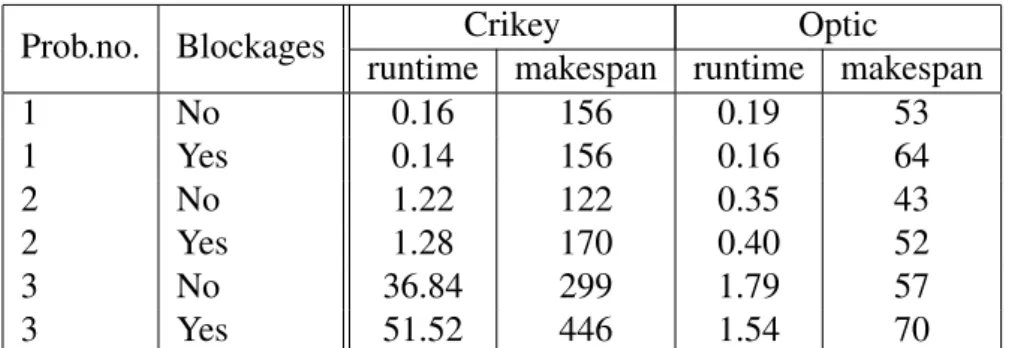
The Crikey family on the other hand [30; 32], employed a different approach to temporal planning compared with SAPA. It uses the relaxed graph plan [74] with an extension of some guidance from the temporal structure of the plan, to guide a for-ward search. The planners use a Simple Temporal Network(STN) to model and solve the temporal constraints between the action end points as they are accumulated during successive action choices.
The Temporal Fast Downward(TFD) planner [48; 72] uses an approach that is a slight enhancement of the compressed action model used by TGP, allowing some re-quired concurrency to be managed. Both TFD and SAPA face the same problem in situations in which an action must be started sometime after the last happening, but before the next queued event: neither planner includes this choice in its search space.
There are other temporal planners that use SAT solvers, such as [76], that was developed using ‘planning-as-SATisfiability’ paradigm. This uses a combination of Graphplan to SATisfiability approach ‘Graphplan-to-SAT’ encoding. This approach is especially suitable for problems where an appropriate time increment can be identified. Most of the temporal planners mention so far is restricted to the computation and man-agement of discrete changes. Continuous duration changes cannot be handled by these planners.
2.3.4
Continuous Planning
Continuous planning extends temporal planning by considering constantly changing state variables with respect to time. Continuous planning in domains which are repre-sented with rich notations has long been a great challenge for AI [19]. For instance, changes occurring due to fuel consumption, continuous movement, or environmental conditions may not be adequately modelled through instantaneous or even durative ac-tions; rather these require modelling as continuously changing processes. The combi-nation of time dependent problems and numeric optimisation problem create a more challenging and hard task of time-dependent metric fluents.
One of the earlier work that involves planning with continuous processes includes the Zeno system [113]. In this case, processes are described using differential equations rather than as continuous update effects, so that simultaneous equations must be consis-tent with one another rather than accumulating additive effects. McDermotts OPTOP system [99] is another early planner to handle continuous processes. A forward search planner that avoids grounding the representation using a unique approach to generate heuristics(relaxed plan estimates of the number of actions required to achieve the Goal) from a given state.
TM-LPSAT [145] was built upon the earlier LPSAT [145]. It was the first planner to implement thePDDL+Semantics [58] and an addition capability of handling variable durative actions. This includes durative actions with continuous effects and duration-dependent end-effects. It uses PDDL+ semantics to compile a collection of SAT formu-las from a horizon bounded continuous planning problem, together with an associated set of linear metric constraints over numeric variables. The compiled formulation is passed to a SAT-based arithmetic constraint solver, LPSAT [4]. The SAT-solver parses triggered constraints to the LP-solver, if there is no solution the horizon is increased and the process repeats, otherwise the solution is decoded into a plan. The novelty of TM-LPSAT lies in the compilation of the PDDL+ semantics and decoding of the SAT
solver into a plan, since both solvers are well-established systems.
The theory behind TM-LPSAT is very promising with the capability of solving large class of problem with varied continuous dynamics. However, empirical data suggests that the planner requires large CPU time to generate plan and unable to solve problems requiring plans of more than a few steps.
Kongming [94; 95]is another domain dependent continuous planner that solves a class of control planning problems with continuous dynamics. The language used is a version of PDDL2.1 extended to enable dynamics to be encoded. It is based on the building of fact and action layers of flow tubes, using the iterative plan graph structure of Graphplan algorithm [17]. As the graph is expands, every action produces a flow tube which contains the valid trajectories as they develop over a period of time. Reachable states at any time can be computed using the state equations of the system starting from a feasible region, and applying actions whose preconditions intersect with the feasible region. Kongming translates a planning problem into Mixed Logical-Quadratic Program (MLQP) using the plan-graph encoding with the continuous dynamics of the system. The planners metric objectives function can be defined in terms of quadratic function of state variable. Time is discretised to support state update within the plan -successive layers of the graph are separated by a constant and uniform time increment. UPMurphi is another planner [116] that uses PDDL2.1 to reasons with continuous processes on a batch chemical process [115]. It alternatively refines a discretisation of continuous changes until the solution to the discretised problem validates against the original problem specification. UPMurphi starts by discretising the continuous repre-sentation of the problem. Specific values within feasible ranges are taken as actions. Given rise to several version of each actions. The current discretisation is then used to explicitly construct and explore the state space. Plans are constructed in the form of planning-as-model-checking paradigm [28] with no heuristic to guide the search. When a plan is found, it is validated against the original continuous model, using the plan validator [56]. If it fails to find a plan at one discretisation, it alterate again at a
finer grained discretisation. Successive refinements lead to ever denser feasible regions, which might be increasingly complex to construct.
COLIN [33] is a forward-chaining heuristic search planner that uses the temporal semantics of PDDL2.1 and also capable of reasoning with continuous linear numeric change. It combines forward chaining search of FF to prune state, with the use of a Linear Program (LP) to check the consistency of the interacting temporal and nu-meric constraints at each state. The Temporal Relaxed Planning Graph heuristic of CRIKEY3 [32] is also extended to support reasoning with continuous change. A mix integer programming is used for post processes to optimise the timestamps of the ac-tions in the plan.
There are other approaches to continuous reasoning which might not be listed in this thesis. An example of such approach is to model continuous resource consumption and production in terms of uncertainty about the amount consumed or produced [102]. This lead to the construction of a Markov Decision Process (MDP) consisting of hybrid states.
Automated Planing in continuous process, allows us to model actions, process and event [58] as part of domain operators. One line of representation of continuous domain is to use PDDL+ [58], an extension of PDDL2.1 to represent exogenous events and processes as well as durative actions. It is assumed that an action can causes a discrete state change which might trigger a continuous process. This process continues over time until an event is initiated leading into a new state. While in that new state another action might be taken which could trigger a new process or a new action.
The following additions extends the class of metric problems to temporal-metric-continuous problems:
• a set of linear continuous numeric effects is added to the component of each action
a. This corresponds to the PDDL2.1 effect(increase(v) (∗#t k))which denotes an increases invat the rate ofkper unit of time.
• e f f`nande f fanmay additionally include durative parameter ?durationfor both
startorend effects of actions. This denotes the duration of the action, and could be written as:
hv,op,w·v+k·(?duration) +ci, such thatop∈ {+ =,=,−=},c,k∈κ
wherew is a vector of constants and ?durationmay have a constrain value that lie within a range of values, e.g. (?duration>v1)•(?duration6v2), for some numeric variablesv1andv2.
The relationship between time and numbers is more complex in a continuous plan-ing problem than in temporal-metric problems. The extension to the action component allows the value of a variablevto depend on the period time elapsed from the beginning of the continuous effect acting upon it. The second extension the durative effect implies that, ?durationdo not always need to be fixed, since the the value of variables can now depend on the duration assigned to the action.
2.4
Planning Representation and Language Semantics
There exist planning representation and ontologies for representing problems and do-main information in a way that is comprehensible to a planner. An instance of this is the Stanford Research Institute Problem Solver (STRIPS) approach to planning [53].
STRIPSrepresents a model of the world as an arbitrary collection of first-order predi-cate calculus formulas. For example ‘girl(rofia)’ meansRofia is a girl.
Different representations has evolve over time, depending on the nature of the im-plementation and the type of planner that can interpret the language semantics. For instance, Object Centered Language(OCLh)is developed for the acquisition of hierar-chical domains [97][98] . It is based on the idea of engineering a planning domain so that the universe of potential states of objects can be defined first , before operator defi-nition. It is object centred because it deals with object and it relationship with dynamic or static states. Another example is PPDDL [148] (an extension of PDDL) or RDDL [125] for modelling conformant planning problems.
However, planing Domain Description Language (PDDL) [100] is currently the dominant language within the planning community for describing planning domains and problems. This is due to the need to have a uniform language within the plan-ning community for the creation of benchmarks(domains) in the International Planplan-ning Competition (IPC)1. PDDL is the closest language to the representation used in this thesis, thus the next section gives an overview of PDDL semantics.
Planning Domain Definition Language (PDDL)
PDDL can be understood as a language, with a lisp like syntax, for describing plan-ning domain and modelling abstractions of real world problems. It was developed from STRIPS in 1998 by Drew McDermott with the aim of being a specification of planning models and later improved upon and show cased at every International Planning Com-petitions (IPC). It is used due to the need for representation and exchange of domain model within the planning community [100].
It is also important to know that PDDL has different family of languages such as PPDDL, RDDL as mention in the previous section. Figure2.5shows an example of a painting domain expressed in PDDL. This domain required two robots to paint five dif-ferent rooms at difdif-ferent time duration and having some constraint with the paint pots. They need to get and move all the require painting material with them before painting
(:durative-action wet_brush :parameters
( ?ppot - paintpot ?rob - robot
?bru - paintbrush ?bruc - paint ?potc - paint ?r - room )
:duration
(= ?duration 4) :condition
(and
(over all(in ?rob ?r))
(over all(rob_hold ?rob ?bru)) (over all(at ?ppot ?r))
(over all(colour ?ppot ?potc)) (at start(colour ?bru ?bruc)) )
:effect (and
(at start(not(colour ?bru ?bruc))) (at end(colour ?bru ?potc))
) )
Figure 2.5: A excerpt of a PDDL painting domain model showing the action to
wet brushwith paint
and there is limitation to the number of rooms the paintbrush can paint. The generated plans for the execution is shown in Figure2.6. .
Levels of PDDL
An advancement of the STRIPS representation to deal with numeric fluents and tempo-ral actions can also be represented in PDDL2.1 [57]. PDDL2.1 has different levels with level 1.0 restricted to propositional models. Level 2.0 introduces numeric fluents, to create reasoning about numeric values in domains. Though, the use of numeric fluents at level 2.0 is restricted to basic numeric operations, but it was able to solve some basic numeric problems compared to level 1.0.
Time: (ACTION) [action Duration; action Cost]
0.0000: (PICK JOHN BRUSH2 ROOM2)[D:2.0000; C:0.1000] 0.0000: (MOVE ALAN ROOM1 ROOM2) [D:3.0000; C:0.1000]
2.0000: (DIP_BRUSH_IN PAINTBUCKET2 JOHN BRUSH2 WHITE BLUE ROOM2)[D:4.0000; C:0.1000] 3.0000: (PICK ALAN PAINTBUCKET1 ROOM2) [D:2.0000; C:0.1000]
5.0000: (MOVE ALAN ROOM2 ROOM3) [D:3.0000; C:0.1000]
6.0000: (PAINTING JOHN ROOM2 WHITE BLUE BRUSH2 PAINTBUCKET2)D:40.0000; C:0.1000] 8.0000: (DROP ALAN PAINTBUCKET1 ROOM3) [D:2.0000; C:0.1000]
10.0000: (MOVE ALAN ROOM3 ROOM2) [D:3.0000; C:0.1000] 13.0000: (PICK ALAN BRUSH1 ROOM2) [D:2.0000; C:0.1000]
15.0000: (DIP_BRUSH_IN PAINTBUCKET2 ALAN BRUSH1 WHITE BLUE ROOM2)[D:4.0000; C:0.1000] 19.0000: (MOVE ALAN ROOM2 ROOM3) [D:3.0000; C:0.1000]
22.0000: (PAINTING ALAN ROOM3 WHITE BLUE BRUSH1 PAINTBUCKET1)[D:30.0000; C:0.1000] 46.0000: (DIP_BRUSH_IN PAINTBUCKET1 JOHN BRUSH2 BLUE RED ROOM2)[D:4.0000; C:0.1000] 50.0000: (PAINTING JOHN ROOM2 BLUE RED BRUSH2 PAINTBUCKET2)[D:40.0000; C:0.1000] 50.0000: (DROP ALAN BRUSH1 ROOM3) [D:2.0000; C:0.1000]
90.0000: (MOVE JOHN ROOM2 ROOM3) [D:3.0000; C:0.1000] 93.0000: (DROP JOHN BRUSH2 ROOM3) [D:2.0000; C:0.1000] 95.0000: (MOVE JOHN ROOM3 ROOM4) [D:3.0000; C:0.1000] 98.0000: (MOVE JOHN ROOM4 ROOM5) [D:3.0000; C:0.1000]
Solution number: 1 Total time: 0.02 Search time: 0.00 Actions: 19 Execution cost: 1.90 Duration: 101.000 Plan quality: 101.000
Figure 2.6: Painting Plan generated by lpg-td-1.0 planner for two robots painting several rooms with time and resource constraint