Techniques for Improving the Labelling Process of
Sentiment Analysis
in the Saudi Stock Market
Hamed AL-Rubaiee
Department of Computer Science and Technology University of Bedfordshire
Bedfordshire, United Kingdom
Renxi Qiu
Department of Computer Science and Technology University of Bedfordshire
Bedfordshire, United Kingdom
Khalid Alomar
Department of Information Systems King Abdulaziz University Jeddah, Kingdom of Saudi Arabia
Dayou Li
Department of Computer Science and Technology University of Bedfordshire
Bedfordshire, United Kingdom
Abstract—Sentiment analysis is utilised to assess users’ feedback and comments. Recently, researchers have shown an increased interest in this topic due to the spread and expansion of social networks. Users’ feedback and comments are written in unstructured formats, usually with informal language, which presents challenges for sentiment analysis. For the Arabic language, further challenges exist due to the complexity of the language and no sentiment lexicon is available. Therefore, labelling carried out by hand can lead to mislabelling and misclassification. Consequently, inaccurate classification creates the need to construct a relabelling process for Arabic documents to remove noise in labelling. The aim of this study is to improve the labelling process of the sentiment analysis. Two approaches were utilised. First, a neutral class was added to create a framework of reliable Twitter tweets with positive, negative, or neutral sentiments. The second approach was improving the labelling process by relabelling. In this study, the relabelling process applied to only seven random features (positive or negative): “earnings” (حابرا), “losses” (رئاسخ), “green colour” (رضخلاا_نوللاب), “growing” (هدايز), “distribution” (عيزوت), “decrease” (ضافخوا), “financial penalty” (ةمارغ), and “delay” (ليجات). Of the 48 tweets documented and examined, 20 tweets were relabelled and the classification error was reduced by 1.34%.
Keywords—Opinion mining; association rule; Arabic language; sentiment analysis; Twitter
I. INTRODUCTION
Classifying a sentiment polarity as positive or negative is challenging due to the subjectivity factor of the sentiment polarity. Opinionated text can also carry some speech informality—such as sarcasm, subjective language, and emoticons—that makes the opinion detection harder. This required more understanding of the text beyond the facts being expressed [1]. In addition, sentiment polarity might contain positive and negative keywords that can make the labelling process unreliable. This occurred frequently in the neutral class, where one tweet might contain both positive and negative keywords. Labelling carried out by hand can cause human mislabelling sentiments. Therefore, adding the neutral class can help give flexibility for humans to have more options in the labelling process. However, this might cause less
accuracy results. Since, the classifier techniques are used to cover the hall data set vectors, including the neutral data training. The reason behind this is that the data dictionary becomes larger which consist of all vectors that belong to positive, negative, and neutral. But humans will still label the data manually, which may create some mistakes in the labelling process. Consequently, the inaccurate classification creates the need to construct a relabelling process for Arabic tweets to remove noise on labelling. The main goal of the relabelling process is to remove the labelling noise. This will update experts’ knowledge about labelling, which may lead to better classification. This is necessary because of the high degree of noise in labelling texts. Especially, for comments are long and consist of multiple sentences such as blogs [2].
This paper presents techniques for improving the labelling process of sentiment analysis. Section 2 shows the need to improve the labelling process for the neutral class. Section 3 demonstrates the Arabic sentiment analysis. Section 4 shows the experiment-classification into positive, negative, and neutral classes. Section 5 shows the need to improve the labelling process by relabelling. Section 6 demonstrates the process of relabelling. Section 7 analyses the experimental findings from Saudi stock market data. The final section contains a conclusion and recommendations for further work in this area.
II. IMPROVING THE LABELLING PROCESS WITH THE NEUTRAL CLASS
Researchers tend to ignore the neutral class under the hypothesis that there is less learning sentiment from neutral texts compared to positive or negative classes. The neutral class is useful, though, in real-life applications since sentiment is sometimes being neutral and excluding it forces instances into other classes (positive or negative) [3]-[5]. In addition, sentiment polarity might have positive and negative keywords that can make the labelling process unreliable. This happened regularly in the neutral class, where one tweet might have both positive and negative keywords. Labelling carried out by hand can cause human mislabelling of sentiments. Therefore, adding the neutral class can give humans more flexibility and options
in the labelling process. However, this might cause less accurate results, since the data dictionary, which consists of all vectors that belong to positive, negative, and neutral, becomes larger.
III. ARABIC SENTIMENT ANALYSIS
Limited research has been conducted on Arabic sentiment analysis, so this is a field that is still in its early stages [6]. However, Boudad et al. [7], [8] reviewed the challenges and open issues that need to be addressed and explored in more depth to improve Arabic sentiment analysis, finding that these include domain, method of sentiment classification, data pre-processing, and level of sentiment analysis. They show that, in contrast to work on the English language, work on Arabic sentiment analysis is still in the early stages, and there are a lot of potential approaches and techniques that have not yet been explored. Another work carried out by Ibrahim et al. [9] have presented a multi-genre tagged corpus of MSA and colloquial language, with a focus on Egyptian dialects. Interestingly, they suggested that NLP supplements, which have been applied to other languages like English, are not valid for processing Arabic directly. Further, Abdulla et al. [10] explored the polarity of 2,000 collected tweets on various topics, such as politics and art. They used SVM, NB, KNN, and D-tree for their documents’ sentiment classification. They showed that SVM and NB have better accuracy than other classifiers in a corpus-based approach. Their results reported that the average accuracy of SVM was 87.2%, while the average accuracy of NB was 81.3%. El-Halees’s [11] combined approach classified documents using lexicon-based methods, used these as a training set, and then applied k-nearest neighbour to classify the rest of the documents.
IV. EXPERIMENT-CLASSIFICATION INTO POSITIVE, NEGATIVE, AND NEUTRAL CLASSES
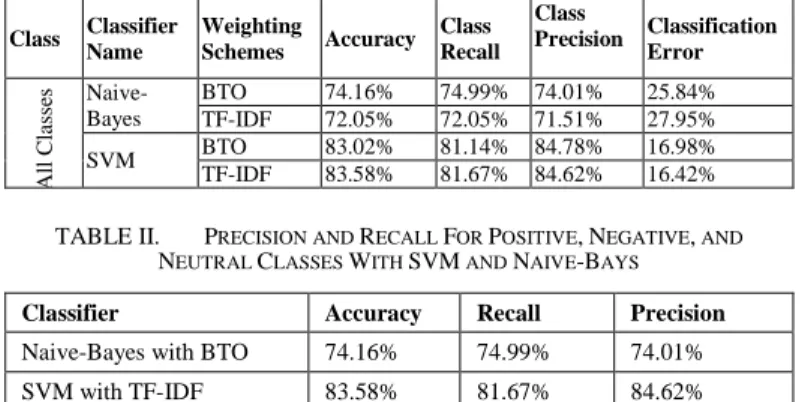
In this paper, Twitter has been chosen as a platform for opinion mining in trading strategy with the Saudi stock market to carry out and illustrate the relationship between Saudi tweets (standard and Arabian Gulf dialects) and the Saudi stock market index. The tweets’ source data was obtained from the Mubasher company website in Saudi Arabia, which was extracted from the Saudi Stock Exchange (which is known by TASI1 Index). This experiment will add the neutral class with the N-gram feature. For this study machine learning approach utilised, in which a set of data labelled as positive, negative. The classifiers, which were used to explore the polarity of all the classes’ data was Naive-Bayes and SVM. Two different weighting schemes (Term Frequency–Inverse Document Frequency (TF-IDF) and Binary Term Occurrence (BTO)) were used for all classes (Positive, Negative, and Neutral). Table I shows the comparison between the classifiers with the neutral class in term of class accuracy, recall, and precision. Table I shows that SVM with TF-IDF worked better to classify the targeted documents when we add the neutral class.
1https://www.tadawul.com.sa
TABLE I. PRECISION AND RECALL FOR POSITIVE,NEGATIVE, AND
NEUTRAL CLASSES USING N-GRAM FEATURE WITH SVM AND NB
Class Classifier Name Weighting Schemes Accuracy Class Recall Class Precision Classification Error A ll Cl as se s Naive-Bayes BTO 74.16% 74.99% 74.01% 25.84% TF-IDF 72.05% 72.05% 71.51% 27.95% SVM BTO 83.02% 81.14% 84.78% 16.98% TF-IDF 83.58% 81.67% 84.62% 16.42% TABLE II. PRECISION AND RECALL FOR POSITIVE,NEGATIVE, AND
NEUTRAL CLASSES WITH SVM AND NAIVE-BAYS
Classifier Accuracy Recall Precision
Naive-Bayes with BTO 74.16% 74.99% 74.01%
SVM with TF-IDF 83.58% 81.67% 84.62%
To sum up the classification experiment, the best accuracy achieved by SVM with TF-IDF was 83.58%. Moreover, the best recall and precision was achieved by SVM with less classification error. The analysis shows similar result for SVM with both schemas and only slight differences between recall and precision. Table II shows the comparison between the classifiers in terms of class accuracy, recall, and precision.
A one-to-one model shows the relationships between the positive, negative, and neutral classes and the TASI. The build model illustrates the results in sentiment analysis by showing the positive, negative, and neutral opinions as well as the TASI closing values. Fig. 1 shows the relation between labelling by human operators and the TASI for the Saudi stock market for positive negative and neutral classes between the middle of March 2015 to May 10, 2015. It can clearly be seen that the positive, negative, and neutral classes rise and fall with each other over time; the greatest score for neutral classes occurred on 21/4/2015; the lowest neutral class score occurred on 25/3/2015; and the lowest negative class score occurred on 28/4/2015. Only once did the neutral class get lower than the negative class, over a four-day period between 23/3/2015 and 26/3/2015. At that point, the TASI started to fall sharply. The neutral class frequently went above the positive class, but TASI remained the same. In conclusion, the neutral class mostly rose and fell with TASI. This indicates that the neutral class is an important consideration in the sentiment analysis process.
V. IMPROVING THE LABELLING PROCESS WITH RELABELLING
High dimensionality in texts makes text pre-processing very significant in text classification problems, including sentiment analysis [12], [13]. This problem increases once the dimensionality becomes higher, like when adding neutral class for the classification. For example, in the previous experiment conducted to improve the labelling process of the neutral class, there was approximately 17% misclassification when SVM were used and approximately 28% misclassification when NB
was used to classify the documents. In addition, labelling the documents conducted manually by humans may have introduced mistakes into the labelling process even when the neutral class was added. Thus, the inaccurate classification
creates the need to construct a relabelling process for Arabic tweets to remove the noise on the original labelling. Below are the suggested steps for a relabelling process for Arabic sentiments analysis.
Fig. 1. The relation between labelling by human operators and the TASI for the Saudi stock market for positive, negative, and neutral classes. The most challenging part of the process is feature selection
since any feature can occur in all classes (positive, negative, and neutral). In addition, the main difficulty is to find out how many times the feature occurred in each class. Therefore, a wordlist technique was used to represent the text data as a matrix to show the frequent occurrence of each term within the three classes. Next, filtering the feature helps to select the highest features presented by the wordlist process. Then, in order to understand the sentences’ structure and the sentiments behind them, a visualisation technique was used. This visualisation technique was applied to all data to achieve both a high level of understanding of the general structure and of the sentiment within an accumulated corpus. In other words, visualising the text shows the vital importance of the correlation between terms involved in the textual contents in general. However, visualisation shows only the feature with all the related terms in the textual contents without showing the classes they belong to. Using the wordlist technique with the visualisation can produce the important features created by the wordlist technique during the pre-process stage. Overcoming the visualisation limitation for the important features in the targeted text is essential to the relabelling process. After that, association rules extracted from the documents that have features that occurred in a questionable class. Association rules were generated regardless of the minimum support and minimum confidence threshold using the visualisation technique for the features that belong to the questionable class. By following these processes, the documents that have features in the questionable class can be relabelled again and the noise of the original labelling will be reduced.
VI. PROCESS OF RELABELLING
Fig. 2 demonstrates the relabelling process for the Arabic sentiments analysis. The process started by collecting the
corpus of data. The relevant training data were labelled and saved and the irrelevant training data were discarded.
Twitter’s API
Arabic Tweets
Labeling
Opinion Mining
Process Evaluate Accuracy Experts
Wordlist Process
Filtering
Extract Rules for questionable classes Rellabeling Yes Unrellabeling No Visualisation Relabelling Process
The second step was to pre-processing the data by cleaning up hashtags, duplicate tweets, retweets, URLs, and special characters, and preparing the collected data for the labelling process. The next step is to label the cleaned data as positive, negative, or neutral by the expert in the domain. After that, the relabelling process consists of several steps: the Wordlist process, Filtering, Visualisation, Extract Rule, and Relabelling.
A. Wordlist Process
Fig. 3 shows the wordlist process. This phase uses the same corpus classified—positive, negative, or neutral—and the same data pre-processing procedure used in Opinion mining for the positive, negative, and neutral classes. The goal of visualising association rules as wordlists2 is to have data sets that contain a row for each word and attributes for the word itself, and the number of labelled documents in each class for each term or word occurring in the training data. One other word represents the text data as a matrix to show the frequent occurrence of each term within the three classes. The key feature in this process was n-gram, which represents the correlation between the feature selection and other terms with their frequent occurrence for just two nods within the all-classes data.
Retrieve Labeled Classes Data Pre-processing WordList to Data Replace Tokens Tokenize Filter Stopwords (Arabic) Light stem Feature Selection
Filter Tokens (by Length) Generate
n-Grams (Terms)
Fig. 3. Wordlist process.
B. Filtering
Features in the context of opinion mining are the words, phrases, or terms that strongly express the opinion as three polarities: positive or negative or neutral. In other words, features are the keywords chosen for the text as positive or negative. That means features have a higher impact on the orientation of a text than other words in the same texts. The impact of feature selection is to help to reduce the dimensionality of a text to increase the classification accuracy. Features in the text are considered explicit or implicit. Features appear in a text as explicit, whereas the feature does not appear is implied [14]. In the proposed process, the explicit features only considered.
C. Visualization
The importance of visualising text is to understand the sentences’ structure and the sentiments behind them. Visualising the text shows the vital importance of the correlation between terms in the textual contents. The first step of the visualising technique is to produce the important features created by the wordlist process. Then, it was decided to select
2https://rapidminer.com/
one of the features that appear in the dictionary created by the wordlist. Selection of the feature was done randomly to cover high-, average-, and low-frequency features to prove the concept of investigating the labelling noise. The next step is to visualise the selected feature in all-classes data as a wordlist representation. The wordlist shows how frequently the selected feature occurs in positive, negative, and neutral classes. If the selected feature was positive sentiment and occurred in other classes, such as neutral or negative, then the other classes (neutral, negative) are considered as a questionable class. In other words, if the selected feature is from the positive list, then it should occur only in the positive class—otherwise, this feature occurring in different classes would be considered a questionable class. A strong positive keyword should affect the text to be classified as positive unless there is a negation. Besides, it should not occur in the neutral class unless there are other words in the text affecting the sentiment. However, features that happened in a questionable class need further investigation to confirm the correctness of the labelling.
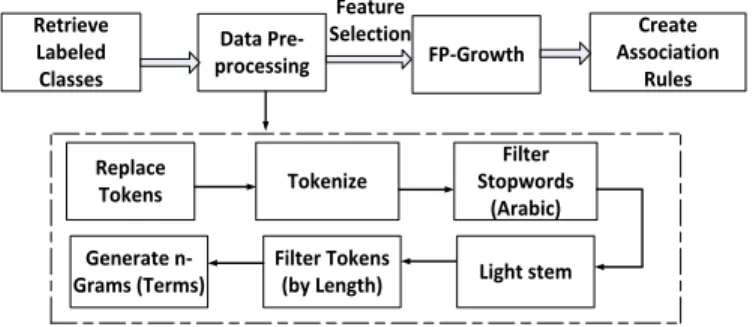
Fig. 4 illustrates the visualisation association rules process. In this phase, the same corpus classified as positive, negative, or neutral was used in this stage; and the same data pre-processing procedure used in the opinion mining process was carried out. After that, FP-Growth was used to discover frequent items discovery regarding the minimum support and minimum confidence threshold. Then, association rules were generated to expose the relationships between seemingly unrelated data. The output of visualization is the association of the high-frequency terms correlated with the selected feature presented previously from the wordlist process.
Data Pre-processing FP-Growth Feature Selection Retrieve Labeled Classes Replace Tokens Tokenize Filter Stopwords (Arabic) Light stem Filter Tokens (by Length) Create Association Rules Generate n-Grams (Terms)
Fig. 4. The visualisation-generated association rules process.
D. Association Rules
The importance of association rule mining is to extract interesting correlations, frequent patterns, associations, or casual structures between sets of items in the transaction databases [15]. Association rule mining is divided into two steps. One, frequent patterns are mined about the threshold minimum support. Second, association rules are built according to the threshold minimum confidence [16]. Some terms or words appear with higher frequency in the dataset, while others rarely occur. In this case, the values of the minimum support will control the rule discovery. For instance, if the minimum support is set at a high value, rules that infrequently occur will not be found. Otherwise, if the minimum support is set at a low value, rules that frequently occur will be found. This cause rules with high confidence have very little support might be ignored [17], [18].
Text mining is defined as knowledge revelation from textual databases. Rules are created by analysing data for frequent if/then patterns. The frequent if/then patterns were mined utilizing methods such as the Apriori algorithm and the FP-Growth algorithm [19], [20]. However, for this study, the FP-Growth method was used to discover the frequent item set in the targeted document [21, 22]. Since, the main advantages of the FP-Growth are: passes only two times over data-set, no candidate generation, and compresses data-set [23].
E. Extract Rules
In this phase, the extraction of association rules from collection of documents was based on the features created by the wordlist. Association rules were generated around the minimum support and minimum confidence threshold using the previous visualisation process; the only difference here is the data we are going to use are the data belonging to the questionable class. This step focuses on extracting the rule that occurred less frequently in the questionable class within a specific document.
F. Relabelling
In this step, searching is the training data for the feature occurring less in each questionable classes according to the wordlist matrix. We ensured reliability of the relabelling applied by the expert for a specific document. Then, sentiment with labelling noise was sent as a recommendation to the expert to check its labelling.
VII. EXPERIMENT -RELABELLING
The Arabic text classifications regarding Saudi stock market opinions through the SVM algorithm were designed and implemented. The classification error was 16.42%. Therefore, a framework was created for relabeling.
The relabelling process started by representing the text data as a matrix to show the frequent occurrence of each term within the three classes. The relabelling process focused on representing the correlation between the feature selection and other terms with their high-frequency occurrence for just two nodes within the all-classes data. Table III shows the feature ―earnings‖ (حابرا) as positive sentiment in the Saudi stock market domain. Table III shows the occurrence of the feature ―earnings‖ (حابرا) in the positive, negative, and neutral classes.
TABLE III. OCCURRENCE OF THE FEATURE ―EARNINGS‖(حابرا)
Feature Occurrence Neutral Positive Negative
حابرا 304 14 223 67
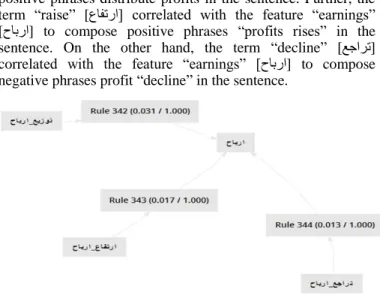
Fig. 5 shows the association rules that related to the feature ―earnings‖ (حابرا) in all classes with respect to the minimum support and minimum confidence threshold. The feature ―earnings‖ (حابرا) entailed sharing the profits of some company in the Saudi stock market. Fig. 5 shows the most important rules for the feature ―earnings‖ (حابرا) which is ―earnings‖ --> ―sharing out‖ [حابرا] --> [عٌسٕح] (support: 0.031 confidence: 1), ―earnings‖ --> ―rise‖ [حابرا] --> [عافحرا] (support: 0.071 confidence: 1), and ―earnings‖ --> ―decline‖ [حابرا] --> [عجازح] (support: 0.031 confidence: 1) The term (sharing out) [عٌسٕح] correlated with the feature ―earnings‖ [حابرا] to compose
positive phrases distribute profits in the sentence. Further, the term ―raise‖ [عافحرا] correlated with the feature ―earnings‖ [حابرا] to compose positive phrases ―profits rises‖ in the sentence. On the other hand, the term ―decline‖ [عجازح] correlated with the feature ―earnings‖ [حابرا] to compose negative phrases profit ―decline‖ in the sentence.
Fig. 5. Visualize the association rules for the feature ―Earnings.)حابرا( ” The next step is to find out from the wordlist representation the occurrence of the most frequent phrases that related to feature ―earnings‖ (حابرا). Table IV shows that the phrase ―high profits‖ [حابرا-عٌسٕح] occurred 79 times—three in the neutral class, 66 in the positive class, and 10 in the negative class.
TABLE IV. PHRASES FOR THE FEATURE ―EARNINGS‖(حابرا) IN ALL DATA
Phrase
-Terms Occurrence Neutral Positive Negative
عٌسٕح -حابرا 79 3 66 10 عافحرا -حابرا 37 0 37 0 عجازح -حابرا 31 0 0 31
From Table IV, the phrase ―high profits‖ [حابرا-عافحرا] does not need further investigation since it only occurred in the positive class. In addition, ―profits decline‖ [حابرا-عجازح] does not need further investigation since it only occurred in the negative class. The phrase [حابرا-عٌسٕح] occurred 79 times— three in the neutral class, 66 in the positive class, and 10 in the negative class. Since the phrase ―distribute profits‖ [حابرا-عٌسٕح] occurred in negative and neutral classes then both classes become questionable classes. Therefore, the feature ―earnings‖ (حابرا) needs further investigation in order to find the association rules in both classes. As result, two scenarios will be followed: In the first scenario, the association rules that occurred for the feature ―earnings‖ (حابرا) in the neutral class are extracted. Association rules are generated with regard to the minimum support and minimum confidence threshold using the previous process of the visualisation.
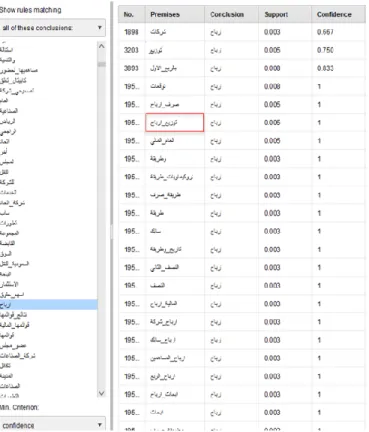
Fig. 6 shows that the feature ―earnings‖ (حابرا) occurred with many rules that appeared in the premises column with the minimum support and minimum confidence values. However, according to the first scenario, the relevant rule here is [حابرا] --> [حابرا-عٌسٕح] (support: 0.005 confidence: 1), which represents the phrase ―distribute profits‖ [حابرا-عٌسٕح] illustrated in the wordlist matrix in the neutral class.
Fig. 6. The correlation rules of the feature ―Earnings‖ (حابرا) in neutral class. From Fig. 6, the rule [حابرا] --> [حابرا-عٌسٕح] (support: 0.005 confidence: 1) which represent the phrase ―distribute profits‖ occurred in the neutral class. Therefore, the next step is to search for the phrase ―distribute profits‖ [حابرا-عٌسٕح] in the neutral class documents. Table V shows the phrase ―distribute profits‖ [حابرا-عٌسٕح] happened in three documents.
TABLE V. TERM ―DISTRIBUTE PROFITS‖[حابرا-عٌسٕح] IN THE NEUTRAL
CLASS DOCUMENTS
Original Labelling class
Original Arabic tweets with English translations New Labelling class Neutral هلعت خٌراح ٍع نلاسأ نلاسلأا عَاصي داححا تكزش تمٌزطٔ حابرأ عيزوت واع ٍي ًَاثنا فصُنا 2014 و Positive Union Wire Mills Company announces the
date and method of distributing dividends for the second half of 2014
Neutral هلعت ٍع زًٍعخنأ ءاشَلإن تكي تكزش عيزوت حابرأ ىهع ًف تٍٓخًُنا تٍناًنا تُسنا ٍع ًٍٍْاسًنا 30 / 4 / 1436 ـْ Positive Makkah Construction & Development
Company announces the distributing dividends to shareholders for the fiscal year ended 30/4/1436 H. Neutral هلعت ٍع ِاكزشٔ زٍكحنا شٌشعناذبع سإف تكزش عيزوت حابرأ واعنا ٍي ًَاثنا فصُنا ٍع ًٍٍْاسًنا ىهع 2014 Positive Fawaz Abdulaziz Al Hokair & Co.
announces a dividend distribution for the second half of 2014
From Fig. 6, the rule [حابرا] --> [حابرا-عٌسٕح] (support: 0.021 confidence: 1) which represents the phrase ―distribute profits‖ occurred in the negative class. Therefore, the next step is to search for the phrase ―distribute profits‖ [حابرا-عٌسٕح] in the negative class documents. Table VI shows the phrase
―distribute profits‖ [حابرا-عٌسٕح] happened in 10 documents. Moreover, only one document has been found to satisfy the rule [حابرا] --> [حابرا-عٌسٕح], so it has been sent again to the expert who labelled the document in the first stage. It can been seen from the structure in the rest of the nine documents that the phrase ―distribute profits‖ حابرأ عٌسٕح has occurred with the negation [ حابرأ عٌسٕح] --> [ وذع], which is the right place for this term in the negative class.
TABLE VI. TERM ―DISTRIBUTE PROFITS‖[حابرا-عٌسٕح] IN THE NEGATIVE
CLASS DOCUMENTS
Original Labelling
class
Original Arabic tweets with English translations New Labelling class Negative ليجأت ىهع تمفإًنا تًُضخًنا ٕكبٍف تٍيًٕع عيزوت حابرأ Positive Postpone the Vipco generality agreed on
dividend distribution Negative ًصٌٕ ٍٍيأخهن تًٍناعنا ةرادإ سهجي مذعب حابرأ عيزوت Negative Global Insurance Board recommend on not
distribute dividend Negative 21 ىهع تمفإًهن ًبزعنا عرذنا تٍيًٕع ٌٕاي مذع عيزوت حابرأ Negative May 21 general Arabian Shield for approval
on not distribute dividend
Negative لَٕاًٍك تٍيًٕع دُٕب ىهع ذعُب ٍع جٌٕصخنا ًاذغ تًُضخًنأ مذع عيزوت حابرأ Negative Tomorrow remote voting on the general
terms of Kimanol, including on not distribute dividend Negative زمح ٍٍيأخهن سٌا مذع حابرأ عيزوت سهجي ءاضعأ بخخُحٔ آحرادإ Negative ACE Insurance recognizes on not distribute
dividend and elects its board of directors
Negative سهجي تٍصٕح ٍع ًهٌابٕي ثلااصحإ داححإ تكزش ٍهعح ةرادلإا مذعب عيزوت حابرأ ًناًنا واعنا ٍي لٔلأا عبزنا ٍع 2015 و Negative Etihad Etisalat announces the
recommendation of the Board of Directors on not distribute dividend for the first quarter
of the fiscal year 2015
Negative زمح ًهٌابٕي ةرادإ مذع عيزوت حابرأ ٍي لٔلأا عبزنا ٍع واعنا اذْ Negative Mobily's management confirms Directors on
not distribute dividend for the first quarter of this year Negative 9 ىهع تمفإًهن ًهٌابٕي تٍيًٕع ٌٍَٕٕ مذع حابرأ عيزوت Negative June 9 Mobily's approval for not distribute
dividend Negative 609 ىخح تًكازخًنا زئاسخ % 30 تمفإًهن تٍيًٕع مٌزبأ ىهع مذع عيزوت حابرأ Negative 609% accumulated losses until 30 April
general to approve on not distribute dividend Negative ًصٕح لإفاص ّكزش 22 ىهع تمفإًهن تٍيًٕع ٌٍَٕٕ مذع عيزوت حابرأ Negative Savola recommends a June 22 general
meeting to approve not distribute dividend
Fig. 7 shows that the feature ―earnings‖ (حابرا) occurred with many rules that appeared in the premises column with the minimum support and minimum confidence values. According to the second scenario, the interested rule here is [حابرا] --> [حابرا-عٌسٕح] (support: 0.021 confidence: 1), which represents the phrase ―distribute profits‖ [حابرا-عٌسٕح] illustrated in the wordlist matrix in the negative class.
Fig. 7. The correlation rules of the feature ―Earnings‖ in the negative class. Fig. 8 shows the correlation rules that can happen with the feature ―earnings‖ (حابرا) in the negative class. This process can identify the negation terms, such as وذع, which means the opposite of positive to help solving the negations problem with Arabic sentiment analysis.
Fig. 8. The correlations of the ―negation term‖ (وذع) and the feature ―Earnings‖ (حابرا) in the negative class.
The second example verifies our experiment with another positive sentiment ―Rise” (عافحرا). Table VII shows the feature ―Rise” (عافحرا) as positive sentiment in the Saudi stock market domain. Table VII also shows the occurrence of the feature ―Rise” (عافحرا) in the positive, negative, and neutral classes.
TABLE VII. FEATURE ―RISE”(عافحرا)OCCURRENCE
Feature Occurrence Doc-tot Neutral Positive Negative
عافحرا 161 158 3 113 47
Fig. 8 shows the association rules related to the feature ―Rise” (عافحرا) in all classes with respect to the minimum support and minimum confidence threshold. The feature ―Rise” (عافحرا) is meant to obtain a financial advantage or benefit from an investment of some company in the Saudi stock market. In addition, Fig. 9 shows the most important rules for the feature
―Rise” (عافحرا), which is ―earnings‖ --> ―rise‖ [حابرا] --> [عافحرا] (support: 0.091 confidence: 1), and the feature ―percentage‖ --> ―rise‖ [ّبسَ] ----> [عافحرا] (support: 0.013 confidence: 1). The term ―earnings‖ [حابرا] correlated with the term ―rise” (عافحرا) to compose positive phrases High profits in the sentence. Further, the term ―percentage‖ [ّبسَ] correlated with the feature ―rise” (عافحرا) to compose positive phrases high ratio in the sentence.
Fig. 9. Visualize the association rules for the feature ―Rise” (عافحرا). The next step is to from the wordlist the representation of the occurrence of the most frequent phrases related to the feature ―Rise” (عافحرا). Table VIII shows that the phrase ―high profits‖ [عافحرا- -ّبسَ ] occurred 30 times—zero in the neutral class, 23 in the positive class, and seven in the negative class.
TABLE VIII. PHRASES FOR THE FEATURE ―RISE”(عافحرا) IN ALL DATA
Phrase
-Terms Occurrence Neutral Positive Negative
عافحرا -حابرا 37 0 37 0 عافحرا – ّبسَ 30 0 23 7
In Table VIII, the phrase ―high profits‖ [حابرا-عافحرا] does not need further investigation since it only occurred in the positive class. The phrase ―high profits‖ [ّبسَ– عافحرا] occurred 30 times—zero times in the neutral class, 23 in the positive class, and seven in the negative class. Since the phrase ―high profits‖ [ّبسَ – عافحرا] occurred in the negative class, the negative class becomes a questionable class. Therefore, the feature ―Rise” (عافحرا) in the negative class needs further investigation to find the association rules in the negative class. As a result, the second scenario will be followed: Extract the association rules that occurred for the feature ―Rise” (عافحرا) in the negative class. Association rules are generated around the minimum support and minimum confidence threshold using the previous process of the visualisation.
The feature ―Rise” (عافحرا) occurred with many rules that appeared in the premises column with the minimum support and minimum confidence values. However, according to the second scenario, the interested rule here is [عافحرا] --> [ عافحرا– ّبسَ] (support: 0.015 confidence: 1) which represents the phrase ―high profits‖ [ّبسَ– عافحرا] illustrated in the wordlist matrix in the negative class. The rule [عافحرا] --> [ّبسَ– عافحرا] (support: 0.015 confidence: 1) which represents the phrase ―high profits‖ [ّبسَ– عافحرا] occurred in the negative class. Therefore, the next step is to search for the phrase ―high profits‖ [ّبسَ– عافحرا] in the negative class documents. Table IX shows the phrase ―high
profits‖ [ّبسَ– عافحرا] happened in three documents. In addition, three documents have been found to satisfy the rule [عافحرا] --> [ّبسَ – عافحرا], so it has been sent again to the expert who labelled the document in the first stage. It can be seen from the structure of the three documents that the Arabic language is a derivative language in which new words are created from other words. For example, عافحرا can create اعفحزي ,عفحزٌ, عفحزح, عفحرا — all those words have the same meaning which ―rise‖ in English language, and each term has different shape and this one of the problems that can be solved by the light stemming in the pre-process phase. Moreover, the replace token operator was used to replace ―%‖ by the term ―percentage‖ (ّبسَ) during the Pre-process phase. For this reason, the term ―percentage‖ (ّبسَ) cannot be seen in the original documents.
TABLE IX. PHRASE ―HIGH PROFITS‖[تبسَ-عافحرا] IN THE NEGATIVE CLASS
DOCUMENTS
Original Labelling
Class
Original Arabic Tweets with English Translation New Labelling Class Negative تئشجخنا عاطل حابرأ ًفاص عفترت 12 % ىغر عجارت ثهث ّحاكزش Positive Net profit for the retail sector increase 12%
despite a third of its companies falling Negative يدٕعسنا قٕسنا عفتري 04 % لإفاصٔ عٕبسلأا تٌآُب آعاطمب عجازخح Positive The Saudi market is up 04% at the end of the
week and Savola is falling in its sector Negative كهغٌ واعنا زشؤًنا اعفترم فهغذٍئ عجارتي ٍي زثكأب 8 % Positive General index closes higher and Medgulf
went down more than 8%
For the third example for ―losses” (زئاسخ), which is negative sentiment, first we visualize the most important rules for the term ―losses” (زئاسخ). Table X shows the feature ―losses” (زئاسخ) as negative sentiment in the Saudi stock market domain. Table X shows the occurrence of the feature ―losses” (زئاسخ) in the positive, negative, and neutral classes.
TABLE X. PHRASES FOR THE FEATURE ―LOSSES‖(زئاسخ) IN ALL DATA
Feature Occurrence Neutral Positive Negative
زئاسخ 87 0 25 62
Fig. 10 shows the association rules related to the feature ―losses” (زئاسخ) in all classes with respect to the minimum support and minimum confidence threshold. The feature ―losses” (زئاسخ) means losing an investment in some company in the Saudi stock market. In addition, Fig. 10 shows the most important rules for the feature ―losses” (زئاسخ), which is [زئاسخ] --> [تًكازخًنا] (support: 0.013 confidence: 1). The term ―losses‖ [زئاسخ] correlated with the term ―accumulated” (تًكازخًنا) to compose the positive phrase ―accumulated losses‖ in the sentence.
Fig. 10.Visualize the association rules for the feature ―losses” (زئاسخ).
The next step is to find out from the wordlist representation of the occurrence of the most frequent phrases that related to feature ―losses” (زئاسخ). Table XI shows that the phrase ―accumulated losses‖ [تًكازخًنا-زئاسخ] occurred 14 times—zero in the neutral class, four in the positive class, and 10 in the negative class.
TABLE XI. PHRASES FOR THE FEATURE ―ACCUMULATED LOSSES‖( زئاسخ -تًكازخًنا) IN ALL DATA
Phrase -Terms Occurrence Neutral Positive Negative
زئاسخ
-تًكازخًنا 14 0 4 10
Since the phrase ―accumulated losses‖ [تًكازخًنا-زئاسخ] occurred in the positive class, the positive class becomes the questionable class. Therefore, the feature ―losses” (زئاسخ) in the positive class needs further investigation in order to find out the association rules in the positive class. As result, the second scenario will be followed to extract association rules that occurred for the feature ―losses” (زئاسخ) in the positive class. Association rules are generated with regard to the minimum support and minimum confidence threshold using the previous process of the visualisation. The rule [زئاسخ] --> [تًكازخًنا-زئاسخ] (support: 0.005 confidence: 1) which represent the phrase ―accumulated losses‖ [تًكازخًنا-زئاسخ] occurred in the positive class. Therefore, the next step is to search for the phrase ―accumulated losses‖ [ تًكازخًنا-زئاسخ] in the positive class documents. Table XII shows the phrase ―accumulated losses‖ [
زئاسخ
-تًكازخًنا ] happened in three documents. Three documents have been found to satisfy the rule [زئاسخ] --> []تًكازخًنا-زئاسخ, so it has been sent again to the expert who labelled the document in the first stage. It can be seen from the structure of the three documents that the term ―descent‖ ( ضافخَإ ( as negative sentiment came before the phrase ―accumulated losses‖ [تًكازخًنا-زئاسخ], also a negative phrase that puts the three documents in the positive situation.
TABLE XII. PHRASE ―ACCUMULATED LOSSES‖[تًكازخًنا-زئاسخ] IN THE
POSITIVE CLASS DOCUMENTS
Original Labelling Class
Original Arabic Tweets with English Translations New Labelling Class Positive هلعت ٍٍياخهن افٔ ٍَّٔاعخنا ٍٍياخهن تٌذُٓنا تٌدٕعسنا تكزشنا ٍع ضافخوإ ةمكارتملا اهرئاسخ ٍي ملأ ىنإ 50 ٍي % آناًسأر Positive Saudi Indian Cooperative Insurance
Company (WAFA) announces its decrease accumulated losses to less than 50% of its capital Positive ضافخوا ةمكارتملا رئاسخلا ٍع ٍٍيأخهن افٔ ـن 50 ٍي % آناًسأر Positive Wafa Insurance's decrease accumulated loss
of 50% of its capital Positive ٍع ًَٔاعخنا ٍٍيأخهن ةذحخًنا تكزشنا ٍهعح ضافخوإ ةمكارتملا اهرئاسخ ٍي ملأ ىنإ 50 آناًسأر ٍي % Positive United Cooperative Insurance Company
announces a decrease in its accumulated losses to less than 50% of its capital
Positive ضافخوا ةمكارتملا رئاسخلا ٍع ٍٍيأخهن افٔ ـن 50 ٍي % آناًسأر Positive Decrease loss of Wafa Insurance
Finally, colour is used as for both positive and negative sentiment in this domain. For instance, green colour indicates a positive sentiment in the stock market domain, while red indicates negative sentiment with the HMI field in computing. Table XIII shows the feature ―green” (زضخلاا) as positive sentiment in the Saudi stock market domain. Table XIII also shows the occurrence of the feature ―green” (زضخلاا) in the positive, negative, and neutral classes.
TABLE XIII. PHRASES FOR THE FEATURE ―GREEN‖(زضخلاا)IN ALL DATA
Feature Occurrence Neutral Positive Negative
زضخلاا 15 0 10 5
Fig. 11 shows the association rules related to the feature ―green” (زضخلاا) in all classes with respect to the minimum support and minimum confidence threshold. The feature ―green” (زضخلاا) indicates that the Saudi stock market values are closing green. Fig. 11 shows the most important rules for the feature ―green” (زضخلاا), which is [زضخلاا] --> [ٌٕهناب] (support: 0.006 confidence: 1). The feature ―green” (زضخلاا) correlated with the term ―colour” (ٌٕهنا) to come up with the positive phrase ―green colour‖ in the sentence.
Fig. 11.Visualize the association rules for the feature ―Green‖ (زضخلاا). The next step is to find out from the wordlist representation of the occurrence of the most frequent phrases that related to the feature ―green” (زضخلاا). Table XIV shows that the phrase ―green colour‖ [زضخلاا_ٌٕهناب] occurred 12 times—zero in the neutral class, eight in the positive class, and seven in the negative class.
TABLE XIV. PHRASES FOR THE FEATURE ―GREEN COLOR‖(زضخلاا_ٌٕهناب)IN
ALL DATA
Phrase -Terms Occurrence Neutral Positive Negative
زضخلاا_ٌٕهناب 14 0 8 5
Since the phrase ―green colour‖ [زضخلاا_ٌٕهناب] occurred in the negative class, the negative class becomes the questionable class. Therefore, the feature ―green” (زضخلاا) in the negative class needs further investigation in order to find out the association rules in the positive class. As result, the second scenario will be followed: Extract the association rules that occurred for the feature ―green” (زضخلاا) in the negative class. Association rules are generated with regard to the minimum support and minimum confidence threshold using the previous process of the visualisation. The rule [زضخلاا] --> [زضخلاا_ٌٕهناب] (support: 0.011 confidence: 1) which represents the phrase ―green colour‖ [زضخلاا_ٌٕهناب] occurred in the negative class. Therefore, the next step is to search for the phrase ―green colour‖ [زضخلاا_ٌٕهناب] in the negative class documents. Table XV shows the phrase ―green colour‖ [زضخلاا_ٌٕهناب] happened in seven documents. Seven documents have been found to satisfy the rule [زضخلاا] --> [زضخلاا_ٌٕهناب], so it has been sent again to the expert who labelled the
document in the first stage. It can be seen from the structure of the seven documents that the term ―decline‖ ( عجازح ( as negative sentiment came sometimes before and after the phrase ―green colour‖ [ زضخلاا_ٌٕهناب], which is a negative term that puts the seven documents in the unreliable situation during the labelling process.
TABLE XV. PHRASE ―GREEN COLOR‖[زضخلاا_ٌٕهناب] IN THE NEGATIVE CLASS DOCUMENTS
Original Labelling Class
Original Arabic Tweets with English Translations New Labelling Class Negative يرامعنا زٌٕطخنأ زضخلأا ٌٕهناب كهغٌ واعنا زشؤًنا عجازخٌ 3 % Positive Index closes in green and real estate
development falls 3% Negative
وشحنا تفصاع تٍفهخ ىهع عجازخح تٍجٍهخنا قإسلأا زضخلأا ٌٕهناب ًبظٕبأٔ
Negative Gulf markets retreat against the backdrop
of the Al-Hazm Storm and Abu Dhabi in green Negative تبسُب ًاعجازخي كهغٌ يدٕعسنا قٕسنا 17 ذحأ عاطلٔ % زضخلأا ٌٕهناب Negative The Saudi market closed down 17% and
one sector in green Negative
ٌٔد يدٕعسنا قٕسنا كهغح حابرا ًُج ثاٍهًع 9750
زضخلأا ٌٕهناب ًاذحأ ًاعاطلٔ تطمَ
Negative Profits taking closes the Saudi market
below 9750 points and one sector in green Negative
ٌٕهناب ذحأ عاطلٔ زًحلأا ٌٕهناب كهغٌ يدٕعسنا قٕسنا زضخلأا
Negative The Saudi market closes in red and one
sector in green
In addition, the same process was carried out for random features (positive or negative), namely, ―growing‖ (ِداٌس), ―distribution‖ (عٌسٕح), ―decrease‖ ضافخَا, ―financial penalty‖ تيازغ, and ―delay‖مٍجاح . The result shows that, after completing the process, 23 documents were sent to experts to check the labelling. Of the 48 tweet documents examined, 20 tweets were relabelled.
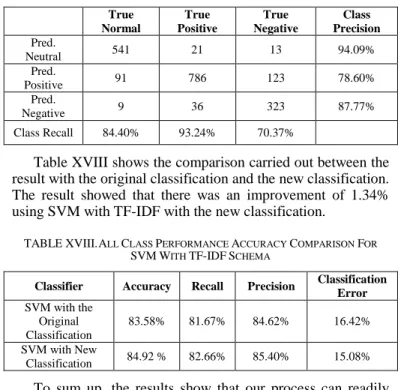
In the last stage, the original data were updated according to the new labelling. Then, the updated data were loaded to run a new classification process. A comparison was carried out between the original classification and the new classification. Tables XVI and XVII show the performance accuracy for the SVM with TF-IDF schema for both, the original classification and the new classification, respectively. For the neutral class, the precision for the original classification is 92.59%, which rose to 94.09% for the new classification after the relabeling process. On the other hand, the recall for the original classification for the neutral class is 82.74%, which rose to 84.40% for the new classification after the relabeling process.
TABLE XVI. ALL CLASS PERFORMANCE ACCURACY IN ORIGINAL
CLASSIFICATION FOR SVMWITH TF-IDFSCHEMA
True Normal True Positive True Negative Class Precision Pred. Neutral 537 26 17 92.59% Pred. Positive 103 757 119 77.32% Pred. Negative 9 45 330 85.94% Class Recall 82.74% 91.43% 70.82%
TABLE XVII.ALL CLASS PERFORMANCE ACCURACY IN NEW
CLASSIFICATION FOR SVMWITH TF-IDFSCHEMA
True Normal True Positive True Negative Class Precision Pred. Neutral 541 21 13 94.09% Pred. Positive 91 786 123 78.60% Pred. Negative 9 36 323 87.77% Class Recall 84.40% 93.24% 70.37%
Table XVIII shows the comparison carried out between the result with the original classification and the new classification. The result showed that there was an improvement of 1.34% using SVM with TF-IDF with the new classification.
TABLE XVIII.ALL CLASS PERFORMANCE ACCURACY COMPARISON FOR
SVMWITH TF-IDFSCHEMA
Classifier Accuracy Recall Precision Classification
Error SVM with the Original Classification 83.58% 81.67% 84.62% 16.42% SVM with New Classification 84.92 % 82.66% 85.40% 15.08% To sum up, the results show that our process can readily classify Arabic tweets. Furthermore, they can handle many antecedent text association rules for the positive class, the negative class, and the neutral class. The analysis shows the importance of the neutral class in sentiment analysis of Arabic documents; adding the neutral class shows different results of classification accuracy. The reason results are different is that the new vectors dictionary for the text data consists of all the words that belong to positive and negative classes as well. The obtained results help to understand the text structure and the sentiment behind them. Finally, these efforts are meant to add to the breadth of expert knowledge in this field and to be beneficial to the future of machine learning methods.
VIII. CONCLUSION
This study presents a relabeling process to enhance the classification accuracy and update the expert knowledge in the original labelling. Since human error occurs in labelling data, visualisation of the text can show the importance of the correlation between terms involved in the textual structured contents. This is especially apparent in the wordlist and the N-gram steps of the pre-process stage. After the relabeling process applied for random only seven features (positive or negative), namely, ―earnings‖ (حابرا), ―losses” (زئاسخ), ―Green color‖ [زضخلاا_ٌٕهناب] , ―growing‖ (ِداٌس), ―Distribution‖ (عٌسٕح), ―Decrease‖ ضافخَا, ―Financial penalty‖تيازغ , and ―delay‖مٍجاح . Of the 48 tweets documented and examined, 20 tweets were relabelled and the classification error was reduced by 1.34%. The current study should be repeated in other domains such as education.
REFERENCES
[1] Haddi, E., Sentiment analysis: text, pre-processing, reader views and cross domains. 2015, Brunel University London.
[2] Yoshida, S., et al. Sentiment analysis for various SNS media using Naïve Bayes classifier and its application to flaming detection. in Computational Intelligence in Big Data (CIBD), 2014 IEEE Symposium on. 2014. IEEE. [3] Go, A., R. Bhayani, and L. Huang, Twitter sentiment classification using distant supervision. CS224N Project Report, Stanford, 2009. 1(2009): p. 12.
[4] Koppel, M. and J. Schler, The importance of neutral examples for learning sentiment. Computational Intelligence, 2006. 22(2): p. 100-109. [5] Agarwal, A., et al. Sentiment analysis of twitter data. in Proceedings of
the Workshop on Languages in Social Media. 2011. Association for Computational Linguistics.
[6] Hamed, A.-R., R. Qiu, and D. Li. Analysis of the relationship between Saudi twitter posts and the Saudi stock market. in Intelligent Computing and Information Systems (ICICIS), 2015 IEEE Seventh International Conference on. 2015. IEEE.
[7] Boudad, N., et al., Sentiment analysis in Arabic: A review of the literature. Ain Shams Engineering Journal, 2017: p. 1-12.
[8] Kaseb, G.S. and M.F. Ahmed, Arabic Sentiment Analysis approaches: An analytical survey.
[9] Ibrahim, H.S., S.M. Abdou, and M. Gheith. MIKA: A tagged corpus for modern standard Arabic and colloquial sentiment analysis. in Recent Trends in Information Systems (ReTIS), 2015 IEEE 2nd International Conference on. 2015. IEEE.
[10] Abdulla, N.A., et al. Arabic sentiment analysis: Lexicon-based and corpus-based. in Applied Electrical Engineering and Computing Technologies (AEECT), 2013 IEEE Jordan Conference on. 2013. IEEE. [11] El-Halees, A.M., Arabic text classification using maximum entropy. IUG
Journal of Natural Studies, 2015. 15(1).
[12] Das, S.R. and M.Y. Chen, Yahoo! for Amazon: Sentiment extraction from small talk on the web. Management science, 2007. 53(9): p. 1375-1388.
[13] Sebastiani, F., Machine learning in automated text categorization. ACM computing surveys (CSUR), 2002. 34(1): p. 1-47.
[14] Liu, B., Sentiment Analysis and Subjectivity. Handbook of natural language processing, 2010. 2: p. 627-666.
[15] Agrawal, R., T. Imieliński, and A. Swami. Mining association rules between sets of items in large databases. in Acm sigmod record. 1993. ACM.
[16] Wu, X., C. Zhang, and S. Zhang, Efficient mining of both positive and negative association rules. ACM Transactions on Information Systems (TOIS), 2004. 22(3): p. 381-405.
[17] Liu, B., Y. Ma, and C.K. Wong. Improving an association rule based classifier. in European Conference on Principles of Data Mining and Knowledge Discovery. 2000. Springer.
[18] Karthikeyan, T. and N. Ravikumar, A survey on association rule mining. International Journal of Advanced Research in Computer and Communication Engineering, 2014. 3(1): p. 2278-1021.
[19] Deng, Z.-H., K.-H. Luo, and H.-L. Yu, A study of supervised term weighting scheme for sentiment analysis. Expert Systems with Applications, 2014. 41(7): p. 3506-3513.
[20] Nasukawa, T. and J. Yi. Sentiment analysis: Capturing favorability using natural language processing. in Proceedings of the 2nd international conference on Knowledge capture. 2003. ACM.
[21] Han, J., J. Pei, and Y. Yin. Mining frequent patterns without candidate generation. in ACM sigmod record. 2000. ACM.
[22] Witten, I.H., et al., Data Mining: Practical machine learning tools and techniques. 2016: Morgan Kaufmann.
[23] Verhein, F., Frequent Pattern Growth (FP-Growth) Algorithm. School of Information Studies, The University of Sydney, Australia, 2008: p. 1-16.