University of Kentucky University of Kentucky
UKnowledge
UKnowledge
DNP Projects College of Nursing
2018
The Evaluation of Advanced Practice Providers Practice Patterns
The Evaluation of Advanced Practice Providers Practice Patterns
and Delivery of Care Models in the Specialty Practice Environment
and Delivery of Care Models in the Specialty Practice Environment
Katherine W. RogersUniversity of Kentucky, [email protected]
Follow this and additional works at: https://uknowledge.uky.edu/dnp_etds Part of the Nursing Administration Commons
Right click to open a feedback form in a new tab to let us know how this document benefits you. Right click to open a feedback form in a new tab to let us know how this document benefits you.
Recommended Citation Recommended Citation
Rogers, Katherine W., "The Evaluation of Advanced Practice Providers Practice Patterns and Delivery of Care Models in the Specialty Practice Environment" (2018). DNP Projects. 206.
https://uknowledge.uky.edu/dnp_etds/206
This Practice Inquiry Project is brought to you for free and open access by the College of Nursing at UKnowledge. It has been accepted for inclusion in DNP Projects by an authorized administrator of UKnowledge. For more
STUDENT AGREEMENT: STUDENT AGREEMENT:
I represent that my DNP Project is my original work. Proper attribution has been given to all outside sources. I understand that I am solely responsible for obtaining any needed copyright permissions. I have obtained and attached hereto needed written permission statements(s) from the owner(s) of each third‐party copyrighted matter to be included in my work, allowing electronic distribution (if such use is not permitted by the fair use doctrine).
I hereby grant to The University of Kentucky and its agents a royalty-free, non-exclusive and irrevocable license to archive and make accessible my work in whole or in part in all forms of media, now or hereafter known. I agree that the document mentioned above may be made available immediately for worldwide access unless a preapproved embargo applies. I also authorize that the bibliographic information of the document be accessible for harvesting and reuse by third-party discovery tools such as search engines and indexing services in order to maximize the online discoverability of the document. I retain all other ownership rights to the copyright of my work. I also retain the right to use in future works (such as articles or books) all or part of my work. I understand that I am free to register the copyright to my work.
REVIEW, APPROVAL AND ACCEPTANCE REVIEW, APPROVAL AND ACCEPTANCE
The document mentioned above has been reviewed and accepted by the student’s advisor, on behalf of the advisory committee, and by the Assistant Dean for MSN and DNP Studies, on behalf of the program; we verify that this is the final, approved version of the student's DNP Project including all changes required by the advisory committee. The undersigned agree to abide by the statements above.
Katherine W. Rogers, Student Dr. Sheila Melander, Advisor
Running head: EVALUATION OF APP SPECIALTY PRACTICE PATTERNS
DNP Final Project Report
The Evaluation of Advanced Practice Providers Practice Patterns and Delivery of Care Models in the Specialty Practice Environment
Katherine W. Rogers, MSN, APRN-BC
University of Kentucky College of Nursing
Spring, 2018
Sheila Melander, PhD, APRN, ACNP-BC, FAANP, FCCM, FAAN – Committee Chair
Debra Hampton, PhD, MSN, RN, FACHE, NEA-BC - Committee Member
Steve Hester, MD, MBA - Committee Member
EVALUATION OF APP SPECIALTY PRACTICE PATTERNS Dedication
My DNP project is dedicated to Advanced Practice Providers who are devoted to improving the healthcare of patients. On a personal note, I dedicate this work to my family. I want to recognize my husband David for his patience and support of my career and educational quests. This would not have been possible without his understanding and encouragement. I would like to thank my parents for passing on their work ethic which has allowed me to juggle many hats at once. To my mother, my mentor, for sharing her love of nursing with me and remaining true to the nursing profession. To my children Nick, Sophia, and Anna, I dedicate this and I thank you for your understanding during the many hours I have focused on this work. I hope I have shown you that hard work and challenging yourself can add much contentment to life.
Running head: EVALUATION OF APP SPECIALTY PRACTICE PATTERNS
iii
Acknowledgements
I would like to thank my advisor Dr. Sheila Melander for being my mentor during this journey. Dr. Melander represents an advanced practice nurse that has excelled in the profession of nursing both locally and nationally. I look forward to working with Dr. Melander in my future. To my committee members Dr. Hester and Cheryl Martin, I thank you for your guidance and support not only on this project but on the many advanced practice initiatives we share. I would like to express sincere gratitude to Dr. Debra Hampton for sharing her knowledge and passion for nursing leadership. My growth during this program is attributed to her hard work and dedication to the Executive Nurse Leader cohort. The relevance of our didactic and clinical experience is secondary to her vision of what a nurse leader should be. I would like to thank my coworkers, specifically Dr. Mikos, for supporting my continued education and for being an ideal physician partner who has allowed me to reach my practice potential. Lastly, I would like to acknowledge that this Doctor of Nursing Practice project and program of study was fully funded through the University of Kentucky College of Nursing and Norton Healthcare academic practice partnership.
EVALUATION OF APP SPECIALTY PRACTICE PATTERNS iv Table of contents Acknowledgement…..……….………..iii Table of Contents…..……….……....iv List of Tables……..……….….…..v List of Appendices………..v Abstract……..……..……….…....vi Background……..……….……2 Purpose……..……….………...3 Methods…..……….4 Design……….…4 Setting……….4
Procedures and Sample….………..5
Measures……….6
Data Analysis………..7
Results………..………8
APP Characteristics………....8
APP Practice Patterns……….8
Care Delivery Models………...9
Quality/Productivity/Engagement……….10
Discussion………..………..10
APP Characteristics………..10
APP Practice Patterns………...11
APP Care Delivery Models………..………12
Quality/Productivity/Engagement……….12
Limitations…………..……….12
Recommendation for Future Research……..………..…………...13
Conclusion……….………..14
References… ………...15
Tables and Appendices…….………....18
EVALUATION OF APP SPECIALTY PRACTICE PATTERNS
v List of Tables
Table 1: APP Characteristics (n=123)..………….……….…...18
Table 2: Specialty Practices Identified………….………..…20
Table 3: Physician Documentation……….………....20
Table 4: Pre-rounding……….……….…..21
Table 5: Split-shared/Incident-to Billing……….………..21
Table 6: Chi Square Test between groups……….………22
Table 7: APP Group Comparison and Quality/Productivity……….…..22
List of Appendices Appendix 1: Committee and Meeting Representation………….……….…23
Appendix 2: APP Reported Certifications……….…...24
Appendix 3: APP Procedures Performed……….……25
Appendix 4: APP Specialty Practice Survey Codebook……….………..26
Running head: EVALUATION OF APP SPECIALTY PRACTICE PATTERNS
vi
Abstract
Background: Advanced Practice Providers (APPs), specifically Nurse Practitioners (NP) and Physician Assistants (PA), have been utilized in healthcare for decades to improve access to care for patients. Norton Healthcare’s largest population of APPs is in specialty practices. The expansion of APPs into the medical group has been rapid and without evaluation of value and role identification.
Purpose: The purpose of this study is to evaluate Advanced Practice Provider (APP) practice patterns and care delivery models within specialty practices in a large medical group. The outcome of the study will help to identify trends in practice and areas where standardization might be achieved.
Methods: The study employed a cross-sectional, correlational design with the outcome to describe characteristics of the advanced practice population. Survey data was utilized to identify delivery of care models based on reported relationship between APP and physician.
Results: Three groups emerged from the survey data based on the practicing relationship between the APP and their physician partners. There was no statistical significance between the groups when comparing patient satisfaction, provider engagement, practice productivity, and practice readmission rates.
Conclusion: This study demonstrates the absence of APP standardization of practice in non-primary care practices. An opportunity to improve utilization of APPs at top of license and areas where standardization could be achieved was identified. In addition, this study reported a volume of work being performed by APPs without a value metric to track their productivity.
Running head: EVALUATION OF APP SPECIALTY PRACTICE PATTERNS
1
The Evaluation of Advanced Practice Providers Practice Patterns and Delivery of Care Models in the Specialty Practice Environment
Advanced Practice Providers (APP), specifically Nurse Practitioners (NP) and Physician Assistants (PA), have been recognized as essential elements to the healthcare team since the mid 1960’s. NP’s and PA’s were added to the team of providers with the intent of expanding primary care access and services to the public sector (Adams, Gardner, & Yates, 2016). In recent years, there has been an expansion of the APP’s role into the private sector and specialty areas of practice. This expansion has provided an opportunity for analysis of this historical role in various delivery of care settings.
In 1965, secondary to expanded health coverage and the loss of primary care physicians to specialty practices, an advanced nursing role was established by a physician and nurse, to meet the healthcare demands of the population (Fairman, 2010). This same year a physician at Duke University began the physician assistant program to increase access to care (AAPA, 2017). NPs and PAs account for the largest percentage of APPs in the United States. In total there are approximately 250,000 NPs and PAs; NPs make up 60% and PA’s 40%. Thirty-five percent practice in the hospital setting or specialty areas, 10% in outpatient clinics, and 54% in
physicians’ offices (US Bureau of statistics, 2016). The statistics represent a changing profile of APPs from the primary care environment to practices that include specialty and acute settings such as oncology, cardiology, and surgery. The utilization of APPs in areas outside of primary care provides an opportunity for analysis and evaluation of current baseline practice patterns and delivery of care models. An in depth review of the role of APPs in specialty practices will help to determine if standardization of practice is achievable. Standardization of practice would allow for a measurement of value of APPs in specialty practices.
EVALUATION OF APP SPECIALTY PRACTICE PATTERNS
2
Norton Healthcare has a multispecialty medical group that employs greater than 280 NPs and PAs that practice in outpatient and inpatient settings. The medical group has grown rapidly over the past five years and has implemented the use of APPs to fill gaps in care and strengthen the specialty practice teams. The utilization of APPs in these practices has been ill defined and has no value measurement system in place. Over the past four years there has been an expansion of the DNP population, which has brought to light issues around best utilization of these
resources.
Background
A dearth of information was found in the literature that defined standardized practice patterns outside of primary care. The Institute of Medicine (IOM) issued a report that noted the value of the NP in primary care and recognized the need for role expansion and coverage into acute and specialty practice populations (IOM, 2011). An integrated review of literature on APP practice patterns in specialty practices demonstrated minimal literature related to practice outcomes of NPs and PAs in acute care. This may be due to the recent expansion of APPs into non-primary care fields and variability from one specialty to another.
Research related to the APP role in oncology, urology, and sleep medicine was noted. Quallich (2011) performed a survey evaluating the current role of the NP in urology and found that studying the role across urology practices not only identified reoccurring practice patterns but assisted with the revision of the advanced practice certification test provided by the
Certification Board of Urologic Nurses and Associates. Quallich (2011) reported that standardization of scope of practice and a clear understanding of practice patterns allows for advancement of the profession. A survey of APPs practicing in sleep medicine defined current roles and educational backgrounds in this specialty. The result of the survey identified practice
EVALUATION OF APP SPECIALTY PRACTICE PATTERNS
3
patterns and gaps in education for the APP in sleep medicine (Colvin, Cartwright, Collop, Freeman, McLeon, Weaver, & Rogers, 2014). This review supported the need for assessment of practice patterns and educational levels of APPs in specialty practices in order to ensure
competency of the practicing provider, as well as advancing the value of the APP in sleep medicine. Moreover, a study performed by the National Comprehensive Cancer Network acknowledged varied utilization of APPs between institutions. A survey addressing practice patterns and productivity was issued; the results defined characteristics in clinical practice that could assist with productivity benchmarks (Hinkel, Vandergrift, Perkel, Waldinger, Levy, & Stewart, 2010).
Purpose
The purpose of this project is to evaluate current practice patterns and care delivery models within specialty practices. Defining the practice patterns and best care models is of great value to leadership in an effort to standardize practice, improve productivity, and optimize use of the APP in the team environment. The result of this evaluation will direct best practice arenas where the addition of an APP will enhance patient care, outcomes, satisfaction, and overall productivity of the practice. Defining the current state of practice allows for development of employment expectations, performance evaluations, educational opportunities, and alignment of incentive plans with practice. In conclusion, an enhanced understanding of the utilization of APP practice patterns in non-primary care disciplines will allow for Norton Medical Group leadership to measure the value of the APP in a specialty practice and assist with future recruiting and onboarding.
The goal of this study is to define current state of APP practice in a non-primary care practice environment. The practice patterns of NPs and PAs in specialty practices is ill-defined.
EVALUATION OF APP SPECIALTY PRACTICE PATTERNS
4
A secondary outcome of this comparative effectiveness study is to identify care delivery models that utilize APPs at the top of license and provide high quality care.
Specific objectives to be addressed in this study included:
1. Identify current APP practice patterns and care delivery models in non-primary care practices from January 1, 2017-December 31, 2017.
2. Compare the APP care delivery models identified as a result of the survey questions relating to physician and APP billing and documentation in collaboration with practice readmission rates, practice patient satisfaction, practice productivity, and provider engagement from January 1, 2017-December 31, 2017.
Methods Design
The study employed a cross-sectional, correlational design study with the outcome to describe characteristics of the advanced practice population.
Setting
The study was performed at Norton Medical Group (NMG), a branch of Norton Healthcare (NHC), in Louisville, Kentucky. Norton Healthcare is a healthcare system that is comprised of five hospitals, 14 Norton Immediate Care Centers and 190 physician practice locations. Norton Healthcare is a not-for profit organization that provides care to the people of Kentucky and Southern Indiana. NHC specializes in caring for patients across the lifespan. NHC’s mission is to deliver high quality health care, which is rooted in the organization’s faith heritage, to the community they serve. The vision of NHC is to be a leader in healthcare delivery for the region. Specifically, the focus of NMG is to provide care to the whole person and develop working partnerships between providers and patients.
EVALUATION OF APP SPECIALTY PRACTICE PATTERNS
5
Procedure and Sample
This study employed an online survey of specialty practice providers as well as an analysis of practice-level outcomes data. See Appendix 4 for a copy of the survey instrument. The survey was created by the principal investigator and was reviewed by leadership, Human Resources, three APPs and the clinical mentor to establish face validity. An online survey was sent using REDCap (Research Electronic Data Capture) to all nurse practitioners (NP) and physician assistants (PA) practicing outside of primary care within NMG with a start date on or before September 2017 who were working at least 24 hours per week. Contracted APPs, primary care APPs, and those working in the immediate care centers were not invited to
participate. An invitation to participate in the survey was sent to each participant’s official NHC email address; REDCap assigned each respondent a unique identifier code to maintain
anonymity of responses. Survey data was collected and managed using REDCap electronic data capture tools hosted at the University of Kentucky. REDCap is a secure, web-based application designed to support data capture for research studies, providing 1) an intuitive interface for validated data entry; 2) audit trails for tracking data manipulation and export procedures; 3) automated export procedures for seamless data downloads to common statistical packages; and 4) procedures for importing data from external sources (Harris, 2009). Practice-level outcomes data were provided by Norton Healthcare Clinical Information Analysis and Decision Support Services. Provider engagement data was obtained from the human resources department of Norton Healthcare using the 2017 Safety and Engagement Survey. Approvals from the University of Kentucky Institutional Review Board (IRB) and Norton Healthcare Office of Research and Administration (NHORA) were obtained prior to the collection of data and survey dissemination.
EVALUATION OF APP SPECIALTY PRACTICE PATTERNS
6
Measures
Survey data included demographic characteristics, practice characteristics, and practice pattern items. The participants were asked to identify themselves as either a PA or a NP. Practice characteristics encompassed questions regarding specialty, certifications obtained, and procedures performed which were open custom response format.
Scope of practice was explored with response options including diagnosis and management of acute conditions, diagnosis and management of chronic conditions, and diagnosis and management of both acute and chronic conditions. Providers were asked to identify their practice setting as ambulatory, inpatient, subacute/long term care, telehealth or other.
Questions regarding relationship with physician partner and care delivery models were asked of the APP. The APP was asked what percentage of time they assist a physician partner with their documentation, with response options ranging in quarter increments from 0-25% to 76-100%. Participants were asked to identify their practice environment with the other providers in their practice as either a collaborative team environment or an individual practice
environment.
Practice-level outcomes data and engagement included productivity, patient satisfaction, readmission rate, and percentage of engaged providers. Productivity included both APP and physician combined work related value units (wRVU). The percentage of productivity is the provider’s total billed wRVU’s compared to the national 60th percentile American Medical Group Association benchmark. The overall rating from the Clinician and Group Consumer Assessment of Healthcare Providers and Systems (CGCAHPS) survey for each practice was used to measure patient satisfaction of the practice. The readmission rate was calculated from the
EVALUATION OF APP SPECIALTY PRACTICE PATTERNS
7
group’s attributed panel of patients and reported as the percent of patients who returned to the hospital within 30 days of discharge. Provider engagement data was obtained from the human resources department of Norton Healthcare using the 2017 Safety and Engagement Survey. The percentage of engaged was reported for specialty practices as a total percentage of engaged providers, including both physicians and APPs in the practice.
Data Analysis
Descriptive statistics, including frequency distributions, means, and standard deviations were used to describe APP demographic data. Survey responses to the following three questions identifying relationship of APP and physician partner in practice were used to group specialty practices into one of three categories.
1. What percentage of time do you assist a physician partner with their documentation? 2. Do you perform pre-rounding for a physician in your practice?
3. Do you participate with a physician in split-shared billing or incident-to billing? The three groups which emerged based on the answers to the above questions were;
Group A- less than 50% of the time APP assisted a physician partner with their
documentation, less than 50% of the APPs in the specialty performed pre-rounding, and APPs in the specialty did not participate in split-shared or incident-to billing.
Group B- a combination of two of the three questions were answered identifying the group as moderately attached to physician when performing clinical documentation of work completed.
Group C- greater than 50% of the time APP assisted a physician partner with their documentation, more than 50% of the APPs in the specialty performed pre-rounding, and APPs in the specialty participated in both split-shared and incident-to billing.
EVALUATION OF APP SPECIALTY PRACTICE PATTERNS
8
The chi-square test of association was used to test for association between groups and each of the three questions identifying relationship of APP and physician partner in practice. This was done as a way to validate the grouping definitions above. Comparative analysis between the three groups and the quality/productivity metrics were performed using one-way Analysis of Variance (ANOVA). The analysis was conducted using SPSS version 22; an [alpha] level of 0.05 was used for statistical significance throughout.
Results APP Characteristics
Of the 187 APPs who were invited to participate 123 APPs (28 PAs and 94 NPs) completed the survey (66% participation rate). The majority of the respondents were female (89%; see Table 1), Caucasian (97%) and Master’s prepared (89%). The most frequently
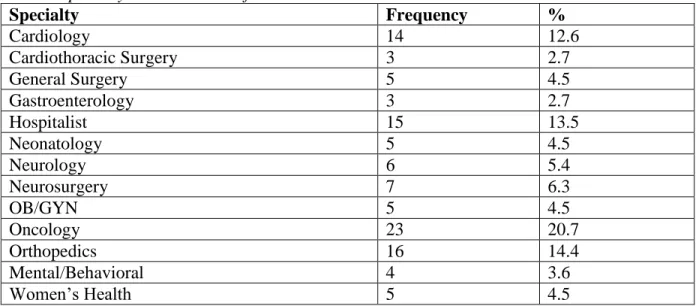
reported age group was 26-49 (46%). Sixty-one percent of respondents had less than 10 years of experience. The top four reported specialties were Oncology (21%; see Table 2), Orthopedics (14%), Hospitalist (14%), and Cardiology (13%). The respondents reported sixty different committee memberships (see Appendix 1), ten different board certifications, and eighteen professional certifications (see Appendix 2).
APP Practice Patterns
The most frequently reported primary scope of practice wasdiagnosis and management of acute and chronic conditions (86%; see Table 1). Over half of the respondents described their practice setting as being ambulatory (62%) or inpatient (53%) and they reported spending more than 7 hours of their day providing direct patient care (70%). Almost half (48%) reported taking call: pager call (52%), surgical call (9%). Weekend coverage in addition to weekday hours was reported by a little over half (55%) of the respondents. The majority reported collaborating
EVALUATION OF APP SPECIALTY PRACTICE PATTERNS
9
physician on site greater than 50% of the time (62%) and had a collaborative team environment (88%). The group reported 76 different types of inpatient and outpatient procedures performed (see Appendix 3).
Care Delivery Models
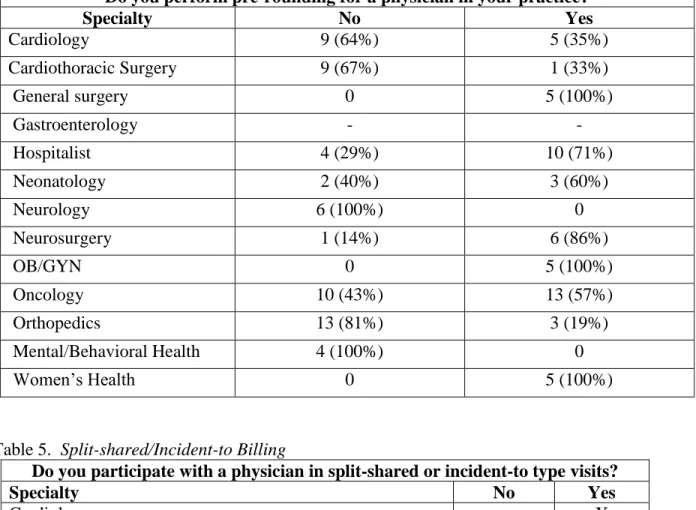
Group A- encompassed specialty practices where the APPs reported assisting physician partners with documentation less than 50% of the time and less than 50% in this group performed pre-rounding. APPs in this group did not did not participate in split-shared or incident-to billing. The following specialty practices exhibiting these specific
characteristics were placed into Group A: Mental/Behavioral Health
Cardiothoracic Surgery Neurology
Group B- encompassed specialty practices where the APPs varied their responses regarding time assisting physician partner with documentation reporting either more or less than 50% of the time. Also, greater or fewer than 50% in each practice reported engaging in pre-rounding. APPs in these practices participated in both split-shared and incident-to billing. The following specialty practices exhibiting these characteristics were placed into Group B:
Obstetrics and Gynecology (OB/GYN) General Surgery
Orthopedics Cardiology
EVALUATION OF APP SPECIALTY PRACTICE PATTERNS
10
Group C- encompassed specialty practices where the APPs reported assisting a
physician partner with their documentation more than 50% of the time and greater than 50% reported performing pre-rounding. More than 50% of the APPs in the specialty participated in both split-shared and incident-to billing. The following practices were defined exhibited these characteristics and were placed into Group C:
Gastroenterology Hospitalist Oncology Neonatology Neurosurgery Women’s Health
A chi square test of association validated the grouping (see Table 6).
Quality/Productivity/Engagement
Patient satisfaction, provider engagement, practice productivity, and practice readmission rates were compared between Group A, Group B, and Group C (see Table 7). There was no statistical significance noted between the groups. There is practical significance in the years of practice experience and the lack of standardized practice patterns.
Discussion APP Characteristics
The review of the demographic characteristics of the specialty practice APPs has allowed for a better understanding of the population of providers and opportunities for strategic planning around onboarding, development of competencies, continuing education, growth, and
EVALUATION OF APP SPECIALTY PRACTICE PATTERNS
11
age of the national NP population as being 48. This identifies the population at Norton
Healthcare as young. Of those in the study 40% have practiced five years or less. With a young provider group an opportunity emerges for the development of continuing education programs to strengthen the knowledge of the advancing provider. A mentorship program would also benefit the new provider as he/she moves from novice to expert. A study performed by Doerksen (2011) recommended a mentorship program that continues throughout one’s career and changes focus as needs change.
A robust list of board certifications and professional certifications identifies a group of advanced practice who have enhanced their knowledge through continued education. The strength of this group of providers is evidenced by the procedures they perform and the certifications they have obtained. The procedure and certification lists highlight areas of
additional training that could be incorporated within an onboarding program. The list of reported procedures will help to build a competency component to an onboarding program as well as catalogue procedures being performed for credentialing purposes.
APP Practice Patterns
The evaluation of the practice patterns of the APPs in specialty practice included
extended hours coverage, call coverage, weekend coverage, in both the ambulatory and inpatient environments. Understanding the work being performed after hours will assist with efforts to align compensation with volume of work performed. The majority listed their scope of practice as diagnosing and managing both acute and chronic conditions in a team environment. The utilization of advanced practice in management of chronic and acute conditions in a team
EVALUATION OF APP SPECIALTY PRACTICE PATTERNS
12
The advanced practice professional is educated and trained to manage patients in the specialty environment as a part of the interprofessional team.
APP Care Delivery Models
Three models emerged regarding relationship between physician and APP in the practice environment. The three models grouped level of attachment to physician through documentation and billing. The variability between the groups was noted. This identified an absence of
standardization of practice. The study identified redundancy of work around documentation. This may be by design for efficiency of the medical practice, but in return complicates the ability to track work performed by the APP. Use of an APP to document or pre-round for another provider is not an example of utilizing the APP at the top of license.
Quality/Productivity/Engagement
It can be difficult to measure quality and productivity of an APP who practices as a part of an interprofessional team in a specialty environment. Participation in an interprofessional team as opposed to having a primary panel of patients presents difficulty when analyzing quality and productivity of an APPs practice. The quality and productivity of the work is attributed to the billing physician. This adds complexity when trying to measure the value of an APP. A culture that supports top of license practice ensures maximum utilization of an APP despite not having a value metric for non-revenue generating work. In addition to top of license practice, the development of an attribution code for the APP that participates in a visit that is billed under the physician would help measure value.
Limitations
Although the research accomplished the objectives described, several limitations were identified. The response rate of the survey was 123 (66% response rate). The data was collected
EVALUATION OF APP SPECIALTY PRACTICE PATTERNS
13
from only one system which may limit the impact of the study due to the unique utilization of APPs in this system. The survey tool used was not validated. Responder bias is another potential limitation of a voluntary self-reported survey. Patient satisfaction was tied to the physician not the APP; thus this did not represent the true patient satisfaction of the total care delivered. This study included all non-primary care practices which was broad. Comparing surgical practices to ambulatory practices limited the ability to identify practice pattern trends.
In addition, the study participants were all practicing in the state of Kentucky and state regulatory bodies determine scope of practice which affects practice patterns. An additional limitation regarding the sample group was that advanced practice included both PAs and NPs. Not only does training differ between these two groups but state scope of practice varies.
Recommendation for Future Studies
Following an assessment of current state, future studies should focus on detailed analysis within the specialties. A comparison of PA and NP practice could provide useful data regarding variation in practice patterns between the two groups. As the DNP population grows there is opportunity to study the impact of the doctorate prepared NP compared to the master’s prepared NP. A comparison of APP utilization in specific surgical practices could identify the impact of APPs on quality, efficiency, and practice productivity. The practice productivity data identified several disease specific NP only practices. A value analysis of independent NP clinics may identify an opportunity to replicate such practice models. Evaluation of interprofessional models between groups, as well as, the cultural acceptance of APPs in specialty practices would help to further identify the role of the APP in specialty practices and perhaps provide opportunity for further role enhancement and expansion.
EVALUATION OF APP SPECIALTY PRACTICE PATTERNS
14
Conclusion
The opportunity to evaluate current state of specialty practice APPs in a medical group helped to identify current characteristics, practice patterns, and relationship with physician partners in practice. The specialty APPs are a diverse group that perform procedures, are board certified, have continued their education through additional certifications, and provide after-hours care in various settings. The opportunity for onboarding and mentorship programs was identified which would strengthen the performance of the APP at all stages of his/her career. Three groups emerged related to relationship of APP to physician partner as it pertained to billing, documentation, and pre-rounding. There was no difference between the three groups in terms of provider outcomes: quality, productivity, provider engagement and patient satisfaction. The opportunity to standardize practice and to develop a tracking method for work performed by the APP during a shared visit was noted. The literature supports the utilization of APPs in specialty practices to strengthen the interprofessional team and expand access. The development of a value metric for APP practice is essential to the specialty practice model. A value metric for shared visits or non-revenue generating work would allow for tracking of productivity, alignment of incentive plans, and data guided provider ratios.
EVALUATION OF APP SPECIALTY PRACTICE PATTERNS
15
References
American Association of Nurse Practitioners (AANP). NP Fact Sheet. Retrieved from https://www.aanp.org/all-about-nps/np-fact-sheet. Accessed April 7, 2018.
Adams, M., Garner, G., & Yates, P. (2016). Investigation nurse practitioners in the private sector: a theoretically informed research protocol. Journal of Clinical Nursing. 26, 1608-1620.
American Academy of Physician Assistants. (2017). https://www.aapa.org/about/history/. Accessed June 27, 2017. Bureau of Labor Statistics, United States Department of Labor. Occupational Employment
Statistics. (2016). https://www.bls.gov/oes/current/oes291171.htm. Accessed July 1, 2017.
Colvin, L., Cartwright, A., Collop, N., Freeman, N., McLeon, D., Weaver, T., & Rogers, A., (2014). Advanced Practice Registered Nurses and Physician Assistants in Sleep Centers and Clinics: A survey of Current Roles and Educational Background. Journal of Clinical Sleep Medicine, 10(5), 581-587.
Doerksen, K. (2011). What are the professional development and mentorship needs of advanced practice nurses? Journal of Professional Nursing, 26(3), 141-151.
Fairman, J. A., (2010). The Evolution and Future of Advanced Practice. 5th ed. New York: Springer, 3-14.
Harris, P., Taylor, R., Payne, J., Gonzalez, N., Conde, J. (2009). Research electronic data capture (REDCap)- A metadata-driven methodology and workflow process for providing translational research informatics support. J Biomed Inform, 2:377-81.
EVALUATION OF APP SPECIALTY PRACTICE PATTERNS
16
Hinkel, J.M., Vandergrift, J.L., Perkel, S.J., Waldinger, M.B., Levy, W., & Stewart, M., (2010). Practice and Productivity of Physician Assistants and Nurse Practitioners in Outpatient Oncology Clinics at National Comprehensive Cancer Network Institutions. Journal of Oncology Practice, 6(5), 182-187.
Institute of Medicine. (2011). The future of nursing: Leading change, advancing health.
Washington, DC; The National Academies Press. Retrieved from http://www.thefutureofnursing.org/IOM-Report.
Litaker, D., Mion, L., Planavsky, L., Kippes, C., Mehta, N., & Frolkis, J. (2003). Physician-nurse practitioner teams in chronic disease management: the impact on costs, clinical
effectiveness, and patients’ perception of care. Journal of Interprofessional Care, 17(3), 223-237.
MGMA, (2014). NPP utilization in the future of US healthcare. An MGMA Research and Analysis Report.
https://www.mgma.com/Libraries/Assets/Practice%20Resources/NPPsFutureHealthcare-final.pdf. Accessed June 20, 2017.
O’Hare, S. (2010). Mid-Level providers in a changing healthcare workforce. August 17, 2010. http://www.beckershospitalreview.com/compensation-issues/mid-level-providers-in-a-changing-healthcare-workforce.html. Accessed June 27, 2017.
Quallich, S. A. (2011). A Survey Evaluating the Current Role of the Nurse Practitioner in Urology. Urologic Nursing, 31(6), 328-336.
EVALUATION OF APP SPECIALTY PRACTICE PATTERNS
17
Sangster-Gormley, E., Martn-Misner, R. , Downe-Wamboldt, B., & DiCenso, A. (2011). Factors affecting nurse practitioner role implementation in Canadian practice settings: an
EVALUATION OF APP SPECIALTY PRACTICE PATTERNS
18 Table 1. APP Characteristics (n=123)
Gender Female Male Transgender 110 (89.4%) 12 (9.8%) 1 (0.8%) Age No response 26-39 40-49 50-59 60-64 18 (5.6%) 57 (46.3%) 29 (23.5%) 15 (12.1%) 4 (3.2%) Race Asian
Black or African American White or Caucasian
Hispanic
Native Hawaiian or Pacific Islander More than one race
2 (1.6%) 2 (1.6%) 111 (91%) 3 (2.5%) 1 (0.8%) 3 (2.5%)
Highest Level of Education Bachelors Masters Doctorate 3 (2.4%) 110 (89.4%) 10 (8.1%) Provider type: PA APRN Other 28 (22.8%) 94 (76.4%) 1 (0.8%)
Primary Scope of Practice
Diagnosis and Management of Acute Conditions Diagnosis and Management of Chronic Conditions Diagnosis and Management of Acute/Chronic Conditions
12 (10.7%) 4 (3.3)% 105 (86.1%) Practice Setting Ambulatory Inpatient
Subacute/long term care facility Telehealth Other 76 (62.3%) 64 (52.5%) 3 (2.5%) 1 (0.8%) 16 (13.1%)
Number of years as provider
Missing 1-5 years 6-10 years 11-15 years 16-20 years 21-25 years 26-30 years 10 (8.1%) 49 (39.8%) 27 (21.9%) 16 (13%) 11 (8.9%) 5 (4.1%) 2 (1.6%) Specialty Missing 12 (9.7%)
EVALUATION OF APP SPECIALTY PRACTICE PATTERNS 19 Cardiology Cardiothoracic Surgery General Surgery Gastroenterology Hospitalist Neonatology Neurology Neurosurgery OB/GYN Oncology Orthopedics Mental/Behavioral Health Women’s Health 14 (12.6% 3 (2.7%) 5 (4.5%) 3 (2.7%) 15 (13.5%) 5 (4.5%) 6 (5.4%) 7 (6.3%) 5 (4.5%) 23 (20.7%) 16 (14.4%) 4 (3.6%) 5 (4.5%)
Hours per day direct patient care 0-3 4-6 7-8 9-10 >11 3 (2.5%) 33 (27.0%) 57 (46.7%) 17 (13.9%) 12 (9.8%)
Hours per day on administrative task (computer) 0-2 3-4 5-6 7-8 >8 52 (42.3%) 43 (35%) 15 (12.2%) 5 (4.1%) 8 (6.5%) Average Call (n=59) Pager Call Surgery Call 64 (52%) 5 (8.5%)
Weekend Coverage in addition to M-F (n=118) No
Yes
53 (44.9%) 65 (55%)
Collaborating Physician on site (n=122)
<25% 26-50% 51%-75% >76% 35 (28.7%) 12 (9.8%) 23 (18.9%) 52 (42.6%) Working Environment (n= 121) Collaborative Team Environment Individual Environment
106 (87.6%) 15 (12.4%)
APP Included in Group Meeting (n=120) Yes
No
60 (50%) 60 (50%)
EVALUATION OF APP SPECIALTY PRACTICE PATTERNS
20 Table 2. Specialty Practices Identified
Specialty Frequency % Cardiology 14 12.6 Cardiothoracic Surgery 3 2.7 General Surgery 5 4.5 Gastroenterology 3 2.7 Hospitalist 15 13.5 Neonatology 5 4.5 Neurology 6 5.4 Neurosurgery 7 6.3 OB/GYN 5 4.5 Oncology 23 20.7 Orthopedics 16 14.4 Mental/Behavioral 4 3.6 Women’s Health 5 4.5
Table 3. Physician Documentation
What percentage of the time do you assist a MD partner with their documentation?
Specialty 0% 1%-25% 51%-75% 76%-100% Cardiology 35% 50% 7% 7% Cardiothoracic Surgery 67% 33% 0% 0% General Surgery 40% 40% 0% 20% Gastroenterology 0% 0% 0% 100% Hospitalist 7% 36% 36% 21% Neonatology 20% 60% 0 20% Neurology 100% 0 0 0 Neurosurgery 0 14% 43% 43% OB/GYN 80% 0 0 20% Oncology 9 64% 14% 14% Orthopedics 31% 44% 25% 0 Mental/Behavioral 100% 0 0 0 Women’s Health 50% 25% 25% 0
EVALUATION OF APP SPECIALTY PRACTICE PATTERNS
21 Table 4. Pre-rounding
Do you perform pre-rounding for a physician in your practice?
Specialty No Yes Cardiology 9 (64%) 5 (35%) Cardiothoracic Surgery 9 (67%) 1 (33%) General surgery 0 5 (100%) Gastroenterology - - Hospitalist 4 (29%) 10 (71%) Neonatology 2 (40%) 3 (60%) Neurology 6 (100%) 0 Neurosurgery 1 (14%) 6 (86%) OB/GYN 0 5 (100%) Oncology 10 (43%) 13 (57%) Orthopedics 13 (81%) 3 (19%) Mental/Behavioral Health 4 (100%) 0 Women’s Health 0 5 (100%)
Table 5. Split-shared/Incident-to Billing
Do you participate with a physician in split-shared or incident-to type visits?
Specialty No Yes Cardiology X Cardiothoracic Surgery X General surgery X Gastroenterology X Hospitalist X Neonatology X Neurology X Neurosurgery X OB/GYN X Oncology X Orthopedics X Mental/Behavioral Health X Women’s Health X
EVALUATION OF APP SPECIALTY PRACTICE PATTERNS
22 Table 6. Chi Square Test between groups
Group 1 % yes Group 2 % yes Group 3 % yes p Assist with Documentation 0 20.00 45.45 .001 Rounding 7.69 45.00 60.70 .002 Split Billing 53.8 60.00 82.76 .017
Table 7. APP Group Comparison and Quality/Productivity
Comparison Between Groups Group A (n=6 practices) Mean (SD) Group B (n=12 practices) Mean (SD) Group C (n=20 practices) Mean (SD) F (p) Productivity 41.44 (28.59) 29.96 (37.19) 37.74 (70.45) .170 (.845) Readmission rate 10.5 (3.31) 5.73 (4.61) 9.45 (5.97) 2.66 (.086) Patient satisfaction 74.05 (36.33) 86.97 (.937) 77.15 (26.78) 1.36 (.296) Engagement 26.7 49.02 (21.06) 37.42 (6.54) 1.03 (.403)
EVALUATION OF APP SPECIALTY PRACTICE PATTERNS
23 Appendix 1. Committee and Meeting Representation
Reported Committee /Meeting Representation
Bravehearts-Norton Children’s Foundation Norton Heart Specialists Group Meetings APP Quarterly Practice Meeting
Afib Meeting Afib Marketing NCI APP Meeting
Integrated Medicine Committee Hematology Meetings
Coding
Norton Neuroscience Institute Case Presentation and M&M Conference Norton Cancer Institute Central Nervous System (CNS) Oncology Research Subgroup committee member
University of Kentucky and Norton Healthcare Physician Assistant Advisory Committee Member
Norton Inpatient Care, Stroke M&M Fetal Boards MFM Provider Meeting Norton Inpatient Care Specialists
TOC (take over care) Meetings Maternal Boards
Norton Advanced Professional Practice Committee
Norton Children's Hospital Advanced Professional Practice Committee
Norton Children's Hospital Patent Safety Committee
Norton Children's Neonatology/University of Louisville Joint Venture Committee
NNI Friday morning conference NNI monthly stroke meetings Refractory epilepsy conference Patient care VAT
Neuroscience Case presentations Tumor Conference
System orthopedic steering committee Fracture fragility committee
Neuroradiology conference Clinical Leadership Council
System Medical Executive Committee Advanced Practice Provider Leadership Council
EPIC Optimization Committee-Norton Medical Group
Medication Management Committee Norton Medical Group
Provider Governance Board-Norton Medical Group
Norton Medical Group Clinical Administration Committee
Primary Care Leadership Council-Norton Medical Group
Norton Medical Group Analytics Team Advanced Practice Professionals Committee Product, Privileging, and Procedure
Committee-Norton Medical Group
Cardiology Advanced Practice Committee Opioid Task Force
Lung Cancer Screening/CT Screening Committee
Lung Cancer Alliance Advisory Board Bellarmine University, Lansing School of Nursing Advisory Board
Norton Healthcare Critical Care Committee Advanced Practice and Credentialing Committee
Fetal Board
Pelvic health Committee Spine conference
Total joint committee at NWC NWC ERAS committee
EVALUATION OF APP SPECIALTY PRACTICE PATTERNS
24 Appendix 2. APP Reported Certifications
Board Certifications Professional Certifications
Acute and Primary Care Nurse Practitioner-Dual Certified
Adult Nurse Practitioner-Board Certified Adult Gerontology Acute Care Nurse Practitioner-Board Certified
Family Nurse Practitioner-Board Certified Neonatal Nurse Practitioner-Board Certified Women’s Health Nurse Practitioner-Board Certified
Advanced Oncology Nurse Practitioner-Board Certified
Advanced Oncology Certified Nurse Specialist-Board Certified
National Commission on Certification of Physician Assistants-Board Certified
Psychiatric Mental Health Nurse Practitioner-Board Certified
Basic Life Support
Advanced Cardiac Life Support
Certified Neuroscience Registered Nurse Stroke Certified Registered Nurse
STABLE
Neonatal Resuscitation Program Certification Registered Nurse First Assist
Emergency Neurological Life Support Wound Care Certified Ostomy Management Specialist Certification
Department of Transportation Medical Examination Certification
Chemotherapy and Biotherapy Certification Collaborative Institutional Training Initiative (CITI) certified
NovoTTF-100A System (Novocure) Certified
Lactation Consultant
Society of Clinical Research Associates Certification
EVALUATION OF APP SPECIALTY PRACTICE PATTERNS
25 Appendix 3. APP Procedures Performed
Reported Procedures Performed
Intubation
Central Line Placement Arterial Line Placement Thoracentesis
Pacemaker Programming ICD Programming Chest tube Insertion Chemical Cardioversion Pace Termination Botox Injections Occipital Nerve Blocks SPG Nerve Blocks Pericranial Nerve Blocks Bone Marrow Biopsy Intrathecal Chemotherapy Orthopedic Mobilization Laceration Repair SUH Drainage
Irrigation and Debridement Wound Vac management Application of placental matrix Callous Parring Wound Closure Nail Removal Nailbed Repair Placement of Nexplanon Circumcision Lumbar Puncture Cast Application Splinting
EVD, subdural, lumbar drain maintenance VAD-tap
Pin Removal
Clubfoot Ponseti Casting Bladder Instillation
Neurostimulator Interrogation
Umbilical Line Placement Paracentesis
PICC Line Placement Frenotomy
Exchange Transfusion Intraosseous Insertion
Suprapubic bladder aspiration Ventricular Reservoir Tap Ligation of extra digits Pericardiocentesis Pericardial tap
UAC/UVC Placement PAL Placement
Trigger Point Injections
External Ventricular Drain Placement Lumbar Puncture Shunt Taps
Shunt patency test IUD insertion IUD removal Nexplanon Insertion Vulvar/Vaginal Biopsy Endometrial Biopsy EMB Colposcopy Ommaya-IT chemotherapy Intra-articular joint injections Intra-articular joint aspirations Carpal Tunnel Injections Tendon Sheath Injections CMC Injections
Ganglion cyst excisions
Fracture/Dislocation Reduction Endo Vein Harvesting
IABP-placement/removal Emergent Sternotomy (reopen) Saline Infused Sonohysterogram
EVALUATION OF APP SPECIALTY PRACTICE PATTERNS
26 Appendix 4. APP Specialty Practice Survey Codebook Variable /
Field Name
Field Label Field Note
Field Attributes (Field Type, Validation, Choices, Calculations, etc.)
Instrument:APP Specialty Practice Survey(app_specialty_practice_survey)
1 record_id Record ID text
2 gender Define your gender:
Select the response that best fits
radio
1 Female 2 Male
3 Transgender
Custom alignment: LV
3 age Document your age: text
Custom alignment: LV
4 race Which of the following best
describes your race: Select the response that best fits
radio
1 American Indian or Alaskan Native 2 Asian
3 Black or African American 4 Hispanic/Latino
5 Not Hispanic/Latino
6 Native Hawaiian or other Pacific Islander 7 White or Caucasian
8 More than one race 9 Prefer not to answer
Custom alignment: LV
5 educ Highest level of education
obtained:
Select the response that best fits
radio 1 Associate 2 Bachelors 3 Masters 4 Doctorate Custom alignment: LV
6 aprn_pa_status Are you: dropdown
1 PA 2 APRN
3 Not an APRN
Custom alignment: LV
7 years_as_provider List number of years as a
provider:
text
Custom alignment: LV
8 rn_years If an APRN, enter the
number of years as a practicing RN prior to becoming an APRN (if less than one year enter 0):
text
EVALUATION OF APP SPECIALTY PRACTICE PATTERNS
27
9 collaborating_yrs List number of years in
practice with collaborating or supervising MD:
text
Custom alignment: LV
10 certifications_obtained List any certifications
obtained
notes
Custom alignment: LV
11 specialty_practice List current specialty of
practice:
text
Custom alignment: LV
12 subspecialty List current subspecialty of
practice:
text
Custom alignment: LV
13 scope_of_practice Primary scope of practice:
Select the response that best fits
radio
1 Diagnosis and management of acute conditions
2 Diagnosis and management of chronic conditions
3 Diagnosis and management of both acute and chronic conditions
Custom alignment: LV
14 practice_setting What describes your
practice setting:
Please respond based upon your primary role in the previous 12 months at Norton Healthcare
checkbox
1 practice_setting___1 Ambulatory 2 practice_setting___2 Inpatient
3 practice_setting___3 Subacute/long term care 4 practice_setting___4 Telehealth
5 practice_setting___5 Other
Custom alignment: LV
15 prac_set_other If practice setting is other
please note:
text
Custom alignment: LV
16 clinical_practice_hours How many hours per day
do you spend in clinical practice providing direct patient care:
Please respond based upon your primary role in the previous 12 months at Norton Healthcare
radio 1 0-3 2 4-6 3 7-8 4 9-10 5 >11 Custom alignment: LV
17 admin_hrs How many hours per day
do you spend on
administrative tasks using a computer:
Please respond based upon your primary role in the previous 12 months at Norton Healthcare
radio 1 0-2 2 3-4 3 5-6 4 7-8 5 >8 Custom alignment: LV
18 avg_pts_day On average, how many
patients do you see per day:
text
EVALUATION OF APP SPECIALTY PRACTICE PATTERNS
28
Please respond based upon your primary role in the previous 12 months at Norton Healthcare
19 avg_comorbid Average number of
comorbidities in your patient panel:
Please respond based upon your primary role in the previous 12 months at Norton Healthcare
radio
1 0-2 2 3-5 3 >5
Custom alignment: LV
20 avg_call_days Average call responsibility
on a monthly basis (list the average number of days): Please respond based upon your primary role in the previous 12 months at Norton Healthcare
text
Custom alignment: LV
21 call_responsibility Call responsibility:
Please respond based upon your primary role in the previous 12 months at Norton Healthcare
radio
1 Pager call 2 Surgery call
Custom alignment: LV
22 after_hours_days Average days per month
working after hours: Please respond based upon your primary role in the previous 12 months at Norton Healthcare
text Custom alignment: LV 23 weekend_coverage_da ys Average weekend coverage responsibility on a monthly basis (days): Please respond based upon your primary role in the previous 12 months at Norton Healthcare
text
Custom alignment: LV
24 weekend_hours Average hours per day on
site during weekend: Please respond based upon your primary role in the previous 12 months at Norton Healthcare
radio 1 0-4 2 5-8 3 9-12 4 >12 Custom alignment: LV
25 time_collab_onsite On average, how much
time per day is your collaborating or
supervising physician on site:
Please respond based upon your primary role in the previous 12 months at Norton Healthcare
radio 1 < 25% 2 26%-50% 3 51%-75% 4 >76% Custom alignment: LV
26 prac_team_mem Practice location includes
the following team members (check all that apply): checkbox 1 prac_team_mem___1 Receptionist 2 prac_team_mem___2 MA 3 prac_team_mem___3 LPN 4 prac_team_mem___4 RN
EVALUATION OF APP SPECIALTY PRACTICE PATTERNS
29
Please respond based upon your primary role in the previous 12 months at Norton Healthcare
5 prac_team_mem___5 Triage RN
6 prac_team_mem___6 Diabetes Educator 7 prac_team_mem___7 Nurse Navigator 8 prac_team_mem___8 Social Worker 9 prac_team_mem___9 Pharmacist 10 prac_team_mem___10 Scheduler 11 prac_team_mem___11 Not Applicable
Custom alignment: LV
27 support_staff Support staff that are
assigned to you (check all that apply):
Please respond based upon your primary role in the previous 12 months at Norton Healthcare
checkbox
1 support_staff___1 MA 2 support_staff___2 RN
3 support_staff___3 Triage RN 4 support_staff___4 Nurse Navigator 5 support_staff___5 Not Applicable
Custom alignment: LV
28 presc_priv Do you have prescriptive
privileges:
yesno
1 Yes 0 No
Custom alignment: LV
29 presc_priv_schedule Do you have prescriptive
privileges for scheduled drugs:
yesno
1 Yes 0 No
Custom alignment: LV
30 assist_md_with_doc What percentage of time
do you assist a physician partner with their
documentation:
Please respond based upon your primary role in the previous 12 months at Norton Healthcare
radio 1 0% 2 1%-25% 3 51%-75% 4 76%-100% Custom alignment: LV
31 work_enviro Would you describe your
working environment with other providers in your practice as:
Please respond based upon your primary role in the previous 12 months at Norton Healthcare
radio
1 A collaborative team environment 2 An individual environment
Custom alignment: LV
32 pre_rounding Do you perform
pre-rounding for a physician in your practice:
Please respond based upon your primary role in the previous 12 months at Norton Healthcare
yesno
1 Yes 0 No
EVALUATION OF APP SPECIALTY PRACTICE PATTERNS
30
33 split_incident Do you participate with a
physician in:
Please respond based upon your primary role in the previous 12 months at Norton Healthcare
checkbox
1 split_incident___1 Split shared visits 2 split_incident___2 Incident to billing
Custom alignment: LV
34 num_of_phys How many physicians do
you directly work with on a daily basis:
Please respond based upon your primary role in the previous 12 months at Norton Healthcare
text
Custom alignment: LV
35 surgery Do you assist in surgery:
Please respond based upon your primary role in the previous 12 months at Norton Healthcare
yesno
1 Yes 0 No
Custom alignment: LV
36 procedures List any procedures you
perform: (Do not include procedures performed in the operating room) Please respond based upon your primary role in the previous 12 months at Norton Healthcare
notes
Custom alignment: LV
37 committees List any Norton Healthcare
committees/meetings you regularly attend:
Please respond based upon your primary role in the previous 12 months at Norton Healthcare
notes
Custom alignment: LV
38 prac_meet Are you included in the
regular practice meetings with the physicians in your practice:
Please respond based upon your primary role in the previous 12 months at Norton Healthcare
yesno
1 Yes 0 No
Custom alignment: LV
39 special_interest Please add any areas of
special interest or need regarding your practice that you would like to communicate:
notes
Custom alignment: LV
40 app_specialty_practice
_survey_complete
Section Header: Form Status Complete? dropdown 0 Incomplete 1 Unverified 2 Complete