Kinesiology, Health and Sport Studies College of Education
1-5-2017
Implementing Comprehensive School Physical
Activity Programs: A Wayne State University Case
Study
Erin E. Centeio
Wayne State University, [email protected]
Nate McCaughtry
Wayne State University, [email protected]
This Article is brought to you for free and open access by the College of Education at DigitalCommons@WayneState. It has been accepted for inclusion in Kinesiology, Health and Sport Studies by an authorized administrator of DigitalCommons@WayneState.
Recommended Citation
Erin E. Centeio & Nate McCaughtry (2017) Implementing Comprehensive School Physical Activity Programs: A Wayne State University Case Study, Journal of Physical Education, Recreation & Dance, 88:1, 42-49, DOI:10.1080/07303084.2017.1250536
Implementing Comprehensive School Physical Activity Programs: A
Wayne State University Case Study
Erin E. Centeioa and Nate Mc Caughtrya
Of course we are taking some liberties in saying this so succinctly but in our view the premise is simple: the more physical activity children get at school, the healthier they will be and the better they will learn. As a result, the notion of embedding more physical activity opportunities before, during and after school has gained a great deal of traction at many levels, from Michelle Obama’s Let’s Move, Active Schools campaign, to governmental agencies (e.g., U.S. Department of Education (Year), Centers for Disease Control and Prevention (year), Institute of Medicine, 2013), and the national physical education community through its premier professional association SHAPE America. However, the reality is that physical activity, more specifically physical education, has always been contested terrain in K-12 schools, evidenced by the wide literature documenting its various forms of historical marginalization, as well as its specious status as a non-core subject in most states’ education guidance. This means that although the premise that physical activity is good for children and that it will facilitate greater health and learning seems simple, it also means a sea-change in the way schools view physical activity, how they operate as a system, and how we as teacher educators can help to re-train current practitioners and also train the next generation of teachers to play a leadership role in rebranding physical activity in schools. This paper focuses on our efforts at Wayne State University to re-invent our physical education teacher education program, at least partly to prepare physical educators who have the knowledge and skills to lead school-wide physical activity when they graduate. We start by explaining the structural re-development of our program, and then move to specific mechanisms built throughout the curriculum (coursework, research engagement, leadership training) that collectively prepare future teachers to participate and lead a new approach to school physical activity.
Overview of PETE Program and Where CSPAP is Situated
In 2014, after several years of planning and development, our program changed its name from Physical Education Pedagogy to Physical Education and Physical Activity Leadership (PE-PAL). This change was made to make our program more marketable to students as well as to better align with national recommendations centered around implementing whole-of-school approaches. Our revised program mission became, “to prepare professionals to design, teach, lead and promote physical activity programs across the lifespan and in a range of school and community settings.” There are a couple of key ideas embedded in this new mission statement that now drives our program. First, of course historically physical educators have always been trained to design and teach physical activity with children. We intentionally added the skills of “lead” and “promote” to signify that our intent is not only train practitioners, but also leaders of physical activity (e.g., budgeting skills, scheduling, staff managements), and also professionals who can advocate, negotiate, and market physical activity. Second, we adopted a lifespan approach where our students learn to lead physical activity programs for a range of populations, from early childhood, to K-12 children, to middle-age adults, all the way to seniors. While we acknowledge that the majority of our graduates will likely continue to become K-12 physical educators, we view our role in the university and the preparation of future professionals more widely. Last, in keeping with this theme of wider preparation, we have moved beyond the strict preparation of K-12 school physical educators, to training what we think of as “physical activity educators.” Again, we know that many of our students will eventually become school teachers; however, the physical activity industry has been rapidly expanding for quite some time and we believe that physical educators ought to be the specialists who lead programming regardless of
the venue, whether it be at day care facilities, parks and recreation departments, boys and girls clubs, schools, fitness facilities, or senior living communities.
Conceptually, our program now has three levels that build upon the general education courses students are required to take. In level one, students take initial instructional strategies courses to ground them in the principles of physical activity instruction, exercise science courses (e.g., anatomy and physiology, motor learning, etc.), and courses to help them understand health and communities more broadly. In level two, students take a series of courses in a wide range of physical activities that blend physical activity content with teaching methods with a lifespan approach. During this time, students also take specialized courses in physical activity for individuals with disabilities, socio-cultural issues, and physical activity technology and assessment. Last, in level three, students complete either a traditional student teaching experience or internship with a physical activity organization, as well as go through the Let’s Move! Active Schools (LMAS) Physical Activity Leader (PAL) training. Again, the big ideas that cut across these levels include preparing physical activity teachers to design, teach, lead, and promote physical activity programs that offer a wide range of physical activity content across the lifespan and in a range of school and community contexts. For our students who anticipate working in schools, this also means helping them develop the skills to be more than traditional “gym” teachers, but instead to see themselves as school-wide leaders of physical activity, where teaching physical education classes is simply one of a number of their professional responsibilities.
Skills/Understandings/Dispositions
Although our program prepares educators to lead physical activity programs across the lifespan and in a range of organizational contexts, one of our foremost focus is on training school physical educators who can spearhead Comprehensive School Physical Activity Programs (CSPAPs). For us, that means embedding five core themes across our program: 1) content diversity, 2) physical activity promotion, 3) policy advocacy and development, 4) physical activity assessment, and 5) cultural relevance. These five themes cut across the three levels of our PE-PAL program. Classes in levels one and two cover themes 1-5, while student teaching during level three of the program focuses on themes 1, 2, 4, and 5.
Content Diversity
It is important that our students learn to teach a wide range of content if they are going to be relevant and effective educators in a wide range of contexts and with a wide range of individuals. Throughout our program we stress the importance of learning to teach a broad range of curriculum content such as outdoor adventure pursuits (e.g., team building games, rock climbing, rope/challenge courses, adventure racing, etc.), and conventional sports from across the game categories (e.g., net/wall, field, target, invasion). Although WSU has always included fitness in the curricular content, within the new program a Fitness Instruction class was designed to focus on teaching group fitness. Students are exposed to the content of the course (e.g., yoga, pilates, kickboxing, boot camp, swimming, etc.) and then ask to observe these type of lifetime activities both in and out of the physical education classroom. One of the changes that was made in conjunction with re-branding the PE-PAL program was broadening the range of content to include teaching and observing physical activity opportunities outside of a traditional physical
education classroom. Students learn to differentiate their instruction by being exposed to physical activity in different delivery locations (schools’ vs various community organizations) as well as to different age/ability levels (e.g., elementary school children versus mobility restricted adults). By preparing our students to teach in a variety of school and community based settings, it allows them to differentiate the type of pedagogy across settings. For example, an afterschool club will look very different from teaching physical education because the physical education lesson is based on the National Physical Education standards where as an afterschool program is focused on getting children moving, having fun, and maximizing MVPA. Regarding CSPAP leadership, the ability to teach a diverse range of content combined with the skill to differentiate instruction means that our future physical educators will be able to plan and deliver attractive and engaging physical activity opportunities before, during and after school, and also in schools irrespective of configuration and location.
Physical Activity Promotion
Learning the importance of promoting a physical activity program both within the school setting and beyond is imperative for our students. It is not enough to simply think that those who make decisions in schools will automatically understand and appreciate the importance of physical activity in schools. We force our students to think about their various audiences (stakeholders) first, and then decide the best method for promoting their programs. Students gain the skills to use research literature, persuasion, technology and social media to be effective communicators with different stakeholder groups. This takes place within various courses that are offered throughout or program, including Fitness Instruction, Sociocultural Issues in Physical Activity, and Assessment and Technology in Physical Education. Students participate in various
assignments (See Table 1) that focus on promoting physical activity before, during, and after school.
Physical Activity Assessment
Our students learn that assessment of outcomes is essential to incorporating CSPAP into schools because data must drive decision making and without assessment and the documentation of various levels of outcomes teachers are unable to effectively promote, market, and advocate for their programs. During the Technology and Assessment in Physical Activity course, our students learn to conduct physical activity assessments such as the School Wellness Investigation, Healthy School Action Tool, Physical Education Curriculum and Assessment Tool, and the Let’s Move! Active Schools physical activity assessment. Understanding how to perform assessment as well as how to use the results to enhance existing programs, develop new ones, and promote a physical activity rich school environment is essential for our future graduates (Table 1).
Policy Advocacy and Development
Understanding how to develop, recommend and negotiate physical activity friendly environmental policies is an essential skill to have for a student leaving our program. They are introduced to concepts like School Health Advisory Committees (SHAC), local/school wellness policies, and school wellness investigations (Fuel up to Play 60) and are taught how to operate within and lead teams aimed at creating policy change. Our intent is to have our future teachers engage in effectively structuring the environmental norms, practices, and procedures at the schools where they will eventually teach. Although currently policy advocacy is only taught through class lectures, activities, and discussions our hope for the future is to allow our
pre-service teachers to work with cooperating teachers to conduct physical activity assessments (as mentioned above) and then help advocate for new policies surrounding physical activity in the school setting.
Cultural Relevance
Last, it is important for our future physical activity leaders to understand the cultural context of learning physical activity across multiple, intersecting social categories (e.g. gender, sexuality, race, poverty, and obesity). Being culturally competent physical activity leaders and applying cultural relevance within teaching is the only way to achieve equity in physical activity settings. Our students learn to implement the 3-stage cultural relevance cycle described by Flory and McCaughtry (2011) where they (a) seek to understand the communities (e.g., neighborhoods, schools, families, students) where they will teach, (b) interrogate their own cultural backgrounds and objectives as teachers, and whether cultural distance might, and (c) develop and implement strategies to bridge cultural distance between their perspectives and the communities where they will teach. The emphasis on cultural relevance begins with providing placements for observations and practical teaching experiences that are diverse in nature. Students begin to understand how physical activity and physical education settings are different in urban and suburban communities as well as across multiple physical activity facilities (e.g. YMCA, Fitness Centers, etc). During level two of the WSU PE-PAL program students participate in a socio-cultural physical activity class that discusses cultural competence and socio-cultural issues in depth. When re-conceptualizing the PE-PAL program this class changed from a strictly “physical education” class to discussing sociocultural issues across physical activity settings. Through reading and thoughtful reflection, as well as through observations, students begin to recognize
that cultural competence is important in their own lives as well as the lives of their students and youth participants (see Table 1.)
Learning Experiences
The Wayne State University Center for School Health has a unique partnership with Blue Cross Blue Shield of Michigan, the Michigan Fitness Foundation, the United Dairy Industry of Michigan, and the Michigan Department of Health and Human Services to enact a healthy school transformation program called Building Healthy Communities (BHC) in elementary schools across Michigan. BHC is a six component model that focuses on integrating healthy eating and physical activity throughout the school day (see Figure 1). The six component model (i.e. Principal engagement, classroom education on nutrition and physical activity, quality physical education, active recess, and healthy kids club) provides schools with the resources, professional development and technical support to enact physical activity and healthy eating opportunities and education throughout the school day (Centeio, et al. 2014; Garn, et al. in press; Gutuskey et al. 2014; Kulik, et al. 2015; Shen, et al. in press). The BHC program allows a unique opportunity for all of our students to experience CSPAP in action and they are involved at a variety of different levels. For example, students help run the afterschool Healthy Kids Clubs (Figures 2 & 3) as well as work with BHC schools to perform LMAS physical activity assessments. This not only helps local teachers become aware of LMAS and national initiatives to include physical activity beyond the physical education classroom, but it also gives students the experience of conducting school-wide assessments. PhD students at Wayne State also help to coordinate the entire BHC program at one or more schools, and also in some cases serve as research and data managers where they
learn how to collect sound data on CSPAP components, and are involved in developing and writing publications about the BHC program.
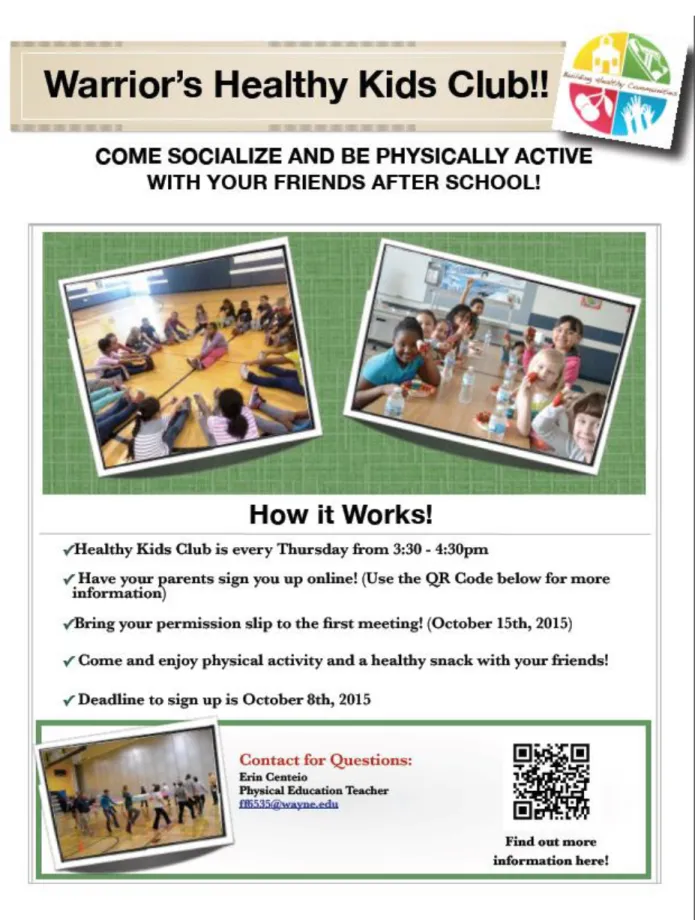
In addition to the above experiences through our signature program, BHC, students have many more opportunities throughout their coursework to prepare to be physical activity educators (see Table 1). For example, students are asked to create a physical activity promotional flyer for a CSPAP opportunity that they might offer as a future PE teacher (Figure 4). The students use technology to design a flyer that is: designed for a specific stakeholder, appealing to the given audience, and uses a QR code to further promote their “product”. Another example takes place within our socio-cultural issues course where students are asked to look at every socio-cultural issue discussed in class (e.g. race, gender, poverty, sexuality, obesity, etc.) in relation to both the physical education environment and beyond. Students discuss how to make physical activity programming culturally relevant and appealing to all students. Finally, at the end of this class students discuss the marginalization of the physical education profession. During this lesson, advocacy is discussed in relation to stakeholders within the school and community. The lesson culminates with students brainstorming a performing a stairwell speech with an “ask” that focuses on additional opportunities for physical activity.
Training and Certifications
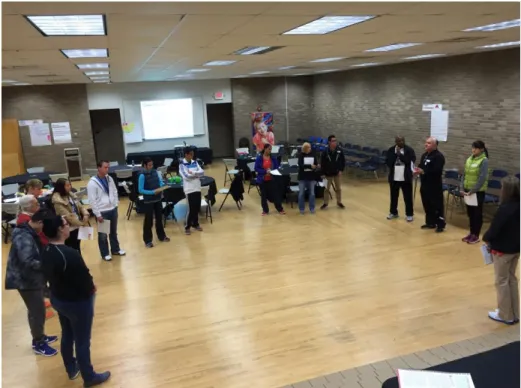
As a culminating event to the Wayne State University PE-PAL program, all of our pre-service teachers are required to participate in a PAL training put on by LMAS (Figure 5). Wayne State hosts a training and invites current student teachers and their cooperating teachers. The training is also open to all past BHC grant schools as well as cooperating teachers for observation sites. As part of the PAL training, students are able to get an in depth understanding of CSPAP
and practicing teachers are able to earn SCECHS (i.e. continuing education credits) for their professional development.
Research Initiatives
Through partnerships such as the Building Healthy Communities program, the WSU Center for School research team is positioned to collect CSPAP and healthy school transformation data across schools in Michigan. This unique program emphasizes all five CSPAP components and allows for research to be conducted on how effective such programs are at increasing student physical activity across the school day as well as ultimately impacting health initiatives (e.g. 60 minutes a day of physical activity, decreasing obesity). The success of the Building Healthy Communities program has opened doors to new funding opportunities to understand the role of CSPAP in schools and this continues to be one of the research priorities within the WSU Center for School Health.
In addition to the funding opportunities surrounding CSPAP initiatives, WSU involves their PhD students, and some master students, in research efforts surrounding program implementation and evaluation. Graduate students receive a hands-on experience through implementing the program, collecting sound data, data entry, data analyzation, and distributing information through publications. The intent of involving graduate students at every step of the process is so that they authentically experience how to plan, implement, and evaluate CSPAP programs in entirety.
Strategies and Future Efforts
Preparing pre-service teachers to view their responsibility in the school building to move beyond the physical education classroom is important. By preparing physical activity educators
at Wayne State we set a precedent that this is part of their job description when they move into the k-12 school setting. Providing a wide-variety of experiences that focus not only on providing quality physical education experiences, but also that focus on encouraging people to be physically active across their lifespan is important.
Partnering with community organizations and local businesses to implement CSPAP’s within the school setting has allowed the WSU PE-PAL program and the WSU Center for School Health to be successful in beginning to shift the culture of local schools to focus on physical activity and healthy eating. This process is only possible if you have community partnerships that are passionate about the health of children. The unique partnership of the Building Healthy Communities program has opened many doors in regards to teaching and scholarship for undergraduate and graduate students, as well as to the faculty at WSU. PETE programs should begin to look beyond the constraints of the University setting and embrace these community partnerships in order to provide learning opportunities for all.
References
Centeio, E.E., McCaughtry, N., Gutuskey, L., Garn, A., Somers, C., . . . & Kulik, N. (2014). Physical Activity Change through comprehensive school physical activity programs in urban elementary schools. Journal of Teaching in Physical Education, 33, 573-591.
Flory, S., & McCaughtry, N. (2011). Culturally relevant physical education in urban schools: Reflecting cultural knowledge. Research Quarterly for Exercise and Sport, 82(1), 49-60. Garn, A.C., Centeio, E, Martin, J., Shen, B., & McCaughtry, N. (in press). A moderated-mediation
of children’s physical activity enjoyment. Journal of Positive Psychology.
Gutuskey, L., McCaughtry, N., Shen, B., Centeio, E., & Garn, A. (2016). The Role and Impact of Student Leadership on Participants in a Healthy Eating and Physical Activity Programme. Health Education Journal, 75, 27-37, DOI: 10.1177/0017896914561878.
Kulik, N., Somers, C., Thomas, E., Martin, J., Centeio, E., . . . & McCaughtry, N. (2015). Source and Type of Support for In-School Physical Activity: Differential Patterns for
Demographic Subgroups. American Journal of Health Education, 46(5), 301-309. Shen, B., Centeio, E., Garn, A., Martin, J., Kulik, N., . . . & McCaughtry, N. (accepted). Parental
social support, perceived competence and enjoyment in school physical activity. Physical Education & Sport Pedagogy.
Table 1. How WSU’s PE-PAL Program Implements CSPAP Across the Curriculum
Quality Physical Education Physical Activity During the School Day
Physical Activity Before and After
School Family and Community Engagement Staff Involvement Classes Across the PE-PAL Program and How they Address the Five Components of CSPAP
Effective Teaching and Instructional Practices
This class introduces the CSPAP model to students and begins to enhance their knowledge about CPSAP and Let’s Move Active Schools. It is here that we talk about how important it is to offer physical activity beyond the PE classroom. We discuss the role of the PE teacher within the school setting and how important it is to build a team to help create a culture of physical activity within the school building as well as how to build relationships with students so that they may embrace this culture as well. Role-modeling is also discussed during this lesson and how staff engaging with students in CSPAP opportunities and setting examples for them can lead to buy-in from students. In addition to one lecture that is designated for the introduction to CSPAP, students are asked to complete an assignment where they interview a current PE teacher who enacts some portion of a CSPAP. The interview is focused on how they started their “program” and why they decided to move what they do outside of the PE classroom. The students then reflect on the interview that they conduct and talk about how they might incorporate a CSPAP once they become a PE teacher in the school setting.
(Six PE-PAL classes) Movement Education; Sports I: Sports II; Adventure and Outdoor Pursuits; Aquatic Leadership
These classes are designed to improve instruction of quality physical education by demonstrating instructional models, providing examples and explanations of best teaching practices, having students practice teach in a variety of settings and situations, teaching reflect practices, among many other elements of instructing quality physical education.
Fitness Instruction During our Fitness Instruction class, students are asked to teach fitness activities within local afterschool programs. As part of the Wayne State Center for School Health, the Building Healthy Communities program implements CSPAPs into 40 local
elementary schools each year. As part of the grant requirement schools are asked to offer 30 afterschool physical activity sessions for their students. Our pre-service teachers get a great experience teaching children fitness through these programs, but also are able to experience CPSAP in action.
(Three PE-PAL courses) Adapted Physical Activity; Disability and Sport; Materials and Methods of Adapted Aquatics
In partnership with the WSU PE/PAL program, our Adapted Physical Education classes team up with Athletes With Autism (AWA; i.e. a local non-profit organization) and offer additional physical activity opportunities once a week for the entire school year. Children are able to come from the greater metropolitan area and participate in a two-hour program where they are led through different sport experiences. They receive individual plans for participation and one on one attention with our pre-service teachers. This family and community engagement is great as the pre-service teachers get to experience first hand what a community program looks like, as well as get experience interacting with the parents and the local teachers that are involved.
Technology and Assessment in Physical Activity
There are two main assignments with in the technology and assessment course that focus on CSPAP. First, students are familiarized with the LMAS assessment tool in class. They are then asked to pair up with a local school and physical education teacher who is not currently part of LMAS. The student then works with the physical education teacher to sign the school up for LMAS and conduct the LMAS physical activity school assessment. This not only helps local teachers become aware of LMAS and national initiatives to include physical activity beyond the physical education classroom, but it also gives students the experience of conducting a school-wide assessment so that they can be prepared to do so with their own school in the future. The second assignment that takes place in this class is a Physical Activity promotional flyer. Students are asked to design a flyer for a CSPAP opportunity that they might offer as a future PE teacher. The students use technology to design a catchy flyer, that is appealing to the audience, and uses a QR code to further promote their “product”.
Socio-cultural Issues in Physical Activity
Within the socio-cultural issues in physical activity course, lots of conversations occur about equity for all students in regards to physical activity. In this course, students participate in two different activities. First, students are asked to look at every socio-cultural issue discussed in class (e.g. race, gender, poverty, sexuality, obesity, etc.) in relation to the physical education environment, but also in regards to physical activity environments outside of physical education. The second assignment focuses on advocacy. As part of the class, students discuss the marginalization of the physical education profession. During this lesson, advocacy is discussed in relation to stakeholders within the school and community. The lesson culminates with students brainstorming a performing a stairwell speech with an “ask” that focuses on additional opportunities for physical activity.
Health and Physical Education for the Elementary School Teacher (Not a PE-PAL
course but related to teaching CSPAP within the WSU program)
Elementary classroom teachers take a class that now advocates for the importance of CSPAP within the school setting. Students gain initial knowledge of CSPAP components through a class lecture/discussion. Through assignments such as providing brain boosters for peers during class, as well as incorporating movement integration into daily lesson plans pre-service
classroom teachers learn how to incorporate the culture of physical activity throughout the school day.
Figure 1.
Note. Building Healthy Communities is a partnership between Wayne State University, Blue Cross Blue Shield of Michigan, Michigan Fitness Foundation, United Dairy Industry of Michigan, and The University of Michigan.
Figure 5. Physical Activity Leader (PAL) Training