Cognitive Processes in Associative and Categorical Priming: A Diffusion Model Analysis
Andreas Voss1, Klaus Rothermund2, Anne Gast3, Dirk Wentura4
1 Ruprecht-Karls-Universität Heidelberg 2 Friedrich-Schiller-Universität Jena 3 Ghent University 4
Universität des Saarlands, Saarbrücken
WORD COUNT: 16.154
Author Note
Andreas Voss, Psychologisches Institut, Ruprecht-Karls-Universität Heidelberg, Heidelberg, Germany; Klaus Rothermund, Friedrich-Schiller-Universität Jena, Jena, Germany; Anne Gast, Department of Experimental Clinical and Health Psychology, Ghent University, Ghent, Belgium, Dirk Wentura, Universität des Saarlands, Saarbrücken, Germany.
Correspondence concerning this article should be addressed to Andreas Voss, Psychologisches Institut, Ruprecht-Karls-Universität Heidelberg, Hauptstrasse 47-51, D-69117 Heidelberg, Germany (email: [email protected]), or to Klaus Rothermund, Friedrich-Schiller-Universität Jena, Institut für Psychologie, Lehrstuhl für Allgemeine Psychologie II, Am Steiger 3, Haus 1, D-07743 Jena, Germany (email:
Abstract
Cognitive processes and mechanisms underlying different forms of priming were investigated using a diffusion model approach. In a series of six experiments, effects of prime-target associations and of a semantic and affective categorical match of prime and target were analyzed for different tasks. Significant associative and categorical priming effects were found in standard analyses of RTs and error frequencies. Results of diffusion model analyses revealed that priming effects of associated primes were mapped on the drift rate parameter (v), while priming effects of a categorical match on a task-relevant dimension were mapped on the extra-decisional parameters (t0 and d). These results support a spreading activation account of associative priming and an explanation of categorical priming in terms of response competition. Implications for the interpretation of priming effects and the use of priming paradigms in Cognitive Psychology and Social Cognition are discussed.
(141 Words)
KEYWORDS: Priming; Evaluation; Spreading Activation; Response Conflict; Diffusion Model; fast-dm
Cognitive Processes in Associative and Categorical Priming: A Diffusion Model Analysis
Sequential priming procedures play a major role in Cognitive Psychology and related disciplines. For example, priming techniques are used to assess associative structures in semantic memory (e.g., Collins & Loftus, 1975; Neely, 1977; Rosch, 1975), to analyze subliminal semantic processing (e.g., Draine & Greenwald, 1998; Klinger, Burton, & Pitts, 2000; Marcel, 1983), or to investigate the mental basis of attitudes, prejudice, and
stereotyping (Blair & Banaji, 1996; Fazio, Sanbonmatsu, Powell, & Kardes, 1986;
Wittenbrink, Judd, & Park, 1997, 2001a). With different sequential priming paradigms it has been shown that the processing of an irrelevant prime stimulus influences the processing of— or the responding to—a subsequently presented target stimulus. Typically, responses are faster and more accurate if prime and target are related.
Despite these similarities, there are also important differences between paradigms. First, relatedness of prime and target can be based on many dimensions, including semantic relatedness, associations, similarity, and others. We are primarily interested here in
associative and semantic relations between prime and target. Items are semantically related when they belong to the same category and thus share semantic properties (e.g., cat and cow are mammals) or when they are functionally related (e.g., broom and floor are related because brooms are used to sweep floors). Items are considered to be associated when a large
percentage of people give the target as the first word they think of in response to the prime (see Moss, Ostrin, Tyler, & Marslen-Wilson, 1995, for an elaborate discussion of the distinction between semantic and associative priming). In addition to the relatedness
dimension, priming paradigms differ in the type of task that is to be performed on the targets: Most paradigms use the lexical decision task (Meyer & Schvaneveldt, 1971; Neely, 1977; see also Gaertner & McLaughlin, 1983; Wentura, 2000; Wittenbrink et al., 1997, 2001a), naming or pronunciation tasks (Meyer, Schvaneveldt & Ruddy, 1974; see also Bargh, Chaiken,
Raymond, & Hymes, 1996; Hermans, De Houwer, & Eelen, 1994), semantic or affective categorization tasks (e.g., De Houwer, Hermans, Rothermund, & Wentura, 2002; Fazio et al., 1986; Klinger et al., 2000), and verification tasks (Collins & Quillian, 1969; Meyer, 1970; see also Dovidio, Evans, & Tyler, 1986).
A structural taxonomy
In this regard it is helpful to introduce a structural taxonomy of priming designs that distinguishes between semantic priming and response priming (see also Wentura & Degner, 2010). In semantic priming, the relationship of interest (e.g., whether prime and target are associatively related or not) is varied orthogonally to the response categories: For example, in a semantic priming design using the lexical decision task, targets that are preceded by
associatively related primes as well as targets that are preceded by unrelated primes require a word-response. By way of contrast, in response priming designs, primes are at the same time congruent or incongruent to the target and to the response that has to be given to the target. For example, in a typical response priming experiment using valent stimuli (i.e., affective priming), positive and negative target stimuli that have to be categorized according to their valence are preceded by positive or negative primes.
Accordingly, two dominant principles of explanation prevail: Effects in semantic priming designs are most often explained by a facilitation of target processing (see Spruyt, Hermans, De Houwer, & Eelen, 2002). For this kind of explanation, spreading activation in a semantic network is still a compelling metaphor (Collins & Loftus, 1975): The basic idea of the spreading activation account is that the processing of the prime stimulus activates its corresponding node in the semantic network and that this activation spreads through
associative links to connected nodes. If prime and target are associated in semantic memory, the processing of the prime pre-activates the target node and thus facilitates the processing of the subsequently presented target. This process of speeded access to target information can be captured in terms of distributed memory models as well (see Masson, 1995). In a nutshell,
semantic relatedness should correspond to a similarity in the activation pattern of units in the model. Therefore the transition process from the prime-representing pattern to the target-representing pattern is faster in the case of related pairs compared to unrelated pairs.
We should hasten to add that effects found in semantic priming designs can also be due to so-called ―post-lexical mechanisms‖ (Neely, 1991), especially if the lexical decision task is used. Different from mechanisms promoting target processing, post-lexical
mechanisms refer to processes that depend on the retrieved semantics of the target stimuli, that is, information that can be assessed only after the orthographic information has been translated into semantic content. For example, Neely, Keefe, and Ross (1989) argued that ―retrospective semantic matching‖ might contribute to the strength of priming effects. According to this account, the impression of a semantic match between prime and target facilitates word decisions because semantic matches typically only occur for word targets. Another post-lexical influence on priming effects was specified in the compound-cue model of Ratcliff and McKoon (1988). Starting from the assumption that lexical decisions are based on a familiarity estimation of the stimuli, with words yielding high and non-words yielding low familiarity values, Ratcliff and McKoon argued that familiarity estimations can also be influenced by the compound of prime and target, with related prime-target pairs yielding higher familiarity than unrelated pairs, thus facilitating a word decision. For some stimulus materials more specific hypotheses about post-lexical processes exist. If affectively valent materials are used, the affective match between prime and target might trigger an affirmative answer whereas a non-match might trigger a tendency to negate (Klauer & Stern, 1992). If the target-related task has explicitly or implicitly a ―yes‖ vs. ―no‖ character (e.g., like the lexical decision task: ―yes, it is a word!‖ vs. ―no, it is not a word‖), the affirmative tendency
(following an affective match) might facilitate a word response whereas a tendency to negate (following an affective mismatch) might interfere (Wentura, 2000).
Effects found in response priming designs are typically explained by response competition mechanisms (Kornblum, Hasbroucq, & Osman, 1990; De Houwer et al., 2002; Klauer & Musch, 2003; Klinger, et al., 2000; Wentura & Rothermund, 2003). Strictly speaking, response priming might work through response competition and response facilitation. We will use the former term ―response competition‖ as a shortcut for both
mechanisms. Similar as in response interference paradigms like the Stroop task (Stroop, 1935) and the flanker task (Eriksen & Eriksen, 1974), it is assumed that the irrelevant information (the prime) elicits a tendency to execute a certain response. If this pre-activated response is in accordance with the response required by the relevant information (the target), response execution is facilitated. Correspondingly, if the prime activates a response that conflicts with the response that is required for the target, response execution is delayed.
There is a crucial difference between accounts of priming that draw on a facilitation of target processing and those that are based on response competition. The former account assumes that priming operates at the stage of access to the target concept: The presentation of a related prime facilitates the encoding and identification of a subsequently presented target and thus speeds up the accessibility of (semantic) target attributes. This implies that this kind of priming should be operative for a wide variety of tasks (i.e., all tasks that require semantic identification of the target). Response competition accounts, however, assume that priming operates at later processing stages of response selection and execution; effects are thus only expected if the dimension on which prime and target are related is task relevant (i.e., in a response priming design), so that the prime pre-activates a response that is part of the response set of the task and thus can either be congruent or incongruent to the correct response (De Houwer et al., 2002; Klauer & Musch, 2003; Klinger et al., 2000; Wentura, 1999). The status of post-lexical mechanisms with regard to the stage of their influence on priming effects is less clear and might depend on the specific kind of post-lexical process that is assumed to mediate priming.1
In sum, priming effects in semantic priming designs are typically explained by a facilitated access to the semantic target information on which response selection is based, whereas response priming is usually explained by a facilitation of (or interference with) response selection or execution. Importantly, however, it should be noted that there is a specific asymmetry with regard to the explanation of priming effects in semantic and response priming designs. Whereas, by virtue of the design, semantic priming effects cannot be
explained by response competition, effects found with response priming designs can be explained by either or both of facilitation of target processing and response competition. Separating these mechanisms in response priming paradigms has therefore been an important research topic.
Problems of previous attempts to distinguish between mediating processes in priming designs
Previous attempts to distinguish between different underlying processes of priming effects in response priming designs have used various experimental manipulations to determine the nature of the underlying processes. Many of these manipulations involve the appropriate selection of another task that has to be performed on the target stimuli. For example, the pronunciation task can be used to eliminate influences of post-lexical and
response competition effects on target responses because pronouncing the specific target word is not facilitated by the pre-activation of a naming response to a related prime, nor can it be facilitated by an increase in familiarity, nor can it be biased strategically by an evaluation of the semantic matching between prime and target. The finding of significant priming effects with the pronunciation task thus establishes a specific influence of facilitated target access processes on priming effects. Robust priming effects with the pronunciation task have repeatedly been demonstrated for associative prime-target pairs (e.g., Meyer et al., 1975; see Neely, 1991, for a review), whereas for categorically related prime-target pairs (e.g., affective priming), highly inconsistent results have been reported, including congruency, incongruency,
as well as null effects (e.g., Bargh et al., 1996; De Houwer & Randell, 2004; Glaser & Banaji, 1999; Hermans, De Houwer, & Eelen, 1994; Klauer & Musch, 2001; Schmitz & Wentura, in press; Spruyt, De Houwer, & Hermans, 2009; Spruyt, Hermans, De Houwer, & Eelen, 2002; Spruyt, Hermans, Pandelaere, De Houwer, & Eelen, 2004; Spruyt, Hermans, De Houwer, Vandromme, & Eelen, 2007; Wentura & Frings, 2008; see Klauer & Musch, 2003, and Wentura & Rothermund, 2003, for reviews).
Similarly, using a categorization task that is unrelated to the dimension for which category congruency effects are investigated (e.g., an animacy categorization task is used when testing for affective category priming) should eliminate response competition as a potential explanation of categorical priming effects (but see Schmitz & Wentura, in press). Moreover, since post-lexical mechanisms are most plausible for the lexical decision task (see above) this strategy should also eliminate post-lexical mechanisms. Categorical priming effects are typically eliminated in designs in which the task is to categorize the targets according to another dimension (e.g., De Houwer et al., 2002; Klinger et al., 2000; Klauer & Musch, 2002; but see Spruyt, De Houwer, Hermans, & Eelen, 2007; Schmitz & Wentura, in press).2
Manipulating the task that has to be performed on the targets has yielded many interesting results regarding the underlying processes and mediating mechanisms of associative and categorical priming effects. However, changing the task (or other experimental manipulations) might not only help to control the influence that specific processes have on responding, it might also influence the nature and quality of the processes themselves that are triggered by the stimuli of a particular priming study. Using a
categorization task that is orthogonal to the dimension of interest in a categorical priming study might reduce or inhibit the processing of information regarding the task-irrelevant categories. For example, in the study by De Houwer and colleagues (2002) positive and negative targets that were preceded by positive or negative primes had to be categorized as
denoting a person (e.g., ―friend‖ or ―enemy‖) or an object (e.g., ―gift‖ vs. ―garbage‖). There was no indication of an affective priming effect (i.e., responses were not faster when prime and target matched in valence than when they differed in valence). This null result might indicate that processing of targets is not facilitated by valence-congruent primes. However, it might alternatively indicate that valence of stimuli is not automatically processed if it is completely irrelevant in the experimental context.
Evidence for such a qualitative change in the processing of the stimuli was reported in a recent ingenious study by Spruyt et al. (2007; see also Spruyt, De Houwer, & Hermans, 2009). In this study, an external cue (a colored frame surrounding the target picture) signaled whether an evaluation task (positive vs. negative) or a semantic categorization task (object vs. animal) had to be performed on the target. By varying the frequency of the different tasks within an experimental block, Spruyt and colleagues could show that categorical congruency effects depended more on the task context in a block than on the specific task that had to be executed in a particular trial. This finding highlights the fact that investigating categorical congruency effects in a semantic priming design might not yield a fair test of whether categorical congruency effects are mediated by processes that facilitate access to the target. Such a task might not only change the mechanism that translates a given process into a priming effect, it might also eliminate the (earlier) processing of the prime or its valence (Moors, Spruyt, & De Houwer, 2010).
The previous arguments have shown that task manipulations alone might not always yield an unambiguous conclusion about the underlying processes of priming and congruency effects. We therefore want to introduce a different route of testing: We decided to combine task manipulations with a diffusion model data analysis. This statistical method allowed us to analyze the influence of different types of priming on specific processing stages. Before we present our hypotheses and give an overview of the present studies, we first give a short
introduction to diffusion model data analysis and explain how this method can be used to identify the contribution of different types of processes to particular priming effects.
Diffusion Model Analysis
The rationale of the diffusion model. Diffusion models (Ratcliff, 1978; Ratcliff & McKoon, 2008; Ratcliff & Smith, 2004) provide a unique possibility to improve the
understanding of cognitive processes underlying simple binary decisions. These models make use of the shape of response time distributions of correct responses and error responses, as well as the ratio of both, to estimate a set of parameters that are indicators for ongoing
cognitive processes (Voss, Rothermund, & Voss, 2004). Diffusion model analyses have been applied successfully to data from many cognitive tasks such as recognition memory (e.g. Spaniol, Madden, & Voss, 2006), lexical decision (e.g., Ratcliff, Gomez, & McKoon, 2004), perceptual discrimination (e.g., Voss et al., 2004; Voss, Rothermund, & Brandtstädter, 2008), multiple categorization tasks (Klauer, Voss, Schmitz, & Teige-Mocigemba, 2007), and others (see Wagenmakers, 2009, for a recent review). To our knowledge, however, there is no study using a diffusion model approach to investigate the cognitive mechanisms underlying priming effects. Note, however, that a related, somewhat complementary approach to diffusion models was recently adopted by Balota, Yap, Cortese, and Watson (2008), who applied ex-Gaussian modeling to RT distributions from semantic priming experiments, using lexical decision and pronunciation tasks. We will give a more detailed description of this approach in the General Discussion.
The diffusion model belongs to the class of continuous sampling models (Ratcliff & Smith, 2004). Information accumulation within one trial is represented by a diffusion process running between two thresholds which stand for two alternative decisional outcomes (see Figure 1, for a graphical illustration of the information accumulation process and of the different parameters that are contained in the model). As soon as the diffusion process hits one of the thresholds the corresponding response is initiated. The duration of the diffusion
process is called decision time. The response time is divided into decision time and the duration of non-decisional processes which cannot be further decomposed by a diffusion model analysis (e.g., for a semantic categorization task it comprises both pre-decision encoding and post-decision initiation and execution of the selected response).
Diffusion model parameters. The diffusion process is characterized by several parameters. The drift rate (v) is the mean rate of information accumulation. Positive drift rates indicate that the evidence accumulation supporting the outcome represented by the upper threshold prevails, and vice versa. The drift represents the performance in a discrimination task: It is a measure of how fast information accumulates in the decisional process.
The distance between the two thresholds (a) represents decision strategies, with larger (smaller) values representing a more conservative (more liberal) strategy of decision making. The starting point of the information accumulation process (z) reflects an a priori decision bias. The closer the starting point lies to one threshold, the less information is needed for the corresponding decisional outcome.
Finally, the duration of all non-decisional processes is given by t0 (sometimes denoted as Terr). This processes may include pre-decisional (preparatory) processes (e.g., directing of attention to the stimulus, activation of the correct task set) and post-decisional, response-related processes (i.e., translation of a decision in a motor action). Importantly, the t0 parameter is conceptually independent of all processes of response selection (which are captured by the diffusion process). Thus, a late level-account of priming effects in terms of response competition which assumes that response execution is facilitated or delayed due to response preparation or interference would predict that priming effects map on this parameter.
The simple diffusion model with four parameters as described above can be extended to allow for variability in trial-to-trial performance within one experiment and participant. In this complete diffusion model, the drift rate is assumed to belong to a normal distribution with the mean v and the standard deviation sv (or η). The starting point is supposed to be equally
distributed around z with the range sz and the non-decisional component is assumed to be equally distributed around t0 with the range st.
Mapping response tendencies with the diffusion model. With the standard diffusion model as described above it is not possible to map differences in the speed of response execution between the two types of responses of the task (i.e., the same duration of execution is assumed for correct and incorrect responses). Durations of response execution are mapped on t0 independent of the chosen response. To solve this problem, Voss, Voss, and Klauer (2010) recently suggested mapping the duration of non-decisional processes separately for the two possible responses. Basically, different parameters t0, lower and t0, upper are applied to the two response alternatives. Thus, extra-decisional times may vary between response
alternatives. For example, with the extended model it is possible to account for prime-congruent responses being executed faster than prime-inprime-congruent responses in a classification task.
Technically, we still denote the mean duration of non-decisional processes (across both responses) as t0. Any difference between the non-decisional component corresponding to the lower threshold (incongruent response) and to the upper threshold (congruent response) is mapped by the new parameter d (d = t0, lower – t0, upper). If, for example, the upper threshold corresponds to the response that matches the prime, a positive value of d indicates that the prime speeds up the execution of a congruent response relative to an incongruent response.
Fitting the diffusion model to data. In a diffusion model analysis, parameters are estimated so that predicted response time distributions optimally fit empirical distributions (Ratcliff & Tuerlinckx, 2002). For this purpose, different optimization criteria have been suggested, like the Log-Likelihood statistic (e.g., Klauer, Voss, Schmitz, &
Teige-Mocigemba, 2007), the Chi Square statistic (e.g. Ratcliff & Tuerlinckxs, 2002), and the Kolmogorov-Smirnov statistic (KS; e.g., Voss et al., 2004). We see two important
outliers as the log-likelihood statistic is. Secondly, no binning of data is required, which is often problematic, especially for experiments with low trial numbers and/or low error rates. For the present analyses, the diffusion model was fitted to the individual response time distributions using the software fast-dm (Voss & Voss, 2007, 2008) which is based on the KS approach. In all analyses data were collapsed across target types (e.g., positive and negative, in the evaluation task).The upper (lower) threshold was assigned to correct (incorrect)
responses. Thus, more positive drift rates always indicate a more efficient processing of the target. In the present models, the d-parameter maps the difference between positions of RT-distributions for correct responses and error responses. If primes influence the speed of response execution, larger (positive) values of d will emerge for congruent primes (i.e., the correct response is primed) and smaller (negative) values of d are expected for incongruent primes (i.e., the incorrect response is primed).
Due to a low number of errors, it was not possible to estimate a model with free starting point and with separate non-decisional parameters for correct and incorrect responses (Voss et al., 2010). For the same reason, the distance from the starting point to the lower threshold can also not be estimated with sufficient accuracy. We therefore decided to fix z to a/2 in all analyses. We decided to estimate separate t0 parameters for correct and incorrect responses rather than estimating differences in the starting point of the decision process because such a difference in response execution times is what is predicted by response-conflict accounts of affective priming (e.g., De Houwer et al., 2002; Klinger et al., 2000; Klauer & Musch, 2002): If the prime already activates a corresponding response, this should reduce response execution times for correct responses (relative to incorrect responses) on congruent trials, but it should increase response execution times for correct responses (relative to incorrect responses) on incongruent trials. We cannot rule out on a priori grounds that semantic congruency effects might also affect the starting point of the diffusion process; we will address this issue again in the General Discussion. As will be seen, additional analyses in
which the starting point was left free to vary revealed that affective congruency effects did not map on the starting point, suggesting that affective priming is not mediated by response selection processes.
Drift rate (v), response-time constant (t0), and response tendency parameter (d) were estimated separately for different prime types (i.e., congruent, incongruent, or neutral, while—for the sake of parsimony—the remaining parameters (a, sz, sv, and st) were assumed to be constant across conditions.
Overview and Hypotheses
The core interest of this paper is to investigate the influence of different types of priming on specific processing stages. Specifically, we compared associative priming and semantic priming for different types of tasks (categorization tasks and lexical decision task). The diffusion model allows us to estimate different parameters for processes that are related to either response selection or response execution. Some priming effects may be best
explained by differences in the speed of target identification or in the accessibility of semantic target features. In the diffusion model framework, such effects will typically be mapped on the drift rate (v). Other forms of priming might operate at a later stage of information processing. In this case, priming facilitates or impedes the activation and execution of the correct motor program. Processes that are related to response-execution are captured by the response-time constant of the diffusion model (t0). Post-lexical processes are not our main focus here3, but some aspects of our data can be used to rule out influences of these post-lexical mechanisms in the priming effects that we observed.
In line with previous findings, we expect that associative priming effects are—at least to some extent—based on a facilitation of early processing stages that are related to response selection: We assume that primes lead to a pre-activation of associated target concepts and their semantic attributes which should have an impact on the efficiency of the decision
target concept and semantic target attributes should be processed and identified more readily. Therefore, we expect larger drift rates (v) for targets after associated compared to
non-associated primes. Such associative priming effects are expected to be largely independent of the task that is to be performed on the targets as long as the task requires lexical or semantic target processing. For example, associative priming effects on the drift rate indicating more efficient target processing after associated primes are predicted for lexical decision and for semantic classification tasks alike.
As elaborated above, we expect that all types of response priming designs are
primarily based on Stroop-like interference processes (De Houwer et al., 2002; Klinger et al., 2000; Klauer & Musch, 2002; Klauer, Musch, & Eder, 2005). We assume that such
interference processes operate at the stage of response execution. According to this account, a prime from the same category as a following target might pre-activate the corresponding motor-response program. In this case, the primed response can be executed faster. If the prime belongs to the alternative response category, the execution of the correct response to the target should be slowed down due to response interference. Since these effects operate
independently of the identification and classification of the target, they will be mapped onto the non-decisional RT component of the diffusion model. The non-decisional component should either be generally reduced by a categorical match between prime and target (lower values on t0), or, more specifically, the primes should reduce (increase) the time that is needed in order to execute the matching (non-matching) response, leading to positive (negative) values for d in case of congruent (incongruent) primes.
Another possibility that cannot be ruled out a priori is that response priming effects influence the response selection process by biasing the decision process in the direction of the prime category. Such an effect would be mapped by the diffusion model on the starting point (z). As already mentioned above, we cannot estimate priming effects on t0, d, and z
non-decisional components (t0 and d) in which the starting point was fixed, but we also conducted additional analyses in which the starting point was estimated freely. The results of these additional analyses suggested that categorical priming does not have an influence on z (see below).
Response priming effects on the extra-decisional RT components are plausible only for (semantic or evaluative) categorization tasks and not for the lexical decision task, because the latter task implies response congruence (word-word) for related and unrelated prime/target pairs likewise. In the following studies we investigate empirically to which extent categorical congruency effects in response priming designs affect non-decisional components and drift rates. In principle, facilitated access for categories can be easily explained by reference to distributed memory models (see Masson, 1995): If we assume that a considerable part of an activation pattern represents valence, the transition of the prime-representing pattern to a target-representing pattern should be facilitated in the case of a valence match (and possibly hindered in the case of a non-match).
As outlined above, previous results were mixed with regard to categorical priming effects (e.g., affective congruency effects) in semantic priming designs (using, e.g., pronunciation or lexical decision instead of evaluation). Given the inconsistent findings reported in the literature, we think that it is an open question whether categorical priming effects that cannot be attributed to Stroop-like interference processes or post-lexical
mechanisms can be found in a typical semantic priming design. Thus it is worthwhile to take the alternative route via diffusion model analysis. The task (i.e., evaluation) makes sure that valence is task-relevant. If part of the categorical priming effect in a response priming design is caused by facilitation of access to target information, the drift rate should be affected as well.
These hypotheses where tested with six experiments. In Experiments 1a and 1b effects of associative priming in a lexical-decision task (Exp. 1a) and of affective priming in
the evaluation task (Exp. 1b) were compared. In Experiments 2a and 2b, affective congruency and semantic congruency (person vs. object) of prime-target pairs were manipulated. Participants classified targets either according to their valence (Exp. 2a), or according to their semantic category membership (Exp. 2b). In Experiments 3a and 3b, the influence of semantic associations between prime and target was examined again in a lexical decision task (Exp. 3a) and in a semantic categorization task (living vs. non-living, Exp. 3b).
Experiments 1a and 1b
Experiment 1 compares cognitive processes of two typical priming paradigms: An associative priming study was realized with a lexical decision task (i.e., a semantic priming design; Exp. 1a), while an affective priming study was realized using the evaluation task (i.e., a response priming design; Exp. 1b). It is expected that associative priming with the lexical decision task influences the decision process by enhancing the accessibility of the target concept and its associated semantic attributes (parameter v), while affective priming with the evaluation task operates primarily on the stage of response execution (parameters t0 and d). It is an open question whether effects of target access (i.e., moderations of parameter v) will be found in Experiment 1b as well (see above).
Method
Participants. Two independent samples of 30 undergraduate students of the University of Trier participated in the associative priming task (Exp. 1a, 22 female, age mean 23.4) and in the affective priming task (Exp. 1b, 15 female, age mean 24.6) for partial fulfillment of course requirements. Additionally, participants got small performance related financial rewards (see Procedure for details).
Materials. Primes and targets were adopted from Rothermund and Wentura (1998): For Experiment 1a, 96 German nouns were used as targets, and 96 other nouns, each of which was associatively related to one of the targets, were used as primes. Three prime stimuli were assigned to each target: One highly associated prime, one non-associated prime, and one
neutral prime (strings of 3 to 12 identical letters, e.g., ―ccccc‖). Each prime word was used as associated prime for one target and as non-associated prime for another target. Associations were taken from norm lists (Hager & Hasselhorn, 1994). Non-words were constructed from targets by replacing one letter (non-word trials were ignored in the following analyses; analyses including non-word trials are presented in Appendix A).4 Prime-target pairings were identical for all participants. For each participant, each target word was combined once with its associated prime, once with its non-associated prime, and once with a neutral prime, yielding a total of 288 prime-target trials plus an additional 288 trials that included the non-word targets. All trials were presented in an individually randomized sequence for each participant. For a practice block, an additional set of 16 associated prime-target pairs was used. Again, each target was combined with an associated, a non-associated, and a neutral prime, yielding 48 word trials, plus 48 trials with non-word targets.
For Experiment 1b, 48 positive and 48 negative German adjectives were used as targets (norms form Hager & Hasselhorn, 1994). Forty-eight positive and 48 negative nouns were used as primes (norms from Wentura, 1999). Prime-target pairs were constructed by assigning one congruent prime, one incongruent prime and one neutral prime (letter string) to each target. Each prime word was used as congruent prime for one target and as incongruent prime for another target. Pairings were identical for all participants. For each participant, each target was presented once with a congruent prime, once with an incongruent prime, and once with a neutral prime, yielding a total of 288 prime-target trials that were presented in an individually randomized sequence. For the practice block, additional adjectives (16 positive, 16 negative) and nouns (16 positive, 16 negative) were selected. Again, each target stimulus was presented once in each priming condition, yielding a total of 96 practice trials.
Design. The only theoretically relevant factor in Experiment 1 was prime type (Exp. 1a: associated, non-associated, neutral; Exp. 1b: affectively congruent, affectively
response categories (Exp. 1a: word vs. non-word; Exp. 1b: positive vs. negative) was counterbalanced across participants.
Procedure. A diffusion-model analysis is only robust with a substantial number of error responses that allow for a reliable estimation of the RT distribution for error responses. Hence instructions strongly emphasized speed. Participants were repeatedly encouraged to respond as quickly as possible, even if this would increase their error rate up to 20%. Responses that were fast and correct were rewarded with 10 points and slow responses were penalized with a subtraction of 10 points in a game-like procedure. The distribution of the previous six correct RTs was used as an adaptive criterion for the categorization of a response as fast or slow. Responses that were below the first quartile or above the third quartile of this distribution were categorized as fast or slow, respectively. Participants earned 50 Euro Cents for every block of 72 trials that was finished with zero or more points and an error rate below 20%.
The experiments were implemented on an IBM-compatible Pentium computer, using a Turbo Pascal (Borland International Inc., Scotts Valley, CA) 7.0 program operating in text mode. Stimuli were presented in a white font on a black screen. The experiments were composed of 96 practice trials and 8 experimental blocks of 72 (Exp. 1a) or 36 (Exp. 1b) trials each. The first two trials of each block were regarded as warm-up trials. Each trial started with the presentation of a cue (***) at the center of the screen. After 500ms, the cue was replaced by the prime stimulus that was presented for 200ms. After an inter-stimulus interval of 50ms (SOA = 250ms) during which the screen was blank, the target was presented at the same location. The target remained on the screen until a response was given. Target stimuli had to be classified as word versus non-word (Exp. 1a), or as positive versus negative (Exp. 1b), by pressing a left key (D) or a right key (L) on a standard computer keyboard. Responses were registered to the nearest millisecond. Immediately after the response was registered, the
target was removed from the screen, and a new trial started after an inter-trial-interval of 300ms.
During the practice block, trial-wise performance feedback was provided, indicating whether a response was regarded as fast or slow, and the current account of points. In the experimental blocks, feedback was given only at the end of each block.
Results
Data pre-treatment. Speed instructions and rewarding of speeded responses were used to evoke a high error rate. However, the logic of payoffs (i.e., errors were not penalized up to a rate of 20%) seemed to have encouraged participants to make fast guesses in some trials to maximize the chance of winning the performance related reward. Accordingly, there was a large amount of fast outlier latencies which can bias parameter estimates from a
diffusion model analysis (Ratcliff & Tuerlinckx, 2002). Therefore, a three-step procedure to identify outliers was performed: First, all latencies below 200ms were excluded. Second, latencies were eliminated starting from the lower edge of the individual RT distributions until the number of removed correct responses exceeded the number of removed error responses by three (cf. Ratcliff & Tuerlinckx, 2002). This was done to exclude latencies that were based on pure guessing. Third, from the remaining individual latency distributions values below (above) the first (third) quartile minus (plus) 1.5 inter-quartile-ranges were eliminated (outlier values; Tukey, 1977). This procedure led to an exclusion of 6.1% of trials (Exp. 1a) or 7.3 % of trials (Exp. 1b), respectively.
Latencies. Mean latencies from correct responses were entered in repeated measurement ANOVAs with the factor prime type (Exp 1a: associated, non-associated, neutral; Exp. 1b: congruent, incongruent, neutral). Table 1 shows the means and standard deviations for all conditions. In Experiment 1a (associative priming), there was a significant effect of prime type on mean latencies, F(2,28) = 10.38, p<.001, ηp2
=0.43. Planned contrasts revealed that responses in trials with associated primes (M = 492ms) where faster compared
to trials with non-associated primes (M = 502ms), F(1,29) = 20.86, p<.001, ηp2
=0.42. Likewise, in Experiment 1b (affective priming), latencies were influenced by prime type, F(2,28) = 3.88, p<.05, ηp2=0.22. Again, the contrast between congruent (M = 546ms) and incongruent (M = 555ms) trials was significant, F(1,29) = 7.69, p=.01, ηp2
=0.21.
Accuracy. Errors (%) are also presented in Table 1. For Experiment 1a, the error rate depended on prime type, with F(2,28) = 18.00, p<.001, ηp2
=0.56, for the global analysis and F(1,29) = 33.63, p<.001, ηp2
=0.54, for the contrast of associated (M = 9.4%) and non-associated (M = 14.4%) primes. For Experiment 1b, the main effect of priming missed significance, F(2,28) = 2.68, p=.08, ηp2=0.16. Error rates did not differ significantly between congruent (M = 14.8%) and incongruent (M = 16.1%) trials, F(1,29) = 1.69, p=.17, ηp2
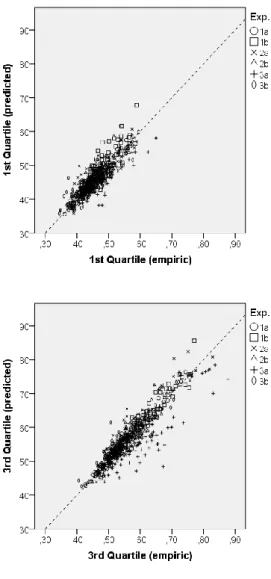
=0.06. Diffusion model analyses. Response time distributions for correct responses and error responses were entered in diffusion model analyses using the fast-dm program (Voss & Voss, 2007; Voss et al., 2010). Parameter values were estimated individually for each participant. Drift rates (v), non-decisional RT constants (t0), and response-execution biases (d) were estimated separately for different prime-types. The remaining parameters (a, sz, sv , and st0) were held constant between conditions. Table 2 shows the mean estimates for all parameters. Table B1 (Appendix B) presents effect sizes for all analyses reported below for the complete samples as well as for reduced samples excluding all data from participants for which the model had only a weak fit.
The three parameters that were allowed to vary between prime types (v, t0, and d) were entered in separate repeated measurement ANOVAs. In Experiment 1a, only the drift rate (v) was influenced by prime type, with F(2,28) = 15.47, p<.001, ηp2
=0.53, for the global analysis, and F(1,29) = 32.02, p<.001, ηp2
=0.53, for the contrast of associated (M = 3.67) vs. non-associated primes (M = 2.96), indicating a more efficient processing of targets following associated primes. For t0 and d there were no significant effects of prime type, all F<1.
Results were different in Experiment 1b. In this study, prime type did not influence the drift rates, F<1. However, there was a significant effect on the RT constant (t0), F(2,28) = 6.85, p<.01, ηp2=0.33. Planned contrasts revealed that the non-decisional processes were faster in trials with congruent primes compared to trials with incongruent primes, F(1,29) = 5.20, p<.05, ηp2
=0.15. The analysis of the d-parameter failed to reach statistical significance, F(2,28) = 2.37; p=.11.
Table 2 also shows the fit-indices (p) provided by fast-dm (Voss & Voss, 2007). These p-values are the probabilities of the Kolmogorov-Smirnov-statistic, that is, they are measures for deviances of the empirical from the predicted RT distributions. In our case, the presented p values represent the product of the three different p values based on the
comparison of empirical and predicted distributions for the three priming conditions.
Although p cannot be interpreted as the exact probability of a statistical test5 it is nonetheless obvious that the values are very close to 1, indicating that the empirical distributions are reproduced very closely by the predicted distributions. A more thorough test of model fit is presented in Appendix B.
Between-experiments analyses. Our main hypotheses include the prediction of a double dissociation between different priming procedures and different diffusion model parameters. To test the differential effect of the two priming procedures on the different diffusion model parameters in a more straightforward manner, we entered data from Experiment 1a and Experiment 1b into combined 2 (experiment: associative priming [Exp. 1a] vs. affective priming [Exp. 1b]) x 3 (prime type: associated/congruent,
non-associated/incongruent, neutral) ANOVAs for each of the diffusion-model parameters. As expected, there was a significant experiment by prime type interaction in the analysis of drift rates, F(1, 58) = 21.10, p<.001, ηp2
=0.27, for the contrast of
reflects a significant priming effect on the drift rate in associative priming and the absence of such an effect in the case of affective priming.
For t0, there was an interaction of experiment with the contrast associated/congruent vs. neutral trials, F(1,58) = 4.80, p<.05, ηp2
=0.08, indicating a speeding of non-decisional processes for associated trials compared to neutral trials in associative priming but not for congruent compared to neutral trials in affective priming. The corresponding contrast (non-associated/incongruent vs. neutral trials) was not significant, F<1, ηp2<0.01.
For the d parameter, priming effects did not differ significantly between experiments, both F(1,58)<2.74; p>.10, ηp2<0.05, for the contrasts associated/congruent vs. neutral and non-associated/incongruent vs. neutral.
Discussion
With Experiment 1a and 1b, two different kinds of priming effects were realized: Experiment 1a revealed the effect of associative priming in a lexical decision task; in Experiment 1b the evaluation task was used to demonstrate an affective priming effect. Regarding latencies, priming effects in the two experiments were nearly identical (10ms vs. 9ms). To evaluate the absolute magnitude of these RT-based priming effects, it has to be taken into account that responses were given at the upper end of the of the speed spectrum due to high time pressure with latencies of about 500 ms. For error-rates, only in Experiment 1a robust priming effect emerged.
The diffusion-model analyses revealed different cognitive mechanisms underlying these priming effects: In the case of associative priming, effects were based on differences regarding the efficiency of response selection processes (drift-rate): If a target is pre-activated by an associated prime, it can be identified faster and it can be processed more efficiently. It should be noted that the associative priming effect that was mapped onto the drift rate in Experiment 1a could also be attributed to a post-lexical process. In particular, according to the compound cue model (Ratcliff & McKoon, 1988), familiarity information uptake should
be enhanced for associated prime-target pairs, which should also lead to an increase in drift rates. The present data do not allow us to disentangle influences of target processing and familiarity-based post-lexical effects for associative priming. We will address this issue again in the Discussion of Experiment 3b.
Affective priming effects with the evaluative decision task (Exp. 1b) were based on differences in the non-decisional components (t0), indicating that response execution in the evaluation task was faster following congruent than incongruent primes. This finding fits with the response facilitation/interference account of affective priming effects in the evaluation task (e.g., De Houwer et al., 2002; Klinger et al., 2000; Klauer & Musch, 2002, 2003): According to this idea, the processing of the prime stimulus automatically pre-activates the corresponding response, which then either facilitates the execution of the target response in case of a match (congruent target), or interferes with the execution of the target response in case of a mismatch (incongruent target). The fact that the effect was mapped on t0 in the present experiments indicates that response compatibility effects mainly affected the execution of correct responses. The lack of an effect on the d parameter indicates that the response compatibly effects were not reversed for error responses. We attribute this null finding at least in part to the fact that the RT component for error responses cannot be
estimated very reliably due to the small number of errors.6 We postpone a detailed discussion of this finding, because we conducted two additional experiments with response priming designs (Exp.s 2a and 2b).
Experiment 1b is not the first study that reports evidence for a response competition account of affective priming. Previous studies provided this evidence indirectly by showing that affective congruency effects disappeared for tasks in which affective congruency was not confounded with response congruency between prime and target. The new aspect of our study is that it provided direct evidence for response competition effects in affective priming within the evaluation task. Such a demonstration is of major importance because it shows that
priming effects in the standard version of the paradigm (Fazio et al., 1986) are mediated by response competition rather than by a modulation of target processing. Second, by using the evaluation task, we can rule out that participants might not have attended to the valence of the stimuli (Spruyt, De Houwer, et al. 2007, Spruyt et al., 2009). Stimulus valence had to be processed because it was task relevant. Nevertheless, processing of a valent prime did not have an influence on the drift rate for (affectively congruent or incongruent) targets, indicating that affective congruency does not facilitate target processing. Affective
congruency effects in the evaluation task thus have to be explained differently. The diffusion model analyses suggest that the basis of the effect lies in extra-decisional components of response facilitation and interference.
Experiments 2a and 2b
With Experiments 2a and 2b, categorical priming effects of affective and semantic congruency were analyzed more closely. As discussed above, in our view affective priming is a special case of a more general phenomenon. We expect that categorical priming effects— and this includes affective priming effects—are mediated by response competition processes that depend on the current task-set; that is, a categorical match of prime and target leads to speeded responses only if the dimension on with the match or mismatch between prime and target occurs is task-relevant (Klauer & Musch, 2002). To test this hypothesis, in Experiment 2, we manipulated semantic congruency (person vs. object) of prime-target pairs orthogonally to affective congruency within the same set of stimulus materials. In Experiment 2a, an evaluation task was used, while in Experiment 2b targets had to be classified as persons vs. objects. A priming effect of evaluative congruency was expected to occur only in the evaluation task, whereas an effect of semantic congruency was expected to occur only in the semantic categorization task. Like in Experiment 1b, we predicted that categorical priming effects were mapped on the non-decisional components (t0 and/or d).
Participants. Two independent samples of 32 undergraduate students of the University of Trier participated in Experiment 2a (24 female, age mean 22.3) and in
Experiment 2b (28 female, age mean 20.8) for partial fulfillment of course requirements and a small performance related financial reward (see Procedure for details).
Materials. Two sets of 64 German nouns were chosen as primes and targets,
respectively. Within both sets, one quarter of the stimuli (i.e., 16) were positive person-words (e.g., ―mother‖), negative person-words (e.g., ―murderer‖), positive object-words (e.g.,
―chocolate‖), and negative object-words (e.g., ―dirt‖). Four prime stimuli (one of each category) were assigned to each target stimulus. Similarly, each prime word was assigned to four different target words (one of each category). Prime-target pairings were identical for all participants. For each participant, each target word and each prime word was presented four times, once for each priming condition (affective and semantic congruency [e.g., mother - friend], affective match/semantic mismatch [e.g., mother - diamond], affective
mismatch/semantic match [mother - liar], affective and semantic mismatch [mother - weapon]), yielding a total of 256 prime-target trials that were presented in an individually randomized sequence. For the practice block, two additional sets of 8 nouns (2 of each category) were selected. Each target and prime stimulus was presented once in each priming condition, yielding a total of 32 practice trials.
Design. In both experiments, the design essentially comprised the repeated-measurement factors affective match (congruent vs. incongruent) and semantic match (congruent vs. incongruent). Additionally, the assignment of response keys to the response categories (Exp 2a: positive vs. negative; Exp 2b: person vs. object) was counterbalanced across participants.
Procedure. Procedural details of Experiment 2 were identical to Experiment 1b with regard to feedback, instructions and stimulus presentation. In Experiment 2, participants finished one block of 32 practice trials, and 8 blocks of 32 experimental trials. The only
difference between the procedures of Experiment 2a and 2b pertains to the task: In Experiment 2a stimuli had to be classified according to valence, whereas Experiment 2b required a semantic classification (person vs. object).
Results
Data pre-treatment. One participant had to be excluded from Experiment 2b, because she made no errors in one condition, which poses a problem for our diffusion model
algorithm. For the remaining sample, the data pre-treatment procedure described above (see Experiment 1) led to an exclusion of 9.4% (Experiment 2a) or 8.1% (Experiment 2b) of all trials. The high number of outliers is due to the high rate of fast guesses that were provoked by the reward of fast responses (see Experiment 1 for details).
Latencies. Latencies from correct responses (see Table 3) were entered into 2 (affective match: congruent vs. incongruent) by 2 (semantic match: congruent vs. incongruent) repeated measurement ANOVAs, separately for Experiment 2a and 2b. In Experiment 2a, evaluation latencies from affectively congruent trials (M = 502ms) were shorter than latencies from incongruent trials (M = 516ms), F(1,31) = 20.29, p<.001, ηp2
=0.40. There was no significant main effect of semantic match and no significant
interaction, both F<1. Results from Experiment 2b revealed a significant effect for semantic match, F(1,30) = 28.99, p<.001, ηp2=0.49, with faster semantic categorization responses for targets after semantically congruent primes (M = 493ms) than after semantically incongruent primes (M = 508ms). Affective match had no influence on latencies, F<1 for main effect and interaction.
Error rates. The analyses of error rates revealed parallel results to the analyses of latencies (Table 3): Error rates were reduced in affective match trials (M = 15.1%) compared to trials with affectively mismatching primes (M = 18.8%) in the evaluation task (Experiment 2a), F(1,31) = 6.33, p=.01, ηp2
=0.18, and in semantic match trials (M = 13.9%) compared to trials with semantically mismatching primes (M = 17.6%) in the semantic categorization task
(Experiment 2b), F(1,30) = 11.97; p<.01; ηp2
=0.29. No other effects emerged in both experiments, all F < 2.40, p > .12.
Diffusion-model analyses. The diffusion model was fitted to individual response time distributions with the same specifications as reported for Experiment 1. Means and standard deviations of the resulting parameters are presented in Table 4 (see Table B1 for an overview of all effect sizes).
Drift rate (v), RT-constant (t0), and response-execution bias parameter (d) were entered in separate 2 (affective match: congruent vs. incongruent) by 2 (semantic match: congruent vs. incongruent) repeated measurement ANOVAs. Results for Experiment 2a revealed a main effect of affective match on t0, F(1,31) = 4.30, p<.05, ηp2
=0.12, indicating faster response execution in affectively congruent trials. Effects on the execution bias parameter d revealed that affective-match had an opposite influence on RT constants of correct and error responses, F(1,31) = 5.34, p<.05, ηp2=0.15. Conforming to our expectations, negative values of d (indicating a delay of correct responses) emerged in affectively incongruent trials. Although the drift rate is numerically larger for affectively matching pairs compared to non-matching pairs, this effect clearly misses the level of significance, F(1,31) = 1.19, p = .28, ηp2=0.04. No other effects emerged for Experiment 2a, all F<1.
For Experiment 2b, the predicted effects of semantic match on response-execution speed emerged for t0, F(1,30) = 12.24, p=.001, ηp2
=0.29, and for d, F(1,30) = 12.71, p=.001, ηp2
=0.30. These effects indicate (a) that responses were executed faster in the semantic match condition, and (b) that correct responses were executed faster than error responses for the semantic match condition, whereas error responses were executed faster than correct
responses for semantically mismatching prime-target sequences. There were two further non-predicted marginally significant results: Firstly, analyses of drift rates revealed an affective match by semantic match interaction, F(1,30) = 4.43; p=.04; ηp2
match also had an effect on d, F(1,30) = 4.17; p=.05; ηp2
=0.12.8 No other effects were significant, all F<2.25, >.14.
As already outlined in the introduction, we also tested whether the pattern of results remains stable in a model without response execution bias (d), in which instead the starting point was allowed to vary between conditions. (Unfortunately, the current data do not allow us to reliably estimate biases in the starting points (z/a) and response execution biases (d) simultaneously; Voss et al., 2010). For this purpose, data were reanalyzed with a diffusion model in which d was fixed to 0 and z was estimated for all conditions. Results revealed shorter non-decisional times (t0) for affective match, F(1, 31) = 12.53; p=.001; ηp2
=0.29, in Experiment 2a, and for semantic match, F(1, 30) = 22.83; p<.001; ηp2
=0.43, in Experiment 2b. No other effects were significant in the analyses of z, v, and t0.
Between-experiments analyses. Differences between the diffusion model results from Experiment 2a and 2b were analyzed with separate 2 (experiment) x 2 (affective match) x 2 (semantic match) ANOVAs for the diffusion-model parameters. As expected, experiment had no influence in the analysis of drift rates, all F(1,61) < 1.78, p>.18, ηp2=0.03. For t0, the interactions of semantic match and affective match with experiment were significant, experiment x semantic match: F(1,61) = 5.06, p<.05, ηp2
=0.08; experiment x affective match, F(1,61) = 3.51, p<.05 (one-tailed), ηp2=0.05. For the d parameter there was a significant experiment x semantic-match interaction, F(1,61) = 2.89, p<.05 (one-tailed), ηp2=0.05, while the experiment x affective match interaction did not reach significance, F(1,61) = 1.53; p=.22, ηp2
=0.02.
Discussion
In Experiment 2, the effects of affective match and semantic match between prime and target were analyzed for the evaluation task and for a semantic classification task (i.e., person vs. object classification). As predicted, only the task-relevant dimension had an influence on performance (De Houwer et al., 2002; Klauer & Musch, 2002; Klinger et al., 2000): In the
evaluation task, responses were faster in affective match trials, whereas semantic match had no influence. In the semantic classification task, only semantic match facilitated responses. Given that the very same stimulus materials were used in both tasks, the pattern of results cannot be attributed to any differences in semantic or affective overlap.
The diffusion-model analyses revealed that priming effects were mediated by the non-decisional components (t0 and d): Response execution (t0) was speeded for trials with a prime-target match on the task-relevant dimension. Results on the response-execution bias parameter (d) indicate that for the task-relevant congruent conditions, correct responses were executed faster than error responses, whereas for task-relevant mismatches, error responses were executed faster than correct responses (negative values of the d parameter in the incongruent conditions indicate a faster execution of erroneous responses). These results support the hypothesis that categorical priming effects are mediated by a pre-activation of the response that is associated with the prime by the current task-set.
It should be noted that the non-decisional components cannot reproduce the
congruency effects that were found for the error rates, because these take influence only on latencies but not on response frequencies. A possible explanation of these error effects is that there may be effects on the starting point (z) in addition to the response execution effects (see General Discussion). Therefore, we repeated parameter estimates with an alternative model in which starting points z was allowed to vary (and with fixed d). These analyses, however, revealed no differences between priming conditions with regard to z. Apparently the
difference in error frequencies between congruent and incongruent conditions also cannot be explained by biases in the starting point, and must be due to some other process that cannot easily be identified in the diffusion models we used. Taken together, the results support our assumption that categorical priming effects are largely based on the preparation of the prime response rather than on a decision bias.
In accordance with the results of Experiment 1b, we found no evidence of affective or semantic congruency effects on the drift rates. We thus conclude that categorical priming effects of affective and semantic congruency are not mediated by differences in target processing (spreading activation) but instead reflect effects of response facilitation and conflict (cf. also Hutchison, 2003).
Experiments 3a and 3b
In Experiment 3, we will further investigate the processes of associative priming. The findings from Experiment 1b, 2a, and 2b demonstrated that primes evoke response tendencies if they can be mapped onto the task-relevant response categories. Such response tendencies speed responses in congruent trials and slow down responses in incongruent trials.
Experiment 1a suggested that in the case of associative priming another mechanism prevails: In this experiment the associative priming effect was located on the drift rate. This fits with our assumption that primes pre-activate closely associated targets, which are then processed more efficiently. A crucial difference between Experiment 1a (associative priming) and Experiments 1b, 2a, and 2b (categorical priming), however, relates to the type of task that was used. Whereas categorical priming effects were always investigated with classification tasks, associative priming effects were analyzed with a lexical decision task in Experiment 1a. To rule out that the different findings reflect different tasks rather than different types of prime-target relationships, two associative priming experiments were realized either with a semantic categorization task or a lexical decision task in Experiment 3. Experiment 3a is an associative priming experiment with the lexical decision task and thus a replication of Experiment 1a. Experiment 3b is an associative priming experiment with a semantic categorization task (living vs. non-living). We expect that associative priming effects should obtain (in RTs and errors) for both kinds of tasks, and that these associative priming effects should be captured by the drift rate for both types of task.
Using a semantic categorization task for the analysis of associative priming effects in Experiment 3b also allows us to rule out that a relatedness effect for associated primes is caused by a biasing of familiarity estimates due to compound cues (Ratcliff & McKoon, 1988). In contrast to the lexical decision task, decisions in a semantic categorization task cannot be based on familiarity estimates because this task contains only words as targets (and as primes). Similarly, processes of a post-lexical semantic matching cannot explain
associative priming effects in a semantic categorization task because related and unrelated prime/target pairs are assigned to both responses of the categorization task with equal probability.
Method
Participants. In Experiments 3a and 3b, two independent samples of thirty-two undergraduate students (Exp 3a: 22 female, age mean 22.1; Exp. 3b: 22 female, age mean 22.6) of the University of Trier participated for partial fulfillment of course requirements and small performance related financial rewards (see Procedure of Experiment 1 for details).
Materials. A set of 64 pairs of associated German nouns was used. Half of the primes and targets belonged to the category "living" and half were "non-living". For half of the targets, the associated prime belonged to the same semantic category (e.g., lion-tiger, bread-butter), whereas for the other half of the targets, the associated prime belonged to the opposite semantic category (e.g., honey-bee, king-crown). The same set of target and prime words was also used to create the non-associated prime-target pairs. Again, for half of the non-associated prime-target pairs, prime and target belonged to the same semantic category (e.g., king-bee, honey-crown), whereas for the other half, prime and targets belonged to different semantic categories (e.g., lion-butter, bread-tiger). For Experiment 3a, pseudo-words were generated from all targets by replacing one letter. Prime-target pairs were identical for all participants. In Experiment 3a (lexical decision task), each target was presented once with its associated prime and once with its non-associated prime, yielding a
total of 128 trials plus an additional 128 non-word trials. In Experiment 3b (semantic
categorization task), each target was presented twice with its associated prime and twice with its non-associated prime, yielding a total of 256 trials. The 256 trials of an experiment were presented in an individually randomized sequence for each participant. For the practice blocks, an additional set of eight associated prime-target pairs were used that were presented once or twice in each condition (associated, non-associated), yielding 32 practice trials.
Design. The design comprised the factors prime-target association (associated vs. non-associated) and prime-target match (congruent vs. incongruent). For data analysis, only the first factor (in the following denoted as prime type) was evaluated.9 Additionally, the assignment of response keys to response categories (Exp. 3a: word vs. non-word; Exp. 3b: living vs. non-living) was counterbalanced across participants.
Procedure. Procedural details regarding feedback and stimulus presentation parameters were identical to the previous experiments. The only difference concerns the required tasks, that is, a lexical decision in Experiment 3a and a living versus non-living classification in Experiment 3b.
Results
Data pre-treatment. The cleaning procedures described above led to an exclusion of 8.4% trials in Experiment 3a and 9.1% in Experiment 3b.
Latencies. Data were collapsed over congruent and incongruent prime-target pairs.10 Latencies of correct responses are presented in Table 5. In Experiment 3a (lexical decision task), responses in trials with associated primes were faster compared to trials with non-associated primes, F(1,31) = 11.08, p<.01, ηp2
=0.26. Similarly, in Experiment 3b (semantic classification), categorization responses for targets were also faster after associated primes than after non-associated primes, F(1,31) = 30.24, p<.001, ηp2
=0.49.
Error rates. Analyses of error rates also indicated an influence of prime type (Table 5): Responses were more accurate following associated primes than following non-associated
primes, with F(1,31) = 10.51, p<.01, ηp2=0.25, and F(1,29) = 9.56, p<.01, ηp2
=0.24, respectively, for Experiments 3a and 3b.
Diffusion-model analyses. Results from the diffusion model analyses are presented in Table 6 (see Table B1 for an overview of all effect sizes). Parameters for drift rate (v), non-decisional-component (t0), and response-execution bias (d) were entered in separate ANOVAs with the repeated measurement factor prime type (associated vs. non-associated) as
independent variable.
As predicted, mean drift rates for trials with associated primes (lexical decision: 3.91; semantic classification: 3.73) exceeded drift rates for trials with non-associated primes (lexical decision: 3.42; semantic classification: 3.34), with F(1,31) = 5.42, p<.05, ηp2
=0.15, for Experiment 3a, and F(1,31) = 6.71, p<.05, ηp2
=0.18, for Experiment 3b. Additionally, in Experiment 3a there was a non-predicted effect of prime type on the t0 parameter, F(1,31) = 5.01, p<.05, ηp2=0.14, indicating a shorter duration of non-decisional processes in the associated condition. No other effects emerged, all F(31) < 1.65; p>.20.
Between-experiments analyses. We did not predict any differences between the diffusion model results from Experiment 3a and 3b. Confirming this prediction, separate 2 (experiment) x 2 (prime type) ANOVAs revealed only a main effect of association on the drift rate, F(1,62) = 11.58, p<.001, ηp2=0.16. There were no interactions between experiment and prime type, with F(1,62) = 2.37, p=.13, ηp2=0.04, for the d-parameter, and F<1 for drift and t0, ηp2
<0.01.
Discussion
In Experiment 3, associative priming effects from two different paradigms were analyzed, that is, the lexical decision task (Exp. 3a) and a semantic classification task (Exp. 3b). In both experiments, associated primes caused faster and more accurate responses. Confirming our predictions, the diffusion-model analysis indicated that behavioral effects are based on differences in drift rates, that is, the processing of targets was facilitated by the prior