A novel set of features for continuous hand gesture recognition
M. K. Bhuyan · D. Ajay Kumar· Karl F. MacDorman · Yuji Iwahori
Received: 8 October 2012 / Accepted: 29 May 2014 © OpenInterface Association 2014
Abstract Applications requiring the natural use of the human hand as a human–computer interface motivate research on continuous hand gesture recognition. Gesture recogni-tion depends on gesture segmentarecogni-tion to locate the starting and end points of meaningful gestures while ignoring unin-tentional movements. Unfortunately, gesture segmentation remains a formidable challenge because of unconstrained spatiotemporal variations in gestures and the coarticulation and movement epenthesis of successive gestures. Further-more, errors in hand image segmentation cause the esti-mated hand motion trajectory to deviate from the actual one. This research moves toward addressing these problems. Our approach entails using gesture spotting to distinguish mean-ingful gestures from unintentional movements. To avoid the effects of variations in a gesture’s motion chain code (MCC), we propose instead to use a novel set of features: the (a) ori-entation and (b) length of an ellipse least-squares fitted to motion-trajectory points and (c) the position of the hand. The features are designed to support classification using condi-tional random fields. To evaluate the performance of the sys-M. K. Bhuyan (
B
)·K. F. MacDormanSchool of Informatics and Computing, Indiana University Purdue University (IUPUI), 535 West Michigan St., Indianapolis, IN 46202, USA
e-mail: [email protected] K. F. MacDorman
e-mail: [email protected] D. Ajay Kumar
Department of Electronics and Electrical Engineering, IIT, Guwahati 781039, India
e-mail: [email protected] Y. Iwahori
Department of Computer Science, Chubu University, 1200 Matsumoto-cho, Kasugai 487-8501, Japan e-mail: [email protected]
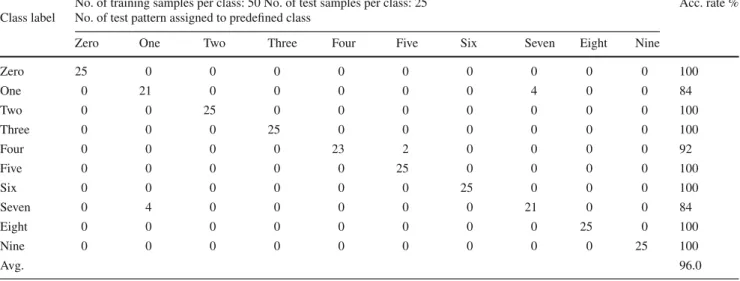
tem, 10 participants signed 10 gestures several times each, providing a total of 75 instances per gesture. To train the sys-tem, 50 instances of each gesture served as training data and 25 as testing data. For isolated gestures, the recognition rate using the MCC as a feature vector was only 69.6 % but rose to 96.0 % using the proposed features, a 26.1 % improvement. For continuous gestures, the recognition rate for the proposed features was 88.9 %. These results show the efficacy of the proposed method.
Keywords Human–computer interaction (HCI)·Gesture recognition ·Motion chain code (MCC)· Conditional random fields (CRF)
1 Introduction
Gestures provide an attractive, user-friendly alternative to using an interface device like a keyboard, mouse, and joy-stick in human–computer interaction (HCI). Accordingly, the basic aim of gesture recognition research is to build a system that can identify and interpret specific human gestures auto-matically and employ them to convey information (i.e., for communicative use as in sign-language) or to control devices (i.e., manipulative use as in controlling robots without any physical contact).
One of the most important requirements for sign language recognition is that natural gesturing be supported by the recognition engine so that a user can interact with the sys-tem without any restrictions. Since a sequence of gestures is generally mixed with coarticulation and unintentional move-ments, these non-gestural movements should be eliminated from an input video before the identification of each ges-ture in the sequence. Movement epenthesis is a non-gestural movement between gestures, and gesture coarticulation is
____________________________________________________
This is the author's manuscript of the article published in final edited form as:
Bhuyan, M. K., Kumar, D. A., MacDorman, K. F., & Iwahori, Y. (2014). A novel set of features for continuous hand gesture recognition. Journal on Multimodal User Interfaces, JMUI-D-12-00038R3. https://doi.org/10.1007/s12193-014-0165-0
the modification of the beginning or end of a sign because of the sign that preceded or suceeded it, respectively [1,2]. In more natural settings, the gestures of interest are embed-ded in a continuous stream of motion, and their occurrence must be detected. This is precisely the goal of gesture spot-ting, namely, to locate the starting point and the endpoint of a gesture pattern and to classify the gesture as belonging to one of the predetermined gesture classes. Once the ges-ture boundaries are known, a gesges-ture in the sequence can be conveniently extracted. However, the process of gesture boundary detection is not trivial for the following reasons:
– Gesture boundaries vary from one signer to another. – Gesture boundaries are sequence dependent; in
particu-lar, gesture segmentation is heavily influenced by higher-level cognitive processes and by the context of each ges-ture.
– It is impossible to enumerate all gestures. Traditional computer vision approaches characterize a gesture as a series of poses. Clearly, given the virtually infinite num-ber of poses that the human body can assume, a generic model-based approach to gesture segmentation is not viable.
Generally, a gesture starts and ends with the hand at a stand-still. That is, a signer generally starts making a sign from a pause state and ends in a pause state even when gestur-ing continuously [3]. Based on this observation, we propose to use the hand motion information to locate the boundary points of each gesture in a continuous stream of gestures. A boundary point is detected whenever the hand pauses during gesturing. For gestures having global motion only or ges-tures having both global and local motions, the gesturing hand traverses through space to form a gesture trajectory. After a gesture trajectory is completed, the hand pauses for a while and then moves with very high velocity to the starting position of the next trajectory. Based on this, we propose to detect movement epenthesis—and distinguish it from a ges-ture stroke—by observing the motion of the hand between pauses in the input hand motion video. Whereas a movement epenthesis phase is simply a fast hand stroke, a gesture phase can be divided into three motion stages: preparation, stroke, and retraction. However, the scheme will result in the incor-rect spotting of gestures under the conditions listed below:
– It is not correct to assume that between gestures there is always some non-gestural hand movement. For exam-ple, there is generally no extra movement if a gesture ends in the same position or pose at which the next ges-ture begins. In this case, the two gesges-tures are adjoined to each other in the sequence with a common pause
indi-cating the end of the first gesture and the start of the next gesture.
– For a sequence of static hand poses (fluent finger spelling), there is generally no motion during the gestur-ing period while the hand may move in between two ges-ture poses because of movement epenthesis. That means a pause itself in the sequence corresponds to a gesture sign as if the starting point and endpoint of the gesture have merged together.
– For gestures involving global hand motion, there may be some pauses within a single gesture. When the hand tra-verses through space, it makes one or more hand strokes to build up a complete gesture trajectory with pauses between the strokes.
The proposed method is described in more details in the following sections.
2 The state of the art
A threshold model based on a hidden Markov model (HMM) was proposed to recognize and spot the gestures [4] in which motion chain code (MCC) is used as the feature. The system was trained with a huge number of isolated samples. The ges-ture is spotted when it crosses the adaptive threshold and the boundary points are detected using the Viterbi back-tracking algorithm. The major limitation of this method is that as the gesture vocabulary increases the number of states increases. Most errors come from the failure of hand extraction that distorts the hand trajectory and also the MCC. Our proposed method focuses on solving this problem by replacing the MCC with other trajectory-based features.
A gesture spotting technique was proposed using a finite state machine (FSM) [5]. The features used are various motion parameters like the velocity of the hand. The velocity of the hand is less at the beginning and end of the gesture, and the hand abruptly moves during movement epenthesis. However, this method cannot be used as a generalized model for all the gestures.
Gesture spotting with a threshold model based on con-ditional random fields (CRF) combines motion-based and location-based features [6]. The MCC of the hand trajectory is used as a motion-based feature. As with other methods, variations in the extracted MCC greatly affect the perfor-mance of the recognizer.
A framework that simultaneously spots and recognizes gestures by using the density functions of the states for each of the gesture classes was proposed in [7]. A 4D position-flow vector is used as the feature, which contains the pixel position of the centroid of the hand and its two dimensional velocity. This method is also not applicable to all kinds of gestures.
A sign language recognition system was developed using three appearance-based features: PCA, kurtosis position, and the MCC [8]. The hand is tracked and the trajectory is rep-resented by MCC. These three features are given to three separate HMM networks for recognition. Thus, the overall recognition accuracy also depends on MCC.
Though the segmentation and coarticulation detection are the main open research issues for continuous hand gesture recognition, few vision-based approaches have been reported prior to this work. The techniques developed so far for coar-ticulation detection have not always been successful for a wide range of gesture vocabulary. Although powerful clas-sifiers for labeling the sequential data exist, feature selec-tion is key to obtaining a high recogniselec-tion rate. In gesture recognition, the features must be selected so as to enable the classifier to unambiguously recognize and segment the con-tinuous gestures. As explained earlier, most of the existing approaches use the motion chain code as a feature. The MCC is a rotation invariant feature for object recognition. But in gesture recognition, many variations occur in the extracted MCC even when the same gesture is performed repeatedly. This is because of ambiguity in hand image segmentation and trembling of the gesturing hand.
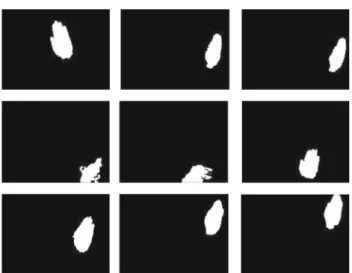
As an example, Fig.1shows frames of the segmented hand regions of the gesture trajectory Eight. The area and the ori-entation of the segmented hand differs from frame to frame. This causes the extracted trajectory to deviate from the actual trajectory, resulting in drastic variations in the MCC, which was encoded from the information of the motion trajectory. This variation in the MCC causes difficulty in modeling a ges-ture. Figure2shows the extracted gesture trajectory varies from the actual one. Hence, for a particular gesture, the MCC will not be unique. To overcome this problem, we propose a much smoother chain code feature than the conventional MCC. The new feature gives better results. Additionally, two other features are proposed to cope with the problem of move-ment epenthesis.
3 Proposed system
This paper focuses on the recognition of continuous digits gesticulated by the user. These gestures, shown in Fig.3, are dynamic, consisting only of global hand motion. These ges-tures are performed continuously, so movement epenthesis and coarticulation come into consideration as the gesturer has to move his hand from the endpoint of one gesture to the starting point of other gesture. Thus, the recognition system should be capable of detecting the meaningful gestures from the continuous stream of gesticulation. Due to coarticulation, the appearance of a sign/gesture, especially at the beginning and end, can be significantly different under different sen-tence contexts, which makes the recognition of gestures in
Fig. 1 Various frames of the segmented hand of the gesture Eight
Fig. 2 Examples of trajectories of isolated gestures
sentences hard. In other words, when gestures are produced continuously, each gesture may be affected by the preceding gesture, and sometimes by the gesture that follows it. How-ever, movement epenthesis occurs when the hand moves very fast from the end position in a gesture to the starting position in the following gesture. This implies that these movements are deliberate and are essential for connecting two gestures in a sequence. A pictorial representation of movement epenthe-sis and the embedded gestures is shown in Fig.4.
In our method, we use CRF to classify the sequential data (feature vector), because they can model the gestures by con-sidering the dependencies in the sequential data. CRFs have the ability to relax the independence assumption of hidden Markov models [9,10]. However, an HMM is a stochastic automaton that models the sequential data by generating the observation while transiting from one state to another state [11]. Whereas, CRF is a non-generative finite state model with a single exponential for joint probability of the label sequence given an observation sequence. Most of the existing gesture spotting approaches in the literature rely on dynamic time warping (DTW), neural networks (NN), or HMM.
Once a particular gesture has been recognized, it needs to be mapped to a corresponding action, for example, to control a robot or activate a window menu. A gesture-based HCI sys-tem also allows a person to communicate with a computer via
Fig. 3 Examples of trajectories of isolated gestures
(a) (b)
(c)
Fig. 5 Hand segmentation by the proposed method
of the hand from the video frame. Skin color is clustered in a very small region in a color space so that skin regions can eas-ily be separated by selecting a proper threshold. In addition, color spaces are selected that are less susceptible to changes in lightning. HSV and YCbCr are two color spaces that sep-arate the chrominance ([H S] or [Cb Cr]) and luminance (V or Y) components [12]. So, after removing the face region, the RGB image is converted to HSV and YCbCr images, and subsequently a threshold is applied to the chrominance com-ponents of both the HSV and YCbCr color spaces. Finally, a logical AND operation is performed between them to obtain the likely skin region.
After getting the skin color segmented regions, the largest connected segment corresponds to the palm region of the hand. Figure 5 shows various intermediate results. After determining the binary alpha plane corresponding to the palm region of the hand, moments are used to find the center of the hand. The 0th and the 1st moments are defined as M00= x y I(x,y), M10 = x y x I(x,y),
Fig.4 Problems in geture recognition include movement epenthesis, indicated by dottedlines in (a) and (b), and the embedding of one gesture
in another. In cFive is embedded in Eight
signlanguageand,thus,enablesthosewithhearing impair-menttointeractwithacomputermoreeasily.Ourmethodis basicallyintendedforthesekindsofHCIapplications.The proposedschemeforcontinuoushandgesturesegmentation andsubsequent recognitionis describedin thesections to follow.
3.1Handsegmentationandgesturetrajectoryestimation Hand segmentation istypically afirst step intrackingthe movementofthehand.Inourmethod,thefaceregioninthe frameisremovedbyusingafacedetectionalgorithm.Skin color-basedsegmentationisusedtoextracttheskinregions
M01 = x y y I(x,y) (1)
Subsequently, the centroid is calculated as xc= M10 M00 and yc= M01 M00 (2) In the above equations, I(x,y)is the pixel value at the position(x,y)in the image. Since the background pixels are assigned 0, the centroid of the hand in a frame is also the cen-troid of the total frame. Therefore, in moment calculations, we may either take the summation over all pixels in the frame or over only the hand pixels.
Finally, the gesture trajectory is formed by joining all the calculated centroids in a sequential manner. However, this trajectory may be noisy for the following reasons:
– Points too close
– Isolated points far from the correct trajectory due to a change in the hand shape
– Unclosed endpoints – Hand trembling
– Unintentional movements
Therefore, to reduce these effects, the final trajectory is smoothed out by considering the mean value of a specified point and its two neighboring points, i.e.,
(xˆt,yˆt)=((xt−1+xt+xt+1)/3, (yt−1+yt+yt+1)/3) (3) So, a dynamic hand gesture(DG)can be interpreted as a set of points in a spatiotemporal space:
DG= {(xˆ1,yˆ1), (xˆ2,yˆ2), . . . , (xˆt,yˆt)} (4)
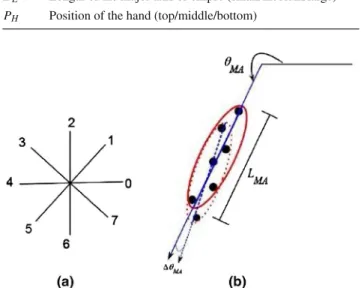
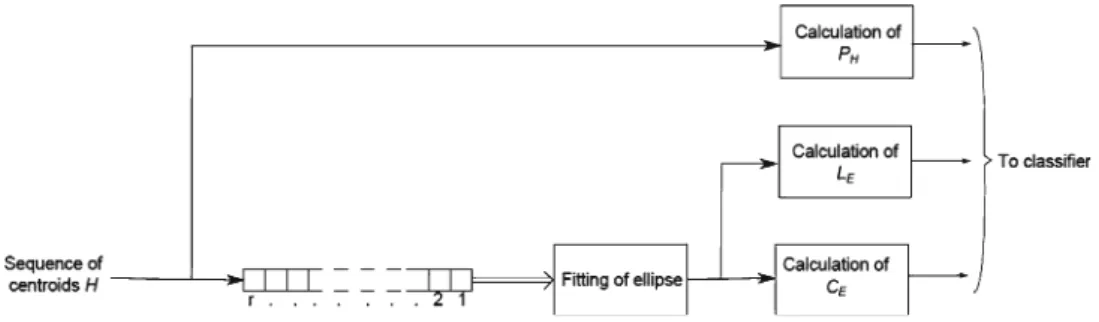
3.2 Extraction of proposed trajectory-based features Given the sequence of centroid of segmented hand, three features are extracted as shown in Table 1. The proposed three dimensional feature vector is extracted to use the CRF effectively, so that it can spot the gestures and recognize them. As shown in Fig.6, feature CEis extracted from the angle
of the major axis of the ellipse which is fitted to the previous r points P = {Xt}tT=T−r of the motion trajectory, where
Xt =(xt,yt). The motivation behind this idea is to obtain a
chain code that preserves the shape of the motion trajectory even if the extracted trajectory is not smooth. The ellipse is fitted using least squares fitting of conic sections. Let us assume an ellipse with a set of parameters A= [a b c d e f]T as
E(A,X)=ax2+bx y+cy2+d x+ey+ f
Table 1 Proposed features Features
CE Chain code obtained by the angle of orientation of the ellipse
LE Length of the major axis of ellipse (small/medium/large)
PH Position of the hand (top/middle/bottom)
Fig. 6 Extraction of features CEand LE
The algebraic distance E(A,X) is the product of χt =
[xt2xtyt yt2xtyt1]and A.
E(A,X)= [xt2xtytyt2xtyt1][a b c d e f]T =χtA
The parameter set A is found using the least-squares tech-nique that minimizes a distance metric (A) between the data points and the ellipse E.
(A)= T t=T−r E(A,Xt)2= D A2 where, D=χT−r χT−r+1. . . χT
is the design matrix. To avoid the trivial solution A = 06, different constraints are applied to the parameter A. We chose the computationally efficient algorithm given in [13] for ellipse fitting. The min-imization ofD A2subject to the constraint 4ac−b2 =1 gives only one solution, which is an ellipse. The counter-clockwise angle of the major axis of that ellipse(θM A)is
used to find our proposed chain code/feature CE, whereas a
conventional MCC is calculated with the slope of the lines joining to successive points.
In our proposed method, starting from the first trajectory point (at the beginning of a gesture), an ellipse is fitted to the set of points of the motion trajectory until r points are enclosed. Then, the straight line joining the two extreme points of the major axis of the ellipse is determined. Next, as shown in Fig.6, the said ellipse is fitted to the next r points starting from the second trajectory point, and the straight line joining the two extreme points of the major axis of the ellipse is determined. Finally, the angle(θM A)is calculated from
Table 2 Example showing the difference between MCC and CE for gesture trajectory One
MCC CE 676556566566066066666667 6055 6666666666666666666666666666 3567007676660666665667620 3446666666666666666666666 5665666766660666666672 5666666666666666666666
information helps in gesture spotting. This also helps in inter-nal modeling of gestures because few gestures have interme-diate stoppages in between the starting and the endpoints of the gestures, namely, motion trajectories of the gestures three, two, four, seven, and nine. The feature LEis extracted
as follows: LE = ⎧ ⎨ ⎩ S, LM A ≤Ta M, Ta<LM A ≤Tb L, LM A >Tb
Finally, the feature PHrepresents the position of the hand
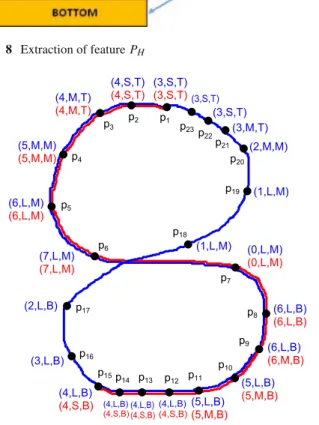
in the frame. It is also a ternary-valued feature (T or M or B). As shown in Fig.8, each image frame is horizontally divided into three regions, which are called as the top, mid-dle, and bottom. Subsequently, PH in each frame is
calcu-lated by setting thresholds Tcand Tdfor the x coordinate of
the centroid of the hand. This feature is targeted to detect
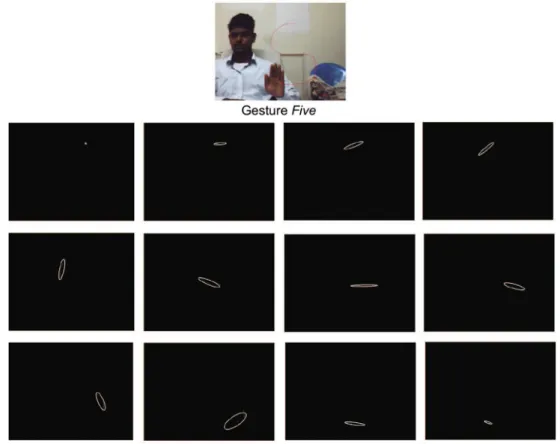
Fig.7 Ellipse fitting to gesture trajectory Five for r=6
thesetwolines,whichissubsequentlyusedfordetermining theproposedchaincode/feature.Thisprocessisperformed forallthepointsofthemotiontrajectory.Inourexperiment, thevalueofr issetto6.Itisexperimentallyobservedthat thehandstopsforatleastsixframesatgestureboundaries, andthelengthofthemajorellipseisverysmallforthe end-points.Thisconsiderationadditionallyhelpsustodetectthe endpoints(gesturespotting).Figure7showsvariousinstants ofellipsefittingcorrespondingtogesturetrajectoryfive.
AsexplainedinSect. 1,the conventional MCCfailsto describetheoriginaltrackofthegestureduetosegmentation ambiguities.ButthenewfeatureCEpreservestheshapeof
thegesturetrajectory,becauseinthiscasetherateofchange inthe orientationangle (θM A) is much lower.Hence,it
resultsinasmootherchaincode.Table2showsthedifference betweenMCCandCEforthegestureOne.Thesamegesture
isperformedthreetimesandtheparametersMCCandCEare
extracted.Clearly,theproposedfeatureCE nicelyencodes
theshapeofthegesturetrajectory.
Next,the feature LE isobtained fromthelength ofthe
majoraxis of the ellipse LM A.Asshown inFig.7, LM A
decreasesattheendpointsofagesture.Itisaternary-valued feature[(S) or (M) or (L)],whichisobtainedbysettingthe thresholdsTaandTb.ItindicateswhetherthelengthofLM A
issmall(S)ormedium(M)orlarge(L).Hence,the tempo-ralinformationofthehandtrajectorycanbeknownandthe
Fig. 8 Extraction of feature PH
Fig. 9 An example showing the proposed set of features (CE,LE,PH) for the gestures Five, indicated by the red-colored trajectory, and Eight, indicated by the blue-colored trajectory
the movement epenthesis. The boundaries of the movement epenthesis stroke are generally either in the top or bottom position of a video frame, whereas the middle region always contains the body of the gesture. The feature PH is derived
as follows: PH = ⎧ ⎨ ⎩ T, xt ≤Tc M, Tc<xt ≤Td B, xt >Td
The proposed features for the gestures ‘Eight’ and ‘Five’ are shown in Fig.9. It is evident that these three features may be the same for both of the gestures until point p8, but the feature LEchanges afterwards. Hence, the proposed features
can detect a gesture when it is embedded in another gesture. 3.3 Proposed gesture recognition scheme
Finally, as shown in Fig.10, the extracted features CE,LE,
and PH are applied to the proposed classifier. In our
experi-ment the train/test sequence o= {o1,o3,o3, . . . ,om}is
asso-ciated with the label sequencew= {w1, w3, w3, . . . , wm}.
The probability of the label sequencewgiven o is calculated
by using a log-linear exponential model: p(w|o)= 1 z(o)exp ⎛ ⎝p j=1 αjtj(wi−1, wi,o,i) + q k=1 βksk(wi,o,i) z(o)= w exp ⎛ ⎝ p j=1 αjtj(wi−1, wi,o,i) + q k=1 βksk(wi,o,i)
where, tj(wi−1, wi,o,i)is a transition feature function of
the observation sequence and the labels at positions i and i −1, sk(wi,o,i)is a state feature function of the label at
position i and the observation sequence, p and q are the total number of features for transition feature functions and state feature functions,αjandβkare weights to the exponent
which are estimated from training data by using the maxi-mum entropy criterion, and z(o)is a normalization factor to ensure thatwp(w|o)=1.
The transition and state feature functions are calculated using the binary-valued predicates on the observation data. An example of such a predicate in our experiment is given by
g(o,i)= ⎧ ⎨ ⎩
1 if o is at the position i defined by the feature value(4, S, B)
0 otherwise.
An example of the state and the transition feature functions that takes on the value of the predicates are given by
tj(wi−1, wi,o,i) = ⎧ ⎨ ⎩ g(o,i) ifwi−1=two andwi =one 0 otherwise sk(wi,o,i)= g(o,i) ifwi =one 0 otherwise
These transition and state feature functions help the CRF to model the data with arbitrary dependencies. An itera-tive algorithm called improved iteraitera-tive scaling (IIS) is then used to estimate the parametersθ= {α1, α2, . . .;β1, β2, . . .} from the training data=ot, wtTt=1that maximizes the log-likelihood objective function, which is found as L(θ)= T t=1 log pθwt|ot ∝ o,w p(o, w)log pθ(w|o)
Fig. 10 Block diagram showing proposed set of features CE, LEand PH
The conditional probability of the label sequence is computed efficiently by using the matrices. Let there be(n+1)labels in the label sequence with a starting and stopping labelw0= start andwn+1= stop. Then pθ(w|o)is calculated using a set of n+1 matrices. In this,{Mi(o)|i=1,2, . . . ,n+1}
where, Mi(o)is a|y×y|matrix with elements of the form
Mi w, w|o=exp ⎛ ⎝ j αjtj(wi−1, wi,o,i) + k βksk(wi,o,i)
The normalization factor zθ(o)is the product of these matri-ces
zθ(o)=(M1(o)M2(o) . . . .Mn+1(o))start,stop
tion, and all the gestures under consideration are performed with one hand only.
In the evaluation, we used gesture sequences correspond-ing to the numerals 0 to 9, as shown in Fig. 3. To obtain the feature LE, the thresholds Ta and Tb were set to 60
and 180, respectively. To extract the feature PH, the
cap-tured image frame is divided into three equally spaced hor-izontal blocks. As the frame resolution is 480×480, the thresholds Tc and Td were set to 160 and 320,
respec-tively. To ensure spatiotemporal variability, each gesture was performed by 10 signers. Even if the same person tries to perform the same sign twice, small variation occur in the speed and position of the hands. In total, 50 isolated samples per gesture were used to train the CRF. Subse-quently, the same CRF was again trained with another 50 samples per gesture class with each feature sequence cor-responding to the selected gesture appended with the pos-sible movement epenthesis segments. This training method creates an extra label in the CRF to handle movement epenthesis as the CRF learns the dependencies of move-ment epenthesis for the gestures. In addition, by setting the window size to 3, the CRF is designed to use only three past and future observations to predict the current state. Motion trajectories extracted by our method are shown in Fig.11.
4.1 Isolated gesture recognition
The classification results corresponding to different gesture sequences are shown in Table3. The overall recognition rate for our proposed method is 96.0 % as compared with 69.6 % when the MCC is used as a feature vector, a 26.1 % increase. The improvement is mainly because of the smoother chain code obtained by our proposed feature CH. However, a
rel-atively low recognition rate is reported for the gesture One, which might be due to the inability of CRFs to model the long-range dependencies. This can be overcome by increas-ing the window size, but this generates many features, which increases the computational complexity. Also, we note that our recognizer misclassifies the gestures One and Seven in some critical conditions. The misclassification occurs when the hand stops too long in the middle of the gesture Seven. And the conditional probability of the label sequence w is
given as pθ (w|o)= i n =+1 1 Mi(wi−1, wi|o) i n =+11 Mi(o) start,stop
In our proposed method, CRF is trained with one label for each gesture and an extra label is added to determine the non-gestural movements. Apart from the isolated ges-tures, all possible non-gestural movements are trained. To model the dependencies of non-gestural movements with gestures, a combination of gesture and non-gestural obser-vation sequences are used in the training data.
4Systemperformanceevaluation
The proposed system was tested in real-time on an Intel
Core I3-based personal computer. The input images are cap-tured by a CCD camera at a resolution of 480 ×480 pixels. The system is evaluated using both isolated and continuous gestures. During the evaluation, we use a comparatively sim-ple background as shown in Fig. 3. The background enhances hand segmentation performance. Moreover, all the experi-ments are with nearly constant uniform
illumina-Fig. 11 Motion trajectories extracted by the proposed method
4.2 Continuous gesture recognition
For continuous gesture recognition, 40 video clips of dif-ferent continuous gestures that contains movement epenthe-sis are considered and 216 sample gestures are used to test the system. We have only considered a few typical possible movement epenthesis and the embedded gesture cases for the
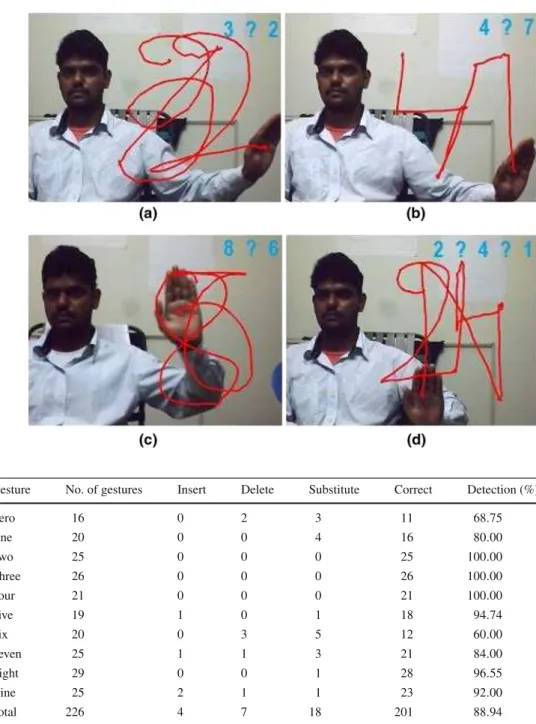
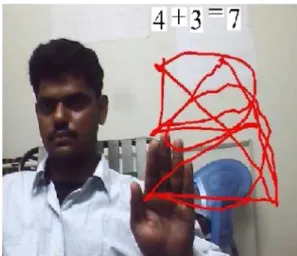
evaluation of the proposed algorithm. Some of the test gesture trajectories are shown in Fig.12. Three parameters are used to evaluate the performance of the proposed continuous ges-ture recognizer. They are labeled as insertion error, deletion error, and substitution error. The insertion error occurs when the spotter reports a nonexistent gesture. The deletion error occurs when the spotter fails to detect a gesture. The substitu-tion error occurs when the spotter falsely classifies a gesture. The detection ratio is the ratio of correctly recognized ges-tures over the number of input gesges-tures. Table4shows the performance of our proposed system in terms of the above mentioned parameters. The proposed system recognizes the continuous gestures with an accuracy of 88.9 %. As shown in Fig.12, the recognized gestures are displayed in the form of blue-colored text appearing in the top right corner of the image, where ? indicates the movement epenthesis present in between the gestures. Additionally, as shown in Fig.13, a gesture-based numeric calculator is implemented to highlight a possible application of our proposed method.
5 Conclusions
One critical issue in continuous gesture recognition research is to identify meaningful gestures in a continuous stream of body movements. This may be accomplished by spotting pre-cisely when a gesture in the sequence starts and ends. This is the goal of gesture spotting. Gesture spotting is essential for a recognition system to work continuously without need of human intervention. In particular, only if gesture spotting is supported in a vision-based interface, it is possible for a user to interact with the recognition platform using natural gestures without any restrictions. By spotting gestures in a
Table 3 Experimental results: isolated gesture recognition rates
No. of training samples per class: 50 No. of test samples per class: 25 Acc. rate % Class label No. of test pattern assigned to predefined class
Zero One Two Three Four Five Six Seven Eight Nine
Zero 25 0 0 0 0 0 0 0 0 0 100 One 0 21 0 0 0 0 0 4 0 0 84 Two 0 0 25 0 0 0 0 0 0 0 100 Three 0 0 0 25 0 0 0 0 0 0 100 Four 0 0 0 0 23 2 0 0 0 0 92 Five 0 0 0 0 0 25 0 0 0 0 100 Six 0 0 0 0 0 0 25 0 0 0 100 Seven 0 4 0 0 0 0 0 21 0 0 84 Eight 0 0 0 0 0 0 0 0 25 0 100 Nine 0 0 0 0 0 0 0 0 0 25 100 Avg. 96.0
Fig. 12 Continuous gestures: a Three-Two, b Four-Seven, c Eight-Six, d Two-Four-One
Table 4 Continuous gesture recognition using the proposed features
Gesture No. of gestures Insert Delete Substitute Correct Detection (%)
Zero 16 0 2 3 11 68.75 One 20 0 0 4 16 80.00 Two 25 0 0 0 25 100.00 Three 26 0 0 0 26 100.00 Four 21 0 0 0 21 100.00 Five 19 1 0 1 18 94.74 Six 20 0 3 5 12 60.00 Seven 25 1 1 3 21 84.00 Eight 29 0 0 1 28 96.55 Nine 25 2 1 1 23 92.00 Total 226 4 7 18 201 88.94
vocabularies. The techniques developed so far for coarticu-lation detection are generally not useful for a broad gesture vocabulary. This is because, motion interpretation itself is an ill-posed problem in the sense that a unique solution can-not be guaranteed. Moreover, the existing algorithms do can-not address the problems associated with the extraction of the smoothed motion trajectory and the more consistent motion chain code.
This work focuses primarily on solving two basic prob-lems in continuous gesture recognition, namely, gesture spot-ting and movement epenthesis detection, by extracspot-ting a smoothed motion trajectory via a modified motion chain continuous video stream, we can automatically remove
unin-tentional movements arising between gestures.
Again, coarticulation detection is one of the main chal-lenges in continuous gesture recognition. It is difficult to dis-tinguish between a valid gesture phase and the coarticulation phase only from the motion information. That is why, few vision-based approaches for estimating coarticulation have been reported in the literature to date. The methods proposed so far do not address the problems encountered in recogniz-ing all types of continuous hand gestures in a vision-based platform. Most of the existing algorithms use the glove envi-ronment and are successful only for some specific gesture
Fig. 13 A gesture-based calculator
code. Its main contribution is the extraction of three novel trajectory-based features to tackle movement epenthesis in continuous hand gesture recognition. The proposed system for movement epenthesis detection and subsequent recog-nition of individual gestures in a continuous stream of tures promises to perform well on different types of ges-ture sequences having different spatiotemporal characteris-tics and motion behavior.
The proposed gesture recognition scheme overcomes the fundamental problems associated with continuous hand ges-ture recognition with the help of novel trajectory-based fea-tures. The experiments demonstrate that the system is 96.0 % accurate for recognizing isolated gestures, and 88.9 % accu-rate for continuous gestures. The number of thresholds to obtain the features LE and PH are application dependent.
Evidently, CRFs can model the sequential data by consider-ing the arbitrary dependencies, but fail to model the long-range dependencies. This is the only reason the recogni-tion rate for gesture One is comparatively low. There is a probabilistic model called hidden conditional random fields (HCRF), which can model the long-range dependencies of the observed data [14]. Extending the proposed system using HCRF to recognize sign language is left for future work. Future work also includes the accurate segmentation and
tracking of a moving hand from a cluttered dynamic back-ground and the recognition of more fluent hand gestures in the form of continuous sign language.
References
1. Segouat J, Braffort A (2010) Toward modeling sign language coar-ticulation. Lecture Notes in Computer Science (Gesture in Embod-ied Communication and Human–Computer Interaction), vol 5934, pp 325–336
2. Yang R, Sarkar S (2006) Detecting coarticulation in sign language using conditional random fields. In: 18th international conference on pattern recognition (ICPR), vol 2, pp 108–112
3. Eisenstein J, Davis R (2005) Gestural Cues for Sentence Segmen-tation. Technical report, MIT AI Memo, pp 1–14
4. Lee HK, Kim JH (1999) An HMM-based threshold model approach for gesture recognition. IEEE Trans Pattern Anal Mach Intell 21(2):961–972
5. Bhuyan MK, Bora PK, Ghosh D (2011) An integrated approach to the recognition of a wide class of continuous hand gestures. Int J Pattern Recognit Artif Intell 25(2):227–252
6. Yang H-D, Sclaroff S, Lee SW (2009) Sign language spotting with a threshold model based on conditional random fields. IEEE Trans Pattern Anal Mach Intell 31(7):1264–1277
7. Alon J, Athitsos V, Quan Y, Sclaroff S (2009) A unified framework for gesture recognition and spatiotemporal gesture segmentation. IEEE Trans Pattern Anal Mach Intell 31(9):1685–1699
8. Zaki MM, Shaheen IS (2011) Sign language recognition using a combination of new vision-based features. Pattern Recognit Lett 32(4):572–577
9. Lafferty J, McCallum A, Pereira F (2001) Conditional random fields: probabilistic models for segmenting and labeling sequence data. In: Proceedings of 18th international conference on machine learning, pp 282–289
10. Wallach HM (2004) Conditional random fields: an introduction. University of Pennsylvania
11. Rabiner LR (1989) A tutorial on hidden markov models and selected applications in speech recognition. In: Proceedings of the IEEE, vol 77, no 2, pp 257–286
12. Chai D, Ngan KN (1999) Face segmentation using skin color map in videophone applications. IEEE Trans Circuits Syst. Video Technol. 9(4):551–564
13. Fitzgibbon A, Pilu M, Fisher RB (1999) Direct least square fitting of ellipses. IEEE Trans. Pattern Anal. Mach. Intell. 21(5):476–480 14. Quattoni A, Wang S, Morency LP, Collins M, Darrell T (2007) Hidden conditional random fields. IEEE Trans. Pattern Anal. Mach. Intell. 29(10):1848–1852