5-2016
How Do Manipulatives Help Students
Communicate Their Understanding of
Double-Digit Subtraction?
Rabab Abi-Hanna Montclair State University
Follow this and additional works at:https://digitalcommons.montclair.edu/etd Part of theEducation Commons, and theMathematics Commons
This Dissertation is brought to you for free and open access by Montclair State University Digital Commons. It has been accepted for inclusion in Theses, Dissertations and Culminating Projects by an authorized administrator of Montclair State University Digital Commons. For more information, please [email protected].
Recommended Citation
Abi-Hanna, Rabab, "How Do Manipulatives Help Students Communicate Their Understanding of Double-Digit Subtraction?" (2016).
Theses, Dissertations and Culminating Projects. 87.
A DISSERTATION
Submitted to the Faculty of
Montclair State University in partial fulfillment of the requirements
for the degree of Doctor of Education
by
RABAB ABI-HANNA Montclair State University
Upper Montclair, NJ 2016
iv ABSTRACT
HOW DO MANIPULATIVES HELP STUDENTS COMMUNICATE THEIR UNDERSTANDING OF DOUBLE-DIGIT SUBTRACTION
by Rabab Abi-Hanna
Multi-digit subtraction is difficult for students to learn. The purpose of this study is to explore how second-grade students communicate their understanding of double-digit subtraction through the use of manipulatives/tools. This qualitative study reports on six case studies of second-grade students where clinical interviews were the main source of data. Findings suggest that manipulatives/tools helped reveal cognitive constructs and difficulties that the handwritten algorithms were not conveying. For example, students who exhibited an understanding of the subtraction process had not yet developed an understanding of ten and 10 ones interchangeability. These results highlight the potential role of manipulatives/tools as communication tools that help reveal students’ actual cognitive development. Implications to research and practice in relation to students’ learning trajectories are discussed.
v
ACKNOWLEDGMENTS
This research came to fruition only with the assistance of many individuals. First and foremost, I would like to offer my heartfelt gratitude to my advisor and
committee chair, Dr. Eileen Fernandez, for her continuous support, patience, motivation, and immense knowledge. Her guidance facilitated this process; without her continuous encouragement and support, I would not have completed this project. This has been a long journey for us, and I am so happy that you shared the experience with me. The words “thank you” are not adequate to convey my sincere appreciation for all the work you did.
I am grateful to my committee members: Dr. Steven Greenstein for his thoughtful advice and constructive feedback. Thank you for your guidance and pushing me to speak about my findings with authority. I also thank Dr. Eileen Murray for her insightful comments and continued support. Thank you for sharing your expertise and for encouraging me to complete this dissertation.
I would also like to thank Dr. Mika Munakata and Ms. Stacy Pinto for their support. I am very grateful to have had you both in my corner.
I would also like to thank Dr. Nicole Panorkou for her support, and for sharing her expertise with me.
I would like to thank the Mathematics Department at Montclair State University, which has been a major focus of my life for many years. I would especially like to thank Dr. Helen Roberts and Dr. Ken Wolff for their support and encouragement over the
vi
years. I would like to thank the teachers and all the students who agreed to participate in my study without whom this research would not have been possible.
I would like to thank Jacky Dauplaise for being my critical, supportive friend and a great listener.
Above all, I would like to thank my family: Akram for being my best friend and believing in me. You are amazing. Ryan, Yasmine and Dahlia, thank you for taking on responsibilities at such a young age: I hope I make you as proud as I am proud of you. You kept me motivated and smiling. You all are my inspiration. There are no words to express the extent of my love and gratitude to you all. Your love and constant support throughout the years made this day possible. This is definitely our joint accomplishment as a family.
Thank you, Vivian Biron, for your love and daily encouragement; I look forward to hearing your voice every night. To Roger Biron, you will always be in my heart.
vii DEDICATION
This dissertation is dedicated to my family: Akram, Ryan, Yasmine, Dahlia, and Vivian and Roger Biron
viii TABLE OF CONTENTS ABSTRACT ... iv ACKNOWLEDGEMENT ...v DEDICATION ... vii LIST OF FIGURES ... xi CHAPTER I. INTRODUCTION ...1
What makes Subtraction Difficult ...2
Tools Used to Help in Understanding Multi-Digit Subtraction ...5
Base-ten blocks ...6
Unifix cubes ...6
Hundreds chart ...7
CHAPTER II. LITERATURE REVIEW ...9
The Child’s Perspective in the Research on Subtraction ...9
The Classroom Perspective in the Research on Subtraction ...13
Summarizing Remarks and Moving Forward ...19
CHAPTER III. THE FRAMEWORK...22
What We Know About Student Understanding ...22
Relational and Instrumental Understanding...23
Representations and Tools ...25
Representation...25
ix
Dual-Representation ...27
CHAPTER IV. METHODOLOGY ...30
Design of Study...30 Sample Selection ...32 Participants ...32 Data Collection ...33 Interview protocol ...33 Data Analysis ...42 Validity ...44 CHAPTER V. RESULTS ...48 Framework Revisited ...48 Concept of ten ...48
Connections for understanding ...49
Tools ...49 Case Studies ...50 Deidra ...50 Mimi ...56 Billy...63 Troy ...68 Ivan ...76 Sally ...82 Cross Analysis ...88
x
Different Mental Constructs ...88
Ten and ten ones equivalence ...88
Ten, not quite ten ones ...90
Lack of transfer ...91
No tens ...92
Responses to Unfamiliar Situations ...93
CHAPTER VI. IMPLICATIONS AND CONCLUSIONS ...96
Answers to Research Questions ...96
Discussion of Responses for Questions 1 and 2 ...101
Implications for Research and Practice ...103
Limitations ...109
Recommendations ...110
References ...112
xi
LIST OF FIGURES
Figure 1. Base-ten blocks and Unifix ...7
Figure 2. Hundreds chart ...7
Figure 3. Connecting base-ten blocks and English word ...14
Figure 4. Cardboard with place-value ...15
Figure 5. Subtraction sequence of 25 – 8 with conventional regrouping ...39
Figure 6. Unconventional subtraction sequence of 25 − 8 with Disruptive frame ...39
Figure 7. Subtraction sequence of 25 – 8 with common error ...40
Figure 8. Subtraction sequence of 33 – 16 with common error ...40
Figure 9. Subtraction sequence of 33 – 16 with conventional regrouping ...41
Figure 10. Unconventional subtraction sequence of 33 – 16 ...41
Figure 11. Example of case study organization ...42
Figure 12. Mimi’s work ...56
Figure 13. Mimi’s work (2) ...59
Figure 14. Billy’s work...66
Figure 15. Troy’s work ...69
Figure 16. Troy’s work (2) ...72
Figure 17. Troy’s reproduction of 34 and 19 ...73
Figure 18. Ivan’s work ...78
Figure 19. Ivan’s work (2) ...79
xii
Figure 21. Sally’s work (2) ...84 Figure 22. Sally’s work (3) ...87
Chapter I
INTRODUCTION
Multi-digit subtraction is hard to learn (Baroody, 1984, 1990; Fuson, 1984; Kamii, 2000). For decades, mathematics education researchers have been looking for ways to understand how students learn subtraction. The difficulties inherent in subtraction have led researchers to explore ways to reduce students’ struggles with subtraction. One of the approaches was the use of tools, such as manipulatives, but before researchers could offer any assistance, they needed to identify why students were struggling.
In this study, I focus on exploring how students articulate their understanding of double-digit subtraction. I will explore some of the difficulties children experience in learning subtraction. In the literature review, I will discuss what researchers say about subtraction, how students learn subtraction, and the role of tools, such as manipulatives, in learning subtraction. As a result of these investigations, I will propose the following research questions:
1. What can be inferred about how tools (like manipulatives) enable students to communicate their thinking about double-digit subtraction?
2. Given an interview setting with multi-digit subtraction problems and a selection of tools (like manipulatives), will students opt to use the tools to help them solve the problems? What are students’ perspectives on the use of tools with double-digit subtraction? What do they prefer and why?
What Makes Subtraction Difficult?
In this section, I will discuss what the literature reveals about the difficulty of subtraction. It is important for the reader to gain insight into the experience of a young learner in order to understand these difficulties with subtraction as well as the need to explore additional ways to support students’ learning.
In general, subtraction is more complex than addition (Baroody, 1984, 1990; Fuson, 1984; Kamii, 2000). One reason subtraction is considered to be difficult for students is that it requires students to mentally perform two separate cognitive tasks in opposite directions (Baroody, 1984; Kamii, 2000). “Counting down involves stating the minuend, counting backward a number of times equal to the subtrahend, and announcing as the answer the last number counted” (Baroody, 1984, p. 205). For example, to
calculate 27 – 19, the child would have to count down from 27 beginning at 26 until 19 is reached. Keeping track of how many numbers are counted down, the child announces eight.
Another line of research that investigates students’ difficulties considers how different contexts can generate challenges: “subtraction is not just take away but has multiple situational interpretations” (Fuson, 1984, p. 214). For example,
x Comparison: Susan has 8 cookies. Her friend Dan has 3 cookies. How many more cookies does Susan have than Dan?
x Separate or take away: Mary has 8 cookies. She gives 3 cookies to her friend Scott. How many cookies does she have left?
x Join missing addend: Dan has 3 cookies. How many more cookies does he have to get so that he will have 8 cookies?
x Combine missing addend: Greg has 3 raisin cookies and some oatmeal cookies. He has 8 cookies. How many oatmeal cookies does he have? (Fuson, 1984, p. 221)
For example, separate has one whole, and a part is taken away from it. Comparison has two wholes, and nothing is being taken away. Thus, comparison is harder than separate because the child has to mentally take the smaller whole and put it against the larger whole to find the relationship. In combine missing addend, there are two wholes, and, again, no part is taken away, whereas join missing addend begins with a whole and requires increasing to a larger whole, making it easier than comparison or combine missing addend (Kamii, 2000). As Kamii (2000) explains “[c]hildren must first understand the logic of the question before going on to numerical precision” (Kamii, 2000, p. 95). These different contexts and the wording of the questions make subtraction more challenging for students because they have to decipher the language and then figure out the math (Fuson, 1984).
Executing the subtraction comes with its own difficulties. Subtraction involving double-digit and multi-digit numbers presents a new challenge because the focus now becomes place-value (Fuson, 1990). For example, for a problem such as 35 – 14, students are expected to know that the 3 is in the tens place, and it is worth 3 tens, or 30 and the 5 is in the ones place and it is worth 5 ones, or 5. Thus, students now are expected to think 5 ones, take away 4 ones and 30 take away 10. While students may be
able to subtract correctly, their understanding of place-value may be fragile. This
becomes apparent in the language they use. For instance, students are taught to align the numbers in a vertical format, with the associated language 5 – 4 and 3 – 1. When questioned about 3 and 1, students may or may not realize that it is 3 tens and 1 ten, and they may or may not be able to associate it with 30 and 10, respectively.
Another challenge arises when the ones digit in the subtrahend is larger than the ones digit in the minuend. A common strategy taught here is regrouping (this is seen in mathematics for elementary school teachers’ textbooks such as Billstein, Libeskind & Lott, 2013, and in elementary textbooks such as Scott Foresman-Addison Wesley
mathematics, 2008). For instance, asking students to subtract 85 – 16 is a typical question that is intended to reinforce the idea of regrouping. In order to solve this problem with regrouping, base-ten blocks can be used to model these two numbers. With the units blocks, students are shown that 6 ones cannot be taken away from 5 ones. That is, students are taught that they cannot take a bigger number from a smaller number, so they have to take 1ten from the number in the tens place, break it into 10 ones, and add it to the number in the ones place. In this case, 10 ones and 5 ones are 15 ones. Now, there are enough ones to take away 6 ones.
The concept of regrouping can introduce a host of new problems. Sometimes (using 85 – 16), students subtract 5 from 6 because all they remember is you cannot take a bigger number from a smaller number, and they proceed to state 6 – 5 is 1 for the ones place. Then, they continue with 8 – 1 is 7, and they end up with 71 instead of 69.
Having zeroes (0s) in one of the place-values presents its own set of impediments. Consider that when a zero occurs in the middle of the numeral, as in 103 – 17. If we regroup, we have to regroup the 1 hundred into 10 tens and regroup one of the tens into 10 ones to get 13 – 7 and 90 – 10. We are left with 86. Some students may make the 3 a 13, but they may skip the zero because they perceive it as nothing and leave the 1 in the hundreds place. They proceed with the subtraction as 13 – 7 and 10 – 1, resulting in 96. Or they may subtract 7 – 3 and 1 – 0, ending up with 114. Each of these different situations can compromise students’ understanding of subtraction.
Tools Used to Help in Understanding Multi-Digit Subtraction
Researchers use different approaches to address children’s issues with subtraction (Baroody, 1990; Carpenter, Franke, Jacobs, Fennema & Empson, 1998; Cobb &
Wheatly, 1988; Fuson, 1990; Fuson & Briars, 1990; Selter, Prediger, Nuhrenborger, & Huβmann, 2012; Torbeyns, De Smedt, Stassens, Ghesquiere, & Verschaffel, 2009). In this study, I focus on how students use tools to communicate their understandings and misunderstandings during the subtraction process. Included among these tools are concrete manipulatives.
Concrete or physical manipulatives, as defined by Moyer (2001), are “objects designed to represent explicitly and concretely mathematical ideas that are abstract” (p. 176). Swan and Marshall (2010) extended the definition, specifying “mathematics manipulative material is an object that can be handled by an individual in a sensory manner during which conscious and unconscious mathematical thinking will be fostered”
(p. 14). In multi-digit subtraction, some of the tools used can include base-ten blocks, unifix cubes, and a hundreds chart.
Base-ten blocks
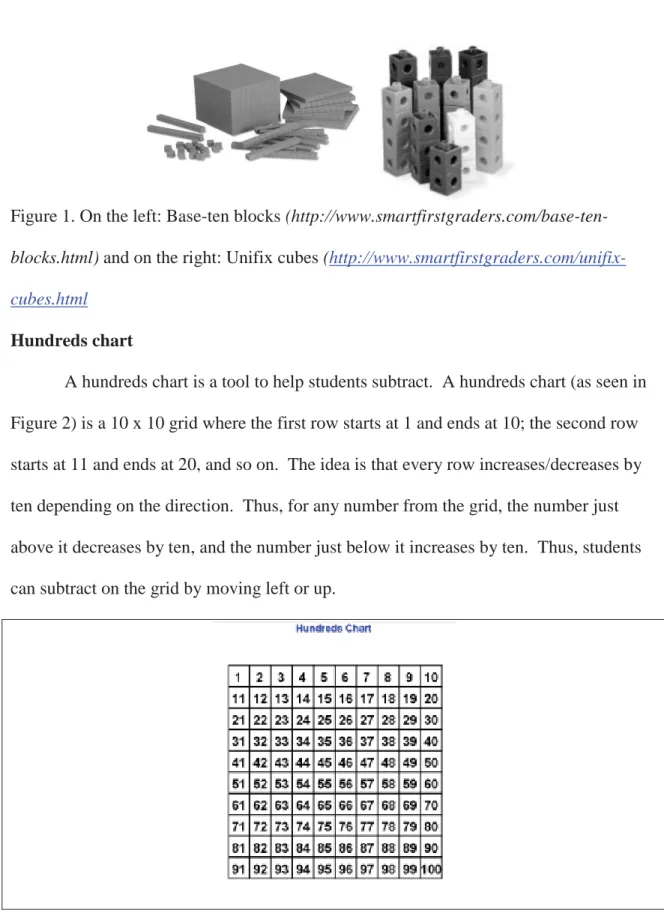
Base-ten blocks are intended to support students’ understanding of our base-ten number system. Base-ten blocks (also known as Dienes blocks, see Figure 1) are used to help explain place-value. The little cubes represent the units or ones; the rods represent the tens; the flats represent the hundreds, and the big cubes represent the thousands. Many teachers are taught to use base-ten blocks in the hope that they would make place-value easier for students to understand, as seen in mathematics textbooks for elementary teachers such as Billstein, Libeskind and Lott, 2013 and Long, DeTemple and Millman, 2015.
Consider the number 85. Base-ten blocks allow for multiple representations of 85. For example, students can count 85 ones, or they can use the 10-rods and the ones to represent 85 as 8 tens plus 5 ones. These multiple representations emphasize place-value and allow for re-grouping, which arises during multi-digit subtraction.
Unifix cubes
Unifix cubes can also be used to represent ones and tens because they can snap together (see Figure 1). When the 10 unifix cubes are snapped together to make a tower of ten, it becomes easier to show students how one tower of ten can be decomposed into 10 ones. For example, the number 15 comprises one ten and five ones. Using the unifix cubes, the tower of ten can easily be broken into ten ones, yielding 15 ones. Again, these unifix cubes can be used to support regrouping during subtraction.
Figure 1. On the left: Base-ten blocks (http://www.smartfirstgraders.com/base-ten-blocks.html) and on the right: Unifix cubes ( http://www.smartfirstgraders.com/unifix-cubes.html
Hundreds chart
A hundreds chart is a tool to help students subtract. A hundreds chart (as seen in Figure 2) is a 10 x 10 grid where the first row starts at 1 and ends at 10; the second row starts at 11 and ends at 20, and so on. The idea is that every row increases/decreases by ten depending on the direction. Thus, for any number from the grid, the number just above it decreases by ten, and the number just below it increases by ten. Thus, students can subtract on the grid by moving left or up.
The tools above have played an important role in students’ understanding of mathematical concepts (Cain-Caston, 1996; Flores, 2009, 2010; Fuson, 1990; Fuson, Wearne, Hiebert et al., 1997; Moyer, 2001; Ojose, 2008; Sowell, 1989; Swan & Marshall, 2010). Some proponents of their use highlight the fact that students need concrete
experiences for learning to occur. Some argue that manipulatives engage students concretely in the activities or tasks at hand (Cain-Caston, 1996; Hansen-Powell, 2007). However, experts emphasize the need for making a specific connection between the manipulative and the mathematics learned and note that if that connection is not clearly understood, the manipulatives might create misconceptions (Fuson, 1990; Fuson & Briars, 1990; Fuson, Wearne, Hiebert et al., 1997; Moyer, 2001; Swan & Marshall, 2010). That is, the mere presence of manipulatives does not necessarily improve understanding. “[S]tudents must reflect on their actions with the manipulatives to build meaning” (Moyer, 2001, p. 177).
CHAPTER II
Literature Review
In an effort to understand why students experience difficulty with multi-digit subtraction, researchers have approached the problem from a variety of perspectives. In this section, I organize these perspectives under two headings: the child’s perspective in the research on subtraction, and the classroom perspective in the research on subtraction. The research discussed under the former heading comprises studies that focused on how students understand and provided insight into why students have difficulties specifically with subtraction. The latter heading encompassed research that tackled one of the issues that is characteristic of the classroom: performance. This research offered methods of instruction to improve student performance.
The Child’s Perspective in the Research on Subtraction
In order to disentangle students’ difficulties with subtraction, one line of research focused on students’ understanding (Baroody, 1990; Carpenter, Franke, Jacobs, Fennema & Empson, 1998; Cobb, 1988; Cobb & Wheatly, 1988; Fuson, 1990; Hiebert &
Carpenter, 1992; Kamii, 2000). For example, in 1988, Cobb and Wheatly criticized instructional materials for the misconceptions they propagate in learning subtraction. They explained that children construct three concepts of ten: ten as a numerical composite, ten as an abstract composite unit, and ten as an “iterable” unit. In the first case, children have “yet to construct ten as a unit of any kind” (Cobb & Wheatly, 1988, p. 5). In other words, they do not recognize that ten is structurally different from any other number. In the second case, children can construct an abstract composite of ten. That is,
they can see ten as a single entity while “simultaneously maintaining [its] tennesss” (p. 5), but counting by ten does not mean ten more or ten less. Rather, it is the last construct of ten as an “iterable” unit that signifies the understanding of ten as a unit that is itself made up of ten ones.
Cobb and Wheatly (1988) posited that although textbooks have pictures of bundles of ten, children are not given the opportunity to construct ten as an “iterable” unit; instead, they treat the ten as a new abstract object, an “abstract singleton” (p. 23). Students do not recognize the fact that one ten is made up of ten ones. The authors argued that the lack of opportunities to build meaning leads to superficial knowledge and rote procedures. They claimed that the textbook approach to teaching place-value
emphasizes the value that digits have based on their position (ones, tens), rather than the relation of the positions to each other. This emphasis on the position of digits precedes the introduction of the standard two-digit subtraction procedures. The combination of disassociating one ten and ten ones and the emphasis on the position of the number (ones, tens) results in a misrepresentation of place-value. The authors described this approach as a flawed representation that leads “… teachers to systematically misteach place-value” (Cobb & Wheatly, 1988, p. 3).
Essentially, Cobb and Wheatly’s (1988) article emphasized the need for young learners to construct a mental representation of ten: a ten comprised of ten ones. Until students reach this developmental stage, place-value does not necessarily mean much to them. Rather than blaming students for not understanding, Cobb and Wheatly (1988) referred to the “inadequacy of adult mathematics for understanding children and for
planning instruction” (p. 2). Accordingly, adults impose their own understanding of ten on students and do not take the time to explore students’ understanding of ten.
In his article addressing the goals of mathematics instruction, Cobb (1988) stated that “[a] fundamental goal of mathematics instruction is or should be to help students build structures that are more complex, powerful, and abstract than those that they possess when instruction commences” (p. 89). In other words, students should be given opportunities to make meaning from what they are learning and continually build on the conceptual structures they already have. Cobb (1988) described an episode between a student and her teacher who was teaching his pupils the count backwards method to solve subtraction problems. As the teacher assessed his student, he inferred that she was
merely trying to do what she had been told, but that she was not always successful. Faced with a problem the student could not solve, she declared, “Okay, I know it - I just can’t get it in my mind” (p. 94). The teacher then engaged his student in activities that allowed her to construct “a backward counting method that expressed her concepts. First, she did not a use a new method until she was in a situation where her … methods did not work” (p. 95). This interaction between teacher and student highlights the importance of understanding how students are thinking as well as the mental images they are
constructing. The process gives the student a voice and allows the student to build on his/her genuine understanding.
Baroody (1987) would agree that mathematics instruction is essentially a process that aims to provide students with opportunities that enable them “to discover
that children who are actively involved in their learning do not rely on the memorization of steps, but rather look for and use relationships to check their actions. In contrast, children who blindly follow a step-by-step procedure fail “to connect what they do know to what they are doing” (Baroody, 1987, p. 45). For example, when a student is faced with a multi-digit subtraction “such as 206 – 77” (p. 231), he or she may proceed with subtracting 6 from 7 and 0 from 7 and ending up with 271 without considering the fact that the answer he or she came up with (the difference) is greater than the number he or she started with (the minuend).
Similarly, based on the perspective that children can construct ways of adding and subtracting without explicit instruction, Carpenter, Franke, Jacobs, Fennema and Empson (1998) found that students who were given the opportunity to invent strategies to add and subtract multi-digit numbers developed an understanding of base-ten number concepts before the students who only knew the algorithm. Students were able to use their invented strategies “flexibly to transfer their use to new situations” (p. 16).
Accordingly, Kamii (2000) explained that children construct mental relationships from within, and as they put these previously made relationships into new relationships, (that is, new constructs) children construct logico-mathematical knowledge. In a study she conducted with Chandler (Chandler & Kamii, 2009), the role that manipulatives played in children’s understanding was addressed. They investigated children’s
construction of tens using dimes and pennies. They played a “store” game with students, ranging from kindergarteners through fourth graders, in which the student was the cashier and the interviewer was the customer. Seven different purchases were made; the costs
ranged from two to nine cents, and the payments were made with pennies, a dime, or a combination of pennies and a dime, depending on the task targeted by the interviewer. Their study explored how “children give change when a dime or a dime and a few pennies are offered as payment for a purchase of up to 9 cents” (p. 110). They explained that many students who confidently stated that a dime is worth 10 pennies did not
exchange the dime into 10 pennies to give the correct change during the interaction between the student and the interviewer. The failure to make a connection between the dime and the 10 pennies is an indication that, for these students, a dime was something different from 10 pennies.
Chandler and Kamii (2009) explained that children need to be given numerous opportunities to construct mental relationships through their own thinking and actions to build on their logico-mathematical knowledge. This view concurs with Cobb and Wheatly’s (1988) position on the three different constructs of ten that students make and reinforces the learner’s statement about not getting it “in my mind” (Cobb, 1988).
Chandler and Kamii (2009) suggested that some students might not have made the mental relationship when they think of tens and ones simultaneously.
The Classroom Perspective in the Research on Subtraction
“Teaching the step-by-step borrowing algorithm for multidigit [sic] subtraction is easier than building up the network of relationships that constitutes knowledge of place value” (Baroody, 1987, p. 43). Baroody is not endorsing the teaching of procedures while ignoring the importance of conceptual structures students develop in mathematical understanding. However, he captures a reality that exists in many public school
classroom settings, in which the emphasis is on demonstrating how well students perform on tests. In this section, I explore a line of research that represents a different perspective on learning. These research studies provide instructional approaches that may enable students to successfully execute multi-digit subtraction problems in the classroom.
For instance, Fuson (1990) attributed elementary students’ low level of competence with place-value and multi-digit subtraction to instructional methods implemented in the United States and to the irregularities of the English language. She argued that the connection between the English word and the written “mark/symbol” of a number is very difficult for young children to grasp. In an effort to alleviate some of the difficulties that subtraction causes, Fuson and Briars (1990) offered a teaching/learning approach that emphasized the connection between the base-ten blocks and the English word. The goal of the initial part of instruction was to explore the relationships between the different blocks and their connection to the English word, including consistent discussion and demonstration of trading one-for-ten and ten-for-one (see Figure 3).
A large piece of cardboard with place-value columns was used to illustrate the problem. Using the example, 3725 – 1647, blocks representing the first number were placed in the first row, blocks representing the second number were placed in the second row, and digits were placed in columns in the corresponding place-values (see Figure 4).
Figure 4. Cardboard with place-value chart in Fuson & Briars, 1990, p. 186
When students were asked to subtract, they would check the first column on the right to see if the number on the bottom was less than the one on the top; if it was not, they would trade a ten for ten ones so that the number on top was larger than the one on the bottom; then, they were able to proceed. This approach modeled the standard
algorithm and was meant to reduce the students’ difficulties in performing the procedure. Pre- and post-tests measured students’ success; that is, the number of correct answers on the post-test was compared to the pre-test. This type of student assessment is different than that discussed in the section entitled, “The Child’s Perspective in the
Research on Subtraction,” because the score a student gets exemplifies the student’s learning. The emphasis on connecting the blocks with the English word for the number is important because in a typical public school classroom, students are judged based on how well they execute an algorithm. However, we cannot conclude that students have gained a better understanding of place-value. On the other hand, students’ success can be
attributed to instrumental understanding (Skemp, 1976); that is, students know the procedure and know how to use it, but they may not understand it. After all, “children can rotely learn procedures with manipulatives as easily as they can with written symbols” (Baroody, 1990, p. 285).
In fact, using the same teaching/learning approach, Fuson and Briars (1990) conducted a second study. However, the authors found that, the “approach did not result in maximal learning in all areas by all children” (p. 202). According to the authors, the approach to the use of the blocks in the first study was more successful in supporting students’ thinking when they were able to self-correct on the post-test or during the interviews. Students in the second study continued to make errors and did not self-correct. This is an interesting observation. Students who are actively involved in their own learning, according to Baroody (1987), are able to rely on the mental relationships they have made. It would be reasonable to infer that these students may be able to self-correct because they rely on their understanding as they engage in solving problems. In contrast, students who memorize and follow procedure steps do not construct such mental relationships (Baroody, 1987), and, therefore, may not be able to self-correct. The results of this study draw attention to the focus of the teaching/learning approach, e.g. what was
measured. The purpose was to learn the standard algorithm of multi-digit subtraction while using manipulatives. The number of correct answers indicated students’ success. Once again, learning was measured by a score on a test.
One reason for the discrepancy in the success of the approaches in the two studies may be attributed to the implementation of the study, the support provided to classroom teacher participants, and the opportunity given to students to develop their understanding of the place-value and the multi-digit subtraction procedure. These conflicting results raise questions about how to characterize the connections students were expected to make. The deciding factor in evaluating students’ success or failure to understand the connections was the post-test score. Despite the fact that successfully executing the multi-digit procedure is an important aspect of the typical public school classroom experience, such success may not necessarily equate to true understanding. Flores (2009, 2010) demonstrated that students who were experiencing difficulty with subtraction and subtraction with regrouping were successful in meeting the district-wide mandated benchmarks after participating in the
Concrete-Representational-Abstract (CRA) instructional sequence. This sequence of instruction comprised three phases. First, the concrete phase required teachers to use concrete/ physical manipulatives to support conceptual understanding. Specifically, teachers used base-ten blocks to demonstrate subtraction and subtraction with regrouping, followed by guided and independent practice. Second, the representational phase followed the same steps as the concrete phase, but the manipulatives were not used; they were replaced by drawings and/or pictures. Following this phase, students were provided with a mnemonic
strategy to help them remember the steps involved in a mathematical computation process. Finally, during the abstract phase, when completing a mathematical task, students transitioned from using pictures or drawings to using only numbers. The
instruction in this phase focused on computational fluency; it involved “… memorization and continues until the students learn the operation or procedure automatically” (Flores, 2009, p. 145).
The effects of the CRA instructional sequence “… resulted in academic gains” (2009, p. 150). These gains were measured using a pre- and post-test assessment. That is, given subtraction problems that required regrouping, students were able to
successfully follow the steps they memorized. However, it was difficult to assess whether students established the relationships (Baroody, 1987) necessary to form meaningful learning of computational fluency merely by successfully performing a procedure.
The study also reported that students were able to retain that knowledge even six weeks after the instruction (Flores, 2010). On one hand, it would seem that the use of base-ten blocks in the first phase of the sequence supported students in successfully computing the subtraction problems. After all, part of the CRA sequence focuses on memorization, which would more likely be related to instrumental understanding (Skemp, 1976). That is, students are proficient in following the steps, but they may not necessarily understand why. On the other hand, it would be difficult to assess whether students will really understand place-value and multi-digit subtraction in the long term.
Students were tested six weeks after the CRA approach, but there was no evidence that they had built a genuine understanding of subtraction after six weeks.
The studies cited in the “The Child’s Perspective in the Research on Subtraction” section focused on students’ understanding. The students’ voices emerged from the message the authors were asserting: students require numerous opportunities to construct their network of mental relationships. In contrast, the studies in this section focused on helping students become adept at computing the step-by-step procedure for multi-digit subtraction. In this case, learning the procedure was a priority, and students’ voices disappeared. Therefore, the focus was on students successfully performing the algorithm.
Summarizing Remarks and Moving Forward
Much has been written about the importance of using manipulatives to clarify mathematical concepts and engage students in mathematical thinking to develop their conceptual knowledge (Clements & Sarama, 2005; Cobb & Wheatly, 1988; Flores, 2009, 2010; Fuson & Briars, 1990; Fuson, 1990; Fuson et al., 1997; Kamii, 2000; Chandler & Kamii, 2009; Moyer, 2001; Moyer, Niezgoda & Stanley, 2005; Reimer & Moyer, 2005; Sowell, 1989; Steen, Brooks & Lyon, 2006; Suh & Moyer, 2005; Swan & Marshall, 2010;Uttalet al., 2013). The research consensus is that manipulative use requires teachers to assign careful and thoughtful tasks that are designed to compel students to engage in mathematical ideas and thinking. The mere presence of manipulatives in the classroom does not imply that students are making the intended cognitive connections, which places the responsibility and burden on teachers to select the appropriate tool for each particular student.
Nevertheless, how was success measured? Many of the studies measured success in terms of pre- and post- tests and the number of correct answers. For example, in some studies (Flores, 2009, 2010; Fuson & Briars, 1990), the focus was on the algorithm, whether learning a procedure with or without manipulatives. In contrast, other studies (Baroody, 1987; Cobb, 1988; Kamii, 2000) were more concerned with how students understand the procedures than they were with using a specific method of instruction. Their findings suggested they focused more on the role of manipulatives and assessing where the students were developmentally in learning subtraction. They emphasized issues such as adults imposing their own understanding of multi-digit subtraction and regrouping on students.
Currently, we are experiencing anew the aforementioned issues. The disregard for these issues manifests itself in the expectations set by the Common Core State Standards (CCSS), which reduces evaluating students’ learning to a list of items to be accomplished (Kamii, 2015). For example, the following is a standard objective for second grade students in the domain of “Numbers and Operations in Base Ten:”
Add and subtract within 1000, using concrete models or drawings and strategies based on place value, properties of operations, and/or the relationship between addition and subtraction; relate the strategy to a written method. Understand that in adding or subtracting three-digit numbers, one adds or subtracts hundreds and hundreds, tens and tens, ones and ones; and sometimes it is necessary to compose or decompose tens or hundreds (CCSS, http://www.corestandards.org/Math/Content/2/NBT/).
To meet this specific standard, second grade students are expected to add and subtract three-digit numbers using manipulatives. Kamii (2015) maintains that this is
unreasonable because meeting the goal depends on whether students have developed a mental construct of tens and hundreds, whereas only a minority of students at this grade level would have built these constructs. It would seem the research that describes how students learn and build their understanding is being ignored, and according to Kamii (2015), “the authors of the CCSS are not aware of the difference between logico-mathematical knowledge and social-conventional knowledge, they urge the direct teaching of logico-mathematical knowledge” (p. 19), which is not teachable.
Consequently, it is now relevant to resuscitate the students' voices because their voices are not being reflected in the policies of the CCSSM. It is time once again to listen to students; therefore, I pose these questions:
1. What can be inferred about how tools (like manipulatives) enable students to communicate their thinking about multi-digit subtraction?
2. Given an interview setting with multi-digit subtraction problems and a
selection of manipulatives, will students opt to use the manipulatives to help them solve the problems? What are students’ perspectives on the use of manipulatives with double-digit subtraction? What do they prefer and why?
Chapter III
The Framework
The constructs used to frame the underlying structure of this study originate from different theories. In this chapter, I will discuss each of these theories, and then I will summarize how I will use them.
1. Cognitive theory
2. Relational and instrumental understanding 3. Representations and tools
4. Dual-representation theory
What We Know About Student Understanding
Understanding requires building relationships between mental structures (Hiebert & Carpenter, 1992). Understanding cannot be passively absorbed; it is “actively
constructed from within” (Baroody, 1987, p. 10) by connecting new knowledge to existing knowledge. Making these connections can help to strengthen a learner’s understanding because the way he/she thinks about a mathematical idea changes (Baroody, 1987). A good example of this process is the concept of ten as presented by Cobb and Wheatly (1988) earlier in this thesis. When students have an understanding of ten as a singleton, that is, they do not conceptualize it as ten ones; their understanding is limited or weak because they have not yet constructed the relationships between the mental representations of ten and ten ones (Hiebert & Carpenter, 1992). Once they have made that connection and created the relationship between ten and ten ones as the same, or simultaneously, then their understanding of the concept of ten changes. It becomes
more powerful. This new perspective leads to changes in their thinking patterns that are essential to the development of understanding (Baroody, 1987).
Using cognitive theory is crucial for the analysis of my data because it enables me to understand how and what students understand. The purpose of this study is to explore how students articulate their understanding of multi-digit subtraction using
manipulatives. In order to recognize the connections of students’ mental representations of mathematical ideas, I must understand what it means for a learner to understand.
Relational and Instrumental Understanding
In the typical elementary school, the dominant teacher model of student
understanding is a procedural model. It follows that students’ understanding is primarily characterized as procedural or conceptual. In reality, students are assessed on how successful they are at executing a procedure. The relational and instrumental understanding (Skemp, 1976), coupled with a reconceptualization of procedural
knowledge (Star, 2005), helped me to recognize what and how students understand multi-digit subtraction. First, I will define the relational and instrumental understanding. Then, I will describe how Star (2005) re-conceptualized procedural understanding.
Relational understanding refers to knowing what to do and why we do it (Skemp, 1976), whereas instrumental understanding is having the rule, using the rule but not knowing why and how the rule works (Skemp, 1976). These two types of understanding are so embedded in a mathematics classroom that using them as a guide to distinguish understanding is only natural. Like a piece of a puzzle, this distinction fits well with the reconceptualization of procedural understanding. Star (2005) disputes the dichotomized
view of procedural and conceptual understanding because it qualifies the types of understanding and puts them on opposite sides (Eisenhart, Borko, Underhill, Brown, Jones & Agard, 1993; Rittle-Johnson & Alibali, 1999; Rittle-Johnson, Siegler & Alibali, 2001). In fact, both play a critical role in students’ learning. Star (2005) introduces the term deep procedural knowledge as “knowledge of procedures that is associated with comprehension, flexibility, and critical judgment and that is distinct from (but possibly related to) knowledge of concepts” (Star, 2005, p. 408).
This definition provides a new perspective that challenges the more dominant view of procedural and conceptual understanding that govern classroom practices to this day. The prevailing thought in some of the research studies (Eisenhart et al., 1993; Rittle-Johnson & Alibali, 1999; Rittle-Johnson et al., 2001) and most classrooms is that conceptual knowledge is perceived to be knowledge of concepts, rich with connections of mathematical ideas, which characterizes it as deep understanding. “This knowledge is flexible and not tied to specific problem types and is therefore generalizable” (Rittle-Johnson et al., 2001, p. 347). In contrast, procedural knowledge is described as knowledge of steps in an algorithm with no connections to mathematical ideas, to why the steps are relevant or what they mean. Therefore, procedural knowledge is
characterized as superficial understanding (Eisenhart et al.,1993; Rittle-Johnson & Alibali, 1999; Rittle-Johnson et al., 2001). “This type of knowledge is tied to specific problem types and therefore is not widely generalizable” (Rittle-Johnson et al., 2001, p. 346). These definitions favor conceptual knowledge over procedural knowledge.
With his alternative approach, Star (2005, 2007) introduces the possibility that both procedural and conceptual knowledge can be either deep or superficial. In comparison to relational and instrumental understanding, relational refers to deep understanding, whereas instrumental falls under superficial understanding. In any case, this approach to understanding is very important specifically because the way students are assessed in the classroom depends heavily on their success with procedural fluency.
Representations and Tools
The use of tools is an important component of this study. Therefore, it is
imperative to explain what representation is and what role tools play in the development of children’s understanding of mathematical concepts.
Representation
Kamii (2000) best explained Piaget’s theory of abstraction and representation. Abstraction is a process by which mental representations are created from sensorimotor perceptions. Physical knowledge is knowledge of external aspects of objects, such as color, weight, shape, etc. Social knowledge is knowledge created by individuals, such as language, traditions, etc. Logico-mathematical knowledge refers to the mental relationships created by each individual. These “mental actions on previously constructed mental relationships are known in everyday language as thinking” (Chandler & Kamii, 2009, p. 98). Children represent ideas that come from within their mind; it is a mental construct. As children proceed to put these mental constructs into relationships, they construct logico-mathematical knowledge. Base-ten blocks do not themselves inspire an understanding of the base-ten number system if the child has not achieved a
“level of constructive abstraction” (p. 21) that would allow him/her to make such mental relationships. The base-ten blocks can, at best, aid in acquiring social (conventional) knowledge “to show how our system of writing [numbers] works” (Kamii, 2015, p. 12).
The Tool
Vygotsky’s (1978) work on the use of tools is also relevant to grounding this study. Tools exist in the child’s social experience. Just as children use physical tools like markers, crayons, computers, or any other object that can be physically manipulated to achieve a goal, they also use cultural tools such as signs, symbols, numbers and, most importantly, language to expand their mental abilities. Furthermore, speech plays a crucial role in the child’s development. Speech starts as a description of the situation, and as a child continues to self-speak, speech turns into analysis and becomes part of planning a solution. Speech is one link between the problem and the solution; this link is referred to as a stimulus or sign. The convergence of the physical and psychological use of the tool allows the development of higher order functions. According to Vygotsky, the child's behavior influences the tool/object. In other words, it affects the object/activity; thus, the behavior is externally oriented. The sign, on the other hand, does nothing to the object, no change is inflicted on it. However, it represents a "means of internal activity aimed at mastering oneself." (Vygotsky, 1978, p. 54). The combination of tool and sign leads to higher behavior or higher psychological function, which is learning according to Vygotsky (1978).
The purpose of this study is to examine the role manipulatives play in helping students communicate their understanding of double-digit subtraction. Vygotsky’s theory
and Kamii’s treatment of representation merge the tool (manipulatives), the role of language, and the thinking (the mental activities affecting student understanding).
Representation is what an individual does. As a student uses base-ten blocks, for example, he/she abstracts precepts from handling the blocks. He/she goes through a process of creating mental constructs, also called abstractions. Representations are built through this process. In terms of base-ten blocks, a young learner can look at a long rod and say it is a ten, which only reflects his/her social conventional knowledge. Only after he/she has constructed mental representations that allow him/her to think of ten ones and ten simultaneously would this young learner truly understand that a rod represents a ten.
Dual-Representation
The dual-representation theory is related to Kamii’s work on representation. This theory gives me another perspective on how young learners view and relate to the manipulatives they are using. For instance, developmental psychology researchers explain the success and failure of students’ experiences with manipulatives using the dual representation hypothesis (McNeil & Jarvin, 2007; Uttal, Scudder & DeLoache, 1997). The core principle is that a concrete symbol (or model) can be viewed in two different ways: as the object itself with its own properties, or as a tool to model something else.
The suggestion is that a concrete object is intrinsically interesting, and students may be so distracted by its physical properties that the object is no longer a useful tool in facilitating the construction of abstractions. In McNeil, Uttal, Jarvin & Stenberg’s (2009) study they found that using perceptually rich concrete objects to trigger students’ real-world knowledge interfered with students’ learning because it may have created a divide
between formal (school-taught) and informal knowledge. These findings support
Kamii’s treatment of representation as a mental construct and maintain that manipulatives in themselves are objects with their own physical traits; manipulatives cannot represent ideas. A representation, as explained by Kamii, is a mental process that occurs when a learner constructs a concept in his/her head. It originates in the learner’s mind. This logico-mathematical construct is not teachable; it is dependent on the learner and where he/she is developmentally. Therefore, unless the student has constructed the knowledge in his/her mind, the physical object is only helping the student achieve
social-conventional knowledge (Kamii, 2000).
Each of the theories discussed above will play a role in helping me to understand the student’s thinking process. As I analyze the data, I will be cognizant of how students come to understand double-digit subtraction. Cognitive theory allows me to understand the developmental phase of a student by listening to his/her explanations and by
observing his/her behavior while working. Based on these observations, I will be able to infer what kind of mental relationships a student has constructed. Vygotsky’s (1978) research on tools gives me a better understanding of the role tools (physical or mental) can play in learning. As Kamii (2000) explains, these tools support constructive
abstractions that lead to mental representations. The dual-representation hypothesis will help me to be aware of a possible separation between the tool as an object that is
intrinsically interesting with its own properties, and the tool as an object that facilitates understanding a mathematical idea. Finally, as I observe a student and how he/she proceeds with the task at hand, I will depend on Skemp’s (1976) explanation of relational
and instrumental knowledge as well as Star’s reconceptualization of procedural knowledge to enable me to assess the type of knowledge a student exhibits.
Although I discuss the theories separately, I believe that they are intricately interrelated. For example, if a student exhibits instrumental understanding, then it is reasonable to assume that the student has a superficial understanding of a procedure because the student would know how to use the procedure, but most likely does not understand why the procedure works. Such an observation would lead me to conclude that the student has not yet built the necessary mental networks to promote constructive abstractions that would allow the emergence of mental representations, which
Chapter IV
Methodology
Design of study
The purpose of this study is to describe and investigate whether and how tools help students to communicate their understanding of double-digit subtraction. This focus makes thequalitative paradigm an appropriate methodological choice. Qualitative
methodology is especially useful because it can provide a rich description and insight into the subjects’ thinking processes. In the present study, the focus is on how students
communicated their understanding of double-digit subtraction and, specifically, how they communicated that understanding as they are using the tools. The setting was a
naturalistic setting in the sense that the researcher was not manipulating or controlling the student’s activity (Merriam, 2009; Savenye & Robinson, 2005).
Moreover, the approach was phenomenological because the study explored a shared experience (Laverty, 2003): subtraction. For this study, the phenomenological approach attempted to capture a second grader’s experience in solving double-digit subtraction problems with or without the use of tools. Phenomenology was considered to be the most appropriate “to explore the phenomena of pedagogical significance” (Kafle, 2011 p. 183). It attempted to understand the student’s experience and to disclose the meanings of this shared experience. It represents hermeneutic phenomenology because it is informed by the individual participant’s experience (Laverty, 2003). According to Laverty (2003), in Heidegger’s phenomenology, also known as hermeneutic
background understanding” (p. 24). As it pertains to this study, a student’s experience has been influenced by the student’s history, for example his/her cognitive development, his/her knowledge of the topic, the tools, and the classroom environment. All of the students shared the experience of solving multi-digit subtraction; however, each student’s approach was influenced by his/her personal background knowledge.
Clinical interviews were used to collect data, because the objective of the research was to encourage students to express their own thinking about their own concepts and methods (Ginsburg, 1997). The clinical interview is “a flexible method of questioning intended to explore the richness of children’s thought, to capture its fundamental activities, and to establish the child’s cognitive competence” (Ginsburg, 1981, p. 4). In this study, I wanted to give the students a voice and to encourage them to verbalize their thinking and understanding of double-digit subtraction. I assumed an interpretive stance in analyzing the data. As discussed in Meriam (2009), interpretive research “…assumes that reality is socially constructed, that is, there is no single, observable reality. Rather, there are multiple realities, or interpretations” (p. 8). The idea here is that researchers make inferences from their interpretation of observed behaviors. These observed behaviors are naturally subjective and vary from one individual to the other. I followed Ginsburg’s (1997) approach to an interpretive stance as it relates to the clinical interview. I was interested in what the students’ behavior revealed about their process of solving double-digit subtraction problems. Thus, I relied on the richness of the interview to “…assign meaning to words or actions on the basis of how they fit into the entire context of the session…” (Ginsburg, 1997, p. 79).
Sample Selection
Purposeful sampling (Merriam, 2009) allows the researcher to learn about a more focused, as opposed to a more general, population. For this study, several factors played a role in selecting the school. I had worked closely with the school’s administration as the math consultant, hired by the district to assist in selecting a new mathematics curriculum and in transitioning fifth-grade students to middle school. In the process, I developed a rapport with the principal who, like me, subscribes to a constructivist approach to learning. In my second year, I worked closely with the teaching faculty helping them implement a new curriculum. As a result, I developed a friendly and comfortable
relationship with the teachers, making my presence in the classroom (as a researcher) less intimidating and less intrusive to them.
Due to these pre-existing relationships, selecting this specific school was an easy decision. The focus on the second grade was due to the topic under study-- double-digit subtraction. During informal conversations with teachers, they revealed that many of their students struggle with multi-digit subtraction, and they were interested in how to help them. Three second-grade teachers enthusiastically volunteered to participate in this study. They used tools in their mathematics classroom regularly (each in her own way). The teachers were experienced, having between 10 to 38 years of teaching experience at the chosen school.
Participants
The participants in the study were second-grade students, ranging from seven to nine years in age and representing three different classrooms. The majority of them had
attended this school since kindergarten. They recognized me from my having been in their classrooms, in the hallways of the school, but also as one of their schoolmate’s mother. Students in this study were interviewed towards the end of the school year at the beginning of June. The students had all learned one-digit, two-digit and multi-digit subtraction. I selected a total of 17 students. Of these, two students were not
interviewed. Of the remaining 15 interviews, six were excluded from this study because they participated in practice interviews that did not follow the same protocol used in this study. Of the nine remaining interviews, I chose two students from each class.
Data Collection
Interviews provide the study’s primary source of data. As the researcher, I conducted and audiotaped the clinical interviews of each participant. The goal was to interview students, who had previously submitted parental consent and assent forms, in their classroom, being careful not to disrupt the classroom’s daily routine and activities. For this reason, the selection of a specific student to interview was left to the teacher’s discretion. For the interviews, teachers suggested the most appropriate time for me to visit the classroom. Upon my arrival, the teacher selected a student to be interviewed, depending on whether the student completed his/her work or whether he/she had a special activity to attend, (for example, speech, resource room, gifted program).
Interview Protocol
Student interviews were conducted after multi-digit subtraction had been taught, towards the end of the school year. Interviews were structured with predetermined questions, but were also semi-structured (Merriam, 2009) in the sense that they allowed
follow-up questions to enable students to elaborate and explain their responses. Student interviews were individual and followed some of Ginsburg’s (1997) suggestions and guidelines. For example, sitting next to the student, or on the floor face-to-face allowed the student to feel that he/she played an equal role in this process, which fostered a mutual respect between the student and me. The student was made to feel that I was not judging his/her responses, but that I was interested in their thinking process.
An area/corner of the classroom (chosen by the teacher) where there was more privacy and less distraction from other students was set up before the student was called. In the interview work area, I officially introduced myself to the student. I explained that my interest was in learning how second-grade students thought about solving subtraction problems. I informed them that there were no wrong answers because they were
explaining how they think; I also assured them that they could stop at any time if they did not want to continue with the interview. It was very important for me to have students be open and honest about what they were thinking (as much as is possible for them to verbalize). In order to create such an atmosphere, I believe they had to be as comfortable as possible. I explained to them that they were helping me with “my homework.” I felt that this perspective would alleviate pressure and anxiety (if present) and acknowledged the importance of the role they are playing in completing “my homework.” It also emphasized the fact that I was not judging them and that they were not being tested.
The interview was structured to last approximately 15 to 20 minutes (see interview protocol in Appendix A). The tools employed included (1) the Hundreds chart, (2) unifix (connecting) cubes, (3) base-ten blocks, (4) pencil and paper. These were laid out within
students’ reach and were regularly available in the classroom. To begin, I asked students if they recognized each tool and asked them to do this familiar addition problem using a tool of their choice: 7 + 5. This particular fact was one of the addition facts students were expected to know, thereby making it a suitable, that is, a familiar initial question. At the outset of the interview, one goal was to reduce any anxiety they might have had about answering questions related to mathematics. A familiar question gave me a baseline from which to assess their mathematics understanding and opened the door toward their responding as honestly and candidly as possible.
The interview included a total of four types of subtraction items (see Appendix A). It began with an open-ended scenario to elicit their spontaneous thoughts and developed into more closed scenarios, with questions being were more tailored to respond to this study’s objectives. I began with “what is 15 – 8?” Whatever the student’s answer was, I followed up with, “How do you know?” While the idea was to ask a question that they knew how to answer, thereby putting them at ease, the expression 15 – 8 was a number fact that they were expected and required to know in the second grade. Their descriptions of their solution gave insight, in their own words, into their thought processes. One strategy they had learned was “doubles minus one.” Furthermore, it fell under mental math strategies, in which the work was done “in their head.” For example, since 16 – 8 = 8, and 15 is one less than 16, then the difference is 7— one less than 8. On the other hand, they could have thought of the addition fact related to this subtraction, 8 + what = 15. No matter what strategy they chose to justify their answer, I asked them to show me how this was done using any of the tools available. Their response to this request gave
me insight into their thinking as well as the role that the tools played in this thinking. At this point in the interview, I expected them to be comfortable with our
interaction. I followed up with a double-digit subtraction, 32 – 14, (noting what they did) and asked them to explain or to show me how they were getting the answer. I considered this problem to be more challenging because it was not a previously known fact. Because the ones in the minuend were fewer than the ones in the subtrahend and because this question was written horizontally, it allowed the student the freedom to choose how he/she wanted to solve the problem. The student’s approach to solving this subtraction problem conveyed the constructs of ten that they had. If they did not use any of the tools and reached for a pencil and paper first, I waited for the paper and pencil response, and then I asked them to show me how to solve this using one of the tools of their choice.
The questions discussed above were not typed ahead of time. My intention was to minimize any similarities to test taking and its associated anxieties. Moreover, I felt that if I were to hand them a typed sheet, it would be reminiscent of worksheets or pre-prepared assessments. Writing out the problems on the spot created the feeling of spontaneity as if it were a game, thereby, promoting an atmosphere of ease. I wrote the problems for students in a horizontal form on the paper in front of them. This gave students an opportunity to look at the numerals without any prompts or reminders of using the T-table procedure, in which they aligned the ones and tens in columns and followed through the steps mechanically. Then, I observed their responses. If their initial reaction was to set-up a T-table, then it was their choice to do so.
presenting them with scenarios that contained both correct and incorrect reasoning. Some of the scenarios were numerical; others were pictorial representations.
I showed them the following and explained to them that some second graders from a different school had worked on these problems.
56 – 23 = 33 40 – 23= 17 34 – 19 = 25
I asked them if they could tell me which answers were correct or incorrect and to explain their choice. I noted whether they used any tools and asked them if they thought tools helped them to understand better; or if they found one tool more helpful than the other. This gave the student an opportunity to voice their thoughts on using and comparing tools. Because this work was supposed to have been completed by students in their grade from another school, there was less pressure on them since it was less personal. In addition, there was no need to give an answer since the answer had already been supplied. They merely needed to agree or disagree and justify their response. As
explained, the horizontal format allowed students the space to tackle the problem in their own natural way, whether they used tools or the procedure spoke to their learning
experiences. The first subtraction problem was straightforward and was dependent on whether they knew their number facts. The second and the third subtraction problems gave more insight into the cognitive development the student had achieved. First, the student was prompted to reveal his/her understanding of zero. This understanding was brought about when the minuend had a zero in the ones place, and the subtrahend had a
three in the ones place. Then, having the ones digit in the minuend less than the ones digit in the subtrahend challenged the student. Again, the solutions to these problems were indicative of the construct of ten that the student had developed. Did the student have a construct of ten as an abstract singleton (Cobb & Wheatley, 1988) or did the student see the ten and ten ones simultaneously (Cobb & Wheatley, 1988)?
For the last item, I showed students subtraction models that were similar to what students see in their textbooks. Each sequence was shown separately, and the student was asked if the picture matched with the subtraction problem given. This exercise had multiple goals. First, it gave students’ perspectives on pictures commonly seen in textbooks. Did these pictorial representations help students get a better understanding of double-digit subtraction? Second, it provided insight into students’ understanding of the visual representations. Students had different outlooks on pictorial representations than adults did. Did they see these representations in the way the adults intended? Third, it provided insight into howstudents connected the visual representation to place-value and the indicated operation. Fourth, and most important, it compelled the student to explain his/her thinking about subtraction with the visual representation of the tool, specifically base-ten blocks.
Two subtraction problems were used: 25 – 8 and 33 – 16. Both expressions can require some form of regrouping, whether using the common procedure or not, and can result in a variety of solutions.
25 – 8
Figure 5. Subtraction sequence of 25 – 8 with conventional regrouping This sequence (see Figure 5) represents the steps taken using a procedure. Students would have to recognize the regrouping of 25 into one ten and 15 ones and then taking away 8. I consider this type of sequence to be the standard pictorial representation. It was commonly seen in most textbooks in the elementary grades. Although this representation may not be as indicative of a student’s concept of ten, it created an opportunity for the student to demonstrate his/her understanding of the subtraction procedure.
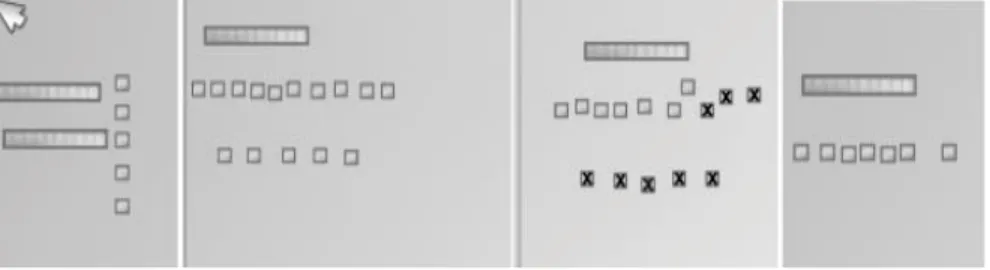
Figure 6. Unconventional subtraction sequence of 25 − 8 with Disruptive frame
In this sequence (see Figure 6), the subtraction does not follow the conventional procedure. The subtrahend 8 is taken from the whole 10. This is a mental math strategy that some students may use, who are comfortable with numbers; namely, students who have a construct of ten that is interchangeable with ten ones. The third frame of this
sequence is referred to as the Disruptive frame because it caused a disruption in students’ thinking.
Figure 7. Subtraction sequence of 25 – 8 with common error
This sequence (see Figure 7) represents one of the most common mistakes students make when subtracting, because it represents subtracting the larger digit in the subtrahend from the smaller digit in the minuend. Rather than regrouping, students sometimes subtract the smaller digit from the larger one.
33 – 16
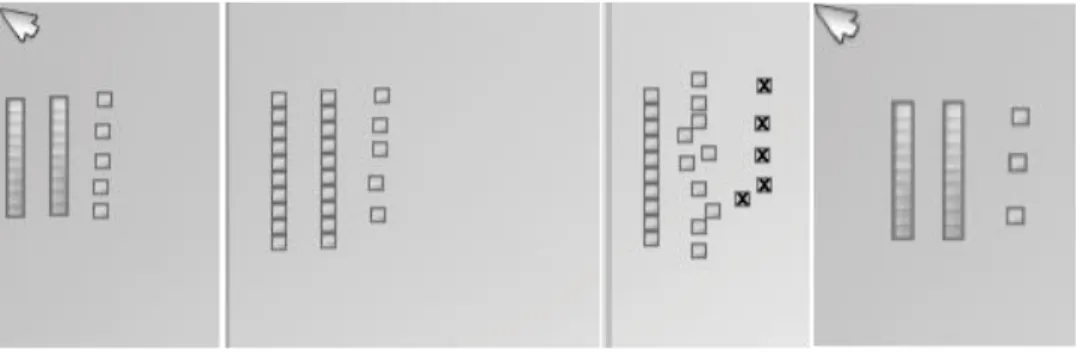
Figure 8. Subtraction sequence of 33 – 16 with common error
This sequence (see Figure 8) represents an incorrect procedure in which students subtract three from the six, rather than regroup to make a 13, and continue to subtract one