INTERNATIONAL JOURNAL OF ENGINEERING, INFORMATION SCIENCE AND
APPLIED SCIENCES (IJEIS-AS)
e-ISSN: 2615-1693 Vol. 1 No. 1, February 2018
This work is licensed under
a Creative Commons Attribution-NonCommercial 4.0 International License.
Application of Technique for Order Preference Method by Similarity
to Ideal Solution (TOPSIS) Priority of KORPRI Housing Recipient
Ramadiani 1*, Reynaldi Kurniawan 1
Department of Computer Science at Faculty of Computer Science and Information Technology Mulawarman University, East Kalimantan Indonesia1
[email protected]* Keywords :
Decision Support System; Technique For Order Preference by Similarity to Ideal Solution (TOPSIS); KORPRI Housing
ABSTRACT
The KORPRI secretariat of Samarinda city focuses on activities that lead to the welfare of members of the Indonesian republican civil service corps. The preferred activity is the KORPRI housing service for civil servants in Samarinda. The objective of the research is to implement the Technique For Order Preference By Similarity To Ideal Solution (TOPSIS) method of the KORPRI Housing Priority Decision Support System. This study uses TOPSIS method because the selected alternative has the closest distance to the ideal solution and furthest from the ideal negative solution. The results achieved from this research by applying TOPSIS method, the decision that can be given is the priority of recipients of KORPRI as the consideration of the secretariat of KORPRI in making the right decision.
INTRODUCTION
KORPRI Secretariat of Samarinda City is one of the offices located in Samarinda which conducts daily activities such as social assistance, business activities, sports coaching, cultural arts, mental and spiritual activities, other tasks assigned by other regional secretariat and chairman governing board of civil servants corps republic Indonesia. The KORPRI Samarinda City Secretariat focuses on activities that lead to the welfare of members of the Indonesian republican civil service corps. Activities undertook view from a predetermined schedule and also there where a predetermined day is of course initiated by employees who have experience in their respective fields. One of the routine activities is Friday clean, blood donation and KORPRI housing service provision for civil servants in Samarinda. The preferred activity is the KORPRI housing service for civil servants in Samarinda. This activity takes precedence because of a large number of requests from each employee who will propose homes for each one family for one request. The problem faced is to determine the main priority of KORPRI housing recipients from the number of civil servants who apply to apply for KORPRI housing in Samarinda. The existence of the problem is needed a decision support system that can help and facilitate in determining the priority of the recipient of housing for employees who have submitted the housing so that it can precisely determine the recipient based on predetermined criteria.
2
Decision Support System (DSS) is an information system that is shown to assist leaders in the decision-making process. Decision Support System combines the capabilities of computers in interactive services by processing or manipulating data that utilizes unstructured models or settlement rules. This system is used to assist decision making in unstructured situations, where nobody knows exactly how decisions should be made [1][2][3][4].
Decision Support Systems can be defined as an information system that helps identify decision-making opportunities or provide information to assist decision-decision-making [5]. The decision-decision-making stage includes an alternative selection process of action or decision consisting of the following steps:
1. Intelligence phase
A stage of a person's process within the framework of the decision maker for the problems encountered, consisting of search activity, detection, and problem recognition process. The input data is obtained, tested in order to identify the problem.
2. Design Phase (Design Phase)
The decision process stage after the intelligence stage includes a process for understanding the problem, lowering the solution and testing the feasibility of the solution. Activities that are usually done such as finding, developing and analyzing alternative actions that can be done.
3. Phase of Choice (Choice Phase)
At this stage, a selection process is made between various possible action alternatives. The election results are then implemented in the decision-making process.
4. Implementation Phase (Implementation Phase)
At this stage is the stage of implementation of the decisions that have been taken. At this stage, it is necessary to prepare a series of planned actions so that the results of the decisions can be monitored and adjusted if necessary improvements.
METHOD
Technique For Others Reference by Similarity to Ideal Solution (TOPSIS) is one of the first
multicriteria decision-making methods introduced by Yoon and Hwang (1981). With the basic
idea is that the chosen alternative has the closest distance to the ideal solution and furthest
from the ideal negative solution. TOPSIS pays attention to either the distance to the ideal
positive solution or to the ideal negative solution by taking a close relationship to the ideal
solution. By doing a comparison of both, the order of choice can be determined [3].
The steps taken in problem-solving using TOPSIS method are:
1.
Create a normalized decision matrix.
TOPSIS requires performance rating of each alternative Ai on each of the normalized Cj
criteria. The normalized matrix is formed from equation 1:
r_ij = x_ij / √ (Σ_ (i = 1) ^ m▒
〖
x_ij
〗
^ 2)
(1)
Where rij is a normalized initial value whereas xij is the initial value of the weight of each
criterion.
2.
Make a normalized matrix weighted decision.
Equation 3 is used to calculate a weighted normalized matrix, it must first be determined
the value of weight that represents the absolute preference of the decision maker. The
preference weight value shows the relative importance level of each criterion or
subcriteria in equation 2:
W = {w1, w2, w3 .... wn}
(2)
Yij = wi. rij
(3)
Where W (w
1, w
2, w
3... .w
n) is the weighted value of the importance of each criterion,
whereas Yij is a normalized weighted value and the result rij result is the normalized value
of equation 1.
Positive ideal solutions and negative ideal solutions can be determined based on a
normalized weighted rating. Note the terms of equations 4 and 5 in order to calculate the
value of the ideal solution by first determining whether the benefits (benefit) or cost
(cost):
A + = y1+ , y2+, ... yn+
(4)
A- = y1-, y2-, ... yn-
(5)
Where A + is the maximum value of the positive ideal matrix with A- is the minimum
value of the ideal negative matrix. Y + j is maxed yij, if j is a benefit attribute (benefit)
while min yij, if j is the cost attribute (cost). Yj is min yij, if j is the benefit attribute (max)
while max yij, if j is the cost attribute (cost).
4.
Determine the distance between the value of each alternative with the matrix of positive
ideal solutions and the solution matrix
Ideal negative separation measure is a long distance measurement of an alternative to an
ideal solution and a negative ideal solution. The mathematical calculations are as follows:
The alternative range (Di
+) with the ideal ideal solution is formulated in equation 6:
In + = √ (Σ_ (i = 1) ^ n▒
〖
(y_i ^ + - y_ij)
〗
^ 2)
(6)
Where Di + is the ideal ideal solution value y + j is maxed yij, if j is the benefit attribute
(benefit) while min yij, if j is the cost attribute (cost). Y-j is min yij, if j is a benefit
attribute (benefit) while max yij, if j is a cost attribute (cost).
Alternative distance (D-i) with the ideal ideal solution is formulated in equation 7:
Di- = √ (Σ_ (i = 1) ^ n▒
〖
(y_i ^ + - y_ij)
〗
^)
(7)
Where Di- is the value of the ideal ideal solution y + j is max yij, if j is a benefit attribute
(benefit) while min yij, if j is the cost attribute (cost). Y-j is min yij, if j is a benefit
attribute (benefit) while max yij, if j is a cost attribute (cost).
5.
Preference value for each alternative
The preference value (Vi) for each alternative is given in equation 8:
V_i = D_i / (
〖
D ^ -
〗
_ i +
〖
D ^ +
〗
_ i)
(8)
Greater Vi values indicate that Ai alternatives are preferred [3].
RESULTS AND DISCUSSIONS
The results and discussion of decision support system of KORPRI housing priority priorities include design and testing. The following calculations are used in the TOPSIS method.
Table 1. Criteria of the recipient of the housing
No. Criteria Symbol
1 Has a House C1
2 Years of service C2
3 The Time Towards Retirement C3
4 Status C4
5 Departure C5
Table 2. Alternative Housing Recipient Data
C1 (Has a House)
C2
(Years of Service)
C3
(The Time Towards Retirement)
C4 (Status)
C5 (Departure)
Yes ≥ 5 Years ≤ 2 Years Widow Class 1
No ≥ 5 Years > 2 Years Married Class 3
4
Each alternative is given a scale value based on the value of preference C, so the values form the table below :
Table 2. TheValue of Preference C
C1 (Has a House)
C2
(Years of Service)
C3
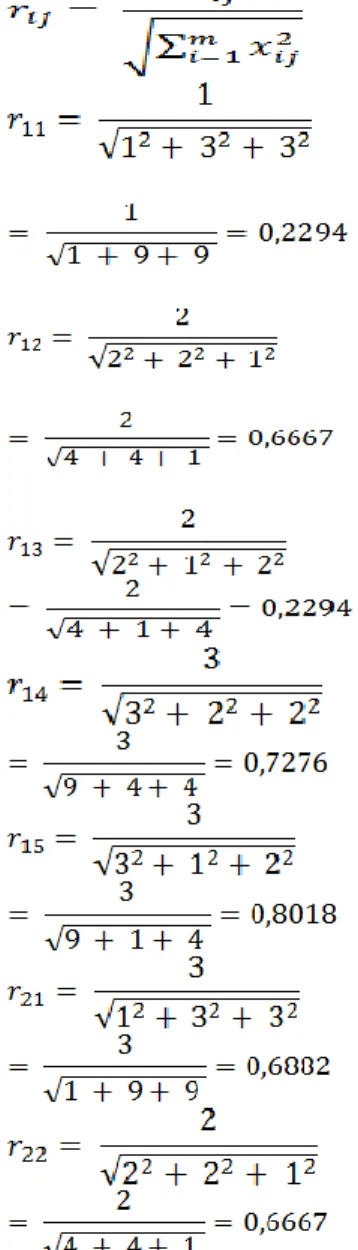
(The Time Towards Retirement) C4 (Status) C5 (Departure) 1 2 2 3 3 3 2 1 2 1 3 1 2 2 2 Matriks X : 1 2 2 3 3 3 2 1 2 1 3 1 2 2 2 Weight (W) = 3 1 2 2 1 Step 1. Each Alternative rank
The value of each alternative to calculation of step 1, which is presented in Matriks R. 0,2294 0,6667 0,6667 0,7276 0,8018
R = 0,6882 0,6667 0,3333 0,4851 0,2673 0,6882 0,3333 0,6667 0,4851 0,5345 Step 2. Decision Matrix Normalized
W = [3 1 2 2 1] V = R * W = ( x ) = 0,2294 x 3 = 0,6882 = ( x ) = 0,6667 x 1 = 0,6667 = ( x ) = 0,6667 x 2 = 1,3333 = ( x ) = 0,7276 x 2
6
= ( x ) = 0,8018 x 1 = 0,8018 = ( x ) = 0,6882 x 3 = 2,0647 = ( x ) = 0,6667 x 1 = 0,6667 = ( x ) = 0,3333 x 2 = 0,6667 = ( x ) = 0,4851 x 2 = 0,9701 = ( x ) = 0,2673 x 1 = 0,2673 = ( x ) = 0,6882 x 3 = 2,0647 = ( x ) = 0,3333 x 1 = 0,3333 = ( x ) = 0,6667 x 2 = 1,3333 = ( x ) = 0,4851 x 2 = 0,9701 = ( x ) = 0,5345 x 1 = 0,5345 0,6882 0,6667 1,3333 1,4552 0,8018 V = 2,0642 0,6667 0,6667 0,9701 0,2673 2,0642 0,3333 1,3333 0,9701 0,5345 Step 3. Positive and Negative Ideal Solutions Positive Ideal Solutions (A+) :Y1+ = MAX ( 0,6884, 2,0642, 2,0642 ) = 2,0642
Y2+ = MAX ( 0,6667, 0,6667, 0,3333 ) = 0,6667
Y3+ = MAX ( 1,3333, 0,6667, 1,3333 ) = 1,3333
Y4+ = MAX ( 1,4552, 0,9701, 0,9701 ) = 1,4552
Y5+ = MAX ( 0,8018, 0,2673, 0,5345 ) = 0,8018
Negative Ideal Solutions (A-) :
Y1- = MIN ( 0,6884, 2,0642, 2,0642 ) = 0,6884
Y2- = MIN ( 0,6667, 0,6667, 0,3333 ) = 0,3333
Y3- = MIN ( 1,3333, 0,6667, 1,3333 ) = 0,6667
Y4- = MIN ( 1,4552, 0,9701, 0,9701 ) = 0,9701
A+ = 2,0642, 0,6667, 1,3333, 1,4552, 0,8018
A- = 0,6884, 0,3333, 0,6667, 0,9701, 0,2673 Step 4. Calculating Ideal Solution Distance.
Proximity of Positive Ideal Solution
= 1,3765 D+ 2 = 0,9826 D+ 3 = 0,6464
Distance Ideal Negative Solution D -1 = 1,0376 D -2 = 1,4163 D -3 = 1,5526
Positive Ideal Solution Results (A+) and Ideal Negative (A-):
D+ 1 = 1,3765 D+ 2 = 0,9826 D+ 3 = 0,6464 D -1 = 1,0376 D -2= 1,4163 D -3 = 1,5526
5. Calculating the Preference Value. Vi = D-I D -i + D+1 V1 = = 0,4298 V2 = = 0,5904 V3 = = 0,7060
So rank order: V3 > V2 > V1 from this value V it can be seen that V3 has the greatest value. So it can
8
CONCLUSION
The result of this system is obtained from TOPSIS method, which makes the normalized decision matrix then calculated using the equations in TOPSIS method So that matrix is obtained which determines the distance between the positive ideal solution value and the negative ideal solution matrix so that the main priority recipient recommendation KORPRI.
REFERENCES
[1] Jahanshahloo GR et al. 2006. Extension of the TOPSIS method for decision-making problems with fuzzy data. Journal Appl Math Comput vol.181: 1544–1551
[2] Ramadiani, Nur Aini, et.al., 2017. Certain Factor Analysis for Extra Pulmonary Tuberculosis Diagnosis. Proc. EECSI 2017 - Yogyakarta, Indonesia, 19-21 Sept; page 133 -139.
[3] Efrain, 2007. Decision Support and Intellegent System
[4] Turban, E. dan Aronson, J, E. 2001. Decision Support Systems and Intelligent Systems. 6th edition. Prentice Hall: Upper Saddle River, NJ