Small and Medium-Sized Organizations
StartContinual
Improvement!
Implementation Planning Checking / Corrective Action Management Review Environmental Policy StartNSF International
Ann Arbor, Michigan
An Implementation Guide for Small and Medium-Sized Organizations
Written by:
Philip J. Stapleton, Principal Glover-Stapleton Associates, Inc.
Anita M. Cooney, Project Manager NSF International
William M. Hix Jr., Intern NSF International
This document was prepared with funding through a cooperative agreement with the U.S. Environmental Protection Agency’s Office of Wastewater Management and Office of Compliance.
NSF International gratefully acknowledges the following Steering Committee Members for their invaluable contributions to the design and content of this Guide:
Jeffrey R. Adrian, The John Roberts Company
Lemuel D. Amen, Washtenaw County Department of Environment & Infrastructure Services Stephen P. Ashkin, Rochester Midland
Christine A. Branson, Industrial Technology Institute
Ken Burzelius, Midwest Assistance Programs, LeSueur County
Marci Carter, Iowa Waste Reduction Center, University of Northern Iowa
John Dombrowski, U. S. Environmental Protection Agency - Office of Compliance
David Fiedler, Michigan Department of Environmental Quality - Environmental Assistance Div. Jim Horne, U. S. Environmental Protection Agency - Office of Wastewater Management Wendy Miller, U. S. Environmental Protection Agency - Office of Compliance
Charles Tellas, Milan Screw Products Bryant Winterholer, K. J. Quinn & Co., Inc.
The authors of this Guide would like to thank Douglas Baggett of Hach Company, and Charles Tellas of Milan Screw Products, Inc., for sharing their experience and insight via case studies of their respective companies.
The authors of this Guide would also like to thank Craig Diamond and Tom Ambrose of NSF International for their significant contributions to the development of this Guide. Your suggestions and assistance were greatly appreciated.
CONTENTS
Introduction ... 1
Section 1: Why Your Organization Should Have an EMS ... 3
Section 2: Key EMS Concepts ... 6
Section 3: Step-by-Step Action Plan ... 8
Section 4: Key Elements of an EMS ... 11
Section 5: The Registration Process ... 56
Section 6: Sources of Assistance ... 63
Appendices Appendix A - Case Studies Milan Screw Products ... 65
Hach Company ... 70
Appendix B - Background on ISO 14000 and Other EMS Standards ... 75
Appendix C - Sources of Information and Other Contacts ... 80
Glossary of Acronyms ... 89
Bibliography ... 90
Appendix D - Tool Kit Sample Environmental Policies ... 92
Descriptions of Environmental Aspect Identification Techniques...98
Sample Procedure: Environmental Aspects Identification ...100
Resources for Tracking Environmental Laws and Regulations ...104
Sample Procedure: Tracking Environmental Laws and Regulations ...106
Worksheet: Setting Objectives and Targets...109
Sample Procedure: Setting Objectives and Targets ...113
Sample Tool: Environmental Management Program ...116
Sample Schedule for EMS Action Plan ...118
Responsibility Matrix ...120
Environmental Training Log ...123
Sample Procedure: Internal Communications ...125
Sample Procedure: Communications with External Parties...128
Sample Document Index...131
Outline of Sample EMS Manual, Other Documents ...133
Sample Procedure: Document Control ...135
Sample Procedure: Corrective Action (Includes Tracking Log) ...139
Environmental Records Organizer...144
Sample Procedure: EMS Audits ...148
This Guide is intended to support and facilitate the development of environmental management systems (EMS) among small and medium-sized organizations. The Guide explains how you can develop and implement an effective EMS and how it can support your organization’s mission and goals. Development of an EMS is a voluntary approach to improving your organization’s environmental performance.
The Guide is designed primarily for use by EMS implementers — the people within a small or medium-sized organization that will lead the EMS development effort. The heart of the Guide is found in Section 4, “Key Elements of an EMS.” For each of the recommended EMS elements, this section discusses the importance of the element, how you can get started, and some key suggestions for implementation. In addition, examples of how other organizations have addressed various EMS elements are provided in Section 4.
The Guide uses the ISO 14001 Standard as a model for an EMS. The ISO 14001 Standard is the widely accepted official international standard for environmental management systems. This Guide is not intended for use by registrars (or others) for registration purposes, nor is it intended to provide specific interpretation of the ISO 14001 Standard.
How this Guide is Organized
Section 1 Describes the many benefits of an EMS and how it can help your organization to compete and prosper in today’s global marketplace.
Section 2 Summarizes the overall management systems concepts. This section explains what a management system is and how it can support your organization’s mission.
Section 3 Describes the overall process for building an EMS and provides recommendations for planning the overall EMS development effort.
Section 4 Provides detailed guidance on how your EMS should be designed and implemented. This section discusses each of the key elements of an EMS and how you can put them in place.
Section 5 Describes the process for registering an EMS and selecting a registrar.
Section 6 Discusses other sources of assistance your organization can use to build and sustain its EMS.
Appendices Provide case studies, sample environmental policies, other sources of information, and information on EMS standards. In addition, the Tool Kit provides sample EMS procedures and other tools that your organization can tailor to fit its EMS needs. The sample procedures are adapted from
Introduction (cont’d.)
Use of Icons
A variety of icons are used in this Guide to highlight key concepts and suggestions for the reader. A few of these icons include:
The light bulb is used to highlight EMS examples and experiences from small and medium-sized organizations. It is also used to indicate that additional help is provided in the Tool Kit or available from other sources.
☞
The hand is used to point out key hints for implementing EMS elements.
The speech balloon is used to indicate quotes from representatives of organizations that have implemented an EMS (as well as definitions from the ISO 14001 Standard).
to compete and prosper in today’s global market.
A systematic approach to meeting your
environmental and business goals
Key EMS Benefits
performance - reduced liability - competitive advantage - improved compliance - reduced costs - fewer accidents - employee involvement - improved public image - enhanced customer trust - better access to capital
- improved environmental
“We view the establishment of an
EMS as a process that forces us to better organize our
priorities and projects and to identify problems
and exposures before they occur.”
- K.J. Quinn & Co. (A small specialty chemical company)
• Is your organization required to comply with
environmental laws and regulations?
• Are you looking at ways to improve your overall
environmental performance?
• Is the state of your organization’s environmental affairs a significant liability?
• Does a lack of time or resources prevent your organization from taking charge of its environmental obligations?
• Does your organization know how its environmental
objectives relate to its business objectives?
If you answered YES to one or more of the above
questions, an environmental management system
(EMS) can help your organization — and so will this Guide!
As one of your organization’s leaders, you know that interest in environmental protection and sustainable development is growing. Like many others, your organization may be increasingly challenged to demonstrate its commitment to the environment.
Implementing an EMS can help in a number of important ways.
First, an effective EMS makes good business sense. By helping you identify the causes of environmental problems (and then eliminate them), an EMS can help you save money. Think of it this way:
• Is it better to make a product right the first time or to perform a lot of re-work later?
• Is it cheaper to prevent a spill in the first place or clean it up afterwards?
• Is it more cost-effective to prevent pollution or to manage it after it has been generated?
“We found that an EMS could improve employee retention, new hire selection, working conditions, and the perceptions of our customers, suppliers, lenders, neighbors, and
regulators.”
- Milan Screw Products (A 32-person manufacturer of precision fittings)
EMS adds value.
Much of what you need for an EMS may already be
in place! The management system framework
described in this Guide contains many elements that are common to managing other business
processes, such as quality, health & safety, finance,
or human resources. As you review this Guide, you may find that you already have many EMS processes in place, but for other purposes (such as quality). Integrating environmental management with other key business processes can improve the organization’s financial and environmental performance.
The key to effective environmental management is the use of a systematic approach to planning, controlling, measuring and improving an organization’s environmental efforts. Potentially significant environmental improvements (and cost savings) can be achieved by reviewing and improving your organization’s management
processes. Not all environmental problems need to
be solved by installing expensive pollution control equipment.
Of course, there is some work involved in planning and implementing an EMS. But many organizations have found that the development of an EMS can be a vehicle for positive change. These organizations believe that the benefits of an EMS far outweigh the potential costs (see next page). As they say in the Total Quality Management (TQM) world, “quality is free” — as long as you are willing to make the investments that will let you reap the rewards. The same holds true for environmental management.
Want to know more about EMS costs and benefits? Read on …
COSTS
• Staff / employee time
• Possible consulting assistance • Training of personnel
BENEFITS
• Improved environmental performance • Improved compliance
• New customers / markets
• Increased efficiency / reduced costs • Enhanced employee morale
• Enhanced image with public
• Reduced training effort for new employees • Enhanced image with regulators
If your organization already has or is considering a quality management system (such as ISO 9000),
you will find some significant synergy between what you need for quality management and for
environmental management.
Some Common Aspects of Quality and Environmental Management Systems • Quality Policy
• Adequate Resources
• Responsibilities and Authorities • Training • System Documentation • Process Controls • Document Control • System Audits • Management Review • Environmental Policy • Adequate Resources
• Responsibilities and Authorities • Training • System Documentation • Operational Controls • Document Control • System Audits • Management Review
One final note: Small and medium-sized
organizations often have some advantages over larger organizations in ensuring effective environmental management. In smaller organizations, lines of communication are generally shorter, organizational structures are less complex, people often perform multiple functions, and access to management is simpler. All of these can be real advantages for effective environmental management.
Are you interested in learning more about how an EMS can help your organization? If so, let’s look at some key management systems concepts
The focus on quality principles
Definition of an EMS:
A continual cycle of planning,
implementing, reviewing and improving the actions that an
organization takes to meet its environmental obligations.
Continual Improvement:
Enhancing your EMS to better your overall
environmental performance
An effective EMS doesn’t just happen. An effective EMS needs ongoing management support.
You have probably heard of Total Quality Management (TQM). Your organization may apply TQM principles to some or all of its operations and activities.
An effective EMS is built on TQM concepts. To improve environmental management, your organization needs to focus not only on what things happen but also on why they happen. Over time, this systematic identification and correction of system deficiencies leads to better environmental (and overall business) performance. Most EMS models (including the recently issued ISO 14001 Standard, which will be described later) are built on the “Plan, Do, Check, Act” model introduced by Shewart and Deming. This model endorses the concept of continual improvement.
Plan
Do
Check
Act
In the ISO 14001 EMS Standard, these “plan, do, check, act” steps have been expanded into seventeen EMS elements. Each element is discussed in Section 4 of this Guide.
Putting TQM principles into practice in the environmental area is the job of top management. To build and sustain an effective EMS, management must communicate to all employees the importance of :
• making the environment an organizational priority (thinking of effective environmental management as fundamental to the organization’s survival)
• building environmental management in
everywhere
(thinking about the environment as part of product and process development, among other activities)
Flexible + simple = adaptable +understandable
Employee involvement is crucial
Regulators have begun to incorporate management system concepts into regulatory programs (for example, OSHA’s Process Safety Management
Standard and EPA’s Risk Management Program for Chemical Accidental Release Prevention ).
The concept of continual improvement recognizes that problems will occur. But a committed organization learns from its mistakes and prevents similar problems from occurring in the future.
An effective EMS must be dynamic to allow your organization to adapt to a quickly changing business environment. For this reason, you should keep your EMS flexible and simple. This also helps make your EMS understandable for the people who must
implement it — you and your organization’s
employees.
As you build and implement an EMS, some roadblocks may be encountered. Some people in the organization may view an EMS as bureaucracy or extra expense — an “add-on” to what you do now. There may be resistance to change or fear of new responsibilities. To overcome these potential roadblocks, make sure that everyone understands
why the organization needs an effective EMS and how an EMS will help you control environmental
impacts in a cost-effective manner. Getting people involved in designing and implementing the EMS will demonstrate the organization’s commitment to the environment and help to ensure that the EMS is realistic, practical and adds value.
Building or improving your EMS (with the help of this Guide) is a great opportunity to assess how your organization manages environmental obligations and to find better (and more cost-effective) solutions. While you will probably identify some areas where your current EMS can be improved, this does not mean that you should change things that are working well ! By reviewing what your organization does and how well it works, you can ensure that your EMS will be viable and effective, both now and in the future. Don’t get discouraged if your system has some bugs at first — this is to be expected. Remember, the focus is on continual improvement !
Putting the theory of EMS into practice
Steps to Consider • Gain management commitment
• Choose a champion • Prepare budget and schedule • Build cross-functional team • Involve employees • Conduct preliminary review • Modify plan • Prepare procedures / other documents • Plan for change • Train employees • Assess performance
Milan Screw Products found that the use of a cross-functional group (the environmental task
group) was the key to progress in evaluating and implementing their
EMS. Participation of shop floor employees is essential in successfully
implementing an EMS.
K.J. Quinn & Company found that it could perform a initial self-assessment of its environmental programs
in 20-25 hours.
Building an EMS might sound like an overwhelming task for a small organization, but it need not be. Time and other resources are limited in any small organization, so it is important that your resources are used wisely. One way to do this is by following a simple, effective plan. Fortunately, you can build on the experiences of other organizations who have already implemented an EMS. Examples are provided throughout this Guide.
Figure 2 illustrates some key steps in the EMS building
process. The importance of careful planning cannot be overemphasized. Taking the time to figure out what you need to do, how you will do it, and which people must be involved will pay big dividends down the road.
Using a team approach for building your EMS is a good way to improve commitment and ensure that the objectives, procedures and other system elements are realistic, achievable, and cost-effective. Ideas for using your team and involving employees are discussed on the following pages.
A few hints to keep in mind as you build your EMS: • Help is available — don’t hesitate to use it.
(See Section 6 of this Guide for more on
resources.)
• Consultants can provide help in evaluating your EMS and suggesting approaches used successfully elsewhere. Look for ways to hold consulting costs down. For example, you may be able to join forces with other small businesses in your area to hire a consultant.
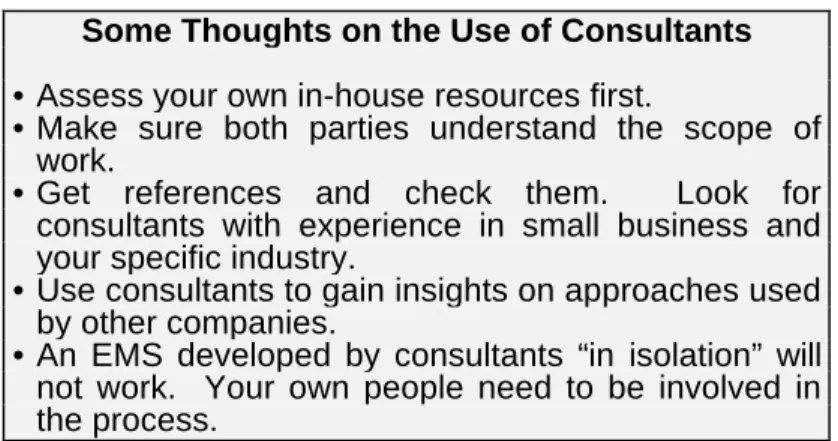
Some Thoughts on the Use of Consultants
• Assess your own in-house resources first.
• Make sure both parties understand the scope of work.
• Get references and check them. Look for consultants with experience in small business and your specific industry.
• Use consultants to gain insights on approaches used by other companies.
• An EMS developed by consultants “in isolation” will not work. Your own people need to be involved in the process.
• Look at your existing environmental compliance plans and programs to assess how effective they have been and how they might be improved.
1 Obtain Management Commitment 2 Choose a Champion 3 Prepare Budget and Schedule 4 Build Project Team 5 Involve Employees more ....
The first step in the EMS-building process is gaining top management’s commitment to supporting the EMS. Management must understand the benefits of an EMS and what it will take to put an EMS in place.
Management commitment and vision should be clear
and communicated across the organization.
Not all small or medium-size organizations have the luxury of choosing among multiple candidates, but your choice of project champion is critical. The champion should have the necessary authority, an understanding of the organization, and project management skills. The champion should be a “systems thinker” (some ISO 9000 experience would be a plus, but is not necessary) and must have the time to commit to the EMS-building process.
The project champion should prepare a preliminary
budget and schedule for developing the EMS. Costs
will likely include staff and employee time, training, some consulting assistance, materials, and possibly some equipment (such as a computer or word processor). The schedule should consider the various tasks described below, among others.
A team with representation from key management functions and production or service areas can identify and assess issues, opportunities, and existing processes. You may want to consider including contractors, suppliers, and other external parties to be part of the project team where appropriate. This team will need to meet frequently, especially in the early stages of the project. The cross-functional team can help to ensure that procedures are reasonable and will build commitment to the EMS.
Employees are a great source of knowledge on environmental and health & safety issues related to their areas as well as on the effectiveness of current processes and procedures. They can help the project team in drafting procedures. Employee ownership of the EMS will be greatly enhanced by meaningful employee involvement in the EMS development process.
6 Conduct Preliminary Review 7 Modify Plan 8 Prepare Procedure & Documents 9 Plan for Change 10 Train Employees 11 Assess EMS Performance
your current environmental programs and system and compare these against the criteria for your EMS (such as ISO 14001). Evaluate your organization’s structure and its procedures, policies, environmental impacts, training programs, and other factors. Determine which elements of your current system are in good shape and which need additional work.
The project plan might need to be modified based on the results of the preliminary review. The modified plan should describe in detail the key actions needed, who will be responsible, what resources are needed, and when the work will be completed.
At this point, you are ready to develop procedures
and other system documents. In some cases, this
might involve modifying existing environmental procedures or adapting other business procedures (such as quality or health & safety management procedures) for EMS purposes. In some cases, you might need to develop new procedures. Get help from employees and the cross-functional team, as discussed above.
In building your EMS, make sure that the system is sufficiently flexible. While you will likely need to modify your EMS over time, try to avoid making your EMS so rigid that you must change it frequently to reflect the realities of your operation.
Once the procedures and other documents have been prepared, you are ready to implement the EMS. As a first step, train your employees on the EMS, especially with regard to the environmental impacts of their activities, any new / modified procedures, and any new responsibilities.
After the EMS is up and running, be sure to assess
system performance. This will be accomplished
through periodic EMS audits and ongoing monitoring and measurement. Assessment of EMS performance provides the opportunity to improve the system and
As mentioned earlier, your EMS should be built on the “Plan, Do, Check, Act” model to ensure that environmental issues are systematically identified, controlled, and monitored. Using this approach will help to ensure that performance of your EMS improves over time.
This section describes seventeen EMS elements included in the ISO 14001 Standard. While there are several good EMS models available, this Guide uses the ISO 14001 Standard as a starting point for describing EMS elements for several reasons:
• ISO 14001 is a widely accepted international Standard for EMS;
• Companies may be asked to demonstrate conformance with ISO 14001 as a condition of doing business in some markets; and
• The Standard is consistent with the key elements found in most EMS models.
Management Review
Planning • Environmental Aspects • Legal / Other Requirements
• Objectives and Targets • Environmental Management Program Checking /
Corrective Action • Monitoring and Measurement • Nonconformance and Corrective
and Preventive Action • Records • EMS Audits
Start
Implementation • Structure and Responsibility • Training, Awareness, Competence
• Communication • EMS Documentation • Document Control • Operational Control • Emergency Preparedness / Response
Continual
Improvement !
Environmental Policy• Environmental policy — Develop a statement of your organization’s commitment to the environment. Use this policy as a framework for planning and action.
• Environmental aspects — Identify environmental attributes of your products, activities and services. Determine those that could have significant impacts on the environment.
• Legal and other requirements — Identify and ensure access to relevant laws and regulations (and other requirements to which your organization adheres).
• Objectives and targets — Establish environmental goals for your organization, in line with your policy, environmental impacts, views of interested parties and other factors.
• Environmental management program — Plan actions to achieve objectives and targets.
• Structure and responsibility — Establish roles and responsibilities and provide resources.
• Training, awareness and competence — Ensure that your employees are trained and capable of carrying out their environmental responsibilities.
• Communication — Establish processes for internal and external communications on environmental management issues.
• EMS documentation — Maintain information on your EMS and related documents.
• Document control — Ensure effective management of procedures and other system documents.
• Operational control — Identify, plan and manage your operations and activities in line with your policy, objectives and targets.
• Emergency preparedness and response — Identify potential emergencies and develop procedures for preventing and responding to them.
• Monitoring and measurement — Monitor key activities and track performance. • Nonconformance and corrective and preventive action — Identify and
correct problems and prevent recurrences.
• Records — Keep adequate records of EMS performance.
• EMS audit — Periodically verify that your EMS is operating as intended.
• Management review — Periodically review your EMS with an eye to continual improvement.
ISO 14001 requires an organization to:
•
develop an environmental policy with a commitment to compliance;•
have a procedure for identifying and having access to environmental laws and regulations;•
set objectives and targets that are in line with its environmental policy (which includes a commitment to compliance);•
establish operational control procedures;•
establish procedures for emergency preparedness and response;•
establish a procedure for periodically evaluating compliance …While these requirements relate directly to an organization’s compliance management, each of the seventeen elements of the ISO 14001 Standard can contribute to enhanced compliance (e.g., communication, training, documentation, records, nonconformance and corrective / preventive action, EMS audits, management review, etc.). An EMS based on the ISO 14001 Standard can complement and improve your organization’s compliance management and help your organization to meet objectives and targets that go “beyond compliance.” An EMS based on the ISO 14001 Standard can also help your organization to meet objectives and targets that address issues that are not subject to regulation.
If you would like to order a copy of the actual ISO 14001 Standard, please contact one of the authorized sources (see Annex C - page 88 for additional information).
The following is a overview of each of the 17 elements of the ISO 14001 Standard in greater detail …
Environmental Policy
Why do we need an environmental policy? What is my organization’s commitment to the environment? C o n t i n u a l I m p r o v e m e n t : “P r o c e s s o f e n h a n c i n g t h e e n v i r o n m e n t a l a c h i e v e i m p r o v e m e n t s i n o v e r a l l e n v i r o n m e n t a l p e r f o r m a n c e i n l i n e w ith the organization’s e n v i r o n m e n t a l p o l i c y ” m a n a g e m e n t s y s t e m t o - ISO 14001☞
Key Policy Commitments - Continual improvement - Pollution prevention - Compliance with relevantlaws and regulations
An environmental policy is your management’s declaration of commitment to the environment. The policy should serve as the foundation for your EMS and provide a unifying vision of environmental concern by the entire organization.
Your policy should be more than just flowery prose. Since it serves as the framework for setting environmental objectives and targets, the policy should be brought to life in your plans and deeds.
Everyone in the organization should understand the environmental policy and what is expected of them in order to achieve the organization’s objectives and targets.
Your policy should contain three key commitments (see
box, below), including a commitment to continual improvement. This doesn’t mean that you must
improve in all areas at once, but that the policy should drive your overall efforts to continually improve your organization’s environmental management.
Sample environmental policies (which contain the three key policy commitments) are provided in the Tool Kit (see page 92).
Hints:
• Your organization probably has an environmental policy now, even if it’s not written. For example, your organization is probably committed to complying with the law and avoiding major environmental problems, at a minimum. Document your existing commitments as a starting point.
• Your policy should be related to your products and services, as well as supporting activities. Consider the results of your preliminary review before finalizing the policy. Also, make sure the policy reflects the environmental aspects of your products, services and activities (as described in the next section).
• Keep your policy simple and understandable. Ask yourself: What are we trying to achieve? How can I best communicate this to the rest of the organization? Will we do what we said we would? Keep in mind that your policy should be explicit enough to be auditable.
Review: Have we ...
developed a written policy?
considered our key products, activities, and services? addressed the three key commitments? effectively
communicated the policy?
• The policy can be a stand-alone document or it can be integrated with your health & safety, quality, or other organizational policies.
• Consider who should be involved in developing
the policy and the best process for writing it. Input
from a range of people in your organization should increase commitment and ownership.
• Make sure that your employees understand the policy. Options for communicating your policy internally include posting it around the site (e.g., in the lunch room), paycheck stuffers, incorporating the policy into training classes and materials, and references to the policy at staff or all-hands meetings.
Test awareness from time to time by asking
employees what the policy means to them.
• The policy should also be communicated externally. Options for external communication include business cards, newspaper advertisements and annual reports, among other options. You can choose to communicate the policy proactively or in response to external requests.
I
M
P
R
O
V
E
M
E
N
T
Environmental
Policy
C
O
M
P
L
I
A
N
C
E
P
R
E
V
E
N
T
I
O
N
Three Pillars
of an
Environmental
Policy
Identifying
Environmental Aspects
How does my organization interface with the environment?Environmental Aspect: “Element of an
organization’s activities, products, or
services that can interact with the environment.”
ISO 14001
Environmental Impact :
“Any change to the environment, whether adverse or beneficial, wholly or partially resulting from an organization’s activities, products, or services.” Define environmental aspects Decide if under your control and
influence Identify related impacts Decide if the impacts are significant environmental
To plan for and control its significant environmental impacts, an organization must first know what these impacts are. But knowing what the impacts are is only part of the challenge — you also should know where
these impacts come from.
If your organization has undertaken pollution prevention projects, you are probably familiar with this concept — you must know how a waste is generated in order to minimize or eliminate it. As with pollution prevention, the identification and management of environmental aspects can (1) have positive impacts on the bottom line and (2) provide significant environmental improvements. Your EMS should include a procedure to identify the environmental aspects that your organization:
• can control, and
• over which it can have an influence.
The relationship between aspects and impacts is one of cause and effect. The term “aspects” is neutral, so keep in mind that your environmental aspects could be either positive (such as making a product out of recycled materials) or negative (such as discharge of toxic materials to a stream).
Your organization is not expected to manage issues outside its sphere of influence. For example, while your organization probably has control over how much electricity it uses, it likely does not control the way in which the electricity is generated.
Once you have identified the environmental aspects of your products, activities, and services, you should determine which aspects could have significant impacts on the environment. These environmental aspects should be considered when you set your environmental
objectives and define your operational controls (as
discussed later).
A multi-step process (see figure at left) can be used to make this evaluation. Keep the resulting information
up-to-date, so that potential aspects of new products,
services, and activities are factored into your objectives and controls.
☞
Service Organizations Can Benefit from an EMS The US Postal Service examined environmental aspects related to the vehicles it operates, the chemicals it
uses to maintain equipment, the solid wastes it generates, and the
products (stamps) that it sells.
K e y H i n t s : • L o o k b e y o n d r e g u la tio n s a n d • P r i o r i t i z e i n s e ttin g o b je c t i v e s • C o n s id e r s e r v i c e s & c o n t r a c t o r s a t n o n - r e g u l a t e d a c t i v i t i e s Factors to Consider: • ecological effects • human health impacts • catastrophic effects • resource depletion • scale, severity &
duration of impacts • probability of occurrence • cost of changing
Hints:
• In identifying aspects and impacts, you should also
look at activities not controlled by applicable laws and regulations. But because many of your
aspects/impacts may be addressed by legal requirements, your compliance program might yield some valuable information. Permits, audit reports, and other such documents can serve as useful inputs. Beyond regulations, look at issues such as land, energy, and other natural resource use.
• Once you have identified environmental aspects and related significant impacts, use this information in setting your objectives and targets. This does not
mean that you need to address all of your impacts at once. There may be good reasons (such as cost,
availability of technology, and scientific uncertainty) for addressing some impacts now and deferring action on others. Keep in mind that managing environmental aspects could have positive business
impacts.
• Remember to look at services as well as products. While the need to examine your on-site operations might be obvious, you should also consider the potential impacts of what you do off-site (such as servicing equipment at customer sites). Similarly, the environmental aspects of the products, vendors, and contractors you use may be less obvious, but should still be considered.
• Identifying significant environmental aspects is one of the most critical elements of the EMS — and can be one of the most challenging. Decisions you make in this task can affect many other system elements (such as, setting objectives and targets, establishing operational controls, and defining monitoring needs). Careful planning and conduct of this activity will pay dividends in later steps.
Getting Started
• To understand your environmental aspects, it helps to understand the processes by which you generate products and services. A flow chart of your major processes might help you understand the inputs and outputs of your processes and how materials are used. A sample flow chart is provided in the Tool Kit (see page 96). You may also want to consider the views of
interested parties — some organizations have found
external parties to be a good resource to help you identify your organization’s environmental aspects. • There are many readily-available sources of Warner-Lambert Company developed
process flow sheets to identify & “visualize” all waste streams from operations, and to determine how much they were costing the company. It also examined the packaging of products and waste
reports,
Review: Have we ...
evaluated our
products, activities, and services? determined which aspects have significant impacts? documented a procedure?
and monitoring records. Trade associations, regulatory agencies, your customers and suppliers also might provide useful information to support your assessment.
• Various techniques exist for evaluating environmental impacts. Find one that can be readily adapted for your use in identifying environmental aspects and significant impacts. Consider techniques used for compliance with the OSHA Process Safety Management Standard, environmental impact assessments, and life cycle analysis. More information on these techniques can be found in the Tool Kit (see page 98).
• Once you’ve found a process that works for your organization, describe the process in a written
procedure. A sample procedure for performing the
assessment is provided in the Tool Kit (see page 100).
• You can start out with a simple process for identifying aspects and then refine the process over time as needed. You also can address the more obvious impacts or “low hanging fruit” first, then tackle the more complex issues later.
The Link Between Aspects and Impacts - Some Examples from a Real Company
Aspects Potential Impacts
Emissions of volatile organic compounds
Increase in ground level ozone
Discharges to stream Degradation of aquatic habitat and drinking water supply
Spills and leaks Soil and groundwater contamination Electricity use Air pollution, global warming
Use of recycled paper Conservation of natural resources
Things to Consider in Evaluating Environmental Aspects:
Air Emissions Water Effluents
Solid and Hazardous Wastes Land Use
Contamination of Land Raw Material and Resource Use
Local Issues Normal and Abnormal Conditions
(e.g. concerns raised by the community such (e.g., start-up, shutdown, emergencies) as: noise, odor, dust, traffic, appearance, etc.)
Legal and Other Requirements
What standards affect the organization?
Setting the legal framework for your EMS
Legal requirements include: • Federal requirements
• State or local requirements • Permit conditions
Other requirements might include ( for example):
• Company-specific codes • Standards in locations where
you sell products • International Chamber of
Commerce (ICC) Charter for Sustainable Development • Chemical Manufacturers Association’s (CMA) Responsible Care • American Petroleum
Institute’s Strategies for Today’s Environmental Partnership (API STEP) • Other industry codes or
programs to which your organization voluntarily subscribes.
Key Steps
- Identify Requirements - Analyze Impacts - Communicate - ActTo be in compliance with the laws and regulations that apply to your organization, you must first know what the
rules are and how they affect what you do. As
discussed earlier, compliance with legal requirements is one of the “three pillars” upon which your environmental policy should be based. Costs of non-compliance (in terms of dollars, public image and possible damage to the environment) can be very high.
An effective EMS will include a process for:
• identifying applicable legal and other requirements, and;
• ensuring that these requirements are factored into the organization’s efforts.
Changing legal requirements might require that you modify your environmental objectives or other elements of your EMS. By anticipating new requirements and making changes to your operations, you can avoid some future compliance obligations and their associated costs.
Getting Started
Your EMS should include a procedure for identifying and having access to the legal and other requirements that apply to your organization. These “other requirements” might include industry codes, the CERES Principles, or similar requirements to which your organization may subscribe.
The process of identifying applicable regulations, interpreting them, and determining their impacts on your operations can be a time-consuming task. Fortunately, there are many ways in which your organization can obtain information about applicable laws or regulations. These include:
• commercial services (offered on-line, on computer disk, and on paper);
• regulatory agencies (federal, state and local); • trade groups / associations;
• public libraries;
• seminars and courses; • newsletters / magazines; • consultants and lawyers; • the Internet; and
• customers, vendors and other companies.
Small business assistance programs exist in every state. Under the Clean Air Amendments of 1990, each state
G e t i n f o r m a t i o n e n v i r o n m e n t a l r u l e s o n t h e I n t e r n e t a t h t t p : / / w w w . e p a . g o v o n f e d e r a l Review: Have we ...
identified applicable rules and other requirements and determined their impacts?
established and
documented a process for keeping up-to-date? communicated to the right people?
technical and compliance assistance program to help companies comply with air quality rules. These programs are being expanded into other environmental “media” (e.g., water, waste management) as well. In addition, National Compliance Assistance Centers can provide compliance assistance for certain industry sectors (see Section 6 & Annex C for more information). Once the applicable legal and other requirements have been identified and analyzed for their impacts, you should communicate these requirements (and plans for complying with them) to the appropriate people within the organization. Communicating the “other requirements” that apply to your organization (as well as their impacts) is an important — and often overlooked — step.
A list of some resources you can use to identify and track environmental laws and regulations is provided in the Tool Kit (see page 104). Annex C also contains additional sources of information about environmental laws and regulations. The Tool Kit contains a sample procedure for tracking environmental laws and regulations (see page 106).
Commonly Applicable Federal Environmental Laws in the US Clean Air Act (CAA)
[40 CFR Parts 50-99]
Establishes ambient and source emission standards and permit requirements for conventional and hazardous air pollutants.
Clean Water Act (CWA)
[40 CFR Parts 100-145, 220-232, 410-471]
Establishes ambient and point source effluent standards and permit requirements for water pollutants, including those discharged directly to a waterbody and to a public sewer.
Federal Insecticide, Fungicide and Rodenticide Act (FIFRA)
[40 CFR Parts 150-189]
Establishes a program for the review of, registration, and control of pesticides.
Resource Conservation and Recovery Act (RCRA)
[40 CFR Parts 240-299]
Establishes regulations and permit requirements for hazardous waste management. Also, creates standards for underground storage tanks holding oil or hazardous substances.
Toxic Substances Control Act (TSCA)
[40 CFR Parts 700-799]
Regulates the use, development, manufacture, distribution and disposal of chemicals. Certain chemicals (such as PCB’s) targeted for specific management standards.
Comprehensive Environmental
Response, Compensation and Liability Act (CERCLA, also known as “Superfund”)
[40 CFR Parts 300-311]
Establishes program for cleaning up contaminated sites and establishes liability for clean-up costs. Also, provides reporting requirements for releases of hazardous substances.
Emergency Planning and Community Right-To-Know Act (EPCRA)
[40 CFR Parts 350-374]
Establishes a program to inform the public about the hazardous and toxic chemicals used by industries. Reporting requirements apply to companies using, processing, or storing specific chemicals over specified quantities.
Objectives and Targets
How will objectives and targets help my organization?
What does my organization do to achieve its policy?
Environmental Objective:
“Overall environmental goal, arising from the environmental policy, that an organization sets itself to achieve, and which is
quantified where practicable.” - ISO 14001 Environmental Target: “Detailed performance requirement, quantified where practicable, applicable to the organization or parts thereof, that arises from
the environmental objectives and that needs to be set and met in order to
achieve those objectives.”
Objectives and targets help you translate purpose into
action — they should be factored into your strategic plan
and can facilitate the integration of environmental management with other business management processes.
You determine what objectives and targets are
appropriate for your organization. These goals can be organization-wide or applied to individual units or activities. In setting objectives, keep in mind your environmental policy, including its three “pillars.” You should also consider your significant environmental
aspects, applicable legal and other requirements, the views of interested parties, your technological options, and financial, operational, and other business requirements.
There are no “standard” environmental objectives that fit all organizations. Your objectives and targets should reflect what your organization does and what it wants to achieve. Policy Environmental Aspects Legal / Other Requirements Views of Interested Parties Objectives and Targets
Technology Finance Operations Other
Business
Environmental Program
☞
Factors to consider in setting objectives and targets: • ability to control • ability to track / measure • cost to track / measure • progress reporting • links to policy commitments Hints:• Objectives and targets should be set by the people in the
functional area involved — they will be best positioned to
establish, plan for, and achieve these goals.
• Involving people in the area will help to build commitment. • Objectives should be consistent with your overall business
mission and plan and the key commitments established in your policy (pollution prevention, continual improvement, and compliance).
• Be flexible in your objectives. Define a desired result and let the people responsible determine how to achieve the result. • Keep your objectives simple initially, gain some early
successes, and then build on them.
• Communicate objectives and targets (as well as your progress in achieving them) across the organization. Consider a regular report on progress at staff meetings.
• To obtain the views of interested parties, consider holding an
open house or establishing a focus group with people in the community. These activities can have other payoffs as well. • Make sure your objectives and targets are realistic.
Determine how you will measure progress towards achieving them.
• Keep in mind that your suppliers (service or materials) can help you in meeting your objectives and targets (e.g., by providing more environmentally friendly products).
A sample
✰✰ POLLUTION
PREVENTION ✰✰
The most significant savings from Pacific Gas & Electric’s EMS have come from reductions in hazardous waste generation and disposal. Ten years ago the hazardous waste generated by operations exceeded 90,000 tons per year — now that number is below 10,000 tons per year and is still falling.
worksheet and procedure for setting objectives
and targets are included in the
Tool Kit (see
Comparing Objectives and Targets - Some Examples
Objectives Targets
Reduce energy use • Reduce electricity use by 10% in 1996
• Reduce natural gas use by 15% in 1996 Reduce usage of hazardous chemicals • Eliminate use of CFC’s by 1997
• Reduce use of high-VOC paints by 25% Reduce hazardous waste generation • Reduce chrome wastes in plating area by
50% in 1997 Improve employee awareness of
environmental issues
• Hold monthly awareness training courses • Train 100% of employees by end of year Improve compliance with wastewater
discharge permit limits
• Zero permit limit violations by the end of 1997
Review: Have we …
documented objectives and targets at relevant functions and levels within the organization? ensured that our objectives and targets are
consistent with the environmental policy (including commitments to pollution prevention, continual improvement, and compliance)?
ensured consistency with our business plan / mission?
established a process for tracking and reporting progress?
✰✰ POLLUTION
PREVENTION ✰✰
Warner-Lambert Company used a “holistic” approach to identify its waste streams.
The company looked beyond emissions from its property and considered all of the ramifications of its activities …
By replacing chillers and redesigning the chilling system to be more efficient, the company has realized $250,000 in energy savings. Because the company is more energy efficient, it has reduced emissions at the local power plant!
By redesigning and revising dust collection, the company now uses 40 hp instead of 100 hp (without compromising the effectiveness of the dust collection system), has lowered its operating costs (and, reduced emissions at the local power plant).
Environmental Management Program(s)
Why do we need an environmental management program?
A road map for achieving your environmental goals
☞
So far, this Guide has focused on the foundations of your EMS (the planning elements) and on defining what your organization intends to achieve in the environmental area. To ensure that objectives and targets are achieved, you need an action plan.
The environmental management program should be linked
directly to your objectives and targets — that is, the
program should describe how the organization will
translate its goals into concrete actions so that
environmental objectives and targets will be achieved. To ensure its effectiveness, your environmental management program should:
• designate responsibilities for achieving goals, and • define the means and time frame for achieving those
goals.
Keep in mind that your program should be a dynamic one. Consider modifying the program when:
• objectives and targets are revised or added;
• progress in achieving your objectives and targets is made — or not made; or
• products, processes, or facilities change or other factors arise.
Your action plan need not be compiled into a single document. A “road map” to several plans is an acceptable alternative, as long as the key responsibilities, tactical steps and schedules are adequately defined in these other documents.
Keep in mind that this program should not be developed in a vacuum — it should be coordinated or integrated with
other business plans, strategies, and budgets. For
example, if you are planning changes to a manufacturing process (say, for quality or production purposes), then it makes sense to look at the possible environmental issues associated with this process change at the same time.
Hints:
• Involve your employees early in establishing and carrying out the program.
• Clearly communicate the expectations and responsibilities laid out in the program to those who need to know. Objectives and Targets Established Environmental Management Program Defined Monitoring and Measurement
Key Hints • Involve employees • Communicate expectations • Build on existing programs
• Keep program simple • Look for opportunities
• Re-evaluate your action plan when you are considering significant changes to your products, processes, facilities or materials. Make this re-evaluation part of your change
management process.
• Keep it simple (see sample tool, below) and focus on
continual improvement of the program over time.
Thought to Keep in Mind: There may be real opportunities here!! Coordinating your environmental
program with your overall business plans and strategies may position your organization to exploit some significant cost-saving opportunities.
Review: Have we ...
prepared an action plan on how the organization will meet its objectives and targets?
included responsibilities, means and time frames?
incorporated environmental concerns in our change management process?
communicated the plan and tracked progress internally?
Environmental Management Program -- Sample Tool
(Note: A full-size copy of this tool is provided in the Tool Kit — see page 116.) A Sample Schedule for an EMS Action Plan is provided in the Tool Kit (see page 118).
✰✰ POLLUTION
PREVENTION ✰✰
In an effort to reduce VOC emissions, Aeroquip
Corporation has successfully
replaced a high-solids paint with a water-based paint. Solvent use has decreased significantly because the dilution solvent for the paint is now deionized water.
Action Items Priority Respon-sibilities Schedule Resources Needed Comments • • • • •
Structure and Responsibility
How does our organizational structure affect environmental management?
Aligning your resources to succeed
“Resources include human resources and specialized skills,
technology, and financial resources.” - ISO 14001 Characteristics of a good management representative: • Knowledgeable • Assertive • Independent More organizational advantages of small business: • shorter lines of communication • less complex organization • limited delegation • simpler access to management
For your EMS to be effective, roles and responsibilities must be clearly defined and communicated. In a small organization, the commitment of all employees is needed.
Top management plays a key role by providing the
resources needed to ensure that the EMS is
implemented effectively. Ensuring this capability is one of the most important jobs of top management (see “Finding Resources” on next page).
Any effective management system needs an advocate. Top management should appoint a management
representative. This representative (1) ensures that
the EMS is established and implemented; (2) reports on its performance over time; and (3) works with others to modify the EMS when necessary. The management representative could be the same person who serves as the project champion (as discussed in Section 3), but this is not mandatory. Management can use information on EMS performance to improve the system over time. (A business owner, plant or shop manager, or any number of other people might serve as an effective management representative.)
Small and medium-sized businesses may have an
advantage over larger businesses in structuring their
organizations for environmental management. Because personnel and other resources are generally more limited in small businesses, people often “wear more than one hat” and are experienced in performing multiple functions. In some cases, the individual responsible for environmental management in a small firm is also responsible for quality, health & safety, facilities, or other related functions. For this reason, integrating environmental responsibilities with other functions can be greatly simplified.
Getting Started:
The following questions can help you determine the right organizational structure for environmental management: • Look at the scope of your environmental
management program: What capabilities do we need? Who needs to be involved to make the system effective? What training or other resources will they need?
• Look at your significant environmental impacts: What operations / activities need to be controlled?
Getting Started Look At: • Program scope • Environmental aspects • Previous audits • Other systems
☞
Consider integrating EMS with your existing:• information systems • purchasing controls • quality procedures • work instructions • training programs • communication efforts • reporting systems • recruitment, appraisal and
disciplinary processes
• Look at the results of previous audits or other assessments: What does this information tell us about the effectiveness of our organizational structure? How could it be improved?
• Look at the current responsibilities for environmental management: How can we enhance ownership of environmental management across the organization? How can other business functions support the EMS? (See next page.) • Look at your quality management and / or other
existing management systems: What roles and responsibilities exist in these management systems? Where are the opportunities for integration?
Consider flow charting your organization’s activities relating to environmental management. This can help you understand how processes work and the final product can be a great communication and training tool. Flow charts might be useful to look at processes such as chemical purchasing and distribution, employee training, and preventive maintenance, among others.
Hints:
• Build flexibility into your organization’s EMS. Recognize that environmental (and other) management needs will change over time.
• Be sure to communicate to people what their roles are (as well as the roles of others). One tool for communicating these responsibilities is a
responsibility matrix (an example of which is
provided in the Tool Kit — see page 120).
Finding Resources
In most cases, developing and maintaining an EMS will not require large capital outlays. What an EMS will require is time. Many small organizations have found that they can make effective use of interns or temporary employees to perform potentially time-consuming EMS development tasks (such as collecting data, drafting and typing procedures, etc.). This approach allows in-house personnel to focus on more complex EMS development tasks.
Also, exploit the links between environmental management and other aspects of your organization. Look for areas where environmental management can support other business functions (and vice-versa — see next page).
More information on resources is found in Section 6 of this Guide
How Various Functions Can Support Your EMS
Functions How They Can Help (Possible Roles)
Purchasing • Develop and implement controls for chemical / other material purchases
Human Resources • Define competency requirements and job descriptions for various EMS roles
• Integrate environmental management into reward, discipline and appraisal systems
Maintenance • Implement preventive maintenance program for key equipment
Finance • Track data on environmental management costs
• Prepare budgets for environmental management program • Evaluate economic feasibility of environmental projects
Engineering • Consider environmental impacts of new or modified products and processes
• Identify pollution prevention opportunities
Top Management • Communicate importance of EMS throughout organization • Provide necessary resources
• Track and review EMS performance
Line Workers • Provide first-hand knowledge of environmental aspects of their operations
• Support training for new employees
Review: Have we ....
defined roles for environmental management? communicated those roles internally?
assessed resource needs?
integrated environmental management with other business functions wherever possible and practical?
Training, Awareness and Competency
Why is training important to the success of our EMS?
Building internal capabilities Reasons for Training • motivation • awareness • commitment • skills/ capability • compliance • performance An example of a training log is
provided in the Tool
Kit (see page 123).
There are two excellent reasons for training employees about environmental management and your EMS:
• Every employee can have an impact on the environment.
• Any employee can have good ideas about how to improve environmental management efforts.
Each person and function within your organization can play a role in environmental management. For this reason, your training program should cast a wide net. Everyone in the organization should be trained on the environmental policy, significant environmental impacts of their work activities, key EMS roles and responsibilities, procedures that apply to their activities, and the importance of conformance with EMS requirements.
All personnel should receive appropriate training. However, training is just one element of establishing
competence, which is typically based on a combination
of education, training, and experience. For certain key roles (including tasks which can cause significant environmental impacts), you should establish criteria for measuring the competence of individuals performing those tasks.
Getting Started:
• A critical first step in developing your training program is assessing your training and skill
needs. In assessing these needs, you should
consider both general and specific aspects (e.g., “What EMS procedures affect Joe’s daily work and what happens if they aren’t followed?” “What environmental impacts might Joe’s work cause?” “What broader understanding of environmental issues and our EMS does Joe need?”)
• Look at the training you conduct already, for compliance with environmental and health and safety regulations and other purposes. You may find that your existing training efforts go a long way towards satisfying the requirements for the EMS. Implementing an EMS
Milan Screw Products found that it could provide a great deal
of its EMS training during “brown bag” lunches, during which employees bring their lunches, participate in a training
session, and remain “on the clock” for the lunch period.
☞
Training Resources: • internal trainers / experts • consultants • community colleges • vendors / suppliers • customers • technical / trade / business associations • self-study or study groups • training consortia(teaming with other local companies) • computer-based
training
Key Steps in Developing a Training Program Step 1: Assess training needs & requirements
Step 2: Define training objectives
Step 3: Select suitable programs and methods Step 4: Prepare training plan (who, what, when,
where, how)
Step 5: Implement training program
Step 6: Track training (and maintain records) Step 7: Evaluate training effectiveness
Step 8: Improve training program (as needed)
Hints:
• Because of the level of effort involved in a training program, this is one EMS area where you don’t want to start from scratch. Many employees may already be qualified on the basis of their experience and previous training. (Keep in mind that all training should be documented.) Since some employees may require training on how to run a process safely,
on-the-job training certainly plays a role.
• Plan and schedule training opportunities carefully. While finding enough time for training can be a challenge, there may be creative ways to make “more time” (see box above left). Use venues like safety meetings, staff meetings, and tool box meetings to provide “training” and reinforce key messages.
• New employees can pose a significant training challenge. Consider developing an EMS training package for new employee orientation. Even better, videotape one of your current EMS training courses to show new employees.
• In reviewing training needs, don’t forget to consider the qualifications and training needs of your
environmental manager and your trainers.
Professional certification programs may be appropriate for certain functions.
• Factor your EMS skills requirements into your
recruiting, selection, and new employee orientation
efforts (as noted above).
• Establishing competency for various tasks can be a challenge. Competency criteria for jobs that can