NSF International
Environmental Management System
Demonstration Project
Final Report
Environmental Management System
Demonstration Project
Final Report
December 1996 Written by: Craig P. Diamond Project Manager NSF International 2100 Commonwealth Blvd. Suite 100 Ann Arbor, MI 48105CONTENTS
I. Foreword . . . 1
Organization of the Report . . . 1
Advice to Readers . . . 2
Acknowledgments . . . 2
II. Executive Summary . . . 3
Project Overview . . . 3
Project Findings . . . 4
Conclusions . . . 8
III. Introduction and Project Overview . . . 9
Project Summary . . . 9
Project Activities in Detail . . . 12
Profile of Participating Organizations . . . 13
IV. EMS Implementation Progress . . . 16
Background on EMS Assessments and Data Analysis . . . 16
Self-Assessment Results . . . 17
Findings from Independent Assessments . . . 21
V. Findings on Key EMS Implementation Issues . . . 25
Incentives for Implementing an EMS . . . 25
Benefits and Costs of Implementation . . . 27
Barriers and Keys to Successful Implementation . . . 31
Links with ISO 9000 and Health & Safety . . . 33
Comparison of SMEs and Large Organizations . . . 34
Recommended Guidance and Implementation Tools . . . 36
Participant Feedback on ISO 14001 . . . 38
Participant Advice to Regulators . . . 42
VI. Conclusions . . . 43
Major Lessons Learned . . . 43
Remaining Questions and Areas for Future Study . . . 44
VII. Case Studies . . . 46
3M Corporation . . . 47
K.J. Quinn & Co. . . 67
Lockheed Martin Federal Systems . . . 70
Madison Gas and Electric Company . . . 73
Milan Screw Products . . . 76
NEO Industries Ltd. . . 80
NIBCO Incorporated . . . 83
Pacific Gas and Electric Company . . . 86
Pitney Bowes Inc. . . 89
TRINOVA Corporation . . . 92
United States Postal Service . . . 95
Washtenaw County Government . . . 98
VIII. Bibliography . . . 101
IX. Appendices . . . 102
Appendix A: Background on ISO 14000, EMS Standards, and Registration . . . 102
Appendix B: Questions Asked of Participants at Conclusion of Project . . . 107
Appendix C: Elements of the ISO 14001 Standard: A Snapshot . . . 108
I. FOREWORD
The ISO 14000 series of standards, in particular the ISO 14001 Standard for environmental management systems (EMS), has become one of the most widely discussed developments in environmental management in both the private and public sectors. The ISO 14001 Standard was officially approved in September 1996, and is expected to become as pervasive in the international marketplace as the ISO 9000 series of quality management standards. This expectation has driven many organizations to devote significant resources into preparing for ISO 14001. Despite this level of investment, there is still a great deal of uncertainty about the implementation of the ISO 14001 Standard. Although several organizations in Europe have completely implemented a formal EMS based on standards (e.g., BS 7750, EMAS, IS 310), relatively few organizations in the United States have done so. Therefore, in the U.S. there is a need for “real life” examples from organizations about the challenges and benefits of implementing an EMS and the incentives for doing so.
This final report on NSF International’s EMS Demonstration Project conveys the experiences of 18 organizations as they attempted to implement the ISO 14001 Standard from March 1995 through June 1996. The project was funded through a cooperative agreement from the U.S. Environmental Protection Agency (EPA), Office of Wastewater Management. The report will be of interest to many types of organizations interested in EMS implementation, including:
manufacturers and other organizations considering whether to implement the Standard; regulatory agencies; engineering and management consulting firms; law firms; training organizations; banks; and insurance companies.
The Demonstration Project focused on EMS implementation issues, not on registration. In this report, “EMS implementation” refers to an organization’s effort to develop an EMS based on the ISO 14001 Standard; the term does not refer to maintaining and improving the system after it is implemented. Participating organizations varied significantly in the extent to which they came into the project with the elements of ISO 14001 already in place.
The organizations, which participated voluntarily, were not required or expected to become registered to ISO 14001 during or after the project; nor were they required to implement all the requirements of the Standard over the course of the project.
Organization of The Report
The Introduction and Project Overview outlines the activities of the project in some detail and provides an overview of the 18 organizations that participated. The section on EMS
incentives, benefits, and keys to success. It also offers a list of suggested EMS implementation guidance tools. A brief Conclusions section discusses major lessons learned from the project and suggested areas for further inquiry. The Case Studies,which were written by the participating organizations and edited by NSF, convey the EMS implementation experiences of the participants from their own viewpoints (to maintain confidentiality, none of the other sections of the report refer to specific organizations by name). Appendices A-D are provided to help clarify certain parts of the project and this report. For those readers who are not familiar with the ISO 14001 Standard, it may be helpful to refer to Appendix C which provides an overview of the elements of ISO 14001.
Advice to Readers
This report assumes a basic knowledge of ISO 14000 and of the ISO 14001 EMS Standard. A thorough understanding of environmental management systems is helpful, but not required. For those who are not very familiar with the language of ISO 14001, it is suggested that the Standard be referenced regularly while reading the report.
Acknowledgments
NSF International would like to thank the U.S. EPA, Office of Wastewater Management, for providing the majority of the funding for the EMS Demonstration Project.
NSF also wishes to thank the 18 participating organizations (and the individuals who represented them in the project) for their invaluable contributions through the case studies, self-assessments, meeting presentations, and advice to NSF project staff (the organizations are listed in Section III of the report). NSF would also like to gratefully acknowledge the following individuals who have given much of their time to the planning and implementation of the EMS Demonstration Project, and who have contributed to the project’s success:
Thomas Ambrose, HS&E Management Advisor Henry Balikov, TLI Systems
Joe Egan, Tucker Alan, Inc.
Jimmy Margolis, Arthur D. Little, Inc.
Philip Stapleton, Glover-Stapleton Associates, Inc. Wayne Tusa, Environmental Risk & Loss Control, Inc. David Van Wie, Robert G. Gerber, Inc.
Finally, the author would like to thank Anita Cooney and Michael Hix of NSF International for their assistance in the development of this report.
II. EXECUTIVE SUMMARY
Project Overview
This final report on NSF International’s Environmental Management System (EMS)
Demonstration Project summarizes the EMS implementation experiences of 18 organizations of a variety of types and sizes. The project, which used the ISO 14001 Standard as the model for an EMS, was funded through a two-year grant from the U.S. Environmental Protection Agency, Office of Wastewater Management (October 1994 - September 1996). The EPA funded the project because it recognized that both private organizations and regulatory agencies were in need of practical information about the process of implementing the ISO 14001 Standard.
Participating organizations included 16 private companies, one government agency, and one government-owned corporation (the U.S. Postal Service). The companies ranged from small manufacturers with fewer than 100 employees to multinational corporations.
The goals of the project were to: (1) document the experiences of a variety of organizations as they attempted to develop an EMS based on ISO 14001; (2) demonstrate the benefits and challenges of, and incentives for, EMS implementation; (3) determine what types of tools and assistance organizations need to be successful with EMS implementation; and (4) provide a forum for organizations to learn from each others’ EMS experiences. Another important objective of the project was to identify and assess any differences that might exist between small and large organizations in their ability to implement an EMS.
After organizations were recruited for the project, an initial training session was held in March 1995 to familiarize participants with ISO 14000 and EMS. Following the training, participants conducted assessments of their EMS against the requirements in ISO 14001 using a self-assessment tool developed by NSF International. Three additional meetings were held (in August and December 1995, and June 1996) during which participants shared lessons learned from their EMS implementation experiences. Final EMS self-assessments were conducted prior to the last meeting in June 1996. In August 1996, participants submitted responses to specific questions as well as self-written EMS implementation case studies (the case studies are included in the report). In October 1996, EMS auditors conducted independent EMS assessments for four of the
participants to determine if significant differences might exist between the results of the self-assessments and independent self-assessments.
To meet the objectives of the project, NSF collected and analyzed information from four sources: (1) results of the initial and final EMS self-assessments, and of the four independent assessments; (2) responses to the specific questions about EMS implementation; (3) the self-written case studies; and (4) observations made at the four project meetings.
Project Findings
EMS Implementation Progress
The results of the EMS self-assessments showed that, overall, participants made notable progress on implementing the ISO 14001 Standard over the course of the project (the average period of time between the initial and final self-assessments was approximately 11 months). Whereas the initial self-assessments showed that the group as a whole had only 22% of the requirements of the Standard complete, the final self-assessments showed that the group had 50% of the requirements complete.
Important Note: For both the initial and final self-assessments, participants evaluated themselves on 63 requirements which comprise all 17 elements of ISO 14001. Each requirement could be evaluated on five different levels: No Action (NA), Initiation (IN), Partial Implementation (PAR), Complete Implementation (COM), and Evaluated & Sustained (ES). NA, IN and PAR are considered
incomplete, while COM and ES are considered complete (in the self-assessment tool, incomplete was denoted by “NO,” while complete was denoted by “YES”).
As a whole, participants also made progress on each of the 17 elements of ISO 14001, although more progress was made on some elements than on others. The element of ISO 14001 with the highest level of implementation wasPolicy, while EMS audit was least implemented (84% of the requirements under Policy, and 24% under EMS audit, were evaluated as complete at the
conclusion of the project).
The results of the independent assessments showed that there were significant differences in how the organizations and independent auditors evaluated the requirements of ISO 14001.
Approximately 30% of the requirements evaluated in the four organizations were evaluated differently by the organization and the independent auditor on the YES/NO response. Twenty-four percent were rated lower by the independent auditors; i.e., the independent auditor evaluated these requirements as NO, but the organization evaluated them as YES. Six percent were rated higher; i.e., the independent auditor evaluated these requirements as YES, but the organization evaluated them as NO.
Since 24% of all the requirements were evaluated lower by the independent assessors, and only 6% were evaluated higher, these findings suggest that the %YES of the initial and final self-assessment results would have been lower if all the EMS self-assessments had been conducted by independent auditors rather than by the organizations themselves.
The independent auditors made some additional observations during the audits. Most notably, in the three organizations with ISO 9000 systems, the quality management staff was surprisingly disconnected from the environmental management staff. It appeared that the organizations were not taking full advantage of their existing ISO 9000 systems to develop EMS procedures and documentation.
Incentives for Implementing an EMS
Participants were asked at the end of the project to list their organizations’ incentives for
implementing ISO 14001. The incentives most commonly cited by participants are listed below. The number of participants that cited each incentive is provided in parentheses (note: fourteen participants listed their incentives, and some cited more than one incentive):
• Competitive advantage (7);
• Improved environmental performance (6); • Possible ISO 14001 registration (5); • Enhanced regulatory compliance (4); and • Possible regulatory flexibility (3).
Competitive advantage was also mentioned quite frequently at meetings, although participants did not always specify whether the advantage would be derived from external recognition (i.e.,
through registration) or from the benefits of improved environmental management. Benefits of EMS Implementation
Several benefits of implementing an EMS were realized by participants over the course of the project. In addition, those organizations which had extensive EMSs at the beginning of the project reported benefits they had realized before becoming involved in the project. The number of participants that cited each benefit is provided in parentheses (note: fourteen participants listed benefits, and some listed more than one). Reported benefits include:
• Improved cooperation and environmental awareness among employees (5); • Improved procedures and documentation (5);
• Enhanced regulatory compliance (3); and • Improved environmental performance (5).
Participants had not realized reduced environmental management costs or access to international markets by the conclusion of the project. Although these benefits are often mentioned in
conjunction with ISO 14001, it will likely take more time for organizations to realize these benefits.
Keys to Successful Implementation
The following keys to successful EMS implementation emerged as common themes during the group meetings and in participants’ responses to questions at the conclusion of the project. These
• Secure top management commitment early in the process; • Gain a thorough understanding of the ISO 14001 Standard; • Perform a thorough self-assessment;
• Involve many functions and staff levels in the planning process;
• Initially, set a small number of achievable environmental objectives; and • Build on existing business practices.
Links with ISO 9000 and Health & Safety
A majority of project participants have facilities that are either registered to ISO 9000 (ISO 9001 or 9002) or working towards registration (only two organizations reported that they were not registered or pursuing registration). Most of the organizations with ISO 9000 experience indicated that they would model several elements of the EMS after their quality system, or that they would at least partially integrate certain elements of ISO 9000 and ISO 14001. However, only a few participants reported at the end of the project that they intended to fully integrate the two systems in the near future. This finding is consistent with observations made during the independent assessments.
Six participants reported they were intending to integrate ISO 14001 with their health & safety program.
Comparison of SMEs and Large Organizations
In the Demonstration Project, small and medium-sized enterprises (SMEs) were defined as having fewer than 1,000 employees organization-wide. Based on question responses from both SMEs and large organizations in the project, some differences between the two types of organizations were observed.
Incentives. For certain incentives identified by participants (i.e., competitive advantage, regulatory relief) there was not a clear difference between the proportion of SMEs and large organizations citing them as incentives. However, for other incentives there were notable differences. SMEs were more likely than large organizations to identify enhanced compliance and improved documentation as motivating factors. Large organizations, on the other hand, were more likely to identify improved environmental performance and pollution prevention as motivating factors.
Barriers. SMEs and large organizations cited most EMS implementation barriers (e.g., promoting the EMS concept within the organization, achieving thorough documentation) in roughly equal proportions. However, a much greater proportion of SMEs cited lack of time and resources as a barrier.
Recommended Guidance and Implementation Tools
Based on the experience of the organizations in the project, it became evident that certain types of guidance are very important for organizations of all types and sizes attempting to implement ISO 14001. These include:
• Clarification of the intent of ISO 14001;
• A checklist or other tool to conduct an EMS self-assessment;
• Guidance on how to identify and assess the significance of environmental aspects and impacts; • A step-by-step implementation guide;
• Examples of EMS manuals, policies, and procedures; and • EMS implementation case studies.
Feedback on the ISO 14001 Standard, and Advice to Regulators
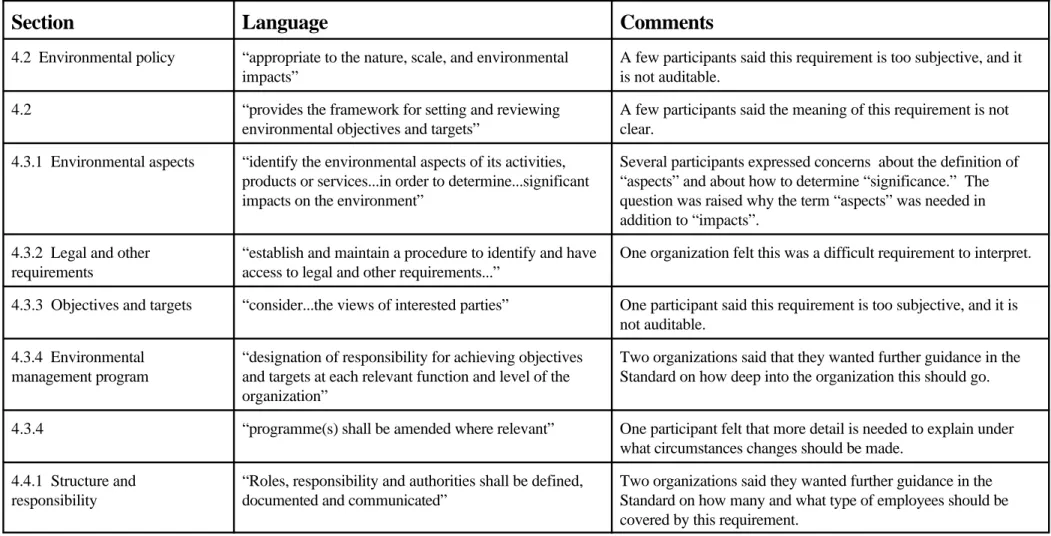
Participants reported on their general and specific concerns about the ISO 14001 Standard. In general, the participants believed that the Standard was a good model for an EMS. However, most participants expressed at least one overriding concern about the Standard, and some specific comments (specific comments are presented in section V of the report). The greatest overriding concern was the potential for certain requirements to be variably interpreted by different auditors. Other commonly reported concerns included confusion over the definition of “environmental aspects;” an overemphasis on documentation; and confusion about whether written procedures were necessary for particular requirements.
Participants also offered comments to the regulatory community about how government agencies should integrate ISO 14001 into their regulatory approaches. Most participants stated that regulators should offer incentives -- primarily “regulatory flexibility” -- to companies that implement an EMS. These proposed incentives included:
• Reductions in reporting;
• Reductions in site inspections and audits; • Reductions in fines;
• Elimination of penalties and NOVs for various environmental compliance issues; and • Fast-track permitting.
Many participants expressed a concern about the voluntary disclosure of self-audits (ISO 14001 requires organizations to conduct, and maintain the records of, EMS audits). Several participants also commented that a greater level of trust was needed between regulators and the regulated community.
Implementing ISO 14001 is Feasible in a Wide Variety of Organizations
The experience of the Demonstration Project suggests that an EMS based on ISO 14001 can be implemented in a wide variety of organizations, but varying amounts of guidance and assistance are required for different organizations. The main factors that seem to determine an
organization’s ability to implement an EMS are (1) its experience with EMS, ISO 9000, or other management system concepts; (2) the level of commitment from its top management; and (3) the resources available to the organization to develop the necessary procedures and documentation. Since SMEs are more likely to lack adequate resources, they will probably require more guidance and take longer to complete EMS implementation than large organizations.
EMS Implementation Can Bring Concrete Internal Benefits
Project participants reported many benefits from EMS implementation that were not market or trade related, including enhanced environmental awareness, improved documentation, and pollution prevention. These benefits were realized within the one year time frame of the project, and before any of the organizations had attained full implementation or registration.
Independent Assessments Can Provide an Important Check on Self-Assessments
The results of the independent EMS assessments suggest that organizations might have the tendency to evaluate their systems higher than would independent auditors. The results may also have important implications for the concept of “self-declaration,” in which an organization would declare itself to be in conformance with the ISO 14001 Standard rather than receive an
III. INTRODUCTION AND PROJECT OVERVIEW
In October 1994, the U.S. EPA, Office of Wastewater Management, awarded funding to NSF International to manage the EMS Demonstration Project. EPA awarded the grant because it recognized that both private organizations and regulatory agencies needed practical information about the EMS implementation process in organizations of various types and sizes. NSF was selected to manage the project because it had developed an interim EMS standard (NSF 110) very similar to ISO 14001, and because NSF was an active participant in the ISO 14000 development process.
The goals of the project were to: (1) document the experiences of a variety of organizations as they attempted to develop an EMS based on ISO 14001; (2) demonstrate the benefits and
challenges of, and the incentives for, EMS implementation; (3) determine what types of tools and assistance organizations need to be successful with EMS implementation; and (4) provide a forum for organizations to learn from each others’ EMS experiences. An important objective of the project was to identify and assess any differences that might exist between small and large organizations in their ability to implement an EMS (for the remainder of this report, smaller organizations will be referred to as small and medium-sized enterprises, or SMEs). In part, this objective was intended to address concerns which arose during the Standard development process regarding the applicability of ISO 14001 to SMEs.
The intent of the project was to examine the process of implementing an EMS based on ISO 14001. It was not within the scope of the project to measure or assess the effects of EMS implementation on environmental compliance or other aspects of environmental performance. It was also not required or expected that participating organizations would become registered to ISO 14001 during or after the project. It is important to note that this report attempts to focus on the experience of implementing an ISO 14001 EMS, as opposed to the benefits of already having one in place. However, those participants which came into the project with most ISO 14001 elements in place reported on the experience of having an established EMS as well as on the experience of implementing certain requirements. Nevertheless, most of the feedback received from the participants addressed their experiences with the process of implementing the EMS.
Project Summary
Project participants were recruited in late 1994 and early 1995. A project announcement and interest form were sent to approximately 1,000 organizations. A few organizations were also recruited individually. A maximum of 20 organizations were sought, and 18 were recruited (there was no competitive selection process; i.e., all 18 organizations that expressed interest were
The project consisted of two major activities: (1) EMS self-assessment and implementation; and (2) group training and discussion. Each participant performed an initial assessment of its EMS in the spring of 1995 using NSF’s EMS Self-Assessment Tool. The participants used the results of their initial assessments to develop EMS implementation action plans. Based on their action plans, participants implemented the ISO 14001 Standard at their own pace. Each participant conducted a second self-assessment in the spring of 1996 to determine progress made over the course of the project. Following the final self-assessments, four participants received independent EMS assessments conducted by EMS auditors. The results of these assessments were compared to the final EMS self-assessments for the four participants. The purpose of the independent assessments was to determine if organizations might evaluate their own systems differently than independent auditors would.
In addition to self-assessment and implementation, the organizations convened in four meetings at NSF to receive training on EMS implementation and to discuss practical implementation
strategies. Based on feedback received from participants, these meetings were a very constructive way to exchange ideas about EMS concepts.
At the conclusion of the project, participants submitted responses to a series of questions regarding their EMS implementation experiences; these responses are summarized in Section V, Findings on Key EMS Implementation Issues (the questions are listed in Appendix B).
Participants also prepared self-written case studies which are included in Section VII. (Note: 14 of the 18 organizations submitted question responses regarding their EMS implementation experiences; 17 submitted case studies).
Final Self-Assessments Initial Self-Assessments & Begin Implementation April - July 1995 2nd Meeting Discussion and Training August 1995 3rd Meeting Discussion and Training December 1995 1st Meeting EMS Training March 1995 Continued Implementation August -December 1995 Continued
Implementation Final Meeting
Discussion
Independent EMS Assessments
Figure 1
EMS Demonstration Project
Activities at a Glance
Project Activities in Detail
EMS Self-Assessments and Implementation
Each participant performed two EMS self-assessments, one in the spring of 1995 (following the first meeting) and one in the spring of 1996 (before the last meeting).
The results of the self-assessments were aggregated and summarized to serve two purposes: (1) to provide an internal benchmark for the group; and (2) to measure group progress over the period of the project.
Self-assessments were conducted internally by the organizations (some had consultants assist with the self-assessment, others did not) using NSF’s EMS Self-Assessment Tool. The tool was developed prior to the first meeting under the direction of an ad hoc advisory group. The group was comprised of environmental management consultants, in addition to environmental managers from some of the companies recruited to the project. The tool contains a checklist that allows the user to assess how the organization’s EMS compares to the requirements in ISO 14001. The self-assessment results and a brief description of the EMS Self-Assessment Tool are provided in Section IV.
Following the initial self-assessments in the spring of 1995, each participant identified those EMS elements it wanted to develop (please refer to Section IV for an explanation of the self-assessment process). While some of the organizations already had several elements of ISO 14001 already in place, others needed to make more substantial changes to their existing environmental
management practices to develop an ISO 14001 EMS. As mentioned previously, participants were not required to implement any particular requirements of the Standard in any specific time frame. Rather, they were asked to make the best effort possible, based on their own priorities, over the course of the project.
Group Training and Discussion
Group meetings were held at NSF International in March, August and December of 1995, and in June of 1996. The purpose of these meetings was to provide EMS training and to create a forum in which participants could learn from each other. Each organization was represented at the meetings by one to three individuals. The attendees served a variety of roles in their organizations including company presidents, environmental managers, and quality managers. The first three meetings were two-day sessions, while the last meeting was a one-day session.
The first meeting provided training on the requirements of ISO 14001 and included an overview of basic EMS concepts. NSF’s EMS Self-Assessment Tool was provided to each participant at
the meeting so that each organization could conduct a self-assessment of its EMS before the second meeting. At the conclusion of the first meeting, participants were asked to make their best effort to implement the requirements of ISO 14001 over the course of the project, and were encouraged to do so at a pace appropriate to their individual situations.
The second meeting provided further training on specific topics related to EMS implementation, including: identifying environmental aspects and impacts; setting environmental objectives and targets; promoting the EMS concept within an organization; and integrating ISO 14001 with ISO 9000. In addition, each participant reported back to the group on its experience with the EMS self-assessment and on progress it had made in implementing the requirements in the Standard. Individual progress reports (each about 10-15 minutes) were followed by questions from the group and discussion. For both the training and report-back sessions, participants were broken into smaller groups to facilitate discussion.
The third meeting was similar to the second, but more time was devoted to feedback and
discussion than to training. Each participant presented its progress on EMS implementation, and discussed keys and barriers to success. Following the progress reports, plenary workshops were held on estimating the costs and benefits of EMS implementation, and on evaluating
environmental performance. In addition, guest speakers updated the group on developments in EMS registration and accreditation. In the fourth meeting, the majority of the agenda was
devoted to sharing keys and barriers to EMS implementation, and lessons learned over the course of the project.
Profile of Participating Organizations
Ten of the 18 participating organizations are large, and eight are SMEs (for the purpose of categorization, large organizations were defined as having over 1,000 employees organization-wide, while SMEs were defined as having fewer than 1,000 employees organization-wide). The organizations provide a variety of products and services, and range from Fortune 100
corporations to small manufacturers. At the outset of the project, the organizations also varied significantly in their approach to environmental management. In particular, they varied in the extent to which procedures were formalized and documented, and in the extent to which activities that go beyond regulations had been integrated into their existing environmental management practices.
A majority of the participants are either registered to ISO 9000 or working towards registration. Approximately one-half operate facilities overseas. Table I lists the 18 organizations that
participated in the project. They consist of 16 private companies, 1 government agency, and one government-owned corporation (the U.S. Postal Service). It is important to note that the
becoming involved in the project.
As of December 1996, two organizations (both companies) in the project had facilities that were registered to ISO 14001 or other EMS standards. Manyothers are planning to become ISO 14001 registered within the next few years. Others may not be specifically planning for
Table I: Brief Profiles of Participating Organizations
Organization Headquarters Products/Services* Size** 3M Corporation St. Paul, MN Produces multiple products for the Large
industrial, commercial, consumer, and health care markets
Allergan, Inc. Irvine, CA Produces pharmaceuticals Large Commodore Applied Columbus, OH Performs remediation technology Small
Technologies R&D
Fluke Corporation Everett, WA Produces electronic test and Large measurement instruments
Globe Metallurgical Selma, AL Produces silicon metal and ferroalloys Med Hach Company Ames, IA Produces instruments for water Med
analysis
K.J. Quinn & Co. Seabrook, NH Produces coatings and adhesives Small Lockheed Martin Manassas, VA Produces semiconductors and Large
Federal Systems computer systems
Madison Gas & Electric Madison, WI Provides electricity and natural gas Med Company
Milan Screw Products Milan, MI Produces screw machine products Small NEO Industries Ltd. Portage, IN Performs metal finishing Small NIBCO Inc. Elkhart, IN Produces fluid handling products Large Pacific Gas & Electric San Francisco, CA Provides electricity and natural gas Large Pitney Bowes Inc. Stamford, CT Produces mailing systems and other Large
office machines
Prime Tanning Co. Berwick, ME Produces finished leather Med TRINOVA Corporation Maumee, OH Produces engineered components and Large
systems for industry
U.S. Postal Service Washington, DC Provides mail delivery services Large Washtenaw County Ann Arbor, MI Provides a variety of municipal Large
Government services
* Note: Please refer to the Case Studies for a more detailed description of products/services.
Note: Small denotes fewer than 250 employees; Med denotes 250-1000 employees; Large denotes over 100
es (app lies to entir e orga niza tion ).
IV. EMS IMPLEMENTATION PROGRESS
Backgroundon EMS Assessments and Data Analysis
Self-Assessments
Progress on EMS implementation over the course of the project was measured by comparing the results of the initial and final self-assessments conducted using NSF’s EMS Self-Assessment Tool. The initial assessments were conducted between April and July 1995, while the final assessments were conducted between March and May 1996 (thus, the average time between self-assessments was approximately 11 months). The analysis provided in this section reflects results for the entire group of organizations, not for individual participants. Of the 18 organizations in the project, 15 submitted data on both their 1995 and 1996 self-assessments; therefore, 3 of the 18 organizations are not included in the aggregate data analysis.
The EMS Self-Assessment Tool contains a checklist which breaks the 17 elements of ISO 14001 Standard down into 63 separate requirements. The checklist does not interpret the Standard, rather each requirement is taken verbatim from ISO 14001. The user evaluates each requirement on five possible “implementation levels”: No Action (NA), Initiation (IN), Partial Implementation (PAR), Complete Implementation (COM), and Evaluated & Sustained (ES). If the requirement is evaluated as COM or ES, it is considered to be satisfied, or complete (“YES”); if the requirement is evaluated as NA, IN, or PAR, it is considered to be not satisfied, or not complete (“NO”). The reader should refer to Appendix D which provides a sample page of the assessment tool and detailed descriptions of each implementation level.
Because the final ISO 14001 Standard was published only recently (September 1996), the Self-Assessment Tool was based on the Draft International Standard (DIS). This does not affect the results of the project because there are no substantive differences between the DIS and the final version of the Standard.
A note regarding the initial self-assessments. The initial self-assessments were conducted using an assessment tool which contained the requirements of both the ISO 14001 draft and another EMS standard (NSF 110), while the final self-assessments used a revised self-assessment tool which
contained only the requirements of the ISO 14001 draft. Participants were given the option to complete the initial assessment using NSF 110, ISO 14001, or both. Three participants did not complete the 14001 assessment; those organizations were asked to retroactively evaluate
themselves on how their EMS would have compared to ISO 14001 in the spring of 1995. (Note: NSF 110 was developed by NSF International as an interim EMS standard in the U.S. The NSF standard was used in the initial phases of the project because, at the time, NSF 110 was a
completed standard and ISO 14001 was in an earlier draft stage; as the project progressed and interest in ISO 14001 increased, a decision was made to use ISO 14001 in the project rather than NSF 110).
Independent Assessments
In October 1996, four project participants received EMS assessments conducted by independent EMS auditors. The assessments were conducted by experienced environmental auditors utilizing the same assessment tool used in the self-assessments. Each assessment took two days and was conducted by two auditors. Three of the assessments were conducted for single facilities, and one was conducted for an entire organization. As discussed below, there were significant differences between the results of the self-assessments and independent assessments for the four
organizations in which independent assessments were conducted.
Self-Assessment Results
The initial and final self-assessment results were aggregated and analyzed to evaluate (1) overall implementation progress on the Standard as whole; and (2) implementation progress on each of the 17 elements of ISO 14001. As presented and discussed below, progress was made on the Standard as a whole and on all of the 17 elements.
Overall Progress on ISO 14001
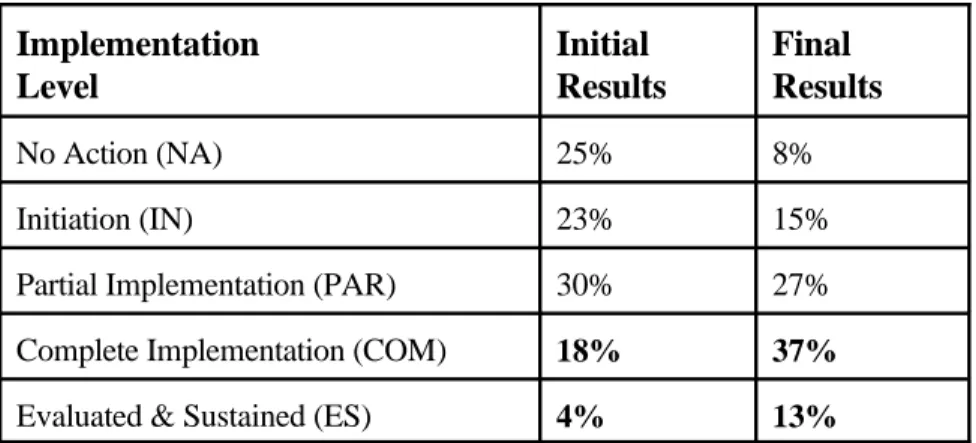
A total of 945 self-assessment responses were analyzed (15 organizations x 63 requirements in assessment tool = 945 total responses). In the initial self-assessment, 22% of responses were “YES” (i.e., COM or ES) and 78% were “NO” (i.e., NA, IN, or PAR). However, in the final self-assessment, 50% of responses were “YES” and 50% were “NO.” In Table II, these results are further broken down into the five implementation levels.
Implementation Initial Final
Level Results Results
No Action (NA) 25% 8%
Initiation (IN) 23% 15%
Partial Implementation (PAR) 30% 27% Complete Implementation (COM) 18% 37%
Evaluated & Sustained (ES) 4% 13%
Table II also shows that participants, as a group, did not begin ISO 14001 implementation “from scratch,” since only 25% of the requirements were evaluated as No Action initially.
There was a large variation amongst project participants both on EMS implementation progress and on the %YES of requirements for the initial and final self-assessments. Some participants evaluated well under 50% of their requirements as YES, while others evaluated well over 50% of their requirements as YES.
Table III shows the %YES of individual participants for both the initial and final self-assessments. Each column represents a participant (there are only 15 columns because 15 of the 18 project participants submitted both their initial and final self-assessments). The columns are ordered, from left to right, by the %YES in the initial self-assessments. These data illustrate the extent to which project participants varied in their levels of EMS implementation at both the beginning and end of the project. Note that only three of 15 showed no progress over the course of the project. The two negative results are likely due to the final self-assessments being more rigorous than the initial self-assessments in those two organizations.
Table III
EMS Implementation Progress of Individual Participants
Initial %YES 75 54 41 38 33 27 21 21 16 6 0 0 0 0 0 Final %YES 100 100 84 37 33 18 51 41 81 41 62 52 27 11 5 Final -Initial 25 46 43 -1 0 -9 30 20 65 35 62 52 27 11 5
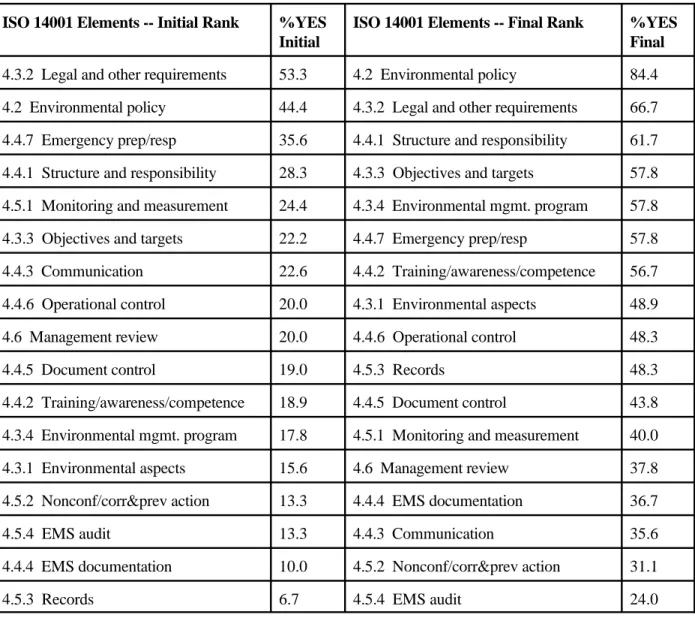
Table IV shows how the elements ranked for both the initial and final self-assessments in terms of the % of responses evaluated as “YES” within each element. The %YES was calculated by dividing the total number of responses in an element into the number of responses evaluated as “YES.” For example, there are six requirements in the Self-Assessment Tool under Policy. Since 15 participants responded, there was a total of 90 responses for Policy. Seventy-six of the 90 responses (84.4%) were evaluated as “YES.”
Table V shows the same information as Table IV, but in a different format. The 17 elements of ISO 14001 are ranked by the extent to which project participants made implementation progress on them over the course of the project. The difference between the initial and final
self-assessment for each element is provided in the third column. For example, although 6.7% of responses for Records were evaluated as “YES” (COM or ES) in the initial assessments, 48.3% or responses were evaluated as “YES” in the final assessments.
Table IV
Ranking of ISO 14001 Elements -- Initial and Final Self-Assessments
ISO 14001 Elements -- Initial Rank %YES ISO 14001 Elements -- Final Rank %YES
Initial Final
4.3.2 Legal and other requirements 53.3 4.2 Environmental policy 84.4 4.2 Environmental policy 44.4 4.3.2 Legal and other requirements 66.7 4.4.7 Emergency prep/resp 35.6 4.4.1 Structure and responsibility 61.7 4.4.1 Structure and responsibility 28.3 4.3.3 Objectives and targets 57.8 4.5.1 Monitoring and measurement 24.4 4.3.4 Environmental mgmt. program 57.8 4.3.3 Objectives and targets 22.2 4.4.7 Emergency prep/resp 57.8 4.4.3 Communication 22.6 4.4.2 Training/awareness/competence 56.7 4.4.6 Operational control 20.0 4.3.1 Environmental aspects 48.9 4.6 Management review 20.0 4.4.6 Operational control 48.3
4.4.5 Document control 19.0 4.5.3 Records 48.3
4.4.2 Training/awareness/competence 18.9 4.4.5 Document control 43.8 4.3.4 Environmental mgmt. program 17.8 4.5.1 Monitoring and measurement 40.0 4.3.1 Environmental aspects 15.6 4.6 Management review 37.8 4.5.2 Nonconf/corr&prev action 13.3 4.4.4 EMS documentation 36.7
4.5.4 EMS audit 13.3 4.4.3 Communication 35.6
4.4.4 EMS documentation 10.0 4.5.2 Nonconf/corr&prev action 31.1
Table V
Implementation Progress on Individual ISO 14001 Elements
ISO 14001 Element Initial Final Final minus
%YES %YES initial
4.5.3 Records 6.7 48.3 41.6
4.2 Policy 44.4 84.4 40
4.3.4 Environmental mgmt program 17.8 57.8 40 4.4.2 Training/awareness/competence 18.9 56.7 37.8 4.3.3 Objectives and targets 22.2 57.8 35.6 4.4.1 Structure and responsibility 28.3 61.7 33.4
4.3.1 Environmental aspects 15.6 48.9 33.3 4.4.6 Operational control 20.0 48.3 28.3 4.4.4 EMS documentation 10.0 36.7 26.7 4.4.5 Document control 19.0 43.8 24.8 4.4.7 Emergency preparedness/resp 35.6 57.8 22.2 4.5.2 Nonconformance/corr&prev action 13.3 31.1 17.8 4.6 Management review 20.0 37.8 17.8
4.5.1 Monitoring and measurement 24.4 40.0 15.6 4.3.2 Legal and other requirements 53.3 66.7 13.4
4.4.3 Communication 22.2 35.6 13.4
4.5.4 EMS audit 13.3 24.0 10.7
It is difficult to draw hard conclusions from Tables IV and V because many factors may
contribute to why certain ISO 14001 elements were more developed than others at the beginning of the project, or why organizations addressed certain elements of the Standard before others. However, a few observations from Tables IV and V are provided below.
Policy was evaluated the highest in implementation in the final assessment (84.4%) and the second highest in the initial assessment (44.4%). Moreover, Policy was ranked 2nd in progress. EMS audit, on the other hand, was evaluated quite low in both the initial assessments (13.3%)
organizations may choose to wait until most other EMS elements are in place before developing an EMS audit program. Another possible reason is that organizations may tend to rate
themselves down on this element because they have not yet performed an audit, even if they have the procedures in place.
Although Records was evaluated the lowest in the initial assessments (6.7%), the greatest progress was made on that element (up to 48.3%). On the other hand, Legal and other requirements, which received the highest evaluation initially (53.3%), made relatively little progress over the course of the project (up to 66.7%). It is not clear what factors may have contributed to these results.
Environmental aspects was ranked quite low in the initial assessment (15.6%), but significant progress was made over the course of the project (up to 48.9%). The low initial evaluation for this element likely reflects that most organizations have not yet attempted to conduct a formal assessment of their environmental aspects and impacts because doing so is not required under traditional command and control. The significant progress made over the course of the project is probably due to the fact that many participants recognized the importance of identifying
environmental aspects and impacts early on in the EMS implementation process.
Findings from Independent Assessments
This section discusses the results of the four independent EMS assessments performed in October 1996. First, the aggregate findings are analyzed. Then, several examples are given of specific requirements where there were differences between the self-assessments and independent assessments. Finally, some additional observations from the independent assessments are discussed.
Aggregate Results
For the four organizations receiving independent assessments, a total of 252 requirements were evaluated (4 x 63 requirements in assessment tool = 252). The evaluations were analyzed by identifying all those requirements for which there were differences on the YES/NO response between the self-assessment and independent assessment. The analysis showed that
approximately 76 of the 252 requirements, or 30%, were evaluated differently on the YES/NO response. Twenty-four percent (61 out of 252) were rated lower by the independent auditors; i.e., the independent auditor evaluated these requirements as NO, but the organization evaluated them as YES. Six percent (15 out of 252) were rated higher; i.e., the independent auditor
evaluated these requirements as YES, but the organization evaluated them as NO. Notably, 13 of the 15 requirements evaluated higher were in one organization.
showed at least one of the four organizations with a difference on the YES/NO response. Moreover, 51 of the 63 requirements showed at least one organization with a difference on the YES/NO response; however, for only three of the 63 requirements did three or more of the four organizations have differences on the YES/NO response.
The most notable differences in the Standard between the self-assessments and independent assessments were found in the sections on Objectives and targets and Environmental
management program. In Objectives and targets, five out of the 12 responses were evaluated lower, while two were evaluated higher. The most significant differences were found in the language requiring organizations to consider their significant environmental aspects and the views of interested parties when setting environmental objectives. In Environmental management program, seven out of 12 responses were evaluated down, while none were evaluated up. The most significant differences in this section were found in the language requiring organizations to include the means and time-frame by which objectives and targets will be achieved.
Since 24% of all the requirements were evaluated lower, and only 6% were evaluated higher, these findings suggest that the %YES of the initial and final self-assessment results would have been lower if all the EMS assessments had been conducted by independent auditors rather than by the organizations themselves. And because seven out of 12 responses in the Environmental management program section of the Standard were evaluated lower, this section in particular may have been evaluated too high in the self-assessments. These findings do not imply, however, that less overall progress was made over the course of the project, since any “self-assessment bias” would have been a factor in both the initial and final self-assessments. In fact, there was likely more bias in the initial self-assessments because the organizations’ understanding of the Standard was probably not as thorough. This suggests that the overall progress may have actually been greater than the observed difference, even though the initial and final %YES may have been lower than reported in the self-assessments.
Specific Examples from the Standard
Two types of differences were observed between the self-assessments and independent assessments:
• differences in how the organization and the auditors interpreted the intent of ISO 14001 requirements; and
• differences in opinion on what environmental management practices satisfied particular ISO 14001 requirements. (Note: this could be the case even if there is agreement between the organization and the auditors on the intent of the Standard).
were due to auditor oversights.
Most of the differences appeared to fall under the second type -- differences in opinion -- but in many cases it was difficult to differentiate between interpretation and opinion since the two are so closely linked. However, in some cases the differences could be explained fairly clearly by one type or the other. A few examples of each case are provided below.
Differences in Interpretation. One organization’s Environmental policy did not have the terms “prevention of pollution” or “pollution prevention;” rather, it had the terms “waste management” and “waste minimization.” While the independent auditors felt that the word “prevention” was required, the organization believed that “minimization” was sufficient. Therefore, the organization evaluated itself as COM on this requirement, while the auditors evaluated it as PAR on the requirement.
Another organization was evaluated higher on several requirements due to a different interpretation of the Standard. The reason for the auditors evaluating these requirements higher than the organization did was the same in each case. The organization believed that several requirements could not be complete (i.e., COM or ES) because they had not implemented every element of the ISO 14001 Standard. For example, in Structure and responsibility, the organization evaluated itself as PAR on the requirement that
management provide “essential resources;” it did so because it did not have a specific budget item for an ISO 14001 EMS. The auditors, however, evaluated this requirement as COM because they had observed that the existing EMS was being adequately
resourced.
Also in Structure and responsibility, the organization evaluated itself as NA (No Action) on the requirement that the management representative report EMS performance to top management. It reasoned that it could not report on the EMS because it did not yet have an ISO 14001 EMS. Again the auditors evaluated this requirement as COM because the management representative was in fact reporting regularly to top management on the performance of the existing EMS. The same type of situation occurred in the sections on Training, awareness and competence and Management review in which the organization evaluated itself as NO on certain requirements, while the auditors evaluated the
organization as YES on those requirements.
Differences in Opinion. Under Objectives and targets, one organization was evaluated lower on the requirement that significant environmental aspects be considered in establishing and reviewing objectives and targets. In the judgement of the auditors, the objectives and targets did not adequately address the organization’s significant
environmental aspects. Unlike with the above examples, this YES/NO difference was not caused by differing interpretations of the Standard; both the organization and the auditor
agreed that significant aspects were considered, but the auditors felt that aspects had not been considered adequately. In the same organization under Document control, the auditors evaluated lower the requirement that “documentation shall be legible, dated, and readily identifiable...” because the organization had not placed footers on each page of controlled documents to prevent copying pages out of context. This reflects a difference in judgement about what constitutes an effective document control system, rather than a difference in interpretation of the requirement.
In another organization, under Training, awareness and competence, the auditors evaluated lower the requirement that “training needs be identified” because the organization had not indicated who would be responsible for identifying those needs. Again, this difference is more a matter of judgement or opinion than interpretation, since it does not state in the Standard that the organization must specify the individual who is responsible for identifying training needs.
Additional Observations
Following the independent assessments, the audit teams were asked to report any additional observations regarding the four organizations’ EMS implementation processes. They observed two areas with which the organizations appeared to be most challenged: (1) EMS planning; and (2) taking advantage of the existing ISO 9000 system to help develop EMS procedures and documentation.
The auditors found that, as a whole, the four organizations were having more difficulty with EMS planning (with the exception of Legal and other requirements) than with the other parts of the Standard. Although all the organizations had at least some of the planning requirements in place, each organization needed to make improvements in several areas. For example, one organization had not considered all of its activities, products or services in identifying its environmental
aspects. Another organization had set objectives and targets, but had not communicated them to upper management. A third organization had identified significant environmental aspects and set objectives and targets, but had not adequately identified the means and time-frame for achieving the objectives and targets.
The auditors also found that those organizations with ISO 9000 systems (three of the four organizations were registered to ISO 9000) were not taking full advantage of their internal expertise in management systems to prepare procedures and documentation for the EMS. In all three cases, the environmental manager responsible for the EMS was surprisingly disconnected from the activities of the ISO 9000 staff. For example, in one organization the environmental manager was not aware that certain environmental procedures had already been incorporated into the ISO 9000 system.
V. FINDINGS ON KEY EMS IMPLEMENTATION ISSUES
The primary source of information for this section is the set of question responses submitted by 14 participants at the conclusion of the project. The questions (which are listed in Appendix B) were open-ended; i.e., information was not collected through a formal survey that provided response choices. This section also draws, to a limited extent, on information presented in the self-written case studies and on observations made by project staff during the four meetings held at NSF International.
Incentives for Implementing an EMS
There are many reasons why project participants decided to develop an EMS based on ISO 14001. The major incentives cited by participants are discussed below (note that incentives should be differentiated from benefits, which is discussed later in this section).
Competitive Advantage
Most participants believed that implementing an EMS will be important in maintaining or gaining competitive advantage (seven of the organizations reported that competitive advantage was an incentive for implementing an EMS, and competitive advantage was discussed frequently at the meetings). However, participants did not always specify whether the advantage would be derived from external recognition (i.e., registration) or from the benefits of improved environmental management. For some participants, the anticipated competitive advantage may have been different among departments in the organization. For example, two participants reported that the environmental management department believed that competitive advantage would be derived from improved environmental management, while upper management believed that competitive advantage would derive from external recognition.
Although competitive advantage can be viewed as an obvious incentive (i.e., an organization would not implement an EMS if it believed that doing so would not in some way lead to
competitive advantage), it is discussed here because it was mentioned quite frequently throughout the project.
Improved Environmental Performance
Six of the participants cited improved environmental performance as a reason for implementing the ISO 14001 Standard. These organizations view the EMS as a good way to identify pollution prevention opportunities and encourage continual improvement of environmental performance. As discussed below under Benefits and Costs, several participants did realize improvements in
environmental performance as a result of implementing an EMS. Possible ISO 14001 Registration
Preparing for possible ISO 14001 registration was cited by five of the project participants as an incentive for implementing an EMS. Anticipating the need for ISO 14001 registration is important for companies that sell products internationally or operate facilities overseas. It is believed by many that ISO 14001 registration could become a de facto requirement in international markets and in the U.S. marketplace as well. Registration is also seen by some companies as a potential way to demonstrate environmental performance to customers and other stakeholders including regulators, insurance companies, and community groups.
Two participants stated that implementing ISO 14001 would be an effective way to demonstrate good environmental practices externally, even though they did not tie that potential benefit directly to registration.
Enhanced Regulatory Compliance
Four participants cited enhanced regulatory compliance as an important reason they were implementing an EMS. Some participants viewed an EMS as a mechanism for cost-effectively maintaining compliance. Twice as many participants (eight) reported at the end of the project that they believed implementing an EMS would in fact improve their compliance management. It should be noted that the participants generally had very good systems to manage compliance before the project began.
Possible Regulatory Flexibility
The term “regulatory flexibility” is used to describe regulatory changes such as fewer inspections, reduced fines, and expedited permitting. Many organizations are hoping that having both a solid compliance record and a proactive EMS will result in regulators focusing efforts on organizations with significant compliance problems. Currently, regulatory flexibility appears to be a fairly weak incentive (although three project participants did cite it as an incentive) because regulatory agencies have not yet determined how to integrate ISO 14001 into their regulatory programs. If regulators determine that regulatory flexibility can be effectively linked to ISO 14001, and if agencies begin to make significant changes, then regulatory flexibility may become a much stronger incentive than it is now.
Benefits and Costs of Implementation
Every organization faced with the decision of whether or not to implement ISO 14001 must estimate the potential benefits and costs. However, accurately predicting the actual benefits and costs can be quite difficult. An organization may rely on its previous experience with ISO 9000 or other management systems to estimate EMS benefits and costs, or it may look at the
experiences of other organizations.
A common question asked about ISO 14001 is, “What are the benefits and costs of implementing the Standard?” This question is difficult to answer in general terms, because each organization will realize different benefits and costs based on a variety of factors. These factors include the size of an organization, and the environmental impacts of its activities, products, and services. An equally important factor is the extent to which an organization already has the elements of ISO 14001 in place. It is likely that an organization with the majority of ISO 14001 elements already in place before starting implementation will realize fewer benefits and incur fewer costs than a similar organization which had significantly fewer elements already in place. An organization’s accounting methods can also affect the manner in which benefits and costs of EMS
implementation are calculated. Benefits of Implementation
Measuring the benefits of EMS implementation can be challenging. Even for those benefits that are seemingly measurable (e.g., environmental management cost-savings), it can be difficult for an organization to conclude that the EMS alone is responsible for a given outcome given all the other changes occurring in the organization. For example, one organization in the project said that it had identified some specific environmental management cost-savings while implementing the EMS, but the organization could not pinpoint to what extent EMS implementation was responsible for the improvement.
At the conclusion of the project, organizations began to realize some benefits of their efforts. Most of these benefits were recognized between the third and fourth meetings (i.e., between December 1995 and June 1996), about one year after the beginning of the project. A few participants realized some benefits that they had not anticipated at the beginning of the process. Below is a discussion of the types of benefits participants reported they had realized (or not realized) at the conclusion of the project. It is important to keep in mind that although most of these benefits were realized over the course of the project during the ISO 14001 implementation process, a few participants which already had well developed EMSs reported benefits they had realized before they became involved in the project. It appears likely that many of the
Improved Cooperation and Environmental Awareness Among Employees
Five participants reported that the EMS had enhanced awareness of environmental issues among its employees. Enhanced awareness had resulted in improved employee morale, in addition to improved operations. One organization said, “people want to do the right thing in the correct manner but need to be made aware of the opportunities and methods available.” The
organization noted that the EMS had provided employees with the “opportunities and methods” to do the right thing. Another organization reported “an enhanced spirit of cooperation at the facility” which was attributable to the EMS. This organization commented that “perceptions that the work force doesn’t care about management, or management doesn’t care about the work force, or that corporate is out of touch and offers no practical help are torn down” when employees at all levels are given enhanced roles in environmental management. A third organization reported that heightened responsibility at the facility level made the facility less dependent on the corporate environmental office.
Improved Procedures and Documentation
Five participants reported that the EMS had led to improved procedures and documentation. This reported benefit is interesting in light of the fact that it is common for organizations considering EMS to complain about the level of documentation that is required in ISO 14001. One
explanation for this seeming discrepancy is that organizations see a value in documentation and written procedures, but they do not want a standard to require what should or should not be documented.
Enhanced Regulatory Compliance
Several organizations reported that they had not yet been able to determine if EMS
implementation had actually improved their compliance management; however, most believed that having an established EMS would do so in the future. Those organizations which began the project with well-developed systems (primarily the larger organizations) reported that their EMS had undoubtedly enhanced their ability to maintain regulatory compliance (three organizations reported this). As one large organization summarized: “Our EMS provides the process whereby environmental laws and regulations are analyzed, guidance is provided, practices are implemented, and performance is audited. The reports from the audit feed our continuous improvement cycle.” The three organizations which reported these benefits had realized many of them before
participating in the project; thus, the benefits may be more likely a result of having an EMS in place than a result of implementing one.
Improved Environmental Performance
The ISO 14001 Standard defines environmental performance as “measurable results of the environmental management system, related to an organization’s control of its environmental aspects, based on its environmental policy, objectives and targets.” Although this definition was developed through a broad consensus process, there is still no universally shared definition of environmental performance. However, it is probable that most people generally view
environmental performance in terms of an organization’s ability to maintain compliance and/or reduce emissions, effluents, and other causes of detrimental environmental impact. It should be noted that project participants were not asked to consider any particular definition of
environmental performance in reporting how their EMS influenced environmental performance. Five organizations reported that they had realized improved environmental performance due, at least in part, to implementing their EMS or having one already established (several others, particularly those in the earlier stages of implementation, believed that an EMS would lead to improved performance in the future). Examples from different organizations are provided below. • Fifty percent reduction in the quantity of hazardous waste generated over a five year
period (this benefit was realized before the demonstration project).
• Improved emergency preparedness and response procedures (this occurred during the project).
• Identification and implementation of two specific pollution prevention projects involving materials substitution (this occurred during the project).
Reduced Environmental Management Costs
Most organizations reported that it was very difficult to determine if the EMS was responsible for a net reduction in overall environmental management costs (it is likely that an organization’s EMS would need to be in place for a significant amount of time before the organization could measure costs-savings). However, a few participants did cite specific cost reductions in a particular area due to EMS activities. For example, one organization reported a 74% reduction in hazardous waste disposal costs over the period of the project.
Access to International Markets
At the end of the Demonstration Project, participants reported that the EMS had not yet opened or maintained an opportunity in international markets. This finding is consistent with the fact that market forces for international EMS registration have not yet developed. One organization said that it was actually skeptical of the trade benefits of ISO 14001. This organization had originally
implemented ISO 9000 primarily for trade reasons, but ISO 9000 registration had not resulted in the competitive advantage that the organization originally anticipated.
Costs of Implementation
The major cost of implementing an EMS is staff time. If an organization chooses to have an outside consultant perform a large portion of the work, consulting fees might also be significant. Other costs might include travel (if, for example, corporate staff are actively involved with an off-site facility that is developing an EMS), EMS auditor training, and computer software. Additional costs might be incurred if an organization decides to pursue EMS registration or have a baseline assessment conducted.
Fewer than half of the participants specifically tracked the costs of EMS implementation, and only two (both large companies) actually reported estimated costs. Several organizations noted that they did not track the costs of EMS implementation because it was not established as a cost center -- it was simply considered a part of doing business. Those that did track costs included different items in their cost calculations. For example, some organizations only tracked consulting fees and training, while others only tracked staff time.
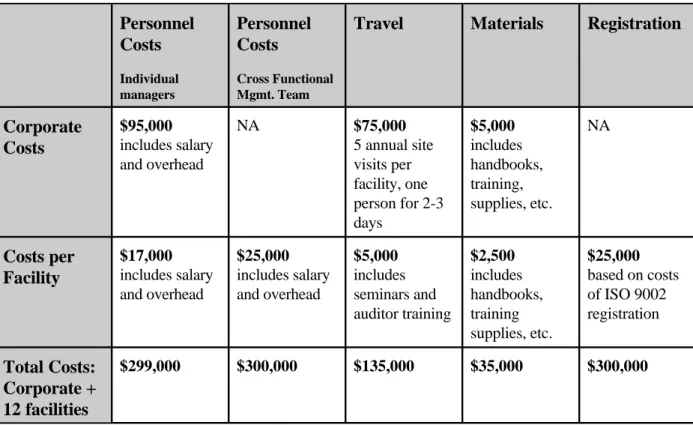
One participant reported estimated EMS implementation costs in some detail. Costs were estimated for 12 facilities from the beginning of implementation (spring 1995) through initial registration (around the spring of 1997). Since the estimate only pertains to EMS
implementation, it does not include the future costs of EMS maintenance or registration surveillance audits. Table VI below shows categories used by this organization in estimating costs. It is important to note this is only one example from the 18 organizations participating in the project, and should not be interpreted as a “typical” case.
Table VI
One Company’s Estimation of EMS Implementation Costs
Personnel Personnel Travel Materials Registration Costs Costs
Individual Cross Functional managers Mgmt. Team
Corporate Costs
$95,000 $75,000 $5,000
includes salary 5 annual site includes
and overhead visits per handbooks,
NA NA
facility, one training, person for 2-3 supplies, etc. days
Costs per Facility
$17,000 $25,000 $5,000 $2,500 $25,000
includes salary includes salary includes includes based on costs and overhead and overhead seminars and handbooks, of ISO 9002
auditor training training registration supplies, etc.
Total Costs: Corporate + 12 facilities
$299,000 $300,000 $135,000 $35,000 $300,000
Total: $1,069,000 corporate-wide, or $89,000 average per facility
Barriers and Keys to Successful Implementation
Even with the commitment of upper management, implementing an EMS can be a challenging effort, particularly for organizations that have few ISO 14001 elements in place or are unfamiliar with management system concepts.
Project participants cited several barriers to implementation. By far the most commonly cited barrier was lack of time due to competing priorities (nine organizations reported this); as will be discussed later, lack of time tends to be a greater concern for SMEs. Other barriers cited include: • insufficient support or lack of understanding from top management;
• insufficient resources;
• uncertainty about the intent of ISO 14001; and
• an aversion to added documentation and paperwork (a few organizations reported that it was difficult to convince the organization to add procedures and documentation to a system already perceived as quite successful in maintaining compliance).