Imperial College London Department of Computing
Argumentation Accelerated
Reinforcement Learning
Yang Gao
March 2015
Supervised by Professor Francesca Toni
Submitted in part fulfilment of the requirements for the degree of Doctor of Philosophy in Computing of Imperial College London
Copyright Declaration
The copyright of this thesis rests with the author and is made available under a Cre-ative Commons Attribution Non-Commercial No DerivCre-atives licence. Researchers are free to copy, distribute or transmit the thesis on the condition that they attribute it, that they do not use it for commercial purposes and that they do not alter, trans-form or build upon it. For any reuse or redistribution, researchers must make clear to others the licence terms of this work
Abstract
Reinforcement Learning (RL) is a popular statistical Artificial Intelligence (AI) technique for building autonomous agents, but it suffers from the curse of dimen-sionality: the computational requirement for obtaining the optimal policies grows exponentially with the size of the state space. Integrating heuristics into RL has proven to be an effective approach to combat this curse, but deriving high-quality heuristics from people’s (typically conflicting) domain knowledge is challenging, yet it received little research attention. Argumentation theory is a logic-based AI technique well-known for its conflict resolution capability and intuitive appeal. In this thesis, we investigate the integration of argumentation frameworks into RL algorithms, so as to improve the convergence speed of RL algorithms.
In particular, we propose a variant of Value-based Argumentation Framework (VAF) to represent domain knowledge and to derive heuristics from this knowl-edge. We prove that the heuristics derived from this framework can effectively instruct individual learning agents as well as multiple cooperative learning agents. In addition,we propose the Argumentation Accelerated RL (AARL) framework to integrate these heuristics into different RL algorithms viaPotential Based Re-ward Shaping(PBRS) techniques: we use classical PBRS techniques forflatRL (e.g. SARSA(λ)) based AARL, and propose a novel PBRS technique for MAXQ-0, a hierarchical RL (HRL) algorithm, so as to implement HRL based AARL. We empirically test two AARL implementations — SARSA(λ)-based AARL and MAXQ-based AARL — in multiple application domains, including single-agent and multi-agent learning problems. Empirical results indicate that AARL can im-prove the convergence speed of RL, and can also be easily used by people that have little background in Argumentation and RL.
Acknowledgements
I consider myself very fortunate to have benefited from the unparallelled knowl-edge and guidance of my supervisor, Professor Francesca Toni. I am greatly in-debted to her patience, continued support and encouragement throughout my PhD studies. Francesca allowed me to follow my own research agenda and to slowly plow my way through research topics I am interested in, while, at the same time, inspiring me with new ideas and providing invaluable instructions whenever I had problems. She spent late nights and early mornings in reading and revising my papers, shared her enthusiasm for my work with her colleagues, and introduced me to the academic community. Without her help, this thesis would not have been possible.
Also, I must give my special thanks to my parents and my girlfriend, Kai Sun, for their consistent support, help and love. Kai cheerily endured my foulest moods and helped me in countless ways, from cooking meals for me during long nights spent in front of my computer, to proofreading drafts of my thesis. The video talk with my parents in each weekend has been my most enjoyable part in each week.
Special thanks also to Xiuyi Fan, who has been an invaluable sounding board giving helpful feedback on many naive thoughts I gave him, a trustworthy ‘big brother’ providing me with a lot of insights into the problems I encountered, and a humorous friend cheering me up when my self-confidence waned. Without Fan, my life at Imperial would be far less colourful.
In addition, I would like to thank my funding body, China Scholarship Council, for its generous scholarship covering both my tuition and living expenses.
Thanks to everybody in the CLArg group and many others in the department for helping to create an enjoyable working environment. Special thanks to Krysia Broda and Murray Shanahan for their comments on my work, and to Amani El-Kholy, Ann Halford and Teresa Ng for looking after me so well in the department. Finally, many thanks to Abbas Edalat, Sanjay Modgil and Marc Deisenroth, my examiners, for reading this thesis and giving some very useful comments that have contributed to greatly improve it.
Contents
1 Introduction 11
1.1 Overview . . . 12
1.2 Proactive Decision Making and Argumentation . . . 14
1.3 Reactive Decision Making and RL . . . 17
1.4 Contribution . . . 19
1.5 Structure of This Dissertation . . . 20
1.6 Publications . . . 21
1.7 Statement of Originality . . . 22
2 Background 23 2.1 Argumentation Theory . . . 23
2.1.1 A Brief Overview of Argumentation Theory . . . 23
2.1.2 Abstract Argumentation Frameworks . . . 25
2.1.3 Value-Based Argumentation Framework . . . 27
2.1.4 Computation of Argumentation Semantics . . . 28
2.2 Reinforcement Learning (RL) . . . 29
2.2.1 Markov Decision Processes (MDPs) and Semi-MDPs . . . 31
2.2.2 SARSA Learning Algorithm . . . 36
2.2.3 Hierarchical RL (HRL) and MAXQ . . . 42
2.2.4 Eligibility Traces . . . 53
2.2.5 Potential-Based Reward Shaping (PBRS) . . . 56
2.3 Conclusion . . . 58
3 Argumentation Frameworks for Reinforcement Learning 60 3.1 Motivation . . . 60
3.1.1 The RoboCup Soccer Games . . . 61
3.1.2 Why Incorporate Argumentation into RL . . . 64
3.2 Argumentation Frameworks for Reinforcement Learning . . . 65
3.2.2 Argument for RL . . . 66
3.2.3 Argumentation Frameworks . . . 68
3.2.4 From Extensions to Heuristics . . . 76
3.3 Argumentation Accelerated RL (AARL) . . . 78
3.4 Related Work . . . 81
3.5 Conclusion . . . 83
4 SARSA(λ)-based AARL 84 4.1 SARSA(λ)-based AARL . . . 84
4.2 Experiments in RoboCup Games . . . 87
4.2.1 Performances of Both Sides Using Fixed Strategy . . . 89
4.2.2 Experiments in Keepaway games . . . 91
4.2.3 Experiments in Takeaway games . . . 96
4.3 Experiments in a Wumpus World Game . . . 102
4.4 Related Work . . . 109
4.5 Conclusion . . . 111
5 Potential Based Reward Shaping for Hierarchical RL 112 5.1 MAXQ with PBRS . . . 112
5.1.1 Integrating Potential Values into the MAXQ Decomposition 114 5.1.2 The PBRS-MAXQ-0 Algorithm . . . 120
5.2 Experiments . . . 130
5.2.1 Taxi Problem . . . 130
5.2.2 Stochastic Wumpus World . . . 133
5.3 Related Work . . . 139
5.4 Conclusion . . . 140
6 MAXQ-Based AARL: An Empirical Evaluation 142 6.1 MAXQ-based AARL . . . 143
6.2 The Energy Usage Recommendation System . . . 147
6.3 Why Use MAXQ-Based AARL . . . 148
6.4 A Real-Data-Based Simulated User . . . 149
6.5 Model the Problem as a MDP . . . 152
6.6 Arguments for EURS . . . 157
6.6.1 Arguments Supporting Primitive Actions and Their Values 157 6.6.2 Arguments Supporting Composite Sub-tasks and Their val-ues . . . 164
6.7 Experimental Settings and Results . . . 165
6.7.1 Experimental Settings . . . 166
6.7.2 Results in Learning Phases . . . 168
6.7.3 Results in the Evaluation Phases . . . 169
6.8 Related Works . . . 173
6.9 Conclusion . . . 176
List of Tables
2.1 Some types of computation in abstract argumentation frameworks. 29 2.2 Complexity of some types of computation for the preferred and
grounded semantics (adjusted from [DW09]). . . 29
4.1 The performances of 3 keepers playing against 2 takers, both using fixed strategies. . . 91 4.2 The performances of 4 keepers playing against 3 takers, both using
fixed strategies. . . 91 4.3 State variables in aN-Keepaway game. . . 93 4.4 Performances of learning keepers playing against random takers
after several hours of learning. . . 96 4.5 Performances of learning keepers playing against always-tackle
takers after 40 hours of learning. . . 97 4.6 Performances of learning keepers playing against argument-based
takers after 40 hours of learning. . . 98 4.7 State variables for learning takerT1 in aN-Takeaway game. . . . 100 4.8 Performances of learning takers playing against random keepers
after 40 hours of learning. . . 101 4.9 Performances of learning takers playing against random keepers
after 40 hours of learning. . . 101 4.10 Some statistics of the experiments involving students’ arguments. . 109
5.1 Some statistics during the learning in the stochastic Wumpus World. 138
6.1 The average rewards and their standard errors of different SARSA(0)-based algorithms in the evaluation phases. . . 172 6.2 The average rewards and their standard errors of different
MAXQ-based algorithms in the evaluation phases. . . 173 6.3 Pairwise p-values of SARSA-based algorithms in EURS. . . 174 6.4 Pairwise p-values of MAXQ-based algorithms in EURS. . . 175
List of Figures
1.1 A scenario in a simple Wumpus World. . . 13
1.2 An AF for representing the domain knowledge given in Section 1.1. . . . 15
1.3 The interaction between a RL agent and the environment. . . 18
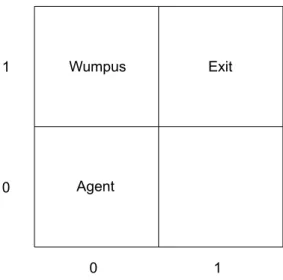
2.1 A2×2Wumpus World. . . 34
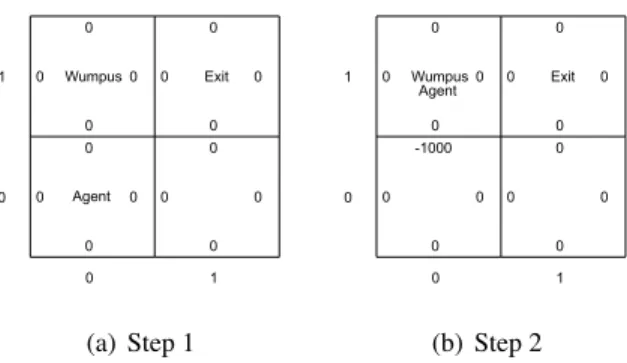
2.2 The first episode of the SARSA-based learning in the2×2 Wum-pus World in Figure 2.1. . . 37
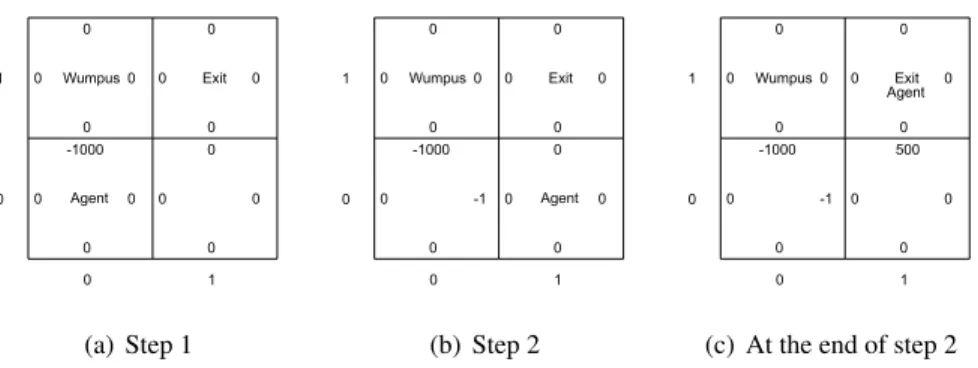
2.3 The second episode of the SARSA-based learning. . . 39
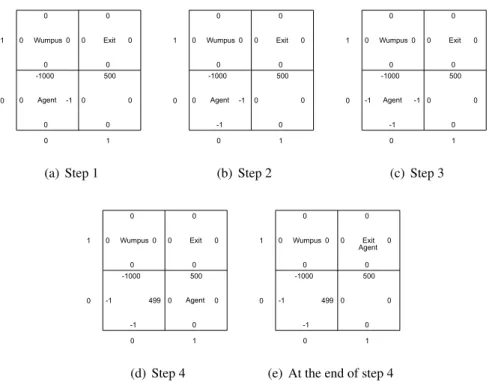
2.4 The third episode of the SARSA-based learning. . . 40
2.5 The task graph for the stochastic Wumpus World problem. . . 45
2.6 An example scenario in the extended Wumpus World. . . 47
2.7 The hierarchical execution process of the Wumpus World example shown in Figure 2.6. . . 49
3.1 An example scenario in RoboCup Soccer Game. The ball is the white circle next to keeperK1. . . 62
3.2 The derived AF of SCAFs for the Keepaway game (left) and the Takeaway game (right) in the scenario shown in Figure 3.1. . . 69
3.3 The simplified argumentation frameworks for the Keepaway game (left) and the Takeaway game (right) in the scenario shown in Fig-ure 3.1. . . 72
3.4 The simplified argumentation framework for takers in the scenario shown in Figure 3.1, given the new value rankingQUICK CLOSE>v QUICK TAC>v QUICK MARK. . . . 76
3.5 The architecture of AARL. . . 79
4.1 The performances of learning keepers against random takers. . . . 94 4.2 The performances of learning keepers against always-tackle takers. 94
4.3 The performances of learning keepers against argument-based tak-ers. . . 95 4.4 The performances of learning takers against random keepers. . . . 99 4.5 The performances of learning takers against hand-coded keepers. . 99 4.6 The performances of two Takeaway games by using potential
val-ues proposed in [DGK11]. . . 102 4.7 The GUI-based system of the Wumpus World game. . . 104 4.8 Performances of SARSA(0)-based AARL and standard SARSA(0)
in the Wumpus World game. . . 108 4.9 A histogram summarising the number of students’ AARLs
receiv-ing different overall rewards. . . 109
5.1 Settings of the Taxi problem. . . 114 5.2 Performances in the Taxi problem. . . 133 5.3 Performances of R-MAXQ and R-MAXQ in the Taxi Problem. . . 134 5.4 A Wumpus World. . . 135 5.5 Performances of four RL algorithms in the stochastic Wumpus
World game. . . 137
6.1 The probability distribution of the switching on time of the wash-ing machine. . . 150 6.2 The probability distribution of the switching on time and working
time of the TV set. . . 151 6.3 The task graph for the energy adviser system. . . 156 6.4 Settings we use to implement AARL for EURS. . . 158 6.5 Performances of SARSA(0)-based EURS in the learning phases. . 170 6.6 Performances of MAXQ-based EURS in the learning phases. Lighter
colour areas represent 95% confidence intervals. All results are av-eraged over 100 independent experiments, each consisting of 2000 episodes. . . 171
1 Introduction
We take decisions every day, and the ability for making good decisions is an impor-tant reflection of people’s intelligence. Two decision-making strategies are widely used in our daily lives: the proactive decision-making strategy, which predicts possible outcomes of each available option and evaluates these outcomes before making the decision; and thereactive strategy, which simply tries options, ob-serves and evaluates their outcomes, and remembers the best option, so that when the same situation is encountered again, the best option can be directly invoked. Intuitively, when the environment is deterministic and the outcomes can be eas-ily predicted, the proactive strategy can be more effective; otherwise, the reactive strategy can be more useful as the proactive strategy cannot work effectively when the environment is highly unpredictable. In many real cases, the environment is stochastic and we cannot precisely predict all possible outcomes; but still, we may have some domain knowledge about the environment or the optimal decisions, based on which we can perform some proactive planning. In these cases, making decisions by jointly using these two strategies is more likely to lead to the optimal decisions than using any of these strategies alone. The general research target of this dissertation is to design intelligent agents that can make decisions by jointly using the proactive and reactive strategies.
Our research falls under the remit ofArtificial Intelligence(AI), and much AI re-search has been devoted to building proactive or reactive decision-making agents. For example, Argumentation Theory(e.g. as given in [Dun95]), which resolves conflicts between different options using the simple idea that ‘the one who holds the last word laughs best’, has been widely used for designing proactive agents, e.g. in [KM03, FTMW14]; andReinforcement Learning(RL) [SB98], aMachine Learningalgorithm based on the idea of ‘trial and error’, has been widely used in designing reactive, sequential-decision-making agents, e.g. in [NCD+06, SSK05]. Despite their strengths, both face problems when used alone in real applications: for example, a main problem faced by RL is thecurse of dimensionality, which states the computational requirement for obtaining the optimal policies grows
ex-ponentially with the size of the state space; as for argumentation, it still lacks a mechanism for performing sequential-decision-making under stochastic envi-ronments. Given the complementary advantages of these two techniques (RL’s advantage of making sequential decisions in stochastic environment, and Argu-mentation’s advantage of proactive reasoning and planning), we believe that their integration can result in a technique, which not only is able to reactively perform sequential decision making in stochastic environments, but also able to proactively make draft action plans based on prior knowledge. A main contribution of this thesis is a methodology for systemically and effectively incorporating these two techniques. To the best of our knowledge, this is the first proposal for integrating these two techniques.
In the remainder of this chapter, we first briefly describe the problems we want to tackle and how we tackle these problems in Section 1.1, and then we give a non-technical introduction of Argumentation Theory and RL in Section 1.2 and 1.3, respectively. We summarise the contribution of this dissertation in Section 1.4, and provide a brief outline of the dissertation structure in Section 1.5. The publications which have resulted from this thesis are presented in Section 1.6, and the statement of originality is in Section 1.7.
1.1 Overview
This dissertation addresses the topic of planning and learning for stochastic, se-quential decision making. The term ‘stochastic’ means that the environment in which decisions are taken has uncertain factors, i.e. the outcome of actions may not be deterministic. The ‘sequential’ aspect of the decision problem reflects the fact that the immediate costs or benefits of an action only play a small part in deter-mining the true long-term value of this action. In other words, we are not focusing on making a ‘one-shot’ decision, which maximises the immediate utility; instead, we attempt to make decisions that maximise the long-term rewards. The decision-making problem is framed from the perspective of an agent or a group of agents that are situated in a stochastic environment, and the agents have some sensors to detect certain signals in the environment. Our goal is to develop algorithms that can find these agents’ optimalpolicy, which describes a strategy maximising the long-term rewards received by the whole group of agents in this environment,1and
1
In this thesis, we only consider thecooperativemulti-agent learning problem, in the sense that the goal each learning agent is to maximise the whole team’s long-term reward.
Figure 1.1: A scenario in a simple Wumpus World. The smiling face stands for the agent. Note that the agent does not directly know the location of the Wumpus, the pit or the exit.
these algorithms involve both planning (proactive decision-making) and learning (reactive decision-making).
As a concrete example, consider the decision making problem in a simple Wum-pus World, a classic application domain in AI [RN09]. The WumWum-pus World is a grid world, where there are some Wumpuses, some pits and an exit. Each exper-iment in the Wumpus World consists of a series ofepisodes. At the beginning of each episode, an agent is located in some square in the Wumpus World. The agent has four available actions: go up, go down, go leftand go right. These actions move the agent one square towards the intended direction if there are no walls next to the agent in the intended direction; otherwise, the agent will remain in the same square. When the agent steps into a square that has a pit or a Wumpus, the agent dies and the episode ends. When the agent is in a square (non-diagonally) next to a pit or a Wumpus, it detects breeze or stench, respectively. The agent’s task is to arrive at the exit as quickly as possible, without being killed by a Wumpus or falling into a pit.
Now suppose the agent is in a square such that it feels stench and breeze, as illustrated in Figure 1.1. Also, we have domain knowledge that, in this scenario, go up and go left do not lead to death. Neither the proactive nor the reactive decision-making strategy can effectively find the best policy in this situation when used alone: by using the proactive planning alone, although the agent can infer
thatgo upandgo left are better than the other available actions (as we will see in the next section), it cannot decide which is the best action; on the other hand, by using the reactive strategy alone, the agent needs to perform all actions before it identifies the best action, although it is unnecessary to try actionsgo right and go down. So, intuitively, the best solution is to use these two strategies together: first use proactive planning to select some promising actions, and then use the reactive strategy to systematically test their performances and find the best. This example illustrates the motivation of our research. In the following two sections, we will describe, in detail, which proactive and reactive technique we focus on in this thesis, and further motivate why we integrate these techniques.
1.2 Proactive Decision Making and Argumentation
Proactive decision making involves making plans and predictions to avoid a po-tential disaster or to increase the likelihood of a popo-tential success. Reasoning and planning abilities play important roles in this process. Since people naturally use logic to perform reasoning [Mac01], logic-based approaches are widely used in designing reasoning and planning algorithms in AI (see, e.g. [Min01]). Among the logic-based techniques,Argumentation Theory[RS09] has attracted consider-able and increasing research attention in recent years, because of its conceptual simplicity as well as strong conflict-resolving capability.
Argumentation is usually traced back to Aristotle’s work in formal deductive reasoning and rhetoric [Irw89]. In its classical treatment within philosophy, the study of argumentation is concerned with how assertions are proposed, discussed, and resolved in the context of issues upon which several diverging opinions may be held [BCD07]. The important early motivations that brought Argumentation Theory into use in AI arose from the issue of reasoning and explanation in the presence of incomplete and uncertain information. As classical logic is proved to be inadequate in addressing these issues [Rei80],non-monotoniclogic has at-tracted substantial research interest within AI, and formal logics of Argumentation emerged as one style of formalising non-monotonic reasoning (e.g. see discus-sions in [CML00]). In the non-monotonic logic reasoning formalisms, concludiscus-sions drawn may be later withdrawn when additional information is obtained [Ant97], and the idea of Argumentation is that reasoning can be performed by constructing and evaluating arguments, which are composed of a number of reasons for the va-lidity of a claim. Argumentation is considered as a non-monotonic logic because
Loo //U
Figure 1.2: An AF for representing the domain knowledge given in Section 1.1.
new information may give rise to new counter-arguments defeating arguments that were originally acceptable. Whether a claim can be accepted, therefore, depends not only on the existence of an argument that supports this claim, but also on the existence of possible counter-arguments, that can then themselves be attacked by counter-arguments, etc.
In this thesis, we focus on computational argumentation frameworks, starting with the influential work of Dung [Dun95]. In Dung’s Abstract Argumentation Frameworks (AFs), an argumentation framework is only consisting of a set of arguments and a binaryattack relation. Therefore, AFs are usually represented by directed graphs, where each node stands for an argument and each directed arc stands for an attack. A more comprehensive and detailed review of Argumentation Theory will be given later in Chapter 2.
As an illustration, let us still consider the example we presented in Section 1.1. The domain knowledge can be represented by the AF in Figure 1.2, whereL(U) is a shorthand for argument ‘recommend the agent to perform actiongo left(go up) if going left (going up) is deemed to be safe’. Attacks between arguments are represented by directed arcs in Figure 1.2: an arc pointing from argument A to argumentBmeans ‘AattacksB’, and a two sided arc connecting argumentAand Bmeans thatAandBmutually attack one another. In Figure 1.2, we can see that two argumentsLandUmutually attack each other, because, at each moment, the agent can at most perform one action. Also, we can see that, in this AF, there are no arguments supporting actionsgo downorgo right, because there is no do-main knowledge suggesting that these actions are safe; instead, sensory informa-tion (i.e. the agent feels stench as well as breeze in the current square) suggests that performing these actions may be dangerous. Since we have no ‘applicable’ in-formation to encourage the agent to performgo rightandgo down, no arguments supporting these actions appear in this AF. By comparing the domain knowledge we presented in Section 1.1 and the AF illustrated in Figure 1.2, we can see that the domain knowledge as well as the conflicts therein are concisely and precisely represented by the AF.
To resolve conflicts in AFs and identify the ‘winning’ arguments, multiple cri-teria, also known assemantics, are proposed [Dun95] and some algorithms are
developed for computing winning arguments according to these criteria [MC09]. In the AF shown in Figure 1.2, for example, different winning arguments may be obtained by using different semantics: according to a ‘sceptical’ semantics, neither of these two arguments is winning, because no one can ‘defeat’ the other and thus convincingly win; instead, according to a ‘credulous’ semantics, both of these ar-guments win, because each of them can counter-attack all arar-guments attacking it. Later in Chapter 2, we will revisit this example and introduce some other criteria for selecting winning arguments in greater detail.
Furthermore, based on AFs, new computational argumentation frameworks have been developed, and these new frameworks have even stronger conflict-resolving abilities. For example,Value-based Argumentation Frameworks(VAFs) [BCA09] extend AFs with values so that the relative importance of each argument can be ranked. In order to choose the winning arguments in a VAF, we not only need to consider the attack relation between arguments, but also take into account the relative importance of different arguments. In other words, VAFs can take ad-vantage of more information (the relative importance of arguments) to select the winning arguments and, therefore, they have stronger capability in resolving con-flicts contained in the domain knowledge (details of VAFs will be presented later in Chapter 2). In addition, a particularly noticeable advantage of VAFs, which is not shared by other extensions of AFs (e.g. Preference-based Argumentation Frameworks[AC02]) is that the values in VAFs often represent people’s expecta-tions of the outcomes of different arguments, and in some applicaexpecta-tions (e.g. the energy usage adviser system we introduced later in Chapter 6) the domain expert can correlate the values in VAFs with numerical values straightforwardly. Hence, by using VAFs, people can easily rank the actions according to the rankings of their outcomes; by doing this, people can not only rank arguments, but also pro-vide the reasons for this ranking. This property of VAFs facilitates people to jus-tify their rankings of arguments. Because of the conceptual simplicity as well as strong conflict-resolving capability, AFs and their extensions have been widely used in designing decision support tools in many real applications, e.g. for legal [PS07] and medical [FCS+13] decision-making support. However, to the best of our knowledge, AFs have not been used in stochastic sequential decision-making problems yet, because they lack systemic mechanisms in dealing with uncertainty and time series simultaneously. Considering the strengths and limitations of argu-mentation frameworks, in this thesis we integrate a variant of VAF into machine learning techniques for tackling stochastic sequential decision problems.
1.3 Reactive Decision Making and RL
Reactive decision making is often used in situations when people cannot or do not want to plan for problems because they have no prior knowledge about how to solve these problems. In reactive decision making, people simply try each option, observe their outcomes and decide which is the best option. This process is expen-sive, because trying each option is time-consuming and performing some actions may lead to undesirable outcomes. However, by using computer simulations, ‘trial and error’ processes in reactive decision making can be much cheaper, and this leads to the development of RL algorithms in AI [SB98].2
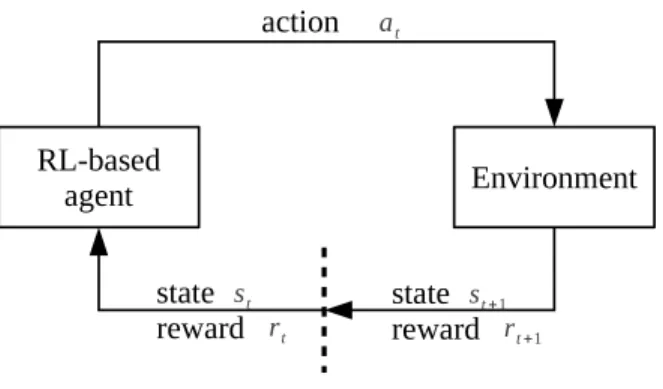
The RL framework is a considerable abstraction of the problem of goal-directed learning from interaction. The interaction between a RL agent and its environment is illustrated in Figure 1.3. We can see that the agent and the environment interact at each of a sequence of discrete time steps3 t = 0,1,2,· · ·. We refer to each interaction between the agent and the environment as alearning step. At each time stept, the agent receives some representation of the environment: statest, and on
that basis selects an action at. In the next time step, in part as a consequence
of action at, the agent receives its numerical reward rt+1, and finds itself in a new statest+1. Note that, in different learning steps, performing the same action
in the same state may result in different reward and next state; this represents thestochasticnature of the environment. This interaction repeats until the agent reaches aterminal state, and the procedure ranging from putting the agent at the initial state to the agent reaching a terminal state is called anepisode.
ARL experimentconsists of one or many episodes. People (either the designer of the RL system or the user) need to specify when a RL experiment terminates: for example, an experiment can terminate after learning for ten episodes, or terminate after one hour of learning. In this thesis, we restrict our attention toepisodicRL problems, i.e. RL problems in which each episode consists of a finite number of learning steps and each experiment consists of a finite number of episodes. The target of RL is to identify mappings from states to actions, which return the actions to be performed in each state, such that by following these mappings, the
2In this thesis, we focus on themodel-freeRL algorithms, because they do not learn the dynamic of the environment explicitly and are thus most conceptually close to the idea of ‘trial and error’ and proactive decision making. We will give greater details of model-free RL techniques later in Chapter 2.
3 The time sequence can also be continuous in RL, but for simplicity, most RL problems are modelled as having discrete time series [SB98]. In this thesis, we focus on the discrete time RL problems.
Figure 1.3: The interaction between a RL agent and the environment.
long-term cumulative reward can be maximised. Such mappings are known as optimal policiesin the RL literature, and RL algorithms amount to any method that is suited to find the optimal policies.
RL can be used to designmulti-agent learning systems, where there are multiple agents learning independently [BBS08]. In this thesis, we focus on one specific form of multi-agent RL: cooperative multi-agent RL, whose goal is to maximise the whole team’s long-term cumulative reward. Single-agent RL problems can be viewed as special cases of cooperative multi-agent RL, where there is only one agent.
Naively, the optimal policies can be found by trying all possible policies, stor-ing the cumulative rewards they lead to, and selectstor-ing the policy that leads to the highest long-term rewards. This naive approach is computationally expensive and memory-consuming; as a result, different RL algorithms use different ‘tricks’ to reduce the time and memory space required to find the optimal policies. How-ever, no matter what tricks RL algorithms use, the computational requirement for obtaining the optimal policies increases exponentially with the size of the state space. This is the famouscurse of dimensionality faced by all RL algorithms, and it is a main obstacle for applying RL to large-scale and realistic problems, for example in robotics control problems [BS01, SB98].
A widely used idea to combat the curse of dimensionality is to integrate prior knowledge into RL algorithms. By using prior knowledge, RL agents do not need to ‘learn from scratch’ and can instead take advantage of some existing instruc-tions derived either from people’s domain knowledge or other agents’ learning ex-periences. Potential-Based Reward Shaping(PBRS) [NHR99] is one of the most widely used techniques for incorporating instructions into RL. It can be applied to
many popular RL algorithms, e.g. Q-Learning [WD92] and SARSA(λ) (a detailed introduction of SARSA(λ) will be given later in Chapter 2). Its idea is to give more promising actions some extra rewards, so that the agent is more encouraged to perform the recommended actions. The most significant advantage of PBRS is that no matter whether the instructions are right or not, the PBRS-augmented RL algorithms are still able to converge to the optimal policy after enough time of learning [NHR99, WCE03]. PBRS techniques have been successfully used in both single-agent (e.g. [WCE03]) and multi-agent (e.g. [GK08]) RL problems. A more detailed introduction of PBRS will be given later in Chapter 2.
Besides using domain knowledge, another popular group of RL techniques to improving the convergence speed isHierarchical RL(HRL). HRL algorithms ex-ploittemporal abstraction, where decisions are not required at each step, but rather invoke the execution of temporally extended activities which follow their own poli-cies until termination. Each temporally extended activity can also invoke other activities to solve itself, resulting in a hierarchical reconstruction of the original problem. By doing so, HRL algorithms not only enable quick convergence in complex applications, but also facilitate people to use high-level domain knowl-edge to instruct learning. On the contrary, all the other non-HRL algorithms are referred to asflat RL algorithms. Some popular HRL algorithms like MAXQ-0 [Die00] have been proved to be able to converge faster than flat RL algorithms in some applications. However, HRL algorithms are also faced with the curse of dimensionality and the classic PBRS techniques cannot be applied to HRL algo-rithms to accelerate them. As a result, there are still difficulties in applying HRL algorithms to large-scale problems [BM03].
In this thesis, we focus on using prior knowledge to improve both flat and hier-archical RL algorithms’ performances, because results of proactive planning can be naturally used as instructions for agents. In particular, we investigate the incor-poration of PBRS techniques and HRL algorithms, which can enable the heuristics to be easily integrated into HRL algorithms, without altering its original (hierar-chical) optimal policies. We will present the resulting algorithmPBRS-MAXQ-0 later in Chapter 5.
1.4 Contribution
From the perspective of decision-making research, this thesis contributes a frame-work for designing cooperative agents that can make decisions jointly using
proac-tive and reacproac-tive decision-making strategies; from the perspecproac-tive of AI research, this thesis contributes a framework for combining logical and statistical AI algo-rithms; and from a technical perspective, the main contributions of this thesis are presented as follows:
• We propose Argumentation Accelerated RL (AARL), a generic framework for representing domain knowledge by a variant of VAFs, deriving high-quality heuristics from this domain knowledge and incorporating these heuris-tics into RL algorithms via Potential-Based Reward Shaping (PBRS) tech-niques. We prove that the heuristics generated by AARL can not only struct individual learning agent, but also coordinate multiple cooperative in-dependent learning agents.
• We propose an algorithm calledPBRS-MAXQ-0, which incorporates classi-cal PBRS into a popular HRL algorithm: MAXQ-0 [Die00]. We prove that this algorithm is able to converge to the (hierarchical) optimal policy with arbitrary heuristics (potential values) being used. This algorithm allow for the integration of AARL and HRL algorithms.
• We implement AARL on two widely used RL algorithms: SARSA(λ) and MAXQ-0, and test the resulting algorithms performances in multiple appli-cation domains: some are single-agent learning problems, while some others are multi-agent cooperative learning problems. In particular, we use these algorithms to implement a real system called theEnergy Usage Recommen-dation System (EURS), and we design a real-data-based simulated user to interact with this system so as to train it and test its effectiveness.
1.5 Structure of This Dissertation
In Chapter 2 we present the background material in Argumentation Theory and Reinforcement Learning. As for Argumentation Theory, we give a detailed and technical introduction of Abstract Argumentation Frameworks and Value-based Argumentation Frameworks. With regard to RL, we introduce the most widely used mathematical models for RL, and present some popular RL algorithms and techniques that are directly used in this thesis.
In Chapter 3, we propose a generic argumentation framework for represent-ing people’s domain knowledge, and we prove that by computrepresent-ing the ‘winnrepresent-ing’
arguments in this framework, heuristics with several desirable properties can be obtained; also, we discuss how to incorporate this framework into RL algorithms to build the Argumentation Accelerated RL (AARL) algorithms.
In Chapter 4, we present our a SARSA(λ)-based AARL, and empirically test its effectiveness in multiple application domains, including singe-agent learning problems (e.g. a Wumpus World problem) and cooperative multi-agent learning problems (e.g. the RoboCup Soccer Takeaway games).
In Chapter 5, we present the PBRS-MAXQ-0 algorithm, which provides a method for integrating recommendations into Hierarchical RL algorithms without altering their original optimal policies. We theoretically prove the convergence property of this algorithm, and empirically test its effectiveness in theTaxiproblem and a stochastic Wumpus World.
In Chapter 6, we present our MAXQ-based AARL algorithm using the PBRS-MAXQ-0 algorithm given in Chapter 6. Moreover, to comprehensively evalu-ate the effectiveness of our AARL algorithms, we use both the SARSA(λ)- and MAXQ-based AARL to solve a novel energy usage recommendation problem. We use data collected from a real user to simulate this user’s behaviour, and use this simulated user to train agents based on these two different RL algorithms, respectively.
In Chapter 7 we conclude this thesis and discuss future works.
1.6 Publications
The work presented in this thesis has resulted in several publications and one paper currently under review:
• (Chapter 3 and 4) Y. Gao, F. Toni and R. Craven. Argumentation-Based Reinforcement Learning for RoboCup Soccer Keepaway. InProceedings of 20th European Conference on Artificial Intelligence, 2012. [GTC12]
• (Chapter 3 and 4) Y. Gao and F. Toni. Argumentation Accelerated Rein-forcement Learning for RoboCup Keepaway-Takeaway. InTheory and Ap-plications of Formal Argumentation, LNCS Volume 8306, pp 79-94, 2014. [GT13]
• (Chapter 3 and 4) Y. Gao and F. Toni. Argumentation-Based Reinforcement Learning for RoboCup Soccer Takeaway. In Proceedings of 13th
Interna-tional Conference on Autonomous Agents and Multiagent Systems, 2014. [GT14b]
• (Chapter 3 and 4) Y. Gao and F. Toni. Argumentation Accelerated Rein-forcement Learning for Cooperative Multi-Agent Systems. InProceedings of 21st European Conference on Artificial Intelligence, 2014. [GT14a]
• (Chapter 5 and 6) Y. Gao and F. Toni. Potential-Based Reward Shaping for Hierarchical Reinforcement Learning. Under review.
1.7 Statement of Originality
I declare that this thesis was composed by myself and that the work it presents is my own, except where otherwise stated.
2 Background
In the previous chapter, we briefly introduced the basic ideas of Argumentation Theory and Reinforcement Learning (RL). In this chapter, we provide a fuller treat-ment of these areas. In particular, in Section 2.1, we describe the intuition behind Argumentation Theory in greater detail, give a technical introduction of Abstract Argumentation Frameworks (AFs) and Value-based Argumentation Frameworks (VAFs), and introduce some argumentationsemantics: criteria used for deciding ‘winning arguments’. Then in Section 2.2, we introduce the mathematical models of RL and present some widely used RL algorithms and techniques. At last, we conclude in Section 2.3.
2.1 Argumentation Theory
In this section, we first briefly review Argumentation Theory in Section 2.1.1, so as to obtain further insights into the core idea of Argumentation. Then we introduce AFs, one of the first computational argumentation framework, in Section 2.1.2, and introduce VAFs in Section 2.1.3. Some widely used semantics are also covered in this chapter, and we use the Wumpus World example, which was introduced in Section 1.1, to illustrate how these argumentation frameworks resolve conflicts and obtain the ‘winning arguments’ by using these semantics. For a more com-prehensive introduction of Argumentation Theory, the readers can refer to, e.g. [RS09, CML00, BCD07].
2.1.1 A Brief Overview of Argumentation Theory
Rather than as a paradigm whose study is of independent interest in itself, Argu-mentation was initially developed as a supportive analytic tool for non-monotonic reasoning [CML00]. However, Argumentation later received attention from re-searchers in different fields, e.g. law, philosophy, decision making and computer science, and this multi-disciplinary community made important contributions in developing models of argumentation.
Toulmin [Tou58] introduced a conceptual, semi-formal model of argumentation. He considered a representation for legal arguments, in which four elements are distinguished:claim,warrant(a non-demonstrative reason that allows the claim), datum(the evidence needed for using the warrant), andbacking(the grounds un-derlying the reason). Counter-arguments are also arguments that may attack any of the four elements of an argument. Toulmin’s work is mainly of historical in-terest now, because it made little progress in formally understanding ‘argument acceptability’ as we know today.
Pollock’s work also had profound influence on the early development of Ar-gumentation Theory [Pol87, Pol91]. Pollock postulated that reasoning operates in terms of reasons, and reasons can be assembled to comprise arguments. He distinguished two kinds of reasons: non-defeasibleanddefeasible. The notion of defeasible reason is defined in terms of a special kind of knowledge called de-featers. Defeaters are new reasons that attack the justificatory power that a certain (defeasible) reason has for its conclusion. Pollock refers to two kinds of defeaters, rebutting defeaters andundercutting defeaters. A rebutting defeater is a reason that attacks a conclusion by supporting the opposite one, while an undercutting defeater is a reason that attacks the connection existing between a reason and a conclusion. The arguments considered in Pollock’s work arestructured: each ar-gument is an inference tree, where the roots of the trees are statements, the leaf nodes are premises, and the paths from leaf nodes to root nodes are aforemen-tioned reasons.
In parallel with this development of the formal logical theory, the early 1990s also saw important uses of argumentation techniques in the computational treat-ment of legal reasoning (a survey can be found in [BCV97]). The significance of argumentation with regard to non-monotonic logic [SL92, Bre94] and the tech-nical treatment evident in Artificial Intelligence contributions to non-monotonic reasoning and the argumentation-based methodologies offered in the field of legal reasoning found some degree of common ground in the exploitation of logic pro-gramming paradigms and knowledge-based systems. It was in this context, build-ing upon the argument-based treatment of ‘negation-as-failure’ of Kakas, Kowal-ski and Toni [KKT92], together with Eshghi and KowalKowal-ski’s work on abductive interpretation [EK89], that the influential contribution of Dung [Dun95] appeared: Dung presented a theory for argumentation whose central notion is the acceptabil-ity of arguments.Abstract Argumentation Frameworks(AFs) described in [Dun95] are now regarded as providing an important bridge between argumentation theory
as a supporting analytic tool for non-monotonic reasoning and the independent exploitation of argumentation models in wider AI contexts. A fuller treatment of Dung’s AFs will be given below in Section 2.1.2.
However, in many contexts, the attack relation between arguments is not the only concern when we decide which arguments are acceptable: arguments also have a force which derives from the value they advance or protect. Thus an argu-ment may be defended not only by counter attacking its attackers, but also by rank-ing its value more highly than those of its attackers. Moral and legal disagreements should be seen in terms of different preferences for the values which the conflict-ing arguments defend or promote: this is a major insight of work in jurisprudence such as that of [PB80]. For making decisions in such scenarios, the notion of an argument found in AFs is too abstract, and some extensions of AFs are thus pro-posed: for example, Modgil [Mod09] integrated meta-level argumentation-based reasoning about preferences into AFs, such that arguments can not only attack arguments, but also can attack attacks; and Bench-Capon [BC03] proposed the Value-based Argumentation Frameworks(VAFs), which relate arguments to their supporting values and allow these values to be ranked to reflect the preferences of the audience to which the arguments are addressed. A more detailed description of VAFs will be given below in Section 2.1.3.
2.1.2 Abstract Argumentation Frameworks
An AF [Dun95] is a pair(Arg,Att) where Arg is a set of arguments and Att ⊆
Arg×Arg is a binary relation ((A, B) ∈ Att is read ‘A attacks B’). Consider
F= (Arg,Att),S ⊆ArgandB ∈Arg. SattacksBiff some member ofSattacks B. S isconflict-freeiffSattacks none of its members. S defendsB iffS attacks all arguments attackingB. Semanticsof AFs are defined as sets of ‘winning’ ar-guments, known asextensions. For example, S is anadmissible extension iffS is conflict-free and defends all its elements. We say that an argument is admis-sible iff it is contained in an admisadmis-sible extension. Admisadmis-sible semantics is one of the most widely used semantics, and it captures the idea that a set of ‘winning arguments’ should be non-contradictory (conflict-free) and be able to protect all its member arguments from external attacks (by defending all its elements). Based on the concept of admissible semantics, other semantics are developed. For example, S is apreferred extensioniff S is maximally (with respect to ⊆) admissible for
is thegrounded extensioniffS is minimally (with respect to⊆) complete. Simi-larly, we say that an argument is preferred, complete or grounded iff it is contained in at least one preferred, complete or grounded extension, respectively. From the definitions of these semantics, we can see that each preferred/complete/grounded extension is also admissible, but not vice versa; each preferred extension is a com-plete extension, but not vice versa; and the grounded extension is the intersection of all complete extensions (so the grounded extension is unique) [Dun95]. In this thesis, we mainly use the preferred and grounded semantics to select ‘winning ar-guments’. Also note that there can be several preferred extensions ‘credulously’ accepting arguments that can be coherently defended, whereas the grounded ex-tension is guaranteed to be unique [Dun95], consisting solely of the uncontrover-sial arguments and being thus ‘sceptical’. Both the preferred extensions and the grounded extension can be empty.
As a concrete illustration, let us consider the Wumpus World example intro-duced in Section 1.1. Credulously, we may think that performinggo upandgo left are both acceptable, because both these actions are safe, and the other actions are dangerous (go right andgo down). Sceptically, however, we may think that nei-thergo upnorgo left is ‘winning’, because neither of them is uncontroversially better than the other. We build an AF for this problem and use different semantics to select the ‘winning’ arguments. The AF is represented as the graph in Figure 1.2. Formally, this AF can be represented by a pair(ArgT,AttT), where
• ArgT ={L,U},
• AttT ={(L,U),(U,L)}.
Set{L}({U}) is an admissible extension, because it is conflict-free and is able to defend all its elements. By definition of the complete and preferred extensions, we can also easily see that{L}({U}) is a preferred and a complete extension. Also, note that the empty set∅is also an admissible extension and a complete extension. Neither{L} nor{U}is the grounded extension, because they are not minimally (with respect to⊆) complete; instead, the grounded extension in the AF is the empty set∅. The different extensions obtained by the preferred and grounded se-mantics reflect the credulous and sceptical nature of these two sese-mantics: when there are multiple conflicting but ‘equally good’ arguments, preferred extensions will give all of them (maybe in different extensions), whereas the grounded exten-sion will contain none of them. Also, we can see that the winning actions
iden-tified by the preferred and grounded extensions are consistent with our credulous and sceptical reasoning results presented earlier in this subsection, respectively.
2.1.3 Value-Based Argumentation Framework
Value-based Argumentation Frameworks(VAFs) [BC03] are an extension of AFs by incorporating values as well as preferences over them into AFs. The values used in VAFs, in many cases (e.g. in the example follows shortly and in the RoboCup Keepaway/Takeaway games presented later in Chapter 4), can be viewed as peo-ple’s expectations of the results of some arguments. The key idea is to allow for attacks to succeed or fail, depending on the relative worth of the values promoted by the competing arguments. Given a setV of values, an audience Valpref is a strict partial order overV (corresponding to the preferences of an agent), and an audience-specific VAFis a tuple(Arg,Att, V,val,Valpref), where (Arg,Att) is an AF andval : Arg → Vgives the values promoted by arguments. In VAFs, the ordering over values,Valpref, is taken into account in the definition of extensions. InValpref, for two valuesv1, v2 ∈V, ‘v1is more preferred thanv2’ is denoted as v1 >v v2. Thesimplificationof an audience-specific VAF is the AF(Arg,Att−), where (A, B) ∈ Att− iff (A, B) ∈ Att and val(B) is not more preferred than val(A) inValpref, i.e. val(B) 6>v val(A). (A, B) ∈ Att− is read ‘Adefeats B’.
Then, (acceptable) extensions of a VAF are defined as (acceptable) extensions of its simplification(Arg,Att−). We refer to(Arg,Att−)as thesimplified AF derived from(Arg,Att, V,val,Valpref).
As an illustration, still consider our earlier Wumpus World problem, and sup-pose that we add a new piece of domain knowledge that ‘the exit is in the left-hand side of this agent’. Given this domain knowledge, performing actiongo left po-tentially increases the speed to escape from this world and, therefore, promotes a value ‘exiting the Wumpus World quickly and safely’. Formally, we extend the earlier illustrative AF with the value setVT consisting of values:
• vexit: exiting the world quickly and safely,
• vsaf e: avoiding being killed.
LetvalT be such that L promotesvexit (i.e. valT(L) = vexit) and U promotes
vsaf e. From the description of each value and the promotion relation, we can see
that each value actually corresponds to the (expectation of the) outcome of some argument(s). For example, Lpromotes vexit because we expect that performing
go left can lead to the results described invexit. As for the preference over the
values, as an example, we letValprefT givevexit>vvsaf e. Then we obtain a VAF
(ArgT,AttT, VT,valT,ValprefT)and derive the simplified AF(ArgT,Att−T), where
Att−T =Att\ {(U,L)} ={(L,U)}. The attack fromU toLis eliminated because the valuevsaf epromoted byUis lower ranked than the valuevexitpromoted byL.
BecauseUcannot defend itself from the attack fromL, the unique preferred and grounded extension for the simplified AF is{L}, indicating that, when performing go leftcan lead to quicker exit of this world, go leftis the winning action given the preference explained byValprefT.
However, we note that some requirements in VAFs restrict its usage in knowl-edge representation in RL problems. For example, in VAFs, the value ranking (i.e. Valpref) is required to be a strict partial order; however, in some real applications (e.g. the RoboCup Keepaway/Takeaway games in Chapter 4), the domain expert(s) may rank multiple values with the same preference, indicating that these values are equally preferred. Therefore, in order to use VAFs to represent people’s domain knowledge in RL problems, we may need to relax some requirements in standard VAFs and propose a new variant of VAFs.
2.1.4 Computation of Argumentation Semantics
Computing the winning arguments according to different semantics is generally a complex problem. Different types of computation are listed in Table 2.1, and the computational complexity for the grounded and preferred semantics are sum-marised in Table 2.2. From these two tables we can see that computing preferred extensions is generically more expensive than computing the grounded extension. Note that the simplification in VAFs (see Section 2.1.3) can be accomplished by traversing all attacks once; therefore, for an AF withnarguments,n∈ N∗, there
can be at mostn2 attacks, so the complexity of the simplification computation is O(n2).
Standard computational mechanism for computing argumentation semantics, e.g. [DMT07] and [DT09], are defined using trees and disputes, respectively, and only construct relevant parts of extensions. Answer Set Programming(ASP) [Lif02] can instead be used to support the full computation of extensions [TS11], and there exist several efficient ASP solvers, including Smodels1, DLV2and clasp3.
1
http://www.tcs.hut.fi/Software/smodels 2http://www.dlvsystem.com
Table 2.1: Some types of computation in abstract argumentation frameworks (ad-justed from Table 5.1 in [DW09]). Given an abstract argumentation frameworkAF= (Arg,Att),ET(AF)is the set of all extensions of
se-mantics typeT.
Problem Instance Question
V ERT AF= (Arg,Att), S ⊆Arg IsS∈ET(AF)?
CAT AF= (Arg,Att), x∈Arg Is there anyxs.t. x∈S, S ∈ET(AF)?
N ET AF= (Arg,Att) Is there anyS∈ET(AF), S6=∅?
Table 2.2: Complexity of some types of computation for the preferred and grounded semantics (adjusted from [DW09]).
Problem T =preferred T =grounded
V ERT coNP-complete P
CAT NP-complete P
N ET NP-complete P
Based on ASP and its solvers, multiple methodologies have been developed to compute different argumentation semantics, e.g. [EGW08, FW09, DGWW11, NCO08, WN09]. ASPARTIX [WN09] is a widely used ASP-based tool, and it can compute many widely used argumentation semantics (including all semantics we have mentioned in Section 2.1.2) in both AFs and VAFs. In the remainder of this thesis, we use ASPARTIX, implemented on DLV, to compute the preferred and grounded extensions.
2.2 Reinforcement Learning (RL)
As we have discussed in Section 1.3, the Reinforcement Learning (RL) framework is a considerable abstraction of the problem of goal-directed learning from interac-tion, and RL algorithms amount to techniques to find the best policy that leads to the goal. In this section, we give a more detailed description of the RL framework from two perspectives: the problems we aim to tackle, and the techniques we use to tackle these problems.
The Wumpus World problem we introduced in Section 1.1 is an illustration of the problems that RL tackles: there is a goal state the agent wants to achieve, but
the agent is currently in a state different from the goal state. Also, the agent has certain actions available in each state, such that by performing different actions, the agent can move to different new states and receive different rewards/punishments. The problem is how to find the best sequence of actions that can lead the agent to the goal state with highest rewards. This problem is known as a sequential decision-makingproblem [Lit96].Markov Decision Processes(MDPs) and Semi-MDPs (SSemi-MDPs) provide formal models of these problems: they provide a simple yet powerful method for modelling states, actions, state transitions and rewards received in each transition. As a result, most RL work uses MDPs or SMDPs to model the underlying problems. A detailed introduction of these two models is presented below in Section 2.2.1.
If complete information of a MDP/SMDP is known a priori, the sequential decision-making problem can be effectively solved by using classic planning tech-niques, e.g.Dynamic Programming[Bel56a] orTeleo-Reactive[Nil94]. However, in many problems, especially some real problems (e.g. the RoboCup Soccer games that we will introduce later in Section 3.1.1), the agent virtually has no prior knowl-edge about the problem and it has limited sensory information during its interac-tion with the environment. Classic planning techniques have difficulties in solving these problems, and RL algorithms are thus developed to combat the ‘incomplete knowledge’ challenge. RL techniques are based on Dynamic Programming, but they offer two important advantages over Dynamic Programming [SB98, Die00]:
(1)RL methods are online, i.e. the policies are evaluated and improved simulta-neously; therefore, once RL finds that a policy is bad, it will reduce the time used to evaluate this policy but, instead, turn to look for some other better policies. In other words, the online property of RL allows RL to focus only on the policies that are important and spend less time on those less promising ones. (2)RL can employ function approximation algorithms (e.g. neural networks [MWS95] or tile coding [SB98]) to represent the agent sensory information, so that the experiences learnt in one state can be used in some other ‘close’ states as well, and this helps RL to scale better; this property is especially useful in continuous environment. Later in this section, we introduce two widely used RL algorithms in Section 2.2.2 and 2.2.3.
Although RL algorithms can effectively obtain the optimal policies in certain problems, for example a small scale Wumpus World, in large-scale and real appli-cations, standard RL algorithms usually suffer from thecurse of dimensionality: the number of possible policies grows exponentially with the number of possible
states. To combat this curse, some techniques for accelerating RL are proposed. We introduce two widely used such techniques in Section 2.2.4 and Section 2.2.5. Since it is impossible and unnecessary to cover all RL algorithms or techniques in this Section, we only cover those that are directly used in the remainder of this thesis. We refer the reader to [SB98] and [BM03] for a more detailed and comprehensive introduction of RL.
2.2.1 Markov Decision Processes (MDPs) and Semi-MDPs
Most RL research is based on the formalism of Markov Decision Processes (MDPs), because they provide a simple framework in which to study basic RL algorithms and their properties. In this thesis, we focus on discrete-time, countable action and finite length episode MDPs, because they are simple yet powerful enough to model the RL problems we aim to tackle. A MDP is a tuple(S, A, P, R, γ), where S is the set of states, A is the set of actions, P(s′|s, a) is thetransition
proba-bilityof moving from state sto s′ by performing actiona, R(s′|s, a) gives the immediate rewardreceived when action ais executed in states, moving to state s′, andγ ∈[0,1]is thediscount factor, which is used when computing long-term rewards. The goal of planning in a MDP is to find a policyπ :S →A, specifying for each state the action to take, so as to maximise the expected discounted sum of future rewards. We call polices that meet this requirement theoptimal policies, denoted asπ∗. Thevalue functionVπ(s)represents the expected discounted sum
of rewards that will be received by followingπstarting in states:
Vπ(s) =E[rt+γrt+1+γ2rt+2· · · |st=s, π]
wherert=R(st+1|st, π(st))is the immediate reward received in time stept,stis
the state visited int. Besides the value function, also known asV-values, another, arguably more widely used function in RL is thestate-action-valuefunction, often referred to asQ-values. Qπ(s, a)is the expected discounted return for executing actionain statesand thereafter following policyπ:
whereat stands for the action performed in time stept. A famous result about
value functions is that V-values satisfy theBellman equationfor a fixed policyπ: Vπ(s) =X
s′
P(s′|s, π(s))[R(s′|s, π(s)) +γVπ(s′)]. (2.1)
From the Bellman’s equation, we can see that the value function of a states(i.e. Vπ(s)) can be recursively defined by the value function of the next state (i.e.
Vπ(s′)). By doing this, the problem of obtaining the current state’s value function can be solved by obtaining the next state’s value function and obtaining the imme-diate reward (this is trivial, because immeimme-diate rewards can be directly observed). Since the next state is ‘closer’ to the termination state, computing the value func-tion of the next state is slightly simpler than computing the current state’s value function. From a computer science perspective, the Bellman’s equation breaks the decision problem in MDPs into smaller sub-problems, and suggests that the decision making problems in MDPs haveoptimal substructure, i.e. an optimal solution can be constructed efficiently from optimal solutions of its sub-problems [Bel56b, CLR+01].
From a more mathematical perspective, Bellman’s equation guarantees the con-vergence property of the value function. To be more specific, Equation (2.1) can be rewritten as:
TπVπ(s) =Vπ(s)
whereTπ is theBellman operator underlyingπsuch that (TπV)(s) =X
s′
P(s′|s, π(s))[R(s′|s, π(s)) +γV(s′)].
Note that this is a linear system of equations in Vπ and Tπ is an affine linear operator[KMA97]; if0 < γ < 1then Tπ is a maximum-norm contractionand
the fixed-point equationTπVπ(s) = Vπ(s)has a unique solution for anys∈ S
[Ber95].
For an optimal policyπ∗, the value function is: V∗(s) =X
a
Pπ∗(a|s)X
s′
P(s′|s, a)[R(s′|s, a) +γV∗(s′)]
Pπ∗(a|s)is the probability of performing actionain statesin the optimal policies. The Bellman equation also holds for the Q-values:
Qπ(s, a) =X
s′
P(s′|s, a)[R(s′|s, a) +γQπ(s′, π(s′))]. (2.2)
We denote the Q-value for performing actionaat statesand thereafter following policyπ∗asQ∗(s, a). The Bellman equation also holds forQ∗(s, a):
Q∗(s, a) =X
s′
P(s′|s, a)[R(s′|s, a) +γmax
a′ Q
∗(s′, a′)].
GivenQ∗(s, a)for all state-action pairs(s, a), the optimal policyπ∗at statescan be obtained as follows:
π∗(s) = argmax
a
Q∗(s, a).
Semi-MDPs (SMDPs) are a generalisation of MDP in which the actions can take variable amounts of time to complete. We restrict our attention to discrete-time SMDP, and let the random variableτ ∈N+denote the number of time steps
actionatakes in states. Similar to MDPs, a SMDP is also represented as a tu-ple(S, A, P, R, γ), but functions P andRare dependent on the random variable τ. In particular, the transition probability functionP is extended to be the joint distribution of the result states′ and the number of time stepsτ when actionais
performed in states: P(s′, τ|s, a). Similarly, the reward function is extended to R(s′, τ|s, a), representing the reward received by performing action ain state s and reaching states′ after τ number of time slots. The value function (V-value)
also satisfies the Bellman’s equation in SMDP:
Vπ(s) =X
s′,τ
P(s′, τ|s, π(s))[R(s′, τ|s, π(s))+γτVπ(s′)],
so does the action function (Q-value):
Qπ(s, a) =X
s′,τ
P(s′, τ|s, a)[R(s′, τ|s, a) +γQπ(s′, π(s′))].
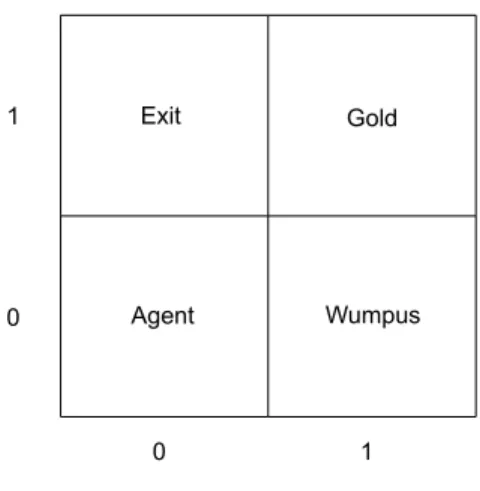
For illustrating how to use a MDP to model a RL problem, let us still consider the Wumpus World application introduced in Section 1.1.4 Recall that the agent’s
Figure 2.1: A2×2Wumpus World.
goal is to arrive at the exit square without visiting any square with a pit or Wumpus. We can use the following MDP to model this problem:
• State setS. Note that a state should distinguish the current scenario from other scenarios in this problem, and it should also include available and needed information for decision-making in the current scenario. Given this understanding, we use a vector to represent a state, consisting of the co-ordinate location of the current square, and two boolean values indicating whether the agent feels breeze and stench in this square, respectively. For example, in the Wumpus World in Figure 2.1, the agent’s current state is < 0,0, F, T >, where F and T are shorthands of false and true, respec-tively. Note that when the current state is < 0,1, F, T >, an episode is terminated, because in this state the agent is eaten by the Wumpus. We call the states that terminate an episode asterminal states.
• Action setA. As we have described in Section 1.1, four actions are available to the agent in each state: go left,go right,go upandgo down. As a result, the action setAconsists of these four actions.
• Transition function P. The transition function describes, by performing actionain states, which states′ the agent will reach in the next time slot.
In the Wumpus World problem, an action will move the agent one square towards the intended direction if there is no wall in the intended direction. In other words, the transition function is implicitly defined by the actions. For example, still consider the scenario in Figure 2.1, we can see thatP(< 1,0, F, F >|<0,0, F, T >,go right) = 1because performinggo rightin <0,0, F, T >will definitely move the agent to<1,0, F, F >.
However, in many real problems, for example the RoboCup Soccer Keep-away/Takeawaygames (introduced later in Chapter 3), the transition func-tion is unknown, i.e. the agent does not know what next state it will reach by performing an action in a state. Some RL algorithms are able to learn the best policy without prior knowledge of the transition functionP, including the RL algorithms we will introduce later in this section.
• Reward function R. Note that rewards are used to instruct the agent to achieve the tasks of the problem. Given the goal of this problem, we let the agent receive -1 for each action it performs. Also, we let it receive an additional reward +501 when it arrives at the exit, and receive an additional reward -999 when it steps into a square with a Wumpus. The reason that we give a negative reward to each action is to reduce the total number of steps needed to exit the world. Also note that some RL algorithms (e.g. SARSA and MAXQ as we will introduce below in Section 2.2.2 and 2.2.3, respectively) do not require any knowledge of the reward function a priori.
• Discount factor γ. Recall thatγ defines how ‘short-sighted’ the agent is: the bigger the γ is, the agent gives more weights to the long-term rewards. In this example problem, we assume that our agent is extremely ‘far-sighted’ and, therefore, we letγ = 1.
A naive method to find the optimal policy of a MDP is to perform all possible polices, compare their Q-value (i.e. the long-term cumulative reward) at each state-action pair(s, a), and select the policy that has the highestQ(s, a)in each(s, a) pair as the optimal policy. However, the number of policies grows exponentially with the number of possible states. For example, consider the MDP above for the Wumpus World. Since the agent can perform four actions in each state, there are 4|S|policies in total. This is a reflection of the well-knowncurse of dimensionality
2.2.2 SARSA Learning Algorithm
SARSA [RN94] is a simple yet powerful RL algorithm, and it has been used in many application domains, for example the RoboCup Keepaway and Takeaway games, which will be introduced in detail later in Chapter 6. Particularly noticeable features of SARSA include its fast convergence speed and its model-free property [SB98]. Some factors that contribute to the fast convergence property of SARSA include: (1) SARSA is an on-policy learning method, meaning that the policy being evaluated is also the policy being used by the agent, and, meanwhile, the agent continuously updates the policy according to the latest trajectory. This al-lows SARSA to select the policy that is optimal with respect to the latest learning experiences. (2)SARSA is aTemporal Difference (TD) based learning method, meaning that it updates the Q-value of each state-action pair by using the next state-action pairs’ Q-value, and this allows SARSA to back-propagate the delayed stimulus information (i.e. rewards) quickly (this will be illustrated shortly in this subsection). Also, SARSA does not require any prior knowledge about the tran-sition function of the underlying MDP, and it does not explicitly reconstruct the transition function (in RL literature, this kind of RL algorithms are referred to as model-freealgorithms): all it needs to store are the Q-values (illustrated below). This model-free property allows SARSA to be used in applications where the tran-sition function is unknown. Also note that SARSA can be used in either MDP or SMDP problems, i.e. the actions in SARSA can take one or more time slots to finish.
Pseudo code of SARSA is presented in Algorithm 1. A walk-through of this algorithm will be given below. We first describe some learning parameters in this algorithm: α ∈ R, α ∈ [0,1]is thelearning rateparameter, which controls how
significantly the current Q-value will be changed after each update;γ is the dis-count factor; in line 4 and 7,ǫ-greedyis anaction selection policy, which chooses the action to perform in the current state: by usingǫ-greedy, the action with high-est Q-value is chosen with probability 1−ǫ, and a uniformly random action is chosen with probabilityǫ. As the learning proceeds, bothǫandαvalues should be gradually decreasing to 0, meaning that less exploration is needed and Q-values should be updated in smaller steps. Note that the purpose of choosing some ran-dom actions with probabilityǫis to prevent the learning agent trapped in a local sub-optimal policy, andǫ-greedy is a method to trade off betweenexploration(i.e. choosing an action that does not have the highest Q-value in the current state) and

![Table 2.1: Some types of computation in abstract argumentation frameworks (ad- (ad-justed from Table 5.1 in [DW09])](https://thumb-us.123doks.com/thumbv2/123dok_us/10220308.2925889/29.894.175.717.237.328/table-types-computation-abstract-argumentation-frameworks-justed-table.webp)