AUTHOR:
TITLE:
YEAR:
OpenAIR citation:
OpenAIR takedown statement:
This work is made freely available under open access.
This ƚŚĞƐŝƐ is distributed under a CC ____________ license. ____________________________________________________
Section 6 of the “Repository policy for OpenAIR @ RGU” (available from http://www.rgu.ac.uk/staff-and-current-students/library/library-policies/repository-policies) provides guidance on the criteria under which RGU will consider withdrawing material from OpenAIR. If you believe that this item is subject to any of these criteria, or for any other reason should not be held on OpenAIR, then please contact [email protected] with the details of the item and the nature of your complaint.
This work was submitted to- and approved by Robert Gordon University in partial fulfilment of the following degree: _______________________________________________________________________________________________
HUSSEIN, A.
Deep learning based approaches for imitation learning.
2018
HUSSEIN, A. 2018. Deep learning based approaches for imitation learning. Robert Gordon University, PhD thesis.
Doctor of Philosophy, School of Computing Science and Digital Media
BY-NC 4.0
https://creativecommons.org/licenses/by-nc/4.0
Deep Learning Based Approaches for
Imitation Learning
Ahmed Hussein
A report submitted as part of the requirements for the degree of PhD in Computing: Artificial Intelligence
at the School of Computing Robert Gordon University
Aberdeen, Scotland
May 2018
Abstract
Imitation learning refers to an agent’s ability to mimic a desired behaviour by learn-ing from observations. The field is rapidly gainlearn-ing attention due to recent advances in computational and communication capabilities as well as rising demand for intelli-gent applications. The goal of imitation learning is to describe the desired behaviour by providing demonstrations rather than instructions. This enables agents to learn complex behaviours with general learning methods that require minimal task specific information. However, imitation learning faces many challenges. The objective of this thesis is to advance the state of the art in imitation learning by adopting deep learning methods to address two major challenges of learning from demonstrations.
Firstly, representing the demonstrations in a manner that is adequate for learning. We propose novel Convolutional Neural Networks (CNN) based methods to automatically extract feature representations from raw visual demonstrations and learn to replicate the demonstrated behaviour. This alleviates the need for task specific feature extrac-tion and provides a general learning process that is adequate for multiple problems. The second challenge is generalizing a policy over unseen situations in the training demonstrations. This is a common problem because demonstrations typically show the best way to perform a task and don’t offer any information about recovering from sub-optimal actions. Several methods are investigated to improve the agent’s generalization ability based on its initial performance. Our contributions in this area are three fold. Firstly, we propose an active data aggregation method that queries the demonstrator in situations of low confidence. Secondly, we investigate combining learning from demon-strations and reinforcement learning. A deep reward shaping method is proposed that learns a potential reward function from demonstrations. Finally, memory architectures in deep neural networks are investigated to provide context to the agent when tak-ing actions. Ustak-ing recurrent neural networks addresses the dependency between the state-action sequences taken by the agent.
tasks that are learned from raw visual data, as well as a 2D soccer simulator. The pro-posed methods are compared to state of the art deep reinforcement learning methods. The results show that deep learning architectures can learn suitable representations from raw visual data and effectively map them to atomic actions. The proposed meth-ods for addressing generalization show improvements over using supervised learning and reinforcement learning alone. The results are thoroughly analysed to identify the benefits of each approach and situations in which it is most suitable.
Acknowledgements
Firstly, I would like to express my sincere gratitude to Dr. Eyad Elyan for his mentor-ship, motivation and support throughout my PhD. I would also like to thank the rest of my supervisory team Dr. Mohamed Medhat Gaber and Prof. Chrisina Jayne for their continuous guidance and enthusiastic support. I thank my fellow labmates for their stimulating discussions, moral support and for the long and fun nights we shared at the lab. I would like to particularly thank Jeremy Close and Pamela Johnston for their kind support during this thesis. Last but not least, I would like to thank my parents whose guidance and love have helped me throughout the PhD as they do in life.
Declaration
I confirm that the work contained in this PhD project report has been composed solely by myself and has not been accepted in any previous application for a degree. All sources of information have been specifically acknowledged and all verbatim extracts are distin-guished by quotation marks.
Signed ... Date ... Ahmed Hussein
Contents
Abstract ii Acknowledgements iv Declaration v 1 Introduction 1 1.1 Motivation . . . 2 1.2 Objectives . . . 4 1.3 Problem Definition . . . 5 1.4 Challenges . . . 6 1.5 Contributions . . . 7 1.5.1 List of publications . . . 8 1.6 Used Frameworks . . . 9 1.7 Chapter List . . . 11 1.8 Summary . . . 12 2 Background 13 2.1 Problem formulation and Notations. . . 132.2 Deep Learning . . . 16
2.2.1 Convolutional Neural Networks . . . 19
2.2.2 Recurrent Neural Networks . . . 21
2.3 Summary . . . 22 3 Related Work 23 3.1 Direct Imitation . . . 24 3.1.1 Classification . . . 24 3.1.2 Regression. . . 25 3.1.3 Hierarchical Models . . . 27 3.2 Self Improvement . . . 28
3.2.1 Reinforcement Learning . . . 28
3.2.2 Optimization . . . 32
3.2.3 Transfer Learning . . . 34
3.2.4 Inverse reinforcement learning. . . 35
3.2.5 Data Aggregation . . . 37
3.2.6 Active Learning. . . 37
3.3 Applications. . . 43
3.3.1 Multi-agent Imitation . . . 45
3.3.2 Model-based learning and Planning. . . 47
3.4 Conclusion . . . 48
4 Learning Representations from raw visual data 50 4.1 Introduction. . . 50
4.1.1 Autonomous Navigation . . . 52
4.1.2 Deep Learning . . . 53
4.2 Proposed Method . . . 54
4.2.1 Representing Demonstrations . . . 55
4.2.2 Deep convolutional Neural network . . . 56
4.3 Conclusion . . . 57
5 Active Data Aggregation 58 5.1 Introduction. . . 58 5.2 Proposed Method . . . 59 5.3 Experiments. . . 61 5.3.1 Tasks . . . 61 5.3.2 Setup . . . 63 5.3.3 Implementation details. . . 64 5.3.4 Results . . . 64
5.4 Conclusion and Future Directions . . . 67
6 Combining Learning from Demonstrations and Experience 69 6.1 Introduction. . . 69
6.2 Proposed Method . . . 70
6.3 Experiments. . . 72
6.3.1 Grid Navigation Task . . . 73
6.3.2 Inter-process Communication . . . 74
6.3.3 Results . . . 75
6.4 Conclusion and Future Work . . . 78
7.1 Introduction. . . 79
7.2 Method . . . 80
7.3 Experiments. . . 84
7.3.1 Experimental Setup . . . 84
7.3.2 Results . . . 86
7.4 Conclusion and Future Work . . . 88
8 Deep Imitation Learning from Sequences 89 8.1 Introduction. . . 89 8.2 Related Work . . . 91 8.3 Method . . . 92 8.4 Experiments. . . 96 8.4.1 robocup . . . 96 8.4.2 Half-Field-Offence . . . 96 8.4.3 Experimental Setup . . . 97 8.4.4 Results . . . 98
8.5 Conclusion and Future Work . . . 101
9 Conclusion and Future work 102 9.1 Summary . . . 102
9.2 Discussion . . . 104
9.3 Future Directions . . . 105
List of Tables
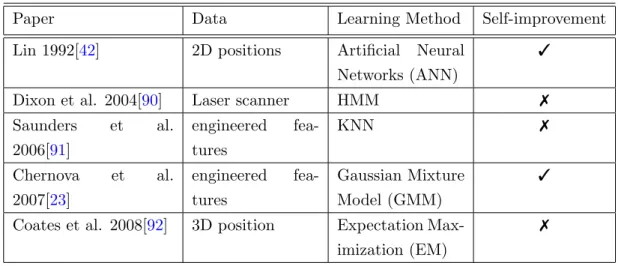
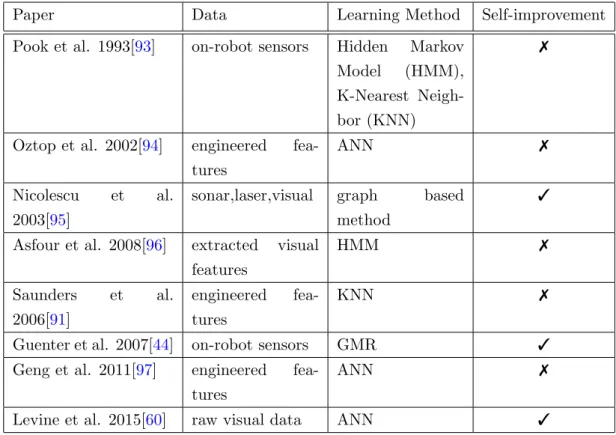
3.1 Imitation learning methods for navigation . . . 39
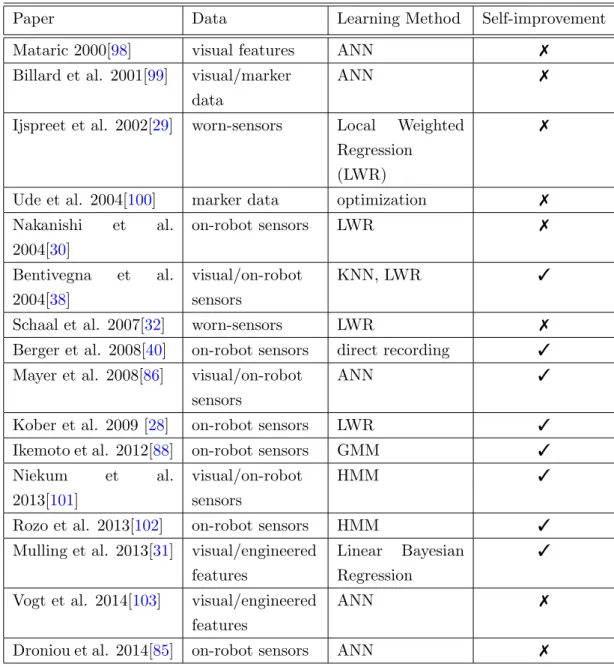
3.2 Imitation learning methods for object manipulation. . . 40
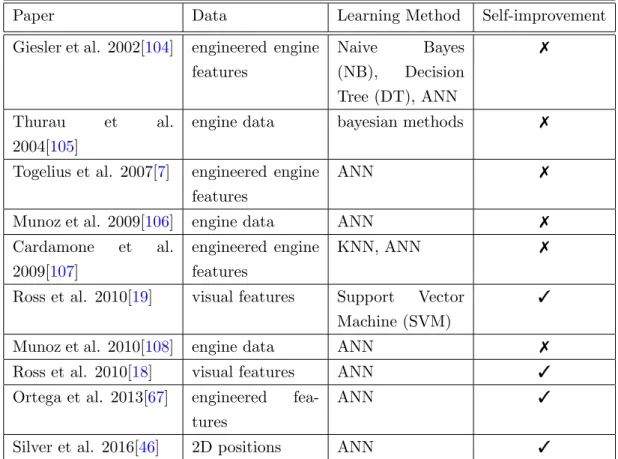
3.3 Imitation learning methods for robotics . . . 41
3.4 Imitation learning methods for games . . . 42
3.5 Imitation learning methods for simulations. . . 43
4.1 Neural network architecture . . . 57
5.1 A comparison of deep learning agent approaches . . . 61
5.2 Direct Imitation results . . . 65
5.3 “Eat all disks” results . . . 66
6.1 Direct Imitation vs RL . . . 76
6.2 “Eat all disks” results . . . 76
7.1 Neural network architecture . . . 84
8.1 A comparison of machine learing approaches for rocbocup . . . 95
8.2 HFO results for the hand crafted teacher . . . 98
8.3 MLP data aggregation results with shuffling . . . 100
List of Figures
1.1 Illustration of the Grid Navigation Task . . . 10
1.2 Illustration of the Soccer simulator Task . . . 11
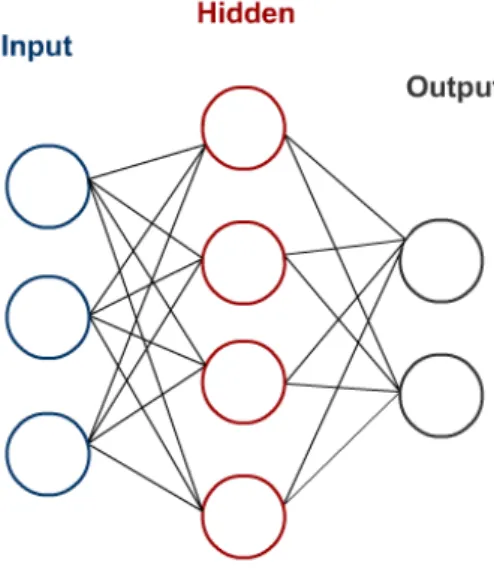
2.1 Example of an artificial neural network showing connections between the nodes in different layers. . . 17
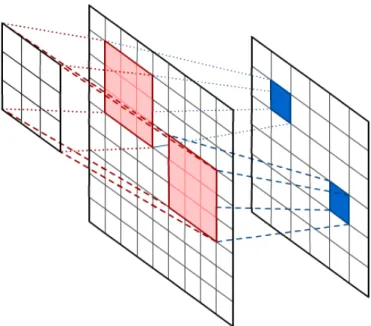
2.2 Convolution operation on a 2D input using a 3x3 filter . . . 20
2.3 Example of an artificial neural network showing connections between the nodes in different layers. . . 20
2.4 Example of a recurrent neural network unit. . . 21
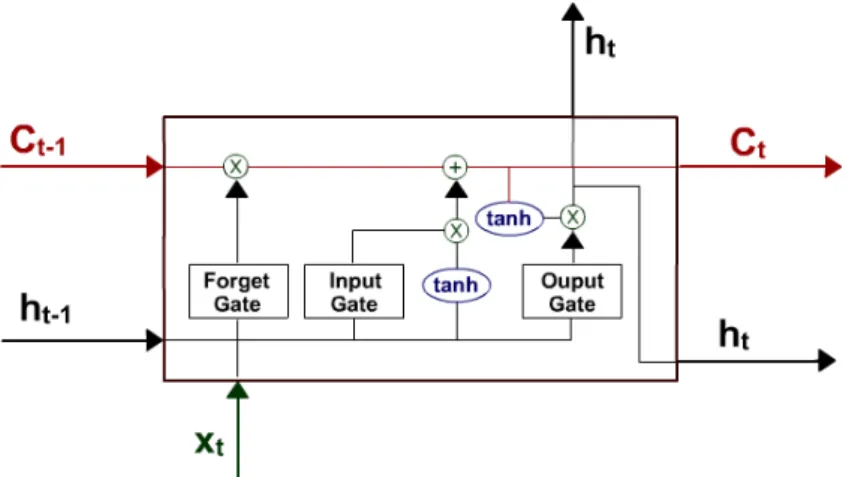
2.5 Example of an LSTM unit. . . 22
3.1 learning methods from different sources . . . 23
3.2 Example of hierarchical learning of actions. . . 27
4.1 Features representations and their relationships. Raw features can be manually manipulated to extract tailored features. While manually tai-lored or raw features can be automatically processed to extract feature representation. . . 52
4.2 Workflow of the learning representation process. The process starts by a teacher providing demonstrations on a given simulator. The demon-strations are collected and processed into a dataset that is fed into a deep convolutional neural network. The network learns high level rep-resentations of the raw input features as well as mapping to the action space. . . 54
4.3 Example of observations captured during demonstration . . . 55
4.4 Architecture of the neural network used to train the agent . . . 56
5.1 sample images from “Reach the flag” . . . 62
5.2 sample images from “Follow the line”. . . 62
5.3 sample images from “Reach the correct object” . . . 63
5.5 Dataset Collection Flowchart . . . 64
5.6 Imitation Agent Playing Flowchart . . . 65
5.7 Results for active learning on “follow the line” task . . . 66
5.8 Results for “reach the flag” task with increasing time limits . . . 67
6.1 Illustration of the Grid Navigation Task . . . 73
6.2 Reinforcement learning Flowchart . . . 74
6.3 DQN and A3C results on the Grid Navigation Task . . . 75
6.4 Results for DQN on Navigation tasks in MASH simulator . . . 76
6.5 Results for A3C on Navigation tasks in MASH simulator. . . 77
6.6 Results for combining learning from demonstrations and experience on “Reach the flag” . . . 78
7.1 Illustration of the Grid Navigation Taks . . . 85
7.2 Adaptive vs static network updating . . . 86
7.3 Reward shaping vs DQN, adaptive updating . . . 87
7.4 Reward shaping vs DQN, freeze parameter = 500 . . . 87
7.5 Reward shaping vs DQN, = 0.4 . . . 87
8.1 Illustration of LSTM units . . . 93
8.2 Re-segmenting the demonstrated sequences into arbitrary sequences . . 94
8.3 Illustration of the Half-field-offence environment . . . 97
8.4 Results for robocup half field offence. The outcomes presented in the graph are: Goal: The offensive agent scored a goal, Defence: The ball was captured by the defence, Bounds: The ball went out of bounds, Time: A time limit was reached before any of the other outcomes . . . . 99
List of Algorithms
1 Active Learning Algorithm . . . 60
2 Learning from demonstration and experience . . . 72
Chapter 1
Introduction
In recent years, the demand for intelligent agents capable of mimicking human be-haviour has grown substantially. Advancement in robotics and communication tech-nology have given rise to many potential applications that need artificial intelligence that can not only make predictions, but is able to perform sequences of actions that reflect robust, intelligent behaviour. Many future directions in technology rely on the ability of artificial intelligence agents to behave as a human would when presented with the same situation. Examples of such fields are self-driving vehicles, assistive robots and human computer interaction
Most applications are dynamic and involve many variables and are therefore not suit-able for manually designed policies. For examples, self driving cars should be suit-able to robustly act in real urban conditions, where the roads are shared with other vehicles and pedestrians that can behave unexpectedly. It is not feasible to take into account all the possibilities that may face the autonomous vehicle when manually programming a policy. It is also difficult to break down and articulate how humans perform tasks in order to program intelligent agents to replicate this behaviour. Sticking with the autonomous vehicle example, it is hard for an experienced driver to describe to another human how to drive well. A more intuitive and effective method of imparting this knowledge is to show the student examples of good driving.
Imitation learning, also called learning from demonstrations, is a paradigm where an intelligent agent is taught to mimic human behaviour by supplying the agent with demonstrations provided by a teacher rather than instructions. By learning from demonstration, the agent does not require explicit knowledge about the task or the environment such as objectives or constraints. Rather, a general learning process is ad-vocated where all needed information is inferred from the provided demonstrations. For
example, an autonomous vehicle doesn’t require knowledge of how the vehicle works, how the other agents in the environment are modelled or that it shouldn’t drive over the pavement. Instead The policy learns to operate the vehicles controls as demon-strated by the teacher without knowing the underlying mechanics of these controls or the rules of the road; and learns to adapt to the dynamic environment by observing the interaction between the teacher and the environment through the demonstrated behaviour. This thesis explores deep learning approaches for training intelligent agents from demonstrations.
1.1
Motivation
Learning by imitation has gained a lot of attention due to its relevance to a wide range of potential applications where machines are required to behave intelligently (like a human would). Inspired by neuroscience, this field aims to mimic the process of learn-ing by imitation in humans and animals [1] and is regarded from early stage as an integral part of machine intelligence [2]. Several other approaches exist for learning intelligent behaviour, commonly formulating the desired task as an optimization prob-lem. These are goal oriented methods where the agent is required to achieve a certain target behaviour without any information about how to do it. However, it has become widely accepted that having prior knowledge provided by an expert is more effective and efficient than searching for a solution from scratch [2,3,4,1].
While Learning from experience can produce robust policies that generalize to dynamic scenarios, finding a solution through trial and error may take too long. Especially in problems that require performing long trajectories of actions with delayed rewards, which is common in many real life applications. In such cases it may be extremely difficult to reach rewards by chance; and the time to learn a policy to maximize the rewards exponentially increases. For example in a game of football, the target is to score more goals than your opponent. However, scoring a goal requires a complicated sequence of actions, taking into account the other agent’s in the environment. It is therefore extremely unlikely that a goal will be scored using trial and error alone. Demonstrations of how the game is played provides invaluable information for the agent in this case. Such information can be imparted in other ways than demonstrations, such as rules or sub goals but may lack the generalization and simplicity to generate of demonstrations. Moreover, learning through trial and error may result in a policy that solves the problem differently to how a human would. Performing a task in a manner that is intuitive to a human observer may be crucial in applications where humans and intelligent agents interact together in an environment [5]. Nass et al [6]
suggest that humans view computers interacting with them as social agents and that humans interact with them in a manner derived from their experiences interacting with other humans. Therefore, even with the conscious knowledge that an agent is not a human, interaction is improved when the agent behaves in a way that is familiar to its human counterpart. This also emphasises that it is intuitive for humans to provide demonstrations to teach intelligent agents.
On the other hand learning from demonstrations may result in faster learning and produce a policy that follows the teacher’s way of solving the task. However, learning a direct mapping between observation and action can commonly result in a policy that generalizes poorly to unseen scenarios. The supervised policy only learns to deal with situations covered in the demonstrations. Since demonstrations only cover the optimal trajectory, if the agent deviates even slightly from that trajectory at any point, it finds itself in an unseen situation not covered by the training data [7]. For example, if an autonomous vehicle trained to drive in the middle of the lane veers slightly towards the lane line (which is expected in a machine learning application), the agent has no information on how to recover this error. A more pronounced case is unexpected behaviour on the road such as an accident up ahead or any of the countless cases that may not have been included in the demonstrations. The agent has no information on how to behave in such situations. So essentially the policy is trained using samples from a distribution that is different to the one it is evaluated on. Therefore, in many cases, policies need to be refined based on the performance of the initially learned policy. Moreover, supervised learning needs a sufficient number of demonstrations; which for deep network architectures may be large. These cases highlight the limitations of imitation learning; in that it depends on the demonstrations. The demonstrations may not be sufficient or contain faults. The pros and cons of learning from experience and demonstrations motivate combining both approaches; which is not dissimilar to how humans and animals partly learn [3].
Both learning from demonstrations and experience approaches aim to create a general learning process that requires minimal task specific information. In contrast to hand crafted methods, ideally all the information needed by the learner would be incorpo-rated in the demonstrations or the reward function. One aspect of learning that usually requires knowledge of the task is creating the feature representations used for learning. Features are engineered to best represent a specific task or environment. Manually de-signing features is time consuming and can be in efficient if we need to apply the agent in different environments. Deep learning methods have shown great success in learning from high dimensional raw data in a variety of applications. Automatically extract-ing feature representations can greatly facilitate creatextract-ing general learnextract-ing processes for
learning from demonstration. Thus, the same network architecture can extract relevant features for different situations depending on the provided demonstrations.
1.2
Objectives
The main objective of this thesis is to expand the state of the art in autonomous agents through novel imitation learning methods. To achieve this target, sub-objectives are specified that dictate the directions taken in this body of work.
• The first objective is to review imitation learning methods for autonomous agents. Imitation learning is a multi-disciplinary field and the literature is filled with diverse approaches that consider the challenges of intelligent autonomous agents from different points of view. This survey aims to categories learning methods that utilize demonstrations and bridge gap between the various methods that tackle the same problem from different perspectives. Reviewing related literature helps identify important research areas and promising directions.
• Representing demonstrations is a key challenge in imitation learning. We aim to create general methods for creating feature representations from raw sensory information without requiring task specific knowledge. In particular we target demonstrations from visual information and sequences.
• Generalization is another important challenge as the agent is required to adapt be-yond the provided demonstrations. This thesis investigates several approaches to improve generalization. The target is to create autonomous agents that demon-strate robust behaviour in dynamic environments by using the agent’s perfor-mance in the environment to refine its policy and allow it to generalize to situation not covered in the demonstrations.
• Deep reinforcement learning is gaining a lot of attention as an approach for teach-ing autonomous agents. At this point in AI research we find it is important to perform comparisons between imitation learning and reinforcement learning ap-proaches to highlight the advantages and challenges of each approach. Such stud-ies can help identify when these approaches are most suitable; as well as evaluate the benefits of combining learning from demonstrations and experience compared to using only one approach.
• Reproducibility is an integral part in emerging research fields. The easy repro-duction of results and comparison of state of the art methods can substantially expedite the rate of research advancement. I this thesis we aim to conduct all
experiments on open-source benchmarks that can be used for both imitation and reinforcement learning. The applications should have clear evaluation criteria and the challenges and the relevance of each task should be explicitly stated. The experiments are implemented in a general design that allows interchanging learning methods easily. The implementations are uploaded on Github to allow other researchers to easily reuse, compare and expand our proposed methods.
1.3
Problem Definition
The process of imitation learning is one by which an agent uses demonstrations of performed actions to learn apolicy that replicates the demonstrated behaviour.
Definition 1 An agent is defined as an entity that autonomously interacts within an
environment towards achieving or optimizing a goal [8]. An agent can be thought of as
a software robot; it receives information from the environment by sensing or communi-cation and acts upon the environment using a set of actuators.
Definition 2 A policy is a function that maps a state to an action. It is what the
agent uses to decide which action to execute in any given situation.
Definition 3 A state is a representation of world at a given point in time. The state
describes details about the agent such as pose, position and internal parameters as well as its surrounding environment. States are feature representations and should include all features relevant to learning the task at hand. This information can be captured by the agent’s observations or can be provided from any source.
Definition 4 An action is a decision made by the agent to interact with the
envi-ronment. The set of actions available to the agent may be discrete, continuous or parametrized (a set of discrete actions where each action may have one or more con-tinuous parameters).
An action u(t) can often be represented by a vector rather than a single value. This means that the action is comprised of more than one decision executed simultaneously; such as pressing multiple buttons on a controller or moving multiple joints in a robot. Actions can also represent different levels of autonomous control such as low level actions and high level macro actions [9].
1.4
Challenges
Imitation learning problems pose a variety of challenges at different stages of the train-ing process.
• Capturing demonstrations whether from sensors on the learner or the teacher, or using visual information, can be challenging. A discrepancy between the agent’s perspective and the perspective from which the demonstrations are captured is challenging to deal with. Therefore acquiring demonstrations should be designed to minimize such discrepancies. Moreover, the captured signals are prone to noise, synchronization and sensor errors.
• Similar problems arise during execution when the agent is sensing the environ-ment. Noisy or unreliable sensing will result in erroneous behaviour even if the model is adequately trained.
• A key issue concerning demonstration is the correspondence problem. Corre-spondence is the matching of the learner’s capabilities, skeleton and degrees of freedom to that of the teacher. Any discrepancies in the size or structure between the teacher and learner need to be compensated for during training. Often in this case a learner can learn the shape of the movement from demonstrations, then refine the model through trial and error to achieve its goal.
• A related challenge is the problem of observability where the kinematics of the teacher are not known to learner. If the demonstrations are not provided by a designated teacher, the learner may not be aware of the capabilities and possible actions of the teacher; it can only observe the effects of the teacher’s actions and attempt to replicate them using its own kinematics.
• The quality of the demonstrations can also greatly affect the performance of the policy. Sub-optimal demonstrations will degrade the learned policy as they are the only source of information. Moreover, in many tasks behaviour can be subjective and using a limited number of teachers can restrict the ability of the policy to execute the given task. Another common issue is that in most cases only good demonstrations can be provided, while in machine learning having negative and positive examples can be very beneficial.
• The learning algorithms also face challenges as traditional machine learning tech-niques do not scale well to high degrees of freedom. Imitation learning methods typically need to deal with high dimensional sensory input as well as high dimen-sional multivariate predictions.
• Unlike typical machine learning applications that assume independent and identi-cally distributed (i.i.d.) samples, motor behaviours consist of sequences of depen-dent decisions. This makes autonomous agents prone to accumulation of error. Therefore, the learned policy must be able to adapt its behaviour based on pre-vious actions and make corrections if necessary. The policy must also be able to adapt to variations in the task and the surrounding environment. The com-plex nature of imitation learning applications dictate that agents must be able to reliably perform the task even under circumstances that vary from the training demonstration.
The scope of this thesis focuses on the last two challenges that directly concern learn-ing a policy, while maintainlearn-ing real-time execution of the policy. The sensor-based challenges are bypassed by utilizing simulators for our experiments. The simulators provide tasks where we can control observability, perspective and sensor noise. We now elaborate on two major challenges that are directly addressed in this thesis: 1- Creating adequate feature representations for learning from high dimensional data. 2- Learning a policy that generalizes to unseen situations. Feature representations are required to encode the demonstrations in a way that the agent can learn from and also to represent how the agent perceives its environment from its sensory data. The representations must be adequate for learning as well as be suitable for real time processing. Man-ually designing suitable features for imitation learning is an arduous task as different representations must be tailored for each task or environment. Especially in dynamic settings where the representations must be robust against various scenarios. General-ization to unseen scenarios is also a challenge because of the dynamic nature of the tasks. This is a common problem because demonstrations typically show the best way to perform a task and do not offer any information about recovering from sub-optimal actions. Therefore approaches are required that can generalize beyond demonstrated behaviour without extensive feedback from a teacher or the environment.
1.5
Contributions
The aim of this thesis is to expand the state of the art by proposing novel deep learning approaches to leverage imitation learning methods.
• The first contribution of this thesis is to survey and categories the imitation learn-ing literature. Imitation learnlearn-ing is a relatively new field, however it has been contemplated from early stages of AI research and is approached from various perspectives. Therefore, a modern survey is needed categorize the learning meth-ods for imitation problems and perform in-depth analysis to compare the different
approaches and highlight their similarities and differences.
Following, we mainly address two aspects of imitation learning: representing the state of the agent using adequate feature representation and improving the agent’s ability to generalize to unseen situation.
• To create feature representations, we propose the use of a deep convolutional neural network (CNN) to automatically learn features suitable to the task from the provided demonstrations and directly map them to actions. The proposed deep network is modular and is used in several experiments throughout this thesis in conjunction with other contributions.
To address the generalization challenge in imitation learning we propose the following contributions:
• Firstly, A deep active data aggregation method is proposed to improve the adapt-ability of the agent. Based on an initial policy trained using supervised learning, the agent queries the teacher for additional demonstrations in situations of uncer-tainty. Active data aggregation significantly improves the generalization of the agent using relatively few additional samples.
• Secondly, different methods for utilizing demonstrations to guide reinforcement learning are investigated. A comprehensive comparison and analysis is carried out between the proposed methods, state of the art deep reinforcement learning and our deep active imitation method.
• Thirdly, learning from demonstrations is used to shape a reward function for reinforcement learning. Both the supervised and reinforcement learning policies learn using the proposed learning representations approach. Shaping the reward from demonstrations provides a more general alternative to the standard method of tailoring shaped rewards and provides a significant performance improvement over using reinforcement learning alone.
• Finally, proposes a method for imitation learning from sequences in a multi-agent setting. The demonstrations are represented as sequences of state action pairs which keep the temporal relation between the decisions taken by the teacher. A stacked long short term memory network is used to learn a policy that takes past experiences into consideration when making a decision at each time step. The network automatically maps raw sensory data from the agent’s perspective to multivariate parametrized atomic actions.
1.5.1 List of publications
The contributions of this thesis have resulted in the following publications.
• Hussein, A., Gaber, M. M., & Elyan, E. (2016, September). Deep active learning for autonomous navigation. In International Conference on Engineering Applica-tions of Neural Networks (pp. 3-17). Springer, Cham. [10].
• Hussein A, Gaber MM, Elyan E, Jayne C. Imitation Learning: A Survey of Learning Methods. ACM Comput Surv. 2017 Apr;50(2):21:121:35. Available from: http://doi.acm.org/10.1145/3054912. [11].
• Hussein A, Elyan E, Gaber MM, Jayne C. Deep imitation learning for 3D navi-gation tasks. Neural computing and applications. 2017;p. 116. [12].
• Hussein A, Elyan E, Gaber MM, Jayne C. Deep reward shaping from demonstra-tions. In: Neural Networks (IJCNN), 2017 International Joint Conference on. IEEE; 2017. p. 510-517. [13].
• Hussein A, Elyan E, Jayne C. Deep Imitation learning with memory for Robocup Soccer Simulation. Submitted for review to the International Conference on En-gineering Applications of Neural Networks (EANN 2018).
1.6
Used Frameworks
The proposed approaches in this thesis are demonstrated on a number of applications that pose various key challenges. Firstly a simple 2D navigation task is designed to evaluate learning navigation from raw visual data. The task is formulated as a grid navigation problem. The agent makes a decision given an image representing its current state. Although this task makes a number of simplifications, it poses a number of challenges common in real navigation applications. Specifically, learning from raw visual observations and performing long trajectories without intermediate feedback. This application is used to evaluate the ability of learning from demonstrations and experience approaches to deal with these challenges. Figure 1.1illustrates the task on a 5×5 grid. The visualization shows the starting cell of the agent marked by the blue cursor, and the target cell marked by the green cursor. The agent is able to move in the four cardinal directions one cell at a time. For each cell, the state is represented by an image that shows the number of the cell as illustrated in the figure. This task can be performed with a grid of any arbitrary size.
Figure 1.1: Illustration of the Grid Navigation Task
Moreover a 3D simulator, MASH simulator [14], is also used to evaluate navigation from visual data. The 3D environment is more realistic and poses extra challenges such as randomizing the shape and lighting conditions of the agent’s surroundings as well as the positions of relevant objects. Another challenge that is shared with real applications is that the observations are captured from the point of view of the agent. In a 3D setting, a small movement from the agent can dramatically change the visual observations and so it is harder to keep track of relevant information. MASH simulator is used to evaluate navigation on 4 different tasks. All the approaches evaluated learn from raw pixels and therefore do not need any task specific information to learn the different tasks other than the rewards provided by the environment or demonstrations provided by a teacher.
Finally, we use a benchmark soccer simulator to evaluate multi-agent scenarios. Robocup [15] is a popular benchmark and is used in competitions for hand crafted agents as well as machine learning research. In this application, the agent needs to perform a long trajectory of actions while at the same time reacting to the actions of other agents. The observations are presented to the agent in the lowest level possible and can depend on the agent’s perception. Moreover, the actions available to the agent are atomic parametric actions. This means that at the lowest level of decision making the agent need to generate continuous value as parameters along with the chosen action (such as kicking angle and force). The delayed terminal rewards inherent in a game of soccer are especially challenging for reinforcement learning agents. Figure 1.2 show a visualization of the robocup simulator. The figure shows a football field with the team names and scores illustrated. The visualizer also has playback controls to rewind, pause and speed up the the action. The figure shows a 2 vs 1 match being played in
half the field.
Figure 1.2: Illustration of the Soccer simulator Task
The approaches used throughout this thesis are designed to be as general as possible and require minimal task specific information. They are by no means limited to the demonstrated applications. This is shown within the thesis to some extent by using the same methods for various tasks within one application, but they can be used for a variety of other applications as well.
1.7
Chapter List
The remainder of the thesis consists of the following chapters.
Chapter 2 This chapter provides background information that is necessary for the
remainder of the thesis. Problem formulation and notations for imitation learning are defined, and an introduction to deep learning is given.
Chapter 3 This chapter surveys related work in the literature. It provides a review
and categorization of imitation learning methods.
Chapter 4 This chapter addresses learning state representations from raw sensory
data using deep learning. It details the processes of acquiring the demonstrations, formulating the data for training, and the training model used to learn from the data. This chapter focuses on the generality of the learning method while maintaining the effectiveness of the learned representations.
Chapter 5 This chapter presents the proposed method for deep active data
it’s generalization ability. Active learning is combined with the deep learning of the policy by iteratively aggregating additional training samples based on the confidence of the policy.
Chapter 6This chapter addresses combining learning from demonstrations and
expe-rience. Two methods are proposed to train a deep neural network using both demon-strations and reinforcement learning. The proposed methods are compared to state of the art reinforcement learning methods as well as direct imitation and the active data aggregation method proposed in chapter5.
Chapter 7 This chapter proposes a novel reward shaping method to learn reward
functions from demonstrations. The shaped reward is learned from raw demonstrations using a deep neural network and added to the reward signal to train a reinforcement learning policy. Experiments demonstrate that the augmented reward signal provides a significant improvement in performance over state of the art deep reinforcement learn-ing.
Chapter 8 This chapter presents the proposed method to learn sequences of actions
by utilizing memory in deep neural networks. Temporal dependencies in the task are captured by representing demonstrations as a sequence of state-action pairs and using a long short-term memory network to learn a policy from demonstrations. The results show that utilizing memory while learning significantly improves the performance and generalization of the agent and can provide a stationary policy.
Chapter 9 This chapter concludes the thesis. It summarizes the contributions and
findings of this work and discusses these conclusions in the context of the state of the art in autonomous agents. Future direction are and recommendation are discussed to highlight potential next steps.
1.8
Summary
This chapter provides and introduction to this thesis, by defining the problem of imita-tion learning and briefly stating the purpose of this thesis. The challenges and problems addressed are identified and motivation is provided for the proposed methods. The contributions of this thesis are listed and the chapters describing the contributions are outlined. Finally, we describe the problems to which the proposed methods are applied.
Chapter 2
Background
This chapter provides a background to the topics discussed in this thesis. Namely the process of training autonomous agents is formally described and an introduction to deep neural networks is provided. Two types of deep neural networks, convolutional neural networks (CNNs) and long short-term memory (LSTM) networks, that are used in this thesis are described in further details.
2.1
Problem formulation and Notations
In this section we formalize the problem of imitation learning and introduce some preliminary notations and definitions. Moreover, we define the process of learning from experience which can be used on its own or in conjunction with imitation learning to train an autonomous agent.
The aim of imitation learning is to map observations of the current state to a behaviour based on a set of demonstrations. The behaviour consists of a set of actions dictated by the learned policy. In order for the learning process to be general, it is preferable that agents interact with the environment using atomic actions. That is, the lowest level of decisions available in this application. A high level action policy determines the immediate plan of the agent such as (’open the door’ or ’kick the ball’). This approach requires sub-policies to break down these decisions into a sequence of atomic actions. In robotics, a popular way of representing actions is using Motor primitives.
Definition 5 Motor primitives are simple building blocks that are executed in sequence
concerning one degree of freedom or actuator) that can be used to make up any action that needs to be performed in the given problem.
These primitives are then learned by the policy. In addition to being useful in building complex actions from a discrete set of primitives, motor primitives can represent a desired move in state space, since they can be used to reach any possible state. As in MDPs described above, the transition from one state to another state based on which action is taken is easily tracked when using motor primitives. In this case the output of the policy can represent the change in the current state [16] as follows:
˙
x(t) =π(x(t), t, α) (2.1)
Where ˙x(t) is the change in the environment’s state that is affected by the policy. x is the feature vector,t is the time andα is the set of policy parameters that are changed through learning. While the time parameter t is used to specify an instance of input and output, it is also input to the policy π as a separate parameter. In the context of imitation learning, a policy is trained using a set of collected demonstrations. The demonstrations may come from a designated teacher or another agent. The demonstra-tions provide the optimal action to a given state, and so the agent learns to reproduce this behaviour in similar situations. This makes demonstrations suited for direct policy learning such as supervised learning methods. More formally:
Definition 6 A demonstration is presented as a pair of input and output(x, y). Where
xis a vector of features describing the state at that instant andyis the action performed
by the demonstrator.
It is clear from this formulation that learning from demonstration does not require the learner to know the cost function optimized by the teacher. It can simply optimize the error of deviating from the demonstrated output such as the least square error in supervised learning. More formally, from a set of demonstrationsD= (xi, yi) an agent learns a policyπ such that:
u(t) =π(x(t), t, α) (2.2)
Whereuis the predicted action. So the change in state is represented by an action with which the agent affects the environment. This representation allows for direct policy learning by using observation-label pairs for training. Moreover, it is difficult to model state change in dynamic environments. It is important to note that in this context, the teacher’s behaviour is referred to as the optimal policy as it is the goal to reach human
level behaviour even if this policy does not achieve the best possible performance. For the rest of this thesis, the expert’s behaviour and optimal behaviour are used interchangeably. Such direct policy learning however, is prone to poor generalization. Since the agent’s interaction with the environment can change its state, the assumption that predictions are independent and identically distributed is not valid. Indeed most applications require the agent to perform a sequence of dependent actions to achieve a goal. Therefore even a small prediction error can lead the agent to an unfamiliar state. Since demonstrations only provide the optimal action trajectories, a suboptimal policy will be presented with states that are not represented in the demonstrations. More formally the agent is presented with states drawn from a distribution different to the distribution from which the training setD= (xi, yi) was sampled.
A policy for autonomous agents can alternatively be learned from experience. The experiences uses for learning may be the agent’s own or may come from a different agent. While learning from experience does not require examples of good behaviour to imitate, a reward function is required to evaluate the performance of the current policy in order to optimise it. Reinforcement learning uses the actions performed by the agent, which may not be optimal, along with the reward (or cost) of performing that action given the current state, to learn a policy that maximizes its overall reward. More formally:
Definition 7 An experience is presented as a tuple (s, a, r, s0) where s is the state, a
is the action taken at states, r is the reward received for performing action aand s0 is
the new state resulting from that action.
Learning from experience is commonly formulated as a Markov decision process (MDP). MDPs lend themselves naturally to motor actions, as they represent a state-action network and are therefore suitable for reinforcement learning. In addition the Markov property dictates that the next state is only dependent on the previous state and action, regardless of earlier states. This timeless property promotes stationary policies. There are different methods to learn from experience through reinforcement learning that are out of the scope of this thesis. For a survey and formal definitions of reinforcement learning methods for intelligent agents, the reader is referred to [17]. Note that both learning paradigms are similarly formulated with the exception of the cost function; the feature vectorx(t) corresponds tos,u(t) corresponds toaand x(t+ 1) corresponds to the resulting states0. It is therefore not uncommon (especially in more recent research) to combine learning from demonstrations and experience to perform a task.
Definition 8 A policy that uses t in learning the parameters of the policy is called a
consideration at what stage of the task the agent is currently acting.
Definition 9 A stationary policy (autonomous) neglects the time parameter and learns
one policy for all steps in an action sequence.
One advantage of stationary policies is the ability to learn tasks where the horizon (the time limit for actions) is large or unknown [18]. While non stationary policies are more naturally situated to learn motor trajectories i.e actions that occur over a period of time and are comprised of multiple motor primitive executed sequentially. However, these policies are difficult to adapt to unseen scenarios and changes in the parameters of the task [16]. Moreover, this failure to adapt to new scenarios, at one point in the trajectory, can result in compounded errors as the agent continues to perform the remainder of action. In light of these drawbacks, methods for learning trajectories using stationary policies are motivated. An example is the use of structured predictions [19] where the training demonstrations are aggregated with labelled instances at different time steps in the trajectory – so time is encoded in the state. Alternatively, [20] learns attractor landscapes from the demonstrations, creating a stationary policy that is attracted to the demonstrated trajectory. This avoids compounded errors as the current state is considered by the policy before executing each state of the trajectory.
2.2
Deep Learning
Deep learning is a sub-field of machine learning that is concerned with training large neural networks termed: deep neural networks. Deep neural networks are distinct from traditional neural network in that they consist of more layers which allows them to learn more complex models. Deep learning can be thought of as hierarchical feature learning. Each layer learns a higher level representation of the data from the previous layer thus uncovering deeper insights into the data. Recent advances in deep learning algorithms and computational technology have made it possible to effectively train very large and complex neural networks. This section provides a background on deep neural networks. We start by presenting multi-layer perceptrons, describing how they are constructed and how they learn. Following two types of deep neural networks that are used in this thesis are described, namely, convolutional neural networks (CNN) and recurrent neural networks (RNN).
Definition 10 Artificial neural networks are computing systems inspired by biological
neural networks in the brain. Neural networks act as a function approximator that
learns a function that maps a given inputxto a corresponding outputy. Thus providing
Figure 2.1: Example of an artificial neural network showing connections between the nodes in different layers.
Neural networks are composed of layers each with a given number of nodes. Figure2.1
provides an illustration of a neural network with an input layer, a hidden layer and an output layer. Connections between the nodes provide parameters that are optimised to learn the required function. This is achieved using two steps: A forward pass and
a back propagation step. The forward pass goes through the network from the input
layer to the output layer performing the following computation at each node:
yj =a( I
X
i=1
wijxi+bj) (2.3)
Where y is the output of the node, xi is an input to the node from node i, wi is the weight assigned to the connection with nodei,bis a scalar bias and ais an activation function which transforms the weighted sum of the inputs linearly or non-linearly. Activation functions define the structure of the function being estimated.
Common activation functions used in neural networks are the hyperbolic tangent (Tanh) function:
a(x) =tanh(x) = 2
1 +e−2x −1 (2.4) rectified linear unit (ReLU):
a(x) = 0 forx <0 x forx≥0 (2.5)
and the logistic sigmoid function:
a(x) = 1
1 +e−2 (2.6)
It is clear from the feed forward that neural networks are inherently regressors as the output is a continuous value. However, neural networks are commonly used for classi-fication by using activation functions that transfer the node outputs towards discrete decisions. The neural network learns the function estimation by tuning the values of the weights wand bias b to minimize a cost function of the final output from the forward pass and a given ground truth. The choice of cost function is also an important distinc-tion between classificadistinc-tion and regression using neural networks. Mean square error is commonly used for regression problems, to calculate the cost between continuous targets and the output of the network.
C = 1 I I X i=1 (ui−yi)2 (2.7)
Where C is the cost, ui and yi are the networks output and the target for instance
i respectively and I is the number of instances. Cross entropy is a common cost function for classification problems, usually with softmax activations. They calculate the likelihood of the neural network choosing the correct class.
C =−1 I I X i=1 J X j=1 yijlog(uij) (2.8)
Where uij and yij are the networks output and the target respectively for instance i and classj,I is the number of instances and J is the number of classes.
Back propagation works in reverse order from the output layer towards the input layer, calculating the changes that need to be made to the parameters in each layer. These changes are based on the gradient of the cost function with respect to the parameters. Intuitively, back propagation calculates how much of the cost can be attributed to each parameter and uses gradient descent to iteratively move towards minimizing the gradient of the cost. More formally ∆wij, the change made to weight of the connection
between nodesi, j is calculated as: ∆wij =γCa0( I X i=1 wijxi))xi (2.9)
Where γ is a constant learning rate, C is the cost, a0(PI
i=1wijxi) is the derivative of the activation function and xi is the input from connection i. The chain rule 2.10 is used to find the gradient of the error starting from the output of the final layer of the network and propagating back through the layer. To calculate the gradients all through the network, the activation functions and cost function need to be differentiable.
∂C ∂w = ∂C ∂yj ∂yj ∂wij (2.10)
2.2.1 Convolutional Neural Networks
A Convolutional neural network is a type of deep neural network that takes advantage of spatial relations between features to learn high level representation. Inspired by the visual cortex in animals, Convolutional networks apply convolution filters to restrict the connections between nodes. By limiting the number of connections, convolutiuonal layers allow for creating deep networks with fewer parameters. This makes CNNs very effective in learning from images, but they have also shown great potential in learning from other signals where spatial relations between features can be exploited, such as text and audio data. Automatically learning feature representation alleviates the need to hand engineer features which is a major challenge in many applications. Therefore CNNs achieve state of the art performance in a number of domains and are considered one of the most popular neural network classes for modern application.
Definition 11 The convolution operation applies a filter (or kernel) to a section of the
input and is defined as the sum of the element wise product between the filter and the section of the input.
A convolution layer applies a number of filters to the image using a sliding window. The result is a 3D structure (assuming a 2 dimensional input) where the width and height are a reduction of the original dimensions of the input signal, and the depth is the number of filters used. This can be considered as producing a feature vector for each sub section of the input. Figure2.2illustrates applying a convolution filter to an input signal. By segmenting the input signal using the convolutional filters, the number of connections between the nodes is greatly reduced.
Figure 2.2: Convolution operation on a 2D input using a 3x3 filter
We now present the convolution process. Applying kernel K to input I at pointi, k is given as: conv(I, K)i,j = M X m N X n I(i−m, j−n)K(m, n) (2.11)
Where M and N are the dimensions of the kernel. Deep convolutional networks usu-ally consist of a number of stacked convolutional layers followed by a fully connected hidden layer, to map the extracted features to the output layer. The output of the last convolutional layer is flattened into a vector and connected to the hidden layer. The forward pass of the fully connected layer is the same as eq. 2.3. Figure 2.3illustrates a full convolutional neural network.
Figure 2.3: Example of an artificial neural network showing connections between the nodes in different layers.
The backward pass in convolutional networks starts with output layer and propagates through the network calculating the gradient for the fully connected layers and then the convolutional layers in sequence using the chain rule 2.10. The convolution operation is differentiable, therefore, the back propagation process is unaffected.
2.2.2 Recurrent Neural Networks
Recurrent Neural Networks are a group of neural networks that take advantage of temporal relations in the data by keeping track of previous samples during learning. Recurrent units retain an internal memory which allows them to process sequences of data such as speech and text. Recurrent units unlike typical feed-forward nodes, recur-rent units can have looping connections, thus providing feedback that contributes to the processing of the next time step. Figure2.4illustrates how the recurrent connection can be viewed as a sequence of nodes where each node provides an additional input to the next node. In other words, a recurrent node receives the current input in addition to its decision for the previous time step as shown in the following equation.
hjt=a( I
X
i=1
wijxit+ujhjt−1) (2.12)
Wherehjt is the hidden state of nodejat time stept,ais the activation function,wij is the weight of the connection between nodes iand j and similarly,uj is a weight on the recurrent connection between nodejand its hidden state at the previous time step
hjt−1.
Figure 2.4: Example of a recurrent neural network unit.
U. Learning values for U allows the network to learn temporal relationships within sequences of learning. The backward pass in RNNs is dubbed as back propagation through time as the gradient is calculated for the last members of the sequence first and then back propagate to the earlier examples. Since RNNs can have long term temporal dependencies, they are prone to suffer from vanishing and exploding gradients. This occurs because the calculation of the gradient passes through multiplication processes at each step in the chain rule. Therefore the gradient for parameters that are far removed from the cost can become exponentially small or large rendering them useless for learning. Long-short-term-memory (LSTM) networks [21] deal with this issue by including gates in the node that dictate when to hold information in the networks memory and when to forget it. Figure 2.5 shows an LSTM unit containing: a forget gate that controls retaining or forgetting the current cell state; and input gate that controls the current input signal; and an output gate that controls what is output from the node.
Figure 2.5: Example of an LSTM unit.
2.3
Summary
This chapter provides a background to the topics discussed in this thesis. An introduc-tion to training autonomous agents is provided and the processes of training such agents from demonstrations and experience are formally defined. Following a background to deep learning is presented. Two types of deep neural networks which are used in this work (Convolutional neural networks and recurrent neural networks) are described, as well as a general overview of neural networks.
Chapter 3
Related Work
This chapter presents the main works in the literature related to this thesis. It provides an overview on different imitation learning methods but focuses on methods that employ deep learning and that integrate learning from experience. We also highlight notable works in applications similar to the ones used in this thesis, namely navigation and multi-agent applications. We categorize imitation learning into policies that directly copy behaviour from demonstrations and policies that self-improve based on its current performance. This literature review is published in the following survey paper [11].
Figure 3.1: learning methods from different sources
Intelligent agents can learn behavioral policies from different sources. Each case needs appropriate learning methods that can best utilize the data source. Figure3.1shows a Venn diagram outlining the sources of data employed by different learning methods. An agent can learn from dedicated teacher demonstrations, observing other agent’s actions or from experience through trial and error. Active learning needs a dedicated oracle that can be queried for demonstrations. While other methods that utilize demonstra-tions can acquire them from a dedicated expert or by observing the required behavior
from other agents. RL and optimization methods learn through trial and error and do not make use of demonstrations. Transfer learning uses experience from old tasks, or knowledge from other agents to learn a new policy. Apprenticeship learning uses demonstrations from an expert or observation to learn a reward function. A policy that optimizes the reward function can then be learned through experience. The meth-ods proposed in this thesis focus on learning from dedicated experts and the agent’s own experiences. We now review the learning approaches for direct and self-improved imitation.
3.1
Direct Imitation
Direct imitation, also known as behaviour cloning [22], is using demonstrations to learn mapping between observations and actions. It is the most straight forward way to learn a policy from demonstrations and usually learns via supervised learning, where the action provided by the expert acts as the label for a given instance. The model is then capable of predicting the appropriate action when presented with a situation. Supervised learning methods are categorized into classification and regression.
3.1.1 Classification
Classification is a popular task in machine learning where observations are automati-cally categorized into a finite set of classes. A classifierh(x) is used to predict the class
y to which an independent observation x belongs; where y ∈Y, Y ={y1, y2. . . yp} is a finite set of classes, and x ={x1, x2. . . xm} is a vector ofm features. In supervised classification, h(x) is trained using a dataset of n labelled samples (x(i), y(i)), where
x(i)∈X,y(i)∈Y and i= 1,2. . . n.
Classification approaches are used when the learner’s actions can be categorized into discrete classes [9]. This is suitable for applications where the action can be viewed as a decision such as navigation [23] and flight simulators [24]. In [23], a Gaussian mixture model (GMM) is trained to predict navigational decisions. Meta-classifiers are used in [18] to learn a policy to play computer games. The base classifier used in this paper is a neural network. “Super Tux Kart” is a kart racing game where the analogue joystick commands are discretized into 15 buckets, reducing the problem to a 15 class classification problem. So the neural network used had 15 output nodes. “Mario Bros” is a platform game that uses a discrete controller. Actions are selected by pressing one or more of 4 buttons. So in the neural network, the action for a frame is represented by 4 output nodes. This enables the classifier to choose multiple
classes for the same instance. Although the results are promising, it is argued that using an Inverse Optimal Control (IOC) technique [25] as the base classifier might be beneficial. In [19] the experiments are repeated this time using regression (see regression section 3.1.2) to learn the analogue input in “Super Tux Kart”. For Mario Bros, 4 Support Vector Machine (SVM) classifiers replace the neural network to predict the value of each of the 4 binary classes. Classification can also be used to make decisions that entail lower level actions. In [26] high level decision are predicted by the classifier in a multi-agent soccer simulation. Decisions such as ‘Approach ball’ and ‘Dribble towards goal’ can then be deterministically executed using lower level actions. An empirical study is conducted to evaluate which classifiers are best suited for the imitation learning task. Four different classifiers are compared with respect to accuracy and learning time. The results show that a number of classifiers can perform predictions with comparable accuracy, however, the learning time relative to the number of demonstrations can vary greatly [26]. Recurrent neural networks (RNN) are used in [27] to learn trajectories for object manipulation from demonstrations. RNNs incorporate memory of past actions when considering the next action. Storing memory enables the network to learn corrective behaviour such as recovery from failure given that the teacher demonstrates such a scenario.
3.1.2 Regression
Regression methods are used to learn actions in a continuous space. Unlike classifi-cation, regression methods map the input state to a numeric output that represents an action. Thus they are suitable for low level motor actions rather than higher level decisions. Especially when actions are represented continuous values, such as input from a joystick [19]. The regressorI(x) maps an independent samplexto a continuous value y rather than a set of classes. Where y ∈R, the set of real numbers. Similarly the regressor is trained using a set of labelled samples (x(i), y(i)), where y(i) ∈R and
i= 1,2. . . n.
A commonly used technique is locally weighted regression (LWR). LWR is suitable for learning trajectories, as these motions are made up of sequences of continuous values. Examples of such motions are batting tasks [28] [29] (where the agent is required to execute a motion trajectory in order to pass by a point and hit a target); and walking [30] where the agent needs to produce a trajectory that results in smooth stable motion. A more comprehensive application is table tennis. [31] use Linear Bayesian Regression to teach a robot arm to play a continuous game of table tennis. The agent is required to move with precision in a continuous 3D space in different situations, such as when hitting the ball, recovering position after a hit and preparing for the
opponent’s next move. Another paradigm commonly used for regression is artificial neural networks (ANN). Neural networks differ from other regression techniques in that they are demanding in training time and training samples. Neural network approaches are often inspired by biology and neuroscience studies, and attempt to emulate the learning and imitation process in humans and animals [1]. The use of regression with a dynamic system of motor primitives has produced a number of applications for learning discrete and rhythmic motions [20] [32] [33], though most approaches focus on direct imitation without further optimization [34]. In such applications, a dynamic system represents a single degree of freedom (DOF) as each DOF has a different goal and constraints [32].
Dynamic systems can be combined with probabilistic machine learning methods to reap the benefits of both approaches. This allows the extraction of patterns that are im-portant to a given task and generalization to different scenarios while maintaining the ability to adapt and correct movement trajectories in real time [35]. In [35] the estima-tion of dynamical systems’ parameters is represented as a Gaussian mixture regression (GMR) problem. This approach has an advantage over LWR based approaches as it allows learning of the activation functions along with the motor actions. The proposed method is used to learn time-based and time-invariant movement. In [36] a similar GMM based method is used in a task-parametrized framework which allows shaping the robot’s motion as a function of the task parameters. Human demonstrations are encoded to reflect parameters that are relevant to the task at hand and identify the position, velocity and force constraints of the task. This encoding allows the frame-work to derive the state in which the robot should be, and optimize the movement of the robot accordingly. This approach is used in a Human Robot Collaboration (HRC) context and aims to optimize human intervention as well as robot effort. Deep learning is combined with dynamical systems in [37]. Dynamic movement primitives (DMP) are embedded into autoencoders that learn representations of movement from demon-strated data. Autoencoders non-linearly map features to a lower dimensional latent space in the hidden layer. However, in this approach, the hidden units are constrained to DMPs to limit the hidden layer into representing the dynamics of the system. In both classification and regression methods, a design decision can be made regarding the learning models resources. Lazy learners such as kNN and LWR do not need training but need to retain all training samples when performing predictions. On the other hand, trained models such as ANN and SVM require training time, but once a model is created the training samples are no longer needed and only the model is stored, which saves memory. These models can also result in very short prediction times.
3.1.3 Hierarchical Models
Rather than using a single model to reproduce human behaviour, a hierarchical model can be employed that breaks down the learned actions into a number of phases. A classification model can be used to decide which action or sub-action, from a set of possible actions, should be performed at a given time. A different model is then used to define the details of the selected action, where each possible low-level action has a designated model. Figure 3.2 illustrates an example of hierarchical actions. [38] use a hierarchical approach for imitation learning on two different problems. The first is Air Hockey which is played against an opponent, and the objective is to shoot a puck into the opponent’s goal while protecting your own. The second game is marble maze; the maze can be tilted around different axis to move the ball towards the end of the maze. Each task has a set of low level actions called motor primitives that make up the playing possibilities for the agent (e.g., Straight shot, Defend Goal, and Roll ball to corner). In the first stage, a nearest neighbour classifier is used to select the action to be performed. By observing the state of the game the classifier searches for the most similar instances in the demonstrations provided by the human expert, and retrieves the primitive selected by the human at that point. The next step is to define the goal of the selected action, for example the velocity of the ball or the position of the puck when the primitive is completed. The goal is then used in a regression model to find the parameters of the action that would optimize the desired goal. The goal is derived from the k nearest neighbour demonstrations found in the previous step. The goals in those demonstrations are input in a local weighted regression model to perform the primitive. In a similar fashion, [39] use a classifier to make decisions in a sorting task consisting of the following macro actions (wait, sort left, sort right and pass). Each macro action entails temporal motor actions such as picking up a ball, moving and placing the ball.
3.2
Self Improvement
It is often the case that direct imitation on its own is not adequate to reproduce robust, human-like behaviour in intelligent agents. This limitation can be attributed to two main factors: (1) errors in demonstration, and (2) poor generalization. Due to limitations of data acquisition techniques, such as correspondence problem, sensor error and physical influences in kinesthetic demonstrations [9], direct imitation can lead to inaccurate or unstable performance, especially in tasks that require precise motion in continuous space such as reaching or batting. For example, in [40] a robot attempting to walk by directly mimicking the demonstrations would fall because the demonstrations do not accurately take into consideration the physical properties involved in the task such as the robot’s weight and centre of mass. However, refinement of the policy through trial and error would take these factors into account and produce a stable motion.
While generalization is an important issue in all machine learning practices, a special case of generalization is highlighted in imitation learning applications. It is common that human demonstrations are provided as sequence of actions. The dependence of each action on the previous part of the sequence violates the i.i.d. assumption of training samples that is integral to generalization in supervised learning [18]. Moreover, since human experts provide only correct examples, the learner is unequipped to handle errors in the trajectory. If the learner deviates from the optimal performance at any point in the trajectory (which is expected in any machine learning task), it would be presented with an unseen situation that the model is not trained to react to. A clear example is provided in [7] where supervised learning was used to learn a policy to drive a car. Given that human demonstrations contained only ‘good driving’ with no crashes or close calls, when error occurs and the car deviates from demonstrated trajectories, the learner does not know how to recover.
This section discusses indirect ways to learn policies that can complement or replace direct imitation. The policy can be refined from demonstrations, experience or obser-vation to be more accurate or to be more general and robust against unseen circum-stances. We categorize the methods for refining the policy into the following groups: reinforcement learning, transfer learning, data aggregation, active learning, apprentice-ship learning and optimization.
3.2.1 Reinforcement Learning