Firefighting as a Strategic Game
∗†Carme `Alvarez Maria J. Blesa Hendrik Molter ALBCOM Research Group
Computer Science Department
Universitat Polit`ecnica Catalunya - BarcelonaTech E-08034 Barcelona, Spain
{alvarez,mjblesa}@cs.upc.edu, [email protected]
Abstract
TheFirefighter Problemwas proposed in 1995 [25] as a determinis-tic discrete-time model for the spread and containment of a fire. The problem is defined on an undirected finite graph G = (V, E), where initially fire breaks out atf nodes. In each subsequent time-step, two actions occur: A certain number b of firefighters are placed on non-burning nodes, permanently protecting them from the fire. Then the fire spreads to all non-defended neighbors of the nodes on fire. Since the graph is finite, at some point each node is either on fire or saved, and thus the fire cannot spread further. One of the objectives for the problem is to place the firefighters in such a way that the number of saved nodes is maximized.
The applications of the Firefighter problem reach from real fires to the spreading of diseases and the containment of floods. Further-more, it can be used to model the spread of computer viruses or viral marketing in communication networks. Most research on the problem considers the case in which the fire starts in a single place (i.e.,f = 1), and in which the budget of available firefighters per time-step is one (i.e., b = 1). So does the work in this paper too. This configuration already leads to hard problems and even in this case the problem is known to be NP-hard.
∗
This work was supported by grants TIN2013-46181-C2-1-R and TIN2012-37930-C02-2 of the Spanish Ministry of Science and Innovation, and by the project SGR 2014-1034 of the Generalitat de Catalunya.
†
A preliminary version of this work was presented in11th Workshop on Algorithms and Models for the Web Graph (waw’14), Beijing, China, December 2014.
In this work, we study the problem from a game-theoretical per-spective. We introduce a strategic game model for the Firefighter Prob-lem to tackle its complexity from a different angle. We refer to it as theFirefighter Game. Such a game-based context seems very appropri-ate when applied to large networks, where entities may act and make decisions based on their own interests, without global coordination.
At every time-step of the game, a player decides whether to place a new firefighter in a non-burning node of the graph. If so, he must decide where to place it. By placing it, the player is indirectly deciding which nodes to protect at that time-step. We define different utility functions in order to model selfish and non-selfish scenarios, which lead to equivalent games. We show that the Price of Anarchy (PoA) is linear for a particular family of graphs, but it is at most 2 for trees. We also analyze the quality of the equilibria when coalitions among players are allowed. It turns out that it is possible to compute an equilibrium in polynomial time, even for constant size coalitions. This yields to a polynomial time approximation algorithm for the problem and its approximation ratio equals the PoA of the corresponding game. We show that for some specific topologies, the PoA is constant when constant size coalitions are considered.
Keywords: Firefighter Problem; Algorithmic Game Theory; Strate-gic Games; Nash Equilibria; Price of Anarchy; Coalitions.
1
Introduction
The Firefighter Problem was introduced by Hartnell [25] as a deterministic discrete-time model for the spread and containment of fire. Since then, it has been subject to a wide variety of research for modeling the spread and containment phenomena such as diseases, floods, ideas in social networks and viral marketing.
The Firefighter Problem is defined on an undirected finite graph G = (V, E), where initially fire breaks out at f nodes. In each subsequent time-step, two actions occur: first, a certain numberbof firefighters are placed on non-burning nodes, thus permanently protecting them from the fire; then the fire spreads to all non-defended neighbors of the nodes on fire. Since the graph is finite, at some point each node is either on fire or saved. Then the process finishes, because the fire can not spread any further. There are several different objectives for the problem. Typically, the goal is to save the maximum number of nodes. Other objectives include minimizing the num-ber of firefighters (or time-steps) until the spreading stops, or determining whether a specified collection of nodes can be prevented from burning.
Most research on the Firefighter Problem (also the work in this paper) considers the case with only one starting place on fire, and one available firefighter to protect a non-burning place at a time (i.e.,f =b= 1), which already leads to hard problems. The problem was proved NP-hard for bipar-tite graphs [30], graphs with degree three [17], cubic graphs [28] and unit disk graphs [21]. However, the problem is polynomial-time solvable for various well-known graph classes, including interval graphs, split graphs, permu-tation graphs, caterpillars, and Pk-free graphs for fixed k [18, 23, 30, 21].
Furthermore, the problem is (1−1/e)-approximable on general trees [8], 1.3997-approximable for trees where nodes have at most three children [27], and it is NP-hard to approximate withinn(1−ε) for any ε > 0 [2]. Later results on approximability for several variants of the problem can be found in [2, 4, 11].
Recently, the scientific community has focused on the study of the pa-rameterized complexity of the problem. It was shown to be fixed parameter-tractable with respect to the combined parameter “pathwidth” and “max-imum degree” [10]. Other important results can be found in [12, 3]. From this perspective, the problem is known to be fixed-parameter tractable on trees in various parameterizations. When parameterized by the number of burned nodes, the problem is fixed-parameter tractable (FPT) on general graphs but has no polynomial kernel on trees. When parameterized by the number of unburned nodes, the problem is W[1]-hard even on bipartite graphs.
In 2000, the greedy algorithm for trees, which saves the vertex v that maximizes the number of nodes that will be saved if v is protected, was proved to be a 1/2-approximation algorithm [26]. A linear programming relaxation for trees that supposedly gives ac-approximation algorithm was presented in 2006 [24], and a sub-exponential (1−1/e)-approximation method in 2008 [8]. These results have been improved in 2011 [27]. On the other hand, exact polynomial solutions exist for caterpillar and P-trees [18, 23, 30]. First approaches for grids of dimensions 2 and 3 were provided in 2002 [20, 34], and then generalized in 2007 [13]. These studies concluded that two firefighter were needed to contain the fire in an infinite 2-dimensional square grid, and 2d−1 in a d-dimensional one with d ≥3. There exist concrete results for triangular, strong, and hexagonal grids [20, 31, 32, 33, 22], and for other graph classes [21].
The surviving rate of a graph is defined as the average percentage of nodes that can be saved whenf fires break out at random nodes of the graph [7]. The study of this concept has become very fruitful in the literature and the evidence is the existence of many works on the subject for different graph
structures [9, 6, 14, 16, 29, 36, 41, 44, 42, 43].
A complementary concept is called the burning number of a graph. It indicates how fast a graph can burn down completely if there is a new fire in every round. It can be used as a measure of the speed of the spread of contagion in a graph [5].
For other variants of the Firefighter Problem see [15, 35, 18].
In this work we introduce a game-theoretical model for the Firefighter Problem to tackle its complexity from a different angle. Our main objec-tive is to try to bypass the NP-hardness of the problem of computing the optimal solution of the Firefighter Problem by taking into account different kinds of solutions. Our proposal as a possible set of solutions to the Fire-fighter Problem corresponds to the set of Nash equilibria of a new strategic game that we call the Firefighter Game. In this game there is a player for each time-step. Each player decides where to put the firefighters at his corresponding time-step. The goal of each player is to save as many nodes as possible. The outcomes of this strategic game represent solutions to the classical Firefighter Problem. Game theory provides a powerful toolset to analyze the quality of stable outcomes or equilibria.
To the best of our knowledge, the only existing game-theoretical models to similar problems are those referred to as the vaccination problem [2, 19], the spreading of rumors [45, 46] and competitive diffusion [1, 37, 40, 39, 38]. Those models however focus on information spreading on social networks, and thus take into account other inherent aspects of those scenarios, like pref-erences, reputation, popularity and other personal traits of the users, and relevance or truthfulness of the information. Our proposal is well-suited to model fighting against spreading phenomena in large networks, where the protection strategy for each time-step is decided by one player, indepen-dently from the others. We believe that our model has legitimacy, especially if this problem is used to model processes that take place on some modern networks where no central entity exists. In this case, the resources to fight the spreading have to be delegated by independent agents, who might not be able to compute a global solution. Once we have defined formally the model, we focus on the study of the Nash equilibria and the Price of Anarchy as measures for the quality of the equilibria.
The paper is organized as follows. In Section 2 we define some basic game-theoretical concepts extensively used throughout the paper, most im-portantly the measures of the quality of equilibria, i.e. the Price of Anarchy. In Section 3 we introduce the game and we study the set of equilibria corre-sponding to two different utility functions. In Section 4 we analyze the Price of Anarchy for different families of graphs. In Section 5 we consider that the
players may form coalitions and we analyze the equilibria for constant size coalitions. Finally, conclusions and directions for future work can be found in Section 7.
2
Game-Theoretical Definitions
Let us introduce some basic definitions. Astrategic game G is defined by a tuple G= (N,(Si)i∈N,(ui)i∈N), where
• N denotes the set of players,
• Si is the set of actions of player i∈ N, and
• ui is theutility function of playeri∈ N.
The strategy si of a player i is selecting an action si ∈ Si. Let s =
(s1, . . . , s|N |) be astrategy profile describing the strategiessi of each player
i∈ N. We denote by S the set of all strategy profiles, S =S1×. . .× S|N |.
The utility function of playeri,ui:S →R, assigns to each strategy profile (s1, . . . , s|N |) ∈ S a value ui(s1, . . . , s|N |). This value quantifies the benefit
that player i receives by selecting strategy si when the strategies of other
players are (sj)j∈N,j6=i.
Given a strategy profile s= (s1, . . . , s|N |), we denote s−i = (sj)j∈N \{i}.
Furthermore we denote (s−i, s0i) = (s1, . . . , s0i, . . . , s|N |), i.e. strategy vector
s, where player i changed his strategy from si to s0i. The social benefit of
the outcome of the game for any strategy profile is quantified by a function that is calledSocial Welfare W :S →R.
Definition 1 (Nash Equilibrium). A strategy profile of a game is a Nash equilibrium, if no player can improve his payoff by changing his strategy. Formally, given a strategic gameG= (N,(Si)i∈N,(ui)i∈N), a strategy profile
sis a Nash equilibrium of G if and only if
∀i∈ N,∀s0i∈ Si:ui(s)≥ui(s−i, s0i).
We denote byne(G) the set of all Nash equilibria ofG. Whenever there is no possible confusion we will use the notation ne without any reference to the game. In order to measure the quality of the equilibria, Koutsoupias and Papadimitriou introduced the Price of Anarchy concept in 1999.
Definition 2 (Price of Anarchy). The Price of Anarchy (PoA) of a game
G (with respect to a social welfare function W) is defined as follows:
PoA(G) = maxs∈SW(s) mins∈neW(s)
.
If instead of considering the worst equilibria with relation to the social welfare, we consider the best equilibria, then we have thePrice of Stability.
Definition 3(Price of Stability). The Price of Stability (PoS) of a game G
(with respect to a social welfare functionW) is defined as follows:
PoS(G) = maxs∈SW(s) maxs∈neW(s)
.
3
The Firefighting Game
Each instance of the Firefighting Problem is defined by an undirected graph G = (V, E) and a marked node v0 ∈ V. We assume that initially the fire
breaks out at v0 and it burns. At each time-step t ≥ 1 the burned nodes
at time step t−1 incinerate all their neighboring nodes. Let us call them burning nodes. At each time-step a fixed number of firefighters b, called budget, can be placed on non-burning nodes to permanently protect them from burning. These nodes are called defended. If a node never burns because it is defended or cut off from the fire it is called saved. All other nodes are called vulnerable. We only consider the case where budget is of size one (i.e.,b= 1).
Players and Strategies. In order to model the Firefighter problem as a game, we define a set of playersN ={1, . . . , n−1} where n=|V|. Player i represents the firefighter who selects the set of nodes to be protected at time stepi. Hence, the set of all possible strategies of playeriis defined by
Si ={U |U ⊆ V}. The strategy of player i consists of selecting a subset of nodes U ∈ Si. Since we only deal with the case of b = 1 we overload
notation and instead of subsets of size one, we set the strategies to the vertices themselves or the empty set, i.e. Si = V ∪ {∅}. This means that every player can choose one node or the empty set as strategy. Note that player i ∈ N applies its strategy si at time step i. Let s = (s1, . . . , s|N |)
The outcome of a strategy profile. The outcome of a strategy profile s = (s1, . . . , s|N |) on a given graph G = (V, E) is a partition of V into
saved and burning nodes. It is defined in the following way. At time-step 0 the only burning node isv0. At time-step i >0, two events occur: First,
playeri’s node is protected if his action is valid w.r.t. to strategy profiles, i.e. it is neither burning nor already defended at the end of time-stepi−1. Second, each node burning at time-stepi−1 incinerates all its non-defended neighbors. The process stops when the fire cannot spread any further. Let us denote by Safe(s) ⊂ V the set of nodes that are saved by the strategy profiles.
In the following we introduce some predicates in order to define formally the outcome of a strategy profile on a given graphG.
Notice that, when no further restrictions apply on the strategies for each player, then it might be the case that a player selects a node that is already burning or that already has a firefighter on it. In order to identify these situations, we introduce additional predicates. Given a strategy profiles, a nodev∈V, and a playeri∈ N we define:
• defended(s, v, i) =trueiff in the strategy profiles, nodevis defended at the end of time-stepi,
• burning(s, v, i) = true iff in the strategy profile s, node v is burning at the end of time-stepi, and
• invalid(s, i) = true iff player i’s action is not valid with respect to strategy vector s, i.e. player i either wants to place a firefighter on a node that already is defended at time-stepi−1 or that is burning at time-step i−1.
Let Safei(s) denote the set of nodes that would burn if playeriswitched
his action to the empty set. Formally, Safei(s) = Safe(s)\Safe(s−i,∅)
At this point we can define all the previous predicates inductively on i ≥ 0. For the case i = 0 we have no player, but the process starts by burningv0. Formally:
∀s∈ S,∀v∈V : defended(s, v,0) =f alse. (1)
∀s∈ S,∀v∈V \ {v0}: burning(s, v,0) =f alse. (2)
These equations define the starting configuration. Equation (1) makes sure that all nodes are undefended at time 0. Equation (3) defines that the fire starts at nodev0 and Equation (2) declares all other nodes as non-burning.
For any playeri∈ N (or time-stepi≥1) and for any s∈ S we define: invalid(s,i) = = ( f alse ifsi=∅, W v∈si
defended(s, v, i−1)∨burning(s, v, i−1) otherwise. (4) The first case in Equation (4) makes sure that it is always valid to play the empty set. The second case states that the move of playeri is invalid, if he tries to put a firefighter on a node that is either already defended or already burning. We can also define inductively on i ≥ 1 the predicates defended and burning.
∀s∈ S,∀v∈V : defended(s, v, i) = _ j∈N ∧j≤i v∈sj∧ ¬invalid(s, j) . (5)
Equation (5) states that a nodev is defended at (the end of) time-step i, if one of the players who has made a valid move until then has decided to put a firefighter on nodev.
To define that a node v is burning at (the end of) time-step i≥ 1, we need the neighborhood relation of nodes. LetN(v) denote the neighborhood ofv, i.e. w∈N(v) if, and only if, (v, w)∈E. Then
∀s∈ S, v∈V, i≥1 : burning(s, v, i) =¬defended(s, v, i)∧ _ w∈N(v) burning(s, w, i−1) . (6)
Equation (6) states that a node v is burning at time-step i, if it is not defended by the end of time-stepiand at least one of its neighbors is burning at time-stepi−1. We can also define the set of all nodes that will be saved when a strategy vectorsis played, that is the ones that are still not burning at time-step n−1.
∀s∈ S : Safe(s) ={v ∈V | ¬burning(s, v, n−1)}.
Furthermore we can define the set of nodes that a player i helped to save, i.e. that would burn if playerichanged his strategy to the empty set.
We can consider two different and natural utility functions. The first one models a selfish behavior while the second models a non-profitable behavior.
Selfish Firefighters Model. In this model, firefighters get paid for the nodes they save. Intuitively, if player imakes a valid move other than the empty set, he gets one unit of currency from each node he helped to save. In other words, he gets paid by all nodes that are saved with respect to the played strategy vector, but would not be saved if he would change his strategy to the empty set. Additionally, he will get charged a penalty if he makes an invalid move. Now let us define the utility function formally.
u(Selfish)i (s) = −c if invalid(s, i), 0 ifsi =∅, |Safei(s)| −ε otherwise,
with 0< ε <1 andc >0. We can see that the definition follows the intuition very closely. Subtracting anεcost for placing a firefighter makes sure that players always prefer to play the empty set over placing a firefighter on a node that is already saved. (which would not be an invalid move).
Hence, a game G(Selfish) in this Selfish Firefighters Model is defined by
a tuple G(Selfish) = (G, v
0, ε, c), where G = (V, E) is an undirected graph,
v0∈V is the initial burning node, andε, care constants. The utility function
of each playeri∈ N is defined as u(Selfish)i .
Non-Profit Firefighters Model. Here we assume that the goal of every firefighter is to save as many total nodes as possible, independently of which firefighters actually save more nodes. Formally, we define
u(Non-Profit)i (s) = −c if invalid(s, i), |Safe(s)| ifsi =∅, |Safe(s)| −ε otherwise,
with 0 < ε < 1 and c > 0. Hence, a game G(Non-Profit) in this Non-Profit
Firefighters Model is defined by a tuple G(Non-Profit) = (G, v
0, ε, c), where
G = (V, E) is an undirected graph, v0 ∈ V is the initial burning node,
and ε, c are constants (w.r.t n = |V|). The utility function of each player i∈ N is defined asu(Non-Profit)i . Let us denote byG(Selfish)(G, v
0, ε, c) and by
G(Non-Profit)(G, v
0, ε, c) the games defined by G, v0, ε, andc in the models
Selfish Firefighters and Non-Profit Firefighters, respectively. For simplicity we also denote byne(G) the set of neof the game G.
Notice that in an equilibrium, no player plays an invalid move or puts a firefighter on an safe node. Also, since we have that 0< ε <1, the utility of playing the empty set is less than the utility of saving one node. Because of that, given that a player does not play the empty set, theε-value does not affect his preferences. Therefore, we will ignore it in the proofs.
Proposition 1. For any graph G = (V, E), any initial node v0 ∈ V, any constants ε, ε0, c, c0 such that 0< ε, ε0 <1 and c, c0>0, we have that:
i) ne(G(Selfish)(G, v0, ε, c)) =ne(G(Selfish)(G, v0, ε0, c0)), ii) ne(G(Non-Profit)(G, v0, ε, c)) =ne(G(Non-Profit)(G, v0, ε0, c0)).
From now on we will omitεand cin the definition of the games.
Equivalence of Games. Surprisingly, the behavior of selfish firefighters leads to the same equilibria as the behavior of the non-profit firefighters.
Let us now formally show that the games G(Selfish) and G(Non-Profit) are
equivalent in the sense that their sets of equilibria are the same.
Proposition 2. For any graphG= (V, E) and any v0 ∈V, if
G(Selfish)=G(Selfish)(G, v0) , and G(Non-Profit) =G(Non-Profit)(G, v0) , then
ne(G(Selfish)) =ne(G(Non-Profit)) Proof.
i) Let us show thatne(G(Selfish))⊆ne(G(Non-Profit)):
Lets= (s1, ..., sn) ∈ne(G(Selfish)). If s6∈ne(G(Non-Profit)), then there
is a player i who can improve his payoff by changing his strategy from si to another s0i. If we denote by s0 = (s−i, s0i), we have that
u(Non-Profit)i (s)< u(Non-Profit)i (s0), and then |Safe(s)|<|Safe(s0)|. By definition,
Safe(s) = Safe(s−i,∅)∪Safei(s) , and
Safe(s0) = Safe(s−i,∅)∪Safei(s0).
Notice that Safe(s−i,∅) = Safe(s0−i,∅) and Safei(s
0)∩Safe(s
−i,∅) =∅.
Then, their cardinalities of Safe(s0) and Safe(s0) can be expressed as:
|Safe(s0)|=|Safe(s−i,∅)|+|Safei(s0)|, (7)
Since we have assumed that |Safe(s)| < |Safe(s0)|, then |Safei(s)| <
|Safei(s0)|contradicting the fact that s∈ne(G(Selfish)).
ii) Let us now prove that ne(G(Non-Profit))⊆ne(G(Selfish)):
Let us suppose that there is a strategys= (s1, ..., sn)∈ne(G(Non-Profit)) which is not inne(G(Selfish)). Then, there exists a playeriand a strat-egys0i6=si such that|Safei(s)|<|Safei(s0)|wheres0 = (s−i, si).
Since we can express the cardinalities as in (7) and (8), and|Safei(s)|<
|Safei(s0)|, then
|Safe(s)|<|Safe(s0)|. But this is a contraction with the fact that
s= (s1, ..., sn)∈ne(G(Non-Profit)).
Social Welfare. We define the social welfare of a strategy as the number of the nodes that are saved, i.e. W(s) =|Safe(s)|.
Corollary 1. Let G = (V, E) be a graph and let v0 ∈ V. Let G(Selfish) =
G(Selfish)(G, v
0) and G(Nonprofit) =G(Nonprofit)(G, v0) . Then,
PoA(G(Selfish)) = PoA(G(Non-Profit)), PoS(G(Selfish)) = PoS(G(Non-Profit)).
Therefore we will use the utility function which is more convenient for the proofs. From now on, we will also refer to a firefighter game with G, whenever the respective result holds for both the selfish and the non-profit model.
4
Quality of Equilibria
Once we have established the model, we can analyze the quality of the equilibria. It is easy to argue that equilibria always exist. Notice that in the non-profit firefighter model the social welfare of a strategy s coincides with the utility of every player i on such strategy, W(s) = |Safe(s)| = u(Non-Profit)i (s). Hence, in the case of non-profit firefighters, every strategy that maximizes the social welfare also maximizes the utility of every player i. In an optimal solution sno player protects nodes that are already saved
or already burned. Then s not only is a optimal solution but also a Nash equilibrium. Therefore, we have the PoS is 1. This is independent of the class of graphs we are considering and holds for every solution concept where players maximize their utility function.
Proposition 3. For any firefighter game G, PoS(G) = 1.
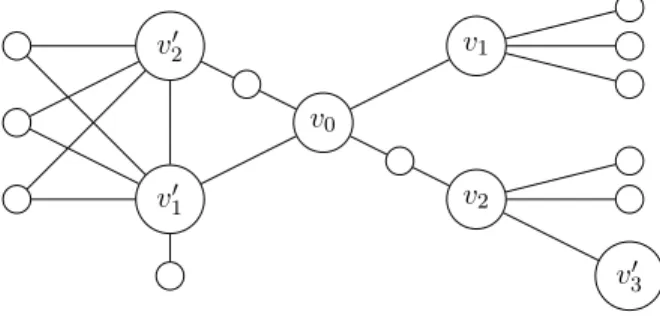
In contrast to the PoS, the PoA might be very high in this model. In Figure 1 we depict a family of graphsGP oA(n) = (VP oA(n), EP oA(n)) that
allows us to show a linear lower bound for the PoA. Note that (v1, v4) ∈
EP oA(n) and (v2, v3) ∈ EP oA(n). For better visibility these edges are not
drawn in the picture. Further we have that|VP oA(n)|=n, hence the size of
the complete subgraph isn−8, and nodes v1,v2, v3 and v4 are connected
to every node in the complete subgraph.
v0 v1 u0 v2 v3 v4 u1 u2 complete graph
Figure 1: Family of graphs GP oA(n) = (VP oA(n), EP oA(n)).
Theorem 1. For anyn ≥1, the firefighter game G = G(GP oA(n), v0) sat-isfies that:
PoA(G) = Θ(n).
Proof. Notice that any strategy profilesof the gameGsatisfies that Safe(s)≤
n. Hence, we only need to prove PoA(G) = Ω(n).
Recall that the fire starts atv0. It is easy to see thats= ({v1},{v2},∅n−3)
is the optimal strategy. Only nodesv0 and u0 burn, hence the social welfare
is W(s) = n−2. Furthermore we have that s0 = ({v3},{v4},∅n−3) is an
equilibrium. Note that the complete graph is burning after two time-steps, therefore at time-step 3 only u1 and u2 are neither burning nor defended.
firefighters on them. Furthermore, players 1 and 2 cannot improve their payoff, since if one of them changes strategy, that player will save at most one node. The social welfare of s0 is W(s0) = 4. Hence, we have that PoA(G)≥ n−42. It follows that PoA(G)∈Ω(n).
The Price of Anarchy for Trees. Since the PoA might be very high in general, we are interested in studying the quality of equilibria for particular topologies. Our aim is to prove that there are cases where the quality of the equilibria is close to the quality of an optimal solution. In the following we analyse the PoA on tree topologies.
Theorem 2. For any tree T = (V, E) and any node v0 ∈V, the firefighter gameGTree=G(T, v0) satisfies that:
PoA(GTree)≤2.
Proof. In this proof, we use ideas similar to the proof of the approximation ratio of a greedy algorithm in a paper by Hartnell and Li [26]. We assume that the initial burning node v0 is the root of the tree. We use the utility
functions of the selfish firefighters. This implies that the utilityu(Self ish)i of playeriis less than, or equal to, the size of the subtree rooted by si.
Let s = (s1, . . . , s|N |) be a ne and let opt = (opt1, . . . ,opt|N |) be an
optimal solution. Notice that for each pair of different playersi, j, we have thatsi can not be an ancestor ofsj. Even though that it can be the case that
opti is an ancestor of optj, we can always consider an equivalent strategy opt’ = (opt−j,∅) such that W(opt’) = W(opt). Hence, there exists an
optimal strategy opt’ such that, for every pair i, j, i 6= j, the subtrees rooted at opt’i and opt’j, respectively, are disjoint.
Let optA be the set of optimal actions opti that they are neither equal to any strategysj nor successors of any strategysj. Formally,
optA={opti | ∀j∈ N :sj 6= opti∧sj is not an ancestor of opti}.
Let optB denote the remaining optimal actions: optB={optj |j∈ N ∧optj 6∈optA}.
Let P(opti) denote the set of strategies sj that are successors of opti.
Let sA denote the set of strategies, that do not have an optimal action as
an ancestor. Formally,
LetsB denote the remaining player actions.
sB ={sj |j∈ N ∧sj 6∈sA}.
Let save(a) denote the number of nodes saved by action a. Notice that save(si) =ui(s) (the size of the subtree rooted atsi) and save(optj) is equal
to the size of the subtree rooted at optj. Moreover, since the subtrees rooted at opti and optj are disjoint, then W(opt) = P
i∈Nsave(opti). Therefore, we have that X i∈N |opti∈optB save(opti)≤ X i∈N |si∈sA save(si). (9)
Sinces is ane, then for eachi∈ N save(si)≥save(opti)−
X
sj∈P(opti)
save(sj),
Otherwise player i would have an incentive to switch his strategy to opti. Summing up over all optimal actions in optA, we get
X i∈N |opti∈optA save(opti)≤ X i∈N |opti∈optA save(si) + X sj∈P(opti) save(sj) .
We can split up the sum on the right hand side and get
X i∈N |opti∈optA save(si) + X i∈N |opti∈optA X sj∈P(opti) save(sj).
Note that in the double sum, we sum up exactly over the player actions that have an optimal action as an ancestor i.e. sB. So we can rewrite this to
X i∈N |opti∈optA save(opti)≤ X i∈N |opti∈optA save(si) + X i∈N |si∈sB save(si).
Now we can use Inequality 9 to get
X i∈N save(opti)≤ X i∈N |opti∈optA save(si) + X i∈N save(si).
Furthermore, we have thatP
opti∈optAsave(si)≤
P
si∈ssave(si) which yields to X i∈N save(opti)≤2X i∈N save(si). Since W(s) =P
i∈Nsave(si) and W(opt) =
P
i∈Nsave(opti), we have that
As we will see in Section 6, the problem of finding a ne of a given firefighter gameG is polynomial time computable. Hence, the algorithm of computing ane yields a polynomial time approximation algorithm for the firefighter problem with an approximation ratio bounded by PoA. In the case of the trees, the algorithm of computing a ne provides an approximation algorithm with an approximation ratio upper bounded by 2 (the number of nodes saved by an optimum solution is at most twice the number of nodes saved by a ne solution as in the case of the greedy algorithm presented in [26]).
5
Coalitions
In this section we consider that players may form coalitions among them-selves. A coalition is willing to deviate from their strategy as long as no player in the coalition loses payoff and at least one player increases his util-ity. We show that this may affect the PoA. We consider that a strategy vectorsis an equilibrium strategy with respect to coalition sizek, if no set of at mostkplayers can simultaneously change their strategies in such a way that at least one player increases his payoff and no player of the coalition decreases his payoff. In the following we define formally these concepts.
Let K ⊆ N be a coalition set and let s be a strategy profile of all the players in N. Let sK denote the joint strategy profile of all the players in
K,sK = (si)i∈K. We say that coalitionK has anattractive joint deviation
fromswhen there exists a joint strategy profiles0K, such that for alli∈K, ui(s)≤ui(s−K, s0K) and there is at least one playerj∈Ksuch thatuj(s)<
uj(s−K, s0K).
We say that a strategy profilesis anequilibrium with respect to coalition sizek if for everyK ⊆ N such that|K| ≤k, coalitionK does not have any attractive deviation froms. LetEk⊆ S denote the set of all equilibria with
respect to coalition sizek.
In the case of equilibria with respect to a coalition size, we do not have an equivalence between selfish and non-profit firefighters like in the Nash case.
Lemma 1. There exists a graph G, a node v0 ∈ V(G), and a coalition size k > 1 such that the firefighter games G(Selfish) = G(Selfish)(G, v
0) and
G(Non-Profit)=G(Non-Profit)(G, v
0) satisfy that:
Proof. Consider the graph in Figure 2 and assume a coalition size k ≥ 2. Note that only Players 1 and 2 can make meaningful moves, hence without loss of generality we denote the strategy vector with s= (s1, s2).
v0
v2
v1
v01 v02
Figure 2: Example Graph. Note that all nodes have distance at most 2 from the fire.
We have that s= ({v1},{v2}) is an equilibrium strategy for the selfish
firefighters, since deviating tos0= ({v10},{v02}) would decrease the utility of Player 2. However,sis not an equilibrium strategy for non-profit firefighters, since the joint deviation s0 increases the total number of saved nodes.
Lemma 2. There exists a graph G, a node v0 ∈ V(G), and a coalition size k > 1 such that the firefighter games G(Selfish) = G(Selfish)(G, v
0) and
G(Non-Profit)=G(Non-Profit)(G, v
0) satisfy that:
Ek(G(Non-Profit))6⊆Ek(G(Selfish)).
Proof. Consider the graph in Figure 3 and assume a coalition size k ≥ 2. Note that at most the first 3 players can make meaningful moves, hence, without loss of generality, we denote the strategy vector withs= (s1, s2, s3).
v0 v2 v1 v30 v10 v20
Figure 3: Example Graph. Note that all nodes have distance at most 3 from the fire.
We have that s= ({v1},{v2},∅) is an equilibrium strategy for the
non-profit firefighters, since deviating to s0 = ({v01},{v20},{v03}) would decrease the total number of saved nodes. However,sis not an equilibrium strategy for selfish firefighters, since the joint deviation s0K = ({v10},{v20}) strictly increases the utility of player 1 without decreasing that of player 2.
From now on we will only consider non-profit firefighters since they re-semble the usual objective to save as many nodes as possible.
5.1 Price of Anarchy
We analyze the PoA for coalitions and its relation with the coalition size.
Definition 4(Price of Anarchy for coalitions). The PoA for a coalition size k (PoAk) of a game G is defined as follows:
PoAk(G) =
maxs∈SW(s)
mins∈EkW(s) .
We show that the PoA for a coalition size k is O(nk) for any class of graphs.
Proposition 4. Let k >1 be the coalition size. Any non-profit firefighter game G = G(G, v0) where |V(G)| = n ≥ 2k and any v0 ∈ V(G) satisfies that:
PoAk(G)≤
n k −1.
Proof. In order to show this bound, we bound the welfare of the optimal solution from above and bound the welfare of the worst equilibrium from below. Let us consider the following two cases:
i) If there is an optimal solution that useskor less firefighters, a coalition of size k can always make a joint deviation to that solution. Hence, there are no equilibria that have a lower welfare than the optimal solution. It follows that PoAk(G) = 1 for those instances.
ii) If every optimal solution uses strictly more than k firefighters, the optimal solution saves at most n−(k+ 1) nodes. This is because it uses at leastk+ 1 steps and at least one node burns every time-step, otherwise the fire would be contained. An equilibrium however always saves at leastk nodes in this case, because for every strategy profile where the players save less thanknodes, the firstkplayers can
jointly deviate to the first k steps of the optimal solution, saving at least the nodes they protect, i.e. k. This yields the desired bound, PoAk(G)≤ nk −1.
Furthermore, we can also show that there exists a family of graphs where this upper bound is tight. Figure 4 shows the construction of the family of graphs GP oA(n, k) = (VP oA(n, k), EP oA(n, k)), with |VP oA(n, k)| = n. All
nodes that are not specifically depicted are inside the complete subgraph. Hence the size of the complete subgraph isn−4k−2. Note that nodesv1 to
vk+1 are connected to every node in the complete subgraph. The nodes v01
tovk0 together withw form a clique. Furthermore, for every vi and uj and
for everyv0i andu0j there are edges (vi, uj) and (vi0, u0j), respectively, ifi≤j.
Last, for everyui andu0i there is an edge toui+1 and u0i+1, respectively. We
refer tov0 as the initial fire, nodesv1 tovk+1,u2 touk+1 and the complete
subgraph as the left part of the graph, and the rest as the right part of the graph. v0 u2 uk uk+1 v1 v2 vk vk+1 u02 u0k v01 v02 vk0 w complete graph
Figure 4: Family of graphs GP oA(n, k) = (VP oA(n, k), EP oA(n, k)), with
|VP oA(n, k)|=n.
Theorem 3. Let k >1be the coalition size. For anyn≥2k, the non-profit firefighter game G= (GP oA(n, k), v0) satisfies that:
PoAk(G) = Θ(
n k).
Proof. Let us show that PoAk(G) = Ω(nk). Notice that the welfare of any
strategy profile is a lower bound for the welfare of an optimal solution, while the welfare of any equilibrium gives an upper bound for the worst equilibrium in terms of quality.
The strategy profiles∗ = (v1, v2, . . . , vk+1,∅|N |−k−1) saves all but 3k+ 1
nodes. The nodes that burn areu2touk+1 andv0 as well as the right part of
the graph. This yields a lower bound for the welfare of an optimal solution. Furthermore, we have that s= (v10, v20, . . . , v0k,∅|N |−k) is an equilibrium
that saves nodewand the nodes that are protected by the firefighters. Since at time-stepk+ 1 there are no vulnerable nodes left, players i, with i > k, have no incentive to deviate from the empty set. Furthermore, we have to argue that for every joint deviation of a coalition of size k at most k+ 1 nodes can be saved.
We use an inductive argument to show that there is no attractive joint deviation for any coalition of sizek into the left part of the graph. Notice that for the left side of the graph, v1 is connected to all other vulnerable
nodes, which means that if player 1 does not protectv1, then all vulnerable
nodes in the left part will be adjacent to the fire in the next time-step. The next player can protect only one extra node but then everything burns with a total number of two saved nodes. If player 1 protectedv1, nodev2assumes
the role ofv1for the next time-step, because it is again connected to all other
vulnerable nodes. Hence, for time-stepi, withi≤k, we have the following situation. If players from 1 toi−1 protect nodesv1 tovi−1, respectively,vi
is connected to all other vulnerable nodes. If playeridoes not protectvi the
next player can protect one at most extra node and everything else burns, yielding a number of at most i+ 1 total saved nodes. This implies that in order to save at leastk+ 1 nodes in the left part of the graph, players from 1 tokhave to protect nodes fromv1 tovk, respectively, and playerk+ 1 has
to play an action different from the empty set. Hence, more thank players would have to jointly deviate from strategy profiles.
For the right part of the graph, we can make a symmetric argument, where vi0 assumes the role of vi for every i,1 ≤i≤k. This yields that the
only way to save at leastk+ 1 nodes is to play strategy profiles.
Finally, we have to argue that there is no attractive joint deviation con-sidering the case that some nodes from both sides from the graph are pro-tected. Note that both sides of the graph burn in two time-steps if there are no firefighters. This implies that the only way to place firefighters in both parts of the graph is to put one in the left side at the first step and one in the right side at the second, or vice versa. Then, at the third time-step, all other nodes in the part where the firefighter was placed in the second
time-step are burning. In the part where the first firefighter was placed all unprotected nodes are also burning or adjacent to the fire. This means that only one extra node can be saved in the third time-step and then the process finishes saving at most three nodes.
Now, we can conclude thats∈Ek and we have thatW(s) =k+ 1. This yields a lower bound
PoAk(G)≥
n−3k−1 k+ 1 ≥
n k+ 1−3.
From this lower bound jointly with the general upper bound shown in propo-sition 4, it follows that PoAk(G) = Θ(nk).
It is interesting to see that in the same family of graphs{GP oA(n, k)}n≥2k,
if n= Θ(k), then PoAk(G) = Θ(1). But in general, since k is a constant,
we have that PoAk= Θ(n). It seems natural to analyze whether coalitions
can improve the quality of equilibria for certain families of graphs. In the next subsection we address this question to the particular case of families of graphs having constant cut-width.
5.2 Graphs with Constant Cut-width
In this section we explore the impact of the cut-width of a graph on the PoA for certain coalition sizes. In order to define the cut-width of a graph we need to introduce some basic concepts.
Definition 5 (Cut-width under a linear order). Given a graphG= (V, E), letL= (v0, . . . , vn−1)be a linear order of V. The cut-width of Gunder the
linear orderL is denoted by cw(G, L) and it is defined as follows:
cw(G, L) =k
if, and only if, for everyisuch that 0≤i < n−1, the number of edges with one endpoint in {v0, . . . , vi} and the other in {vi+1, . . . , vn−1} is at most k and there exists j,0 ≤ j < n−1, such that the number of edges with one endpoint in{v0, . . . , vj} and the other in {vj+1, . . . , vn−1} is equal tok.
Definition 6(Cut-width of a graph). Thecut-width of a graphGis denoted by cw(G) and it is defined as follows:
Lemma 3. Let (G, v0) an instance of the firefighter problem. Then, there exists a strategy profile such that at most b(cw(G)) nodes are burned for some function b.
The proof of a more general version of this claim in contained in the proof of Theorem 2 of [10] and brings us into the position of showing the following proposition.
Proposition 5. For anyk≥1, for any graphG= (V, E)such thatcw(G) = k, and any v0∈V, there exists a coalition size bk such that:
PoAbk(G(G, v0))≤1 + bk−1
n−bk
Proof. Let G = G(G, v0) where G = (V, E), v0 ∈ V and cw(G) = k. By
Lemma 3 there is strategy profiles, such that at mostbk=b(cw(G)) nodes
burn. Now we make use of the fact that the number of time-steps before the spreading of the fire stops is less or equal to the total number of burned vertices. This is because in each time-step at least one node has to burn, otherwise the spreading of the fire would be stopped. Hence we get that with strategy profile s, the fire is contained in at mostbk time-steps. Note that
we can place at most one firefighter per time-step, therefore a coalition of sizebkcan apply this strategy profile. Furthermore, only a constant number
of nodes burn. Hence, asymptotically, we have that PoAbk(G)≤
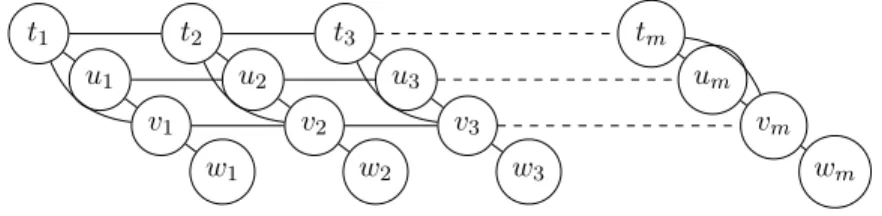
n−1 n−bk. t1 u1 v1 w1 t2 u2 v2 w2 t3 u3 v3 w3 tm um vm wm
Figure 5: Family of graphs Gcw(n) with constant cut-width.
However, we cannot achieve this PoA without coalitions as the following instance shows. Figure 5 shows a family of graphs Gcw(n). Note that
n = 4m. Each ti is connected to ui and vi, furthermore we have edges
(ui, vi) and (vi, wi) for each i. Additionally, for each i < m, we have edges
(ti, ti+1), (ui, ui+1) and (vi, vi+1). A linear layout is given by the horizontal
position of the nodes in the figure,
It shows that the cut-width of the graph is at most 6, since every vertical line through the graph crosses at most 6 edges. Let v0 =u1 be the initial fire.
Without coalitions, saving the nodesv1 tovm is an equilibrium, since each
player saves one extra node and cannot do better by switching to another node. Note that only a constant fraction of the nodes are saved, whereas in the case of coalition all nodes except a constant number can be saved. Thus, for this class of graphs, constant size coalitions can improve the PoA.
6
Computational Complexity
Let us explore the computational complexity of computing equilibria. More specifically, let us bound the computation time of a best response and the converging time of best response dynamics.
Lemma 4. For any coalition size k ≥ 1, the computational complexity of finding an equilibrium with respect a coalition size kof any given non-profit firefighter game is polynomial time computable.
Proof. LetG=G(G, v0) any non-profit firefighter game and letn=|V(G)|.
Note that for a given strategy vectors, we can simulate the spreading of fire in polynomial time and hence compute the social welfare W(s) and check whether there are no invalid actions ins. LetO(q(n)), for some polynomial q, denote the computation time.
For a coalition size k, we can find a best response (if it exist) in time
O(q(n)·nk) by simply trying out every possible joint deviation. Furthermore, we have that the social welfare is strictly increased with every best response, since it equals the utility function of the players. Recall that the social welfare counts the nodes that are saved, so its value cannot exceed n−1. Hence, the best response dynamics converge after at mostn iterations.
It follows that we can find an equilibrium in timeO(p(n)·nk) for some polynomialp.
This implies that we can find equilibria in polynomial time in the case of constant size coalitions. This yields to a polynomial time approximation algorithm for the firefighting problem. The computation of a ne with re-spect a coalition sizek can be seen as an approximation algorithm with an approximation ratio that depends on the quality of the equilibrium. Hence, in the case of case of trees we have shown that we can compute in polynomial time aneand its quality with respect to the social optimum is bounded by PoA≤2 ( coalition size 1). In the case of graphs with constant cut-width k, we can compute anewith PoAbk ≤1 +
bk−1
7
Conclusions
We have defined a new strategic game that models the Firefighter Problem. We have shown that for a particular family of graphs PoA(G) = Θ(n). For trees however, we get a PoA(G)≤2. Furthermore, we have shown that the coalition size has a direct effect on the quality of the equilibria. We have proved that PoAk(G) = Θ(nk) for a specific family of graph, being k the
coalition size. We have shown that there are topologies where PoAbk(G) ≤ 1 + bk−1
n−bk for coalitions of constant size bk, e.g. graphs with constant cut-widthk.
Notice that it is possible to compute an equilibrium in polynomial time, even for constant size coalitions. This can be done following a best response dynamics. This yields to a polynomial time approximation algorithm for the firefighter problem and its approximation ratio equals the PoA of the corresponding game.
We think that the most promising area to explore is the PoA for other restricted classes of graphs, and the impact of the coalition size in those cases. Particularly interesting are classes of graphs, where we can achieve a good PoA with constant-sized coalitions. The results for trees and graphs with constant cut-width are a nice starting step in this direction. In the case of trees we showed a PoA of 2, the next step would be to investigate how far we can improve the PoA if we allow coalitions. Note that it is not possible to get a PoA of one for trees with constant-sized coalitions unless P=NP, since the firefighter problem is known to be NP-hard even on trees [17]. However, we can try to find restricted classes of trees where we can get a PoA of one. Finding the most general description of trees with this property is an open problem [18]. Other classes of graphs we want to consider are grids and graphs with a bounded number of cycles. A related open question is whether the Firefighter Problem is solvable in polynomial time on graphs with path-width two [10].
It also makes sense to analyze the quality of the equilibria with respect to different game-theoretical solution concepts and different social welfare functions. In general there are other optimization objectives for the Fire-fighter Problem, like for example, minimize the number of timesteps until the fire stops spreading [18]. They have to be reflected in the social welfare function if we want to analyze the quality of the outcomes of the game for those cases.
A natural extension of our model is to allow more than one firefighter per time-step and more than one initial fire. This is a generalization that has also been made for the classical Firefighter Problem although most results
are done for the basic case of one initial fire and one Firefighter per time-step. Many complexity questions in the general case are still open problems, even for trees.
References
[1] N. Alon, M. Feldman, A. Procaccia, and M. Tennenholtz. A note on competitive information diffusion through social networks. Information Processing Letters, 110:221–225, 2010.
[2] E. Anshelevich, D. Chakrabarty, A. Hate, and C. Swamy. Approxima-bility of the firefighter problem. Algorithmica, 62:520–536, 2012. [3] C. Bazgan, M. Chopin, M. Cygan, M. R. Fellows, F. V. Fomin, and
E. Jan van Leeuwen. Parameterized complexity of firefighting. Journal of Computer and System Sciences, 80:1285–1297, 2014.
[4] C. Bazgan, M. Chopin, and B. Ries. The firefighter problem with more than one firefighter on trees. Discrete Applied Mathematics, 161:899– 908, 2013.
[5] A. Bonato, J. C. M. Janssen, and E. Roshanbin. Burning a graph as a model of social contagion. InAlgorithms and Models for the Web Graph, Lecture Notes in Computer Science (LNCS), volume 8882, pages 13–22, 2014.
[6] A. Bonato, M.-E. Messinger, and P. Pra lat. Fighting constrained fires in graphs. Theoretical Computer Science, 434:11–22, 2012.
[7] L. Cai, Y. Cheng, E. Verbin, and Y. Zhou. Surviving Rates of Graphs with Bounded Treewidth for the Firefighter Problem. SIAM Journal on Discrete Mathematics, 24:1322–1335, 2010.
[8] L. Cai, E. Verbin, and L. Yang. Firefighting on Trees: (1 − 1/e)-Approximation, Fixed Parameter Tractability and a Subexponential Algorithm. In Algorithms and Computation, Lecture Notes in Com-puter Science (LNCS), volume 5369, pages 258–269, 2008.
[9] L. Cai and W. Wang. The Surviving Rate of a Graph for the Firefighter Problem. SIAM Journal on Discrete Mathematics, 23:1814–1826, 2010.
[10] J. Chleb´ıkov´a and M. Chopin. The firefighter problem: A structural analysis.Parameterized and Exact Computation, Lecture Notes in Com-puter Science (LNCS), volume 8894, pages 172–183, 2014.
[11] V. Costa, S. Dantas, M. Dourado, L. Penso, and D. Rautenbach. More fires and more fighters. Discrete Applied Mathematics, 161:2410–2419, 2013.
[12] M. Cygan, F. V. Fomin, and E. van Leeuwen. Parameterized Complex-ity of Firefighting Revisited. InParameterized and Exact Computation, Lecture Notes in Computer Science (LNCS), volume 7112, pages 13–26, 2012.
[13] M. Develin and S. Hartke. Fire containment in grids of dimension three and higher. Discrete Applied Mathematics, 155:2257–2268, 2007. [14] L. Esperet, J. van den Heuvel, F. Maffray, and F. Sipma. Fire
Contain-ment in Planar Graphs. Journal of Graph Theory, 73:267–279, 2013. [15] O. Feldheim and R. Hod. 3/2 Firefighters Are Not Enough. Discrete
Applied Mathematics, 161:301–306, 2013.
[16] S. Finbow, B. Hartnell, Q. Li, and K. Schmeisser. On minimizing the effects of fire or a virus on a network. Journal of Combinatorial Mathematics and Combinatorial Computing, 33:311–322, 2000.
[17] S. Finbow, A. King, G. MacGillivray, and R. Rizzi. The firefighter problem for graphs of maximum degree three. Discrete Mathematics, 307:2094–2105, 2007.
[18] S. Finbow and G. MacGillivray. The Firefighter Problem: A survey of results, directions and questions. Australian Journal of Combinatorics, 43:57–77, 2009.
[19] P. Floderus, A. Lingas, and M. Persson. Towards more efficient infection and fire fighting. International Journal of Foundations of Computer Science, 24:3–14, 2013.
[20] P. Fogarty. Catching the fire on grids. Thesis (M.S.). Department of Mathematics, University of Vermont. USA, 2003.
[21] F. V. Fomin, P. Heggernes, and E. J. V. Leeuwen. Making life easier for firefighters. In Fun with Algorithms, Lecture Notes in Computer Science (LNCS), volume 7288, pages 177–188, 2012.
[22] T. Gavenciak, J. Kratochv´ıl and P. Pra lat. Firefighting on square, hexagonal, and triangular grids. Discrete Mathematics, 337:142–155, 2014.
[23] M. Gr¨otschel, L. Lov´asz, and A. Schrijver. Geometric Algorithms and Combinatorial Optimization. Springer-Verlag, 1988.
[24] S. G. Hartke. Attempting to Narrow the Integrality Gap for the Fire-fighter Problem on Trees. In DIMACS Series in Discrete Mathematics and Theoretical Computer Science, pages 225–231. American Mathe-matical Society, 2006.
[25] B. Hartnell. Firefighter! an application of domination. Presentation, 24th Manitoba Conference on Combinatorial Mathematics and Com-puting, University of Manitoba in Winnipeg, Canada, 1995.
[26] B. Hartnell and Q. Li. Firefighting on trees: How bad is the greedy algorithm? Congressus Numerantium, 145:187–192, 2000.
[27] Y. Iwaikawa, N. Kamiyama, and T. Matsui. Improved Approximation Algorithms for Firefighter Problem on Trees. IEICE Transactions, 94-D:196–199, 2011.
[28] A. King and G. MacGillivray. The firefighter problem for cubic graphs. Discrete Mathematics, 310:614–621, 2010.
[29] J. Kong, W. Wang, and X. Zhu. The surviving rate of planar graphs. Theoretical Computer Science, 416:65–70, 2012.
[30] G. MacGillivray and P. Wang. On the firefighter problem. Journal of Combinatorial Mathematics and Combinatorial Computing, 47:83–96, 2003.
[31] M.-E. Messinger. Firefighting on Infinite Grids. Master’s thesis, De-partment of Mathematics and Statistics, Dalhousie University, Halifax, Canada, 2004.
[32] M.-E. Messinger. Firefighting on the Triangular Grid.Journal of Com-binatorial Mathematics and ComCom-binatorial Computing, 63:3–45, 2007. [33] M.-E. Messinger. Average Firefighting on Infinite Grids. Australasian
Journal of Combinatorics, 41:15–28, 2008.
[34] S. Moeller and P. Wang. Fire Control on graphs. Journal of Combina-torial Mathematics and CombinaCombina-torial Computing, 41:19–34, 2002.
[35] K. L. Ng and P. Raff. A generalization of the firefighter problem on Z×Z. Discrete Applied Mathematics, 156:730–745, 2008.
[36] P. Pra lat. Graphs with Average Degree Smaller Than 30/11 Burn Slowly. Graphs and Combinatorics, 30:455–470, 2012.
[37] R. Takehara, M. Hachimori and M. Shigeno. A comment on pure-strategy nash equilibria in competitive diffusion games. Information Processing Letters, 112:59–60, 2012.
[38] E. Roshanbin. The competitive diffusion game in classes of graphs. In Algorithmic Aspects in Information and Management, Lecture Notes in Computer Science (LNCS), volume 8546, pages 275–287, 2014.
[39] L. Small and O. Mason. Information diffusion on the iterated local tran-sitivity model of online social networks. Discrete Applied Mathematics, 161:1338–1344, 2013.
[40] L. Small and O. Mason. Nash equilibria for competitive information diffusion on trees. Information Processing Letters, 113:217–219, 2013. [41] W. Wang, S. Finbow, and P. Wang. The surviving rate of an infected
network. Theoretical Computer Science, 411:3651–3660, 2010.
[42] W. Wang, S. Finbow, and P. Wang. A lower bound of the surviving rate of a planar graph with girth at least seven. Journal of Combinatorial Optimization, 27:621–642, 2014.
[43] W. Wang, J. Kong, and L. Zhang. The 2-surviving rate of planar graphs without 4-cycles. Theoretical Computer Science, 457:158–165, 2012. [44] W. Wang, X. Yue, and X. Zhu. The surviving rate of an
outerpla-nar graph for the firefighter problem. Theoretical Computer Science, 412:913–921, 2011.
[45] D. Zinoviev, V. Duong, and H. Zhang. A game theoretical approach to modeling information dissemination in social networks. CoRR, abs/1006.5493, 2010.
[46] D. Zinoviev and V. Duong. A Game Theoretical Approach to Broadcast Information Diffusion in Social Networks. In Proceedings of the 44th Annual Simulation Symposium, ANSS, pages 47–52. ACM, 2011.