Psychopathy and the Ability to Detect Cheaters: An Evolutionary Perspective
by Tabitha Jones
A thesis
submitted in partial fulfilment of the requirements for the degree of Master of Arts, Psychology (Social Personality)
Department of Psychology BROCK UNIVERSITY
St. Catharines, Ontario July 2015 © Tabitha Jones, 2015
ii Dedication
To Josh, thank you for being the amazing supportive man that you have been throughout this degree, the last degree, and the next. I hope you know that it is because of you I am able to chase
my dreams.
To my daughter Adelaide, thank you for being the inspiration I need to always be my best self. Thank you for giving me the motivation to succeed even when the odds are stacked against me.
To my family, by blood and by law, thank you for believing in me and for always encouraging me to be my very best. I would not have gotten this far without you.
iii Abstract
This research examined psychopathy as an evolutionary adaptation that involves cheating and deception. I theorized that this strategy should be associated with certain abilities. This research examined the association between psychopathic traits and the ability to detect cheaters, altruism, deception, and psychopathic traits. Results indicated that psychopathic traits were not significantly associated with the ability to detect cheaters or altruism. Results indicated that high Factor 1 psychopathy scores, and low Factor 2 psychopathy scores, were indicative of higher ratings of deception when viewing deceptive videos. Conversely, when viewing truthful videos, Factor 1 was a significant predictor of higher ratings of deception. Finally, our results indicated that total psychopathy scores were associated the ability to identify psychopathic traits in others. Taken together the results provide mixed support for the evolutionary perspective of
iv
Acknowledgements
Before all others I would like to thank my supervisor Dr. Angela Book. You have provided me with a great amount of inspiration, and knowledge. If it had not been for your amazing zest for this field that I witnessed taking my first undergraduate course in Forensic Psychology I would never have found myself here today. I am so grateful for all of the
opportunities, learning experiences, and guidance that she has bestowed upon me. I would also like to thank my supervisory committee composed of Dr. Anthony Volk, and Dr. Timothy Murphy for all of their guidance and suggestions throughout this fulfilling journey. I would also like to thank Dr. Danielle Molnar, for allowing me to frequently tap into her astounding
knowledge of statistics and all other academic matters, but also for providing me with guidance, and support. Most of all I want to thank her for her warmth, her patience, and her ability to instill confidence.
Finally, I would like to thank my lab mates: Ashley Hosker-Field, and Nathalie Gauthier, who are more like family to me than lab mates. Thank you for your hours of edits, hours of listening to my obsession over details, for mitigating my stress, and for making me feel like I can achieve everything I set out to accomplish. I am so blessed to have you both in my life.
v
Table of Contents
Dedication ……….. ii
Abstract ………. iii
Acknowledgments ……….. iv
List of Tables ………... iiix
List of Figures ……… ix
List of Appendices ……….……….……….... x
Introduction ……… 1
Psychopathy ………. 2
The Profile of Adaptive Psychopathy…...……...……..………... 5
Game Theory……….………... 6
Wason Selection Task for Cheater Detection……..………...10
Social Contracts ………..………... 10
Cheater Detection …………..………...……….. 11
Wason Selection Task for Detecting Altruism ….…………..………...… 12
Altruism Detection ……….………. 13 Deception Detection ………...………... 14 Practice ……….…….………. 14 Emotion Detection ……….………. 16 Empathy……….……….………. 18 Current Work ………. 19 Method ………. 22 Participants ………...……. 22
vi
Material ………..…. 22
Demographics ………..… 22
Wason Selection Task …..……… 22
Psychopathy Measure ……… ………. 22
Videos ……….……..………... 23
Procedure ……….. 23
Analytic Strategy ……….. 24
Results ……….. 26
Assumptions and Multivariate Outliers………..… 26
Assumptions for the Poisson Regression………...………...………….. 29
Examining Hypotheses 1 and 2 ………..… 30
Hypotheses 1 and 2: Analysis ………..………..… 30
Hypotheses 1 and 2: Conclusion ..………..… 31
Examining Hypotheses 3 and 4 ………..… 31
Hypotheses 3 and 4: Analysis ………..………..… 31
Hypotheses 3 and 4: Conclusion ..………..… 32
Examining Hypotheses 5 and 6 ………..… 32
Hypotheses 5 and 6: Analysis ………..………..… 32
Simple Slopes Analysis……….………...………….. 33
Hypotheses 5 and 6: Conclusion ..………..… 34
Examining Hypotheses 7 and 8 ………..… 35
Hypotheses 7 and 8: Analysis ………..………..… 35
vii
Supplementary Analysis for Deception Detection and Truth Detection…….... 36
Examining Hypotheses 9 and 10 ………..… 37
Hypotheses 9 and 10: Analysis ………..………..… 37
Hypotheses 9 and 10: Conclusion ..………..… 39
Discussion ………..………. 40
Wason Selection Task..…………..……….………..… 41
Hypotheses 1 and 2……….………..… 41
Hypotheses 3 and 4……….………..… 41
Truth and Deception Detection..……….………..… 45
Hypotheses 5 and 6………..….... 45
Hypotheses 7 and 8………..….... 45
Psychopathy Detecting Psychopathy..……….………..… 50
Hypotheses 9 and 10…..………..….... 50
Implications ……….………...……….. 52
Limitations ……….………....……….. 53
Future Directions ………..……….……….. 54
viii List of Tables
Table 1. Predicted Independent Effects of Psychopathy Factors for Each
Dependant Variable ……….……….………….………...… 21 Table 2. Descriptive Statistics for all Variables …...… 27 Table 3. Bivariate Correlations between Psychopathy Factors and Cheater
Detection Measures ……….… 28 Table 4. Hypotheses 1 and 2, Main Analysis: Summary of Simultaneous Regression Predicting Scores on the Wason Selection task Cheater Version …..………….. 31 Table 5. Hypotheses 3 and 4, Main Analysis: Summary of Simultaneous Regression Predicting Scores on the Wason Selection task Altruism Version ... 32 Table 6. Hypotheses 5 and 6, Main Analysis: Summary of Simultaneous Regression Predicting Ratings of Perceived Deception when Viewing Deceptive Videos …. 33 Table 7. Summary of Simple Slopes Analysis …….………... 35 Table 8. Hypotheses 7 and 8, Main Analysis: Summary of Simultaneous Regression
Predicting Ratings of Perceived Truthfulness when Viewing Truthful Videos …. 36 Table 9. Supplementary Analysis: Bivariate Correlation Table for Psychopathy and Accuracy Scores ………...……… 37 Table 10. Hypotheses 9 and 10, Main Analysis: Summary of Simultaneous Regression Predicting Difference Scores ………..…….…... 38 Table 11. Hypotheses 9 and 10, Supplementary Analysis: Summary of Simultaneous Regression Predicting Difference Scores from Total Psychopathy Scores …… 38 Table 12. Supplementary Analysis: Bivariate Correlation Table for Supplementary
ix List of Figures
Figure 1. An example of the Wason Selection task, which switch social contract answers …11 Figure 2. An example of a Wason Selection task, cheater version, with switched social
contract answers ………...……….... 12 Figure 3. An example of a Wason Selection task, altruism version, with switched social
contract answers ………...……… 13 Figure 4. Interaction of Factor 1 and Factor 2 on ratings of perceived deception ………34 Figure 5. Proposed mediational model for future studies ……… 55
x
List of Appendices
Appendix A. Brock University Research Ethics Board Clearance ……….. 64
Appendix B. Consent Form ……….. 65
Appendix C. Feed Back Form …...………... 67
Appendix D. MTURK Advertisement ………..………...…..………. .68
Appendix E. Facebook Advertisement ……….……... 69
Appendix F. Demographics ……….…….... 70
Appendix G. The Self-Report Psychopathy Scale III …..……….…... 71
Appendix H. Wason Selection Task – Altruism Versions ……...……… 74
Appendix I. Wason Selection Task – Cheater Versions ………...………...… 77
1 Introduction
As the study of psychopathy is a relatively young one in the field of personality research, there is a great deal of debate on the manner in which psychopathy should be defined and
measured (Edens, Marcus, Lilienfeld, & Poythress Jr, 2006; Lilienfeld & Andrews, 1996; Lilienfeld et al., 2012; Miller & Lynam, 2012).
One of the current debates is in regards to whether or not psychopaths represent a specific type of individual, or whether psychopathy may be dimensional (Edens et al., 2006; Harris, Skilling, & Rice, 2001). The first perspective is that psychopathy is natural class, where an individual either is, or is not, a psychopath (Harris et al., 2001). The second perspective is that psychopathy is constellation of traits that exists on a continuum (Edens et al., 2006). Edens et al. (2006), for example, examined the structure of psychopathy and found no support for a dichotomous structure. They used their results as support for the presence of a dimensional structure. The current research endorses the dimensional perspective.
Another debate in the research of psychopathy surrounds how psychopathy should be studied. Traditionally psychopathy has been studied as a personality disorder, however recently some researchers have suggested that it should be studied from an adaptive perspective
(Lilienfeld & Andrews, 1996; Lilienfeld et al., 2012). The current research honours this adaptive perspective of psychopathy, and aims to investigate whether or not there are specific adaptive abilities associated with psychopathic traits. Specifically the current research builds off the theory put forth by Mealey (1995), who suggested that individuals high in certain psychopathic traits may have a history of employing cost/benefit analyses (as explained by game theory; Dawkins, 1976) to inform their behaviour and interactions with others. The current work proposes that the cost/benefit analyses employed by individuals high in psychopathic traits may
allow for a better understanding of the victim selection techniques employed by individuals (Mealey, 1995). More specifically, individuals high in psychopathic traits may be using a cheater detection mechanism, based on a cost/benefit analysis, to determine which individuals are safe targets for exploitation (those not employing cheater strategies), and which individuals are too costly to encounter (individuals who are employing a cheater strategy, and who may be attempting to cheat them). Research has shown that the general population is skilled at
identifying both cheaters and altruists (Cosmides & Tooby, 1992; Brown & Moore, 2000), and thus the current work proposes that psychopathy may be associated with these abilities as well. It is hypothesized that this ability is present in the non-psychopathic population in order to prevent contact with individuals who would cost a cooperative individual resources (cheaters), and to facilitate cooperation with individuals likely to engage in a fair exchange of resources (Cosmides & Tooby, 1992; Brown & Moore, 2000; Mealey, 1995). It is suggested that this same ability, to a greater extent, may be present in the psychopathic population in order to allow these individuals to avoid costly encounters with fellow cheaters, and locate individuals from whom they could easily exploit resources. The following review will clearly define the relevant major concepts, such as psychopathy and game theory, which are essential to understand in order to fully explain the perspective of the current research.
Psychopathy
Psychopathy is traditionally viewed as a personality disorder, characterized by individuals who con, manipulate, and destroy others in order to meet their own needs (Hare, 1993). It is typically assessed in offender samples using the Psychopathy Checklist-Revised (PCL-R; Hare, 2003) which breaks psychopathy down into two factors, that can be split further into four facets (Hare & Neumann, 2008). Factor 1 is associated with interpersonal
characteristics and it can divided into Interpersonal Manipulation and Callous Affect.
Interpersonal Manipulation includes items that assess: glibness, a grandiose sense of self-worth, pathological deception, and manipulation. Callous Affect measures characteristics such as: a lack of guilt or remorse, general shallow affect, callousness, and an inability to accept responsibility for one’s own actions. Factor 2 is associated with the antisocial lifestyle aspects of psychopathy, and is comprised of Erratic Lifestyle and Antisocial Behaviours. Erratic Lifestyle includes various characteristics such as a need for stimulation, parasitic lifestyle, irresponsibility, and impulsivity. Antisocial Behaviours includes the behavioural aspects of psychopathy such as poor behavioural controls, early behaviour problems, youth delinquency, and a varied criminal history (Hare & Neumann, 2008).
Although traditionally viewed as a personality disorder, some investigators are now studying psychopathy from an evolutionary perspective, viewing it, not as a disorder, but as a life strategy or an adaptation (Barr & Quinsey, 2004; Book & Quinsey, 2004;Mealey, 1995; Seto, Khattar, LaLumiere, & Quinsey, 1997). When studied from this evolutionary perspective, psychopathy is explained via a frequency-dependant life history strategy, in which psychopathic individuals fill a specific niche within society (Book & Quinsey, 2004; Mealey, 1995). As a frequency dependant strategy psychopathy would exist as a small subsection of the population outnumbered by other non-psychopathic life strategies (Glenn, Kurzban, & Raine, 2011). Psychopathy is theorized to exist in about 1% of the population, which would fit the notion of a frequency-dependant selection (Hare, 1996).
Krupp, Sewall, Lalumière, Sheriff, and Harris (2013) proposed that there certain factors that call into question the idea of psychopathy as a disorder. The authors employed Wakefield’s (1992) definition of a disorder as a Harmful dysfunction, to support their perspective. The
Harmful dysfunction theory states that in order for psychopathy to be considered a disorder it needs to fulfill two criteria, (1) it needs to cause harm to the subject or others, and (2) Its
symptoms need to be caused by a failure of a mechanism, and not act an adaptation to a specific environment (Krupp et al, 2013). There is no doubt that individuals high in psychopathic traits fulfill the first criteria, they are parasites causing harm wherever they go (Hare, 1993). The second criteria, however, is not as clear. Psychopathy is associated with behaviour that would be considered different from the non-psychopathic population (pathological deception,
manipulation, parasitic tendencies, shallow affect; Hare, 1996). However, Wakefield (1992) argues that different does not necessarily equate to dysfunctional. It can be argued that
individuals high in psychopathic traits are actually very adapted to, and functional within, their environment (Glenn et al.,2011; Mealey, 1995). Although some argue that psychopathy is more akin to a harmful mutation than to an adaptation (Miller & Lynam, 2012), it is possible that the “symptoms” of psychopathy, such as a lack of fear and remorsemay actually serve to assist psychopathic individuals in maximizing survival and reproductive fitness. Their lack of fear, for example, could be what allows them to appear charming, calm, and charismatic to others, even under the most intimidating of circumstances, thus luring others into parasitic relationships, which in turn, serve the psychopathic individual (Glenn et al, 2011). This returns us to the idea of difference not necessarily equating to disorder (Wakefield, 1992). Although there are most definitely differences between an individual high in psychopathic traits and the average non-psychopathic individuals, there are certainly psychopaths who are very successful at using their differences to maximize their success (Boddy, 2006; Mullins-Sweatt, Glover, Derefinko, Miller, & Widiger, 2010). To explore the idea of psychopathy as an adaptive selection, it is important to
understand the theoretical position on which this argument is based. An examination of the profile of adaptive psychopathy, and of game theory will follow.
The Profile of Adaptive Psychopathy
There has been much debate about how psychopathy should be defined and measured (Lilienfeld & Andrews, 1996; Lilienfeld et al., 2012; Miller & Lynam, 2012, Skeem & Cooke, 2010). Some psychopathy researchers feel that psychopathy is inherently maladaptive, should include measures of criminal behaviour, and should necessarily relate to measures of other maladaptive qualities (Miller & Lynam, 2012). However, recently there has been expanded interest in studying psychopathy from an adaptive perspective (Lilienfeld & Andrews, 1996; Lilienfeld et al., 2012), and the belief that criminal behaviour is not a central construct of psychopathy (Skeem & Cooke, 2010).
What has yet to be made entirely clear is what exactly adaptive psychopathy looks like. To understand the profile of adaptive psychopathy the research outlining successful psychopathy should be examined. The successful psychopathy literature examines individuals high in
psychopathic traits who are able to thrive and survive (Mullins-Sweatt et al., 2010). These individuals can be thought of as very adaptive, as they seem to be able to capitalize on their psychopathic traits. Successful psychopathy can be differentiated from the traditional
(maladaptive) forms of psychopathy by higher levels of contentiousness, higher levels of Factor 1 traits, and lower levels of Factor 2 traits (Mullins-Sweatt et al., 2010). This body of research suggests that adaptive psychopathy should be associated with high Factor 1 traits, and low Factor 2 traits (Lilienfeld & Andrews, 1996; Lilienfeld et al., 2012; Mullins-Sweatt et al., 2010). As such, the current work will examine the construct of adaptive psychopathy from this framework.
Game Theory
Game theory is a cost/benefit analysis of behaviour in competitive settings (Dawkins, 1976). It has been use to analyze how certain life strategies may have evolved, based on how and when certain strategies either cost an individual or benefit them (or both), and how and when this cost/benefit interaction can be stable and adaptive (Sigmund, 1993). Game theory can be
understood though the Dove/Hawk scenario, where there are two different strategies within a species to win certain resources (Dawkins, 1976). The Hawk, will always show aggression and this aggression will always escalate into a fight. The Hawk will fight until the encounter is over, emerging either as the victor, or the heavily injured (even fatally injured) loser. The Dove will show aggression, through posturing and other displays, but will inevitably run if a fight is imminent. The cost of running from a fight is lower than the cost of losing a fight and being injured, but the rewards associated with winning (the payoff) is also high. When a Dove faces another Dove, the one who endures the most posturing (the cost perhaps being the expended energy of the display), wins the encounter (receiving all of the payoff). The Dove that retreats and refuses to continue posturing has to face the costs associated with the display, with none of the payoff. The Hawk when faced with another Hawk will fight, possibly even to the death, until a victor emerges (the cost of injury is high, much higher than the cost of an aggressive display, but so is the payoff). When a Hawk encounters a Dove, they may both begin by posturing, however, the Hawk will always initiate a fight, the Dove will always retreat from the Hawk, and the Hawk will always be victorious. The Dove may never have to pay the high costs associated with sustaining an injury in an encounter, but it will also never win the payoff when facing a Hawk. A Hawk will always win against a Dove, but risks great injury when approached by another Hawk. Simulations have shown that neither the Hawk nor the Dove strategy would be
particularly stable, as neither would allow for a stable population of that particular strategy over time (Dawkins, 1976). A more stable strategy is one referred to as the retaliator. A retaliator begins by behaving like a Dove, however, when attacked instead of retreating, a retaliator will retaliate (Dawkins, 1976). In this situation cooperation can emerge, where violence does not occur in every encounter, but when it does occur no one side is forced to flee unable to defend themselves. In a society composed of retaliators, who behave cooperatively, but defend themselves against attacks, the psychopath can be thought of a prober-retaliator (Book & Quinsey, 2004). The prober-retaliator acts like a retaliator, but with bursts of unpredictable aggression (Dawkins, 1976, Book & Quinsey, 2004). Thus they will begin by behaving like a Dove, but will have bursts of escalating aggression. If no retaliation occurs it will continue to attack, if retaliation does occur it will resume Dove like behaviour (Dawkins, 1976). A
psychopath will initially appear to be cooperative with their victims (like a Dove), this pretence is needed to establish a level of trust (Frank, 1988). They will, however, implement random bouts of escalating aggressive behaviour, and are highly reactive in response to a perceived attack (Book & Quinsey, 2004). A psychopath will begin by behaving like a Dove or a retaliator, but by implementing random bouts of aggressionthey fail to follow the rules of these strategies. This strategy of behaving like a dove, with bursts of aggression and cheating has also been deemed the Cheater-Warrior Hawk strategy (Book & Quinsey, 2004).
Game theory can also be understood in terms of the Prisoner’s Dilemma game. The Prisoner’s Dilemma is a game that is played in pairs, that illustrates why two individuals might not cooperate, even though it would be in their best interest to do so (Cosmides & Tooby, 1992). In this game players can either defect against or cooperate with their opponent. If a player defects and their opponent cooperates, they receive a large prize. If a player cooperates and their
opponent defects, the player will receive a large penalty. If both players cooperate then both players receive a moderate prize, and if both players defect then both players face a minor penalty (Dawkins, 1976). In general, if only one game is played, participants should choose to defect, as this is the safest strategy. If iterated games are played, cooperation tends to emerge, where a player only retaliates if they have been defected against, as it is in the long-term best interest of both players to cooperate, as both will consistently receive moderate prizes (Cosmides & Tooby, 1992). Simulations have illustrated that the most successful strategy for this particular game is a tit-for-tat strategy. Similar to a retaliator, one cooperates unless defected against, and then one will retaliate accordingly, and then resume a cooperative strategy (Cosmides & Tooby, 1992). Similar to the prober-retaliator strategy an individual high in psychopathic traits would be expected to begin encounters by behaving like cooperator, or even a tit-for-tat player (in order to maintain a certain level of trust), however, these individuals would implement random bouts of defection. Bearing this strategy in mind, if an individual high in psychopathic traits were
encountering the same players over and over again they could potentially develop a reputation as an individual who does not abide by the rules of fair play.
Psychopathy has been viewed as particular strategy employed by a small group of cheaters amongst a larger group of cooperators (Book & Quinsey, 2004; Mealey, 1995). Individuals high in psychopathic traits will behave cooperatively in order to lure in fellow cooperators, however they are not consistent with their cooperative behaviour. Theory suggest that the reason individuals high in psychopathic traits need to begin encounters by behaving like a dove is because, as a predator, psychopaths need to be viewed as cooperative and trustworthy to gain the trust of their potential victims (Frank, 1988). It is theorized that in these simulated encounters individuals high in psychopathic traits would cheat, defect, and behave aggressively,
thus not following the rules of fair play employed by cooperators and retaliators (Book & Quinsey, 2004). This is in keeping with the research that suggests that psychopaths cheat, con, manipulate, and behave aggressively in their encounters with others (Book & Quinsey, 2004; Cima & Raine, 2009;Hare, 1993). The concept of the Cheater Warrior-Hawk (Book & Quinsey, 2004), or the prober retaliator (Dawkins, 1976) is connected to the theory that psychopathy can only exist in a frequency based model; they have to exist as a small subsection of society in order to reap the evolutionary benefits of being antisocial (Mealey, 1995). The logic underlining why this strategy would be successful as a frequency dependent selection can be understood through two explanations. The first explanation is that in order to function within society individuals high in psychopathic traits need to be able to cheat and manipulate, then move onto their next target without encountering the same individual twice or developing a reputation. The cost of
developing a negative reputation to an individual high in psychopathic traits would be the inability to locate potential victims who would be willing to enter into a parasitic relationship with them. The second explanation is that individuals high in psychopathic traits need to avoid encountering other cheaters, as this poses an extensive risk to them. Attempting to cheat
someone, who is, in turn, attempting to cheat you would result in a very costly interaction, where both parties are paying the cost of the encounter, yet neither acquire any of the rewards. Thus, if individuals high in psychopathic traits exist only as a small sub-section of the larger population, their probability of encountering another psychopathic individual would be relatively low. A mechanism that would serve in the prevention of engaging with another cheater would be one that enables individuals high in psychopathic traits to identify other hawks, defectors, or
cheaters. Studies have shown that the general population has some natural propensity to detect a cheater (Cosmides & Tooby, 1992). It is logical to assume that a psychopath would have this
propensity to an even greater degree as it would be very costly for them to encounter another cheater (a Hawk encountering a Hawk). Furthermore, it should be a great deal easier for an individual high in psychopathy to identify other cheaters, as they would be very familiar with the cheating strategy, and thus, more readily able to identify it. One method to test if this tendency is present is the Wason Selection Task.
Wason Selection Task for Cheater Detection
The Wason selection task was originally designed to test the theory that individuals reason and learn through hypothesis testing (Cosmides & Tooby, 1992). The Wason selection task has a participant decide whether or not a conditional contract in the form of “If P, then Q” has been violated by scenarios represented on four different cards (Brown & Moore, 2000). The rule can only be violated if P is true and Q is false.
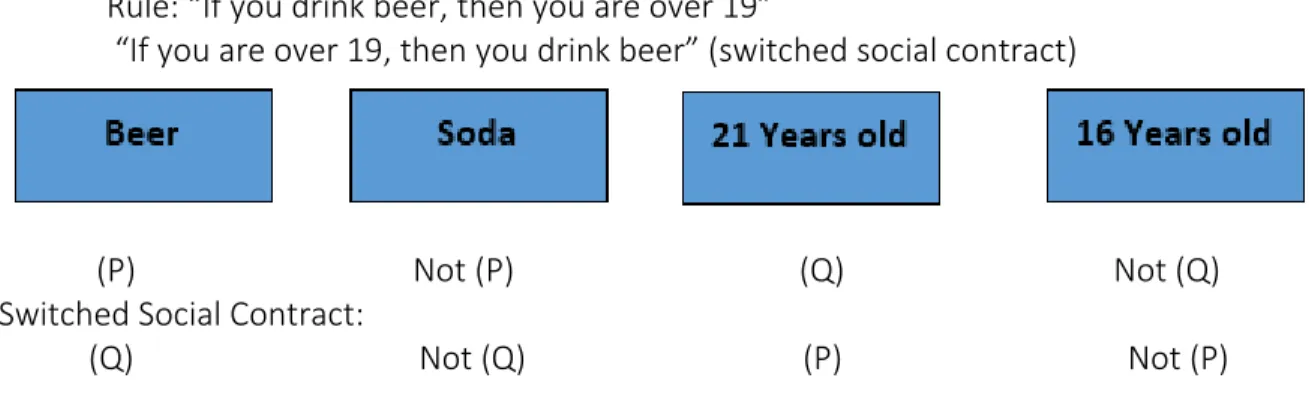
Social Contracts. When used as a strict reasoning exercise to test conditional rules participants do very poorly. Conversely, when used in the context of social contracts, participants do exceedingly well (Cosmides & Tooby, 1992). This technique uses a cost/benefit scenario where if one pays the costs then they may receive the benefits. An example of a social contract is: if you receive the benefit (P), then you pay the cost (Q). Participants are then presented with four cards with which to test whether or not the conditions have been met (Cosmides & Tooby, 1992). These cards are double sided, and have to be flipped to test the hypothesis. For our example one side of each card would have whether or not the benefit was received, and the other side would indicate if the cost was paid (see Figure 1).
Rule: “If you receive the benefit, then you pay the cost”
“If you pay cost, then you receive benefit” (Switched social Contract)
(P) Not (P) (Q) Not (Q) Switched Social Contract:
(Q) Not (Q) (P) Not (P) Figure 1. An example of the Wason Selection task, which switch social contract answers. To test the hypothesis that this rule was being followed one would flip card 1 to ensure that the other side indicated that person had paid the cost, and card 4 would also have to be flipped because this individual has not paid the price and so should not have received the benefit. The two cards that are flipped represent the benefit accepted and cost not paid conditions. Card 2 would not have to be flipped because the benefit was not received, and so no contract was made. Card 3 would not have to be flipped as the rules do not state that one has to receive the benefit if one pays the cost. The appropriate logic based response to any question on the Wason Selection task is to select the options that correspond with (P) and Not (Q).
Cheater Detection. From our social contract example it would appear that people are adept at identifying whether or not someone was cheating based on a specific rule, if P then Q. This cheater detection adaptation has been demonstrated by using the Switched Social Contract scenario (Cosmides & Tooby, 1992) (see Figure 2). The Switched Social Contract is based on a switched rule such as: if you pay the cost (now referred to as (P)), you receive the benefit (now referred to as (Q)). In the switched social contract situation (P) refers to the cost being paid, and (Q) now refers to the benefit being received. If a person was utilizing logic to prove this rule was being followed they would have the flip card two (Not (Q)), to ensure that the person had not paid the cost, and card three (P) to ensure that the person had received the benefit. However, research has shown that participants still tend to select card 1 Benefit (Q) and card 4 Cost Not
Benefit
No Benefit
Cost NotPaid
Paid (Not (P)), which is not the logical answer to the switched logic question of is the rule being violated, but is the answer to the question of is this person being cheated (Cosmides & Tooby, 1992). By employing cheater detection versions of the Wason Selection task it will enable us to determine whether or not psychopathy is associated with this tendency to detect cheaters.
Rule: “If you drink beer, then you are over 19”
“If you are over 19, then you drink beer” (switched social contract)
(P) Not (P) (Q) Not (Q) Switched Social Contract:
(Q) Not (Q) (P) Not (P)
Figure 2. An example of a Wason Selection task, cheater version, with switched social contract answers.
Wason Selection Task for Detecting Altruism
Another mechanism that would be beneficial to individuals high on psychopathic traits would be one which enables these individuals to identify altruists. It has been shown that the propensity to detect altruists, similar to the propensity to seek out cheaters, is present in the general population (Brown & Moore, 2000). It is theorized that this ability is an evolutionarily developed skill which enabled cooperators to identify other cooperators with whom they can fairly exchange resources (Brown & Moore, 2000). It is logical that psychopathy would also be associated with the ability to detect altruists. Altruists, with their kind, generous, and selfless nature would make ideal victims for the psychopath’s manipulative, deceptive and parasitic nature. Studies have already shown that individuals high in psychopathy have the ability to identify vulnerability and emotions in others (Book, Quinsey, & Langford, 2007; Wheeler, Book, & Costello, 2009). Having the ability to identify vulnerable individuals, who are prone to
altruism, would further assist psychopaths in selecting appropriate victims. Furthermore, the ability to detect an altruist would be another means by which to avoid other cheaters as it is impossible to be a cheater and an altruist at the same time.
Altruism Detection. It has been shown that the Wason selection task can also be used to elicit an altruism detection mechanism in a similar way that it is used to elicit the cheater
detection mechanism (Brown & Moore, 2000). Participants would be required to identify altruistic people within the Wason selection task, by determining whether or not a specific type of social contact was being followed. An example of an altruism detection version of the Wason selection task would be to tell participants that if a person follows a specific rule then they are not altruistic,participants would then be asked to indicate the two cards they would need to select in order to determine whether a person was altruistic (see Figure 3).
Rule: “They give blood, they accept payment”
“They accept payment, then they give blood”(Switched social contract) \
(Q) Not (Q) (P) Not (P) Switched Social Contract:
(P) Not (P) (Q) Not (Q) Figure 3. An example of a Wason Selection task, altruism version, with switched social contract answers.
The answer of P and Not (Q) would indicate that the individual was employing an altruism detection mechanism. During the switched social contract scenario Accepts Payment (P), and Does Not Give Blood Not (Q) corresponds to the correct response, but is not the response that would indicate that altruism detection was present. Interestingly, the research suggests that participants do not employ logic to solve switch social contact problems, rather that
Accepts Payment
Gives Blood Does Not Give Blood Does not Accept
participants are still employing an altruism detection mechanism and selecting Not (P) and (Q) (Brown & Moore, 2000).
The current research aims to examine the idea that psychopathic traits may be associated with higher accuracy in both the cheater and altruism detection versions of the Wason selection task. This is based on the idea that psychopaths may have evolved to identify other cheaters in order to protect themselves from dangerous and costly interactions, and to identify altruists, who would be the ideal target in their victim selection.
Deception Detection
A practical example of cheater detection would be the ability to detect deception when interacting with others. The ability to detect if others are being deceptive would protect an individual from being taken advantage of. For individuals high in psychopathic traits, it could potentially ensure these individuals are not interacting with other cheaters. There has been some support for the idea that psychopathy may be associated with higher degrees of accuracy in detecting deception from video clip stimulus (Lyons, Healy, & Bruno, 2006). There has also been some contrary findings indicating that individuals high in psychopathy are not accurate at detecting deception from written narratives (Peace & Sinclair, 2012). This discrepancy can be explained by examining the literature that investigates certain characteristics that are associated with accuracy in detecting deception, and by assessing the importance of the methods employed by each study.
Practice. Research investigating deception detection has identified certain characteristics which are associated with more accuracy in predicting deception. One of these characteristics is practice. There is evidence suggesting that individuals in occupations that involve the need to frequently decipher truths from deceptions tend to be better at identifying the specific kinds of
lies they are exposed to on a regular basis (O’Sullivan & Ekman, 2004). A study conducted by O’Sullivan and Ekman (2004), found that police officers were very good at identifying
deceptions based on criminal activity, but poor at identifying deceptions based on emotions. However, a group of therapists were very good at identifying lies based on emotions, but poor at identifying lies based on criminal activity. The researchers theorized that this pattern of
associations was present because specific occupations would have a great deal of practice with, and exposure to certain types of deception. In their everyday interactions with patients, therapists would have to identify emotional deceptions, but would rarely encounter lies based on
criminality. Conversely, police officers would encounter and decipher lies based on criminal behaviour daily, yet would rarely encounter emotional deception (O’Sullivan & Ekman, 2004).
Although, it is uncertain whether or not there would be frequent contact with deceivers in the professional lives of individuals high in psychopathic traits, their exposure to lies is certainly a daily occurrence. It has been well established that individuals high in psychopathy employ pathological deception on a regular basis, and in fact it is one of the defining features of
psychopathy (Hare & Neumann, 2009; Cleckley, 1941). Pathological deception is central to the manipulation implemented by individuals high in psychopathy (Hare, 1996). These individuals may very well be exploiting their understanding of their own deceptive techniques in order to identify when deception is taking place. The current work theorizes that it is their own use of deception that acts as the practice and exposure necessary to facilitate accuracy in deception detection.
Wright, Berry, and Bird (2012) conducted a study examining the ability to detect deception in others. They had participants paired in partners, and instructed them to either
instructed the participants to listen to their partner and to determine whether or not their partner was being deceptive. The researchers found that those who could accurately detect a lie were able to produce statements that others found difficult to classify as deceptive or truthful. They theorized that there is a general deception ability, where the ability to deceive successfully is associated with the ability to detect deception accurately (Wright et al., 2012). It has already been illustrated that psychopathy is associated with deception (Hare & Neumann, 2009;
Cleckley, 1941). There is also research suggesting that individuals high in psychopathy are also more believable when being deceptive(Billings, 2004; Klaver, Lee, & Hart , 2006; Mullins-Sweatt et al., 2010). If there is a deceptive general ability, as suggested by Wright et al. (2012), then individuals high in psychopathic traits may also have the ability to detect deception in others.
Emotion Detection. A great deal of literature has examined the assertion that the ability to perceive emotion from micro facial expressions may be paramount in the detecting of
deception (Frank and Ekman, 2004; O'Sullivan & Ekman, 2004; Shaw, Porter, & ten Brinke, 2013). High stakes lies tend to be accompanied by certain emotions, such as remorse, fear, anger, and even excitement, these emotions need to be masked in order to be viewed by others as truthful (Shaw et al., 2013). This is the point at which the detection of micro expression becomes significant, during deception there is emotional “leakage”, when this occurs the incongruent emotions which are being hidden, often leak out in the form of micro expressions (Ekman & Friesen, 1969; Shaw et al., 2013). Consequently, the ability to detect and identify these incongruent emotions should aid in the detection of deception.
Research regarding whether or not psychopathy is associated with the ability to detect and identify emotions is mixed. Some research has indicated that psychopathy is associated with
such an ability (Book et al., 2007; Copestake, Gray, Snowden, 2013; Richell et al., 2003), and some research on psychopathy indicates that there is a deficiency in emotional intelligence (Blair, Jones, Clark, & Smith, 1997; Hare, 1993;Patrick, Bradley, & Lang, 1993). Psychopaths certainly have an emotional poverty in that they do not appear to experience emotion in the same range and depth as non-psychopathic individuals (Hare, 1993). Other studies have clearly shown that psychopaths lack certain startle responses (Patrick et al., 1993), and that they are less
responsiveness to human distress cues (Blair et al., 1997). Conversely, there is evidence available indicating that although psychopathy is associated with the inability to experience emotions, it may not be associated with the complete inability to understand emotions. Book et al. (2007) demonstrated that psychopathy was associated with the ability to categorize emotions and accurately gage their intensity, by simply showing psychopathic individuals pictures of faces and having them identify and rate emotions. Other studies have also indicated that psychopathy is not associated with a deficiency in the ability to recognize and categorize emotions when viewing faces (Richell et al., 2003). In a study using only the eyes as a stimulus, psychopaths were able to detect emotional state with the same level of accuracy as non-psychopathic participants (Richell et al., 2003). Consistent with the lie detection literature (Frank & Ekman, 2004; O'Sullivan & Ekman, 2004;Shaw et al., 2013), this ability to discern emotional states from facial cues would be an asset in a psychopath’s ability to detect deception in others. This also explains why studies employing written deceptive narratives such as the ones employed by Peace and Sinclair (2012) had results indicating that psychopathy is not associated with the ability to detect deception. Individuals high in psychopathic traits may require information based on emotional displays in order to gleam truthfulness.
Empathy. Although it has been theorized that the ability to identify emotions, a component of Emotional Intelligence (EI), is essential in deception detection (Shaw, Porter, & ten Brinke, 2013; O'Sullivan & Ekman, 2004; Frank and Ekman, 2004), research has indicated that some components of EI may actually be hindering the ability to detect deception. These components are associated with empathy and sympathy (Baker, ten Brinke, & Porter, 2013). Baker et al. (2013) showed participants international news clips of individuals pleading for the safe return of loved ones, in half of the tapes someone else was found to be responsible for the missing person, in the other half of the cases the individual pleading in the video was found responsible for the person being missing (thus they were telling a very high sakes lie). They asked participants to rate how truthful or deceptive the individuals’ stories were, and also assessed EI. Participants who were high in EI components related to empathy and sympathy preformed worse on deception detection tasks (Baker et al., 2013). The researchers theorized that there could be an empathetic blockage that occurs, where a person’s own empathetic response to an emotional plea blocks out other important deception cues.
One of the defining characteristics of psychopathy is the inability to experience empathy. Psychopathic individuals are unable to put themselves in the shoes of others, and experience their emotions (Hare, 1993). Psychopathy should not be associated with this empathetic blockage, which prevents non-psychopaths from picking up on cues of deception (Baker et al., 2013). Although individuals high in psychopathic traits have been categorized as lacking in EI (Lyons, Healy, & Bruno, 2006; Malterer, Glass, & Newman, 2008), they do appear to possess the components of EI that would aid in deception detection (the ability to identify emotions from facial cues), and lack the components that would prevent them from having accuracy in
Current Work
My thesis proposes to test whether psychopathy is associated with the ability to logically reason out indicators of cheating and altruism using the Wason Selection task (Cosmides & Tooby, 1992). I will also test the more practical association between psychopathy, and the ability to detect deception from video interrogation statements. Finally I will examine the accuracy with which participants high in psychopathic traits are able to rate the individuals within the videos on items associated with psychopathy. The two practical measures would attest to the proclivity of psychopathic individuals to identify other cheaters in order to avoid them, which is necessary in order to be successful in this specific frequency-based strategy. The hypotheses of this project are specific to Factor 1 and Factor 2 of psychopathy, and are premised on the theories
surrounding successful/adaptive psychopathy. These successful psychopaths are suggested to be characterized by high Factor 1 scores, and low Factor 2 scores (Mullins-Sweatt et al., 2010). It is predicted that it is the ability to thrive and survive that would enable an individual high in
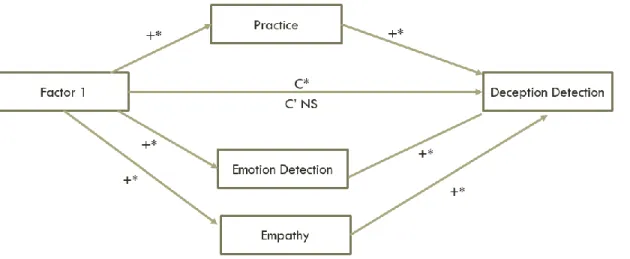
psychopathic traits to avoid encountering rivals, and also enable them to locate potential victims. The predictions specific to deception detection are also premised on the research that suggests: that practice in deception (O’Sullivan & Ekman, 2004; Wright et al., 2012) (which is associated with the pathological deception component of Factor 1)(Hare, 1993), emotion detection (Frank and Ekman, 2004; O’Sullivan & Ekman, 2004; Shaw, Porter, & ten Brinke, 2013) (which is associated with the emotional characteristics of Factor 1 (Book et al., 2007)), and a lack of empathetic response (Baker et al., 2013) (which is a characteristic of the emotional aspects of Factor 1 (Hare, 1993), are all uniquely associated with aspects of Factor 1.
It is hypothesised that Factor 1 (Interpersonal manipulation and Callous affect) will be associated with greater accuracy on the Wason Selection task cheater detection version
(Hypothesis 1). It is hypothesised that Factor 2 (Erratic Lifestyle and Antisocial Behaviour) will moderate the relationship between Factor 1 and scores on the Wason Selection task cheater detection version (Hypothesis 2). The current work proposes that the relationship between Factor 1 traits and scores on the Wason Selection task will be strongest when Factor 2 is low. It is hypothesised that Factor 1 (Interpersonal manipulation and Callous affect) will be associated with greater accuracy on the Wason Selection task altruism detection version (Hypothesis 3); and it is hypothesised that Factor 2 (Erratic Lifestyle and Antisocial Behaviour) will moderate the relationship between Factor 1 and the Wason Selection task altruism detection version
(Hypothesis 4). Similarly, it is hypothesised that Factor 1 will also be associated with higher ratings of perceived deception when watching deceptive videos (Hypothesis 5), and that this relationship will be strongest when Factor 2 is low, such that Factor 2 will moderate the relationship between Factor 1 and ratings of perceived deception when watching deceptive videos (Hypothesis 6). Similarly it is hypothesised that Factor 1 will also be associated with higher ratings of perceived truthfulness when watching truthful videos (Hypothesis 7), and that this relationship will be strongest when Factor 2 is low, such that Factor 2 will moderate the relationship between Factor 1 and ratings of perceived truthfulness when watching truthful videos (Hypothesis 8) . It is hypothesised that Factor 1 will be associated with greater accuracy in detecting psychopathic traits from suspect interrogation videos when rating individuals within those videos on itemsof the Self-Report Psychopathy Scale: Version III (Paulhus, Hemphill, & Hare, 2007)(Hypothesis 9). Finally, it is hypothesised that this relationship will be strongest when Factor 2 is low, such that Factor 2 will moderate the relationship between Factor 1 and ratings of psychopathic traits when watching suspect interrogation videos (Hypothesis 10). A summary of hypotheses can be found in Table 1.
Table 1
Predicted Independent Effects of Psychopathy Factors for Each Dependant Variable Variables Cheating Altruism Deception Truthfulness Psychopathy Factor 1 Positive Positive Positive Positive Positive Factor 2 No Prediction No Prediction No Prediction No Prediction No Prediction Factor 1 x
Factor 2
Significant Significant Significant Significant Significant
Note. Cheating = Wason selection task cheating version, Altruism = Wason selection task
altruism version, Deception = ratings of perceived deception, Truthfulness = ratings of perceived truthfulness, Psychopathy = ratings of perceived psychopathy, N/S = Non significant
22 Method Participants
One hundred and eighty-seven participants were recruited through Amazon’s Mechanical Turk website in exchange for $2.50, or through the social media website known as Facebook. Of the one hundred and seventy-five participants 59.4 were female, with a mean age of 36.02 year (SD = 11.82 years)
Materials
Demographics. A demographics questionnaire was used to ascertain information regarding participants’ age, sex, ethnicity, and educational background (see Appendix F)
Wason Selection Task. Participants completed the Wason Selection task seven times, four different scenarios of the cheater detection version, and three different scenarios of the altruism detection version. The altruism detection tasks was adapted from previous studies (Brown & Moore, 2000; Fiddick & Erlich, 2010; Oda, Hiraishi, &Matsumoto-Oda, 2006) (see Appendix H), the cheater detection tasks were also adopted from previous studies (Cosmides & Tooby, 1992; Oda, Hiraishi, & Matsumoto-Oda, 2006;Fiddick & Erlich, 2010; Carlise & Shafir, 2005) (see Appendix I). Half of the versions of the Wason selection task were standard versions, and half were switched social contract versions. Participants were scores on their ability to select cards that corresponded to cheater and altruism detection mechanisms.
Psychopathy Measure. The Self-Report Psychopathy Scale: Version III (Paulhus, Hemphill, & Hare, in press) was used to assess psychopathy (see Appendix G). This is a well-established measure of sub-clinical psychopathy. The SRP III is a 64-item scale, which measures both factors, and all four facets of psychopathy. This measure was acceptably reliable in its overall measure of psychopathy (α =.93), the subscales for Factor 1 and Factor 2 were also
adequately reliable (α = .91 & .88, respectively) (Paulhus, Hemphill, & Hare, in press).
Responses are on a five point Likert scale 1 = Strongly Disagree 2 = Strongly Agree. Items on the scale include “I have cheated on a school test” and “I have shoplifted”.
Videos. Videos gathered during a previous study run through Forensic Psychology lab at Brock University were implemented. These videos show participants claiming have not to have stolen money from a wallet. Half of these participants were instructed to steal the money, and half of were not. Participants were told that if they were able to convince an interrogator that they were being truthful then they would win a cash prize. This reward is particularly important as studies have shown that in order to lie convincingly there has to be strong motivation to do so (Wright, Berry, & Bird, 2012; Carlucci, Compo, & Zimmerman, 2013; Frank & Svetieva, 2012). Participants were shown 4 truthful videos and 4 deceptive videos. Participants then rated whether they believed the individual in each of these videos was being truthful or deceptive on a ten point Likert scale (1 = very deceptive 10 = very truthful). Participants then rated each of the eight individuals from the video stimuli on 12 items of the SRP III, rephrased to assess how much participants felt the individual within the video fulfilled each specific characteristic or behaviour. This was used as an indication of how psychopathic they would rate each video participant (see Appendix J).
Procedure
Upon selecting to be a part of this study, participants were directed to the website
www.Qualtrics.com, and were instructed to read and accept the terms outlined in a consent form provided to them (see Appendix B).
Participants then completed the demographics questionnaire, seven different scenarios of the Wason selection task (rotating between altruism and deception detection versions), and the
Self-Report Psychopathy Scale: Version III (Paulhus, Hemphill, & Hare, in press). Next the participants watched each of the eight videos one at a time, in random order. After completing a video, the participants responded to the truthful or deceptive question, as well as filling out the 12 rephrased items of the Self-Report Psychopathy Scale: Version III (Paulhus, Hemphill, & Hare, in press).
Following the completion of the questionnaires and video stimuli participants were presented with a debriefing form explaining the purpose of the study in more detail (see Appendix C).
Analytic Strategy
Analysis was begun by ensuring that the data met the assumptions of univariate normality, skewness and kurtosis were also examined via standardizedskewness and kurtosis values. Furthermore, the data was examined to determine that it met multivariate assumptions, and finally the data was examined for multivariate outliers.
Two Poisson Regressions were conducted using Mplus 7.2 (Muthen & Muthen, 2013). The first Poisson Regression was used to test: a1) whether Factor 1 scores were associated with higher scores on the Wason selection task (cheater version); and a2) and to test whether Factor 2 scores moderated the association between Factor 1 scores and scores on the Wason selection task (cheater version). The second Poisson Regression was used to test: b1) whether Factor 1 scores were associated with higher scores on the Wason selection task (altruism version); and b2) and to test whether Factor 2 scores moderated the association between Factor 1 scores and scores on the Wason Selection Task (altruism version). The choice to implement Poison Regressions was made because the outcome variables in each regression were count variables and count variables do not meet the assumption of a normal distribution. As each Wason selection task requires two
specific cards be selected to attain a correct response each task was out of two. As such, there was a possible total score of eight for the cheater version of the Wason selection task (which implemented four scenarios), and possible score of six for the altruism version of the Wason selection task (which implemented three scenarios).
Two simultaneous Ordinary Least Squares Regressions were conducted using Andrew Hayes Process in SPSS version 20 to analyse the first portion of our video data. The first regression was utilized to test: a1) if Factor 1 scores were associated with higher scores of perceived deception in the deception condition and a2) whether Factor 2 scores moderated the association between Factor 1 scores and perceived deception ratings. The second regression was utilized to test: b1) whether Factor 1 scores were associated with higher scores of perceived truthfulness in the truthful condition; and b2) whether Factor 2 scores moderated the association between Factor 1 scores and perceived truthfulness ratings. Participants rated four videos in each the deceptive and truthful condition, the average rating was taken for each condition.
A simultaneous Ordinary Least Squares Regressions was conducted in Andrew Hayes Process in SPSS version 20 to analyse my final hypothesis regarding the assessment of
psychopathy in others as a function of one’s own psychopathy scores. Participants’ ratings of the videotaped individuals on the SRP III, and the SRP III scores of the individuals in the suspect interview videos were standardized. Absolute difference scores were calculated between standard predicted scores on the SRP III, and the actual standard SRP III scores of the
videotaped individuals. The average difference score of the eight videos was calculated. The regression was utilized to test: a) whether Factor 1 scores were associated with smaller difference scores and; b) whether Factor 2 scores moderated the association between Factor 1 scores and difference scores.
26 Results Assumptions and Multivariate Outliers
Examination of the descriptive statistics reveal relatively normal distributions for each of the variables, excluding the Wason selection altruism version which was positively skewed, and Wason selection task cheating version which was platykurtic. Standard skewness and kurtosis scores for each of the remaining variables all fell below 2.25 standard deviations, the highest being the skewness of psychopathy ratings which only reached a standard score of 2.33. It should be noted that the Kolmogorov-Smirnov test was significant for Factor 2, and for psychopathy ratings, however this test is known to be highly conservative. Through examination of their standard skewness and standard kurtosis scores and through the examination of histograms, P-P plots, and Q-Q plots it can be determined that a reasonable level of normality could be assumed for these variables. The normality of each of the remaining variables were also investigated in this manner (through the visual inspection of descriptives, histograms, P-P plots, and Q-Q plots), and all appear to be acceptably normal.
Prior to running the analyses a test of linear correlations was conducted (see Table 3). The relationship between each individual predictor and the criterion variables was plotted. Factor 1 shared a linear relationship with truthfulness, deception, and psychopathy ratings, however, it had non-significant relationships with both Wason selection task versions. Factor 2 shared a linear relationship with psychopathy ratings, but did not share a significant linear relationship with any of the other criterion variables.
Table 2
Descriptive Statistics for all Variables
Variable N M SD Skewness SE Kurtosis SE
Factor 1 187 75.38 17.97 .13 .18 -.18 .35 Factor 2 187 65.76 16.35 .40 .18 -.45 .35 WS Cheating 187 6.71 2.61 -.19 .18 -1.23 .35 WS Altruism 187 4.37 1.67 -.63 .18 -.66 .35 Deception Ratings 173 6.28 1.45 .09 .19 -.31 .37 Truthfulness Ratings 168 6.39 1.60 -.002 .19 -.62 .37 Psychopathy Ratings 145 1.11 .34 .93 .20 .34 .40
Note. WS = Wason selection task. Psychopathy Ratings = the average absolute difference score between predicted and actual SRP III scores.
Next the assumption of linearity was tested further. The independent variable (Factor 1) and the moderator variable (Factor 2) were plotted with the residuals from the truthful, deceptive, and psychopathy regressions, and no relationship was discernable through the examination of the fit line.
Regarding the assumption of specification, it seems that all relevant predictors were included in the model regarding my specific question. The literature on psychopathy frequently employs the use of the SRP III indicating that it is a reliable and valid measure of the construct (Paulhus, Hemphill, & Hare, 2007).
Note that the reliability of each measure was mentioned earlier, and that each measure was measured as being fairly reliable. The reliability of the 12 rephrased SRP III items employed in each of the 8 videos was calculated, and each video’s SRP III, was found to be very reliable,
with alphas ranging from .91 to .94. It can be assumed that the assumption that measures are reliable and without error was reasonably met.
Table 3
Bivariate Correlations between Psychopathy Factors and Cheater Detection Measures
Note. *p < .05, **p < .01.Psychopathy Ratings = the average absolute difference score between predicted and actual SRP III scores.
To test the assumption of homoscedasticity a scatter plot was created, with standardized predicted values on the X axis, and the standardized residuals on the Y axis using the residuals from the truthful, deceptive, and psychopathy regressions. A line of fit was then included, from the examination of these plots it is apparent that no relationship is present, and thus it can be assumed that the assumption of homoscedasticity was met.
To test the assumption that the residuals are independent the plot of the standardised residuals and participant’s identification numbers was examined, there was no relationship present for any of the sets of variables. Furthermore the results of the Durbin-Watson test of independence for the truthful regression was 2.08 which is within the acceptable range of
1.5-Variable 1 2 3 4 5 6 7 1) Factor 1 - .66** .06 -.07 -.19* -.22** -.27** 2) Factor 2 - .05 -.11 -.03 -.14 -.23** 3) Wason Cheating - .64** .03 .08 -.07 4) Wason Altruism - .08 .03 .06 5) Truthfulness Ratings - .49 -.01 6) Deception Ratings - -.27** 7) Psychopathy Ratings -
2.5. The results of the Durbin-Watson test of independence for the deceptive regression was 2.08 which is within the acceptable range of 1.5-2.5. The results of the Durbin-Watson test of independence for the psychopathy regression was 1.97 which is within the acceptable range of 1.5-2.5. From this information it can be assumed that the assumption that residuals are
independent was met.
The assumption of multivariate normality (normality of the residuals) was tested by creating a histogram and Q-Q plots to examine the distribution of the residuals for all sets of variables. The examination of these plots indicates that the residuals are normally distributed. The level of skewness and kurtosis was also examined directly, and the standard score for each fell below plus or minus 3 standard deviations (.45 and -1.24 respectively for the truthful regression, and .21 and -2.22 respectively for the deceptive regression), however, the residuals for the psychopathic regression were slightly skewed (with a standard skewness of 3.95), it’s kurtosis levels were within the exactable range (.53).
To identify multivariate outliers the standardized residuals were examined to identify if any cases were |3| standard deviations from the mean. There were no such cases. Cook’s Distance were examined using a cut off of |1| (Cohen, Cohen, West, & Aiken, 2003), and no such outliers were present for either sets of data. Examining DFFITS according the guidelines put forth by Cohen, Cohen, West, & Aiken (2003), all cases are well under |1|, which indicates that there are no cases that are largely influential.
Assumptions for the Poisson Regression
Unfortunately, the assumption of linear relationships between variables was not met for either regression. Factor 1 scores were not associated with scores on either version of the Wason
selection task, furthermore, Factor 2 scores were not associated with scores on either version of the Wason selection task. So results of the regressions should be interpreted with caution.
To test the assumption that the residuals are independent a plot of the standardised residuals and participant’s identification numbers was examined, there was no relationship present for either of the set of variables.
When implementing the Poisson regressions additive changes were not expected, however, multiplicative changes are to be expected.
Finally testing was conducted to determine if over-dispersion was occurring. A scatter plot was created, with standardized predicted values on the X axis, and the standardized residuals on the Y axis using the residuals from the truthful, deceptive, and psychopathy regressions. A line of fit was included, from the examination of these plots it is apparent that no relationship is present, and thus it can be assumed that the assumption of over-dispersion was met.
Examining Hypotheses 1 and 2
A simultaneous Poisson Regression was conducted using Mplus 7.2 (Muthen & Muthen, 2013) to determine whether Factor 1 scores were associated with higher scores on the Wason selection task (cheater detection version), and also and to test whether Factor 2 scores moderated the association between Factor 1 scores and scores on the Wason selection task (cheater
detection version).
Hypothesis 1 and 2: Analysis
No variable, including the interaction term was a significant predictor of the criterion variable. A summary of the results of the regression can be found in Table 4.
Hypotheses 1 and 2 Conclusions
Results from the simultaneous Poisson Regression failed to provide support for hypotheses 1 and 2. Support was not found indicating that Factor 1 scores were a significant predictor of scores on the Wason Selection task cheater detection version. Furthermore, support was not found indicting that Factor 2 scores moderated the relationship between Factor 1 and scores on the Wason Selection task.
Table 4
Hypotheses 1 and 2, Main Analysis: Summary of Simultaneous Regression Predicting Scores on the Wason Selection task Cheater Version
B SE p
Factor 1 .0001 .0020 .86
Factor 2 .0010 .0010 .33
Factor 1 x Factor 2 .0010 .0001 .30
Examining Hypotheses 3 and 4
A simultaneous Poisson Regression was conducted using Mplus 7.2 (Muthen & Muthen, 2013) to determine whether Factor 1 scores were associated with higher scores on the Wason selection task (altruism detection version), and also and to test whether Factor 2 scores moderated the association between Factor 1 and scores on the Wason selection task (altruism detection version).
Hypothesis 3 and 4: Analysis
No variable, including the interaction term was a significant predictor of the criterion variable. A summary of the results of the regression can be found in Table 5.
Table 5
Hypotheses 3 and 4, Main Analysis: Summary of Simultaneous Regression Predicting Scores on the Wason Selection task Altruism Version
Hypotheses 3 and 4 Conclusions
Results from the simultaneous Poisson Regression failed to provide support for hypotheses 3 and 4. Support was not found indicting that Factor 1 scores were a significant predictor of scores on the Wason selection task altruism detection version. Furthermore, support was not found indicting that Factor 2 scores moderated the relationship between Factor 1 and scores on the Wason selection task altruism detection version.
Examining Hypotheses 5 and 6
A simultaneous Regression in Andrew Hayes Process in SPSS version 20 was conducted to determine whether Factor 1 scores were associated with higher ratings of perceived deception when viewing deceptive videos, and also and to test whether Factor 2 scores moderated the association between Factor 1 scores and perceived deception ratings.
Hypothesis 5 and 6: Analysis
The significance test of the overall model was significant (F(4, 168) = 4.40, p = .002). Only the interaction term was a significant predictor of the criterion variable. The overall model
B SE p
Factor 1 -.0010 .0020 .56
Factor 2 -.0001 .0010 .49
including the two predictors, and the interaction term accounted for 9% of the variance in
perceived deception ratings. A summary of the results of the regression can be found in Table 6. Simple slopes analysis. As the interaction was a significant predictor of ratings of perceived deception, the interaction was plotted to determine the pattern of the interaction. By examining Figure 4 it is apparent that the combination of low Factor 1 scores and low Factor 2 scores is associated with the lowest ratings of perceived deception, and that the combination of high Factor 1 scores, and low Factor 2 scores is associated with the highest ratings of perceived deception (lower scores are indicative of higher ratings of deception).
Table 6
Hypotheses 5 and 6, Main Analysis: Summary of Simultaneous Regression Predicting Ratings of Perceived Deception when Viewing Deceptive Videos
Independent Variable B SE 95% CI p R 2 F df LL UL .0916 4.40 4,168 Factor 1 -.0156 .0100 -.0353 .0041 .12 Factor 2 -.0060 .0113 -.0283 .0163 .60 Factor 1 x Factor 2 .0012 .0004 .0004 .0019 .01
Figure 4. Interaction of Factor 1 and Factor 2 on ratings of perceived deception.
A simple slopes analysis was conducted to determine which slopes were significantly different than zero, a summary of the results can be viewed in Table 7. Results indicated that only the slope of the low Factor 2 line was significantly different from zero. These results provide support for hypothesis 6, such that high Factor 1 scores, low Factor 2 scores does represent the highest ratings of perceived deception.
Hypotheses 5 and 6 Conclusions
Results from the simultaneous regression provided some support for hypotheses 5 and 6. Support was not found indicting that Factor 1 scores were a significant unique predictor of ratings of perceived deception when viewing deceptive videos. Some support was found
indicting that Factor 2 scores moderated the relationship between Factor 1 scores and ratings of perceived deception. Furthermore, results of the simple slopes analysis indicated that the slope of the low Factor 2 line was the only significant slope, and by examining the plot it was apparent that the combination of high Factor 1 and low Factor 2 scores was associated the highest ratings of perceived deception. 5 5.2 5.4 5.6 5.8 6 6.2 6.4 6.6 6.8 7 1 2 3 De ce p tio n Rat in g Factor 1 F2 High F2 Med F2 Low