STUDENT NURSES IN TRANSITION: GENERATING AN
EVIDENCE BASE FOR FINAL PLACEMENT
LEARNING-FACILITATION BEST PRACTICE
Denise Ann MAJOR
Degree of Master of Philosophy
University of Salford, Salford, UK School of Nursing & Midwifery
Table of Contents
List of Figures ………..xv
List of Boxes ………...xvi
List of Tables..………...xvii
Acknowledgements ………xix
Abstract ………....xx
CHAPTER 1. ………1 - 7 INTRODUCTION TO THE TOPIC AND THE THESIS The relevance of the topic ……….1
Professional interest in the topic ………..4
Overview of the Thesis ………..5
CHAPTER 2. .……….8 - 40 LEARNING IN CLINICAL PRACTICE The development of nurse education in the United Kingdom………...8
Education Reform for Nursing ………...13
The impact of staffing and financial issues on student supervision ……….….15
The clinical practice learning and teaching of student nurses ……….….17
Mentors and assessors of practice ………18
Assessment of fitness for practice ……….24
The evolved practice role of the nurse teacher ……….31
The quality of practice placements .………..32
Allocation of practice placements ……….35
Complementing practice-based learning ………..36
CHAPTER 3. ………...41 - 92 STUDENT NURSES LEARNING IN THE FINAL PRACTICE PLACEMENT
The final practice placement experience prior to Registration ………..41
Allocation of the final practice placement ………..44
Assuring the quality of the final clinical placement ………...45
The final placement as transition from student to Registered Nurse ………45
Practice-based learning: from instructional models of apprenticeship to socio-cultural models of creating ‘knowledgeable doers’..………..49
Scales of learning ……….54
Focussed review of the published literature regarding student nurse final placement learning ...………55
Search strategy ……….55
Results of the search ………59
Populations ………..60
Quality review of the published literature ………...60
Samples and sampling methods ..………..61
Participant selection - Quantitative studies ………62
Participant selection - Qualitative studies ………..63
Self-selection ………..63
Purposive sampling ………64
Participant selection - Mixed methods studies ………65
Ethical conduct within the studies ………67
Ethical Approval ………..67
Researching one’s own students .……….67
Anonymity, privacy and confidentiality of data ………...68
Aims and data collection methods of the studies ………..69
Overview ………..69
Aspect 1. Positive and negative experiences of clinical learning and role socialisation in the practice placement ……….71
Aspect 2. Supervision models ………..74
Aspect 3. Specific student to RN preparation programmes . ………...76
Aspect 4. Placement location ………..79
Summary of aims and data collection methods ………...81
Data analysis . ………..81
Overview ……….81
Quality of the data analysis ……….82
Study limitations ………83
Sample size and study location ………84
Study site ………..84
Design faults ………85
Methodological bias ………85
Unreported limitations . ………..86
Potential researcher bias ………87
Quality review summary ………...88
Summary of the literature review ………89
Implications of the research studies and the need for further research ………89
CHAPTER 4. ……….93 - 130 METHODOLOGICAL FRAMEWORK
Research aims ………..93
Research objectives ……….94
Philosophy……….94
Overview of the study design ……….96
The research study in detail ………...98
The study site ………99
The final practice placement sites ……….99
Placement allocation model in the study site ………..100
Placement choice ………….100
Placement learning ………101
Quality audit of placements ………103
Student evaluation of practice placements ……….104
Shortfall in evaluation of the final placement ………105
The study sample ………106
Access and recruitment ………...107
Data Collection ………...107
Phases 1. and 2. Pre- and Post-placement survey ……….107
Design and development of the survey instruments ………..109
Piloting the survey instruments ……….110
The finalised survey instrument ……….111
Surveying learning achievements and learning experiences ..…………112
Phase 3 interviews ………..115
Interview sampling frame ……….………..116
Design and development of interview instruments ……….……118
Piloting the interview………...…118
The finalised interview design..……….………...120
Data Analysis ……….124
Quantitative analysis method ………..125
Qualitative analysis method ………126
Analysing survey data ……….126
Analysing interview data ……….126
Ethical considerations and approval ……….127
Informed consent ……….127
Confidentiality ……….128
Anonymity ………...128
Data protection ………...128
Avoidance of harm ………..129
Use of Personal Professional Development Plans as a focus for the interview ……….129
Conducting the interview conversation ……….129
CHAPTER 5. ………...131 - 186 FINDINGS : FINAL PLACEMENT LEARNING AS TRANSITION
TOWARDS THE REGISTERED NURSE ROLE
Sample……….131
Phase 1 and Phase 2Survey samples and returns ………....131
Phase 3 Interview sample ………..133
Data analysis………...138
Overview ……….138
Findings Theme 1. Learning achievements and fulfilment of personal learning needs during final placement………141
Overview ……….141
1.1. Management and leadership ………..143
1.2. Knowledge and caring skills ………...144
1.3. Fulfilling programme requirements ………...148
1.4. Passing assessments ………148
Summary……….149
Findings Theme 2. Learning experiences and personal qualities for learning during final placement ……...………..149
Overview ……….149
2.1. Importance and usefulness of students’ learning experiences ……….151
2.2. Availability of learning experiences ………...154
2.3. Satisfaction with provision of learning experiences ………..158
2.4. Recommendation of placement and influence of placement specialty ………….161
2.5. Personal qualities for learning in final placement ………170
Findings Theme 3. Final placement allocation satisfaction ………173
Overview ………173
3.1. Equity of placement allocation ………..175
3.2. Choice of placement ………177
3.3. Range of placement choice ……….177
3.4. Issues which would influence a choice of final placement ………...178
3.5. Spoke placements undertaken ………184
Summary ………184
Summary of findings……….185
CHAPTER 6. ………...………...187 - 238 DISCUSSION Objective 1………..188
Learning Achievements and fulfilment of personal learning needs ………188
Learning experiences ……….196
Positive and negative opinions of others ………198
Positive and negative aspects of the learning environment ………199
How staff made a difference for students ………205
Personal qualities for learning ………..206
Summary .………...208
Objective 2. ……….………..209
Objective 3. ………213
Key Aspect 2. ………..216
Key Aspects 3, 4 and 5. ………...217
Objective 4. ……….………...220
Satisfaction with final placement ………..220
Having a choice of final placement ………...220
Placement as transition ………..221
Reflection ………...223
Decision and development points within the research process ………223
Development and decision point 1. ……….224
Development and decision point 2. ……….225
Research method related to questionnaire design ………225
Grouping of items ………...225
Applicability of response options ………226
Use of the Likert scale ……….226
Additional learning needs identified by respondents pre-placement ………..226
Unmatched response options for repeated measures testing ………..227
Post-placement Question 3.3 ………..227
Research method related to interviewing ………..228
Sampling ……….228
Use of Personal Professional Development Plans ……….228
Progressive focussing of the interviews ……….231
Limitations ………..234
Personal learning ………...235
Summary ………238
CHAPTER 7. ………...239 - 248 CONCLUSIONS and RECOMMENDATION Scientific rigour across quantitative and qualitative findings ………..239
Truth value ……….240
Internal validity ………..240
External validity (generalisability)……….240
Reliability ………241
Objectivity and confirmability………241
Confirming the literature………..242
Students’ preference to choose their final placement ………...242
Use of research instruments devised from a range of reputable sources ………242
The complexity of final placement learning ……….243
Specific local practices and transitional learning opportunities………243
Extending the evidence base……….244
Inventories of needs, experiences and personal qualities which guide final placement learning ………..244
The need to develop a final-placement-specific learning-environment evaluation tool ………..245
Recommendation ………...245
APPENDICES ………..249 - 343
Appendix 1. Literature Search Strategy………..249
Appendix 2. Categorisation of literature by aspects of final placement learning ……….251
- Appendix 3. Literature review critical appraisal summary ………..256
Appendix 4. Twenty items for clinical placement evaluation and audit at The University of Salford and its Partner Higher Education Institutions ………...258
Appendix 5. Research study information sheet………...259
Appendix 6. Consent form for students to participate in a student satisfaction survey and to be contacted for interview………261
Appendix 7. Consent form for students invited to participate in individual, focussed interviews………...262
Appendix 8. Pre-placement questionnaire - Pilot version 1. ………263
Appendix 9. Pre-placement questionnaire - Pilot version 2. ……….269
Appendix 10. Pre-placement questionnaire -Final version ...……….275
Appendix 11. Post-placement questionnaire………...281
Appendix 12. Interview schedule……….287
Appendix 14. Example of a Personal Professional Development Plan
pro-forma ……….………..290
Appendix 15. Data analysis strategy Objective 1. ………....291
Objective 2. ………293
Objective 3. ………294
Objective 4. ………296
Appendix 16. University of Salford Research Ethics and Governance Committee Approval………..299
Appendix 17. Matrix of child branch interview sampling ………300
Appendix 18. Thematic analysis matrix……….301
Appendix 19. Perceived importance of learning achievements across all respondents ………...306
Appendix 20. Pre- and post-placement perceptions of importance of learning achievements across t-test matched pairs ………310
Appendix 21. Pre and post-placement perceptions of the importance and usefulness of learning experiences at Q2.2 ………..312
Appendix 22. Frequency by branch of experiences ‘available but not offered’ or ‘not available’ ………..316
Appendix 23. Reasons for satisfaction level with final placement experiences ………...318
Appendix 24. Availability of learning experiences by branch placement specialties Adult Branch………...320
Child Branch………...321
Appendix 25. Recommendation of placement by specialty group ………...323 Appendix 26. Range of choice from which respondents would like
to choose a placement ………...324 Appendix 27. Issues which would impact on a choice of final placement …………325
Appendix 28. Reasons why students undertook spoke placements …………...327
Appendix 29. Prepared for graduate practice questionnaire
(Nash et al. 2005) adapted from Hill et al. (1998) ..………328
Appendix 30. Mapping of Desired final placement learning achievements
to NMC (2007) Essential Skills Clusters ……….329 Appendix 31. University of Salford (2009) Guidance for Student Nurses
visiting clients in the community ...………...331 Appendix 32. Findings for final placement learning experiences
compared to various clinical placement evaluation tools ….……….332 Table 17. Inventory of final-placement-specific
learning experiences from the findings mapped to the
various placement evaluation tools ………..333 Table 18. Sand-Jecklin (2009) SECEE matched to the
final-placement-specific learning needs findings ………336 Table 19. Hosoda (2006) CLEDI matched to the
final-placement-specific learning needs findings……….338 Table 20. Saarikoski et al. (2002) CLES scale matched to the
final-placement-specific learning needs findings……….339 Table 21. Chan (2001) CLEI matched to the
final-placement-specific learning needs findings……….340 Table 22. Dunn & Hansford (1997) CLES matched to the
final-placement-specific learning needs findings……….341 Table 23. University of Salford et al. (2004) clinical placement
evaluation and audit tool matched to the final-placement-specific learning needs findings ………...343
REFERENCES ………344 - 371 List of references………344
List of Figures
Figure 1. Research design ……….…………..98
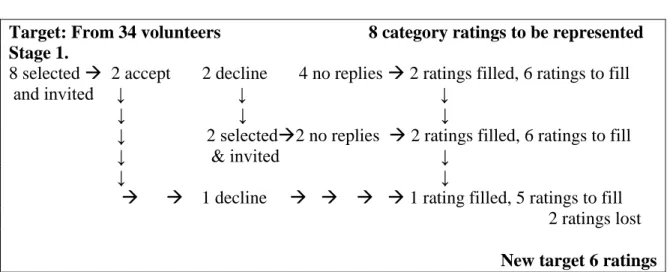
Figure 2. The first stage of interview invitations………135
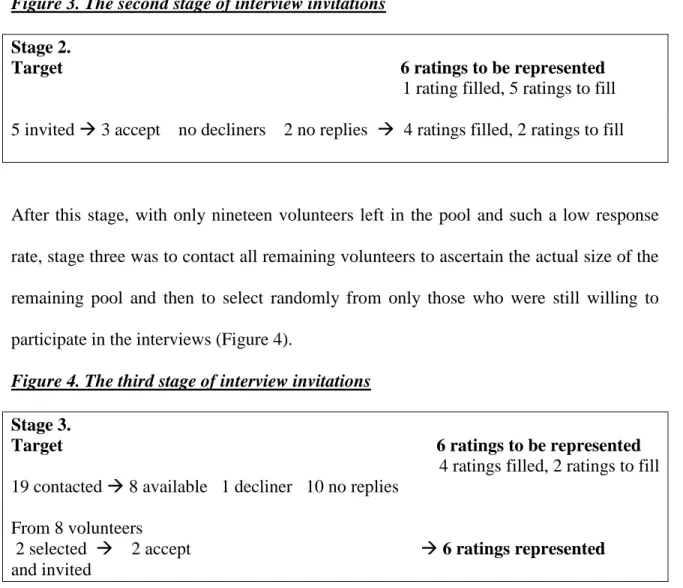
Figure 3. The second stage of interview invitations ………...136
Figure 4. The third stage of interview invitations ………..136
Figure 5. The fourth stage of interview invitations ………137
Figure 6. Data analysis model ………..139
Figure 7. Qualitative themes of final placement learning ……….140
Figure 8. The construction of integrated sub-themes for presentation of data at Theme 1 ……….142
Figure 9. The construction of integrated sub-themes for presentation of data at Theme 2 ……….149
Figure 10. The construction of integrated sub-themes for presentation of data at Theme 3 ………...174
List of Boxes
Box 1. UKCC (1986 & 1987) recommendations for ‘Project 2000’
Pre-registration Nursing Education ………...10
Box 2. ENB (1997) Standard eighteen: Fitness for Purpose, Practice and Award ……….25
Box 3. UKCC (1999) Definitions of Fitness for Practice, Fitness for Purpose, Fitness for Award ……….29
Box 4. Key search terms ……….56
Box 5. Literature inclusion and exclusion criteria ………...57
Box 6. Four aspects of placement experiences apparent in the literature ………….59
Box 7. Summary of sampling methods ………...62
Box 8. Themes for Presentation of Findings ………...140
Box 9. Reasons for wanting a choice of final placement ………178
Box 10. The four ways in which placement specialty ………213
influences final placement learning Box 11. Five key aspects of a successful final placement experience………...214
List of Tables
Table 1. Grey literature investigated for relevance to the research question ……...58
Table 2. Study Progression ………98
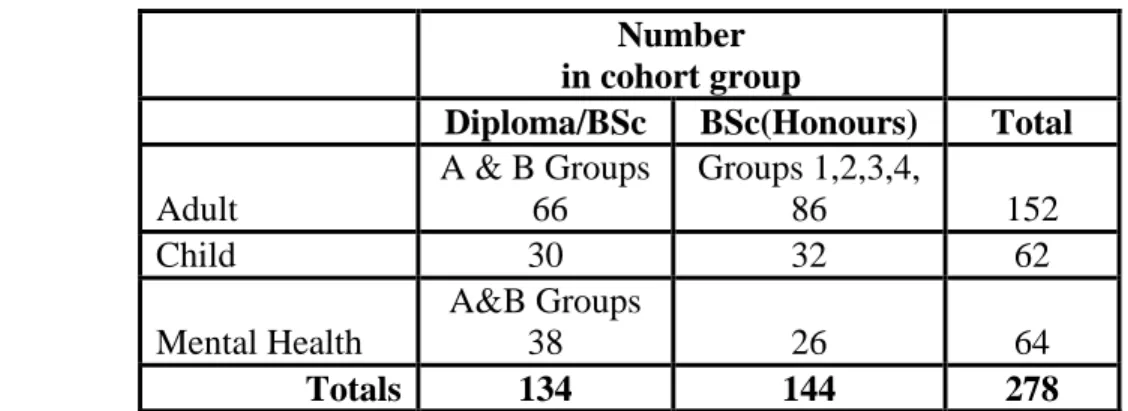
Table 3. Cohort composition ………108
Table 4. Pilot questionnaire returns ………110
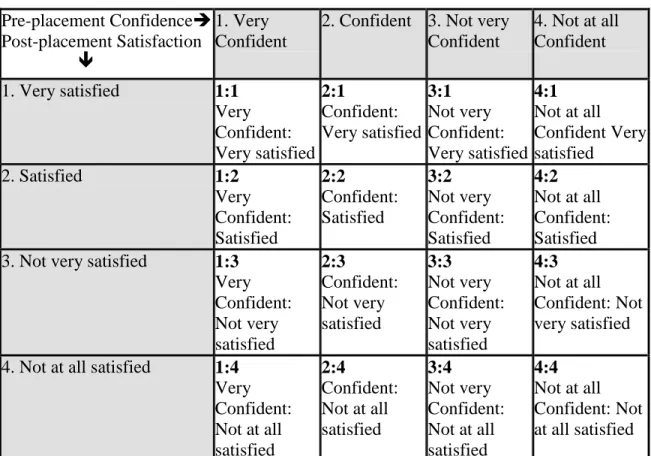
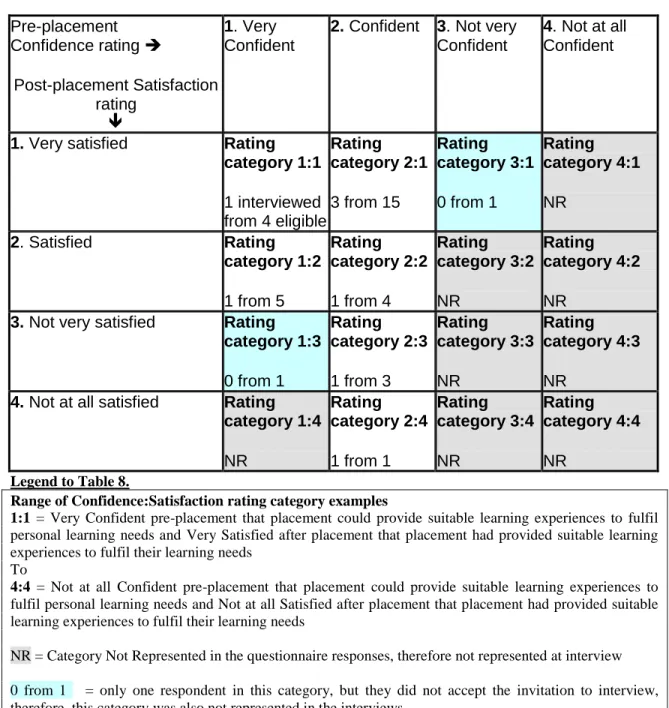
Table 5. Possible Confidence:Satisfaction rating categories to be represented at interview ………...117
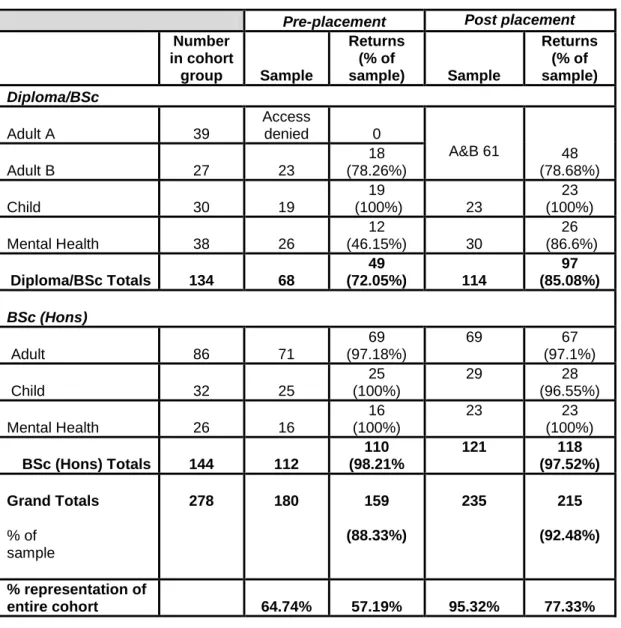
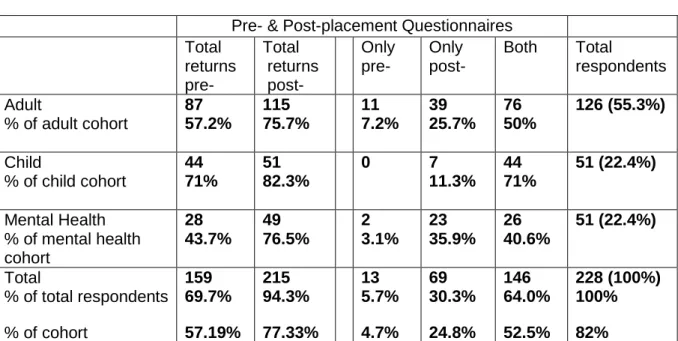
Table 6. Questionnaire sample and returns ………...132
Table 7. Phase 1 and phase 2 returns to provide matched pairs for repeated measures analysis………..133
Table 8. Interview sample ……….………...134
Table 9. Learning achievements statistically less important after final placement ……….145
Table 10. Satisfaction that placement learning experiences met students’ learning needs ………...159
Table 11. Recommendation of placement by branch ..……….161
Table 12. Respondents’ views of equity of allocation……….175
Table 13. Would students like a greater choice of placement? ……….177
Table 14. Learning Achievement Needs Inventory for final-placement-specific learning ………189
Table 15. Learning Experiences Inventory for final-placement-specific learning………..196
Table 16. The Personal Qualities which students identified as helpful in managing their own final placement learning………207
Table 17. Inventory of final-placement-specific learning experiences from the findings mapped to the various placement evaluation tools….……..333
Table 18. Sand-Jecklin (2009) SECEE matched to the final-placement-specific learning needs findings………...336
Table 19. Hosoda (2006) CLEDI matched to the final-placement-specific
learning needs findings………...338 Table 20. Saarikoski et al. (2002) CLES scale matched to the
final-placement-specific learning needs findings………...339 Table 21. Chan (2001) CLEI matched to the final-placement-specific
learning needs findings………...340 Table 22. Dunn & Hansford (1997) CLES matched to the
final-placement-specific learning needs findings………...341 Table 23. University of Salford et al. (2004) clinical placement evaluation
and audit tool matched to the final-placement-specific
ACKNOWLEDGEMENTS
To all who have made this study and thesis possible: Service and academic colleagues, students, friends and family; at home and abroad.
Especially:
The students whose data I have the privilege of representing, who generously shared their time and experiences for the good of others.
The School of Nursing & Midwifery Executive for funding and study time allowances. My research supervisors: Dr Paula Ormandy, Ms Lillian Neville and Dr Tracey Williamson for their guidance, support and intellectual wisdom.
Esteemed colleagues, who have acted as critical readers, particularly Mrs Karen Holland.
Most especially, those who have sustained me throughout, with their patience, kindness and unfailing encouragement: my husband and our children.
STUDENT NURSES IN TRANSITION: GENERATING AN EVIDENCE BASE FOR FINAL PLACEMENT LEARNING-FACILITATION BEST PRACTICE
Denise Ann MAJOR ABSTRACT
The recent review of United Kingdom pre-registration nursing education has prompted local evaluation studies of nursing curricula, in readiness for the introduction of new standards for pre-registration nursing education. This three-phased, mixed methods study, set out to determine whether the final practice placement learning experiences could better meet student nurses’ learning needs in readiness for their first Registered Nurse post. The findings contribute alongside other projects towards an evidence base that supports change.
The origins and learning experience of the final placement are examined amongst several reviews of nursing education since the early 1960s, in the context of the professional Fitness for Practice and Fitness for Purpose debate. Evidence suggests that final placement learning needs to develop independence and ensure the student feels valued and supported to build confidence. Students are more willing to take up a first post in a placement which has provided support.
An exploratory, interpretive design, targeting an entire cohort of 278 students, triangulated pre- and post-placement survey data with data from eight in-depth individual interviews. The research investigated the students’ final placement learning experiences to ascertain their perceived needs, actual and desired experiences, and preferences for final placement allocation. Findings demonstrated a strong perception of the final placement as a role development transition. Students’ perceived needs reflected the NMC (2007) Essential Skills Clusters, as well as specialty-specific Fitness for Purpose learning needs. Learning experiences reflected the extant literature and included facilitative, gate-keeping and restrictive practices, against which students balanced their own agency for learning, recommending improved mentoring practices.
A four part model, of final placement learning-facilitation best-practice, recommends development of the learning environments in balance with the personal learning needs and qualities of the transition student and a changed final placement allocations system.
CHAPTER 1
INTRODUCTION TO THE TOPIC AND THE THESIS
This study contributes to the professional literature regarding the purpose and effectiveness of the final practice placement for pre-registration nursing students. The study establishes a current evidence base for final placement learning-facilitation best practice from the students’ perspective, within a large School of Nursing & Midwifery in the United Kingdom (UK).
The relevance of the topic
Within the national review and imminent new Standards for pre-registration nursing education, the nursing profession is moving towards a changed curriculum with great emphasis on enhancing the student experience, whilst achieving professional body requirements (Nursing & Midwifery Council (NMC) 2010a).
In revising the curriculum, the importance of using multiple data sources has been recognised (Sperhac & Goodwin 2003). Therefore, in addition to the professional body guidelines and standards, a project-led internal review of many aspects of the current pre-registration nursing curricula is underway, to which this study has a timely contribution. The study is rooted in the clinical link partnerships which exist between the University and its partner National Health Service Trusts for the provision of pre-registration nursing education. Supporting student learning through purposeful partnerships is a key perspective of the ‘Making a Difference’ pre-registration curricula in the UK (Department of Health (DH) 1999a; United Kingdom Central Council for Nursing & Midwifery (UKCC) 1999; DH National Health Service (NHS) Executive 1999).
Partnership activities within the University and its partner Trusts have grown through many lecturer and practitioner exchanges, particularly the joint delivery of pre-registration teaching and learning initiatives. Also, mentor education and update activities have promoted a tri-partite arrangement for student learning and support in the placement areas (NMC 2004a). Within the placement where the topic originated, the link partnership is well established between the researcher as the University Link Lecturer and the practice staff. This partnership is demonstrated by the staff feeling able to discuss their concerns about the final placement experience. Clinical staff raised the issue of being uncertain as to whether the specialist nature of the placement was providing the right kind of learning experiences to prepare final placement child branch students for their first Registered Nurse (RN) post. Concerns suggested that the majority of students who passed through the specialty as a final placement would not enter the confines of the placement’s specialty as their first post. Hence, staff felt that students needed to be prepared to function in a wider ranging children’s nursing arena. This led to the need to know exactly what the students’ learning needs are in final placement and whether where they are placed for their final placement makes a difference to their preparations for their first RN post. At the University, there is currently little student choice in allocation to final placement. The current final placement allocation model is based on students returning to a “‘Home’ Trust” for final placement, introduced in the Making Difference curricula to provide “stronger links between the end of … nursing education and first employment in the NHS” (DH NHS Executive 1999: Appendix 2; 19). Fifteen hundred to two thousand students, across all cohorts, share the placements at any one time, based on availability and best fit for the NMC placement experience requirements (NMC 2004b).
Approximately 200-300 (60 to 100 child branch) are final placement students, having some choice between hospital and community, but not the specific specialty or ward/unit. Students in final placement are required to achieve the twenty seven proficiency outcomes across four domains of nursing practice, in order to be assessed as ‘Fit for Practice’ for entry to the professional Register, as well as providing evidence of being ‘Fit for Purpose’ to function in the reality of the current nursing practicum (ENB 1997; UKCC 1999; NMC 20004a). Whilst the achievement of Fitness for Practice and Fitness for Purpose are both features of the NMC 2004 Standards of proficiency for pre-registration nursing education, Fitness for Purpose at the point of Registration, by being able to function competently in clinical practice, has been questioned as to its possibility within an ever changing health care system (UKCC 1999). However, the NMC 2004 Standards of proficiency for pre-registration nursing education apply to the curriculum for the students within the cohort being considered and ‘Fitness for Purpose’ within that curriculum seems to be a fundamental part of the debate which the specialist placement practitioners began.
Staff in the specialist area particularly questioned the appropriateness of the specialist practice area in being able to provide adequate management experience due to the complexity and dependency level of the patients. The importance of integrating organisation and management experience into pre-registration nursing education was recognised in the Briggs report (HMSO 1972). This influential report prompted inclusion of organisation and management of care into the required proficiencies for entry to the professional Register (NMC 2004a). Newly Registered nurses should be able to function adequately and confidently at the point of registration, rather than be “Fumbling along”
amidst their mastery of basic skills without having had sufficient rehearsal of higher order thinking and organisation (Gerrish 1990:35; Gerrish 2000). From the original practitioner concern, attention began to focus on whether it was the placement type or the learning experiences per se which were important as final placement preparation for first post. Whether the students’ fitness for practice or fitness for purpose is in question begs consideration of whether the students either cannot learn management skills per se and are thus not fit for practice, or whether what the students do learn in this specialist placement is not transferrable to other contexts and thus reduces their fitness for purpose in their first RN post. Three perspectives were also emerging: that of the students, the mentors/supervisors and the placement allocations personnel. The enquiry developed to focus on one of these perspectives which was manageable as an individual study project, but have implications for all - that of the students.
Professional interest in the topic
As the link lecturer to the placement concerned, professional interest to research this area stems from the need to support the staff in development of the placement in order that the mentors and students enjoy the final placement learning experience for its match to the students’ learning needs. An essential part of any Higher Education programme is to review and evaluate the effectiveness of its provision, especially from a student perspective of their satisfaction with the experience. Within nursing education, review is also essential to maintain validity of programme content for its contribution to the professional body agenda of “Safeguarding the health and well being of the public” (NMC 2008a: Inside cover) through the upholding of professional standards, by ensuring
that students can meet the required proficiencies for Registration through undertaking appropriate learning experiences.
Professional interest is also related to the researcher’s role as an admissions tutor to the pre-registration programmes. The maintenance of high quality student placement experiences is an important part of ongoing programme development, due to the scrutiny of placements by potential applicants through the National Student Survey (The Higher Education Academy 2010). The external reputation of programmes affects their ability to attract high calibre applicants. Hence, an enhancement of student learning can serve to improve not only the internal satisfaction, but also create greater professional body and public confidence in the programmes’ abilities to prepare nurses who are fit for Registration. This enhancement of student learning will, in turn, attract recruits to fulfil the commission from the Strategic Health Authority, adding to the government agenda of educating high quality nurses for the profession (DH 1999a; DH 1999b).
Overview of the Thesis
The thesis aims to explore whether the final placement learning experience could better meet the needs of the student nurses as they prepare for their first Registered Nurse post, since this can inform the evolving nursing education curriculum, especially on the eve of implementation of new Standards for pre-registration nursing education (NMC 2010a). With a view to informing final placement learning–facilitation best practice, three facets form the focus of the investigations:
Definition of students’ final placement learning needs Expected and actual learning-facilitation experiences Allocation of students to their final placement
Investigation of student needs begins in chapter two, which presents the development of nursing education that has culminated in the current Diploma/BSc and BSc (Hons) programmes, and their required proficiencies. As preparation for professional Registration, there is exploration of issues arising from the notions of Fitness for Practice and Fitness for Purpose. Common features of instructional and socio-cultural models of learning accompanying the change from the apprenticeship style of training to the student-status educational models of today are included. Continuing to examine learning provision, chapter three provides a focussed review of published studies of student nurse perceptions of final placement learning facilitation. From this review, sparse UK literature exists against which to compare and model local curriculum development. However, best-practice research methodology emerged and research objectives were formulated, to focus a research strategy which follows in chapter four.
The research strategy argues the value of a plurality of methodology to enable the use of mixed data collection and analysis methods for obtaining descriptive, inferential and thematic data. The data are used to interpret and understand the students’ learning experiences across the whole range of final placements, focussing down on selected child branch experiences for contextual interpretation.
Research findings across the quantitative and qualitative data are combined in chapter five and discussed in chapter six against the contemporary literature regarding final placement learning, to present three main themes, which contribute to professional role development and address the four study objectives.
Researcher reflexivity, reflections on the study method and limitations of the study are presented. Conclusions in chapter seven draw together the findings, which create the
thesis upon which the recommended local model of final placement facilitation best-practice is justified.
CHAPTER 2
LEARNING IN CLINICAL PRACTICE
This chapter explores the development of nurse education in the UK in relation to the clinical practice learning of student nurses, particularly the rationale for and the importance placed upon the final practice placement experience prior to qualifying for entry to the professional Register of the Nursing and Midwifery Council (NMC).
The time frame for this exploration extends from the 1960’s to the present day, with particular emphasis on the major shift of nursing education into the Higher Education sector from the 1990’s.
The development and reform of nursing education is a multi-faceted complexity of several intertwined aspects, which, for ease of reading, are separately presented with their relevant chronological developments.
The development of nurse education in the United Kingdom
Certificate level training courses predominated for nursing in the 1960’s, where student nurses typically spent approximately 83% of their training in practice-based service (Weatherston 1981). Alongside this, a small number of Undergraduate programmes were introduced, which provided a more academic focus, for students who were external to the workforce. At the University of Edinburgh, Bachelors, Honours and Masters degrees of five and six years were introduced and the University of Manchester Bachelor of Nursing programme evolved after evaluation of its successful ‘Diploma in community nursing’ experimental curriculum proposed that nursing was viable as a degree subject (Royal College of Nursing & National Council of Nurses of the UK (RCN & NCN 1964). Other
experimental training schemes also emerged at the time, aiming to improve the preparation of nurses for Registered practice. Included were the ‘2+1’ schemes in Glasgow and London which prepared nurses for the State Final examination after two years rather than three years and provided an entire ‘intern’ year for practice preparation for the Registered Nurse role (RCN & NCN 1964; Pomeranz 1973). Graduate entry to a reduced length programme at St. Thomas’s School of Nursing provided for Registration after twenty six months with the school certificate of completion being presented after six months post-registration experience (RCN & NCN 1964). These curricula were to inform a radical reform of nursing education. Being previously situated in Schools of Nursing within National Health Service (NHS) hospitals, nurse education links with the Higher Education sector grew through the development of Diploma level programmes from the late 1980s. As a result of predicted manpower shortages between 1985 and 1992, based on the demography of available 18-year old entrants to the service, a radical reform of nursing education was taking place. Taking forward proposals made in 1972 from the Report of the Committee on Nursing (Briggs report), a consultation with the professions culminated in the proposals of ‘Project 2000’ which moved nurse training from the apprenticeship model to a higher education (HMSO 1972; English National Board for Nursing, Midwifery and Health Visiting (ENB) 1985; Royal College of Nursing (RCN) 1985; United Kingdom Central Council for Nursing, Midwifery & Health Visiting (UKCC) 1986). The move away from the traditional apprenticeship model of nurse training began with the following main recommendations within ‘Project 2000: A new preparation for Practice’ (UKCC 1986), which would completely change the students’
relationship with practice, exchanging their service-based practice for 80% supernumerary student status (UKCC 1987) (Box1).
Box 1. The UKCC recommendations for ‘Project 2000’ Pre-registration Nursing Education (UKCC 1986; UKCC 1987)
1. A new programme of education for a single level of Registered Nurse, to replace the existing Registered Nurse and Enrolled nurse preparation, such that the new Registered nurse would provide direct care
2. A 3-year training programme with up to two years as a Common Foundation Programme and a ‘Branch’ programme leading to registration in either care of the adult, child, mentally ill, or mentally handicapped persons
3. New competency-based outcomes set out in Training Rules
4. The new preparation would provide competence in assessing, providing, monitoring and evaluating care in institutional and non-institutional settings, emphasising health promotion as well as health care
5. Programmes to have clear educational credibility at an advanced level of educational qualification
6. Supernumerary status for student nurses for 80% of their time with a 20% contribution to service
7. A non-means-tested training grant rather than being paid employees, from an education budget separate from the service pay budget
Changes regarding the organisation of nursing, particularly as regards student status, had been recommended within the Platt report (RCN & NCN 1964), but largely not acted upon due to political pressures from within the nursing profession (Bentley 1996). The Report of the (Briggs) Committee on Nursing (HMSO 1972) took forward the Platt recommendations, making proposals for major policy changes which would support the changes in delivery of nursing care and the education of nurses. The statutory framework
of the United Kingdom Central Council for Nursing and Midwifery (UKCC) and its subsequent four national boards were created as a result of the influence of the Briggs report on the Nurses, Midwives and Health Visitors’ Act (HMSO 1979). The structure of the UKCC provided the ‘machinery’ to support and drive the changes in pre-registration education, supported by the amended nursing and midwifery training rules to prescribe the course structure (Statutory Instrument 1989). An examination of the post-registration education provision in light of changing health care requirements of the UK population was also begun, as a part of the nursing education and practice reforms. Project 2000 education programmes brought fulfilment of the recommendation of the Briggs report (HMSO 1972) for closer links between nurse education and the Higher Education sector, with the amalgamation of small hospital-based schools of nursing into colleges affiliated to, and eventually merged into, Higher Education Institutions (HEIs) by 1996. Collaboration between the National Health Service and the Higher Education sector was required in order to provide the high quality learning experiences needed to raise educational standards and expand lifelong learning opportunities for nursing staff (Department of Health NHS Executive and Committee of Vice Chancellors and Principals (CVCP) 1999). The role of placement allocations officers also grew, commensurate with the work required in securing quality practice placements for the high numbers of students to be recruited to the programmes, to secure the future Registered nursing workforce (Jacka & Lewin 1987; National Audit Office (NAO) 1992). Raising the academic profile of student nurses to a minimum of Diploma level (Framework for Higher Education Qualifications intermediate level, level 5) (Quality Assurance Agency for Higher Education 2008), was a strategy to attract high calibre recruits from the
diminishing pool of school leavers. The Royal College of Nursing Education Commission noted that in 1983 as many as 90% of the nurse entrants had gained or exceeded 5 ‘O’ levels or 5 ‘O’ and 2 ‘A’ levels, and espoused that if nursing education was not made more attractive, potential applicants would otherwise use their General Certificate of Education (GCE) ‘Ordinary’ and ‘Advanced’ level qualifications as entry to other educational programmes which carried recognisable academic awards (RCN 1985). Thus it was important to improve learning conditions, with freedom to learn away from the restrictions of service, in order to continue to attract and retain applicants. Improvements proposed were for student nurses to be a part of the Higher Education student body, to learn in the wider academic and social community, rather than within the confines of a nursing education system which provided no academic status or recognition beyond the profession (HMSO 1972).
Improving the academic quality of the nursing programme, and its entrants, ultimately aimed to improve retention and attrition for the nursing workforce, which was losing 15-20% of its students during the life of each programme, as well as up to 30% failing the final examination; whilst University educated nurse attrition from undergraduate degree courses was lower (RCN 1985; Chapman 1985). The Committee on Nursing (HMSO 1972) had noted particular interest in the experimental training schemes which were linking theory and practice more constructively, as well as noting emergence of the undergraduate programmes preparing nurses through a higher level of education to be able to deliver and co-ordinate care. Informed critical thought was seen as a central focus to becoming the reflective and flexible practitioners required for the changing health care system.
Education Reform for Nursing
The Project 2000 reform principles were to be applied to the existing undergraduate programmes as well as to the new Diploma level programmes. A new preparation for practice was to integrate all student nurses into higher education and provide supernumerary, supervised practice to prepare them for a single level of Registration rather than perpetuating the State Enrolment and State Registration in general nursing, with post-registration specialisation. The direct entry ophthalmic, orthopaedic, thoracic and fever nursing certificates were to cease (HMSO 1972).The new staffing skill mix was to comprise Registered Nurses and their aides (support workers) with students as learners external to the paid and rostered workforce. Programmes would prepare students for registration in one of four branches of nursing at pre-registration level through a common foundation programme and a branch programme in adult, child, mental health or learning disabilities nursing. A proposed training bursary rather than the usual student grants system was to be implemented as students of nursing would not have the opportunity for employment during vacations due to the need for extended college time to undertake practice placements (RCN 1985).
Eventually balancing the cost of implementing the Project 2000 reforms with the benefits of staff retention and ultimately better quality patient care and lower costs to the NHS, the aim of the Project 2000 reforms was to prepare nurses who were “knowledgeable doers” (UKCC 1987: p5). The initial proposals of Project 2000 (UKCC 1986) advocated supernumerary status for student nurses throughout the entire clinical component of their learning, defined at that time as their removal from the duty rota (roster) and from the clinical work obligation as follows:
“Names of students should no longer be included on duty rotas, their presence should not be part of the calculation of the number of staff required to carry out the work” (UKCC 1986 p: 54) However, the final proposals for project 2000 nursing programmes determined that because of the high clinical content of the programme, students would inevitably be making a contribution to service, most likely towards the end of the programme, such that the retention of a 20% contribution as a period of rostered practice was stipulated (UKCC 1987). There was also a cost-saving implication of retaining a period of service contribution (Price Waterhouse 1987), such that the 20% service was seen by many as a cost compromise between professional aspirations and workforce requirements (Elkan & Robinson 1995; Bentley 1996; Le Var 1997a). However, despite recognition of the value of rostered service to students and to the health service as “easing the transition from student to employee” (Elkan & Robinson 1995: p388), a counter-argument for removing rostered practice was that “rostering limits the potential range of practice placement opportunities that can be accessed” (DH NHS Executive 1998: p4) and thus, rostered practice was phased out, such that all students beginning programmes from September 1999 did not provide a rostered service contribution. Instead, students undertook longer practice placements in order to benefit from increased patient contact, still providing a valuable contribution to service, but in a way which was beneficial to their own learning. The re-definition of supernumerary status was issued within the 2004 Standards of proficiency for pre-registration nursing education (NMC 2004a: p19) as:
“Supernumerary status means thatthe student shall not as part of their programme of preparation be employed by any person or body under a contract of service to provide nursing care”
The impact of staffing and financial issues on student supervision
The skill mix of staff available to supervise student nurses in clinical placements was under scrutiny from the outset of Project 2000. The increased numbers of students, low qualified staffing levels and poor preparation of the Registered Nurses to supervise students, seriously limited the quality of the learning environment, reducing the number of available placements where students could be adequately supervised (NAO 1992; Elkan & Robinson 1995). The increased need for community health care experiences required creative increases in capacity, with some placements in local businesses requiring revision of the purpose of the students’ placements when students had been mistaken as staff of the establishment and assigned inappropriate duties such as stacking shelves (NAO 1992).
A three-pronged approach to increasing the nursing establishment, not only to supervise, but also to provide care without students in the rostered numbers, included conversion of Enrolled Nurses to Registered Nurse status, recruitment of Registered Nurse returners to nursing and the employment of a new kind of nursing aide – the clinical support worker or Health Care Assistant (HCA), with a career structure to also permit advancement towards registration (UKCC 1986; NAO 1992; RCN 1992). Whilst the role of the HCA was given more importance than merely replacing the student nurses in order to support and complement the Registered Nurse role, a review of the nursing grading and pay structure was to increase their numbers beyond the initial proposals (NAO 1992). As well as under-recruitment of nurse returners, the employment of more expensive trained staff gave way in some areas to the employment of cheaper Health Care Assistants, viewed as a “budget necessity”, as monies were initially provided to replace only 50% of the student
workforce (NAO 1992; Roberts 1994: p20; Lord 2002). Whilst the removal of students through supernumerary status initially caused disruption to the staffing, their replacement by permanent members of staff brought more consistency to the ward team, no longer experiencing the change of a large part of the nursing workforce each time the students changed placement; but Project 2000 student nurses were initially more dependent than their apprenticeship counterparts, creating new demands for the Registered Nurses. The delayed entry of students into practice, of up to six months, due to the change in emphasis from a skills-based education to a more theoretical programme, resulted in large cohorts of Project 2000 student nurses entering their first practice placement with relatively fewer clinical skills (Gray 1997; Nichol & Freeth 1998; UKCC 1999). Needing supervision from a less than full complement of trained staff who were themselves often the least qualified to teach and assess, required that several students were supervised at a time, creating difficulties for students and staff (Clifford 1994; Nichol and Freeth 1998; UKCC 1999). The need for increased supervision was further compromised due to a changing dependency level of hospital patients and changes in service delivery which resulted in less Registered Nurse time for mentoring and supervising students. Staff availability was further compromised by financial initiatives to reduce the staffing budget such as the removal of the shift overlap in the middle of the day (While 1991). This initiative removed expensive duplication of staffing, but the time was then no longer available for mentors to teach whilst others cared for patients. These measures increased the already stretched resources of the Registered Nurses’ workload in two directions - towards the more dependent patients and the more dependent students, with less time for both (While 1991; UKCC 1999). Divorcing the education budget from the service budget displaced
the cost of education and its associated bursaries away from service spending, however, the pre-registration education budget could not be used to offset the low numbers of Registered Nurses employed within the service budget (Burke 1995).
Department of Health ‘Working Paper 10’ provided education and training monies for the post-registration continuing education of the qualified staff. However, it took several years to implement a programme to support Registered Nurses in their teaching and assessing function and continuing professional development, whilst the pre-registration implementation was begun less than three years from the Project 2000 final proposals (DH NHS Management Executive 1989; Le Var 1997a; Le Var 1997b).
The clinical practice learning and teaching of student nurses
It was the concept of the ‘knowledgeable doer’ which drove the major educational changes for teaching and supervision within the Project 2000 programmes. The new Registered Nurse was to be able to ‘do’ as well as to manage, whereas previously, it had been noted that nursing care had been lost between the role of the assisting Enrolled Nurse and the managing Registered Nurse (Pembrey 1980). Nursing education was charged with the responsibility to provide research-based care, the opportunity to learn health promotion as well as care of the sick and to provide community care experience as well as hospital based experiences, with an emphasis on critical thinking, problem solving and clinical skills (Slevin 1992). Although the Project 2000 proposals had stated the need for practice teaching not to be left entirely to the service staff practitioners (UKCC 1986), the contribution to practice by education staff had already been eroded with the introduction of assessors courses for sisters to undertake the ward-based assessments prior to project 2000. Development of Clinical Teacher roles in the early
1970s had assisted students in their practice learning and assessment. However, Weatherston (1981) reported the antagonism of the role by belonging neither to the practice area nor to the lecturing staff, yet performing a dual role between the two without authority in either place and in insufficient numbers to provide a service to all students. The nurse teacher’s role as directly involved in practice teaching and assessments was also further eroded as the use of continuous practice assessment became the responsibility of those Registered Nurses in regular contact with the students. Nurse teachers’ needs to prepare for the new education programmes and attend to their own academic up-skilling to teach at higher levels became their central focus (Clifford 1994; Day et al. 1998).
The building of practitioner responsibilities for teaching grew through the development of mentorship. The Project 2000 reforms required Registered Nurses in practice to assume the function of mentor as well as practice teacher and assessor, often as an imposition rather than as a prepared role (Le Var 1997b; Andrews & Chilton 2000; Neary 2000). Mentors and assessors of practice
To accompany the Project 2000 curriculum changes, several supporting standards followed, relating to the continuing practice education of nurses, their emerging role as mentors and the quality of the clinical placement and its facilitators (UKCC 1990; ENB 1991; UKCC 1994; ENB & DH 2001; NMC 2004b; NMC 2006; QAA 2007; NMC 2008a).
Mentor preparation developed from recognition that those to whom the education and assessment of student nurses had fallen, were indeed unprepared themselves, often being the most recently Registered Nurses (Clifford 1994; Coates & Gormley 1997; Neary 2000; Landmark et al. 2003).
The existing ENB Teaching and Assessing in Clinical Practice programmes continued to be used until the introduction of new standards for the preparation of mentors and teachers were introduced (UKCC 1997). Mentor and teacher preparation escalated after the Peach Education Commission report (UKCC 1999) and an updated definition of the role of mentor followed:
“The term ‘mentor’ is used to denote the role of the nurse, midwife or health visitor who facilitates learning and supervises and assesses students in the practice setting. Different professional groups use differing terminology. The term ‘assessor’ is often used to denote a role similar to that of the mentor as identified in this publication” (ENB & DH 2001: p6). Working closely together at strategic and operational levels, practice and educational leaders increased the teaching and assessing capacity amongst the Registered Nurses (Scholes et al. 2004) and mentor standards were revised in 2006 and 2008 (NMC 2006; NMC 2008a). However, a variety of programmes for mentor preparation still exists in England, whilst Scotland has implemented a national mentor preparation, core curriculum framework, across all of its HEI and NHS partners, to strengthen consistency of support to students and transferability of mentoring between institutions (National Health Service Education for Scotland (NES) 2007). Wales has standardised nine areas of the nursing curriculum to be delivered through its Higher Education Institutions, including mentor preparation (National Assembly for Wales (NAfW) 2002a; NAfW 2002b; Hughes 2004; Fothergill et al. undated).
In the UK practice setting, students are individually assigned to a mentor, who oversees the student’s practice placement experiences and works with the student for at least 40% of their clinical time to achieve their required learning outcomes (NMC 2004a). Several models of practice supervision and support exist, requiring clarification between the
terminology and roles of mentor and preceptor, as terminology is often inappropriately used interchangeably without exploration of the differences (Phillips 1994; Wilson-Barnet et al. 1995; Andrews and Wallis 1999; Yong et al. 2007; Gleeson 2008). A definition of mentorship which most closely represents its origins relates to an enduring long-term relationship of the student with a guardian of the student’s best interests, providing guidance for aspiring personal and professional growth (Zwolski 1982; Armitage & Burnard 1991). In contrast, within the UK system, mentorship is a relatively short-term relationship as students change their mentor with each clinical placement in order to capitalise on the specific clinical expertise of their guide. The term ‘preceptorship’ originally designated a short term, specific 1:1 relationship of individualised teaching support and assessment of competence towards a specific purpose (Yong et al. 2007). Preceptorship has been interpreted in UK nursing as a relationship between an expert nurse and novice Registered Nurse during the first few months of Registered practice to ease transition into the Registered Nurse role (UKCC 1993; Neary 2000), the latest definition being:
“A period of transition for the newly registered nurse during which time he or she will be supported by a preceptor, to develop their confidence as an autonomous professional, refine skills, values and behaviours and to continue on their journey of life-long learning” (DH 2009: p 11). Because of the transitory nature of the relationship which pre-registration students have with mentors, due to their frequent change of placements, and the fact that mentors now also undertake an assessor function towards a specific purpose, the current UK system of pre-registration supervision and coaching appears to be a hybrid between the coaching of mentoring and the supervision and assessment of preceptoring. One disadvantage of this system is the removal of an element of impartiality which existed in the Registered
Nurse-student relationship when a student had separate supervisors and assessors; she could be guided by her supervisors as she practised her practice, without fear of jeopardising her practice assessment outcome. It can be argued that with the regular change of placements, the large numbers of students to mentors and the 40% stipulated supervision time for mentor activities, the mentor function in the UK may be creating only shallow learning. This is in contrast to creating the deep learning which occurs in enduring relationships through making connections with and building on previous learning. Turning declarative knowledge into functional knowledge through the process of coaching, probing and confirming enhances creation of the “knowledgeable doer”, envisaged as a product of Project 2000 education (UKCC 1986: p40; Biggs 2003). Despite the aims of the competency-based education to ensure that students develop higher order intellectual skills (UKCC 1999), concerns have been expressed about mentor abilities to demonstrate incorporation of higher order thinking into their patient care, resulting in poor ability to ask higher order questions and apply the science of nursing in their clinical practice with students (Scholes et al. 2004; Beckman & Lee 2009).
Contrasting views regarding the role satisfaction of mentors include fostering independence and passing on skills of good practice to prepare future professionals and enhance recruitment, countered by difficulties with workload balance and patient dependency causing lack of time with students, not being supported to support failing students and not being supported to fail students (Darling 1984; Duffy 2003).
Students describe good mentors as
“...enthusiastic, friendly, approachable, patient and understanding and having a sense of humour” (Gray & Smith 2000: p1546).
Being a good mentor is about having
“Good understanding of what is expected of you at the stage you are at”
(Lauder et al. 2008: p140).
Student difficulties with mentors are reported as prevention of learning through blocking behaviours, gate-keeping and lack of agency (Darling 1986; Gray 1997; Brammer 2006). Toxic mentors are seen as those who disable, take learner’s credit, are self-interested, exert power and excessive control, condition cloning, practice elitism and mutual exclusion; restricting learning from other experiences (Darling 1986). Poor mentors may intimidate students and delegate unwanted jobs, such that students become to resent working with these mentors and deliberately engineer situations so as not to work with them (Gray & Smith 2000). Lack of interest in teaching and helping the student, as well as a lack of up-to-date knowledge were further descriptions of a poor mentor (Lauder et al. 2008). Furthermore, the questioning, thinking nurse may be stifled to challenge practice or the behaviours of poor mentors for fear of reprisal which poses a risk to her belongingness and ultimately to her practice assessment (Phillips et al. 1994; Gray 1997). Within a mentorship model of practice learning, the freedom to learn as supernumerary allows the exploration of personal learning experiences under the guidance of the mentor, but not working together all of the time, working with and under the supervision of other members of staff. The value of individual mentors’ personal teaching attributes and the quality of the ward learning environment, rather than just the freedom to learn which supernumerary status brings, are recognised as the crux of good learning facilitation (Lauder et al. 2008; Callaghan et al. 2009).
Several models of team mentorship exist, from a whole practice area team supervision to smaller groups within the practice area team taking groups of students, used to ensure that
when the assigned mentor is unavailable, or the student chooses a learning experience specific to another team member’s practice, there is continuation of supervision (Caldwell et al. 2008; NMC 2008a). Responsibility for the student’s learning is shared, jointly reported and recorded by the team of RNs and compares well to the Clinical Learning Unit model described in the United States of America (USA) (Callaghan et al. 2009).The exception of the USA system is the inclusion of Faculty members as student assessors within the nursing team; a role which would have neatly addressed the recommendations of Neary (2000) and Hallin & Danielson (2009) for an assessor independent of the clinical mentor’s role and would have strengthened the bond between education and practice. Stronger connections between the theory and practice components across the duration of the programme, to strengthen and deepen students’ learning in practice, have been suggested in the role of the “Clinical Guide” (Andrews & Roberts 2003: p 474), who can make meaningful connections between the problem-solving activities of the classroom and issues in the clinical setting through reflection and application of new learning. As an expert senior nurse in the practice setting, but external to the ward milieu and its practices, the role of the clinical guide provides for the original function of exploring and challenging practice which has been stifled by combining the assessor function with the mentor’s role, as students are less likely to question and challenge their mentors when the mentors are also involved in the students’ assessment of practice (Woodrow 1994; Cahill 1996; Nolan 1998; Callaghan et al. 2009). However, success of the clinical guide scheme requires a time commitment from the most senior nurses, often in managerial positions, who also need a familiarity with the educational curriculum in order to make the theory practice links. The need for dedicated time for
mentoring activities was recognised as needing investigation in the early evaluations of project 2000 programmes (White et al. 1993), and recommended by Scholes et al. eleven years later (Scholes et al. 2004), but has still not become a reality in general mentoring. Registered Nurses, on the same part of the NMC Register as the student, took on the role of ‘Sign-off mentors’ from September 2007. After receiving extra preparation in overseeing the final assessment of practice, they are charged with the accountability of making a safe judgment of the student’s fitness to practice after taking into account all previous practice assessment decisions (NMC 2006). Since 2008, sign-off mentors are expected to have one hour per week protected time to see their mentees, in addition to working 40% of their practice shifts per week with the supernumerary student (NMC 2008a). This amount of time is considered by mentors as too little for final placement mentoring, whereas supporting students through a recognised 1:1 individualised mentor or preceptor function could reduce the personal, professional dilemmas which have been identified in determining fitness for practice (Duffy & Scott 1998; Watson & Harris 1999, Dolan 2003; Duffy 2003; NMC 2004c; NMC 2006).
Assessment of fitness for practice
Registered Nurses’ lack of preparedness for their new role as mentors, to add to their role as assessors, with a new continuous assessment framework to replace the four ward-based assessments, to Diploma level rather than certificate level, further affected the facilitation of student nurse learning in the early implementation of Project 2000 (ENB 1990; Clifford 1994). Little direction and much ambiguity of interpretation of the continuous assessment across the country compounded the problems of trying to provide an education and assessment at recognised levels and scope of student achievement (Phillips et al. 1994). The ENB (1996) Regulations and Guidelines for Approval of Programmes