007 - 0003
Outsourcing Process and Theories
POMS 18th Annual Conference
Dallas, Texas, U.S.A. May 4 to May 7, 2007
Zoran Perunović
Centre for Technology, Economics & Management Technical University of Denmark, Building 421
2800 Kongens Lyngby, DENMARK
Telephone: +45 45 25 61 15 - Fax: +45 45 88 43 37 - E-mail: [email protected]
Jørgen Lindgaard Pedersen
Department of Manufacturing Engineering and Management Technical University of Denmark, Building 423
2800 Kongens Lyngby, DENMARK
Abstract
The studying of the outsourcing phenomenon has been grounded in many theories. Some of them are complementary, the other are contradictory. This creates confusion among the researchers of the outsourcing phenomenon. This paper has an aim to contribute to the existing body of knowledge on outsourcing process by exploring how theories have been used to study, understand and describe activities within the phases of the outsourcing process. We associate those theories with certain phases of the process, where they could contribute towards understanding the embedded activities and mechanisms. The final result of the paper is a map showing the phases of the outsourcing process with the associated theories that have been used and could be used in exploring and explaining the outsourcing process.
1. Introduction
The outsourcing phenomenon has been increasingly receiving attention both from academic and practitioners communities. The result of the research has lead towards the emergence of several process frameworks depicting the phases of the outsourcing process. It is commonly recognised that the outsourcing process consists of the preparation, vendor(s) selection, transition, management of relationship, and reconsideration phases. Each of the phases has been broken down in the serious of activities that an outsourcing company performs.
At the same time, the phases were subject to a flow of theoretical explanations. The studying of the outsourcing phenomenon has been grounded in many theories. Some of them are complementary, the other are contradictory. This creates confusion among the researchers of the outsourcing phenomenon. This paper has an aim to contribute to the existing body of knowledge about the outsourcing process by exploring how theories have been used to study, understand and describe activities within the phases of the outsourcing process. In addition, we analyze the explanatory power of various theories that haven’t been much used in studying the outsourcing. Consequently we associate those theories with certain phases of the process, where they could contribute towards understanding the embedded activities and mechanisms. The final result of the paper is a map showing the phases of the outsourcing process with the associated theories that have been used and could be used in exploring and explaining the outsourcing process.
The paper is structured as follows. In the next section we describe the outsourcing process framework and enlist the key activities and issues embedded in each of the phases of the process. In the third section we present the literature study of the theories that have been used in the research on the outsourcing process and provide a map associating the theories with the phases of the
outsourcing process. We conclude the paper with suggestions for the future potential utilization of theories across the outsourcing process.
2. Outsourcing process
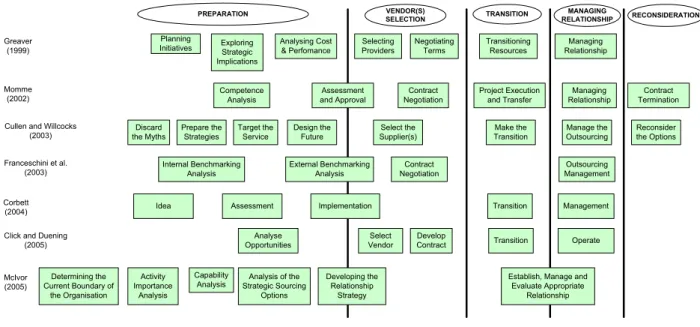
Outsourcing is the process of establishing and managing a contractual relationship with an external supplier for the provision of capacity that has previously been provided in-house (Momme, 2001). In spite of an impressive research intensity of the outsourcing process, there are only few frameworks depicting the actual stages and the layout of the overall process of outsourcing. Figure 1 presents an overview of some of the frameworks.
Design the Future Discard
the Myths Prepare the Strategies Target the Service Supplier(s)Select the TransitionMake the OutsourcingManage the Reconsider the Options Competence
Analysis and ApprovalAssessment NegotiationContract Project Execution and Transfer RelationshipManaging TerminationContract
Determining the Current Boundary of the Organisation Activity Importance Analysis Capability
Analysis Strategic Sourcing Analysis of the Options
Developing the Relationship
Strategy
Establish, Manage and Evaluate Appropriate
Relationship Analyse
Opportunities VendorSelect Develop Contract Transition Operate Internal Benchmarking
Analysis External Benchmarking Analysis NegotiationContract ManagementOutsourcing Planning
Initiatives Exploring Strategic Implications Analysing Cost & Perfomance Selecting Providers Negotiating Terms Transitioning Resources Managing Relationship TRANSITION Greaver (1999) Momme (2002) Cullen and Willcocks
(2003) Franceschini et al.
(2003)
Click and Duening (2005) McIvor (2005) MANAGING RELATIONSHIP VENDOR(S) SELECTION RECONSIDERATION PREPARATION Corbett
(2004) Idea Assessment Implementation Transition Management
Figure 1 - Overview of the outsourcing process frameworks
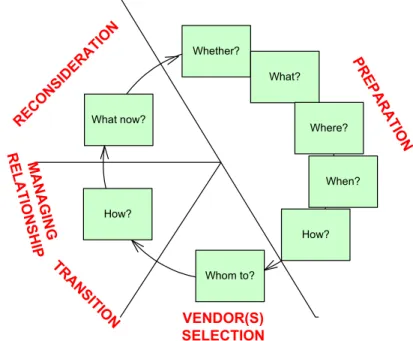
After carefully examining the content of the stages of each of the proposed outsourcing process frameworks we have aligned the frameworks and grouped the stages into the following sequence: preparation, vendor(s) selection, transition, managing relationship and reconsideration (See Figure 1). Each of the stages has to provide an answer on various questions, thus emphasising the complexity of the outsourcing process and arguing for a need that it has to be managed carefully throughout all of its life cycle (See Figure 2). Cyclic and holistic characteristic of the outsourcing
process management is stemmed in the evolutionary economics (Nelson and Winter, 1982). The evolutionary economic theory is in the core of process theories. It has received significant application in exploring firm’s learning characteristics for improving performance (Simonin, 1997), creating value (Anand and Khanna, 2000), and capabilities (Kale et al., 2002).
Figure 2 – Framework for the process of outsourcing (Source: Perunovic et al., 2006) A more detailed insight into the contents of the phases is given in Table 1.
Phase Key activities Some key issues
Strategy Underlying philosophy
Sourcing options Why and what to outsource
Approach Big Bang
Incremental Piecemeal
Configuration Many suppliers
Preferred suppliers
Prime contractor with subcontractors Sole supplier (one stop shop) Screening of potential vendors
Preferred relationship Contractual or collaborative
Preferred length of the contract Preparation
Drafting the SLA
Announcing outsourcing RFP
Evaluation Choosing the vendor
Negotiating Creating a win-win situation
Vendor(s) selection
Finalizing the contract Type, flexibility and content of the
contract Defining communication and exchange of knowledge
and information
Change management Transition
Transferring assets, people, information, knowledge, hardware, software
Reengineering
Adopting organizational structure and processes Whether? Whom to? How? What? What now? How? P R EP A R A TIO N M A N AG IN G R E L A T IO NS H IP TR AN SITI ON VENDOR(S) SELECTION RECO NSI DERA TION Where? When?
Human resource management Job loss, transfer
Type of relationship Reciprocal
Client dominant Vendor dominant Preferred vendor
Maintaining relationship Contracts
Trust Hostages Handling meetings and communicating
Performance monitoring and evaluation Applying incentives and penalties Solving problems
Re-negotiating and managing variations Managing
relationship
Managing success factors Economic factors
Character of the exchange
Co-operation between buyer and supplier
Distance between buyer and supplier
Reconsideration Reconsidering Continue
Change vendor Backsource Switching costs
Table 1 – Key activities and issues within the phases of the outsourcing process
3. Theories in the Research of the Outsourcing Process
The outsourcing process is a complex structure consisting of numerous activities and subactivities, carrying many managerial dilemmas. It is no wonder that many theories have been utilized to help the academics to understand the nature of those activities, and to help practitioners successfully manage the process. It is a common knowledge that each phenomenon can be described by several frameworks that are embedded in various theoretical approaches. From its occurrence, the outsourcing has been approached by different theories. This creates confusion among the researchers of the outsourcing phenomenon. Various authors identified significant number of theories that could explain the outsourcing phenomenon (cf. Gotttschalk and Solli-Sæther, 2005; McIvor, 2005).
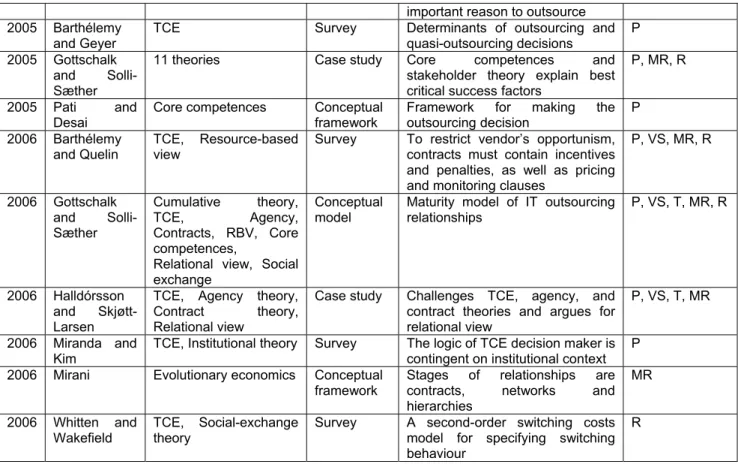
In order to depict the utilized theories we have conducted a literature study of the research papers in outsourcing from the 1990 up to 2006. Table 2 shows the papers and the theories utilized. The last column indicates phases of the outsourcing process the paper and its theoretical grounding have
addressed. The abbreviations P, VS, T, MR, and R stand for the phases of the outsourcing process i.e., Preparation, Vendor(s) Selection, Transition, Managing relationship, and Reconsideration.
Year Authors Theory Method Key points Applicability to outsourcing process 1995 Lacity and Willcocks Transaction Costs Economics (TCE)
Case study Experiences to the TCE
framework of efficient governance structures resulted in anomalies
P, VS, MR, R 1995 Pinnington
and Woolcock
Core competences Case study Growth of IT vendor industry is
creating a new firm relationship for the IS function
P , R
1995 Willcocks and
Choi Relational view Case study Defining characteristics of total IT outsourcing strategic alliances and
identifying problems of managing them
P, MR
1995 Willcocks et
al. Core competences Conceptual framework Factors around which IT outsourcing decisions can be
based
P
1996 Aubert et al. TCE, Incomplete
contract theory Case study TCE and Incomplete contract theory support the choice of
activity to be outsourced and contract management between the outsorucer and its vendor
P, MR
1996 Ulset TCE, Property rights
theory
Survey When substantial externalities are
involved, like in the supply of R&D, TCE should be combined with property rights theory to explain the use of governance mechanisms
P, VS, MR
1997 Brandes et al. TCE, Core
competences
Case study Outcomes are more successful if
outsourcing decision is based on core competence and cost efficiency and if outsourced unit is able to develop strong resource base P, MR, R 1999 Vining and Globerman TCE Conceptual framework
Framework for making the outsourcing decision
P
2000 Arnold TCE, Core
competences Conceptual framework Framework for making the outsourcing decision P
2000 Baden-Fuller
et al. Core competences Conceptual framework Framework for making the outsourcing decision P
2001 Lee Knowledge-based view,
Core competences Survey Knowledge sharing is positively related to outsourcing success MR
2001 Mahnke Evolutionary economics Conceptual
paper
Propositions regarding scope, speed and switching costs have been developed
P, T, MR, R
2001 Roy and
Aubert RBV Case study The best predictor of success and failure is the governance mode
and the position of project in the value matrix
P
2001 Zviran et al. Relational view Case study Factors determining success from
outsourcer’s and vendor’s perspective – good project definition and specifications, good
project management, trustworthiness, technical competence
P, VS, T, MR, R
2003 Barthélemy Agency theory,
Relational view Case study Managing contracts and trust outsourcing by MR
2004 Aubert et al. TCE, Incomplete
contract theory Survey Uncertainty outsourcing, while the level of is major deterrent to
technical skills is the most P
important reason to outsource 2005 Barthélemy
and Geyer TCE Survey Determinants of outsourcing and quasi-outsourcing decisions P
2005 Gottschalk and Solli-Sæther
11 theories Case study Core competences and
stakeholder theory explain best critical success factors
P, MR, R
2005 Pati and
Desai Core competences Conceptual framework Framework for making the outsourcing decision P
2006 Barthélemy
and Quelin TCE, Resource-based view Survey To restrict vendor’s opportunism, contracts must contain incentives
and penalties, as well as pricing and monitoring clauses
P, VS, MR, R 2006 Gottschalk and Solli-Sæther Cumulative theory, TCE, Agency, Contracts, RBV, Core competences,
Relational view, Social exchange
Conceptual model
Maturity model of IT outsourcing relationships
P, VS, T, MR, R
2006 Halldórsson and Skjøtt-Larsen
TCE, Agency theory, Contract theory, Relational view
Case study Challenges TCE, agency, and
contract theories and argues for relational view
P, VS, T, MR 2006 Miranda and
Kim TCE, Institutional theory Survey The logic of TCE decision maker is contingent on institutional context P
2006 Mirani Evolutionary economics Conceptual
framework
Stages of relationships are contracts, networks and hierarchies
MR 2006 Whitten and
Wakefield TCE, Social-exchange theory Survey A second-order switching costs model for specifying switching
behaviour
R
Table 2 – Theories utilized in the research of the outsourcing process
The research communicated in the selected papers (Table 2) was grounded in most of the cases in one or two theories. The exception is the work of Gottschalk and Solli-Sæther (2005, 2006) where the authors examine 11 theories in order to establish their explanatory power. The results suggest that the theory of core competences, the stakeholder theory and the neoclassical economic theory best explain the most important critical success factors of outsourcing relationships (core competence management, stakeholder management, and production cost reduction). In their later work (2006), the same authors apply cumulative theory to examine critical issues in stages of maturity in outsourcing relationship. They conclude that at the beginning of an outsourcing arrangement a Cost Stage occur, which is grounded in TCE and agency theory. After several years of having outsourcing the focus of the outsourcer shifts into the Resource Stage, where resource based view and core competences are the most important explanatory theories. At the end, the stage of Partnership may occur with the explanations sought in relational view, social exchange, and the stakeholders theory.
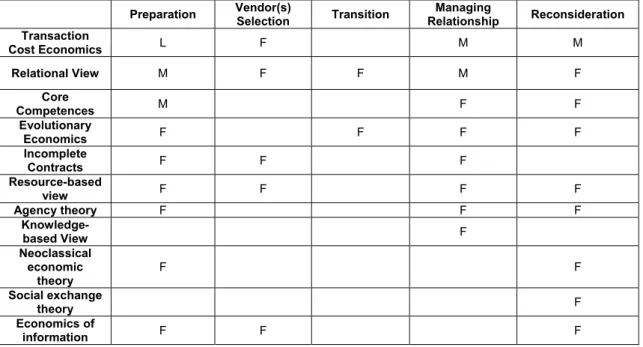
A content analysis of the selected research papers provides the distribution of the most utilized theories across the phases of the outsourcing process (Table 3). Letters in the cells indicate if a theory has been utilized to explore or explain some of the key activities and issues of a certain outsourcing process’ phase in a large number of cases (L - more than 7), medium (M – between 4 and 7 inclusive), or just a few (F – less than 3 inclusive).
Preparation Vendor(s) Selection Transition Relationship Managing Reconsideration Transaction Cost Economics L F M M Relational View M F F M F Core Competences M F F Evolutionary Economics F F F F Incomplete Contracts F F F Resource-based view F F F F Agency theory F F F Knowledge-based View F Neoclassical economic theory F F Social exchange theory F Economics of information F F F
Table 3 – Utilized theories and phases of the outsourcing process Transaction Cost Economics
Transaction cost economics (TCE) has been the most utilised theory of outsourcing. TCE is perceived to provide the best decision making tools to help organizations to decide to outsource and to prepare themselves for forthcoming outsourcing arrangements. The governance features of the theory influenced that it has been applied in studying the Managing relationship phase, whilst the concept of switching costs made the theory applicable in the reconsideration phase. Another useful issue for outsourcing provided by TCE is explanation of contractual complexity. Though TCE has not been utilized explicitly for studying the Vendor selection phase, its sub-theory (if we may say
so), the theory of incomplete contracting, has been applied in studying the structure and contents of outsourcing contracts, and related preparation and contract management activities.
Even though it has been exercised extensively in outsourcing applications, the TCE has several indulgencies. Lacity and Willcocks (1995) found that the original mapping to the TCE framework only explained few IT sourcing decisions and generated much more anomalies in their sample. Another critique could be that TCE relies on a single transaction as a unit of analysis, neglecting the contemporary industrial collaborative arrangements. Finally, TCE is static, which doesn’t correspond to dynamism of current business environment.
Relational View
Relational view develops and explains how firms gain and sustain competitive advantage within inter-organisational relationships (McIvor, 2005). Its key premise – the concept of relational rents has been explored to explain how firms choose their future outsourcing partners and preferred type of the relationship. It has been also utilized in studying the Transition, Managing relationship and Reconsideration phases. This makes the relational view to be the only theory that has been applied in the research of all the outsourcing process’ phases.
Concept of Core Competences
The concept of core competences has been developed on the basis of the resource-based theory. Prahalad and Hamel (1990) defined the core competencies as the collective learning in the organisation, especially how to coordinate diverse production skills and integrate multiple streams technologies. The application of concept of core competences in outsourcing became very popular among researchers. The concept has been predominantly use to develop and test various outsourcing decision frameworks arguing that the core activities shall remain in house. Learning
and communication premises of the concept made it also applicable in the Managing relationship and Reconsideration phases. Vendor’s competences are assumed to be one of the most important factors that influence success of an outsourcing arrangement (Levina and Ross, 2003; Feeney et al., 2005).
Resource-based View
The core premise of the resource-based view is that resources and capabilities can vary significantly across firms, and that these differences can be stable (Barney and Hesterly, 1996). If resources and capabilities of a firm are mixed and deployed in a proper way they can create competitive advantage for the firm. The resource-based view in outsourcing builds from a proposition that an organisation that lacks valuable, rare, inimitable and organised resources and capabilities, shall seek for an external provider in order to overcome that weakness. Therefore the most prominent use of the theory is in the Preparation phase of the outsourcing process for defining the decision making framework and in the vendor selection phase for selecting an appropriate vendor. The theory has been also used to explain some of the key issues of the Managing relationship and Reconsideration phases.
Evolutionary Economics
Although mentioned for the first time in the 19th century, the evolutionary economics experienced revival after Nelson and Winter’s work in 1982. The theory develops from Darwinism and includes some assumptions transposed to the economic “species”. These assumptions include (Andersen, 1994):
• The agents (individuals and organisations) can never be perfectly informed and they have to optimize locally rather than globally
• Agents are to some extent able to imitate the rules of other agents, to learn for themselves and to create novelty,
• The processes of imitation and innovation are characterised by significant degrees of cumulativeness and path dependency but they may be interrupted by occasional discontinuities
• The interaction between the agents are typically made in disequilibrium situations and the result is success and failures of commodity variants and method variants as well as agents • The processes of change occurring in a context described by the above assumptions and
characteristics are non-deterministic, open-ended and irreversible.
This makes the theory highly applicable in outsourcing. However, the actual research has been very modest studying issues predominantly within the Managing relationship phase. The other phases of the outsourcing process (expect the transition) have been also explored through the evolutionary economics but very scarcely.
Agency Theory
The focus of the agency theory originally was on the relationship between managers and stakeholders (Jensen and Meckling, 1976), but had spread over the time on explaining the relationship between two inter-firm subjects. In that context we associate the agency theory to understanding the relationship between outsourcer and vendor. Sources of the agency problem, moral hazards and adverse selection (Arrow, 1985) are should be resolved by monitoring and bonding (Barney and Hesterly, 1996). Consequently, the application of the theory in the outsourcing process research was in the Preparation Phase (when screening for vendors and defining its own attitude towards the type of the relationship. Naturally, the Managing relationship phase has been also explored, and to a very small extent the Reconsideration phase.
Knowledge-based View
The knowledge-based view provides insight in understanding how individuals co-operate to produce goods and services. The knowledge-based view distinguishes two ways how knowledge is shared among partners. They are knowledge generation and knowledge application. The knowledge-based view has been used in utilized in the outsourcing research to prove that knowledge sharing in the Managing relationship phase is positively related to the success of an outsourcing arrangement.
Neoclassical Economic Theory
The key characteristics of the neoclassical economic theory are (Hodgson, 1994):
• Assumption of rational, maximizing behaviour by agents with given preference function • Focus on attained, or movement towards, equilibrium states
• Absence of chronic information problem
The neoclassical theory explains the initial motives for outsourcing demonstrated by some pioneering companies like Kodak. However, the theory has received a significant critique for not being able to explain contemporary business processes. Especially, the concepts of rationality and absence of chronic information problem have been criticised. However Gottschalk and Solli-Sæther (2005) showed that the neoclassical economic theory explains critical success factors of outsorucing that are being evaluated in the Reconsideration phase.
Social Exchange Theory
The social exchange theory explains interpersonal relationships by positing the economical cost-benefit analysis as precondition for social engagement and exchange. The theory presupposes that the exchange of resources (material or social) is a basic form of human interaction. Social exchange is an ongoing reciprocal process in which actions are contingent on rewarding reactions from others
(Gottschalk and Solli-Sæther, 2005). The theory has been used in combination with TCE to specifying switching behaviour in the Reconsideration phase.
Economy of Information
It has been admitted that the information is not perfect and new economical models emerged to explain situations where two parties possess unequal or none quantity of information. One of the first works in the area was development of the search theory (Stigler, 1961). The identification of sellers and the discovery of their prices are only one sample of the vast role of the search for information in economic. Another key concept of the economy of information is the concept of signalling developed by Spence (1973). His essay is about markets in which signalling takes place and in which the primary signallers are relatively numerous and in the market sufficiently infrequently that they are not expected to invest in acquiring signalling reputation. Application of the economy of information in outsourcing is associated to activities of searching, selecting, and contracting the vendor. However, the economics of information hasn’t been used explicitly in the studies of the outsourcing process.
4. Conclusion
In most theories about outsourcing processes the perspective has been focused on exploring certain issues emerging within the phases of the process. The problem occurring in such approach is to choose between many different possible outcomes. In principle it is possible to find an optimal solution of this rather stationaryproblem.
However a more fruitful and practically useful approach could be taken if we ask questions about the dynamics in the outsourcing processes. What is important in such cases can be caught up under the term learning. The idea is that the outsourcing decision makers will take into account results of
former decisions in similar cases. This creates a need to study the outsourcing process as an evolutionary process. Evolutionary thinking in economics and more generally in social sciences as organizational theory and sociology has used these insights to draw one important conclusion namely that structure is not sufficiently to make an optimal solution in outsourcing considerations. It is also necessary to take into consideration the actors with their interpretation of history. In social sciences the problematic is well known as the structure – actor problem.
Applied to the outsourcing problematic the point is that the relevant discussion is not only to look at the mention theoretical models or explanations of the outsourcing phenomenon. It is also about doing matters in another way next time because you have some mistakes and failures done first time. Therefore we cannot draw a conclusion about the absolute optimal solution in beforehand. We can and shall learn from history but still at one point we shall stop and make a decision.
References
1. Andersen E.S., (1994). Evolutionary Economics, Post-Schumpeterian Contributions, Pinter, London
2. Arnold U., (2000). “New dimensions of outsourcing: a combination of transaction cost economics and the core competencies concept”, European Journal of Purchasing & Supply Management, 6, pp. 23-29
3. Arrow K.J., (1985). “The economics of agency”, in Principals and Agents: the Structure of American Business, Harvard Business School Press, Boston
4. Aubert B.A., Rivard S., Patry M., (1996). “A transaction cost approach to outsourcing behaviour: Some empirical evidence”, Information and Management, 30, pp. 51-64
5. Aubert B.A., Rivard S., Patry M., (2004). “A transaction cost models of IT outsourcing”,
6. Baden-Fuller C., Targett D., Hunt B., (2000). ”Outsourcing to Outmanoeuvre: Outsourcing Redefines Competitive Strategy and Structure”, European Management Journal, 18, 3, pp. 285-295
7. Barney J.B., Hesterly W., (1996). “Organizational Economics: Understanding the Relationship between Organizations and Economic Analysis”, in Clegg S.R., Hardy C., Nord W.R. (Eds.) Handbook of Organization Studies, Sage Publications, London
8. Barthélemy J., (2003). ”The Hard and Soft Sides of IT Outsourcing Management”,
European Management Journal, 21, 5, pp. 539-548
9. Barthélemy J., Geyer D., (2005).”An empirical investigation of IT outsourcing versus quasi-outsourcing in France and Germany”, Information & Management, 42, 4, pp. 533-542 10.Brandes H., Lilliecreutz J., Brege S., (1997). ”Outsourcing-success or failure?”, European
Journal of Purchasing & Supply Management, 3, 2, pp. 63-75
11.Click R.L., Duening T.N. (2005). Business Process Outsourcing: The Competitive Advantage, John Wiley & Sons, Hoboken
12.Corbett M.F., (2004). The outsourcing revolution: Why it makes sense and how to do it right, Dearborn Trade Publishing, Chicago
13.Cullen S., Willcocks L., (2003). Intelligent IT Outsourcing: Eight Building Blocks to Success, Butterworth-Heinemann, Oxford
14.Feeny D., Lacity M., Willcocks L., (2005). “Taking the measure of outsourcing providers”,
MIT Sloan Management Review, 46, 3, pp. 41-48
15.Franceschini F., Galetto M., Pignatelli A., Varetto M., (2003). “Outsourcing: guidelines for a structured approach”, International Journal of Benchmarking, 10, 3, pp. 246-260
16.Gottschalk P., Solli-Sæther H. (2005). “Critical success factors from IT outsourcing theories: an empirical study”, Industrial Management & Data Systems, 105, 6, pp. 685-702
17.Gottschalk P., Solli-Sæther H. (2006). “Maturity model for IT outsourcing relationships”,
Industrial Management & Data Systems, 106, 2, pp. 200-212
18.Greaver M.F., (1999). Strategic Outsourcing: A Structured Approach to Outsourcing Decisions and Initiatives, AMACOM, New York
19.Halldórsson Á., Skjøtt-Larsen T., (2006). “Dynamics of relationship governance in TPL arrangements – a dyadic perspective”, International Journal of Physical Distribution and Logistics Management, 36, 7, pp. 490-506
20.Hodgson G.M., (1994). “Critique of Neoclassical Microeconomic Theory”, in Hodgson G.M., Samuels W.J., Tool M.R., The Elgar Companion to Institutional and Evolutionary Economics, Edward Elgar, Aldershot
21.Jensen M.C., Meckling W.H., (1976). “Theory of the firm: managerial behaviour, agency costs and ownership structure”, Journal of Financial Economics, 3, pp. 305-360
22.Lacity M., Willcocks L., (1995). “Interpreting Information Technology Sourcing Decisions from a Transaction Cost Perspective: Findings and Critique”, Accounting, Management and Information Technology, 5, 3/4, pp. 204-244
23.Levina N., Ross J.W., (2003). “From the Vendor’s Perspective: Exploring the Value Proposition in Information Technology Outsourcing”, MIS Quarterly, 27, 3, pp. 331-364 24.Mahnke V., (2001). “The Process of Vertical Dis-Integration: An Evolutionary Perspective
on Outsourcing”, Journal of Management and Governance, 5, pp. 353-379 25.McIvor R., (2005). The Outsourcing Process, Cambridge, Cambridge
26.Miranda S.M., Kim Y-M., (20069. ”Professional versus political contexts: Institutional mitigation and the transaction cost heuristic in infomration systems outsourcing”, MIS Quarterly, 30, 3, pp. 725-753
27.Mirani R., (2006). “Client-Vendor Relationships in Offshore Applications Development: An Evolutionary Framework”, Information Resources Management Journal, 19, 4, pp. 72-86
28.Momme J. (2001). Outsourcing Manufacturing to Suppliers, PhD dissertation, Department of Production Aalbrog University, Aalborg
29.Momme J., (2002). “Framework for outsourcing manufacturing: strategic and operational implications”, Computers in Industry, 49, pp. 59-75
30.Nelson R.R., Winter S.G. (1982). An evolutionary theory of economic change, Belknap, Cambridge
31.Pati N., Desai MS., (2005). "Conceptualizing strategic issues in information technology outsourcing", Information Management & Computer Security, 13, 4, pp. 281-296
32.Perunovic Z., Christoffersen M., Williams H., (2006). “Vendor’s Perception of Outsourcer’s ICT Utilisation in the Outsourcing Process”, Proceedings of the 15th international conference of management of technology IAMOT '06, Beijing
33.Pinnington A., Woolcock P., (1995). "How Far is IS/IT Outsourcing Enabling New Organizational Structure and Competence?", International Journal of Information Management, 15, 5, pp. 353-365
34.Roy V., Aubert B., (2001). “A Resource-Based Analysis of Outsourcing: Evidence from Case Studies”, Scientific Series, CIRANO
35.Ulset S. (1996). “R&D outsouricng and contractual governance: An empirical study of commercial R&D projects”, Journal of Economic Behaviour & Organization, 30, pp. 63-82 36.Vining A., Globerman S. (1999). “A Conceptual Framework for Understanding the
Outsourcing Decision”, European Management Journal, 17, 6, pp. 645-654
37.Willcocks L., Choi C.J., (1995). "Co-operative Partnership and 'Total' IT Outsourcing: From Contractual Obligation to Strategic Alliance?", European Management Journal, 13, 1, pp. 67-78
38.Willcocks L. Fitzgerald G., Feeny D., (1995). “Outsourcing IT: The Strategic Implications”,
39.Whitten D., Wakefield R.L., (2006). “Measuring switching costs in IT outsourcing services”, Strategic Information Systems, 15, pp. 219-248