Management Accounting, Devolution and
Democratic Accountability
Research Report
Mahmoud Ezzamel Cardiff Business School
Noel Hyndman Queen’s University, Belfast
Åge Johnsen Oslo University College
Irvine Lapsley
University of Edinburgh Management School June Pallot
Canterbury University, New Zealand Simona Scarparo
Copyright © CIMA 2005 First published in 2005 by: The Chartered Institute of Management Accountants 26 Chapter Street
London SW1P 4NP Printed in Great Britain
The publishers of this document consider that it is a worthwhile contribution to discussion, without necessarily sharing the views expressed.
No responsibility for loss occasioned to any person acting or refraining from action as a result of any material in this publication can be accepted by the authors
or the publishers.
All rights reserved. No part of this publication may be reproduced, stored in a retrieval system, or transmitted, in any form or by any means method or device, electronic (whether now or hereafter known or developed), mechanical, photocopying, recorded or otherwise, without the prior permission of the publishers.
Management Accounting, Devolution and Democratic Accountability
1
Contents
Acknowledgements . . . 2
About the authors . . . 3
Executive Summary and recommendations . . . 4
Glossary of abbreviations . . . 5 1. Introduction . . . 6 1.1 Purpose . . . 6 1.2 Background . . . 6 1.3 Framework . . . 8 1.4 Research Questions . . . 9
1.5 Outline of the Report . . . 9
2. The Process of Devolution in the UK . . . .10
2.1 Introduction . . . .10
2.2 Devolution in Northern Ireland . . . .10
2.3 Devolution in Scotland . . . .11 2.4 Devolution in Wales . . . .12 2.5 Conclusion . . . .13 3. International Comparisons . . . .14 3.1 Introduction . . . .14 3.2 Political Institutions . . . .14
3.3 National Audit Institutions . . . .17
3.4 New Public Management (NPM) . . . .18
3.5 Public Management Culture . . . .18
3.6 Conclusion . . . .19
4. Research Methods . . . .20
4.1 Research Design . . . .20
4.2 Data Collection . . . .20
4.3 Way of Working . . . .21
5. Accountability in the UK Devolved Parliaments and Assemblies . . . .22
5.1 Introduction: ‘The Accountability Gap’ . . . .22
5.2 Accountability Arrangements in the UK Devolved Institutions . . . .23
5.3 What Accountability Means for the Participants to the Study . . . .24
5.4 Conclusion . . . .25
6. Management Accounting Information in the UK Devolved Institutions . . .26
6.1 Northern Ireland . . . .26
6.2 Scotland . . . .28
6.3 Wales . . . .29
6.4 Conclusion . . . .30
7. Issues of Performance Measurement and Auditing in the UK Devolved Parliament and Assemblies . . . .31
7.1 Introduction . . . .31
7.2 Availability and Use of Performance Information . . . .32
7.3 Sources and Accessibility of Performance and Audit Information . . . .33
7.4 The Impact of Reforms on Performance and Audit Information . . . .34
7.5 The Impact of Devolution on Performance and Audit Information . . . .34
7.6 Conclusion . . . .35
8. International Comparison: Issues on Accounting and Accountability in New Zealand and Norway . . . .36
8.1 Introduction . . . .36
8.2 Empirical Issues on Accounting and Accountability in New Zealand . . . . .36
8.3 Empirical Issues on Accounting and Accountability in Norway . . . .38
8.4 Conclusion . . . .39
9. Discussion and Conclusions . . . .40
Management Accounting, Devolution and Democratic Accountability
2
The work on this project started in Edinburgh in 2000 as an idea for a CIMA-sponsored project on management
accounting in central government. The project was funded by a grant from the Research Foundation of The Chartered Institute of Management Accountants (CIMA) in 2001. In 2002, the project also received a grant from the Devolution, Parliamentarism and Democratic Accountability: a
Comparative Study project (grant award number
L219252132) in the Economic and Social Research Council (ESRC) research programme on devolution and constitutional change.
The aim in writing this report is to contribute to the debate on the role of finance, accounting and management as facets of the modernising agenda in evaluating the democratic accountability that is taking place in accounting, public management, political science, sociology and economics, within the ‘governance and the constitution’ theme. This report aims to be useful to practitioners (public sector accountants, managers and policy-makers). Research on current political and administrative practices can be useful for politicians, policy-makers, journalists and citizens, at large. In particular, the project is relevant for informing the debates on devolution, decentralisation, regionalisation and federalism, for instance with regard to establishing regional assemblies in England, and in assessing the diverse roles of accounting on democratic accountability in public sector reforms.
Acknowledgements
It is of great sadness to the research team that we acknowledge the death of June Pallot, a member of this research team who passed away on 5th November 2004 following a long battle with illness. This publication is dedicated to her memory.
A number of steps have been taken to facilitate interaction with – and dissemination of findings to – different user groups of this research (such as academics, politicians and policy-makers). Firstly, the main findings have been presented both to academic and to professional conferences, including seminars in Northern Ireland, Scotland and Wales, where plans and preliminary results have been presented and discussed with politicians and policy-makers. Secondly, the authors have also participated in CIMA and ESRC workshops and conferences. Thirdly, results have been circulated and published, with more publications in prospect to enhance dissemination.
There are many institutions and individuals to acknowledge. Thanks to ESRC and CIMA for financial support. Thanks to Rebecca Edser, Sarah Hunt, Gary Martin and Elisa Wright for assistance in data collection for the project. Thanks also to the many colleagues and reviewers that, at different stages in the project and at different seminars and conferences, have provided numerous constructive comments. Lastly, thanks to all of the interviewees – members of parliaments and national assemblies, executive officers, audit officers and parliamentary clerks and advisers – who generously gave of their time and insights to help with the data collection phase of the project.
Management Accounting, Devolution and Democratic Accountability
3
About the Authors
The team involved in this international comparative project consists of six researchers who have backgrounds in public management, management accounting and public policy: Mahmoud Ezzamel
University of Cardiff, Wales.
Mahmoud Ezzamel is professor of accounting at Cardiff Business School. He is a joint editor of Accounting and Business Research. He has previously held professorial posts at Aberystwyth, UMIST and Manchester.
Noel Hyndman
Queen’s University, Belfast, Northern Ireland.
Noel Hyndman is professor of management accounting in the School of Management and Economics at Queen’s University, having previously worked at the University of Ulster and the University of Ottawa in Canada. He is editor of the Irish Accounting Review, the journal of the Irish Accounting and Finance Association, and has provided training and advice to a number of public bodies in the UK and Canada.
Åge Johnsen
The University of Edinburgh, Scotland Oslo University College, Norway.
Åge Johnsen is associate professor at the Faculty of Business, Public Administration and Social Work, Oslo University College; and senior research fellow at the the University of Edinburgh Management School.
Irvine Lapsley
The University of Edinburgh, Scotland.
Irvine Lapsley is professor of accounting and director of the Institute of Public Sector Accounting Research (IPSAR) at the University of Edinburgh Management School. He is editor of Financial Accountability & Management and has advised a number of public sector organisations, including the Finance Committee of the Scottish Parliament.
June Pallot
University of Canterbury, New Zealand
June Pallot was professor of accounting at the Department of Accountancy and Information Systems at Canterbury University, Christchurch. She was associate editor of Financial Accountability & Management, and a visiting professor of accounting at the University of Edinburgh.
Simona Scarparo
Warwick University, England
Simona Scarparo is a lecturer in accounting at Warwick Business School. Previously, she was a PhD student and post-doctoral researcher at IPSAR, the University of Edinburgh.
Management Accounting, Devolution and Democratic Accountability
4
Executive Summary and Recommendations
Devolution is commonly understood to be the transfer to a subordinate elected body, on a geographical basis, of functions previously exercised by ministers and the national parliament. Devolution is also called external decentralisation to differentiate it from delegating responsibility within an existing structure of authority. In 1997, the populations of Wales and Scotland voted in favour of devolution, and, in Northern Ireland, the 1998 Good Friday Agreement – based on the re-establishment of devolved government – also received electoral support. In 1999, the Northern Ireland Assembly in Belfast, the Welsh National Assembly in Cardiff and the Scottish Parliament, Holyrood, in Edinburgh began their operations. One of the main purposes of the devolution programme was to facilitate political responsiveness to the people in their respective countries within the United Kingdom. The aim was to increase transparency and enhance democratic accountability using a different approach to matters of government to that previously taken by Whitehall and Westminster.
This report documents how management accounting in the devolution project has affected democratic accountability four years into the devolution programme’s operation. Based on documentary studies, media reports, observation of parliamentary committee meetings and interviews with key actors (for example, members of national assemblies and parliaments, parliamentary committee clerks and advisers, executive ministers and deputy ministers, audit officers, party politicians and other external experts) in the five countries, it concludes that devolution has significantly and unequivocally contributed to a more consultative, transparent and
democratic accountable government in Northern Ireland, Scotland and Wales.
Key Findings:
●politicians in the devolved assemblies/parliaments, have a very compartmentalised view of accountability and – often – limited awareness of the potential of management accounting;
●most politicians interviewed experienced information overload. This is a key challenge for providers of budgeting and financial information in these settings; ●there was limited knowledge of what resource
accounting and budgeting (RAB) is, and what it is intended to do, amongst the politicians in this study; ●most expertise in RAB sits with professional experts
(government accountants and auditors) and there is a danger of democratic processes becoming increasingly mystifying, rather than more transparent;
●there is a need for the complexity of new forms of government accounting to be taught to elected representatives. There is little evidence of interest or inclination from the elected representatives to attend seminars on accounting, which makes this a bigger challenge;
●there is a shift towards the increased use of
performance information in Northern Ireland, Scotland and Wales. This trend is even more marked in New Zealand and Norway;
●the processes of budgetary scrutiny in the devolved assemblies/parliaments need to be streamlined. They appear over-elaborate; and
●devolution and RAB are in their infancy. There is a need for a more consistent appraisal/review of both of these processes on a continuing basis.
AMS Additional Member System CSG Consultative Steering Group DG Devolved Government
FEC Finance and Expenditure Committee (NZ) FIAG Financial Issues Advisory Group
FMI Financial Management Initiative FPTP First Past the Post System FSA Financial Services Authority KRA Key Results Area
MLA Member of Legislative Assembly MMP Mixed-Member Proportional System MP Member of Parliament
MSP Member of Scottish Parliament NAO National Audit Office (UK) NPM New Public Management PAC Public Accounts Committee (UK) PR Proportional Representation PSA Public Service Agreement
RAB Resource Accounting and Budgeting SDA Service Delivery Agreement
SPICe Scottish Parliament Information Center SRA Strategic Results Area
Glossary of abbreviations
Management Accounting, Devolution and Democratic Accountability
6
1.1 Purpose
This project is a study of the role of accounting in informing and shaping the democratic accountability of key agents’ actions in the newly devolved executives, national assemblies and parliaments in the UK (Northern Ireland, Scotland and Wales). It explores how accounting is affected by a
modernised public management culture and the new public management (NPM) movement, and how it relates to non-accounting forms of accountability.
The emergence and development of accounting practices and the meanings attributed to these developments for
democratic accountability are also examined. The project studies annual financial budgeting, performance management and performance audit reporting processes, and the
link/coupling between budgeting and reporting. Specifically, it examines the linkages between mission statements,
objectives and targets (including budgets) in the planning process and the use of performance measures and indicators in the reporting process. It distinguishes the macro,
whole-of-government level from the micro, agency level and focuses on the devolved governments and parliaments as affected by whole-of-government budgeting.
1.2 Background
Democratic accountability, has been substantially improved in most western countries during the 20th century. The newly devolved parliaments have had the opportunity to profit from the latest developments and best practices among western democracies.
Simultaneously – and paradoxically, given increasing democratic representation, more transparency and the extensive public management reforms in the 1980s and 1990s – there is evidence of a decline in citizens’ interest in democratic accountability, decreasing party membership, low voter turnout, and political communication practices resembling the old fashioned Westminster/Whitehall model, with ‘spin doctors’ and lobbying resulting in not so
transparent politics (Schlesinger, Millar and Dinan, 2001). However, democratic governance is executed via a diverse set of instruments and procedures. Such arrangements may also vary over time and between different national, institutional and political ‘cultures’ (Hood, 1998).
While political scientists and economists often study given institutions, their relationships and effects, this project focuses on what is going on inside the devolved institutions. This entire area is under-researched and so presents an opportunity to study the role of management accounting in the implementation of devolution, which represents one of the most significant changes in British public policy in decades. This study will shed more light on several
dimensions of democratic accountability in the Westminster model of democracy, compared to the (non-Westminster) Nordic consensus model (Lijphart, 1999), such as
representation of relevant information and openness and accessibility for the participating actors. Democratic accountability issues will be examined in a comparative research design that acknowledges historical and institutional contexts.
This research is informed by studies of government and public sector reforms in general and, in particular, the NPM reforms implemented during the 1980s and 1990s (Boston et al., 1996; Pollitt and Bouckaert, 2000).
NPM reforms typically have evolved around six dimensions: ●privatisation;
●marketisation; ●decentralisation; ●output orientation; ●quality systems; and ●intensity of implementation.
Several of these dimensions have been embraced by the current (and former) UK government(s) as part of a modernisation strategy 1.
In particular, three of these issues will be addressed here: ●decentralisation;
●output orientation; and ●intensity of implementation.
An important element of the evaluation of management accounting practices is the context in which they are used. The UK political system of democratic accountability may be characterised as a process within a long history of evolution (Marshall, 1991). In this regard, one central dimension in current public sector management reforms is
decentralisation.
Decentralisation in public sector management reforms has been more developed during the 1980s and 1990s in the Nordic countries and in the Netherlands. Moreover, the recent and expanding literature on devolution (Bogdanor, 1999) and on non-US parliaments and legislatures (Lijphart, 1999; Matthews and Valen, 1999) is also crucial.
Decentralisation and devolution may, theoretically, also be contrasted to the more radical form of constitutional change by revolution (Skocpol, 1979) or other more relevant forms of exit or ‘disloyalty’ as, for instance, independence for Scotland (Hirschman, 1970). While the UK has had, in a European context, a long history of a relatively centralised state structure with little power decentralised to local government, in recent times the UK government has extended devolution of power from Westminster to three new national assemblies. In Northern Ireland, Scotland and Wales, openness,
transparency and accountability have been central subjects in the devolution programme.
A common trait with decentralisation reforms, however, is the parallel development of the centralisation of controls. An increasing emphasis on output orientation by way of performance measurement and performance audits may be seen as instruments for retaining (or gaining) central control, at least in the UK. These wider issues reaffirm the importance of an international comparative study.
Furthermore, the use of planning systems integrating financial and management accounting and historic and forward looking figures – for instance in the form of RAB (Likierman, 2001) – indicates that a tight coupling between plans and actions are pursued and provide evidence of a high intensity of public policy implementation. These issues are the subjects of this study. Accounting can therefore be seen as a vital ingredient in modern public sector reforms that warrants close scrutiny.
The notion that accounting is important in government and in reform is of course neither new, nor unique. Heald and Geaughan (1997), for example, have argued that accounting reform is playing a significant role in the restructuring of UK central government. However, there is a perceived need to inject more uniformity into the system, for instance by clearer definition of the reporting entities and continued publication of performance information in annual reporting. Important elements of the new devolved arrangements are the commitments made to improve transparency and to develop new mechanisms for deliberating upon the business of government. There are a number of factors that suggest that budgetary information will assume a new significance. In particular, the promotion of RAB, which extends beyond the cash-based accounting used previously, will have a major impact.
This new system of accounting recognises assets and liabilities (full accrual accounting) and entails the use of performance indicators and the incorporation of department objectives within budgets. In addition, it requires that management accounts better align to financial accounting statements. All of these influences make this a particularly opportune time to, first, evaluate the effectiveness of these initiatives for the devolution programme and, second, consider the potential for further development and refinements for democratic accountability.
Management Accounting, Devolution and Democratic Accountability
Introduction
8
1.3 Framework
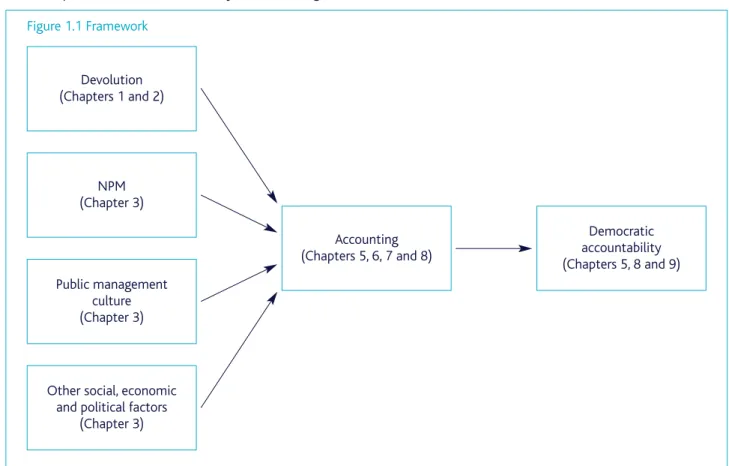
The conceptual framework for this study is shown in Figure 1.1. Figure 1.1 Framework
The framework in Figure 1.1 demonstrates that democratic accountability is affected by accounting, which is, partly, intended to serve the objectives of the devolution programme.
There are also, however, many other, relevant factors with potential – intended or unintended – consequences to affect accounting and hence democratic accountability. Some of them have been included in Figure 1.1. The arrows in the figure illustrate assumed causal relations. There may, however, be more bi-directional and multi-directional relations than we have depicted in the framework. For example, if there is a general discontent with democratic accountability in a society, this issue may induce reforms.
This project has links to other research in the ESRC
programme on devolution and constitutional change. It draws upon other projects within the research initiative phase (1998–2000) and the first phase of the programme (2001), in particular the following studies:
●Boyne,Political Control of Public Agencies in Scotland and Wales,Cardiff;
●Brown,Making the Scottish Parliament: Standing Orders and Procedures,Edinburgh;
●Parry,Designing the Transition from Scottish Office to Scottish Executive,Edinburgh;
●Fawcett,Political Communication and Devolution in Northern Ireland: Equality and Institutional Change in Northern Ireland,Ulster;
●Heald,Financial Arrangements for Devolved Government Within the UK,Aberdeen;
●Mitchell,Devolution and the Centre,Strathclyde; and ●Parry,Home Civil Service as an Integrative Force in the
Post-devolution Polity,Edinburgh. Devolution (Chapters 1 and 2) NPM (Chapter 3) Public management culture (Chapter 3) Democratic accountability (Chapters 5, 8 and 9) Accounting (Chapters 5, 6, 7 and 8)
Other social, economic and political factors
In fact, many of the recent public sector accounting (that is, NPM) reforms are intended (and designed) to affect democratic accountability but do not have any formal connections to the devolution programme. Most notably, the emphasis on targets and outputs in many NPM reforms may affect democratic accountability but this emphasis would also be present when there is no programme of devolution. However, there are also many other factors, apart from devolution and NPM reforms, which could impact on democratic accountability.
Some of the most relevant factors in this project are general public management cultures, and other general social, economic, technological and political developments. Thus, in order to explore how accounting is affected by devolution and the relationship between accounting and democratic accountability, the alternative influences on accounting and democratic accountability must also be taken into account. In particular, international, as well as national and local, trends must be investigated, further work on these issues which stems from this research has been published elsewhere (Ezzamel, Hyndman, Johnsen, Lapsley & Pallot, 2004; Ezzamel, Hyndman, Johnsen, Lapsley & Pallot, 2005). 1.4 Research Questions
The two specific, overarching sets of research themes addressed in this report are the following.
●Political devolution and democratic accountability: Is devolution the driver for changes in accountability, or are changes in accountability driven by the NPM movement regardless of devolution?
For example, what is the role of traditional bureaucracy in governments and executives in relation to transparency, accountability and the ‘third way’? Do their executives mirror the kinds of changes we expect for the devolved parliaments? Are there any lessons to be learned from fully autonomous parliaments in other countries of interest that are of comparable populations as those of the UK’s devolved governments (DGs)?
●Accounting and democratic accountability:
How does public management culture affect democratic accountability in devolution?
For example, what role does accounting play in democratic accountability? How is accounting information used in modern parliaments? Who uses accounting information, and when and why is such information used? To what extent is accounting used to underpin democratic accountability? To what extent is democratic
accountability pursued through more traditional political means? Does the detailed and extensive information provided by accounting procedures undermine and destabilise, rather than stabilise and enhance, democratic accountability and the devolution programme?
1.5 Outline of the Report
The remainder of this report is organised as follows: ●chapter 2 briefly outlines the process of devolution in the
UK;
●chapter 3 presents information regarding key UK
institutions and the two international comparisons in this project (New Zealand and Norway);
●in Chapter 4, the chosen research design of the project is documented;
●chapter 5 elaborates on the issue of accountability in the UK devolved parliaments and national assemblies; ●chapter 6 presents findings on the use of management
accounting information in the UK devolved institutions; ●chapter 7 follows with a presentation of the project’s
findings regarding issues of performance measurement and auditing in the devolved parliaments and national
assemblies;
●chapter 8 presents two international comparisons (New Zealand and Norway) of the issues relating to accounting and accountability; and
●chapter 9 contains a discussion of the findings and conclusions arising from the project.
Management Accounting, Devolution and Democratic Accountability
10
2.1 Introduction
The idea of devolution is not a new one. It dates back two centuries, when home rule for Ireland was proposed in 1886. Bogdanor states that devolution can be defined as ‘consisting of three elements: the transfer to a subordinate elected body, on a geographical basis, of functions at present exercised by ministers and Parliament’ (Bogdanor, 2001, p. 2).
Even though Northern Ireland, Scotland and Wales have obtained devolution at the same time, the cultural and political development of the ‘quest’ for devolution has been different for each country.
Northern Ireland experienced a form of devolution when it was granted home rule between 1921 and 1972. Scotland benefited from separate local government and education systems, authority to issue banknotes and an established church since the union of the crowns; its national identity has always been recognised and strongly felt. Wales, unlike Northern Ireland and Scotland, has never been granted any special legislative or administrative status, although there is the official recognition of Welsh as an ancient language. Scottish and Welsh nationalistic movements started during the late 1960s, demanding the recognition of distinctive identities and the opportunity to look after their own economic interests (Jones, 2001). In 1968, a royal commission was set up to investigate the role of central legislature and of government within a devolved context. In 1979, a referendum was held in Scotland and Wales on the matter, and it showed very little support for devolution. In Scotland, only a narrow majority – not enough to achieve the weighted majority needed – voted in favour of devolution. In Wales, a strong majority voted against devolution.
One of the main reasons for this lack of support was attributed to a division in the Labour Party. Some Labour members did not want to challenge the unity of the state, while other members considered the issue of devolution as a problem of equality rights (Mitchell, 2002). Furthermore, the Tory government placed strong emphasis on the strength of a unitary government and on the importance of parliamentary sovereignty.
During the 1980s and 1990s, things began to alter and the level of support for constitutional change grew. In Scotland the idea, supported by the Labour Party, of a Scottish parliament elected through some form of proportional representation (PR) was emerging. In Wales, where there was more ambivalence on the importance of separate political identity, there was a similar debate, but its pace and spirit was different from Scotland.
However, when another referendum on devolution was called in the late 1990s, all three countries voted in favour: in NI, 71.1 per cent of voters in support of it; in Scotland, 74.3 per cent; and in Wales, 50.3 per cent. The following sections describe the further development of devolution in NI, Scotland and Wales.
2.2 Devolution in Northern Ireland
Northern Ireland was under home rule between 1921 and 1972. Home rule was considered a form of devolution but it differed substantially from the current form of devolution for two main reasons. First, the initial devolved parliament, home rule, was established after a long and controversial debate that had at its centre the desire to avoid the inclusion of Northern Ireland in the Irish Free State. Second, the political scene was dominated by the conflict between the unionist (Protestant) community, which wanted to preserve the link with the UK, and the nationalist (Catholic) community, which was instead pushing towards unification with the rest of Ireland (Bogdanor, 2001).
Under home rule, the Belfast Parliament was very similar to Westminster in terms of its functions and organisation. Legislative power was conferred with specific limitations on matters concerning foreign affairs, defence, and external trade.
In terms of fiscal arrangements, it was believed that Northern Ireland could finance the services with her own revenue. However, by the end of the 1970s, financial allocations were determined according to needs, being in practice
expenditure-based. The budget had to be approved by Westminster and it was negotiated between the Northern Ireland Ministry of Finance and the Treasury in London, implying a tight control on the allocation of resources. In practical terms, Northern Ireland did not have financial autonomy, as taxation matters were London’s domain and spending matters were dealt with in Belfast. Home rule ceased in 1972 due to the intensification of violence from 1968 onwards.
The establishment of direct rule from Westminster was conceived as a short-term solution. In the period between 1972 and 1997, there were several attempts to introduce devolution that failed due to the impossibility of reaching agreement between the parties involved. A significant breakthrough was made in the summer of 1994, when the Irish Republican Army (IRA) announced a cease-fire and Sinn Fèin participated in the political debate. In 1996, multi-party talks were carried out between the elected representatives of the political parties and in 1998, the Belfast Agreement was signed. The agreement was subsequently approved by a referendum held in May 1998, in which 71.1 per cent voted in favour of devolution and 28.9 per cent voted against it.
2. The Process of Devolution in the UK
One hundred and eight members are elected to the Assembly by a single transferable vote for a fixed-term period of four years.
The areas of devolved power are: ●finance; ●personnel; ●agriculture; ●education; ●health; ●social services;
●economic development; and ●environment.
The Belfast Agreement is built on two key principles: power sharing and the application of two forms of qualified majority voting for ‘key decisions’.
The principle of power sharing, an institutional novelty of the agreement (O’Leary, 2002, p. 284), affects the functional operations of the executive. The executive is led by the first minister and by the deputy first ministers, who hold office together. This means that if one resigns, the other one loses his/her office as well. Both positions exercise the same functions and have equivalent powers. The members of the executive are selected by party leaders in accordance with the number of seats that each party has acquired. The second principle that underlies the agreement is the existence of two forms of qualified majority voting applied to ‘key decisions’.
‘Key decisions’ are any of the following:
●the choice of the first and deputy first ministers; ●dismissal from office;
●budgetary procedures; ●standing orders;
●election of the Assembly’s presiding officer (speaker); ●the programme for government; and
●policy issues defined as ‘key’.
(Meehan, 1999, p. 20; Wilford, 2000, p. 580)
When voting on these issues, there has to be a majority of those members present and voting and also a majority of the unionists and nationalists present and voting. This
mechanism was devised in order to guarantee ministerial autonomy and to reinforce partnership and cooperation. Within the Assembly, statutory committees are formed. These have an advisory role during the process of policy
formulation, can initiate primary legislation and can scrutinise the work of the Assembly.
2.3 Devolution in Scotland
Scotland has benefited from a separate legal and
administrative system even after the Act of Union (enacted in 1707), which abolished a separate Scottish parliament. In 1885 the Scottish Office was established, held by the secretary of state for Scotland. Initially, it was a department of the UK government with very limited functions. Gradually, its role grew and it became responsible for areas such as health, justice, education, agriculture, fisheries and farming. The secretary of state for Scotland ensured that Scottish matters were handled in Scotland and that specific Scottish needs were considered in the process of policy-making and legislation. This arrangement reinforced the idea of a Scottish political distinctiveness. As per the situation in Northern Ireland, at the end of the 19th century and throughout the 20th century, nationalistic movements argued for a Scottish home rule. Prior to the late 1990s, propositions for
implementing home rule in Scotland were presented 13 times to the House of Commons but were always rejected (Bogdanor, 2001).
From the 1970s onwards, the pressure for constitutional change that would establish a Scottish national assembly grew. This was partly due to discontent with the political system at that time, which was considered to be inadequate in representing Scottish needs at UK level, and partly due to a growing sense of Scottish identity and of feelings of
difference (Brown, 2000).
In 1989, the Scottish Constitutional Convention was set up. It proposed a plan for devolution in the Scottish Constitutional Convention Report, issued in 1995, that formed the basis of the proposals made to the UK government in 1997. These proposals were subjected to referendum in September 1997 and were approved with a strong majority by the electorate. The Scotland Act 1998 introduced the Scottish Parliament, which commenced its first legislative period in July 1999. The Scottish Parliament has two main features: an innovative electoral procedure and a distinctive internal working. Members are elected by combining the traditional first-past-the-post system with a form of PR. This model was chosen in order to ensure the consensual nature of the new Parliament, which was considered a fundamental aspect of the new institution (Mitchell, 2000). In terms of the internal working of the parliament, a model was developed that was to be substantially different from Westminster’s (Mitchell, 2000). The Consultative Steering Group (CSG) and the Financial Issues Advisory Group (FIAG), set up by the secretary of state for Scotland, developed proposals for the practical operations of the new institution.
Management Accounting, Devolution and Democratic Accountability
The Process of Devolution in the UK
12
Four main principles were identified:
●Power-sharing. The Scottish Parliament should embody and reflect the sharing of power between the people of Scotland, the legislators and the Scottish executive; ●Accountability. The Scottish executive should be
accountable to the Scottish Parliament, and the Parliament and the executive should be accountable to the people of Scotland;
●Access and participation. The Scottish Parliament should be accessible, open and responsive and develop procedures that make possible a participative approach to the development, consideration and scrutiny of policy and legislation; and
●Equal opportunities. The Scottish Parliament, in its operation and its appointments, should recognise the need to promote equal opportunities for all.
The Scotland Act planned a parliament with substantial powers. The areas in which the Scottish Parliament has legislative authority are as follows:
●health and social work; ●education and training; ●local government and housing; ●justice and police;
●agriculture, forestry and fisheries; ●the environment;
●tourism, sport and heritage; and
●economic development and internal transport.
The Scottish Parliament has full legislative competence. That is to say, it holds primary legislative powers across the above range of domestic policy areas and, potentially, the power to legislate in any non-reserved area of policy.
Unlike the other devolved assemblies, it is also given the authority to vary income tax, by up to three pence per pound, although there has been strong political debate around the issue of whether – and how – to exercise this power. Furthermore, the Scottish Parliament controls local authority taxation. It can raise revenue by charging fees for some public services.
A comprehensive committee system has been established, which aims to give committees a more powerful role in comparison with the Westminster system. There are 17 committees (eight mandatory committees and nine subject committees) that have been given power to initiate legislation, to scrutinise and monitor government legislation and to conduct enquiries and take evidence from ministers and civil servants (Brown, 2000; Mitchell, 2000). Membership of the committees reflects the political composition of the Parliament, and conveners usually do not belong to the governing parties.
In its first legislative period, the Scottish Parliament enacted 22 bills, in matters such as housing, the establishment of national parks and issues related to adults with incapacity. The ability to legislate on specific Scottish matters has been considered as one of the most important achievements of the new institution, which would have not happened without devolution.
2.4 Devolution in Wales
Wales, unlike Northern Ireland and Scotland, has never been granted separate administrative institutions. Nationalistic movements started to emerge towards the end of the 19th century but claims were mainly concerned with obtaining equality with England rather than being connected to arguments relating to separation from England (Bogdanor, 2001). The Welsh Liberals were trying to obtain recognition of Welsh cultural and religious uniqueness, but there was no aspiration for a Welsh Parliament. During the 1900s, a progressive process of administrative decentralisation in education, agriculture and national insurance took place. This was driven by the UK government’s political decisions, which were initiated only for pragmatic reasons.
In 1964, after the Labour Party’s UK election victory, the first secretary of state for Wales was established, with very limited powers granted by Whitehall. Due to the fact that Wales – unlike Scotland – did not have a separate legal system, the Welsh secretary only had the ability to modify policy set by Whitehall according to Welsh needs and differences. The Scotland and Wales Bill of 1979, which proposed the application of home rule, devised a form of devolution for the two countries which, if accepted, would have resulted in significantly fewer powers being transferred to Wales. During the 1990s, an organised campaign for devolution started without official support from political parties. The campaigners lacked a strong public image, as well as financial resources. The ‘Campaign for a Welsh Assembly’ was
established in 1987 and advocated the potential economic benefits of a separate assembly.
Ten years later, the UK government published the white paper, A Voice for Wales, outlining proposals for devolution in Wales that were to be approved in the referendum held in September 1998. Subsequently, the UK Parliament passed the Government of Wales Act 1998 through which powers and responsibilities were transferred to the Welsh Assembly on 1 July 1999.
The Welsh Assembly is defined as ‘a unique institution within the United Kingdom’ (Laffin and Thomas, 2000) because it is a hybrid system in which there is a combination of a Westminster cabinet model with a local government model of subject committees. As in Westminster, there is a cabinet, but there is also a system of multifunctional committees. This model was devised after long debate among the members of the National Advisory Group. The group thought the committee model was inconvenient and inefficient and would have delayed the decision-making process, and that the cabinet model would have given too much power to the first minister and therefore undermine the principles of power sharing and inclusiveness.
The powers of the Assembly are defined by National Assembly for Wales (Transfer of Functions) Order 1999; an arrangement that has been criticised as a potential constraint on the powers of the Welsh Assembly (McAllister, 2000). The Assembly cannot issue primary legislation and does not have tax-varying powers but it can modify UK legislation in order to meet specific Welsh needs. The cabinet is the decision-making institution whose members carry out most of the Assembly’s function, by authority of the Assembly. The Assembly elects a first minister, who is the leader of the cabinet and of the Assembly. The first minister appoints eight ministers (secretaries).
Similar to the other devolved institutions, there are subject committees, which cover ministers’ portfolios. Their role is to develop policies, to scrutinise the work of the Assembly and the executive’s operations and to contribute to the debate over budgetary priorities. The membership of the subject committees reflects, as much as is possible, the political composition of the Assembly.
In contrast to the other devolved institutions, ministers are part of the subject committees, and the chairs of the subject committees are usually drawn from the opposition party (or even from minority parties) in order to guarantee the principle of inclusiveness.
The work of the Welsh institution is complemented by four regional committees that are not present in the other devolved institutions. These committees fulfil an advisory role, provid consulting and representing the needs and interests of historically different, and geographically separated, areas of the country.
2.5 Conclusion
The development of devolution was not a stable and uniform process across Northern Ireland, Scotland and Wales. Each devolved institution moved towards devolution in a different way according to its own past experience, historical
ambitions and political interchange (Meehan, 1999). Northern Ireland and Scotland benefit from broader legislative powers than Wales. In addition, there are differences that affect financial arrangements, with tax-varying powers only available in Scotland (a difference that has raised the debate on whether a parliament without taxation is a less powerful institution (Meehan, 1999)). Despite these differences, the process of devolution represents a major change in the UK political scene, and it has brought with it significant innovations. The most important one is the emphasis placed on the new values that the devolved institutions carry and represent, and their political consequences. Power sharing, inclusiveness, participation and accountability have been declared the fundamental elements upon which the devolved institutions have built up their credibility. Their application has led to changes to the electoral system, through the introduction of PR. The responsibility of subject committees is different from Westminster, strengthening their engagement with the executives and the parliaments/assemblies in terms of advisory and scrutiny role.
Since 1997, support for devolution has increased in Wales and has remained fairly stable in Scotland (ESRC, 2003). The devolved assemblies have begun to make a significant difference in policy terms, introducing policies that are different from those of the Westminster Parliament and which can generate unplanned – and positive – influences for the UK.
Management Accounting, Devolution and Democratic Accountability
14
3.1 Introduction
This study examines the practices of New Zealand and Norway as benchmark cases for the devolved national assemblies in the UK.
There are several reasons why such international comparisons are useful:
●the inclusion of international comparisons helps locate the UK experiences within the broader international experience of the move towards greater devolution and multi-governmental layers;
●international comparisons aid understanding by underlining the similarities and differences between the UK and other nations and democracies;
●both New Zealand and Norway are small countries. In 2002, their populations were 3.9 and 4.5 million, respectively. The small country characteristic facilitates comparisons with Northern Ireland (1.7 million), Scotland (5.1 million) and Wales (2.9 million). England and the UK had, in comparison, 49.6 and 59.2 million inhabitants, respectively;
●an important reason for including Norway in the comparison is that Norway has a long experience with multi-party proportional representation and multi-party coalition (and also minority) governments. This is now part of the devolution experience (unlike New Zealand until 1996 and the UK, with its Westminster model); and ●New Zealand is also an important comparator because of
its deserved reputation as a world leader in modernising public management.
Before addressing the specific management accounting issues that this project is interested in in the later chapters, some political and institutional aspects of New Zealand and Norway, compared with the three UK nations (cf. the framework in Figure 1.1), are described.
3.2 Political Institutions
In this section, some formal features of the two most important political institutions in our study – the parliament and the executive/government – are described.
Table 3.1 documents some characteristics of the parliamentary institutions in the five countries. The parliaments of Norway, New Zealand and Northern Ireland are relatively old, being established in 1814, 1854 and 1921, respectively. These institutions, or at least the two
parliaments of Norway and New Zealand, have had ample time to establish and develop proper rules and processes of democratic accountability.
The Northern Ireland Assembly, on the other hand, has had its operations interrupted on several occasions since 1972, and at the time of writing (June 2004), the assembly was suspended. All of the five study settings have now adopted some variant of PR. In New Zealand’s case, this was the MMP system (Mixed-Member Proportional System) that came into use in the 1996 general election.
The Welsh Assembly is the smallest body regarding size, representatives and powers, with only 60 representatives. The Norwegian Parliament was the biggest, with 165
representatives. The New Zealand Parliament had only 120 representatives, less than Scotland and Norway.
The New Zealand Parliament is a national parliament with related powers. Measured in terms of parliamentary representatives however, it is relatively small, possibly indicating that the representatives in New Zealand have relatively large ‘control spans’ and hence relatively limited capacity in holding the government to account.
With the exception of the Northern Ireland Assembly, all the parliaments had a relatively high proportion of women representatives. In Wales, 50% of the representatives were women.
Generally, the standing committees perform important functions in contemporary legislatures (Matthews and Valen, 1999). The standing committees (and the party groups) make the division of labour possible for a large group of politicians to handle a large number of complex issues simultaneously, particularly under conditions of intense interest group and media attention. An interesting characteristic of the study, in addition to the relatively small size of the New Zealand Parliament, was the portfolios and size of the standing committees. The Welsh Assembly had no finance committee. The finance committee in the New Zealand Parliament, the Finance and Expenditure Committee (FEC), only had 12 members, nearly the same as the number of members (11) in the equivalent committees in the three devolved national assemblies and parliaments. Note, in particular, that the New Zealand Parliament had no equivalent to the powerful Public Accounts Committee (PAC) at Westminster. And the number of committee members on the Finance Committee in the Norwegian Parliament was higher than in any of the other four countries.
Notes:
1 AMS=Additional Member System, MMP=Mixed-Member Proportional System, PR=Proportional Representation, FPTP=First Past the Post System.
2 For the devolved parliaments and national assemblies, it was the 1999–2003 election period. For Northern Ireland, the numbers were based on MLAs until 28 April 2003. For New Zealand, it was the 2000–2002 election period. For the Norwegian Storting, it was the 2001–2005 election period.
3 Termed Audit Committee in Scotland and termed The Standing Committee on Scrutiny and Constitutional Affairs in Norway. 4 The Welsh Assembly had no Finance Committee.
5 See Lynch (2001) Table 5.1 regarding the Scottish Parliament. 6 The committees also have private meetings.
Management Accounting, Devolution and Democratic Accountability
International Comparisons
15
Table 3.1 The Parliamentary Institutions (December 2003).
Northern Scotland5 Wales New Zealand Norway
Ireland
Year of establishment 1921/1999 1999 1999 1854 1814
PR AMS AMS MMP PR
Election system1 (73 FPTP (40 FPTP
& 56 PR) & 20 PR)
Tax raising power No Yes No Yes Yes
Number of representatives2 108 129 60 120 165
Women representation 14% 37% 50% 30% 36%
Committee meetings Public6 Public6 Public6 Closed Closed
Number of standing committees 16 17 11 13 15 Number of representatives in Public Accounts 11 11 10 – 10 Committee or equivalent3 Number of representatives in Finance Committee 11 11 – 12 20 or equivalent4 Number of representatives in Education Committee 11 11 10 10 16 or equivalent Number of representatives in Health Committee 11 11 10 11 14 or equivalent
Management Accounting, Devolution and Democratic Accountability
International Comparisons
16
Furthermore, while openness, transparency and equality are values that are held in high esteem in Norway, the
committee meetings are closed to the media and the public (although the plenary sessions are open to the public). These facets may reflect the crucial importance of the committees in the Norwegian, consensual way of practising politics. However, closed select committee meetings were not unique to Norway. In New Zealand, this was also the case, as it was in Northern Ireland, Scotland and Wales.
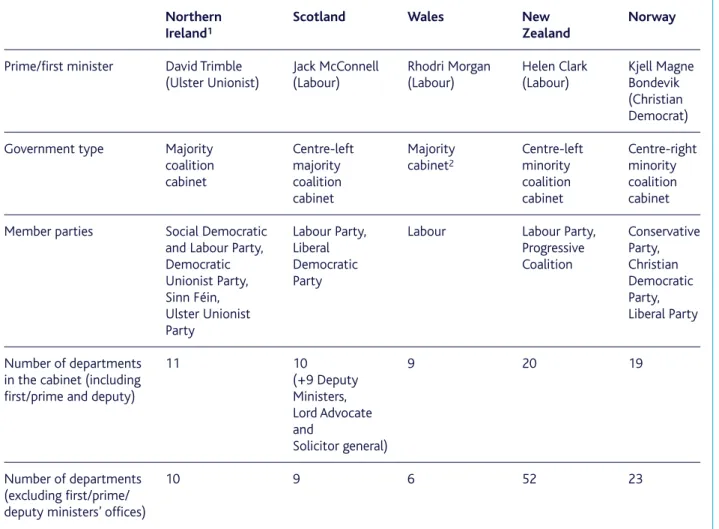
Table 3.2 documents some central features of the executives and cabinets in the five countries. Most distinctly, two of the executives in the three UK countries, and both New Zealand and Norway, had coalition cabinets. The presence of coalition cabinets was distinct from the traditional Westminster practice. However, coalition – and especially minority – governments may not enact policies as easily as majority and one-party governments can do.
Notes:
1 According to the Northern Ireland Assembly website, the Assembly was suspended from midnight on 14 October 2002 and was dissolved on 28 April 2003. Elections to the Northern Ireland Assembly were held on 26 November 2003. The secretary of state assumed responsibility for the direction of the Northern Ireland departments. A new executive was not established at the time of writing (June 2004).
2 Wales had a Labour Party executive in December 2003. However, for most of the period for our empirical study (2001–2003), Wales had a centre-left majority coalition cabinet of Labour and the Liberal Democrats, led by Rhodri Morgan (Labour) as first minister.
Table 3.2 The Executives and Cabinets (December 2003)
Northern Scotland Wales New Norway
Ireland1 Zealand
Prime/first minister David Trimble Jack McConnell Rhodri Morgan Helen Clark Kjell Magne
(Ulster Unionist) (Labour) (Labour) (Labour) Bondevik
(Christian Democrat)
Government type Majority Centre-left Majority Centre-left Centre-right
coalition majority cabinet2 minority minority
cabinet coalition coalition coalition
cabinet cabinet cabinet
Member parties Social Democratic Labour Party, Labour Labour Party, Conservative
and Labour Party, Liberal Progressive Party,
Democratic Democratic Coalition Christian
Unionist Party, Party Democratic
Sinn Féin, Party,
Ulster Unionist Liberal Party
Party
Number of departments 11 10 9 20 19
in the cabinet (including (+9 Deputy
first/prime and deputy) Ministers,
Lord Advocate and
Solicitor general)
Number of departments 10 9 6 52 23
(excluding first/prime/ deputy ministers’ offices)
On the other hand, coalition governments may have advantages when it comes to learning (Olsen and Peters, 1996). It could be argued that in political systems with coalition governments, management accounting models that include such features as RAB, performance measurement and performance audits may be used more for ‘learning’ than for ‘blaming’ compared to practice in systems with majority governments (Westminster).
There are some notable differences between the five countries. The national governments in New Zealand and Norway had about twice the number of members compared to the executives. Note also the large number of departments (52) in the New Zealand government, about twice the number of those in Norway (23).
3.3 National Audit Institutions
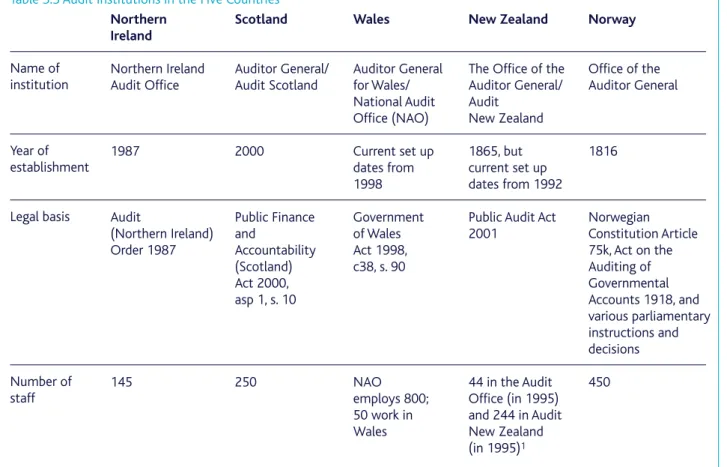
The last institution we shall compare in this chapter is the national audit institution. Table 3.3 presents information regarding the names, year of establishment, legal basis, and numbers of staff of the national audit institutions. As a consequence of the option of the contracting out of certain services, the audit institutions in the UK and New Zealand consist – in principle – of the auditor general and an audit institution. In Norway, all central governmental audits are carried out by the Office of the Auditor General. Some of the audit institutions are relatively old. The national audit institution in Norway was established in 1816. The NAO, in the UK, was established in 1983, but it took over the responsibilities of the former Exchequer and Audit Department, which was established in 1866. The audit institution in New Zealand was established in 1865, modelled on UK legislation.
The audit institutions vary in size from 50 staff in Wales to 450 in Norway. Note, however, that the size of the
Norwegian audit institution was large, compared to the NAO, which had 800 staff in total (including in Wales).
Management Accounting, Devolution and Democratic Accountability
International Comparisons
17
Table 3.3 Audit Institutions in the Five Countries
Name of institution Year of establishment Legal basis Number of staff Northern Ireland Northern Ireland Audit Office 1987 Audit (Northern Ireland) Order 1987 145 Scotland Auditor General/ Audit Scotland 2000 Public Finance and Accountability (Scotland) Act 2000, asp 1, s. 10 250 Wales Auditor General for Wales/ National Audit Office (NAO) Current set up dates from 1998 Government of Wales Act 1998, c38, s. 90 NAO employs 800; 50 work in Wales New Zealand
The Office of the Auditor General/ Audit New Zealand 1865, but current set up dates from 1992 Public Audit Act 2001 44 in the Audit Office (in 1995) and 244 in Audit New Zealand (in 1995)1 Norway Office of the Auditor General 1816 Norwegian Constitution Article 75k, Act on the Auditing of Governmental Accounts 1918, and various parliamentary instructions and decisions 450 Notes:
Management Accounting, Devolution and Democratic Accountability
International Comparisons
18
3.4 New Public Management (NPM)
In general, New Zealand and the UK have been in the forefront in implementing NPM. While NPM, in both the UK and New Zealand, has been in broad conformance with the ideas, principles and practices of ‘managerialism’, the New Zealand model is distinguished by its conceptual rigour and intellectual coherence (Boston et al., 1996).
In the UK, there has been widespread public management reform via privatisation, marketisation and output
orientation. The UK government has developed performance measurement and performance auditing more than in New Zealand and Norway (Pollitt et al., 1999). At least until recently, however, the degree of decentralisation in the UK has been very low, evidenced by the fact that the government has relatively strong control over local government.
Like the UK, New Zealand has also adopted market-type-models and contractualism enthusiastically. New Zealand has extended the use of strategic planning in public management beyond that in the UK and Norway (Boston and Pallot, 1997). Both the UK and New Zealand have been renowned for their intensity in the implementation of public management reforms (Pollitt and Bouckaert, 2000). For instance, in 1992, New Zealand became the first country to produce financial statements on an accrual basis for its national government. In comparison, the UK implemented RAB in 2001 (Likierman, 2001) and accrual accounting in government is currently under consideration in Norway. However, even though the New Zealand model is distinct, there is a high degree of pragmatism with regard to its implementation (Boston et al., 1996).
The high implementation intensity in the UK and New Zealand contrasts to Norway, which has developed along the highly consensual, decentralised, Nordic political model. Norway is often labelled as a ‘slow learner’, or as a reluctant or hesitant reformer, at least at governmental level (Olsen and Peters, 1996). Compared to the UK and New Zealand, policy in Norway is implemented incrementally following consensual policy-making, even though (coalition) governments change (Matthews and Valen, 1999).
3.5 Public Management Culture
Public management culture in the five countries in our study can be compared using public management culture theory to describe potential important traits of those countries. Opinions on what the ‘best’ public management is will, according to Hood’s (1998) public management culture theory, depend on cultural platforms and on history. The public management cultural theory framework distinguishes four styles of public management: ●hierarchist;
●egalitarian; ●individualist; and ●fatalist.
A hierarchist approach features socially coherent organisations and operates according to well-understood rules of procedure. In the UK, there are the traditional hierarchies of aristocracy, middle class and working class. Westminster, with its division in the House of Lords and the House of Commons, frontbenchers, backbenchers and party whips, is another possible example of a hierarchist public management style. A hierarchist style is also the traditional, public sector bureaucracy.
An egalitarian approach has organisations that are socially distinct from the world outside, but where the rules of the game are debated constantly. Examples of an egalitarian management style could be rules regulating voting and representation, rules for the political representatives’, and the public’s, access to governmental information, and lobbying from environmental, feminist or fundamentalist interest groups, as recently depicted in sociology by the individualist and informal, reinvented notion of politics (Beck, 1997). The Scandinavian tradition of democratic corporatism could also be included as part of the egalitarian management style. The consultation element, including corporatism and lobbying activities, is well established in Scandinavian public management and is now also a significant aspect of the programme of devolution.
An individualist approach involves antipathy to collectivism and a preference for handling transactions by trading or negotiations rather than by pre-set rules. Typical approaches along the ‘bottom-up’, individualist management style could be found in the extended use of the market in NPM. New Zealand and UK public management have probably utilised these kinds of models – including performance (VFM) auditing, performance measurement, league tables, targets, annual reporting, privatisation and contracting out – relatively extensively since the 1970s.
A fatalist approach features conditions with little
co-operation, widespread distrust and much apathy. Typical fatalist management would be to acknowledge that crises and scandals happen, and work to prevent or minimise the impact of such events. This style is rarely found as a
pre-meditated management style in practice, but it should be very familiar to politicians. Note, however, that the
opposition and government MPs at Westminster are seated facing each other in the Commons, while the MLAs in Wales and MSPs in Scotland are seated in a ‘horse shoe’ form, and MLAs in Northern Ireland debate in a layout utilising three sides of a rectangle. Thus, the Westminster assembly room may facilitate debate and confrontation, while the devolved assembly rooms may facilitate debate and consensus, at least more than at Westminster.
Many of the roles that accounting, media and whistleblowers have in politics, may be attributed to a fatalist style of management. Furthermore, in such a culture, the government might expect the political opposition to use accounting as an ammunition machine (Burchell et al., 1980) for scrutinising the government. At the same time, expert knowledge of the design of the accounting system and the assumptions underlying the disclosed information, could be cunningly utilised, for example by ‘insiders’, or by the government. Based on the available literature and preliminary evidence, Westminster predominantly has a strong hierarchist (and individualist) culture but the three UK countries in our study have less so.
Furthermore, observations of meetings in the Northern Ireland and Welsh national assemblies indicate that these have a more informal, egalitarian political culture than Scotland. This is supported in the interviews where it is evident that Scotland’s point of reference still is (hierarchist) Westminster. (For a description of the research methods that we use, see Chapter 4).
New Zealand and Westminster have the most individualist culture, while the other four countries have a medium level of individualist culture.
Norway has a predominantly egalitarian public management culture, more so than any of the other four countries. Schlesinger, Millar and Dinan (2001) have revealed a fierce media competition in Scotland where the media, especially tabloid newspapers, actively utilise political scandals. Norway has traditionally had a relatively high level of trust in people and in political institutions, including the government and the parliament, Stortinget (Matthews and Valen, 1999). These patterns may indicate that Scotland (together with Westminster) has a more fatalist political culture than the other four countries in this study.
3.6 Conclusion
In this chapter, some traits in our five countries have been documented and compared. According to the framework in Figure 1.1, traits like these may influence the use of accounting and how accounting affects democratic accountability. Both the similarities and the distinctions should be kept in mind in analysis and comparisons across countries and over time in the subsequent chapters. Before turning to an analysis of the empirical evidence that was gathered, the research methods will be discussed.
Management Accounting, Devolution and Democratic Accountability
Research Methods
20
4.1 Research Design
The research design is a multi-case, embedded case study (Yin, 1994). A multi-case study means that each devolved country was studied with its institutions as single cases. Thus, each case may serve as a replication study, an ‘experiment’, within the total study. An embedded case study means that within each case, several units and subunits of analysis were used. Individuals as politicians, civil servants and audit officers were studied, as were groups as meetings, committees and parties. Organisations as parliamentary, governmental and audit institutions were also studied.
The overall research strategy was to ensure a planned variation design between the five cases (Eisenhardt, 1989). A similar approach was employed in Northern Ireland, Scotland, Wales, New Zealand and Norway in order to develop a shared project ‘database’ and to ensure sensible and meaningful comparability. There are multiple sources of data and methods (Denzin, 1970).
4.2 Data Collection
The embedded research approach used both qualitative and quantitative data, focussing on key actors in five study settings: the devolved parliaments/assemblies of Scotland, Northern Ireland and Wales and the Parliaments of Norway and New Zealand. Key actors within three groups in this study were distinguished.
The first group of key actors were members of the Scottish Parliament (MSPs), and members of the legislative assemblies (MLAs) in Northern Ireland and Wales. Such key actors were seen as elected members of these bodies in oversight committees, particularly those parliamentary select committees with overall responsibility for major parts of public expenditure programmes such as health care, education and local government. These actors can be further labelled as spokespersons, ‘frontbenchers’ or committee conveners versus laymen politicians. The second group of key actors were ministers and eventually other members of the executives. The third group consisted of other key actors, such as audit officers, advisers, civil servants and other experts. The data collected involved informal semi-structured interviews, backed by documentation and policies. The rationale for this is based on the interactionist’s premise that, when the aim of the research is to understand a complex process where those involved have different perspectives on the matter in question, it makes sense to adopt a research strategy which allows these perspectives to be understood in the same terms in which the participants understand them (Blumer, 1969).
Early on in the project three important research strategies were decided upon:
●to sharpen the focus of the project by focussing on specific policy areas;
●to standardise the data collection by developing an interview guide that should be used for all the interviews; and
●to conduct semi-structured interviews, and to have a series of research group workshops for the analysis of preliminary findings.
In order to develop in-depth insights, it was decided to focus the project on issues and committees concerning two of the main policy areas: education and health. These policy areas represent major expenses in public budgets and are areas of significant interest and importance to citizens and clients, as well as to the political establishment. However, it should be noted that, in some countries, the politicians served in two or more committees simultaneously. Thus, politicians and other interviewees with lengthy experience may have had
backgrounds spanning wider policy areas than education and health.
The interview guide was developed by discussing the inclusion and operationalisation of relevant issues and concepts drawn out of a literature review, relevant legislation and an understanding of the key issues pertinent to the research questions. Important considerations in the design of the interview guide were to keep the interview to a
reasonable length and focussed. The interview guide was tested in two pilot interviews, in Edinburgh, in January 2002. The main interviews were conducted in the period January 2002 to May 2004. All of the interviews were tape recorded and transcribed. The interview questions encompassed questions on personal background, the interviewees’ conception of accounting and accountability issues, on the general availability and use of information, on RAB, performance information and budgeting.
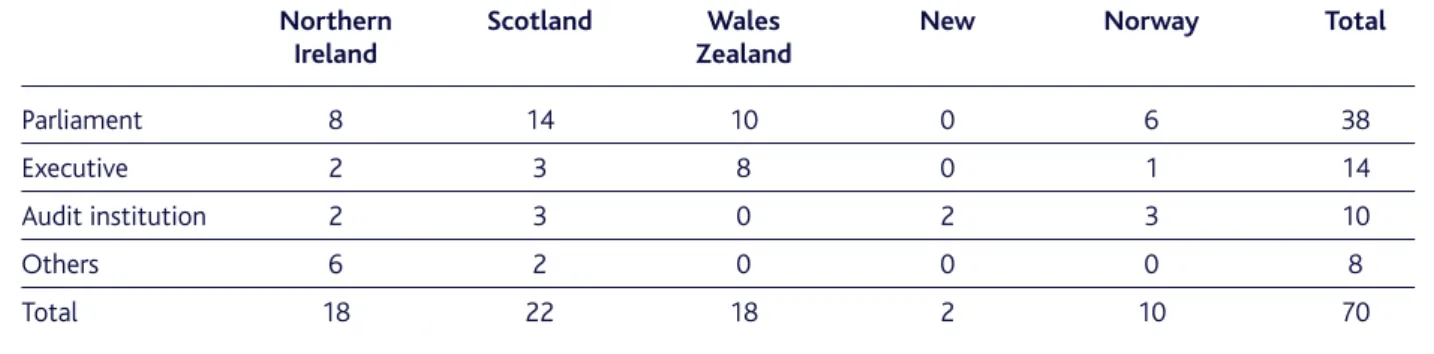
Due to the sensitive issues that were studied, and due to the fact that most politicians and civil servants are very busy, it was anticipated that using ordinary surveys by mail or telephone would result in a low response rate and/or superficial data. Therefore, face-to-face interviews were conducted with a smaller number of interviewees, and with the possibility of more than one member of the research team participating in the interviews each time. In order to achieve conceptual representation in the data relative to the population of elected politicians, there was an attempt to achieve variation with regard to age, gender, party affiliation and committee experience. This procedure produced a total of 70 interviews. In addition, all the interviewees consented to be re-approached, in order to follow up emerging themes or unsettled issues. The interviews varied in duration from 30 to around 75 minutes each. Table 4.1 shows the numbers of interviews by country and organisation. One of the members of the research team had recently participated in extensive studies of the New Zealand case. Therefore, this information background was added, with two more interviews, in order to cover the focus area of this project.