A Unified Theory of Tobin’s
q
, Corporate Investment,
Financing, and Risk Management
∗Patrick Bolton† Hui Chen‡ Neng Wang§
Forthcoming, Journal of Finance
∗We are grateful to Andrew Abel, Peter DeMarzo, Janice Eberly, Andrea Eisfeldt, Mike Faulkender, Michael
Fish-man, Dirk Hackbarth, Christopher Hennessy, Pete Kyle, Yelena Larkin, Robert McDonald, Stewart Myers, Marco Pagano, Gordon Phillips, Robert Pindyck, David Scharfstein, Jiang Wang, Toni Whited, and seminar participants at Boston College, Boston University, Columbia Business School, Duke Fuqua, MIT Sloan, NYU Stern and NYU Eco-nomics, U.C. Berkeley Haas, Yale SOM, University of Maryland Smith, Northwestern University Kellogg, Princeton, Lancaster, Virginia, IMF, HKUST Finance Symposium, AFA, the Caesarea Center 6th Annual Academic Confer-ence, European Summer Symposium on Financial Markets (ESSFM/CEPR), and Foundation for the Advancement of Research in Financial Economics (FARFE) for their comments.
†Columbia University, NBER and CEPR. Email: [email protected]. Tel. 212-854-9245. ‡MIT Sloan School of Management and NBER. Email: [email protected]. Tel. 617-324-3896. §Columbia Business School and NBER. Email: [email protected]. Tel. 212-854-3869.
A Unified Theory of Tobin’s
q
, Corporate Investment, Financing,
and Risk Management
Abstract
We propose a model of dynamic corporate investment, financing, and risk management for a financially constrained firm. The model highlights the central importance of the endogenous marginal value of liquidity (cash and credit line) for corporate decisions. Our three main results are: 1) investment depends on the ratio of marginal q and marginal value of liquidity, and the relation between investment and marginalq changes with the marginal source of funding; 2) optimal external financing and payout are characterized by an endogenous double barrier policy for the firm’s cash-capital ratio; 3) liquidity management and derivatives hedging are complementary risk-management tools.
When firms face external financing costs, they must deal with complex and closely intertwined investment, financing, and risk management decisions. How to formalize the interconnections among these margins in a dynamic setting and how to translate the theory into day-to-day risk management and real investment policies remains largely to be determined. Questions such as how corporations should manage their cash holdings, which risks they should hedge and by how much, or to what extent holding cash is a substitute for financial hedging are not well understood.
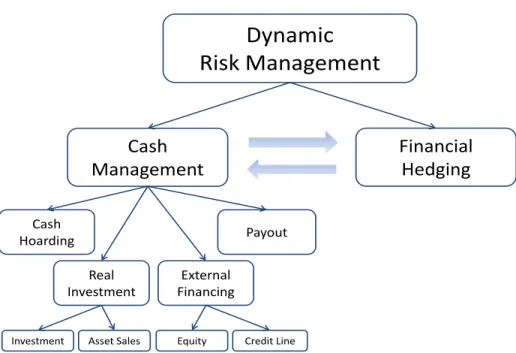
Our goal in this article is to propose the first elements of a tractable dynamic corporate risk management framework — as illustrated in Figure 1 — in which cash inventory, corporate invest-ment, external financing, payout, and dynamic hedging policies are characterized simultaneously for a “financially constrained” firm. We emphasize that risk management is not just about financial hedging; instead, it is tightly connected to liquidity management via daily operations. By bringing these different aspects of risk management into a unified framework, we show how they interact with and complement each other.
The baseline model we propose introduces only the essential building blocks, which are: i) the workhorse neoclassical q model of investment1
featuring constant investment opportunities as in Hayashi (1982); ii) constant external financing costs, which give rise to a corporate cash inventory problem as in Miller and Orr (1966); and, iii) four basic financial instruments: cash, equity, credit line, and derivatives (e.g., futures). This parsimonious model already captures many situations that firms face in practice and yields a rich set of prescriptions.
With external financing costs the firm’s investment is no longer determined by equating the marginal cost of investing with marginal q, as in the neoclassical Modigliani-Miller (MM) model (with no fixed adjustment costs for investment). Instead, investment of a financially constrained
1
Brainard and Tobin (1968) and Tobin (1969) define the ratio between the firm’s market value to the replacement cost of its capital stock, as “Q” and propose to use this ratio to measure the firm’s incentive to invest in capital. This ratio has become known as Tobin’s average Q. Hayashi (1982) provides conditions under which averageQ is equal to marginalq. Abel and Eberly (1994) develop a unifiedq theory of investment in neoclassic settings. Lucas and Prescott (1971) and Abel (1983) are important early contributions.
Financial
Hedging
Dynamic
Risk Management
Cash
Management
Cash HoardingEquity Credit Line Investment Asset Sales
Real Investment
External Financing
Payout
Figure 1: A Unified Framework for Risk Management.
firm is determined by theratio of marginal q to marginal cost of financing:
marginal cost of investing = marginal q
marginal cost of financing.
When firms are flush with cash, the marginal cost of financing is approximately one, so that this equation is approximately the same as the one under MM. But when firms are close to financial distress, the marginal cost of financing, which is endogenous, may be much larger than one so that optimal investment may be far lower than the level predicted under MM. A key contribution of our article is to characterize both analytically and quantitatively the marginal value of cash to a financially constrained firm as a function of the firm’s investment opportunities, cash holding, leverage, external financing costs, and hedging opportunities it faces.2
2
Hennessy, Levy, and Whited (2007) derive a related optimality condition for investment. As they assume that the firm faces quadratic equity issuance costs, the optimal policy for the firm in their setting is to either issue equity or pay out dividends at any point in time. In other words, the firm does not hold any cash inventory and does not face a cash management problem as in our setting.
An important result that follows from the first-order condition above is that the relation between marginalqand investment differs depending on whether cash or credit line is the marginal source of financing. When the marginal source of financing is cash, both marginalq and investment increase with the firm’s cash holdings, as more cash makes the firm less financially constrained. In contrast, when the marginal source of financing is credit line, we show that marginalq and investment move in opposite directions. On the one hand, investment decreases with leverage, as the firm cuts investment to delay incurring equity issuance costs. On the other hand, marginalq increases with the firm’s leverage, because an extra unit of capital helps relax the firm’s borrowing constraint by lowering the debt-to-capital ratio, and this effect becomes increasingly more important as leverage rises. Thus, there is no longer a monotonic relation between investment and marginal q in the presence of credit line, and average q can actually be a more robust indicator for investment.
A second key result concerns the firm’s optimal cash-inventory policy. Much of the empirical literature on firms’ cash holdings tries to identify atarget cash-inventory for a firm by weighing the costs and benefits of holding cash.3
The idea is that this target level helps determine when a firm should increase its cash savings and when it should dissave.4
Our analysis, however, shows that the firm’s cash-inventory policy is much richer, as it involves a combination of a double-barrier policy
characterized by a single variable, the cash-capital ratio, and the continuous management of cash reserves in between the barriers through adjustments in investment, asset sales, as well as the firm’s hedging positions. While this double-barrier policy is not new (it goes back to the inventory model of Miller and Orr 1966 in corporate finance), our model provides substantial new insight on how the different boundaries depend on factors such as the growth rate and volatility of earnings, financing costs, cash holding costs, as well as the dynamics of cash holdings in between these boundaries. Besides cash inventory management, our model can also give concrete prescriptions for how a firm choose its investment, financing, hedging, and payout policies, which are all important parts of
3See Almeida, Campello, and Weisbach (2004, 2008), Faulkender and Wang (2006), Khurana, Martin, and Pereira
(2006), and Dittmar and Mahrt-Smith (2007).
4
Recent empirical studies have found that corporations tend to hold more cash when their underlying earnings risk is higher or when they have higher growth opportunities (see e.g. Opler, Pinkowitz, Stulz, and Williamson (1999) and Bates, Kahle, and Stulz (2009)).
dynamic corporate financial management.
For example, when the cash-capital ratio is higher, the firm invests more and saves less, as the marginal value of cash is smaller. When the firm is approaching the point where its cash reserves are depleted, it optimally scales back investment and may even engage in asset sales. This way the firm can postpone or avoid raising costly external financing. Since carrying cash is costly, the firm optimally pays out cash at the endogenous upper barrier of the cash-capital ratio. At the lower barrier the firm either raises more external funds or closes down. The firm optimally chooses not to issue equity unless it runs out of cash. Using internal funds (cash) to finance investment defers both the cash-carrying costs and external financing costs.5 Thus, with
a constant investment/financing opportunity set our model generates a dynamic pecking order of financing between internal and external funds. The stationary cash-inventory distribution from our model shows that firms respond to the financing constraints by optimally managing their cash holdings so as to stay away from financial distress situations most of the time.
A third new result is that our model integrates two channels of risk management, one via a state non-contingent vehicle (cash), the other via state-contingent instruments (derivatives). In the presence of external financing costs, firm value is sensitive to both idiosyncratic and systematic risk. To limit its exposure to systematic risk, the firm can engage in dynamic hedging via derivatives (such as oil or currency futures). To mitigate the impact of idiosyncratic risk, it can manage its cash reserves by modulating its investment outlays and asset sales, and also by delaying or moving forward its cash payouts to shareholders. Financial hedging (derivatives) and liquidity management (cash, investment, financing, payout) thus play complementary roles in risk management. When dynamic hedging involves higher transactions costs, such as tighter margin requirements, we also show that the firm reduces its hedging positions and relies more on cash for risk management.
There is only a handful of theoretical analyses of firms’ optimal cash, investment and risk man-agement policies. A key first contribution is by Froot, Scharfstein, and Stein (1993), who develop a
5
static model of a firm facing external financing costs and risky investment opportunities.6
Subse-quent contributions on dynamic risk management literature focus on optimal hedging policies and abstract away from corporate investment and cash management. Notable exceptions include Mello, Parsons, and Triantis (1995) and Morellec and Smith (2007), who analyze corporate investment together with optimal hedging. Mello and Parsons (2000) study the interaction between hedging and cash management, but do not model investment. However, none of these models consider external financing or payout decisions. Our dynamic risk management problem uses the same contingent-claim methodology as in the dynamic capital structure/credit-risk models of Fischer, Heinkel, and Zechner (1989) and Leland (1994), but unlike these theories we explicitly model the wedge between internal and external financing of the firm and the firm’s cash accumulation process. Our model extends these latter theories by introducing capital accumulation and thus integrates the contingent-claim approach with the dynamic investment/financing literature.
Our model also provides new and empirically testable predictions on investment and financing constraints. Fazzari, Hubbard, and Petersen (1988) (FHP) are the first to use the sensitivity of investment to cash flow (controlling for q) as a measure of a firm’s financing constraints. Kaplan and Zingales (1997) provide an important critique on FHP and successors from both a theoretical (using a static model) and empirical perspective. Recently, there is growing interest in using dynamic structural models to address this empirical issue, which we discuss next.
Gomes (2001) and Hennessy and Whited (2005, 2007) numerically solve discrete-time dynamic capital structure models with investment for financially constrained firms. They allow for stochas-tic investment opportunities but have no adjustment costs for investment.7
However, these studies do not model a cash accumulation equation and do not consider how cash inventory management interacts with investment and dynamic hedging policies. Hennessy, Levy, and Whited (2007) char-acterize a related investment first-order condition for a financially constrained firm to ours, but
6
See also Kim, Mauer, and Sherman (1998). Another more recent contribution by Almeida, Campello, and Weisbach (2008) extends the Hart and Moore (1994) theory of optimal cash holdings by introducing cash flow and investment uncertainty in a three-period model.
7
Recently, Gamba and Triantis (2008) have extended Hennessy and Whited (2007) to introduce issuance costs of debt and hence obtain the simultaneous existence of debt and cash.
they consider a model with quadratic equity issuance costs, which leads to a fundamentally dif-ferent cash management policy from ours. Using a model related to Hennessy and Whited (2005, 2007), Riddick and Whited (2009) show that saving and cash flow can be negatively related after controlling for q, because firms use cash reserves to invest when receiving a positive productivity shock.8
In contrast to the impressive volume of work studying how adjustment costs affect investment,9
very few analytical results are available on the impact of external financing costs on investment. Our model fills this gap by exploiting the simplicity of a framework that is linearly homogeneous in cash and capital, and for which a complete analytical characterization of the firm’s optimal investment and financing policies, as well as its dynamic hedging policy and its use of credit lines is possible. In terms of methodology, our paper is also related to Decamps, Mariotti, Rochet, and Villeneuve (2006), who explore a continuous-time model of a firm facing external financing costs. Unlike our set-up, their firm only has a single infinitely-lived project of fixed size, so that they cannot consider the interaction of the firm’s real and financial policies.
The paper that is most closely related to ours is DeMarzo, Fishman, He, and Wang (2010), henceforth DFHW. Both our paper and DFHW consider models of corporate investment that in-tegrate dynamic agency frictions into the neoclassic q theory of investment (e.g. Hayashi (1982)). The approach taken in DFHW is more microfounded around an explicit dynamic contracting prob-lem with moral hazard, where investors dynamically manage the agent’s continuation payoff based on the firm’s historical performance. The key state variable is their dynamic contracting problem is thus the manager’s continuation payoff.10
Their dynamic contracting framework endogenizes the firm’s financing constraints in a similar way to ours, even though firm value in their framework is expressed as a function of a different state variable. One key difference, however, between the two
8
In a related study, DeAngelo, DeAngelo, and Whited (2009) model debt as a transitory financing vehicle to meet the funding needs associated with random shocks to investment opportunities.
9
See Caballero (1999) for a survey on this literature.
10
The manager’s continuation payoff gives the agent’s present value of his future payments, discounted at his own rate. Interestingly, it can be interpreted as a measure of distance to liquidation/refinancing and can be linked to financial slack via (non-unique) financial implementation.
models is in the dynamics of the state variable measuring financial slack. In DFHW, the manager’s equilibrium effort choice affects the volatility of financial slack but not directly the drift. In our model, in contrast, the manager directly influences the drift, but not the volatility of the dynamics of financial slack. As a result, investment is monotonically linked to marginal q in DFHW, while investment is linked to the ratio between marginal q and the endogenous marginal value of finan-cial slack in our model. This distinction leads to different implications on corporate investment, financing policies, and payout to investors in the two models.
The remainder of the paper proceeds as follows. Section I sets up our baseline model. Section II presents the model solution. Section III continues with quantitative analysis. Section IV and V extend the baseline model to allow for financial hedging and credit line financing. Section VI concludes.
I
Model Setup
We first describe the firm’s physical production and investment technology, then introduce the firm’s external financing costs and its opportunity cost of holding cash, and finally state firm optimality.
A. Production Technology
The firm employs physical capital for production. The price of capital is normalized to unity. We denote by K and I respectively the level of capital stock and gross investment. As is standard in capital accumulation models, the firm’s capital stock K evolves according to:
dKt= (It−δKt)dt, t≥0, (1)
whereδ ≥0 is the rate of depreciation.
KtdAt, where dAt is the firm’s revenue or productivity shock over time increment dt. We assume
that after accounting for systematic risk the firm’s cumulative productivity evolves according to:
dAt =µdt+σdZt, t≥0, (2)
where Z is a standard Brownian motion under the risk-neutral measure.11
Thus, productivity shocks are assumed to bei.i.d., and the parametersµ >0 andσ >0 are the mean and volatility of the risk-adjusted productivity shockdAt. This production specification is often refereed to as the
“AK” technology in the macroeconomics literature.12
The firm’s incremental operating profitdYt over time incrementdt is then given by:
dYt=KtdAt−Itdt−G(It, Kt)dt, t≥0, (3)
whereG(I, K) is the additional adjustment cost that the firm incurs in the investment process. We may interpret dYt as cash flows from operations. Following the neoclassical investment literature
(Hayashi (1982)), we assume that the firm’s adjustment cost is homogeneous of degree one in I
and K. In other words, the adjustment cost takes the formG(I, K) =g(i)K, whereiis the firm’s investment capital ratio (i = I/K), and g(i) is an increasing and convex function. While our analyses do not depend on the specific functional form of g(i), we adopt the standard quadratic form for simplicity:
g(i) = θi
2
2 , (4)
where the parameter θ measures the degree of the adjustment cost. Finally, we assume that the
11
We assume that markets are complete and are characterized by a stochastic discount factor Λt, which follows dΛt
Λt =−rdt−ηdBbt, whereBbtis a standard Brownian motion under the physical measureP, andηis the market price
of risk (the Sharpe ratio of the market portfolio in the CAPM). Then, Bt =Bbt+ηt will be a standard Brownian
motion under the risk-neutral measureQ. Finally,Zt is a standard Brownian motion underQ, and the correlation
betweenZtandBtisρ. Then, the mean productivity shock underPis ˆµ=µ+ηρσ. 12
Cox, Ingersoll, and Ross (1985) develop an equilibrium production economy with the “AK” technology. See Jones and Manuelli (2005) for a recent survey in macro.
firm can liquidate its assets at any time. The liquidation value Lt is proportional to the firm’s
capital, Lt=lKt, wherel >0 is a constant.
Note that these classic AK–production technology assumptions, plus the quadratic adjustment cost, and the liquidation technology imply that the firm’s investment opportunities are constant over time. Without financing frictions, the firm’s investment-capital ratio, average and marginal
q are therefore all constant over time. We intentionally choose such a simple setting in order to highlight the dynamic effects of financing frictions, keeping investment opportunities constant. Moreover, these assumptions allow us to deliver the key results in a parsimonious and analytically tractable way.13 See also Eberly, Rebelo, and Vincent (2009) for empirical evidence in support of
the Hayashi homogeneity assumption for the upper size-quartile of Compustat firms.
B. Information, Incentives and Financing Costs
Neoclassical investment models (Hayashi (1982)) assume that the firm faces frictionless capital markets and that the Modigliani and Miller (1958) theorem holds. However, in reality, firms often face important external financing costs due to asymmetric information and managerial incentive problems. Following the classic writings of Jensen and Meckling (1976), Leland and Pyle (1977), and Myers and Majluf (1984), a large empirical literature has sought to measure these costs. For example, Asquith and Mullins (1986) found that the average stock price reaction to the announce-ment of a common stock issue was −3% and the loss in equity value as a percentage of the size of the new equity issue was −31%. Also, Calomiris and Himmelberg (1997) have estimated the direct transactions costs firms face when they issue equity. These costs are also substantial. In their sample the mean transactions costs, which include underwriting, management, legal, auditing and registration fees as well as the firm’s selling concession, are 9% of an issue for seasoned public offerings and 15.1% for initial public offerings.
We do not explicitly model information asymmetries and incentive problems. Rather, to be able
13
Non-convex adjustment costs and decreasing returns to scale production function will substantially complicate the analysis and do not permit a closed-form characterization of investment and financing policies.
to work with a model that can be calibrated we directly model the costs arising from information and incentive problems in reduced form. Thus in our model, whenever the firm chooses to issue external equity we summarize the information, incentive, and transactions costs it then incurs by a fixed cost Φ and a marginal cost γ. Together these costs imply that the firm will optimally tap equity markets only intermittently, and when doing so it raises funds in lumps, consistent with observed firm behavior.
To preserve the linear homogeneity of our model, we further assume that the firm’s fixed cost of issuing external equity is proportional to capital stockK, so that Φ =φK. In practice, external costs of financing scaled by firm size are likely to decrease with firm size. With this caveat in mind, we point out that there are conceptual, mathematical, and economic reasons for modeling these costs as proportional to firm size. First, by modeling the fixed financing costs proportional to firm size, we ensure that the firm does not grow out of the fixed costs.14
Second, the information and incentive costs of external financing may to some extent be proportional to firm size. Indeed, the negative announcement effect of a new equity issue affects the firm’s entire capitalization. Similarly, the negative incentive effect of a more diluted ownership may also have costs that are proportional to firm size. Finally, this assumption allows us to keep the model tractable, and generates stationary dynamics for the firm’s cash-capital ratio.
Having said that, a weakness of our model is that it will be mis-specified as a structural model of firms outside equity issue decisions. The model is likely to work best when applied to mature firms and worst when applied to start-ups and growth firms, as small firms are not scaled-down versions of mature firms in reality. To get sharper quantitative predictions of the effects of external financing costs, would require extending the model to a two-dimensional framework with both capital and cash as state variables. However, the main qualitative predictions of our current model are likely to be robust to this two-dimensional extension. In particular, the endogenous marginal value of cash will continue to play a critical role in determining corporate investment and other financial
14
Indeed, this is a common assumption in the investment literature. See Cooper and Haltiwanger (2006) and Riddick and Whited (2009), among others. If the fixed cost is independent of firm size, it will not matter when firms become sufficiently big in the long run.
decisions.
We denote by Ht the firm’s cumulative external financing up to time t and hence by dHt
the firm’s incremental external financing over time interval (t, t+dt). Similarly, let Xt denote
the cumulative costs of external financing up to time t, and dXt the incremental costs of raising
incremental external funds dHt. The cumulative external equity issuance H and the associated
cumulative costsX are stochastic controls chosen by the firm. In the baseline model of this section, the only source of external financing is equity.
We next turn to the firm’s cash inventory. Let Wt denote the firm’s cash inventory at time t.
In our baseline model with no debt, provided that the firm’s cash is positive, the firm survives with probability one. However, when the firm runs out of cash (Wt= 0) and has no option to borrow, it
has to either raise external funds to continue operating, or it must liquidate its assets. If the firm chooses to raise external funds, it must pay the financing costs specified above. In some situations the firm may prefer liquidation, for example, when the cost of financing is too high or when the return on capital is too low. Letτ denote the firm’s (stochastic) liquidation time. If τ =∞, then the firm never chooses to liquidate.
The rate of return that the firm earns on its cash inventory is the risk-free rate r minus a
carry cost λ > 0 that captures in a simple way the agency costs that may be associated with free cash in the firm.15 Alternatively, the cost of carrying cash may arise from tax distortions. Cash
retentions are tax disadvantaged as interest earned by the corporation on its cash holdings is taxed at the corporate tax rate, which generally exceeds the personal tax rate on interest income (Graham 2000 and Faulkender and Wang 2006). The benefit of a payout is that shareholders can invest at the risk-free rate r, which is higher than (r −λ) the net rate of return on cash within the firm. However, paying out cash also reduces the firm’s cash balance, which potentially exposes the firm to current and future under-investment and future external financing costs. The tradeoff between
15
This assumption is standard in models with cash. For example, see Kim, Mauer, and Sherman (1998) and Riddick and Whited (2009). Ifλ= 0, the firm will never pay out cash since keeping cash inside the firm has no costs but still has the benefits of relaxing financing constraints. If the firm is better at identifying investment opportunities than investors, we haveλ <0. In that case, raising funds for earning excess return is potentially a positive NPV project. We do not explore the cases whereλ≤0.
these two factors determines the optimal payout policy. We denote by Ut the firm’s cumulative
(non-decreasing) payout to shareholders up to timet, and bydUt the incremental payout over time
interval dt. Distributing cash to shareholders may take the form of a special dividend or a share repurchase.16
Combining cash flow from operationsdYtgiven in (3), with the firm’s financing policy given by
the cumulative payout processU and the cumulative external financing process H, the firm’s cash inventoryW evolves according to the following cash-accumulation equation:
dWt=dYt+ (r−λ) Wtdt+dHt−dUt, (5)
where the second term is the interest income (net of the carry cost λ), the third term dHt is the
cash inflow from external financing, and the last termdUt is the cash outflow to investors, so that
(dHt−dUt) is the net cash flow from financing. This equation is a general accounting identity,
wheredHt,dUt, and dYt are endogenously determined by the firm.
The firm’s financing opportunities are time-invariant in our model, which is not realistic. How-ever, as we will show, even in this simple setting, the interactions of fixed/proportional financing costs with real investment generate several novel and economically significant insights.
Firm optimality. The firm chooses its investment I, payout policyU, external financing policy
H, and liquidation timeτ to maximize shareholder value defined below:
E Z τ 0 e−rt(dUt−dHt−dXt) +e−rτ(lKτ+Wτ) . (6)
The expectation is taken under the risk-adjusted probability. The first term is the discounted value of net payouts to shareholders and the second term is the discounted value from liquidation. Optimality may imply that the firm never liquidates. In that case, we haveτ =∞. We impose the
16
A commitment to regular dividend payments is suboptimal in our model. We exclude any fixed or variable payout costs, which can be added to the analysis.
usual regularity conditions to ensure that the optimization problem is well posed. Our optimization problem is most obviously seen as characterizing the benchmark for the firm’s efficient investment, cash-inventory, dynamic hedging, payout, and external financing policy when the firm faces external financing and cash-carrying costs.
C. The Neoclassical Benchmark
As a benchmark, we summarize the solution for the special case without financing frictions, in which the Modigliani-Miller theorem holds. The firm’s first-best investment policy is given by
IF B
t =iF BKt, where17
iF B =r+δ− q
(r+δ)2−2 (µ−(r+δ))/θ. (7)
The value of the firm’s capital stock is qF BK
t, whereqF B is Tobin’ s q,
qF B = 1 +θiF B. (8)
Three observations are in order. First, due to the homogeneity property in production tech-nology, marginal q is equal to average (Tobin’s)q, as in Hayashi (1982). Second, gross investment
It is positive if and only if the expected productivity µis higher than r+δ. With µ > r+δ and
hence positive investment, installed capital earns rents. Therefore, Tobin’s q is greater than unity due to adjustment costs. Third, idiosyncratic productivity shocks have no effect on investment or firm value. Next, we analyze the problem of a financially constrained firm.
17
For the first-best investment policy to be well defined, the following parameter restriction is required: (r+δ)2− 2 (µ−(r+δ))/θ >0.
II
Model Solution
When the firm faces costs of raising external funds, it can reduce future financing costs by retain-ing earnretain-ings (i.e. hoardretain-ing cash) to finance its future investments. Firm value then depends on two natural state variables, its stock of cash W and its capital stock K. Let P(K, W) denote the firm value. We show that firm decision-making and firm value then depend on which of the following three regions it finds itself in: i) an external funding/liquidation region, ii) an internal financing region, and iii) a payout region. As will become clear below, the firm is in the external funding/liquidation region when its cash stockW is less than or equal an endogenouslower barrier
W. It is in the payout region when its cash stockW is greater than or equal an endogenous upper barrier W. And it is in the internal financing region when W is in between W and W. We first characterize the solution in the internal financing region.
A. Internal Financing Region
In this region, firm valueP(K, W) satisfies the following Hamilton-Jacobi-Bellman (HJB) equation:
rP(K, W) = max
I (I−δK)PK+ [(r−λ)W +µK−I−G(I, K)]PW +
σ2K2
2 PW W. (9)
The first term (thePKterm) on the right side of (9) represents the marginal effect of net investment
(I −δK) on firm valueP(K, W). The second term (thePW term) represents the effect of the firm’s
expected saving on firm value, and the last term (thePW W term) captures the effects of the volatility
of cash holdings W on firm value.
The firm finances its investment out of the cash inventory in this region. The convexity of the physical adjustment cost implies that the investment decision in our model admits an interior solution. The investment-capital ratio i=I/K then satisfies the following first-order condition:
1 +θi= PK(K, W)
PW(K, W)
With frictionless capital markets (the MM world) the marginal value of cash is PW = 1, so
that the neoclassical investment formula obtains: PK(K, W) is the marginal q, which at the
op-timum is equal to the marginal cost of adjusting the capital stock 1 +θi. With costly external financing, on the other hand, the investment Euler equation (10) captures both real and financial frictions. The marginal cost of adjusting physical capital (1 +θi) is now equal to the ratio of marginal q, PK(K, W), to the marginal cost of financing (or equivalently, the marginal value of
cash), PW(K, W). Thus, the more costly the external financing (the higher PW) the less the firm
invests, ceteris paribus.
A key simplification in our setup is that the firm’s two-state optimization problem can be reduced to a one-state problem by exploiting homogeneity. That is, we can write firm value as
P(K, W) =K·p(w), (11)
where w=W/K is the firm’s cash-capital ratio, and reduce the firm’s optimization problem to a one-state problem in w. The dynamics ofw can be written as:
dwt = (r−λ)wtdt−(i(wt) +g(i(wt))dt+ (µdt+σdZt). (12)
The first term on the right-hand side is the interest income net of cash-carrying costs. The second term is the total flow-cost of (endogenous) investment (capital expenditures plus adjustment costs). While most of the time we havei(wt)>0, the firm may sometimes want to engage in asset
sales (i.e. set i(wt) < 0) in order to replenish its stock of cash and thus delay incurring external
financing costs. Finally, the third term is the realized revenue per unit of capital (dA). In accounting terms, this equation provides the link between the firm’s income statement (source and use of funds) and its balance sheet.
Instead of solving for firm value P(K, W), we only need to solve for the firm’s value-capital ratio p(w). Note that marginal q is PK(K, W) = p(w) −wp′(w), the marginal value of cash
is PW(K, W) = p′(w), and PW W = p′′(w)/K. Substituting these terms into (9) we obtain the
following ordinary differential equation (ODE) forp(w):
rp(w) = (i(w)−δ) p(w)−wp′(w)+ ((r−λ)w+µ−i(w)−g(i(w)))p′(w) +σ
2
2 p
′′(w). (13)
We can also simplify the FOC (10) to obtain the following equation for the investment-capital ratioi(w): i(w) = 1 θ p(w) p′(w) −w−1 . (14)
Using the solution p(w) and substituting for this expression of i(w) in (12) we thus obtain the equation for the firm’s optimal accumulation of w.
To completely characterize the solution for p(w), we must also determine the boundaries wat which the firm raises new external funds (or closes down), how much to raise (the target cash-capital ratio after issuance), andw at which the firm pays out cash to shareholders.
B. Payout Region
Intuitively, when the cash-capital ratio is very high, the firm is better off paying out the excess cash to shareholders to avoid the carry carry cost. The natural question is how high the the cash-capital ratio needs to be before the firm pays out. Letwdenote this endogenous payout boundary. Intuitively, if the firm starts with a large amount of cash (w > w), then it is optimal for the firm to distribute the excess cash as a lump-sum and bring the cash-capital ratiowdown to w. Moreover, firm value must be continuous before and after cash distribution. Therefore, for w > w, we have the following equation forp(w):
p(w) =p(w) + (w−w), w > w. (15)
following condition for the endogenous upper boundaryw:
p′(w) = 1. (16)
At w the firm is indifferent between distributing and retaining one dollar, so that the marginal value of cash must equal one, which is the marginal cost of cash to shareholders. Since the payout boundary w is optimally chosen, we also have the following “super contact” condition (see, e.g. Dumas (1991)):
p′′(w) = 0. (17)
C. External Funding/Liquidation Region
When the firm’s cash-capital ratio w is less than or equal to the lower barrier w, the firm either incurs financing costs to raise new funds or liquidates. Depending on parameter values, it may prefer either liquidation or refinancing by issuing new equity. Although the firm can choose to liquidate or raise external funds at any time, we show that it is optimal for the firm to wait until it runs out of cash, i.e.w= 0. The intuition is as follows. First, because investment incurs convex adjustment cost and the production is an efficient technology (in the absence of financing costs), the firm does not want to prematurely liquidate. Second, in the case of external financing, cash within the firm earns a below-market interest rate (r−λ), while there is also time value for the external financing costs. Since investment is smooth (due to convex adjustment cost), the firm can always pay for any level of investment it desires with internal cash as long asw >0. Thus, without any benefit for early issuance, it is always better to defer external financing as long as possible. The above argument highlights the robustness of the pecking order between cash and external financing in our model. With stochastic financing cost or stochastic arrival of growth options, the firm may time the market by raising cash in times when financing costs are low. See Bolton, Chen, and Wang (2010).
When the expected productivity µ is low and/or cost of financing is high, the firm will prefer liquidation to refinancing. In that case, because the optimal liquidation boundary is w = 0, firm value upon liquidation is thusp(0)K =lK. Therefore, we have
p(0) =l. (18)
If the firm’s expected productivity µis high and/or its cost of external financing is low, then it is better off raising costly external financing than liquidating its assets when it runs out of cash. To economize fixed issuance costs (φ >0), firms issue equity in lumps. With homogeneity, we can show that total equity issue amount is mK, where m >0 is endogenously determined as follows. First, firm value is continuous before and after equity issuance, which implies the following condition for
p(w) at the boundaryw= 0:
p(0) =p(m)−φ−(1 +γ)m. (19) The right side represents the firm value-capital ratiop(m) minus both the fixed and the proportional costs of equity issuance, per unit of capital. Second, sincemis optimally chosen, the marginal value of the last dollar raised must equal one plus the marginal cost of external financing, 1 +γ. This gives the following smoothing pasting boundary condition at m:
p′(m) = 1 +γ. (20)
D. Piecing the Three Regions Together
To summarize, for the liquidation case, the complete solution for the firm’s value-capital ratiop(w) and its optimal dynamic investment policy is given by: i) the HJB equation (13); ii) the investment-capital ratio equation (14), and; iii) the liquidation (18) and payout boundary conditions (16)-(17). Similarly, when it is optimal for the firm to refinance rather than liquidate, the complete solution
for the firm’s value-capital ratio p(w) and its optimal dynamic investment and financing policy is given by: i) the HJB equation (13); ii) the investment-capital ratio equation (14); iii) the equity-issuance boundary condition (19); iv) the optimality condition for equity equity-issuance (20), and; v) the endogenous payout boundary conditions (16)-(17). Finally, to verify that refinancing is indeed the firm’s global optimal solution, it is sufficient to check thatp(0)> l.
III
Quantitative Analysis
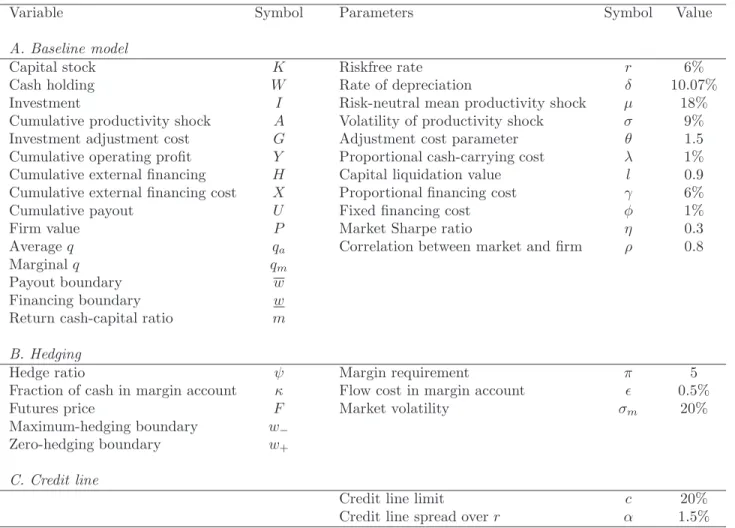
We now turn to quantitative analysis of the baseline model. For the benchmark case, we set the mean and volatility of the risk-adjusted productivity shock to µ= 18% andσ = 9%, respectively, which are in line with the estimates of Eberly, Rebelo, and Vincent (2009) for large US firms. The riskfree rate is r = 6%. The rate of depreciation is δ = 10.07%. These parameters are all annualized. The adjustment cost parameter isθ= 1.5 (see Whited 1992). The implied first-bestq
in the neoclassical model isqF B = 1.23, and the corresponding first-best investment-capital ratio is
iF B = 15.1%. We then set the cash-carrying cost parameter toλ= 1%. The proportional financing
cost is γ = 6% (see Altinkihc and Hansen 2000) and the fixed cost of financing is φ= 1%, which jointly generate average equity financing costs that are consistent with the data. Finally, for the liquidation value we take l = 0.9 (as suggested in Hennessy and Whited 2007). Table I Panel A recapitulates all the key variables and parameters in the model.
Before analyzing the impact of costly external equity financing, we first consider a special case where the firm is forced to liquidate when it runs out of cash. While this is an extreme form of financing constraint, it may be the relevant constraint in a financial crisis.
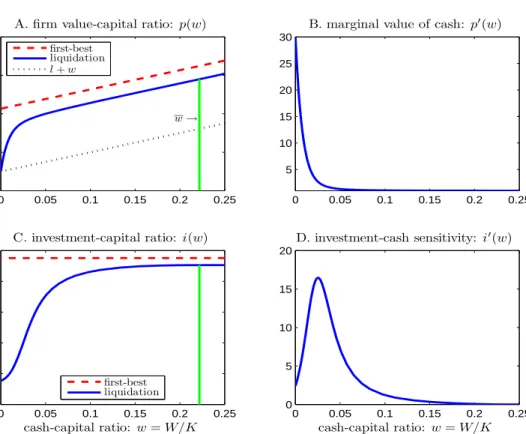
Case I: Liquidation. Figure 2 plots the solution in the liquidation case. In Panel A, the firm’s value-capital ratio p(w) starts at l = 0.9 (liquidation value) when cash balance is equal to 0, is concave in the region between 0 and the endogenous payout boundary w = 0.22, and becomes linear (with slope 1) beyond the payout boundary (w ≥ w). In Section II, we have argued that
Table I: Summary of Key Variables and Parameters
This table summarizes the symbols for the key variables used in the model and the parameter values in the benchmark case. For each upper-case variable in the left column (except K, A, and
F), we use its lower case to denote the ratio of this variable to capital. All the boundary variables are in terms of the cash-capital ratiowt.
Variable Symbol Parameters Symbol Value
A. Baseline model
Capital stock K Riskfree rate r 6%
Cash holding W Rate of depreciation δ 10.07%
Investment I Risk-neutral mean productivity shock µ 18%
Cumulative productivity shock A Volatility of productivity shock σ 9%
Investment adjustment cost G Adjustment cost parameter θ 1.5
Cumulative operating profit Y Proportional cash-carrying cost λ 1%
Cumulative external financing H Capital liquidation value l 0.9
Cumulative external financing cost X Proportional financing cost γ 6%
Cumulative payout U Fixed financing cost φ 1%
Firm value P Market Sharpe ratio η 0.3
Averageq qa Correlation between market and firm ρ 0.8
Marginalq qm
Payout boundary w
Financing boundary w
Return cash-capital ratio m
B. Hedging
Hedge ratio ψ Margin requirement π 5
Fraction of cash in margin account κ Flow cost in margin account ǫ 0.5%
Futures price F Market volatility σm 20%
Maximum-hedging boundary w−
Zero-hedging boundary w+
C. Credit line
Credit line limit c 20%
0 0.05 0.1 0.15 0.2 0.25 0.8 1 1.2 1.4 1.6 w→
A. firm value-capital ratio: p(w)
first-best liquidation l+w 0 0.05 0.1 0.15 0.2 0.25 5 10 15 20 25 30
B. marginal value of cash: p′(w)
0 0.05 0.1 0.15 0.2 0.25 −0.8 −0.6 −0.4 −0.2 0 0.2 cash-capital ratio: w=W/K C. investment-capital ratio: i(w)
first-best liquidation 0 0.05 0.1 0.15 0.2 0.25 0 5 10 15 20 D. investment-cash sensitivity: i′(w) cash-capital ratio:w=W/K
Figure 2: Case I. Liquidation. This figure plots the solution for the case when the firm has to liquidate when it runs out of cash (w= 0).
the firm will never liquidate before its cash balance hits 0. Panel A of Figure 2 provides a graphic illustration of this result, wherep(w) lies above the liquidation valuel+w(normalized by capital) for all w >0.
Panel B of Figure 2 plots the marginal value of cash p′(w) =P
W(K, W). The marginal value
of cash increases as the firm becomes more constrained and liquidation becomes more likely. It also confirms that the firm value is concave in the internal financing region (p′′(w)<0). The external
financing constraint makes the firm hoard cash today in order to reduce the likelihood that it will be liquidated in the future, which effectively induces “risk aversion” for the firm. Consider the effect of a mean-preserving spread of cash holdings on the firm’s investment policy. Intuitively, the marginal cost from a smaller cash holding is higher than the marginal benefit from a larger cash holding because the increase in the likelihood of liquidation outweighs the benefit from otherwise
relaxing the firm’s financing constraints. It is the concavity of the value function that gives rise to the demand for risk management. Observe also that the marginal value of cash reaches a value of 30 asw approaches 0. In other words, an extra dollar of cash is worth as much as $30 to the firm in this region. This is because more cash helps keep the firm away from costly liquidation, which would permanently destroy the firm’s future growth opportunities. Such high marginal value of cash highlights the importance of cash in periods of extreme financing frictions, which is what we have witnessed in the recent financial crisis.
Panel C plots the investment-capital ratio i(w) and illustrates under-investment due to the extreme external financing constraints. Optimal investment by a financially constrained firm is always lower than first-best (iF B = 15.1%), but especially when the firm’s cash inventory w is
low. When w is sufficiently low the firm will disinvest by selling assets to raise cash and move away from the liquidation boundary. Note that disinvestment is costly not only because the firm is underinvesting but also because it incurs physical adjustment costs when lowering its capital stock. For the parameter values we use, asset sales (disinvestments) are at the annual rate of over 60% of the capital stock whenwis close to zero! The firm tries very hard not to be forced into liquidation. Even at the payout boundary, the investment-capital ratio is only i(w) = 10.6%, about 30% lower than the first best level iF B. On the margin, the firm is trading off the cash-carrying costs with
the cost of underinvestment. It will optimally choose to hoard more cash and invest more at the payout boundary when the cash-carrying costλis lower.
Finally, we consider a measure of investment-cash sensitivity given byi′(w). Taking the
deriva-tive of investment-capital ratio i(w) in (14) with respect to w, we get
i′(w) =−1 θ
p(w)p′′(w)
p′(w)2 >0. (21)
The concavity of p ensures that i′(w) > 0 in the internal financing region, as shown in Panel D of Figure 2. Remarkably, the investment-cash sensitivity i′(w) is not monotonic in w. In
Formally, the slope of i′(w) depends on the third derivative ofp(w), for which we do not have an
analytical characterization.
Clearly, certain liquidation when the firm runs out of cash is an extreme form of financing constraint, which is why the marginal value of cash can be as high as $30, and asset sales as high as an annual rate of 60% when the firm runs out of cash. An important insight however from this scenario is that an extreme financing constraint causes the firm to hold more cash, defer payout, and cut investment aggressively even when its cash balances are relatively low. Remarkably, all of these actions help the firm stay away from states of extreme financing constraints most of the time, as our simulations below show.
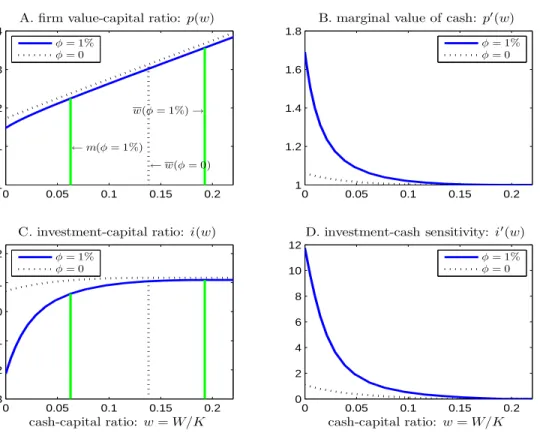
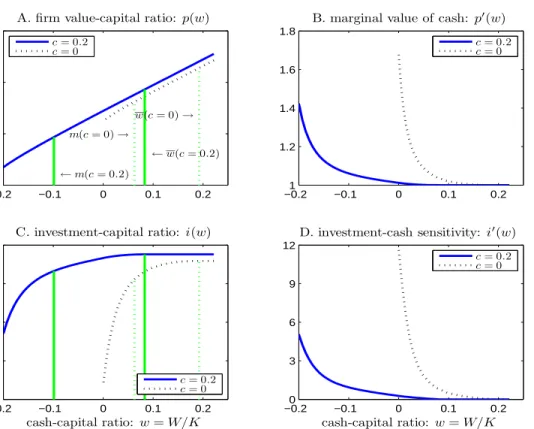
Case II: Refinancing. Next we consider the setting where the firm is allowed to issue equity. Figure 3 displays the solutions for both the case with fixed financing costs (φ= 1%) and without (φ = 0). Observe that at the financing boundary w = 0, the firm’s value-capital ratio p(w) is strictly higher than l, so that external equity financing is preferred to liquidation under this model parameterization. Comparing with the liquidation case, we find that the endogenous payout boundary (marked by the solid vertical line on the right) isw= 0.19 whenφ= 1%, lower than the payout boundary for the case where the firm is liquidated (w = 0.22). Not surprisingly, firms are more willing to pay out cash when they can raise new funds in the future. The firm’s optimalreturn cash-capital ratio is m = 0.06, marked by the vertical line on the left in Panel A. Without fixed cost (φ = 0), the payout boundary drops further to w = 0.14, and the firm’s return cash-capital ratio is zero, as the firm raises just enough funds to keep wabove 0.
Panel B plots the marginal value of cashp′(w). which is positive and decreasing between 0 and w, confirming that p(w) is strictly concave in this case. Conditional on issuing equity and having paid the fixed financing cost, the firm optimally chooses the return cash-capital ratiom such that the marginal value of cashp′(m) is equal to the marginal cost of financing 1 +γ. To the left of the return cash-capital ratiom, the marginal value of cashp′(w) lies above 1+γ, reflecting the fact that
0 0.05 0.1 0.15 0.2 1 1.1 1.2 1.3 1.4 ←m(φ= 1%) w(φ= 1%)→ ←w(φ= 0)
A. firm value-capital ratio:p(w) φ= 1% φ= 0 0 0.05 0.1 0.15 0.2 1 1.2 1.4 1.6 1.8
B. marginal value of cash: p′(w) φ= 1% φ= 0 0 0.05 0.1 0.15 0.2 −0.3 −0.2 −0.1 0 0.1 0.2 cash-capital ratio: w=W/K C. investment-capital ratio: i(w)
φ= 1% φ= 0 0 0.05 0.1 0.15 0.2 0 2 4 6 8 10 12 cash-capital ratio:w=W/K D. investment-cash sensitivity: i′(w) φ= 1% φ= 0
Figure 3: Case II. Optimal refinancing. This figure plots the solution for the case of refinancing.
out of cash, the marginal value of cash is around 1.7, much higher than 1 +γ = 1.06. This result highlights the importance of fixed financing costs: even a moderate fixed cost can substantially raise the marginal value of cash in the low-cash region.
As in the liquidation case, the investment-capital ratio i(w) is increasing in w, and reaches the peak at the payout boundaryw, where i(w) = 11%. Higher fixed cost of financing increases the severity of financing constraints, therefore leading to more underinvestment. This is particularly true in the region to the left of the return cash-capital ratio m, where the investment-capital ratio
i(w) drops rapidly. Asset sales go down quickly (i′(w)>10) whenw moves away from zero. This
is because both asset sales and equity issuance are very costly. Removing the fixed financing costs greatly alleviates the under-investment problem, where both the marginal value of cash and the investment-capital ratio become essentially flat except for very low w.
Average q, marginal q, and investment. We now turn to the model’s predictions on average and marginal q. We take the firm’s enterprise value – the value of all the firm’s marketable claims minus cash, P(K, W)−W – as our measure of the value of the firm’s capital stock. Average q, denoted by qa(w), is then the firm’s enterprise value divided by its capital stock:
qa(w) =
P(K, W)−W
K =p(w)−w. (22)
First, average q increases withw. This is because the marginal value of cash is never below 1, so that q′
a(w) = p′(w)−1 ≥ 0. Second, average q is concave provided that p(w) is concave, in that
q′′
a(w) =p′′(w).
In our model where external financing is costly, marginal q, denoted byqm(w), is given by
qm(w) =
d(P(K, W)−W)
dK =p(w)−wp
′(w) =q
a(w)− p′(w)−1w, (23)
whereqa(w) =p(w)−w(see Equation (22)). An increase in capital stockK has two effects on the
firms enterprise value. First, the more capital stock, the higher the enterprise value. This is the standard averageqchannel, whereqa(w) =p(w)−w. Second, increasing capital stock mechanically
lowers the cash-capital ratio w = W/K forW > 0, thus making the firm more constrained. The wedge between marginalqand average q,−(p′(w)−1)w, reflects this effect of financing constraint
on firm value. With p′(w) >1 and w > 0, that wedge is negative, and marginal q is smaller than
averageq. Third, both marginalq and averageqincrease withwforw >0, becausep(w) is strictly concave. Finally, as a special case, under MM,p′(w) = 1 and hence average q equals marginal q.
Figure 4 plots the average and marginal q for the liquidation case, the refinancing case with no fixed costs (φ= 0), and the case with fixed costs (φ= 1%). The average and marginal q are below the first best level, qF B = 1.23, in all three cases, and they become lower as external financing
0 0.05 0.1 0.15 0.2 0.25 0.9 0.95 1 1.05 1.1 1.15 1.2 cash-capital ratio: w=W/K A. average q case II (φ= 1%) case II (φ= 0) case I 0 0.05 0.1 0.15 0.2 0.25 0.9 0.95 1 1.05 1.1 1.15 1.2 cash-capital ratio: w=W/K B. marginalq case II (φ= 1%) case II (φ= 0) case I
Figure 4: Average q and marginal q. This figure plots the averageq and marginalqfrom the three special cases of the model. Case I is the liquidation case. Case II and III are with external financing. The right end of each line corresponds to the respective payout boundary, beyond which bothqa andqa are flat.
Stationary distributions of w, p(w), p′(w), i(w), average q, and marginal q. We next
investigate the stationary distributions for the key variables tied to optimal firm policies in the benchmark case with refinancing case (φ= 1%).18 We first simulate the cash-capital ratio under
the physical probability measure. To do so, we calibrate the Sharpe ratio of the market portfolio
η= 0.3, and assume that the correlation between the firm technology shocks and the market return is ρ = 0.8. Then, the mean of the productivity shock under the physical probability is ˆµ = 0.20. Figure 5 shows the distributions for the cash-capital ratio w, the value-capital ratio p(w), the marginal value of cash p′(w), and the investment-capital ratioi(w). Sincep(w), p′(w), i(w) are all
monotonic in this case, the densities for their stationary distributions are connected with that ofw
through (the inverse of) their derivatives.
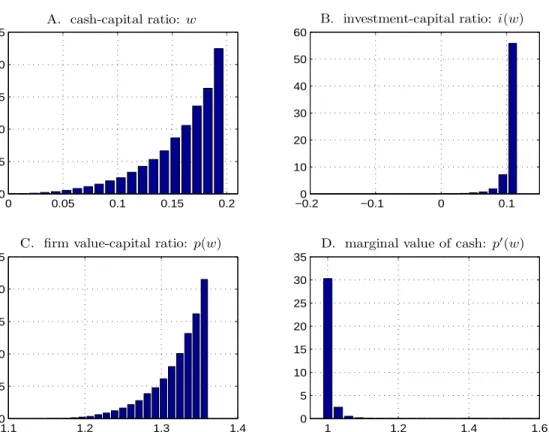
Strikingly, the cash holdings of a firm are relatively high most of the time, and hence the probability mass fori(w) is concentrated at the highest values in the relevant support of w, while
p′(w) is mostly around unity. Thus, the firm’s optimal cash management policies appear to be
effective at shielding itself most of the time from the states with the most severe financing constraints
18
We conduct additional analysis of the effects of various parameters on the distributions of cash and investment in Appendix B.
0 0.05 0.1 0.15 0.2 0 5 10 15 20 25 A. cash-capital ratio: w −0.20 −0.1 0 0.1 10 20 30 40 50 60 B. investment-capital ratio: i(w) 1.1 1.2 1.3 1.4 0 5 10 15 20 25
C. firm value-capital ratio: p(w)
1 1.2 1.4 1.6 0 5 10 15 20 25 30 35
D. marginal value of cash: p′(w)
Figure 5: Stationary distributions in the case of refinancing. This figure plots the probability distribution functions (PDF) for the stationary distributions of cash holding, investment, firm value, and marginal value of cash for the case of refinancing withφ= 1%.
and underinvestment.
Table II reports the mean, median, standard deviation, skewness, and kurtosis forw,i(w),p′(w), qa(w),qm(w), andi′(w). Not surprisingly, all these variables have skewness. The marginal value of
cash and the investment-cash sensitivity are positively skewed, while the remaining variables have negative skewness. Interestingly, the kurtosis fori(w), p′(w),q
a(w), and i′(w) are especially large,
in contrast to their small standard deviations. Thefat tail from the distribution of cash holdings is dramatically magnified due to the highly nonlinear relation between these variables andw.
Empirical research on corporate cash inventory has mostly focused on firms’ average holdings. As is apparent from Table II, average cash holdings provide an incomplete and even misleading picture of firms’ cash management, investment, and valuation. The same is true for empirical
esti-Table II:Moments from the stationary distribution of the refinancing case
This table reports the population moments for cash-capital ratio (w), investment-capital ratio (i(w)), marginal value of cash (p′(w)), average q(q
a(w)), and marginalq (qm(w)) from the
station-ary distribution in the case with refinancing (φ= 1%).
cash investment marginal investment-cash capital ratio capital ratio value of cash average q marginalq sensitivity
w i(w) p′(w) q a(w) qm(w) i′(w) mean 0.159 0.104 1.006 1.164 1.163 0.169 median 0.169 0.108 1.001 1.164 1.164 0.064 std 0.034 0.013 0.018 0.001 0.001 0.376 skewness -1.289 -6.866 9.333 -8.353 -3.853 8.468 kurtosis 4.364 76.026 146.824 106.580 22.949 122.694
mates of the marginal value of cash and investment-cash sensitivity, which are generally interpreted as capturing how financially constrained a firm is. Even though the median and the mean ofp′(w)
are close to 1 (and those ofi′(w) close to 0), and even though both distributions have rather small
standard deviations, the kurtosis is huge for both, indicating that the firm could become severely financially constrained.
The impact of these low probability yet severe financing constraint states is evident. The mean and median of qa(w) are 1.16, which is about 5% lower than qF B = 1.23, the average q for a
firm without external financing costs. Similarly, the mean and median of i(w) is 0.104, which is about 31% lower than iF B = 0.151, the investment-capital ratio for a firm without external
financing costs. Therefore, simply looking at the first two moments for the marginal value of cash or investment-cash sensitivity, provides a highly misleading description of firms’ financing constraints. Firms endogenously respond to their financing constraints by adjusting their cash management and investment policies, which in turn reduces the time variations in investment, marginal value of cash, etc. However, the impact of financing constraints remains large on average.
The analysis above highlight that, by providing a more complete picture of firms’ capital expen-ditures and cash holdings over the time series and in the cross section, this model helps us better
understand the empirical patterns of cash holdings. The model’s ability to match the empirical distributions can be further improved if we allow for changing investment and financing opportunity sets and firm heterogeneity.
IV
Dynamic Hedging
In addition to cash inventory management, the firm can also reduce its cash flow risk through financial hedging (e.g., using options or futures contracts). Consider, for example, the firm’s hedging policy using market index futures.19 Let F
t denote the futures price on the market index at time
t. Under the risk-adjusted probability, Ft evolves according to:
dFt=σmFtdBt, (24)
whereσm is the volatility of the aggregate market portfolio, andBtis a standard Brownian motion
that is partially correlated with firm productivity shock driven by the Brownian motion Zt, with
correlation coefficientρ.
Let ψt denote the hedge ratio, i.e., the position in the market index futures (the notional
amount) as a fraction of the firm’s total cashWt. Futures contracts often require that the investor
hold cash in a margin account, which is costly. Let κt denote the fraction of the firm’s total cash
Wt held in the margin account (0≤κt≤1). In addition to the carry cost for cash in the standard
interest-bearing account, cash held in this margin account also incurs the additional flow cost ǫ
per unit of cash. We assume that the firm’s futures position (in absolute value) cannot exceed a
19
In this analysis we only consider hedging of systematic risk by the firm. In practice firms also hedge idiosyncratic risk by taking out insurance contracts. Our model can be extended to introduce insurance contracts, but this is beyond the scope of this article.
constant multipleπ of the amount of cash κtWt in the margin account.20 That is, we require
|ψtWt| ≤πκtWt. (25)
As the firm can costlessly reallocate cash between the margin account and its regular interest-bearing account at any time, the firm will optimally hold the minimum amount of cash necessary in the margin account. That is, provided that ǫ > 0, optimality implies that the inequality (25) holds as an equality. When the firm takes a hedging position in the index future, its cash balance evolves as follows:
dWt=Kt(µdAt+σdZt)−(It+Gt)dt+dHt−dUt+ (r−λ)Wtdt−ǫκtWtdt+ψtσmWtdBt. (26)
Next, we investigate the special case where there are no margin requirements for hedging.
A. Optimal Hedging with No Frictions
With no margin requirement (π =∞), the firm carries all its cash in the regular interest-bearing account and is not constrained in the size of the index futures positionψ. Since firm valueP(K, W) is concave inW (i.e. PW W <0), the firm will completely eliminate its systematic risk exposure via
dynamic hedging. The firm thus behaves exactly in the same way as the firm in our baseline model but the firm is only subject to idiosyncratic risk with volatility σp1−ρ2. It is easy to show that
the optimal hedge ratio ψis constant in this case,
ψ∗(w) =− ρσ wσm
. (27)
Thus, for a firm with sizeK, the total hedge position is|ψW|= (ρσ/σm)K, which linearly increases
with firm size K.
20
B. Optimal Hedging with Margin Requirements
Next, we consider the important effects of margin requirements and hedging costs. We will show that financing constraints fundamentally alter hedging, investment/asset sales, and cash manage-ment. The firms HJB equation now becomes:
rP(K, W) = max I,ψ,κ (I−δK)PK(K, W) + ((r−λ)W +µK−I−G(I, K)−ǫκW)PW(K, W) + 1 2 σ 2 K2 +ψ2 σ2 mW 2 + 2ρσmσψW K PW W(K, W), (28) subject to: κ= min |ψ| π ,1 . (29)
Equation (29) indicates that there are two candidate solutions for κ (the fraction of cash in the margin account): one interior and one corner. If the firm has sufficient cash, so that its hedging choiceψis not constrained by its cash holding, the firm setsκ=|ψ|/π. This choice ofκminimizes the cost of the hedging position subject to meeting the margin requirement. Otherwise, when the firm is short of cash, it sets κ = 1, thus putting all its cash in the margin account to take the maximum feasible hedging position: |ψ|=π.
The direction of hedging (long (ψ > 0) or short (ψ < 0)) is determined by the correlation between the firm’s business risk and futures return. Withρ >0, the firm will only consider taking a short position in the index futures as we have shown. Ifρ <0, the firm will only consider taking a long position. Without loss of generality, we focus on the case whereρ >0, so that ψ <0.
We show that there are three endogenously determined regions for optimal hedging. First, consider the cash region with an interior solution forψ(where the fraction of cash allocated to the margin account is given by κ=−ψ/π <1). The FOC with respect to ψis:
ǫ πW PW + σ 2 mψW 2 +ρσmσW K PW W = 0.
Using homogeneity, we may simplify the above equation and obtain: ψ∗(w) = 1 w −ρσ σs − ǫ π p′(w) p′′(w) 1 σ2 s . (30)
Consider next the low-cash region. The benefit of hedging is high in this region (p′(w) is high
whenw is small). The constraint κ≤1 is then binding, henceψ∗(w) =−π forw≤w−, where the
endogenous cutoff pointw− is the unique value satisfyingψ∗(w−) =−π in (30). We refer tow−as
the maximum-hedging boundary.
Finally, whenwis sufficiently high, the firm chooses not to hedge, as the net benefit of hedging approaches zero while the cost of hedging remains bounded away from zero. More precisely, we have
ψ∗(w) = 0 forw≥w
+, where the endogenous cutoff pointw+ is the unique solution ofψ∗(w+) = 0
using Equation (30). We refer tow+ as the zero-hedging boundary.
We now provide quantitative analysis for the impact of hedging on the firm’s decision rules and firm value. We choose the following parameter values: ρ = 0.8, σm = 20%,π = 5 (corresponding
to 20% margin requirement), and ǫ= 0.5%. The remaining parameters are those for the baseline case. These parameters and the key variables for the hedging case are also summarized in Table I. Figure 6 shows the effects of hedging. We focus on the costly hedging case (depicted in solid lines). First, for sufficiently high cash balance (w > w+= 0.11), the firm chooses not to hedge at
all because the marginal benefit of hedging is smaller than the marginal cost of hedging. Second, the hedge ratio reaches the maximally allowed level, ψ=−5 in our example, for sufficiently loww
(w < w− = 0.07). The constant hedge ratio implies that the dollar amount of hedging is going to 0 aswgoes to 0. That is, when hedging is most valuable, the firm will be significantly constrained in its hedging capacity.21
Third, the firm’s hedging position ψ(w) increases with w in the middle region (0.07< w <0.11). Finally, we note that the firm optimally scales back its hedging position, and as a result, faces higher volatility when hedging becomes more costly.
21
Rampini and Viswanathan (2010) argue that financially constrained firms engage in less risk management due to collateral constraints. The margin requirement in our model leads to a similar prediction.
0 0.05 0.1 0.15 0.2 −10 −8 −6 −4 −2 0 A. hedge ratio: ψ(w) costly margin frictionless 0 0.05 0.1 0.15 0.2 −0.4 −0.2 0 0.2 B. investment-capital ratio: i(w) frictionless costly margin no hedging 0 0.05 0.1 0.15 0.2 1.1 1.2 1.3 1.4 cash-capital ratio: w=W/K
C. firm value-capital ratio: p(w)
frictionless costly margin no hedging 0 0.05 0.1 0.15 0.2 1 1.5 2 2.5 3 cash-capital ratio: w=W/K
D. marginal value of cash: p′(w) frictionless costly margin no hedging
Figure 6: Optimal hedging. This figure plots the optimal hedging and investment policies, the firm value-capital ratio, and the marginal value of cash for Case II with hedging (with or without margin require-ments). In Panel A, the hedge ratio for the frictionless case is cut off at −10 for display. The right end of each line corresponds to the respective payout boundary.
With hedging, the firm holds less cash, pays out to shareholders earlier, and raises less cash each time it issues equity. As shown in Panel B and D, as long as it is not too constrained, the firm also invests more and has a lower marginal value of cash (for the same cash-capital ratio) with hedging. Panel C shows that firm value also rises with hedging. The cash management policies will affect the dynamics of cash holdings, which ultimately determines the dynamics of hedge ratios. For instance, under costly hedging, the stationary distribution of cash holdings will be similar to Figure 5, which implies that the firm will not engage in financial hedging most of the time.
Second, for sufficiently low cash, the firm may underinvest more when hedging becomes less costly (see Panel B). This might appear surprising, as Froot, Scharfstein, and Stein (1993) show
that hedging mitigates underinvestment in a static model. However, in our dynamic model, hedging raises the firm’s going concern value. At times of severe financing constraints, it is optimal to aggressively scale back investment in the short run in order to better manage risk and preserve firm value for the long run.
Specifically, as equation (14) shows, investment depends on the ratio p(w)/p′(w). When w
becomes sufficiently small, not only is p(w) higher with hedging, but also the marginal value of cashp′(w), as shown in Panel D. There are two reasons hedgingincreases p′(w) for loww. First, as
Panel A shows, the margin constraint is binding whenwis sufficiently low. Thus, each extra dollar of cash can be put in the margin account, which helps move the firm closer to optimal (frictionless) hedging. Second, when the volatility of cash flow is reduced through hedging, an extra dollar of cash becomes more effective in helping the firm avoid issuing equity (especially when cash is low). Whenwis sufficiently small, the effect of hedging on the marginal value of cash can exceed its effect on firm value, which leads to lower investment. In summary, hedging can lead to more demand for precautionary savings, hence more underinvestment for a severely financially constrained firm.
Many existing models of risk management focus on financial hedging while treating the oper-ations of the firm as exogenous. Our analysis highlights a central theme that cash management, financial hedging, and asset sales are integral parts of dynamic risk management. It is therefore important to examine these different ways of managing risk in a unified framework.
How much value does hedging add to the firm? We answer this question by computing the net present value (NPV) of optimal hedging to the firm for the case with costly margin requirements. The NPV of hedging is defined as follows. First, we compute the cost of external financing as the difference in Tobin’s q under the first-best case andq under Case II without hedging. Second, we compute the loss in adjusted present value (APV), which is the difference in the Tobin’s q under the first-best case and q under Case II with costly margin. Then, the difference between the costs of external financing and the loss in APV is simply the value created through hedging. On average, when measured relative to Tobin’s q under hedging with a costly margin, the costs of external financing is about 6%, the loss in APV is about 5%, so that the NPV of costly hedging is of the