Cloud Computing: A Risk Assessment Model
Alireza Shameli-Sendi and Mohamed Cheriet
Synchromedia Laboratory for Cloud Computing ´
Ecole de technologie sup´erieure Montreal, Canada
[email protected], [email protected]
Abstract—Cloud computing has recently emerged compelling paradigm by introducing several characteristics such as on-demand self-service, broad network access, resource pooling, rapid elasticity, and measured service. Despite the fact that cloud computing offers huge cost benefits for companies, the unique security challenges have been introduced in a cloud environment that make risk assessment challenging. Cloud consumers need a protection to their cloud applications against cyber attacks. Although some security controls and policies are devised for each element of cloud computing, we need a framework with overall quantitative risk assessment model.
The aim of this paper is to propose a framework for assessing the security risks associated with cloud computing platforms. The fully quantitative, iterative, and incremental approach enables cloud customer/provider to assess and manage cloud security risks. A proper result of risk assessment leads to have appropriate risk management mechanism for mitigating risks and reach to an acceptance security level.
Keywords-Cloud computing; Risk assessment; Risk manage-ment;
I. INTRODUCTION
Cloud computing has critical role in today’s mission-critical business requirements. The cloud provides conve-nient and on-demand network access to a shared pool of computing resources with great efficiency and minimal management overhead [1]. This infrastructure encouraged companies, that were involving with purchasing software or new hardware, start relying on cloud-services. On the other hand, we are surrendering all company’s sensitive information to a third-party cloud service provider. Thus, security is one of the major issues in cloud computing and a critical requirement of the cloud provider (CP) and cloud customer. With these points in mind, the organizations have to have right comprehensive about important risks in cloud computing environment [3]. This requires proper security Risk Assessment (RA) and then security Risk Management (RM) in cloud. Thus, we need an integrated framework for managing security risks in all levels in cloud [2].
There are some standards available for risk assessment such as ISO/IEC 27002:2005 [4], NIST risk management guide for information technology systems [5], and ”best practice” documents that are developed by security organi-zations, such as CERT’s OCTAVE [6] method. In this sense, cloud security (risk assessment and management) looks un-suitable [7] with current (Manual) information security risk
assessment approaches (In spite of difficulty to automate risk assessment in cloud, there are some efforts in this area like Cloud Audit (A6) [8]). If we apply these standards to cloud not only there are no details on how to implement it in cloud computing but also they left some questions unanswered: 1) how to segregate security roles and responsibilities? 2) which activities have to be done by each role?, 3) which artifacts have to be generated by each activity. The main contribution of this work is to focus on addressing these questions and find an appropriate solution for risk assessment as a service (RAaaS) in cloud computing. The paper is organized as follows: first, we will discuss about the proposed model. Then experimental results are given in Section III. Finally, Section IV concludes the paper.
II. PROPOSEDMODEL
The proposed framework is an iterative and incremental approach that can help design, implement, monitor, and man-age information security manman-agement system in Cloud Com-puting. This approach provides any cloud consumer with a predictable life-cycle security process for the development, adoption, and continual improvement of the Information Security solution. In our model, iterations are planned in number, duration, and objective. A proper assessment of objectives enables the move to the next iteration successfully. As seen in Figure 1, the proposed model includes two dimensions: static, which are disciplines, and dynamic, which are phases. In this architecture, the static dimension comprises six disciplines that are represented by business modeling, asset, security policy, implementation, configura-tion and change management, and project management. The dynamic dimension contains four life-cycle phases that are illustrated by inception, analysis and design, construction, and monitoring. Also, each phase can iterate. The area under the curve that is associated with each discipline shows the relative amount of effort and activity required to perform it over time. Along the vertical axis are the disciplines, which are a collection of workflows related to a major area of concern within the overall project. From a security management perspective, each phase is concluded by a major milestone. In each milestone, there are some major criteria that must be evaluated to determine whether the objectives
Figure 1: Architecture (Phases: dynamic dimension; Disci-plines: static dimension)
of the phase have been met or not. These criteria are the phases’ objectives that must be reached.
A workflow consists of some activities that produce a result of observable value. Figure 2 presents, identifies and analyzes risk workflow from asset discipline. As seen in Fig-ure 2, in each workflow, we have some roles, activities, and artifacts that are integrated to provide the goal of workflow. As mentioned, role segregation has not been considered in risk assessment standards and other security models prop-erly. Our model proposes appropriate role segregation and makes sure that we establish a framework where we can easy segregate security roles and responsibilities. As mentioned, Figure 2 illustrates one of the model workflow that are relevant to the asset discipline. Roles segregation is clearly shown in this workflow that includes eight roles: Asset Evaluator, Vulnerability Evaluator, Threat Evaluator, Risk Evaluator, SaaS Security Specialist, PaaS Security Specialist,
IaaS Security Specialist,andData Security Specialist. Seven
activities have been specified and in fact, each role is responsible to perform the related sub-activities. Also, all the artifacts (output of activities) should be updated and each role has to keep updated the related sections of each artifact.
A. Risk Assessment
In the proposed model, we use the fuzzy multi-criteria decision making technique for risk assessment in Cloud Computing. First, the important coefficients for the basic goals of information security, which are confidentiality, integrity, and availability (CIA) are determined [12]. Second, the basic goals of information security are used to calculate the value of each asset. Then, vulnerability indices are created for each asset separately. In this model, linguistic variables are used to obtain expert opinions for weighting criteria and for rating alternatives as shown in Table I and Table II.
CIA Triad Evaluation: This step is key to calculating
Table I: Linguistic variables and fuzzy equivalents for the importance weighting of each criterion
Linguistic variables Fuzzy triangular Very Low (VL) (0, 0, 0.1) Low (L) (0, 0.1, 0.3) Medium Low (ML) (0.1, 0.3, 0.5) Medium (M) (0.3, 0.5, 0.7) Medium High (MH) (0.5, 0.7, 0.9) High (H) (0.7, 0.9, 1.0) Very High (VH) (0.9, 1.0, 1.0)
Table II: Linguistic variables and fuzzy numbers for the criterion ratings
Linguistic variables Fuzzy triangular Very Poor (VP) (0, 0, 1) Poor (P) (0, 1, 3) Medium Poor (MP) (1, 3, 5) Fair (F) (3, 5, 7) Medium Good (MG) (5, 7, 9) Good (G) (7, 9, 10) Very Good (VG) (9, 10, 10)
the CP’s risks, and we can determine which of these three complimentary goals is more important to a CP. The weight of confidentiality (C), integrity (I), and availability (A) are denoted aswC,wI, andwA respectively. We usen experts
(e) to evaluate the CIA triad. x˜ek
i illustrates the expert
opinion e in domain i. Finally, the base of the CIA triad can be calculated using the following formula:
i∈[1,2,3] k∈[E1, E2, ..., En] ˜ xek i = (a, b, c) ˜ wC =n1[˜xe11(+)˜x e2 1 (+)...(+)˜x en 1 ] ˜ wI = n1[˜xe21(+)˜x e2 2 (+)...(+)˜x en 2 ] ˜ wA= n1[˜xe31(+)˜x e2 3 (+)...(+)˜x en 3 ] ˜ W = [ ˜wC,w˜I,w˜A] (1)
Asset Value: The CIA triad should be used to calculate
the value of each asset. We use n experts to evaluate each asset. Every expert assigns a value from the list of linguistic variables to each part of theCIAtriad. For example, a large number of important linguistic variables for confidentiality means that this asset’s privacy level is very high, and fewer linguistic variables for availability means that the availability of the asset is not as important. The asset value could be calculated as follows:
Figure 2: Identify and Analyze Risk Workflow i∈[1,2,3] j∈[A1, A2, ..., An] k∈[E1, E2, ..., En] ˜ xek ij = (a, b, c) ˜ xij = 1n[˜xeij1(+)˜x e2 ij(+)...(+)˜x en ij] ˜ A= C I A A1 A2 .. . An ˜ x11 ˜ x21 .. . ˜ xn1 ˜ x12 ˜ x22 .. . ˜ xn2 ˜ x13 ˜ x23 .. . ˜ xn3 (2)
The next step is to linearly normalize the consolidated matrix through the following relationship (category B is related to the benefit criteria and category C is related to the cost criteria) [10] [11]:
˜ rij = aij c∗ j ,bij c∗ j ,cij c∗ j if j∈B a−j cij, a−j bij, a−j aij if j∈C c∗j =max cij if j∈B a−j =min aij if j∈C (3)
Then, the combined weights are defuzzified, using the Signed Distance method (wC.def, wI.def, wA.def), and
normalized using the following formula:
i∈[1,2,3] wi.def = Xwi.def
i
wi.def (4)
After defuzzification of each criterion, we calculate the weight matrix: ˜ x11 x˜12 · · · x˜1n ˜ x21 x˜22 · · · x˜2n ˜ xm1 x˜m2 · · · x˜mn ∗ wC.def wI.def wA.def (5)
The final step is to establish the asset value matrix by combining the criteria and the defuzzification of fuzzy values by the Signed Distance method for each asset.AViillustrates
˜ C,I,˜ A˜= (a, b, c) ˜ AVi= ˜C+ ˜I+ ˜A AVi.def = a+24b+c A= A1 A2 .. . An AV1.def AV2.def .. . AVn.def (6)
Vulnerability Effect: A vulnerability is a flaw or weak
point in the design or implementation of a system security procedure. It could be exploited by an attacker or may affect the security goals of the CIA triad. We represent the vulnerability effects with a percentage, and, for better accuracy, we obtain help from n experts. We define two criteria: 1) Threat Capability (TC), which illustrates the extent to which the attacker is capable of compromising an asset. Expert opinion in evaluating this factor for each asset is based on the recent history of threats against the asset respect to the vulnerabilities; and 2)Control Strength (CS), which indicates the extent to which each asset is resistant to all relevant threats. A low linguistic variable for theCSfactor means that there is poor security control to this vulnerability and related threats have a high probability of occurring [13]. The vulnerability effect could be calculated as an asset value, but the final step in this case is different. In the final step, we first defuzzify the fuzzy values using the Signed Distance method for the TC and CS attributes. Then, we establish the asset vulnerability matrix. This matrix representsn vulnerabilities with two attributes. Finally, we calculate the vulnerability effect using the division function:
˜ T C,CS˜ = (a, b, c) T Ci.def, CSi.def = a+24b+c V= V1 V2 .. . Vn T C1.def T C2.def .. . T Cn.def CS1.def CS2.def .. . CSn.def Vi=T Ci.def /CSi.def (7)
Threat Effect (TE): We used the CIA triad to calculate
threat effects. We use n experts to calculate those effects. For each threat, we should get help from relevant experts to get better results. The calculation method of threats is similar to the one for assets.
Risk Identification and Impact: The objective of risk
identification is to identify all possible risks to the assets. In the previous steps, we exposed all the vulnerabilities of each asset. We also exposed all threats to the SaaS software. In this step, we determine which threats are related to which
vulnerability. The relationship between each vulnerability and threat is a risk. The risk impact is modeled using three parameters: Asset value (A), Vulnerability effect (V), and
Threat effect (T). Below, we show how the risk impact can
be calculated with the fuzzy model.
R= R1 R2 .. . Rn A[i1]∗V[j1]∗T[k3] A[i1]∗V[j2]∗T[k4] .. . A[in]∗V[jm]∗T[kl] (8)
Finally, we have an ordered list of risk impact in SaaS layer of cloud computing. In the risk management process, the customer provider has to chose appropriate solution to deal with them.
III. EXPERIMENTRESULTS
A. Environment
To better illustrate our approach, we present a case study about an Industrial Car Company. This company decides to manage the Enterprise Resource Planning (ERP) sys-tems in a Cloud Computing environment. ERP integration can be very complex and time consuming considering the manufacturing process, inventory, shipping, supply-chain management, and accounting. Cloud based ERP provides managers and engineers with better performance, resource scalability, and integration. The company simple uses secure web browser to login to cloud.
B. Results
We used three cloud Decision Makers (DM) in our case study: DM1, DM2, and DM3. The first step in our model is to indicate the importance of asset, vulnerability, and threat criteria (Tables III and VII).
Table VII presents the decision makers’ opinion about the importance of vulnerability criteria. They all believe that the history of cloud threats is not very important (C1: Threat Capability). They accentuate preparation to tackle threats by applying secure controls or configurations in all assets in cloud (C2: Control Strength). Of course, they could have a different opinion such that the history of threats against the assets is important than how much each asset is resistant to all relevant threats. The literature shows that experts accentuate preparation to tackle threats by applying secure controls or configurations in all layers of cloud (C2: Control Strength). In other hands, they connive at the history of cloud threats (C1: Threat Capability). Table IV illustrates cloud assets in our case study that consists of four assets. A1 is Cloud Customer database that has interact with company web application (A2) and ERP software (A3). Cloud Provider exposes a software interface or API (A4). Industrial Car Company uses this interface to manage and interact with cloud services.
Table III: Importance weightings of the criteria for Cloud Customer DM1 DM2 DM3 C1: Confidentiality VH H VH C2: Integrity VH H VH C3: Availability VH VH H
Table IV: Cloud Assets Asset
A1 Database A2 Company Website A3 ERP Software
A4 Cloud Interfaces and APIs
Table VIII illustrates unique vulnerabilities in the cloud respect to the cloud assets [9]. Each vulnerability is mapped to an asset. As Table VIII shows company web site and ERP software has two vulnerabilities while company database and cloud interface has one. As Tables V, IX, and XI illustrate, the experts use the linguistic rating variables to evaluate as-sets, their related vulnerabilities, and threats with respect to their criteria. Table IX column ”Control Strength” represents that all experts believe that there is not enough security control for all vulnerabilities respect to the cloud assets. For the threat capability they assigned appropriate linguistic variables based on threat history in the Internet. Table XI shows a list of threats with relative values reflecting their potential impact on confidentiality, availability, and integrity in our case study. The next steps involve constructing the fuzzy decision matrix and the fuzzy weighted normalized decision matrix. Tables VI, X, and XII present the final results after the defuzzification step. As Table V illustrates, based on expert opinion, company data is more important compare to other assets. Table X shows that vulnerability V5 (Weak Encryption or Authentication Mechanism) has the biggest effect because not only it has good threat history but also there is not very strong implemented security control about it in our cloud computing. It looks threat T3 (Cross-site scripting), can bypass access controls, will be very dangerous for our cloud and has high impact on CIA triad. The final step is risk assessment involves a process to compute the residual risk arising from each combination of assets with the related vulnerabilities and threats. Table XIII illustrates the identified risks in our case study, the impact, and relative rank from the most serious to the least.
Table V: Ratings of all assets by decision makers under criteria
Confidentiality Integrity Availability Asset DM1 DM2 DM3 DM1 DM2 DM3 DM1 DM2 DM3 A1 Database G VG G G VG G VG VG VG A2 Company Website MG MG G G MG G F F G A3 ERP Software G G VG G G G VG VG G A4 Cloud Interfaces and APIs VP P MP F F MG VG VG VG
Table VI: Asset Values
Confidentiality Integrity Availability Fuzzification Value Defuzzification Value Normal A1 (0.26,0.32,0.33) (0.26,0.31,0.33) (0.30,0.33,0.33) (0.811, 0.956, 1) 0.931 93 A2 (0.19,0.26,0.31) (0.21,0.28,0.32) (0.14,0.21,0.27) (0.544,0.744,0.900) 0.733 73 A3 (0.26,0.31,0.33) (0.23,0.30,0.33) (0.28,0.32,0.33) (0.767,0.933,1) 0.908 91 A4 (0.01,0.04,0.10) (0.12,0.19,0.26) (0.30,0.33,0.33) (0.433,0.567,0.689) 0.564 56
Table VII: Importance weightings of the vulnerability crite-ria
DM1 DM2 DM3
C1: Threat Capability M MH ML C2: Control Strength VH VH VH
Table VIII: Vulnerabilities
Id Name Asset
V1 Poor Integrity or Backup Control A1 V2 Insertion of unchecked data in restricted system locations A2 V3 Lack of hashes to protect the cookie A2 V4 Flaw in the security design of software A3 V5 Weak Encryption or Authentication Mechanism A3 V6 Insecure Interfaces and APIs A4
Table IX: Ratings of all asset vulnerabilities by decision makers under criteria
Threat Capability Control Strength DM1 DM2 DM3 DM1 DM2 DM3 V1 MP MP MP G G MG V2 G MG P MG G G V3 MP MP F F F F V4 MG MP G MG F MP V5 VG G G MG F MG V6 F F P MG F F
Table X: Asset vulnerability Effect
Threat Capability Control Strength Defuzzification Defuzzification Vulnerability Normal TC Value CS Value Effect V1 (0.02,0.05,0.09) (0.23,0.30,0.35) 0.053 0.292 0.182 18 V2 (0.07,0.10,0.13) (0.23,0.30,0.35) 0.1 0.292 0.344 34 V3 (0.06,0.06,0.10) (0.18,0.18,0.25) 0.074 0.196 0.376 38 V4 (0.08,0.11,0.14) (0.11,0.18,0.25) 0.111 0.179 0.620 62 V5 (0.14,0.17,0.18) (0.15,0.23,0.30) 0.161 0.226 0.711 71 V6 (0.04,0.06,0.10) (0.13,0.20,0.27) 0.066 0.202 0.328 33
Table XI: Ratings of all threats by decision makers under criteria
Confidentiality Integrity Availability Asset DM1 DM2 DM3 DM1 DM2 DM3 DM1 DM2 DM3 T1 Data theft MP F P MP F P VP VP VP T2 Unauthorized access VG VG VG VG VG VG F F F T3 Cross-site scripting VG G G VG G G MG F MG T4 Cookie manipulation MG MG G VG VG G P MP MP T5 Data loss/manipulation VG VG VG VG VG VG P VP MP
Table XII: Threat Effect
Confidentiality Integrity Availability Fuzzification Value Defuzzification Value Normal T1 (0.04,0.10,0.17) (0.04,0.10,0.17) (0.00,0.00,0.04) (0.09,0.20,0.37) 0.216 22 T2 (0.30,0.33,0.33) (0.30,0.33,0.33) (0.15,0.20,0.28) (0.75,0.87,0.95) 0.857 86 T3 (0.26,0.31,0.33) (0.26,0.31,0.33) (0.17,0.25,0.33) (0.68,0.88,1.00) 0.859 86 T4 (0.19,0.26,0.31) (0.28,0.32,0.33) (0.03,0.09,0.17) (0.49,0.67,0.82) 0.663 66 T5 (0.30,0.33,0.33) (0.30,0.33,0.33) (0.01,0.05,0.12) (0.61,0.72,0.79) 0.710 71
Table XIII: Risks
Risk Id Threat Id Vulnerability Id Asset Id Risk Effect Rank
R1 T1 V6 A4 40,656 9 R2 T2 V6 A4 158,928 7 R3 T2 V4 A4 298,592 3 R4 T2 V2 A4 163,744 6 R5 T3 V2 A2 213,452 4 R6 T4 V3 A2 183,084 5 R7 T5 V5 A3 458,731 1 R8 T4 V5 A3 426,426 2 R9 T5 V1 A1 118,854 8
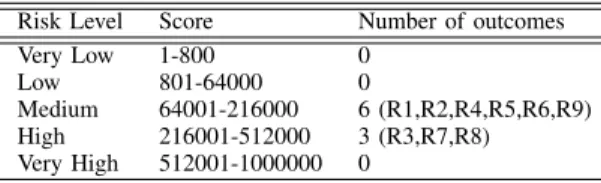
Table XIV: Risk Level
Risk Level Score Number of outcomes
Very Low 1-800 0
Low 801-64000 0
Medium 64001-216000 6 (R1,R2,R4,R5,R6,R9) High 216001-512000 3 (R3,R7,R8)
Very High 512001-1000000 0
C. Risk Level and Risk Management
To understand risk result, we group similar results in graduated levels ranging from Very Low to Very High as Table XIV illustrates. Six risks are in Medium level and three risks are in High level. This result is very important for risk management. The first step in risk management is to define ”acceptance risk level”. In our case study, acceptance risk level is Low. It means if all risks fall inLowlevel, there is no concern in our cloud. All risks in our case study pass our threshold and are identified as unacceptable risks. The next step in RA is to identify appropriate security designs or safeguards that could mitigate unacceptable risks and reduce them to below acceptable level. The main question here is that how much the safeguards cost to mitigate a risk. If the cost is very high and the risk reduction is very low, it is obvious that it is not acceptable by cloud customer. The next question is that how much is the risk reduction amount by implementing safeguards. To answer these questions, we ask cloud expert to verify vulnerabilities list (Table IX) and reevaluate linguistic variables. Our framework automatically updates all processes and shows the next level of risk. Then we can decide based on implantation cost and risk reduction amount.
IV. CONCLUSION
In this paper, we first discussed the main cloud computing characteristics and how these characteristics make hard ap-plying traditional security approaches. Then, we focused on the main issues in manual security standards for implement-ing risk assessment/management in cloud computimplement-ing. Since cloud computing is growing rapidly, providing an efficient and reliable solution for security risk assessment is needed. Although having an automated solution is critical and ideal for Risk Assessment as a Service (RAaaS) in cloud, it needs too much effort respect to the cloud computing charac-teristics. In this paper, we proposed a framework for risk assessment/management in cloud computing environment. Our main contribution consists of proposing a fuzzy multi-criteria decision making technique for analyzing public cloud risks. One major benefit of the proposed model is its ability to keep security management continuously within the cloud computing by an iterative and incremental approach. The limitation of the model is that it is not fully automated in cloud but it is trying to solve the inefficiency of current traditional risk assessment models that have to be used in
cloud. As future work, we intend to make use of more sophisticated cloud computing and have some solutions for fully automated risk assessment.
ACKNOWLEDGMENT
This work is partly funded by MSERC RDC to GSTC project and by CRC on Sustainable Smart Eco-Cloud.
REFERENCES
[1] K. Ren, C. Wang, and Q. Wang, ”Security Challenges for the Public Cloud,” IEEE Internet Computing, vol. 16, no. 1, pp. 69-73, 2012.
[2] S. Subashini and V. Kavitha, ”A survey on security issues in service delivery models of cloud computing,” Journal of Network and Computer Applications, vol. 34, pp. 1-11, 2011. [3] S. Ramgovind, M. M. Eloff, and E. Smith, ”The Management of Security in Cloud Computing,” Proceedings of IEEE Inter-national Conference on Information Security for South Africa, 2010.
[4] ISO/IEC 27002:2005. Information technology Security tech-niques Code of practice for information security management. http://www.iso.org/iso/catalogue detail?csnumber=50297 [5] National Institute of Standards and Technology, Gary
Stoneb-urner, Alice Goguen, and Alexis Feringa, ”NIST SP 800-30 Risk Management Guide for Information Technology Sys-tems,” pp. 8-26.
[6] C. Alberts and A. Dorofee, ”Managing information security risks,” The OCTAVE approach, Addison Wesley, ISBN 0-321-11886-3, 2002.
[7] B. S. Kaliski Jr. and W. Pauley, ”Toward risk assessment as a service in cloud environments,” Proceedings of the 2nd USENIX conference on Hot topics in cloud computing (Hot-Cloud’10), USENIX Association, Berkeley, CA, USA, 2010. [8] Cloud Audit. The Automated Audit, Assertion, Assessment,
and Assurance API. http://www.cloudaudit.org/
[9] M. Theoharidou, N. Tsalis, and D. Gritzalis, ”In Cloud We Trust: Risk-Assessment-as-a-Service,” Proceedings of the 7th IFIP WG 11.11 International Conference, pp 100-110, 2013. [10] C. T. Chen, ”A fuzzy approach to select the location of the
distribution center,” Fuzzy Sets and System, vol. 118, pp. 65-73, 2001.
[11] S. Y. Chou, Y. H. Chang, and C. Y. Shen, ”A fuzzy simple additive weighting system under group decision-making for facility location selection with objective/subjective attributes,” Operational Research, vol. 189, pp. 232-145, 2008.
[12] A. Shameli-Sendi, M. Jabbarifar, M. Shajari, and M. Da-genais, ”FEMRA: Fuzzy expert model for risk assessment,” Proceedings of the Fifth International Conference on Internet Monitoring and Protection, pp. 48-53, Barcelona, Spain, 2010. [13] J. Jones, ”An introduction to factor analysis of information risk (FAIR),” Norwich Journal of Information Assurance, vol. 2, no. 1, pp. 1-76, 2006.

![Figure 2: Identify and Analyze Risk Workflow i ∈ [1, 2, 3] j ∈ [A 1 , A 2 , ..., A n ] k ∈ [E 1 , E 2 , ..., E n ] ˜ x e ij k = (a, b, c) ˜ x ij = 1 n [˜x e ij 1 (+)˜x e ij 2 (+)...(+)˜ x e ij n ] A =˜ C I AA1A2 .](https://thumb-us.123doks.com/thumbv2/123dok_us/10743792.2962552/3.918.223.706.105.553/figure-identify-and-analyze-risk-workflow-a-aa.webp)