Life Insurance for Switches & Circuit Breakers
Surviving Harsh Environments
Author: John Arnold Director Sales & Marketing
APM HEXSEAL
Unsealed electromechanical switches and circuit breakers offer limited environmental protection against harsh environmental contamination penetration. For example: controls mounted on oil/gas platforms in the Gulf of Mex-ico, to ski mobiles in the Arctic to the Antarctic, constant exposure to moisture, ice, dust dirt, fungus, lubricants, cleaning solvents and chemically corrosive atmospheres will eventually reach the internal contact mechanism making them susceptible to damage and shorting. There can be external operational problems too. For example, the exterior toggle/pushbutton well is a prime location for collection of dirt and ice build-up, thus interfering with the switch or breaker free-movement and reliability. Contaminants can seep past the switch/breaker mounting hole, exposing delicate circuitry to shorting and corrosion as well. Even sealed switches/breakers are exposed to the same potential environmental risks. That’s because hermetically sealed devices are designed to protect only the internal mechanism. It does nothing to prevent clogging in the actuator well, or prevent seepage past the mount-ing hole. Durmount-ing World War II, the U.S. Military was made painfully aware of this type of control reliability problem and shortly thereafter, APM HEXSEAL joined with the Department of Defense to develop a series of seals addressing these issues based on a newly created specification — MIL-DTL-5423. The result was the develop-ment of two patented families of sealing boots for switch and circuit breaker protection that even included a special panel sealing washer for sealed switches. They are rated to IP66/68 dust and water ingress protection.
For more than 60 years these seals have been extensively used in military, naval, land and avionics applications throughout the world. They are UL Recognized Components and RoHS Compliant. Industry has also embraced this sealing technology and is using it on control panels in some of the harshest environments imaginable, such as automation, marine, gas and oil rigs, construction and excavating equipment, communication, instrumenta-tion…whereever commercial and industrial controls must be secure, fully operational and safe.
©2012 APM Hexseal Page 2 of 4 www.apmhexseal.com What makes these seals special, and how do they work?
There are sealing boots for toggle, pushbutton, rotary and rocker devices with configurations matching most popular brands. The vast majority of boots are fabricated in high-performance silicone rubber with a molded-in mounting-nut that replaces the original switch’s exterior nut. Other elastomeric materials are also available to match specific environmental chemical exposures. (See materials table). These UL Recognized Component boots are precision engineered, with special care taken to maintain uniform consistency and performance. For example, many of the toggle boots are designed with an inner secondary seal affording additional protection should the exterior be compromised by a puncture or tear. High-performance silicone features several important properties including extreme elongation, high actuation life (up to 100,000 operations and beyond) and a wide operating temperature range of from -94°F to +400°F (-70°C to +204°C). APM HEXSEAL boots are molded and oven-aged which is an effective method to reduce silicone out gassing to an absolute acceptable minimum thus preventing silicone molecule migration that could coat sensitive electrical and electronic components causing circuit malfunction*. To prevent contaminant seepage past the mounting hole cut-out, each boot has a perimeter sealing rib that is firmly pressed against the panel surface when the boot is tightened. For extremely rough handling situations where workers wear gloves, there are several switch seals that feature a stainless steel (armored) exterior with a silicone membrane/boot that fits over and transfers the actuation motion to the standard toggle or pushbutton switch. This also makes an ideal solution for very high pressure and temperature wash down situations.
Circuit breaker boots present a somewhat different challenge. It isn’t enough to environmentally protect the breaker externally and internally — the operator must be able to view the circuit status as well. That’s why a clear version of silicone rubber is used. The elastomeric cover must maintain its clear visibility for an extended period of time and not yellow or otherwise degrade from UV and other contaminant exposure. Plus, it must provide long actuation life and be robust enough to absorb rough handling while providing the operator with sufficient tactile feel. APM
Pushbutton style front-of-panel mounted switch boot Toggle style front-of-panel mounted switch boots Pushbutton style front-of-panel mounted
switch boot Rocker stylefront-of-panel mounted circuit breaker boots
Lever style front-of-panel mounted sealing boots
Lever style back-of-panel mounted circuit breaker boots Digital Panel Meter custom cover Heavy duty, armored, stainless steel, mushroom head boot
Lever style back-of-panel mounted circuit breaker boot
uses a special UV resistant formulation trade marked RUBRGLAS®which has an operational life of a minimum of up to100,000 actuations, while maintaining the same wide temperature range as the switch boots. Besides pushbutton, rocker and toggle styles, there are single and multiple lever styles; some mounting from the front of the panel and others that mount from behind. Special APM designed O-Ring embedded stainless steel screws (SEELSKREW®) are used to secure these boots to the panel.
A wide choice of sealing boots is offered for switches and circuit breakers. A simple way to match and select the right boot is to visit our web site www.apmhexseal.com and review our catalogs which contain dimensional information and comprehensive cross-reference charts. There are also CAD and PDF drawings, so you can double check dimensions against controls you presently have or are planning to install. This is an important step as controls manufacturers change dimensions from time-to-time. Some guidelines to follow are:
• What size threaded bushing does your switch use (e.g., 15/32-32, M12x1, 3/8-24, M6x 0.75,¼-40, etc.)? • What is the height of the tip of the switch actuator above the threaded switch bushing?
• For rotary switches, what is the diameter of the shaft?
• If a rocker switch is used, what are the dimensions of the bezel and actuator and height of the rocker above the plane of the bezel face?
• For circuit breakers, consider the number of levers, mounting method, and overall dimensions. Does it require enhanced actuation force (see CT and HT Trigger model series)?
• And, in all instances, specify the elastomeric material that best conforms to your environmental challenges. Silicone will suffice for most, but there are exceptions (see Materials chart).
AC motor controllers typically have these boots installed for protection against wash down and hostile environments, as do NEMA 4X enclosures and IEC type electrical distribution and industrial controls as described in this article. The photograph above shows some of the various ways these boots can be installed to protect both externally as well as within the enclosure.
APM offers many options including choice of color-matching to panel colors or functional coding and emi/rfi suppression models. Most models provide IP water immersion and dust ingress rating of IP66/68. In today’s global market it is more important than ever to know where the raw silicone is coming from and its integrity, as well as how the boot is fabricated (without short cuts) into a high-performance seal. Quality, constancy and reliability are paramount. Standards — conforming to appropriate MIL-Spec, UL Recognition and other related agency requirements, and ISO9001 conformance — all play important roles for safe, secure specifying.
©2012 APM Hexseal Page 4 of 4 www.apmhexseal.com Material Relevant
Specifications Service Temp
RESISTANT TO TYPICAL PROPERTIES
Ozone Chemicals Oil Solvents Tensile PSI Elongation % Abrasion Resistance Compression Set Silicone Rubber A-A-59588 CLASS I&II GR 30-70 -94°F to 400°F
-70°C to 204°C Excellent Good Good Fair 500-1800 100-800 Fair Excellent
Silicone Rubber
ASTM D1418 GR 30-70
-80°F to 400°F
-62°C to 204°C Excellent Good Good Fair 500-1800 100-800 Fair Excellent
Fluoro-Silicone Rubber MIL-R-25988 AMS 3326 GR 60 -78°F to 150°F
-61°C to 66°C Excellent Excellent Excellent Excellent 2000-2200 300-400 Good Excellent Buna N (NBR) ASTM D2000-90 M2BG714 GR 60 -65°F to 250°F
-54°C to 121°C Fair Good Excellent Good 1500-3000 400-600 Good Excellent
Neoprene (EPR)
MIL-R-3065 GR 60
-65°F to 300°F
-54°C to 149°C Good Good Good Fair 1500-4000 100-700 Excellent Good
Ethylene Propylene (EPDM) ASTM D2000-90 M3BA708 GR 60 -65°F to 300°F
-54°C to 149°C Excellent Excellent Poor Good 1400-1600 500-600 Excellent Excellent
IEC 60529 DEGREES OF ACCESS TO HAZARDOUS PARTS, FIRST CHARACTERISTIC NUMERAL
IEC 60529 DEGREES OF PROTECTION AGAINST WATER INGRESS, SECOND CHARACTERISTIC NUMERAL First Characteristic Numeral:
With Respect to Solid Foreign Objects IP
0 Non-protected
1 Protected against solid foreign objects≥50 mm diameter
2 Protected against solid foreign objects≥12.5 mm diameter
3 Protected against solid foreign objects≥2.5 mm diameter
4 Protected against solid foreign objects≥1.0 mm diameter
5 Dust-protected (Dust shall not penetrate in quantity to interfere with satisfactory operation of the apparatus or to impair safety)
6 Dust-tight (No ingress of dust)
Second Characteristic Numeral: With Respect to the Harmful Ingress of Water IP
0 Non-protected
1 Protected against vertically falling water drops
2 Protected against vertically falling water drops when enclosure tilted up to 15°
3 Protected against spraying water
4 Protected against splashing water
5 Protected against water jets
6 Protected against powerful water jets
7 Protected against the effects of temporary immersion in water
8 Protected against the effects of continuous immersion in water
44 Honeck Street • Englewood NJ 07631
(201) 569-5700 • Sales Toll Free (800) 498-9034 • Fax (201) 569-4106
The World’s Most Hostile Environments Are Our Proving GroundsSM
*For more information on silicone purity and its importance in sealing boots performance and integrity — see APM White Paper “Silicone Source-Certain.”
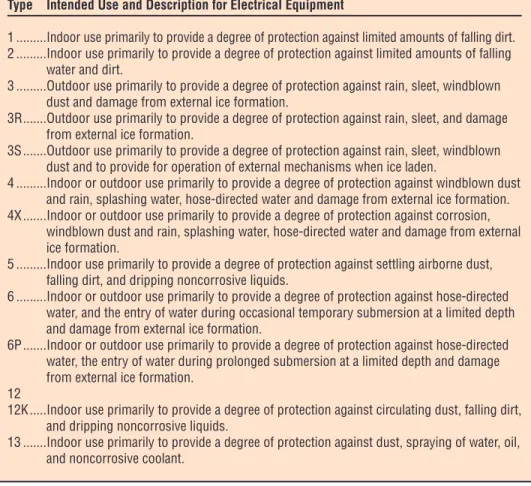
Table 2. NEMA Enclosure Types
Type Intended Use and Description for Electrical Equipment
1 ...Indoor use primarily to provide a degree of protection against limited amounts of falling dirt. 2 ...Indoor use primarily to provide a degree of protection against limited amounts of falling
water and dirt.
3 ...Outdoor use primarily to provide a degree of protection against rain, sleet, windblown dust and damage from external ice formation.
3R...Outdoor use primarily to provide a degree of protection against rain, sleet, and damage from external ice formation.
3S ...Outdoor use primarily to provide a degree of protection against rain, sleet, windblown dust and to provide for operation of external mechanisms when ice laden.
4 ...Indoor or outdoor use primarily to provide a degree of protection against windblown dust and rain, splashing water, hose-directed water and damage from external ice formation. 4X ...Indoor or outdoor use primarily to provide a degree of protection against corrosion,
windblown dust and rain, splashing water, hose-directed water and damage from external ice formation.
5 ...Indoor use primarily to provide a degree of protection against settling airborne dust, falling dirt, and dripping noncorrosive liquids.
6 ...Indoor or outdoor use primarily to provide a degree of protection against hose-directed water, and the entry of water during occasional temporary submersion at a limited depth and damage from external ice formation.
6P ...Indoor or outdoor use primarily to provide a degree of protection against hose-directed water, the entry of water during prolonged submersion at a limited depth and damage from external ice formation.
12
12K ...Indoor use primarily to provide a degree of protection against circulating dust, falling dirt, and dripping noncorrosive liquids.
13 ...Indoor use primarily to provide a degree of protection against dust, spraying of water, oil, and noncorrosive coolant.