BUSINESS PROCESS DOCUMENT NOT PROTECTIVELY MARKED Disclosure and Barring Service
BUSINESS PROCESS DOCUMENT
e-Bulk Interface
Date: 6 January 2014 Version: 4.0
BUSINESS PROCESS DOCUMENT NOT PROTECTIVELY MARKED Disclosure and Barring Service
CONTENTS
Table Of Contents 1 Introduction ... 3 1.1 Background ... 31.2 Purpose of the document ... 3
1.3 Scope ... 3
1.4 Document Overview ... 4
1.5 References ... 4
1.6 Abbreviations & Terminology ... 4
1.6.1 Abbreviation ... 4 1.6.2 Terminology ... 5 2 Business Context ... 6 2.1 Business Background... 6 2.2 Business Flows ... 8 2.2.1 eBulkApplications ... 9 2.2.2 eBulkResults ... 9
3 Business Message Model ... 11
3.1 Message Model Diagram ... 11
3.2 Business Flows ... 12
3.2.1 eBulkApplications Business Flow ... 12
3.2.2 eBulkResults Business Flow ... 13
4 Logical Messages ... 14 4.1 Section Overview ... 14 4.1.1 Unique Identifiers ... 14 4.1.2 Data Descriptions ... 15 4.2 eBulkApplications ... 15 4.2.1 Description ... 15 4.2.2 Data ... 15 4.3 eBulkApplicationBatchRejection ... 16 4.3.1 Description ... 16 4.3.2 Data ... 16 4.4 eBulkApplicationReceipts ... 16 4.4.1 Description ... 16 4.4.2 Data ... 17 4.5 eBulkResults ... 17 4.5.1 Description ... 17 4.5.2 Data ... 18
BUSINESS PROCESS DOCUMENT NOT PROTECTIVELY MARKED Disclosure and Barring Service
1
Introduction
This introduction provides background information concerning the eBulk interface to which this document relates and describes the scope, purpose and structure of this document.
1.1
Background
The Disclosure and Barring Service (DBS) has in place a facility to enable DBS
applications to be bulk-submitted electronically and to return information regarding the result of those applications by a similar means. This facility is known as the “eBulk” interface.
Registered Bodies (RBs) who wish to use the eBulk facility may register to do so. RBs that have registered for eBulk are also referred to as e-RBs.
Use of the eBulk interface will alleviate the need for the production and mailing of paper forms by the e-RBs and form scanning, and data keying by the DBS.
1.2
Purpose of the document
This document defines a generic business messaging model for this eBulk interface. It is aimed, primarily, at technicians and analysts who need to understand this process when involved in implementing an end point connection to the interface (e.g. from an RB’s system).
1.3
Scope
This document is one of a number that, taken together, describe the eBulk interface. The complete documentation set is shown in the following table, with this document highlighted.
Document ID Purpose
Interchange Agreement IA States the agreed business level agreement that governs the use of the interface end to end between RBs and the DBS.
Business Process
Document BPD Defines the information exchange between the end points (RB and DBS systems) and the business process that surrounds and controls it.
Business Message
Specification BMS Defines the technical format of the business messages that will pass between the end points (RB and DBS systems). Message Integrity
Specification MIS Defines the approach to assuring integrity of business messages used for the business information exchange between the end points (RBs and the DBS systems).
Interface Control
Documents ICD Define the specific configuration of message delivery and operational interface protocols that will be used by end points (e.g. RB systems) Operational Interface
Specification OI Defines the operational interface syntax and semantics for the services provided by CJSE, including operations (such as routing). Message Delivery
BUSINESS PROCESS DOCUMENT NOT PROTECTIVELY MARKED Disclosure and Barring Service
The focus of this document is the business information exchange between the end points (RBs and the DBS) of the DBS e-Bulk interface for processing applications and the business process that surrounds and controls that information exchange.
Note that the eBulk interface provides an alternative to the use of paper application forms. The eBulk interface does not make provision for applications started by telephone , nor does it cover the forms for registering as a Registered Body or Countersignatory (also called RAFs and CAFs).
1.4
Document Overview
This document consists of the following sections:
Business Context – describes the high level business process flows that the interface supports and the business process context surrounding the operation of the interface.
Business Message Model – identifies the messages that the interface provides for communication between RBs and the DBS and how these support the high level business process flows.
Logical Messages – provides a detailed description of each message provided by the interface, including a description of the data passed by the interface,
particularly focusing on data that is most relevant to the business process that governs the interface.
1.5
References
The table below lists references to other relevant documents. References to these documents, within the text of this document, are made using the square-bracket notation shown in the “Ref” column of the table.
Ref Details
[1] Business Message Specification
[2] ICD CJSE-DBS RB (Internet FTPS), Interface Control Document for Registered Body interface over the Internet
[3] ICD CJSE-DBS RB (Secure Government Network), Interface Control Document for Registered Body interface over a secure government network (particularly GSi)
[4] ICD CJSE-DBS CRM Interface control document for CRM system interface
1.6
Abbreviations & Terminology
This section provides definitions of abbreviations and unusual terminology used in this document.
1.6.1 Abbreviation
Abbreviation Meaning
RB Registered Body
CJSE The Criminal Justice System Exchange – an integration service used by the interface. DBS The Disclosure and Barring Service
BUSINESS PROCESS DOCUMENT NOT PROTECTIVELY MARKED Disclosure and Barring Service
1.6.2 Terminology
Term Meaning
eBulk The term that has been given to the interface described in this document, named as such because provides an electronic mechanism for submitting applications in bulk (i.e. in batches of one or many at a time). This is analogous to the current practice of sending paper applications in bulk by post.
eBulkApplication An application sent by electronic means. In the context of this document, this refers to an application sent via the eBulk interface.
eBulkResult An electronically delivered response to an eBulkApplication. e-RB An RB that is registered to use the eBulk service
Blank A shorthand used in this document to describe eBulkResults indicating that the search found that no match exists for the specified applicant in requested field and that no paper certificate will be sent to the RB
Non-blank A shorthand used in this document to describe eBulkResults indicating that the RB must wait for the paper certificate
BUSINESS PROCESS DOCUMENT NOT PROTECTIVELY MARKED Disclosure and Barring Service
2
Business Context
This section describes the high level business process flows that the interface supports and the business process context surrounding the operation of the interface.
2.1
Business Background
All applications are submitted to the DBS via Registered Bodies (RBs) or Umbrella Bodies (UBs), who have responsibilities that include the verification of the applicant’s identity. Prior to the introduction of the eBulk interface, all of these applications have been submitted on paper application forms. These are scanned, and the data contained within them is keyed manually onto the DBS’ systems for processing. This paper process provides an opportunity for errors to be introduced, either on the paper form itself or during manual keying. Such errors may not be found until later in the process, introducing delays. Some RBs already capture much of the data present on the application form in their own systems, so the data may be keyed twice.
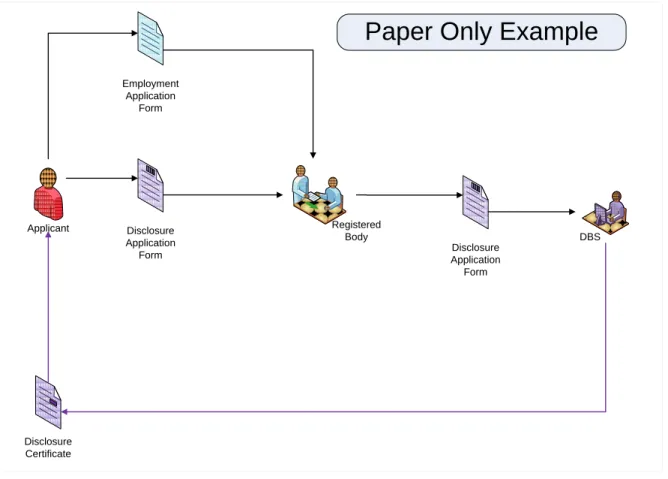
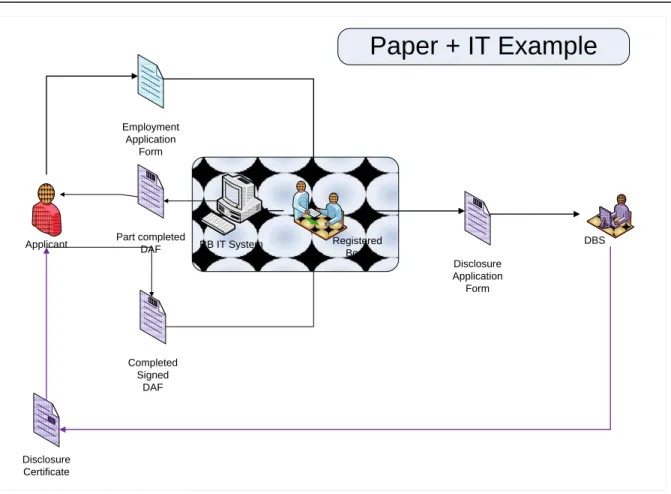
The following two diagrams illustrate two possible variations of this paper process, with the second depicting one possible way that an RB might support this with an IT system.
Applicant DBS Registered Body Disclosure Application Form Employment Application Form Disclosure Application Form Disclosure Certificate
Paper Only Example
BUSINESS PROCESS DOCUMENT NOT PROTECTIVELY MARKED Disclosure and Barring Service Applicant Registered DBS Body Part completed DAF Employment Application Form Disclosure Application Form Disclosure Certificate RB IT System Completed Signed DAF
Paper + IT Example
Figure 2 Paper-based process for an RB (RB supported by IT system)
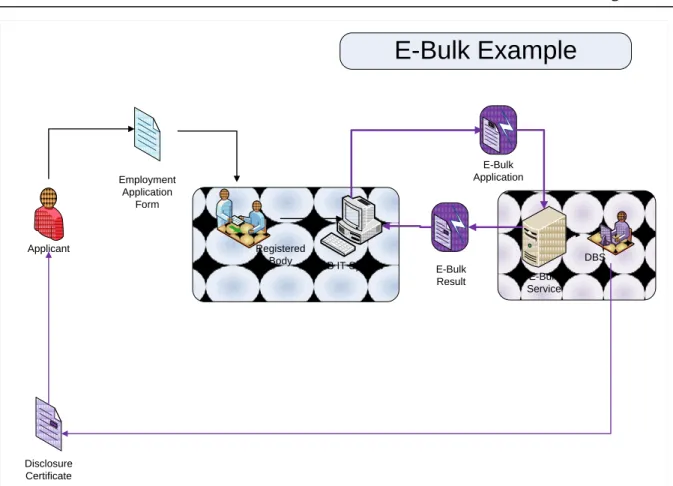
The introduction of the eBulk interface provides a mechanism for e-RBs (RBs and UBs who are registered to use the eBulk service) to submit applications electronically to the DBS and receive notifications electronically concerning the result in the form of an “eBulkResult”.The following diagram shows a typical example of how the process for an RB looks with the introduction of e-Bulk, and comparison with the preceding diagram shows how this can be a relatively straightforward enhancement. In the example shown, all of the information required for the employment application and the DBS application is provided, by the applicant, on a single form.
BUSINESS PROCESS DOCUMENT NOT PROTECTIVELY MARKED Disclosure and Barring Service Applicant DBS Registered Body Employment Application Form Disclosure Certificate RB IT System E-Bulk Service E-Bulk Result E-Bulk Application
E-Bulk Example
Figure 3 e-Bulk process for an RB
Using the existing paper-based process, RBs send application forms to the DBS individually or in batches. The eBulk interface similarly enables RBs who use the interface to submit batches of one or more applications, hence the name “eBulk”. e-RBs and, in particular, their Countersignatories, continue to have responsibilities in respect of the applications that they submit by eBulk, as laid out in the DBS Code of Practice and accompanying guidance. As is the case for paper submissions, this includes responsibility for verifying the identity of applicants.
e-RBs provide a Countersignatory number in each application submitted by eBulk to indicate which Countersignatory has validated the application, and provision of the Countersignatory number in this way conveys acceptance, by the respective
Countersignatory, of their responsibilities in respect of that application. For this reason, it is recommended that each RB’s IT system allows each Countersignatory, and only that Countersignatory, to action this approval of each application for which they take
responsibility and that this alone allows the inclusion of their respective Countersignatory number in the application.
2.2
Business Flows
This section describes the key business flows, between RBs and the DBS, that are supported by the interface, approached at a high level and focusing on the key information exchanges needed to support the business process.
BUSINESS PROCESS DOCUMENT NOT PROTECTIVELY MARKED Disclosure and Barring Service
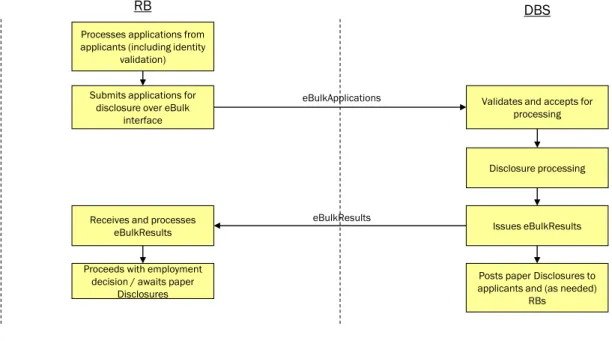
The following diagram illustrates these key information exchanges.
Processes applications from applicants (including identity
validation)
Submits applications for disclosure over eBulk
interface
Receives and processes
eBulkResults Issues eBulkResults
Disclosure processing Validates and accepts for
processing
Proceeds with employment decision / awaits paper
Disclosures
Posts paper Disclosures to applicants and (as needed)
RBs
RB DBS
eBulkApplications
eBulkResults
Figure 4 High Level Information Exchanges
As shown, RBs process applications for individuals and, using the eBulk interface, can pass batches of eBulkApplications to the DBS for processing. As the processing completes for individual applications, the DBS is able to provide batches of
eBulkResults, relating to completed applications, to RBs, again via the eBulk interface. 2.2.1 eBulkApplications
RBs will process applications for positions that are eligible for a DBS check typically collecting information that is required by the RB to process the job application as well as information required by the DBS for processing that application, including information relating to the RB and their authorised countersignatory.
This data is captured on the RBs’ IT systems. RBs use the collected data to populate eBulkApplications in the required format and pass these, in batches, to the DBS for processing, via the eBulk interface.
2.2.2 eBulkResults
Once processing for an application submitted over eBulk has completed, the
eBulkResult will be created by the relevant DBS systems In all cases, a paper certificate will be sent to the individual applicant, as is the case for paper applications.
In this document, when describing eBulkResults:
The term “blank” is used to describe eBulkResults indicating that the searches found that no match exists for the specified applicant in the requested fields. The term “non-blank” is used to describe eBulkResults indicating that the RB
must wait for the applicant to present the paper certificate.
Note that these terms, blank and non-blank, are convenient shorthand used in this document. However, the actual messages used to communicate these states, as described in [1], identify these states using different, specific terminology.
BUSINESS PROCESS DOCUMENT NOT PROTECTIVELY MARKED Disclosure and Barring Service
As they become available, eBulkResults will be collected into batches per RB and provided to the respective RB via the eBulk interface.
BUSINESS PROCESS DOCUMENT NOT PROTECTIVELY MARKED Disclosure and Barring Service
3
Business Message Model
This section takes the high level business flows identified in Section 2.2 and defines a model, at a more detailed level, that specifies a series of messages that support them. The messages themselves are described at a high level. Section 4 covers each of the messages in more detail.
3.1
Message Model Diagram
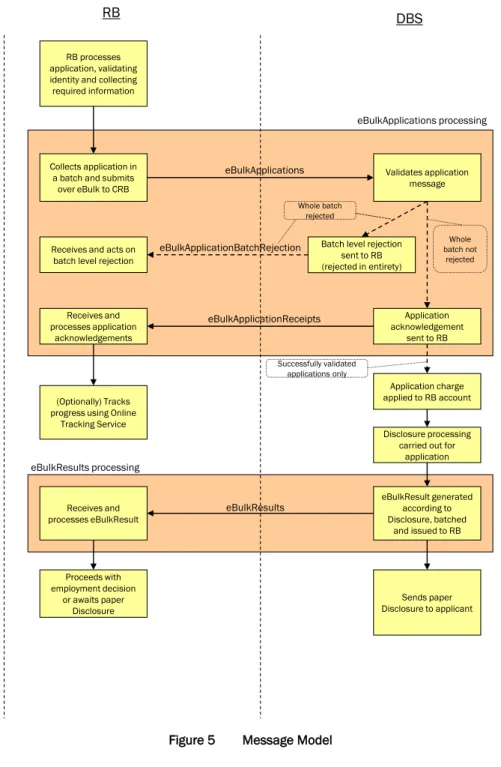
The diagram below illustrates the proposed message model for the eBulk interface. Section 4 of this document provides an overview of the types of data passed by these messages.
RB processes application, validating identity and collecting required information
Collects application in a batch and submits
over eBulk to CRB Receives and processes eBulkResult eBulkResult generated according to Disclosure, batched and issued to RB Application acknowledgement sent to RB Disclosure processing carried out for
application Validates application message Proceeds with employment decision or awaits paper Disclosure Sends paper Disclosure to applicant RB DBS Receives and processes application acknowledgements Application charge applied to RB account eBulkApplications processing eBulkResults processing eBulkApplications eBulkApplicationReceipts eBulkResults (Optionally) Tracks progress using Online
Tracking Service Receives and acts on
batch level rejection
Batch level rejection sent to RB (rejected in entirety) eBulkApplicationBatchRejection Successfully validated applications only Whole batch rejected Whole batch not rejected
BUSINESS PROCESS DOCUMENT NOT PROTECTIVELY MARKED Disclosure and Barring Service
Each message is described in summary during the remainder of this section and in more detail in section 4.
3.2
Business Flows
3.2.1 eBulkApplications Business Flow
The overall business flow for the submission of eBulkApplications involves the passing of batches of eBulkApplications and corresponding acknowledgements. This flow is
represented by three business messages:
eBulkApplications – used by an e-RB to submit a batch of applications to the DBS.
eBulkApplicationBatchRejection – used by the DBS to provide notification that an entire batch of applications has failed initial batch-level validation.
eBulkApplicationReceipts – used by the DBS to perform the following:
o acknowledge receipt of applications
o provide identifiers that can be used to track progress of the applications using the Online Tracking facility
o feed back any errors found upon initial validation of the applications themselves
The overall flow is triggered when the RB has applications to submit using the eBulk interface and does so by making use of the eBulkApplications message. Only RBs registered and enabled for use of the eBulk service will be able to successfully submit applications in this way. When the DBS has received these applications, validation of the entire batch is first undertaken to confirm that the batch can be processed. This validation includes:
Confirmation that RB is valid for eBulk Confirmation of message integrity
Confirmation that message format is correct Additional technical checks
If this validation fails, an eBulkApplicationBatchRejection is returned to the RB and the batch proceeds no further in the process. If batch-level validation succeeds, the
applications contained within it are individually validated. An eBulkApplicationReceipt item is produced for each eBulkApplication processed.
The receipt for each eBulkApplication includes an indication of whether it passed the initial application validation and was thus accepted for processing. Only those individual applications that pass this initial application validation then proceed to application processing. In the receipt, an error indication is returned for any applications that fail the initial application validation and no further processing takes place for those applications.
eBulkApplicationReceipts are batched up and returned to the RB.
It should be noted that although eBulkApplicationReceipts are returned in batches, there is no guaranteed correspondence, at batch level, between application batches and receipt batches. In other words:
BUSINESS PROCESS DOCUMENT NOT PROTECTIVELY MARKED Disclosure and Barring Service
The receipts for the applications provided within a single applications batch of applications may be returned in different batches of receipts.
A batch of receipts may include receipts that, individually, correspond to applications that were submitted in different batches.
RBs should not, therefore, rely on any batch level correspondence between batches. Note that provided the batch-level validation is passed, the failure of one or more individual messages against initial application validation does not invalidate the
complete batch of applications. Those individual applications that pass the application validation continue for processing.
3.2.2 eBulkResults Business Flow
The overall business flow for the return of eBulkResults involves the passing of a batch of eBulkResults. This flow becomes applicable where an application processing has completed for one or more eBulkApplications from the e-RB and the results of the searches are ready to be communicated back to the e-RB.
This flow is represented by a single business message:
eBulkResults – used by the DBS to return a batch of eBulkResults to an e-RB. The eBulkResults message is used to provide eBulkResults for applications that have completed the process. Implicit in this is the fact that corresponding eBulkApplications passed initial validation upon receipt by the DBS and were, therefore, accepted for processing. Clearly, eBulkResults will not be issued for eBulkApplications that fail their initial application validation or in cases where an entire batch of eBulkApplications fails batch-level validation.
Using the eBulkResults message, eBulkResults are passed in batches. Note that the processing for individual applications may vary considerably in duration and that there is no correspondence, at batch level, between application batches and eBulkResult
batches. Thus:
The eBulkResults pertaining to the applications provided within a single
applications batch of applications should be expected to be returned in different batches of eBulkResults.
A batch of eBulkResults should be expected to include eBulkResults that,
individually, correspond to applications that were submitted in different batches. Furthermore, eBulkResults are not returned in respect of applications that did
BUSINESS PROCESS DOCUMENT NOT PROTECTIVELY MARKED Disclosure and Barring Service
4
Logical Messages
4.1
Section Overview
This section describes the individual logical business messages used to pass data between RBs and the DBS in the context of the eBulk interface. A sub-section is provided below for each logical message, within which are provided:
A description of the message.
An overview of the types of data contained within the message, focusing on data that is relevant with respect to the business process that governs the interface. Note that this document does not fully describe all the data items which flow between systems, nor defines the format of the business data passed. These are described in [1] Business Message Specification. Nor does this document define the physical interface format used to pass these business messages, any system headers used to wrap messages, or specifics of the interface mechanism. These are described in [2], [3] and [4] which describe the DBS and RB system interfaces.
4.1.1 Unique Identifiers
The message descriptions provided below introduce identifiers that enable
corresponding items to be associated with one another as they flow back and forth across the eBulk interface. This section describes these identifiers, explaining the reason for their inclusion within the context of the process that governs the interface. 4.1.1.1 RB Application Reference
In order for e-RB systems to handle application receipts and eBulkResults in an automated manner, e-RBs will need an identifier that associates these with the
corresponding eBulkApplications and the corresponding records on the e-RBs’ systems. e-RBs will provide their own identifier to accompany each eBulkApplication. This
identifier should be meaningful to the RB in uniquely identifying each application (while having no inherent business meaning to the DBS). This identifier can then be returned, unchanged, to the RB with each corresponding eBulkApplicationReceipt and
eBulkResult, enabling the RB to associate each with the corresponding eBulkApplication and RB system record.
Provision is made for this RB Application Reference in the messages described below. Although the RB Application Reference has no inherent business meaning to the DBS, validation will check for the use of duplicate references. These will only be identified in cases where an application with the same RB Application Reference has previously passed all initial validation and been accepted for processing. In the case where an application fails initial validation and is not accepted for processing, the RB Application Reference is not recorded as having been used. Thus, it is possible for applications that have failed this validation to be re-submitted with the same RB Application Reference. An implication of this validation is that the RB Application Reference should be the RB’s reference to the application and not simply to the applicant, as it is possible that there could be multiple applications for the same applicant over time.
BUSINESS PROCESS DOCUMENT NOT PROTECTIVELY MARKED Disclosure and Barring Service
4.1.1.2 DBS Form Reference
Each paper application form has a form reference number printed on it. This reference number is used by the applicant to subscribe to the Update Service. Progress of an application can be tracked using the DBS’ Online Tracking Service, by providing the form reference number, along with the applicant’s date of birth.
When applications are submitted using the eBulk interface, the absence of a paper form requires that an alternative to the paper form reference number be provided for use by the RB with Online Tracking.
An alternative DBS Form Reference is provided by the DBS in the eBulkApplicationReceipts message, described below, for this purpose. 4.1.2 Data Descriptions
Each logical message description given below (sections 4.2 to 4.5) includes a data sub-section that provides and overview of the types of data provided in the respective message, focusing particularly on those elements of data that are significant in the context of the business process that governs the interface. These sections do not, therefore, attempt to cover every data item passed in the messages.
Furthermore, these sections do not define the physical data format used to define these data items. These are defined in [1], which also documents the business content within each message at the most detailed level.
4.2
eBulkApplications
4.2.1 DescriptionThis message contains the data for a batch of applications which it delivers to the DBS from an RB. Each batch may contain one or, typically, many sub-items, each sub-item representing a single application.
4.2.2 Data
An overview of the data carried in this message is provided in the text and tables that follow in this section. To reduce complexity, the message details are sub-divided, introducing top-level details first and then drilling-down into greater detail where appropriate.
The table below shows, at the highest level, the data included in the message. As can be seen, the message consists of a sequence of applications.
Data Description Multiplicity
eBulkApplications The message includes the data for one or many
applications as a sequence of eBulkApplications. 1 to many per message
Viewed at a high level, for each eBulkApplication provided in the message, the following data is supplied.
BUSINESS PROCESS DOCUMENT NOT PROTECTIVELY MARKED Disclosure and Barring Service
Data Description Multiplicity
RB Application Reference An identifier supplied by the RB. This is the RB’s reference for the application and has no inherent business meaning for the DBS.
Once per eBulkApplication Application Data This is the set of information that makes up the
application itself, which is used by the DBS in conducting the searches.
Once per eBulkApplication
The Application Data shown in the preceding table contains many data items. These are defined comprehensively and in detail in[1]. The following table shows the categories of data of which this is composed.
Data Description Multiplicity
Applicant Information The applicant’s key personal details. Once per eBulkApplication Potential Employer Information Details of the position that the applicant has
applied for and for which the check is being requested.
Once per eBulkApplication Additional Applicant Details Additional personal details related to the applicant. Once per
eBulkApplication Evidence of Identity
Information Details related to identity evidence pertaining to the applicant Once per eBulkApplication Registered Person Statement Details provided by and related to the RB and
countersignatory. Once per eBulkApplication
4.3
eBulkApplicationBatchRejection
4.3.1 DescriptionThis message provides notification that an entire batch of applications, delivered using the eBulkApplications message, has failed initial batch-level validation and been
rejected in its entirety. Each message is a single notification for failure of a single batch and does not contain multiple repeating sub-items.
4.3.2 Data
An overview of the data carried in this message is provided in the text and tables that follow in this section.
The table below shows, at the highest level, the data included in the message. As can be seen, the message consists of a sequence of acknowledgements.
Data Description Multiplicity
Identification of rejected batch Provides information sufficient to identify the batch
that has been rejected 1 only per message Error Details Provide information concerning the reason for
rejection of the batch 1 only per message
4.4
eBulkApplicationReceipts
4.4.1 DescriptionThis message contains acknowledgement information for applications that have been delivered using the eBulkApplications message. It provides an acknowledgement for each individual application that was provided within the batch, rather than an
BUSINESS PROCESS DOCUMENT NOT PROTECTIVELY MARKED Disclosure and Barring Service
acknowledgement for the batch as a whole. Each message may contain one or, typically, many sub-items, each sub-item representing a single receipt in response to a single application. All eBulkApplicationReceipts contained within each individual use of the message pertain to (and are destined for) a single RB. Note that eBulkApplications that were received in the same batch may be receipted in different
eBulkApplicationReceipts batches, and vice versa. 4.4.2 Data
An overview of the data carried in this message is provided in the text and tables that follow in this section.
The table below shows, at the highest level, the data included in the message. As can be seen, the message consists of a sequence of application receipts.
Data Description Multiplicity
eBulkApplicationReceipts The message includes the data for a sequence of one or many application receipts. Each corresponds with an eBulkApplication sent previously by an RB using the eBulkApplications message.
1 to many per message
Viewed at a high level, for each application receipt provided in the message, the following data is supplied.
Data Description Multiplicity
RB Application Reference The identifier previously supplied by the RB using the eBulkApplications message. This is the RB ’s identifier for the application to which this receipt relates.
Once per
eBulkApplicationReceipt
DBS Form Reference A surrogate form reference number provided by the DBS for use by the RB to refer to the application to which the receipt relates. This can be provided to the DBS’ Online Tracking Service to track progress of the application.
Once per
eBulkApplicationReceipt
Success or Error Information Acknowledgement information either indicating successful submission of this specific
application or indicating failure of the submission along with error information.
Once per
eBulkApplicationReceipt
4.5
eBulkResults
4.5.1 DescriptionThis message contains the data for a number of eBulkResults sent from the DBS to an RB. Each message may contain one or, typically, many sub-items, each sub-item
representing a single eBulkResult. All eBulkResults contained within each individual use of the message pertain to (and are destined for) a single RB.
Each eBulkResult will relate to an application previously submitted by the RB using the eBulkApplications message. However, there is no correspondence, at an overall batch level, between batches of applications and batches of eBulkResults, and it is expected that eBulkResults will be batched in different groupings from their corresponding
BUSINESS PROCESS DOCUMENT NOT PROTECTIVELY MARKED Disclosure and Barring Service
eBulkApplications. This is due to the fact that the duration of processing may vary considerably from application to application.
4.5.2 Data
An overview of the data carried in this message is provided in the text and tables that follow in this section.
The table below shows, at the highest level, the data included in the message. The message includes a batch-level header and a sequence of eBulkResults.
Data Description Multiplicity
eBulkResults The message includes the data for one or many
eBulkResults. 1 to many per message
For each eBulkResult provided, the following data is supplied: DBS Application Reference Number
RB Application Reference Number Disclosure Type
Disclosure Number Disclosure Issue Date Applicant Names Applicant Date of Birth Applicant Place of Birth Gender
Applicant Full Address (inc post code) Please wait to view applicant certificate
or