Wright State University Wright State University
CORE Scholar
CORE Scholar
Browse all Theses and Dissertations Theses and Dissertations 2016
The Influence of Implicit and Explicit Gender Bias on Grading, and
The Influence of Implicit and Explicit Gender Bias on Grading, and
the Effectiveness of Rubrics for Reducing Bias
the Effectiveness of Rubrics for Reducing Bias
Sarah Marie JacksonWright State University
Follow this and additional works at: https://corescholar.libraries.wright.edu/etd_all Part of the Industrial and Organizational Psychology Commons
Repository Citation Repository Citation
Jackson, Sarah Marie, "The Influence of Implicit and Explicit Gender Bias on Grading, and the Effectiveness of Rubrics for Reducing Bias" (2016). Browse all Theses and Dissertations. 1529. https://corescholar.libraries.wright.edu/etd_all/1529
This Dissertation is brought to you for free and open access by the Theses and Dissertations at CORE Scholar. It has been accepted for inclusion in Browse all Theses and Dissertations by an authorized administrator of CORE Scholar. For more information, please contact [email protected].
THE INFLUENCE OF IMPLICIT AND EXPLICIT GENDER BIAS ON GRADING, AND THE EFFECTIVENESS OF RUBRICS FOR REDUCING BIAS
A dissertation submitted in partial fulfillment of the requirements for the degree of
Doctor of Philosophy
By
SARAH MARIE JACKSON B.A., The Ohio State University, 2002
M.S., Wright State University, 2011
2016
WRIGHT STATE UNIVERSITY GRADUATE SCHOOL
. April 29, 2016 I HEREBY RECOMMEND THAT THE DISSERTATION PREPARED UNDER MY SUPERVISION BY Sarah Marie Jackson ENTITLED The Influence of Implicit and Explicit Gender Bias on Grading, and the Effectiveness of Rubrics for Reducing Bias BE ACCEPTED IN PARTIAL FULFILLMENT OF THE REQUIREMENTS FOR THE DEGREE OF Doctor of Philosophy.
_________________________________ Tamera Schneider, Ph.D. Dissertation Director _________________________________ Scott Watamaniuk, Ph.D. Graduate Program Director _________________________________ Debra Steele-Johnson, Ph.D. Chair, Department of Psychology _________________________________ Robert E. W. Fyffe, Ph.D. Vice President for Research and Dean of the Graduate School Committee on Final Examination _________________________________ Tamera Schneider, Ph.D. _________________________________ Gary Burns, Ph.D. _________________________________ Martin Gooden, Ph.D. _________________________________ Kevin Bennett, Ph.D.
iii ABSTRACT
Jackson, Sarah M. Ph.D., Department of Psychology, Wright State University, 2016. The Influence of Implicit and Explicit Gender Bias on Grading, and the Effectiveness of Rubrics for Reducing Bias.
The effect of implicit bias on discriminatory grading in education has received
considerable attention but, to date, no study has examined the effectiveness of using a rubric to reduce biased grading. Current research has demonstrated that the presence of a gender-normative name is sufficient to activate implicit gender bias, which can result in disparate treatment. The purpose of this study was to examine the effects of implicit and explicit gender bias on grading decisions for written assignments. When grading identical essays on the topic of computers (stereotypically-male), participants assigned
significantly lower grades when the essay was supposedly written by a female author, compared to a male author. This difference was more pronounced in participants who had a stronger implicit association of men with science (high implicit bias). Male and female author grades did not differ when assigned by participants who were low in implicit bias. Further, participants who were high in implicit bias, but reported low explicit prejudice toward women in STEM graded the female author more harshly than the male author. This study also investigated the effectiveness of using a rubric to decrease bias effects on grading. Unexpectedly, use of the rubric enhanced the effect of implicit bias on grading when the author gender and essay topic were stereotype-inconsistent (i.e. female
computer author). It is possible that rubric use further depleted cognitive resources already limited by dissonant implicit and explicit attitudes. While rubrics might increase the perception of objectivity, they might also inadvertently serve to amplify the effect of implicit gender bias when the topic being graded is strongly-gender normative.
iv
TABLE OF CONTENTS
I. INTRODUCTION AND PURPOSE ...1
Stereotypes, Discrimination, and Implicit Bias ...4
Gender Discrimination ...6
Bias in Online Education ...12
Educational Performance Assessments and Rubrics ...14
Purpose ...17 Hypotheses ...18 II. METHOD ...23 Design ...23 Participants ...23 Power Analysis ...25 Task Apparatus ...25 Materials ...25 Measures ...27 Procedure ...31 III. RESULTS ...32 Manipulation check ...32
Evidence of Implicit Bias Activation ...32
Effects of Implicit and Explicit Attitudes on Essay Grades...37
Effect of Author Gender on Essay Grades ...41
v
Effects of Implicit & Explicit Attitudes on Grades, by Author Gender ...48
Effectiveness of Rubrics to Increase Consistency in Grading ...61
Effectiveness of Rubrics to Decrease Bias Impact on Grading ...62
Gender Differences in Implicit and Explicit Attitude Scores ...75
Interaction of Author Gender, Rubric, & Participant Gender ...77
IV. DISCUSSION ...80 Summary of Results ...81 Theoretical Implications...92 Practical Implications...93 Limitations ...96 Future Research ...98 Conclusion ...99 V. REFERENCES ...101
vi
LIST OF FIGURES
Figure Page
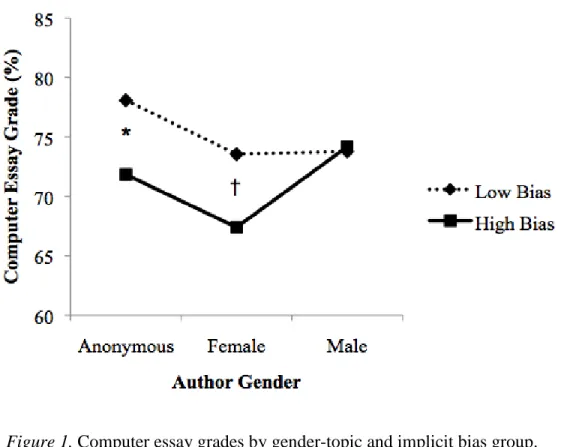
1. Computer essay grades by gender-topic & implicit bias group ...46
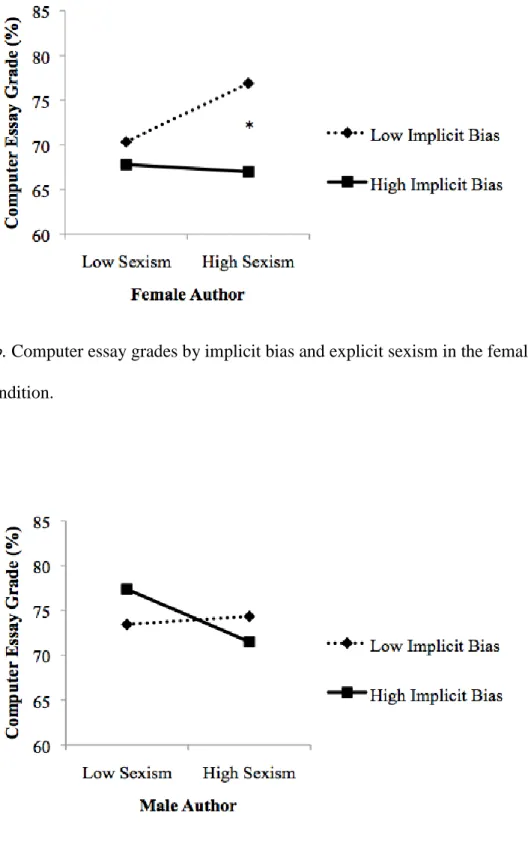
2. Computer essay grades by implicit bias & explicit sexism ...49
3. Exercise essay grades by implicit bias & explicit sexism ...50
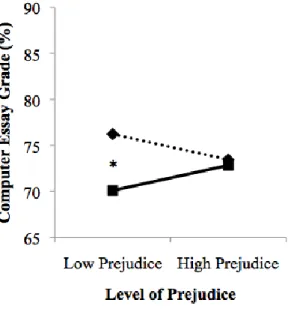
4. Computer essay grades by implicit bias & explicit prejudice ...51
5. Exercise essay grades by implicit bias & explicit prejudice ...52
6a. Computer grades by implicit bias & explicit sexism, anonymous ...55
6b. Computer grades by implicit bias & explicit sexism, female author ...56
6c. Computer grades by implicit bias & explicit sexism, male author ...56
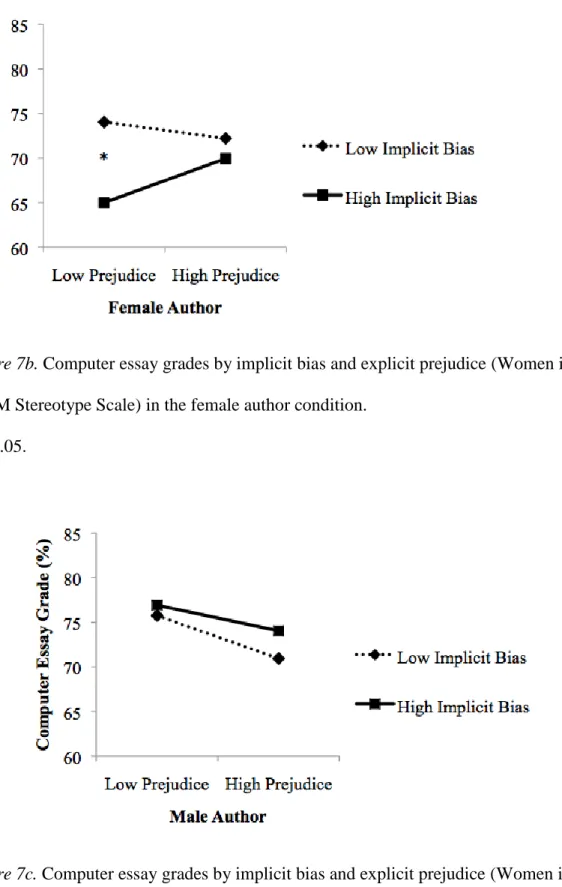
7a. Computer grades by implicit bias & explicit prejudice, anonymous ...59
7b. Computer grades by implicit bias & explicit prejudice, female author ...60
7c. Computer grades by implicit bias & explicit prejudice, male author...60
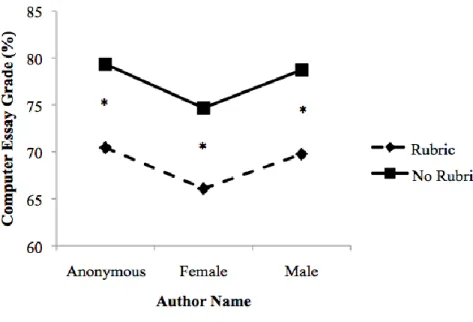
8. Computer grades by gender-topic & rubric condition ...68
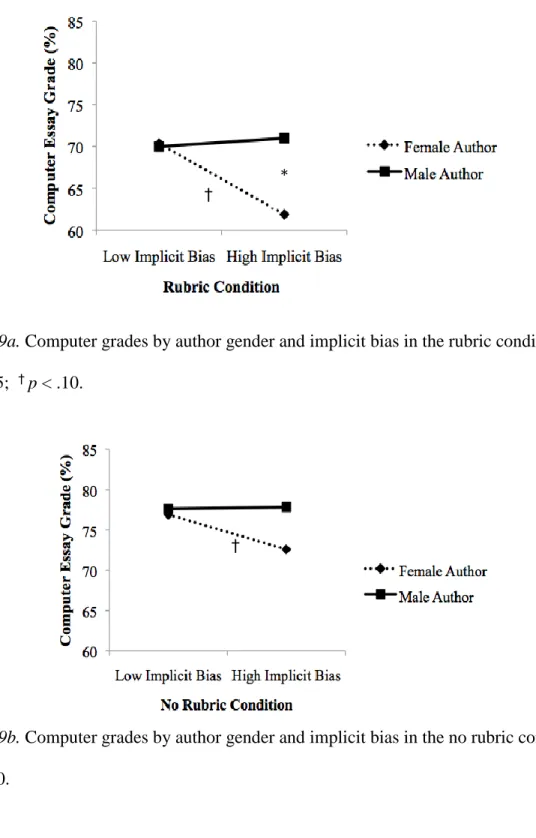
9a. Computer grades by author gender & implicit bias, rubric condition ...74
vii
LIST OF TABLES
Table Page
1. Number of Participants Per Study Condition, by Participant Gender...24
2. Reading Statistics for the Computer and Exercise Essays ...26
3. Pronoun Used in Participants’ Descriptions of Essay Author ...33
4. Frequency of Computer Author Descriptors by Author Gender ...36
5. Correlation Matrix for Key Study Variables ...38
6a. Multiple Regression: Implicit & Explicit Attitudes on Computer Grades ...39
6b. Multiple Regression: Implicit & Explicit Attitudes on Exercise Grades ...40
7a. MANOVA: Computer & Exercise Grades (%) by Gender-Topic... 42
7b. Planned Contrast: Computer & Exercise Grades by Gender-Topic ...43
8a. MANOVA: Computer & Exercise Grades by Gender-Topic & Implicit Bias ...45
8b. Planned Contrasts: Computer Grades by Gender-Topic & Implicit Bias ...47
8c. Planned Contrasts: Exercise Grades by Gender-Topic & Implicit Bias ...48
9. Implicit Bias & Explicit Sexism on Computer Grades (%) by Author Gender...54
10. Implicit Bias & Explicit Prejudice on Computer Grades (%) by Author Gender...58
11. Hierarchical Regression: Computer Grades by Implicit Bias & Rubric ...63
12. Hierarchical Regression: Computer Grades by Implicit Bias & Rubric, Split by Author Gender ...65
13a. MANOVA: Computer & Exercise Grades (%) by Gender-Topic & Rubric ...67
13b. Planned Contrasts: Computer & Exercise Grades (%) by Gender-Topic & Rubric ...69
viii
14a. MANOVA: Computer & Exercise Grades (%) by Gender-Topic,
Implicit Bias & Rubric ...70 14b. Planned Contrasts: Computer Grades by Gender-Topic, Implicit
Bias, & Rubric ...72 14c. Computer Grades (%) by Gender-Topic, Implicit Bias, & Rubric ...73 15. Computer & Exercise Grades (%) by Implicit Bias, Explicit Attitudes,
& Participant Gender ... .76 16. Computer Grades (%) by Gender-Topic, Rubric, & Participant Gender ...78 17. Exercise Grades (%) by Gender-Topic, Rubric, & Participant Gender ...79
ix
LIST OF APPENDICES
Appendix Page
A: Online Learning Management System (LMS) ...113
B: Computer and Exercise Essays...116
C: Rubric (grade sheet used in the Rubric condition) ...118
D: Grade Sheet (used in the No Rubric condition) ...119
E: Instructions and Stimuli Used for Implicit Association Test...120
F: Modern Sexism Scale (Swim et al., 1995) ...121
G: Women in STEM Stereotype Scale (Jackson et al., 2014) ...122
H: Semantic Differential Scale Items ...123
I: Feeling Thermometers ...124
J: Experimental Laboratory Layout ...125
x
ACKNOWLEDGEMENTS
I would like to thank my advisor, Dr. Tamera Schneider, for her advice and guidance. I would also like to thank my committee members, Dr. Kevin Bennett, Dr. Gary Burns and Dr. Martin Gooden, for their feedback and contributions.
I couldn’t have made it through this journey without the love and support of my amazing family. Thank you especially to my husband and best friend, Mark, who never gave up on me, and always had my back. Thank you to my parents, Russ and Jan, whose passions for learning and teaching inspired me from an early age. I am, and will always be, a life-long learner thanks to you. Thank you to my daughter, Olivia, for your patience and love and joyous spirit, even on those long days and nights when I couldn’t play or read or cuddle as much as I wanted to. I hope you always know how much I love you, and that one day you’ll understand that all these sacrifices were made for you.
Finally, I would like to thank my friends who have been there for me along the way. Your own dedication and perseverance inspired and encouraged me. Thank you for providing a listening ear, a shoulder to cry on, or a good laugh when needed.
1
I. INTRODUCTION AND PURPOSE
If [people] (male or female) conclude that women are inferior, [their] perceptions of women – their personalities, behavior, abilities, and accomplishments – will tend to be colored by [their] low expectations of women. ...whatever the facts about sex differences, anti-feminism – like any other prejudice – distorts
perception and experience. What defines anti-feminism is not so much the belief that women are inferior, as allowing that belief to distort one’s perceptions of women. More generally, it is not the partiality itself, but the distortion born of that partiality, that defines prejudice (italics in original, Goldberg, 1968, p. 29).
Goldberg viewed prejudicial action as a conscious decision based on distorted perceptions about a target group, in this case, women. This further implies that biased ratings of written work in favor of male authors (and against female authors) was the result of an explicit belief that women were inferior to men: “Women seem to think that men are better at everything (italics in original, Goldberg, 1968, p. 30). The participants in his study were described as unwilling to concede that women’s competence could be comparable to the competence of men. The idea that one might possess conflicting
2
come. There was no consideration given to the possibility that unconscious associations could affect behavior, resulting in prejudicial outcomes, despite favorable explicit attitudes. Goldberg concludes his study by answering his own question, “Is the
intellectual double-standard really dead? Not at all...” (p. 30). Nearly 50 years later, this question is still relevant. Explicit attitudes regarding women have become increasingly more favorable (Buchmann, 2004; Mladnic & Eagly, 1994), yet disparate treatment of women still occurs across a variety of professional fields, especially those areas that are traditionally considered predominantly male (Devine, 1989; Heilman & Eagly, 2008; Fuchs, Tamkins, Heilman, & Wallen, 2004; National Research Council [NRC], 2007; Nosek et al., 2009).
Stereotypes can be damaging to women in STEM through several modes, as discrimination resulting from prejudice can impact education, hiring, promotion, retention, and availability of resources (National Academy of Science, 2006). The implicit biases held by both men and women can significantly hinder the success of women who choose to enter STEM fields, and gender stereotypes can prevent women from initially entering STEM fields in the first place. Women who choose to major in fields related to computers, technology, engineering, and math report increased overt and covert hostility, and are frequently one of only a few (if not the only one) in these courses (Morganson, Jones, & Major, 2010).
Online education programs have grown increasingly commonplace throughout the United States in recent decades. In 2013, approximately 7.1 million students in the United States took at least one online course, and the vast majority of all institutions of higher education offer online learning options (Allen & Seaman, 2014). Even among
3
traditionally “brick-and-mortar” institutions, online-only programs are becoming acceptable routes for degree completion, and web-enhanced courses have now become the norm. Although some authors have argued that the online learning format should reduce discrimination toward disadvantaged groups by creating a more even playing field (Koenig, 2015), stereotypes and bias can continue to result in disparate treatment toward disadvantaged groups, even in programs that are entirely online (Postmes & Spears, 2002).
The social structures in face-to-face classrooms continue to persist in virtual environments, and therefore continue to result in discriminatory behavior (Gunn et al., 2002). Grades are among the most important methods used to assess learning outcomes; when discrimination impacts grading, the effects are wide-reaching, affecting social, emotional, and academic outcomes (Tierney & Simon, 2004). When discrimination takes more subtle forms, it can be more difficult to address. People are often unaware of the ways in which implicit bias can affect their behaviors (Carnes et al., 2012; Chen & Bargh, 1997; Devine, 1989). Mere exposure to a normative name is sufficient to activate bias resulting in inaccurate or unfair assessments, and this effect can manifest even without direct exposure to targets (Budden et al., 2007; Easterly & Ricard, 2011; Spelke & Grace, 2007; Towers, 2008; Trix & Psenka, 2003). The greatest risk of biased grading occurs when grading expectations are more subjective in nature. Rubrics are designed not only to communicate expectations to students, but also to increase reliability and objectivity in grading.
The purpose of this study was to examine the effects of implicit and explicit gender bias on grading decisions for written assignments. This study also investigated
4
the moderating effect of a rubric on grading bias, to determine whether the use of a rubric would reduce the effect of bias on grading. Finally, this study evaluated whether the use of a measure of implicit associations could predict grading outcomes above and beyond explicit attitude measures.
Stereotypes, Discrimination, and Implicit Bias
Explicit attitudes have been defined as psychological tendencies to evaluate a target with favor or disfavor (Eagly & Chaiken, 1993); in contrast, implicit attitudes reflect automatic psychological tendencies or social cognitions that are purported to be outside the control of the individual (Aberson & Haag, 2007; Greenwald & Banaji, 1995; Greenwald et al., 1998). Implicit and explicit attitudes reflect beliefs, feelings, and associations that originate from a number of sources. It is necessary to first examine some of those sources, including stereotypes, prejudice, and discrimination.
Stereotypes are automatic, oversimplified attitudes toward a target group, and may be favorable or unfavorable (Allport, 1954; Eagly & Chaiken, 1993). To a degree, stereotyping is a natural part of cognitive processing in the same way that schematic heuristics are; they can improve information processing efficiency by allowing an individual to create organizing categories and make generalizations based on selective attention to specific identifying features (Allport, 1954; MacCrae, Milne, &
Bodenhausen, 1994). Stereotypes can help people efficiently make decisions about how to interact with others and they help maintain self-image, group esteem, and in-group identification (Maccrae, Milne, & Bodenhausen, 1994). Individuals who are low in prejudice possess the same knowledge about the stereotypes that exist toward target groups (Devine, 1989). Individuals who are high in explicit prejudice are more likely to
5
discriminate, and overt prejudice can take the form of hostility and intentional discrimination.
Stereotypes and prejudice reflect some of the cognitive components of attitudes, while discrimination reflects a behavioral component (Devine, 1989; Hackney, 2005); as a result, stereotyping may or may not result in discriminatory behavior. Knowledge of a stereotype does not always equate to high explicit prejudice (Olson & Fazio, 2004). Effortful cognitive processing can be employed to control or change behaviors to reduce discrimination (Petty, Wegener, & White, 1998). However, because stereotypes are activated automatically when one is exposed to a target, people might not be consciously aware of how these unconscious associations can affect their behaviors (Carnes et al., 2012; Chen & Bargh, 1997; Devine, 1989; Greenwald & Banaji, 1995; Rudman, Ashmore, & Gary, 2001). Individuals who report low levels of explicit prejudice can also engage in discriminatory behaviors, whether they are aware of these disparate outcomes or not. One source of this unintentional discrimination is implicit bias.
The theory of implicit social cognition holds that past experiences and exposures to target groups affect behaviors, even when the experiences are not consciously recalled or available to introspection, and therefore not consciously available for self-report (Greenwald & Banaji, 1995; Olson & Fazio, 2004; Rudman, 2004). Implicit bias can conflict with an individual’s explicit attitudes and affect behaviors and decision-making. Implicit and explicit measures often correlate weakly at best (Hofmann, Gawronski, Gschwendner, & Schmitt, 2005; Karpinski & Hilton, 2001; Olson & Fazio, 2004). Relying on self-reports alone, one might mistakenly believe that stereotypes toward women and minorities have been reduced to the point of no longer being a concern
6
(Eagly & Mladnic, 1994). Despite these explicit reports, discrimination and disparate treatment persist (Christopher & Wojda, 2008). Differences in accessibility, activation, and awareness between implicit and explicit attitudes explain this dissociation. Implicit associations can result in discrimination, even when people see themselves as egalitarian, and have no explicit intention to discriminate. People are often unaware that their
unconscious associations can influence their behavior. As a result, despite the fact that they disagree with overt prejudice, prejudicial outcomes can occur if they do not consciously engage their egalitarian beliefs (Devine, 1989).
Gender Discrimination
Stereotypes regarding gender can be activated by subtle cues, even in the absence of direct contact with a target. Something as simple as a stereotypically-normative name (i.e. male versus female), can be sufficient. To test this assumption, Goldberg (1968) instructed female undergraduate students to evaluate the quality of six articles. The articles were identical for all participants apart from the author names, which were either male or female. Goldberg reported that women rated the male essays higher than female essays, whether the articles were from traditionally masculine or feminine fields.
However, significant differences were only found in the three fields that were considered masculine: city planning, linguistics, and law. Further, despite Goldberg’s explicit conclusion that “[w]omen seem to think that men are better at everything” (1968, p. 30,
emphasis in original), there were no significant differences in ratings on the feminine topics (art history, dietetics, and education). Regardless of topic, participants rated the author as more competent (one of the 9 dimensions rated) when they thought it was a male (Goldberg, 1968).
7
Subsequent replications of this study have mixed results. Pheterson, Kiesler, and Goldberg (1971) found that when the competency of the female author was
unambiguous, evaluation differences were negligible. Women devalued female authors only when the authors’ achievements were not made clear. Both of these studies were limited, however, in that they each used only female participants. Levenson et al. (1975) included both male and female undergraduates in a series of studies. In their first study, they attempted to replicate Goldberg’s original findings. They found no significant differences by author name or participant gender, and no significant interactions. In their second study, they recruited male and female undergraduates in a political science class to evaluate an essay supposedly written for that course in order to control for participant-level knowledge of the topics being rated. They found no significant difference in evaluations made by male participants, but female participants rated female-authored essays higher than male-authored essays. A meta-analysis of 123 studies using the Goldberg paradigm found a main effect of gender: female authors received lower ratings than male authors, although the effect sizes were small (Swim et al., 1989). They further found that male authors were rated more favorably than female authors when the topics were masculine rather than feminine.
Goldberg’s original hypothesis was that women explicitly devalued the work of other women, and their evaluations reflected conscious beliefs. There is a considerable body of research identifying explicit stereotypes regarding women. Most people are aware of the stereotypes that exist in society regarding the types of roles men and women should occupy (Heilman & Eagly, 2008; Fuchs et al., 2004). Prescriptive gender
8
characteristics that men and women should exhibit (Prentice & Carranza, 2002). When women violate these prescriptive norms, they are met with discrimination through disparate impact or disparate treatment. Discrimination can also take the form of either hostile sexism or benevolent sexism (Christopher & Wojda, 2008). Hostile sexism occurs when discrimination is overt, resulting from negative beliefs about women. In contrast, benevolent sexism occurs when discrimination is covert, resulting from positive beliefs about women (e.g. they are agreeable, supportive, and nurturing), but also from stereotypes that demean women (e.g. they are weak, overly emotional, passive, and in need of protection). The result of either type of sexism is maintenance of the status hierarchy. As a result, women are less likely to be hired, promoted, or offered leadership positions, particularly in fields that are viewed as traditionally masculine.
Women in STEM fields are often the target of each of these forms of
discrimination, affecting education, hiring, promotion, retention, availability of resources, and even the likelihood of entering to STEM fields of study in the first place (National Academy of Science, 2006). A number of specific stereotypes are widely held about women, such as beliefs that they are not good at math, are not competitive or assertive, and that women faculty are less productive in their research and more interested in family than in careers (National Academy of Science, 2006). The belief that men are more inclined to participate and excel in math and science is widely held, even among women (National Academy of Science, 2006; Nosek, Banaji, & Greenwald, 2002).
As noted above, women are generally evaluated favorably, and most people see themselves as egalitarian. Although most people report positive attitudes toward women (Buchmann, DiPrete, & McDaniel, 2008; Eagly & Mladinic, 1994), research continues to
9
support the existence and impact of unconscious gender bias. For example, when
presented with a male or female computer avatar, participants were less likely to trust the advice of female avatars over male avatars (Webb, 2001). This main effect of avatar gender occurred regardless of participant gender, and in the absence of explicit favoritism toward advice from males or females. In another study, participants were randomly assigned to a “tutor” computer that was programmed with either a male or female voice (Nass, Moon, & Green, 2007). The tutor computer provided information on either love and relationships or computers and technology. After the tutoring session, participants completed a test to evaluate what they learned. Then, an evaluator computer that also had either a male or female voice, gave feedback to participants about their test performance. They were told upfront that the tutoring and evaluation programs could have been written by either a man or woman and that the voice they were hearing did not necessarily reflect the gender of the programmer. Despite participants’ self-reported beliefs that gender stereotyping a computer is illogical, the researchers found that the male-voiced evaluator was rated as more competent and friendlier than the female-voiced evaluator computer across all conditions. When the evaluator computer was male, subjects reported that the female tutor was more informative on feminine topics such as love and relationships, while the male tutored was reported to be more informative on masculine topics like computers and technology.
Implicit gender bias extends beyond the laboratory, with significant disadvantages occurring in both academic and professional settings. Resumé studies have shown that identical resumes labeled with male versus female names tend to result in a number of advantages for men: more positive evaluations (Uhlmann & Cohen, 2005), greater chance
10
of selection (Gill, 2003; Koch et al., 2015), and higher starting salary (Lips, 2013). Given identical application packages, both male and female university psychology professors preferred the name Brian over the name Karen twice as often (Steinpreis, Anders, & Ritzke, 1999). In hiring decisions, men not only have an advantage over women, women who reveal that they are mothers are further penalized in terms of perceived competence and commitment, performance and punctuality standards, starting salary, and recommendations for hiring (Benard, Palik, & Correll, 2007). Men who reveal that they are fathers not only escape penalization, but in some cases they benefit further as a result of their parental status.
Long before candidates seek out employment, they are subjected to implicit bias in educational contexts. In early school years, research finds that girls and boys perform similarly, yet as children age a gender gap appears with girls scoring higher on verbal skills and boys scoring higher on math skills (Buchmann et al., 2008). While some earlier researchers suggested that the gap in performance was a result of biological differences rather than environmental differences (e.g. Pearson, 1987), more recent work has consistently shown that many of the differences can be attributed to environmental factors, including implicit bias held by the students themselves (Nosek, Banaji, &
Greenwald, 2002; Steele & Aronson, 1995). One study comparing automatic bias among women in a coeducational college and a women’s college found that automatic gender stereotypes increased for students after only one year of college (Dasgupta & Asgari, 2004). Even current researchers who suggest a biological component tend to concede that boys and girls share an equal aptitude for math and science (e.g. Spelke, 2005). In addition to the effect of self-selection and self-fulfilling prophecy that can result from
11
implicit biases, it has been shown that teachers, as early as kindergarten level, demonstrate biased evaluations of male and female students’ math performance (Robinson-Cimpian et al., 2014). Underrating girls’ performance from an early age is likely to account partly for the gaps in ability that appear in later educational contexts, despite a lack of differences in early elementary school.
These differences continue throughout the schooling experience, and follow students into college. Milkman, Akinola, & Chugh (2014) found that faculty were more likely to respond to an email request for a meeting when they believed the message came from a man rather than a woman. This occurred across all fields, including business, education, human services, engineering, science, and math. Subtle gender biases have resulted in less support for female students in science fields, and science faculty preferred male applicants over female applicants when hiring for a laboratory manager position (Moss-Racusin et al., 2012). Another study found that when faculty members wrote recommendation letters for medical school applicants, the letters were longer for men compared to women and they contained more references to the male student’s curriculum vita and accomplishments (Trix & Psenka, 2003). Letters for women were shorter,
contained more references to the student’s personal life, and included more irrelevant or “doubt-raising” comments. Similarly, performance evaluations of medical students included adjectives reflecting gender bias; women were more likely to be described as “compassionate”, “sensitive”, and “enthusiastic”, whereas men were more likely to be described as “quick learners” (Axelson et al., 2010). This gender difference increased as student proficiency increased; at higher rates of performance, the biased differences between men’s and women’s evaluations became even more pronounced.
12
There is a widely-held implicit belief that women are better in school and better writers. While women may be favorably assessed for general academic ability and for writing ability (or penalized more harshly for poor writing), stereotypes regarding women’s competence, intelligence, emotional stability, and others remain (Buchmann et al., 2008; Prentice & Carranza, 2002). Some stereotypes are shifting to a more equitable level. For example, a once large divergence between descriptions of men and women as being “nerdy” or “geeky” has now diminished such that there are no longer differences (Buchmann et al., 2008). On the other hand, people are still significantly more likely to refer to video games and computers when referencing males, compared to females
(Buchmann et al., 2008). Knowledge of these stereotypes strengthens unconscious gender associations. Most people implicitly associate men with science more than women with science (Nosek et al., 2009). Weak implicit associations of women being linked to STEM fields may partly help explain why women faculty are paid less, promoted more slowly, receive fewer honors, and are given fewer leadership positions than men, despite there being no significant gender differences in knowledge, ability, or productivity (NRC, 2007).
Bias in Online Education
Gender is frequently mentioned in the literature on web-based learning, but gender bias in online education is rarely (Garland & Martin, 2005). Most empirical studies suggest that the perception of the online environment as being democratic and equalizing is naturally flawed, because the complex sociocultural relationships and resulting imbalances remain despite the use of computer communication (Gunn et al., 2002; Wolfe, 1999).
13
Universities first started supplementing courses by email and computer
conferences in the mid-1970s (Harasim, 2000). Online courses were made available in adult non-credit education and executive training programs as early as 1981, and the first online undergraduate courses were introduced in 1984. These developments occurred even before the official launch of the Internet in 1989 and before the invention of the World Wide Web in 1992. Since then, the use of computer technology in classrooms has grown significantly. Today, a majority of degree programs employ a web-enhanced modality (Allen & Seaman, 2014; Gunn et al., 2002; Harasim, 2000), and virtually all public institutions have at least some online course offerings (Allen & Seaman, 2014). A web-enhanced course, also known as a computer-supported learning environment (CSL), is an educational setting where computer networking complements the traditional
classroom environment, providing a platform for communication, learning, and
administrative tasks (Gunn et al., 2002; Harasim, 2000). Most universities now recognize that online education provides an efficient and effective way to meet student needs and many researchers have found that web-based courses are as effective as traditional classroom formats (Allen & Seaman, 2014: Hamann, Pollock, & Wilson, 2008). Given the widespread use of computer-based interaction in education, it is necessary to study how biases can affect behaviors in the online classroom. This is particularly true
regarding grades and performance evaluations, which predict student success in the form of course completion, degree completion, credit transfer, GPA, and admission into graduate schools, to name a few.
More women than men enroll in online courses (Garland & Martin, 2005). Female nontraditional students have reported that online classrooms reduce their feelings
14
of discomfort and alienation compared to face-to-face environments (American
Association of University Women, 2001). However, once computer access and computer literacy are controlled for, gender-based interactions and inequities found in face-to-face classrooms continue to persist online, dispelling the myth that technology provides a gender-neutral and equitable learning environment (Gunn et al., 2002; Postmes & Spears, 2002; Wolfe, 1999). Some researchers have found that women thrive in online
environments, whereas younger male students achieve at a lower level (Gunn et al., 2002; Siann & Callaghan, 2001; Kleinfeld, 1998). This difference has been attributed to beliefs that women are more motivated, have greater ability to work independently, and can more effectively multi-task (Gunn et al., 2002). However, while women tend to fare better academically overall, differences in grading outcomes still exist in areas that are more strongly associated with men, such as science, technology, engineering, and math (Ackerman, Kanfer, & Beier, 2013; Buchmann et al., 2007).
Educational Performance Assessments and Rubrics
Most educators are aware of the possibility that subjective evaluations can unintentionally be influenced by personal bias. Objective criteria and assessment tools, such as rubrics, are often employed in an attempt to reduce this possibility, while also increasing consistency and transparency in grading. A rubric is typically defined as an assessment tool that describes expectations for performance quality (rating score) across different dimensions (criteria) on a particular task (Hafner & Hafner, 2003; Jonsson & Svingby, 2007; Reddy & Andrade, 2010). The three primary features of a rubric are a set of evaluation criteria, definitions of quality for each criterion, and a scoring guide
15
scoring guide describes what the grader should look for when determining the quality of a particular criterion, typically represented on a numeric scale ranging from 0 (poor) to excellent (4 or 5).
Rubrics are used across a wide range of disciplines in higher education, and can be used for several reasons (Jonsson & Svingby, 2007). Rubrics improve efficiency in grading, quantify and clarify expectations, increase objectivity, and promote fairness and satisfaction (Jonsson & Svingby, 2007; Rippé, 2008). Rubrics are also used to provide feedback to students and to enhance learning and teaching (Reddy & Andrade, 2010). Students generally express positive perceptions of rubric use, citing the benefits of clear expectations and increased perceived fairness (Reddy & Andrade, 2010). Instructors, on the other hand, are at times resistant to using rubrics. Their reluctance is in part because most higher education instructors have little or no pedagogical preparation as teachers and because there is a commonly held belief that rubrics require a great deal of time and effort (Hafner & Hafner, 2003; Reddy & Andrade, 2010). Despite the reluctance found among some educators, rubrics are generally highly regarded due to the perceptions that they increase reliability and validity. A number of researchers have reported increased reliability in the presence of a rubric (Jonsson & Svingby, 2007; Renzai & Lovorn, 2010; Silvestri & Oescher, 2006), whereas no research has revealed any negative effects
resulting from rubric use (Renzai & Lovorn, 2010).
There are two primary ways of measuring the effectiveness of a rubric: consensus and consistency (Reddy & Andrade, 2010). Consensus typically involves examining the proportion of ratings that match an expert evaluation (either identical in scoring, or falling within a certain acceptable scoring range). Consistency is often evaluated using
16
inter-rater reliability. Not all researchers have found that rubrics result in consistent grading outcomes. For example, within medical training programs, validated scoring instruments are commonplace, yet there remains significant variability among faculty assessments of student performance (Ottolini et al., 2007). Oakleaf (2006) examined consistency and consensus in a group of raters on a literacy skill assessment. They found that consistency was adequate, but consensus (complete agreement) was far below acceptable levels.
On the other hand, several studies have shown rubrics to be effective in reliably assessing performance. Hafner and Hafner (2003) compared peer-grading and instructor grading in an undergraduate course and found significant consensus and consistency. Simon and Forgette-Giroux (2001) compared instructor grades with undergraduate self-assessments using a rubric and found that instructors and students reached consensus 75% of the time. Researchers examining essay grading without the use of a rubric have shown significant variability in grades, further supporting the use of a rubric to decrease grading variance. Gage and Berliner (1992) recruited experienced teachers to grade an identical essay without a rubric, and they found a great deal of variability in scores between teachers. On a scale from 0 to 100, the teacher grades ranged from 60 to the upper 90s, and teachers’ evaluation of the essay writer’s grade level also varied
considerably. Most of the research on rubric use refers to the increase in consistency as a primary way of evaluating the effectiveness on rubrics.
When rubrics are used to increase consistency and decrease variability resulting from bias, grading with a rubric is likely more reliable than grading without a rubric (Jonsson & Svingby, 2007). There are a number of elements that can be employed to
17
enhance consistency when designing a rubric. Rubrics that are analytic, topic-specific, include exemplars, and are complemented with rater training tend to be more reliable (Jonsson & Svingby, 2007). Rubrics are most effective when the number of criteria assessed is kept to a minimum (i.e. less than 10; Rhodes, 2010). The language in the rubric must be clear and consistent because ambiguity cannot be interpreted accurately by graders or students (Reddy & Andrade, 2010; Payne, 2003). One short-coming of some rubrics is a lack of narrative anchor, which is more likely to result in disparate scoring and less inter-rater reliability (Ottolini et al., 2007). Thus, the addition of narrative descriptions or the practice of encouraging raters to reflect upon their grading decisions in a narrative fashion is preferred in the design and implementation of rubrics.
Purpose
The purpose of this study was to examine the effects of implicit and explicit gender bias on grading decisions for written assignments. This study also investigated whether the use of a rubric would reduce the effect of bias on grading. Finally, this study evaluated whether implicit association and explicit attitude measures could explain a significant amount of variance in grading outcomes. Participants graded identical essays with manipulated author gender names (anonymous, female, or male) using either a rubric or no rubric. This grading task was followed by a series of implicit and explicit measures of gender bias, and a set of questions regarding participants’ impressions of the authors whose work they ostensibly read. This design was intended to elicit biased responses depending on author gender, which in turn would provide the opportunity to study the use of a rubric to reduce discrimination in grading.
18 Hypotheses Evidence of Activation of Implicit Bias
Most people possess a stronger implicit association of men with STEM rather than women with STEM (Nosek et al., 2009). Although previously common explicit gender stereotypes are less common today (e.g. women are less intelligent or competent; men can be nerds, but women cannot), prescriptive gender norms continue to influence evaluations of women and men (Rudman & Glick, 2001; Prentice & Carranza, 2002). Faculty are more likely to respond to an email request from a male student (Milkman, Akinola, & Chugh, 2014), letters for female medical school applicants are shorter and contain more doubt raisers (Trix & Psenka, 2003), and performances evaluations for medical students contain more descriptions of men as quick learners and women as compassionate (Axelson et al., 2010). Based on these findings, in the current study, participants’ descriptions of the author of the computer essay (a STEM topic) were expected to reflect implicit associations between author gender and essay topic.
Hypothesis 1. A: In the anonymous condition, participants will use a male pronoun (‘he’) to describe the author of the computer essay more often than a female pronoun (‘she’), and participants will ascribe male and female pronouns equally to the anonymous exercise essay.
Hypothesis 1. B: Participants will describe female authors using fewer descriptive words and fewer words overall compared to when they describe male authors.
Hypothesis 1. C: Participants will use descriptors to describe the male and female authors differently, revealing implicit gender norms.
19
Implicit and Explicit Bias and Their Effects on Essay Grades
A number of attitude researchers have found that measures of implicit bias are better predictors of discriminatory behaviors than explicit attitudes (Lane et al., 2012; Nosek & Smyth, 2011; Nosek et al., 2002; Steffens et al., 2010). Even in studies where explicit attitudes are found to significantly predict behaviors, once implicit bias is added to the statistical model, explicit measures become non-significant (Nosek et al., 2009). Similar findings were expected in the current research.
Hypothesis 2. A: The implicit association measure will correlate significantly with computer essay grades. Explicit attitude scores will correlate weakly with computer essay grades and weakly with implicit association scores.
Hypothesis 2. B: None of the implicit or explicit measures are expected to correlate significantly with exercise essay grades.
Hypothesis 2. C: Implicit gender-science association scores will explain a
significant amount of variance in computer essay grades, and the IAT will explain a significant amount of variance above and beyond explicit measures.
Effect of Author Gender on Essay Grades
Several studies have found that female authors (e.g. of essays, articles, and blogs) receive lower ratings and rated less competent or credible that male authors (Armstrong & McAdams, 2009; Goldberg, 1969; Levenson et al., 1975; Swim et al. 1989). Because most people have a stronger implicit association of men with science (Nosek et al., 2009), and because both men and women can face backlash if they violate prescriptive gender norms (Prentice & Carranza, 2002), author gender was expected to affect essay grades
20
positively when author gender and essay topic were stereotype-consistent and negatively when author gender and essay topic were stereotype-inconsistent.
Hypothesis 3. A: Computer essay grades with the male author name (stereotype-consistent) will be higher than computer essay grades with the female author name (stereotype-inconsistent). The computer essay with no author name will receive grades that are equal to the grades assigned to the stereotype-consistent (male-computer) author gender-essay topic pairing.
Hypothesis 3. B: Exercise essay grades with the female author name (stereotype-consistent) will be higher than exercise essay grades with the male author name (stereotype-inconsistent). The exercise essay with no author name will receive grades that are equal to the grades assigned to the stereotype-consistent (female-exercise) author gender-essay topic pairing.
Interaction of Implicit and Explicit Attitudes on Grades, by Author Gender High prejudice individuals are those who endorse stereotypes toward a target group, whereas low prejudice individuals do not endorse stereotypes. People who report low explicit prejudice, yet harbor high implicit bias might report positive attitudes as an intentional method of replacing stereotypes with egalitarian views, or they might do so because they are unaware of their personal implicit biases (Devine, 1989). When people report low explicit prejudice and high implicit bias, they tend to be more vigilant and more scrutinizing toward members of the target group (Devine et al., 1991; Monteith et al., 1993; Petty et al., 1999; Johnson et al., 2011). Therefore, implicit bias was expected to interact with explicit attitudes to affect essay grades.
21
Hypothesis 4. A: High-prejudice individuals will exhibit greater bias in grading than low-prejudice individuals.
Hypothesis 4. B: Participants with low explicit prejudice and high implicit prejudice will assign lower grades to female authors but not to male authors compared to the no name condition.
Effectiveness of Rubrics to Increase Consistency in Grading
In addition to improving efficiency and clarifying expectations, effective rubrics are increase reliability among raters (Jonsson & Svingby, 2007; Renzai & Lovorn, 2010; Rippé, 2008). The rubric used in the current research was expected to result in greater consistency within essay grades.
Hypothesis 5: Essay grades will have greater consistency (less variability) within the rubric condition compared to grades in the no-rubric condition.
Effectiveness of Rubrics to Decrease Bias Impact on Grading
By increasing consistency and reliability, rubrics are believed to increase objectivity and fairness in grading (Jonsson & Svingby, 2007; Renzai & Lovorn, 2010; Rippé, 2008). The rubric was expected to interact with author gender to affect essay grades, resulting in greater parity between grades assigned to different authors.
Hypothesis 6. A: There will be a significant difference in essay grades between author gender in the no-rubric condition, but not in the rubric condition. Differences observed among author gender grade assignments in the no rubric condition will become non-significant in the rubric condition.
Hypothesis 6. B: The rubric will interact with the IAT to reduce the effect of bias on grades, resulting in more equal grades among author genders.
22
Gender Differences in Implicit and Explicit Attitude Scores
Some attitude research has found little to no differences in implicit or explicit attitudes between male and female respondents (Nosek et al., 2009). Others, however, have found significant attitude differences by participant gender (Buchmann et al., 2007; Jackson, Hillard, & Schneider, 2014). Male participants’ responses were expected to differ from those of female participants.
Hypothesis 7: Implicit bias and explicit stereotype endorsements were expected to be higher within male participants, compared to female participants. Interaction of Author Gender, Rubric, and Participant Gender on Grading
In-group gender bias emerges early in childhood, with boys and girls evaluating members of their gender group more favorably. Girls tend to have stronger implicit own-gender preferences, but as men age, their implicit preferences begins to lean toward women as well (Dunham, Baron, & Banaji, 2015). Given the relatively young age of the subject pool from which this research drew its participants, it was expected that there would be evidence of in-group gender bias, but that rubric use would reduce this effect.
Hypothesis 8: There will be a three-way interaction between author gender, rubric, and participant gender. Male participants are expected to grade the male author more favorably, female participants are expected to grade the female more favorably, and rubric is expected to moderate this
relationship.
23 II. METHOD Design
The current study employed a between-subjects, factorial, experimental design. Manipulated independent variables were name of the essay author (anonymous, female, or male) and grade instructions (rubric or no rubric). Attitude variables included a measure of implicit gender-science bias and four measures of explicit gender attitudes. The dependent variables were the final grades (out of 20 points, converted to
percentages) that participants assigned to each essay (computers, exercise). Participants were randomly assigned to receive a rubric or not. Order of essay topic presentation and author gender-essay topic combination (hereafter referred to as ‘gender-topic condition’) were completely counterbalanced. Stereotype-consistent gender-topic conditions were: (a) male author with computer essay and (b) female author with exercise essay.
Stereotype-inconsistent gender-topic conditions were: (a) female author with computer essay, and (b) male author with exercise essay. In the anonymous condition, participants graded the same computer and exercise essays, but neither essay had an author name. Participants
Participants were 216 undergraduate students (70% female, n = 151) taking an introductory psychology course at a midwestern university. Distribution of participants by study condition and participant gender were statistically equivalent across all cells (see Table 1). The average age was 21 years (ages ranged from 18 to 54). Of those
24
participants who reported their ethnicity, 71% were White, 13% were African-American, 4% were Middle Eastern, 3% were Hispanic, 4% were mixed race, and 4% were other.
Table 1
Number of Participants Per Study Condition, by Participant Gender
Participant Gender Condition Grading Instructions Stereotype Congruence Gender-topic
condition Male Female
n Per Condition 1 Rubric Stereotype consistent Male computer, female exercise 11 24 35 2 Rubric Stereotype inconsistent Female computer, male exercise 13 25 38
3 Rubric Anonymous Computer, exercise
(no author name) 7 28 35
4 No Rubric Stereotype consistent Male computer, female exercise 15 21 36 5 No Rubric Stereotype inconsistent Female computer, male exercise 10 27 37
6 No Rubric Anonymous Computer, exercise
(no author name) 9 26 35
25 Power analysis.
Previous studies examining grading differences given for male and female authors have found mean effect sizes ranging from -0.08 (small) to -0.38 (medium; Swim et al., 1989). Using power tables from Cohen (1992), a sample size of 35 per condition will yield power of 0.80 with 6 groups (total N required = 210). This effect size
estimation was based on planned contrasts and was expected to yield a small to moderate effect size.
Task Apparatus
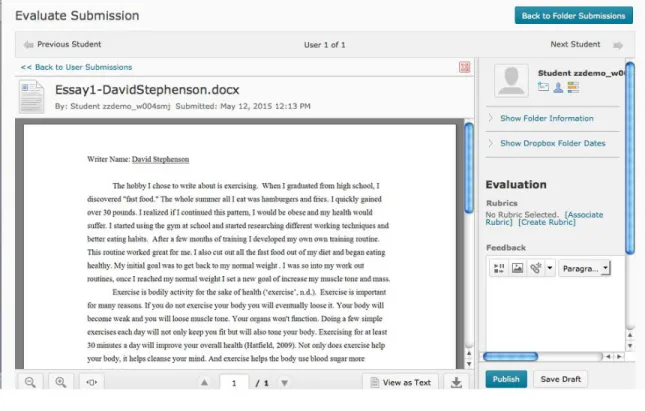
Online course environment. Participants viewed the essays in the university’s online Learning Management System (LMS; see Appendix A). All students enrolled in introductory psychology courses (currently or within the past 5 years) had prior
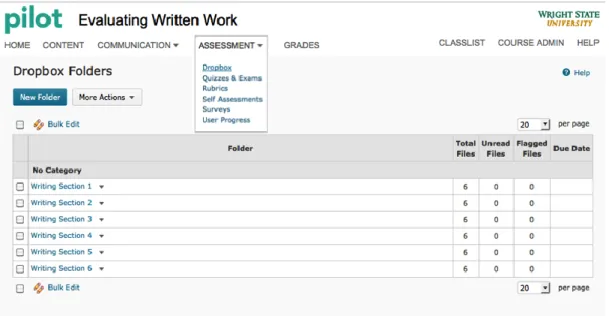
experience with this system and were familiar with the way assignments are uploaded and reviewed. Essays were pre-loaded in the “Dropbox” folder under “Assessments”, a feature in the LMS wherein students electronically upload assignments for their courses and receive grades and comments from their instructors. There were six folders (“writing sections”) within Dropbox, each containing six files. The first two contained the
experimental essays, and the remaining four were files that were deliberately manipulated so they did not open when clicked (an error would appear and further attempts to open the file would result in a warning stating that the file was corrupt). Participants believed they would be grading 6 essays, but only graded the first two.
Materials
Essays. Participants read two essays, ostensibly written by other students, on the topics of computers and exercise (see Appendix B). The essays were adapted from
26
existing essays available at a free essay writing website. The resulting composite essays were reviewed by the researchers to ensure that no explicit information remained that might be suggestive of author gender. Reading statistics were comparable for both essays (see Table 2).
Table 2
Reading Statistics for the Computer and Exercise Essays
Essay Topic Statistic Computer Exercise Counts Words 421 456 Characters 2027 2101 Paragraphs 3 3 Sentences 30 34 Averages
Sentences per paragraph 10.0 11.3 Words per sentence 14.0 13.4 Characters per word 4.7 4.5 Readability
Passive Sentences 6% 5%
Flesch Reading Ease 58.5 66.1 Flesch-Kincaid Grade Level 8.5 7.3
27
Rubric/grading instructions. A blank rubric was provided in paper format to participants in the experimental condition (see Appendix C). The rubric contained the writing prompt, (described as the prompt given to the authors of the essays), participant instructions, and a list of 4 main objectives (e.g. content, writing mechanics, etc.). Each objective was evaluated on a scale from 0 (not acceptable or objective not present) to 5 (excellent). For each point value, a short narrative anchor was provided, describing in more detail what would constitute a rating at each level. Participants were instructed to write the point value assigned to each objective, then total all ratings for a combined grade out of a maximum of 20 points. The rubric also included a key providing percentage equivalents for each point value range. In the male and female author conditions, a blank was provided for “author name” (no blank was included in the no-name author condition).
Participants in the control condition (no rubric) received a grading sheet that contained the same writing prompt and instructions, blank for author name (in the male and female author conditions), and the percentage equivalent key (see Appendix D). Participants were instructed to grade the essay to the best of their ability, and then record the total score they assigned out of a maximum of 20 points in the space provided on the instruction sheet.
Measures
Essay grades. The dependent variables were the final grades (out of a maximum of 20 points and subsequently converted to percentages) assigned to each of the two essays.
28
Follow-up interview. Prior to the debrief, the researcher asked a series of follow-up questions regarding the essay grading task. These questions served both as a
manipulation check, and as a measure of implicit gender bias. Participants were asked to describe their impressions of the two authors whose essays they read. In addition to recording the participants’ descriptions, the researcher made note of the pronoun used to describe each author.
Gender-Science Implicit Association Test. The Implicit Association Test (IAT) assesses implicit attitudes and other automatic associations based on reaction times (Greenwald, McGhee, & Schwartz, 1998). Compared to self-report explicit attitude measures, the IAT is purported to be more resistant to validity threats such as social desirability. The IAT measures how quickly a participant classifies stimuli into
categories. The target category contains the dichotomous aspects of the object attitude the researcher is interested in studying. The attribute category contains the valence of the attitudes. The traditional IAT measures how quickly participants associate dichotomous target groups (e.g. women or men) with favorable or unfavorable attributes (e.g. good or bad). The response time indicates the relative strength of association by assessing how quickly a participant can pair a target category with the attribute dimension. If a target category is associated with an attribute dimension that reflects the participant’s implicit association, he or she should respond more quickly (Greenwald et al., 1998). Participants are instructed to correctly sort stimuli items as quickly as possible, to elicit responses that are instant, uncontrollable, and automatic.
Stereotype IATs, rather than traditional attitude (good-bad, pleasant-unpleasant) IATs were used in this study because the hypotheses are directly related to stereotypes
29
regarding women with STEM, rather than a general positive or negative attribution. Furthermore, stereotype IATs have been shown to higher predictive validity than
traditional attitude IATs (Rudman & Ashmore, 2007). The Gender-Science IAT was used in this study (Nosek et al., 2009). This IAT is intended to reveal the relative association between liberal arts or science and females or males. The Gender-Science IAT uses the target categories of “Male” and “Female”, and the attribute categories of “Science” and “Liberal Arts”. Stimuli used in this IAT, along with testing procedure, can be found in Appendix E.
Explicit attitude measures.
The Modern Sexism Scale (Swim et al., 1995) presents eight statements reflecting beliefs about women across three dimensions: (1) denial of continuing discrimination (e.g. “Discrimination against women is no longer a problem in the United States.”), (2) antagonism toward women’s demands (e.g. “It is easy to understand the anger of
women’s groups in America,” reverse-scored) and (3) resentment about special favors for women (e.g. “The government and media have shown more concern about the treatment of women than is warranted by women’s actual experiences.”) Participants rate their agreement with each statement using a 5-point Likert scale (1 = strongly disagree, 5 = strongly agree). A Principal Axis Factor analysis (PAF) with a Varimax rotation was conducted to ensure that the items loaded on the same factor. The 8-item scale was reliable (Cronbach’s alpha = .80; see Appendix F).
The Women in STEM Stereotype Scale (Jackson, Hillard, & Schneider, 2014) presents 14 stereotype-derived statements (e.g. “Women are worse at math than men;” NAS, 2006). Participants rated their agreement with each statement using a 5-point
30
Likert scale. A Principal Axis Factor analysis (PAF) with a Varimax rotation was conducted for this relatively new scale. Items were retained when their loading was greater than .40 on that factor and less than .30 on any other factor. The final 10-item scale was reliable, with a Cronbach’s alpha of .76 (see Appendix G).
A semantic differential scale contains a pair of dichotomous words of opposite meaning anchored on opposite ends of a numeric ratings scale containing number ratings from 1 to 5 spaced equally between the words. Participants are asked to rate a target group by circling where on the scale their beliefs about the target group falls. In the current study, participants were asked to rate “women” on each of 12 semantic differential scale items (adapted from Blair, Ma, & Lenton, 2001; Jackson, Hillard, & Schneider, 2013; Olson & Fazio, 2004). Items assessed general favorability toward women (e.g. good versus bad; favorable versus unfavorable) and stereotypes regarding women (e.g. analytical versus emotional; passive versus assertive). A Principal Axis Factor analysis (PAF) with a Varimax rotation was conducted for the 12 semantic differential items. Of the 12 semantic differential items, 8 were included in the final attitude scale, resulting in a Cronbach’s alpha of .81 (see Appendix H). Because of the strong correlations and high factor loadings for these 8 items, scores for the semantic differential scales were collapsed to produce a single semantic differential average.
The final explicit attitude measure consisted of 6 feeling thermometer items. Participants were asked to rate on a scale from 0 (very cold/unfavorable) to 100 (very warm/favorable) their feelings toward each item. Of these 6 items, three were
31
faculty”). Cronbach’s alpha for the combined feeling thermometer items was .80 (see Appendix I).
Procedure
Participants were told that they would be reading and evaluating a series of short written assignments. The researcher provided each participant with a grade sheet containing either a rubric with a space for the final grade, or a blank grade sheet with a space for the final grade. After explaining the task to the participant, the researcher opened the first and second essay in sequence, providing the same rubric or grade sheet each time. When the researcher attempted to open any additional files, the error message appeared on the screen, indicating that the files were corrupt and could not be opened.
At this point, the researcher apologized, explaining that there had been technical problems with this writing section in the past, and asked the participant if they would be willing to take part in a “second study” being conducted in the lab. They were informed that it was voluntary and that they would receive their full credit for participation either way. If the participant did not agree to do the second study, the researcher thanked them again for their time, provided a demographic survey, and read the debrief statement.
Participants who agreed to participate were then escorted to a different computer in the laboratory (see Appendix J). The participant then completed the Gender-Science IAT on the computer, followed by a pencil-and-paper copy of the explicit measures and demographics. At the end of the survey, the researcher asked a series of follow-up questions regarding both studies, read the debrief statement, and thanked them for their participation (see Appendix K for procedural flowchart).
32 III. RESULTS Manipulation Check.
To ensure that the author name manipulation was effective, participants were asked to describe the author, and the pronoun used was tallied. For the computer essay, 80% of participants correctly described the male author as “he”. The remaining 20% used either the gender-neutral, singular “they” or did not use any pronoun. When the computer essay had a female author, 75% of participants correctly described the author as “she”, and 20% used “they” or no pronoun. For the exercise essay, there were no
significant differences in pronoun use for either of the gendered author name conditions: 77% of participants correctly described the male exercise author as “he”, and 77% of participants correctly described the female exercise author as “she”; participants were equally likely to use the singular “they” or to use no pronoun, in both author gender conditions. These results indicate that the manipulation was effective.
Evidence of Activation of Implicit Bias
Pronouns used to describe the writer of the computer essay in the anonymous condition (no author name) were examined to investigate the activation of implicit bias. In the no author name condition, participants were expected to use pronouns that would reflect implicit associations between gender and essay topic. For the anonymous computer essay, participants were expected to use a male pronoun (‘he’) to describe the author. For the anonymous exercise essay, participants were expected to use male or
33
female pronouns. In the computer condition, 56% of participants described the
anonymous author as male, whereas only one participant described the author as female, 2 (5) = 42.82, p < .01. The remaining 42% used either a gender-neutral pronoun, or no pronoun. For the no name exercise essay, pronoun use was approximately evenly distributed across male and female pronouns; none of the observed pronoun categories differed significantly from expected values, all ps > .47 (see Table 3).
Table 3
Pronoun Used in Participants’ Descriptions of Essay Author
Pronoun
he she they none
Condition n % n % n % n % total 2
Computer essay Anonymous 39 56% 1 1% 22 31% 8 11% 70 42.82** Female author 4 5% 56 75% 9 12% 6 8% 75 14.51** Male author 57 80% 0 0% 10 14% 4 6% 71 0.28 Exercise essay Anonymous 18 26% 19 27% 26 37% 7 10% 70 1.40 Female author 2 3% 55 77% 10 14% 4 6% 71 2.54 Male author 58 77% 1 1% 11 15% 5 7% 75 0.12 Note: **p < .01.34
Participants’ descriptions of authors were also expected to reflect implicit gender norms. Descriptions given for the female author were expected to be shorter, contain more references to appearance than intelligence, have fewer references to video games and to interest in STEM majors or careers, and be described as more extraverted, agreeable, and emotional than males. Descriptions of the male author were expected to include more references to intelligence, conscientiousness, and introversion, and the male was expected to be described as nerdy and anti-social. An independent-samples t-test was conducted to compare word count for the male author and female author descriptions. To compare descriptions of the male and female author, comments were coding in three stages (based on Moni, Beswick, & Moni, 2005): (1) open coding: each concept from each description was recorded on a separate line, (2) axial coding: key words were tallied, and words with similar stems or definitions were grouped together, and (3) selective coding: descriptors were then collapsed into categories based on similar or related meanings. Chi-square analyses were then conducted to compare frequencies of descriptive words within each category.
As shown in Table 4, there were no differences in word count for male author or the female author of the computer essay. Number of descriptive words also did not differ between the male and female authors. The type of descriptive adjectives used to describe the computer essay differed depending on author gender, χ2(9) = 23.92, p < .001.
Predictions were partially supported. There were no significant differences between the male and female author in references to intelligence or likelihood of majoring/seeking a career in STEM, yet the female author received significantly more criticisms regarding English and writing ability. There were no differences in descriptions of the male author
35
of female author being “nerdy” or “geeky”, yet the female author received significantly fewer references to video games.
There were no significant differences in frequency of personality descriptors applied to the male and female authors, all ps > .11, although there appeared to be a trend toward females receiving more descriptions referencing low conscientiousness. A
surprising marginal difference occurred in the number of descriptions referencing
physical appearance. The male author received marginally more comments regarding the way participants imagined he looked, compared to the female author. The category labeled “doubt-raisers” included four references to the female author and zero references to the male author. These references implied that the author was disingenuous or not serious about the topic. Expected frequencies were less than five, precluding the possibility of conducting a chi-square analysis, but the fact that these comments were only recorded in reference to the female author is note-worthy. Doubt-raising statements regarding the female author were:
“Real people in computer science don’t talk...like that.” “She is trying to appear smart, lacks interest.”
“She has no idea what she is talking about.” “She’s apparently not interested in this hobby.”
36 Table 4
Frequency of Computer Author Descriptors by Author Gender
Author Gender
Female Male
2 (1) t (111)Intelligent 26 28 0.07 -
Major or Career in STEM 17 24 1.20 -
Nerdy or Geeky 5 6 0.09 -
Hard Worker, Motivated 13 9 0.73 -
Poor English / Writing 26 12 5.16* -
Interest in Video Games 4 20 10.67** -
Low Conscientiousness 21 12 2.46 - Extraverted 5 4 0.11 - Introverted 18 15 0.27 - Physical Appearance 6 14 3.20† - Doubt-raisers 4 0 - - Counts [M (SD)]:
Total Word Count 17.82 (12.54) 18.51 (12.35) - 0.43 Number of Descriptors 2.87 (01.43) 3.11 (01.36) - 0.39