8
A Qualitative Biochemistry
and Its Application to the
Regulation of the Tryptophan Operon
Peter D. Karp
1 Introduction
This article is concerned with the general question of how to represent biological knowledge in computers such that it may be used in multiple prob-lem solving tasks. In particular, I present a model of a bacterial gene regula-tion system that is used by a program that simulates gene regularegula-tion experi-ments, and by a second program that formulates hypotheses to account for errors in predicted experiment outcomes. This article focuses on the issues of representation and simulation; for more information on the hypothesis for-mation task see (Karp, 1989; Karp, 1990).
The bacterial gene regulation system of interest is the tryptophan (trp) operon of E. coli (Yanofsky, 1981). The genes that it contains code for en-zymes that synthesize the amino acid tryptophan. My model of the trp
oper-on—called GENSIM(genetic simulator)—describes the biochemical reactions that determine when the genes within the operon are expressed and when they are not, the reactions by which the genes direct the synthesis of the biosynthetic enzymes (transcription and translation), and the reactions cat-alyzed by these enzymes. Therefore my modeling techniques are specifically designed to represent enzymatically-catalyzed biochemical reactions whose substrates include macromolecules with complex internal structures, such as DNA and RNA. These techniques address such issues as: How might we represent the attributes and the structures of the objects that make up the trp operon? What is a suitable ontology for these objects—an appropriate level of abstraction at which to model them? How might we describe a gene regu-lation experiment, and how can we maintain a library of known experiments? How might we represent known biochemical reactions? How can we design a simulation program that predicts the outcome of a gene regulation experi-ment by correctly and efficiently simulating every reaction that occurs in that experiment, and only those reactions?
GENSIMembodies a qualitative biochemistry because it provides a frame-work for representing knowledge of biochemistry, and for performing tative simulations of biochemical systems. The specific features of this quali-tative biochemistry are as follows.
I employ frames to represent biochemical objects that correspond to homogeneous populations of molecules. This representation describes the decomposition of complex objects into their component parts. I use frame knowledge bases to represent the objects present in the initial conditions of different experiments. Section 2 describes how instance frames represent chemical objects in simulation knowledge bases; Section 3 describes how class frames are used to represent general classes of biochemical objects, and presents a method for automatically instantiating these classes.
I employ frames called processes to represent biochemical reactions; reac-tions are arranged in an inheritance hierarchy and often inherit porreac-tions of their definitions from more general reaction classes. Section 4 discusses the GENSIMprocess knowledge base.
The GENSIMsimulator uses information in the process knowledge base to determine what reactions occur among the objects in an experiment, and to predict what new objects will be present at the end of an experiment. Section 5 presents two different algorithms used by GENSIMto simulate process exe-cution. Because biochemical reactions are probabilistic events that act on populations of molecules, when GENSIMsimulates reactions it splits reacting populations of molecules into two subpopulations: those that do react and those that do not react (this operation is called object forking). Object forking is necessary to ensure simulation correctness, but it is a computationally ex-pensive operation. Therefore, Section 5.5 presents methods for increasing simulation efficiency. For example, there are times when we can avoid object
forking. Section 5.4 identifies a restriction on the syntax of biochemical reac-tion descripreac-tions that is necessary to ensure simulareac-tion correctness.
Section 6 presents the results of several simulations that have been com-puted by GENSIM. Section 7 compares my model of the tryptophan operon to models of biochemical systems that have been created by other researchers.
I claim that the methods embodied by GENSIMare sufficient to represent qualitative scientific knowledge about objects and processes in molecular bi-ology and biochemistry, such that the knowledge can be used to predict ex-perimental outcomes, and such that other programs can reason about and modify this knowledge.
The mechanism of transcription will be used as an example throughout the remainder of this article. Transcription is a set of processes that are in-volved in the expression of genes, such as those within the trp operon. Tran-scription is somewhat analogous to copying a magnetic tape. An enzyme (called RNA polymerase) first attaches to the trp operon DNA at a promoter site, and then moves along the linear DNA strand, reading the message on the DNA and simultaneously synthesizing another long molecule called RNA that contains what is effectively a copy of the DNA message. When RNA polymerase recognizes a terminator DNA site, it releases both the DNA and RNA.
2 Representation of Biochemical Objects and Experiments
In the GENSIMframework, a user defines a gene regulation experiment by describing the objects present at the start of the experiment. I have used IntelliCorp’s KEEframe knowledge representation system to represent all of GENSIM’s knowledge (Kehler and Clemenson, 1984). To describe an experi-ment in which a particular strain of E. coli is grown in a particular medium, a user creates KEEinstance frames that represent the bacterial DNA (wildtype or mutant), the proteins that are present within the cell (such as RNA poly-merase and the regulatory trp-repressor protein), and small molecules that are present (such as glucose and tryptophan). Users do not create these frames “out of the blue,” but by instantiating existing class frames (see Section 3).
In the ontology for this qualitative biochemistry, each “object” represents not a single molecule, but rather a homogeneous population of molecules. For example, all molecules of tryptophan in a experiment that are in a given state (such as those floating free in solution, as opposed to those bound to the trp-repressor protein) are represented by a single KEEframe. All molecules of tryptophan in a different single state (such as bound to the trp-repressor protein) are represented by a different single KEEframe.
These frames reside within a single KEEknowledge base for this particu-lar experiment, called an SKB or simulation knowledge base. Other experi-ments could be described within other knowledge bases.1In the context of a
GENSIM simulation the SKB corresponds to the working memory of a pro-duction system. Since the facts it contains are represented using frames, all facts are literals and contain neither disjunction nor negation.
GENSIMdoes not represent temporal aspects of objects explicitly; the work of (Simmons and Mohammed, 1987) and (Williams, 1986) is relevant to this problem. GENSIM’s task is to simulate the behavior of a biochemical system during a very short interval of time. Within such a short interval, new objects can come into existence because the creation of an arbitrarily small amount of an object is enough to change its concentration from zero to positive. However, we make the simplifying assumption that GENSIMsimulations take place in a short enough interval that a population of molecules is never fully consumed; thus objects are never deleted from simulations. When an arbi-trarily small amount of an object is destroyed, we cannot assume that its con-centration has changed from positive to zero.
This assumption implies that the number of objects in a simulation must increase monotonically. In reality, biologists do perform experiments over in-tervals of time long enough that objects are completely consumed by reac-tions. However, this assumption simplifies the implementation of GENSIM significantly. Without it, GENSIMwould have to reason about time and quan-tities. Yet the system is still able to make predictions for an interesting class of experiments. This assumption also simplified the implementation of the HYPGENEhypothesis formation program described in (Karp, 1989).
3. The Class Knowledge Base
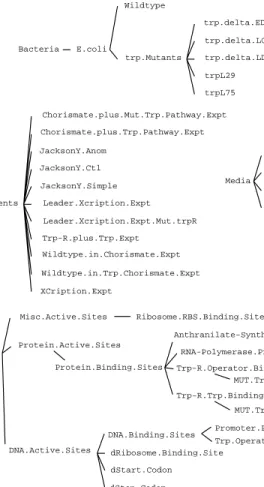
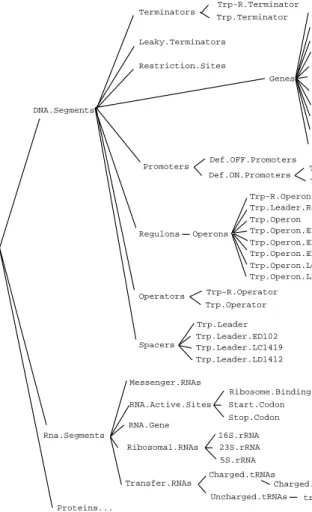
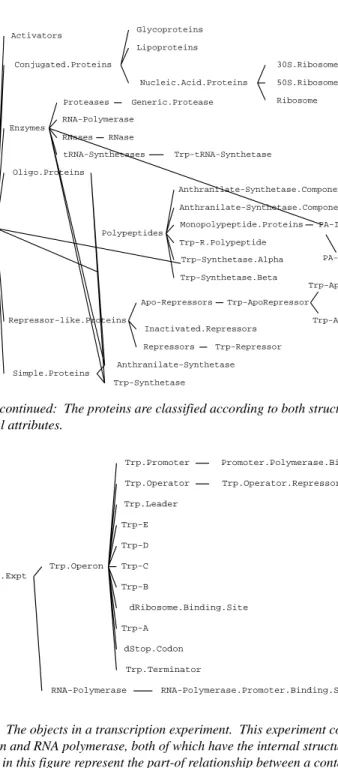
GENSIM’s class knowledge base (CKB) is a taxonomic hierarchy that de-scribes classes of biochemical objects such as genes, proteins, and biochemi-cal binding sites. The KB describes the properties and states of different classes of objects, and the decomposition of objects into their component parts. The CKB can be viewed as a library that records all known types of objects that could be present in experiments on the trp system (in practice, we have omitted many marginally relevant objects because bacteria are in-credibly complex biochemical systems). Each object class is represented as a KEEclass frame. The CKB is shown in Figures 1 and 2.
A central type of relationship among objects in this domain is the
containment of one or more objects by a composite object. The example
ob-ject structure in Figure 3 describes an experiment obob-ject that has two compo-nents: an enzyme (R N A - P o l y m e r a s e) and a segment of DNA (Trp.Operon). The trp operon is in turn divided into a number of compo-nent regions. Several issues of interest arose in the representation of objects with complex component structures: how to represent different types of con-tainment relationships, how to define classes of these objects, and how to in-stantiate these classes. The slots within the Trp.Operonclass shown in
Figure 4 are used to represent the component structure of this object (each slot has been truncated for brevity)
A user instantiates Trp.Operon by sending a Create.Instance message to the Trp.Operonframe. The LISPmethod invoked instantiates Trp.Operon and then recurses, sending the same message to each of the class frames listed in the Component.Object.Classes slot of Trp.Operon. Instantiating Trp.Operon itself involves creating a new instance of the class with a unique name, such as Trp.Operon.1. The
Chorismate.plus.Mut.Trp.Pathway.Expt Chorismate.plus.Trp.Pathway.Expt JacksonY.Anom JacksonY.Ctl JacksonY.Simple Leader.Xcription.Expt Leader.Xcription.Expt.Mut.trpR Trp-R.plus.Trp.Expt Wildtype.in.Chorismate.Expt Wildtype.in.Trp.Chorismate.Expt XCription.Expt Experiments Chorismate.Medium Trp-Excess.Medium Trp-Minimal.Medium Trp.plus.Chorismate Media Promoter.Polymerase.Binding.Site Trp.Operator.Repressor.Binding.Site DNA.Binding.Sites dRibosome.Binding.Site dStart.Codon dStop.Codon DNA.Active.Sites Ribosome.RBS.Binding.Site Misc.Active.Sites Anthranilate-Synthetase.Trp.Inhibition.Site RNA-Polymerase.Promoter.Binding.Site MUT.Trp-R.Operator.Binding.Site Trp-R.Operator.Binding.Site MUT.Trp-R.Trp.Binding.Site Trp-R.Trp.Binding.Site Protein.Binding.Sites Protein.Active.Sites Active.Sites Wildtype trp.delta.ED24 trp.delta.LC1419 trp.delta.LD1412 trpL29 trpL75 trp.Mutants E.coli Bacteria
Figure 1. Object classes within the class knowledge base. The lines represent the class–subclass relation and connect object classes with the subclasses to their right. This figure shows objects that describe experiments, media, and bacterial strains, as well as active sites within proteins and DNA, and mutations.
names of the created component objects are bound to the variables named in the Component.Object.Bindingsslot of Trp.Operon.
A general problem that occurs when encoding class-level templates that are used to guide the creation of instance frames is how to encode relations among objects at the class level so that those relations can automatically be instantiated at the instance level. For example, every promoter object in an operon records what operator object in that operon controls the promoter. We wish to specify this general relationship in the operon class object, and
Ribosome.Binding.Site Start.Codon Stop.Codon Charged.trp.tRNA Charged.tRNAs trp.tRNA Uncharged.tRNAs Transfer.RNAs RNA.Active.Sites RNA.Gene 16S.rRNA 23S.rRNA 5S.rRNA Ribosomal.RNAs Rna.Segments Messenger.RNAs Trp-R.Operator Trp.Operator Operators Trp-R.Promoter Trp.Promoter Def.ON.Promoters Promoters Def.OFF.Promoters Trp-R.Operon Trp.Leader.Region Trp.Operon.LC1419 Trp.Operon.LD1412 Operons Regulons Trp.Operon.ED102.S Trp.Operon.ED24 Trp.Operon Trp.Operon.ED102 Trp.Leader Trp.Leader.ED102 Trp.Leader.LC1419 Trp.Leader.LD1412 Spacers Trp-R.Terminator Trp.Terminator Terminators Trp-A Trp-B Trp-C Trp-C.LC1419 Trp-D Trp-D.ED102 Trp-D.ED24 Trp-D.LD1412 Trp-E Trp-E.ED24 Trp-R.Gene Genes Leaky.Terminators Restriction.Sites DNA.Segments Proteins... Nucleic.Acid. Segments
Figure 2. Object classes within the class knowledge base. This figure shows the “nucleic acid segment” objects that are used to describe various regions of DNA and RNA, as well as classes of proteins, which are shown in the continuation of figure 2 on the next page.
Trp.Operator Promoter.Polymerase.Binding.Site Trp.Promoter Trp.Operator.Repressor.Binding.Site Trp.Leader Trp-E Trp-D Trp-C Trp-B dRibosome.Binding.Site Trp-A dStop.Codon Trp.Terminator Trp.Operon RNA-Polymerase.Promoter.Binding.Site RNA-Polymerase XCription.Expt
Figure 3. The objects in a transcription experiment. This experiment contains the trp operon and RNA polymerase, both of which have the internal structure shown. The lines in this figure represent the part-of relationship between a containing object and the parts to its right.
Figure 2 continued: The proteins are classified according to both structural and functional attributes. Activators Glycoproteins Lipoproteins 30S.Ribosome.Subunit 50S.Ribosome.Subunit Ribosome Nucleic.Acid.Proteins Conjugated.Proteins Generic.Protease Proteases RNA-Polymerase RNase RNases Trp-tRNA-Synthetase tRNA-Synthetases Enzymes Oligo.Proteins Anthranilate-Synthetase.Component.I Anthranilate-Synthetase.Component.II PA-Isomerase.Mut PA-Isomerase Monopolypeptide.Proteins Trp-R.Polypeptide Trp-Synthetase.Alpha Trp-Synthetase.Beta Polypeptides Trp-ApoRepressor.NOB Trp-ApoRepressor.NTB Trp-ApoRepressor Apo-Repressors Inactivated.Repressors Trp-Repressor Repressors Repressor-like.Proteins Anthranilate-Synthetase Trp-Synthetase Simple.Proteins Proteins
whenever a user instantiates the operon class, the promoter within the newly instantiated operon should refer to the operator object within that operon ob-ject. GENSIMallows the user to list a set of variablized assertions within the Structural.Relationsslot of an object class. These assertions are ex-ecuted by Create.Instanceusing the variable bindings described in the previous paragraph. For example, the first PUT.VALUE expression asserts a relationship between a promoter and an object that regulates that promoter.
4. The Process Knowledge Base
The process knowledge base (PKB) describes the potential behaviors of the objects in the trp system such as biochemical binding, rearrangement, and dissociation events.
The sample process in Figure 5 describes a binding reaction between the activated trp-repressor protein and the trp operator. Table I gives the functions and predicates used in GENSIMprocesses. The process specifies that for any two molecules of type Trp.Operatorand Trp-Repressor, if these ob-jects contain complementary binding sites, and if these sites are empty and contain no mutations that interfere with this binding reaction, then new in-stances of these objects should be created and bound together as a new object. Users represent processes using KEEframes. A process definition specifies actions that will be taken (listed in the Effectsslot of the process) if cer-tain conditions hold (listed in the Preconditionsslot). In addition, since processes operate on objects, the Parameter.Object.Classesslot specifies the types of objects on which a process acts. Processes are executed by a process interpreter. The interpreter activates a process when at least one object is present from each class in the parameter-object classes of the pro-cess. The Parameter.Objectsslot lists variables that are bound to the actual objects with which a process has been activated. In addition, an
arbi-FRAME: Trp.Operon
SLOT: VALUES
Component.Object.Classes: (Trp.Promoter Trp.Promoter Trp.Operator Trp.Leader dRibosome.Binding.Site Trp-E dStop.Codon ... ) Component.Object.Bindings: ($pro1 $pro2 $op1 $lead1 $drbs1 $trpe $dsc1 ... ) Component.Objects:
Structural.Relations: ((PUT.VALUE $Object
‘Regulated.Promoters $pro1) (PUT.VALUE $pro2
‘Regulator $op1))
Parameter.Object.Classes: Trp.Repressor Trp.Operator Parameter.Objects: $A $B
Preconditions: Check that $B contains an active site that interacts with objects of $A’s type. [EXISTS $Bsite
(AND
(IS.PART.R $Bsite $B)
(OBJECT.EXISTS $Bsite Active.Sites) (EXISTS $site.interaction.class (AND (MEMBER $site.interaction.class (GET.VALUES $Bsite Potential.Interacting.Objects)) (OBJECT.EXISTS $A $site.interaction.class] Check that $Bsite is not occupied. [NOT (EXISTS $obj
(AND (MEMBER $obj (GET.VALUES $Bsite Object.Interacting.With.Site)) (OBJECT.EXISTS $obj (GET.VALUE $Bsite Potential.Interacting.Objects] Check that $Bsite does not contain a
mutation that disables the current reaction. [NOT (EXISTS $mutation
(AND (IS.PART $mutation $Bsite) (OBJECT.EXISTS $mutation
Mutations)
(MEMBER $Current.Process (GET.VALUES $mutation
Processes.Disabled] Effects: Create a new object that contains $A
and $B as parts. (BINDV $Complex
(CREATE.COMPLEX RepOp.Complexes (LIST $A $B) RBOUND))
Record that $A is interacting with $Bsite. (PUT.VALUE $Bsite
Interacting.With.Site $A))
Record that the promoters controlled by $B are no longer able to bind RNA Polymerase. (PUT.VALUE (GET.VALUE $B
Promoters.Controlled) Receptive.To.Polymerase NO)
Figure 5. The definition of the process Trp-Repressor.Binds.Operator. This process describes the binding of the activated trp-repressor protein to the trp opera-tor. Comments that explain the process are given in italics.
trary list of variable bindings may be given in the Bindingsslot.
Processes possess an additional type of precondition called Efficien-cy.Preconditions. These preconditions prevent process invocations that, although technically correct, are uninteresting. For example, the trp-re-pressor protein binds to the operator site at the start of the trp operon. It can bind there during almost any of the 17 intermediate steps of the transcription process that GENSIMgenerates to model the progression of RNA polymerase along the DNA. These intermediate transcription-elongation complexes, however, have no special functionality when bound to the repressor, and are thus uninteresting. The Efficiency.Preconditions are used to pre-vent GENSIMfrom simulating these reactions—thereby increasing simulation speed—and because expert biologists usually ignore these reactions. But by putting these preconditions in a special slot, we make it easy to ignore them during tasks such as hypothesis formation.
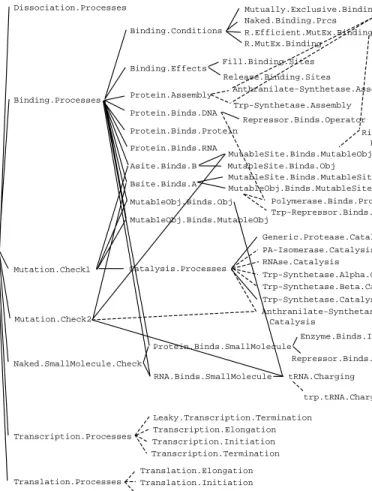
The process frames within the PKB are structured as an inheritance hier-archy, part of which is shown in Figure 6. At the top level is a general tem-plate for all processes. Its children are temtem-plates that provide descriptions of general classes of events, such as chemical-binding and enzymatic-reaction processes. In turn, the children of these templates either describe actual pro-cesses (such as the bindings of particular species of molecules), or define im-portant subclasses of processes. An example of such a subclass is Mutual-ly.Exclusive.Binding. This template defines preconditions for a subclass of binding processes: for object Ato bind to B, it cannot be the case
Predicate or Function Meaning
(OBJECT.EXISTS X Y) Object Xexists within class Y
(IS.PART X Y) Object Xis part of object Y
(MEMB X Y) Atom Xis an element of list Y
(GET.VALUES X Y) The value of slot Xof object Y
(BINDV $X Y) Binds variable $Xto the value Y
(CREATE.COMPLEX X Y) Creates an object of type Xcontaining the objects in list Yas parts
(COPY.STRUCTURE X) Creates a copy of object X
(PUT.VALUE X Y Z) Stores Zinto slot Xof object Y
(EXISTS $X Y) True if expression Yis true for one binding of $X
(FORALL $X Y) True if expression Yis true for all bindings of $X
Table I. The predicates and functions used within GENSIM process definitions. OB-JECT.EXISTS, IS.PART, and MEMBare predicates. The symbols AND, OR, and NOT
that Ais already bound to an object of class B, or that Bis already bound to an object of class A. A particular process instance can inherit slots from one or more template processes. For example, Trp-Repressor.Binds.Trp inherits most of its definition from the Repressor.Binds.Cofactor template, which specifies the behavior of the class of all repressor proteins. Trp-Repressor.Binds.Trpinherits additional preconditions from the process Mutually.Exclusive.Binding. Process classes often pro-vide enough of the definition of a process instance that only the Param-eter.Object.Classesslot must be modified in the instance, to define the actual classes of objects to which the process pertains.
Mutually.Exclusive.Binding Naked.Binding.Prcs R.Efficient.MutEx.Binding R.MutEx.Binding Binding.Conditions Fill.Binding.Sites Release.Binding.Sites Binding.Effects Anthranilate-Synthetase.Assembly Trp-Synthetase.Assembly Protein.Assembly Repressor.Binds.Operator Protein.Binds.DNA Protein.Binds.Protein Protein.Binds.RNA Binding.Processes Dissociation.Processes Asite.Binds.B Generic.Protease.Catalysis PA-Isomerase.Catalysis RNAse.Catalysis Trp-Synthetase.Alpha.Catalysis Trp-Synthetase.Beta.Catalysis Trp-Synthetase.Catalysis Catalysis.Processes MutableObj.Binds.Obj Mutation.Check1 MutableObj.Binds.MutableSite Polymerase.Binds.Promoter Trp-Repressor.Binds.Operator MutableSite.Binds.MutableSite MutableObj.Binds.MutableObj Ribosome. Binds.RBS MutableSite.Binds.MutableObj Anthranilate-Synthetase. Catalysis Mutation.Check2 Enzyme.Binds.Inhibitor Repressor.Binds.Cofactor Protein.Binds.SmallMolecule trp.tRNA.Charging tRNA.Charging RNA.Binds.SmallMolecule Naked.SmallMolecule.Check Leaky.Transcription.Termination Transcription.Elongation Transcription.Initiation Transcription.Termination Transcription.Processes Translation.Elongation Translation.Initiation Translation.Termination Translation.Processes Processes MutableSite.Binds.Obj Bsite.Binds.A
Figure 6. The process knowledge base. Process classes are linked to their super-classes by solid lines; executable process instances are linked to the super-classes of which they are members by dashed lines.
I have created special machinery to facilitate the use of inheritance to modify process templates. Process preconditions, bindings, and effects are actually represented by pairs of slots—called for example, Effects.Mand Effects.A. The values of the slot Effects.M(main) are inherited using KEE’s override inheritance—new values for this slot override previous val-ues. Values of Effects.A (additional) are inherited using union inheri-tance—new values for this slot are unioned with the previous values. The process interpreter executes the effects listed in both of these slots. The pairs of slots for preconditions and bindings are defined analogously.
This use of inheritance to define processes is similar to that used in object-oriented programming (OOP) systems (Goldberg and Robson, 1983; Stefik and Bobrow, 1986) (although GENSIM’s process interpreter does not employ the message-sending control structure of OOP). Thus, our approach reaps many of the same benefits as OOP systems, such as facilitating the definition of new processes and the maintenance of existing processes. GENSIM’s use of inheritance is novel in two ways. First is the use of inheritance in this par-ticular type of language—a production-rule—like process-description lan-guage. Because GENSIMprocesses are so similar to the production rules used in expert systems, inheritance probably could be used in this way as a soft-ware-engineering tool in the construction of expert systems. The second novel aspect of this use of inheritance is the manner in which an individual process is dissected into pieces (preconditions, effects, parameter objects, bindings) that can be inherited and modified as required. OOP systems usual-ly treat procedures as indivisible units that can onusual-ly have additional code wrapped around them, rather than having their internals altered as desired.
The definition of a process inheritance hierarchy should have benefits in addition to those already defined. This approach should facilitate the defini-tion of new processes by hypothesis formadefini-tion programs such as HYPGENE. These programs could postulate new processes by instantiating process tem-plates (see (Karp, 1989) for more details).
4.1 Alternative Reaction Representations
At least two other approaches could be used to represent biochemical re-actions. One approach would eschew the use of processes, and would repre-sent the behaviors of an object using slots within that object. For example, for an object O, one slot might list all objects that O can react with, and other slots might list other objects that inhibit or activate these reactions. Another slot might list the products of the reactions. This approach is problematic in several ways. First, a given object might participate in several reactions, each of which could involve different other reactants, and produce different prod-ucts. Thus, the slot values must be encoded in a way that does not lose infor-mation about which reactants are associated with which products, activators, and inhibitors. Second, if five objects participate in a given reaction,
presum-ably each object must describe the same reactants, products, activators, in-hibitors, and so on, which is highly redundant. Third, as GENSIMprocesses il-lustrate, it usually is not sufficient simply to list the activators and inhibitors of a reaction; we usually must test for particular properties of these objects using complicated predicate-calculus formulae. Without the language of predicate calculus we could not express preconditions such as: the trp-repres-sor protein binds to the trp-operator region only if a specific binding site within the trp repressor is occupied by tryptophan. In summary, when reac-tions involve several reactants, it is clearer and more efficient to separate process definitions from object definitions. And when reactions involve com-plex preconditions and effects—as biochemical reactions often do—a special language is required to express this complexity.
A second approach would use processes that are somewhat more general than those most often used by GENSIM(in fact, GENSIM’s representation of mutations uses this approach). If we were to model three different repressible operons using GENSIM—say, the trp, lac, and phe operons—we would have to create separate GENSIMprocesses to describe the binding of the trp-repres-sor to the trp operator, the lac-represtrp-repres-sor to the lac operator, and the phe-re-pressor to the phe operator. GENSIMallows these processes to be constructed using inheritance from the general Repressor.Binds.Operator pro-cess, but we still might argue that this approach creates an excessive number of processes. The alternative would be to use a single general process, such as Repressor.Binds.Operator, to define a slot within each repressor object that specifies the operator(s) to which the repressor can bind, and to reference this slot from the Repressor.Binds.Operatorprocess. Al-though this approach is considerably more compact, it has two disadvan-tages. First, it would force a proliferation of the slots that encode these object interactions—every general process (such as R e p r e s -sor.Binds.Operator) would refer to such a slot. Second, this approach blurs the clean separation between structure and behavior that is inherent in the CKB and the PKB. The new specificity slot acts much like a process pre-condition, yet it resides within an object. If object behaviors are defined using processes only we have much more modular descriptions that will be easier to maintain and extend.
5. The Process Interpreter
GENSIM processes bear significant similarity to production rules, and the program that interprets processes is similar to a production system. The pro-cess interpreter uses propro-cesses to detect interactions among objects that exist in the current simulation, and computes the effects of these interactions. This section describes how the process interpreter activates and executes process-es, and manages the existence of objects during a simulation. Since these
is-sues are so closely intertwined, this section alternates between the two. It be-gins with a brief description of object management, then presents a detailed description of process execution. It finishes by presenting points related to both issues.
Before proceeding, let us resolve the potential ambiguity of the term
pro-cess instance. I use this term to mean the execution of a propro-cess on a given
set of objects—an instance of process execution. Because processes are defined hierarchically in a KEE KB, the KB contains both class process frames and instance process frames; I use the term leaf process to refer to in-stance process frames.
5.1 Object Management
At least two possible approaches to the management of objects are con-ceivable in GENSIM. The term object management refers to the manner in which operations on objects (such as creation, deletion, and modification) are implemented. Consider the simple reactions in Figure 7, in which an object A is acted on by two processes: one converts A to object B, the other converts Ato object C. A simulator might model the first reaction in one of two ways: it might modify Adirectly to produce B, or it might copy Ato a new object, and then modify that new object to produce B.
GENSIMshould produce correct and complete predictions: it must predict all and only all the correct reactions. Predictions should not depend on the order in which processes are executed; for example, care must be taken that the execution of the first reaction in Figure 7 does not prevent execution of the other by removing the A object, because both reactions would occur to some degree. In general, most chemical processes are probabilistic events that act on populations of molecules. Since objects A, B, and Crepresent populations of molecules, and reactions occur at some finite rate, it is likely that, at some time, members of all populations exist. Thus, when a biochemi-cal reaction converts Ato B, all members of population Ado not disappear instantaneously.
We conclude that GENSIMshould not destroy objects or modify their
prop-A
B
C
Figure 7. A simple reaction network in which an object Acan cause two reactions; one produces Band the other produces C.
erties, because to do so would allow the possibility that the system would overlook some reaction. Rather than modifying Adirectly to create B, GEN -SIMcopies Aand modifies the copy to produce B. I call this operation object
forking. The assumption that object populations are never fully consumed
was discussed in Section 3.
This discussion also implies that, to predict both what reactions occur, and the rates of these reactions, requires a two-stage computation (GENSIM cur-rently performs only the first stage):
1) Determine the complete set of reactions that will occur—that is, the com-plete set of objects that will be created and the set of processes that will fire. Forbus calls this task computing the “process and view structures” (Forbus, 1986).
2) Use information about reaction rates and molecular concentrations to compute how much of each object population forms. Forbus calls this task “resolving influences” (Forbus, 1986).
The intuition here is that to predict the rate of a reaction R that consumes reactants I1, … , In, we must know about all other reactions in which each Ii takes part, so that we can compute the relative rates of these competing reac-tions.
Most other qualitative-reasoning researchers have not used object forking. One reason for this may be that in their domains, objects do not represent populations of molecules, some of which probabilistically change to another state—they represent individual objects that change completely. Simmons and Mohammed (Simmons and Mohammed, 1987) use an explicit model of time to represent object properties as histories, so in effect, different versions of different objects exist at different points in time due to the different values their properties take on at these different points in time. The biochemistry domain does not allow this approach because the populations of molecules we model often coexist at a single time.
5.2 Reference Patching
One complication that arises during object forking is that the component objects of a complex object may refer to one another, and these references must be altered during the copy operation. This procedure is called reference
patching. For example, a component of the Trp.Operon object—
Pro-moter.1—contains a slot Regulator with value Operator.1. This slot indicates what operator object controls this promoter. The value of this slot must be altered in the object to which Promoter.1is copied, to name the object to which Operator.1is copied, since a promoter is regulated by only the operator in the same operon object.
Another complication is that there are some object slots for which refer-ence patching should not be performed, such as slots that do not contain the
names of objects. Thus, each slot in the system is described by a special frame that describes whether or not reference patching should be performed for that slot.
5.3 Implementation of the Process Interpreter
I constructed two different implementations of the process interpreter. The first uses a brute-force algorithm and is slow. It iterates through all processes in the PKB, and searches for objects in the simulation that are members of the parameter object classes of the current process. It then determines which combinations of these objects satisfy the preconditions of the process, and executes the effects of such processes, until no new reactions are detected. More precisely, the first interpreter cycles through the following steps until no new processes can be activated in Step 2.
1) Process selection: Select a member P from the set of all leaf processes that exist in the process knowledge base.
2) Process activation (binding of processes to objects): Consider each ob-ject class Ck, k=1…N listed in the Parameter.Object.Classesof
P. Let ℑkbe the set of object instances within class Ck. If every set ℑkis nonempty, then create a new set A containing all possible tuples of the ele-ments of each ℑk. Each tuple contains an element of ℑ1, an element of ℑ2, and so on including an element of ℑN. The set A is the set of possible bind-ings of the parameter-object variables of P, and is a list of all possible in-teractions of objects due to P. If any ℑk is empty, no activations of this process are generated.
3) Filter process activations: Remove from A every set of variable bindings for which process P has already been activated with that set of bindings in this simulation. Because objects never change, and because process pre-conditions can refer only to objects in the parameter objects of a process, the truth or falsity of the preconditions of a process as applied to a given set of objects will never change. Thus, it is never necessary to activate a process more than once on a given set of parameter objects.
4) Process execution: For each Ajremaining in A:
a) Bind the variables in the Parameter.Objects slot of P to the objects in Aj
b) Evaluate the variable bindings in the Bindingsslot of P
c) Evaluate the Preconditionsof P. IFany are false, THEN contin-ue to the next Aj; ELSE
d) Execute the Effectsof P This approach is inefficient in two ways:
ob-jects exist in some parameter-object class of the process
2) It repeatedly generates process activations that have been considered pre-viously, which must be filtered out in Step 3 (at a cost) to avoid the larger cost of reevaluating the process preconditions.
The cost of these inefficiencies grows as more objects and processes exist in a simulation.
To improve what is essentially a generate-and-test algorithm, we move part of the test inside the generator. New process activations are generated only when the process interpreter first starts running, and when new objects are created. A given set of object bindings is never generated more than once for a process.
The second algorithm maintains two data structures. The first is the
pro-cess-activation queue, which contains process variable-binding tuples—the
variable bindings for which each process has not yet been executed. The in-terpreter repeatedly pops entries lists off this queue and executes the given process with the given variable bindings.
The second data structure is used to determine what process activations should be created when a new object is created. It is called the live-objects
list and consists of a list of records of the form (C (P1… Pn) (O1… On)) where
• C is the name of a class of objects that appears in the Parameter.Ob-ject.Classesslot of at least one process
• (P1… Pn) is the set of processes that contain C in their Parameter.Ob-ject.Classes slot—the processes that describe reactions involving this class of object
• (O1… On) is the list of objects within class C that exist in the simulation When a new object O is created by the execution of a process, the following
actions are taken: 1. Let C be the class of O.
2. Find the set ℜof all records in the live-objects list such that record Ri de-scribes a class that is equal to or a superclass of C. If none exist, exit. 3. Add O to the object list of each record in ℜ.
4. For each Ri in ℜdo
For each process Pjin Ri do
Compute the new variable bindings for Pj. Imagine that Pj oper-ates on two objects—one of class C, the other of class D. The ac-tivations of Pjconsist of O paired with every object from class D
(as listed in the live-objects record for D). Append these activa-tions to the process-activation queue.
Two properties of this approach are worth noting. First, new process acti-vations are generated only when new objects are created. This approach is correct because new process activations must include at least one new ob-ject—since old objects are never modified, a group of old objects will never spontaneously activate an existing process that had not been activated previ-ously. Similarly, because objects are forked and not deleted, process activa-tions never have to be removed from the process-activation list.
An additional optimization is possible using a slightly different data struc-ture. It may be the case that the interpreter could prove that an existing object
O will always prevent process P from firing, because O will always cause a
precondition of P to be violated (GENSIMcould prove this by partially
evalu-ating the preconditions of the process (Hsu, 1988)). In this case, the
inter-preter should never generate an activation of P that includes O. This infor-mation could be used in a similar approach that stored live objects within a class on a per-process basis, rather than with every process that acts on the class (the latter is done in the current live-objects structure). Objects would be removed from the list for a process when GENSIMproved that they could not fire that process.
5.4 A Restriction on Process Preconditions
The preceding approach to object management and process execution re-quires that we impose a restriction on the syntax of process preconditions to guarantee the correctness of our simulations. This restriction has an interest-ing biochemical interpretation.
The restriction is that a precondition of a process P may not check for the existence or nonexistence of an object D1unless D1either is a parameter ob-ject of P, or is part of an obob-ject that is a parameter obob-ject of P. For example, a process P1 that describes the binding of object A1 to B1 may not check whether no objects exist in the simulation that belong to class D. Therefore, the following precondition is forbidden for process P:
(NOT (EXISTS $X (OBJECT.EXISTS $X D)))
But P may, however, check whether no objects of class D exist in the simula-tion as parts of B1:
(NOT (EXISTS $X (AND (OBJECT.EXISTS $X D) (IS.PART $X B1))))
Without this restriction the correctness of simulations is no longer guaran-teed, because the truth of the shorter precondition will depend on when the process interpreter evaluates that precondition (which depends on when pro-cess P is executed). If evaluation occurs when no objects of type D exist, then the precondition will be true. But if it occurs after the execution of
an-other process P2that creates an object of type D, then the precondition will be false. Thus, in this example the relative execution times of processes P1 and P2(which times are undefined in GENSIM simulations because GENSIM has no model of time and assumes all reactions occur in a very brief interval) determines the truth of the precondition.
The value of the restriction is that by stipulating that D1must be part of
B1it ensures that D1must exist at the time P1is activated. The second algo-rithm activates P1when, and only when, all of the parameter objects of P1 exist. So, if P2created B1, P2must have executed before P1. Furthermore, given the framework of object forking, once created, B1cannot be modified. Thus, there is no possible ambiguity in the evaluation of the preconditions of
P1.
An important question to ask is: does this restriction have reasonable se-mantics in the biochemistry domain? The answer is yes. In general, biochem-ical reactions occur when a set of reactants is present in solution, and when each of the reactants is in a required state. Process preconditions examine the states of the reactants. In general, the only way one molecule can influence the state of another molecule is by physically attaching to the other molecule and altering its conformation. That is, there is no way for A1and B1to magi-cally sense the presence or absence of D1in solution. To affect the reaction,
D1must bind to A1or B1to alter that object’s state, in which case D1is a re-actant in this reaction, and should therefore be listed as a parameter object of the process. Thus, it makes no biochemical sense to write the type of precon-dition that we prohibit.
5.5 Optimizations
The reason we employ object forking is that this approach to managing simulation objects meets the correctness and completeness criteria described in Section 5.1. A drawback of object forking is that in the trp operon simula-tions are slower by roughly a factor of 20 than are simulasimula-tions in which ob-jects are modified directly. Object forking increases the computational re-sources required for simulation of the trp operon because some processes within this system generate many complex objects. During execution of the transcription process, for example, each movement of RNA polymerase along a DNA strand is accomplished by a different activation of a single pro-cess that generates a new copy of the transcription-elongation complex that contains DNA, mRNA, and RNA polymerase (each of which is a complex object). Object forking is costly both because the KEEframes that represent objects are expensive to create, and because the large numbers of created ob-jects can later cause large numbers of additional reactions. Here we discuss methods for increasing the speed of simulations.
5.5.1 Avoidance of Object Forking. In the biochemical domain there is a
forking the object, without sacrificing the correctness of the simulation. The need to copy-then-modify objects rather than to modify them directly arose from the possibility that multiple processes might act on the original object. Modifying the original object could cause some of its behaviors to go undetected. However, if inspection of the PKB reveals that only a single pro-cess acts on a given object class (in which case the object class would be named in the Parameter.Object.Classes slot of a single process), the preceding consideration would appear to be nullified. Unfortunately, it is not completely nullified, because multiple activations of the process could act on the same object. For example, if we found that the only process acting on the class RNA-Polymeraseis the Polymerase.Binds.Promoter process, the object RNA-Polymerase.1still could bind to two different instances of T r p . P r o m o t e r, such as T r p . P r o m o t e r . 1 and T r p . P r o m o t e r . 2. Thus, we cannot avoid forking R N A -Polymerase.1. We can, however, avoid copy-then-modify when only a
single known process acts on a given object class, and that process has only one parameter object. For example, the transcription-elongation process acts
on a single Transcription.Elongation.Complex object (whose components are the DNA, enzyme, and RNA described earlier). This opti-mization has not been implemented within GENSIM.
Note that this optimization may cause problems for a program that must analyze a simulation-dependency trace, such as a hypothesis formation pro-gram. Such a program might try to understand why a final set of objects are predicted to be present in a given experiment by inspecting the intermediate objects that reacted to form those final objects. It is just those intermediates that this optimization destroys.
5.5.2 Object Merging. A procedure called object merging is used to
de-tect when two different processes independently create the same object. When this event is detected, only one of the object descriptions is retained. This procedure produces a small economy by eliminating redundant storage of the merged objects. It produces a much larger savings by preventing pro-cesses from being invoked by the redundant objects, and by preventing the creation of the additional redundant objects that these duplicate reactions would produce.
5.5.3 Sharing Object Descriptions with an ATMS. It is possible to use
an ATMS (DeKleer, 1986) to reduce the storage consumed by object forking. This approach was inspired by the ATMS property of allowing efficient ex-ploration of alternative decisions through storing rather than recomputing el-ements of the problem-solving state that the alternatives share. For example, the ATMS has been used previously in qualitative physics to represent envi-sionments more efficiently (Forbus, 1984; deKleer and Brown, 1984). My hope was that an ATMS could be used in a similar way to provide efficient storage of different objects that have a large amount of common structure.
This use of the ATMS is novel because I propose using the ATMS to repre-sent more efficiently common aspects of similar objects that coexist within a
single context of the simulation. Previously, it has been used to represent
more efficiently common aspects of similar objects that exist in alternative predictions of the state of the physical system (envisionments).
IntelliCorp’s KEEcontains an ATMS implementation (Intellicorp, 1986; Morris and Nado, 1986). In the following paragraphs, I describe this ATMS implementation, sketch how it might be used to solve this problem, discuss why this approach will fail, and then examine additional ATMS functionality that will solve the problem.
KEE’s ATMS forms the basis for a facility called KEEworlds, which is
well integrated with KEE’s frame representation system. By default, any modification to a KEEframe (e.g. of a slot value) affects the background (the root world), and all slot-value queries access the background. New worlds are defined as children of the background and/or existing worlds. Users may explicitly direct assertions and queries to the background or to any existing world. By default, any fact true in the parent of a world W is also true in W. But W may override some of the facts defined in its parents: the values of ex-isting slots in exex-isting frames may be modified arbitrarily, however, it is pos-sible to create, delete, or rename both frames and slots in the background only.
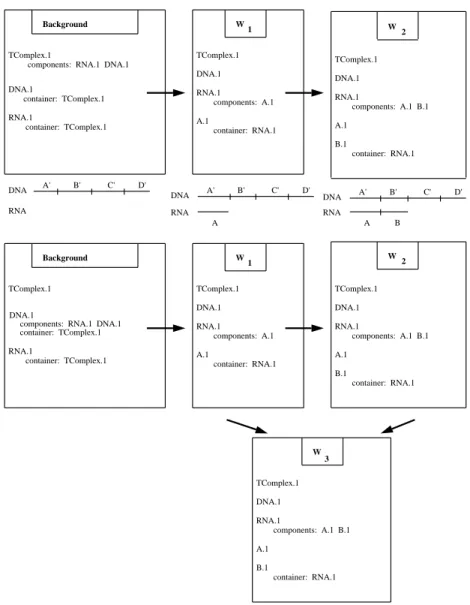
Figure 8 shows how the KEEworlds facility could be used to implement object forking. The background and the worlds W1 and W2 represent three consecutive states of the transcription process discussed earlier. In this pro-cess, a transcription-elongation complex object contains two other objects: an RNA whose length grows as the process executes repeatedly, and a DNA. Rather than create new versions of the elongation complex object for every step, the KEEworlds facility allows the core descriptions of each object to be inherited by the KEEworlds facility with only the changes to each object recorded explicitly, as shown in Figure 8. The substructure of the RNA.1 ob-ject changes the length of the RNA increases, and new obob-jects A.1and B.1 are created.2
The limitation of this mechanism arises in the following situation. Imag-ine the existence of a biological process that specifies that two RNA objects may bind together when they are components of a transcription-elongation complex. If this reaction were to occur between the two versions of the RNA.1object in worlds W1 and W2, we would create a new world W3 with parents W1 and W2. W2 would inherit descriptions of RNA.1from both W1 and W2. The problem is that the new world W3 would contain only a single version of RNA.1, whose properties would result from merging the RNA.1 objects from W1 and W2. Chemically, two distinct RNA objects must exist in
RNA.1from W1 and W2 to be merged, because both objects have the same name. Because object names are both the basis for sharing information be-tween worlds and the source of the merging problem, the KEEworlds imple-mentation is not able to reduce the space required to represent similar objects. This limitation would not exist in a worlds mechanism that had the addi-tional funcaddi-tionality of being able to rename objects from one world to
anoth-TComplex.1
components: RNA.1 DNA.1
DNA.1 container: TComplex.1 RNA.1 container: TComplex.1 TComplex.1 DNA.1 RNA.1 components: A.1 A.1 container: RNA.1 TComplex.1 DNA.1 RNA.1 components: A.1 B.1 A.1 B.1 container: RNA.1 Background W 1 W 2 A' B' C' D' DNA
RNA RNA RNA
A A B W TComplex.1 DNA.1 RNA.1 components: A.1 B.1 A.1 B.1 container: RNA.1 3 DNA A' B' C' D' DNA A' B' C' D' TComplex.1
components: RNA.1 DNA.1 Background DNA.1 container: TComplex.1 RNA.1 container: TComplex.1 TComplex.1 DNA.1 RNA.1 components: A.1 A.1 container: RNA.1 1 W TComplex.1 DNA.1 RNA.1 components: A.1 B.1 A.1 B.1 container: RNA.1 2 W
Figure 8. Use of an ATMS to share the descriptions of similar objects during a simu-lation.
er. That is, if we were able to rename RNA.1to RNA.2within W2, no merg-ing of the two RNA objects would occur in the child world W3. GENSIMdoes not use this technique because we lack such an ATMS. (In KEEworlds, frames can be renamed only in the background.)
Other researchers employ an ATMS, but for different purposes: Forbus uses it to represent alternative envisionments more efficiently (Forbus, 1986), and Simmons and Mohammed use it to represent causal dependencies for later analysis by their diagnostic system (Simmons and Mohammed, 1987).
6. GENSIM Trials
I tested the GENSIMprogram in a number of trial runs. In each trial I used the program to predict the outcome of a different biological experiment. This section describes each trial by stating what objects were present in the initial conditions of the experiment whose outcome GENSIMpredicts, and what re-actions and new objects were predicted by GENSIM. For some trials, I show the internal structures of objects in the initial conditions or the prediction.
6.1 The Trp Biosynthetic Pathway
This simple trial models the trp biosynthetic pathway, in which a set of enzymes convert chorismate to tryptophan (the current model ignores the reactant serine). The initial conditions of the experiment are shown in Figure 9, the predicted outcome in Figure 10. Figure 11 shows the internal structure of every object in the prediction. GENSIM’s prediction is correct in that it omits no reactions that should occur, it includes all reactions that do occur, and the objects produced by each reaction have the predicted parts and prop-erties.
6.2 The Trp Biosynthetic Pathway with a Mutant Enzyme
This trial is a variation of the previous trial. In this trial, the enzyme tryp-tophan synthetase contains a mutation that prevents it from catalyzing the re-action that converts InGP to tryptophan. The mutation is represented as an object that is part of the tryptophan-synthetase object. GENSIMcorrectly pre-dicts that the last two (rightmost) reactions in Figure 10 do not occur.
6.3 Transcription of the Trp Leader Region
The leader-region transcription trial focuses on another subset of the over-all trp system: the transcription of DNA. Figure 12 shows the objects in the initial conditions of this experiment, which include a truncated version of the trp operon called Trp.Leader.Region.1(I removed all the genes in the operon to make this trial easier to describe), the enzyme RNA polymerase, the trp-aporepressor protein, and tryptophan. The prediction generated by
Anthranilate-Synthetase.3 trp.8 Anthranilate-Synthetase. Component.I.3 Anthranilate-Synthetase. Trp.Inhibition.Site.3 Anthranilate-Synthetase. Component.II.3 Anthranilate-Synthetase. COMPLEX.2 Anthranilate-Synthetase. Component.I.1 Anthranilate-Synthetase. Trp.Inhibition.Site.1 Anthranilate-Synthetase. Component.II.1 Anthranilate-Synthetase.1 Trp-Synthetase.Alpha.2 Trp-Synthetase.Beta.3 Trp-Synthetase.2 trp.7 InGP.2 PRanthranilate.2 Chorismate.1 Phosphoribosyl-Anthranilate-Isomerase.1 Chorismate.plus. Trp.Pathway.Expt.1
Figure 11. The internal structures of the objects predicted to be present at the end of the trp biosynthetic-pathway experiment.
Chorismate.1 Anthranilate-Synthetase. Component.I.1 Anthranilate-Synthetase. Trp.Inhibition.Site.1 Anthranilate-Synthetase. Component.II.1 Anthranilate-Synthetase.1 Phosphoribosyl-Anthranilate-Isomerase.1 Trp-Synthetase.Alpha.1 Trp-Synthetase.Beta.1 Trp-Synthetase.1 Chorismate.plus.Trp. Pathway.Expt.1
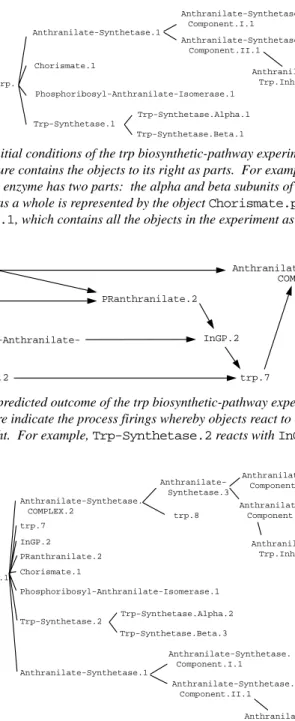
Figure 9. The initial conditions of the trp biosynthetic-pathway experiment. Every object in this figure contains the objects to its right as parts. For example, the Trp-Synthetase.1enzyme has two parts: the alpha and beta subunits of the protein. The experiment as a whole is represented by the object Chorismate.plus.Trp.-Pathway.Expt.1, which contains all the objects in the experiment as parts.
Chorismate.1 Anthranilate-Synthetase.1 Phosphoribosyl-Anthranilate-Isomerase.1 Trp-Synthetase.2 PRanthranilate.2 InGP.2 trp.7 Anthranilate-Synthetase. COMPLEX.2
Figure 10. The predicted outcome of the trp biosynthetic-pathway experiment. The lines in this figure indicate the process firings whereby objects react to create the ob-jects to their right. For example, Trp-Synthetase.2reacts with InGP.2to form
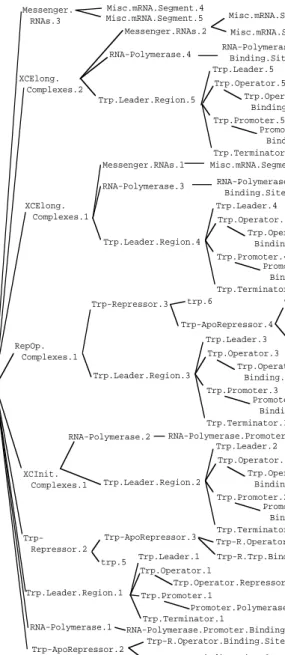
GENSIMis shown in Figure 13. This prediction is correct. The two sequences of reactions in this experiment fork the population of trp operon leader-re-gion DNA into two classes: those whose operator releader-re-gions bind to the activat-ed repressor protein Trp-Repressor.2, and those whose promoters bind to RNA-Polymerase.1and undergo transcription to produce a messenger RNA.3The figures do not name Trp.Leader.1as participating in these reactions, but rather name the components of the operon that react: the pro-moter Trp.Promoter.1and the operator Trp.Operator.1.
The internal structure of one of the transcription-elongation complexes is shown in Figure 14. A transcription-elongation complex contains RNA poly-merase, the DNA that RNA polymerase is transcribing, and the mRNA that RNA polymerase has synthesized thus far. The number of segments (parts) within the mRNA reflects the length of DNA that RNA polymerase has tra-versed. Since the mRNA contains two segments, we can infer that RNA polymerase traveled two segments along the DNA to produce this trans-cription-elongation complex. Figure 15 shows the internal structures of every object in this experiment.
Promoter.Polymerase. Binding.Site.1 Trp.Promoter.1 Trp.Operator.Repressor . Binding.Site.1 Trp.Operator.1 Trp.Leader.1 Trp.Terminator.1 Trp.Leader.Region.1 RNA-Polymerase.Promoter.Binding.Site.1 RNA-Polymerase.1 Trp-R.Operator.Binding.Site.1 Trp-R.Trp.Binding.Site.1 Trp-ApoRepressor.1 Leader.Xcription.Expt.1 trp.4
Figure 12. The objects in the initial conditions of the leader-region—transcription experiment. Trp.Promoter.1 RNA-Polymerase.1 Trp.Operator.1 Trp-ApoRepressor.1 trp.4 XCInit.Complexes.1 Trp-Repressor.2 XCElong. Complexes.1 XCElong. Complexes.1 Messenger. RNAs.3 RepOp.Complexes.1
Figure 13. The outcome of the leader-region transcription experiment that was pre-dicted by GENSIM.
6.4 The Full Trp System
This trial simulates the entire trp system as it was known in the late 1960s. Figure 16 shows the initial conditions of this experiment. GENSIM’s predic-tion is shown in Figures 17 and 18. Figure 17 shows the transcrippredic-tion of the trp operon by RNA polymerase, which yields a free mRNA ( Messen-ger.RNAs.18). Some of this mRNA is degraded into its constituent bases by the enzyme RNase.1. The mRNA also reacts with ribosomes, as shown in Figure 18. Messenger.RNAs.18contains five ribosome-binding sites, including Ribosome.Binding.Site.47.4 Each binding site attracts a ribosome, which translates the five different regions of mRNA into polypep-tides such as Trp-Synthetase.Beta.1 Some of these polypeptides bind together to form larger, functional proteins, such as Trp-Syn-thetase.1.
The enzymes produced from translation of the trp-operon mRNA react with chorismate to carry out the steps in the trp pathway. The trp thus pro-duced enters into several reactions: It binds to and inhibits anthranilate syn-thetase, and it activates the trp aporepressor protein (the latter complex then binds to the trp operator). Finally, the trp-tRNA-synthetase enzyme catalyzes the binding of tRNAtrpand trp to form charged tRNAtrp(which is used in all protein synthesis).
Generation of this prediction required approximately 70 minutes of Dora-do (Xerox 1132 LISPmachine) CPU time. The prediction contained a total of 1050 objects (including components).
7. Related Work
Here I review the work of other AI researchers who have created models of biochemical systems, comparing and contrasting their techniques with those described in this article:
• Meyers’ model of the life cycle of Lambda phage (Meyers, 1984) • Round’s model of the E. coli trp operon (Round, 1987)
Misc.mRNA.Segment.2 Misc.mRNA.Segment.3 Messenger.RNAs.2 RNA-Polymerase.Promoter.Binding.Site.4 RNA-Polymerase.4 Trp.Leader.5 Trp.Operator.Repressor. Binding.Site.5 Trp.Operator.5 Promoter.Polymerase. Binding.Site.5 Trp.Promoter.5 Trp.Terminator.5 Trp.Leader.Region.5 XCElong.Complexes.2
Misc.mRNA.Segment.4 Misc.mRNA.Segment.5 Messenger. RNAs.3 Misc.mRNA.Segment.2 Misc.mRNA.Segment.3 Messenger.RNAs.2 RNA-Polymerase.Promoter. Binding.Site.4 RNA-Polymerase.4 Trp.Leader.Region.5 Trp.Leader.5 Trp.Operator.Repressor. Binding.Site.5 Trp.Operator.5 Promoter.Polymerase. Binding.Site.5 Trp.Promoter.5 Trp.Terminator.5 XCElong. Complexes.2 Trp.Leader.3 Trp.Operator.Repressor. Binding.Site.3 Trp.Operator.3 Promoter.Polymerase. Binding.Site.3 Trp.Promoter.3 Trp.Terminator.3 Trp.Leader.Region.3 Trp-R.Operator. Binding.Site.4 Trp-R.Trp. Binding.Site.4 Trp-ApoRepressor.4 trp.6 Trp-Repressor.3 RepOp. Complexes.1 Misc.mRNA.Segment.1 Messenger.RNAs.1 RNA-Polymerase.Promoter. Binding.Site.3 RNA-Polymerase.3 XCElong. Complexes.1 Trp.Leader.4 Trp.Operator.Repressor. Binding.Site.4 Trp.Operator.4 Promoter.Polymerase. Binding.Site.4 Trp.Promoter.4 Trp.Terminator.4 Trp.Leader.Region.4 RNA-Polymerase.Promoter.Binding.Site.2 RNA-Polymerase.2 XCInit. Complexes.1 Trp.Leader.2 Trp.Operator.Repressor. Binding.Site.2 Trp.Operator.2 Promoter.Polymerase. Binding.Site.2 Trp.Promoter.2 Trp.Terminator.2 Trp.Leader.Region.2 Trp-R.Operator.Binding.Site.3 Trp-R.Trp.Binding.Site.3 Trp-ApoRepressor.3 trp.5 Repressor.2 Trp-R.Operator.Binding.Site.2 Trp-R.Trp.Binding.Site.2 Trp-ApoRepressor.2 Trp.Leader.1 Trp.Operator.Repressor.Binding.Site.1 Trp.Operator.1 Promoter.Polymerase Binding.Site.1 Trp.Promoter.1 Trp.Terminator.1 Trp.Leader.Region.1 RNA-Polymerase.Promoter.Binding.Site.1 RNA-Polymerase.1 Leader.Xcription. Expt.1
Figure 15. The objects in the predicted outcome of the leader-region-transcription experiment.
• Weld’s PEPTIDEmodel of biochemical reactions (Weld, 1984; Weld, 1986) • Koton’s GENEXmodel of gene expression (Koton, 1985)
• Karp’s earlier model of the trp operon (Karp and Friedland, 1989)
23S.rRNA.1 5S.rRNA.1 50S.Ribosome.Subunit.1 16S.rRNA.1 30S.Ribosome.Subunit.1 Ribosome.RBS.Binding.Site.1 Ribosome.1 Promoter.Polymerase.Binding.Site.1 Trp.Promoter.1 Trp.Operator.1 Trp.Leader.1 dRibosome.Binding.Site.1 Trp-E.1 Trp-D.1 dRibosome.Binding.Site.2 Trp-C.1 dStop.Codon.2 dStop.Codon.1 dRibosome.Binding.Site.3 dStop.Codon.3 dRibosome.Binding.Site.4 Trp-B.1 dStop.Codon.4 dRibosome.Binding.Site.5 Trp-A.1 dStop.Codon.5 Trp.Terminator.1 Trp.Operon.1 Trp-ApoRepressor.1 Generic.RNAse.1 RNA-Polymerase.1 RNA-Polymerase.Promoter.Binding.site.1 Trp-tRNA-Synthetase.1 Trp-R.Operator.Binding.Site.1 Trp-R.Trp.Binding.Site.1 Chorismate.Medium.1 Chorismate.1 Trp.Operator.Repressor.Binding.Site.1 Trp.Expt.1
• Koile and Overton’s model of the life cycle of the HIV virus (Koile and Overton, 1989)
• Brutlag et al’s model of DNA metabolism (Brutlag et al., 1991)
• Mavrovouniotis’ model of intermediary metabolism (Mavrovouniotis, 1990; see also Mavrovouniotis, this volume)
Virtually all of these researchers represent objects as frames that describe UTP.1 GTP.1 CTP.1 ATP.1 Messenger.RNAs.18 XCElong.Complexes.17 XCElong.Complexes.16 XCElong.Complexes.15 XCElong.Complexes.14 XCElong.Complexes.13 XCElong.Complexes.12 XCElong.Complexes.11 XCElong.Complexes.10 XCElong.Complexes.9 XCElong.Complexes.8 XCElong.Complexes.7 XCElong.Complexes.6 XCElong.Complexes.5 XCElong.Complexes.4 XCElong.Complexes.3 XCElong.Complexes.2 XCElong.Complexes.1 Trp.Promoter.1 XCInit.Complexes.1 RNA-Polymerase.1 RNase.1
Figure 17. Simulation of the trp system, part 1. This figure shows a simulation of transcription of DNA and degradation of the resulting mRNA. The nodes of the graph are the names of objects (many objects in this figure contain 10 to 30 compo-nent objects). The links in the figure connect the reactants and products of each reac-tion; for example, Trp.Promoter.1and RNA-Polymerase.1reacted to yield the transcription-initiation complex XCInit.Complexes.1.
object properties and object part-whole structures. Exceptions are Koton, who used PROLOGclauses to represent this information, and Mavrovonioutis, who used Flavors. Although most workers represented object parts such as binding sites, none approached the complexity used for example in the GEN -SIMrepresentation of a transcription-elongation complex (see Figure 14). In
Trp.Operator.1 RepOp.Complexes.1 Charged.trp.tRNA.1 Trp-Repressor.1 PRanthranilate.1 InGP.1 Trp-Synthetase.1 trp.1 Chorismate.1 Trp-ApoRepressor1 trp.tRNA.1 Ribosome.1 Phosphoribosyl-Anthranilate-Isomerase.1 XLElong.Complexes.2 XLElong.Complexes.7 XLElong.Complexes.1 XLElong.Complexes.6 XLElong.Complexes.3 XLElong.Complexes.8 XLElong.Complexes.4 XLElong.Complexes.9 XLElong.Complexes.5 XLElong.Complexes.10 XLInit.Complexes.1 XLInit.Complexes.2 XLInit.Complexes.3 XLInit.Complexes.4 XLInit.Complexes.5
Ribosome.Binding.Site.50 Ribosome.Binding.Site.49 Ribosome.Binding.Site.48
Ribosome.Binding.Site.47 Ribosome.Binding.Site.46 Trp-Synthetase.Alpha.1 Trp-Synthetase.Beta.1 Anthranilate-Synthetase.1 Anthranilate-Synthetase.Component.I.1 Anthranilate-Synthetase.Component.II.1 Trp-tRNA-Synthetase.1 Anthranilate-Synthetase.COMPLEX.1
Figure 18. Simulation of the trp system, part 2. This figure shows the translation of the trp operon mRNA to produce the enzymes in the trp biosynthetic pathway, the re-actions catalyzed by these enzymes, and the rere-actions involved in repression of the trp operon. Each ribosome-binding site named in this figure is a component of the Mes-senger.RNAs.18object in the previous figure.
addition, none of the other programs represented classes of biological objects that were automatically instantiated to describe particular experiments, as de-scribed in Section 3. Koile and Overton represented little or no information about object properties or structures; their approach focuses on object quanti-ties such as concentrations.
Only GENSIMand Weld’s PEPTIDEperform object forking (in Weld’s ter-minology he “splits the histories” of the “nodes” that represent populations of molecules—he also merges histories when identical nodes are produced by different reactions, which is identical to GENSIM’s object merging). Koton states (p. 33) that her approach is to focus only on those binding reactions with the highest affinities, and not to simulate all possible competing reac-tions. Section 5 of this article provides the most thorough analysis of the rea-sons to perform object forking, and of ways to optimize this procedure.
The different researchers took varying approaches to representing quanti-tative information about the biological systems they modeled. Like GENSIM, Koton represented no quantitative information at all. Mavrovonioutis, Weld, Koile, and Karp (Karp and Friedland, 1989) applied techniques developed for qualitative physics (and developed new techniques) to their biological systems. They could represent very coarse quantitative information such as “the concentration of the HIV primary transcript is greater than zero” (Koile and Overton, 1989), or somewhat more precise order-of-magnitude informa-tion such as “the concentrainforma-tion of X is much greater than the concentrainforma-tion of
Y” (Mavrovouniotis, 1990). Mavrovonioutis also used chemical theory to
es-timate values for kinetic and thermodynamic parameters of his system. Mey-ers represented reaction rates and protein concentrations as real numbMey-ers, but these numbers were not solidly grounded in experimental data. Brutlag is the only researcher to accurately represent and reason with experimental condi-tions such as temperature and pH.
All of the researchers represented reactions using some type of condi-tion—action formalism. Meyers employed production rules. Round devel-oped a process-description language that allows a user to decompose pro-cesses into their component subpropro-cesses. Brutlag used KEE production rules. Koton used PROLOGrules containing preconditions and postconditions to represent reactions; Weld used a similar precondition-postcondition repre-sentation, but in addition each reaction had a pattern that was equivalent to GENSIM’s parameter object classes. Section 5 shows that separating the pa-rameter object classes from the rest of the preconditions facilitates the index-ing of processes accordindex-ing to the objects whose behaviors they describe and leads to a more efficient simulation algorithm. Koile and Overton encode re-actions using Forbus’ qualitative process theory (see next paragraph). None of the systems except for GENSIMarrange reactions in an inheritance hierar-chy, which is useful for describing complex reactions in a modular fashion. This approach may also be useful for hypothesis formation because by
sum-marizing knowledge of known classes of reactions the taxonomy provides expectations for the types of unknown reactions we are likely to discover. Only this article and Weld’s work describe simulation algorithms in any de-tail; Weld’s algorithm is equivalent to the first GENSIMalgorithm presented in Section 5. Only GENSIMand PEPTIDEallow quantification within reaction pre-conditions and postpre-conditions, which provides the ability to express complex reactions.
Forbus (Forbus, 1984; Forbus, 1986) and Simmons and Mohammed (Simmons and Mohammed, 1987) use a notion of process in their process-modeling systems that is similar to that used by GENSIM; all include parame-ters, preconditions, and effects. GENSIMprocesses are most similar to what Forbus terms individual views, because both are concerned with creating and deleting objects, and with altering relations between objects. Those things that Forbus calls processes describe how quantities change in a physical sys-tem, whereas GENSIMhas no notion of quantity. Forbus briefly discusses the use of an abstraction hierarchy to define processes, although he did not im-plement this idea (Forbus, 1984, p. 44). The main difference in our approach-es is that for a procapproach-ess P1to be a specialization of another process P2, Forbus requires that the parameter-object classes, preconditions, and quantity condi-tions of P1must be a subset of those of P2. Since our Preconditions.M slot allows parent preconditions to be removed in a child process, we do not use this restriction. In addition, Forbus does not discuss inheritance from multiple parents. There are also differences between our process-definition languages. The preconditions of Forbus’ processes must contain a conjunc-tive list of (possibly negated) predicates; the preconditions of GENSIM pro-cesses can include arbitrary predicate-calculus formulae, including disjunc-tion and quantificadisjunc-tion. In addidisjunc-tion, GENSIMand the system built by Simmons and Mohammed allow process effects to be conditionalized and universally quantified; Forbus does not allow this.
Weld addressed the problem of using a model of a given chemical reac-tion to predict the aggregate behavior of many molecules that undergo the same reaction. His technique is similar to mathematical induction. The
ag-gregation technique allows him to predict the transcription of an entire gene
by reasoning about an individual transcription-elongation event that ad-vances RNA polymerase one base along a DNA strand. This technique re-duces the execution time of simulations and prore-duces simpler and more un-derstandable causal explanations, but it has an important limitation: Weld’s program cannot predict the final sequence of the transcribed RNA because the aggregation technique does not copy every base from the DNA to the RNA; in fact, PEPTIDEdoes not even know that the length of the mRNA is the same as the length as the DNA from which it was transcribed. For similar reasons, his program would be unable to predict what proteins would be translated from a given mRNA (as Weld notes on p. 52 of (Weld, 1984)).