María Inés León Radío
Daiana Martín Delgado
Supervisors: Urban Nilsson, SLU Southern Sweden Forest Research Centre
Carlos Mantero, UDELAR Universidad de la república Uruguay
Management of young teak plantations in Panama
- Effect of pruning and thinning
Swedish University of Agricultural Sciences
Master Thesis no. 229
Southern Swedish Forest Research Centre
Alnarp 2014
Swedish University of Agricultural Sciences
Master Thesis no. 229
Southern Swedish Forest Research Centre
Alnarp 2014
María Inés León Radío
Daiana Martín Delgado
Supervisors: Urban Nilsson, SLU Southern Sweden Forest Research Centre
Carlos Mantero, UDELAR Universidad de la república Uruguay
Examiner: Eric Agestam
Management of young teak plantations in Panama
- Effect of pruning and thinning
MSc Thesis in Forest Management – Euroforester Master Program SM001, Advanced level (A2E), SLU course code EX0448, 60 ECTS
ABSTRACT
On high quality wood species, thinning and pruning are compulsory management that must be done not only in early stages but also often during later development of the plantation in order to improve wood quality and growth of individual high-quality trees. In this thesis two trials were carried out to determine the adequate intensities of first thinning and pruning in a teak plantation in order to find the optimum early management to reach the best growth in yield and quality terms.
In trial 1 pruning at 3 and 5 metres was combined with a thinning of the 35 % of the initial number of trees, 1111 tree per ha, which meant 15% removal of basal area. In trial 2 four thinning intensities were analyzed: 0, 25, 35, 45 % of the initial number of trees (15, 20 and 30 % of basal area).
The variables observed in the different treatments after six months, were analysed using the measurements of diameter, height and form factor. With this data, the increment of height, diameter, basal area and volume according each treatment were calculated. The measured stem-volumes were compared with stem-volume estimated by a function developed by Diego Pérez and Markku Kaninnen, 2003, for teak plantations in Costa Rica that uses only diameter at breast height as independent variable. It was found that this function for teak stem volume can be used for calculating teak wood volume in the Darién region of Panama.
Keywords: teak, Tectona grandis, Panama, pruning, thinning, productivity, quality timber.
ACKNOWLEDGEMENTS
We would like to thank to all the people that somehow collaborate with us to do this thesis.
Professor Carlos Mantero, UDELAR, for his knowledge, constant support and time dedicated to us.
Professor Urban Nilsson, SLU, for his time and for giving us the opportunity to carry out this thesis.
Diego Pérez for all the given information.
Gerardo Medina, Forwood Panamá CEO, for receiving us in Panamá and provide the tools and the people that helped us to set the trials.
Timo Lehtonen, Forwood CEO.
Jorge Franco for helping in the statistical analysis.
Very special thanks to Andrés, José, Joselín, Eleuterio and all the people from Forwood Panamá that helped during our work in the plantations.
Thanks very much to our families for their loving and unconditional support.
PREFACE
The thesis presented in this manuscript was done in cooperation between Daiana Martín and María Inés León. Two trials were set in order to test different silvicultural managements for Tectona grandis in Panamá. Daiana was mainly responsible for Trial 1, in which different prune height and thinning intensities were tried and María for Trial 2, where different thinning intensities were tested.
For each trial a discussion about the results was wrote by corresponding author. The authors worked together in the field work and in the written parts: introduction, literature review, methodology, conclusions and recommendations.
CONTENTS
1. INTRODUCTION ... 11
2. LITERATURE REVIEW ... 13
2.1. The country: Panama ... 13
2.2. The Darién province ... 15
2.3. Species characteristics Tectona grandis(L.f.) ... 19
2.3.1. Taxonomy classification ... 19
2.3.2. Natural distribution ... 19
2.3.3. Bio-ecological requirements and growth ... 20
2.3.4. Climate, temperature, rainfall ... 20
2.3.5. Edaphic factors ... 21
2.3.6. Factors on stand level ... 23
2.3.7. Mycorrhiza ... 23
2.3.8. Propagation material ... 23
2.3.9. Pests and diseases in the place of origin and in Central America ... 24
2.4. Quality of teak plantations vs. natural teak ... 33
2.5. Teak market ... 35
2.6. Productivity ... 39
2.6.1. Rotation length ... 39
2.6.2. Annual Volume increments ... 40
2.6.3. Teak growth in Panama ... 42
2.6.4. Site index ... 45
2.6.5. Site quality and wood production ... 46
2.6.6. Equations to predict total and commercial volume. ... 47
2.7. Teak management ... 49
2.7.1. Pruning ... 49
2.7.2. Criteria for starting to prune ... 51
2.7.3. Pruning frequency ... 51
2.7.4. Time of the year for pruning... 52
2.7.5. Sprouts removal ... 52
2.7.6. Thinning ... 55
2.8. Forwood work procedure... 61
2.8.1. Land selection ... 61
2.8.2. Land preparation ... 61
2.8.3. From seed to plant ... 62
2.8.4. Planting ... 63
2.8.5. Management ... 64
2.8.6. Thinning ... 64
2.8.7. Final felling ... 64
3. MATERIALS AND METHODS ... 65
3.1 Stand management before the experiments installation ... 65
3.2 Work in the field ... 66
3.2.1 Edaphic characterization of the trials site ... 66
3.2.2. Trial 1: Pruning and first thinning ... 71
3.2.3. Trial 2: Different intensities of first thinning ... 72
3.2.4. Trials design ... 72
3.2.5. Measurements ... 73
3.2.6. Criteria for thinning decision ... 74
3.2.7. Stem damages characterization ... 76
3.3 Calculations ... 78
3.3.1 Form Factor ... 78
3.3.2 Tree growth increment... 78
3.3.3 Volume prediction model ... 78
3.4 Statistics analysis ... 79
4. RESULTS ... 80
4.1 Trial 1. Pruning and first thinning ... 80
4.1.1. Pruning effect on tree height, diameter and volume increment ... 80
4.1.2 Mean annual increment ... 81
4.2. Trial 2. Different first thinning intensities ... 82
4.2.1. Effect of treatments for diameter, height, volume increment per tree and mean annual increment ... 82
4.2.2 Mean annual increment ... 86
4.2.3. Stem characterization ... 86
4.3. Volume prediction model ... 88
5. DISCUSSION ... 89
6. CONCLUSIONS AND RECOMMENDATIONS ... 92
7. REFERENCES ... 95
8. APPENDIX ... 100
FIGURES
Figure 1. Panama political map, 1995. ... 13
Figure 2. Darién province. ... 15
Figure 3. Average precipitation and temperatura, period 1999-2008... 17
Figure 4. Teak natural distribution. ... 19
Figure 5. Teak leaves eaten by Radopterus sp. in Darién, Panama. October 2009. ... 28
Figure 6. Characteristic damage caused by Walteraniella sp. in Tectona grandis leaves.. 28
Figure 7. Tectona grandis multiple canker caused by Botryosphaeria sp. ... 29
Figure 8. Insect holes and fungus on teak stem, 6 months after thinning in ... 31
Figure 9. Termites “Comején”... 32
Figure 10. Termites on tree stem. ... 32
Figure 11. Canker. ... 33
Figure 12. Prices (US$ per m3) of natural forest and plantation teak logs. ... 38
Figure 13. Sawing for quality in small teak logs . ... 39
Figure 14. Distribution of the teak plots. ... 43
Figure 15. Relation between age and MAI in dbh (cm/year). ... 44
Figure 16. Teak total volume tendency per hectare according to age. ... 44
Figure 17. Teak tendency for Site Index in meters according to the age of the evaluated plantations. ... 45
Figure 18. Three years old plantation. ... 49
Figure 19. Early pruning keeps knots in a central core, allowing for the production of clear wood outside. ... 51
Figure 20. Sprouts in 1 year old teak plantation. ... 53
Figure 21. Prune scar. ... 54
Figure 22. April 2010, 3 years old teak plantation without thinning... 56
Figure 23. April 2010, 3 years old teak plantation with 45 % of thinned trees. ... 57
Figure 24. April 2010, 17 years old teak plantation without management. ... 58
Figure 25. Epicormic branches in 3 years old plantation. ... 59
Figure 26. Seedlings ready to be planted. ... 62
Figure 27. Seedling root system. ... 62
Figure 28. Manual planting. ... 63
Figure 29. Chemical weed control. ... 63
Figure 30. Boles from first thinning. ... 64
Figure 31. Re-forestation projects in Panama. Trial location. ... 65
Figure 32. Pit Nº1 October 2009, Pit N°1 April 2010, dry season. ... 67
Figure 33. Pit N°2. October 2009. ... 68
Figure 34. Pit Nº3 October 2010 ... 69
Figure 35. Pit Nº3, April 2011 ... 69
Figure 36. Plot design. ... 73
Figure 37. DBH with calliper. ... 73
Figure 38. Plot nº 8 (P8). First file (F1), tree Nº 1. ... 74
Figure 39. October 2009, blue marks in trees to be removed Nº46 and 44. ... 75
Figure 40. Leaning tree. ... 76
Figure 41. Tree Nº 23, crooked tree. ... 77
Figure 42. Tree Nº 3, crooked in the upper part. ... 77
Figure 43. Box-plot diagram using volume increment per tree in trial 1. ... 81
Figure 44. Diameter frequency per treatment before and after thinning in trial 2. ... 84
Figure 45. Box-plot diagram using volume increment per tree in trial 2. ... 85
Figure 46. Damage characterization after and before thinning. ... 87
Figure 47. Adjustment between observed volume data in Darien province (Panama) and predicted volume using Diego Pérez and Markku Kaninnen volume model for teak in Costa Rica. ... 88
Figure 48. Four weel stuck in the mud. ... 93
TABLES
Table 1. Panama geographical and political data. ... 14Table 2. Data about Darién Province... 15
Table 3. Surface in hectares (ha) according to different land use. ... 16
Table 4. Surface and distribution of soil categories (approx.) according to use capacity. .. 18
Table 5. Area with teak in the main origin countries. ... 20
Table 6. Bio-climatic considerations for planting teak in Costa Rica. ... 23
Table 7. Sustainable production capacity of teak plantations in the major tropical countries, 2005. ... 36
Table 8. Myanmar log prices (natural forest logs). Teak logs, FOB. ... 37
Table 9. Teak growing facts in different countries. ... 41
Table 10. Performance of teak at Mata Air Station, Perlis, Malaysia. ... 41
Table 11. Yields for Tectona grandis in Guanacaste, Costa Rica for high, middle and low productivity sites. ... 42
Table 12. Summary of the averages of Nº trees per hectare, MAI in Diameter, Total height, Basal area and Volume according age ranges in Panama. ... 43
Table 13. Growth characterization according to different ranges. ... 46
Table 14. MAI maximum and at 50 years rotation age in m3ha-1year-1 on best, average and poor site classes. ... 46
Table 15. Models for estimation of total volume over and under bark for Tectona grandis in Costa Rica. ... 48
Table 16. Models adjusted for estimating commercial volume (up to an arbitrary diameter or commercial height) over and under bark for Tectona grandis in Costa Rica. . 48
Table 17. Pruning schedule for 5 m logs, Trinidad Site Class 1. ... 55
Table 18. Pruning schedule for two, 2.8 m logs, Trinidad Site Class 2. ... 55
Table 19. Site soil visual description Pit 1. ... 67
Table 20. Laboratory Analysis Pit 1. ... 67
Table 21. Visual soil description Pit 2. ... 68
Table 22. Laboratory Analysis Pit 2. ... 68
Table 23. Site soil visual description Pit Nº3. ... 69
Table 24. Laboratory analysis Pit Nº3. ... 69
Table 25. Summary table of each pit. ... 70
Table 26. Topographic placement, thinning and pruning form of each plot. ... 71
Table 27. Percentage of removed trees according to the number of plot. ... 72
Table 28. Average height in October 2009 and April 2010 per diameter class. ... 74
Table 29. Characterization of observed stem damages. ... 76
Table 30. Teak average diameter in centimetres before and after thinning, and increment according each treatment. ... 80
Table 31. Teak average height in meters before and after thinning, and increment
according each treatment. ... 80 Table 32.Teak mean annual increment according each treatment... 82 Table 33. Teak average diameter in centimetres before and after thinning, and increment according each treatment. ... 82 Table 34. Teak average height in meters before and after thinning, and increment
according each treatment. ... 85 Table 35. Teak mean annual increment according each treatment... 86 Table 36. Stem characterization observed frequency for the total number of trees before the thinning and six month after the thinning. ... 86 Table 37. Trees ha-1 in different damage classes before and after thinning for the
thinning treatments and the unthinned control (No thin). ... 87 Table 38. Percentage of absent trees, average diameter and height before and after
thinning and total volume at the beginning of the experiment according the number of plot. ... 100
1. INTRODUCTION
Fast growing forest species require a timely and intensive management schedule to obtain high yield, required log size and high quality timber. Besides the wood esthetic characteristics, sufficient size is an important quality criterion in sawmilling (Person, 1986 mentioned by Kanninen and Pérez, 2005).
Tectona grandis is one of the main species being grown in the tropics, which combines two essential elements, productivity and high-quality timber. Teak occurs naturally in India, Myanmar, Laos and Thailand.
The growing market for plantation timber favors teak plantations in the tropics in Asia, America (Brazil, Paraguay, Costa Rica, Colombia, Ecuador, El Salvador, Panama, Trinidad and Tobago and Venezuela), Africa (Côte d'Ivoire, Nigeria, Sierra Leona, Tanzania and Togo) and in the Pacific Area (Papua Nueva Guinea, Fiji and Salomon Islands); also as an experimental way in the north of Australia. The reduction in the supply of timber from natural forest and associated increases in price and the environmental concerns of consumers are the main driving forces that promote plantation timber in international markets (ITTO, 2009).
In the past few years the forest sector in Latin America and in the Caribbean has increased its production and trade of plantation-based products. The loss of natural forest, the increased environmental regulation on natural resources, the enlargement of protected areas and protection policies have all affected wood production in natural forests (ITTO, 2009).
The lack of appropriate forest management is often the cause for low plantations quality and qualitative levels of volume production for commercial and industrial wood (Gómez and Ugalde, 2006).
The Forwood Group was founded in 1986 to work with a system of investment in forestry. Nowadays the company is focused on high value teak (Tectona grandis). The Group operates in Sweden and in Panama. The head office is located in Sweden. Since October 2008 the Ukrainian company Nordic Financial Group has joined the Group. Forwood was owned by approximately 500 shareholders in 2010.
The teak plantations are established in two regions of Panama (Colón and Darién) and the operations are regulated through subsidiaries: investment company Forwood Management Group S.A., land and management company Forwood Forestry Panama S.A. and cultivation and timber company Forwood Production S.A. (Forwood Group, 2010). Forwood has 1218 ha of teak afforestation, of which 752 ha are situated in the Darién province distributed in 5 plantations (Forwood Group, 2010).
An important feature that motivated Forwood for planting teak is that, at the moment, it is the only species of fine dark wood being planted massively, which means low competition in the market. Teak timber has very valuable qualities for outdoor constructions because of its natural resistance against pests and metal corrosion. The
design of the wood gives it a beautiful appearance, which makes it attractive for many wood products.
Another reason is that the demand for quality timber in Asia (where teak is a native species) has increased markedly in the last years, which is directly proportional with the increase in the building activity. But the availability of the species in natural forest is decreasing and plantations are the answer to meet the demand. Plantations contribute to reduce the use of teak from natural forest (Forwood Group, 2010).
Panama was chosen as cclimate conditions near the equator are similar to the ones in the countries from where teak is native which is perfect to obtain good growth and timber quality. Furthermore the Panama Canal offers an exceptional export advantage, reducing costs and time to reach different parts of the world (Forwood Group, 2010).
Aim of this thesis
The aim of this thesis is to evaluate if there are differences in growth in a three years old teak stand, when different pruning and thinning treatments are applied, in order to determine the best management to favour the growth and quality of the plantation. To achieve this, two experiments were installed and measurements of height, dbh (diameter at breast high), stem form and visual analysis were taken before the start of the experiment and 6 months after it was installed.
The experimental plots were installed in October 2009 in Panama in the Darien Region, in a field that belongs to the Forwood Group enterprise.
2. LITERATURE REVIEW
2.1. The country: Panama
Panama is located in Central America and may be considered as a link with South America. The country borders to the North with the Caribbean Sea, to the South with the Pacific Ocean, to the East with Colombia and to the West with Costa Rica. It is an isthmus of 80 km width in the narrowest section, where the Panama Canal is situated (Figure 1).
Figure 1. Panama political map, 1995. Source: Central Intelligence Agency (CIA).
In Table 1 geographical and political data about the country is presented, as well as data about planted forest and surface occupied by teak plantations. Only 1.4% of the land suitable for forest is actually covered and teak is the main exotic species planted in Panama, representing 70% of the planted forest area.
The climatic conditions are very influenced by the orography. The relief affects the temperature, which is lower with higher elevations. And also affects the atmospheric circulation of the region, modifying the rainfall regime. The climate has a big maritime influence because of the Atlantic and Pacific Oceans, which are the principal sources of humidity content in the air.
A semi-permanent anticyclone (Mike Spartz) from the North Atlantic generates the trade winds from the northeast and these winds determine the climate of the country.
Table 1. Panama geographical and political data.
There exists a Zone of Intertropical Convergence (ZITC) where the trade winds confluence from both hemispheres (North and South). This zone moves following the apparent movement of the sun through the year. This migration of the ZITC from N to S produces the dry and rainy seasons, which characterize the mayor part of the territory. The temperatures are very stable, varying between 26ºC and 30ºC throughout the year. In the mountains the temperatures go down to 12 and 15ºC (ETESA, 2010).
Surface 7.820.000 ha (PANNet, 2010)
Geographic coordinates 7°12'07'' and 9°38'46'' North latitude. 77º09'24'' and83°03'07'' West latitude
Capital Ciudad de Panama
Political division 9 provinces (Bocas del Toro, Chiriquí, Cocle, Colón, Darién, Herrera, Los Santos, Panama, Veraguas) and 5 indigenous regions: Emberá Wounaan, Kuna Yala, Madungandi, Ngöbe-Buglé, Wargandi
Population 3.5 million people (United Nations Population Division 2010, mentioned by ITTO 2011)
GDP per capita 5.615 US$ (2009)
GDP Forestry 0.2% (2009, estimated value) Forest cover (ha) 3.251.000 (FAO, 2010) Natural forest cover (ha) 3.172.000 (FAO, 2010) Lost in forest cover
1990 – 2010
0.71% average per year (extracted from data, FAO 2010)
Land suitable for forest (ha)
5.700.000 (ANAM, SENADAF, 2001) Planted forest (ha) 79000 (FAO,2010)
Teak afforestation area (ha)
55.000 (FAO, 2010)
2.2. The Darién province
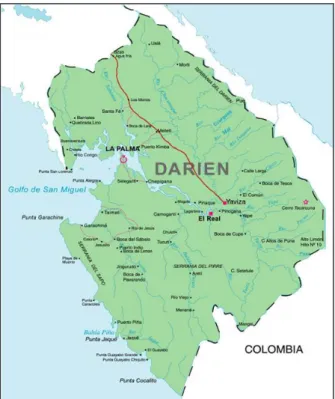
The province of Darién is situated next to Colombia, in the southern part of Panama (Figure 2).
Figure 2. Darién province.
Source:www.vmapas.com/.../Mapa_Politico_Darien.jpg
The population of Darien is over 45 thousand inhabitants which live in a total area of 1.695.500 hectare; half of the area is covered with forest. Teak afforestation is the main planted exotic tree species (Table 2).
Table 2. Data about Darién Province.
Population (inhabitants)
45.325
(Contraloria General de la República de Panamá, 2008)
Surface (ha) 1.692.500
GDP agriculture, cattle and silviculture 26.5% (Contraloria General de la República de Panama, 2007)
Total forest cover (ha) 833.350
Planted forest (ha) 3.229
(ANAM, 2004) Teak afforestation area (ha) 1.929
(Gómez and Ugalde, 2006)
More than half of the land in Darién is used for protection or reserve area and is in this land where most indigenous people live (Table 3).
Table 3. Surface in hectares (ha) according to different land use.
Land use Ha %
Mangles 33.688 2
Mix forest of Cuipo 478.250 28
Cativales 45.688 3
Dry mix palm forest 45.375 3
Swamps 20.188 1 Agricultural area 47.625 3 Protection area 301.250 18 Reserve area 665.138 40 Subtotal 1.637.200 97 Rivers 43.100 3 Total 1.680.300 100
Source: Organization of American States, 2010.
The climate in Darién is humid and warm, however climatic variations exist in the zone due to the local topographic conditions. The absolute maximum temperature is 35.5ºC and the minimum 17.2ºC, average temperature fluctuates between 25ºC and 26ºC. The dry season last 3 or 4 month, from January to April and the rainy season from May to November. The rains are irregularly distributed along the year. Precipitation is copious in the mountain lands near to the Atlantic coast (3000 mm – 4000 mm) and increase in the Pacific mountains in the south-east of the region (4000 – 5000 mm). In the central area and to the south-west, precipitation decreases and fluctuates between 1700 - 2800 mm year-1 (OAS). In the closest climatic station to Darién, Garachiné, annual precipitation varied between 494 mm in 2002 to 2341 mm in 2007. The period of the maximum precipitations is from June to December and this part of the year is considered the “rainy season” (Figure 3).
Figure 3. Average precipitation and temperatura, period 1999-2008.
Source: Elaborated with data given by Hidromet Panamá.
Winds from the north-east and north-west are dominant in the end of December up to April in the major part of the region. From May to December, winds from the south are dominating as well as local winds originating from the sea, the valleys and the adjacent mountains (OAS, 2010). In this area the probability of hurricanes is between 0.1 and 0.9 hurricanes per year (Mendez, ____).
Darién region presents four different physiographic landscapes:
Alluvial landscape: The topography is flat and the soils originate from fresh fluvial sediments and marine sediments. The first ones run along the principal rivers and get new sediments because of floods that occur periodically. In contrast, the soils from marine or sediments form very poor drained lands (mangroves).
Undulating plain landscape: The topography is slightly waved with slopes not steeper than 15%. This landscape can be found in the valleys of regional rivers.
Hilly landscape: The landscape is dominated by hills and slopes. The hills were originated from the tectonic movements from the tertiary period and climate factors, mainly rainfall. Slopes vary between 15 and 50%.
Mountain landscape: Two parallel mountain systems form the mountain landscape in the oriental region. The highest mountains are the Puna and Tacaruma with 1220 and 1585 m above sea level respectively. The mountain massif from the Pacific is represented by the hills of Majé and Cañazas in the occidental region. This disappears in
the wide estuary of the river Tuira and appears again in the northern sector of Darién (OAS, 2010).
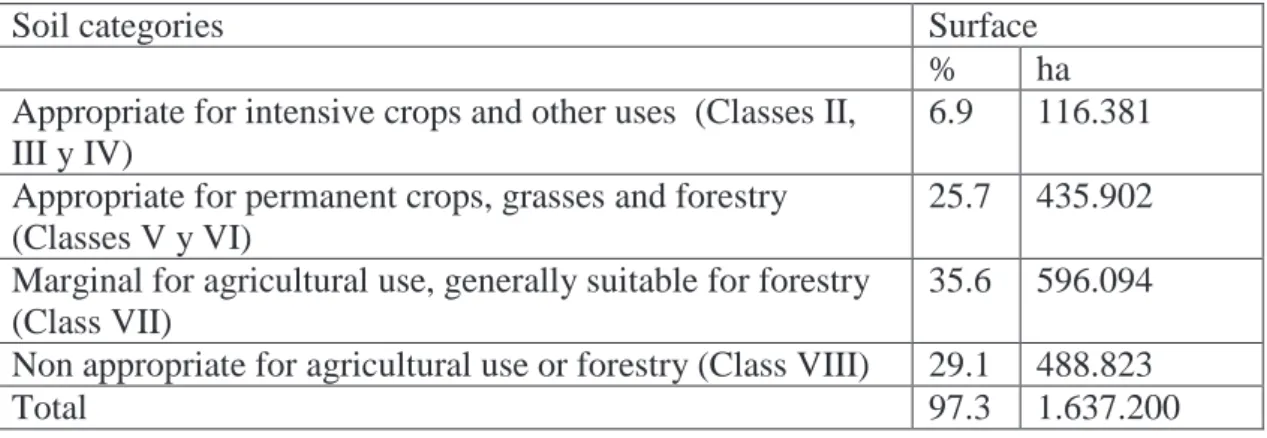
In Panama the soils are divided in seven categories from II to VIII according to their fertility. Limitations for agricultural activities and necessities for maintaining the quality and productivity of the lands, increase progressively from II to VIII. In a second group, these soil classes are combined in 4 categories that focus on the agricultural uses of the lands (Table 4).
Table 4. Surface and distribution of soil categories (approx.) according to use capacity.
Soil categories Surface
% ha
Appropriate for intensive crops and other uses (Classes II, III y IV)
6.9 116.381 Appropriate for permanent crops, grasses and forestry
(Classes V y VI)
25.7 435.902 Marginal for agricultural use, generally suitable for forestry
(Class VII)
35.6 596.094 Non appropriate for agricultural use or forestry (Class VIII) 29.1 488.823
Total 97.3 1.637.200
The class II is the best for annual crops like corn, rice, vegetables, yucca, peanut, watermelon, legumes and tropical fruit trees. These soils are Tropofluvent with flat topography.
Class III, also with Tropofluvents, can be used for rice, corn, legumes, vegetables, plátano and banana, but is more prone to floods and erosion problems.
In class IV, mango, marañón, mangotín, piña and other crops can be grown. These are formed by the groups Haplortex in the subclass Paleudol, Tropuldalf and Palendalf in subclass IVe.
Class V presents slow permeability and imperfect drainage. One part of these lands belongs to the group Tropacuept.
Class VI soils are susceptibles to high erosion due to steep slopes. Adding this factor to the low fertility, these lands are limited to perennial plants, like tropical fruit trees and cattle breeding in the lowest gradients. The soil groups in this class are Hapludol, Eutropept, Distropept, Cromustert Udico, Tropudulty Plintudalf.
In class VII the topography can be steep to very steep, being prone to high erosion because of the heavy rains. Moreover in some parts it presents low permeability and poor drainage. The use of these lands is rational forestry exploitation. The soil groups in this class are Hapludol, Distropept, Eutropept, Tropudult and Tropical Fluvacuent. Class VIII is considered not appropriate for forestry or agricultural exploitation. These lands are found in the mountain area. The soil groups in this class are Hapludol, Eutropept, Lytic Troportent and Sulfacuent. These lands are highly susceptible to
erosion and are more suited to the protection of watersheds, which provides the maintenance of forests (OAS, 2010).
2.3. Species characteristics
Tectona grandis
(L.f.)
2.3.1. Taxonomy classification
Teak was previously believed to belong to the family Verbenaceae but recently scientists have questioned this classification based on the use of modern DNA-technique. Probably teak will soon be placed in the family of Labiatae (Teaknet, 2005, mentioned by Keonakhone, 2006).
2.3.2. Natural distribution
Teak growth naturally from approximately latitude 23 to 10 north in the south east of Asia, in an area that includes the majority of the peninsular India, most part of Myanmar (former Burma) and parts of Laos and Thailand (Weaver, 1993). It can be found at latitudes between 9º - 25º 30’ N and longitudes between 73º - 104º 30’ E. Teak in Indonesia is considered to be naturalized (Kadambi 1972, Siswamartana 1999, mentioned by Kobayashi et al. 1999) (Figure 4).
Figure 4. Teak natural distribution.
Source: Weaver, 1993.
It seems to have been introduced to Java, Indonesia, in the 14th century. There are references to plantations established in India in the early 1800s and in tropical America about 100 years later (Centeno, 1997).
The area of the natural teak forests in India, Laos, Myanmar and Thailand totalize 27.9 million hectares (FAO, 1998), Table 5.
Table 5. Area with teak in the main origin countries.
According to FAO (2002), the first report on introduction of teak seed in Central America is from 1926, when it was planted in the Summit Botanical Garden of the former Channel Zone of Panama. The seed came from Colombo, probably from the Paranaeniya Botanical Garden. This provenance, that has been called Ceylon - Panama or Sri Lanka - Panama, gave way to teak plantations located in farms dedicated to the banana production of the Chiriquí Land Company. Furthermore, the Good Year Company, dedicated to establish rubber plantations, also planted teak. The shipment of seeds from the Summit Botanical Garden to eleven Central and South American countries and the Caribbean occurred during the period between 1936 and 1948. The United Fruit Company purchased the seeds in February of 1943. Records from the Botanical Garden indicate a second shipment to R.A. Nichols, at the IICA, Turrialba, in April of 1943. By 1967, the Forest Development Project in select zones directed by FAO/UNDP/ITCO used seeds from five places of provenance: Honduras, Panama, Trinidad and Tobago, Quepos (Costa Rica) and Nicoya (Costa Rica).
2.3.3. Bio-ecological requirements and growth
In order to determine whether a site is good or bad for teak plantations, Tanaka et al. 1998, mentioned by Keonakhone, 2006, claims that the following factors should be considered: climate, edaphic factors such as geology, topography and soil and factors on a plant community level such as light, moisture conditions, etc.
The type and quality of seeds are also important: rate of growth and quality of teak from plantations are largely dependent on the type and quality of seeds (Centeno, 1997). The available information for teak requirements in Central America is mainly from Costa Rica, which is next to Panama. According to FAO 2002, most of the data of the bio-ecological requirements of teak in Central America comes from the experience and the studies done in Costa Rica and very little from Panama and El Salvador.
2.3.4. Climate, temperature, rainfall
Kaosa-ard (1981, mentioned by Keonakhone, 2006) gives values for optimal temperatures and rainfall for teak growth. Teak grows when the monthly minimum temperature is above 13°C and monthly maximum temperature is below 40°C. Optimal rainfall for teak ranges between 1250 and 3750 mm per year. For the production of high-quality timber the species requires a dry season of at least four months with less
Country Area with teak (thousand ha) India 8.900 Laos 16 Myanmar 16.518 Thailand 2.500 Total 27.934 20
than 60 mm precipitation per month. Teak has proved to grow well in day temperatures ranging from 27 to 36°C and night temperatures ranging from 22 to 31°C.
Another source for information about optimal climate for growth of teak is FAO 1998. In Central America, sites classified as highly productive have rainfalls higher than 2000 mm/year and the limits in temperature to be classified as good for growing teak are on average of 25 to 28 ºC (FAO, 1998). Outside of those temperatures, the species does not grow well. Teak grows well between rainfalls of 1250 and 2500 mm/year. The species requires a 3 to 5 months dry period per year (Ugalde, 1997 mentioned by FAO, 1998). Windy areas should be avoided for growing teak, as this species is prone to be affected by wind and storms (Brown and Pandey mentioned by FAO, 2000).
2.3.5. Edaphic factors
The first step to ensure the good development of a teak plantation is to choose the right site. Teak prefers moderately deep soils (>90 cm) well drained, medium textured, flat or gentle slope (Drechsel and Zech, 1994; Jha, 1999, mentioned by Alvarado, 2006).
Best sites for teak are located at the base of mountains or in valleys. These sites allow plenty of space for root growth, and have high water and nutrient availability, with calcium content higher than 10 meq/100 ml of soil in the first stratum (Ugalde and Vásquez,1995).
Sites with slopes steeper than 25% must be avoided due to the erosion associated with the foliar characteristics of the species; Miller, 1969, mentioned that due to the large leaf area, teak trees produce a strong shadow which does not allow the understory to develop. During the dry season, teak defoliates and when the rainy season starts, the absence of leaves in the crowns allows the heavy rains to impact on the soil through the decomposed leaves causing erosion. However, thinning may promote development of understory plants preventing soil erosion.
According to Kaosa-ard (1981), teak can grow on a variety of soils. However, the quality of the biomass depends on the soil depth, structure, porosity, drainage and moisture-holding capacity. Teak develops best on volcanic substrata and on alluvial soils formed from various parent materials. The optimal soil pH for teak is between 6.5 and 7.5. Under 6 or above 8.5 the growth may be restricted. The calcium content of the soil is also an important factor. Calcium deficiency may result in stunted growth (Tewari, 1992 mentioned by Keonakhone, 2006). pH is one of the most important factor which limits teak distribution.
Alvarado & Fallas (2004) demonstrated, in a study done in Costa Rica, the high sensitivity of teak to soil acidity saturation (% Al) since the annual height increment of the trees is severely reduced at values as low as 3% of acidity saturation. A similar effect was found when soil calcium saturation was below 68%, reflecting the need of teak for this element. Under these conditions, a 59% increment in growth was obtained when 1 kg CaCO3 per tree was applied and a 216% increment in tree height was attained when the same amount of lime plus 150 g of the fertilizer formula 14-22-15-4-5 (N-P2O5–K2O-MgO-S) per tree were added to a one year old plantation.
Alvarado et al. (2005) found in a study done near the Panama Canal, that the acidity saturation percentage and the Ca saturation percentage proved to be the most limiting factors for growth, which contributes to explain the condition related to the different growth classes. Optimal conditions were given when acidity saturation was less than 8% and when Ca saturation was more than 40%. This situation was even more evident with soils with pH <5.5.
The effects of acidity in teak results in the presence of very short growth segments, internodes very close to the apical section, a general yellowing of the tips, which in extreme cases come to die. In addition, the lower leaf foliage presents necrotic at the edges and sometimes in full, effects associated with the low fertility of the soil that causes a deficiency of bases (Ca, Mg and K) in the leaves. In extreme cases it appears that the trees affected by acidity, can be affected more easily by opportunistic organisms.
Studies for estimating the needs of liming and fertilization on teak in Brazil, consider that the soil must have a maximum of Al saturation of 10 %, at least 2.5 cmol (+) Ca + Mg dm -3, bases saturation of 65 % and pH = 6 (Olivera, 2003 mentioned by Alvarado and Fallas, 2004).
In Oriental Africa values of interchange Al between 2.55 and 6.55 cmol (+) l -1 are high, meanwhile in other places it is advisable to maintain the saturation of Al in the soil under 8% (Expomadera and Coillte 2002, mentioned by Alvarado & Fallas, 2004). Another experiment shows that teak, irrespective of age, has a poor growth when pH in CaCl2 is lower than 4.3, while when pH is above 4.7 the growth is good; under these conditions soils have low values of interchangeable Ca, so it is advisable to leave the bark in the forest when the harvest is done (Zech and Dreschel, 1990 mentioned by Alvarado and Fallas, 2004).
Zech and Drechsel, 1990, found in Venezuela that high content of Fe, Al and Mn in soil cause leaves deficiency of P, K, Mg, Zn. The same authors in East Africa found that in leaves the limiting elements were N, Ca, P, affected by excess of Al in the soil and found that a good reason to maintain organic matter in the soil is to correct these symptoms. However, little is known about tolerance of these nutrients (Paniagua and Rodriguez., ____).
In Costa Rica it was found that the optimal conditions for planting teak considered a temperature between 25 - 28 ºC. The optimum rainfall varied from 900 - 3700 mm (approx.) with at least three dry month. Deep soil with high fertility and light texture without compaction promoted a good growth. The drainage should be good and winds could be a limiting condition (Table 6).
Table 6. Bio-climatic considerations for planting teak in Costa Rica.
Variable Optimal conditions Observations **
Temperature (°C) 25 - 28 25
Rainfall (mm) 889 - 3 689 2 500
Rainfall distribution At least 3 dry months
Elevation 0 - 600 Up to 800
Soil Deep with high fertility
Texture Light Heavy/drainage
Compaction* Absent Can be managed
Fertility * High
High calcium content, neutral pH, low in aluminum
Topography Flat (to) undulated
Slope * Under 20%
Drainage * Good Superficial/Internal
Holdridge’s Life Zones
Tropical Humid Forest Tropical Dry Forest
Under 800 m above sea level
Winds * Absent Limiting
Source: Picado (1997) mentioned by FAO, 2002. *Limiting condition or variable.
**Detailed values or specifications.
2.3.6. Factors on stand level
According to Krishnapillai, 2000, Teak is an obligate light-demanding species throughout its life cycle. Smaller trees are readily suppressed if stand density is too high. Therefore, plantations should be thinned regularly and heavily, particularly in the first half of the rotation. Initial planting density is generally between 1200 and 1600 trees per hectare.
2.3.7. Mycorrhiza
The Arbuscular Mycorrhizal (AM) fungi form an ubiquitous group of soil fungi colonizing the roots of plants belonging to more than 90% of the plant families. Teak plants grown in the presence of AM increase in plant growth variables such as plant height, stem girth, leaf area and total dry weight, compared to those grown in soils that are not inoculated with AM fungus. The mycorrhizal inoculation increases the phosphorus content of the teak plant. The enhancement in growth and nutritional status is also related to the per-cent root colonization in soil apart from several other soils and environmental factors (Rajan et al., 1998, mentioned by Keonakhone, 2006).
2.3.8. Propagation material
Teak plants can be grown from seeds or vegetative tissues (stems, cuttings, etc.). Plants grown from seeds collected randomly usually have a great variability of growth, while vegetative propagation by cuttings and tissue culture materials can produce the desired quality. Nevertheless, the seeds are very important to maintain a broad genetic base. For
reasonably uniform planting materials from seeds, seedling nurseries or clonal seed orchard are necessary to produce future trees with good quality (Krishnapillai, 2000). In Tectona the unit of dispersal, seed storage and reproduction is the fruit, sometimes called "seed" (FAO, 1987).
The seed yield per tree is low (causing problems in relation to progeny testing and especially mass seed production in seed orchards). Furthermore, only a few seedlings are produced per 100 sown seeds in nurseries which add to the problems of low seed production. Also, controlled pollination has turned out to be difficult in teak (Kaosa-ard, 1998).
Tectona grandis is one tropical species in which there is evidence that chemical
dormancy caused by inhibitors in the pericarp may be more important than physical dormancy (FAO, 1987).
For a good germination the seed must be treated. Repeated soaking of seeds in water during night followed by sun drying for two to three weeks is by far, the best method known for improving germination of teak seeds (KFRI, ____).
Nowadays CATIE’s seed bank offers pre-treated seed that has the following advantages:
Less weight and volume of transport which can save up to 30% in transportation costs Higher germination, up to 90%
Increased number of fruits per kilogram, up to 1800 fruits
Increased number of plants. Tiles per kilogram up to 2200 plants
It does not require pre-treatment before sowing, thereby saving up to 15 days in production
Germination times (6 to 20 days) More homogeneous in nursery plants
The spectacular gains reported with clonal forestry overall and the low productivity in the Costarican plantations, motivated to the creation of the first Costarican tree improvement and gene conservation cooperative (GENFORES), directed by the Technological Institute of Costa Rica (Badilla and Murillo, 2004).
2.3.9. Pests and diseases in the place of origin and in Central America
About 180 insects in India were reported to feed on teak (Mohanadaset al., 1998). Species that cause major damage in plantations and natural stands in India include two species of defoliators (Hyblaea puera and Eutectona machaeralis) and two borers, one in saplings (Sahyadrassus malabaricus) and the other in standing trees (Cossus cadambae) (Mathew, 1990).
H. puera larvae consume the entire leaf, leaving only the major veins. E. machaeralis larvae on the other hand, consume only the green layer of the leaves, leaving all the veins intact, this characteristic has earned for it the popular name, ‘skeletoniser’ (Chacko et al. 1985).
Hyblaea puera (Lepidoptera, Hyblaeidae)
Hyblaea puera is distributed in the Oriental and Australian regions, in South Africa, parts of East Africa and West Indies (Beeson, 1941 and Browne, 1968 mentioned by Chacko et al., 1985).
The teak defoliator, H. puera is recognised as the most serious pest of teak in India. Previous studies in the Kerala Forest Research Institute (Chacko et al., 1985) have demonstrated the enormous growth loss caused by this insect in teak plantations. It was shown that in 4 to 8 year old plantations, trees protected from defoliation by H. puera put forth a mean annual volume increment of 6.7 m3ha-1 compared to 3.7 m3ha-1 of unprotected trees (Mohanadas et al., 1994). The defoliation causes 40% loss of potential volume increment during the early part of the growth season (Chacko et al., 1985). Defoliation occurs in tender leaves and has a regular annual feature, with one or two waves of epidemic defoliations between late April and July, followed in some years by another lighter defoliation between August and October (Chacko et al. 1985).
Outbreak populations of H. puera are highly aggregated and mobile. Because of this, parasitoids were not capable of regulating host numbers during outbreaks (Mohanadas et al., 1994).
Generally, after one or two epidemics, the population declines due to leaf maturity, natural enemies and density dependent food depletion. Until the next flushing season, the population remains small and non-migratory, but active. Trees with mature leaves, escape from defoliation because they do not elicit egg-laying (Chacko et al. 1985).
Eutectona machaeralis. Synonyms: Pyrausta machaeralis, Hapalia machaeralis (Lepidoptera, Pyralidae).
The teak skeletoniser E. machaeralis, which is usually active during the later part of the growth season, has little negative impact on teak growth. The main reasons are that the population is infrequent over years, generally of low intensity, and infection occur late in the season when the leaves are old and the rate of growth is low (Chacko et al.,1985). This species is distributed in the Indo-Malayan Region up to Australia (Beeson, 1941 and Browne, 1968 mentioned by Chacko et al., 1985).
Normally the life-cycle is completed within a month, the exact duration depending primarily on temperature. There are 5 larval instars, feeding superficially to begin, later the larvae consume the leaf tissues between the network of veins, thereby skeletonising the leaves. The larvae generally feed on mature, tough leaves, unlike H. puera (Beeson, 1941 mentioned by Chacko et al., 1985).
Sahyadrassus malabaricus (Lepidoptera, Hepialidae).
The family Hepialidae (called swift moths) is a primitive family of Lepidoptera, best developed in South America and Australasia (Mani, 1973 mentioned by Nair, 1982).
The larva bores into the stem of saplings and lives in a tunnel along the pith. The mouth of the tunnel is covered by a thick mat of wood particles spun together with silk, underneath which the larva feeds on the callus tissue that grows as a result of continuous browsing. The insect has an annual life cycle with most moths emerging in late April and early May.
S. malabaricus is not a serious pest. As the larva feeds only on callus growth in the vicinity of the tunnel mouth, the damage caused is negligible. In rare instances, the stem is ring-barked, resulting in drying up of the sapling or the stem breaks off at the point weakened by feeding (Nair, 1982).
Trunk borer Cossus cadambae (Lepidoptera, Cossidae).
C. cadambae belongs to the lepidopteran family Cossidae. Cossids are popularly known as goat moths (because of the characteristic odour produced by many members of this group) and carpenter worms (due to the larval habit of boring in the wood). All members of this family without exception are internal feeders inside the woody tissues of plants.
There are two peak periods of moth emergence in May and in October.
Eggs are laid in small crevices or depressions on the bark of teak trees, either on the main stem or on branches. The colour and sculpturation of the eggs match the surface of the bark rendering detection difficult.
The natural enemies of this insect consist of 2 species of birds viz. The golden backed woodpecker (Dinopium benghalense) and an unidentified barbet, both predatory on the larvae, besides 6 species of microbial pathogens affecting various stages of this insect either in the laboratory or in the field. In the pathogenicity trials maximum larval mortality was observed in the case of treatment with the bacterium, Serratia marcescens (83.3%) followed by the fungi Aspergillus flavus and Paecilomyces fumosoroseus (57%) (Mathew, 1990).
Teak`s pests and diseases in Central America.
In Costa Rica, 20 species of insects (48%), 18 species of pathogens, two species of vertebrates and one species of mistletoe (Lorathaceae family) were identified as pests on teak. The major impacts on teak are caused by Phomopsis sp., Pseudomonas sp.,
Hyblaea puera, Rhapdopterus sp., Walterianella sp., Nectria nauriticola,
Botryodiplodia sp., Agrobacterium tumefaciens, Neoclytus cacicus, Phyllophaga spp. and “Teak decline” (Arguedas, 2004).
The following pests and diseases were found in phytosanitary inspections in commercial plantations of T. grandis in Costa Rica, Guatemala and Panama.
Outbreaks burning (Phomopsis sp.).
Outbreaks have been observed in trees from 6 to 24 months of age. The infection begins in apical meristem, young leaves turn dark brown, and then vanish. Apparently, in less
than five days the fungus fall along the cortical stem tissue, which initially acquires a brownish purple, then turns black. Sometimes the main veins of the leaves are also affected and necrosis can be observed (Macías et al. 2002, mentioned by Arguedas, 2004).
"Teak net" by Pseudomonas.
Affected trees show a slight yellowing and flaccidity of the foliage, which then begins to become necrotic from the edges, until the entire leaf blade and die.
In small trees (less than 1.5 m in height), the infection begins to affect also cortical stem tissue, resulting in the death of every individual. The radical system is totally deteriorated, the rootlets bark peels off easily and the thicker tissues become rotten. This disease is very important because it is a bacteria that kills the tree and may contaminate the soil. It has operated efficiently the removal of individuals with their roots from the plantation. The holes left are sprinkled with antibiotics as estreotomicina.
The skeletonizer Hyblaea puera.
In Costa Rica, Hyblaea puera (Hyblaeidae, Lepidoptera) known worldwide as the teak "skeletonizer, has been producing since more or less 4 years significant defoliation on teak plantations during the dry season. Larvae fold and unite with silk the edge of the leaf with the leaf blade and make its home. From there it will come out to feed the rest of the film leaf leaving only the primary and secondary veins. If the attack is very severe, you can see up to 12 larvae per leaf and total defoliation, preferring the younger leaves (Fair 1986, Nair et al.1996, Arguedas 1999, Ordóñez 1999 mentioned by Arguedas, 2004).
The defoliator Rabdopterus sp.
Rabdopterus sp. is a polyphagous species of the family Chrysomelidae (order
Coleoptera). The Adults feed on foliage of teak, producing holes as features elongated and curve about 1.3 cm long and 0.16 cm wide (Arguedas, 2004).
Figure 5.
Walterianella sp defoliator.
Adults feed on the leaves producing a small scrape on the upper cuticle and parenchyma of approximately10x2mm. For the amount of damage on a single leaf, it can be almost completely perforated and die (Figure 6). Populations are concentrated in one or two trees, and when disturbed, jump and form "clouds" in the environment. It is a plague whose incidence has increased markedly over the past two years (Arguedas, 2004).
Figure 5. Teak leaves eaten by Radopterus sp. in Darién, Panama. October 2009.
Eggs are laid in cracks in the soil surface. It has night eating habits. The attacks are related to the dominance of grasses at the site, and larvae feed on roots of grasses and blueberries (Muñoz 2002, mentioned by Arguedas 2004).
Figure 6. Characteristic damage caused by Walteraniella sp. in Tectona grandis leaves. Source: Arguedas, 2004.
Multiple canker Botryosphaeria sp.
Each canker is as welling along the stem of 3 cm to 20cm long and from 2 cm to 23 cm wide, the barks opened in such sites and are located mainly at the point of pruning. In a tree can be found up to16 cankers, Figure 7 (Ordóñez 1999, mentioned by Arguedas, 2004).
Figure 7. Tectona grandis multiple canker caused by Botryosphaeria sp. Source: Arguedas, 2004.
Nectria canker (Nectria nauriticola)
This canker makes at the base of the stem an oval area of dark crust. This rotten bark can be released manually and observe the exposed xylem tissue. It has been observed that cankers can stay for a long time in the tree, which starts to produce callus tissue and sub-epidermal cortex as a possible defence, causing swollen and deforming large areas mainly at the base of the tree. In the young trees canker can be longitudinal and expanded at the base, some resulting in death tree banding. Many times, 7 years old trees roots are attacked by Fusarium sp. This could be related to the attacks of N. nauriticola, as Fusarium species are the imperfect state of Nectria (Arguedas, 2004).
Elongated canker
The typical symptom is a longitudinal cracking of the bark that can drill down to the xylem. In some cases it develops extensively, covering average areas of 12 x 6 cm, and when the bark surface is cut, it is possible to observe the internal tissues completely necrotic (dark brown colour). In other cases, apparently in older cankers, the cracking extends along the stem (up to 60 cm) and the tree form calluses on edges, which defines the perimeter of the same length (Arguedas, 2004).
Crowngall “Agrobacteriumhh”
Although this disease has been reported for many years, the incidence in teak has increased. A.tumefaciens is a bacteria that produces a disease called
"crowngalls" which causes tumours in more than 80 families (Arguedas, 2004).
Stem borer Neoclytuscassicus.
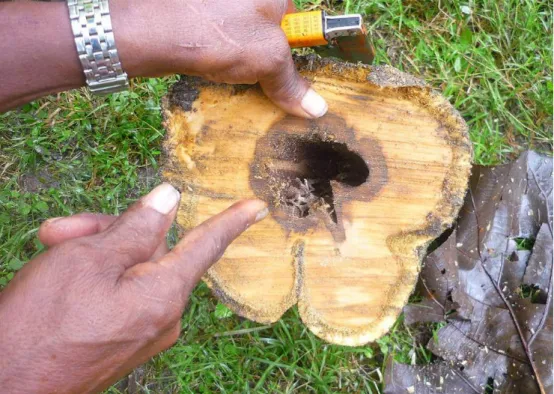
In stem pieces stored in yards, mainly from thinning, Neoclytus (Cerambycidae, Coleoptera) borer attacks. Larvae built galleries in the sapwood, no external signs of attack are detected. The stem becomes full of galleries, the adult who builds circular holes of approximately 5 mm in diameter from where they emerge. The first spots jointly form an "M" and the latest form a "V" inverted (Arguedas, 2004).
Rootles eater Phyllophaga spp.
The larvae of many species of the genus Phyllophaga, can be considered as the pest with most important feeding ground for tubers and roots. The damage is caused by larvae in their third instar, which are known in the region as "jogotos", "fogotos" or "Grubs." Adults are known as "May beetles" (CATIE 1991, Coto 2000, mentioned by Arguedas, 2004). The impacts are strong on new plantations and established plantations of up to 3 years in the months of September and October. In Panama this pest was discovered in 2003. It was found hundreds or more larvae in some individuals with severely affected root system, both almost total absence of absorption roots, such as perforations in the primary and secondary roots. This situation means that these trees are much more prone to other phytosanitary problems as those produced by soil pathogens (Arguedas, 2004).
Teak decline
In plantations older than 7 years in the humid regions (annual rainfall of over 4000 mm), there has been a process of death of individual trees and groups called the "Teak Decline”. The processes of root rot (bark root necrosis) occurs primarily in the apical major regions (approximately 1.0 - 1.5 cm in diameter), where the bark peels off easily. The internal tissues turn usually blackish product of oxidation processes that were possibly accelerated and because mildew stains from wood. Degeneration is also observed in adventitious rootlets, producing rot and death of them, so that the roots tertiary "strip", giving the appearance of "fox-tail" (Arguedas, 2004).
Rust Olivea tectonae.
In November 2003, was reported the fungus disease called "Rust". The pathogen was identified as Olivea tectonae first reported in Panama, however it originates from Asia (Arguedas, 2004).
Teak leaf begins to change colour from green to yellow and observable orange pustules. Later, the leaf turns dark brown and black hanging from the stem at the tree until it falls to the ground.
The absence of thinning, no pruning, too high planting density, inadequate fertilization and especially a poorly selected planting site, favour the development of the disease. A high-density plantation preserves much moisture in the air and if there is no aeration (poor circulation of the wind), no penetration of sunlight, the environment favours the development of the fungus.
The fallen leaves on the ground have rust pustules that its spores are spread by wind, allowing the distribution to other plantations. O. tectonae is an obligate parasite, needs of green leaf tissues of teak to survive, however, may remain in a state of uredospores (fungus spores, survival and dissemination structure) until it finds appropriate tissue to develop De Gracia ( ).
The following figures show some symptoms that were found in Forwood teak plantation during the essay installation:
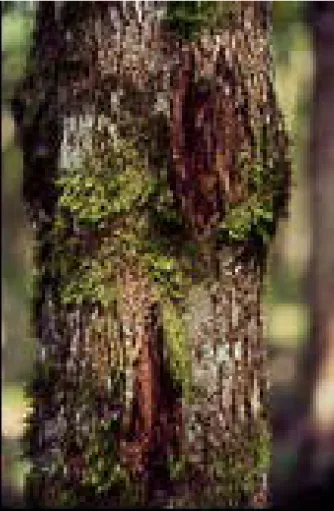
Figure 8. Insect holes and fungus on teak stem, 6 months after thinning in Darién, Panama, April 2010.
Figure 9. Termites “Comején”.
Figure 10. Termites on tree stem.
Figure 11. Canker.
2.4. Quality of teak plantations vs. natural teak
There exists a global debate about if the quality of the wood from teak plantations approaches the quality of that grown in natural forest (Akwasi and Oteng-Amoako, 2004).
Teak wood produced in the natural forest from Myanmar, India and Thailand has excellent reputation in the international market with very good prices.
Natural teak has a high proportion of heartwood which gives an attractive color, nice texture, straight grain and good mechanic characteristics which are favorable for the process at the sawmill. Moreover, the fact of having a big proportion of heartwood, makes the natural teak products to last longer because of the high resistance of the wood. This fact also means a good potential for carbon storage in the long term (Bhat and Keogh, 2003 mentioned by Akwasi and Oteng-Amoako, 2004).
Teak from plantations with rotation length of 21 – 30 years often presents a high content of sapwood and juvenile wood. Therefore, the veined, color, grain and texture are regarded as less attractive than in natural teak. According to some researchers, teak wood from plantations has lower density than in natural stands which is commonly attributed to the faster growth. However there are studies which suggest that these
differences are not always evident and even some results of genetic studies in different species have shown no correlation between the two facts (ISTF, 2009).
Studies conducted at the Forest Research Institute in Dehra Dun, India, did not find a significant relationship between growth rate and wood density (Sekar, 1972 mentioned by ISTF, 2009).
Chudnoff, 1984, found that natural teak wood from Asia has a medium-high specific gravity of 0.55. The wood is quite stable with very little shrinkage during drying. Teak wood contains oily resins called tectoquinones that naturally repel termites and resist rot (Steber, 1997 mentioned by ISTF, 2009). In spite of having an oily feel when fresh, the dry wood glues well.
In Costa Rica the specific gravity of plantations teak wood was found to vary with age and also from the inside to the outside of the bole. Wood in the center and at the base of trees was found to have wood specific gravities of 0.40 to 0.45, whereas wood on the outside and higher in the trees has specific gravities of 0.55 to 0.60 (Moya, 2001 mentioned by ISTF, 2009). Wood density for 20 years old teak in plantations in western Venezuela is reported to vary from 0.54 to 0.67 (Valero et al., 2005 mentioned by ISTF, 2009).
Bailleres and Duran, 2000 found that teak from 21 year-old plantation can have a similar resistance as mature teak from natural forest. Nevertheless the accumulative effect of the differences in the diverse properties of the wood, combined with the smaller dimensions of teak plantations makes them less valuable than teak from natural forest (Akwasi and Oteng-Amoako, 2004).
Bhat, 2000 mentioned by Akwasi A. and Oteng-Amoako, 2004 proposed alternatives to improve the quality of teak wood from plantations. He suggested that it is possible to produce logs with higher yield of naturally durable heartwood per individual tree by accelerating tree growth in short rotation with cautious fertilizer application and genetic improvements on suitable sites. Moreover fast growing provenances and clones can be selected for teak management without reducing the wood´s specific gravity. However, matching the provenances for specific site conditions and product requirements appears to be most crucial in tree improvement programs.
According to Akwasi and Oteng-Amoako, 2004, even with genetic and silvicultural improvements, the appearance of the teakwood produced by fast-grown trees is likely to continue to be different from slow-grown natural forest teak in terms of color, grain and texture. Given that one of the main criteria for the market price of a timber is its appearance (another is durability), fast-grown teak is therefore unlikely to ever reach the prices given in the market to old-growth teakwood.
Long rotations in teak plantations appear essential if the high potential value of the heartwood is to be realized. Studies in India found that the heartwood content of 51 to 52 year old trees was 77 percent, whereas for 8 year old trees it was only 30 percent (Bhat, 1997, mentioned by Krishnapillai, 2000). The same studies also showed a positive correlation of heartwood percentage with ring width (0.73) and with dbh (0.46), indicating that faster growth rates were associated with higher heartwood content and, by implication, higher-value timber. These results suggest that rotations longer than 8
years are necessary for producing high value logs and that faster growth rates may not be detrimental to the value of the timber.
The bole form is also a fact considered to be of worse quality in plantations than in natural teak forest. The phenomenon of fluting (irregular involutions and swellings) in the teak stem has been observed in a number of plantations. In an international provenance trial the mean heritability value of stem straightness was found to be 0.83, indicating that the character for stem straightness is strongly controlled by provenance and is thus genetically inherited (Kaosa-ard, 1999 mentioned by Krishnapillai, 2000). Hence, fluting can be minimized if the appropriate genetic material is used in breeding trials to produce plants that exhibit straight stems.
Market demand has traditionally been for teak heartwood with no sapwood. However as smaller saw logs from plantations become more common, sapwood inclusions will tend to become more important (ISTF, 2009).
Furthermore, there are differences in preference regarding the appearance of the wood. In Indonesia, lighter wood for decorative interior panels for export is desirable, while darker colored wood is preferred for making furniture (ISTF, 2009).
In Thailand, teak wood with dark brown stripes is known as tiger stripe teak. The tiger stripe teak is used in furniture, but is not desirable for interior paneling. The causes of the variations in the colour and characteristics of the teak grain are not documented but some researchers suggest that this can be attributed to the soil and site characteristics and also to genetic variation (ISTF, 2009).
2.5. Teak market
The global focus on forest plantations for tropical timber production has been re-enforced by the raising consciousness about the protection of natural forest.
Teak as a high quality timber species has become a very interesting option for investors. It is estimated that teak shares 75% of the global high-value tropical timber trade.
For a number of political and economic reasons, investments in teak plantations have declined in recent decades in many countries, especially in Africa, and few efforts have been made to improve forest practices or the productivity of existing plantations. On the other hand, in countries where the investment climate is more favorable, investment to expand and improve the quality of teak plantations is expected to continue. In many countries, public polices now tend to provide incentives for plantations, which imply that more private sources are investing in teak than the state, which has been the main investor in the past. As consumers are making a strong environmental pressure in favor of plantation timber, the market demand for teak timber is increasing and the price is expected to continue to be attractive (ITTO, 2009).
FAO (2000) has estimated the global sustainable production capacity of teak plantations. The countries shown in Table 5 have a total production capacity of 31.3 million m3 of teak round wood per year, which is 7% of the total volume of tropical timber harvested globally. India, Indonesia and Thailand together have an estimated
sustainable production capacity of 24.3 million m³ per year, 78% of the world total volume (Table 7).
Table 7. Sustainable production capacity of teak plantations in the major tropical countries, 2005. Country Commercial planted area (`000 ha) MAI (m3/ha/year) Sustainable production (`000 m3/year) India 2561 5 12805 Indonesia 1470 5 7350 Thailand 836 5 4180 Others 726 4.5 3267 Subtotal Asia - Pacific 5593 - 27602 Nigeria 74 9.5 1260 Ivory Coast 66 11.3 756 Ghana 40 15 200 Sudan 25 4 100 Others 51 4 204 Subtotal Africa 256 - 2353 Brazil 50 9 450 Costa Rica 30 13 390 Others 53 10 530
Subtotal Latin America 133 - 1370
Total 5982 - 31325
Source: FAO (2000), STPC database and other sources.
FAO also mentioned that almost as important as volume is the quality of the wood. In general, Asian plantations produce a denser, darker and more uniform wood than those in Brazil and Costa Rica, probably because rotations are between 80 and 120 years in Asia and 25 – 30 years in Latin America. As a result, the products obtained are different, with logs produced in Asia tending to capture a higher price.
According to the ISTF (2009), in 2004 Myanmar was estimated to have 60 % of the world´s remaining primary teak forests. Teak trade in Myanmar is controlled by the military and exports are being used for military spending. Myanmar round wood timber trade with China was 295.000 m3 in 1997 and grew to 948.000 m3 by 2002 (Kahrl et al., 2004). However, India is the largest destination for Myanmar timber exports, receiving 76% (770.554 m3) of all hardwood log exports in 2001, according to Myanmar´s published customs statistics (Kahrl et al., 2004. ISTF, 2009).
On the other hand, China comprised just 0.3% (3.237 m3) of Myanmar´s official hardwood log exports, but China´s customs statistics record 2001 log imports from Myanmar at 513.574 m3. This discrepancy indicates that illegal logging is taking place on a massive scale along Myanmar´s border with China (Kahrl et al., 2004. ISTF, 2009).
Keogh (2008) mentioned that several sources of plantation teak prices are available worldwide. However, their use is limited because they are mostly unsubstantiated and lack precise information about log dimensions, time of data collection and what point along the value chain they refer to (ITTO, 2008).
Myanmar base the prices of teak on a traditional log grading system which make differences between highest quality veneer logs from lower grade sawlogs. Grading is based on top diameter, log length and straightness and number of defects.
Log prices in Myanmar are listed in Euros per hoppus ton (1 hoppus ton = 1.8027 m3). Table 8, provides FOB log values for 2011.
Table 8. Myanmar log prices (natural forest logs). Teak logs, FOB.
Log class € Avg per Ton (traded volume) 2011 Veneer quality Mar Apr
2nd quality nil nil 3rd quality nil nil 4th quality 2.654 (12 tons) 2.588 (11 tons) Sawing quality vGrade 1 (SG-1) 1.734 (48 tons) 1.777 (44 tons) Grade 2 (SG-2) 1.507 (40 tons) 1.581 (41 tons) Grade 4 (SG-4) 1.175 (200 tons) 1.122 (200 tons) Grade 5 (SG-5) 764 (118 tons) 729 (139 tons) Grade 6 (SG-6) 698 (57 tons) 664 (78 tons) Grade 7 (ER-1) 544 (107 tons) 520 (92 tons)
All grades, except SG-3/5/6, are length 8´x girth 5´&up. SG-3/4/6 is girth 4´&up. SG-3 grade is higher than SG-4 but with lower girth in price. Prices differ due to quality or girth at the time of the transaction.
Sources: ITTO TTM reports May, 2011.
There are different prices between natural and plantation teak. According to Keogh, 2008, all the plantation teak log prices are significantly lower than the lowest Myanmar grade (SG-6), suggesting that the upper ceiling for plantation teak prices is, with few exceptions, lower than the lowest category of natural forest teak. Most plantation price data lie between US$ 150 and 250/m3 (real prices), equivalent to between US$ 200 and 300 (nominal) (ITTO, 2008) (Figure 12).
37
Figure 12. Prices (US$ per m3) of natural forest and plantation teak logs. Source: ITTO 2008
According to ISTF (2009), in Venezuela there were 5000 ha of teak plantations in the federal forest reserves of Ticoporo and Bum-Bum in the western state of Barinas established during the 1970’s and 1980’s. Most of them were not thinned and had not been pruned. When most of the plantations had reached 20 years of age, trees were in the range of 25 cm to 35 cm dbh, they were sold to Malaysian buyers at a stumpage price of US$ 200/m3. On the north coast of Colombia, near the city of Monteria, at the same time, teak plantations 20 years old were sold to Indian buyers for a stump price of US$ 225/m3, but the real net price after discounting defects was US$ 168/m3.
It is difficult to have information about teak log prices from Panama, however, ITTO in 2011 have reported that India bought logs from Panama with prices from 315 to US$ 400/m3. Comparing with other Central American countries in 2011, Panama tends to the cheapest prices for teak logs.
Clearly, markets for small diameter teak logs from plantations are different from the traditional markets for large diameter logs. A marketing strategy is needed to demonstrate the value and possible uses of teak from young plantations. One possibility which some growers are trying to apply is showing increasing interest in producing value-added consumer products from their wood and engaging in the processing and marketing of their own finished or semi-finished products, as opposed to trying to sell stumpage or logs.