SIT Digital Collections
Capstone Collection SIT Graduate Institute
Spring 5-17-2016
Destination Choice in Study Abroad
Courtney Smith SIT Graduate Institute
Follow this and additional works at:https://digitalcollections.sit.edu/capstones
Part of theBilingual, Multilingual, and Multicultural Education Commons, and theInternational and Comparative Education Commons
This Thesis (Open Access) is brought to you for free and open access by the SIT Graduate Institute at SIT Digital Collections. It has been accepted for inclusion in Capstone Collection by an authorized administrator of SIT Digital Collections. For more information, please contact
Recommended Citation
Smith, Courtney, "Destination Choice in Study Abroad" (2016).Capstone Collection. 2899. https://digitalcollections.sit.edu/capstones/2899
DESTINATION CHOICE IN STUDY ABROAD Courtney Smith
SIT Graduate Institute PIM 74
A capstone paper submitted in partial fulfillment of the requirements for a Master of Arts in International Education at SIT Graduate Institute in Brattleboro, Vermont, USA.
May 16, 2016 Advisor: Karla Giuliano Sarr
Consent to Use Capstone
I hereby grant permission for World Learning to publish my capstone on its websites and in any of its digital/electronic collections, and to reproduce and transmit my CAPSTONE
ELECTRONICALLY. I understand that World Learning’s websites and digital collections are publicly available via the Internet. I agree that World Learning is NOT responsible for any unauthorized use of my capstone by any third party who might access it on the Internet or otherwise.
Student name: Courtney Smith Date: 5/17/2016
TABLE OF CONTENTS Introduction ... 2 Conceptual Framework ... 4 Literature Review ... 4 Definitions ... 6 Existing Research ... 7 Inquiry Design ... 11
Data Collection Methods... 13
Data Analysis ... 14 Survey. ... 14 Focus group ... 15 Interviews ... 16 Limitations ... 17 Ethics ... 18
Presentation and Analysis of Data ... 18
Student Characteristics ... 19
Relationship Factors ... 23
Push Factors ... 26
Pull Factors ... 33
Discussion... 36
Language ability and study ... 37
Recommendations ... 38
University policies and study abroad structure ... 38
Academic environment in host country ... 39
Cultural environment in host country ... 40
Previous or desired travel ... 40
Financial considerations ... 40
Practical Applicability ... 41
BIBLIOGRAPHY ... 45
Appendix A: Student Online Survey ... 47
Appendix B: Interview and Focus Group Questions ... 53
Appendix C: Consent Form ... 55
Appendix D: Survey Results ... 56
Appendix E: Focus Group Participants ... 57
List of Tables
Table 1: Research Participants ... 12
List of Figures Figure 1: Survey Results, Personal Factors ... 20
Figure 2: Survey Results, Relationship Factors ... 24
Figure 3: Survey Results, Push Factors ... 28
List of Abbreviations
COL: College of Letters (a major department) IIE: Institute of International Education IRB: Institutional Review Board
OSA: Office of Study Abroad
SIT: School for International Training UK: United Kingdom
ABSTRACT
The most popular destinations for U.S. undergraduate study abroad are the United Kingdom (UK), Italy, Spain, and France, hosting 37.5% of all students who studied abroad in 2013-2014, with approximately 2-6% increases in each of those countries over the previous year (IIE, 2016). Despite world events and changing international relations interests, the majority of U.S.
students continue to choose traditional destinations in study abroad. Using a factor analysis approach, this study seeks to determine which factors play the most significant role in undergraduate student destination choice for study abroad.
The results from this study indicate that the most important factors for students in making their destination choice are language ability and study, recommendations, university policies and study abroad structure, the academic environment in the host country, the cultural
environment in the host country, previous or desired travel, and financial considerations. Increased awareness of the factors that students at this east coast liberal arts university
consider most when planning their study abroad may aid study abroad advisors to better assist students in planning their undergraduate study abroad experience.
Introduction
As an undergraduate student who studied abroad in Japan and had friends going to a wide range of locations, I believed that undergraduates studying abroad chose a wide variety of countries around the world, and that the Eurocentric focus in study abroad was an antiquated idea. Upon enrolling in the International Education program at SIT and reading the Open Doors (2000-2014) report (a report about study abroad), for the first time, however, I quickly realized my assumptions were incorrect; in fact, Europe remains the main study abroad destination of choice by a wide margin. I instantly began to wonder what motivates students to choose
Europe in such overwhelming numbers. As illustration, the Open Doors Report (IIE, 2016) shows that the United Kingdom (UK), Italy, Spain, and France are the top four destinations, hosting 37.5% of all students who studied abroad in 2013-2014, with approximately 2-6% increases over the previous year (IIE, 2016).
Returning to reflect upon my junior year abroad, I recalled the reason I personally chose my destination of Japan was due to a long-standing fascination with how different the culture is from Western culture, as well as anticipating the amount of job prospects that knowing
Japanese would open to me. As an International Studies major, I also knew I would be able to complete coursework at my school abroad that would allow me to graduate on time despite studying abroad for a full academic year. I assumed that my peers chose study abroad
destinations due to world events, career opportunities, or political and economic relevance of the region, because that is what my immediate group of friends and I did.
After a year at SIT, I went on to work as a study abroad advisor at a medium-sized, private, east coast liberal arts university as my practicum site. I expected at least a third of the
students that coming through our office to be going abroad to East Asia, especially due to the rising number of Asian students studying in the U.S. and my perceived increase in interest of studying Chinese by U.S. students. My university has a reputation of being “different,” and although I had read the Open Doors report, I assumed the study abroad numbers would reflect the uniqueness of my institution. While my university sends 100-200 students abroad per semester, I only advised 3-4 students wishing to study abroad in East Asia in my first semester working there. From 2000-2014, in fact, only 10% of students at this university went abroad to Asia, and 47% went to traditional destinations (XXX1, 2014). This led me to further wonder what was motivating students to choose their destinations, because my assumptions based on the university’s reputation were incorrect.
After learning about the Critical Language Scholarship from one of my coworkers and later researching the scholarship in order to apply, I realized the U.S. does not produce enough language speakers to meet government and Foreign Service needs, and students are not choosing to study in locations that would allow them to obtain the cultural competencies necessary to fill this need in the Near East and South and Central Asia. This further led me to wonder what was pulling students to Western Europe despite such explicit need for young people to gain cultural competencies and language skills from other parts of the world. This paper will address this curiosity by examining reasons students choose their destinations at this university.
1 Author masked to protect the identity of my research site and participants as commensurate with ethical considerations.
Thus, for my capstone, I formulate the following research question: What factors influence undergraduates in choosing their study abroad destinations?
Conceptual Framework
Conceptual frameworks help organize research as well as allow for generalizations across research (Rossman & Rallis, 2012). For the purposes of this study, I rely upon Chen’s (2007) synthesis model, which incorporates the three phases of college and study abroad decision-making theory and factors influencing student decision at each stage, as a conceptual framework. This synthesis model informs the methods I chose for my study. I examine the results to analyze how students’ decision-making processes at this small, liberal arts university compare to this model. In this next section I present a literature review which details of these relevant theories.
Literature Review
Because of my experiences, assumptions, discoveries and questions, I began to research the current literature and findings regarding how students choose study abroad destinations. I began my musing using Google search with keywords such as “student destination choice in study abroad” and “choosing study abroad locations.” This produced minimal results, but allowed me to connect with key articles whose own literature reviews served a more
trustworthy map for developing my understanding of the existing research on my topic. After this preliminary Google search, I refined my search using the SIT library search to ensure the articles I was finding and referencing were of sound academic quality. I was also able to retrieve
some sources that contained many useful articles about study abroad theory and research, which really helped to guide my research. Because the results of these initial keyword searches were minimal, I did not place any boundaries on my research at first. Instead, I gathered
general information regarding study abroad choice for both U.S. students and students from other countries.
While much research has been done examining factors influencing students’ decision to study abroad, which I further explain below, I found that very little literature exists on factors influencing student destination choice. The majority of existing research regarding destination choice is location-specific and aimed at improving marketing strategies of a particular country or school. The main models employed by this type of research are derived from one theory regarding how students make the decision to attend college: college choice theory (Hossler and Gallagher, 1987; Perna, 2006; Salisbury et al., 2009). Research supports that this decision-making process is virtually identical to the decision of whether or not to study abroad (Salisbury et al., 2009). Within these decision-making models is a component regarding destination
choice, and that is what I will focus on for the purposes of my study. Below, I will describe in greater detail the origins of the model I have chosen to employ in my study. My description will be chronological, following the theory through time as student decision-making theory evolved. This literature review is by no means an exhaustive history of college choice theory and its connection to my study; I introduce only the most relevant research to provide a chronological narrative from the origin of college choice theory to the synthesis model I have chosen to use. I will now explain some definitions, and in the subsequent section, I will review in greater detail the existing literature relevant to my research question.
Definitions
In delving into the literature to identify relevant theoretical grounding, the first issue to grapple with is defining “traditional destinations” and “nontraditional destinations.” Wells (2006) offers the following definition:
The primary criterion for being categorized as a nontraditional country is the fact that relatively few American students study there. This general definition is sometimes combined with the qualification of being non-European or non-English speaking. Others classify non-industrial, third-world, or developing countries as nontraditional
destinations. To strike a balance between accuracy, utility, and ease of definition, I will refer to nontraditional study abroad destinations simply as those in Africa, Asia, Latin America, or the Middle East. (p. 114)
I do not find this a satisfactory definition, due to the fact that it ignores popular destinations outside of Europe, and under this definition, many non-popular Eastern European countries such as Hungary, the Czech Republic, Poland, etc. get counted as traditional destinations. At the liberal arts university where I’m currently doing my practicum, I feel as though my colleagues are referring to Western Europe and Australia when referring to ‘traditional destinations.’
For the purposes of this study, I will create my own definition. In this paper,
“traditional” implies “long-established,” so using the Open Doors reports from 2000-2014 (the 2014 report is the most current available online), I have determined which countries have remained in the top ten destinations for U.S. students studying abroad for the duration of these past 14 years. Those countries are: UK, Italy, Spain, France, Australia, Germany, Ireland, and Costa Rica. I am defining these countries as traditional destinations in study abroad, and thus all other countries as non-traditional destinations.
From 2000-2014, 47% of students at my university went to traditional destinations, and of those students, 82% went to the UK, Italy, Spain and France (Gonzales, 2014). These
numbers are quite comparable to U.S. national statistics for study abroad. In those same years, 54% of U.S. students went to traditional destinations, and 77% of those students went to the UK, Italy, Spain, and France (IIE, 2016). Below, I will go into further detail about the existing literature relevant to my study.
Existing Research
In the following section, I will chronologically describe relevant theory and its origins regarding student destination choice in study abroad as the theory developed over time. To begin, Hossler and Gallagher (1987) created one of the first in-depth models of college choice theory: a three-phase model of student college decision making that is the basis for the models presented here. While unrelated to study abroad, this served as a foundation for student decision-making that was later extended to study abroad decisions. Their model includes three steps: predisposition, search, and choice. This model also considers influential pressures and outcomes at each step. Hossler and Gallagher’s (1987) model also takes into account individual student characteristics such as socioeconomic status, language background, heritage, etc.
Subsequently, Mazzarol (1997) looked specifically at student decision-making in study abroad rather than college choice and examined students from Australia going to study in Taiwan and Indonesia. He describes the three steps of the study abroad decision making process as: (1) the decision to study abroad, (2) the choice of a host country, and (3) the selection of a host institution (1998). Mazzarol (1998) later also identifies “push factors” (conditions motivating a student to leave their home country) that are relevant in the first phase, the decision to study abroad, and “pull factors” (enticing conditions in the potential host
country) that become relevant in the second phase, the choice of a host country. Push factors include lack of access to higher education, availability of science and technology-based
programs, wealth in the home country, and perceptions of quality of higher education in the home country. Pull factors include an institution's reputation for quality, market profile, range of courses, alliances or coalitions, offshore teaching programs, staff expertise, degree of innovation, use of information technology, resources, size of the returnees base, and promotion and marketing efforts (Mazzarol, 1998). In separate study, Mazzarol et. al (1997) describe six main factors influencing student selection of a host country: (1) overall level of knowledge and awareness of the host country in the student’s home country including the destination’s reputation for quality; (2) referrals or personal recommendations that the study destination receives from parents, relatives, and friends; (3) cost issues including expenses and social costs such as safety, racial discrimination, and presence of students from the home country; (4) environment, which includes physical climate and lifestyle; (5) geographic proximity to home country; and (6) social links such as friends or family in the destination country. While Mazzarol (1997, 1998) provides a wealth of information across his works, neither of his studies relevant to student destination choice provide a comprehensive model. For example, while one of his models alludes to academic considerations and language knowledge, it ignores financial factors, and his model that discusses cost factors ignores academic considerations. I continued searching the literature in hopes of finding an even more comprehensive model that combines the myriad of stages and factors that students go through and consider when making the choice to study abroad and where to study abroad. Below, I explain how Perna’s model demonstrates an expansion of the decision making context.
Returning to the stream of literature regarding college choice theory, Perna (2006) adds another, broader layer by taking into account the economic model of human capital
investment, meaning investing in people to enhance mental and physical abilities for economic gain, and the sociological model of status attainment, meaning investing for gains in social and cultural capital. Perna’s model for decision making regarding higher education is based on four contextual layers: (1) the individual’s habitus, (2) school and community context, (3) the higher education context, and (4) the broader social, economic, and policy context. Perna’s expansion of college choice theory, drawing strongly on the works of scholars such as Hossler and
Gallagher (1987), opens up opportunities for applying college choice theory to decisions a student makes once at college, specifically when considering study abroad opportunities.
Building upon these theories, Chen’s (2007) synthesis model is the one I have chosen to use a theoretical model for my own study. Chen (2007), recognizes the similarities in Hossler and Gallagher’s (1987) model, and Mazzarol’s (1997, 1998) work, and in a 2007 study describing why East Asian graduate students come to Canada, she combines their theories to create a synthesis model. Chen (2007) starts with the three phases of deciding to study abroad: (1) deciding to study abroad, (2) choice of a host country, and (3) choice of a host institution. She then lays out the dominant factors influencing student decision in each stage: student
characteristics, significant others, and external push-pull factors. “Student characteristics” include socioeconomic background, personal characteristics/preferences, academic ability, social capital, and creative capital. “Significant others” refers to encouragement from family, spouses, relatives, professors, sponsors, or employers. “External push and pull factors” include positive and negative forces from the home and host countries, personal driving forces, and
institutional characteristics. Chen’s (2007) model offers a level of personalization that suits the complicated lives of students today, as it not only defines the stages of how one decides to study abroad, but encompasses the decision of which country and institution to study at, while examining factors at play during each stage of the decision.
In further validating Chen’s (2007) research, Salisbury et al. (2009) argue that college choice theory (Hossler and Gallagher, 1987; Perna, 2006) can be applied not only to the decision to pursue higher education, but also to students’ decisions to participate in educationally valuable experiences during their undergraduate experience, such as study abroad. Salisbury et al. (2009) unifies this body of work describing college choice theory and study abroad decision making, which serves to further validate Chen’s (2007) work. Salisbury et al. (2009) support the claim that “the process of deciding whether or not to study abroad is virtually identical to the process described by college choice theory” (p. 123) because both are composed of three main decision-making stages: (1) development of intent, (2) search, and (3) selection of a specific location and program. This closely reflects Hossler and Gallagher’s (1987) stages of the college choice process outlined above. The connection established by Salisbury et al. (2009) between college choice theory and study abroad choice is extremely important, because one can now apply this insightful theory to the study abroad decision process.
While both Mazzarol (1997; 1998) and Chen’s (2007) work focus specifically on international education, they both examine specific countries. As I illustrate through my
preliminary literature review here, I have found no generalizing studies examining these models in relation to U.S. undergraduate student choice of location for study abroad. The purpose of Chen’s (2007) model was to determine why students came to Canada, but my application of
Chen’s model, particularly stage two (choice of a host country), will be to determine how students choose a country in general for study abroad. I anticipate that this may be a unique contribution to the field with the potential to inform and improve study abroad advising at my university and similar institutions.
Inquiry Design
As a reminder, my research question asks what factors influence undergraduates in choosing their study abroad destinations, thus my type of inquiry is a qualitative case study. Shallenberger (2008) describes a case study as a qualitative study that “seeks to understand a larger phenomenon through intensive study of a specific incidence” (p. 1). In this instance, I used mixed methods to understand the incidence of students making a decision of where to study abroad at the university where I am completing my practicum. My focus has included how and why students decide on a particular location. The qualitative methods I used include a survey, focus group, and interviews, and I analyzed a specific set of factors derived from a conceptual framework described below. I have chosen this method of inquiry because I will be asking questions regarding factors that influence student destination choice. Due to my work as a study abroad advisor at a private, east coast liberal arts university, understanding how
students choose destinations will help study my fellow abroad advisors and I better meet students’ needs in terms of study abroad planning. This results of this study may also prove valuable to other international education professionals at similar institutions. We send approximately 300 students abroad each semester, which is approximately 11% of all undergrad students.
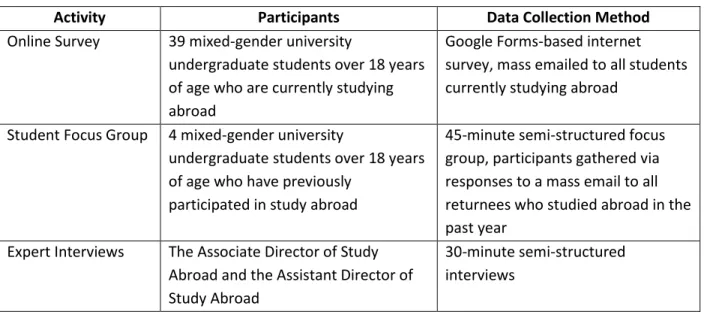
This study gathers information from the approximately 100 students at my university who are currently studying abroad, four study abroad returnees, and the two administrative staff members from the OSA:
Table 1: Research Participants
Activity Participants Data Collection Method
Online Survey 39 mixed-gender university
undergraduate students over 18 years of age who are currently studying abroad
Google Forms-based internet survey, mass emailed to all students currently studying abroad
Student Focus Group 4 mixed-gender university
undergraduate students over 18 years of age who have previously
participated in study abroad
45-minute semi-structured focus group, participants gathered via responses to a mass email to all returnees who studied abroad in the past year
Expert Interviews The Associate Director of Study
Abroad and the Assistant Director of Study Abroad
30-minute semi-structured interviews
This approach allowed me to triangulate my understanding of how study abroad destination decisions are made. Triangulations involves the conscious combination of methodologies as a solution to strengthen research design when a single method is not a logical or holistic choice (Holtzhausen, 2001). I gathered data from students who have recently made their decisions (those currently studying abroad), students who made their study abroad destination choices one to two years ago (study abroad returnees), and staff (who work every day with students making study abroad destination choices). I further elaborate upon my sampling design within the discussion below.
Data Collection Methods
This study employed multiple data collection methods. As indicated in Table 1, I conducted an online survey created for all students currently studying abroad, hosted a focus group for four study abroad returnees, and interviewed the two OSA permanent staff
members. In this section, I will explain in detail how I administered each of these techniques. To create the online survey, I used Google Forms and emailed the survey link to the exactly 100 students currently studying abroad (see Appendix A). I gathered the email
addresses for these students from our list of students currently abroad, and sent the survey link in a mass blind-copied email message from my institutional email address. Two follow-up reminders were sent within a nine-day period in order to complete the survey process within a timely manner but also allow enough time for students who may be studying abroad in remote areas and only get to check email weekly. This method employed a convenience (voluntary) response sampling strategy, meaning that those who responded were the sampling pool (Chaturvedi, 2011). Of the 100 students who received the survey, 39 students, responded within the designated time frame, for an excellent response rate of 39%. The responses through Google Forms bore no identifying information. In addition, I offered the incentive of a $10 Amazon electronic gift card that was raffled off to participants in the survey. The gift card was sent electronically via the student’s university email address, and can be used anywhere in the world where students can access the internet. Because of the ubiquitous nature of Amazon use among millennials and the small amount offered, this incentive conformed with ethical practice and had very limited potential to introduce bias.
Additionally, I hosted a 45-minute, semi-structured focus group comprised of four study abroad returnees who are currently still undergraduates at this university (See Appendix B). These students were a combination of students who work in the OSA and students who responded to an invite that I sent to all study abroad returnees, making it a convenience
sampling (Chaturvedi, 2011). This focus group took place in a private meeting room in the same building as the OSA. Because I scheduled the focus group from 12-1pm, I offered light snacks as an incentive for students.
I also conducted short, semi-structured interviews with my two OSA coworkers: the Associate Director of Study Abroad and the Assistant Director of Study Abroad. In doing so, I employed a purposeful sampling method because I targeted the two people at my university who have the most knowledge about study abroad advising (Chaturvedi, 2011). These interviews took place in my coworkers’ respective offices and lasted 15 minutes and 18
minutes. I recorded the focus group and interviews using my iPhone and transcribed them with the assistance of Audacity. Pursuant to good ethical practice, my research design received approval from both the SIT Institutional Review Board (IRB) as well as my university’s IRB. I obtained consent from all parties involved in my study (see Appendix C).
Data Analysis
In the following section, I will describe the methods by which I analyzed my collected data.
Surveys. Survey responses from students currently abroad were collected in a spreadsheet. Thirty-nine students studying abroad at the time of this study from a diverse
section of programs and locations completed the online survey. The survey asked participants to assign numerical rankings of the importance of a list of factors for study abroad, as well as left space for open-ended commentary after each section. All participants filled out the rankings, and many also took the opportunity to write comments that reiterated or explained answers. Students were asked to assign the least important factors 1 point, and the most important factors 5 points. After determining the average ranking for each factor, it was easy to see which factors were the most important to students as they chose their destinations, and which were the least important (see Appendix D for the full results). In the following section, I explain the factors with the highest and lowest averages in each category (student
characteristic, relationship, push, and pull factors), focusing on factors with averages above 3 points and below 2 points. I also created graphs to visually depict the information (see Figures 1-4). Graphs are presented with an x-axis of 0-5, indicating the average number of points for each factor. Color coding on the graphs is as follows: orange indicated factors with an average ranking above three points (especially high), green indicates factors with an average ranking below 2 points (especially low), and blue indicates factors with an average ranking of between two and three points (average).
Focus group. Four returned students attended the focus group who had studied abroad
in the UK, Germany, and China (two students studied abroad in China). During the discussion, they shared information regarding factors in each category (student characteristic, relationship, push, and pull factors). In presenting the data, I label students as “Returned Student, [country of study abroad], Focus Group.” Because two students in the focus group studied in China, they
are labeled as “China 1” and “China 2.” See Appendix E for additional information on the focus group participants.
Interviews. Interviewing the Associate Director of Study Abroad and the Assistant
Director of Study Abroad allowed me to gather more general information and observations made regarding students destination choice in study abroad over time. The Associate Director has been at this university for approximately one year, and has previously worked at two different intuitions of higher education in similar positions. She has an education background in international education. The Assistant Director has worked in the OSA at this university for 21 years, and has been in her current position for 17 years. She has an educational background in teaching. In presenting the data, I label interviewees as “Associate Director” or “Assistant Director, OSA, Interview.”
I recorded the focus group and interviews and transcribed them by slowing down the tempo in Audacity, and then coded the results in MS Word using color coding. I chose to code in MS Word due to its simplicity and flexibility. Chen’s (2007) synthesis model lays out the categories so well that I used her exact words to code the data from my surveys, interviews, and focus group (p. 274). The codes I used are as follows:
Student Characteristics: o Socioeconomic Background o Personal characteristics/preference Significant Others: o Relatives o Family/Spouse o Friends/Returnees o Employers o Professors External Influences
o Push (Home country): Academic Economic Political Culture/Language Educational System Information available
o Pull (Host country):
Academic quality
Economic & political tie
Environment (safety/climate)
Culture/Language
Marketing
Geographic proximity
In the “Presentation and Analysis” section, I discuss the results of the survey and the major themes that arose during the focus group discussion and interviews.
Limitations
Limitations are inherent in every research project. As I have indicated, this study focused specifically on undergraduate students at one east coast, liberal arts university. The study I conducted was specific to the culture and idiosyncrasies of this particular university’s study abroad application process and requirements. While this information may shed light on factors influencing students’ decisions, this study does not allow for generalization across the field. Additionally, my data was only collected from three cohorts of students of who have gone abroad. While this may not allow me to generalize trends over time, patterns, which I will explain later, emerged which allowed me to identify considerations for further research.
Ethics
The following paragraph explains how this project was conducted in an ethical manner. This study involved minimal risk and did not involve deception. The research topic and
discussions were non-sensitive and were about student destination choice in study abroad, a subject that all students have discussed with an advisor in the Office of Study Abroad at some point previously. The informed consent process differed for each research activity. For surveys, consent was implied by filling out and returning the internet survey. Students participating in the focus group and staff participating in interviews signed a written consent form which also informed them they can terminate participation at will without penalty. While participation in this study may not have benefitted participants directly, participation produced valuable information for study abroad advisors to better aid students planning to study abroad. All personal information and interview recordings are being kept strictly confidential on a locked hard drive and password-protected Google Drive. The focus group and interviews took place in private rooms. This study was approved by the SIT IRB as well as the IRB at the university where my study took place.
Presentation and Analysis of Data
This study combined several data collection methods. As indicated above, 39 students responded to the online survey for students currently abroad, four study abroad returnees attended the focus group, and the two staff members of the study abroad office successfully participated in interviews. Below, I will explain the results and themes from each piece of my
data collection and outline overarching themes present throughout the results of my research. I present the data by factor: student characteristics, relationship factors, push factors, and pull factors. It is important to note that some finding may overlap into multiple factor categories. This indicates the complex nature of students’ identities and the effect of these identities on choosing a study abroad location. I will discuss data in the category that best fits the description of Chen’s (2007) model.
Student Characteristics
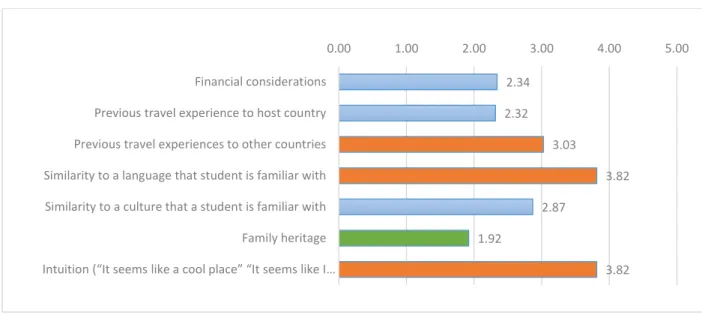
Student characteristics refers to factors such as socioeconomic status, language background, heritage, etc. Analysis reveals that the top factors that emerged from the survey results differ from the top factors that emerged from the focus groups and administrator interviews. As is depicted in Figure 1, survey results identified the factors of “similarity to a language that a student is familiar with” and “intuition” both had the highest averages of 3.82 points. Per the survey results, “family heritage” had the lowest average of 1.92 points.
Figure 1: Survey Results, Student Characteristics
Several important factors emerged during data analysis regarding student characteristics, including financial considerations, the desire to go somewhere new, family heritage, and intuition.
Participants discussed the issue of finances from several angles. To begin with, focus group students discussed specific policies of the university that prevented them from choosing a program based on cost. University policy dictates that all students abroad continue to pay full tuition, and the university directly pays the study abroad providers or partner institutions. The rationale behind this idea is that paying tuition to the university allows students to continue to use their financial aid uninterrupted, even if they are abroad, which makes study abroad need-blind (available to all students regardless of their financial situation). During the focus group, while one student pointed out the advantages of this, the other students focused on the negative aspects of having to pay normal tuition, which is quite high at this university, while studying abroad. 2.34 2.32 3.03 3.82 2.87 1.92 3.82 0.00 1.00 2.00 3.00 4.00 5.00 Financial considerations Previous travel experience to host country Previous travel experiences to other countries Similarity to a language that student is familiar with Similarity to a culture that a student is familiar with Family heritage Intuition (“It seems like a cool place” “It seems like I …
In a similar vein, the Assistant Director, who is in charge of financial aid, further discussed this financial situation during an interview. She underlined the importance of
studying abroad being need-blind (meaning that students can study abroad regardless of their financial aid situation), and how it allows students the freedom to choose any programs they want, rather than being bound by financial restrictions because financial aid won’t cover a study abroad experience. This would have definitely impacted destination choice for those with financial restrictions, due to variances in cost of living around the world. She commented:
[If] students had financial aid, they could take their non-[university-specific] aid, but not their [university-specific] aid, so they were more looking at the cost of a program and if they were eligible, then the quality. (Assistant Director, OSA, Interview)
The desire to go somewhere new was also a huge choice factor for a student who regularly returned to China to visit family. Although this individual was studying Chinese as a heritage language, her desire to go somewhere new led her to choose an English-speaking program in another country. Due to the university policies, students can only study abroad on English-speaking programs if English is the country’s primary language or if the country’s primary language is not taught at this university (this policy is further explained below).
The Associate Director, who has worked at three different intuitions, pointed out that the majority of students at this university have traveled more and have already been to certain countries, such as the student mentioned above. She has encountered more students who mentioned choosing to go abroad to less common locations because they’ve already been to heritage countries or more popular global destinations such as Paris. For example, she commented:
I guess I have talked to students who had gone to Paris every summer for example, so like, “I’m not gonna go to Paris to study abroad because that’s where I’ve been every
summer and I don’t need to go there. I’m going to go to Argentina instead.” (Associate Director, OSA, Interview)
Overall, the desire to travel to a particular destination that a student had never been to before appeared to be a significant factor in their choice of study abroad location.
Per the conversation during the focus group, family heritage also seems to be a
significant factor in student choice, despite that it received the lowest rating on the survey with 1.92 points. As illustration, it played an important role for one focus group student who went to China for the opposite reason; she was Chinese but had never been to China. As a heritage speaker, she wanted an intensive language program that would help her improve her Chinese as well as allowing her to experience her family’s culture: “I guess that’s just sort of it, and then when I actually wanted to learn Chinese and I actually wanted to learn about China, that like kind of really pushed me in that direction” (Returned Student, China 1 Focus Group).
Intuition was also discussed in the focus group conversation, and tied with language familiarity as the highest ranked factor in the student characteristics section, with 3.82 points. Intuition was mentioned by one focus group student. This factor came into play for this student when making the decision to study in the U.K. Although her decision was based on other
factors, she mentioned that her school “looked like Downton Abby, like Hogwarts castle,” (Returned Student, U.K., Focus Group) which helped play a role in her decision process. She also indicated that she while she recognized this seems superficial, it was still part of her decision. Even reasons that may seem superficial often seem to affect students’ decisions, which may be the reason this factor had a high number of points on the survey.
It is interesting to note that the two factors discussed by the administrators were also the top two factors discussed by focus group participants. While previous travel ranked third on
the survey, financial considerations ended up on the lower side of importance by ranking, yet was discussed heavily in the focus group and by the assistant director. Perhaps it played a role, but ultimately a less important role because study abroad is need-blind. While financial
considerations are generally important to most students, other factors would have come before financial considerations in a ranking of importance because the students’ financial situations would not change during a year abroad. Perhaps the focus group sampling of students was also not representative of this university’s wider student opinion.
Relationship Factors
The relationship factors discussed by focus group members and interviewees coincided with the highest rated factors on the survey, although it is interesting to note that none of the relationship factors on the survey have averages of over three points; this is the only section of the survey where no factors were rated above three (see Figure 2). The most prominent
relationships affecting student destination choice per this study were family and parents, study abroad returnees, and professors.
Figure 2: Survey Results, Relationship Factors
Focus group student first discussed how their parents influenced their decision of where to study abroad by telling them where not to go:
My family definitely didn’t want me to go to a third-world country. ‘Cause like I’m from California so I’m already so far away from home. I know my mom worries about me a lot, ‘cause I was like “I could go to India.” Because I didn’t take a language, so I had to focus on where the language requirement didn’t matter. Like I could go to India…I don’t speak the language but I was like, “I’m sure… I’m sure I could take classes,” and she was like, “No, you have to deal with all these things, men…” like… just… it’s like this different way of being. I mean, also she was like, “I want you to be able to enjoy yourself as a woman…” (Returned Student, U.K., Focus Group)
One student’s parents were influenced by family friends:
[My mom] was not a fan of me going abroad [to Germany], until her friend was like, “oh my daughter went abroad [to Germany],” and she was like, “oh okay, he can survive,” but yeah, my parents didn’t really want me to go. (Returned Student, Germany, Focus Group)
In addition to family, study abroad returnees played a role in students’ decisions. Study abroad returnees, who focus group participants met at various stages of their college
experiences, also played a significant role in influencing country choice. Students who
2.61 2.37 2.08 1.47 2.36 2.18 1.45 2.67 2.13 1.61 0.00 1.00 2.00 3.00 4.00 5.00 Parents Family Family friends Significant others Friends who studied abroad before you Study abroad advisors Vendors at the study abroad fair Language professors Other professors Employers
witnessed their friends go abroad to certain locations and have a positive experience were more likely to go to those destinations based on the study abroad returnee’s decision.
Language professors also strongly influenced participants’ decisions by suggesting programs that would allow study in the language they were teaching. For instance, one participant of the focus group shared, “my Chinese teacher was like, ‘oh you should do this program ‘cause it’s harder” and I was like, “okay! Will do!” (Returned Student, China 1, Focus Group).
The importance of word of mouth recommendations from returnees and professors were also discussed at length by interviewees. The self-perpetuating nature of program popularity spreading this way is certainly evident among students at this university. The Associate Director referred to it as a “herd mentality” that not only affects where students ultimately choose to go, but also pressures students to study abroad so they do not get left behind. As illustration, she indicated:
I think their friends are going there and I really do think that’s a huge influence on them […], I think that there’s this herd mentality, like everybody goes in the fall, everybody goes to western Europe, all my friends are going to Paris, like, I study French, and all my friends are going to Paris, I’m not going to go to Cameroon, because I’m going to be by myself, or whatever, so there is definitely that community kind of situation. (Associate Director, OSA, Interview)
The Assistant Director was the only one who brought up the study abroad fair (an event where study abroad providers are invited to the university to showcase their programs to interested students), explaining that it is similar to “bringing students the pre-approved list in 3D, the pre-approved list come to life” (Assistant Director, OSA, Interview. She believes it has been instrumental in putting study abroad in front of students, and letting them explore various program options. On the survey, however, the study abroad fair ranked the lowest in
importance, and it was not discussed by members of the focus group. Interestingly, this event that is such a big deal in our office, and that hundreds of students attend each year, ultimately plays such a small role in their decision of where to go. Perhaps attending the study abroad fair is such a preliminary step to studying abroad, that students deprioritized its significance in favor of other factors.
The three relationship factors that participants and interviewees talked most about correspond exactly with the three highest ranked factors from the survey, “language professors,” “parents,” and “friends who studied abroad before you.” While these factors seemed to play a primary role in student’s decision making for participants in the focus group, the overall low number of points given to these factors in the survey seem to indicate an inconsistency between the survey participants and focus group participants in terms of the importance of relationships in making their study abroad location choices. Perhaps the informal nature of the focus group allowed students to focus more heavily on an area that played a significant role in their choice, but was ultimately not the most important factor. Alternatively, the small group of students that participated in the focus group may not have representative of students at this university.
Push Factors
As a reminder, building upon the literature, I define “push factors” as elements in the home country and home institution that ultimately affect where a student chooses to go. Before describing the various push factors that were pinpointed in my study, it is important to first highlight some of the specific policies affecting study abroad at this university. The first is
the OSA’s pre-approved list of programs that students use to choose their country and
program, and the second is the university’s strict language policy, which directly affects where a student is allowed to study abroad. Before introducing my findings, I will provide some
additional background regarding these policies.
The OSA has a list of pre-approved programs that students can choose from to study abroad. The list is currently online, arranged by country, and includes minimal information regarding each program as well as a link to the programs own website. If students wish to go on a program not on this list, they must petition for the program. Many students use this list as a resource for choosing their program, and students have mentioned frustrations regarding the limitations and organization of the list. Although this university emphasizes study abroad as an academic experience, the list is arranged by country and the short text about each program only sometimes mentions details about available subjects of study. The inefficiencies of this list force students to rely on other means of learning about programs available in their area of study, often including time-consuming research. Sixteen percent of countries on this list are “traditional” study abroad destinations, and 84% constitute “non-traditional” destinations. Interestingly, 47% of the total programs offered are to traditional destinations, and only 53% are to non-traditional destinations (see Appendix F). This list, and perhaps the disproportionate amount of programs to traditional countries, plays a significant role in students’ destination choice, as described below.
Another policy that plays a role in determining student destination choice is the language policy. The university language policy dictates that a student must have reached the intermediate level in the languages this university teaches before being allowed to study
abroad in that country. If students do not have such intermediate competencies in a language other than English, their study abroad options are limited to English-speaking countries and countries whose language this university does not teach. I will now turn my attention to the findings related to push factors.
The predominant push factors determining student destination choice that emerged from this study were difficulty with department requirements, the university’s language policies, the desire to study a language outside the US, the pre-approved list, and similarity to home campus or culture. These factors were reflected in the focus group discussion, interviews, and within the survey. The two highest-ranked factors on the survey were availability of
programs were “availability of programs on the pre-approved list” (3.47), followed by “language studied at [University]” (3.28). There was no survey question regarding institutional policies and requirements, however, so information regarding this factor was not captured in the survey (see Figure 3).
Figure 3: Survey Results, Push Factors
2.03 2.51 1.74 3.47 2.10 3.28 1.27 1.92 1.66 2.87 0.00 1.00 2.00 3.00 4.00 5.00
Major classes not available at home institution Ease of application process to program Prominence of the three institution-run programs Availability of programs on the pre-approved program list High school language study Language studied at home institution Desire to study a language not available at home institution Information available in the US regarding host country Similarity of host country’s education system with US …
The overwhelming push factor discussed during the focus group had to do with difficulties of department requirements and restrictions posed by language requirement policies and the pre-approved list. Focus group students indicated they had a hard time coordinating prerequisites for study abroad such as language with requirements of their
particular major(s), as well as having classes approved from universities abroad for their majors. Students who had a hard time meeting all of these requirements occasionally had to petition for programs not on the pre-approved list, which was a process that one student described as quite difficult. The student explained:
If you’re a science major taking Intro to bio and chemistry, those are all 9am three-day-a-week classes, and most of the language classes are… the beginning classes are at the same time. Like Chinese for this year was five days a week, so you know there’s just no way that you can do some or a lot of them with science and language classes are just scheduled incompatibly. (Returned Student, China 2, Focus Group)
This same student went on to explain:
The science department needs to be a little more inclusive and accepting. I had the same experience with the econ [economics] department. For months I was emailing the Chair back and forth, sending syllabuses that I printed out and physically handed them to him, like stacks and stacks of paper like “how about this?” well, and just trying to convince…it was so frustrating. And it felt really discouraging. (Returned Student, China 2, Focus Group)
The issue of department policies is clearly an important factor for students choosing a study abroad location.
The Associate Director’s discussion regarding department requirements was a very positive view in contrast to the negative view that students in the focus group discussed. While focus group participants focused on limitations and difficulties with department requirements, the Associate Director believes that the curriculum is very open and flexible: “We’re very flexible here with curriculum in terms of study abroad. It’s an open curriculum, students really
can count anything as long as it fits into a department” (Associate Director, OSA, Interview). While this university may have flexible policies compared to other institutions, the student view is that it is still very restrictive in terms of which credits they are able to transfer for certain courses. This university wants to ensure that students are receiving high quality education since they will be awarded with a degree branded with this university’s name and legacy, but
students see these policies as limiting their study abroad options. Perhaps this is a disconnect that needs to be addressed; while students see restrictions, the university sees assurance of quality. If this were better explained to students in preliminary study abroad processes, perhaps it would be a more respected policy from students’ perspective.
The Assistant Director also discussed certain department requirements that pertain specifically to study abroad, including the requirement for East Asian Studies students to study abroad in Asia and the College of Letters requiring students to go abroad to a romance
language-speaking location. She points out the difference that these students make in the study abroad destination numbers:
Part of the reason we have a lot of euro centric students is that the College of Letters (COL) requires that their students study abroad as well, but in French, Spanish, Italian, Portuguese, whatever language they have. The COL has, in recent years, over the past say eight or nine, allowed their majors to go to Francophone Africa, and to Spanish and Portuguese speaking Latin America, so they’ve branched out a little bit, but really that major is about Europe, so it’s kind of unusual when they let someone do that. (Assistant Director, OSA, Interview)
She went on to say:
We do have a student population that does routinely study abroad in Asia because the College for East Asian study, used to be East Asian studies major, requires study abroad. […] It boosts our Asia numbers! ‘Cause we do have students that go to Korea, China, Japan, so that boosts our numbers and all those languages are taught here. (Assistant Director, OSA, Interview)
To this point, the focus group student who studied abroad in the U.K. explained how language requirements impacted her decision:
Language requirements [were the factor that affected my decision the most]. I was so limited, I know there’s a physics programs in Germany, and in Budapest, I guess that the language requirement means you don’t need speak Hungarian, but they’re just a lot of places around the world, like I didn’t speak Arabic or Korean. Even though a lot of the courses were taught in English, because I didn’t speak the language, I wasn’t allowed to go, which I can understand, but it was very limiting. So I was kind of like, I knew I was limited to a couple countries. There’s also a lot of requirements for majors, like they’re not very common, and hardly anyone in physics ever goes abroad. (Returned Student, U.K., Focus Group).
The majority of the focus group participants acknowledged how the language requirement created a similar situation of frustration for them or for people they know.
While focus group participants saw this university’s language requirements as a factor that limited their study abroad options, the Assistant Director discussed how many options are available to those students without a second language background. She said,
If they [students] don’t have another language, they can still go because of the way study abroad programs are set up. There are some programs in eastern Europe, in particular, and Scandinavia, central Europe, where programs are run in countries where we don’t teach the language or the language isn’t commonly taught in U.S. institutions, so the programs tend to be run in English, all of the young people their age in the country have English has a second language. (Assistant Director, OSA, Interview) The contrasting views regarding of students and staff regarding language policies also demonstrate a potential disconnect between policies and student understanding of why policies are in place.
In addition to department and language policies, another factor that strongly impacts student destination choice is the pre-approved list mentioned above. One student made it clear that while he understood the reasons for the pre-approved list and petition process he also explained why he still found it restrictive:
But what was really limiting I think, was [University’s] pre-approved list, because not many people go abroad to Germany, so the pre-approved list for programs in Germany weren’t as extensive it was just, there were two programs, and like think it would’ve been cool to go to Switzerland or Austria, but they don’t have any programs in those two countries. So it was very limited and then the whole petition process seemed like it was really annoying and really hard to get. Yeah, like I would’ve definitely liked to looked into other programs, but because they’re so similar to programs in Germany, or like the ones in Berlin or Regensburg, it was gonna be really hard to have them accept it. Because the main reason I wanted to go was because to really improve on my language abilities, so you can do that basically anywhere, like why don’t you just go here. But I just wanted to be somewhere else, but they really don’t like to hear that you just want to be somewhere else. Yeah because their main concern is, like, your academics, unless you have a strong academic justification, [your petition doesn’t get accepted]. (Returned Student, Germany, Focus Group)
This student’s perspective demonstrates that the pre-approved list is often a student’s first view into study abroad at this university, and is an important factor in how students make study abroad choices.
Other factors outside of policies and the preapproved list that came up included the desire to study a language abroad and the language spoken in the host country. Three out of four of the focus group participants indicated that their choices were strongly affected by their desire to study a second language outside of the US: “I was taking German, so naturally I wanted to go somewhere where I can use the language, and there’s only like three countries in the world to do that, but we only had programs in Germany” (Returned Student, Germany, Focus Group). Another student described a reason for choosing China: “China then seemed like the logical choice because I wanted to do like a language immersion program” (Returned Student, China 1, Focus Group). When asked what the most important factor is for students choosing a destination to study abroad, the Assistant Director responded that the only overarching factor that dictates a choice is the desire to study a language outside of the U.S. This factor also ranked second highest on the survey. As she indicated, “The only thing I feel
safe in saying is that if they are studying a language, or want to continue studying a language, that dictates a choice. I’m not sure that there’s another factor that dictates a choice” (Assistant Director, OSA, Interview).
Additionally, the similarity of a country to a participant’s own campus or culture also plays a role in student destination choice. For one student, hearing a university in the U.K. described as the European equivalent to her U.S. university helped sway her decision to choose the U.K. Moreover, other participants agreed that they had friends who had also chosen
schools in the U.K. because of similarities to private, east coast liberal arts universities like their home institution.
Pull Factors
The overall most important pull factors discussed were the environment of the program, the availability of classes, and ease of living. As depicted in Figure 4, the highest rated pull factor was “cultural environment in host country” (3.74), followed by “classes for major
available in host country” (3.18), “physical environment in host country” (3.13), and “quality of academic institutions in host country” (3.03). The cultural and physical environment factors as well as class availability were factors that were significantly discussed by focus group
participants and/or interviewees, demonstrating congruence between the survey, focus group, and interviews.
Figure 4: Survey Results, Pull Factors
The major pull factors (conditions in the host country that draw students) that focus group participants discussed were the environment of a particular program and the ease of living in a particular location. Ease of living in a particular location includes both lifestyle and academics, and is something that students talked a lot about amongst themselves. One focus group participant discussed how certain locations have reputations for being easier or more difficult in which to study abroad. As illustration, this student said: “[She] was studying Chinese but I think just wanted an easy experience [so she went to Denmark]” (Returned Student, China 2, Focus Group). She continued on to say: “I mean, for better or worse, there definitely study abroad destinations that have reputations for being easier or more difficult, more party
oriented, you know less…” (Returned Student, China 2, Focus Group). In addition to academics, ease of living was also mentioned as a significant factor that led to her decision:
3.03 3.18 2.50 2.68 3.74 2.79 3.13 2.00 1.45 1.76 1.97 1.84 1.61 0.00 1.00 2.00 3.00 4.00 5.00
Quality of academic institutions in host country Classes for major available in host country Economic conditions in host country Political conditions in host country Cultural environment in host country Safety in host country Physical environment in host country (weather, built…
Your awareness of host country through marketing Geographic proximity of host country to home institution Financial aid/Scholarships Prestige of studying in host country Technological advancement of host country Marketing efforts by a specific program or country
Probably just like ease of being in the U.K. [was the biggest factor in my destination choice]. Didn’t have to learn a new language, it’s very similar to America, I knew It would be easy to get around, that’s probably the biggest factor. (Returned Student, U.K., Focus Group)
Both administrators echoed this idea during interviews. They commented on their desire that students would choose destinations to challenge themselves rather than because they seem easy to live in. The Associate Director said:
They have been to London, they have been to Paris, they’ve been to those locations, and so it’s not really as challenging for them and I think that pedagogically, you know, what we want with study abroad is we want students to become more interculturally competent, we want them to learn in that way, in order to do that, they need to be challenged. (Associate Director, OSA, Interview)
The Assistant Director mentioned:
I think that it’s [unfortunate] when we’re talking about students going on programs where it’s either the U.K., which is an English speaking part of the world, or they do use their language skills but in more so in Western Europe than Eastern Europe. (Assistant Director, OSA, Interview)
These thoughts speak directly to the experiences that focus group participants mentioned. For instance, that certain students do choose locations because they are easy to live in, or because they do not have confidence in their language skills, or because they have heard that certain cultures abroad are more challenging to navigate than others.
It is worth noting that while the survey did not mention ease specifically and survey participants did not mention it directly in comments, “cultural environment in host country,” a similar factor, was one of the highest ranked factors on the entire survey.
In addition to ease of living in a particular location, the Associate Director discussed how students tend to choose programs based on the environment of a program, and how this is a
good choice for some, but can cause less success if chosen for the wrong reasons. She explained,
I guess when we focus on the destination, I feel like students don’t really think about what they want to do, so for example the SIT IHP [School for International Training International Honors Program] programs. So there’s been a conversation among some of U.S. study abroad advisers when students choose those based on “ooh I get to go to all these different places,” they’re not as successful as if they are, you know, saying “I really want to study human rights, and I want to compare,” you know, like what the program is for, “I want to study human rights from a comparative perspective.” Then they do a lot better if that’s what their focus is. And that’s why when we do the
petitions, that’s why the reason has to be an academic reason. (Associate Director, OSA, Interview)
This speaks to the true focus of this university, which is that study abroad is inherently an academic process, and that academics should be the basis of deciding where one should study abroad.
Some students do consider academics as a primary deciding factor, citing courses available as a main reason for choosing a destination. The student who studied abroad in the U.K. mentioned the availability of certain classes as an important pull factor for her: “So I had to find somewhere where I could take major courses abroad, and it kind of was basically between like England and Australia, and I’m interested in history and love to travel so I picked England” (Returned Student, U.K., Focus Group). These pull factors regarding classes available and program environment also mirrored the highest-ranked pull factors from the survey.
Discussion
In an examination of data from this study, I have found that Chen’s (2007) model is quite comprehensive in summarizing factors that affect undergraduate choice of study abroad destination. My study examined factors that specifically affect students at this university, and
below I will discuss the various factors that were most frequently discussed in this present study, connecting them to specific factors within Chen’s (2007) model.
This present study confirms Chen’s (2007) model in many ways. The synthesis model examines student characteristics, significant others, push factors, and pull factors. Each category includes a list of subcategories. In regards to this study, for significant others, push factors, and pull factors, I found that the list of subcategories accurately encompasses all aspects of students’ decision making for a study abroad host country. The category that I felt did not do an adequate job of describing subcategories was student characteristics. The only subcategories Chen (2007) lists under student characteristics are “socioeconomic background” and “personal characteristics/preferences.” While “personal characteristics/preferences” encompasses everything about a person not related to their socioeconomic status, I would suggest adding additional subcategories to the student characteristic list including “heritage,” “travel experience,” and “preference.” I found that heritage often played a significant role in determining location choice, whether it was to embrace heritage, or distance one’s self from heritage. Travel experience also came up as a significant factor that does not necessarily fit into any other categories, and “preference” would be the final, all-encompassing “student
characteristics” subcategory.
Language ability and study. Language ability and study cuts across several of the
categories of Chen’s (2007) synthesis model, including student characteristics, push factors, and pull factors. This present study demonstrates that at the university in question, students’ desire to study a language abroad, continue studying a language abroad, or overall language ability (including monolingualism) play perhaps the most important role in determining where
students study abroad. This is, in part, due to this university’s strict language policies regarding where students can go given their language abilities, which is further discussed below.
Recommendations. This study found that recommendations by professors,
friends/study abroad returnees, and relatives also played an important role in student
destination choice. These factors all fall under the “significant others” category of the synthesis model. While focus group participants and interviewees focused heavily on the importance of the relationships with significant others making recommendations regarding studying abroad, survey participants overall rated the significant others category as the least influential in their location choice. Perhaps this is due to the relative independence of students at this university referenced by the Assistant Director. This may also be because survey participants were able to prioritize factors relative to each other because of the standardized format of a survey, whereas participants in a semi-structured focus group had more time and space to discuss this factor.
University policies and study abroad structure. The following factors, including the pre-approved list, department requirements, and language requirements all fall under the push factors of the synthesis model. They refer to the academics, educational system, and information available about study abroad at an institution. The university that serves as the focus of this study emphasizes study abroad as an academic experience, thus these policies are in place to ensure students have the most quality academic experience abroad possible.
One policy frequently mentioned is the policy regarding the language requirements. Throughout this study, students mentioned frustrations with the language requirements, which are put in place by this university to ensure that students are able to use their language skills obtained here or elsewhere to actually study in the host country’s language. Because strict