Social Europe
Demography,
active ageing
Social Europe guide | Volume 3
and pensions
active ageing
and pensions
Social Europe guide
Volume 3
European Commission
Directorate-General for Employment, Social Affairs and Inclusion
Manuscript completed in May 2012
Cover illustration: Mi Ran Collin / Edouard Aronson — © European Union
For any use or reproduction of photos which are not under European Union copyright, permission must be sought directly from the copyright holder(s).
Europe Direct is a service to help you find answers to your questions about the European Union
Freephone number (*):
00 800 6 7 8 9 10 11
(*) Certain mobile telephone operators do not allow access to 00 800 numbers or these calls may be billed.
More information on the European Union is available on the Internet (http://europa.eu). Cataloguing data as well as an abstract can be found at the end of this publication. Luxembourg: Publications Office of the European Union, 2012
ISBN 978-92-79-25009-5 ISSN 1977-2343 doi:10.2767/65869 © European Union, 2012
Reproduction is authorised provided the source is acknowledged.
Printed in Luxembourg
László Andor
Commissioner for Employment, Social Affairs and Inclusion
The ageing of Europe’s population and shrinking of our working-age population is a major challenge for the decades ahead. First because it does not make economic growth easier, at least in the way growth has been traditionally understood. And second, because together with the underlying trends of higher life expectancy and low birth rates, and other demographic and social phenomena such as migration and exclusion of vulnerable groups, it may easily result in dynamics that weaken social cohesion within the EU and its Member States.
The severe economic crisis which Europe has been undergoing for nearly 5 years, and notably the reduced budgetary pos-sibilities and the loss of human capital caused by high unemployment, make it only more difficult to adapt to these demographic developments. At the same time, Europe has hardly ever needed active employment, social and innovation policies more than it needs them now. To ensure
prosperity and solidarity across the society and generations even as the working-age population shrinks, Europe will need in the future higher employment, greater productivity and more social cohe-sion than until now.
Policies cannot change demographic trends and the balance between generations other than in a very long term (and that is mainly by creating favourable conditions for childbearing at sufficient levels). But a lot can be done to adapt to demographic changes. Public policies can promote work-life balance and new ways of working to enable higher employment, notably of women and older workers. Future employ-ability and productivity can be improved today by reducing child poverty and social inequalities and ensuring everybody’s access to quality education. More imme-diately, employment and productivity can be boosted through investment in training, lifelong learning, job-placement support,
nities for professional development and economic independence.
All these social investments are also crucial for maintaining the values of fairness,
equal opportunities and social mobility
in Europe as the balance between genera-tions shifts.
Moreover, adaptation to demographic developments also means that we need to modernize our pension systems. In order to ensure adequate old-age income for generations to come, we need to make our pension systems safe and sustainable. While the main responsibility for the design and functioning of pension systems lies with each of the Member States, the EU has an important role to play in facilitat-ing savfacilitat-ings, investment, portability and drawing of pensions across borders. It also has a responsibility for ensuring a healthy regulatory framework for occupational and private pensions. And because we are interconnected, we need a common analysis of how pension systems perform and what the economic and social impli-cations are.
But as the European Commission has emphasised in its White Paper on pensions
ing early retirement schemes do not, alone, ensure the adequacy and sustainability of future pensions. It is crucial to create oppor-tunities so that employment rates of people above age 55 continue to increase. For this, we need to develop the right ways of work and make the necessary investments, so that older workers are able to contribute to the economy and society. Likewise, the gaps between men and women in terms of employment, pay, and pension entitlements must be closed, so that all women have decent old-age income.
Solutions for the challenge of ageing and shrinking working-age population cannot be limited to measures addressing older people. We need to increase opportuni-ties for and employment of young people, women in childbearing age and all groups that are to various extents disadvantaged or excluded, such as minorities, people with disabilities or migrants. Social policies such as social protection benefits, childcare or labour market integration programmes benefit the whole society and economy as they prevent further decline in the human potential that exists and provide a springboard, or rather a ladder, for the individuals concerned to develop and real-ize their potential.
CHAPTER 1
The demographic revolution in Europe
. . . .7CHAPTER 2
Economic, employment and social implications of Europe’s
demographic trends
. . . .17Increasing growth and productivity. . . .17
Supporting a growing population of older people. . . .25
Maximizing the benefits of living longer. . . .28
CHAPTER 3
Active ageing
. . . .31Creating better jobs and working conditions for older people. . . .31
Helping older people to lead active lives. . . .36
Encouraging healthy ageing and independent living . . . .37
What action is needed to support active ageing ?. . . .41
Older people as consumers . . . .51
The information society. . . .54
Conclusion . . . .56
View of the Council Presidency
. . . .58Interview with Karen Hækkerup, Minister for Social Affairs and Integration, Denmark CHAPTER 4
Pensions
. . . .61The impact of demographic change . . . .61
Meeting the challenge of demographic change. . . .64
The role of the European Union. . . .67
CHAPTER 5
Conclusions
. . . .73Voice from the European Parliament
. . . .76Ria Oomen-Ruijten, Member of the European Parliament
Further information
. . . .78Forthcoming guides
. . . .79The demographic
revolution in Europe
The age structure of the European popu-lation is changing rapidly and radically. A profound change is taking place in the balance between the number of younger and older people. This is the result of two firmly established and parallel trends: life expectancy is increasing and birth rates remain at historically low levels.
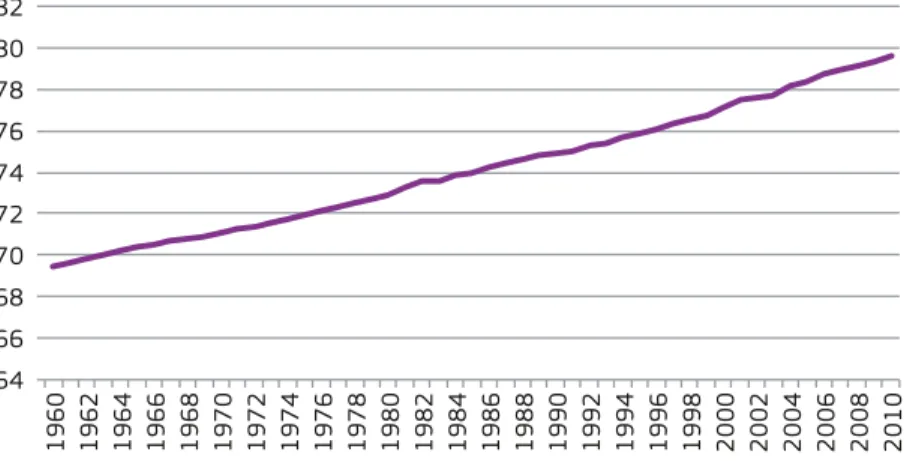
First, Europeans are living longer and health-ier lives. Life expectancy has been rising sig-nificantly for five decades. It rose by 8 years between 1960 and 2006. It is expected to increase by another 5 years by the middle of the present century. As of 2009, a newborn girl in Europe could be expected to live on average 82.6 years, and a boy 76.7 years.
Figure 1.1: Life expectancy at birth in the EU-27
64 66 68 70 72 74 76 78 80 82 19 60 19 62 19 64 19 66 19 68 19 70 19 72 19 74 19 76 19 78 19 80 19 82 19 84 19 86 19 88 19 90 19 92 19 94 19 96 19 98 20 00 20 02 20 04 20 06 20 08 20 10
Source: World Bank, health database (http://data.worldbank.org/topic/health). Secondly, the fertility rate in the countries
which now constitute the EU-27 has been declining since 1965 and was at its low-est at the beginning of the present century. Since then there has been a slight increase but there are indications that the fertility rate has begun to fall again during the current economic recession. Eurostat assume that
over the coming decades the fertility rate in the EU-27 will be no more than 1.6 for each woman in the population and therefore well below the rate of 2.1 necessary to replace each generation. Likewise, the number of live births in the countries of the EU-27 has fallen from over 7.5 million children per year in the early 1960s to around 5.4 million in 2008-10.
Figure 1.2: Declining fertility rate in the EU-27 0 0,5 1 1,5 2 2,5 3 19 60 19 62 19 64 19 66 19 68 19 70 19 72 19 74 19 76 19 78 19 80 19 82 19 84 19 86 19 88 19 90 19 92 19 94 19 96 19 98 20 00 20 02 20 04 20 06 20 08 20 10
Source: World Bank, health database (http://data.worldbank.org/topic/health).
The result of the combination of these people aged 15-64 and 58 million more trends is that by the middle of this century people aged 65 and over in the EU. there are expected to be 48 million fewer
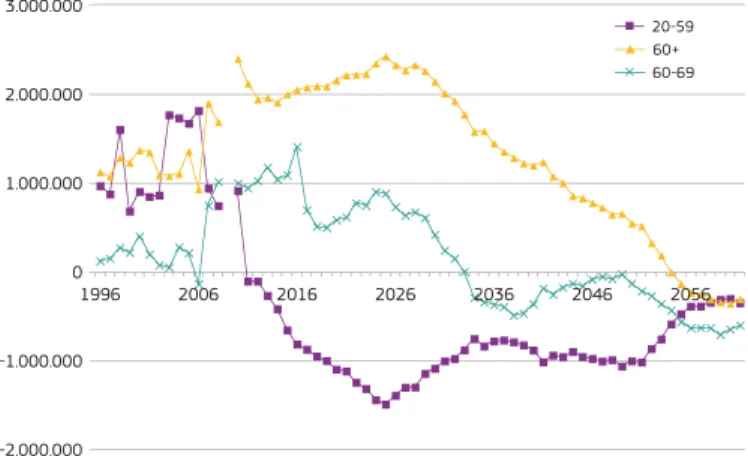
Figure 1.3: Projected year-on-year change in the size of age groups 20-59, 60-69 and 60+ -2.000.000 -1.000.000 0 1.000.000 2.000.000 3.000.000 1996 2006 2016 2026 2036 2046 2056 20-59 60+ 60-69
This not a distant prospect. The most dramatic changes are taking place in the present and next decade as the last cohorts of baby boomers move into and through their sixties, as figure 1.3 illustrates. Over the next 30 years or so the population of working age is expected to shrink at the rate of between 1 and 1.5 million each
year. In parallel, the number of people aged 60 and over is expected to increase at the rate of about 2 million each year. This will transform the balance of the population between older and younger people to an extent that is without precedent. There are no historical examples of age distributions where the oldest age groups are bigger than youngest.
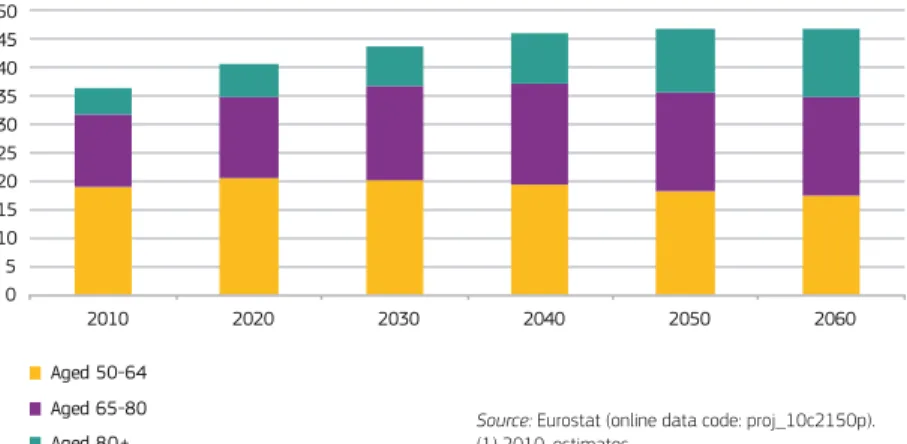
Figure 1.4: EU-27 Population by age group, 2010-2060 (%)(1)
0 5 10 15 20 25 30 35 40 45 50 2010 2020 2030 2040 2050 2060 Aged 80+ Aged 65-80 Aged 50-64
Source: Eurostat (online data code: proj_10c2150p). (1) 2010, estimates.
All Member States have ageing popula-tions but the rate of ageing varies widely not only between different Member States but also regionally within Member States. The regions with the highest proportion of people aged 65 and over tend to be either the metropolitan regions in Germany (usually cities in the north east which were formerly the home of traditional, heavy industries) or rural regions predominantly
in southern Europe (for example, parts of Italy, Greece, Portugal and Spain) from which large numbers of young people have migrated in search of work.
The regions with the lowest proportion of people aged 65 and over tend to be urban areas: for example, Île de France (France), Flevoland and Utrecht (the Netherlands), Inner and Outer London and West Yorkshire and Greater Manchester (UK).
Map 1.1: Relative importance of persons aged 65-79 in the total population, 1 January 2009(1) (% share of total population)
0 600 km
Cartography: Eurostat — GISCO, 10/2011 © EuroGeographics Association, for the administrative boundaries
Guadeloupe (FR) 0 25 Martinique (FR) 0 20 Guyane (FR) 0 100 Réunion (FR) 0 20 Açores (PT) 0 50 Madeira (PT) 0 20 Canarias (ES) 0 100 Malta 0 10 0 100 Ísland Liechtenstein 0 5 <= 9 9 – 12.5 12.5 – 17 > 17 Data not available
Source: Eurostat (online data code: demo_r_d2jan).
(1) 2008 instead of 2009 for regions in Belgium, the United Kingdom and Turkey.
The 2004 and 2007 enlargements have also altered the demographic structure of the EU, e.g. as regards fertility rates, which have been throughout the 1990s and 2000s much lower in the countries of the EU-12 than in the EU-15. This means that from approximately 2020 onwards,
the countries of the EU-12 face a pros-pect of particularly pronounced ageing and shrinkage of the working-age population. Map 1.2 below shows how dramatically the share of older workers in the total work-force will change between 2000 and 2030 but still with significant regional variations.
Map 1.2: Share of older workers (aged 55-64) in total workforce (age group 20-64) 2000 Ratio per 1000 6a Higher than 226.3 5a 226.3 to 209.3 4a 209.3 to 197.4 3a 197.4 to 191.7 2a 191.7 to 184.2 a 184.2 to 177.8 ab 177.8 to 173.3 b 173.3 to 169.2 2b 169.2 to 165.2 3b 165.2 to 157.9 4b 157.9 to 144.1 5b 144.1 to 130.8 6b Less than 130.8
Re-define class borders
2030 Ratio per 1000 6a Higher than 226.3 5a 226.3 to 209.3 4a 209.3 to 197.4 3a 197.4 to 191.7 2a 191.7 to 184.2 a 184.2 to 177.8 ab 177.8 to 173.3 b 173.3 to 169.2 2b 169.2 to 165.2 3b 165.2 to 157.9 4b 157.9 to 144.1 5b 144.1 to 130.8 6b Less than 130.8
Re-define class borders Distribution of regions 39 Distribution of regions 45 79 90 119 135 159 181
Source: Labour Force Survey data, own calculations based on DG EMPL‘s regional projection.
Overall, the EU’s demographic structure has become more diverse through suc-cessive enlargements, with more minorities and various types of migration patterns (e.g. north-south, east-west, rural-urban or core-periphery). There are also greater dif-ferences in levels and patterns of poverty: in most countries children are at greatest risk (e.g. Italy, Romania, Spain or the UK), while in others it is elderly people or people in working age (e.g. Denmark or Slovenia). That said, the main trends of ageing and
shrinking working age population are com-mon to all Member States.
Europe is not alone in having an ageing population: all countries, including many in the developing world as it gets more prosperous, are expected to have ageing populations in the first half of the 21st cen-tury. But Europe will be the only continent with a negative population growth rate
over the next 50 years and as a result will have the highest median age.
Figure 1.5: Projected median age of the population and population trends across the world (years)
0 10 20 30 40 50
World Europe Latin America and the Caribbean
Asia North America Oceania Africa 2010 2060
Source: United Nations, Department of Economic and Social Affairs, World population prospects: the 2010 revision.
This could have important implications for the level of migration to Europe from other parts of the world.
The scale of net migration (the difference between immigration and emigration) is subject to greater short term fluctua-tions than natural changes in the birth rate and life expectancy. Net migration
had a limited effect on total population between 1960 and the mid 1980s but it increased significantly thereafter. In 2003-07 net migration added on aver-age almost 2 million people a year to the EU-27’s total population. Since then there has been a fall. Migration added 875 000 people to the EU-27 popula-tion in 2009.
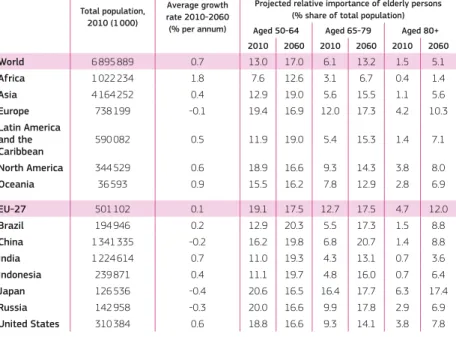
Table 1.1: Projected population trends and relative importance of older persons Total population, 2010 (1 000) Average growth rate 2010-2060 (% per annum)
Projected relative importance of elderly persons (% share of total population)
Aged 50-64 Aged 65-79 Aged 80+
2010 2060 2010 2060 2010 2060 World 6 895 889 0.7 13.0 17.0 6.1 13.2 1.5 5.1 Africa 1 022 234 1.8 7.6 12.6 3.1 6.7 0.4 1.4 Asia 4 164 252 0.4 12.9 19.0 5.6 15.5 1.1 5.6 Europe 738 199 -0.1 19.4 16.9 12.0 17.3 4.2 10.3 Latin America and the Caribbean 590 082 0.5 11.9 19.0 5.4 15.3 1.4 7.1 North America 344 529 0.6 18.9 16.6 9.3 14.3 3.8 8.0 Oceania 36 593 0.9 15.5 16.2 7.8 12.9 2.8 6.9 EU-27 501 102 0.1 19.1 17.5 12.7 17.5 4.7 12.0 Brazil 194 946 0.2 12.9 20.3 5.5 17.3 1.5 8.8 China 1 341 335 -0.2 16.2 19.8 6.8 20.7 1.4 8.8 India 1 224 614 0.7 11.0 19.3 4.3 13.1 0.7 3.6 Indonesia 239 871 0.4 11.1 19.7 4.8 16.0 0.7 6.4 Japan 126 536 -0.4 20.6 16.5 16.4 17.7 6.3 17.4 Russia 142 958 -0.3 20.0 16.6 9.9 17.8 2.9 6.9 United States 310 384 0.6 18.8 16.6 9.3 14.1 3.8 7.8
Source: Eurostat (online data code: proj_10c2150p) and United Nations, Department of Economic and Social Affairs, World population prospects: the 2010 revision.
Figure 1.6: Demographic balance, EU-27(1)
Source: Eurostat (online data code: demo_gind). (1) Break in series, 1998. (2) Provisional, 2008 and 2009. -1 0 1 2 3 4 5 1961 1967 1973 1979 1985 1991 1997 2003 2009 Natural change Millions
Net migration including statistical adjustment(2)
Immigration from outside the EU (and greater mobility of labour within the EU) have the potential to mitigate the effects of the shrinking of the working age popu-lation. However, it is generally accepted that immigration alone cannot rectify the expected imbalance between the work-ing age and older populations. Accordwork-ing to Eurostat’s latest population projections (EUROPOP2010), annual net inflows for the EU as a whole are projected to increase from about 1 018 000 people in 2010 (equivalent to 0.20 % of the EU popula-tion) to 1 217 000 by 2020 and thereaf-ter to decline to 878 000 people by 2060 (a slightly smaller part, 0.17 % of the EU population).
Moreover, the present economic crisis has also triggered emigration from the EU else-where, notably from countries dealing with high levels of youth unemployment, such as Portugal, Ireland or Greece. Should this
wave of emigration turn out to be perma-nent, it will also have an influence on the demographic structure of the countries concerned.
Whatever the scale of future net migra-tion, therefore, it is clear that, as a result of the existing trends in life expectancy and the birth rate, Europe is on the brink of a demographic revolution. This will require many adjustments to be made by individual people, by governments and by society as a whole. But, because there is no previous example in history of an age distribution in which the older age groups are larger than the younger ones, there is no previous experience on which to draw. Some consequences are easier to predict than others. The one most often remarked upon is the cost of providing pensions for a much larger population of retired peo-ple and for much longer periods spent in
retirement. This is certainly a major con-sequence but it is far from being the only one or necessarily the most serious. The ageing of European society has major implications for employment, fiscal policy, social policy, health, education and tech-nology as well as for immigration, mobility within the EU, the balance between work and family life and women’s participation in the labour market.
The opportunity for people to live longer and healthier lives is, of course, an enor-mously positive one and to be warmly welcomed. But a shrinking working age population has potentially serious conse-quences for future economic growth and the standard of living and greater longevity has profound implications for the cost of supporting, and caring for, the very elderly. In fact, Europe’s demographic revolution can be seen to pose three distinct but closely related challenges:
y how to deliver future economic growth with a shrinking working age population;
y how to provide adequate pensions, health care and other services for an unprecedented number of older people;
y how to enable older people to remain independent and active citizens. Increased employment opportunities for older people themselves are an impor-tant part of the answer – but not the whole answer – to each of these chal-lenges. Higher employment rate and greater productivity are needed across the population.
Chapter 2 analyses the three abovemen-tioned challenges in detail and explains the importance of employment and social policies in this context. Chapter 3 analyses the issue of active ageing and presents examples of policy actions in this area. Chapter 4 describes how the demographic challenges are reflected in the EU’s policy on pensions, notably in the agenda set out in the 2012 White Paper on adequate, safe and sustainable pensions. Chapter 5 sum-marizes the main points and outlines the way ahead.
Economic, employment
and social implications of
Europe’s demographic trends
Increasing growth
and productivity
As Europe moves to the fifth year of an economic crisis, a return to sustained growth is a major priority. Economic growth is the sum of growth in employment and growth in productivity. A shrinking work-ing age population is therefore a direct and continuing threat to future economic growth, as are the loss of economic out-put and the destruction of people’s skills and productivity that have resulted from the high levels of unemployment seen in the EU since 2008. The decline of the European working age population over several decades to come represents an unprecedented challenge, which can only be met through a major policy effort and investment, already today, in substantially increasing employment and improving productivity.
European growth and prosperity in the post war decades benefitted from the post war increase in the birth rate (the ‘baby boom’). The industrial revolution in nineteenth cen-tury Europe depended on a massive trans-fer of population from rural areas to the cities and from relatively low productivity agriculture to higher productivity manufac-turing. China’s remarkable growth rate over the last thirty years has been achieved in
exactly the same way. The transformation of the economy of the USA at the end of the nineteenth century would not have been possible without mass immigration from Europe. All these major economic developments were achieved thanks to increases in the amount of labour and in its productivity.
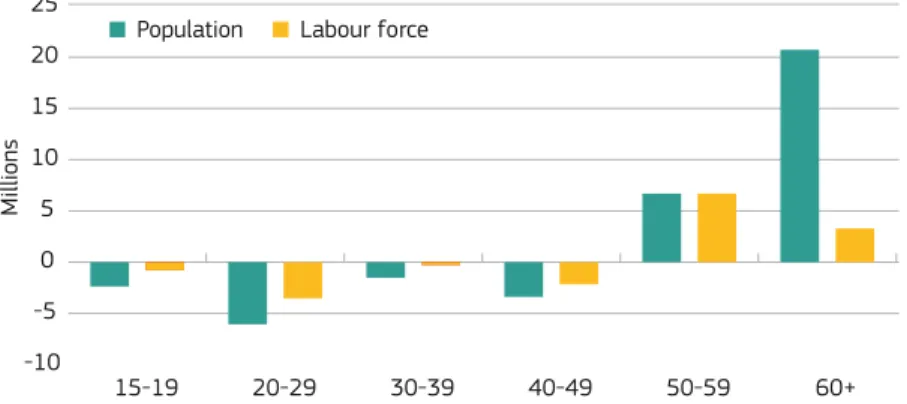
Europe now faces the challenge of grow-ing out of a 4-year long economic slump without any of these advantages but with a population of working age which is expected to decline by between 1 and 1.5 million each year for the next 30 years. Over the course of the current decade the only part of the working age population which will grow is the group of people aged over 50. The challenge is even bigger if we consider that Europe is today significantly under-utilizing its employment poten-tial (the EU-27 unemployment rate has been above 9 % since mid-2009 and has exceeded 10 % in 2012). Youth unemploy-ment is particularly worrying in this context, as the lost opportunity for jobless young people to develop professional skills is likely to translate into lower productivity and lower earnings over a longer period of time. Economic insecurity associated with high unemployment of young people also affects their household formation deci-sions and aggregate demand. Since 2009,
Figure 2.1: Changes in population and workforce 2010-2020 by age group -10 -5 0 5 10 15 20 25 M illions 60+ 50-59 40-49 30-39 20-29 15-19
Population Labour force
Source: CEDEFOP 2010 (http://www.cedefop.europa.eu/en/Files/3052_en.pdf). the EU-27 average unemployment rate
among people aged 15-24 has been in excess of 20 %, and in some countries it has reached over 50 %.
Europe’s demographic revolution there-fore puts a premium on increasing the employment rate and improving pro-ductivity. Both are critically important. If we fail to improve productivity by invest-ing in skills, education, innovation and efficient use of natural resources, then growth will be insufficient to maintain current living standards. If we fail to find ways to raise the employment rate, total economic output and income will likewise be lower. Capital could substitute labour to some extent, though this could also mean greater concentration of income, with negative effects on total demand and even higher dependency of the economi-cally inactive on the active. Moreover, given the shrinking working-age population in the decades ahead, if Europe is to maintain
its current levels of prosperity, productiv-ity would have to grow at a much faster pace than the approximately 1 % per year in 2000-08, unless there is an increase in the employment rate. If we fail in terms of both employment and productivity, Europe faces a future of economic decline and falling living standards.
The Europe 2020 Strategy, which was adopted by EU leaders in June 2010, addresses this challenge directly. Its key objectives are to secure:
y smart growth by improving performance in education, innovation and the use of digital technologies;
y sustainable growth by transforming Europe into a low-carbon economy, by making more efficient use of natural resources and improving the business environment;
y inclusive growth by generating more and better jobs, with greater investment in skills and training.
To achieve these objectives, the Europe 2020 Strategy set a range of key targets, three of which relate to the need to coun-teract the effect of a shrinking working age population:
y an employment target to ensure that 75 % of 20-64 year olds are in employ-ment by 2020;
y an education target to reduce school drop-out rates to below 10 % and ensure that 40 % of 30-34 year olds complete tertiary-level education;
y a poverty and social exclusion target to lift at least 20 million people from life in or the risk of poverty and social exclusion.
The Europe 2020 Strategy highlights the central importance of raising the employ-ment rate. This means drawing on the employment potential of all parts of the population, including older workers. The target of 75 % can be achieved only if
a higher proportion of the population remains in employment until a later age. The link between employment and eco-nomic growth is not always understood. It is sometimes suggested that govern-ments should respond to rising unemploy-ment by taking steps to reduce the size of the working age population, for example, by encouraging earlier retirement. This assumes that labour markets are static and contain a fixed number of jobs. This is a false assumption, also known as the ‘lump of labour fallacy’.
If there were a fixed amount of work, countries with high employment rates for older workers would have high youth unemployment. But in fact, the EU Member States with the highest employment rates for older workers also have the highest employment rates for young people.
Figure 2.2: Youth unemployment and employment of older people: 2011 BE BG CZ DK DE EE IE EL ES FR IT CY LV LT LU HU MT NL AT PL PT RO SI SK FI SE UK 0 10 20 30 40 50 60 70 80 0 10 20 30 40 50 Em pl oy m en t ra te of ol de r pe rs on s (5 5-64 y ea rs )
Unemployment rate of young persons (15-24 years)
Source: Eurostat, (online data code lfsa_ergan and lfsa_urgan).
A job held by one person is not a job denied to someone else. On the contrary, produc-tive employment generates additional income, resulting in new demand for goods and services which translates into additional jobs.
To take a simple example: a successful manufacturing company, whose products address a certain need on the market, will create jobs not just for its own employees but also for those who distribute and sell its products. Those new jobs will, in turn, generate additional income which will increase the demand for other goods and services. Increasing employment is both a condition for, and a beneficial result of, economic growth.
It would be a mistake, therefore, to believe that jobs can be made available for young
people simply by persuading older people to retire prematurely. There is no trade-off between jobs for older people and jobs for young people.
On the contrary, retaining older workers within an otherwise shrinking European labour force is essential for maintaining the capacity of the European economy to grow and hence to create new jobs. Over the next few decades Europe literally can-not afford to lose the employment poten-tial of the only age group which will be growing in size: the over 50s.
Enabling older workers to remain in produc-tive employment is therefore a critically important condition for generating future economic growth and employment oppor-tunities for people of all ages. The potential for raising the employment rate of older
people is clear: in 2010 over one third of men and over half of women in the age group 55 to 64 were not in employment.
A dynamic and inclusive
labour market
Of course, raising the employment rate of older workers is not the only means of counter-acting the fall in the working age population. Unemployment itself consti-tutes a huge waste of human resources. Even before the onset of the economic and financial crisis in 2008 the employment rate for the population aged 15-64 was only 65.9 %. More than 16 million peo-ple were unemployed in the EU and even at the height of the boom Europe had a persistent problem of youth unem-ployment. Today’s unemployment in the unprecedented magnitude of 24.5 million people in the EU-27 is a pressing problem, but much of Europe’s joblessness is not caused just by the protracted economic downturn (‘cyclical’ factors), but also by more structural reasons. To reduce unem-ployment, governments must therefore try to stimulate job creation in the short run, as well as improve the way in which European labour markets function. The lat-ter includes efforts to improve matching between jobseekers and vacancies, com-bating discrimination and social exclusion, ensuring up-to-date skills, and facilitat-ing transitions from education or parental leave to work.
This is a major and wide ranging agenda which is described in the ‘Employment
Policy’ volume of the Social Europe Guide series as well as in the April 2012 Commission communication ‘Towards a job-rich recovery’. It encompasses policies which combine the promotion of flexibility and security in employment (‘flexicurity’); policies to raise the level of skills and qualifications, particularly through lifelong learning; measures to ease labour market transitions; and modernization of social security systems so as to provide adequate income, encourage employment and facili-tate labour market mobility. Focused job creation measures such as reducing taxa-tion of labour or supporting entrepreneur-ship are also vitally important.
Europe cannot afford to lose the employ-ment potential of people who have lost or cannot find jobs. Active labour market poli-cies to maximize the rate of employment have never been more important than they will be over the next few decades when working-age population shrinks.
Nor can Europe manage without draw-ing more effectively on the employment potential of women. The employment rate of women aged 25-49 still falls well short of the rate for men in the same age group. This underlines the importance of organiz-ing work in ways that provide parents with the flexibility they need to bring up their children and with the security they need to develop a sustainable career. As shown in the Commission’s Demography Report for 2010, Member States with most devel-oped measures for gender equality and
reconciliation of work and private life
employment rates, but also the highest birth rates. This shows how modern employment and family policies can play an important role in shaping demographic trends. There is a range of other groups whose employment potential is still untapped. In particular, one in every five young peo-ple cannot find a job. 7.5 million young people between the age of 15 and 24 are not in employment, education or training. The longer they remain in this situation, the harder it becomes for them to gain a foothold in the labour market and start their careers. Youth unemployment is more than a problem for those who are directly affected by it: it risks creating a generation which feels excluded from the mainstream of soci-ety. Economic insecurity within the gen-eration in childbearing age can also have negative consequences on birth rates, discouraging family formation
among many people who would other-wise be keen to have (more) children.
Immigration and mobility
Movements of population have historically had a strong association with economic growth and a rapidly shrinking working-age population seems certain to act as a stimulant to further immigration as labour shortages emerge. To what extent can immigration compensate for the effects of the low birth rates of the past and today on the working age population of tomorrow ? Foreign citizens accounted for 6.5 % of the EU-27 population in 2010. They tend to be significantly younger than the national or native born population. In 2010 the median age for the total EU-27 population was 40.9 %, while the median age of non-EU nationals living in the non-EU was 34.4 %.
Figure 2.3: Population age structure of nationals and non-nationals (EU and other), EU-27, 2010 0 25 50 75 100 3% 2% 1% 0% 1% 2% 3% Nationals Foreigners Men Women 0 25 50 75 100 3% 2% 1% 0% 1% 2% 3% Native-born Foreign -born Men Women
Source: Eurostat (online data codes: migr_pop2ctz and migr_pop4ctb).
Figure 2.4: Age distribution of nationals and non-nationals (EU and other), EU-27, 2010 (%) 0 10 20 30 40 50
Nationals EU foreigners Non-EU foreigners Aged 0-19 Aged 20-39 Aged 40-59 Aged 60+
Source: Eurostat (online data code: migr_pop1ctz).
However, the employment rate of third country nationals is still some 10 % below the overall employment rate. Barriers to their employment, for example in the form of discrimination and a failure to recog-nise their existing qualifications, increase the risk of their being unemployed and of their skills and abilities being wasted in low skilled jobs. It can also drive them towards undeclared work.
The full potential contribution to economic growth of the third country nationals who
are already resident in the EU has there-fore still to be realised. Their effective eco-nomic integration will reduce the risk of illegal immigrants’ filling the employment gaps created by the shrinking working age population.
In 2011 the Commission proposed a ‘New Agenda for Integration of Third Country Nationals’ as a framework for the integra-tion policies of individual Member States. This includes measures, such as lan-guage training, introductory programmes,
mapping of individual migrant’s qualifi-cations and training needs, equipping teachers and school leaders with skills for managing diversity etc, to improve labour market participation.
Increasing labour mobility within the EU also has the potential to make a greater contribution to economic growth in the face of demographic change as the existence of a genuine EU labour market would make it easier to find suitable candidates to fill available vacancies.
Labour mobility in the EU remains low, however, especially in comparison with the USA, despite the large regional disparities in unemployment across the EU. In the EU, people of working age who changed their region of residence in 2008 amounted to only 1.2 % of total working-age population as against 2.8 % in the US.
There are significant differences between Member States in the pattern of regional movements and there is a clear distinction between the EU-15 and the EU-12 coun-tries. In the EU-15 some 1.4 % of the work-ing age population moved between regions in 2008, nearly four times more than in the EU-12 countries.
Furthermore, on average, more than 85 % of the labour movement in the EU is between regions in the same Member State. Less than one in 7 cases involved crossing a national border. Only 0.15 % of people of working age moved between Member States, less than movements
into the EU from third countries (0.2 % of the working age population). Between 2000 and 2009, the total population of the EU-15 countries grew by 20.5 million (15.6 million through net migration and 4.8 million through excess births over deaths), while in the EU-12 total population declined with 2.2 million (0.9 million net emigration and 1.3 million excess deaths over births). Almost 40 % of the EU’s regions recorded both positive internal mobil-ity and external migration, especially in France, Italy and Spain. In about 30 % of the regions, the total mobility balance was also positive, but with negative internal mobility and positive external migration. Conversely, there are very few regions with positive internal mobility and negative external migration. Regions with both negative internal mobility and external migration (about 10 % of all regions) can be found mainly in Poland, Bulgaria and Romania, but also in the northern part of France.
The free movement of labour is a funda-mental principle of the EU. It is a right of European citizens and European labour markets would operate more effectively if overall mobility was at a higher level. Equally, however, it is important to create favourable conditions for employment growth throughout the EU and, as far as possible, correct existing regional imbal-ances to ensure that economic activity is not concentrated in some regions at the expense of others. Cohesion policy investments, accounting for about 35 %
of the EU budget, play an important role in supporting balanced development of the Union. In the absence of such a devel-opment policy, the overall demographic challenges of a declining working-age population and low fertility would impact certain regions particularly hard, reducing their potential contribution to the growth of the EU as a whole.
In short, the demographic revolution gives importance and urgency to the development of a dynamic and inclusive labour market across Europe. Measures to reverse the employment-destroying effects of the crisis, reforms and invest-ments to tackle structural unemploy-ment and improve productivity: these are all now essential if Europe is to reach its target of a 75 % employment rate by 2020 and be in a position to deal with the challenge of a shrinking working age population in the decades ahead.
Supporting a growing
population of older people
The second challenge is closely related to the first because future economic growth will be critically important for funding the pensions, health care, long term care and the other services on which the rapidly growing older population will depend in their later years.
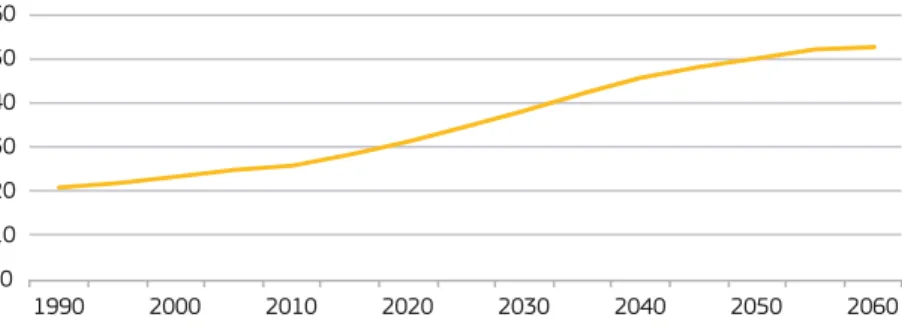
The extent of the challenge is clearly illustrated by Figure 2.5, which shows how the ratio of the population aged 65+ to the population aged 15-64 (the ‘old age dependency ratio’) is expected to change over the next four decades. It shows that the ratio will double by the middle of the century – from 26 % in 2010 to 50 % in 2050. In 2008 there were four people of working age for every person aged 65 and over. By 2050 there will be only two.
Figure 2.5: Old-age dependency ratio, EU 27(1) (%)
0 10 20 30 40 50 60 1990 2000 2010 2020 2030 2040 2050 2060
Source: Eurostat (online data code: demo_pjanind and proj_10c2150p).
The consequence is clear: as the popula- between 2010 and 2030 – an increase tion aged 65 and over grows by about of 57.1 % over the two previous decades. 2 million each year the cost of pensions This will inevitably make much bigger and of the health care and other services demands on health and long term care on which they depend can be expected services.
to rise significantly. Chapter 4 discusses
in more detail the specific challenge of As detailed in the Commission’s 2012 ensuring adequate, safe and sustainable Ageing Report, healthcare and long term pensions. But the provision of health care care expenditure in the EU is projected to and long term care for older people will increase by about 2.6 % of GDP between also put a big strain on public expenditure. today and 2060. Spending on long term The number of people aged over 80 is care is projected to grow faster (rising by expected to increase by 12.6 million 83 %) than spending on healthcare (+15 %).
Figure 2.6: Projections of care expenditure and dependents, EU-27
Healthcare expenditure (% of GDP, le-hand axis) Long-term care expenditure (% of GDP, le-hand axis) Number of dependents (1,000, right-hand axis)
Number of dependents receiving formal care (1,000, right-hand axis) 0 2 4 6 8 10 12 0 10000 20000 30000 40000 50000 60000 2010 2015 2020 2025 2030 2035 2040 2045 2050 2055 2060
It is natural for each generation, as it moves into retirement, to expect to enjoy at least the same level of pensions (in real terms) and the same standard of health care and other services as their parents’ generation and to regard the maintenance – and if possible the improvement – of these standards of provision as a touchstone of social progress. They believe, legitimately, that they have contributed to this through the taxes and social charges they have paid throughout their working lives. In reality, however, the current cost of pen-sions and services for older people is borne by people of working age through the taxes they pay or the consumption they forego when goods and services are consumed by older people. As these costs rise over the coming decades and fall on fewer and fewer people of working age, the scope for
potential resentment between the genera-tions is evident. The risk of such tensions is heightened by fears that future generations will not enjoy the same standard of living as the ‘baby boomers’ did in the prosper-ous post-war decades, although the shifting demographic balance also involves a risk that the ‘baby boomers’, when they retire, may suffer a decline in living standards compared to the previous generations and to their own earlier standards.
A useful measurement in this context is the
‘economic dependency ratio’. This is the ratio between the total non-working popu-lation and those who are in employment. It shows how many non-working people (children, retired people, the unemployed etc), are supported by each person in employment.
Figure 2.7: Economic dependency ratio, 2010-2030 (%)
EU-2 7 BE BG CZ DK DE EE IE EL ES FR IT CY LV LT LU HU MT NL AT PL PT RO SI SK FI SE UK NO 2010 2030 0 20 40 60 80 100 120 140 160 180
If economic growth is weak, the rising costs associated with an ageing society will be harder to meet and difficult choices will need to be made between:
y raising rates of taxation to maintain pension levels and standards of health care and other services;
y switching resources from other areas of public expenditure;
y reducing the level of pensions and standards of service.
There are, therefore, compelling arguments for taking urgent steps to counteract the effects of demographic change in ways that will mitigate these rising costs and allow for an equitable sharing of the bur-den between the generations. In particular, encouraging and enabling older people to remain in productive employment will simultaneously reduce their reliance on pensions while contributing directly to the economic growth which will help to finance those pensions. This sharing of the costs of an ageing society is an essential basis for securing solidarity between the generations. Raising the employment rate of older people is part of a much wider agenda to enable older people to remain active citizens, to live independent and healthy lives and to continue to contribute posi-tively to the societies in which they live. This is the agenda of ‘Active Ageing’ which is described in Chapter 3. It is linked directly with the third main challenge posed by the demographic revolution.
Maximizing the benefits of
living longer
The rapid growth in the population aged 65+ projected over the next four dec-ades is the result of people living much longer. This is, of course, a hugely posi-tive achievement. It is the direct result of the enormous social and medical progress over the last six decades and of the much higher standards of living enjoyed by the post war generations. It is a reflection both of the achievements of the modern wel-fare state and of a long period of peace and rising prosperity which is unique in European history.
Greater longevity is therefore a matter for rejoicing and congratulation. For the first time people of 60 are able to look forward to 2 or 3 further decades of life. The past is not necessarily a guide to what future generations of older people will be able to do or will want to do. People who are now facing a longer and healthier old age than any previous generation will have new ambitions and greater expectations than their parents and grandparents. Society will need to respond by broaden-ing the opportunities available to them. Enabling them to live independently for as long as possible, to remain active citi-zens and to contribute to development of the communities in which they live will be important for them – but it will be equally important for the rest of society.
The concept of Active Ageing represents a policy agenda aiming, at the same time, to enable older people to lead fuller and healthy lives, to remain independent and self-supporting and to contribute to society and to economic growth. Providing oppor-tunities to work longer than the current age of retirement is one of the most important aspects of the active ageing agenda. A recent Eurobarometer survey indicated that, while continuing to oppose the idea of being forced to work longer, a majority of people now reject the idea of mandatory retirement at a given age. One in three people would like to have the opportunity to work beyond the age at which they become entitled to a pension.
But there is more to the active ageing agenda than extending working life. There are many other ways in which older peo-ple can continue to contribute to society in their retirement – by volunteering to help to deliver social and community services, by making their experience and expertise
available to younger people or simply by leading a full and active life which gener-ates productive work for others. A rapidly growing and active population of older people will create new and expanding markets for products and services. In short, an ageing population does not have to be a burden on society. On the con-trary, it can be a stimulus to new forms of work, new and wider notions of citizenship and the development of new products and services. Enabling older people to realize their full potential both within employment and after their retirement will mean that they can lead more interesting and fulfill-ing lives and remain active, healthy and independent for longer. At the same time it will help Europe to come through the demographic revolution of the next few decades with a growing economy, with sustainable and secure pensions, and expanded health and long term care serv-ices. How the Active Ageing agenda can help to achieve these goals is the subject of the next chapter.
Active ageing
Active ageing has been defined by the World Health Organization as ‘the proc-ess of optimizing opportunities for health, participation and security in order to enhance quality of life as people age.’ The Commissioner for Employment, Social Affairs and Inclusion, László Andor, has said that, in the context of Europe’s ageing population, this means ‘encouraging older people to remain active by working longer and retiring later, by engaging in volun-teer work after retirement and by leading healthy and autonomous lives.’
The basic purpose of active ageing is to widen and enrich the range of opportunities available to older people so that they can realize the full potential of their abilities and pass on their accumulated knowledge and experience to later generations. Enabling older people to lead fuller, more active and healthier lives will allow them to contribute directly to the growth of the economy and to the development of society as a whole. The European Commission has desig-nated 2012 as the European Year for Active Ageing and Solidarity between Generations with the aim of raising aware-ness of the contribution that older people can make to society and of the importance of enabling them to do this in a context of rapid demographic change.
It seeks to encourage action at all levels and the setting of ambitious goals for active ageing, focusing on three main areas:
y creating better job opportunities and working conditions for older people;
y helping older people to play an active role in society;
y encouraging healthy ageing and inde-pendent living.
What is the scope for widening the oppor-tunities for older people in each of these areas ? What changes in attitude and prac-tice are needed to make these opportuni-ties a reality and enable older people to take full advantage of them ? What action is needed to support active ageing and healthy and independent living ?
Creating better jobs
and working conditions
for older people
Chapter 2 explained the vital importance of raising the employment rate for older workers in order to sustain Europe’s eco-nomic growth and its overall standard of living over the coming decades. Without the full and active contribution of older workers both economic growth and living standards will be lower. The EU’s commit-ment to achieve an employcommit-ment rate of 75 % among 20-64 year olds by 2020 can be achieved only if the employment rate for older people rises significantly. There is a significant difference between the employment rates for women and men, particularly in the 50-64 age group.
Figure 3.1: Employment rates by gender and age group, EU-27 (%) 0 10 20 30 40 50 60 70 80
Male Female Male Female Male Female Aged 15-64 Aged 50-64 Aged 65+
2000 2010
Source: Eurostat (online data code: lfsa_ergan).
Furthermore, the employment rate for older workers varies widely between different
Member States, and the magnitude of the task of raising it varies accordingly.
Figure 3.2: Employment rates of older workers (55-64) in EU Member States (%)
EU (27 countries)
Belgium Bulgaria
Czech Republic
Denmark Germany Estonia Ireland Greece Spain France
Italy Cyprus Latvia Lithuania Hungary Luxembourg Malta Netherlands
Austria Poland Portugal Romania Slovenia Slovakia Finland Sweden
United Kingdom Iceland Norway Switzerland Turkey FYROM Croatia 0 10 20 30 40 50 60 70 80 2011
In 2009 the average age of retirement from employment in the European Union was 61 years and five months. Six Member States reported an average exit age below 60 and, again, there was considerable
variation between Member States. The average age of retirement is likely to rise over the next few years as a number of Member States raise the age of pension entitlement.
Figure 3.3: Average exit age from the labour force in EU Member States, 2009(1) (years) 55 57 59 61 63 65 EU-27 RO SE BG IE NL UK CY LV EE PT DK ES DE FI BE EL AT CZ MT IT FR LT SI LU HU PL SK IS CH NO HR
Source: Eurostat (online data code: lfsi_exi_a).
It is an encouraging sign that the employ-ment rate for the 55-64 age group has been rising continuously – and rising faster
than the rate for younger age groups – since the beginning of the twenty first century.
Figure 3.4: People in employment by age group, EU-27 (2000=100)
80 100 120 140 160 2000 2001 2002 2003 2004 2005 2006 2007 2008 2009 2010 Total population(1) Aged 15-64 Aged 50-54 Aged 55-59 Aged 60-64 Aged 65+
Source: Eurostat (online data codes: lfsa_pganws and demo_pjan). (1) Based on information for 1 January of each year.
The largest number of people aged 50 to 64 work in manufacturing, construction, dis-tributive trades, public administration, educa-tion, health and social work. This is in line with
the pattern of employment for the 15-64 age group as a whole. There are higher than aver-age proportions of people aver-aged 50 or over in agriculture, education, health and social work.
Table 3.1: Shares of employment by gender, age group and economic activity, EU-27, 2010(1) (%)
Aged 15-64 Aged 50-64 Aged 65+
Male Female Male Female Male Female
Agriculture, forestry & fishing 5.4 3.9 7.2 5.7 25.5 29.7
Mining & quarrying 0.6 0.1 0.6 0.1 : :
Manufacturing 20.5 10.3 19.9 9.3 9.2 4.4
Electricity, gas, steam & air conditioning supply 1.1 0.4 1.4 0.3 : :
Water supply; sewerage, waste management &
remediation activities 1.1 0.3 1.3 0.3 : :
Construction 12.9 1.5 11.4 1.5 6.5 1.6
Wholesale & retail trade; repair of motor
vehi-cles & motorcyvehi-cles 13.1 15.3 10.7 12.0 11.9 13.0
Transportation & storage 7.3 2.5 8.2 2.5 4.8 1.3
Accommodation & food service activities 3.7 5.3 2.4 3.9 2.8 4.6
Information & communication 3.6 2.0 2.4 1.3 1.7 :
Financial & insurance activities 2.7 3.4 2.7 2.8 1.3 :
Real estate activities 0.7 0.9 0.9 1.1 1.9 1.7
Professional, scientific & technical activities 4.7 5.1 4.8 3.8 9.5 5.0
Administrative & support service activities 3.6 4.1 3.5 3.9 3.7 3.3
Public administration & defence; compulsory
social security 7.2 7.4 8.1 9.1 2.7 2.7
Education 3.8 11.7 5.3 14.1 4.8 7.0
Human health & social work activities 4.1 17.7 5.1 20.2 5.1 12.3
Arts, entertainment & recreation 1.5 1.7 1.4 1.6 2.7 2.9
Other service activities 1.5 3.5 1.7 3.1 3.8 4.3
Activities of households as employers 0.2 2.4 0.3 2.9 : 2.9
Activities of extraterritorial organisations &
bodies 0.1 0.1 0.1 0.1 : :
No response 0.6 0.5 0.5 0.5 : :
Source: Eurostat (online data code: lfsa_egan2).
The potential for building on the progress of the last decade and raising the employ-ment rate for older people is therefore clear, although the scale of the task varies widely between Member States.
Helping older people to lead
active lives
People in their 50s and above tend to be more engaged with the communities and societies in which they live. They are, for example, more likely to vote in elections at all levels (50 % of people aged 55 or more vote in elections to the EU Parliament,
compared with 29 % of those aged 18 to 24). A survey in May 2011 showed that local, national and European political mat-ters are frequently discussed by a higher proportion of people aged 55 and over than by any younger age group.
After they have retired from employment, older people have the time and energy to turn this sense of engagement into positive activity. They can continue to make an impor-tant contribution to society, for example:
y as responsible and active citizens under-taking voluntary work in their local com-munities and more widely;
y as carers for both the younger and the older generations within their own families;
y as consumers whose personal activi-ties and interests create a significant economic demand for new products and services.
These are not, of course, exclusive catego-ries: many retired people will be active in all three roles.
Traditions of volunteering for social serv-ice are more strongly established in some Member States than in others but the demand and the scope for volunteering is certain to increase across the whole of the European Union as the cost of public services rises – not least as a consequence of the ageing population – and the pres-sure on public expenditure increases. At the same time, volunteering cannot and should not be relied upon as a substitute for the provision of social services: innovative and cost-effective ways need to be found to ensure adequate provision of care, social inclusion, human capital formation and other services. New forms of employment for older people in the area of social serv-ices could be developed.
The same distinctive qualities that older people can bring to employment in gen-eral – maturity of judgement, experience and accumulated knowledge and exper-tise – are equally valuable for delivering social services. At the same time, employ-ment or volunteering in these areas is attractive to older people because it gives them the opportunity both to work flex-ibly in terms of their commitment of time and to use their experience and abilities in ways that ‘make a difference’ to the com-munities where they live.
The role of older people as carers is also likely to increase. In particular, by 2060 there may be more than two elderly people for each child: in other words, there will be more grandparents for fewer grandchildren than ever before. In fact, the oldest family members may outnumber children under five by the beginning of the next decade. This ‘grandparent boom’ may increase the amount of informal childcare within the fam-ily. And many people will approach retire-ment while their own parents are still alive. This can make it easier for them to care for their parents themselves, although in some cases it can also mean difficulties in combin-ing work and carcombin-ing responsibilities in pre-retirement years. This could be a significant development as the number of people over 80 rises to unprecedented levels.
The role of older people as consumers
will also become much more important. As the largest section of the population by the middle of the century, older people will be a major market for new products and services which can be delivered in
new ways. In particular, the scope of the internet to meet the needs of older peo-ple has only just begun to be tapped. The ‘baby boomers’, who are now in their early 60s, have pioneered the use of computers and many of them have used them for many years in their careers. Even those who do not have the same affinity with information technology as young people who have been educated in the digital age, will expect to use the full resources of the internet in retirement.
Encouraging healthy ageing
and independent living
Given the traditional association of old age with declining health, it is important to emphasise that the European popula-tion is not only living longer but is fitter and healthier for longer than was the case with previous generations. In 2008 women in the EU aged 65 could on average expect to live a further 8.4 years free from any disabling health problem – a period of time equal to 40.5 % of their remaining lifespan. The comparable figure for men was 8.2 years – a period equal to nearly half (47.8 %) of their remaining lifespan. There is plenty of evidence that an active life style promotes good health, so active ageing in all its forms can both contribute to, and benefit from, healthy ageing. The two agendas are entirely congruent. It is noticeable that the Member States with the highest proportion of older people who are free of any disability are those with the most active elderly populations.
Table 3.2: Life expectancy and healthy life years of elderly people in EU Member States
Life expectancy at age 65 (years)
Healthy life years at age 65 (years)
Healthy life years at age 65 as a proportion of life expectancy
at age 65 (%)
Male Female Male Female Male Female
EU-27(1) 17.2 20.7 8.2 8.4 47.8 40.5 BE 17.5 21.1 10.5 10.1 60.2 48.0 BG 13.8 17.0 8.4 9.1 61.1 53.8 CZ 15.2 18.8 8.0 8.4 52.9 44.5 DK 16.8 19.5 11.2 12.0 66.9 61.5 DE 17.6 20.8 6.4 6.5 36.4 31.0 EE 14.0 19.2 5.5 5.3 39.0 27.7 IE 17.2 20.6 10.2 10.5 59.1 50.8 EL 18.1 20.2 7.2 6.6 40.0 32.6 ES 18.3 22.5 9.2 8.4 50.1 37.1 FR 18.7 23.2 8.8 9.2 47.0 39.6 IT(1) 18.2 22.0 7.3 6.8 40.4 30.9 CY 18.1 20.9 9.9 8.5 54.9 40.6 LV 13.4 18.2 4.7 5.7 35.2 31.2 LT 13.4 18.4 5.9 6.7 44.0 36.4 LU 17.6 21.4 10.8 11.4 61.5 53.2 HU 14.0 18.2 5.7 5.6 40.7 30.6 MT 16.8 20.6 11.0 11.2 65.7 54.4 NL 17.6 21.0 9.4 10.3 53.3 49.2 AT 17.7 21.2 8.1 8.0 46.0 37.9 PL 14.8 19.2 6.8 7.4 46.1 38.8 PT 17.1 20.5 6.6 5.4 38.4 26.6 RO 14.0 17.2 7.2 7.0 51.4 40.6 SI 16.4 20.5 9.3 9.9 56.6 48.3 SK 14.1 18.0 3.4 2.8 24.3 15.7 FI 17.3 21.5 8.1 8.9 46.9 41.4 SE 18.2 21.2 13.6 14.6 74.8 69.1 UK(1) 17.7 20.3 10.7 11.8 60.5 57.9 IS 18.6 21.0 12.7 13.6 68.3 64.6 NO 18.0 21.1 13.5 14.0 75.2 66.3
Source: Eurostat (online data code: hlth_hlye). (1) 2008 instead of 2009.
Box 3.1: The EU and healthy ageing The EU supports healthy ageing as part of its health strategy: ‘Together for health: a strategic approach for the EU 2008-13’ and through the open method of coordination on social protection and social inclusion. Healthy ageing is based on a twofold approach:
y the promotion of health over the whole of a person’s life with the aim of preventing health problems and disabilities from an early age by adopting a healthy lifestyle and diet;
y a commitment to tackle health inequalities that are linked to social, economic and environmental factors.
Of course, independent living depends on more than good health. The environment in which they live – housing, transport, access to public services – has a major impact on the ability of older people to look after themselves and lead autonomous lives. While a recent survey indicated that most older people believe they live in an age-friendly environment, it is clear that more needs to be done, particularly in respect of transport.
Changes in attitudes
to retirement
It is clear from recent surveys that attitudes to retirement are shifting in significant
ways. A Eurobarometer Survey conducted in September and October 2011 found that 33 % of the population aged 15 and above would like to carry on working after they reach the age when they become entitled to a pension. This figure rose to 41 % among those aged 55 and over. Furthermore, according to the same sur-vey, 61 % of the population aged 15 and over believe that people should be able to continue to work beyond any statutory retirement age: in other words, they reject the idea of a mandatory retirement age. This is an important and welcome develop-ment. Mandatory retirement ages which prevent people from continuing to work when they want to do so and are able to do so make no sense at a time when the working age population is shrinking. One of the purposes of active ageing is to create the conditions in which the effective age of retirement can rise in line with increasing longevity. Mandatory retirement ages run directly contrary this aim by frustrating the growth of opportunities for older people to remain in employment.
Perceptions of older workers
Perceptions are very important. In some respects perceptions of older workers are changing in line with the changing atti-tudes to retirement. In other respects per-ceptions of what older people can do seem still to lag behind the realities of greater and healthier longevity.
A survey carried out in 2006 found that 43 % of the population aged 15 and over believed that many of their fellow citi-zens retired too early. In a survey in 2009 46.6 % of people aged 15 to 24 said they did not think that if older people worked
longer there would be fewer jobs for young people – evidence, perhaps, of some solidarity between the generations. And there is an increasing recognition that older people bring distinctive qualities to the world of work.
Figure 3.5: Perceptions of older workers in the EU-27
0 25 50 75 100 Up to date with technology
Open to new ideas Flexible Productive Able to work well with other people Able to find solutions to problems Find it easy to make decisions on their own Reliable Experienced
Aged 15+ Aged 55+
Source: European Commission, Special Eurobarometer No. 378 – Active ageing.
However, a special Eurobarometer survey on discrimination in the EU in 2009 found that age was perceived to be the most common form of disadvantage in seeking work. This was confirmed by the Eurobarometer sur-vey carried out in September and October 2011, which found that ‘not being valued by employers’ was one of the strongest reasons for people over 55 stopping work. Traditionally, older people have had to contend with the reluctance of many employers to hire older workers or to invest in re-training those they employ. They have also been vulnerable to having their careers terminated prematurely when employers resort to early retirement to restructure or reduce the size of the work
force in times of recession. Against this background, it is not surprising therefore if older workers have often felt undervalued. The EU has enacted specific legislation requiring Member States to prohibit age discrimination in employment. A directive to outlaw discrimination in access to goods and services is currently being considered by the Council.
All member countries have now legislated to give effect to the EU directive 2000/78/ EC, which makes it unlawful to discriminate in the labour market on grounds of age, as well as on grounds of religion or belief, disability or sexual orientation. The directive covers recruitment, promotion, training and
working conditions and it prohibits both direct and indirect discrimination as well as harass-ment and victimization on grounds of age. The demographic revolution is a golden opportunity to eliminate discrimination on grounds of age for good. What was once mainly damaging for older people them-selves can now be seen to be damaging for society as a whole – not only a matter of injustice to the individual but a dangerous waste of valuable human resources. Now is the time to put the positive argument for the contribution older people can make – and must now be allowed to make – to the economy and to society.
Box 3.2: EU action against age discrimination The European Commission has taken a range of action to combat discrimination against older workers. It funds an EU level Exchange platform on National Diversity Charters which encourages businesses voluntarily to meet diversity commitments in their employment practices. Since 2003 the Commission has funded a ‘For Diversity, Against Discrimination’ campaign which uses films, pictures and published material to combat stereotypes and raise awareness of the negative effects of discrimination. And it supports groups of Non-Discrimination Experts who provide analysis and the exchange of information between Member States, validate good practice and produce publications (including two publications on age discrimination in employment).
What action is needed to
support active ageing ?
Against this background of changing reali-ties and changing attitudes, what needs to be done to support active ageing ? It must be emphasised at the outset that many older people do not need special arrangements or treatment in order to remain in employment. In many cases their needs and their capabilities are no different from those of younger people. The post war ‘baby boom’ generations are fitter, healthier and better educated than any previous generation. There is some evidence, for example, that, on average, work-related health problems do not nec-essarily increase with age. In 2007 15.9 % of people at work or having previously worked aged 45 to 54 reported at least one work-related health problem. Among those aged 55 to 64 the proportion fell to 15.0 %.
Again, it seems that attitudes to some aspects of work change very little with age. For example, according to the 2011 Eurobarometer survey, the proportion of older workers (84.3 %) who say that they are ‘satisfied’ or ‘very satisfied’ with their working conditions differs remarkably little from the proportion of all workers (84.4 %) who say the same.
Furthermore, many of the steps employers need to take in order to attract and retain older workers are, in fact, the same steps which are necessary for raising employ-ment rates generally.
To take a few examples:
y making a reality of life-long learning
is important for people of every age because the need to refresh skills and acquire new ones in order to keep up with technological change is critical at every stage of working life: in the dig-ital age life-long learning is a continu-ous need throughout everyone’s career, not something which is relevant only to people in their 50s and 60s: learning new skills may be just as important for people in their 30s and 40s who can no longer depend simply on what they learnt before they entered the labour market;
y healthy living is important at every age – not just for older people – and the foundations for a healthy old age are laid – or not laid – much earlier in life;
y improved mobility, in the form of easier and cheaper travel from home to work, is critically important for everyone in or seeking employment – for women returning to work after child birth, for people with disabilities, for the long term unemployed, for integrating immigrants and others into the labour market;
y the need for working arrangements which allow employees to combine work with family caring responsibili-ties is increasingly important through-out working life, whether it is caring for children, for sick family members or for elderly relatives: it is inherent in the now nearly universal model of both family partners working: the need for flexible working hours and ways of reconciling employment and family responsibilities is apparent throughout working life.
In other words, much of what needs to be done to boost the employment of older workers is not specific to the needs of older people. It involves the sort of changes which are necessary in order to draw peo-ple into employment from all sectors of the population – women as well as men, young people at the outset of their careers as well as older people, those who have recently lost their jobs as well as the long term unemployed and others at risk of social exclusion. In the context of a rapidly shrinking working age population, these are increasingly mainstream changes which are necessary to boost mainstream employment.
Nonetheless, it is clear from the results of the special Eurobarometer survey carried out in September and October 2011 that some changes of attitude and practice are needed if the full employment potential of older workers is to be realised.
The survey asked why people over 55 stop working. The most commonly cited fac-tors were:
y the lack of opportunities to retire gradually;
y exclusion from training;
y not being viewed positively by employers
y lack of skills. These were followed by:
y disincentives in the pension and tax systems;
y workplaces not adapted to their needs
y care obligations;
y wanting to retire at the same time as their partner.