Australian
Black Coal
Industry
Inquiry Report
Volume 1: Report Report No. 1ISBN 0 646 33559 6
This work is subject to copyright. Apart from any use as permitted under the
Copyright Act 1968, the work may be reproduced in whole or in part for study or
training purposes, subject to the inclusion of an acknowledgement of the source. Reproduction for commercial use or sale requires prior written permission from AusInfo. Requests and inquiries concerning reproduction and rights should be addressed to the Manager, Legislative Services, AusInfo, GPO Box 84, Canberra, ACT, 2601.
Enquiries:
Media and Publications Officer Productivity Commission Locked Bag 2
Collins Street East Post Office Melbourne VIC 8003
Tel: (03) 9653 2244 Fax: (03) 9653 2303
An appropriate citation for this paper is:
Productivity Commission, 1998, The Australian Black Coal Industry, Inquiry Report, AusInfo, Canberra.
Information about the Productivity Commission and its current work program can be found on the World Wide Web at http://www.pc.gov.au
LB2 Collins Street East Melbourne VIC 8003 Telephone 03 9653 2100 Facsimile 03 9653 2199 Canberra Office Telephone 02 6240 3200 3 July 1998
The Honourable Peter Costello MP Treasurer
Parliament House
CANBERRA ACT 2600
Dear Treasurer
In accordance with Section 11 of the Productivity Commission Act 1998, I have pleasure in submitting to you the report on the Australian Black Coal Industry.
Yours sincerely
John Cosgrove
This report comprises two volumes. Volume 1 contains the Overview and the body of the report. Volume 2 comprises supporting appendices.
Page
Abbreviations XIII
Terms of Reference XVIII
OVERVIEW
XXI
1
INTRODUCTION
1
1.1 The Australian black coal industry 1
1.2 Contemporary issues in the black coal industry 5 1.3 The inquiry’s terms of reference and the Commission’s
approach 7
1.4 Conduct of the inquiry 8
2
THE CHANGING MARKET FOR BLACK
COAL
11
2.1 Introduction 12
2.2 Supply and demand outlook for the black coal industry 13 2.3 Factors increasing competition in the black coal market 16 2.4 The dynamic nature of the international black coal market 27 2.5 Price discrimination and collective price negotiation 31 2.6 Barriers to international trade in coal 35
3
INDUSTRY PERFORMANCE
37
3.1 Introduction 37
3.2 Industry-wide performance 38
3.3 Productivity of Australian coal mines 44
3.4 The Commission’s benchmarking study 53
4
WORK ARRANGEMENTS: THE CONTEXT
63
4.1 Introduction 63
4.2 Labour market features 64
4.4 Development of work arrangements in black coal mining 79
5
WORK ARRANGEMENTS IN AUSTRALIAN
BLACK COAL MINES
87
5.1 Introduction 87
5.2 Size and composition of the workforce 89
5.3 Hours of work and roster arrangements 105
5.4 Remuneration and on-costs 114
5.5 Functions, tasks and skills 122
5.6 General procedures 133
5.7 Conclusion 138
6
WORK ARRANGEMENTS: ENABLING
CHANGE
141
6.1 Introduction 141
6.2 Managers and workplace change 144
6.3 Unions and workplace change 155
6.4 Employees and workplace change 163
6.5 Adjusting to change 167
7
COAL RAIL TRANSPORT
175
7.1 Introduction 175
7.2 Efficiency and prices of coal rail freight services 177
7.3 Structure of rail authorities 186
7.4 Removing implicit royalties and monopoly rent 192 7.5 Introducing competition into rail freight 196
7.6 Price setting for rail access 205
8
THE COAL WATERFRONT
217
8.1 Introduction 217
8.2 Australian coal ports 218
8.3 Coal waterfront cost comparisons 222
8.4 Pricing issues 228
8.5 Other issues 235
9.1 Introduction 244 9.2 The Australian black coal industry’s safety record 244 9.3 The regulation of safety in the coal industry 248 9.4 How coal mining OHS legislation compares with other
OHS legislation 250
9.5 Problems with the current approach 255
9.6 Alternative regulatory approaches 260
9.7 The Joint Coal Board 272
9.8 Local governments 276
10
ROYALTY ARRANGEMENTS
279
10.1 Current royalty arrangements in NSW and Queensland 279 10.2 Criteria for assessing royalty systems 282 10.3 Alternative royalty collection methods 283 10.4 Evaluation of alternative royalty systems 284 10.5 Royalties collected through rail freights 290 10.6 Participants’ views on royalty arrangements 292
11
MODELLING THE EFFECTS OF IMPROVED
PERFORMANCE
295
11.1 Introduction 297
11.2 Scenario 1 (the base case): steady productivity growth 298 11.3 Scenario 2: no further productivity growth 301 11.4 Scenario 3: accelerated productivity improvements 304 11.5 Scenario 4: accelerated productivity improvements
leading to lower coal prices 308
11.6 Scenario 5: accelerated productivity improvements in coal coupled with best practice productivity in rail transport
of coal and accelerated removal of excess rail charges 311
11.7 State and Territory results 314
11.8 Summary 314
REFERENCES
LIST OF BOXES — VOLUME 1
2.1 The Taiwan Power Company: an example of the increasing
2.2 Deregulation of the Japanese power industry 21 2.3 The United States: a ‘swing producer’ in international coal trade 28 4.1 Federal industrial relations arrangements: a snapshot 72 4.2 The twenty allowable matters in Federal awards 73 4.3 The ‘no disadvantage’ test in the Federal jurisdiction 75 4.4 Coal Industry Tribunal of Western Australia (CITWA) 76 5.1 Examples of informal restrictions on changes to shift and
roster arrangements in black coal mines 109
6.1 The role of unions in Federal agreement-making 162
6.2 Restructuring at Drayton Coal 174
7.1 Independent Pricing and Regulatory Tribunal (IPART) 199
7.2 Queensland Competition Authority (QCA) 203
8.1 The coal waterfront labour force 226
8.2 Westshore Terminals’ approach to the coal chain 240
8.3 Cumberland mine’s line balance approach 242
9.1 The NSW Coal Mines Regulation Act 1982 249
9.2 Examples of prescriptive requirements in NSW coal mining
legislation: explosives 252
9.3 Examples of prescriptive requirements in Queensland coal
mining legislation: showering facilities 254
9.4 Compliance costs at BHP’s Elouera mine 258
9.5 NSW Review of Mine Safety 265
9.6 Review of the Queensland Coal Mining Act, 1925 268 9.7 Incentives for companies to invest in safety 270 10.1 Phasing in of new royalty arrangements in Queensland 281 10.2 Purchase of private coal titles by the NSW Government 282
10.3 The neutrality of rent-based royalties 285
10.4 The effect of specific and ad valorem royalties on mining output 289
LIST OF TABLES — VOLUME 1
3.1 Profitability measures — NSW Coal and Australian coal and
Australian minerals industries 43
5.1 The impact of the retrenchment list on mine labour productivity
and unit labour costs 95
5.2 Summary of the impact of LOFO on mine labour productivity
metalliferous and US black coal mines 112 5.4 Proportion of individuals with annual income of $52 000 or more,
selected occupations, black coal mining compared with metal ore
mining, Australia 1996 115
5.5 Major labour costs per employee, black coal mining compared
with metalliferous mining, Australia, 1993–94 117 5.6 Comparison of penalty rates in Australian black coal,
metalliferous and US black coal mines 119
5.7 An overview of training in the United States and United Kingdom 132 6.1 Coal mining employment and unemployment rates for selected
labour force regions, NSW and Queensland, November 1997 167 6.2 Employment by occupation, mining and all industries, August 1997 170 6.3 Employment in coal mining regions, 1986 to 1996 172 7.1 Average distance from the mine to the port 181 7.2 Weighted average coal rail charges and average distance
carried, 1996 182
8.1 Australian coal ports and terminals, capacity and throughput, 1997 219
8.2 Coal port pricing categories 224
9.1 Lost time in Queensland coal mines, 1996–97 245 9.2 Comparative safety performance at BHP operations 248 10.1 Black coal royalties in NSW and Queensland, 1996–97 280 11.1 Scenario 1 (base case): economy-wide projections 300
11.2 Economy-wide impact of Scenarios 1 to 5 304
11.3 Output and employment by State and Territory in the base case,
Scenario 2 and Scenario 3 315
LIST OF FIGURES — VOLUME 1
1.1 Black coal production for export and domestic markets and
by mine type 2
1.2 Black coal industry output and employment 3
1.3 Mine to port costs of producing coal, 1996 4
1.4 Real export prices for Australian coal 6
2.1 Real export coal prices 13
2.2 Australian black coal exports 14
2.3 Benchmark prices compared with spot prices 17 2.4 Supplying countries’ share of Asian thermal coal market 21
2.5 Share of Asian coking coal market 23
2.7 European and Japanese coal prices 29 2.8 European thermal coal price and US thermal coal exports 29 3.1 Profitability measures for coal mining, oil and gas extraction
and metal ore mining 41
3.2 Net capital expenditure by the black coal industry for NSW
and Queensland 42
3.3 Variation in total productivity within truck and shovel mine,
categories 58
4.1 Black coal industry employment by State and mine type 65 4.2 Real full-time average weekly total earnings for black coal,
metal ore mining and all industries 66
4.3 Industrial disputes, days lost per ‘000 employees per year,
1970–1997 67
7.1 Weighted average freight rates for NSW and Queensland, 1996 182
8.1 Coal port capacity and throughput, 1997 220
8.2 Waterfront charges, by category of charge and port, 1994 225 9.1 Average fatal injury frequency rates, selected Australian
industries 245
9.2 Lost time injury frequency rates for coal and metalliferous
mining, 1987–88 to 1996–97 247
9.3 Fatal injury frequency rate, underground and open cut coal
mining 247
11.1 Base case: thermal coal indicators, 1997–98 to 2009–10 299 11.2 Base case: coking coal indicators, 1997–98 to 2009–10 299 11.3 Scenario 2: impact on coal mining, 1997–98 to 2009–10 302 11.4 Scenario 3: impact on the black coal industry, 1997–98
to 2009–10 305
11.5 Scenario 4a: impact on the black coal industry, 1997–98
to 2009–10 310
11.6 Scenario 4b: impact on the black coal industry, 1997–98
to 2009–10 311
11.7 Scenario 5a: impact on the black coal industry, 1997–98
to 2009–10 312
11.8 Scenario 5b: impact on the black coal industry, 1997–98
to 2009–10 313
11.9 Economy-wide effects of Scenarios 2 to 5a 316 11.10 Coking coal production, exports and employment in 2009–10,
11.11 Thermal coal production, exports and employment in 2009–10,
Scenarios 1 to 5 317
VOLUME 2 — APPENDICES
A Conduct of the inquiry A1
B Coal and coal mining B1
C The Australian black coal industry C1
D The international coal market D1
E History of industrial relations in the Australian black coal industry E1
F Black coal awards F1
G Black coal agreements G1
H Metalliferous awards and agreements H1
I US black coal agreements I1
J Statutory positions J1
K The work models K1
L Economy-wide effects of productivity change L1
M Issues in modelling productivity change M1
REFERENCES — VOLUME 2
List of boxes — Volume 2
List of tables — Volume 2
List of figures — Volume 2
$A Australian dollar $US United States dollar
ABARE Australian Bureau of Agricultural and Resource Economics ABS Australian Bureau of Statistics
ACCC Australian Competition and Consumer Commission ACIRL Australian Coal Industry Research Laboratories
ACIRRT Australian Centre for Industrial Relations Research and Training
ACSA Australian Collieries Staff Association
ACSA Award Coal Mining Industry (Supervision and Administration) Interim Consent Award, 1990, New South Wales and Tasmania
ACT Australian Capital Territory AGA Australian Gas Association
AIRC Australian Industrial Relations Commission AMMA Australian Mines and Metals Association
AMWU Automotive, Food, Metals, Engineering, Printing and Kindred Industries Union
AUSAID Australian Agency for International Development AWAs Australian Workplace Agreements
AWTE Average Weekly Total Earnings AWU Australian Workers Union
BHP BHP Coal Pty Ltd
BIE Bureau of Industry Economics
BLS United States Bureau of Labour Statistics
BN Burlington Northern
CEO Chief Executive Officer
CEPU Communications, Electrical, Electronic, Energy, Information, Postal, Plumbing and Allied Services Union of Australia CFMEU Construction, Forestry, Mining and Energy Union
cif Cost Insurance and Freight CIT Coal Industry Tribunal
CITWA Coal Industry Tribunal of Western Australia CMI Coal Mines Insurance Pty Ltd
CMQB NSW Coal Mining Qualifications Board
CMR Coal Mines Regulation
cntk Cents Per Net Tonne Kilometre CoPS Centre of Policy Studies
CPI Consumer Price Index
CSOs Community Service Obligations
CTC Competitive Tendering and Contracting Out DBCT Dalrymple Bay Coal Terminal
DEETYA Department of Employment, Education, Training and Youth Affairs
DPIE Department of Primary Industries and Energy
DWR&SB Department of Workplace Relations and Small Business
EAF Electric Arc Furnace
EFAs Enterprise Flexibility Agreements EIA Energy Information Agency (US)
fob Free-on-board
GBE Government Business Enterprise GDP Gross Domestic Product
GNE Gross National Expenditure GOCs Government Owned Corporations
Gw Gigawatt
Gwh Gigawatt hour
Hospitality Award
Hospitality Industry – Accommodation, Hotels, Resorts and Gaming Award 1995
HVCC Hunter Valley Coal Chain
IAC Industries Assistance Commission
IC Industry Commission
ICR International Coal Report IEA International Energy Agency ILO International Labour Organisation
IPART Independent Pricing and Regulatory Tribunal IPP Independent Power Producers
IR Industrial Relations
IR Act Industrial Relations Act 1988 (Cth)
JAG Joint Advisory Group
JCB Joint Coal Board
JFY Japanese fiscal year JSM Japanese steel mill
kt Kilotonne
kw Kilowatt
LAP Labour adjustment package LAXT Los Angeles Export Terminal
LMPCP Labour Management Positive Change Process (US) LOFO last on, first off (retrenchment)
MIM Mount Isa Mines
Mt Million tonnes
MUA Maritime Union of Australia
mw Megawatt
NAIRU Non-Accelerating-Inflation Rate of Unemployment NCC National Competition Council
NEM National Electricity Market
NILS National Institute of Labour Studies NLRA National Labour Relations Act (US)
NLRB National Labour Relations Board (US)
NMITAB National Mining Industry Training Advisory Body
NSW New South Wales
NSWMC New South Wales Minerals Council
NT Northern Territory
NTF National Training Framework
OECD Organisation for Economic Cooperation and Development OHS Occupational Health and Safety
OPEC Organisation of Petroleum Exporting Countries
P&E Award Coal Mining Industry (Production and Engineering) Interim Consent Award, September 1990
PCI Pulverised Coal Injection
PCQ Ports Corporation of Queensland
PJ Peta Joule
PWCS Port Waratah Coal Services QBOE Queensland Board of Examiners QCA Queensland Competition Authority
QCB Queensland Coal Board
QLD Queensland
QMC Queensland Minerals Council
QMITAB Queensland Mining Industry Training Advisory Body
QR Queensland Rail
RRR Resource Rent Royalty RSA Rail Services Authority
SA South Australia
SCI Statement of Corporate Intent SCPL Shell Coal Pty Ltd
SRA State Rail Authority
sub. submission
Tas Tasmania
TFP Total Factor Productivity TPA Trade Practices Act trans. transcript
UMSS United Mining Support Services UMWA United Mine Workers of America
UNFCCC United Nations Framework Convention on Climate Change
US United States
Vic Victoria
WA Western Australia
WBP World’s Best Practice
TERMS OF REFERENCE
I, Peter Costello, Treasurer, under Part 2 of the Industry Commission Act 1989 hereby:
1. refer international competitiveness of the Australian black coal industry to the Industry Commission for inquiry and report with 12 months of receiving this reference;
2. specify that in making its recommendations the Commission identify ways of improving the international competitiveness of the Australian black coal industry which are consistent with improving the overall performance of the Australian economy;
3. request that the Commission report on:
(a) sound, objectively determined benchmarks of productivity performance for Australian black coal mines, best practice in comparable international black coal mines and best practice in analogous Australian metalliferous mines, identifying the reasons for differences in productivity performance between the specified groups. Components investigated should include management, labour, machine performance and mine geology;
(b) cost components from the mine to the port for exported Australian black coal, including wages and other onsite mine costs, royalties, and infrastructure charges and comparison of the costs with those of overseas black coal mines and Australian metalliferous mines, with an explanation of the
differences;
(c) safety arrangements and performance of Australian black coal mines, and how they compare with international counterparts and Australian metalliferous mines, recognising previous Commission work on occupational health and safety;
(d) work arrangements in the Australian black coal mines, compared with international counterparts and Australian metalliferous mines; and
(e) methods by which Australia’s major competitors have implemented micro-economic reform in their black coal industries, the success of those measures, and their applicability to the Australian black coal industry;
4. specify that the Commission report, where appropriate, on implementation strategies for its recommendations;
5. specify that the Commission avoid duplication of any recent substantive studies undertaken or underway elsewhere; and
6. specify that the Commission have regard to the established economic, social, regional development and environmental objectives of governments.
1. refer international competitiveness of the Australian black coal industry to the Industry Commission for inquiry and report with 12 months of receiving this reference;
2. specify that in making its recommendations the Commission identify ways of improving the international competitiveness of the Australian black coal industry which are consistent with improving the overall performance of the Australian economy.
3. request that the Commission report on;
(a) sound, objectively determined benchmarks of productivity performances for Australian black coal mines, best practice in comparable international black coal mines and best practice in analogous Australian metalliferous mines, identifying the reasons for differences in productivity performance between the specified groups. Components investigated should include management, labour, machine performance and mine geology;
(b) cost components from the mine to the port for exported Australian black coal, including wages and other onsite mine costs, royalties and infrastructure charges and comparison of the costs with those of overseas black coal mines and Australian metalliferous mines, with a n explanation of the
differences;
(c) safety arrangements and performance of Australian black coal mines, and how they compare with international counterparts and Australian metalliferous mines, recognising previous Commission work on occupational health and safety;
(d) work arrangements in the Australian black coal mines, compared with international counterparts and Australian metalliferous mines; and
(e) methods by which Australia’s major competitors have implemented micro-economic reform in their black coal industries, the success of those measures, and their applicability to the Australian black coal industry;
4. specify that the Commission report, where appropriate, on implementation strategies for its recommendations;
5. specify that the Commission avoid duplication of any recent substantive studies undertaken or underway elsewhere; and
6. specify that the Commission have regard to the established economic, social, regional development and environmental objectives of governments.
Black coal in Australia
• Black coal is classified broadly according to its end use as either thermal
coal or coking coal. Thermal coal is used mainly for the production of
electricity, and coking coal is converted to coke for use in steel making. – Australia’s black coal production is now divided fairly evenly
between coking and thermal coal.
– Coking coal commands a price premium over thermal coal. For the first three quarters of 1997–98, the average fob price for hard coking coal exports was around $A72 per tonne compared with about $A48 per tonne for thermal coal.
• Coal is produced from two distinct types of mines, surface (open cut) and underground.
– There are about 120 black coal mines in Australia, half of which are underground mines.
– About 70 per cent of coal production is from open cut mines.
• Black coal is mined predominantly in Queensland and New South Wales, but also in South Australia, Western Australia and Tasmania.
– Queensland and New South Wales produce approximately equivalent amounts of black coal.
– NSW accounts for about 80 per cent of underground production, and Queensland for about 60 per cent of open cut production.
• Queensland accounted for nearly 70 per cent of Australia’s coking coal exports in 1997. New South Wales accounted for about 63 per cent of Australia’s thermal coal exports.
Black coal production and exports (Mt)
Underground Open cut 0 50 100 150 200 250 1970 1979 1988 1997 Domestic market
Coking coal exports Thermal coal exports
0 50 100 150 200 250 1970 1979 1988 1997
OVERVIEW
This report is about the performance of Australia’s black coal industry and factors which affect its capacity to remain strong and competitive in the face of changing domestic and export markets. Work arrangements in black coal mining, transport infrastructure and government regulation of the industry are the key issues.
The Australian black coal industry
Black coal is Australia’s largest export industry.
Black coal is Australia’s largest export industry. In 1997, it accounted for 10 per cent ($8.8 billion) of Australia’s merchandise exports and more than 1 per cent of GDP.
Australia is the world’s largest coal exporter.
Australian black coal production has more than quadrupled since 1970 when more than half of Australia’s production was used domestically. In 1997, more than 90 per cent of coking coal and about 60 per cent of thermal coal production was exported, major markets being Japan, Korea, Taiwan and Europe. Australia is now the world’s largest coal exporter, accounting for nearly 30 per cent of world coal trade.
The industry has many natural advantages.
Australia is a successful black coal exporter because:
• it has abundant supplies of good quality coal;
• coal deposits are readily accessible;
• coal deposits are relatively close to shipping ports;
• it has established rail and port facilities;
• it is close to major Asian coal markets; and
Australian coking coal exports Japan 76% Europe 13% Other 1% Other Asia 3% ROK 7% ROK 12% Taiwan 7% Europe 18% Other 6% Other Asia 4% India 12% Japan 41% 1980 1997
Australian thermal coal exports
Japan 41% Europe 36% Other 11% Taiwan 11% Other Asia 1% ROK 17% Taiwan 13% Europe 6% Other 2% Other Asia 10% Japan 52% 1980 1997
Share of Asian thermal coal market
Australia 51% South Africa 23% Other 19% China 5% Indonesia2% Australia 43% Indonesia 18% China 18% South Africa 11% Other 10% 1985 1996
Share of Asian coking coal market
Australia 44% Canada 23% US 20% Other 13% Australia 54% Canada 21% US 9% Other 16%
The market for coal has become more
competitive.
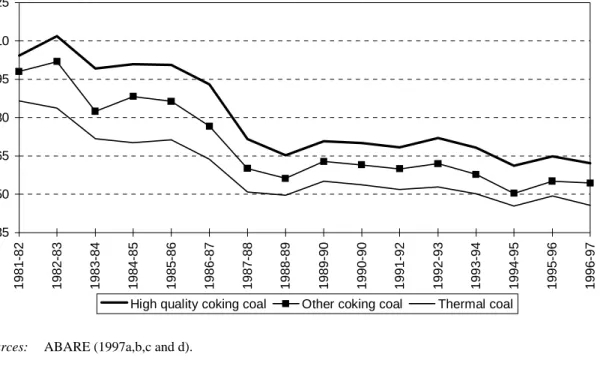
However, since the mid-1980s Australian black coal producers have experienced increasing price pressure from competition in both export and domestic markets.
Real export prices for Australian coal ($A1996–97/t)
35 50 65 80 95 110 125 1981-82 1982-83 1983-84 1984-85 1985-86 1986-87 1987-88 1988-89 1989-90 1990-90 1991-92 1992-93 1993-94 1994-95 1995-96 1996-97 High quality coking coal Other coking coal Thermal coal
Export market price pressures
Export markets are under pressure from new low cost suppliers, ...
Since 1990, both Indonesia and China have increased coal exports rapidly and now supply more than one third of thermal coal imported by Asian countries. Both of these suppliers are low-cost producers and are close to Australia’s traditional coal export markets. In addition, the United States has recently enhanced its capability as a coal exporter to Asia.
... technological change in user industries, and ...
Technological change in steel production has reduced the amount of coking coal needed to produce a given quantity of steel and has increased the scope for substitutability between different types of coal as inputs to the steel making process. These changes have reduced the premium which Australian producers can command for high quality coking coal.
... changing marketing arrangements.
The emergence of new suppliers to the world coal market and increasing competition in the electricity and steel markets have had an important influence on the basis on which coal is traded. Buyers are
purchasing a greater share of their requirements by tender or on the spot market where price competition is more intense. Less coal is being sold under long-term contracts where prices may include a premium for reliability of supply.
Domestic market price pressures
Competition in the national electricity market is affecting black coal prices, ...
Since 1996, when the national electricity market was introduced, competition between electricity producers has exerted downward pressure on domestic black coal prices. These pressures will intensify as physical and contractual constraints on interstate trade in electricity are removed progressively.
... as is competition from alternative fuel sources.
Competition from alternative fuel sources such as gas and brown coal will become more effective as the full potential benefits of competition in the electricity market are realised.
Barriers to international trade in coal
There are barriers to trade in black coal.
Although other countries’ barriers to trade in coal are low compared with those applying to agricultural products and many manufactured goods, significant reduction and distortion of coal trade occurs through tariffs, quotas, and subsidies, and through preferential tariff arrangements that favour some coal exporting countries over others.
Some of these trade barriers are being dismantled progressively, but this should not detract from the importance of Australia vigorously pursuing further liberalisation of international trade in coal.
Output, exports, employment
The black coal industry has a record of strong growth in production ...
Australian coal production increased by nearly 70 per cent between 1970 and 1980, more than doubled in the next ten years, and has averaged growth of 4 per cent per annum since 1990.
... and exports, ... Export volumes more than doubled between 1970 and 1980, increased a further 150 per cent in the following decade and have averaged nearly 5.5 per cent annual growth since 1990.
... but employment has declined.
Despite high output growth, employment levels declined from a peak of around 33 000 in 1986 to 24 000 in 1997.
Black coal industry output and employment
0 40 80 120 160 200 240 1970 1973 1976 1979 1982 1985 1988 1991 1994 1997 Mt 0 5 10 15 20 25 30 35 40 45 50 (’000)
Production (LHS) Total employment (RHS)
Profitability
quality of the coal resource, in the quality of management, and in work arrangements.
Profitability varies between individual mines.
As a consequence, there is significant variation in profit performance between individual coal mines and companies, the most profitable mines generally being newer ones which have negotiated flexible work arrangements with their employees.
On average, recent profitability has been poor.
On average, the recent profitability of black coal mining has been poor and well below the average for other mining activities.
Productivity performance
Productivity performance must improve.
A key question for this inquiry is the actual and potential productivity performance of Australian black coal mines. Given the increasingly competitive environment, and poor profitability, it is clear that the industry’s performance will need to improve in order for it to take advantage of the potential growth opportunities in export markets.
Productivity varies between mines.
While there is evidence that some Australian coal producers are highly productive, many producers made submissions citing poor performance of their own mines and of the industry in general.
Poor management contributes to low productivity.
Some producers conceded that low productivity was due in part to poor mine management.
Previous studies which have benchmarked the performance of Australian black coal mines also show that there is much variability of performance among mines.
A comprehensive study commissioned for this inquiry compared a sample of Australian black coal mines with better practice United States coal mines and Australian metalliferous mines.
Performance falls well short of Australian metalliferous and US
The study results indicate that, on average, productivity of major operations in the sampled Australian truck and shovel and longwall mines lagged around 20 to 30 per cent behind better practice US coal
... but Australian draglines perform very well.
Queensland draglines were close to 20 per cent more productive than the selected better practice US coal mines while NSW dragline operations were roughly on a par with the US mines.
It was found that the productivity of the best-performing Australian truck and shovel and longwall operations in the sample was not far behind that of the best practice US mine.
There is scope to do better.
This variability of performance indicates that there is scope for many Australian black coal mines to improve their performance considerably.
Submissions to this inquiry, and the benchmarking studies, attribute the poor productivity performance of Australian black coal mines to restrictive work arrangements, which result in the inefficient utilisation of equipment and high labour costs.
Work arrangements
Inefficient work arrangements have a long history.
The work arrangements which exist in Australian black coal mines today, and about which mine owners and managers complain, have their roots in the early history of coal mining in Australia.
In the past, a captive domestic market ...
They evolved first at a time when coal was sold to a captive domestic market for use in essential industries such as electricity generation, steel production, in homes and in rail and sea transport. The industry achieved a special status and a culture developed of maintaining supply at all costs.
... placed no discipline on cost increases.
Pressure for higher wages and changed working conditions, backed by the threat of strikes and disruption to supply, was usually successful. Consequent cost increases, whether caused directly by wage increases, or indirectly through inefficient work arrangements, were simply passed on to consumers. Continuity of supply
was especially important.
As export markets for coal developed, the culture of maintaining supply at all costs continued. Japanese buyers attached importance to continuity of supply and, with limited alternative sources available, entered
into long-term contracts at prices favourable to Australian coal producers. Export markets initially were very profitable.
Strong unions emerged. These circumstances were conducive to the emergence of strong industry unions and a highly unionised workforce.
Workers in the black coal industry tend to be in full-time employment, older, predominantly male and from an English-speaking background.
Industrial disputes, days lost per ’000 employees
0 5 000 10 000 15 000 20 000 25 000 1970 1973 1976 1979 1982 1985 1988 1991 1994 1997
Coal mining Other mining All industries
When compared with the total employed labour force, the Australian black coal workforce has:
• high earnings;
• a very high level of unionisation;
• a very high level of industrial disputes;
• high levels of days lost to sick leave and workers’ compensation leave;
• low levels of voluntary labour turnover; and
• low levels of tertiary qualifications. The industry attained a
special status through
The traditional notion that the black coal industry had unique characteristics which warranted special
regulations. industry-specific legislation and regulations.
Legislation mainly directed towards safety in both New South Wales and Queensland influences:
• the site management structure for each open cut and underground mine;
• the number of staff required at each level on site by setting out the functions to be undertaken by each position; and
• the nature of management at each mine by setting out the qualifications, training and experience required for each position, as well as the functions to be performed.
A passive management style developed, with unions taking the initiative.
In this environment, mine managers’ efforts were focussed more on complying with the regulations and maintaining supply than on pursuing production efficiency. In concert with weak competition in the product market until the mid-1980s, the legislation gave rise to a passive mine management style, providing scope for union representatives to take the initiative in industrial relations and human resource management.
Recommendation 1
Governments should facilitate improvement in management by increasing the choices available to owners and managers in managing mines. They should not prescribe:
• the management hierarchy at the mine site;
• the bundle of skills held by mine managers (including management experience); and
• the functions of mine managers.
(Chapter 6)
Recommendation 2
The Coal Mining Qualifications Board (NSW) and the role in the coal industry of the Board of Examiners (Qld) should be abolished.
Recommendation 3
The role of employees in carrying out safety inspections should not be restricted by regulation to union nominees.
(Chapter 6)
At the Federal level, and in Western Australia, tribunals whose charters included ensuring continuity of coal supply were established to deal with industrial disputes. This tended to insulate the industry from workplace reform occurring elsewhere in the economy. In 1995 the Coal Industry Tribunal was abolished and the industry was brought into mainstream industrial relations under the AIRC. The Coal Industry Tribunal of Western Australia is currently under review.
Past management and industrial practices are not sustainable.
Competitive pressure now being faced by the coal industry has led to the growing realisation that past management and industrial practices are no longer sustainable. It has focussed attention also on changing work arrangements which unnecessarily restrict productivity as the major means of improving the industry’s competitiveness.
Restrictive work arrangements
There are still many productivity-restricting work arrangements which ...
Some mines have negotiated new workplace agreements which do not contain any of the productivity-restricting work arrangements of the past. Such developments are encouraging. But a multitude of productivity-restricting work arrangements are still found in other Australian black coal mines.
... reduce mine managers’ ability to achieve efficiency, ...
An effect of these arrangements is to reduce the flexibility of mine managers to employ the quantity and quality of labour best suited to the circumstances of a particular mine and to make optimum use of employees’ skills. In this context, arrangements relating to seniority, demarcation, allocation of tasks, and the use of contractors are particularly restrictive.
capitalisation, ... encourage over-capitalisation of mines in order to compensate for work practices which underutilise equipment — for example, demarcation between production and engineering employees and restrictions on staggering ‘crib breaks’.
... and raise labour costs.
Overall, these arrangements increase unit labour costs, which can threaten the viability of mines.
Achieving change
Management is primarily responsible for achieving change.
The compelling force changing restrictive work arrangements is the more competitive market for black coal. Primary responsibility for achieving change and driving continuous improvement lies with management.
Change is occurring, ... Indeed, much of what has been achieved to date can be linked directly to the recognition by managers, workers and unions that, in the absence of change, some mines would become uncompetitive and have to close.
At some mines under threat of closure, companies have negotiated new arrangements with their workforce; others have given their mines over partially, or in total, to contractors as a means of circumventing restrictive work arrangements.
For example, at Cyprus Coal’s Baal Bone mine in New South Wales employees recently agreed to sweeping changes which included an end to demarcation rules and a two year moratorium on pay increases. In Queensland, Mount Isa Mines contracted out to Thiess the open cut operations of its Collinsville and Newlands mines.
Productivity-restricting work arrangements
Work arrangements which restrict productivity in Australian black coal mines include:
requirement to use ‘retrenchment lists’ of previous industry employees and selection from the list based on seniority in NSW;
• retrenchment on the basis of seniority;
• restrictions on the use of casual, part-time employment and on the use of contractors;
• the allocation of overtime on the basis of seniority and restrictions on the amount of overtime worked;
• informal restrictions on changing shift and roster arrangements;
• the use of seniority in allocating personnel to shifts;
• practices which contribute to relatively high levels of idle time, such as ‘early knock off’ and restrictions on staggering ‘crib breaks’;
• seniority-based allocation of personnel to annual leave;
• seniority-based promotion;
• strict enforcement of demarcations between production work and engineering work, and between the work of production and engineering employees and supervisory staff;
• rigid job demarcations through State coal industry legislation which specifies ‘statutory positions’ and their associated functions and qualifications;
• the possible inefficient allocation and inappropriate type of supervisory training from a workplace perspective as a result of its determination in coal-specific legislation;
• basing pay on skill accumulation rather than the application of skills;
• the allocation of training (and therefore tasks) based on seniority;
• the limited focus of communication and consultative arrangements; and
• the negative approach to dispute resolution at some mine sites.
Innovative work arrangements now exist at some open cut greenfield sites and are spreading to new underground mines and brownfield sites.
... but the process is difficult.
The process has not been easy. It has been expensive, and has required strong management to negotiate with employees who are represented by strong unions. At some mines, progress in improving work arrangements has been minimal, with many restrictive
agreements — for example, at the Muswellbrook mine. State legislation
remains a problem.
Some legislative and institutional impediments to change have been removed. Although some mines have achieved important changes, State legislation which stifles management initiative and encourages a compliance mentality remains a key barrier to improved mine performance.
Changes in the Federal sphere are in the right direction, ...
The Workplace Relations Act appears to have provided a facilitative environment by moving the Federal industrial relations system in a direction which:
• focuses on agreements at the workplace as the centrepiece for bargaining;
• sees the role of awards as a ‘safety net’ with a limited coverage of matters;
• restricts the extent to which the AIRC can intervene to settle disputes, as well as limiting the matters subject to arbitration; and
• places limits on industrial action such as that undertaken outside a ‘protected’ bargaining period.
But there are still many impediments to achieving timely change embedded in the legislation and awards. ... but awards still
contain some provisions which impede change.
For example, a ‘custom and practice’ award provision, together with the requirement to maintain the status quo during industrial disputes, provides considerable scope for unions to delay the introduction of continuous change strategies on the grounds that proposed changes constitute variations to agreed award provisions.
Furthermore, since ‘custom and practice’ varies between mine sites, and since not all customs and practices are documented, there is considerable uncertainty as to the extent of coverage of work arrangements in awards.
A positive initiative has been the recent exclusion of some seniority-based provisions from one of the main coal industry awards as part of the award
simplification process.
However, the AIRC’s decision to include ‘custom and practice’ as an allowable matter in black coal industry awards maintains a key impediment to change in the industry.
Effects of change
Changes to inefficient work arrangements are likely to produce substantial economy-wide gains.
The Commission’s assessment is that the productivity enhancing effects of changes to work arrangements are likely to produce substantial economy-wide gains. This view is confirmed by modelling undertaken by the Centre of Policy Studies at Monash University.
The modelling suggests that real GDP could be around 0.4 per cent higher than otherwise by 2009–10, and real private consumption 0.9 per cent higher, as a result of feasible, accelerated productivity change in the black coal industry. In today’s dollars, this would represent additional annual income of around $3 billion in 2009–10.
There is likely to be a continuation of the trend of job loss in aggregate in the black coal industry over the next decade. The size of the job loss (and consequent adjustment) would be reduced by changing work arrangements which currently restrict productivity growth.
Recommendation 4
The following should not be included as part of the allowable award matters in the black coal industry:
• ‘custom and practice’;
• retrenchment lists and seniority-based recruitment;
• provisions which require retrenchment based on seniority alone;
• restrictions on the use of part-time, casual or temporary employment or on the use of contractors;
• specific demarcation provisions; • prescriptive training provisions; and
• provisions relating to the process of negotiating change.
(Chapters 4 and 5)
Transport infrastructure
Efficient transport infrastructure is essential.
The performance of the coal chain, which includes rail transport, coal terminals and shipping ports, has an important influence on the international competitiveness of the Australian black coal industry. Rail freight (excluding royalties) averages around 15 per cent, and waterfront charges about 6 per cent of the fob cost of export coal.
The coal industry, railways and coal ports in Australia have a strong mutual interdependence in that coal is the single largest commodity transported by rail, export coal is transported almost exclusively by rail, and the ports and terminals used by the industry are dedicated mainly to coal.
Modelling the effects of improved performance
The Centre of Policy Studies (CoPS) at Monash University was commissioned to model the potential industry and economy-wide effects of productivity change in the black coal industry.
Overall, the CoPS results underline the importance of productivity improvements for this export-oriented industry. Confirming expectations, the results also indicate that the economy and the community at large can benefit substantially from a more efficient coal industry. Productivity improvements expand the productive capacity of the economy.
Modelling suggests that real GDP could be around 0.4 per cent higher than otherwise by 2009–10, and real private consumption 0.9 per cent higher, as a result of feasible, accelerated productivity change in the industry. In today’s dollars, this would represent additional annual income of the order of $3 billion in 2009–10.
Under reasonable assumptions about conditions in international coal markets and the response of coal export prices to cost reductions, improvements in both labour and capital productivity would benefit the coal industry and its employees.
By encouraging higher investment, higher productivity growth has the potential to slow job losses in the industry which have been occurring for many years and which are likely to continue in the absence of improved productivity. On the other hand, the modelling indicates that a failure to maintain the industry’s present competitiveness would lead to lower output and investment growth, and accelerate job losses. Thus higher productivity growth could reduce the need for relocation of coal industry workers.
Not surprisingly, the two major black coal producing States, NSW and Queensland, benefit from expansion of the sector, while other States, particularly those which are export-oriented, are estimated to experience somewhat slower growth than otherwise.
It should be borne in mind that the modelling results are illustrative only, designed to focus on the impact of productivity change on the coal industry and the economy at large. In practice, productivity changes in the coal industry will occur in the context of myriad unforseen changes in the industry itself and in the domestic and international economies.
Rail transport
High freight rates have eroded some of the industry’s natural advantage.
Australia has an advantage in the international supply of black coal because Australian mines are much closer to ports than their international competitors. However, some of this advantage has been eroded by very high freight rates caused mainly by:
• State governments using rail charges as a means of taxing the coal industry; and
• the productivity performance of State rail authorities being around 20 per cent lower than that of better operations overseas.
State reforms have improved the efficiency of rail pricing, but the pace of change is slow.
The practice of using freight charges to make monopoly profits or collect implicit royalties is being discontinued gradually, with both the New South Wales and Queensland Governments intending to eliminate excess charges by 2000. This has already reduced rail freight charges and encouraged improved performance by rail authorities, but the slow pace of change has delayed the potential benefits of more complete pricing reform.
The introduction of third party access to rail infrastructure, if pursued vigorously by State governments, and if supported by fair and transparent access regimes, offers significant opportunities to improve the productivity of coal rail freight services. Effective third party
access to rail
infrastructure has been delayed.
Although State governments have commitments to provide third party access to rail infrastructure, they have been slow to develop access regimes acceptable to the National Competition Council. This has delayed the achievement of the benefits of competition in coal rail freight.
Recommendation 5
The NSW and Queensland Governments should facilitate the early establishment of comprehensive rail access regimes that can be certified by the National Competition Council as effective.
(Chapter 7)
practices are not transparent.
government enterprises in NSW and Queensland is not transparent. The Commission considers that a set of principles and practices should be developed in each State which will generate efficient prices and provide the private rail freight and coal industries with confidence in the fairness of pricing.
Recommendation 6
In New South Wales and Queensland, pricing principles and asset valuations used to determine prices for access to rail infrastructure should be made public. So too should any related recommendations prepared by the NSW Independent Pricing and Review Tribunal and the Queensland Competition Authority.
Freight customers should have a right of appeal to these bodies regarding the application of the principles on a case-by-case basis.
The role of the regulation and arbitration units of IPART and QCA should be clearly defined and delineated.
Parties should be able to use an independent arbitrator of their choice for dispute resolution.
(Chapter 7)
The coal waterfront
Australian coal ports and terminals perform well.
In general, Australian coal ports and terminals perform well by international standards in terms of physical throughput and pricing. However, there is scope for improvement.
A recent capacity constraint at the Port of Newcastle is being addressed through better utilisation of existing facilities, and progress is being made on expanding the capacity of the port.
The level and structure of waterfront charges is
Inquiry participants raised issues concerning the level and structure of some government-imposed components of total waterfront charges. An issue is whether governments earn an excessive rate of return
on infrastructure used for exporting coal.
At present the target rates of return for Queensland’s port corporations are not published, and there is no external discipline on the pricing practices of either the Queensland or New South Wales port corporations. Greater transparency is
needed.
In the Commission’s view, there should be greater transparency of target rates of return, methods of valuing assets, and pricing practices of port corporations. Making the port corporations in Queensland and New South Wales subject to prices oversight would impose discipline on them not to generate excessive returns on their assets.
Recommendation 7
The Queensland Government should publish the target rates of return for its port corporations’ assets.
The New South Wales and Queensland Governments should bring their port corporations within the prices oversight jurisdiction of the Independent Pricing and Regulatory Tribunal and the Queensland Competition Authority, respectively.
(Chapter 8)
Government regulation and safety Occupational health and safety
Underground coal mining is hazardous.
Underground coal mining is a hazardous industry. The industry’s fatality rate is about six times the Australian industry average. However, the low injury record of some mines indicates that accidents are preventable if hazards are managed effectively.
The rate of fatal injury in the open cut coal mining sector is slightly higher than that for all Australian industries.
Average fatal injury frequency rates (1991 – 1997)
0.00 0.05 0.10 0.15 0.20 0.25 0.30 All industries
Manufacturing Open cut coal Open cut metalliferous Construction Transport and storage
Agriculture Underground metalliferous Underground coal
Average fatal injury rates per million hours worked
Lost time injury frequency rates
0 50 100 150 200 250 300 1987-88 1988-89 1989-90 1990-91 1991-92 1992-93 1993-94 1994-95 1995-96 1996-97
LTI rate per million hours worked
Open cut coal Underground coal Open cut metalliferous Underground metalliferous
Within the mining industry, coal mining has a similar fatality rate to metalliferous mining, but a higher lost time injury rate. On all indicators, the underground sector of the black coal industry has a worse safety record than the open cut sector.
Injury rates have declined but the fatality rate remains high.
The industry’s progress in improving safety is mixed. Between 1987–88 and 1996–97 the lost time injury rate has been reduced significantly, but the fatality rate remains high.
OHS legislation is different for coal mining.
The occupational health and safety (OHS) legislation applying to the black coal industry is very different from the general OHS legislation that applies to almost all other Australian industries. Together with other mining industries, black coal mining is one of the few industries subject to industry-specific legislation.
Regulations prescribe how hazards are controlled and how mines are managed.
The legislative approach to OHS in most other industries makes workplace parties responsible for safety under a ‘duty of care’ approach. In contrast, coal mine safety regulations still prescribe how particular hazards are to be controlled and how mines are to be managed to ensure safety.
Submissions to this inquiry argued that the current approach to OHS in the coal industry is not conducive to good safety outcomes, encourages an apathetic approach to safety, and imposes high compliance costs on firms without commensurate improvements in safety.
Many safety regulations are inappropriate or redundant.
Participants pointed to regulations which are redundant and not appropriate to particular mines, the prescriptive nature of most regulations, and regulations developed for the underground sector and inappropriately imposed on open cut operations.
To improve safety outcomes in the coal industry, an alternative to the current regulatory approach is required. Workplace parties need to bear more responsibility for safety.
favours an alternative approach to safety.
regulating OHS in the black coal mining industry under which workplace parties are legally responsible for mine safety through their duty of care. The duty of care would require companies to develop safety management plans in consultation with their employees and would be enforced vigorously.
Recommendation 8
Workplace parties (principally employers) should be legally responsible for mine safety through their duty of care.
Underground coal mines should be regulated separately from the open cut coal sector, which should be covered by OHS legislation governing metalliferous mining or the general legislation governing OHS in other industries.
(Chapter 9)
Under the regulatory approach proposed by the Commission:
• companies would be required to develop and periodically review mine safety management plans in consultation with their employees. These plans would identify all safety risks at a mine and contain procedures for the management of these risks;
• mines would be guided in developing safety management plans by codes of practice, guidance notes and advice from safety consultants and coal inspectorates;
• existing regulatory requirements would be reviewed and rationalised to remove obsolete regulations and detailed provisions prescribing the management of minor hazards;
• regulations prescribing the management of serious hazards would be redrafted along performance or management system lines, and existing regulatory prescription would be
recategorised as codes of practice;
• regulations prescribing management positions would be abolished and the need for regulations prescribing other safety positions would be reassessed;
• there would be vigorous enforcement, with an emphasis on deterrence, so that workplace parties had the incentive to comprehensively assess and control the hazards of their work;
• inspectorates would conduct random audits of mines to ensure that mine safety management plans addressed mining hazards and had been implemented;
• coal inspectorates would issue an enforcement policy and publish details in their annual reports about actions taken against companies in respect of significant derelictions of their duty of care; and
• maximum penalties applying to the coal industry would be brought into line with those applying to other industries.
The Joint Coal Board
The Joint Coal Board (JCB) was established under Federal and New South Wales legislation in 1946. Its main function was to regulate the industry and ensure the maintenance of coal supplies in New South Wales. The JCB has four core
businesses.
The JCB’s four core businesses now are:
• to manage an occupational health service that delivers health assessments, injury management, work environment monitoring (including dust monitoring) and health education to the NSW coal industry;
• to maintain a fully funded workers’ compensation insurance scheme for people working in the NSW coal mining industry (known as Coal Mines
Insurance);
• to provide an information service on production, employment and accidents; and
• to conduct international training courses, funded by the United Nations, on the utilisation of coal in an environmentally sustainable manner.
The JCB should be abolished.
The Commission sees no need for continuation of the JCB. Its existence tends to reinforce the perception that the coal industry is ‘special’. In the interests of creating a more efficient industry, this perception must change. Abolition of the JCB, with its functions transferred to the NSW Department of Mineral Resources, WorkCover and other public and private providers as appropriate, would help to bring the regulation of the coal industry into line with that of other industries.
The legislated monopoly which Coal Mines Insurance currently enjoys should be abolished, enabling coal mining companies to insure with whom they choose. Coal Mines Insurance could compete for business against other insurance providers.
Recommendation 9
The Joint Coal Board should be abolished and its functions taken over by the NSW Department of Mineral Resources, WorkCover and other public and private providers as appropriate.
If it were decided to retain the workers’ compensation role of the JCB, Coal Mines Insurance should be corporatised and required to compete for business against other insurance options.
(Chapter 9)
currently levied on mine output.
resources through royalties. In NSW, royalties are levied as a dollar amount per tonne of production (specific rate royalty), and in Queensland as a percentage of the value of production (ad valorem royalty).
Ad valorem royalties are superior to specific rate royalties.
These royalty systems have the advantage of being easy to administer. Ad valorem royalties have the additional benefit of varying with price and therefore partly responding to changes in the value of the resource. Specific rate royalties take no account of differences in the various types of coal or of changes in coal prices over time.
In principle, a resource rent royalty would be more efficient ...
In principle, a resource rent royalty would be superior on efficiency grounds as a company’s royalty liability would depend on the value of its resource, and would vary with changes in mining costs and coal prices. Such a royalty would not distort mining production decisions.
... but would be complex and costly to administer in the black coal
industry.
In practice, however, the potential complexity and cost of administering and complying with a resource rent royalty for black coal has caused State governments to rely on output-based royalty schemes.
Nevertheless, there are strong arguments for making royalties more responsive to market conditions. In NSW, the replacement of specific rate royalties with ad valorem royalties would allow royalty levels to move with world coal prices, better reflect the value of coal resources, and encourage the economic exploitation of low grade coals.
Recommendation 10
The NSW Government should adopt an ad valorem royalty system.
(Chapter 10) Implementation of recommendations
The Commission’s recommendations arising out of this inquiry relate largely to matters within the jurisdiction
of State governments and their instrumentalities. However, the potential economy-wide gains which could flow from improved productivity performance are sizeable.
Accordingly, the Commonwealth Government has reason to take an interest in implementation of the recommendations, which range across a number of policy portfolios.
There would be advantage in joint Commonwealth and State government discussion of the recommendations. This could occur either in the Council of Australian Governments or in a meeting of Ministers with portfolio responsibilities for matters covered by the Commission’s recommendations.
This chapter provides a brief description of the Australian black coal industry and introduces some contemporary factors influencing its performance. It then outlines the main issues raised by the inquiry and how the Commission has approached its task.
1.1 The Australian black coal industry
The Australian black coal industry has undergone substantial change over the past few decades. Rapid development of large open cut mines in Queensland transformed the industry from one which essentially supplied local power stations to one geared to exporting. This transformation, together with a period of strong increases in coal prices, generated high levels of profitability for mining companies and high levels of income for miners. However, less favourable market conditions in recent times have posed new challenges for the industry.
Australia’s coal output is now divided fairly evenly between coking and thermal coal. The former is used in the production of steel while thermal coal is used in electricity generation and as an industrial energy source.
The black coal industry accounts for more than one per cent of GDP, almost twice the size of the Australian iron and steel industry. In December 1997, around 23 800 people were employed in the black coal industry.
Black coal is Australia’s largest export industry. In 1997, black coal exports amounted to $8.8 billion, equivalent to 10 per cent of the value of Australia’s total merchandise exports. While Australia ranks only sixth among coal producing nations, it is the world’s largest coal exporter. Australia accounts for around 30 per cent of world trade in coal. Australia’s principal coal customer is Japan, which takes nearly half of total exports, followed by the Republic of Korea, Taiwan and India.
Australian black coal production has more than quadrupled since 1970. At that time, more than half the production was used domestically, and the limited exports were of coking coal. In the wake of large increases in oil prices in the 1970s, world demand for thermal coal increased substantially, and Australian thermal coal exports expanded from just over one million tonnes (Mt) in 1970 to almost 74 Mt in 1997. This was equivalent to an annual growth rate of almost
15 per cent in thermal coal exports. Coking coal exports also have grown since 1970, but at a much slower pace (see Figure 1.1).
By 1997, exports accounted for 72 per cent of Australian black coal production, a major change from the early 1970s, when the industry was mostly a supplier to the domestic electricity and steel markets. Of the coal sold presently to the domestic market, almost 80 per cent is thermal coal used in electricity production.
Figure 1.1: Black coal production for export and domestic markets and by mine type (Mt)
Domestic market Coking coal exports
0 40 80 120 160 200 240 1970 1973 1976 1979 1982 1985 1988 1991 1994 1997
Thermal coal exports
Open cut
Underground
1970 1973 1976 1979 1982 1985 1988 1991 1994 1997
Sources: JCB and QCB (various).
More than 95 per cent of Australia’s black coal comes from NSW and Queensland, in roughly equal proportions. In the 1970s, production was concentrated in NSW. However, Queensland has enjoyed a greater rate of growth since then. Coking and thermal coals are produced in both States. Queensland is the dominant coking coal exporter, accounting for about 70 per cent of Australian coking coal exports, and NSW is the dominant thermal coal exporter, accounting for close to 70 per cent of Australian thermal coal exports.
The growth in output since the 1970s has been mainly in open cut mining, which now accounts for over 70 per cent of Australia’s production (see Figure 1.1). This form of mining is quite similar to quarrying, and the mining of many other Australian minerals such as iron ore.
While the output of the Australian coal industry has increased by more than 380 per cent since 1970, mine employment has grown by only 39 per cent from 17 100 to 23 800 persons. Figure 1.2 presents data on industry output and mine employment. Industry employment peaked at 32 700 in December 1986 and has fallen gradually since then. Among other influences, this reflects:
• the growth of capital-intensive open cut mining;
• the introduction of more capital-intensive underground mining techniques (longwall mining); and
• improvements in labour productivity.
Figure 1.2: Black coal industry output and employmenta
0 40 80 120 160 200 240 1970 1973 1976 1979 1982 1985 1988 1991 1994 1997 Mt 0 5 10 15 20 25 30 35 40 45 50 (’000)
Production (LHS) Total employment (RHS)
a Employment at June.
Sources: JCB and QCB (various).
Although the Australian coal industry has moved to more capital-intensive types of mining, labour remains a major cost, together with mine capital costs, mine operating costs and transport costs (see Figure 1.3).
The Australian black coal industry is also a major contributor to State government revenue. The Commission estimates that the industry contributed $636 million in royalties to the NSW and Queensland Governments in 1996–97, equivalent to 2.8 per cent of own revenue in these States.