A Resources Allocation Model for Multi-Project
Management
Hamdjatou Kane, Alban Tissier
To cite this version:
Hamdjatou Kane, Alban Tissier. A Resources Allocation Model for Multi-Project Management.
9th International Conference on Modeling, Optimization & SIMulation, Jun 2012, Bordeaux,
France.
<
hal-00728599
>
HAL Id: hal-00728599
https://hal.archives-ouvertes.fr/hal-00728599
Submitted on 30 Aug 2012
HAL
is a multi-disciplinary open access
archive for the deposit and dissemination of
sci-entific research documents, whether they are
pub-lished or not.
The documents may come from
teaching and research institutions in France or
abroad, or from public or private research centers.
L’archive ouverte pluridisciplinaire
HAL
, est
destin´
ee au d´
epˆ
ot et `
a la diffusion de documents
scientifiques de niveau recherche, publi´
es ou non,
´
emanant des ´
etablissements d’enseignement et de
recherche fran¸cais ou ´
etrangers, des laboratoires
publics ou priv´
es.
« Performance, interopérabilité et sécurité pour le développement durable »
A Resource Allocation Model for Multi-Project Management
H. KANE & A. TISSIER
Département des Sciences administratives, Université du Québec en Outaouais 101, rue Saint-Jean-Bosco, C.P. 1250 Succ. Hull, Gatineau (Québec), J8X 3X7, Canada
(Tel : +1 819 595-3900 # 1949; e-mail : [email protected])
ABSTRACT: In this paper, we propose a mathematical model which can be used in the phases of planning and organizing of a multi-project program. The model will optimize the costs of completing a group of linked projects while speeding up the realization of the whole program in order to save time. We improve substantially a model that Wiley et al. (1998) had elaborated, and adapt it to the current requirements of the multi-project manager’s work, including the extensive use of subcontracting companies. We tested the model through a multi project case to ensure it will be efficient and safe in planning complex multi-project programs. We focused explicitly and practically on the optimization of shared human resources among the various projects in order to save time and lower the costs of the whole project.
KEYWORDS: Multi-project management, Resource allocation, Mathematical programming.
1 INTRODUCTION
The multi-project management, also designated as management by projects, consists in planning, coordinating and controlling a program that comprises several parallel projects (PMI, 2000). Multi-project management is a growing field of research. More and more companies manage several projects in order to carry out their activities (Tissier 2008 ; Frame, 1995). To be efficient, multi-project managers have to optimize time management and resource allocation. Time management is the most important stake in project management. Speeding up the realization of projects saves money, respects time schedule in case of activities that incur delay, and wins contracts by proposing the best time of delivery in a business competition. Speeding up the realization of projects is therefore a key challenge. Few works have been published on this subject (see section 2). Among them, only a small number of papers deal specifically with multi-project management. Resource allocation is the second main task in piloting projects. A literature review shows the allocation of resources issue has been widely dealt in many research reports in the case of managing a unique project. Methods and models have been developed to formalize resource allocation work (Gordon & Tulip, 1997). In multi-project management, this work is more complex. In fact, the allocation of resources is one of the main issues of multi-project management (Payne, 1995). Most of the time, resources are limited and have to be shared among projects led in parallel. This paper deals with the general topic of multi-project management. It investigates more specifically resource allocation works. Within companies, human, financial and material resources are limited, as is the time allocated to achieve the project. The main objective of this research is to help multi-project managers speed up their projects and allocate the proper amount of resources to make the acceleration of their projects possible. We have focused on the phases of planning and organization of the project within a company
that performs multi-project management. The specific aim of our research was to create a mathematical model that allows optimizing the costs of performing a group of projects while speeding up the realization of the whole program in order to save time. Wiley et al. (1998) elaborated a mathematical model to reduce time spent in carrying out a program of several projects and allocate resources at the lowest cost possible. We rewrote it to adapt it to the current requirements of the multi-project manager works. For example, we took into account the use of subcontracting companies achieving tasks in projects led in a multi-project program. Our model has been split in two different parts. The first part deals with the acceleration of the project. In this paper, this first part of the model will not be described (Tissier 2008). Only its results will be showed. The second part deals exclusively with the allocation of the resources. The second part is our main contribution in developing the former model proposed by Wiley et al. (1998). That is why this paper only presents this part in details. All our developments were conducted to simplify the understanding of the model and its use by the multi-project managers. To validate the model, we tested it through a complex case including many conditions. This case deals with the realization of three projects, the characteristics of which (the duration, the budget, the number of operators and the quantities of work) are different from one project to the other. With this approach, we demonstrate that the model can be applied to a large number of real cases. In next section, we review the related literature which allowed us to consider and understand all the points of view about the acceleration of projects and the allocation of resources in multi-project environment. Section 3 outlines the model formulation on multi-project resource allocation. Section 4 presents the case of study. Section 5 concludes this paper with a review of the works and suggests some orientations for further research.
MOSIM’12 -
06 au 08 Juin 2012 - Bordeaux - France
2 LITERRATURE REVIEW
Many researchers have worked on topics related to the acceleration of projects and the allocation of resources. Siemens (1971) developed a model on time and cost parameters to accelerate a project. The model accelerates some tasks and not others in function of their cost by units of time. With this method, the duration of project realization is reduced. However, the cost of the project increases after acceleration and the critical path of the project may change. It would be more efficient to reduce duration with keeping the same critical path. It also appeared thought-provoking to save time at the lowest possible cost. Islam et al. (2004) consider it is more difficult to make business decision now than in the past. Currently, more alternatives have to be taken into account, in order to make a business choice. Moreover, the financial impact of a bad decision is more important, and less tolerable in companies nowadays than in the past. That is why the authors considered that the decision process has to be rationalized. Then, they developed a linear mathematical model to reduce time for completing a project. The model accelerates projects solely on the basis of financial considerations, lowering the cost as much as possible. However, supplies of additional resources are needed for acceleration, and the model does not specify these resources and their extra costs. Moreover, the model deals with a unique project management and not with multi-project management. Azondékon (2002) examined the trade-off between task duration increase – or decrease – and the allocation of resources. The author estimated it is more efficient to consider the trade-off between time and resources than the trade-off between time and the costs of the tasks. The trade-off between time and the costs of the tasks is an aggregation of cost of human resources and other costs. It is not detailed. Azondékon’s model uses a different trade-off between the time and the resources for each type of resource – human or material - which acts in a However, the model does not determine the amount of resources. Gordon & Tulip (1997) listed different models and methods for the allocation of resources from 1959 to 1997. Those models and methods try to allocate - human, financial or material - resources under restriction of resources and time. However, the authors explained that those models and methods were rarely adapted to the reality of project management. Azaron et al. (2006) presented a non-linear model to allocate resources. Although the model is considered as versatile by its creators, it is based on restrictive hypothesis. Consequently, the results given by the model are relevant just for a restrictive number of case studies. Moreover, the model gives no detail on the type of resources in its outputs. Most of the researchers studied unique projects, whereas companies are currently managing multi-projects. Moreover, many of these authors consider the acceleration of projects as a cost-increasing factor. Accelerating a task – or a project – is obtained by providing more resources in order to achieve the work faster. Consequently, costs increase. However, we can also consider deceleration of
tasks. Projects contain critical and non-critical tasks. Critical path includes all the critical tasks of a project. Non-critical tasks can be achieved in a longer duration and be performed with fewer human resources than initially planned. In this way, the decelerations of non-critical tasks can provide additional human resources to the critical tasks. The challenge is to re-allocate human resources from a task to another to speed up the projects. Using the fewest new external human resources speeds up the projects at the lowest possible cost.
In this paper, we propose a model that deals with resource allocation or re-allocation to make the program acceleration possible. Re-allocation of human resources from a project to another in multi-project program is the main way to accelerate at the lowest possible cost.
3 MULTI-PROJECT RESOURCE ALLOCATION MODEL
Our first contribution in developing a model from Wiley et al. (1998) was to respond to the current requirements of multi-project managers. For example, projects in program can be led by different companies. Consequently in our model, overhead project costs appeared as different costs as they are related to different companies. We propose a mathematical model to formalize the allocation of resources in multi-project program.
Variables of the model
cijl: number of human resources of type l to be added to - or to be taken off from - task (i,j) in order to achieve it.
Parameters
Br: budget of the program dedicated to human resource funding
Brk: budget of project k dedicated to human resource funding
I: the set of connected arcs (i,j) in the program
Ik: the set of connected arcs (i,j) in project k ; 𝐼𝑘∈ 𝐼, ∀𝑘
Tij: normal duration of task (i,j)
yij: maximal quantity of time units on which task (i,j) is accelerated
zij: maximal quantity of time units on which task (i,j) is decelerated
Eijl: quantity of human resources of type l, which is allocated to task (i,j) before its acceleration or deceleration
hl: cost of human resources of type l per time unit and per person, in normal conditions
Sijl: cost of human resources of type l per time unit and per person, which are allocated to speed up the task (i,j) Vijl: cost of human resources of type l per time unit and per person, which are allocated to the deceleration of task (i,j) Cl maximal quantity of human resources of type l
available on the program
Ckl maximal quantity of human resources of type l available on project k.
(1)Objective function:
𝑀𝑖𝑛 𝑧 = � � �(𝑆𝑖𝑗𝑙𝑦𝑖𝑗𝑐𝑖𝑗𝑙 − 𝑉𝑖𝑗𝑙𝑧𝑖𝑗𝑐𝑖𝑗𝑙)
𝑙 𝑗 𝑖
Minimizing the value of the objective function is frameworked by constraints:
(2)Human resources program budget:
� � �(ℎ𝑙𝑇𝑖𝑗𝐸𝑖𝑗𝑙 + 𝑆𝑖𝑗𝑙𝑦𝑖𝑗𝑐𝑖𝑗𝑙 − 𝑉𝑖𝑗𝑙𝑧𝑖𝑗𝑐𝑖𝑗𝑙)
𝑙 𝑗 𝑖
≤ 𝐵𝑟, ∀𝑙 𝑎𝑛𝑑 (𝑖, 𝑗) ∈ 𝐼 • In the most restrictive case:
𝐵𝑟= ∑ ∑ ∑ ℎ𝑙𝑇𝑖 𝑗 𝑙 𝑖𝑗𝐸𝑖𝑗𝑙 , ∀𝑙 𝑎𝑛𝑑 (𝑖, 𝑗) ∈ 𝐼.
• In the less restrictive case:
𝐵𝑟≥ ∑ ∑ ∑ ℎ𝑖 𝑗 𝑙 𝑙𝑇𝑖𝑗𝐸𝑖𝑗𝑙 , ∀𝑙 𝑎𝑛𝑑 (𝑖, 𝑗) ∈ 𝐼.
(3)Maximal quantity of type l human resource available on the program:
� �(𝐸𝑖𝑗𝑙 ± 𝑐𝑖𝑗𝑙)
𝑗 𝑖
≤ 𝐶𝑙 , ∀𝑙 𝑎𝑛𝑑 (𝑖, 𝑗) ∈ 𝐼
+ if task (i, j) can only be accelerated, - if task (i, j) can only be decelerated.
• In the most restrictive case:
𝐶𝑙= ∑ ∑ 𝐸
𝑖𝑗𝑙 𝑗
𝑖 , ∀𝑙 𝑎𝑛𝑑 (𝑖, 𝑗) ∈ 𝐼.
Human resources deducted from decelerated tasks are then re-allocated to speeded-up tasks and ∑ ∑ ∑ ±𝑐𝑖𝑗𝑖 𝑗 𝑙 𝑙 = 0.
• In the less restrictive case:
𝐶𝑙≥ ∑ ∑ 𝐸
𝑖𝑗𝑙 𝑗
𝑖 , ∀𝑙 𝑎𝑛𝑑 (𝑖, 𝑗) ∈ 𝐼.
Human resources deducted from decelerated tasks and human resources allocated to speeded-up tasks are not specifically the same and ∑ ∑ ∑ ±𝑐𝑖𝑗𝑖 𝑗 𝑙 𝑙 ≥ 0
(4)Human resources project k budget:
� � �(ℎ𝑙𝑇𝑖𝑗𝐸𝑖𝑗𝑙 + 𝑆𝑖𝑗𝑙𝑦𝑖𝑗𝑐𝑖𝑗𝑙 − 𝑉𝑖𝑗𝑙𝑧𝑖𝑗𝑐𝑖𝑗𝑙)
𝑙 𝑗 𝑖
≤ 𝐵𝑟𝑘 , ∀𝑙 𝑎𝑛𝑑 (𝑖, 𝑗) ∈ 𝐼𝑘 • In the most restrictive case:
𝐵𝑟𝑘= ∑ ∑ ∑ ℎ𝑖 𝑗 𝑙 𝑙𝑇𝑖𝑗𝐸𝑖𝑗𝑙 , ∀𝑙 𝑎𝑛𝑑 (𝑖, 𝑗) ∈ 𝐼𝑘.
• In the less restrictive case:
𝐵𝑟𝑘 ≥ ∑ ∑ ∑ ℎ𝑙𝑇𝑖 𝑗 𝑙 𝑖𝑗𝐸𝑖𝑗𝑙 , ∀𝑙 𝑎𝑛𝑑 (𝑖, 𝑗) ∈ 𝐼𝑘.
(5)maximal quantity of type l human resource available on the project k:
� �(𝐸𝑖𝑗𝑙 ± 𝑐𝑖𝑗𝑙)
𝑗 𝑖
≤ 𝐶𝑘𝑙 , ∀𝑙 𝑎𝑛𝑑 (𝑖, 𝑗) ∈ 𝐼𝑘
+ if task (i, j) can only be accelerated,
- if task (i, j) can only be decelerated.
•In the most restrictive case:
𝐶𝑘𝑙= ∑ ∑ 𝐸
𝑖𝑗𝑙 𝑗
𝑖 , ∀𝑙 𝑎𝑛𝑑 (𝑖, 𝑗) ∈ 𝐼𝑘.
Human resources deducted from decelerated tasks are then re-allocated to speeded-up tasks and ∑ ∑ ∑ ±𝑐𝑖 𝑗 𝑙 𝑖𝑗𝑙 = 0.
•In the less restrictive case:
𝐶𝑘𝑙≥ ∑ ∑ 𝐸
𝑖𝑗𝑙 𝑗
𝑖 , ∀𝑙 𝑎𝑛𝑑 (𝑖, 𝑗) ∈ 𝐼𝑘.
Human resources deducted from decelerated tasks and human resources allocated to speeded-up tasks are not specifically the same and ∑ ∑ ∑ ±𝑐𝑖𝑗𝑖 𝑗 𝑙 𝑙 ≥ 0.
(6)Lower bound of cij l
for speeding-up task (i, j)
𝑦𝑖𝑗
𝑇𝑖𝑗𝐸𝑖𝑗
𝑙 ≤ 𝑐 𝑖𝑗𝑙, ∀𝑙
(7)Upper bound of cijl to decelerate task (i, j)
If zij is lower than Tij then we consider the following
constraint: 𝑐𝑖𝑗𝑙 ≤𝑧𝑖𝑗
𝑇𝑖𝑗(𝐸𝑖𝑗
𝑙 − 1), ∀𝑙
If zij is bigger than Tij then we consider the following
constraint: 𝑐𝑖𝑗𝑙 ≤𝑇𝑖𝑗 𝑧𝑖𝑗(𝐸𝑖𝑗 𝑙 − 1), ∀𝑙 (8) Non-negativity 𝑐𝑖𝑗𝑙 ≥ 0 4 NUMERICAL APPLICATION
Multi-project management is really a common type of management in construction companies or in air-space firms. However, this type of management is recommended to every company, which wants to realise big achievements in a very limited duration. The case study presentation will be split in three parts. First, a multi-project program and its characteristics will be presented. Then, model results concerning this context will be presented. Finally, those results will be analysed.
MOSIM’12 -
06 au 08 Juin 2012 - Bordeaux - France
Program presentation
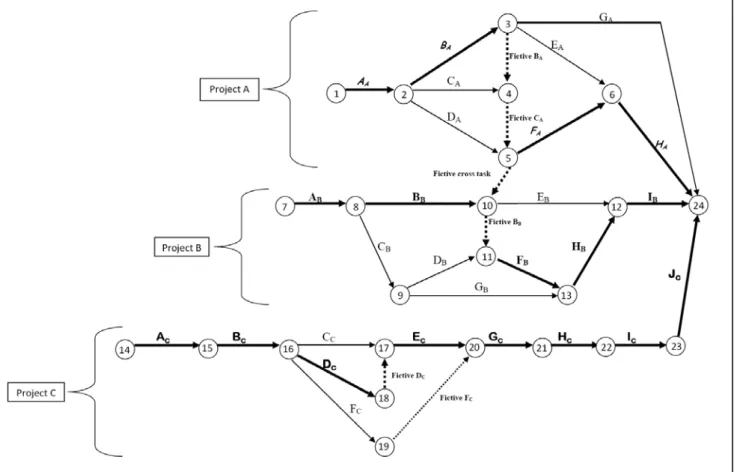
We consider a program made up of three projects (A, B and C). Each project has a set of precedence constraints dictated by the program network in Fig. 1. All the three projects have the same completion date. The assumption is that each task begins at the earliest possible date in the
projects. Only the data necessary for the model will be presented. We are using the PERT network illustration method. Arrows (also designated as arcs) represent tasks and nodes represent beginning or completion dates. Critical tasks are double-lined. All the nodes are numbered.
The characteristics of the project A, B and C are presented in the following tables.
Table 1. Works breakdown structure of the project A
1 2 3 4 5 6 7 8 9 Name Task (i, j) Predecesors Normal duration Tij [days] Final durations Tij-yij+zij [days] Normal cost Dij [$] Hum. Res. of type 1, Eij1 [persons] Hum. Res. of type 2, Eij2 [persons] Hum. Res. of type 3, Eij3 [persons] AA BA CA DA EA FA GA HA 12 23 24 25 36 56 324 624 -- AA AA AA BA BA, CA, DA BA EA, FA 2 7 4 2 4 6 3 2 1 7 6 6 4 5 5 2 3000 10800 4800 2400 6000 16000 2400 12000 1 2 3 1 3 2 1 4 2 3 1 2 2 2 1 6 4 6 2 6 4 4 2 12 critical duration: 17 days new critical duration: 15 days 57400$
Table 2. Works breakdown structure of the project B
1 2 3 4 5 6 7 8 9 Name Task (i, j) Predecesors Normal duration Tij [days] Final durations Tij-yij+zij [days] Normal cost Dij [$] Hum. Res. of type 1, Eij1 [persons] Hum. Res. of type 2, Eij2 [persons] Hum. Res. of type 3, Eij3 [persons] AB BB CB DB EB FB GB HB IB 78 810 89 911 1012 1113 913 1312 1224 -- AB AB CB BB BB, DB CB GB, FB EB, HB 3 8 3 1 3 5 2 3 2 3 7 3 2 4 5 3 1 1 16000 20000 4000 1000 12000 20000 1000 1200 1000 2 2 1 1 2 2 0 1 1 4 4 2 1 4 5 1 0 1 8 8 4 2 8 12 2 1 1 critical duration: 21 days new critical duration: 17 days 76200$
MOSIM’12 -
06 au 08 Juin 2012 - Bordeaux - France
Table 3. Works breakdown structure of the project C
1 2 3 4 5 6 7 8 9 Name Task (i, j) Predecesors Normal duration Tij [days] Final durations Tij-yij+zij [days] Normal cost Dij [$] Hum. Res. of type 1, Eij1 [persons] Hum. Res. of type 2, Eij2 [persons] Hum. Res. of type 3, Eij3 [persons] AC BC CC DC EC FC GC HC IC JC 1415 1516 1617 1618 1720 1619 2021 2122 2223 2324 -- AC BC BC CC, DC BC EC, FC GC HC IC 1 14 5 12 5 8 5 7 2 3 1 10 10 10 3 13 5 5 1 2 600 13300 5600 14900 4800 4100 19600 10700 1400 4400 1 2 2 2 2 1 2 2 2 0 1 1 2 2 1 1 6 3 0 2 0 1 1 2 1 0 20 3 0 10 critical duration: 49 days new critical duration: 37 days 79400$
Table 4. Common parameters across the three projects
Human resources types Type 1 Type 2 Type 3 Maximal quantity of human resource
(type l) available on the program [persons] 60 81 166 Costs of type l human resource
[$/day] h1=240 h2=120 h3=80 Costs of added type l human resource, in
case of acceleration [$/day] Sij1=360 Sij2=180 Sij3=120 Costs of withdrawn type l human resource,
in case of deceleration [$/day] Vij1=180 Vij2=90 Vij3=60 program budget dedicated to human
resources funding
BrA+ BrB+ BrC = Br
$53 900 + $77 280 + $113 240 = $244 420
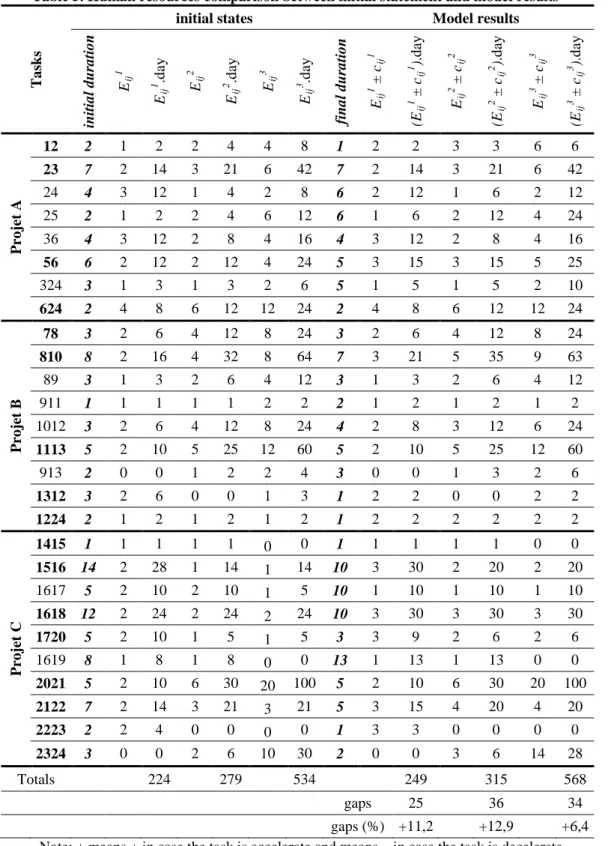
The following table (Table 5) presents results from the model to the program of projects A, B and C. These results allowed proposing human resources to work on the program in addition to the human resources already working on the program. Hiring is then a second factor of allocation, after the re-allocation of human resources from a task to another. Moreover we noticed the acceleration of tasks has a better chance to induce an increase of quantity of human resources than the deceleration of tasks has to induce a decrease of quantity of human resources on a task team. Two reasons can explain this phenomenon. First, we cannot remove resources from a team of only one person;
otherwise the task would not be achieved. In our case study, many decelerated tasks are performed by only one person. That is why re-allocation is not really possible. Second, the model does not reduce the quantities of human resources to their minimal values, because it not only chooses the optimal financial values to accelerate the whole program, but also reduces the additional cost on every task. Finally, the model allows detailing for each task how the allocation – or re-allocation – of human resources can induce additional costs and gains.
Table 5. Human resources comparison between initial statement and model results
Ta
sk
s
initial states Model results
in itia l d u ra tio n Eij 1 Eij 1 .d ay Eij 2 Eij 2 .d ay Eij 3 Eij 3 .d ay fin a l d u ra tio n Eij 1 ± cij 1 (E ij 1 ± cij 1 ) .d ay Eij 2 ± cij 2 (E ij 2 ± cij 2 ) .d ay Eij 3 ± cij 3 (E ij 3 ± cij 3 ) .d ay P ro je t A 12 2 1 2 2 4 4 8 1 2 2 3 3 6 6 23 7 2 14 3 21 6 42 7 2 14 3 21 6 42 24 4 3 12 1 4 2 8 6 2 12 1 6 2 12 25 2 1 2 2 4 6 12 6 1 6 2 12 4 24 36 4 3 12 2 8 4 16 4 3 12 2 8 4 16 56 6 2 12 2 12 4 24 5 3 15 3 15 5 25 324 3 1 3 1 3 2 6 5 1 5 1 5 2 10 624 2 4 8 6 12 12 24 2 4 8 6 12 12 24 P ro je t B 78 3 2 6 4 12 8 24 3 2 6 4 12 8 24 810 8 2 16 4 32 8 64 7 3 21 5 35 9 63 89 3 1 3 2 6 4 12 3 1 3 2 6 4 12 911 1 1 1 1 1 2 2 2 1 2 1 2 1 2 1012 3 2 6 4 12 8 24 4 2 8 3 12 6 24 1113 5 2 10 5 25 12 60 5 2 10 5 25 12 60 913 2 0 0 1 2 2 4 3 0 0 1 3 2 6 1312 3 2 6 0 0 1 3 1 2 2 0 0 2 2 1224 2 1 2 1 2 1 2 1 2 2 2 2 2 2 P ro je t C 1415 1 1 1 1 1 0 0 1 1 1 1 1 0 0 1516 14 2 28 1 14 1 14 10 3 30 2 20 2 20 1617 5 2 10 2 10 1 5 10 1 10 1 10 1 10 1618 12 2 24 2 24 2 24 10 3 30 3 30 3 30 1720 5 2 10 1 5 1 5 3 3 9 2 6 2 6 1619 8 1 8 1 8 0 0 13 1 13 1 13 0 0 2021 5 2 10 6 30 20 100 5 2 10 6 30 20 100 2122 7 2 14 3 21 3 21 5 3 15 4 20 4 20 2223 2 2 4 0 0 0 0 1 3 3 0 0 0 0 2324 3 0 0 2 6 10 30 2 0 0 3 6 14 28 Totals 224 279 534 249 315 568 gaps 25 36 34 gaps (%) +11,2 +12,9 +6,4 Note: ± means + in case the task is accelerate and means – in case the task is decelerate.
MOSIM’12 -
06 au 08 Juin 2012 - Bordeaux - France
5 CONCLUSION
The allocation of resources is a difficult challenge in multi-project management. It is mainly due to the interaction of time and resources between the projects included in the same program. However, their benefits can allow companies to increase their capacities to succeed in the current global competition. We also presented how it can propose an allocation of resources to make this acceleration possible. Moreover, the model presents results that minimize additional costs from the initial budget and maximize gains by decelerating tasks. All our work was
based on the will to make our model as understandable and user-friendly as possible for managers. However, our model can be improved. We only considered human resources in our work. Further research could investigate other resources in project management. By evaluating material resources - for example - in addition to human resources researchers could be able to present a more detailed model that will be able to propose more detailed results.
6 REFERENCES
Ahn, T., & Erenguc, S.S. (1998). The resource constrained project scheduling problem with multiple crashable modes: A heuristic procedure, European Journal of
Operational Research, Vol. 107, 250-259.
Al-jibouri, S. (2002). Effects of resource management regimes on project schedule. International Journal of
Project Management, Vol. 20, 271-277.
Anavi-Isakow, S., & Golany, B. (2003). Managing multi-project environments through constant work-in-process. International Journal of Project
Management, Vol. 21, 9-18.
Azaron, A., Katagiri, H., Sakawa, M., Kato, K., & Memariani, A. (2006). A multi-objective resource allocation problem in PERT networks. European
Journal of Operational Research, Vol. 172, 838-854.
Azondékon, S. (2002). A Way to Deal With Time/Resource Trade-Off Problem. Fifth International Conference of the International Research Network on Organizing by Project (IRNOP V). Renesse, The Netherlands.
Burns, S. A., Lui, L., & Feng, C. (1996). The LP/IP hybrid method for construction time-cost trade-off analysis.
Construction Managment and Economics, Vol. 14,
265-276.
Cohen, I., Mandelbaum, A., & Shtub, A. (2004). Multi-project scheduling and control: A process-based comparative study of the critical chain methodology and some alternatives. Project Management Journal,
Vol. 35, 39-50.
Demeulemeester, E. L., Herroelen, W. S., & Elmaghraby, S. E. (1996). Optimal procedures for the discrete time/cost trade-off problem in project networks.
European Journal of Operational Research, Vol. 8,
50-68.
Elonen, S., & Artto, K. (2003). Problems in managing internal development projects in multi-project environments. International Journal of Project
Management, Vol. 21, 395-402.
Engwall, M., & Jerbrant, A. (2003). The resource allocation syndrome: The prime challenge of multi-project management. International Journal of Project
Management, Vol. 21, 403-409.
Eskerod, P. (1996). Meaning and action in multi-project environment. International Journal of Project
Management, Vol. 14, 61-65.
Fatemi Ghomi, S. M. T., & Ashjari, B. (2002). A simulation model for multi-project resource allocation.
International Journal of Project Management, Vol. 20, 127-130.
Frame, J. D. (1995). Le nouveau management de projet. Paris : AFNOR.
Gordon, J., & Tulip, A. (1997). Resource scheduling.
International Journal of Project Management, Vol. 15, 359-370.
Islam, M. N., Rana, B. Md., Rafique, S., & Aziza, T. (2004). Crashing project time with least cost: A linear programming approach. Journal of Business
Research, Vol. 6, 2004.
Payne, J. (1995). Management of multiple simultaneous projects: A state-of-the-art review. International
Journal of Project Management, Vol. 13, 163-168.
Project Management Institut (2000). Guide du Corpus des
connaissances en management de projet. PMI Global
Standard.
Siemens, N. (1971). A simple CPM time-cost trade-off algorithm. Management Science, Vol. 17 No. 6, 354-362.
Spühler, R. W., & Biagini, R. G. (1990). The role and weaknesses of top management in internal projects. In R. Gareis (Éds). Handbook of management by
projects. Vienne : Manzsche Verlag.
Tissier, A. (2008). Accélération de projets et allocation de ressources : Des enjeux de la gestion multi-projet.
Thèse de Maîtrise. Université du Québec en
Ourtaouais.
Wiley, V. D., Deckro, R. F., & Jackson, J. A. Jr. (1998). Optimization analysis for design and planning of multi-project programs. European Journal of
Operational Research, Vol. 107, 492-506.
Zika-Viktorsson, A., Sundström, P., & Engwall, M. (2006). Project overload: An exploratory study of work and management in multi-project settings.
International Journal of Project Management, Vol. 24, 385-394.