www.ijper.org
Mannequin-Simulator as a New Teaching
and Learning Method in Performance-Based
Pharmacotherapy
Mohd Makmor-Bakry*, Norazrina Azmi and Adliah Mhd. Ali
Faculty of Pharmacy, Universiti Kebangsaan Malaysia, Jalan Raja Muda Abdul Aziz, 50300, Kuala Lumpur, Malaysia.
ABSTRACT
Introduction: Active learning approach is deemed to be important for performance-based education. Aims: Objectives of this study were to report experience in employing a mannequin-based case assessment of pharmacotherapy for pharmacy students and to seek students’ opinion on the usefulness of this approach. Methods: Students were exposed to a standardised heart failure case using mannequin-simulator and were asked to evaluate the medication prescribed and to manage any drug related problems. Performance grade of the students was evaluated based on participation and a written report. A cross-sectional survey was utilised to identify the students’ perception on the simulation experience. The survey consisted of six statements related to the simulation and three statements related to the clinical pharmacy and pharmacotherapy. Results: A total of 81 students completed the survey. The median grade for the cohort was seven out of ten marks. Before exposure to the session, 86.4% of the students agreed that clinical pharmacy is interesting, only 29.6% of the students agreed that pharmacotherapy is easy to learn and 60.5% of the cohort agreed they are confident to provide clinical pharmacy services. After exposure to the session, 82.7% of the students agreed that the session has enhanced their interest in pharmacotherapy, 91% of the cohort agreed that this simulation provided an opportunity to utilise their theoretical knowledge, 79% of the students stated the experience has developed their skills to solve pharmacotherapy related problems. Up to 76.5% of the cohort enjoyed the simulation session. Conclusion: The students value mannequin-based pharmacotherapy teaching and learning as effective and interesting.
Keywords: Simulation-based, active learning, pharmacotherapy, performance-based.
INTRODUCTION
The scope of pharmacy profession is expanding from pharmaceutical product orientation to clinically oriented phar-macy practice which includes direct patient care. Clinically oriented pharmacy prac-tice include advanced drug-control pro-cess, development of physical and human resources, clinical pharmacy skills, and the training of pharmacy practitioners.1
Pharmacy curriculum should provide expe-riential practice learning whereby the knowl-edge and skills learned in the classroom can be applied in a real clinical setting.2
In Malaysia, the Pharmacy Board and the
Qualification Agency encourage a shift
in pharmacy education from traditional
DOI: 10.5530/ijper.47.3.1
Address for correspondence Mohd Makmor-Bakry
Faculty of Pharmacy, Universiti Kebangsaan Malaysia, Jalan Raja Muda Abdul Aziz, 50300 Kuala Lumpur, Malaysia. Phone: +60392897244 Fax: +60326983271 E-Mail:
lectures to experiential and competency-based learning.3 Both bodies are
respon-sible to regulate the standard of academic programme and competencies required by the pharmacists. The Pharmacy Board of Malaysia guideline stated that “There must be a variety of teaching-learning meth-ods that are enjoyable, which will enable students to develop the range of intellec-tual and practical skills as well as positive attitudes”.3 One of the ways to achieve
teamwork skills.2 This method reduces the exposure of
uncomfortable environment to the students. The simu-lator facility allows a safe environment for repeat train-ing to achieve the expected competence without early direct patient’s involvement.4 Clinical situations can also
be simulated repeatedly to allow standardised training and assessment for all students. In addition, uncommon scenario such as side effects or adverse reactions of drugs can be simulated for the students to experience. Through this method, performance-based simulation assessment could be used to evaluate the cognitive and practical skills of students.5
For the past 15 years, the pharmacy student’s theoretical knowledge has been assessed through small group dis-cussion on real clinical cases in Universiti Kebangsaan Malaysia (UKM), These students were exposed to the written problem-based learning prior to the real clini-cal case exposure. Nevertheless, only limited issues can be highlighted because drug related problem is mini-mum in the current teaching facility. In our Faculty of Pharmacy, patient simulation was introduced into clinical pharmacy courses in June 2009. The pharmacy courses include Basic Clinical Pharmacy (NFNF3083), Clinical Pharmacy and Therapeutics I (NFNF4024) and Clinical Pharmacy and Therapeutics II (NFNF4044). The pharmacodynamic of selected medications can be demonstrated in an almost realistic situation, and in a controlled environment. We believe that students’ inter-est levels and performance may be further increased by active interaction in a simulated clinical environment. Therefore, this patient simulation was introduced in the middle of each semester to strengthen their theoretical knowledge gained throughout the semester and to pro-vide the students with a unique learning experience. We believed that this teaching and learning approach was
the first of it kinds in the Asian region for pharmacy
students.
The aims of this article are to report our experience employing a mannequin simulation-based case assess-ment for pharmacotherapeutic education of pharmacy students and to seek students’ opinion on the usefulness of this teaching and learning approach.
MATERIALS AND METHODS
Prior to this simulation session, the students have com-pleted three courses related to clinical pharmacy; Basic Clinical Pharmacy, Hospital Clinical Pharmacy Practice, and Clinical Pharmacokinetics, and all theoretical
lectures related to pharmacotherapeutics. All students
have also completed the basic medical science courses, which comprise anatomy and physiology, biochemistry, immunology, basic pathology, microbiology and pharmacology. These courses familiarised the students
with the basic understanding of pharmacotherapeutic concepts.
Forth year students of academic session 2010–2011 were chosen for this internal audit. Clinical Pharmacy and Therapeutics I and II are compulsory courses in
the final semester of the fourth year curriculum of
Bachelor of Pharmacy with honours in Universiti Kebangsaan Malaysia. The course sampled for this purpose was the Clinical Pharmacy and Therapeutics I (NFNF4024), which mainly covers the cardiovascular pharmacotherapy. This course incorporates theoreti-cal lecture, patient simulation followed by real clinitheoreti-cal experience. The patient simulation was performed at the Clinical Pharmacy Simulation (CliPS) laboratory, where students were required to dress profession-ally with laboratory coats and were allowed to bring any relevant drug information resources if deemed necessary.
A standardised case was designed with known past
medication history and patient was suffering of acute exacerbation of congestive heart failure with poor control of hypertension. The case included all subjective and objective information, similar to the real clinical practice. Laboratory and other clinical data were
avail-able for students. A list of medications that were taken
by the patient was also available as a printed prescription. No further information was given to the students prior to the scheduled patient simulation experience. Each student group, comprised an average of four students, was scheduled for a one-hour simulation session within eight weeks of rotation. One facilitator was scheduled to control the simulator and to advise each group. The group was guided to the simulation room and oriented to the mannequin in the room. The mannequin was controlled by a computerised unit, SimMan® (Laerdal
Medical, New York, USA), and had a palpable pulse,
blood pressure, audible heart, lungs, abdominal and breathing sounds.
The students were asked to assess the patient conditions, determine drug-related problems and suggest suitable
pharmacotherapy management. After a five-minute briefing by the facilitator who is a clinical pharmacy
lecturer, the students were left alone for 30 minutes with the patient to enhance their sense of independence and
responsibility. After half an hour and at the end of the
session, the facilitator approached the students again to
discuss any significant findings and problems related to
the simulator. This provided immediate feedback to the students and created an open environment for enquiries related to the case.
a framework for minimum competency throughout the simulation and was used as the basis for assessing the performance consistently between students. The ability
of the student to fulfill these tasks was assessed through
discussion and a short written report.
At the end of the simulation session, each group was
responsible to produce a written report for the patient simulation. Students who completed the survey returned the form in a reply box to the researcher. The survey was part of an internal audit to evaluate the performance of the CliPS laboratory and acceptance of the students on the simulation session. Thus, ethical approval was regarded as unnecessary. This cross-sectional survey consisted of six statements related to the simulation learning experience which were adopted from a study by Seybert et al. and additional three statements related to clinical pharmacy and pharmacotherapy in general.4
The level of agreement for each statement was
signi-fied using the Likert scale on which 1 was regarded as
strongly disagree to 5 as strongly agree.6
Students were given a group grade for the simulation
session, which was a part of the overall final grade
assessment for the course. This patient simulation ses-sion contributed to 10% of the students’ overall grade.
Another 90% of the assessment came from the written
examination, clinical case portfolio and clinical case
pre-sentation. A maximum of ten marks were given for the
simulation session; two marks for participation and group work, and eight marks were based on the critical think-ing skills and the written report prepared by each group. Students were considered to achieve the minimal com-petency level when they score a mark of more than six.
RESULTS
Overall, 90 students completed the simulation session
and submitted the group written report. A total of 81
students (90%) completed the post-simulation survey instrument. The average age of the students was 22.1 ± 0.4 years (mean ± s.d.) and 27.2% of them were male. The median grade of the simulation session for the
cohort was seven out of ten marks. All students were
given the full marks of two for active participation and group work.
Before exposure to the simulation session, 86.4% of the students agreed that clinical pharmacy is an interesting area of pharmacy, only 29.6% of the students agreed pharmacotherapy is easy to learn and 60.5% of the cohort
agreed they are confident to provide a minimum level of services related to clinical pharmacy. After exposure
to the simulation session, 82.7% of the students agreed that this experience strongly stimulated their interest in internal medicine pharmacotherapy. Ninety one percent of the cohort agreed that this simulation session provided them with an opportunity to utilise theoretical knowledge
learned earlier. A total of 79% of the students stated that
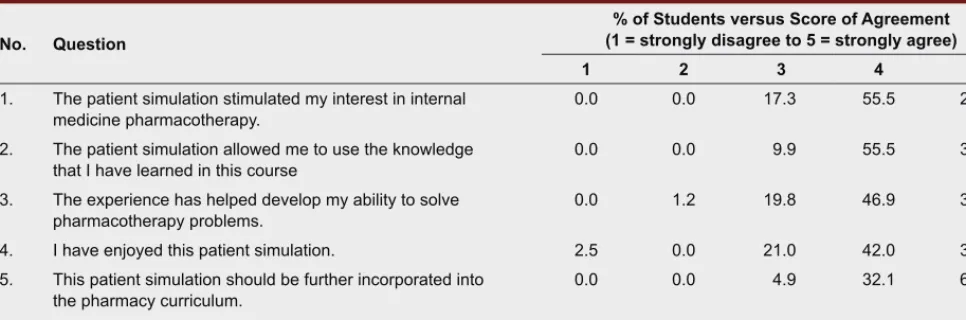
the experience enhanced them to develop skills to solve pharmacotherapy related problems. Up to 76.5% of the cohort enjoyed the pharmacotherapy simulation session. Majority (95.1%) of the students agreed that simulation session should be largely incorporated into the pharmacy curriculum. Most of the students (92.6%) agreed that the presence of facilitator is helpful in the simulation process. Table 1 and 2 summarise the students’ response to each question on the survey instrument.
DISCUSSION
Part of successful knowledge dissemination depends on the teaching and learning techniques. Therefore, performance-based teaching techniques have been
intro-duced in heath care education for decades. Accordingly,
the assessment methods of these teaching techniques and their psychometric characteristics have been estab-lished and extensively evaluated.7 These teaching and
assessment methods include written clinical simulations, computer-based clinical simulations, oral examinations, standardised patients and mannequin-based patient simulator. These techniques rapidly evolve with the fast development in electronic and computer technologies.
As such, traditional methods of teaching like didactic
lecture are becoming less popular. More high education institutions prefer to deliver the information through student-centred approaches or performance-based teaching. These methods of teaching are believed to improve student motivation and self learning strategy. Thus, these will directly increase the success of
knowl-edge delivery. A simulator-based learning has been
recognised as a valuable educational tool in medical
Table 1: Student’s Opinion on the Education and Practice of Clinical Pharmacy Prior to the Simulation Session
No. Question
% of Students versus Score of Agreement (1 = strongly disagree to 5 = strongly agree)
1 2 3 4 5
1. Clinical Pharmacy is an interesting area of pharmacy. 1.2 0.0 17.3 38.3 48.2
2. Pharmacotherapy course is easy to understand. 1.2 9.9 59.3 29.6 0.0
3. I believed I will be able to provide clinical pharmacy
undergraduate education.8 Simulation-based learning
gives an opportunity to students to apply their theoreti-cal knowledge in an almost realistic setting.
Previously, the Faculty of Pharmacy UKM only adopted didactic lectures, laboratory practicals, tutorials, problem-based learning sessions and ward attachments as the methods of teaching and learning. The weak-nesses of the latter method include sudden frighten-ing exposure to the clinical environment, drug related problems are commonly learnt as theory and a very minimal hands-on experiences. We believed that all these weaknesses would compromise the competency
and confidence of pharmacists produced.
Although most of the students agreed that clinical
pharmacy is an interesting area of pharmacy, more than half of the students thought that pharmacotherapy is
difficult to learn. This negative perception may influ -ence the student interest in exploring further knowledge regarding pharmacotherapy or clinical pharmacy. Thus, the simulation laboratory was established to provide students with experiential learning and to enhance their
interest and self-efficacy in pharmacotherapy. This is
hoped to improve student motivation to learn the
phar-macotherapy management. Self-efficacy is defined as
“an individual’s judgments of his or her capabilities to perform given actions”.9 The students’ motivation may
be enhanced if the students become aware that they are making progress in learning. This realisation can be demonstrated in the simulation learning process. The students’ may also identify their lacking in theoretical knowledge while carrying out the simulation task. This may help the students to identify areas of weaknesses for them to focus in pharmacotherapy and to con-tinue working to improve and become more skillful.
Accordingly, the students will maintain a sense of self-efficacy for performing well.10
The students believed that the simulation session has improved their understanding on the theoretical part
of the pharmacotherapy. The majority of students also felt that their interest in internal medicine pharmaco-therapy has been enhanced. Comparable with previous study, 90% of students felt that mannequin-simulation based learning represented better clinical patient care experience.2 The perception that they comprehend their
study material enhances self-efficacy and motivation.10
The student involvement in the simulation experience requires quantity and quality of physical and
psychologi-cal energy. According to the education theory, the greater
the students’ involvement in their study, the greater will be the amount of student learning and personal development.11 Through our observation and the
assess-ment of written report, the simulation session not only enhanced the students’ knowledge regarding pharmaco-therapy but also developed their imperative generic skills that are required to be competent pharmacists. These generic skills include interpersonal communication,
appropriate response to specific clinical problems, time
management, team work and ethical practice. The devel-opment of skills in solving clinical problems and team work was similarly observed by previous study.2
CONCLUSION
This article has demonstrated the usefulness of mannequin-based simulation learning in pharmaco-therapy for pharmacy students. The students value simulation-based learning as effective and interesting. The patient simulator is a valuable educational tool in pharmacy undergraduate education.
REFERENCES
1. Hassan Y. Challenge to clinical pharmacy practice in Malaysia. Ann Pharmacother 1993; 27:1134–8.
2. Fernandez R. Parker D, Kalus JS, et al. Using a Human Patient Simulation Mannequin to Teach Interdisciplinary Team Skills to Pharmacy Students. Am J Pharm Educ 2007; 71:51.
3. Guidelines on Approval and Recognition of A Pharmacy Programme. The Pharmacy Board of Malaysia. Ministry of Health Malaysia. [cited
Table 2: Student’s Opinion on the Clinical Pharmacy Simulation Session
No. Question
% of Students versus Score of Agreement (1 = strongly disagree to 5 = strongly agree)
1 2 3 4 5
1. The patient simulation stimulated my interest in internal
medicine pharmacotherapy. 0.0 0.0 17.3 55.5 27.2
2. The patient simulation allowed me to use the knowledge
that I have learned in this course 0.0 0.0 9.9 55.5 34.6
3. The experience has helped develop my ability to solve
pharmacotherapy problems. 0.0 1.2 19.8 46.9 32.1
4. I have enjoyed this patient simulation. 2.5 0.0 21.0 42.0 34.5
5. This patient simulation should be further incorporated into
the pharmacy curriculum. 0.0 0.0 4.9 32.1 63.0
2012 March 1st]. Available from http://www.pharmacy.gov.my/index.
cfm?&menuid=62&parentid=10.
4. Seybert AL, Laughlin KK, Benedict NJ, Barton CM, Rea RS. Pharmacy Student Response to Patient-Simulation Mannequins to Teach Performance-based Pharmacotherapeutics. Am J Pharm Educ 2006; 70:article 48. 5. Rodgers PL, Jacob H, Rashwan AS, et al. Quantifying learning in medical
students during a critical care medicine elective: A comparison of three evaluation instruments. Crit Care Med 2001; 29:1268–73.
6. Cohen L, Manion L, Morrison K. Research Methods in Education. London: Routledge Falmer, London; 2000.
7. Swanson DB, Norman GR, Linn RL. Performance-based assessment: Lessons from the health professions, Educ Researcher 1955; 24:5–11. 8. Weller JM. Simulation in undergraduate medical education: bridging the gap
between theory and practice. Med Educ 2004; 38:32–8.
9. Schunk DH. Self-efficacy and academic motivation. Educ Psychol 1991;
26:207–31.
10. Schunk DH. Self-efficacy and cognitive skill learning, Research on motivation
in education: goals and cognitions. 3rd vol., San Diego: Academic; 1989. 11. Astin AW. Student Involvement: A Developmental Theory for Higher