Volume 15 | Issue 1 Article 32
5-1-2016
New Procedures of Estimating Proportion and
Sensitivity Using Randomized Response in a
Dichotomous Finite Population
Tanveer A. Tarray
School of Studies in Statistics, Vikram University Ujjain - M.P. - India., [email protected]
Housila P. Singh
School of Studies in Statistics, Vikram University Ujjain, M.P., India, [email protected]
Follow this and additional works at:http://digitalcommons.wayne.edu/jmasm
Part of theApplied Statistics Commons,Social and Behavioral Sciences Commons, and the
Statistical Theory Commons
Recommended Citation
Tarray, Tanveer A. and Singh, Housila P. (2016) "New Procedures of Estimating Proportion and Sensitivity Using Randomized Response in a Dichotomous Finite Population,"Journal of Modern Applied Statistical Methods: Vol. 15 : Iss. 1 , Article 32. DOI: 10.22237/jmasm/1462077060
Cover Page Footnote
The authors are thankful to the Editor – in- Chief, and to the anonymous learned referee for his valuable suggestions regarding improvement of the paper.
Dr. Tarray is affiliated with the Department of Computer Science and Engineering. Email him at: [email protected]. Dr. Singh is affiliated with the School of Studies in Statistics.
New Procedures of Estimating Proportion
and Sensitivity Using Randomized Response
in a Dichotomous Finite Population
Tanveer A. Tarray Vikram University Ujjain, M. P., India Housila P. Singh Vikram University Ujjain, M. P., India
The problem of estimating the population proportion possessing a sensitive attribute using simple random sampling with replacement (SRSWR) is advocated. Two new procedures are proposed. The suggested models are more efficient than the Huang (2004) randomized response technique under some realistic conditions. Numerical and graphic illustrations are given.
Keywords: Randomized response technique, direct response, estimation of proportion, privacy of respondents, sensitive characteristics
Introduction
Socioeconomic investigations often relate to certain personal features that people desire to hide from others in comprehensive inquiries, detailed questionnaires include numerous items. Direct questioning of respondents about them is likely to result either in non–response or in a deliberately incorrect answer. Social stigma and fear of reprisals often lead respondents to give biased, misleading, or even erroneous responses when approached with a direct response (DR) survey method. Even for the reason of merely being unwilling to reveal secrets to strangers, many individuals attempt to avoid certain questions put to them by interviewers.
Consider a dichotomous population in which every person belongs to either a sensitive group A or to the non–sensitive complement Ac. The aim is to estimate π,
the population proportion of individuals who are members of A. To do so, a simple random sample of size n is drawn from the population with replacement. Let T be the probability that the respondents belong to A report the truth. The respondents
belonging to the non–sensitive group Ac have no reason to tell a lie. For a DR survey
of size n, the interviewee is asked if they are a member of A. Then we have a direct estimator 1 ˆ n i i D X n
(1)with mean square error (MSE) given by
ˆ
1
2
2MSE D D D 1 T n
(2)where Xi = 1(0) if the ith interviewee responds Yes (No) and θD = πT.
To procure reliable sample data for the population proportion of the respondents belonging to the sensitive group A, Warner (1965) proposed an ingenious procedure called Warner’s randomized response technique. This pioneering work led to modification and developments in several directions; for instance, see Fox and Tracy (1986), Mangat and Singh (1990), Mangat (1994), Mahmood, Singh, and Horn (1998), Chua and Tsui (2000), Sing, Singh, and
Mangat (2000), Chang and Huang (2001), Huang (2004), Chang, Wang, and Huang
(2004a, b) and Singh and Tarray (2012, 2013a, b, c, 2014a, b, c, d, e).
Huang (2004) pointed out there are many variants of the randomized response technique in the literature, but most do not dwell on the fundamental question: whether or not the issues considered in the survey should be regarded as sensitive, meaning that there is a need for a randomized response procedure rather than a direct response procedure. In general, the probability T is a measure instrument of the sensitivity (see Huang, 2004). It has a primary use in appraising the efficiency of different survey plans. One may use a simple formula for ascertaining whether a randomized response technique is beneficial in efficiency relative to a DR scheme. However, the probability T is unknown in actual practice. To overcome such a difficulty, Chang and Huang (2001), Huang (2004), and Chang et al. (2004a) have suggested alternative survey strategies which make it possible to estimate the unknown parameters π and T simultaneously. Two alternatives to Huang’s (2004)
A Brief Review of Randomized Response Models
Warner’s ModelsIn order to improve respondent cooperation and to encourage honest response,
Warner (1965) proposed the following procedure, known as a randomized response
technique (RRT). Instead of a DR procedure, a randomization device is used to gather sample information consisting of one of two statements:
(i) “I am a member of group A”
(ii) “I am not a member of group A”
with probabilities P and (1 - P) respectively. Following this device, the respondent selects a statement unobserved by the interviewer, and then simply gives a “Yes”
or “No” answer in a random sample of n respondents. By the method of moments,
Warner obtained an unbiased estimator of the population proportion π possessing
the sensitive attribute A:
1
1 ˆ , 2 1 2 W Y P P P
,where Yi = 1(0) if the ith respond answers Yes (No) and
1 1 2 n i i Y
y . The variance of
ˆW is given by
2 2 1 ˆ V , 2 1 1 1 2 1 W W W n P P P n n P
, (3) where θW = πP + (1 – π)(1 – P). Singh ModelsSingh (1993) developed two randomized response techniques named RRT1 and
RRT1: In this procedure, each interviewee in A with replacement simple random sample of size n is provided with one randomized response device. It consists of the statement “I belong to the sensitive group” with known probability P, exactly the same probability as used by Warner (1965) and the statement “Yes”
with probability (1 – P). The interviewee is instructed to use the device and report “Yes” or “No” for the random outcome of the sensitive statement according to his/her actual status. Otherwise, he is simply to report the “Yes” statement observed on the randomized response device. The whole procedure is completed by the respondent, unobserved by the interviewer. Then θ1, the probability of a “Yes”
answer in the population, is
1 1
S P P
.An unbiased estimator of π due to Singh (1993) is given by
1 1 ˆ 1 ˆ S S P P
,where
ˆS1 is the proportion of “Yes” answers in the sample of size n. The variance of the estimator
ˆS1 is given by
1
1 1 1 ˆ V S P n nP . (4)RRT2: This procedure is exactly like RRT1 except for a change in probabilities on the randomized response device, i.e., the probabilities for the “sensitive” statement and “Yes” statement have been interchanged. The probability of a “Yes” response is then
2
2 ˆ ˆ 1 S S P P
,
2
1 1 ˆ V 1 S P n n P . (5)Huang (2004) showed that his procedure resulted in better performance as
compared to the Warner (1965) and Chang and Huang (2001) procedures.
Huang Model
In this procedure, a simple random sample of size n is drawn with replacement from a finite population. The sampled individuals are required to reply to a direct query as to whether or not they belong to A. When answering “No”, the respondent is provided with a randomization device consisting of two statements:
(i) “I am a member of A”
(ii) “I am not a member of A”
with probabilities P and (1 – P), respectively.
It is assumed that the respondents belonging to A give totally honest responses under the randomized response procedure, but with probability T following the usual direct response procedure. The probability of a “Yes” response in the direct response procedure is given by
1 T
, and in the randomized response procedure by
2 P 1 T 1 P 1 2P 1 P T 1 P
.Huang (2004) suggested the following estimators of π and T respectively as
1 2 ˆ ˆ 1 ˆ 2 1 H P P P and
1 1 2 ˆ 2 1 ˆ ˆ ˆ 1 H P T P P ,where ˆj, the observed proportion of “Yes” answers, is the binomial random variable with parameters n and θj, j = 1, 2. Huang (2004) obtained the variance of
ˆH
as
2 1 1 1 ˆ V 2 1 H P P T n n P
(6)and the MSE of the estimator TˆH, up to terms of order O(n-1), as
2
2 2 1 1 1 ˆ MSE 2 1 H T T P P T T T n n P (7)Proposed Procedures
HRRT1In this procedure, a simple random sample of size n is drawn with replacement from a finite population. The sampled individuals are instructed to answer a direct query as to whether or not he/she belongs A. When answering “No”, the respondent is provided with a randomization device. It consists of the statement “I belong to the sensitive group” with known probability P, exactly the same probability as used by Warner (1965), and the statement “Yes” with probability (1 – P) (Singh 1993, p.
68). The interviewee is instructed to use the device and report “Yes” or “No” for
the random outcome of the sensitive statement according to his/her actual status. Otherwise, they are simply to report the “Yes” statement observed on the randomized response device. The whole procedure is completed by the respondent, unobserved by the interviewer. Then θt1, the probability of a "Yes" answer in the
population, is 1 1 t t T T
And, adopting the randomized response procedure, the respondent gives totally honest responses under the randomized response procedure by
1 2
1 1 1 1 t t t P P P T P P
.Thus the proposed estimators of π and T are given by
1 1 1 ˆ ˆ 1 ˆ t t a P P P
and
1 1 1 2 ˆ ˆ ˆ ˆ 1 t t t P T P P ,respectively, where ˆtj, the observed proportion of “Yes” answers, is the binomial random variable with parameters n and θtj, j = 1, 2. The principal properties of the estimator
ˆa1 are outlined in the following theorem:Theorem 1. The estimator
ˆa1 is unbiased with the variance given by
1
1 1 1 ˆ V a P T n nP (8)Proof. The unbiasedness follows from E
ˆtj
tj, j1, 2. The variance of the estimator
ˆa1 can be obtained as follows:
2 1 2 1 2 1 2 2 1 1 2 2 1 2 2 2 2 2 2 1 2 1 2 1 2 2 2 2 1 2 1 2 2 2 2 1 ˆ ˆ ˆ ˆ ˆ V V V 2 cov , 1 1 2 1 1 2 1 1 1 1 1 1 1 1 1 a t t t t t t t t t t t t t t t t t t t t P P P P P P n n n P P P nP P P nP P P P T nP P T n P Hence the theorem.
An unbiased estimator of the variance V
ˆa1 can easily be obtained, whichis given as follows:
Theorem 2. The unbiased estimator of V
ˆa1 is given by
1
1
1 1
1 ˆ ˆ 1 1 ˆ 1 ˆ ˆ V 1 1 a a a a a P n n P (9)To form an idea about the sampling fluctuation of the direct estimator
ˆD from the sample itself, one has to develop an estimator of MSE
ˆD . In fact, with the help of the proposed procedure, one can find an unbiased estimator of the MSE of
ˆa1, which is presented in the following theorem:
2 1 1 1 1 1 2 1 1 1 1 2 1 ˆ 1 2 ˆ ˆ ˆ ˆ ˆ ˆ ˆ MSE 1 V 1 ˆ 2 ˆ ˆ ˆ ˆ Vˆ ˆ 1 t D t a a a t t a t t a P n p P P n P Proof. The proof is straightforward and is therefore omitted.
To obtain the bias and MSE of the estimator ˆT , we write d1P
ˆ1 and
2 ˆ1 ˆ2 1
d P
P , and it follows that E(d1) = PπT and E(d2) = πP. Theestimator ˆT can then be represented as Tˆd d1 2, and we have T = E(d1)/ E(d2).
Furthermore, we define the following quantities:
1 1 1 1 E E d d e d and
2 2 2 2 E E d d e d ,assuming that |e1| < 1 so that the function (1 + e2)-1 can be validly expanded as a
power series. It can be easily proved that
1 1 1 1 1 2 1 2 2 2 1 1 2 1 1 2 2 1 2 2 2 2 2 1 1 1 2 1 2 2 1 1 1 E , 1 1 2 E , 1 E t t t t t t t t t t t t t t t t t e n n n T P P e nP P e e nP T
1 1 1 2 1 2 1 1 2 1 1 2 1 2 1 1 2 1 ˆ (1 ) 1 (1 ) 1 (1 ) ˆ ( ) o t t t P P e T T T P e P T e e T P T e e T T T T e e n
We then state the following theorem:
Theorem 4. The MSE of the estimator Tˆ1, up to terms of order o(n−1), is given
by
2
1 2 1 1 1 ˆ MSE T T T P T T n nP (10) Proof. Consider
2 1 1 2 2 2 1 1 2 2 1 1 1 2 1 1 2 2 2 2 2 2 1 1 2 2 1 2 2 2 2 2 1 1 1 2 2 2 2 2 2 2 2 2 2 1 2 2 2 ˆ ˆ MSE E E 2 E E 2 1 1 1 1 2 1 1 2 1 1 1 t t t t t t t t t t t t t t t t t t t t T T T T e e e e P T T P T n P P P T T T n T PT P P T T T n P
2 1 2 2 2 2 2 2 1 1 1 1 1 1 t P T t T T P T T T T P T n P
2
2 1 1 1 T T P T T n nP Hence the theorem.
HRRT2
In this proposed method, a simple random sample of size n is drawn with replacement from a finite population. The sampled individuals are required to reply a direct query as to whether or not they belong to A. When answering “No”, the respondent is provided with a randomization device consisting of the statement “I belong to the sensitive group” with known probability (1 – P), exactly the same probability as used by Warner (1965), and the statement “Yes” with probability P (Singh 1993, p. 68). The interviewee is instructed to use the device and report “Yes”
or “No” for the random outcome of the sensitive statement according to his/her actual status. Otherwise, they are simply to report the “Yes” statement observed on the randomized response device. The whole procedure is completed by the respondent, unobserved by the interviewer. The probability of a "Yes" answer in the population is then
1
t T
and in the randomized response procedure is
3 1 1
t P T P
.The proposed estimators of π and T are given by
1 3 2 ˆ ˆ 1 ˆ 1 t t a P P P and
1 2 1 3 ˆ 1 ˆ ˆ ˆ 1 t t t P T P p ,where
ˆt1 and
ˆt3 are the observed proportion of “Yes” answers. The principal properties of the estimator
ˆa2 are outlined in the following theorem:Theorem 5. The estimator
ˆa2 is unbiased with variance given by
2
1 1 ˆ V 1 a P T n n P (11)Proof. The unbiasedness follows from E
ˆt1
t1 and E
ˆt3
t3. The variance of the estimator
ˆa2 can be obtained as follows:
2 2 2 1 3 1 3 2 2 1 3 1 3 2 2 2 1 ˆ ˆ ˆ ˆ ˆ V 1 V V 2 1 cov , 1 1 1 1 1 1 1 1 1 1 1 1 1 1 2 1 a t t t t t t t t P P P P P n P P P P T n P P T P
Hence the theorem.
An unbiased estimator of the variance V
ˆa2 can easily be obtained, which is given in the following theorem.Theorem 6. The unbiased estimator of V
ˆa2 is given by
2
2
2 1
2 ˆ ˆ 1 ˆ 1 ˆ ˆ V 1 1 1 a t a a a P n n P .To form an idea about the sampling fluctuation of the direct estimator
ˆD2 from the sample itself, one has to develop an estimator of MSE
ˆa2 . In fact, withthe help of the proposed procedure, one can find an unbiased estimator of the MSE of
ˆD2, which is presented in the following theorem.Theorem 7. The unbiased estimator of MSE of
ˆD2 is given by
1 1 2 2 2 2 1 1 2 1 3 2 ˆ 2 ˆ ˆ ˆ ˆ ˆ ˆ ˆ MSE 1 V 1 1 ˆ 2 ˆ ˆ 1 1 ˆ ˆ Vˆ ˆ 1 1 t D t a a a t t a t t a P n P P P n P Proof. The proof is straightforward and omitted.
Now to obtain the MSE of Tˆ2 , we define d1*
1 P
ˆt1 and
*
2 1 ˆt1 ˆt3
d P
P . It follows that E
d1*
1 P
T and
*
2 1 3
E d 1P t t P . The estimator Tˆ2 can then be represented as
* * 2 1 2
ˆ
T d d , and we therefore have T E
d1* E d2* . We then define the following quantities:
* * 1 1 * 1 * 1 E E d d e d and
* * 2 2 * 2 * 2 E E d d e d ,assuming that |e1| < 1 so that the function (1 + e2)-1 can be validly expanded as a
1 1 1 1 *2 1 2 2 2 1 2 1 1 3 3 1 3 *2 2 2 2 1 1 1 3 * * 1 2 2 1 1 E 1 1 1 2 1 E 1 1 1 E 1 t t t t t t t t t t t t t t t e n n T P P e n P P e e n T P
and the estimation error of the estimator Tˆ2 can be expressed as
* 1 1 1 3 2 * 2 1 * * 1 2 1 * * 1 2 * * 1 2 2 1 2 1 1 ˆ 1 1 1 1 1 1 1 1 ˆ o t t t P P e T T T P e P T e e T P T e e T T T T e e n Theorem 8. The MSE of the estimator Tˆ2, up to terms of order o(n−1), is given
by
2
2 2 1 1 ˆ MSE 1 T T PT T T n n P
(12) Proof.
2 2 2 2 2 * * 1 2 2 *2 * * *2 1 1 2 2 ˆ E ˆ E E 2 E E MSE T T T T e e T e e e e
1 1 1 3 1 1 2 2 2 2 2 1 1 3 3 1 3 2 2 2 2 2 1 3 1 3 2 2 2 2 2 2 2 2 1 1 1 1 1 1 1 2 1 1 1 1 1 1 1 1 1 1 1 1 1 1 t t t t t t t t t t t t t t t t P T P T T n P P P T T T n T P T P T T T T T P n P P T T T n
2 2 2 2 2 2 2 2 2 2 2 2 1 1 1 1 1 1 1 1 1 1 1 1 1 1 1 1 1 1 1 T T T T T PT P P T T T T T T PT n P P T T T T P PT n P P T T PT T n P
Hence the theorem.
Theoretical Comparisons
Comparisons of the proposed estimators
ˆa1 and
ˆa2 with Warner’s estimator
ˆW From (3) and (8),
1 2 2 2 2 2 1 1 1 ˆ ˆ V V 2 1 1 2 1 1 2 1 2 1 W a P P t n P P P P P P T P n P P
(13)which is positive if
23P 1 1 P 1 T 2P 1 0
. (14)
The condition (14) is always true as long as P > 1/3. Thus the proposed estimator is more efficient than the Warner’s (1965) estimator
ˆW if P > 1/3.It is further observed from (3) and (11) that V
ˆW V
ˆa2 0 if
2 2 2 1 2 1 1 0 2 1 1 P P P T n P P ,i.e. if [P(2 − 3P) + (2P – 1)2π(1 + T)] > 0, which is always true if P < 2/3. Thus the
proposed estimator
ˆa2 is better than Warner’s (1965) estimator as long as P < 2/3.Comparisons of the proposed estimators
ˆ ,a1 Tˆ1
with Huang’sestimator
ˆ ,H TˆH
From (7) and (8),
2 2 1 2 2 2 2 2 1 1 ˆ ˆ V V 2 1 2 1 1 1 3 1 1 2 1 2 1 3 1 1 1 3 1 1 2 1 2 1 H a P T P P n P P P P T P P P nP P P P P T P P P nP P
(15) which is positive if
2
3P 1 1 P T 3P 1 1 P 2P 1 0 ,i.e. if either
2 2 3 1 1 1 , and 3 3 1 1 2 1 2 1 3 1 1 P P P P P T P P T P P (16) or
2 2 3 1 1 1 , and 3 3 1 1 2 1 2 1 3 1 1 P P P P P T P P T P P (17)Thus the proposed estimator
ˆa1 is more efficient than Huang’s (2004) estimatorˆH
as long as either inequality (16) or (17) is satisfied.We note from (15) that the difference V
ˆH V
ˆa1 is always positive if
2 2 2 1 0 3 1 1 0 P P P P i.e. if 1 3 P , (18)which is a sufficient condition for the proposed estimator
ˆa1 to be more efficient than Huang’s (2004) estimator
ˆH.
2 2 1 2 2 2 2 2 2 2 2 2 2 2 1 1 1 1 ˆ ˆ MSE MSE 2 1 1 1 1 2 1 1 1 2 1 1 2 1 H P P T T P T T T nP n P P T P T T n P P P T P T P T n P
which is positive if
2 2 2 2 2 2 2 2 2 2 2 2 1 2 1 1 0 2 1 1 2 1 0 2 1 2 1 2 1 0 3 1 1 3 1 1 2 1 0 P T P T P P TP T P P P T P P P P P T P P P i.e. if either
2
3 1 1 1 , 3 2 1 3 1 1 P P P P P P T (19) or
2
3 1 1 1 , 3 2 1 3 1 1 P P P P P P T . (20)It follows that the proposed estimator Tˆ1 is better than Huang’s (2004) estimator
ˆ
H
Comparisons of the proposed estimators
ˆa2 and Tˆ2 with Huang’s estimator
ˆ ,H TˆH
From (6) and (11),
2 2 2 2 1 1 ˆ ˆ V V 1 2 1 3 2 2 1 3 2 1 2 1 H a P P P T n P n P P TP P P P P n P P
Which is positive if either
2
3 2 2 , 3 2 1 3 2 P P P P P P T (21) or
2
3 2 2 , 3 2 1 3 2 P P P P P P T . (22)Thus the proposed estimator
ˆa2 is better than Huang’s (2004) estimator TˆH if either (21) or (22) holds.From (18) it is further observed that the different V
ˆH V
ˆa2 is alwayspositive if 2 – 3P > 0, i.e. if
2 3
P . (23)
The condition (23) is sufficient for the proposed estimator
ˆa2 to be better than Huang’s(2004) estimator TˆH.
2 2 2 2 2 2 2 2 1 1 1 ˆ ˆ MSE V 1 2 1 2 3 2 3 2 1 1 2 1 H P T T PT T T n P P PT P P P P T P n P P
which is positive if either
2 2 3 2 , 3 2 3 2 1 P P P P P T P P (24) or
2 2 3 2 , 3 2 3 2 1 P P P P P T P P . (25)It follows that the proposed estimator Tˆ2 is more efficient than Huang’s (2004) estimator TˆH if either (24) or (25) is satisfied.
Comparisons of the proposed estimators
ˆ ,a2 Tˆ1
with the proposed estimators
ˆ ,a2 Tˆ2
From (7) and (11),
2
1
1 2 1 ˆ ˆ V V 1 a a T P nP P ,which is positive if either
1 1
,
1 T P 2
1 1 ,
1 T P 2
(27)
Thus the proposed estimator
ˆa1 is more efficient than the proposed estimator
ˆa2 if either (26) or (27) is satisfied.Further, the difference V
ˆa2 V
ˆa1 0 if
1 2 1 0 1 T P nP P i.e. if [1 – π(1 + T)](2P – 1) < 0, 1 1 , 1 T P 2
(28) or 1 1 , 1 T P 2 (29)It follows from the above that the proposed estimator
ˆa2 is more efficient than the suggested estimator ˆa1 if either (28) or (29) is satisfied.From (10) and (12) we have
2
1 22
1 ˆ ˆ MSE MSE 1 1 P T P T T T n
P P ,which is positive if P2 – (1 – P)2 > 0, i.e. if
1 2
P . (30)
Thus if P > 1/2 holds, the proposed estimator Tˆ1 is better than the estimator Tˆ2. On
Comparisons of the proposed estimators
ˆa1,ˆa2
with direct estimator ˆD.From (2) and (7) we have
2 2 1 1 1 1 ˆ ˆ V V 1 1 1 D a nP T T T P nP P P T
which is greater than zero if
2 2 1 1 1 1 1 0 nP T T T P P P T i.e. if
2 2 1 1 1 1 1 1 n P T T P T P
T
i.e. if
2
2 1 1 1 1 , 1 1 T n P T P T P T . (31)Thus the proposed estimator
ˆa1 is more efficient than the direct estimator ˆD if the inequality (31) holds.From (2) and (11) we have
2 2 2 1 1 1 1 1 ˆ ˆ MSE MSE 1 1 1 1 D a n P T T T P n P P P T
,which is greater than zero if
2
2
1 1 1 1 1 1 1 0
2 2 2 2 2 2 1 1 1 1 1 1 1 1 1 1 1 1 1 1 1 1 1 1 1 1 n P P T P T T P T n P T T P T P T T n P T P P T
i.e. if
11T
. (32)It follows that the proposed estimator ˆa2 is more efficient than the direct estimator
ˆD
if the condition (32) holds.
Numerical Illustration
This illustration is provided to give a tangible idea about the magnitude of the relative efficiency of the suggested procedures with respect to the Huang (2004) and direct estimator procedures. The percent relative efficiency (PRE) of the proposed estimators
ˆa1,ˆa2
in relation to the Huang (2004) estimator
ˆH are given by
2 1 2 2 1 1 1 1 ˆ ˆ PRE , 100 2 1 1 1 1 a H P P P P T P P P T (33) and
2 2 2 1 2 1 1 1 1 ˆ ˆ PRE , 100 2 1 1 1 1 a H P P P P T P P P T , (34)respectively. The PRE of the proposed estimators
T Tˆ ˆ1, 2 with respect to the Huang (2004) estimator TˆH are given by
1
2
2
1 2 1 1 1 ˆ ˆ PRE , 100 2 1 1 1 1 H P T P P P T T T T P T P P T T (35) and
2
2
2
1 1 2 1 1 1 ˆ ˆ PRE , 100 2 1 1 1 1 H P T P TP P T T T P T P PT T , (36)respectively. The expression for PRE of the proposed estimators
ˆa1, ˆa2
inrelation to the direct estimator ˆD are given by
2 2 1 1 1 ˆ ˆ PRE , 100 1 1 1 a D P T T n T P P T (37) and
2 2 2 1 1 1 ˆ ˆ PRE , 100 1 1 1 a D P T T n T P P T , (38)respectively. For comparing the two proposed procedures, we give the PRE of
ˆ ,a1 Tˆ1
with respect to
ˆ ,a2 Tˆ2
as
1 2
1 1 1 ˆ ˆ PRE , 100 1 1 1 1 a a P P P T P P T P
(39) and
2
1 2 2 1 1 1 ˆ ˆ PRE , 100 1 1 1 1 P P T T PT T T T P T T P T T P
, (40)respectively. We have further obtained the expressions for PRE of the proposed estimators
ˆ ,a2 Tˆ2
with respect to
ˆ ,a1 Tˆ1
, given by
2 1
1 1 1 1 ˆ ˆ PRE , 100 1 1 1 a a P P P T P P P T
(41) and
2
2 1 2 1 1 1 1 ˆ ˆ PRE , 100 1 1 1 P P T T P T T T T P P T T PT T
, (42) Respectively.Using the formulae (33)-(42), we have computed
(i) The PRE
ˆa1, ˆH
and PRE
T Tˆ ˆ1, H
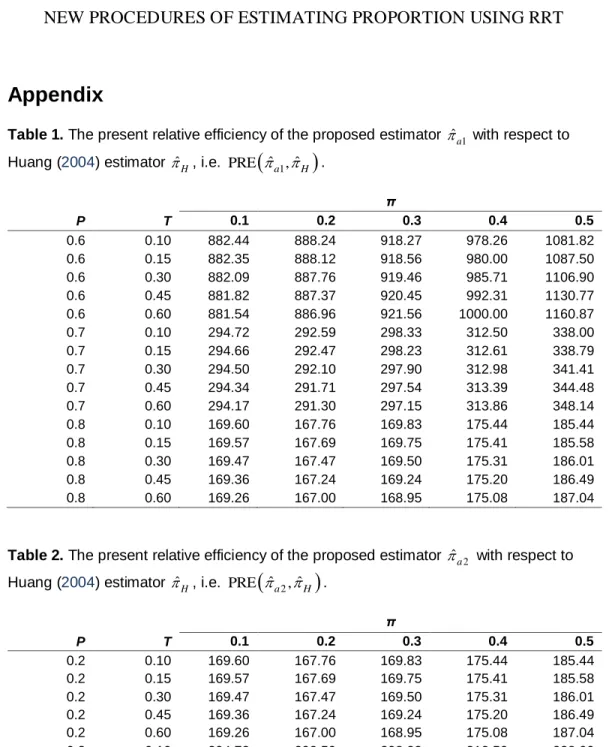
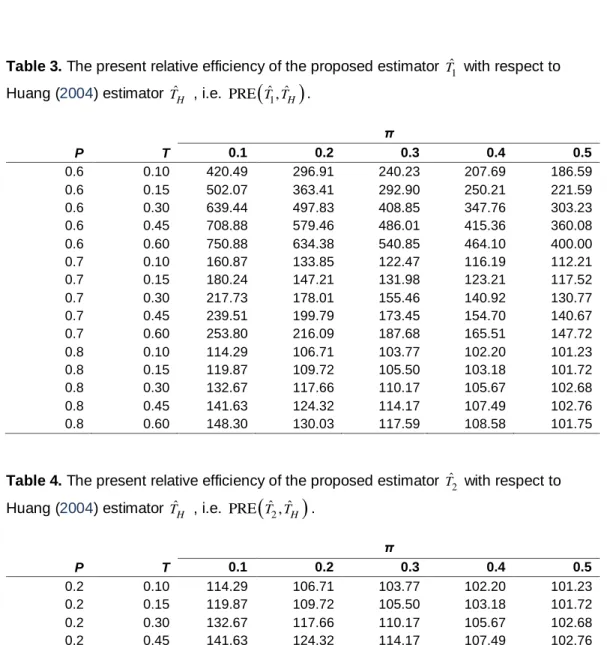
for the values of P = 0.6, 0.7, 0.8; T = 0.10, 0.15, 0.30, 0.45, 0.60; and π = 0.1 (0.1) 0.9. The results are displayed in Tables 1 and 3.(ii) The PRE
ˆa2, ˆH
and PRE
T Tˆ ˆ2, H
for the values of P = 0.20, 0.30, 0.40; T = 0.10, 0.15, 0.30, 0.45, 0.60; and π = 0.1 (0.1) 0.9. The results are shown in Tables 2 and 4.(iii) The PRE
ˆa1, ˆD
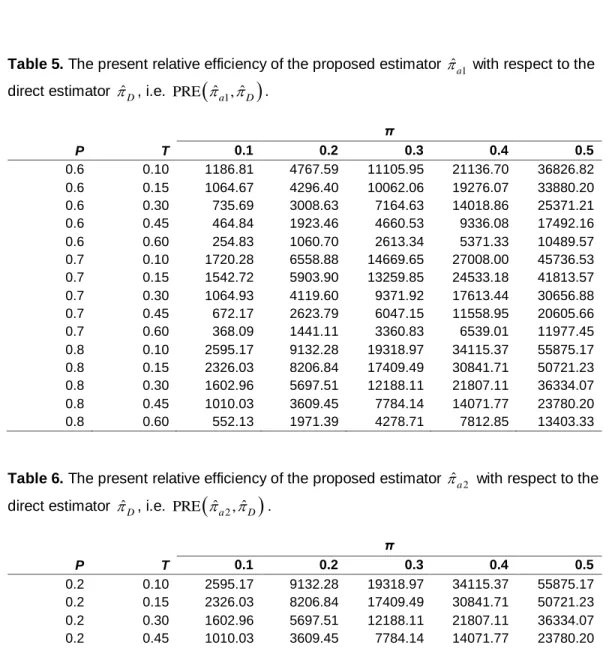
for the values of P = 0.60, 0.70, 0.80; T = 0.10, 0.15, 0.30, 0.45, 0.60; π = 0.1 (0.1) 0.9; and n = 1000. The findings are displayed in Table 5.(iv) The PRE
ˆa2,TˆD
for the values of P = 0.2, 0.30, 0.40; T = 0.10, 0.15, 0.30, 0.45, 0.60; π = 0.1 (0.1) 0.9; and n = 1000. The findings are displayed in Table 6.(v) The PRE
ˆa1, ˆa2
and PRE
T Tˆ ˆ1, 2
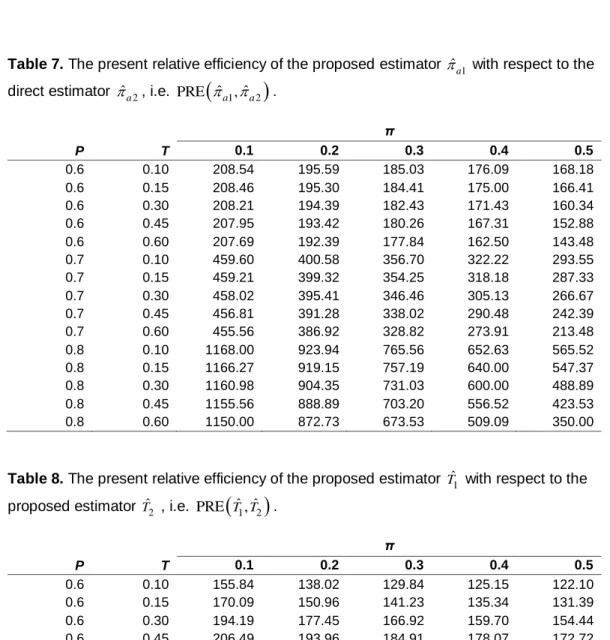
for the values of P = 0.6, 0.7,0.8; T = 0.10, 0.15, 0.30, 0.45, 0.60; and π = 0.1 (0.1) 0.9. The findings are displayed in Tables 7 and 8.
(vi) The PRE
ˆa2, ˆa1
and PRE
T Tˆ ˆ2, 1
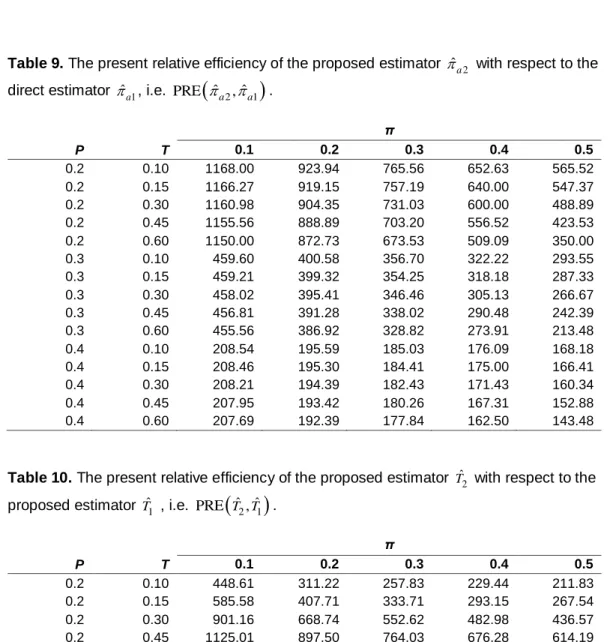
for the values of P = 0.20, 0.30, 0.40; T = 0.10, 0.15, 0.30, 0.45, 0.60; and π = 0.1 (0.1) 0.9. The results are displayed in Tables 9 and 10.Tables 1 and 3 show that the values of PRE
ˆa1, ˆH
and PRE
T Tˆ ˆ1, H
are larger than 100, showing that
ˆH is more efficient than
ˆa1 and that Tˆ1 is also superiorto TˆH . It is observed that, for fixed values of (P, T), the
ˆ 1 ˆ
ˆ ˆ1
PRE
a , H PRE T T, H decreases (increases) as π increases (decreases) slowly (rapidly). For fixed values of (T, π), both PRE
ˆa1, ˆH
and PRE
T Tˆ ˆ1, H
decrease in a speedy manner as P increases. Thus a larger gain in efficiency by using
ˆa1
Tˆ1 over
ˆH
TˆH is expected when P is close to 0.5.Tables 2 and 4 exhibit that
For fixed values of (P, T), the PRE
ˆa2, ˆH
PRE
T Tˆ ˆ2, H
increases (decreases) as π increases (decreases)
PRE
ˆa2, ˆH
PRE
T Tˆ ˆ2, H
decreases (increases) slowly (rapidly) as T increases (decreases) Both PRE
ˆa2, ˆH
and PRE
T Tˆ ˆ2, H
increase in a speedy way as P increasesHence higher gain in efficiency by using ˆa2
Tˆ2 is observed when (P, π) arecloser to 0.5. It is further observed from Tables 2 and 4 that the values of
ˆ 2 ˆ
PRE
a , H and PRE
T Tˆ ˆ2, H
are greater than 100, from which it follows that the envisaged estimators
ˆ ,a2 Tˆ2
are more efficient than Huang’s (2004)estimators
ˆ ,H TˆH
.It is observed from Table 5 that
For fixed (P, π), the PRE
ˆa1, ˆD
decreases as T increases For fixed (T, π), the PRE
ˆa1, ˆD
increases as P increasesThere is substantial gain in efficiency through use of the proposed estimator ˆa1 over direct estimator ˆD for all values of (P, π, T) considered here.
It is observed from Table 6 that
For fixed (P, T), the PRE
ˆa2, ˆD
increases as π increases For fixed (P, π), the PRE
ˆa2, ˆD
decreases as T increases For fixed (T, π), the PRE
ˆa2, ˆD
increases as P increasesThere is substantial gain in efficiency through use of the proposed estimator ˆa2 over direct estimator ˆD for all values of (P, π, T) considered here.
Tables 5 and 6 clearly demonstrate the superiority of the proposed estimators
1
ˆa
and ˆa2 over the usual direct estimator ˆD as the values of PRE
ˆa1, ˆD
and
ˆ 2 ˆ
PRE
a , D are larger than 100 for all values of (P, π, T) considered.Tables 7 and 8 demonstrate that the values of PRE
ˆa1, ˆa2
and
ˆ ˆ1 2
PRE T T, are greater than 100 for 0.10 ≤T≤ 0.60, 0.10 ≤T≤ 0.50, and P > 1/2. Both PRE
ˆa1, ˆa2
and PRE
T Tˆ ˆ1, 2
increase in a speedy way as Pincreases. Hence higher gain in efficiency by using PRE
ˆa1, ˆa2
and
ˆ ˆ1 2
PRE T T, is observed when (P, π) are closer to 0.5.
It is observed from Tables 9 and 10 that the values of PRE
ˆa2, ˆa1
and
ˆ ˆ2 1
PRE T T, are greater than 100 for 0.10 ≤T≤ 0.60, 0.10 ≤T≤ 0.50, and P < 1/2. Thus the proposed procedures
ˆ ,a2 Tˆ2
are more efficient than theestimators
ˆ ,a1 Tˆ1
. Higher gains in efficiencies are observed for lower values of P (i.e. for the values of P close to zero).Finally we conclude that the proposed procedures are superior to the Huang (2004) procedure and hence the Chang and Huang (2001) procedure, and to the usual direct procedure.
Conclusion
Randomized response procedures are attractive mechanisms for counteracting fears in response and providing with valid statistical inferences concerning a population. The proposed randomized response procedure allows us to estimate the population proportion π unbiasedly and to get an admissible estimator for T, which is an unattainable feature for most of the competing methods. It has been shown theoretically and empirically that the proposed procedures are better than the Warner (1965), Chang and Huang (2001), and Huang (2004) procedures. The unbiased estimators of the MSE are provided for the direct response survey based on the proposed RR techniques. The suggested procedure is therefore recommended for application in survey sampling practice.
References
Chang, H. J. & Huang K. C. (2001). Estimation of proportion and sensitivity of a qualitative character. Metrika, 53(3), 269-280. doi: 10.1007/s001840100109
Chang, H. J., Wang, C. L., & Huang, K. C. (2004a). On estimating the proportion of a qualitative sensitive character using randomized response
sampling. Quality and Quantity, 38(5), 675-680. doi: 10.1007/s11135-005-8105-4
Chang, H. J., Wang, C. L., & Huang, K. C. (2004b). Using randomized response to estimate the proportion and truthful reporting probability in a
dichotomous finite population. Journal of Applied Statistics, 31(5), 565-573. doi:
10.1080/02664760410001681819
Chua, T. C. & Tsui, A. K. (2000). Procuring honest responses indirectly. Journal of Statistics Planning and Inference, 90(1), 107-116. doi: 10.1016/S0378-3758(00)00109-9
Fox, J. A. & Tracy, P. E. (1986). Randomized response: A method of sensitive surveys. Newbury Park, CA: SEGE Publications.
Huang, K. C. (2004). Survey technique for estimating the proportion and sensitivity in a dichotomous finite population. Statistica Neerlandica, 58(1),
75-82. doi: 10.1046/j.0039-0402.2003.00113.x
Mahmood, M., Singh, S. & Horn, S. (1998). On the confidentiality
guaranteed under randomized response sampling: A comparison with several new techniques. Biomedical Journal, 40(2), 237-242. doi:
Mangat, N. S. (1994). An improved randomized response strategy. Journal of the Royal Statistical Society. Series B, 56(1), 93-95.
Mangat, N. S. & Singh, R. (1990). An alternative randomized procedure. Biometrika, 77(2), 439-442. doi: 10.1093/biomet/77.2.439
Sing, S., Singh, R., and Mangat, N. S. (2000). Some alternative strategies to
Moor’s model in randomized response model. Journal of Statistical Planning and
Inference, 83(1), 243-255.
Singh, H. P. & Tarray, T. A. (2012). A stratified unknown repeated trials in
randomized response sampling. Commmunications for Statistical Applications
and Methods, 19(6), 751-759. doi: 10.5351/CKSS.2012.19.6.751
Singh, H. P. & Tarray, T. A. (2013a). A modified survey technique for estimating the proportion and sensitivity in a dichotomous finite population. International Journal of Advanced Scientific and Technical Research, 3(6), 459-472.
Singh, H. P. & Tarray, T. A. (2013b). An alternative to Kim and Warde’s
mixed randomized response model. Statistics and Operations Research
Transactions, 37(2), 189-210.
Singh, H. P. & Tarray, T. A. (2013c). An alternative to Kim and Warde’s mixed randomized response technique. Statistica, 73(3), 379-402.
Singh, H. P. & Tarray, T. A. (2014a). An alternative to stratified Kim and
Warde’s randomized response model using optimal (Neyman) allocation. Model
Assisted Statistics and Applications, 9(1), 37-62.
Singh, H. P. & Tarray, T. A. (2014b). An improved mixed randomized response model. Model Assisted Statistics and Applications, 9(1), 73-87.
Singh, H. P. & Tarray, T. A. (2014c). A dexterous randomized response model for estimating a rare sensitive attribute using Poisson distribution. Statistics & Probability Letters, 90, 42-45. doi: 10.1016/j.spl.2014.03.019
Singh, H. P. & Tarray, T. A. (2014d). A modified mixed randomized response model. Statistics in Transition new series, 15(1), 67-82.
Singh, H. P. & Tarray, T. A. (2014e). An improvement over Kim and Elam stratified unrelated question randomized response model using Neyman
allocation. Sankhya B, 77(1). doi: 10.1007/s13571-014-0088-5
Singh, R. & Mangat, N. S. (1996). Elements of survey sampling (Vol. 15). Dordrecht, Netherlands: Kluwer Academic Publishers.