Address for Correspondence:
Dr. R Ravichandran
Madras Institute of Nephrology, Vijaya Health Center,
N.S.K. salai, Vadapalani, Chennai- 600026.
ARTICLE
24-hours ambulatory blood pressure (ABP)
monitoring in renal transplant recipients
R Ravichandran, SM Rao, T Rengarajan
Madras Institute of Nephrology, Vijaya Health Center, Chennai
Abstract
A prospective study was conducted in post renal transplant (RT) recipients to find out the prevalence of hypertension, the control of hypertension and to determine the correlation between systolic blood pressure through 24 hrs ABP and the serum creatinine level, cyclosporine dosage, the number of antihypertensive drugs used. The prevalence of systolic and diastolic hypertension in post renal transplant patients was 91.9 %. The total average systolic blood pressure, of the 24 hrs ABP recording in post transplant period, positively correlated with the number of antihypertensive drugs used and the serum creatinine level. Only 5 (5.4%) patients were found to be dippers while the remaining 94.6% of them were nondippers. The office blood pressure recording failed to detect hypertension in 25% of them during daytime and in 47% RT recipients in night time when compared with 24 hrs ABP results.
Key words: Continuous ambulatory blood pressure monitoring, Circadian rhythm; Cyclosporine; Renal transplant; Antihypertensives;
Introduction
Hypertension is a well known problem in patients after a successful renal transplantation 15,19,20,21. The long term
out come of the graft depends upon the good control of blood pressure 1,20. Office blood pressure recording may
not reflect 24 hours blood pressure adequately 2,3. 24
hours ambulatory blood pressure (ABP) monitoring has added a new dimension to evaluation of abnormal blood pressure in renal transplant recipients14,15,16,17,18.
The following parameters, in 24 hours ABP readings, were taken into consideration in this study. (1) total average blood pressure, (2) day average blood pressure, (3) day systolic blood pressure > 140 mmHg in %, (4) day diastolic blood pressure > 90 mmHg in %, (5) day maximum of systolic blood pressure, (6) day maximum of diastolic blood pressure, (7) night average blood pressure, (8) night systolic blood pressure > 125 mmHg in %, (9) night diastolic blood pressure > 80 mmHg in %, (10) night maximum of systolic blood pressure, (11) night maximum of diastolic blood pressure, (12) dipper or nondipper status.
Materials and methods
The prospective study involved patients who had undergone successful renal transplantation (3 months and above from the date of renal transplantation) (Table-1) with stable renal function (serum creatinine < 2mg%) and Ambulatory blood pressure study for 24 hrs was studied using mobile-o-graph monitor. Blood pressure measurements were taken every 15 minutes in the daytime and every 30 minutes in the night time. The night interval was set between 10 PM to 6 AM. The
Table 1 - Interval from the date of transplantation
Post Transplant Male Female
period (in yrs)
<1 47 8 1-2 8 4 2-3 3 1 3-4 3 1 5-6 2 6-7 4 8-9 1 1 >9 2
4 8
Copyright © 2001 by The Indian Society of Nephrology
Indian Journal of Nephrology Indian J Nephrol 2002;12: 47-51
daytime blood pressure less than or equal to 140/90 mmHg and the night time blood pressure less than or equal to 125/80 mmHg were considered to be normal
1,9,19. The number of readings falling above the set normal
blood pressure was expressed in percentage. The persons having nighttime dip in the blood pressure were described as nocturnal dippers and the others as nondippers.
Study included 87 transplant patients (72 M, 15 F, mean age 39.7 (± 11.56) years, min age 16 yrs, max age 68 yrs) who underwent ABP monitoring consecutively (Table-2). Number of antihypertensive drugs taken, cyclosporine dosage (mg/kg), serum creatinine value and office blood pressure, at the time of ABP study, were taken into consideration. The number of antihypertensive drugs, which were prescribed before transplantation, was also taken into account.
Results
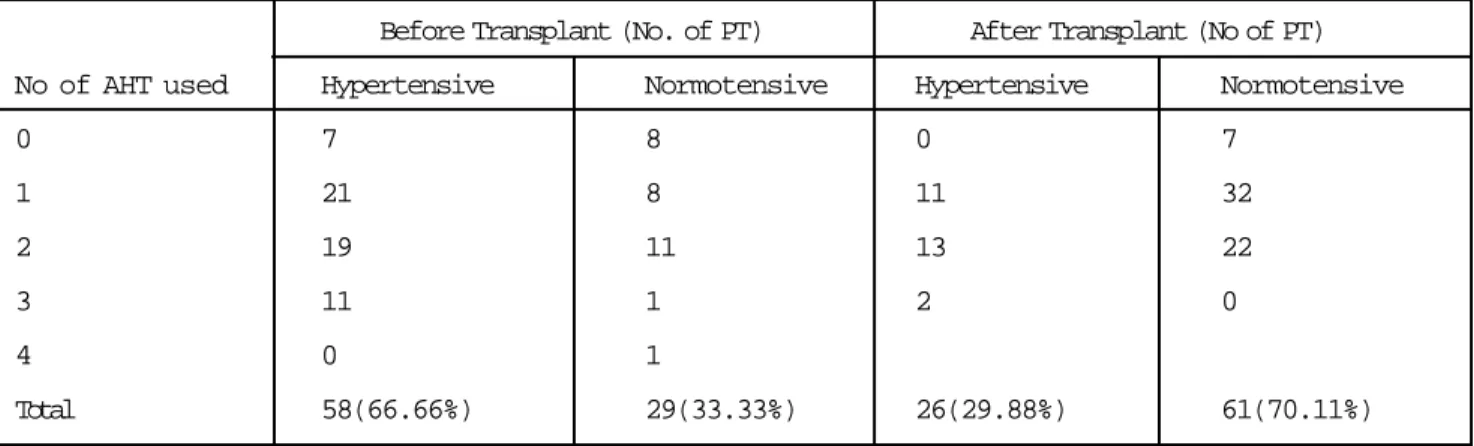
24 Hrs ABP showed 7(8.04%) patients were normotensive without any antihypertensive drugs. Remaining 80 (91.9%) were found to be hypertensive.
Of these 80 hypertensive persons 54 (67.5%) were having BP readings in normotensive range with use of antihypertensive drugs and the remaining 26(32.5%) persons were still having high BP despite use of antihypertensive medications (Table-3).
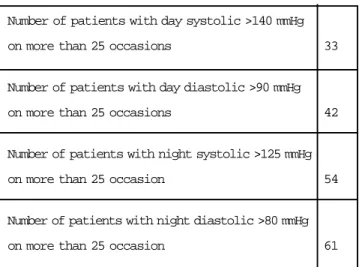
24-hrs ABP revealed that in 13 (39%) patients daytime systolic blood pressure, in 5 (11%) patients daytime diastolic blood pressure remained high on more than 25% of the occasions, though their office blood pressure did not reveal them to be having hypertension.
Similarly, in 34 (39%) patients night time systolic blood pressure, in 41 (47%) patients night time diastolic blood pressure remained high on more than 25% of the occasions that could not be assessed through office blood pressure checkup (Table-4).
Of the 87 patients studied, 7(8%) were not on any antihypertensive, 43(49%) were on single drug, 35(40%) of them were on two drugs, 2(2%) of them on three drugs in post transplant period. Comparatively 15(17%) of them were not put on any drugs, 29(33%) were on single drug, 30(34%) of them on two drugs, 12 (14%) of them on three drugs, 1(1%) of them on four drugs before transplantation (Table-3). Nocturnal dipping was found in 5(5.4%) and the remaining were non-dippers. The mean serum creatinine value was 1.21 mg% with minimum was 0.8 mgs and maximum was 1.9 mg%. Of these 74 had serum creatinine > 1 mg%. The dosage of cyclosporine did not correlate with the number of hypertensive drugs(r= -0.05) used after transplant (statistically not significant). Statistical correlation between the systolic blood pressure after transplant and s.creatinine(r= 0.221, p<0.01) (Fig-1), and the number of anti-hypertensives(r= 0.236, p<0.05) (Fig-2) used were significant. The correlation between the systolic blood pressure (through ABP) and cyclosporine dosage (in mg per kg) (r= 0.066, p<0.05) (Fig-3) was not significant.
Table 2 - Age distribution of transplant patients
Age group (years) Male Female
10-20 1 1 21-30 12 6 31-40 22 4 41-50 22 2 51-60 13 2 61-70 2 0 Total 72 15
Table 3 - Blood pressure control before & after renal transplant
Before Transplant (No. of PT) After Transplant (No of PT) No of AHT used Hypertensive Normotensive Hypertensive Normotensive
0 7 8 0 7 1 21 8 11 32 2 19 11 13 22 3 11 1 2 0 4 0 1 Total 58(66.66%) 29(33.33%) 26(29.88%) 61(70.11%)
5 0
Copyright © 2001 by The Indian Society of Nephrology
Indian Journal of Nephrology Indian J Nephrol 2002;12: 47-51
References
1. Marx MA, Gardner SF, Ketel BL. Diurnal blood pressure variation in kidney-pancreas transplant recipients. Am J Hypertens 1996; 9:823-7.
2. Lingens N, Dobos E, Lemmer B, Schcrer K. Nocturnal blood pressure elevation in transplanted pediatric patients. Kidney Int Suppl 1996; 55:s175-6.
3. Gatzka CD, Schobel HP, Klingbeil AU, Neumayer HH,Schmieder RE. Normalisation of circadian blood pressure profiles after renal transplantation. Transplantation 1995; 59:1270-4.
4. Nakano S, Fukuda M, Hotta F, Ito T, Ishil T, Kitazawa M, Kigoshi T. Uchida K. Reversed circadian blood pressure rhythm is associated with occurrence of both fatal and nonfatal vascular events in NIDDM subjects. Diabetes 1998; 47:1501-6.
5. Poulsen PL, Bek T, Ebbehcsj E, hansen KW, Mogensen CE. 24-h ambulatory blood pressure and retinopathy in normoalbuminuric IDDM patients. Diabetologia 1998; 41:105-10.
6. Equiluz-Bruck S, Schnack c, Kopp HP, Schernthaner G. Nondipping of nocturnal blood pressure is related to urinary albumin excretion rate in patients with type 2 diabetes mellitus. Am J Hypertens 1996; 9:1139-43.
7. Farmer CK,Goldsmith DJ,Quin JD,Dallyn P,Cox J,Kingswood JC, Sharpstone P. Progression of diabetic nephropathy—is diurnal blood pressure rhythm as important as absolute blood pressure level? Nephrol Dial Transplant 1998; 13:635-9.
8. Timo M, Venanzi S, Lolli S, Lippi G, Verdura C, Monarca C, Guerrini E. “Nondipper” hypertensive patients and progressive renal insufficiency: a 3-year longitudinal study. Clin Nephrol 1995; 43:382-7.
9. Baumgart P, Walger P, Gemen S, von Eiff M, Raidt H, Rahn KH. Blood pressure elevation during night in chronic renal failure, hemodialysis and after renal transplantation. Nephron 1991; 57:293-8.
10. Luik AJ, Struijk DG, Gladziwa U,von Olden RW,von Hoof JP, de Leeuw PW, Leunissen KM. Diurnal blood pressure variations in hemodialysis and CAPD patients. Nephrol Dial Transplant 1994; 9:1616-21.
11. Rosansky Sj, Menachery SJ,Wagner CM,Jackson K. Circadian blood pressure variation versus renal function. Am J Kidney Dis 1995; 26:716-21.
12. Rodby RA, Vonesh EF, Korbet SM. Blood pressure in hemodialysis and peritoneal dialysis using ambulatory blood pressure monitoring. Am J kidney Dis 1994; 23:401-11.
Discussion
Blood pressure follows a characteristic pattern throughout the 24 hr cycles with daytime pressures being higher than the night time pressures. In case of chronic renal failure patients managed conservatively or patients on haemodialysis or patients on continuous ambulatory peritoneal dialysis, this nocturnal pattern of blood pressure drop is lost 1,2,19,11,12,13. Patients lacking this
normal nocturnal decrease in blood pressure have a higher incidence of end organ damage 4,5,6,7,8. It is
possible to ascertain this pattern only by 24hr ambulatory
blood pressure monitoring. Following successful renal transplantation several body parameters return to physiological level. However the prevalence of hypertension is high in spite of normally functioning graft
10,11,12,13. Return of the normal circadian rhythm has been
reported only by Gatzka et al 3. Other studies however
have found out that the nocturnal blood pressure continues to be high and standard blood pressure medication do not control the nocturnal blood pressure adequately 1,2,9,7,14.
Our study also shows that only 5.4% of the successfully transplanted patients are dippers. A casual or office blood pressure measurement does not pickup hypertension in a significant number of patients (25% considering day time readings and 47% considering night time readings of ABP). Nocturnal hypertension is specifically missed by office blood pressure measurements, which is revealed by our study and others 1,2,8,9,14,15,16,18. Hence a
good control of blood pressure in post transplant patients would necessitate recording of 24–hour ambulatory blood pressure monitoring.
Several factors may contribute to the high prevalence of hypertension in post renal transplant patients. Cyclosporine has been reported as an important cause of hypertension and for the loss of circadian rhythm 19,21.
Our study also shows loss of circadian rhythm but there was no correlation between blood pressure and cyclosporine dose 1,2,15,16,17,18,19.
Table 4: Hypertensives according to ABP
Number of patients with day systolic >140 mmHg
on more than 25 occasions 33
Number of patients with day diastolic >90 mmHg
on more than 25 occasions 42
Number of patients with night systolic >125 mmHg
on more than 25 occasion 54
Number of patients with night diastolic >80 mmHg
13. Chazot C, Charra B, Laurent G, Didier C, Vo Van C, Terrat JC, Calemard E,Vanel T, Ruffet M. Interdialysis blood pressure control by long hemodialysis sessions. Nephrol Dial Transplant 1995; 10:831-7.
14. McGregor DO, Olsson C, Lynn RL. Autonomic dysfunction and ambulatory blood pressure in renal transplant recipients. Transplantation 2001; 71(9): 1277-81.
15. Kooman JP, christiaans MM, Boots JM, van Der Sande PM, Leunissen KM, van Hooff JP. A comparison between office and ambulatory blood pressure measurements in renal transplant patients with chronic transplant nephropathy. Am J Kidney Dis 2001; 37(6): 1170-6. 16. Giordano V, Matteucci MC, Calzolari A, Turchetta A,
Rizzoni G, Alpert BS. Ambulatory blood pressure monitoring in children with coarctation and kidney transplantation. Journal of Pediatrics 2000; 136(4): 520-3.
17. Calzolari A, Giordano V, Matteucci MC, Pastore E, Turchetta A, Rizzoni G, Alpert B. Hypertension in young patients after renal transplantation: ambulatory blood
pressure monitoring versus casual blood pressure; American journal of hypertension. 1998;11(4 Pt 1): 497-501.
18. Lingens N, Dobos E, Witte K, Busch C, Lenner B, Klaus G, Scharer K. Twenty-four-hour ambulatory blood pressure profiles in pediatric patients after renal transplantation. Pediatric Nephrology 1997; 11(1): 23-6.
19. Soergel M, Maisin A, Azancot-Benisty A, Loriat C. [Ambulatory blood pressure measurement in children and adolescents with kidney transplants]. [German]. Zeitschrinft fur Kardiologie, Blood supplement, 1992, 2:67-70.
20. Sobotova D, Zharfbin A. [Hypertension after kidney transplantation]. [czech]. Vnitrni Lekarstvi 1999; 45(11): 645-9.
21. Van den Dorpel MA, van den Meiracker AH, Lameris TW, Boomsma F, Levi M., Man in ‘t Veld AJ, Weimar W, Schalekamp MA. Cyclosporine impairs the nocturnal blood pressure fall in renal transplant recipients. Hypertension, 1996 Aug, 28(2): 304-7.