QoE-Centric Control and Management of Multimedia Services
in Software Defined and Virtualized Networks
by
ALCARDO ALEX BARAKABITZE
A thesis submitted to the University of Plymouth in partial fulfilment for the degree of
DOCTOR OF PHILOSOPHY
School of Engineering, Computing and Mathematics
Copyright Statement
This copy of the thesis has been supplied on condition that anyone who consults it is understood to recognise that its copyright rests with its author and that no quotation from the thesis and no information derived from it may be published without the author’s prior consent.
Abstract
Multimedia services consumption has increased tremendously since the deploy-ment of 4G/LTE networks. Mobile video services (e.g., YouTube and Mobile TV) on smart devices are expected to continue to grow with the emergence and evolution of future networks such as 5G. The end user’s demand for services with better quality from service providers has triggered a trend towards Quality of Experience (QoE) - centric network management through efficient utilization of network resources. However, existing network technologies are either unable to adapt to diverse changing network conditions, or limited in available resources. This has posed challenges to service providers for provisioning of QoE-centric multimedia services.
New networking solutions such as Software Defined Networking (SDN) and Network Function Virtualization (NFV) can provide better solutions in terms of QoE control and management of multimedia services in emerging and future networks. The features of SDN, such as adaptability, programmability and cost effectiveness make it suitable for bandwidth intensive multimedia applications such as live video streaming, 3D/HD video and video gaming. However, the delivery of multimedia services over SDN/NFV networks to achieve optimized QoE, and the overall QoE-centric network resource management remain an open question especially in the advent development of future softwarized networks. The work in this thesis intends to investigate, design and develop novel ap-proaches for QoE-centric control and management of multimedia services (with a focus on video streaming services) over software defined and virtualized networks. First, a video quality management scheme based on the traffic intensity under Dynamic Adaptive Video Streaming over HTTP (DASH) using SDN is developed. The proposed scheme can mitigate virtual port queue congestion which may cause buffering or stalling events during video streaming, thus, reducing the video quality.
A QoE-driven resource allocation mechanism is designed and developed for improving the end user’s QoE for video streaming services. The aim of this approach is to find the best combination of network node functions that can provide an optimized QoE level to end-users through network node cooperation. Furthermore, a novel QoE-centric management scheme is proposed and developed, which utilizes Multipath TCP (MPTCP) and Segment Routing (SR) to enhance QoE for video streaming services over SDN/NFV-based networks. The goal of this strategy is to enable service providers to route network traffic through multiple disjointed bandwidth-satisfying paths and meet specific service QoE guarantees to the end-users. Extensive experiments demonstrated that the proposed schemes in this work improve the video quality significantly compared with the state-of-the-art approaches. The thesis further proposes the path protections and link-failure free MPTCP/SR-based architecture that increases Survivability , resilience,
availability and robustness of future networks. The proposed path protection and dynamic link recovery scheme achieves a minimum time to recover from a failed link and avoids link congestion in softwarized networks.
Contents
Abstract i Table of Contents ii List of Figures ix List of Tables xi Acknowledgements xii Author’s declaration xv 1 Introduction 11.1 Research Challenges and Motivations . . . 2
1.2 Research Aims and Objectives . . . 4
1.3 Summary of Thesis Contributions . . . 5
1.3.1 QoE-based Multimedia Flow Routing Mechanisms using SDN/NFV . . . 6
1.3.2 A QoE-Driven SDN based Resource Allocation Algorithm in Future Networks . . . 6
1.3.3 A Novel QoE-Centric Multipath Routing Algorithm for Video Streaming using SDN . . . 7
1.3.4 QoE Control and Management of Video Streaming Services in Softwarized Networks . . . 7
1.3.5 Multipath Protections and Dynamic Link Recovery in Soft-warized 5G Networks using Segment Routing . . . 8
1.4 Overview of Publications and Author Contributions . . . 8
1.4.1 Journal Papers . . . 9
1.5 Thesis Outline . . . 10
2 Literature Review 13 2.1 Introduction . . . 13
2.2.1 Quality of Exeprience (QoE): Definition . . . 14
2.2.2 QoE Monitoring and Measurement . . . 14
2.2.3 QoE Optimization and Control of Multimedia Services . . . 15
2.3 Multimedia Streaming Services over the Internet . . . 16
2.3.1 HTTP Adaptive Streaming (HAS) Solutions . . . 16
2.3.2 Server and Network assisted DASH (SAND) . . . 19
2.3.3 Issues and Challenges of HTTP Adaptive Video Streaming . 21 2.4 Network Softwarization and Virtualization: The Promise of SDN and NFV in Future Networks . . . 22
2.4.1 Software Defined Networking (SDN) . . . 22
2.4.2 OpenFlow Standard . . . 25
2.4.3 Network Function Virtualization (NFV) . . . 27
2.4.4 Network Hypervisors, Containers and Virtual Machines . . 29
2.5 QoE Management for HTTP Adaptive Video Streaming using SDN/NFV: State-of-the-Art . . . 30
2.5.1 Server and Network-Assisted Optimization Approaches us-ing SDN . . . 31
2.5.2 QoE-Fairness and Personalized QoE-centric control in SDN 33 2.5.3 QoE-Centric Routing Mechanisms using SDN/NFV . . . 36
2.6 Summary . . . 38
3 Video Quality Management based on Queueing Mechanisms and QoE/QoS Policy in SDN 40 3.1 Introduction . . . 40
3.2 Related Work . . . 43
3.3 The Proposed Video Quality Management Algorithm over SDN . . 44
3.3.1 Video Clips/Sequences . . . 46
3.3.2 Experimental Testbed based on SDN . . . 48
3.4 Performance Analysis and Evaluation of the Video Quality Man-agement Scheme. . . 49
3.4.1 Implementation of DASH without the Proposed Quality Management Scheme . . . 50
3.4.2 Implementation of DASH with the Proposed Quality Man-agement Scheme . . . 53
3.5 Summary . . . 55
4 QoE-Driven SDN based Resource Allocation Mechanism using Network Softwarization 56 4.1 Related Work . . . 57
4.3 Network Model and the Overall Utility Function . . . 60
4.4 QoE-driven Resource Allocation Mechanisms in SDN . . . 63
4.4.1 The proposed QoE-driven Resource Allocation and Task Assignment Algorithm . . . 64
4.4.2 Video Clips/Sequence used for Implementations . . . 64
4.4.3 Experimental Testbed using SDN . . . 65
4.5 Performance Evaluation and Results . . . 67
4.5.1 Bandwidth and End-to-End Delay Variations . . . 68
4.5.2 Effects of Packet Loss Variations on Video Quality . . . 69
4.5.3 Transmitted Video QoE with the Normalized QoS Values . . 70
4.6 Summary . . . 71
5 QoE-Centric Multipath Routing for Multimedia Services using SDN/NFV 72 5.1 Related Work . . . 73
5.2 Principles and Basic Operation of MPTCP . . . 74
5.2.1 MPTCP Connection establishment between End-points . . . 76
5.2.2 Path Management and Scheduling . . . 77
5.2.3 Congestion Control and Avoidance in MPTCP . . . 79
5.3 A MPTCP over SDN-based Networks: Concepts and Descriptions . 80 5.4 Traffic Engineering with Segment Routing in SDN . . . 82
5.4.1 Mapping of Subflows Paths to SR Paths . . . 84
5.5 QoE-aware MPTCP SDN-based SR Adaptation Framework . . . 84
5.5.1 SDN Controller . . . 84
5.5.2 MPTCP-Flow Manager . . . 85
5.5.3 Segment Routing Module . . . 86
5.5.4 QoE-Management Module . . . 87
5.6 QoE-Centric Multipath Routing Algorithm (QoMRA) over SDN . . 87
5.6.1 Video Clips/Sequence used for Experiments . . . 89
5.6.2 Experiemental Testbed based on SDN . . . 90
5.7 Experimental Evaluation and Results . . . 91
5.7.1 System Throughput . . . 91
5.7.2 Link Utilization . . . 92
5.7.3 The Impact of Segment Length on Throughput . . . 92
5.7.4 Video Quality Switches and Startup Delays in Video Streaming 93 5.8 Summary . . . 96
6 QoE Management of Video Streaming Services using MPTCP and SR in
6.1 Related Work . . . 98
6.2 QoE- Softwarization in Future Networks using SDN and NFV . . . 100
6.2.1 Application Scenario and Use Cases . . . 102
6.3 MPTCP Implementations over Software Defined and Virtualized Networks . . . 103
6.4 Path Protection and Traffic Recovery Mechanisms with Segment Routing in Softwarized Networks . . . 104
6.5 Service Chaining for OTT Service Providers using SR in Softwarized Networks . . . 106
6.6 The QoE-Control and Management Architecture of Video Streaming Services in Softwarized Networks . . . 108
6.6.1 Data Plane . . . 109
6.6.2 QoE Control and Management Plane (QoCoMa) . . . 109
6.6.3 Network Information Collector (NIC) . . . 109
6.6.4 MPTCP Module . . . 109
6.6.5 TE-Segment Routing Module . . . 110
6.6.6 QoE-Management Module for Softwarized Networks . . . . 110
6.6.7 NFV Management and Orchestration (NFV MANO) . . . . 110
6.6.8 Configuration Module . . . 111
6.6.9 Database Storage Module . . . 111
6.6.10 The SDN Controller . . . 112
6.7 System Model and QoE-based Multipath Source Routing Algorithm in Softwarized Networks . . . 112
6.7.1 QoE-Driven Multipath Routing and Quality Optimization in Softwarized Networks . . . 115
6.7.2 MPTCP Congestion Window Adaptation in Softwarized Networks . . . 118
6.7.3 Experimental Testbed & Setup . . . 121
6.7.4 Video Clips/Sequences Used for Experiments . . . 122
6.8 Experimental Results and Discussion . . . 123
6.8.1 System Throughput . . . 123
6.8.2 Video Reception Quality Measurements . . . 125
6.8.3 Measurements of Failure Recovery and Localization Time . 125 6.9 Summary . . . 132
7 Discussions, Future Work and Conclusions 135 7.1 Introduction . . . 135
7.2.1 QoE-based Multimedia Flow Routing Mechanisms using SDN/NFV . . . 136 7.2.2 QoE-driven SDN based Resource Allocation Algorithm in
Future Networks . . . 137 7.2.3 A Novel QoE-Centric Multipath Routing Algorithm for
Video Streaming using SDN . . . 138 7.2.4 QoE Control and Management of Video Streaming Services
in Softwarized Networks . . . 138 7.2.5 Multipath Protections and Dynamic Link Recovery in
Soft-warized 5G Networks using Segment Routing . . . 139 7.3 Limitations of this Work and discussions . . . 140 7.3.1 The use of Open Source Tools for Simulations . . . 140 7.3.2 Limitations of End-to-End QoE Management considerations 140 7.3.3 Limited considerations of Different Video Content Types . . 141 7.3.4 Limited considerations of Different Video Streaming Patterns141 7.4 Promising Directions of Future work in QoE Management . . . 142
7.4.1 QoE-oriented Network Sharing and Slicing in Future Soft-warized Networks . . . 142 7.4.2 Emerging Multimedia Services and Applications in 5G
Net-works . . . 143 7.4.3 QoE Management and Orchestration of Resources in Future
5G Softwarized Networks . . . 144 7.5 Conclusions . . . 145
List of Figures
1.1 QoE management challenges in future networks. . . 3
1.2 Organization and structural contributions of this thesis . . . 10
2.1 Multimedia streaming chain. . . 15
2.2 Dynamic adaptation according to network conditions . . . 18
2.3 MPEG-SAND architecture. DANEs can communicate among each other and with the DASH clients to optimize the end-to-end video quality delivery [1]). . . 20
2.4 Main layers of the SDN architecture. . . 23
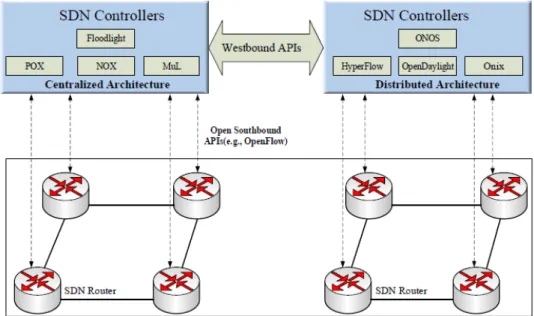
2.5 Illustration of information exchange between SDN controllers using Westbound APIs . . . 24
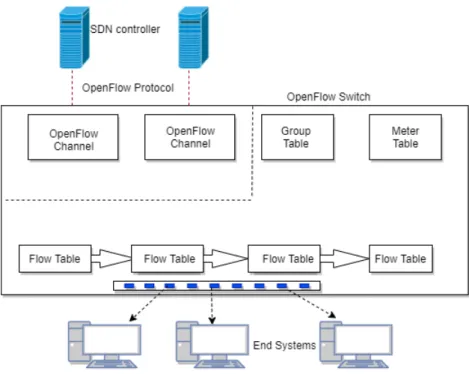
2.6 An OpenFlow architecture . . . 26
2.7 Meter Table defined in OpenFlow v1.3 . . . 27
2.8 The ETSI NFV management and orchestration framework. . . 28
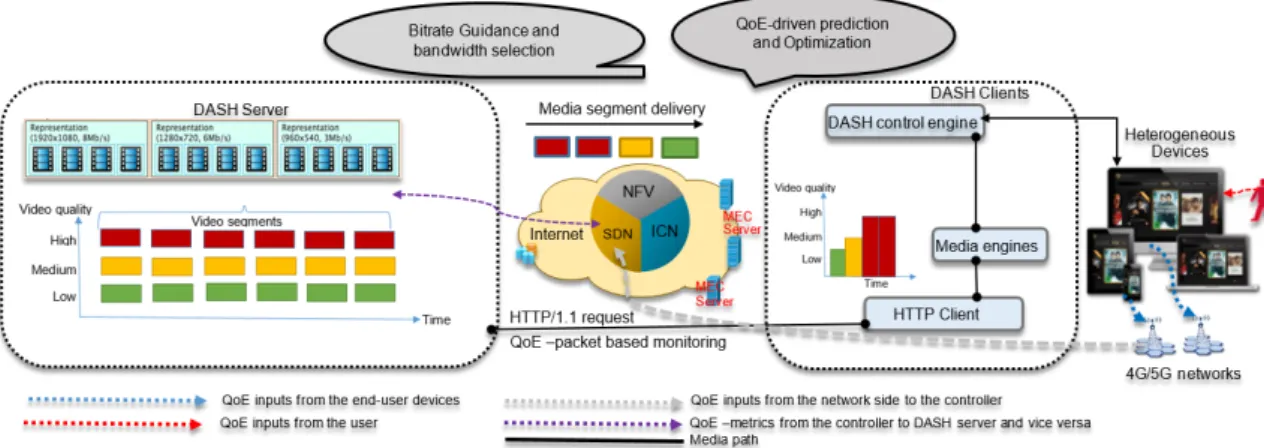
2.9 QoE-based network-assisted approaches for adaptive video stream-ing. (a) A specific bandwidth for each client is enforced by the network when bandwidth shaping is used, and (b) the network provides an explicit bitrate to the clients using bitrate guidance [2]. 32 2.10 Per-cluster QoE policy structure and model abstraction (Adapted from [3]). . . 34
2.11 Scalable QoE-aware path selection in large-scale SDN-based networks. 37 3.1 Packet flow through an Openflow switch [4] . . . 42
3.2 Packet flow processing and action handling in OpenFlow [4] . . . . 43
3.3 Snap shots of the video sequences . . . 47
3.4 A network flow switching of the proposed video quality manage-ment scheme . . . 48
3.5 An experimental testbed used to implement the proposed video quality management scheme . . . 50
3.6 The average arrival rates of video sequences . . . 51
3.7 Number of stalls for high level traffic intensity . . . 51
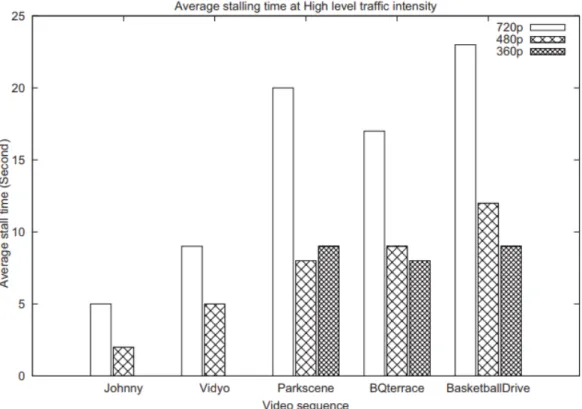
3.8 Number of stalls for Medium level traffic intensity . . . 52 3.9 Average number of stalling duration for High level traffic intensity 53
3.10 The number of stalls in the proposed video quality management
scheme . . . 54
4.1 An example of a DAG for adaptive media streaming . . . 59
4.2 QoE-driven SDN based resource allocation system overview . . . . 59
4.3 Illustration of task assignment model . . . 60
4.4 Video clips/sequence . . . 65
4.5 QoE-driven experimental setup based on SDN . . . 66
4.6 Bandwidth and delay variations with different number of clients and video servers . . . 68
4.7 QoE values at different variations of packet loss and delay . . . 70
4.8 Transmitted video QoE with the normalized QoS values. . . 71
5.1 MPTCP link aggregation between Ethernet switches . . . 75
5.2 MPTCP subflow connection establishment . . . 76
5.3 The architecture and software components of MPTCP. Note that, for compatibility, the MPTCP architecture keeps the standard socket API to legacy applications .src, dst: Source and Destination IP ad-dress, sp, dp: Source and Destination Port [5] . . . 77
5.4 Path Manager configurations in MPTCP Linux’s Kernel . . . 78
5.5 Coupled congestion control algorithms in MPTCP Linux Kernel . . 79
5.6 MPTCP slow-start and congestion avoidance stages [6] . . . 80
5.7 A video streaming scenario using MPTCP in SDN-based 5G networks 81 5.8 Segment routing operation in SDN-based 5G networks . . . 83
5.9 A QoE-aware, MPTCP SDN-based SR architecture . . . 85
5.10 Video clips/sequences used for implementations . . . 89
5.11 Experimental testbed . . . 90
5.12 Comparison of throughput of QoE-aware MPTCP SDN-based SR and regular TCP . . . 92
5.13 Comparison of link utilization of QoE-aware MPTCP SDN-based SR and regular TCP . . . 93
5.14 The impact of segment length on throughput . . . 94
5.15 Startup delay for three experiments . . . 95
5.16 Quality switching for three experiments . . . 95
5.17 Success rate for three experiments . . . 95
6.1 SDN controller with QoE entities . . . 101
6.2 QoE-driven video streaming over softwarized infrastructure . . . . 102
6.3 MPTCP implementations in softwarized infrastructures . . . 104
6.5 Path protection using backup actions configured in failover tables (FT). . . 106 6.6 A scenario of service function chaining for enterprises using SR . . 107 6.7 The proposed QoE-aware, MPTCP/SR-based in softwarized
net-works. . . 108 6.8 MPTCP sequence workflow diagram . . . 120 6.9 QoE-aware MPTCP/SR experimental testbed and prototype used . 122 6.10 Comparison of system throughput for a video resolution of 360p . 123 6.11 Comparison of system throughput for a video resolution of 480p . 124 6.12 Comparison of system throughput for a video resolution of 720p . 124 6.13 Comparison of video streaming reception quality for 360p . . . 125 6.14 Comparison of video streaming reception quality for 480p . . . 126 6.15 Comparison of video streaming reception quality for 720p . . . 126 6.16 An example of path protection and link recovery mechanisms in
softwarized networks . . . 128 6.17 Performance comparison in terms of failure recovery time . . . 129 6.18 Performance comparison in terms of failure recovery time using
OpenDaylight controller . . . 130 6.19 Performance comparison in terms of failure localization time . . . . 131 6.20 Performance comparison in terms of link capacity occupation . . . 131
List of Tables
2.1 A comparison of HTTP adaptive streaming solutions . . . 17
2.2 The relationship and comparison between SDN and NFV . . . 29
3.1 Summary of Notations and Parameters used for Implementation . 45 3.2 Video sequences and used parameters . . . 47
3.3 Comparison of number of Stalls of DASH with and without the proposed scheme . . . 54
3.4 Comparison of DASH with and without the proposed scheme . . . 55
4.1 Resolutions of video streams. . . 65
5.1 Required TCP throughput for QoE-centric algorithm . . . 90
5.2 Selected QoE comparison results for regular TCP and QoE-aware MPTCP SDN-based SR . . . 96
6.1 Notation and Symbols Description. . . 113
6.2 A list of used parameters . . . 122
6.3 Average throughput in Mbps . . . 125
6.4 A Summary of Performance Comparison for Path Protection and Link Recovery Mechanisms in Softwarized Networks . . . 133
Acknowledgements
This work is the culmination of a journey that started in September 2015. Under-taking this PhD has been a truly life-changing experience for me and it would not have been possible to do without the support and guidance that I received from many people.
First and foremost, I would like to express my sincere gratitude to my Director of Studies Prof. Lingfen Sun for the continuous support, patience, motivation, and immense knowledge she gave to me since when I started my PhD study. Her professional guidance helped me in all the time of research and writing of this thesis. I appreciate all her contributions of time, encouragement and ideas to make my PhD experience productive and stimulating. The joy and enthusiasm she has for her research will remain to be contagious and motivational for me throughout the journey of my research career. It has been an enormous privilege to learn from her expertise and leadership and I am also thankful for the excellent example she has provided to me of working very hard. My numerous quality papers that I was able to publish during my four years of studying towards PhD would not have been possible without her and for that I am truly grateful.
I am also deeply in debt to my PhD supervisors, Prof. Emmanuel Ifeachor and Dr. Is-Haka Mkwawa who always had a door open when I needed someone to discuss and get feedback from. Their insights and comments have shaped this PhD thesis. A very special thanks to them for their advice and support during my four years of pursuing my PhD. I have hugely benefitted from the collabora-tions and discussions with them. I collectively thank my supervisory team for inspirational guidance, support and constructive discussions with me regarding the experiments that helped me to publish papers in different conferences and journals. I am truly grateful to Prof. Lingfen Sun, Prof.Emmanuel Ifeachor and Dr.Is-Haka Mkwawa for helping me in whatever way they could during this challenging period. I would also like to thank all the reviewers who reviewed my papers. Without their constructive comments and suggestions I would not have been able to raise the standard of my publications.
A particular mention also goes to all members of Signal Processing Multimedia Communications (SPMC) Research group: Dr Emmanuel Jammeh for any kind of help, support and constructive discussions he gave to me in the lab. It has been my great pleasure to have been working in the SPMC group. I thank all of my fellow lab mates from SPMC for the stimulating discussions and for all the fun moments we have had together in the last four years. It has really been a privilege to be part of such an amazing team.
I gratefully acknowledge the funding received towards my PhD from the EU Horizon 2020 Research and Innovation Programme under Marie Sklodowska-Curie Innovative Training Networks (MSCA-ITN-2014-ETN), Grant Agreement No.643072, Network QoE-NET. My thanks also go out to the support I received
from the ITU - T Study 12 (Network performance, QoS, and QoE) when I was undertaking my Internship as an Early Carer Researcher (ESR). I am especially grateful to Martin Adolph for all the discussions we had in the field of performance, QoS, and QoE through ITU-T Study 12 meetings.
Infinite thanks to my parents, Alex Barakabitze and Leonia Francis Nzika, my sisters and brothers, Josaphine, Alfred, Abely and Bibiana for all the support and unconditional love over the years. I would also like to thank my wife, Lilian Alcardo Barakabitze for her encouragement, support and unconditional love during this amazing journey. Lastly, this thesis is dedicated to our beautiful two children, Alvin and Niah for their motivation, support, endless love and for bearing with me in my PhD study journey. Not only they have given me the strength, stability, and motivation to finish this work, they have also made my life brighter and lighter with their love.
Author’s declaration
At no time during the registration for the degree of Doctor of Philosophy has the author been registered for any other University award without prior agreement of the Doctoral College Quality Sub-Committee.
Work submitted for this research degree at the University of Plymouth has not formed part of any other degree either at the University of Plymouth or at another establishment.
Relevant scientific seminars and conferences were regularly attended at which work was often presented:
Word count for the main body of this thesis:51.300 words
Signed:
Chapter 1
Introduction
Multimedia services consumption has increased tremendously over the past years and is expected to continue to grow even more over the next years. According to the latest Cisco Visual Networking Index (VNI) Forecast [7], over three-fourths of the world’s data traffic is going to be video by 2021. Mobile-connected devices are estimated to be 11.6 billion including Device to Device (D2D) and Machine to Machine (M2M) communications and therefore exceeding the world’s projected population of 7.8 billion by 2021. The exponential growth of video streaming services (e.g., YouTube and Mobile TV) on smart devices has triggered and introduced new revenue potential for telecom operators and service providers.
This fact, coupled with the increasing numbers of data consuming devices which run enhanced applications such as live video streaming, social networking, 3D/HD video, video gaming and Virtual Reality pose a challenge to mobile and service providers in terms of management of multimedia networks as end-users become accustomed to more resource demanding services with better quality. Fixed and mobile networks today are converging towards the future telecommunication domain (e.g., 5G networks) through the integration of existing and new wireless technologies. Such integration is set to provide access to any service with better quality to the end-users through a reliable and cost effective communication, over any medium and across multi-operator domains using different networking technologies [8]. Therefore, future networks should enable end-users to access multimedia services with high Quality of Experience (QoE) from service providers at anytime, anywhere without limitations on technology and medium. In order to meet these requirements, new architectures and intelligent schemes for QoE control
and management of future multimedia services have to be designed and developed.
1.1
Research Challenges and Motivations
The end-users’ demand for services with better quality from service providers has trig-gered the trend of traditional and future networks towards using QoE in network manage-ment through an efficient utilization of network resources. In order to meet end-users’ QoE requirements and their expectations, several QoE issues (e.g., QoE monitoring, QoE control and management) pose challenges to service providers [9]. Such issues are contributed by existing technologies which are either unable to adapt to diverse changing network conditions, or limited in the available resources. In addition, existing QoE adaptation approaches limit the network ability to provide intelligent and efficient solutions such that they only react when a problem occurs and therefore resulting in sub-optimal network performance. These challenges necessitate harmonizing the integration of advanced intel-ligence architectures in future networks with the development of intelligent QoE-aware adaptation mechanisms. Therefore QoE enabled functions, such as QoE-centric routing, admission QoE control, resource allocation and server selection mechanisms in future networks should be adaptive to changing network conditions to improve end-users’ QoE. Today, end-users are accustomed to more resource demanding services with better quality from Service Providers (SP) [10]. However, achieving good Quality of Experience (QoE) is a challenging task because of different clients devices/requests patterns, changing media contents and varying transmission/network conditions. Great efforts from both academia and industry have been made to optimize the video content delivery chain and enhance end users’ QoE. Some of the common mechanisms used for improving end-users’ QoE are either based on network optimization (e.g. QoE-driven network resource allocation and QoE-driven routing) or based on client-server request/response (e.g. client-driven adaptive video streaming) and QoE-based routing [11, 12, 9].
Despite these efforts, QoE management remains a challenging task due to many is-sues [9, 13]. Firstly, the variability of network resources, and unstable nature of wireless channels and the characteristics of fixed/mobile networks in heterogeneous environments, for example, crowded areas such as train, stadium and shopping malls. This kind of envi-ronments requires continuous adaptation of network resources allocation. Secondly, the emergence of new services (e.g., video gaming and virtual/augmented reality (VR/AR)),
Heterogenous Environments
Multiple Terminals
Multiple Applications
End Users with
different preferences
Network Domains
5G LTE/4G WiMax Internet WLANNetwork Domains
5G LTE/4G WiMax Internet WLANMultiple Networks
Heterogenous Environments
Multiple Terminals
Multiple Applications
End Users with
different preferences
Network Domains
5G LTE/4G WiMax Internet WLANMultiple Networks
Figure 1.1: QoE management challenges in future networks.
the diversity of contexts of use, the users’ expectations combined with the operational cost optimization by mobile and service providers lead QoE management into challenging zones of the research field. Thirdly, considering a variety of networks (e.g., fixed and mobile), different measurement and assessment methods are required to be employed for QoE management considering resources constraints. Fourth, the popularity and fast growth of the multimedia services over the Internet, the heterogeneity of end-user devices with different capabilities (e.g., screen size, computational power/resources, and storage capabilities) pose even more challenges regarding resource allocation among users with different QoE preferences. Fig. 1.1 summarizes the QoE management challenges in current and future IP-based networks.
Increased user demand and expectations of services with excellent quality have triggered telecom operators to upgrade their systems and invest in new cutting-edge network soft-warization paradigms such as Software Defined Networking (SDN) [14], Network Func-tion VirtualizaFunc-tion (NFV) [15], Multi-access Edge Computing (MEC) [16] and Cloud/Fog
Computing (C/FoC). This transformation and the upgrade of their systems are also driven by the mounting pressure of new emerging use cases, ranging from full ultra-high defini-tion video resoludefini-tions (4K/8K), network-controlled D2D communicadefini-tions, Machine Type Communication (MTC) and Massive Internet of Things (MIoT).
In such an agile and flexible environment, it is important to consider new solutions, such as the separation of user and control planes, and possibly, re-define the boundaries between the network domains (for example, radio access network and the core network). Therefore, there is a need for autonomic network management platforms that can guarantee the end users’ QoE, especially in heterogeneous environments. Towards this end, new paradigms such as SDN and NFV have been identified as critical technologies for enabling future network control to be programmable, centrally manageable, adaptable and cost-effective. SDN and NFV are considered to be suitable for applications such as video streaming [17, 18, 19, 20, 21, 22, 23, 24]. Indeed, SDN and NFV may enable network management to be automated and ensure that the end-user’s QoS/QoE requirements as well as Experience Level Agreements (ELAs)1are fulfilled in the heterogeneous environments [25].
More importantly, SDN and NFV can provide an end-to-end resource, infrastructure and service orchestration across a multi-programmable domain that belongs to different operators or service providers. To this end, investigations are ongoing as to what extent future networks and different supporting technologies can be software-configurable and to what extent software platforms can be hardware-agnostic. Aligned with the on-going SDN and NFV research activities by some standardization bodies, there is an urgent need to study and explore the adoption of SDN and NFV on how they introduce the significant changes on the operation, management, and delivery of QoE-aware services in the context of emerging and future networks.
1.2
Research Aims and Objectives
The main aim of this thesis is to investigate and develop Quality of Experience (QoE) - centric control and management schemes for streaming video services over software
defined and virtualized networks. Specific objectives of the research work are to:
1Experience Level Agreements (ELAs): Indicates a QoE-enabled counter piece to traditional QoS-based
that conveys the performance of the service in terms of QoE. ELAs establish a common understanding of an end-user experience on the quality levels whiling using the service
• Investigate comprehensively the QoE-centric control and management for HTTP adaptive video streaming using SDN/NFV. The aim is to overcome future challenges and achive an optimized QoE to the end users with different client devices/request patterns at varying transmission/network conditions.
• Investigate a QoE-based multimedia flow routing mechanism using traffic intensity over SDN/NFV. The proposed scheme can mitigate virtual port queue congestion and reduce buffering or stalling events during video streaming.
• Design, formulate and implement the QoE-Centric multipath routing approach for multimedia services using SDN. The aim is to utilize multiple disjointed paths to improve network resources utilization and end-users’ QoE for multimedia services delivery in future softwarized networks.
• Design a novel QoE-driven SDN based resource allocation mechanism for future SDN/NFV-based networks. A combination of network node functions are used to provide an optimized QoE level to end-users through node cooperation in soft-warized networks.
• Investigate and design a QoE-centric management of multimedia services using MPTCP and Segment Routing (SR) in softwarized networks. A QoE-based multipath routing and video quality optimization algorithm is proposed to provide an efficient orchestration, QoE control and management of future multimedia (video) services. • Investigate, design and implement a multipath protections and link- failure free MPTCP/SR-based architecture that increases survavibility, resilience, availability and robustness of 5G networks.
• Perform extensive experiments and quality evaluations from real-time multimedia transmissions over the developed softwarized network platform.
1.3
Summary of Thesis Contributions
This thesis investigates broadly the QoE-centric control and management of video stream-ing services in software defined and virtualized networks. It is important to mention that, apart from addressing the QoE-centric control and management, another contribution of this thesis include the development of an SDN/NFV-based experimental platform for
conducting video streaming experiments. Specifically, the SDN controller was extended by adding QoE management module, Multipath TCP (MPTCP) flow routing module and SR module as presented in Chapters 5 and 6. Figure 1.2 illustrates the approach that was followed in this thesis by providing a relationship between chapters, publications and its contributions in the field. Specifically, the main contributions of this thesis are outlined and summarized in the following five (5) areas.
1.3.1 QoE-based Multimedia Flow Routing Mechanisms using SDN/NFV
A video quality management scheme over an SDN architecture based on traffic intensity is proposed to minimize virtual port queue congestion which may cause buffering or stalling events during video streaming, thus, reduce the video quality. The QoE-based multimedia flow routing approach in SDN/NFV is designed to (a) investigate the performance of the control plane particularly the OpenFlow protocol, and (b) avoid the queuing overflow that can negatively affect the video quality of the transmitted video from server to an end-user. The work has been contributed to the research community following the publication achieved in [26]. The contributions in this work are described in Chapter 3. As part of my contributions in this work, I conducted video streaming experiments over SDN and analyzed the results.
1.3.2 A QoE-Driven SDN based Resource Allocation Algorithm in Future Net-works
With the continuous growth of multimedia applications in future networks such as 5G, enabling the dynamic configuration and resource allocation in SDN-based networks can be significant and an outstanding approach of improving the end-users’ QoE. In this regards, this work applied network softwarization and virtualization technologies specifically SDN and NFV to propose a novel QoE-driven resource allocation mechanism that assigns tasks dynamically to virtual network nodes in order to achieve an optimized end-to-end quality. The aim of the proposed approach is to find the combination of network node functions that can provide an optimized QoE level to end-users through node cooperation. The author considered multimedia service as a collection of tasks where neighbor nodes negotiate the assignment of these tasks by considering the end-users’ perceived video quality. The work has been contributed to the research community
following the publication achieved in [27]. The contributions in this work are described in Chapter 4. My contributions in this work is on experimental part, evaluation of the results and algorithm implementation in SDN.
1.3.3 A Novel QoE-Centric Multipath Routing Algorithm for Video Stream-ing usStream-ing SDN
A multiflow approach is employed in this contributions where multiple disjointed paths are used in SDN-based networks to improve network resources utilization and end-users’ QoE for delivering video streaming services. Specifically, the work provides the first implementation mechanisms of MPTCP and SR for traffic management in software defined and virtualized networks. DASH is employed to test the performance and effectiveness of the proposed algorithm. It is important to mention that, this strategy is compared with the traditional TCP approach. The Stream Control Transmission Protocol (SCTP) which operates at the transport layer is not compared because it serves a role similar to TCP and UDP [28]. The contribution under this work proposes a novel QoE-aware SDN-based MPTCP/SR framework to enhance the QoE for video streaming services delivery in future networks. In the proposed framework, the POX controller was extended by introducing three modules namely, (a) MPTCP-Flow Manager, (b) QoE management, and (c) Segment Routing (SR) Module. The work has been contributed to the research community following the publication achieved in [29]. The contributions in this work are described in Chapter 5.
1.3.4 QoE Control and Management of Video Streaming Services in Softwarized Networks
This contribution provides the first original practical Traffic Engineering (TE) mechanisms where MPTCP and SR are further employed in softwarized networks to facilitate efficient transfer of large amount of multimedia applications between end-points. The chapter extends the contribution four (4) described above, where MPTCP and SR were utilized to improve video quality and the system performance for video streaming services. In order to improve the video quality, the Multi-flow commodity and Constrained Shortest Path Model (MCSPM) is applied to choose important intermediate nodes and perform source routing using SR paradigm. As a key contribution of the thesis, a novel QoE-aware
MPTCP/SR-enabled architecture in softwarized networks is proposed to provide an efficient orchestration, QoE control and management of future multimedia services. The work has been contributed to the research community following the publication achieved in [30]. The contributions in this work are described in Chapter 6.
1.3.5 Multipath Protections and Dynamic Link Recovery in Softwarized 5G Networks using Segment Routing
In this work, a multipath protection and link-failure free MPTCP/SR-based SDN/NFV architecture that increases survivability, resilience, availability of services in 5G networks is proposed. The system model and a multiPath protection and dynamic link- failure free algorithm called"PathReLief"is proposed to minimize the failure recovery time and avoids link congestion in MPTCP/SR softwarized 5G networks. To demonstrate the effectiveness of the proposed approach, the performance of the proposed algorithm is compared with the conventional topology discovery mechanisms for link/node failures in POX and OpenDaylight controllers. The work has been contributed to the research community following the publication achieved in [31]. The contributions in this work are described in Chapter 6.
1.4
Overview of Publications and Author Contributions
It is important to mention that, the thesis and the work described herein is covered in the following peer-reviewed publications and submitted papers. The papers cover technical and novel research-based position contributions in the QoE management as well as future networks domain.
TC1 :A.A.Barakabitze, L.Sun, IH Mkwawa and E.Ifeachor. "A Novel QoE-Aware SDN-enabled, NFV-based Management Architecture for Future Multimedia Applications on 5G Systems", in Eighth International Conference on Quality of Multimedia Expe-rience (QoMEX), June, 2016, Lisbon, Portugal
TC2 :IH Mkwawa,A.A.Barakabitze, L.Sun. Video Quality Management over the Soft-ware Defined Networking, in IEEE International Symposium on Multimedia (ISM), December, 2016, San Jose, CA, USA.
TC3 :E. Grigoriou,A.A.Barakabitze, L.Atzori, L.Sun and V.Pilloni, "An SDN-approach for QoE Management of Future Multimedia Services using Resource Allocations", IEEE International Conference on Communications, May, 2017, Paris, France. TC4 :A.A.Barakabitze, L.Sun, IH Mkwawa, E.Ifeachor, "A Novel QoE-Centric
SDN-Multipath Routing Approach for Future Multimedia Services in 5G Networks", 2018 IEEE International Conference on Communications, May 2018, Kansas City, MO, USA.
TC5 :A.A.Barakabitze, IH Mkwawa, L.Sun, E.Ifeachor, "QualitySDN: Improving Video Quality using MPTCP and Segment Routing in SDN/NFV", IEEE International Conference on Network Softwarization (NetSoft), June 2018 - Montreal, Canada. TC6 A.A, Barakabitze, L.Sun, IH Mkwawa and E.Ifeachor. "MultiPath Protections and
Dynamic Link Recovery in Softwarized 5G Networks using Segment Routing", IEEE GLOBECOM Workshop on Future Internet Architecture, Technologies and Services for 2030 and beyond, December 2019, Waikoloa, HI, USA.
1.4.1 Journal Papers
TC7 A.A, Barakabitze, IH, Mkwawa, L, Sun and E, Ifeachor, "QoEMultiSDN: QoE Man-agement of Multimedia Services using MPTCP and SR in SDN/NFV-based Net-works", ACM Transactions on multimedia computing communications and applica-tions.
PC1 A.A Barakabitze, N. Barman, A. Ahmad, S. Zadtootaghaj, L. Sun, M. Martini, L. Atzori and S. Moller, "QoE Management of Multimedia Services in Future Net-works: A Tutorial and Survey", IEEE Communication Surveys and Tutorials, pp. 1-1, November, 2019.
PC2 A. Barakabitze, A. Arslan, M. Rashid, and H. Andrew, "5G Network Slicing us-ing SDN and NFV: A Survey of Taxonomy, Architectures and Future Challenges," Computer Networks, vol. 167, pp. 1-40, February 2020.
Figure 1.2: Organization and structural contributions of this thesis
1.5
Thesis Outline
The Organization and structural contributions of this thesis are illustrated in Figure 1.2. The studies covered in this thesis are indicated by chapters which form sections as visualized using boxes. The relationship between the sections are indicated using top-down arrows. The green boxes indicate chapters that cover the introduction, literature review and conclusion and future work while blue boxes indicate the major contributions of this thesis in the research field. In the end of each chapter, a summary of the work carried out and/or the lessons learned are provided. In the following, the organization and the overall structure of this thesis is described. After the thesis introduction, Chapter 2 presents a comprehensive description of literature review focusing on four main areas, listed as below. Section 2.2 provides highlights on the concept of QoE management for multimedia streaming services followed by a description of HTTP Adaptive Streaming (HAS) solutions including the Server and Network Assisted DASH (SAND) in Section 2.3. Section 2.4 presents the background information regarding network softwarization and virtualization technologies (e.g., SDN, NFV). Section 2.5 provides a detailed state-of-the-art regarding QoE management for HTTP adaptive video streaming using SDN/NFV. Chapter 3 investigates the video quality management based on queue mechanisms and QoE/QoS Policy in SDN. In order to understand the traffic intensity approach, section 3.1
describes the introduction of queue mechanisms and QoE/QoS policies in SDN. Section 3.2 presents related work followed by a description of the proposed video quality management algorithm in section 3.3. A performance evaluation and results of the proposed scheme for DASH is given in Section 3.4. Section 3.5 provides lessons learned and a summary of this chapter.
Chapter 4 provides a novel QoE-driven resource allocation strategy that dynamically assign tasks to virtual network nodes in order to achieve an optimized end-to-end quality. Section 4.1 presents related work. Section 4.2 provides an illustration of a system overview and task assignment model followed by the description of the network model and a utility function in section 4.3. Section 4.4 presents the QoE-driven resource allocation and task assignment algorithm. Section 4.5 presents the performance evaluation and analysis of the results. Section 4.6 summarizes this chapter.
Chapter 5 explore the utilization of MPTCP and SR in SDN-based networks to improve the end-user’s QoE for delivering video streaming services in future networks. Section 5.1 presents related work regarding multimedia transmission using MPTCP over SDN followed by a description of basic operation and principles of MPTCP in section 5.2. Section 5.3 provides the video adaptive streaming concept of MPTCP over SDN while section 5.4 presents the traffic engineering with segment routing in SDN. Section 5.5 presents a QoE-aware MPTCP SDN-based SR adaptation framework. Section 5.6 presents the proposed QoE-Centric Multipath Routing Algorithm (QoMRA) over SDN. Section 5.7 provides an experimental results and evaluation of the proposed QoE-aware MPTCP/SR-based algorithm. Section 5.8 summarizes the contributions of this chapter.
Chapter 6 presents a novel QoE-based multipath and video quality optimization algo-rithm called"QoEMuSoRo"that forwards traffic using SR paradigms over softwarized networks. In addition, Path Protection and Recovery of Link Failure (PathReLieF) algo-rithms are proposed to achieve dynamic route selection and link/node failure recovery over softwarized networks. Section 6.1 provides related work while section 6.2 provides a novel concept called "QoE-softwarization"in SDN and NFV. Section 6.3 presents the con-siderations of MPTCP over softwarized networks. Section 6.4 describes path protection and dynamic link recovery mechanisms with SR in softwarized networks. Section 6.5 provides the Service Function Chaining (SFC) strategies using SR in future softwarized network while section 6.6 provides a novel QoE-aware MPTCP and SR-based approach
over softwarized infrastructures leveraging the integration of SDN and NFV. Based on the concept from graph theory, section 6.7 presents a formulation of a system model and the proposed QoE-based multipath source routing algorithm. Section 6.8 presents the performance and evaluation of the proposed SDN/NFV system. Finally, section 6.9 summarizes this chapter.
Chapter 2
Literature Review
2.1
Introduction
The traditional best effort delivery paradigms have resulted into inadequate and uneco-nomical ways of providing the required level of end-users’ QoE. Efficient application and network management for future networks (e.g., 5G) has the potential to deliver services enriched with high QoE to the end-users at a minimum cost. The context of QoE for future 5G networks takes into considerations the management perspectives on performance and quality in terms of networked communications through QoE aware service delivery sys-tems. The main goal of mobile operators in implementing QoE management mechanisms is to maintain a maximized end-users’ QoE in the delivered services while minimizing cost through an efficient allocation of available network resources [9]. With the increasing multimedia applications that require increased resources (e.g., high bandwidth, higher link quality) mobile operators have mostly been considering the QoE-driven resource management and QoE-driven service adaptation solutions as an important optimization approach for QoE management. Different QoE management mechanisms and frameworks for QoE optimization in wireless/wired environment have been proposed in the literature. Such mechanisms as we explain later use different approaches (e.g., differ in the chosen location, network or user-oriented) and parameters to be controlled as well as utilizing different network technologies and applications.
2.2
QoE Management for Multimedia Streaming Services
2.2.1 Quality of Exeprience (QoE): Definition
The Quality of Service (QoS) measurements using network parameters (e.g., bandwidth, packet loss, delay and jitter) have been considered for many years to define the level of satisfaction/performance of a service. While QoS indicates the level of performance of a service, it does not necessarily quantify the users’ experience and level of satisfaction. Therefore, in recent years, QoE based measurement, in addition to QoS metrics have been widely used in industry to assess the quality of multimedia services. QoE considers the user’s subjectivity towards a specific service. QoE is defined as"the degree of delight or annoyance of the user of an application or service. It results from the fulfillment of his or her expectations with respect to the utility and/or enjoyment of the application or service in the light of the user’s personality and current state"[32], [33]. The understanding of the users’ expectations and experiences from a service is then vital for the success of a service.
2.2.2 QoE Monitoring and Measurement
The process of managing and optimizing the end user’s QoE requires the knowledge regarding the root cause of QoE degradation or unsatisfactory QoE levels. In that aspect, relevant information and data related to terminal capabilities (e.g., screen size, display performance), application/service specific information and its quantification, QoE-related information inside the network have to be monitored, collected and measured [34]. The data and information or quality parameters can be collected from client devices or network elements using monitoring probes. With the advancement of virtualization and data management capabilities, QoE-awareness along the service delivery chain can be collected using virtualized probes [35]. The collected network-level Key Performance Indicators (KPIs, e.g., throughput, packet loss, delay) or user-level service/application specific Key Quality Indicators (KQI) (e.g., frame rate, video resolution, service usability, and reliability) provide inputs for QoE estimation models [36], [37].
2.2.3 QoE Optimization and Control of Multimedia Services
The QoE management of multimedia services involves continuous optimization and dynamic delivery control mechanisms. One of the ultimate goals of QoE management is the maximization of the end user’s QoE level through the efficient allocation of available network resources. For example, a joint optimization approach of network resource allocation and video quality adaptation that fairly maximize video clients’ QoE is given in [38]. Minimizing energy consumption especially in the context of mobile services has been another important objective considered when optimizing the end user’s QoE [39]. Taoet al. [40] propose an energy-efficient video QoE optimization solution for DASH over wireless networks. Boutenet al. in [41] and [42] present in-network quality optimization agents,
Figure 2.1: Multimedia streaming chain.
which monitor the available throughput using sampling-based measurement techniques. That way, the quality of each client is optimized based on a HAS QoE metric. Trikiet al.[43] propose a dynamic closed-loop QoE optimization for video adaptation and delivery while the characterization of buffer starvation analysis with the aim of optimizing the end user’s QoE is proposed by Xuet al.in [44].
However, considering the multimedia delivery chain as illustrated in Fig. 2.1, QoE opti-mization and control is a challenging task due to many issues including the heterogeneity of multimedia-capable user’s devices. As stated in [9], the main challenges that arise with regards to QoE optimization and control may be summarized in the answers to the following four questions: (1) what key quality parameters to optimize and control? (2) where to control? (3) when to perform QoE optimization and control (e.g., during the service, that is, on-line control or in an off-line fashion)? [21] and (4) how often to control and optimize QoE? Answering the second question, for example, would consider optimizing QoE at various points during the video streaming process, for example at the
client, server and the network side.
2.3
Multimedia Streaming Services over the Internet
With the growth of streaming video traffic, it has become imperative to exploit various factors along the multimedia delivery chain to optimize the video service delivery by considering the end user QoE. This section presents a comprehensive discussion on HTTP adaptive streaming solutions over the Internet. Specifically, it highlights the server and client side optimization of video streaming including Dynamic Adaptive Streaming over HTTP (DASH) as well as SAND. Furthermore, key issues and challenges of HTTP adap-tive video streaming are discussed. This is followed by a tutorial description of network softwarization technologies including SDN, NFV, network hypervisors and virtual ma-chines. Moreover,this work provides the state-of-the-art regarding QoE management for HTTP adaptive video streaming using SDN/NFV. This thesis will build on the concepts presented in this section to investigate, design and develop novel approaches for QoE control and management of multimedia streaming services in future networks.
2.3.1 HTTP Adaptive Streaming (HAS) Solutions
The majority of Internet video traffic today is delivered via HTTP-based adaptive stream-ing (HAS), an approach that aims to provide a smooth streamstream-ing session for the users by keeping the highest possible video quality. The advantages of HAS include: (a) providing a reliable transmission, (b) cache infrastructure reuse capability, and (c) it can run over HTTP. Based on these benefits, HAS has been adopted commercially by almost all major vendors including the three biggest Over-The-Top (OTT) companies as shown in Table 2.1. HAS has been widely used in OTT video services such as Netflix and YouTube [45] as the de-facto standard for adaptive streaming solutions. The underlying logic is common in all these implementations with some differences in the manifest file, recommended segment size (See Table 2.1). HAS solutions use reliable delivery mechanisms such as TCP and very recently, Quick UDP Internet Connections (QUIC) [46]. However, due to the disparity of these proprietary HAS solutions and the media formats, the 3GPP in close collaboration with MPEG has developed a DASH standard [47]. As of today, DASH specifications consist of seven parts namely: (1) Media presentation description and segment formats, (2) Reference software and conformance bitstreams for DASH, (3) Implementation guidelines,
(4) Format Independent Segment encryption and authentication, (5) Server and network assisted DASH (SAND) [1], [48], (6) DASH with Server Push and WebSockets, and (7) Delivery of Common Media Application Format (CMAF)1content with DASH.
Table 2.1: A comparison of HTTP adaptive streaming solutions
HAS Category Company Video Codec Segment Length (sec) Data Description Format Microsoft Smooth Streaming [49] Microsoft Corporation H.264, VC-1 2 Manifest (XML) fMP4 Apple HTTP Live Streaming (HLS) [50] Apple Inc. H.264 10 Playlist file (M3U8) M2TS, *.ts files Adobe HTTP Dynamic Streaming (HDS) [51] Adobe Systems Inc. H.264, VP6 2 - 5 Manifest (F4M) fMP4 MPEG-DASH [47] Standard Any Not specified MPD files (XML) MP4 or M2TS 3GP-DASH [52] Standard H.264 Not specified MPD files (XML) 3GPP File Format
M2TS = MPEG-2 Transport Stream; fMP4 is a fragmented MP4; MPD = Media Presentation Description
Fig. 2.2 illustrates the concept of DASH assuming a throughput-based rate adaptation method. The DASH server contains video contents that are encoded for example with H.264 codecs and segmented based on GPAC MP4Box [53]. The video contents on the server are made up of the Media Presentation Description (MPD) and segments. The MPD describes a manifest of the available video contents, their URL addresses, characteristics (e.g., video periods, adaptation sets and various representations) and other metadata that may be needed by the clients. The video segments contain the actual multimedia bitstreams that the DASH client plays in single or multiple files in the form of chunks. The delivery of video segments, the client behavior for fetching, adaptation heuristics, and playing content are based on the QoE prediction and segment-aware algorithms that consider the granularity of the video [54].
The DASH client runs the DASH.js [55] that can be embedded with QoE prediction, buffer filling and bitrate guidance algorithms. These algorithms enable a DASH client to learn about the media-content availability, their media types, video resolutions, minimum and maximum bandwidths. It can be observed that the client, based on its network condition, adapts the quality of the video to provide a smooth streaming experience to the end user [54]. The video file is encoded at different representation levels (spatial/temporal/quality) and then divided into chunks (also referred to as segments) of equal duration, which are then stored on a server. When the client makes the first request for the video file, the server sends the corresponding manifest file (e.g., .mpd, .m3u8) which consists of the details about the video file such as duration, segment size, representation levels or codec type [11].
1CMAF is a new media streaming format whose standardization is being led within MPEG by Microsoft
Figure 2.2: Dynamic adaptation according to network conditions
The client then measures/predicts the current bandwidth and buffer status and requests the next part of the video segment with an appropriate bit rate. This way, stalling (i.e., the interruption of playback due to empty playout buffers) could be avoided and the available bandwidth is best possibly utilized [56]. The success of HAS can be attributed to these benefits compared to the traditional streaming technologies: 1) video service providers can offer multiple quality levels by adapting bitrates and resolutions, and maybe other encoding parameters, of video to the end-users’ demands; 2) different QoE-tailored personalized service levels and/or pricing schemes can be offered to customers and; 3) the demanded video quality based on the available bandwidth, can be adapted dynamically to changing network and server/CDN conditions. It is worth noting that DASH enables both live and on-demand delivery of media streams over HTTP. On-demand video streaming applications can benefit from optimized encoding methods such as multipass and variable bitrate encoding. As an example, Netflix has recently proposed a content-aware video encoding optimization scheme called theper-titleencoding [57]. With per-title encoding, high-quality videos can be delivered even under low bandwidth conditions by streaming at higher resolution with the same bitrate. The basic concept behind changing resolution with bitrate is that below a given bitrate, it is better to encode a video at a lower resolution and then up-scale it at the end user device rather than encoding it at the higher resolution. Therefore, for the optimized encoding with the available codecs, using a per-title encoding scheme, each video is encoded into multiple resolution bitrate pairs, to obtain the optimum operating curve [57].
Despite success factors of a decentralized nature of HAS principle, there are still some drawbacks especially in the presence of multiple DASH clients that compete for the shared network resources. Some of HAS issues include (1) video instability due to constant bitrate
switching [58], (2) network resource under-utilization, and (3) QoE unfairness [3]. These problems remain a serious concern for video content providers and network operators, and they are even more aggravated in the case of heterogeneous environments. It is worth mentioning that using DASH, and it might therefore not be sufficient to optimize users’ QoE from the available resources fully. Based on these reasons, we discuss next the MPEG-SAND standard where the centralized nodes within the network have been proposed recently to enhance the delivery of DASH content [2], [59].
2.3.2 Server and Network assisted DASH (SAND)
Server and Network assisted DASH (SAND) is an extension of the MPEG-DASH standard that has been recently published [1], [48] to enhance the delivery of DASH content. The SAND specification introduces messages between DASH client and network elements or between various network elements. SAND messages improve the streaming session by providing information about real-time operational characteristics of networks, servers, proxies, caches, CDNs as well as DASH client’s performance [1]. SAND has been specifi-cally designed to address: (1) content-awareness and QoE-service-awareness towards the underlying protocol stack including server/network assistance, (2) analytics and monitor-ing of DASH-based services, (3) unidirectional/bidirectional, point-to-point/multipoint communication with and without session (management) between servers/CDNs and DASH clients.
The SAND architecture shown in Fig. 2.3 consists of three categories of elements, namely, the DASH clients, DASH-Aware Network Elements (DANE), and regular network ele-ments, which are DASH unaware and are present on the path between the origin server and DASH clients (e.g., transparent caches). DANE communicates with DASH clients while having minimum intelligence about DASH. For example, DANEs may be aware that the delivered objects are DASH-formatted objects such as the MPD or DASH seg-ments. This way, they can prioritize, parse or even modify such objects. The MPEG-SAND standard reference architecture shown in Fig. 2.3 also defines three categories of SAND messages, namely: (1) the Parameters Enhancing Reception (PER) messages which are sent from DANEs to DASH clients for enhancing and improving their video quality adaptation, (2) Parameters Enhancing Delivery (PED) messages which are exchanged between DANEs, and (3) Metrics and Status messages which are sent from DASH clients to DANEs. DANE
Figure 2.3: MPEG-SAND architecture. DANEs can communicate among each other and with the DASH clients to optimize the end-to-end video quality delivery [1]).
nodes become aware of the status of DASH clients using SAND status messages.
For example, QoE metrics reported by DASH clients to the network can be used for moni-toring purposes and to simplify QoE-aware bandwidth optimization implementations. Desired quality and bandwidth requirement information reported by the DASH clients can facilitate resource sharing mechanisms among competing DASH clients. A DANE node can use PER messages to inform the DASH clients about the available network bandwidth. They can also inform clients about already cached segments by the DANE so that the clients can request these segments based on their device capabilities. Moreover, information about the streamed video to a particular network delivery element/node can be communicated by the server using a PED message. Generally speaking, a third-party server that receives messages concerning metrics from DASH clients and sends SAND messages to the clients is considered a DANE element.
It is important to note that the MPEG-SAND messages are delivered over HTTP using the Extensible Markup Language (XML) format and follow a specific syntax as defined by the standard in [1]. Compared to the client or server-based solutions, the MPEG-SAND standard represents an essential enabler for solutions that need collaboration between service/application and network providers. However, this needs a modification of network nodes/elements to provide a set of messages that can be exchanged by the
network, servers, and DASH clients during video quality delivery optimization [48]. For the practical and scalable implementation of the SAND approach, SDN can be used to provide a centralized control element. Efficient QoE-driven application and QoE-aware network management strategies using SDN and NFV appear to be vital solutions to guarantee the end user’s QoE at a minimum cost.
2.3.3 Issues and Challenges of HTTP Adaptive Video Streaming
OTT multimedia streaming services are using HTTP adaptive video streaming these days where most of the services use MPEG-DASH standard as discussed in section 2.3.1. While the MPEG-DASH standard can provide excellent video quality to the end-users, there are some issues when multiple clients are competing for the shared limited resources leading to QoE unfairness, video instability and under-utilization of network resources [58], [3]. To overcome these challenges, the MPEG-SAND standard has been proposed recently with the aim to enhance the delivery of DASH contents, thanks to its ability to provide information of the network, servers, and streaming DASH clients in real-time. This way, it becomes easy for DASH clients to report information regarding video bitrates that can be downloaded from the server based on the available network bandwidth. Moreover, QoE measurements that are reported by the DASH clients can be used for monitoring purposes to perform QoE-aware bandwidth optimization efficiently. While SAND provides a set of well-defined messages between DANE and DASH clients during video streaming, the specifications leaves its implementations open in terms of physical network entities that are SAND capable. Some of the open questions regarding SAND implementations includes (a) What are the intelligent QoE-policies to divide network bandwidth among DASH players and other traffic over future softwarized networks, (b) How can network assisted DASH improve the streaming performance in terms of number of quality switches, video bitrate, number of freezes, and QoE-fairness over SDN/NFV-enabled networks, and (c) What is the effect of network bandwidth sharing/slicing policies on DASH Streaming performance over future SDN/NFV- enabled networks?
2.4
Network Softwarization and Virtualization: The Promise of
SDN and NFV in Future Networks
Network softwarization [60] and virtualization using SDN and NFV are expected to impact several aspects of network development and services such as CDN or video accelerators [61], [62]. Before presenting the state-of-the-art solutions regarding QoE management using SDN/NFV in Section 2.5, an overview of the recent advancements in SDN and NFV as an important technology for management and orchestration of resources in future networks is discussed in section 2.4. In that respect, section 2.4.1 and 2.4.3 provide background information of SDN and NFV respectively. This thesis uses network softwarization and virtualization concepts presented in this section in QoE management aspects implementations.
2.4.1 Software Defined Networking (SDN)
SDN Definition
SDN [14] is an approach that brings intelligence and flexible programmable networks capable of orchestrating and controlling applications/services in more fine-grained and network-wide manner [63]. The Open Network Foundation (ONF) [64] defines SDN as “the physical separation of the network control plane from the forwarding plane, and where a control plane controls several devices". Notable advantages of the SDN architecture include enhanced network programmability, centralized control, and management, increased network flexibility and reliability, data flow optimization [64].
SDN Architecture Design
SDN creates a virtualized control plane that can enforce intelligent management decisions among network functions bridging the gap between service provisioning and QoE man-agement. The main layers of SDN architecture and its design components are illustrated in Fig. 2.5. The SDN architecture consists of three layers, namely: the infrastructure, control and application layers.
The control layer is the brain of SDN which consists of the component called the "con-troller". The SDN controller is responsible to forward and process policies for the network flows. The control layer of an SDN network can be implemented as a pure software that runs on commodity hardware devices. The network service functions illustrated in Fig. 2.5 will be implemented in the Control Plane as demonstrated from Chapter 3 to 6 in this thesis. With SDN, the network control becomes directly programmable using standardized Southbound Interfaces (SBI) such as OpFlex [65], FoRCES [66], and OpenFlow [67]. The forwarding plane of SDN can be implemented on a specific commodity server [68] such as VMware’s NSX platform [69] which consists of a controller and a virtual switch (vSwitch).
Figure 2.4: Main layers of the SDN architecture.
The design and implementation choice of SDN controller significantly affect the overall performance of SDN-based networks [14]. Key design and architectural choices for the controller are: centralizedanddistributed. A centralized SDN controller is best suited to manage small networks or a single domain. However, network management using the centralized controller can be confronted with scalability and reliability problems due to
the incremental loads on the controller [70]. The controller itself can be a single point of failure which can negatively affect the performance of the network and the end-users’ QoE. SDN controllers such as Floodlight [71], Beacon [72], Ryu NOS [73] and POX [74] have been designed to achieve system throughput in specific environments such as data centers, carrier-grade networks, and cloud infrastructures. It is vividly important to note that a centralized controller is not enough for large-scale network management. As such, scalability and reliability in large-scale networks that span multiple control domains can be achieved by distributed SDN control architectures such as Hyperflow [75], HP VAN SDN [76], DISCO [77], and ONOS [78]. In essence, a distributed SDN controller implementation can be either a set of elements distributed physically or a centralized cluster of nodes [14]. It is worth mentioning that the distributed SDN controller reduces the network partitioning2 problems and improves the scalability and resilience of the control plane in SDN [79].
Figure 2.5: Illustration of information exchange between SDN controllers using Westbound APIs
• Application Layer:
The application layer is where SDN-enabled applications are created and defined to run on top of the SDN controller. The defined applications are responsible to manage the network by making decisions based on changing network conditions (e.g., during link/node failure). Some of the SDN applications scope include the following: load balancing, 2A network partitioning refers to network decomposition into relatively independent subnets for their
network monitoring and management, QoS- enforcement policy, security and access policies, traffic engineering etc. The Northbound API enables communication between the SDN application and the control layer [14]. Although there are no standardized interface, most of SDN controllers today have RESTful APIs used to communicate between the SDN Controller and the services and applications running over the network [14]. It is important to mention that, SDN applications can be divided into two groups namely, (a) SDN-based internal applications (b) SDN-based external applications. The former is is implemented to run inside the SDN controller while the latter is deployed and runs outside the SDN controller or outside the container where the controller is hosted.
• Infrastructure Layer:
This layer represents the data-forwarding plane where both software/hardware devices (e.g., OpenFlow Switches, routers, middleboxes, virtual switches, firewalls) are intercon-nected via wired or a wireless radio channels. One or more data paths form a route for forwarding network traffic in the network based on their flow tables. The SDN controller defines the routing rules of flow tables. A set of packet field match values (source and destination MAC addresses, source and destination IP, VLAN, port number etc) and a set of actions (e.g., delete, modify, forward to port) are used to represent each entry in the flow table. An OpenFlow protocol is used to control and manage communications between the infrastructure and control layer. The data-forwarding plane can collects the raw measurement data from the network using passive or virtual probes [35].
2.4.2 OpenFlow Standard
OpenFlow protocol [67]is an open standard that defines communication between data forwarding plane and the SDN controller layer. This allows to decouple the data plane and control plane while also enabling higher programmability in SDN. Today, OpenFlow is supported by different networking and service provider’s company to implement SDN applications related to QoS/QoE monitoring and management [80], [26]. An OpenFlow switch stores forwarding rules that are sent from the SDN controller. The OpenFlow switch takes this forwarding decision based on the port number where this packet is coming from. It is important to mention that, the SDN controller takes control of the forwarding rules and their computation in SDN: this enable switches to have minimum requirements in terms of memory and CPU for processing data in SDN. Figure 2.6 shows
Figure 2.6: An OpenFlow architecture
an OpenFlow architecture consisting of a Flow Table, Group Table and Meter Table. These tables are mainly used for performing table lookups and forwarding decisions. An OpenFlow switch consists of one or more OpenFlow channels which connect directly to an external SDN controller. The controller is responsible to manage the switches through the OpenFlow protocol. The flow table represents the packet forwarding table in OpenFlow switch. A flow table consists of flow entries. Each flow table entry contains:match fields,
![Figure 2.3: MPEG-SAND architecture. DANEs can communicate among each other and with the DASH clients to optimize the end-to-end video quality delivery [1]).](https://thumb-us.123doks.com/thumbv2/123dok_us/509370.2560100/37.892.170.803.89.462/figure-architecture-danes-communicate-clients-optimize-quality-delivery.webp)
![Figure 2.10: Per-cluster QoE policy structure and model abstraction (Adapted from [3]).](https://thumb-us.123doks.com/thumbv2/123dok_us/509370.2560100/51.892.176.802.84.330/figure-cluster-qoe-policy-structure-model-abstraction-adapted.webp)