AN INTELLIGENT VERTICAL HANDOFF
DECISION ALGORITHM IN NEXT
GENERATION WIRELESS NETWORKS
by
Yaw Nkansah-Gyekye
A dissertation submitted in fulfillment of the requirements for the
degree of DOCTOR OF PHILOSOPHY in the Department of
Computer Science, University of the Western Cape
Supervisor: Prof. Johnson I. Agbinya
May 2010
Declaration
I declare that
An Intelligent Vertical Handoff Decision Algorithm In Next
Generation Wireless Networks
is my own work, that it has not been submitted before for any degree or examination in any other university, and that all the sources I have used or quoted have been indicated and acknowledged as complete references.Full Name: Yaw Nkansah-Gyekye
Signature: ………. Date: May 2010
Abstract
Seamless mobility is the missing ingredient needed to address the inefficient communication problems faced by the field workforces of service companies that are using field workforce automation solutions to streamline and optimise the operations of their field workforces in an increasingly competitive market place. The key enabling function for achieving seamless mobility and seamless service continuity is seamless handoffs across heterogeneous wireless access networks. A challenging issue in the multi-service next generation wireless network (NGWN) is to design intelligent and optimal vertical handoff decision algorithms, beyond traditional ones that are based on only signal strength, to determine when to perform a handoff and to provide optimal choice of access network technology among all available access networks for users equipped with multimode mobile terminals. The objective of the thesis research is to design such vertical handoff decision algorithms in order for mobile field workers and other mobile users equipped with contemporary multimode mobile devices to communicate seamlessly in the NGWN. In order to tackle this research objective, we used fuzzy logic and fuzzy inference systems to design a suitable handoff initiation algorithm that can handle imprecision and uncertainties in data and process multiple vertical handoff initiation parameters (criteria); used the fuzzy multiple attributes decision making method and context awareness to design a suitable access network selection function that can handle a tradeoff among many handoff metrics including quality of service requirements (such as network conditions and system performance), mobile terminal conditions, power requirements, application types, user preferences, and a price model; used genetic algorithms and simulated annealing to optimise the access network selection function in order to dynamically select the optimal available access network for handoff; and we focused in particular on an interesting use case: vertical handoff decision between mobile WiMAX and UMTS access networks. The implementation of our handoff decision algorithm will provide a network selection mechanism to help mobile users select the best wireless access network among all available wireless access networks, that is, one that provides always best connected services to users.
KEY WORDS – Field workforce, Seamless mobility, Seamless communication, Vertical handoff, Vertical handoff decision, Intelligent and optimal vertical handoff decision algorithm, Next generation wireless network, Multimode mobile terminal, Access network selection, Fuzzy logic, Fuzzy multiple attributes decision making, Mathematical optimization, Genetic algorithm, Simulated annealing.
Acknowledgments
The quest for a Ph.D. degree has indeed been a long journey. I am eternally grateful to God for providing me all the blessings of life to complete the research.
My sincere thanks go to my supervisor, Professor Johnson Ihyeh Agbinya, for giving me the opportunity to conduct my PhD research at the University of the Western Cape. I am grateful to him for his guidance, steadfast support and encouragement.
I acknowledge the financial support I received during the early years of the research work from the South Africa National Research Foundation and Telkom South Africa Limited.
I appreciate the support and help I received from Professor I M Venter, Mr. Michael Norman, the entire academic and non-academic staff of the Computer Science department, and a good number of staff in other departments and offices at the University of the Western Cape which made it possible to do the research. I acknowledge the friendship of my fellow PhD students in the Computer Science department.
I am grateful to several friends including Professor James Darkwa (and his family), Professor Francis Benyah, Mr. Anthony Duah, Mr. Johnson Ampoful and others for their diverse support and assistance during my stay in South Africa. I will definitely miss the sumptuous lunches and dinners, the moral support, and the fruitful discussions we had on several occasions.
I am finally grateful to my parents, my brothers and sisters, my wife Yvonne, my children, and other relatives for their love, warmth, sacrifices and support for my education. Without them this research work would never have come into existence.
Publications
Conference Proceedings
Y. Nkansah-Gyekye and J. I. Agbinya, “Vertical Handoff Decision Algorithms Using Fuzzy Logic”, Proceedings of the First Australian Conference on Wireless Broadband and Ultra Wideband Communications (AusWireless 2006), Sydney, Australia, 13-16 March 2006.
Y. Nkansah-Gyekye and J. I. Agbinya, “Vertical Handoff between WWAN and WLAN’, Proceedings of the 5th International Conference on Networking (ICN 2006), Mauritius, 23-28 April 2006.
Y. Nkansah-Gyekye and J. I. Agbinya, “Vertical Handoff Decision Using Fuzzy Logic’, Proceedings of Southern African Telecommunication Networks & Applications Conference (SATNAC 2006), Western Cape, South Africa, 3-6 September 2006.
Y. Nkansah-Gyekye and J. I. Agbinya, “Vertical Handoff Decision Algorithm for UMTS-WLAN Using Fuzzy Logic”, Proceedings of the 2nd Australian Conference on Wireless Broadband and Ultra Wideband Communications (AusWireless 2007), Sydney, Australia, 27-30 August 2007.
Y. Nkansah-Gyekye and J. I. Agbinya, “Vertical Handoff Decision Algorithm Based on Fuzzy Logic and Genetic Algorithm”, Proceedings of Southern African Telecommunication Networks & Applications Conference (SATNAC 2008), Wild Coast Sun, Eastern Cape, South Africa, 7-10 September 2008.
Y. Nkansah-Gyekye and J. I. Agbinya, “An Optimum Vertical Handoff Decision Algorithm for UMTS-WiMAX”, Proceedings of the 2nd IFIP Symposium on Wireless Communications and Information Technology in Developing Countries (WCITD 2008), Pretoria, South Africa, 6-7 October 2008.
Y. Nkansah-Gyekye and J. I. Agbinya, “A Vertical Handoff Decision Algorithm for Next Generation Wireless Networks”, Proceedings of the 3rd International Conference on Broadband Communications, Information Technology & Biomedical Applications (BroadCom 2008), Pretoria, South Africa, 23-26 November 2008.
Book Chapter
Y. Nkansah-Gyekye and J. I. Agbinya, “Vertical Handoffs in Fourth Generation Wireless Networks” in “Advances in Broadband Communication and Networks”, Editors: J. I. Agbinya, O.Sevimli, S. Lal, S. Selvadurai, A. Al-Jumaily, Y. Li, and S. Reisenfeld, River Publishers, Denmark, 2008, ISBN: 978-8792329004.
Abbreviations
2G – Second Generation 3G – Third Generation
3GPP – Third Generation Partnership Project 4G – Fourth Generation
AAA – Authentication, Authorization, and Accounting ABC – Always Best Connected
ACK – Acknowledgment
AHP – Analytic Hierarchy Process
ANDSF – Access Network Discovery and Selection Function ANS – Access Network Selection
ANSF – Access Network Selection Function AP – Access Point
ASCONF – Address Configuration BS – Base Station
BT – British Telecommunications BWA – Broadband Wireless Access CH – Correspondent Host
CN – Correspondent Node
DAR – Dynamic Address Reconfiguration DHCP – Dynamic Host Configuration Protocol FA – Foreign Agent
FIS – Fuzzy Inference System FL – Fuzzy Logic
FMADM – Fuzzy Multiple Attributes Decision Making FWA – Field Workforce Automation
GA – Genetic Algorithm
GRA – Grey Relational Analysis GPRS – General Packet Radio Service
HA – Home Agent
HIA – Handoff Initiation Algorithm HM – Handoff Management
IP – Internet Protocol MA – Mobility Agent
MADM – Multiple Attributes Decision Making MCDM – Multiple Criteria Decision Making MCHO – Mobile-Controlled Handoff
MEW – Multiplicative Exponent Weighting MF – Membership Function
MIP – Mobile IP
MODM – Multiple Objective Decision Making MT – Mobile Terminal
mSCTP – Mobile Stream Control Transmission Protocol NAHO – Network-Assisted Handoff
NGWN – Next Generation Wireless Network NCHO – Network-Controlled Handoff NIM – Network Interface Management NN – Neural Network
QoS – Quality of Service
R – Real Line
RAT – Radio Access Technology RSS – Received Signal Strength
RSSI – Received Signal Strength Indication SA – Simulated Annealing
SAW – Simple Additive Weighting
SCTP – Stream Control Transmission Protocol SIP – Session Initiation Protocol
T1 FS – Type-1 Fuzzy Set T2 FS – Type-2 Fuzzy Set
TCP – Transmission Control Protocol
TOPSIS – Technique for Order Preference by Similarity to Ideal Solution UDP – User Datagram Protocol
UMTS – Universal Mobile Telecommunications System VHD – Vertical Handoff Decision
VHDA – Vertical Handoff Decision Algorithm VoIP – Voice-over-IP
Wi-Fi – Wireless Fidelity
WiMAX – Worldwide Interoperability for Microwave Access WLAN – Wireless Local Area Network
WMAN – Wireless Metropolitan Area Network WON – Wireless Overlay Network
WPAN – Wireless Personal Area Network WWAN – Wireless Wide Area Network
Table of Contents
Declaration ………. i Abstract ………. ii Acknowledgements ………... iv Publications ……… v Abbreviations ……… viList of Figures ………. xiii
List of Tables ………...xiv
Chapter 1 Introduction ………. 1
1.1 Background and Motivation ……... 1
1.2 Overview of Seamless Mobility in a Next Generation Wireless Network ……... 6
1.3 Problem Statement and Objective ………... 9
1.4 Thesis Outline ………11
Chapter 2 Vertical Handoffs in Next Generation Wireless Networks ………... 12
2.1 Introduction ………... 12
2.2 Next Generation Wireless Networks ……… 14
2.2.1 Heterogeneous Wireless Access Networks ………. 15
2.2.2 Multiple Services ………. 17
2.2.3 Next Generation Multimode Terminals ………... 18
2.3 Seamless Mobility in Next Generation Wireless Networks ………. 19
2.4 Handoffs in the Next Generation Wireless Networks ……….. 23
2.4.1 Handoff Classification ………. 24
2.4.2 Handoff Decision Mechanism ………. 26
2.4.3 Desirable Handoff Features ………. 27
2.5 Handoff Process ……… 29
2.5.1 Network Discovery ……….. 29
2.5.2 Handoff Decision ………. 30
2.5.3 Handoff Execution ………... 33
2.6 Review of Vertical Handoff Related Literature ……… 33
2.6.1 Vertical Handoff Decision Algorithms (VHDAs) ………... 34
2.6.2 Vertical Handoff Management Techniques ………. 40
2.7 Summary ………... 45
Chapter 3 Vertical Handoff Initiation Using Fuzzy Inference Systems ……… 46
3.1 Introduction ………... 46
3.2 Fuzzy Sets and Fuzzy Logic ………. 48
3.2.1 Formal Definitions of Fuzzy Set ………. 48
3.2.2 Fuzzy Set Characteristics ……… 48
3.2.3 Membership Functions ……… 49
3.2.4 Fuzzy Operators ………... 51
3.2.5 Fuzzy Relations and Compositions ……….. 53
3.2.6 Linguistic Variables and Linguistic Hedges ……… 54
3.3 Fuzzy Inference System ……… 55
3.3.1 Fuzzifier ………... 56
3.3.2 Fuzzy Rule Base ……….. 57
3.3.3 Fuzzy Inference Engine ………... 57
3.3.4 Defuzzifier ………... 59
3.4 A Seamless Vertical Handoff Algorithm in the Next Generation Wireless Network ……… 59
3.4.1 Requirements and Features ……….. 60
3.4.2 Terminal-controlled Handoff Framework ……… 62
3.4.3 Access Network Discovery ……….. 64
3.4.4 Vertical Handoff Execution ………. 64
3.5 An Intelligent and Optimal Vertical Handoff Decision Algorithm ……….. 70
3.5.1 Vertical Handoff Decision Criteria ……….. 70
3.5.2 Components of the VHDA ………... 72
3.6 Handoff Initiation Algorithm ……… 74
3.6.1 Handoff from UMTS to WiMAX ……… 75
3.6.2 Handoff from WiMAX to UMTS ……… 81
3.7 Case Study ……… 81 3.7.1 Use Cases ……… 82
3.7.2 Evaluation ……… 83
3.8 Summary ……….. 87
Chapter 4 Access Network Selection Using Fuzzy Multiple Attributes Decision Making ……… 88
4.1 Introduction ………88
4.2 Fuzzy Multiple Attributes Decision Making ……… 89
4.2.1 Multiple Criteria Decision Making ……….. 89
4.2.2 Fuzzy Decision Making ………... 91
4.3 Access Network Selection Algorithm ……….. 94
4.3.1 Problem Definition and Modeling ………... 94
4.3.2 Solution Approach ………. 100
4.4 Performance Evaluation of the ANS Algorithm ………. 101
4.4.1 Use Cases ………... 101
4.4.2 Evaluation using Mathematical Optimization ………... 101
4.5 Summary ………. 105
Chapter 5 Optimization of Access Network Selection Using Genetic Algorithms …. 106 5.1 Introduction ………. 106
5.2 Optimization Problems and Algorithms ………..107
5.2.1 Optimization Problems ……….. 107
5.2.2 Optimization Algorithms ………... 110
5.3 The Genetic Algorithm ………112
5.3.1 Introduction to Genetic Algorithm ………. 112
5.3.2 The Genetic Algorithm Scheme ………. 113
5.3.3 Main Features of Genetic Algorithms ……… 115
5.4 Genetic Algorithm Optimization of the Access Network Selection Function … 117 5.5 Performance Evaluation of the ANS Algorithm with Genetic Algorithm …….. 119
5.5.1 Use Cases ………... 119
5.5.2 Evaluation using Genetic Algorithm ………. 119
5.6 Summary ………. 125
Chapter 6 Optimization of Access Network Selection Using Simulated Annealing …127 6.1 Introduction ………. 127
6.2 Simulated Annealing ………128
6.2.1 The Physical Process of Annealing ……… 128
6.2.2 The Metropolis Algorithm ………. 129
6.2.3 Simulated Annealing Algorithm for Single Objective Optimization …… 130
6.2.4 Key Components of the Simulated Annealing Algorithm ………. 131
6.3 Simulated Annealing Optimization of the Access Network Selection Function..133
6.4 Performance Evaluation of the ANS Algorithm with Simulated Annealing ….. 134
6.4.1 Use Cases ………... 134
6.4.2 Evaluation using Simulated Annealing ……….. 134
6.5 Comparison of the Performances of the Genetic Algorithm and the Simulated Annealing Optimizations ……… 140 6.6 Summary ………. 145 Chapter 7 Conclusions ………. 146 7.1 Summary ………. 146 7.2 Contributions ……….. 147 7.3 Future Work ………149
Appendix A Additional Plots for Use Case1 and Use Case 2 ………. 151
8 References ……….167
List of Figures
Figure 2.1: Horizontal and Vertical Handoffs ………..24
Figure 2.2: Vertical Handoff Decision Metrics ………33
Figure 2.3: Mobile IP in a WLAN-GPRS environment ………...42
Figure 2.4: Protocol architecture using mSCTP ………...45
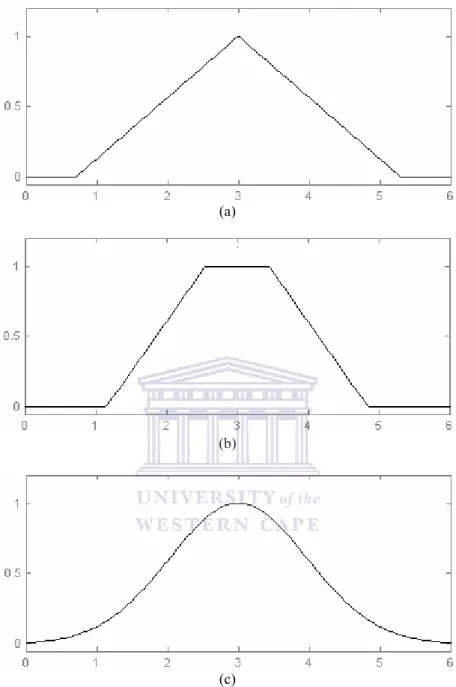
Figure 3.1: (a) Triangular MF, (b) Trapezoidal MF, and (c) Gaussian MF ………. 51
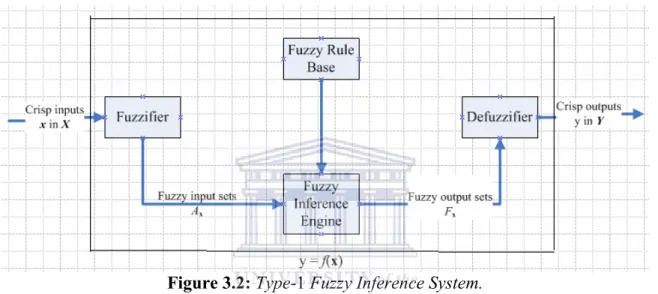
Figure 3.2: Type-1 Fuzzy Inference System ……… 56
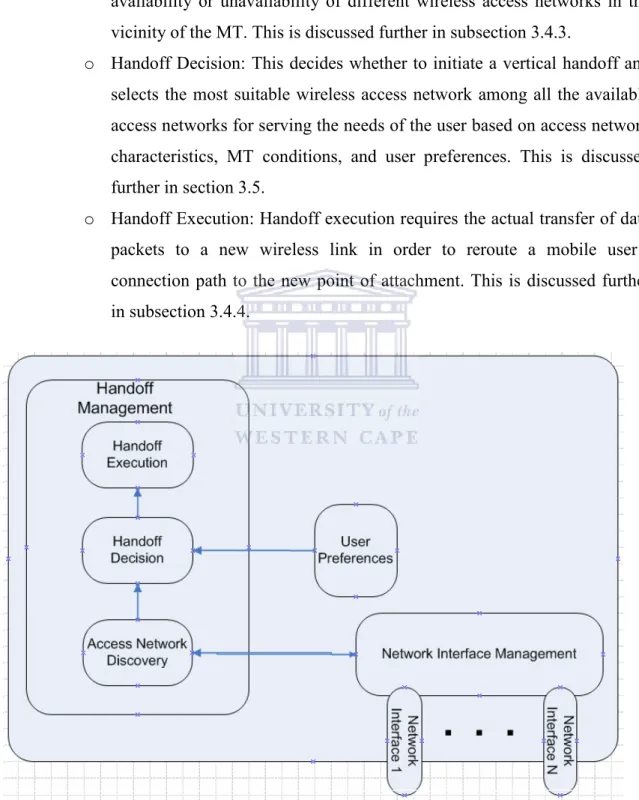
Figure 3.3: Terminal-controlled Handoff Architecture ………63
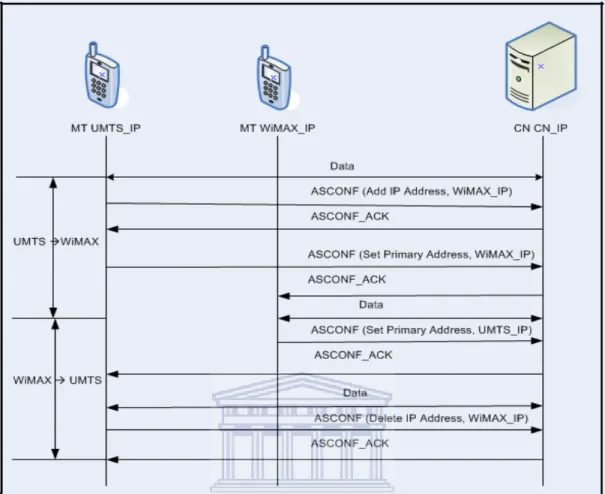
Figure 3.4: The vertical handoff procedure for a single-homing CN ……….. 67
Figure 3.5: The vertical handoff procedure for a dual-homing CN ………. 68
Figure 3.6: The vertical handoff using mSCTP and SIP ………. 69
Figure 3.7: Block diagram for Vertical Handoff Decision Algorithm ……… 74
Figure 3.8: Membership Functions ………. 78
Figure 3.9: Case 1 FIS Rule Viewer for WiMAX_1 ……….. 83
Figure 3.10: Case 1 FIS Rule Viewer for WiMAX_2 ……… 84
Figure 3.11: Case 1 FIS Rule Viewer for WiMAX_3 ……… 84
Figure 3.12: Case 2 FIS Rule Viewer for WiMAX_1 ……… 85
Figure 3.13: Case 2 FIS Rule Viewer for WiMAX_2 ……… 86
Figure 3.14: Case 2 FIS Rule Viewer for WiMAX_3 ……… 86
Figure 4.1: Membership Function plots for Data Rate and Network Latency ………... 97
Figure 5.1: Case 1 GA Best Fitness Value and Best Individual for WiMAX_3 ……... 122
Figure 5.2: Case 2 GA Best Fitness Value and Best Individual for WiMAX_3 ……... 125
Figure 6.1: Case 1 SA Best Fitness Value and Best Individual for WiMAX_3 ……… 137
Figure 6.2: Case 2 SA Best Fitness Value and Best Individual for WiMAX_3 ……… 140
Figure A.1: Additional Case 1 GA Best Fitness Value and Best Individual for WiMAX_3 ………. 154
Figure A.2: Additional Case 1 SA Best Fitness Value and Best Individual for WiMAX_3 ………. 158
Figure A.3: Additional Case 2 GA Best Fitness Value and Best Individual for WiMAX_3 ………. 162
Figure A.4: Additional Case 4 GA Best Fitness Value and Best Individual for WiMAX_3 ………. 166
List of Tables
Table 2.1: Comparison of 3G, Wi-Fi, and WiMAX ……… 17
Table 2.2: Comparison of Proposed Handoff Decision Algorithms ……… 39
Table 2.3: Summary of differences between mobility approaches at various layers …... 40
Table 3.1: RSSI (dBm) ……….75
Table 3.2: Data Rate (Mb/s) ……… 75
Table 3.3: Network Coverage (Km) ……… 75
Table 3.4: Network Latency (ms) ……… 76
Table 3.5: Handoff Factor ……… 76
Table 3.6: Examples of Fuzzy Rules ………... 80
Table 4.1: The Judgment Scale of Saaty ……….. 99
Table 4.2: Parameters for Performance Evaluation of Case 1 ………102
Table 4.3: The Mathematical Optimization Values for Case 1 ………..103
Table 4.4:Parameters for Performance Evaluation for Case 2 ………..104
Table 4.5:The Mathematical Optimization Values for Case 2 ………..105
Table 5.1: Genetic Algorithm ……….114
Table 4.2: Parameters for Performance Evaluation of Case 1 ………120
Table 5.2: Parameters Used for the GA ………..120
Table 5.3: The GA Optimization Values for Case 1 ………...121
Table 4.4:Parameters for Performance Evaluation for Case 2 ………...123
Table 5.4: The GA Optimization Values for Case 2 ………...124
Table 6.1: The Metropolis Algorithm ……….130
Table 6.2: Simulated Annealing Algorithm ………131
Table 4.2: Parameters for Performance Evaluation of Case 1 ………135
Table 6.3: Parameters Used for the SA ………...135
Table 6.4: The SA Optimization Values for Case 1 ………...136
Table 4.4:Parameters for Performance Evaluation for Case 2 ………...138
Table 6.5: The SA Optimization Values for Case 2 ………...139
CHAPTER 1
INTRODUCTION
This chapter presents the background of and motivation for the thesis. An overview of seamless mobility in the next generation wireless network is given. The chapter explains the problem statement and objective, and provides the thesis outline.
1.1 Background and Motivation
The business world is being transformed by workforces who are becoming increasingly mobile, are away from their desks regularly and use mobile computing devices to perform their duties in various locations. Faced with the need for higher worker productivity, the pressure to reduce operating costs, and increasing customer demand for faster and efficient service, telecommunications companies and other companies providing field service operations are looking for ways to streamline and optimise the operations of their field workforces in an increasingly competitive market place. Consequently, these companies have started to automate their field workforces through intelligent field workforce automation (FWA) solutions including scheduling and dispatch components as a way of providing a platform for making internal communication more efficient, reducing cost and improving quality of service.
Field workforce automation (FWA) is about getting the right engineer, technician, or skilled personnel to the right place at the right time with the right equipment/information in an optimum manner and least cost to the company [1, 2]. Among other functions, the FWA software automates the work allocation, the work dispatch, and the work monitoring of the field workforce.
The FWA software becomes a full field workforce automation solution that delivers business benefits when it is combined with the appropriate mobile devices, seamless mobility in a next generation wireless network that provides seamless communications
and a variety of services for both the location and business requirements, and an effective change management programme [3].
Telkom South Africa Limited provides telecommunications products and services to millions of business and residential customers across South Africa, as well as maintaining and repairing the enormous network infrastructure that backs up those services. There are currently thousands of field technicians in Telkom, whose daily duties are mainly the fixing of telephone lines, repairing networking faults, and service provision to customers. Just about seven years ago, each field technician used a Husky hand-held computer to make dial-up connections to Web Force, Telkom’s national workforce management tool, either from a landline or through a cellular phone and data cable. This procedure resulted in an astronomical amount of unproductive time spent, as well as very high billing and operational costs, as evaluated by Telkom. Although Telkom has installed an improved automated workforce management system, and upgraded devices for the field technicians, communication between the field technicians and the national workforce management tool is still not very efficient.
The problems associated with the field workforce management of Telkom South Africa Limited are similar to field workforce problems facing telecommunications companies and other service industries worldwide. A top priority of many service organizations is ensuring the robustness of the connection between the field workforce and the back office. This is due to many enterprises continuing to struggle with inadequate data management resulting from manual and paper-based procedures in the field, and high operational costs and unproductive time spent by the mobile workforce due to inefficient communication between the field workforce and the back office. As a result, more and more companies are automating their mobile workforces with field workforce automation solutions, or workforce management systems, as a way to improve connectivity to the field workforce and reduce reliance on manual processes. These companies realise that linking the mobile workforce with the enterprise and its data resources is key to enhancing productivity, accuracy, profitability and, ultimately, customer satisfaction. For instance, in 1992, British Telecommunications (BT) launched Work Manager [1] – an information system automating work-management and field communication processes – in order to allocate work more efficiently for the thousands of field engineers BT
employs across the United Kingdom to maintain networks, repair faults and provide service to customers. Work Manager was later marketed as a.p.solve’s intelligent fieldforce management called TASKFORCE [4].
The competitive business climate of service organizations demands a field workforce that can provide efficient customer services anytime, solve problems on the go, and stay connected anywhere, anytime with seamless communications. Therefore, the field workforce must be provided with the tools and applications they need to be able to work anywhere, anytime, with the same access, availability and services as if they were back at their office desks. True mobility means having the freedom to communicate and access information using one’s device of choice.
Mobile handheld devices and mobile applications are transforming the ability of companies to keep in touch with and manage their remote field service personnel, but running a smooth operation involves a lot more – including having the right field workforce automation software (or enterprise management systems) back at base, wireless field applications accessible via mobile devices, and the ability to provide a seamless mobility experience that enables seamless communications for the field workforce in a next generation wireless network. However, a major issue that is often overlooked is the provision of seamless mobility, and thus seamless communications, for an efficient mobile field workforce.
The research work presented in this thesis started in response to a call by Telkom South Africa Limited to examine and provide a solution to the inefficient communication problems between the field technicians and the national workforce management tool. The key objective of our “IP-centric Field Workforce Automation” research project is to ensure global access and mobility between heterogeneous wireless access networks, and to allow a user to use one mobile device across many types of networks. We want to ensure that users equipped with multimode mobile terminals (MTs) in a next generation wireless network (NGWN) environment will experience seamless mobility and enjoy seamless communications and ubiquitous access to applications in an always best connected (ABC) mode that employs the most efficient combination of available access systems. Seamless communication involves the ability of the MT to successfully or simultaneously attach to different points of attachment in the NGWN infrastructure in a
way that makes the physical movement transparent and preserves application-level connectivity unaltered.
The rapid evolutions in both wireless broadband technologies and handheld devices are driving an evolution towards seamless communications and seamless services delivery with ubiquitous and high end-user mobility across an overlay of wireless access technologies in the next generation wireless networks. The next generation of cellular/wireless communications is expected to be purely Internet Protocol (IP)-based and consist of a converged core network and multiple wireless access networks to deliver IP-based services (including voice, video, multimedia, and data) for multimode MTs while moving between the various access technologies and roaming between various operator networks.
The evolving NGWN will seamlessly integrate various types of existing and emerging wireless access networks that can be categorized to their coverage areas as wireless personal area networks (such as ultra wideband and Bluetooth), wireless local area networks (such as the IEEE 802.11x family), wireless metropolitan area networks (WMANs) (such as the IEEE 802.16 / WiMAX (Worldwide Interoperability for Microwave Access)), wireless wide area networks (such as existing 2G/3G cellular access technologies (e.g., General Packet Radio Service (GPRS) and Universal Mobile Telecommunications System (UMTS)), and Long-Term Evolution that will offer higher data rates), and regional/global area networks including radio and television broadcasting, and satellite communications.
These heterogeneous wireless access networks typically differ in terms of signal strength, coverage area, data rate, latency, and packet loss rate. Therefore, each of them is practically designed to support a different set of specific services and handheld devices. The limitations of these complementary wireless access networks can be overcome through the integration of the different technologies into a single unified platform (that is, a NGWN system) that will empower mobile users equipped with multimode MTs to be connected to the NGWN system using the best available access network that suits their needs. Wireless networks make it possible for fixed and mobile users to access a variety of services.
In the integrated NGWN it is important to provide a seamless mobility experience to the user (i.e., to make the transition from one access network to another as transparent as possible to the user). Seamless mobility support is the basis of providing seamless communications and uninterrupted services to mobile users roaming between various wireless access technologies in a heterogeneous NGWN environment. In other words, users can realize the goal of seamless communications and seamless services delivery through achieving the seamless mobility objective. With seamless mobility, users can exploit all the access technologies to best meet their service costs and QoS requirements by automatically selecting the best access network through changing weight factors and constraints in a single objective optimization function.
Therefore, we are challenged, at the highest level, to provide seamless mobility for the field workforce of service companies such as Telkom SA using contemporary multimode mobile handheld devices in an integrated WLAN-WiMAX-UMTS heterogeneous wireless access network so that the FWA solution becomes a full field workforce automation solution that delivers business benefits. This challenge constitutes the core motivation of the thesis. Of course this challenge is very difficult as some key issues need to be considered before achieving the seamless mobility experience.
Seamless mobility can be achieved by enabling a multimode MT to conduct a seamless handoff with low latency and minimal packet loss across the heterogeneous wireless access networks, for example, across mobile WiMAX and 3G access networks, seamlessly transferring and continuing its ongoing session from one access network to the best available access network.
Set against this background, our primary motivation can now be stated concisely. To resolve the problem of inefficient communication between the field workforce and the central communication system of a telecommunications company or another service industry, we shall design an intelligent and optimal vertical handoff algorithm for mobile field workers equipped with contemporary multimode mobile devices to communicate seamlessly with their central company management system and be provided with always best connected services in an integrated heterogeneous WLAN-WiMAX-UMTS wireless network system.
1.2 Overview of Seamless Mobility in a Next Generation
Wireless Network
Field workforces (or mobile workers) require a seamless, real-time and intuitive mobility experience and seamless service continuity when communicating with the back office and accessing business applications using appropriate mobile devices in a heterogeneous access network environment.
The next generation wireless network (NGWN) is expected to allow a multimode mobile terminal to simultaneously access multiple networks for a variety of services (or applications) with an appropriate quality of service. The key characteristics of the NGWN include [5, 6, 7]:
• Multiple networks: The evolving next generation wireless network (NGWN) will seamlessly integrate various types of existing and emerging wireless access networks with their corresponding radio access technologies (RATs) since no single RAT is able to optimally cater for all the different wireless communications scenarios. The access networks include wireless personal area networks (such as ultra wideband and Bluetooth) that provide range-limited ad hoc wireless service to users; wireless local area networks (such as the IEEE 802.11x family) that are designed to provide wireless access in areas with cell radius up to hundred meters; wireless metropolitan area networks (WMANs) (such as the IEEE 802.16 / WiMAX (Worldwide Interoperability for Microwave Access) that provide broadband connectivity to both fixed and mobile users in a WMAN environment); wireless wide area networks (such as existing second generation / third generation (2G/3G) cellular access technologies (e.g., General Packet Radio Service (GPRS) and Universal Mobile Telecommunications System (UMTS)) that provide long-range cellular voice and limited-throughput data services to users with high mobility, and Long-Term Evolution that will offer higher data rates); and regional/global area networks including radio and television broadcasting, and satellite communications.
• Multiple services: Users must be able to access, with seamless mobility and quality of service guarantee, a variety of services, or applications including voice, messaging, e-mail, Internet fax, information services, and multimedia.
• Multimode mobile terminal (MT): Intelligent multimode mobile terminals are being designed. The intelligent multimode MT must be equipped with multiple radio interfaces to access different access technologies. A multimode MT may include interfaces for WLAN, WiMAX, UMTS, and so on.
The objective of achieving seamless integration of the heterogeneous wireless access networks in the NGWN is to offer seamless service continuity and a seamless mobility experience to the user (that is, to make the transition from one access network to another as transparent as possible to the user). The seamless mobility experience preserves the application-level connectivity unaltered and conceals the heterogeneity of the NGWN that is conceived as an intelligent system capable of manipulating its available resources to provide the best service to the user without any user intervention. While this kind of experience is typically provided by all terrestrial wireless technologies in homogeneous environments, for example, by all kinds of 3G networks, which facilitate the mobility of a user across 3G cells in a fashion transparent to the user, the NGWN will need to extend this capability to heterogeneous architectures that encompass multiple access technologies such as mobile WiMAX and UMTS.
The vision of seamless mobility and seamless service continuity is the ability for users equipped with multimode mobile terminals to remain connected while roaming across different access networks in an NGWN. Seamless mobility envisions easy, universal, uninterrupted access to communication and other services anytime, anywhere for users across different access networks and locations. In a heterogeneous NGWN environment, seamless mobility support is the basis of providing seamless communications and uninterrupted always best connected services to mobile users roaming between various wireless access networks. In other words, users can realize the goal of seamless communications and seamless always best connected service delivery through achieving the seamless mobility objective. With seamless mobility, users can exploit all the access technologies to best meet their service costs and quality of service (QoS) requirements by
automatically selecting the best access network through changing weight factors and constraints in a single objective optimization function [8, 9, 10]. Seamless mobility provides always best connected services to the mobile user.
There are several issues to consider before an integrated heterogeneous wireless access system in the NGWN can provide the vision of seamless mobility, including: maintaining connectivity for users on the go; choosing among different access network types based on network characteristics, services offered, need, and user preferences; power management to prolong battery life of multimode devices; and dynamic spectrum allocation.
Addressing these issues require key functionalities that need to be performed, including: monitoring of the current serving network, access network discovery, handoff decision, and handoff execution.
Seamless mobility and seamless service continuity can be achieved by enabling mobile terminals to conduct seamless handoffs with low latency and minimal packet loss across heterogeneous wireless access networks, for example, across mobile WiMAX and 3G (such as UMTS) access networks, seamlessly transferring and continuing their ongoing sessions from one access network to the best available target access network. In other words, seamless handoff is the key enabling function for seamless mobility and seamless service continuity among the heterogeneous wireless technologies in the NGWN. Users have experienced seamless horizontal handoff during cell phone calls when connected to single cellular network interfaces for several years now. In the future, however, seamless vertical handoff should become commonplace when MTs are connected to multiple interfaces of the NGWN. A seamless handoff is typically characterized by two performance requirements:
• The handoff latency should be low and no more than a few hundreds of milliseconds.
• The QoS provided by the source and target access networks should be nearly identical in order to sustain the same communication experience.
These two performance requirements are not trivial to satisfy when two or more heterogeneous access networks are combined in a single architecture. Soft handoff can eliminate handoff latency and instability when a multimode MT is used. In order to offer
seamless handoff, a crucial issue to be addressed is the provision of efficient vertical handoff algorithms covering the three sequential phases of the handoff process: access network discovery, handoff decision, and handoff execution. Vertical handoff decision is the main study of this thesis.
1.3 Problem Statement and Objective
The main research problem is to address the inefficient communication problems between the field workforces and the workforce management tools of service companies that are automating their field workforces through intelligent field workforce automation (FWA) solutions as a way of providing a platform for making internal communication more efficient, reducing cost and improving quality of service.
The objective of our research project is to offer seamless service continuity and a seamless mobility experience to the mobile worker (that is, to make the transition from one access network to another as transparent as possible to the worker) so that the FWA software becomes a full field workforce automation solution that delivers business benefits. Even though service companies are rolling out field workforce automation solutions, seamless mobility is the missing ingredient needed to create an effective field (or mobile) workforce as mobility continues to play a key role in helping organizations improve customer service, increase productivity, and reduce costs.
Seamless mobility and seamless service continuity can be achieved by enabling mobile terminals to conduct seamless handoffs with low latency and minimal packet loss across heterogeneous wireless access networks, for example, across mobile WiMAX and UMTS access networks, seamlessly transferring and continuing their ongoing sessions from one access network to another.
Therefore, our main research objective is to design an intelligent and optimal vertical handoff decision algorithm in order for mobile field workers and other mobile users equipped with contemporary multimode mobile devices to communicate seamlessly in the NGWN system. In order to tackle this research objective, the study addresses the following issues:
1. The challenges such as imprecision and complexity constraints that characterize the handoff decision process.
2. The design of a suitable handoff initiation algorithm that can handle imprecision and uncertainties in data and process multiple vertical handoff initiation parameters (criteria).
3. The design of a suitable access network selection function that can handle a tradeoff among many handoff metrics including quality of service (QoS) requirements (such as network conditions and system performance), mobile terminal conditions, power requirements, application types, user preferences, and a price model.
4. Optimisation of the access network selection function in order to dynamically select the optimal available access network for handoff.
5. Provision of a network selection mechanism to help mobile users select the best wireless access network among all available wireless access networks, that is, one that provides always best connected services to users.
In order to address these research issues, we:
• used fuzzy logic and fuzzy inference systems to design a suitable handoff initiation algorithm that can handle imprecision and uncertainties in data and process multiple vertical handoff initiation parameters (criteria);
• used the fuzzy multiple attributes decision making method and context awareness to design a suitable access network selection function that can handle a tradeoff among many handoff metrics including quality of service requirements (such as network conditions and system performance), mobile terminal conditions, power requirements, application types, user preferences, and a price model;
• used genetic algorithms and simulated annealing to optimise the access network selection function in order to dynamically select the optimal available access network for handoff, that is, one that provides always best connected services to users; and
• focused in particular on an interesting use case: vertical handoff decision between mobile WiMAX and UMTS access networks.
1.4 Thesis Outline
This thesis is organised as follows.
In Chapter 1, the background and motivation for the research is presented with the research problem.
Chapter 2 gives a brief introduction to the next generation wireless networks, and seamless mobility. The chapter also presents an overview of vertical handoff in an NGWN and a review of vertical handoff related literature.
In Chapter 3, fuzzy logic and fuzzy inference system are presented with our proposed seamless vertical handoff algorithm in the next generation wireless network. A key phase of the algorithm is the vertical handoff decision algorithm which is composed of two parts: handoff initiation, and access network selection. Finally, the chapter discusses the handoff initiation algorithm using fuzzy inference systems.
Chapter 4 first presents the fuzzy multiple attribute decision making (FMADM) method as a suitable model for making decisions under uncertainty. The FMADM method is then used to develop the access network selection component of the vertical handoff decision algorithm studied in the thesis.
Chapter 5 introduces the notion of optimisation and defines formally the combinatorial, continuous, and mixed-variable optimisation problems. It also explains how the characteristics of these problems impact the types of algorithms used to tackle them. A review of the genetic algorithm (GA) is given in this chapter. Then the GA is used to optimize the access network selection function of the access network selection component of the vertical handoff decision algorithm with the aim of selecting the optimal available access network for handing off.
A review of the simulated annealing (SA) method is presented in Chapter 6. Then the SA is used to optimize the access network selection function of the access network selection component of the vertical handoff decision algorithm. Finally, the Chapter presents a performance comparison of the GA and the SA.
A summary of and the major contributions of the thesis report and future work are presented in Chapter 7.
CHAPTER 2
VERTICAL HANDOFFS IN NEXT
GENERATION WIRELESS NETWORKS
This chapter begins with an introduction, and then gives an overview of the next generation wireless networks and an overview of seamless mobility. Handoff in the next generation wireless networks is presented followed by a review of related literature on vertical handoff.
2.1 Introduction
Service providers such as telecommunications companies are using field workforce automation solutions to streamline and optimise the operations of their field workforces. The provision of seamless mobility, and thus seamless communications, for an efficient mobile field workforce equipped with appropriate multimode mobile devices in a next generation wireless network is the missing component needed to transform the field workforce automation software into a full workforce automation solution. Field workforces and other mobile users require a seamless, real-time and intuitive mobility experience and seamless service continuity when communicating with the back office and accessing business applications using appropriate multimode mobile devices in a heterogeneous access network environment.
The rapid evolutions in both wireless broadband technologies and handheld devices and the growing consumer demand for communication services anywhere and anytime are driving an evolution towards the seamless integration of heterogeneous wireless access networks with their corresponding radio access technologies (RATs) in the next generation wireless networks (NGWNs) with the objective of offering seamless service continuity and a seamless mobility experience to the user, that is, to make the transition from one access network to another as transparent as possible to the user. The NGWN is proposed to integrate the multiple RATs in a common network that can ease the shortage
of radio resources facing users today since the available radio resources of a single RAT are still far from satisfying the requirements of increasingly mobile services [10]. The NGWN will provide significantly higher data rates, and offer a variety of services and applications. The NGWN is expected to allow a multimode mobile terminal to simultaneously access multiple networks for a variety of services with appropriate qualities of service and to choose the most suitable access network among the available access networks. In other words, a main feature of the NGWN is to provide always best connected services to users, that is, users can choose the best available access networks in a way that suit their needs, and to change to another best network if conditions change. Mobile users, including field workforces, can realize the goal of seamless communications and seamless always best connected service delivery through achieving the seamless mobility objective. Seamless communication involves the ability of the MT to successfully or simultaneously attach to different access points in the NGWN infrastructure in a way that makes the physical movement transparent and preserves application-level connectivity unaltered. The NGWN mobile users will enjoy seamless mobility and ubiquitous access to applications in an always best connected (ABC) mode that employs the most efficient combination of available access systems. The goal of the mobile user is to be always best connected, that is, to be not only connected, but also connected through the best available device and access technology at all times [11]. Seamless mobility and seamless service continuity can be achieved by enabling multimode mobile terminals to conduct seamless handoffs with low latency and minimal packet loss across heterogeneous wireless access networks, for example, across mobile WiMAX and UMTS access networks, seamlessly transferring and continuing their ongoing sessions from one access network to the best available target access network. A handoff algorithm is required to preserve connectivity as the mobile terminals move about, and at the same time curtail disturbance to ongoing transfers. Consequently, seamless handoff, with low latency and minimal packet loss, has become a crucial factor for field workforces and other mobile users who wish to receive continuous and reliable services. One of the challenging issues in the multi-service NGWN is to design intelligent and optimal vertical handoff decision algorithms, beyond traditional ones that are based on only signal strength, to determine when to perform a handoff and to provide an
optimal selection of access network technology among all available access networks for users equipped with multimode mobile terminals. In the process, an intelligent and optimal vertical handoff decision algorithm will enable user applications to switch automatically between active interfaces that best suit them based on application requirements and interface capabilities. In this thesis we address the design of such vertical handoff decision algorithms, and we focus in particular on an interesting use case: vertical handoff decision between mobile WiMAX and UMTS access networks.
2.2 Next Generation Wireless Networks
The next generation wireless networks (NGWNs) will be based on a heterogeneous infrastructure comprising different wireless (and wired) access networks with their corresponding radio access technologies in a complementary manner to provide ubiquitous high speed wireless connectivity to mobile terminals. Some key features of the NGWN include [5, 6, 7]:
• Integrated heterogeneous access networks with a common IP-based core.
• Support for telecommunication, data and multimedia services with low transmission cost.
• Use of multimodal devices capable of supporting various types of network access technologies.
• High usability: anytime, anywhere, and with any technology.
• User friendliness and user personalization.
• Support for integrated service access from various service providers.
The term all-IP multi-access networks together with multimode terminals and smart access selection mechanisms that allow the user to be in some sense always best connected (ABC) is often used as a synonym for next-generation systems. The term always best connected refers to the concept of defining a set of access selection criteria and mechanisms that allow users to get connected to various services in a nearly optimal manner [12]. For a person to be always best connected means that he or she is always connected through the best available device and access technology at all times [11].
The heterogeneous access networks, multiple services, and multimode terminals are discussed below.
2.2.1 Heterogeneous Wireless Access Networks
The next generation wireless network (NGWN) is expected to be purely IP-based and consist of a converged core network and multiple wireless access networks to deliver IP-based services (including voice, video, multimedia, and data) for multimode MTs while moving between the various access technologies and roaming between various operator networks.
The evolving NGWN will seamlessly integrate various types of existing and emerging wireless access networks that can be categorized to their coverage areas as:
• Wireless personal area networks (WPANs) – WPANs, such as ultra wideband and Bluetooth, provide range-limited ad hoc wireless service to users.
• Wireless local area networks (WLANs) – WLANs are designed to provide wireless access in areas with cell radius up to hundred meters, and are used mostly in home and office environments. They provide high-throughput connections for stationary/quasi-stationary wireless users without the costly infrastructure of 3G. The most notable WLAN standard is the IEEE 802.11x family. The IEEE 802.11a and IEEE 802.11g provide data rates up to 54 Mbps per access point, and the IEEE 802.11n provides up to 540 Mbps.
• Wireless metropolitan area networks (WMANs) – WMANs are designed to cover wider areas, generally as large as entire cities, with large numbers of LANs and WLANs. The IEEE 802.16 / WiMAX (Worldwide Interoperability for Microwave Access) intends to provide broadband connectivity to both fixed and mobile users in a WMAN environment. It provides data rates up to 50 Mbps. It is optimised to provide high-rate wireless connectivity for a large set of services and applications that require QoS guarantees.
• Wireless wide area networks (WWANs) – WWANs, such as existing 2G/3G cellular access technologies (e.g., General Packet Radio Service (GPRS) and Universal Mobile Telecommunications System (UMTS)) that provide long-range
cellular voice and limited-throughput data services to users with high mobility, and Long-Term Evolution that will offer higher data rates.
• Regional/global area networks – These include radio and television broadcasting, satellite communications, etc.
These heterogeneous wireless access networks typically differ in terms of signal strength, coverage area, data rate, latency, and loss rate. Table 2.1 shows the characteristic differences between 3G, Wi-Fi, and WiMAX. Therefore, each of them is practically designed to support a different set of specific services and devices. However, these networks will coexist and use a common IP core to offer services ranging from low-data-rate non-real-time applications to high-speed real-time multimedia applications to end users since the networks have characteristics that complement each other. The limitations of these complementary wireless access networks can be overcome through the integration of the different technologies into a single unified platform (that is, an NGWN system) that will empower mobile users equipped with multimode MTs to be connected to the NGWN system using the best available access network that suits their needs. For example, given the complementary characteristics of WLAN (faster data rate and short-distance access) and a 3G system such as UMTS (slower data rate and long-range access), it is compelling to combine them to provide ubiquitous broadband wireless access. Similarly, a mobile WiMAX can be overlaid onto a 3G system to provide QoS to wireless Internet users in a cost-effective manner even though 3G systems are designed primarily for mobile voice and data users while WiMAX systems are optimized to provide high-rate broadband wireless access for a large set of services and applications (e.g., with multimedia traffic) that require high security and QoS guarantees.
Cells of the heterogeneous access networks are overlaid within each other to form larger wireless overlay networks (WONs). A WON has a hierarchical structure with different levels [13]. Higher levels in the hierarchy cover a large area but provide lower bandwidth whilst lower levels are comprised of high bandwidth wireless cells that provide a smaller coverage area. WONs solve the problem of providing network connectivity to a large number of mobile users in an efficient and scalable way. The integration and internetworking of the heterogeneous wireless access networks in the
NGWN system requires the design of intelligent handoff and location management schemes to enable mobile users to switch network access and experience uninterrupted service continuity anywhere and anytime.
The main requirements for achieving seamless integration of the heterogeneous wireless access networks in the NGWN are to provide an appropriate AAA (authentication, authorization, and accounting) infrastructure, minimize handoff interruption, preserve the QoS as the MT moves between the current and the candidate network access technologies, and enable inter-operator roaming [9].
2.2.2 Multiple Services
Field workforces and other mobile users should be able to access a variety of services or applications with seamless mobility and quality of service (QoS) guarantee. The available services would include:
• Web browsing (Internet access) is the basic service that must be supported by the NGWN. In general, the QoS features (except bandwidth), such as delay, jitter, and packet loss, are not required for many web browsing applications. For basic Internet access, an essential security requirement is how to protect the confidentiality of messages between a correspondent node and a BS. Due to the nature of wireless communications, the wireless channel and wireless links are
error prone and can fail due to various reasons. Therefore, it is important that the reliability is taken into account in the design and use of next generation wireless access networks.
• Data downloading may need a higher bandwidth especially if the content is a multimedia application and if a large amount of data is to be downloaded.
• Voice-over-IP (VoIP) is a real-time low-bandwidth application that is very sensitive to delay (and therefore requires low network latency) and jitter but can withstand some packet loss.
• Streaming application – Being a multimedia service, a streaming application requires a higher bandwidth than VoIP. Therefore, available bandwidth, transport cost, and current utilization are important factors. It is less vulnerable to delay and jitter than VoIP because of the ability to buffer longer duration of data before playback. Sensitivity to packet loss is similar to VoIP.
2.2.3 Next Generation Multimode Terminals
The evolution toward the NGWNs will necessitate a user-centric approach where users can access different access networks and services using a single device equipped with multiple radio interfaces such as WPAN, WLAN, WMAN (e.g., mobile WiMAX), and WWAN (e.g., UMTS). Terminals and devices capable of supporting different types of access technologies are being designed to eventually replace simple cellular phones, Personal Digital Assistants, Smart Phones, and all other current mobile devices. The next generation of mobile terminals includes devices capable of supporting multiple access systems by incorporating several interface cards and appropriate software for switching between multiple interface technologies. An intelligent multimode terminal should be able to decide autonomously the active interface that is best for an application session and to select the appropriate radio interface as the user moves in and out of the vicinity of a particular access technology. The decision regarding the switching of the interface and the handoff of the active sessions to the new active interface may be decided based on network conditions, QoS requirements of the running applications, and user preferences.
Requirements that need to be fulfilled in order to design intelligent multimode mobile terminals include [14]:
• The terminal should operate with minimum inputs from the user. From the perspective of a user experience, it is preferable to carry out these decisions in an automated manner rather than querying the user every time a new interface becomes available or an old interface disappears.
• Radio access interfaces should be selected based on network conditions, QoS requirements of applications, and user preferences.
• The requirements of applications should be determined and then a decision made whether an application could benefit from changing interfaces.
• Traffic should be balanced while changing the active interface in a way that is transparent to the user, that is, as seamlessly as possible.
The multimode mobile terminal must be capable of [15]:
• Detecting the availability of access networks;
• Finding, receiving and processing measurements regarding the characteristics of available access networks;
• Accessing, modifying and storing the user profile;
• Allowing the user to dynamically redefine his/her preferences; and
• Supporting the applications in seamlessly handing off the existing connections from one access network to another.
2.3 Seamless Mobility in Next Generation Wireless Networks
The availability of broadband wireless technologies has ushered in a new era of a unified communication infrastructure that will provide us with easy, universal, uninterrupted access to communication, information and entertainment when, where and how we want it. The objective of achieving seamless integration of the heterogeneous wireless access networks in the NGWN is to offer seamless service continuity and a
seamless mobility experience to the mobile user (that is, to make the transition from one access network to another as transparent as possible to the user). From the user’s perspective, the seamless mobility experience makes the physical movement transparent, preserves the application-level connectivity unaltered and conceals the heterogeneity of the NGWN that is conceived as an intelligent system capable of handling its available resources to provide the best service to the user without any user intervention [9]. While this kind of experience is typically provided by all wireless technologies in homogeneous environments, for example, by all kinds of 3G networks, which facilitate the mobility of a user across 3G cells in a fashion transparent to the user, the NGWN will need to extend this capability to the NGWN heterogeneous architecture that encompass multiple access technologies such as mobile WiMAX and UMTS.
The vision of seamless mobility and seamless service continuity is the ability for mobile users equipped with multimode mobile terminals to remain connected while roaming across different access networks and technologies in an NGWN and be served uninterruptedly with multiple media from multiple vendors. Seamless mobility envisions easy, universal, uninterrupted access to communication and other services anytime, anywhere for users across different access networks, devices and locations. Seamless mobility also means that our mobile devices and networks will understand us better as they will learn our preferences, sense the world around us, and use that knowledge to make life easier [16].
Achieving seamless mobility will transform industries and enhance convenience and productivity. It will allow everyone to communicate, interact with and collaborate on personal digital content that is customised according to user personal preferences, location, circumstances and availability. Seamless mobility will meet the needs of [16]:
• Consumers who are demanding personalised services that make it easy to access and share digital content when, where and how they want.
• Businesses that are demanding more support for their increasingly mobile workforces and customers who require anytime, anywhere communications and ubiquitous access to data, resources and applications. This will enhance productivity, increase customer response time and spark business innovation.
Some of the attributes of seamless mobility are [16]:
• Full mobility, that is, transparent connectivity across different heterogeneous access networks.
• Always on, always here capability, via sessions that cross access networks and mobile devices automatically and transparently.
• Seamless communication and seamless service delivery.
• Personalised, context-aware applications.
• User-centric content that is context- and device-sensitive.
• Flexible and friendly user-interface architectures and technologies that deliver intuitive, friendly and personal user experiences.
• Privacy, safety and security technologies to enable trusted communications.
In a heterogeneous NGWN environment, seamless mobility support is the basis of providing seamless communications and uninterrupted always best connected services to mobile users roaming between various wireless access networks. With seamless mobility, users can exploit all the access technologies to best meet their service costs and QoS requirements by automatically selecting the best access network through changing weight factors and constraints in a single objective optimization function [8, 9, 10].
There are several issues to consider before an integrated mobile WiMAX/UMTS system can provide the vision for seamless mobility, including [17]:
• Maintaining connectivity for users on the go.
• Choosing among different access network types based on network characteristics, services offered, need, and user preferences.
• Preserving key user-centric capabilities across boundaries between networks, devices and services.
• Configurable, power-efficient multimode mobile devices that can accommodate new wireless access technologies in a variety of frequency bands.
• Dynamic use of licensed and unlicensed spectrum.
Addressing these issues require key functionalities that need to be performed, including [5, 17, 18]:
• Monitoring of the current serving network – obtaining timely information and regular updates on the status of the current serving access network in order to minimise service disruption and optimise the quality of service.
• Network discovery – finding available access networks in the vicinity of the mobile terminal.
• Handoff decision – making the decision on whether to initiate a handoff to the access network(s) discovered and choosing the best target access network to connect to.
• Handoff execution – transferring of data packets to a new wireless link in order to reroute a mobile user’s connection path to the new point of attachment.
Seamless mobility and seamless service continuity can be achieved by enabling mobile terminals to conduct seamless handoffs with low latency and minimal packet loss across heterogeneous wireless access networks, for example, across mobile WiMAX and 3G access networks, seamlessly transferring and continuing their ongoing sessions from one access network to the best access network among all available target access networks [9]. In other words, seamless handoff is the key enabling function for seamless mobility and seamless service continuity among the heterogeneous wireless technologies in the NGWN. Users have experienced seamless horizontal handoff during cell phone calls when connected to single cellular network interfaces for several years now. In the future, however, seamless vertical handoff should become commonplace when MTs are connected to multiple interfaces of the NGWN.
A seamless handoff is typically characterized by two performance requirements [9]:
• The handoff latency should be no more than a few hundreds of milliseconds.
• The QoS provided by the source and target access networks should be nearly identical in order to sustain the same communication experience.
These two performance requirements are not trivial to satisfy when two or more heterogeneous access networks are combined in a single architecture. Soft handoff can eliminate handoff latency and instability when a multimode MT is used. In order to offer seamless handoff, a crucial issue to be addressed is the provision of efficient, intelligent and optimal vertical handoff decision algorithms which is the study of this thesis.
2.4 Handoffs in the Next Generation Wireless Networks
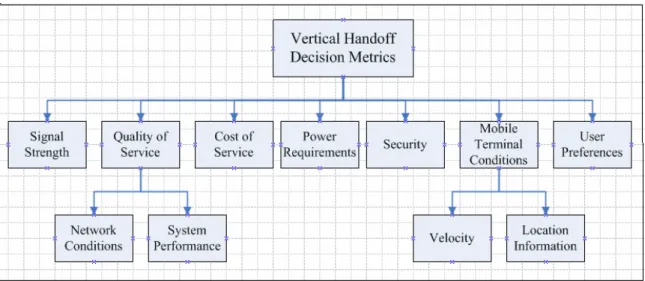
Mobility management is a main challenge in the evolving multi-service heterogeneous NGWN. It consists of two components: location management and handoff management [19]. Location management tracks and locates the mobile terminal (MT) for successful information delivery. Handoff management maintains the active connections for roaming MTs as they change their point of attachment to the network. Seamless mobility can be achieved by enabling MTs to conduct seamless handoffs across the heterogeneous wireless access networks, for example, across mobile WiMAX and 3G access networks. Each MT is at all times within range of at least one network point of attachment. In cellular voice telephony and cellular data networks, such a point of attachment is called a base station (BS), a
![Figure 2.1: Horizontal and Vertical Handoffs [21]](https://thumb-us.123doks.com/thumbv2/123dok_us/507526.2559898/39.918.184.739.485.819/figure-horizontal-and-vertical-handoffs.webp)
![Figure 2.3: Mobile IP in a WLAN-GPRS environment [42].](https://thumb-us.123doks.com/thumbv2/123dok_us/507526.2559898/57.918.153.767.104.555/figure-mobile-ip-wlan-gprs-environment.webp)