Access
Paulo Sergio Pagliusi
Technical Report
RHUL–MA–2008–15
20 March 2008
Royal Holloway
University of London
Department of Mathematics
Royal Holloway, University of London
Egham, Surrey TW20 0EX, England
Remote Access
by
Paulo Sergio Pagliusi
Thesis submitted to the University of London for the degree of Doctor of Philosophy
Department of Mathematics Royal Holloway, University of London
These doctoral studies were conducted under the supervision of Professor Chris Mitchell and Professor Peter Wild.
The work presented in this thesis is the result of original research carried out by myself, in collaboration with others, whilst enrolled in the Department of Mathematics as a candidate for the degree of Doctor of Philosophy. This work has not been submitted for any other degree or award in any other university or educational establishment.
Paulo Sergio Pagliusi 25 January 2008
It is expected that future IP devices will employ a variety of different net-work access technologies to gain ubiquitous connectivity. Currently there are no authentication protocols available that are lightweight, can be carried over arbitrary access networks, and are flexible enough to be re-used in the many different contexts that are likely to arise in future Internet remote access. Fur-thermore, existing access procedures need to be enhanced to offer protection against Denial-of-Service (DoS) attacks, and do not provide non-repudiation. In addition to being limited to specific access media, some of these protocols are limited to specific network topologies and are not scalable.
This thesis reviews the authentication infrastructure challenges for future Internet remote access supporting ubiquitous client mobility, and proposes a se-ries of solutions obtained by adapting and reinforcing security techniques arising from a variety of different sources. The focus is on entity authentication proto-cols that can be carried both by the IETF PANA authentication carrier and by the EAP mechanisms, and possibly making use of an AAA infrastructure. The core idea is to adapt authentication protocols arising from the mobile telecom-munications sphere to Internet remote access. A proposal is also given for In-ternet access using a public key based authentication protocol. The subsequent security analysis of the proposed authentication protocols covers a variety of as-pects, including: key freshness, DoS-resistance, and “false-entity-in-the-middle” attacks, in addition to identity privacy of users accessing the Internet via mobile devices.
This work aims primarily at contributing to ongoing research on the au-thentication infrastructure for the Internet remote access environment, and at reviewing and adapting authentication solutions implemented in other spheres, for instance in mobile telecommunications systems, for use in Internet remote access networks supporting ubiquitous mobility.
First, I would like to thank my supervisor, Professor Chris Mitchell, for his help, constant support, for always being available, and for encouraging the conclusion of this work. After that, I would like to acknowledge the many helpful insights and corrections provided by Hannes Tsch¨ofenig and Yoshihiro Ohba for some of the articles written during my research. Next, my thanks go to the Brazil-ian Navy (particularly GCM, EMA, DAbM, DEnsM, DTM, CASNAV, CCIM and DepSMRJ) for funding and motivating my research. The staff and fellow students within the Mathematics Department, especially from the Information Security Group, by their warmth and friendship, have provided a most pleasant environment during my years of study at Royal Holloway — my thanks go to all of them. I would also like to thank my friends, in especial Williamson de
Lima Santos, Joao Augusto Gomes de Queiroz, and Aldemir Lima Nunes for
their encouragement and support.
I must thank my dear wife Marcia, for allowing me the time and space to
pursue projects such as this, while she gets on with running the house, the family, and much else besides. Last, but by no means least, I want to thank my sons Daniel and Rodrigo for their caress and patience, and my parents Adauto and Nilza, who have supported me in whatever decisions I have taken throughout my life, and whose support has also been important during my studies in England.
A number of papers resulting from this work have been presented in refereed conferences.
• C. J. Mitchell and P. S. Pagliusi. Is entity authentication necessary? In
Bruce Christianson, James A. Malcolm, Bruno Crispo, and Michael Roe,
editors,Security Protocols: 10th International Workshop on Security
Pro-tocols, Proceedings, Lecture Notes in Computer Science 2845, pages 20–33, Cambridge, UK, December 2003. Springer-Verlag.
• P. S. Pagliusi. A contemporary foreword on GSM security. In G. Davida,
Y. Frankel, and O. Rees, editors, Infrastructure Security: International
Conference — InfraSec 2002, Proceedings, Lecture Notes in Computer Sci-ence 2437, pages 129–144, Bristol, UK, October 2002. Springer-Verlag.
• P. S. Pagliusi and C. J. Mitchell. PANA/IKEv2: an Internet
authenti-cation protocol for heterogeneous access. In K. Chae and M. Yung,
edi-tors,4th International Workshop on Information Security Applications —
WISA 2003, Proceedings, Lecture Notes in Computer Science 2908, pages 135–149, Jeju Island, Korea, August 2003. Springer-Verlag.
• P. S. Pagliusi and C. J. Mitchell. PANA/GSM authentication for
Inter-net access. In P. Farkas, editor,Joint 1st Workshop on Mobile Future &
Symposium on Trends in Communications — SympoTIC’03, Proceedings, IEEE Catalog Number 03EX727, pages 146–152, Bratislava, Slovakia, Oc-tober 2003. Institute of Electrical and Electronics Engineers.
• P. S. Pagliusi and C. J. Mitchell. Heterogeneous Internet access via
PANA/UMTS. Inthe Proceedings of 3rd International Conference on
In-formation Security, Hardware/Software Codesign And Computers Net-work — ISCOCO 2004. Rio De Janeiro, Brazil, October 2004. World Scientific And Engineering Academy And Society. To be published in the WSEAS Transactions.
2G Second Generation
2.5G Second-and-a-Half Generation
3G Third Generation
3GPP Third Generation Partnership Project
AAA Authentication, Authorisation and Accounting
AES Advanced Encryption Standard
AH Authentication Header
AK Authentication Key
AKA Authentication and Key Agreement
AMSK Application MSK
AP Authentication Proxy
AS Authentication Server
AuC Authentication Centre
AUTH Authentication Payload
AUTN Network Authentication Token
AVP Attribute Value Pair
BS Base Station
BSC Base Station Controller
BSF Bootstrapping Server Function
CAVE Cellular Authentication and Voice Encryption
CB Contact Book
CDMA Code Division Multiple Access
CDMA2000 Code Division Multiple Access 2000
CERT Certificate
CHAP Challenge-Handshake Authentication Protocol
CMEA Cellular Message Encryption Algorithm
DDoS Distributed-Denial-of-Service
DEA Diameter-EAP-Answer
DER Diameter-EAP-Request
DES Data Encryption Standard
DFD Data Flow Diagram
DHCP Dynamic Host Control Protocol
DI Device Identifier
DoS Denial-of-Service
DSA Digital Signature Algorithm
DSL Direct Subscriber Line
EAP Extensible Authentication Protocol
EAP-PSK EAP-Pre-Shared Key
EAP-TTLS EAP Tunnelled TLS Authentication Protocol
ECMEA Enhanced CMEA
EMSK Extended MSK
EP Enforcement Point
ESN Electronic Serial Number
ESP Encapsulating Security Payload
FQDN Fully-Qualified Domain Name
GAA Generic Authentication Architecture
GBA Generic Bootstrapping Architecture
GL Geolocation
GPRS General Packet Radio Service
GSM Global System for Mobile Communications
GTC Generic Token Card
GUSS GBA User Security Settings
HA Home Agent
HDLC High-level Data Link Control
HLR Home Location Register
HMAC Hash Message Authentication Code
HN Home Network
HPLMN Home PLMN
HSS Home Subscriber System
HTML HyperText Markup Language
HTTP Hypertext Transfer
HTTPS HTTP over TLS
ID Identifier
ID-FF Liberty Identity Federation Framework
IdP Identity Provider
ID-SIS Liberty Identity Service Interface Specifications
ID-WSF Liberty Identity Web Services Framework
IETF Internet Engineering Task Force
IKE Internet Key Exchange
IMSI International Mobile Subscriber Identity
IMT International Mobile Telecommunication
IP Internet Protocol
IPsec IP security Protocol
ISAKMP Internet Security Association and Key Management Protocol
ISP Internet Service Provider
ITU International Telecommunication Union
KDK Key-Derivation Key
LAI Location Area Identifier
LAN Local Area Network
LCP Link Control Phase
LECP Liberty Enhanced Client Profile
LUA Liberty-enabled User Agent
MAC Message Authentication Code
ME Mobile Equipment
MIN Mobile Identification Number
MitM Man-in-the-Middle
MN Mobile Node
MS Mobile Station
MSC Mobile Switching Centre
MSK Master Session Key
MT Mobile Termination
NAF Network Application Function
NAI Network Access Identifier
NAK Not Acknowledged
NE Network Element
OMA Open Mobile Alliance
OTASP Over The Air Service Provisioning
OTP One-Time Password
PAA PANA Authentication Agent
PaC PANA Client
PAMPAS Pioneering Advanced Mobile Privacy and Security
PAN Personal Area Network
PANA Protocol for carrying Authentication for Network Access
PANATLS PANA over TLS
PAP Password Authentication Protocol
PC Personal Computer
PDA Personal Digital Assistant
PDSN Packet Data Serving Node
PEAP Protected EAP Protocol
PIC Pre-IKE Credential
PKI Public Key Infrastructure
PLMN Public Land Mobile Network
PP Personal Profile
PPP Point-to-Point Protocol
PSK Pre-Shared Key
RA Routing Area
RADIUS Remote Access Dial in User Service
RAI Routing Area Identity
RFC Request For Comments
RSA Rivest – Shamir – Adleman
(R)UIM (Removable) User Identity Module
SA Security Association
SAML Security Assertion Markup Language
SCTP Stream Control Transmission Protocol
SeNAA Secure Network Access Authentication
SEND SEcure Neighbor Discovery
SGSN Serving GPRS Support Node
SHA-1 Secure Hash Algorithm revision 1
SHAMAN Security for Heterogeneous Access in Mobile Applications and Networks
SIM Subscriber Identity Module
SLF Subscriber Locator Function
SP Service Provider
SPI Security Parameter Index
SQN Sequence Number
SSC Support for Subscriber Certificates
SSD Shared Secret Data
SSL Secure Sockets Layer
SSO Single Sign-On
TCP Transmission Control Protocol
TE Terminal Equipment
TEK Transient EAP Key
TLLI Temporary Logical Link Identity
TLS Transport Layer Security protocol
TMSI Temporary Mobile Subscriber Identity
TTP Trusted Third Party
UDP User Datagram Protocol
UE User Equipment
UID User IDentifier
UMTS Universal Mobile Telecommunications System
URL Uniform Resource Locator
USIM Universal Subscriber Identity Module
UTRAN UMTS Radio Access Network
VLR Visitor Location Register
VN Visited Network
WAP Wireless Application Protocol
WEP Wired Equivalent Privacy
WG Working Group
WISP Wireless ISP
WLAN Wireless LAN
WTLS Wireless TLS
XAUTH Extended Authentication within ISAKMP/Oakley
Declaration 3 Abstract 4 Acknowledgements 5 List of Publications 6 Abbreviations 7 Table of Contents 14 List of Tables 23 List of Figures 25
I
Overview of Entity Authentication
30
1 Introduction 31
1.1 Motivation and Challenges . . . 32
1.2 The Contribution of this Thesis . . . 33
1.3 Organisation of this Thesis . . . 34
2.1 Security Building Blocks . . . 40
2.1.1 Security Services . . . 41
2.1.2 Security Mechanisms . . . 45
2.1.3 Cryptographic Tools . . . 46
2.2 Authentication: Basic Concepts . . . 55
2.2.1 The Identification Process . . . 56
2.2.2 Authentication and Credentials . . . 57
2.2.3 Authentication Protocols . . . 58
2.2.4 Temporality . . . 59
2.2.5 Implicit Key Authentication and Key Freshness Estab-lishment . . . 60
2.3 General Authentication Model . . . 61
3 Authentication Protocols for Internet Remote Access 63 3.1 Internet Access and Authentication . . . 67
3.1.1 Internet Remote Access Perspectives . . . 67
3.1.2 Authentication Approaches . . . 68
3.2 Initial Authentication . . . 70
3.2.1 A Higher Layer for Internet Authentication . . . 71
3.2.2 Tunnelled Authentication Mechanisms . . . 73
3.2.3 Vulnerabilities in Tunnelled Protocols . . . 73
3.3 Legacy One-Way Authentication Protocols . . . 75
3.3.1 PPP PAP & CHAP . . . 76
3.3.2 PPP EAP-MD5 . . . 78
3.3.3 One-Time Password (OTP) . . . 81
3.3.4 Generic Token Card (GTC) . . . 83
3.4 EAP Architecture . . . 85
3.4.1 EAP Development . . . 86
3.4.2 EAP Basic Features . . . 86
3.4.3 EAP Exchange . . . 87
3.4.4 EAP Layers . . . 88
3.4.5 EAP Advantages and Disadvantages . . . 88
3.5 Mobile Authentication Methods . . . 89
3.5.1 Global System for Mobile Communications (GSM) . . . . 90
3.5.2 General Packet Radio Service (GPRS) . . . 95
3.5.3 Universal Mobile Telecommunications System (UMTS) . . 97
3.5.4 Generic Authentication Architecture (GAA) . . . 101
3.5.5 Code Division Multiple Access 2000 (CDMA2000) . . . . 109
3.6 Cryptographic Tunnelling and Key Generation . . . 115
3.6.1 Internet Security Association and Key Management Pro-tocol (ISAKMP) . . . 116
3.6.2 Internet Key Exchange (IKE) . . . 117
3.6.3 Transport Layer Security Protocol (TLS) . . . 117
3.6.4 Wireless Transport Layer Security Protocol (WTLS) . . . 120
3.6.5 IPsec . . . 121
3.6.6 EAP Key Derivation for Multiple Applications . . . 124
3.6.7 EAP-PSK . . . 125
3.7 Compound Tunnelled Authentication Protocols . . . 126
3.7.1 Extended Authentication within ISAKMP/Oakley (XAUTH)126 3.7.2 Pre-IKE Credential (PIC) Provisioning Protocol . . . 127
3.7.3 Protected EAP Protocol (PEAP) . . . 129
3.7.5 Protocol for Carrying Authentication for Network Access
(PANA) . . . 131
3.7.6 PANA over TLS (PANATLS) . . . 133
3.7.7 Secure Network Access Authentication (SeNAA) . . . 134
3.8 Public Key Authentication for Network Access . . . 135
3.8.1 Internet Key Exchange version 2 (IKEv2) . . . 136
3.8.2 Public Key Based EAP Methods . . . 137
3.9 AAA Backend Infrastructure . . . 140
3.9.1 RADIUS . . . 141
3.9.2 Diameter . . . 143
3.9.3 Diameter EAP Application . . . 146
3.10 Liberty Alliance Project . . . 148
3.10.1 Liberty Objectives . . . 149
3.10.2 Liberty Requirements . . . 150
3.10.3 Operation of the Liberty Scheme . . . 152
3.10.4 Liberty Architecture . . . 154
3.10.5 Liberty Identity Federation Framework (ID-FF) . . . 155
3.10.6 Liberty Identity Web Services Framework (ID-WSF) . . . 157
3.10.7 Liberty Identity Service Interface Specifications (ID-SIS) . 159 3.10.8 Liberty Security Mechanisms . . . 160
II
Internet Remote Access Authentication
163
4 Internet Authentication Problem Domain & Scenarios 164 4.1 Problem Domain . . . 1664.1.1 Remote Dynamic Service Provider Selection . . . 167
4.1.3 EAP Encapsulated Authentication Methods . . . 168
4.1.4 Transport Schemes for EAP . . . 168
4.1.5 Ad Hoc Solutions for Internet Remote Access . . . 169
4.2 Scenarios . . . 170
4.2.1 Tunnelled Authentication with Physical Security . . . 170
4.2.2 Tunnelled Authentication with Link Security . . . 171
4.2.3 Absence of Lower Layer Security . . . 175
4.2.4 Mobile IP . . . 176
4.2.5 Personal Area Networks . . . 177
4.2.6 Limited Free Access . . . 179
5 Internet Remote Access Requirements 180 5.1 Security Requirements . . . 182
5.1.1 Client Authentication . . . 182
5.1.2 Key Establishment . . . 183
5.1.3 Use of EAP Methods . . . 184
5.1.4 Mutual Entity Authentication . . . 184
5.1.5 Key Freshness . . . 185
5.1.6 Re-Authentication . . . 185
5.1.7 Authorisation, Access Control, and Accounting . . . 186
5.1.8 AAA Backend . . . 187
5.1.9 Secure Channel . . . 187
5.1.10 Denial-of-Service Attacks . . . 188
5.1.11 Client Identity Confidentiality . . . 188
5.2 Implementation Requirements . . . 188
5.2.1 Client Identifiers . . . 189
5.2.3 EAP Lower Layer Requirements . . . 190
5.2.4 Flexibility . . . 190
5.2.5 Performance . . . 190
5.2.6 Complexity . . . 190
5.2.7 IP Version Independence . . . 191
5.3 Services and Properties of New Authentication Protocols . . . 191
5.3.1 Security Services and Properties . . . 191
5.3.2 Implementation Services and Properties . . . 192
6 PANA as the Target Transportation Environment 194 6.1 PANA Framework . . . 196
6.1.1 PANA Goals and Overview . . . 196
6.1.2 PANA Terminology . . . 198
6.1.3 PANA Payload (AVPs) . . . 200
6.1.4 PANA Phases . . . 202
6.1.5 PANA Security Association . . . 208
6.2 Reasons for Choosing PANA . . . 210
6.2.1 PANA Threat Analysis . . . 210
6.2.2 PANA Security and Implementation Requirements . . . . 218
6.2.3 PANA Services and Properties Assessment . . . 220
III
Internet Authentication Protocols & Assessments 222
7 PANA/GSM 223 7.1 Introduction . . . 2247.2 PANA/GSM Objective . . . 226
7.4 An EAP Mechanism for Carrying GSM . . . 228
7.5 PANA/GSM Framework . . . 232
7.5.1 PANA/GSM Entities . . . 232
7.5.2 PANA/GSM Authentication Scheme . . . 233
7.6 PANA/GSM SA and Re-Authentication . . . 240
7.7 Conclusions . . . 240
8 PANA/UMTS 242 8.1 Introduction . . . 244
8.2 PANA/UMTS Objective . . . 245
8.3 PANA/UMTS Protocol Hierarchy . . . 246
8.4 An EAP Mechanism for Carrying UMTS . . . 248
8.5 PANA/UMTS Framework . . . 251
8.5.1 PANA/UMTS Entities . . . 251
8.5.2 PANA/UMTS Authentication Scheme . . . 252
8.6 PANA/UMTS SA and Re-Authentication . . . 258
8.7 PANA/UMTS with GAA Infrastructure . . . 259
8.7.1 PANA/UMTS with GAA Entities . . . 260
8.7.2 An Internet AAA and UMTS AKA Interface . . . 261
8.8 Conclusions . . . 263
9 PANA/Liberty 265 9.1 Introduction . . . 267
9.2 PANA/Liberty Objective . . . 269
9.3 PANA/Liberty Protocol Hierarchy . . . 269
9.4 Liberty with GAA Infrastructure . . . 271
9.4.2 Architecture for collocated NAF/IdP . . . 272
9.4.3 Federation in Liberty with GAA . . . 274
9.4.4 Liberty with GAA Session . . . 275
9.4.5 Liberty with GAA Scenarios . . . 276
9.5 PANA/Liberty Framework . . . 277
9.5.1 PANA/Liberty Entities . . . 277
9.5.2 PANA/Liberty Authentication Scheme . . . 279
9.6 PANA/Liberty SA and Re-Authentication . . . 286 9.7 Alternatives for PANA/Liberty Integration . . . 286
9.7.1 PANA/Liberty without GAA Framework . . . 287
9.7.2 Possibilities for PANA Inner Authentication . . . 288
9.8 Conclusions . . . 289
10 PANA/IKEv2 291
10.1 Introduction . . . 292 10.2 PANA/IKEv2 Objective . . . 294 10.3 PANA/IKEv2 Protocol Hierarchy . . . 294 10.4 An EAP Mechanism for Carrying IKEv2 . . . 296 10.5 PANA/IKEv2 Framework . . . 300 10.5.1 PANA/IKEv2 Entities . . . 300 10.5.2 PANA/IKEv2 Authentication Scheme . . . 301 10.6 PANA/IKEv2 SA and Re-Authentication . . . 306 10.7 Conclusions . . . 307
11 Threat Modelling & Evaluation 309
11.1 Introduction . . . 311 11.2 Threat Modelling . . . 311
11.3 Formally Decomposing the Protocols . . . 312 11.3.1 Context Data Flow Diagrams . . . 313 11.3.2 Level-1 and Level-2 Diagrams . . . 314 11.4 Determining the Threats to the Protocols . . . 318 11.4.1 Threat Categories and STRIDE . . . 318 11.4.2 Threat Trees . . . 322 11.5 Ranking the Threats by Decreasing Risk . . . 358 11.5.1 DREAD Ranking Method . . . 358 11.5.2 Using DREAD to Calculate Security Risk . . . 360 11.6 Mitigating the Threats . . . 375 11.6.1 Mitigation Techniques . . . 377 11.6.2 Mitigation Status . . . 377 11.7 Comparative Analysis . . . 379 11.7.1 Security Assessment . . . 381 11.7.2 Implementation Assessment . . . 385 11.7.3 Assessment using Threat Model Results . . . 388 11.7.4 Services and Properties Assessment . . . 389 11.8 Conclusions . . . 391
12 Conclusions 393
12.1 Summary and Conclusions . . . 394 12.2 Suggestions for Future Work . . . 397
3.1 Liberty security mechanisms . . . 161 6.1 PANA security assessment . . . 221 6.2 PANA implementation assessment . . . 221 11.1 PANA/GSM threat #1 . . . 361 11.2 PANA/GSM threat #2 . . . 361 11.3 PANA/GSM threat #3 . . . 362 11.4 PANA/GSM threat #4 . . . 362 11.5 PANA/GSM threat #5 . . . 363 11.6 PANA/GSM threat #6 . . . 363 11.7 PANA/GSM threat #7 . . . 363 11.8 PANA/GSM threat #8 . . . 364 11.9 PANA/GSM threat #9 . . . 364 11.10PANA/GSM threat #10 . . . 364 11.11PANA/GSM threat #11 . . . 365 11.12PANA/GSM threat #12 . . . 365 11.13PANA/UMTS or PANA/Liberty threat #1 . . . 366 11.14PANA/UMTS or PANA/Liberty threat #2 . . . 367 11.15PANA/UMTS or PANA/Liberty threat #3 . . . 367
11.16PANA/UMTS or PANA/Liberty threat #4 . . . 368 11.17PANA/UMTS or PANA/Liberty threat #5 . . . 368 11.18PANA/UMTS or PANA/Liberty threat #6 . . . 369 11.19PANA/UMTS or PANA/Liberty threat #7 . . . 369 11.20PANA/UMTS or PANA/Liberty threat #8 . . . 369 11.21PANA/UMTS or PANA/Liberty threat #9 . . . 370 11.22PANA/UMTS or PANA/Liberty threat #10 . . . 370 11.23PANA/IKEv2 threat #1 . . . 371 11.24PANA/IKEv2 threat #2 . . . 371 11.25PANA/IKEv2 threat #3 . . . 372 11.26PANA/IKEv2 threat #4 . . . 372 11.27PANA/IKEv2 threat #5 . . . 373 11.28PANA/IKEv2 threat #6 . . . 373 11.29PANA/IKEv2 threat #7 . . . 373 11.30PANA/IKEv2 threat #8 . . . 374 11.31PANA/IKEv2 threat #9 . . . 374 11.32PANA/IKEv2 threat #10 . . . 374 11.33Ranking the PANA/GSM threats . . . 375 11.34Ranking the PANA/UMTS and PANA/Liberty threats . . . 376 11.35Ranking the PANA/IKEv2 threats . . . 377 11.36Partial list of threat mitigation techniques . . . 378 11.37Mitigation status of PANA/GSM . . . 379 11.38Mitigation status of PANA/UMTS and PANA/Liberty . . . 380 11.39Mitigation status of PANA/IKEv2 . . . 381 11.40Threat model main results . . . 388 11.41Security assessment . . . 389
2.1 Security building blocks . . . 40
2.2 Authentication model . . . 61
3.1 Authentication for Internet remote access . . . 68
3.2 Internet authentication . . . 70
3.3 CHAP typical steps . . . 78
3.4 PPP EAP-MD5 typical steps . . . 80
3.5 GSM system overview . . . 90
3.6 Authentication and confidentiality for GSM . . . 94
3.7 GAA system overview . . . 102 3.8 GAA authentication mechanisms . . . 105 3.9 GBA bootstrapping network model . . . 105 3.10 SSC certificate issuing model . . . 107 3.11 Relationship among EAP client, EAP server, and NAS . . . 129 3.12 PANA header format . . . 132 3.13 RADIUS operation . . . 142 3.14 Using EAP in Diameter . . . 147 3.15 Liberty operation . . . 152 3.16 Liberty user logs in at IdP and is recognised by SP . . . 157 3.17 Identity Web service invocation . . . 158
4.1 AAA infrastructure for Mobile IPv4 in CDMA2000 . . . 174 6.1 PANA protocol overview . . . 197 6.2 Illustration of PANA messages in a session . . . 202 6.3 Re-authentication phase initiated by the PaC . . . 206 7.1 PANA/GSM protocol hierarchy . . . 228 7.2 Pseudo-random number generator (FIPS 186-2) . . . 230 7.3 PANA/GSM full authentication procedure . . . 234 8.1 PANA/UMTS protocol hierarchy . . . 248 8.2 PANA/UMTS full authentication procedure . . . 253 8.3 PANA/UMTS incorporating GAA . . . 260
8.4 Protocol hierarchy of theZh interface . . . 261
9.1 PANA/Liberty protocol hierarchy . . . 271 9.2 Liberty ID-FF and GAA with a collocated NAF and IdP . . . . 273 9.3 Entities involved in the PANA/Liberty scheme . . . 278 9.4 PANA/Liberty authentication procedure . . . 280 9.5 PANA/Liberty SSO message flow . . . 283 10.1 PANA/IKEv2 protocol hierarchy . . . 296 10.2 EAP-IKEv2 message flow . . . 297 10.3 PANA/IKEv2 full authentication procedure . . . 301 11.1 Process of threat modelling . . . 312 11.2 Basic data flow diagram symbols . . . 313 11.3 PANA/GSM context diagram . . . 314 11.4 PANA/UMTS context diagram . . . 315
11.5 PANA/Liberty context diagram . . . 316 11.6 PANA/IKEv2 context diagram . . . 317 11.7 PANA/GSM level-1 diagram . . . 318 11.8 PANA/UMTS level-1 diagram . . . 319 11.9 PANA/Liberty level-1 diagram . . . 320 11.10PANA/IKEv2 level-1 diagram . . . 321 11.11PAA spoofing via GSM triplet exposure . . . 324 11.12Permanent GSM user identifier disclosure . . . 325 11.13PANA/GSM session key disclosure . . . 326 11.14MitM attacks against PANA/GSM . . . 328 11.15Service theft attacks against PANA/GSM . . . 329 11.16SIM credential reuse and brute-force attacks . . . 330 11.17PANA/GSM signalling traffic tampering . . . 331 11.18Bidding down attacks against PANA/GSM . . . 333 11.19Blind resource consumption DoS against PANA/GSM . . . 334 11.20DoS attacks using PANA/GSM termination messages . . . 335 11.21DoS attacks using false PANA/GSM indications . . . 336 11.22IP address depletion attacks against PANA/GSM . . . 337 11.23A permanent UMTS user identifier disclosure . . . 339 11.24MitM attacks against PANA/UMTS or PANA/Liberty . . . 340 11.25Service theft attacks against PANA/UMTS or PANA/Liberty . . 340 11.26PANA/UMTS or PANA/Liberty signalling traffic tampering . . 342 11.27Bidding down against PANA/UMTS or PANA/Liberty . . . 343 11.28Blind DoS against PANA/UMTS or PANA/Liberty . . . 344 11.29DoS via PANA/UMTS or PANA/Liberty termination messages . 344 11.30DoS via false PANA/UMTS or PANA/Liberty indications . . . . 345
11.31IP address depletion against PANA/UMTS or PANA/Liberty . . 346 11.32Brute-force against PANA/UMTS or PANA/Liberty . . . 347 11.33MitM attacks against PANA/IKEv2 . . . 349 11.34PANA/IKEv2 user identifier disclosure . . . 350 11.35Service theft attacks against PANA/IKEv2 . . . 351 11.36Brute-force against PANA/IKEv2 . . . 352 11.37PANA/IKEv2 signalling traffic tampering . . . 353 11.38Bidding down attacks against PANA/IKEv2 . . . 354 11.39Blind resource consumption DoS against PANA/IKEv2 . . . 355 11.40DoS using PANA/IKEv2 termination messages . . . 356 11.41DoS attacks via false PANA/IKEv2 indications . . . 357 11.42IP address depletion attacks against PANA/IKEv2 . . . 358
Overview of Entity
Authentication
Chapter 1
Introduction
Contents
1.1 Motivation and Challenges . . . 32
1.2 The Contribution of this Thesis . . . 33
1.3 Organisation of this Thesis . . . 34
The aim of this chapter is to provide an introduction, and also to present the overall structure of the thesis. Section 1.1 provides the motivation and main challenges addressed by the thesis. Sections 1.2 and 1.3 describe, respectively, the principal contributions and the structure of this thesis. In fact this thesis is divided into three main parts: Part I — Overview of Entity Authentication, Part II — Internet Remote Access Authentication, and Part III — Internet Authentication Protocols & Assessments.
1.1
Motivation and Challenges
It is expected that future IP devices will use a variety of network access technolo-gies to support ubiquitous connectivity, and security is clearly a very important factor in these scenarios. According to the Pioneering Advanced Mobile Privacy and Security (PAMPAS) Project [82], “the increasing heterogeneity of the net-working environment is one of the long-term trends which requires new security approaches”.
The main challenges include the investigation and development of unified, secure and convenient authentication mechanisms that can be used in access
networks. In this context, authentication and key agreement are the central
components of secure access procedures for heterogeneous network access
sup-porting ubiquitous mobility. Byheterogeneous network accesswe mean to cover
the situation where arbitrary network types are being accessed, through diverse interfaces, by a number of users located in various places, in different situations
and with a variety of preferences. Byubiquitous mobilitywe mean the capability
for providing a universal and ever-present global mobility service to a valid user via a variety of different networks.
For example, one future requirement identified by the Security for
Hetero-geneous Access in Mobile Applications and Networks (SHAMAN1) Project is
to provide flexible security means for accessing heterogeneous mobile networks, including not only GSM [179], GPRS [61] and UMTS [8], but also WLAN [71],
Bluetooth2, and other network technologies. Moreover, “heterogeneous
net-work access control security” received the highest rating value in the list of open research issues for future mobile communication systems produced by the PAMPAS Project [82].
Currently there are no authentication protocols available that are lightweight, 1http://www.ist-shaman.org/
can be carried over arbitrary access networks, and are flexible enough for use with all the various access technologies likely to be deployed to support fu-ture ubiquitous mobility. Furthermore, existing access procedures need to be made resistant to Denial-of-Service (DoS) attacks; they also do not provide non-repudiation. In addition to being limited to specific access media (e.g. 802.1X–2004 [84] for IEEE 802 links), some of these protocols are limited to specific network topologies (e.g. PPP [168] for point-to-point links) and are not scalable.
1.2
The Contribution of this Thesis
This thesis reviews the authentication infrastructure challenges for future het-erogeneous Internet remote access supporting ubiquitous client mobility, and proposes a series of new solutions by adapting and reinforcing security tech-niques arising from a variety of different sources.
Firstly the thesis provides background information on security services, and establishes a general entity authentication model. In order to highlight the issues involved, we next focus on the mechanisms most widely discussed in the context of Internet authentication for remote access. The advantages and disadvantages of these schemes are assessed and compared. Much of this information is based on existing work in the Internet entity authentication literature.
Secondly the thesis defines the problem domain, establishes the usage sce-narios, and defines the requirements for authentication mechanisms for Internet remote access. The authentication services and properties needed to address the threats and to achieve the desired implementation features are then specified. Finally, after the selection of a common target transport environment, this the-sis proposes, evaluates and compares four new Internet authentication schemes for heterogeneous remote access, designed to meet the established requirements.
The focus of this thesis is on authentication protocols that can be carried both by the IETF Protocol for carrying Authentication for Network Access (PANA) [65, 151] authentication carrier and Extensible Authentication Pro-tocol (EAP) [13] mechanisms, and possibly making use of an Authentication, Authorisation and Accounting (AAA) infrastructure, e.g. the Diameter protocol [34]. The core idea is to adapt authentication protocols arising from the mobile telecommunications sphere to provide security mechanisms for heterogeneous Internet remote access. A new proposal is also given for Internet access using a public key based authentication protocol.
The security analysis of the proposed authentication protocols is performed using a threat modelling technique described in Chapter 4 of Howard and LeBlanc [81, p69-124]. The analysis addresses a variety of aspects, including: key freshness, DoS-resistance and resistance to “false-entity-in-the-middle” at-tacks, in addition to identity privacy of users accessing the Internet via mobile devices.
1.3
Organisation of this Thesis
This thesis is divided into three main parts. Part I is a preliminary part contain-ing this introduction, background material regardcontain-ing cryptographic techniques, and a technical overview of entity authentication. Part I also includes a review of existing authentication protocols relevant to this thesis. Part II covers Internet remote access authentication, establishing the problem domain, usage scenarios, requirements, and service properties for new Internet remote access authentica-tion mechanisms. Part III contains the four new protocols, and assesses them using the formal threat modelling process mentioned in section 1.2.
Part I consists of Chapters 1, 2 and 3. Chapter 2 provides background on se-curity services and cryptographic techniques, in addition to a technical overview
of entity authentication. A number of properties of authentication protocols, such as temporality, implicit key authentication, and key freshness establish-ment, are identified. A general model for entity authentication mechanisms is given. The techniques, definitions and schemes discussed in this chapter are used throughout this thesis.
In Chapter 3, we review authentication protocols in the context of Internet remote access. Different perspectives related to Internet remote access are dis-tinguished. We then describe a number of possible approaches to constructing authentication protocols, and divide initial authentication for Internet remote access into two parts. The need for a higher layer authentication procedure for heterogeneous Internet access is discussed. Possible tunnelled authentica-tion mechanisms are considered, and a wide range of potential alternatives are reviewed. We then summarise some of the existing authentication protocols relevant to this thesis, including legacy processes, public key based procedures, and mobile telecommunications methods.
Part II consists of Chapters 4, 5 and 6. In Chapter 4, the problem domain for Internet entity authentication is established. In addition, a number of au-thentication scenarios for Internet remote access are described; the first two of them are categorised in terms of the layer of the protocol stack in which secu-rity is provided. Next we depict a scenario covering the absence of lower layer security. We then describe further scenarios involving respectively mobile IP, personal area networks, and limited free access.
In Chapter 5 we develop means to assess entity authentication protocols against Internet remote access requirements. We define two main sets of re-quirements, namely security and implementation requirements. To establish the security requirements we analyse and compare potential risks associated with entity authentication protocols, examining a number of aspects of entity authentication security for Internet remote access. To obtain the
implementa-tion requirements we analyse and compare features such as complexity, flexibility and performance. The result of this critical analysis is used later in the thesis to determine the security and implementation services and properties required of new entity authentication schemes for Internet access. In Chapter 6, we discuss the selection of the PANA protocol as the target environment for transporting the new Internet authentication schemes proposed here. This chapter describes the PANA protocol in more detail, as well as explaining the reasons for its choice as the transport environment.
Part III consists of Chapters 7 to 11. Chapter 7 presents a proposal for combining the Global System for Mobile communication (GSM) [179] authenti-cation mechanism with PANA, which we call PANA/GSM. This scheme adapts the security techniques used in GSM to PANA. Chapter 8 presents a new means of combining the Universal Mobile Telecommunications System (UMTS) Authentication and Key Agreement (AKA) mechanism [8] with PANA, which we call PANA/UMTS. This scheme adapts the security techniques used in UMTS to the PANA environment. Chapter 9 presents a proposal for com-bining the Liberty Alliance Project and Third Generation Partnership Project (3GPP) Generic Authentication Architecture (GAA) security mechanisms [11] with PANA, which we call PANA/Liberty. This scheme adapts the security techniques used in Liberty and 3GPP GAA to the PANA infrastructure. Chap-ter 10 presents a fourth new scheme that combines the InChap-ternet Key Exchange version 2 (IKEv2) [49] public key based authentication mechanism with PANA, which we call PANA/IKEv2. This scheme adapts the security techniques used in the IKEv2 public key based scheme to the PANA framework.
In Chapter 11, we perform threat modelling and comparative analyses of the four new Internet entity authentication techniques proposed in this thesis. The goal of this chapter is to determine which of them are secure, lightweight, flexible and scalable methods allowing a client to be authenticated in a heterogeneous Internet access environment supporting ubiquitous mobility.
Finally, in Chapter 12, we summarise the findings of the thesis. In addition, suggestions for future work are provided.
Chapter 2
Entity Authentication
Contents
2.1 Security Building Blocks . . . 40
2.1.1 Security Services . . . 41 2.1.2 Security Mechanisms . . . 45 2.1.3 Cryptographic Tools . . . 46
2.2 Authentication: Basic Concepts . . . 55
2.2.1 The Identification Process . . . 56
2.2.2 Authentication and Credentials . . . 57
2.2.3 Authentication Protocols . . . 58
2.2.4 Temporality . . . 59
2.2.5 Implicit Key Authentication and Key Freshness
Es-tablishment . . . 60
2.3 General Authentication Model . . . 61
The aim of this chapter is to provide background information on security services and cryptographic tools, together with a technical overview of entity
authentication. Section 2.1 describes the set of basic building blocks used in se-curity protocols, including the sese-curity services and mechanisms, in addition to the (symmetric and asymmetric) cryptographic techniques of relevance to this thesis. Section 2.2 identifies a number of basic concepts underlying authentica-tion, and describes important properties of entity authentication protocols, such as temporality, implicit key authentication and the provision of key freshness. Section 2.3 provides a general authentication model. The techniques, definitions and schemes discussed in this chapter will be used throughout this thesis.
2.1
Security Building Blocks
The art of war teaches us to rely not on the chance of the enemy’s not attacking, but rather on the fact that we have made our position unassailable.
- The Art of War, Sun Tzu
When designing a security protocol, it is important initially to outline its
security goals. In order to meet each of these goals, one or moresecurity services
need to be provided. A series of fundamental building blocks can then be deployed to implement these security services.
The set of basic building blocks used in security protocols includes
algo-rithms. Cryptographic algorithms are specific instances ofsecurity mechanisms.
A security mechanism is a general term encompassing protocols, algorithms, cryptographic tools and even non-cryptographic techniques. One or more
mech-anisms can be used to build a security service. One or more security services
may be provided by a security protocol.
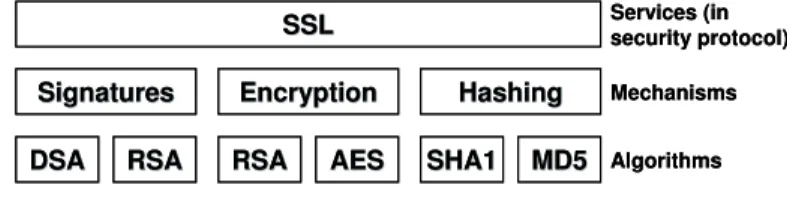
Figure 2.1 illustrates this idea. A typical security protocol provides one or more services. Services are provided using security mechanisms. As stated above, cryptographic algorithms are one very important category of security
mechanisms1.
SSL
SSL
Signatures
Signatures EncryptionEncryption HashingHashing
DSA
DSA RSARSA RSARSA AESAES SHA1SHA1 MD5MD5
Services (in security protocol) Mechanisms Algorithms SSL SSL Signatures
Signatures EncryptionEncryption HashingHashing
DSA
DSA RSARSA RSARSA AESAES SHA1SHA1 MD5MD5
Services (in security protocol)
Mechanisms
Algorithms
Figure 2.1: Security building blocks
1Peter Gutmann’s Crypto Tutorial, http://www.cs.auckland.ac.nz/~pgut001/tutorial/ in-dex.html.
In this section, therefore, we first define the security services of relevance to this thesis (subsection 2.1.1). In subsection 2.1.2, some of the mechanisms which can be used to provide the security services are listed. In subsection 2.1.3, the basic cryptographic techniques used throughout this thesis are briefly described.
2.1.1
Security Services
There are six main security services which are of importance when designing security protocols, and are consequently relevant to this thesis. They are: con-fidentiality, authentication, integrity, non-repudiation, access control, and avail-ability [170, p9-11].
According to [137], ‘it is important to note that all these services can be pro-vided by a variety of different techniques, not just cryptographic means. This is one reason why it is important to distinguish between cryptographic tech-niques, designed to provide services, and the services themselves. Identifying which security services are needed comes from a requirements analysis of a sys-tem — deciding which cryptographic techniques should be employed to provide the services, and how they should be managed, is an implementation decision’. The following definitions are based on those given in [39, 64, 72, 107, 132, 155, 170]. It is worth observing that these services are often combined. For instance, entity authentication can be used to support access control.
2.1.1.1 Confidentiality
Confidentiality means keeping information secret from all but those who are authorised to see it [132]. In other words, it means that the assets of a com-puter system and transmitted information and/or data are protected against disclosure to unauthorised entities. Possible methods of confidentiality
compro-mise include printing, displaying, and other forms of disclosure, such as simply revealing the existence of the information.
In summary, confidentiality services protect against information being dis-closed or revealed to entities not authorised to have that information.
2.1.1.2 Authentication
Authentication is a service related to identification. However, although the terms identification and entity authentication are used synonymously by a num-ber of authors, e.g. Menezes, Oorschot, and Vanstone [132, p386], in some places elsewhere in the literature, identification refers to learning a claimed or stated identity whereas entity authentication is the corroboration of a claimed identity.
That is, identification involveslearning an identifier (possibly a pseudonym) for
an entity, e.g. a communicating party, whereas entity authentication is about
verifying that this identifier does indeed belong to the entity who has claimed
it. This thesis will use these latter definitions for these two terms.
Authentication applies to both entities and information. Two parties enter-ing into a communication should authenticate each other. Information delivered over a channel should be authenticated, for instance, as to its origin, date of origin, and data content [132, p4]. For these reasons, this service is usually subdivided as follows (see section 2.2):
• Entity authenticationensures that an identity presented by a remote party
participating in a communication connection or session is genuinely asso-ciated with that party [64]. It is ‘an ability to verify an entity’s claimed identity, by another entity’ [72].
• Message authentication, otherwise known as data origin authentication,
provides evidence to an entity that the source of a received message is as claimed [107]. The message authentication service thus provides
confir-mation of the source of a data unit. However the service in itself does not provide protection against duplication or modification of data units. Nevertheless one may argue that, implicitly at least, a message authenti-cation service also provides data integrity since, if a message is modified, in some sense the source has changed.
According to Menezes, Oorschot, and Vanstone [132, p385], a major differ-ence between entity authentication and message authentication is that message authentication provides no timeliness guarantees with respect to when a message was created, whereas entity authentication involves corroboration of a claimant’s identity by a verifier through actual communications with the claimant at the instant of execution of the protocol. Conversely, entity authentication typically involves no meaningful message being transferred other than the claim of being a particular entity, whereas message authentication does. Nevertheless, entity authentication is often combined with key establishment; that is, as a result of executing a protocol, not only is one or both of the parties authenticated, but a secret key (known to be authentic and fresh) is established between the two parties.
2.1.1.3 Integrity
Integrity ensures that information has not been altered by unauthorised means [132, p3]. In other words, it means that the assets of a computer system, transmitted information and/or data can be modified only by authorised parties and only in authorised ways. Data integrity services therefore are ‘safeguards against the threat that the value or existence of data might be changed in a way inconsistent with the recognized security policy’ [64].
To protect the integrity of data sent via untrusted communications chan-nels, one must have the ability to detect data manipulation by unauthorised parties. Data manipulation includes writing, changing, changing the status,
deleting, substituting, inserting, reordering, and delaying or replaying of trans-mitted messages [64]. The Clark-Wilson model [39] defines integrity as those qualities which give data and systems both internal consistency and a good cor-respondence to real world expectations for the systems and data. Controls are needed for both internal and external reliability.
2.1.1.4 Non-Repudiation
Non-repudiation prevents the denial of previous commitments or actions [132]. In other words, it is the ability to prove that an action or event has taken place, so that this event or action cannot be repudiated later. A non-repudiation service provides protection against a party to a communication exchange later falsely denying that the exchange occurred. Non-repudiation of receipt or trans-mission provides the sender or the receiver, respectively, with the means to establish that a message was indeed received or transmitted.
According to Ford [64], a non-repudiation service, in itself, does not eliminate repudiation. He states that ‘it does not prevent any party from denying another party’s claim that something occurred. What it does is ensure the availability of irrefutable evidence to support the speedy resolution of any such disagreement.’ For example, one entity may authorise the purchase of property by another entity and later deny such authorisation was granted. A procedure involving examination of evidence of the authorisation by a trusted third party would typically be needed to resolve the dispute.
2.1.1.5 Access Control
Access control restricts access to resources to authorised entities. The goal of an access control service is to protect against unauthorised access to any resource, e.g. a computing resource, communications resource, or information resource
[64]. Unauthorised access includes: unauthorised use, disclosure, modification, destruction, and issuing of commands. This service requires that access to the protected resources be controlled.
2.1.1.6 Availability
Availability services require that computer system assets be available to autho-rised parties when needed. A variety of attacks can result in the loss of, or a reduction in, availability. Some of these attacks are amenable to automated countermeasures, such as authentication and encryption, whereas others require some sort of physical action to prevent or recover from the loss of availability of the elements of a distributed system [170].
2.1.2
Security Mechanisms
A mechanism is a general term encompassing protocols, algorithms, and
non-cryptographic techniques (e.g. hardware protection and procedural controls) to achieve specific security objectives [132, p33]. In order to provide and support a security service, one or more security mechanisms are often combined. ISO
7498-2 [86] divides security mechanisms into two types: specific security mechanisms,
i.e. those specific to providing certain security services, and pervasive security
mechanisms, i.e. those not specific to the provision of individual security services [43, p33].
ISO 7498-2 then defines and describes eight types of specific security mecha-nism and five types of pervasive security mechamecha-nism. The eight types of specific security mechanism are: encipherment, digital signature, access control, data in-tegrity (which includes message authentication codes), authentication exchange, traffic padding, routing control, and notarisation. For a more detailed descrip-tion of the concepts underlying security mechanism standards see, for example,
Dent and Mitchell [43].
Four very important cryptographic security mechanisms relevant to this the-sis are as follows:
• Enciphermentis used to provide confidentiality; encipherment (or
encryp-tion) can also be used to help provide authentication and integrity services.
• Digital signaturesare used to provide authentication, integrity protection,
and non-repudiation services.
• Message authentication codes(MACs) are used to provide integrity
protec-tion and message authenticaprotec-tion; MACs can also be used to help provide entity authentication services.
• Authentication exchanges are used to provide entity authentication and
authenticated session key establishment.
In this thesis, a variety of different security mechanisms are discussed. It is important to observe that no single mechanism can provide all the security services.
Because of their importance, the next subsection focuses on the development, use, and management of cryptographic tools used as components in security protocols.
2.1.3
Cryptographic Tools
In this subsection we first outline the role of cryptography and its use of keys. After that, we briefly describe some of the basic symmetric and asymmetric cryptographic techniques used to provide security services. We also give defini-tions used throughout this thesis. We briefly describe each cryptographic tool
of importance to this thesis in terms of what they are, rather than the details of their operation.
2.1.3.1 Cryptography
Cryptography, from Greekkryptos (hidden), andgraphein (to write), is ‘the
sci-ence of designing of cipher systems’ [155, p8]. Cryptography is thus ‘the study of mathematical techniques related to aspects of information security such as confidentiality, data integrity, entity authentication, and data origin authen-tication’ ([132, p4]). For a more thorough introduction to all the necessary cryptographic concepts see, for example, [132].
Cryptography involves applying analgorithm (a specified sequence of
com-putational steps) to a data string to obtain a cryptographically protected version of the data string. Depending on the type of algorithm, the data string may or may not be recoverable from the transformed version. The operation of the
al-gorithm almost always also takes as input akey (a sequence of symbols), which
parameterises the operation of the algorithm.
Cryptographic algorithms can be divided into two main classes: symmetric
and asymmetric techniques. These two classes are discussed in the following
sections.
2.1.3.2 Symmetric Cryptography
Symmetric (otherwise known as secret key or conventional) cryptography in-volves algorithms where the same key (a secret key), or two keys which can be easily computed from each other, are used as input to both the originator’s and the recipient’s transformation. Only the originator and the recipient know the shared secret key, which needs protection against accidental or malicious disclosure.
Therefore, in a symmetric cryptographic scheme, communications security depends on the strength of protection for the shared secret key. In fact, as mentioned in [87], ‘without knowledge of the secret key, it is computationally infeasible to compute either the originator’s or the recipient’s transformation’.
There are a number of different types of symmetric cryptographic technique, including encryption schemes, cryptographic hash functions, and message au-thentication codes.
Symmetric Encryption Symmetric encryption, or secret-key encryption, is
a symmetric cryptographic technique which can be used to provide confidential-ity services. It uses either a single key for both the encryption and decryption transformations, or a pair of keys for encryption and decryption, where one is easily derived from the other [88]. According to Menezes et al. [132], the en-cryption is said to be symmetric if, for each associated enen-cryption/deen-cryption key pair, it is computationally ‘easy’ to determine a decryption key knowing only the encryption key, and vice versa.
There are two frequently used types of symmetric encryption scheme, namely block ciphers and stream ciphers:
• Ablock cipher is an encryption scheme which breaks up the plaintext to
be transmitted into strings, or blocks, of a fixed length (e.g. of 64 or 128 bits) and encrypts them one block at a time [89].
• Conversely, astream cipher is an encryption mechanism in which, using
a running key or a fresh one-time-pad key stream, an encryption encrypts a plaintext in bit-wise or block-wise manner [90].
As stated by Mitchell [137], a block cipher algorithm possesses two related operations — an encryption operation, which will take as input a block of plain-text and a secret key and output a block of cipherplain-text, and a decryption
opera-tion which, when given the same secret key, will always map a ciphertext block back to the correct plaintext block.
Also according to Mitchell [137], ‘the best known [block cipher] is almost certainly the Data Encryption Standard (DES) algorithm’ [140]. This algorithm has been a de facto standard for over 20 years. However, DES secret keys only contain 56 bits, which means that, with modern technology, it is possible to search through all possible keys until the correct one has been found. As a result, DES is decreasingly often used, at least in its basic form — however, the use of DES in a compound form known as ‘triple DES’, with two or three different DES keys, has given the algorithm a new lease of life.
Another block cipher of increasing importance is the so called Advanced Encryption Standard (AES) algorithm, which was developed as a replacement for DES. Rijndael [42] was chosen as the AES and published as FIPS 197 [142]. This algorithm uses much longer keys than DES (of at least 128 bits) and also has a 128-bit block length, as opposed to the 64-bit blocks used by DES. One other block cipher algorithm of importance in a mobile context is KASUMI [9] (based on MISTY1 [130]), an algorithm with a 128-bit cipher key length that is incorporated into the 3GPP specifications (see section 3.5.3).
An example of a stream cipher is the A5 algorithm used in GSM (see section 3.5.1). Another example is the Ron’s Code #4 (RC4) algorithm [164], which was designed by Rivest in 1987 and is one of the stream ciphers most widely used in software applications. A stream cipher is different from a block cipher in that data is encrypted ‘bit by bit’. As described in [137], the major component of a stream cipher algorithm is a sequence generator, that takes a secret key as input and generates a pseudo-random sequence of bits as output. This sequence is bit-wise ex-ored with the plaintext bit sequence to derive the ciphertext. Decryption uses exactly the same process as encryption.
Cryptographic Hash Functions Hash functions can be used to help provide integrity and authentication services, although, since they do not use a key, they are typically used in conjunction with other security algorithms. ‘A hash function is a computationally efficient function which maps strings of bits to fixed-length strings of bits’ [91, 132]. Hash functions take a message as input and
produce an output referred to as a hash-code,hash-result, hash-value, message
digest, or just a hash.
Cryptographic hash functions must satisfy three properties, namely that it
must be computationally infeasible to find: (i) for a given output, an input
which maps to this output;(ii)for a given input, a second input which maps to
the same output; and (iii)two different inputs which map to the same output.
Hash functions form an important part of almost all commonly used digital signature schemes. There are a number of types of hash function, including those based on block ciphers, those based on modular arithmetic, and dedicated hash functions. One well-known and widely used example of a hash-function is the Secure Hash Algorithm revision 1 (SHA-1) function, defined in FIPS 180-1 [139], which gives a 20-byte output. Another well-known example is the MD5 message-digest algorithm, defined in RFC 1321 [162], which gives a 16-byte output. The use of this latter cryptographic hash function is not recommended, since MD5 has been broken by Wang and Yu [180]. For cryptographic hash function standards, see for example [91, 92, 93, 94].
Message Authentication Codes Message Authentication Codes (MACs)
are symmetric cryptographic techniques which can be used to provide both data origin authentication and integrity services. The data originator inputs the data to be protected into a MAC function, together with a secret key. The resulting output, a short fixed-length bit string, is known as the MAC. This MAC can be sent or stored with the data being protected.
The MAC verifier uses the same secret key to recompute a MAC value on the data. The data is only accepted as valid if the recomputed MAC agrees with the value sent or stored with the data. There are a number of widely used mechanisms for computing MACs; see for example [132]. Many of them are based on either block ciphers or cryptographic hash functions. An example of a MAC mechanism using cryptographic hash functions is the Keyed-Hashing for
Message Authentication (HMAC2) method [123]. There are also standards for
such schemes, notably ISO/IEC 9797 parts 1 and 2 [95, 96].
2.1.3.3 Asymmetric Cryptography
An asymmetric cryptographic technique uses two related transformations, namely a public transformation and a private transformation. The two transformations have the property that, given the public transformation, it is computationally infeasible to derive the private transformation [87].
Diffie and Hellman [45] first introduced the concept of asymmetric cryptog-raphy in 1976. Asymmetric (or public-key) cryptogcryptog-raphy involves the use of key pairs, where each pair is made of a public key and a private key. The private key (which defines the private transformation) is kept secret by its owner, while the public key (which defines the public transformation) can be freely shared with everyone in the communications system.
Key Management In a large network, the number of key pairs that must be
selected in order to support use of an asymmetric cryptosystem may be consid-erably smaller than the number of keys required to support use of a symmetric cryptosystem [132, p32]. But whilst asymmetric cryptography does not, like symmetric cryptography, rely on the sender and receiver agreeing on a shared 2RFC 2104 [123] specifies HMAC using a generic cryptographic hash function (denoted by H); the specific instantiation of HMAC using the MD5 or SHA-1 cryptographic hash function is known, respectively, as HMAC-MD5 or HMAC-SHA1.
secret, the user of a public key must nevertheless ensure that the correct key is used.
That is, although confidentiality is not important for the public key, it is important to ensure its origin and integrity. Public Key Infrastructures (PKIs) are used for this purpose. PKIs are systems consisting of trusted third parties
(TTPs)3, together with the services they make available to provide certified
public keys. The concept of a PKI has been introduced as a means to generate, distribute and manage ‘public key certificates’ [64].
In a PKI, Certification Authorities (CAs) issue digitally signed certificates which bind a public key to an identifier and possibly other information (e.g. the certificate expiry date). ‘In fact, a CA is a centre trusted to create and assign public key certificates. Optionally, the CA may create and assign keys to the entities’ [98]. X.509 [108] is a widely adopted standard specifying the format of public key certificates. Standards also exist for other aspects of the operation
of a PKI; see, for example, IETF PKIX4.
There are a number of different types of public-key cryptographic tools, including encryption schemes, digital signature mechanisms, and key establish-ment techniques.
Asymmetric Encryption Asymmetric encryptionalgorithms can be used to
provide confidentiality services. In an asymmetric encryption scheme, the public key is used for encryption and the private key for decryption. The best known algorithm for public key encryption is RSA, which was proposed in 1978 by Rivest, Shamir, and Adleman [163]. There are a number of standards describing how to use public-key encryption, including the use of RSA; see, for example, [83, 99].
3A Trusted Third Party (TTP) is a security authority, or its representative, trusted by other entities with respect to security related activities [97].
Digital Signatures Adigital signature is a cryptographic mechanism which can be used to help provide entity authentication, data origin authentication, integrity and non-repudiation services. ITU-T X.800 [107] defines a digital signature as ‘data appended to, or a cryptographic transformation of, a data unit, that allows a recipient of the data unit to prove the source and integrity of the data unit and protect against forgery’. ‘The process of signing entails transforming the message and some secret information held by the entity into a
tag called asignature’ [132, p22].
A signature mechanism consists of two components, namely signing and
verification algorithms. The signing algorithm involves the transformation of
the message into a signature, using the signing entity’sprivate key. For a digital
signature mechanism to work, there is a need for a verification process, so that it is possible to verify whether a signature on a message was genuinely created by the claimed entity.
This verification process takes as input the signature, the message, and the
signer’s public verification key, and outputs an indication as to whether or not
the signature on the message is valid. Typically a digital signature functions as a check value on data. That is, when sending a digital signature on data, both the data and the signature need to be transmitted. Signature mechanisms do exist where part or all of the data can be recovered from the signature itself, but these are less commonly used.
Many digital signature schemes have been proposed over the last 25 years (for example, see [132]). For digital signature standards, see for instance [97, 100, 101, 141].
Key Establishment Schemes Akey establishment mechanism is a process
whereby a shared secret key is made available to two or more parties, typically for subsequent use with a symmetric cryptographic algorithm, such as an
en-cryption or MAC scheme. Key establishment schemes can be broadly subdivided into two kinds of mechanisms [132]:
• key agreement mechanisms — key establishment techniques in which a
shared secret is derived by two or more parties as a function of information contributed by, or associated with, each of the parties, (ideally) such that no party can predetermine the resulting value (see, for example, the Diffie-Hellman key agreement algorithm [45]); and
• key transport mechanisms — key establishment techniques where one
party creates or otherwise obtains a secret value, and securely transfers it to the other(s). Key transport mechanisms directly employ asymmetric or symmetric encryption.
Asymmetric cryptography based key establishment techniques, including both key agreement and key transport mechanisms involving various combina-tions of encryption and signatures, are standardised in ISO/IEC 11770-3 [102]. Menezes, van Oorschot and Vanstone [132] state that authenticated key transport may be regarded as a special case of message authentication with confidentiality, where the message includes a cryptographic key. Key establish-ment protocols involving authentication typically require a set-up phase whereby authentic and possibly secret initial keying material is distributed.
Key pre-distribution mechanisms are key establishment protocols whereby
the resulting established keys are completely determined a priori by initial
key-ing material. In contrast, dynamic key establishment mechanisms are those
whereby the key established by a fixed pair (or group) of users varies on
subse-quent executions. Dynamic key establishment is also referred to assession key
Many key establishment protocols based on public-key techniques (see, for example, [132, p515–524]) employ digital signatures for message authentication. Additional variations beyond key transport and key agreement exist, including various forms of key update, such as key derivation [132, p490]. In this case, the nature of the derived keying material depends on whether or not perfect forward secrecy is required.
As stated by Harkins and Carrel [76], perfect forward secrecy refers to the
notion that compromise of a single key will only permit access to data pro-tected by that key. For perfect forward secrecy to exist, the key used to protect transmission of data must not be used to derive any additional keys, and if the key used to protect transmission of data was derived from some other keying material, that material must not be used to derive any more keys.
2.2
Authentication: Basic Concepts
We cannot enter into alliance with neighbouring princes until we are acquainted with their designs.
- The Art of War, Sun Tzu
This section identifies a number of basic concepts relating to authentication, and also describes certain key properties of entity authentication protocols. We first state a number of concepts and thoughts related to the identification pro-cess (section 2.2.1); we then mention the distinct senses of authentication, and describe various different approaches to authentication, categorised by the type of evidence involved (section 2.2.2). Section 2.2.3 next defines what we mean here by an authentication protocol, and lists its possible states. In sections 2.2.4 and 2.2.5, certain basic properties of authentication protocols, including tempo-rality, implicit key authentication and key freshness establishment, are briefly
described.
2.2.1
The Identification Process
The concepts and definitions described in this section were mostly stated by
Clarke [40, 41]. The term entity encompasses all manner of real-world things,
including objects, devices, animals, people, and ‘legal persons’ such as corpo-rations, trusts, and incorporated associations. An entity has a range of
char-acteristics, features or attributes. An identity is a particular presentation of
an entity. An entity does not necessarily have a single identity, but may have many. Therefore individual entities of all kinds may have multiple identities, rather than just one.
Anidentifier is one or more data-items concerning an identity that are
suffi-cient to distinguish it from other instances of its particular class, and that is used to signify that identity. Conventional identifiers such as names and codes are associated with identities rather than with entities. However, some identifiers are not only capable of distinguishing between identities, but can only charac-terise the entity itself, e.g. biometrics, because they measure some feature of
the individual, or of the individual’s behaviour. Identification is therefore the
process whereby an identifier is acquired, and an association achieved between an identity and stored information, e.g. in a database.
Identity authentication is the further verification process, whereby a
suf-ficient degree of confidence is established that the identification process has delivered a correct result; this can be performed by collecting multiple iden-tifiers, acquiring knowledge that only the right entity is expected to have, or inspecting tokens that only the individual entity is expected to possess. Also
known asentity authentication, identity authentication then refers to a process
designed to cross-check against additional evidence the identity signified by the identifier acquired during the identification process. An item of evidence in this
context is usefully referred to as anauthenticator or acredential.
It is important to state that the concept of certainty of identity is an unreal-isable hope, because all identification and authentication techniques are subject to error. In addition to accidental errors, all are capable of being circumvented with varying degrees of ease. False inclusions arise, including successful mas-querades, and the tighter that the tolerances are set, the greater is the frequency of false exclusions. Rather than the naive concept of proof of identity, the
![Figure 3.5 shows the GSM system components, which are described below. Fur- Fur-ther details of the GSM system can be found, for example, in [179].](https://thumb-us.123doks.com/thumbv2/123dok_us/611487.2573273/91.892.186.691.577.815/figure-shows-gsm-components-described-fur-details-example.webp)